Tag: voice control

07 Apr 2026

How to Use Your Voice to Command a Room Without Shouting

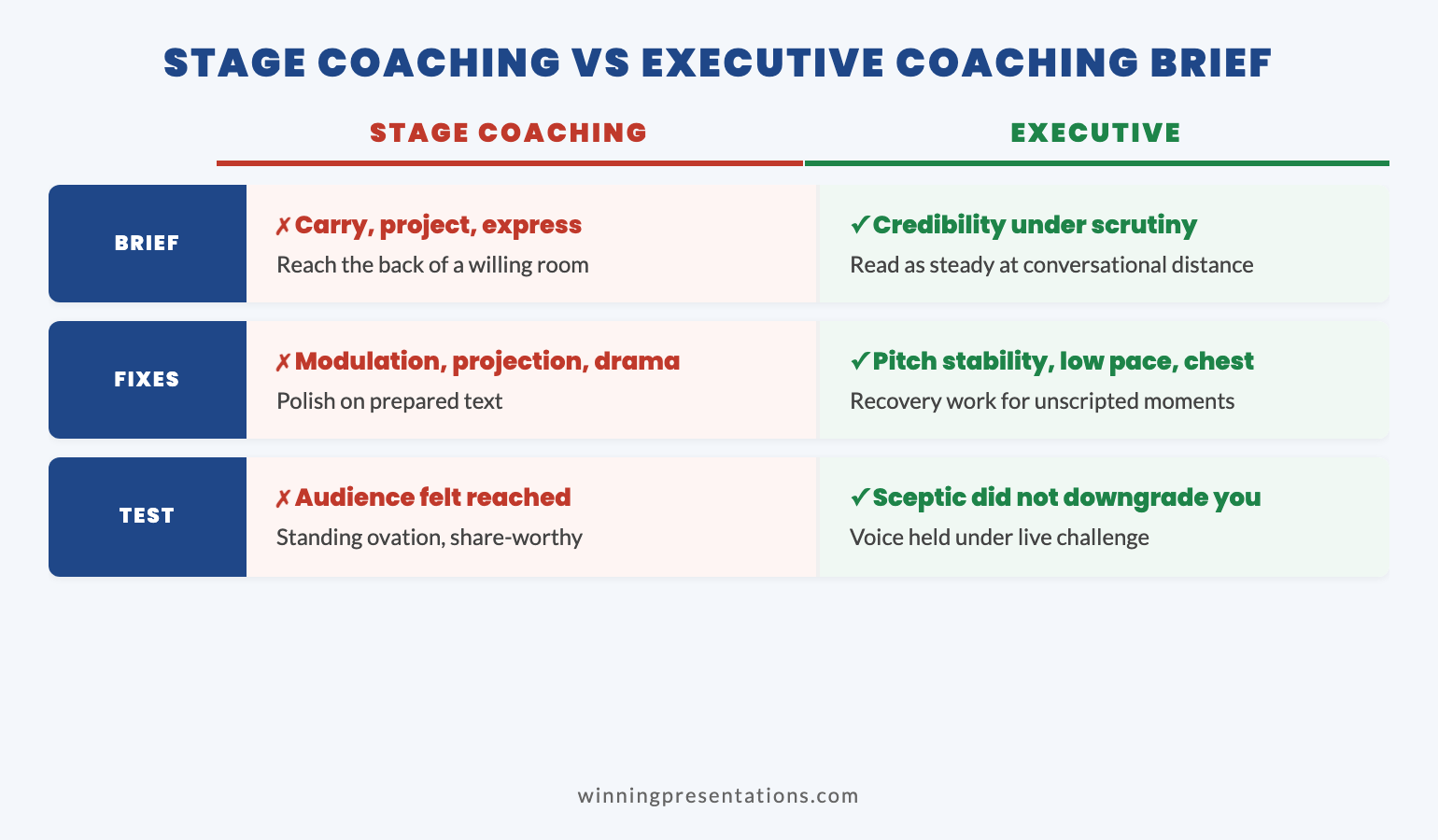
Quick answer: Vocal authority in presentations is not about volume — it is about control of five specific variables: pace, pitch, pause, projection, and resonance. Under pressure, most executives lose control of all five simultaneously, which creates the impression of uncertainty even when the content is strong. Each variable can be trained individually, and the combination creates the quality that audiences describe as a speaker who “commands the room.”

Astrid had spent eleven years in investment banking before moving into a strategy director role at a European infrastructure fund. She was technically exceptional — her analytical rigour was well-regarded across the firm, and her written work was consistently cited as a reference by colleagues. But in rooms with more than six people, something changed. Her voice rose slightly. Her pace quickened. Her sentences — clear and authoritative on paper — became hedged and breathless in delivery.

A senior partner raised it with her directly: “Your content is excellent. But when you present it, you sound like you’re asking for permission.” Astrid was startled. She had not been aware of the shift. She had been focused entirely on the content — on the accuracy of her numbers, the logic of her argument, the completeness of her analysis. She had given almost no attention to the instrument she was using to deliver it.

What followed was six months of deliberate work on her vocal delivery — not elocution lessons or theatrical coaching, but specific, functional adjustments to the way she managed pace, pitch, and pause under conditions that mirrored the presentations she gave at work. The partner who had flagged the issue told her, nine months later, that something fundamental had shifted. “You walk in and people assume you know what you’re talking about before you’ve said a word.”

That is the effect of vocal authority. It operates as a pre-content signal — shaping how the audience receives the words before they have processed what those words mean.

Does your voice give you away under pressure?

Conquer Speaking Fear is a structured programme that addresses the physical and psychological dimensions of presentation anxiety — including the vocal changes that happen when your nervous system interprets the room as a threat.

Explore the Programme →

Why Your Voice Changes Under Pressure

The voice is directly controlled by the body’s stress response. When the nervous system perceives a high-stakes situation — a large audience, a sceptical board, a question you weren’t expecting — it releases adrenaline and cortisol. These hormones prepare the body for rapid action, and the changes they produce are useful in a physical emergency. In a presentation, they are largely unhelpful.

The laryngeal muscles — which control the tension and position of the vocal cords — respond to stress by tightening. This raises pitch. The diaphragm, which controls breath support for the voice, becomes less effective as shallow chest breathing replaces the deep diaphragmatic breathing that supports full vocal resonance. The result is a voice that is higher, thinner, faster, and quieter — regardless of the speaker’s intention to sound confident.

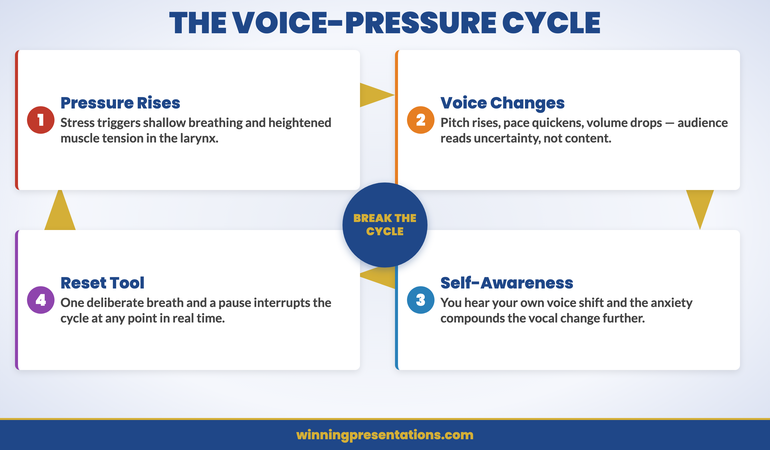
The problem is compounded by self-awareness. Many experienced presenters can hear the change happening in real time — the slightly higher note, the quickening pace — and their awareness of it creates a secondary layer of anxiety that reinforces the vocal change. This is the voice-pressure cycle: stress changes the voice, awareness of the change creates more stress, which changes the voice further.

Understanding this mechanism is important because it clarifies what training can and cannot achieve. You cannot eliminate the stress response entirely, and attempting to do so is counterproductive. What you can do is build the technical habits — breath control, pace awareness, physical positioning — that allow you to maintain vocal quality even when the stress response is active. For broader context on managing physical presentation symptoms, see this guide on why your voice goes higher when you’re nervous and how to fix it.

The Mechanics of Vocal Authority

Vocal authority is not a single quality — it is the auditory impression created by the combination of several technical elements working in alignment. When these elements are in alignment, audiences describe the speaker as authoritative, confident, or commanding. When they are out of alignment, the same content — presented with the same intention — reads as uncertain, apologetic, or unconvincing.

Breath is the foundation. Everything else in vocal delivery depends on the quality of the breath support beneath it. Diaphragmatic breathing — drawing air into the lower lungs rather than the upper chest — produces a fuller, more resonant sound and allows the speaker to maintain a steady pace without running out of breath mid-sentence. Most people breathe diaphragmatically when at rest. Under pressure, they revert to chest breathing without noticing. Retraining this default is the single most impactful investment in vocal quality.

Resonance amplifies authority. Resonance refers to where in the body sound vibrates before it leaves the mouth. A voice that resonates in the chest cavity produces a fuller, lower, more substantial sound than a voice that resonates primarily in the head or nasal cavity. Chest resonance reads as authority. Head resonance reads as uncertainty or youth. Physical relaxation — particularly in the jaw, neck, and shoulders — is prerequisite for chest resonance; tension collapses it.

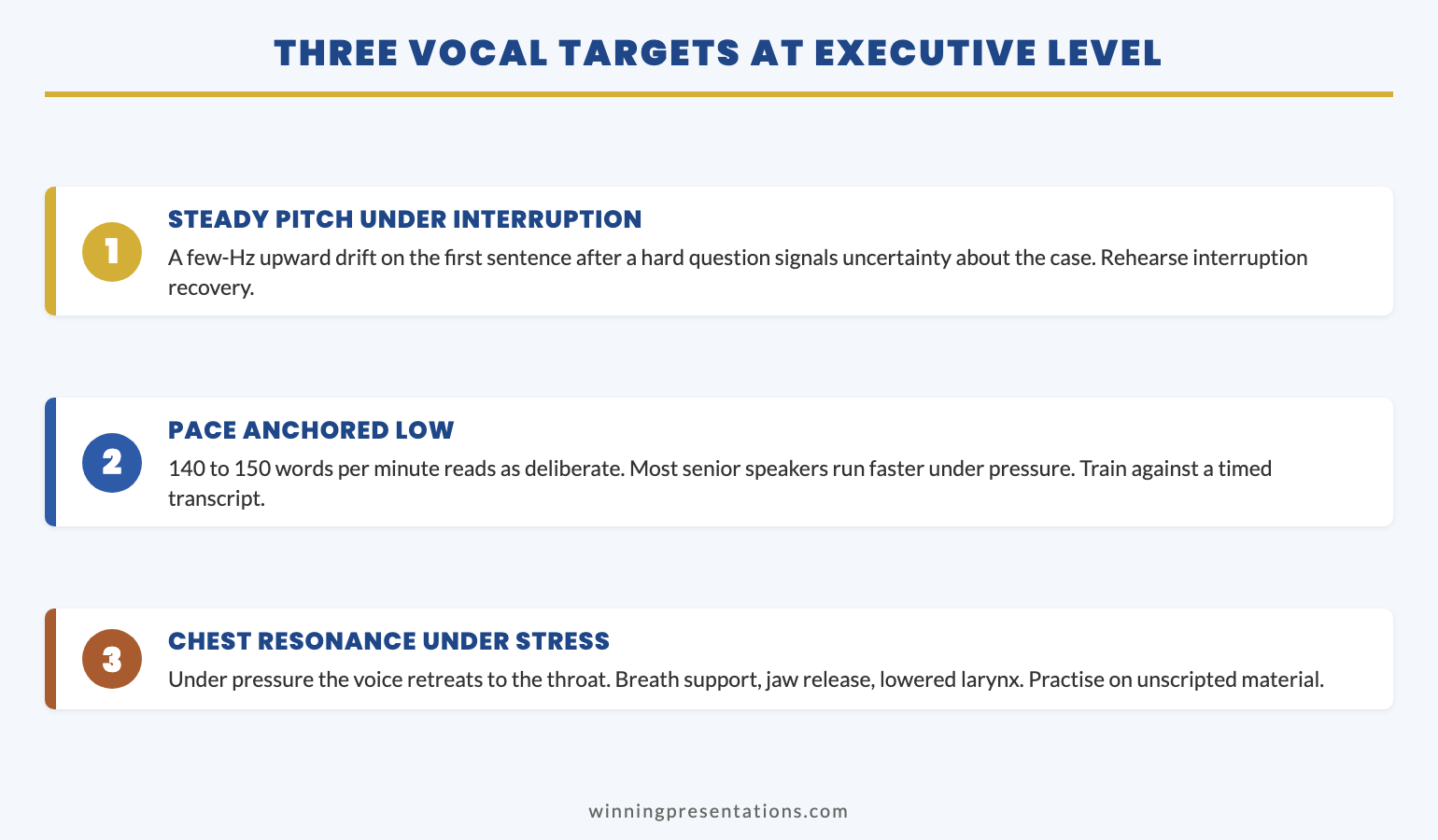
Pace is the clearest signal of confidence. Research in communication consistently shows that slower delivery is associated with higher perceived credibility and authority. The optimal pace for high-stakes executive presentations is slower than most people’s natural conversational rate — and significantly slower than their pressurised presenting rate. A pause of two to three seconds between major points feels uncomfortably long to the speaker and authoritative to the audience. For broader context on pacing and executive attention, see this analysis of how pacing affects executive engagement in presentations.

The Five Voice Variables Executives Must Master

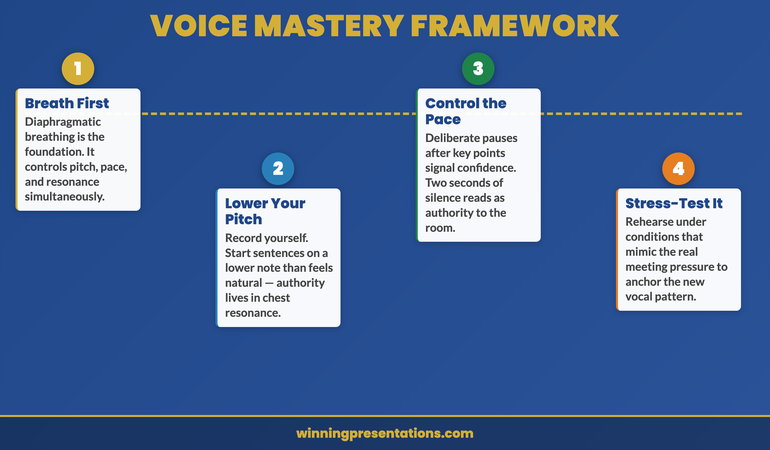
Each of the five variables below can be worked on independently. The sequence moves from the most foundational (breath) to the most contextual (reading the room), because changes to earlier variables often resolve problems in later ones.

Five-stage roadmap for developing vocal authority in executive presentations

Variable one — Breath control. Practise diaphragmatic breathing as a deliberate routine before every presentation. Place one hand on your chest and one on your abdomen. A correct breath expands the abdomen without moving the chest. Three deep diaphragmatic breaths immediately before speaking — particularly before a high-stakes moment — activate the parasympathetic nervous system and provide the breath support the voice needs to function at its best.

Variable two — Pitch management. Record yourself presenting and listen back specifically for pitch. Most people are surprised by how much higher their pitch is under pressure than in ordinary conversation. To lower pitch deliberately, begin sentences on a lower note than feels natural, and resist the upward inflection at the end of statements that makes assertions sound like questions. The latter — sometimes called “uptalk” — is one of the most common authority-eroding vocal habits in executive presentations.

Variable three — Pace and pause. Mark deliberate pauses into your presentation notes or slides — not as reminders to pause, but as specific positions in the content where a pause creates meaning. After a key statistic. After a critical recommendation. After a question to the room. These pauses do triple duty: they give the audience time to process, they give you time to breathe, and they signal confidence in the material.

Variable four — Volume and projection. Projection is not shouting — it is directing the voice toward the back of the room while maintaining full resonance and control. The most common projection problem in executive presentations is not insufficient volume but insufficient direction: the speaker addresses the person nearest to them rather than projecting to the room as a whole. Speaking slightly past the audience — imagining an audience member a metre behind the furthest row — naturally increases both volume and clarity.

Variable five — Resonance and release. Physical tension is the primary enemy of resonance. Jaw tension, shoulder elevation, and neck stiffness all reduce the space available for vocal resonance and produce a thinner, tighter sound. A physical warm-up that includes jaw release, shoulder rolls, and neck mobilisation — done privately before the presentation — removes much of this tension before you enter the room.

Conquer Speaking Fear

A structured 30-day programme that addresses presentation anxiety at the physiological and psychological level — including the nervous system patterns that change your voice under pressure.

  • 30-day structured programme for systematic anxiety reduction
  • Nervous system regulation techniques for high-stakes presentations
  • Clinical hypnotherapy methods for rewiring the threat response
  • Practical drills designed for corporate presentation contexts

Get Conquer Speaking Fear — £39

Designed for executives whose anxiety affects their delivery under pressure.

Practical Drills You Can Do Before Any Presentation

The most effective vocal preparation combines physiological preparation — activating the breath and releasing tension — with cognitive familiarisation — running through the opening material until the initial sentences feel automatic. The following sequence takes approximately eight minutes and can be done in a private space immediately before the presentation.

Two minutes — physical release. Standing, roll both shoulders back slowly five times. Gently rotate the neck in each direction. Release the jaw by opening the mouth wide and then allowing it to close naturally — without pressing the teeth together. These movements address the primary tension sites that restrict vocal resonance.

Two minutes — breath activation. Three full diaphragmatic breaths: four counts in through the nose, hold for two, eight counts out through the mouth. On the exhalation, allow the abdomen to fully deflate. This activates the diaphragm and signals to the nervous system that the situation is manageable rather than threatening. For a full pre-presentation routine, see this framework for the pre-presentation ritual used by high-performance presenters.

Two minutes — vocal warm-up. Hum quietly at a comfortable pitch, feeling the vibration in the chest. Then speak your opening sentence aloud — at the pace you intend to use in the room, not faster. Repeat the opening sentence three times, focusing specifically on the pitch of the first word. Starting a sentence on a lower note than feels natural is one of the fastest ways to drop perceived register.

Two minutes — intention setting. Speak your opening two minutes aloud in full, as if you were in the room. Not as a rehearsal focused on accuracy — as a familiarisation run focused on physical delivery. The goal is to have the first two minutes feel familiar in the body before you enter the room, so that the nervous system has a prior reference for this specific act of speaking in this specific context.

For executives whose anxiety has a deeper physiological component, Conquer Speaking Fear provides a structured 30-day programme for rewiring the nervous system’s response to high-stakes speaking situations.

The Most Common Voice Mistakes Under Pressure

The following patterns appear consistently across executives who self-report difficulty with vocal authority. Each is a response to pressure rather than an intentional choice — which is why awareness alone is rarely sufficient to change them. Each requires a specific corrective practice.

The voice-pressure cycle showing how stress affects vocal quality and how to break the pattern

Rising inflection on statements. When the voice rises at the end of a declarative sentence, the sentence reads as a question — as if the speaker is seeking validation rather than making an assertion. This pattern is particularly damaging in recommendation and conclusion slides, where the executive needs to project certainty. The corrective is deliberate: end every statement with a downward inflection, even if it feels unnatural in practice sessions.

Filler vocalisations between sentences. “Um,” “er,” “so,” and “you know” are auditory signals of cognitive searching — they indicate to the listener that the speaker is uncertain about what comes next. The corrective is not silence; it is the pause. A two-second pause while the speaker transitions to the next point reads as deliberation and authority. The same transition filled with “um” reads as uncertainty. The distinction is almost entirely in the intention to pause rather than fill.

Trailing volume at the end of sentences. Many pressurised speakers begin a sentence at an appropriate volume and then allow the final clause to drop — both in pitch and in volume — as they run out of breath. The last few words of a sentence often carry its most important information: the verb, the number, the specific recommendation. Allowing them to trail off undermines the clarity of the message and signals to the audience that the speaker is uncertain about those specific words.

Pace acceleration through transitions. The space between slides — the moment of transition from one topic to the next — is where pace most commonly accelerates. The speaker feels exposed in the gap and rushes to fill it. This is precisely where a deliberate pause is most effective: it signals to the audience that the transition is intentional, creates anticipation for what follows, and gives the speaker a moment to breathe before beginning the next section.

Reading the Room Through Your Voice

Experienced presenters use their voice not only to deliver content but to read and manage the room. This is an advanced skill — one that requires the foundational vocal habits to be sufficiently automated that the speaker has cognitive bandwidth to observe audience response and adjust in real time.

Volume as a tool for re-engagement. When an audience becomes distracted — when people begin checking phones or having side conversations — the instinctive response is to speak louder. The counterintuitive but more effective response is to drop volume significantly. A dramatic reduction in volume forces the audience to lean in and focus, in a way that increased volume does not. This technique requires confidence, because it feels risky in the moment — but it is remarkably effective for recapturing attention.

Pace as a signal of complexity. When you reach the section of the presentation that contains the most complex or consequential information, slow down further than you think necessary. The additional slowness is a signal to the audience: this matters, pay attention. It also ensures that the audience has time to process before you move on — which reduces the likelihood of questions that reveal they missed a critical point.

Pitch variation to sustain engagement. Monotone delivery — a voice that remains at a constant pitch throughout the presentation — is fatiguing to listen to. Deliberate pitch variation — slightly higher for questions or provocations, slightly lower for conclusions or recommendations — maintains audience engagement over the duration of the presentation. This variation needs to be intentional; under pressure, most people’s pitch variation collapses toward monotone.

How Voice Training Connects to Confidence

There is a bidirectional relationship between vocal quality and confidence. Most people experience this unidirectionally: they believe that if they felt more confident, their voice would improve. This is true — but the reverse is also true, and often more actionable. When the voice functions well under pressure, the speaker receives immediate positive feedback from their own perception of the room’s response — and confidence builds in real time.

This feedback loop is why vocal training has a disproportionate impact on overall presentation confidence relative to the narrowness of its focus. Working specifically on breath control, pitch, and pace produces not only better vocal delivery but also a reduction in the anxiety symptoms that interfere with delivery — because the speaker has a reliable tool they can use to manage the physiological pressure response in the room.

The most effective vocal training for executive presenters combines technical practice — deliberate work on each of the five variables — with exposure to increasingly challenging contexts. Recording practice presentations and listening back with specific focus on one variable at a time accelerates the feedback cycle. Working with a Q&A simulation exercise — where a colleague challenges your answers under conditions that mirror the real room — builds the specific resilience that Q&A situations demand. See the companion piece on building hostile questioner resilience through simulation for a structured method for the Q&A context.

Address the Anxiety Behind the Voice

Conquer Speaking Fear is a structured 30-day programme that works at the nervous system level — addressing the physiological patterns that change your voice, your pace, and your presence under pressure.

View Conquer Speaking Fear — £39

Designed for executives whose anxiety affects their delivery under pressure.

Frequently Asked Questions

Can vocal authority be learned, or is it something you either have or don’t?

Vocal authority is a technical skill with a strong learned component. While some individuals have a naturally resonant voice or a slower default pace, the specific combination of habits that creates the impression of authority — controlled breath, deliberate pace, downward inflection on statements, intentional pausing — can be developed through specific practice. The timeframe varies: most executives who work consistently on these five variables report noticeable change within four to six weeks of deliberate practice.

Is it worth recording yourself to improve your voice?

Yes — with one important caveat. The first time most people hear a recording of themselves presenting, they experience a strong negative reaction to the sound of their own voice. This is normal and does not indicate that the voice is objectively poor. After one or two exposures, the initial aversion subsides and you can listen analytically — focusing on specific variables rather than on the global impression. A useful practice is to record a two-minute section of a presentation, then listen back twice: once for pace, once for inflection. Focusing on one variable at a time produces more actionable feedback than a general impression.

What should I do if my voice visibly shakes during a presentation?

A shaking voice is a physiological stress response — it is caused by tension in the laryngeal muscles, which are activated by adrenaline. The single most effective in-the-moment intervention is a deep diaphragmatic breath before continuing. This does not eliminate the adrenaline, but it provides the breath support that compensates for some of the tension. Slowing your pace simultaneously reduces the load on the vocal system and gives the muscles more time to recover between words. Over time, systematic desensitisation — deliberate exposure to high-stress presenting contexts — reduces the severity of the physiological response in familiar contexts.

The Winning Edge — Weekly Newsletter

Executive presentation strategy, delivered every Thursday. Practical frameworks for delivery, confidence, and high-stakes communication.

Subscribe to The Winning Edge

About the Author

Mary Beth Hazeldine is Owner & Managing Director of Winning Presentations. With 24 years of corporate banking experience at JPMorgan Chase, PwC, Royal Bank of Scotland, and Commerzbank, she advises executives across financial services, healthcare, technology, and government on structuring presentations for high-stakes funding rounds and approvals. Connect at winningpresentations.com.

16 Jan 2026
Executive calmly presenting after a simple nervous-system reset

Stop Talking Too Fast When Nervous (The 30-Second Reset That Works in Real Meetings)

Quick Answer: If you’re talking too fast when nervous, your body is in a “get out of here” stress response.
The fastest fix is a 30-second reset:
exhale longer than you inhalepauseslow your next sentence.
This breaks the adrenaline momentum and instantly makes you sound calmer and more confident.

Years ago, I sat outside a boardroom in London, rehearsing a presentation I knew inside out. The numbers were solid. The story made sense. The slides were clean.

And then I walked in… and my mouth went into overdrive.

I started talking too fast when nervous, racing through sentences without breathing, sounding like I was trying to finish before anyone could interrupt. Halfway through, the CFO leaned forward and said, “Pause. Start that again. What’s the point?”

That moment was humiliating—and useful. It taught me something most people miss: fast talking isn’t just a communication issue. It’s a nervous system issue. When you learn to reset your physiology, your pace changes immediately—and so does your authority.

This is for you if:

  • You speed up in high-stakes meetings (not casual conversations)
  • You sound competent… but less confident than you feel
  • You need a reset that works today, not after 6 months of practice

If you’re presenting in the next 24–48 hours:

  1. Read the 30-second reset and practise it twice
  2. Pick one phrase from the emergency scripts
  3. Slow only your first sentence (it sets your pace for the next 5 minutes)

⭐ Slow Down Your Speech Without Thinking About It

A hypnotherapist’s toolkit for resetting your nervous system before it hijacks your pace.

Includes:

  • The 30-second reset that calms racing thoughts and speech
  • Breathing patterns that naturally slow your delivery
  • Pre-meeting routine you can do at your desk

Get Calm Under Pressure → £19.99

Created by a clinical hypnotherapist who’s helped hundreds overcome presentation anxiety.

Why You Talk Too Fast When Nervous (And Why “Just Slow Down” Fails)

If you’ve ever told yourself “slow down” and watched it fail instantly, you’re not broken. You’re biological.

When your brain perceives social pressure (being evaluated, judged, questioned, interrupted), it can trigger a mild threat response. That response creates three predictable changes:

  • Your breathing becomes shallow (you don’t get enough air to pace yourself)
  • Your adrenaline spikes (your body wants movement, so your words become the movement)
  • Your attention narrows (you try to “get through it” quickly instead of communicating clearly)

That’s why you speed up. It’s not a speaking problem first. It’s a stress response first.

Why do I talk too fast when I’m nervous?
Because your nervous system is trying to escape discomfort. Your breathing shortens, adrenaline rises, and your brain pushes you to finish quickly—so your speech speeds up.

The 30-Second Simple Reset (Use This Mid-Sentence)

30-second reset steps to stop talking too fast when nervous

This is the fastest reset I teach because it works in real life: in meetings, pitches, interviews, and boardrooms—when you can’t “go for a walk” or “calm down” first.

The 30-second reset:

  1. Exhale longer than you inhale (in 3… out 5) x 2 breaths
  2. Pause for one beat (a real pause)
  3. Slow only your next sentence (not everything)

Why this works: a longer exhale signals safety, the pause breaks momentum, and one slow sentence sets a new pace your body can follow.

Do not try to slow down everything at once. Under pressure, your system will rebel. One sentence is enough to reset the rhythm.

Want a full “calm under pressure” system? Conquer Speaking Fear gives you the complete process—so you can stop relying on willpower in the moment.

What to Say When You Need Time (Without Looking Unprepared)

Many people talk fast because they’re afraid silence will expose them. The reality is the opposite: silence signals control.

Use one of these “executive-safe” phrases to buy time and reset your pace:

  • “Let me put that into one sentence.”
  • “Here’s the headline.”
  • “The decision point is this…”
  • “Let’s take this step-by-step.”
  • “Before I answer, let me clarify one thing.”

The key is what happens next: you pause, you exhale, and then you continue at your new pace.


⭐ Racing Speech Is a Nervous System Problem — Not a Willpower Problem

These techniques work at the physiological level, so you don’t have to consciously monitor every word.

Includes:

  • Vagus nerve activation that shifts you out of fight-or-flight
  • The grounding technique that creates natural pauses
  • Emergency reset when you catch yourself speeding up mid-sentence

Get Calm Under Pressure → £19.99

Used by executives who present to boards, clients, and leadership teams.

How to Sound Confident (Not Slow and Awkward)

Some people slow down… and instantly feel unnatural. That’s because they’re slowing the wrong thing.

Confidence doesn’t come from “slow speech.” It comes from clean speech:

  • Shorter sentences (less cognitive load)
  • One message per breath (better pacing)
  • Intentional pauses (authority)

Try this fast rewrite technique:

The one-breath sentence rule:
If your sentence needs two breaths, it’s too long under pressure.
Split it into two sentences. You’ll immediately sound calmer and more in control.

This isn’t about becoming someone else. It’s about keeping your credibility intact when your nervous system tries to hijack it.

If you want the step-by-step method to stay calm and confident in real-world speaking pressure, Conquer Speaking Fear walks you through it in a structured way.

The 5-Minute Pace Training Routine (So It Becomes Automatic)

Here’s the fastest way to train a calmer pace before any important meeting. It takes five minutes and it works because it teaches your body a new baseline.

5-minute pace training:

  1. Read one paragraph out loud at 70% speed
  2. Pause for one full breath after each sentence
  3. Repeat the next paragraph at a natural pace
  4. Finish with your first real sentence from the meeting

Key rule: your first sentence sets your pace for the next five minutes. Start slower than feels necessary and the whole interaction becomes easier.

5-minute pace training routine to slow down speech before a meeting


⭐ Speak at a Pace That Commands Respect

When your nervous system is calm, your natural pace emerges — measured, confident, authoritative.

Includes:

  • Step-by-step calming sequences for before, during, and after
  • Physical anchoring techniques from clinical hypnotherapy
  • The pause method that makes you sound senior — not rushed

Get Calm Under Pressure → £19.99

Instant download. Use before your next meeting.

Frequently Asked Questions

How do I stop talking too fast when nervous?

Use the 30-second reset: exhale longer than you inhale, pause for one beat, then slow your next sentence. It breaks adrenaline momentum and resets your pace immediately.

Why does my voice sound higher when I’m nervous?

Stress tightens the throat and shortens breathing. A longer exhale lowers tension and helps your voice drop back into a calmer register.

Will pausing make me look awkward?

No. Pausing makes you look intentional. Audiences interpret pauses as confidence, not uncertainty—especially in professional settings.

How can I practise slowing down without sounding robotic?

Practise one paragraph at 70% pace, then return to your natural pace. The contrast trains control while keeping your voice authentic.

📧 Want more calm, confident executive communication tools?
Subscribe to The Winning Edge →

📋 Free Download: Calm Under Pressure Checklist

A quick pre-meeting checklist to stabilise your breathing, pace, and first sentence—so you walk in sounding like yourself.


Download the Free Checklist →

Related Resources


About the Author

Mary Beth Hazeldine spent 24 years at JPMorgan, PwC, RBS, and Commerzbank, and now leads Winning Presentations—helping executives communicate clearly when decisions matter.

10 Jan 2026
presentation pacing guide - how speaking speed affects audience engagement and credibility

Presentation Pacing: The Speed Trap That Loses Every Audience

Quick Answer: Most presenters speak too fast when nervous, losing their audience within minutes. Optimal presentation pacing is 120-150 words per minute—slower than natural conversation. The fix isn’t willpower; it’s cutting content so you don’t feel rushed, plus strategic pauses that signal confidence.

During my years at Commerzbank, I sat through a quarterly update where a brilliant analyst presented 47 slides in 12 minutes.

Forty-seven slides. Twelve minutes. Do the math—that’s roughly 15 seconds per slide.

He spoke so fast that words blurred into each other. Data points flew past before anyone could process them. By slide eight, half the room had mentally checked out. By slide twenty, people were checking phones under the table.

When he finished, breathless and sweating, the MD’s only comment was: “Could you send that round? I couldn’t follow it.”

All that work. All that data. Completely wasted because he confused speed with efficiency.

Here’s what nobody told him about presentation pacing—and what I wish someone had told me earlier in my career.

🎯 Master Your Delivery With Confidence

The Public Speaking Cheat Sheets give you quick-reference guides for pacing, pauses, vocal variety, and body language—everything that makes the difference between forgettable and commanding.

Get the Cheat Sheets → £14.99

Why Fast Feels Right (But Isn’t)

When you’re nervous, your brain interprets the situation as threatening. Your heart rate increases. Adrenaline floods your system. And your speech accelerates—it’s a physiological response, not a choice.

The problem is that fast speech signals nervousness to your audience. They may not consciously think “this person is nervous,” but they’ll feel something is off. Trust erodes. Credibility suffers.

Meanwhile, you’re burning through your content faster than anyone can absorb it. You’re not communicating more—you’re communicating less, just more quickly.

This is why voice control is so critical. Your pacing communicates as much as your words do.

Presentation pacing chart showing how speaking speed affects audience comprehension and speaker credibility

The Pacing Sweet Spot

Research consistently shows that audiences comprehend and retain information best when presenters speak at 120-150 words per minute. That’s noticeably slower than typical conversation (which runs 150-180 wpm).

Here’s what optimal presentation pacing looks like in practice:

  • Key points: Slow down to 100-120 wpm. Give important ideas room to land.
  • Transitions: Speed up slightly to 140-150 wpm. This signals movement.
  • Stories: Vary your pace. Speed up during action, slow down for impact moments.
  • Data: Always slower. Numbers need processing time.

The executives who command attention understand this intuitively. Their vocal delivery ebbs and flows with intention, not panic.

Three Fixes That Actually Work

1. Cut 20% of Your Content

If you feel rushed, you have too much material. The solution isn’t speaking faster—it’s saying less. Cut your content until you could deliver it comfortably with time to spare.

2. Script Your Pauses

Write “PAUSE” into your notes at key moments. After your opening hook. Before your main message. After important data points. Pauses feel awkward to you but powerful to your audience.

3. Record and Time Yourself

Most presenters have no idea how fast they actually speak. Record a practice run and count your words per minute. You’ll likely be shocked—and motivated to slow down.

These techniques work together with proper voice training to transform your delivery from rushed to commanding.

📧 Join 2,000+ professionals getting weekly presentation insights. Subscribe to The Winning Edge →

Frequently Asked Questions

How fast should I speak during a presentation?

Aim for 120-150 words per minute for most business presentations. This feels slower than conversation but gives your audience time to process. Slow down further for complex points and speed up slightly for transitions. For more on vocal delivery, see our complete guide to presentation voice tips.

Why do presenters speak too fast?

Nerves trigger faster speech as part of the fight-or-flight response. Presenters also speed up when they’ve crammed too much content and feel time pressure. The solution is editing content, not speaking faster.

How do I slow down my presentation pacing?

Use strategic pauses after key points, practice with a timer to catch rushing, and cut 20% of your content so you don’t feel time pressure. Breathing exercises before presenting also help regulate pace—see our guide to calming nerves before presenting.

📥 Free Download: 7 Presentation Frameworks

Get proven structures that naturally build in pacing variety—so you never feel rushed or monotonous again.

Download Free →

Related: Presentation Voice Tips: How to Sound Confident and Commanding


Mary Beth Hazeldine spent 24 years at JPMorgan, PwC, RBS, and Commerzbank. She’s a clinical hypnotherapist and MD of Winning Presentations.