
High-Stakes Presentation Burnout: Why Senior Leaders Hit a Wall
QUICK ANSWER
High-stakes presentation burnout is the point at which the dread before each major presentation stops easing afterwards. The relief that used to follow a successful board meeting no longer arrives. Each new presentation cycle starts from a lower baseline. The intervention is rarely “more rehearsal.” It is recognising the pattern early, restoring the recovery part of the cycle, and rebuilding a sustainable approach to fear that does not require white-knuckling every meeting.
JUMP TO
What presentation burnout actually is ·
The signs senior leaders miss ·
Why it happens to senior people ·
The intervention ·
Building a sustainable approach ·
FAQ
Hendrik was a managing director at a Dutch wealth management firm. He had been presenting to investment committees and clients for eighteen years. The week before a quarterly review, he found himself unable to focus on anything else — not work, not family conversations, not weekend reading. He performed well in the meeting itself. The dread came back the next Monday for a meeting six weeks away. He told a friend, “I think I have just been carrying this all the time now.”
That sentence is what high-stakes presentation burnout sounds like in the senior leaders who experience it. It is not stage fright. It is not lack of competence. It is the slow erosion of the recovery part of a cycle that used to look healthy. The presentations themselves still get done, often very well. The cost between presentations has quietly moved up.
This article is for senior leaders who recognise that pattern. It is not for the early-career professional struggling with a first major board presentation — that is a different problem. This is the problem that arrives later, in people who have been performing under pressure for years, and who notice that the performance is starting to cost more.
If the dread is not easing afterwards anymore
Conquer Your Fear of Public Speaking is the structured resource for senior professionals working through the kind of long-running presentation anxiety that other techniques have stopped touching. Self-paced, designed for serious cases, instant access.
What high-stakes presentation burnout actually is
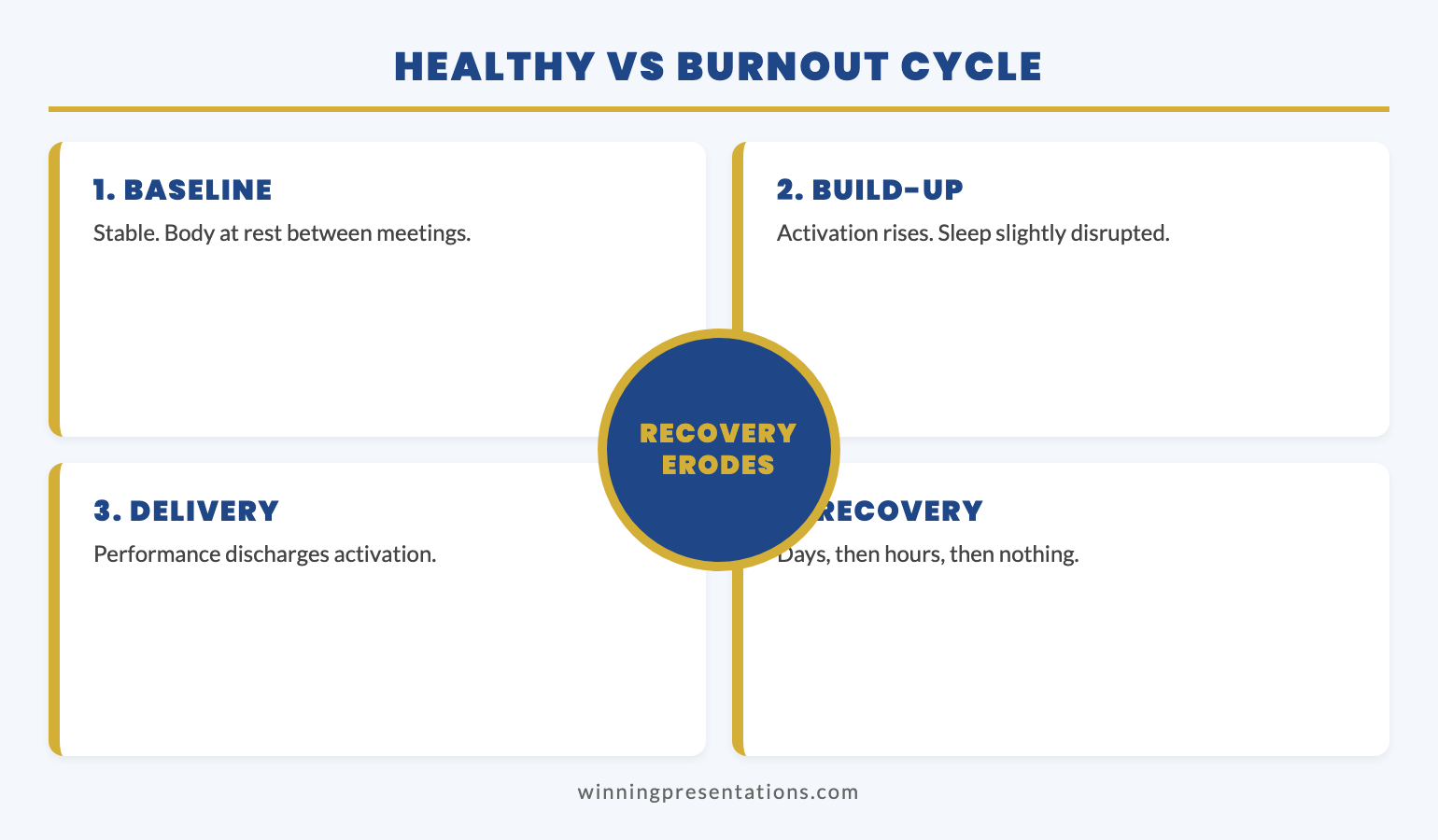
Most senior leaders treat presentation anxiety as a discrete event that lasts from the moment a major presentation appears on the calendar until shortly after it is delivered. There is a build-up phase, a peak, and a recovery. The recovery is where the next cycle’s resilience comes from. A successful meeting closes off the cycle. The body relaxes. Sleep returns. The next presentation arrives several weeks later from a stable baseline.
Burnout happens when the recovery phase shortens, then disappears. The dread of the next major presentation begins arriving before the relief of the previous one has settled. Two weeks of recovery becomes one. One week becomes a few days. Eventually, the recovery phase is not happening at all, and the senior leader is operating in a state of low-grade dread that never fully lifts. The presentations still get delivered. From the outside, nothing looks wrong. From the inside, the cost is becoming unsustainable.
This is structurally different from acute speaking anxiety. Acute anxiety is sharp, time-bound, and responsive to the techniques aimed at it — breathing, preparation, exposure. Burnout is dispersed, chronic, and does not respond to those techniques in the same way. Throwing more rehearsal at it often makes it worse. Throwing more presentation work at it definitely does.
The signs senior leaders consistently miss
Senior leaders who reach burnout almost always missed earlier signs because the signs do not look like anxiety in the conventional sense. They look like organisational behaviour. They are easier to attribute to circumstances than to read as a pattern.
The first sign is what happens after a successful presentation. A senior leader running on a healthy cycle feels relief, registers the success, and resets. A senior leader heading toward burnout finishes a successful presentation and does not feel relief. They feel a brief flatness, then the next concern arrives. The mental space the relief used to occupy is now occupied by the next item on the calendar.
The second sign is what the body does between presentations. Sleep starts to fragment in the days before a major meeting and does not fully return afterwards. The body is operating in a slightly elevated state much of the time. Senior leaders often attribute this to general workload, which is plausible but rarely the full picture. The pattern, when it correlates with the presentation calendar, is the signal.
The third sign is the change in how presentations are spoken about. Senior leaders heading into burnout often talk about presentations in slightly impersonal terms — “got through it,” “another one done,” “two more this quarter.” The language signals a cycle that is being endured rather than performed in. Healthy cycles, even under pressure, generally do not produce that vocabulary.
The fourth sign is reluctance to take on visible work that would have been welcomed two years earlier. A senior leader who has consistently raised their hand for board presentations begins quietly redirecting them. The redirection is rationalised — “more development for the team,” “better signal for succession” — and may be partly true. The pattern, watched over time, often correlates with the burnout trajectory rather than with the development logic.
Why this happens to senior people specifically
Junior professionals can usually avoid presentation burnout for a structural reason: they do not present often enough at high stakes for the cycle to compound. Senior leaders cannot. The expectation set, by the time you are presenting to boards, regulators, investment committees, and clients, is that you will do it on demand and at quality, with each presentation following close behind the last.
The other structural factor is invisibility. Senior leaders are usually the most visible person on most days; the costs of high-stakes presenting are typically the least visible thing about them. There is no obvious place to discuss the dread, no obvious peer with whom to compare notes, and a strong professional norm against admitting to anything that looks like it might affect performance. The cost is carried alone.
Add to this the long compounding effect of years of running this cycle, often well, often without external trouble — and the burnout pattern becomes structurally likely for a meaningful portion of senior professionals over a long enough career. It is not a sign of weakness. It is what the cycle does to a person who runs it on the maximum setting for fifteen or twenty years.
The intervention: what actually helps
The intervention is not “more techniques.” Senior leaders heading into burnout usually have a substantial library of techniques already — breathing patterns, visualisation, preparation routines, mantras — and find that the techniques that used to work no longer touch the underlying state. The intervention is structural. It addresses the recovery part of the cycle, not the performance part.
The first move is honest pattern recognition. Sit down with the calendar and look at the last twelve to eighteen months of high-stakes presentations. How long did the recovery phase last after each one? Has it been getting shorter? When was the last time the dread fully cleared between meetings? Most senior leaders who do this exercise honestly find a clearer pattern than they expected. Managing presentation anxiety covers some of the upstream techniques that can be helpful when the pattern is in earlier stages, before the recovery erosion has set in fully.
The second move is restoring deliberate recovery. This is structurally counter-intuitive for senior leaders, because the obvious response to elevated pressure is to prepare more, not less. Deliberate recovery means specific calendar protections after each major presentation: at least two days where no further high-stakes work is scheduled, no preparation for the next major meeting begins, and the body is allowed to actually exit the elevated state. Without this protection, the cycle never resets.
The third move is changing the mental relationship with the upcoming meeting. The work of preparation is not the same as carrying the meeting in the head all day. Senior leaders heading into burnout typically conflate the two. Real preparation is bounded — structured, intentional, in defined sessions that begin and end. Carrying the meeting all day, every day, is rumination. It does not improve the meeting. It does drain the recovery phase.
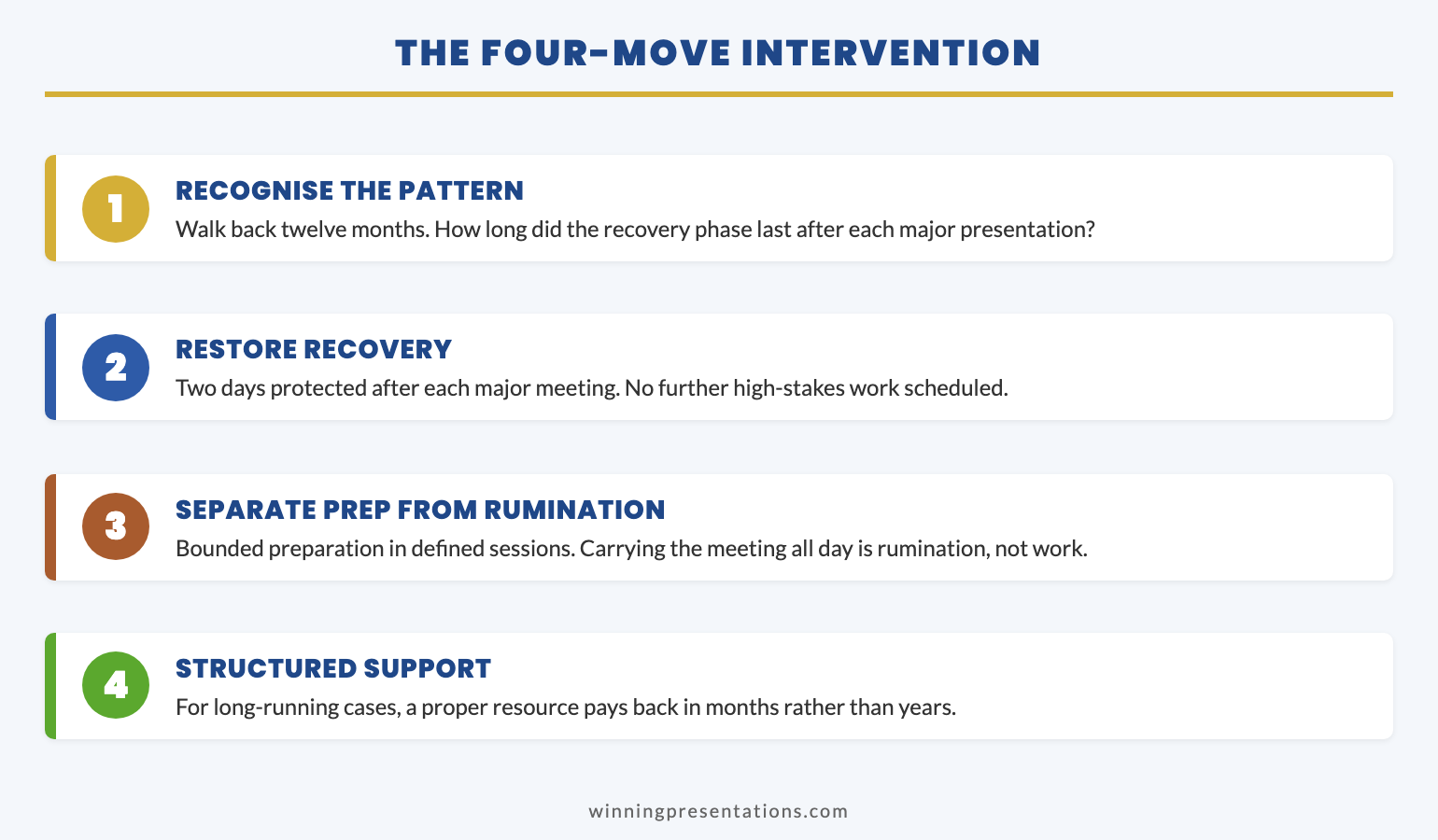
The fourth move is structured support, particularly for senior leaders who have been running the burnout cycle for two or more years. This is the point at which working through the underlying fear with a proper resource — rather than continuing to manage symptoms — usually pays back in months rather than years. Conquer your fear of public speaking is the area I work in directly with senior leaders facing this pattern.
CONQUER YOUR FEAR OF PUBLIC SPEAKING
For senior leaders whose fear has stopped responding to techniques
A structured resource built from real coaching with senior professionals across financial services, biotech, and government. Designed for people who have been performing under pressure for years and want a different relationship with high-stakes presenting.
- Self-paced material on the underlying fear, not just the symptoms
- Frameworks for restoring the recovery phase of the cycle
- Approaches that work specifically for long-running cases
- Designed for senior professionals, not first-time presenters
- Instant access, no subscription
£39, instant access. Designed for serious presentation anxiety in experienced professionals.
Designed for senior professionals carrying long-running presentation anxiety.
Building a sustainable approach to high-stakes presenting
The goal after the immediate intervention is not “no more anxiety.” Senior leaders who expect to feel nothing before high-stakes meetings are aiming at a target that is not real. A measure of activation is part of how the body produces the focus the meeting needs. The goal is a sustainable cycle — a cycle in which the dread arrives, peaks, gets discharged in the meeting itself, and recovers afterwards. That is what was working for the first decade or so. The goal is to get back to that, and to keep it that way.
Sustainability requires changes to how the calendar is built. Not just calendar protections after each major presentation, but calendar choices about how many high-stakes meetings to take in a given quarter at a given moment. Senior leaders running on a healthy cycle can usually carry several. Senior leaders coming out of burnout typically need to take fewer for a period, even if the role would normally accept more. This is a temporary structural choice, not a permanent change in capacity.
It also requires changing the relationship with preparation. Senior professionals coming out of burnout often find that they have been over-preparing for years — not in the sense that the preparation was wrong, but in the sense that it occupied much more emotional space than the work required. Structured, time-boxed preparation, done in defined sessions, with clear stopping points, costs much less than continuous low-grade preparation that fills the days between meetings.
The structural part of presentation work itself can also do more of the heavy lifting. When the case is well-constructed and the slide patterns are reliable, the dread has less to attach to. Buy-in mastery covers the curriculum side of senior approval work — the part that, when strengthened, reduces the cognitive load that fear has been compensating for.
When the structural side needs strengthening too
Senior leaders coming out of burnout often find their case-construction and stakeholder analysis have been carrying invisible weight for years. The Executive Buy-In Presentation System works through the structural disciplines that reduce the underlying cognitive load on each major presentation.
Why naming the pattern matters
Most senior leaders never name presentation burnout, even when they are clearly experiencing it. They describe it as workload, or fatigue, or the natural cost of seniority. Each of those things is partly true. But naming the specific pattern — the recovery erosion across high-stakes presentation cycles — matters because the intervention is specific. General workload reduction does not always touch presentation burnout. The structural moves above usually do.
The professionals I have worked with who have come out of this pattern almost always say the same thing afterwards: they wish they had recognised it sooner. The signs were there years before the breaking point. The intervention works at any stage. It works faster the earlier it starts.
CONQUER YOUR FEAR OF PUBLIC SPEAKING
A different relationship with high-stakes presenting
The structured resource for senior professionals whose fear has stopped responding to surface-level techniques. £39, instant access — designed for serious cases in experienced professionals.
Designed for long-running cases, not first-time presentation anxiety.
Frequently asked questions
How is presentation burnout different from regular nerves?
Regular nerves are time-bound. They build before a presentation, peak around delivery, and discharge afterwards. The recovery is real and full. Burnout is the state in which that recovery stops happening cleanly. The dread no longer fully clears between meetings, and each new cycle starts from a slightly lower baseline. The presentations themselves may still go well from the outside — the difference is in what the cycle costs the person carrying it.
Will more rehearsal help?
Usually not, and often the opposite. Senior leaders heading into burnout typically rehearse extensively already. The issue is not knowledge gaps in the material; it is the recovery phase of the cycle. Adding more rehearsal extends the build-up phase and shrinks the recovery phase further, which usually deepens the pattern. Targeted rehearsal in defined sessions is fine. Continuous rehearsal that occupies the whole period between meetings is part of the problem.
Should I tell my manager or a peer about this?
That is a personal call and depends on the relationships available. The professionals I have seen recover well usually have at least one trusted conversation about the pattern, even if that is with a coach or a partner rather than a colleague. Carrying it alone is one of the structural reasons it persists. The conversation does not have to be about workplace adjustments. It can be about being seen accurately by one person, which by itself reduces some of the cumulative weight.
How long does recovery from presentation burnout take?
It varies with how long the pattern has been running. Senior leaders who recognise the pattern within the first year or two of recovery erosion often see significant improvement within a quarter, especially if the calendar protections and structured support are put in place quickly. Cases that have been running for five years or longer usually take longer — six months to a year is more typical. The trajectory is generally toward a sustainable cycle rather than a return to a younger version of the relationship with presenting. That sustainable cycle is usually better than what came before.
The Winning Edge
A weekly newsletter for senior professionals who present at board level. One specific structural idea per issue, drawn from real boardroom and committee work. No filler.
Not ready for the full resource? Start here instead: download the free Executive Presentation Checklist — the pre-flight checks that catch the structural mistakes most senior professionals make in the last 24 hours before a high-stakes meeting.
If this article landed, the natural companion is When you’re the most senior person in the room but feel the least prepared. It covers the related pattern of senior leaders losing their preparation rhythm under sustained pressure.
Next step: open your calendar and look at the last twelve months of major presentations. How long did the recovery phase last after each one? Has it shortened? That data, looked at honestly, is where the conversation begins.
Mary Beth Hazeldine is the Owner & Managing Director of Winning Presentations. With 24 years of corporate banking experience at JPMorgan Chase, PwC, Royal Bank of Scotland, and Commerzbank, she advises senior professionals across financial services, healthcare, technology, and government on structuring presentations for high-stakes funding rounds and approvals. She speaks German and works extensively with the German-speaking financial markets.