Tag: executive presentation fear

19 May 2026
Featured image for High-Stakes Presentation Burnout: Why Senior Leaders Hit a Wall

High-Stakes Presentation Burnout: Why Senior Leaders Hit a Wall

QUICK ANSWER

High-stakes presentation burnout is the point at which the dread before each major presentation stops easing afterwards. The relief that used to follow a successful board meeting no longer arrives. Each new presentation cycle starts from a lower baseline. The intervention is rarely “more rehearsal.” It is recognising the pattern early, restoring the recovery part of the cycle, and rebuilding a sustainable approach to fear that does not require white-knuckling every meeting.

Hendrik was a managing director at a Dutch wealth management firm. He had been presenting to investment committees and clients for eighteen years. The week before a quarterly review, he found himself unable to focus on anything else — not work, not family conversations, not weekend reading. He performed well in the meeting itself. The dread came back the next Monday for a meeting six weeks away. He told a friend, “I think I have just been carrying this all the time now.”

That sentence is what high-stakes presentation burnout sounds like in the senior leaders who experience it. It is not stage fright. It is not lack of competence. It is the slow erosion of the recovery part of a cycle that used to look healthy. The presentations themselves still get done, often very well. The cost between presentations has quietly moved up.

This article is for senior leaders who recognise that pattern. It is not for the early-career professional struggling with a first major board presentation — that is a different problem. This is the problem that arrives later, in people who have been performing under pressure for years, and who notice that the performance is starting to cost more.

If the dread is not easing afterwards anymore

Conquer Your Fear of Public Speaking is the structured resource for senior professionals working through the kind of long-running presentation anxiety that other techniques have stopped touching. Self-paced, designed for serious cases, instant access.

Explore the resource →

What high-stakes presentation burnout actually is

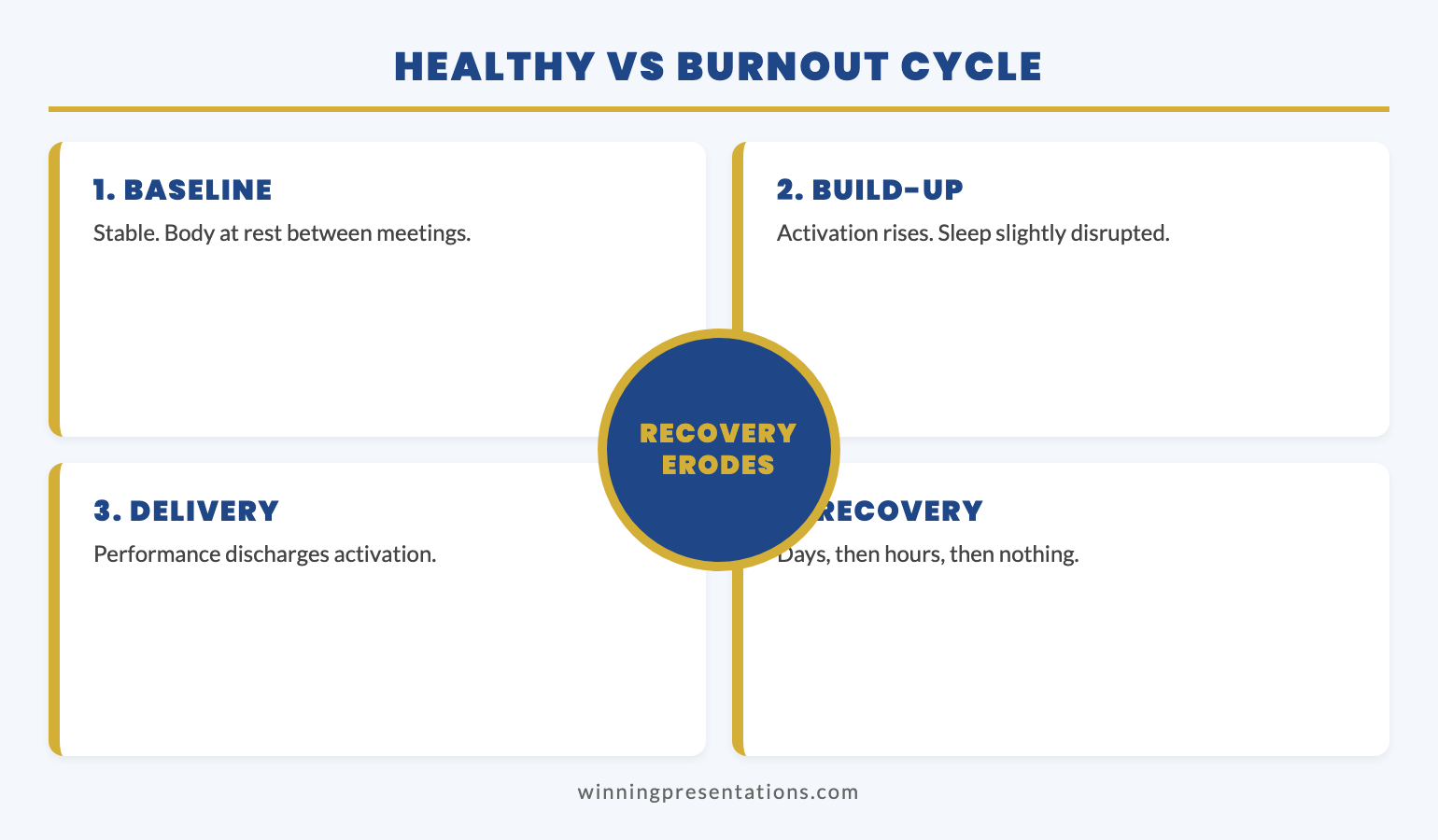
Most senior leaders treat presentation anxiety as a discrete event that lasts from the moment a major presentation appears on the calendar until shortly after it is delivered. There is a build-up phase, a peak, and a recovery. The recovery is where the next cycle’s resilience comes from. A successful meeting closes off the cycle. The body relaxes. Sleep returns. The next presentation arrives several weeks later from a stable baseline.

Burnout happens when the recovery phase shortens, then disappears. The dread of the next major presentation begins arriving before the relief of the previous one has settled. Two weeks of recovery becomes one. One week becomes a few days. Eventually, the recovery phase is not happening at all, and the senior leader is operating in a state of low-grade dread that never fully lifts. The presentations still get delivered. From the outside, nothing looks wrong. From the inside, the cost is becoming unsustainable.

This is structurally different from acute speaking anxiety. Acute anxiety is sharp, time-bound, and responsive to the techniques aimed at it — breathing, preparation, exposure. Burnout is dispersed, chronic, and does not respond to those techniques in the same way. Throwing more rehearsal at it often makes it worse. Throwing more presentation work at it definitely does.

The signs senior leaders consistently miss

Senior leaders who reach burnout almost always missed earlier signs because the signs do not look like anxiety in the conventional sense. They look like organisational behaviour. They are easier to attribute to circumstances than to read as a pattern.

The first sign is what happens after a successful presentation. A senior leader running on a healthy cycle feels relief, registers the success, and resets. A senior leader heading toward burnout finishes a successful presentation and does not feel relief. They feel a brief flatness, then the next concern arrives. The mental space the relief used to occupy is now occupied by the next item on the calendar.

The second sign is what the body does between presentations. Sleep starts to fragment in the days before a major meeting and does not fully return afterwards. The body is operating in a slightly elevated state much of the time. Senior leaders often attribute this to general workload, which is plausible but rarely the full picture. The pattern, when it correlates with the presentation calendar, is the signal.

Cycle infographic showing the four stages of healthy presentation cycle versus the four stages of burnout cycle, contrasting recovery, baseline, build-up and delivery phases

The third sign is the change in how presentations are spoken about. Senior leaders heading into burnout often talk about presentations in slightly impersonal terms — “got through it,” “another one done,” “two more this quarter.” The language signals a cycle that is being endured rather than performed in. Healthy cycles, even under pressure, generally do not produce that vocabulary.

The fourth sign is reluctance to take on visible work that would have been welcomed two years earlier. A senior leader who has consistently raised their hand for board presentations begins quietly redirecting them. The redirection is rationalised — “more development for the team,” “better signal for succession” — and may be partly true. The pattern, watched over time, often correlates with the burnout trajectory rather than with the development logic.

Why this happens to senior people specifically

Junior professionals can usually avoid presentation burnout for a structural reason: they do not present often enough at high stakes for the cycle to compound. Senior leaders cannot. The expectation set, by the time you are presenting to boards, regulators, investment committees, and clients, is that you will do it on demand and at quality, with each presentation following close behind the last.

The other structural factor is invisibility. Senior leaders are usually the most visible person on most days; the costs of high-stakes presenting are typically the least visible thing about them. There is no obvious place to discuss the dread, no obvious peer with whom to compare notes, and a strong professional norm against admitting to anything that looks like it might affect performance. The cost is carried alone.

Add to this the long compounding effect of years of running this cycle, often well, often without external trouble — and the burnout pattern becomes structurally likely for a meaningful portion of senior professionals over a long enough career. It is not a sign of weakness. It is what the cycle does to a person who runs it on the maximum setting for fifteen or twenty years.

The intervention: what actually helps

The intervention is not “more techniques.” Senior leaders heading into burnout usually have a substantial library of techniques already — breathing patterns, visualisation, preparation routines, mantras — and find that the techniques that used to work no longer touch the underlying state. The intervention is structural. It addresses the recovery part of the cycle, not the performance part.

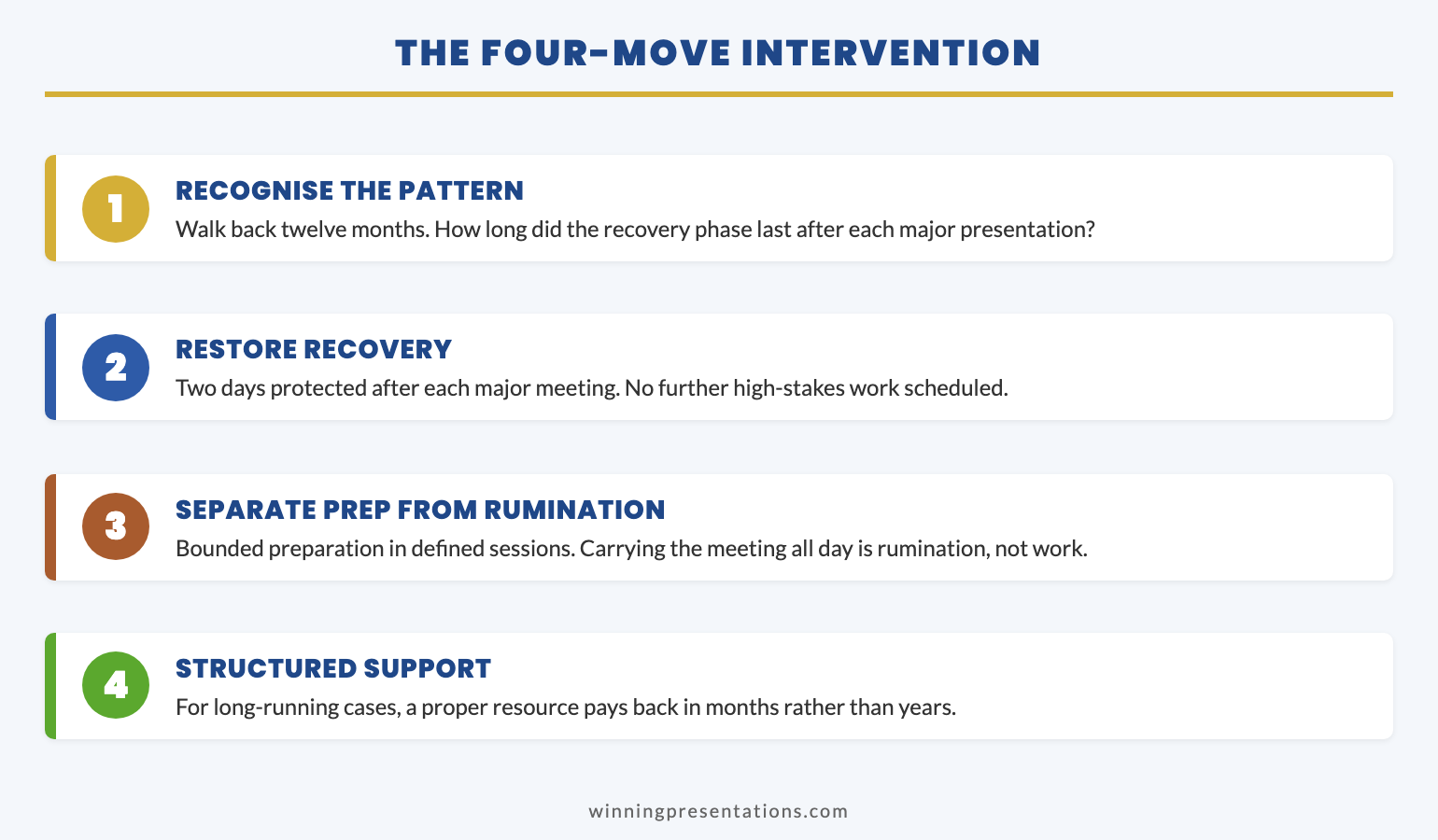
The first move is honest pattern recognition. Sit down with the calendar and look at the last twelve to eighteen months of high-stakes presentations. How long did the recovery phase last after each one? Has it been getting shorter? When was the last time the dread fully cleared between meetings? Most senior leaders who do this exercise honestly find a clearer pattern than they expected. Managing presentation anxiety covers some of the upstream techniques that can be helpful when the pattern is in earlier stages, before the recovery erosion has set in fully.

The second move is restoring deliberate recovery. This is structurally counter-intuitive for senior leaders, because the obvious response to elevated pressure is to prepare more, not less. Deliberate recovery means specific calendar protections after each major presentation: at least two days where no further high-stakes work is scheduled, no preparation for the next major meeting begins, and the body is allowed to actually exit the elevated state. Without this protection, the cycle never resets.

The third move is changing the mental relationship with the upcoming meeting. The work of preparation is not the same as carrying the meeting in the head all day. Senior leaders heading into burnout typically conflate the two. Real preparation is bounded — structured, intentional, in defined sessions that begin and end. Carrying the meeting all day, every day, is rumination. It does not improve the meeting. It does drain the recovery phase.

Stacked cards infographic showing four moves of the presentation burnout intervention: pattern recognition, deliberate recovery, separating preparation from rumination, and structured support

The fourth move is structured support, particularly for senior leaders who have been running the burnout cycle for two or more years. This is the point at which working through the underlying fear with a proper resource — rather than continuing to manage symptoms — usually pays back in months rather than years. Conquer your fear of public speaking is the area I work in directly with senior leaders facing this pattern.

CONQUER YOUR FEAR OF PUBLIC SPEAKING

For senior leaders whose fear has stopped responding to techniques

A structured resource built from real coaching with senior professionals across financial services, biotech, and government. Designed for people who have been performing under pressure for years and want a different relationship with high-stakes presenting.

  • Self-paced material on the underlying fear, not just the symptoms
  • Frameworks for restoring the recovery phase of the cycle
  • Approaches that work specifically for long-running cases
  • Designed for senior professionals, not first-time presenters
  • Instant access, no subscription

£39, instant access. Designed for serious presentation anxiety in experienced professionals.

Get the resource →

Designed for senior professionals carrying long-running presentation anxiety.

Building a sustainable approach to high-stakes presenting

The goal after the immediate intervention is not “no more anxiety.” Senior leaders who expect to feel nothing before high-stakes meetings are aiming at a target that is not real. A measure of activation is part of how the body produces the focus the meeting needs. The goal is a sustainable cycle — a cycle in which the dread arrives, peaks, gets discharged in the meeting itself, and recovers afterwards. That is what was working for the first decade or so. The goal is to get back to that, and to keep it that way.

Sustainability requires changes to how the calendar is built. Not just calendar protections after each major presentation, but calendar choices about how many high-stakes meetings to take in a given quarter at a given moment. Senior leaders running on a healthy cycle can usually carry several. Senior leaders coming out of burnout typically need to take fewer for a period, even if the role would normally accept more. This is a temporary structural choice, not a permanent change in capacity.

It also requires changing the relationship with preparation. Senior professionals coming out of burnout often find that they have been over-preparing for years — not in the sense that the preparation was wrong, but in the sense that it occupied much more emotional space than the work required. Structured, time-boxed preparation, done in defined sessions, with clear stopping points, costs much less than continuous low-grade preparation that fills the days between meetings.

The structural part of presentation work itself can also do more of the heavy lifting. When the case is well-constructed and the slide patterns are reliable, the dread has less to attach to. Buy-in mastery covers the curriculum side of senior approval work — the part that, when strengthened, reduces the cognitive load that fear has been compensating for.

When the structural side needs strengthening too

Senior leaders coming out of burnout often find their case-construction and stakeholder analysis have been carrying invisible weight for years. The Executive Buy-In Presentation System works through the structural disciplines that reduce the underlying cognitive load on each major presentation.

Executive Buy-In System — £499 →

Why naming the pattern matters

Most senior leaders never name presentation burnout, even when they are clearly experiencing it. They describe it as workload, or fatigue, or the natural cost of seniority. Each of those things is partly true. But naming the specific pattern — the recovery erosion across high-stakes presentation cycles — matters because the intervention is specific. General workload reduction does not always touch presentation burnout. The structural moves above usually do.

The professionals I have worked with who have come out of this pattern almost always say the same thing afterwards: they wish they had recognised it sooner. The signs were there years before the breaking point. The intervention works at any stage. It works faster the earlier it starts.

CONQUER YOUR FEAR OF PUBLIC SPEAKING

A different relationship with high-stakes presenting

The structured resource for senior professionals whose fear has stopped responding to surface-level techniques. £39, instant access — designed for serious cases in experienced professionals.

Get the resource →

Designed for long-running cases, not first-time presentation anxiety.

Frequently asked questions

How is presentation burnout different from regular nerves?

Regular nerves are time-bound. They build before a presentation, peak around delivery, and discharge afterwards. The recovery is real and full. Burnout is the state in which that recovery stops happening cleanly. The dread no longer fully clears between meetings, and each new cycle starts from a slightly lower baseline. The presentations themselves may still go well from the outside — the difference is in what the cycle costs the person carrying it.

Will more rehearsal help?

Usually not, and often the opposite. Senior leaders heading into burnout typically rehearse extensively already. The issue is not knowledge gaps in the material; it is the recovery phase of the cycle. Adding more rehearsal extends the build-up phase and shrinks the recovery phase further, which usually deepens the pattern. Targeted rehearsal in defined sessions is fine. Continuous rehearsal that occupies the whole period between meetings is part of the problem.

Should I tell my manager or a peer about this?

That is a personal call and depends on the relationships available. The professionals I have seen recover well usually have at least one trusted conversation about the pattern, even if that is with a coach or a partner rather than a colleague. Carrying it alone is one of the structural reasons it persists. The conversation does not have to be about workplace adjustments. It can be about being seen accurately by one person, which by itself reduces some of the cumulative weight.

How long does recovery from presentation burnout take?

It varies with how long the pattern has been running. Senior leaders who recognise the pattern within the first year or two of recovery erosion often see significant improvement within a quarter, especially if the calendar protections and structured support are put in place quickly. Cases that have been running for five years or longer usually take longer — six months to a year is more typical. The trajectory is generally toward a sustainable cycle rather than a return to a younger version of the relationship with presenting. That sustainable cycle is usually better than what came before.

The Winning Edge

A weekly newsletter for senior professionals who present at board level. One specific structural idea per issue, drawn from real boardroom and committee work. No filler.

Subscribe to The Winning Edge →

Not ready for the full resource? Start here instead: download the free Executive Presentation Checklist — the pre-flight checks that catch the structural mistakes most senior professionals make in the last 24 hours before a high-stakes meeting.

If this article landed, the natural companion is When you’re the most senior person in the room but feel the least prepared. It covers the related pattern of senior leaders losing their preparation rhythm under sustained pressure.

Next step: open your calendar and look at the last twelve months of major presentations. How long did the recovery phase last after each one? Has it shortened? That data, looked at honestly, is where the conversation begins.

Mary Beth Hazeldine is the Owner & Managing Director of Winning Presentations. With 24 years of corporate banking experience at JPMorgan Chase, PwC, Royal Bank of Scotland, and Commerzbank, she advises senior professionals across financial services, healthcare, technology, and government on structuring presentations for high-stakes funding rounds and approvals. She speaks German and works extensively with the German-speaking financial markets.

23 Mar 2026
Abstract representation of a brain with neural pathways illuminated in navy and gold tones against a dark professional background suggesting threat and calm pathways

Why Visualisation Doesn’t Work for Presentation Anxiety (And What Does, According to Neuroscience)

Why Visualisation Doesn’t Work for Presentation Anxiety (And What Does, According to Neuroscience)

Tomás did everything right. Three nights before his product review with the executive team, he spent 20 minutes visualising success. He pictured himself standing confidently, making eye contact, nailing the key message about market share.

The morning of the presentation, his heart rate hit 140 before he reached the conference room door. His voice cracked on the second sentence. He lost his place twice.

The visualisation hadn’t just failed. It had made things worse.

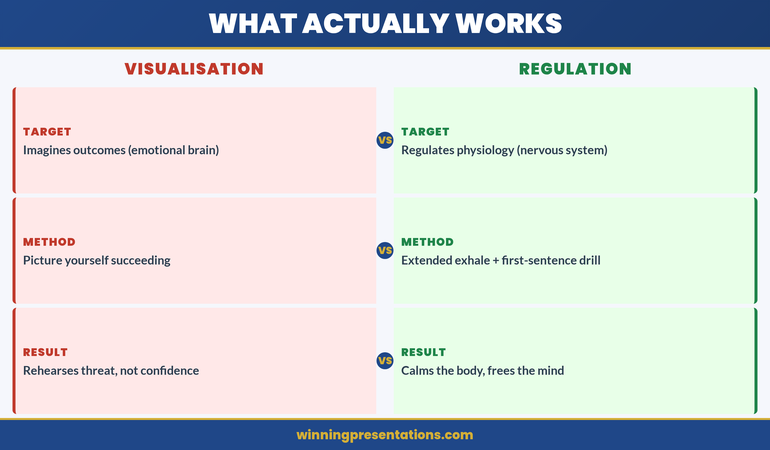
Quick Answer: Visualisation makes presentation anxiety worse for most executives because the brain doesn’t distinguish between “imagining a high-stakes event” and “experiencing a high-stakes event.” When you visualise presenting, your nervous system rehearses the threat response. Neuroscience shows that process-based techniques — nervous system regulation, cognitive reappraisal, and procedural rehearsal — outperform outcome visualisation for presentation anxiety. The shift from imagining success to regulating your physiology is the difference between spiralling and speaking with clarity.

Presentation anxiety and visualisation

If you’ve found that mental rehearsal or “picturing success” makes anxiety worse rather than better, you’re not alone. Many executives experience this response.

→ Explore anxiety management techniques grounded in neuroscience → View Conquer Speaking Fear

I spent five years terrified of presenting. Every presentation coach I worked with said the same thing: “Visualise yourself succeeding. Picture the applause. Imagine the confident version of you.”

So I tried. Lying in bed the night before a board presentation at RBS, I’d close my eyes and picture myself standing at the front, speaking clearly, the board nodding. What actually happened was my brain fast-forwarded to the worst-case scenarios. The voice crack. The silence. The CFO’s frown.

The visualisation didn’t create confidence. It created a rehearsal space for catastrophe.

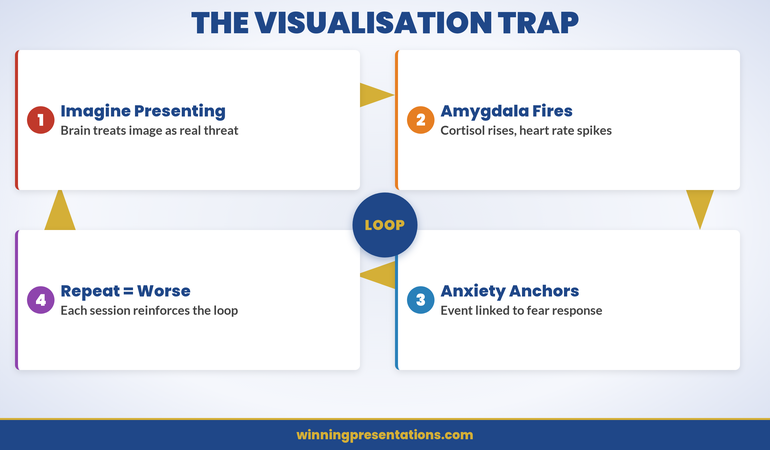
When I trained as a clinical hypnotherapist, I learned why. The brain processes imagined experiences and real experiences through overlapping neural circuits. When you visualise a high-stakes presentation, your amygdala doesn’t know it’s a rehearsal. It fires the same threat signals. Your cortisol rises. Your heart rate increases.

You’re not building confidence. You’re conditioning anxiety.

The techniques that actually worked — the ones I now teach — don’t ask you to imagine anything. They regulate the physiology first. Confidence doesn’t come from picturing success. It comes from a nervous system that isn’t in fight-or-flight.

Why Visualisation Backfires for Presentation Anxiety

Visualisation works brilliantly for athletes. A sprinter imagining the perfect start. A gymnast rehearsing a routine. The difference? Athletes are visualising motor sequences — physical movements they’ve practised thousands of times. The brain’s motor cortex benefits from this kind of mental rehearsal.

Presenting isn’t a motor sequence. It’s a social-evaluative threat. When you “visualise presenting,” you’re not rehearsing a physical movement. You’re rehearsing an emotional situation. And emotional situations activate the limbic system, not the motor cortex.

For executives with presentation anxiety, visualisation triggers what researchers call the “anticipatory anxiety loop.” You imagine the boardroom. Your brain scans for threats. Your amygdala fires. Cortisol floods your system. Now you’re anxious about being anxious — and you’ve got a powerful memory of that anxiety associated with the upcoming event.

The person who told you to “just visualise success” probably doesn’t experience presentation anxiety themselves. For people without an overactive threat response, visualisation is neutral or mildly positive. For people with presentation anxiety, it’s fuel on the fire. If you’ve tried visualisation and found it made things worse, you’re not doing it wrong. The technique is wrong for your situation. Understanding this is the first step — and I’ve written about what to do when nothing seems to work for presentation anxiety.

What Neuroscience Says About the Threat Response and Presenting

Your brain has two processing pathways for threat detection. The fast pathway goes directly from sensory input to the amygdala — bypassing conscious thought entirely. The slow pathway goes through the prefrontal cortex, where it’s evaluated rationally.

Presentation anxiety lives in the fast pathway. Before your rational brain can say “this is just a meeting, you know this material,” your amygdala has already sounded the alarm. Heart rate up. Palms sweating. Voice tightening.

Visualisation doesn’t interrupt the fast pathway. It feeds it. When you imagine standing in front of executives, the amygdala doesn’t process this as “imagination.” It processes it as “incoming threat data.” The physiological response is identical whether you’re actually presenting or vividly imagining it.

This is why the advice to “just think positive” is neurologically backwards. Positive thinking is a prefrontal cortex activity. Presentation anxiety is a limbic system activity. You’re trying to calm a fire alarm with a motivational poster.

The techniques that work target the fast pathway directly — through the body, not through thought. Effective breathing techniques work because they send direct signals to the vagus nerve, telling the amygdala to stand down. No visualisation required.

Neuroscience of presentation anxiety infographic showing the fast threat pathway versus slow rational pathway and why visualisation feeds the wrong one

Presentation Anxiety Management Programme

Conquer Speaking Fear provides a 30-day structured approach targeting nervous system regulation. Built from clinical hypnotherapy principles:

  • Nervous system regulation techniques based on neuroscience
  • Cognitive reappraisal frameworks for executives
  • Evidence-based approaches from clinical hypnotherapy
  • 30-day structured programme with progressive techniques

Explore Conquer Speaking Fear →

Based on clinical hypnotherapy training and work with executives in banking and consulting.

The 3 Techniques That Actually Work (And Why)

If visualisation feeds the anxiety loop, what breaks it? Three approaches, each targeting a different level of the nervous system.

1. Vagal tone activation (physiological level)

Your vagus nerve is the direct line between your body and your brain’s threat system. Stimulating it sends a “safe” signal that overrides the amygdala’s alarm. Extended exhale breathing — breathing in for 4 counts, out for 8 — activates the parasympathetic nervous system within 60 seconds. This isn’t meditation. It’s neurology. It works in the lift on the way to the meeting.

2. Cognitive reappraisal (interpretation level)

Reappraisal isn’t positive thinking. It’s relabelling the physical sensation. “My heart is racing because my body is preparing to perform” instead of “my heart is racing because I’m about to fail.” The physiological state is identical. The interpretation changes the anxiety trajectory entirely. Research shows reappraisal reduces cortisol more effectively than suppression (“calm down”) or visualisation.

3. Procedural rehearsal (behavioural level)

Instead of imagining the outcome, rehearse the process. Practise your first 30 seconds out loud. Walk through your slide transitions physically. Stand in the actual room if you can. This gives your motor cortex something useful to rehearse and creates procedural memory — the kind of memory that operates under stress. Athletes know this: they don’t just imagine the race. They physically rehearse the start.

Process Rehearsal vs. Outcome Visualisation: The Critical Difference

This distinction matters more than any other in anxiety management for presenters.

Outcome visualisation: “I see myself finishing the presentation. The board is smiling. They approve my budget.” This is what most coaches recommend. It’s abstract, emotional, and activates the threat system for anxious presenters.

Process rehearsal: “I walk to the front. I place my hands on the lectern. I say my first sentence: ‘The recommendation is to approve the £2M investment.’ I click to slide 2.” This is concrete, motor-based, and gives the brain a physical sequence to anchor to.

The difference is neurological. Outcome visualisation activates the ventromedial prefrontal cortex — the part of the brain that evaluates emotional significance. Process rehearsal activates the dorsolateral prefrontal cortex and premotor areas — the parts that plan and execute sequences.

For anxious presenters, the emotional significance pathway is already overactivated. Feeding it more emotional content (even positive emotions) increases arousal. Engaging the procedural pathways gives the brain a different job to do — one that doesn’t involve threat evaluation.

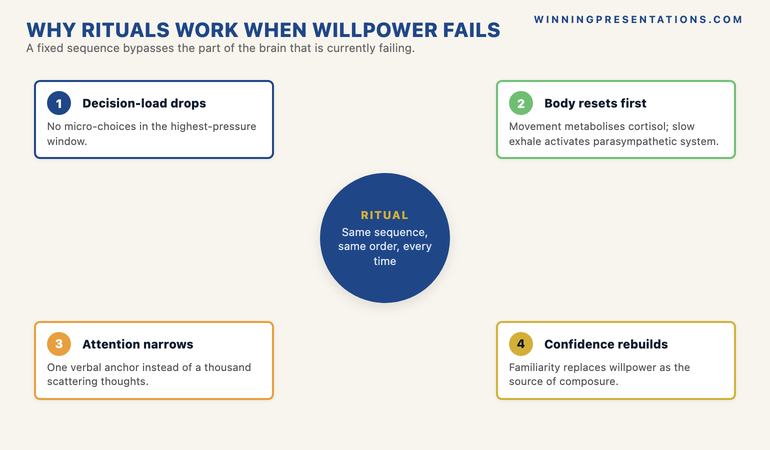
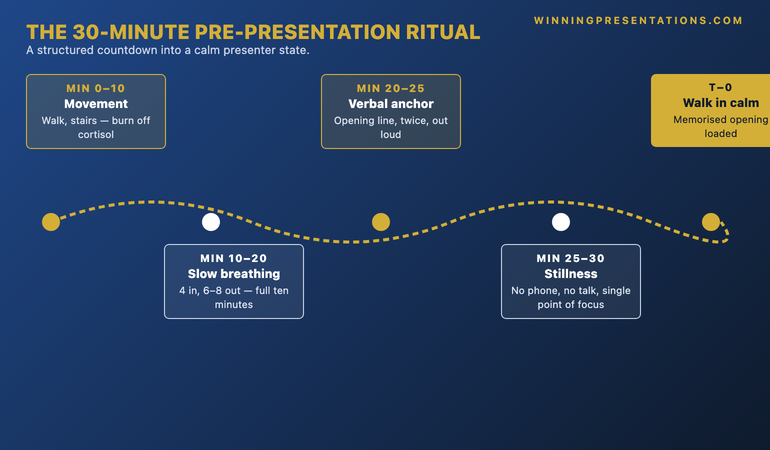
Many executives find this shift transforms their pre-presentation experience entirely. Instead of lying awake imagining catastrophe, they run through their opening sequence like a musician practising scales. The ritual approach I describe in my article on pre-presentation rituals borrowed from Olympic athletes builds on this same principle.

Contrast panel infographic comparing outcome visualisation (feeds anxiety) versus process rehearsal (builds control) for presentation anxiety

Structured Anxiety Management Over 30 Days

Progressive nervous system regulation techniques — grounded in neuroscience rather than visualisation or positive thinking.

Explore Conquer Speaking Fear →

Evidence-based techniques from clinical hypnotherapy and neuroscience research.

The 90-Second Nervous System Regulation Technique

This is the single most effective pre-presentation technique I know. It takes 90 seconds. You can do it in a toilet cubicle, a stairwell, or your car.

Seconds 1–30: Extended exhale breathing. Breathe in through the nose for 4 counts. Out through the mouth for 8 counts. Three cycles. This activates the parasympathetic nervous system via the vagus nerve. Your heart rate will begin to drop within 20 seconds.

Seconds 31–60: Peripheral vision activation. Soften your gaze and expand your visual field to the edges of your vision without moving your eyes. This is a neurological “safety cue” — threat scanning narrows vision (tunnel vision), so deliberately widening it signals safety to the brain. Your shoulders will drop.

Seconds 61–90: First-sentence rehearsal. Say your opening sentence out loud, twice. Not in your head. Out loud. This engages the motor cortex and procedural memory, giving your brain a concrete task instead of an abstract threat to evaluate.

That’s it. 90 seconds. No visualisation. No affirmations. Just neurological signals that tell your threat system to stand down.

The Cross-Link: When Your Slides Are the Anxiety Source

Sometimes presentation anxiety isn’t about standing up. It’s about whether your slides are good enough. If your fear is less about the audience and more about “does this deck hold up?” — structural confidence in your slides can reduce anxiety significantly. Today’s companion article on the partnership proposal structure that gets yes in one meeting shows how the right slide structure removes the guesswork that feeds anxiety.

Is This Right for You?

✓ This is for you if:

  • You’ve tried visualisation, positive thinking, or “just breathe” advice and it hasn’t worked
  • Your anxiety is physical — racing heart, shaking, voice cracking — not just mental nervousness
  • You want science-based techniques from a clinical hypnotherapist, not generic coaching

✗ This is NOT for you if:

  • Your presentation nerves are mild and manageable with basic preparation
  • You’re looking for general public speaking tips rather than anxiety-specific intervention
  • You need physical symptom management in-the-moment (see Calm Under Pressure for that)

Frequently Asked Questions

If visualisation doesn’t work, why do so many coaches recommend it?

Visualisation works well for people with low-to-moderate anxiety and for motor-skill performance (sports, music). Most presentation coaches don’t have clinical anxiety training — they’re applying performance psychology to a clinical problem. For executives with genuine presentation anxiety (not just mild nerves), the evidence shows visualisation either has no effect or increases anticipatory anxiety. The techniques that work target the nervous system directly.

How is process rehearsal different from just practising my presentation?

Standard practice usually means running through the content — saying the words, reviewing the slides. Process rehearsal is about rehearsing the physical and procedural sequence: how you walk to the front, where you place your hands, what your first sentence sounds like out loud, how you transition between slides. It gives your motor cortex a job to do, which reduces the bandwidth available for threat scanning. Practice builds content familiarity. Process rehearsal builds motor memory that holds up under stress.

Can I combine the 90-second technique with other anxiety management approaches?

Yes — and the combination is often more powerful than any single technique. The 90-second regulation technique works as a pre-presentation reset. Pair it with process rehearsal the day before, and cognitive reappraisal when you notice anxiety rising during the presentation itself. The Conquer Speaking Fear programme builds exactly this kind of layered approach over 30 days.

📬 The Winning Edge — Weekly Presentation Intelligence

Join executives who receive one actionable insight every week — from anxiety management techniques to slide structures that build confidence. Neuroscience-informed, not generic advice.

Subscribe to The Winning Edge →

Read next: The 48-Hour Window After Every Q&A: Why Most Presentations Win the Room but Lose the Decision

Your next presentation is on your calendar. It’s not going away. But the anxiety spiral can. Download Conquer Speaking Fear before that date arrives and stop rehearsing catastrophe.

About the Author

Mary Beth Hazeldine is Owner & Managing Director of Winning Presentations. With 24 years of corporate banking experience at JPMorgan Chase, PwC, Royal Bank of Scotland, and Commerzbank, she advises executives across financial services, healthcare, technology, and government on structuring presentations for high-stakes funding rounds and approvals.

Book a discovery call | View services