Tag: presentation recovery

18 Mar 2026

Why Your Heart Races 10 Minutes AFTER the Presentation (The Post-Presentation Crash Nobody Discusses)

Quick Answer: Your heart races after the presentation because your nervous system has just spent 30 minutes in fight-or-flight activation, and when the threat (presenting) ends, adrenaline floods your bloodstream without an outlet. Your body expected physical action; instead you got applause. This causes a physiological crash that manifests as trembling, racing heart, numbness, and emotional volatility—all completely normal, but entirely manageable with the right technique.

You’re Experiencing Post-Presentation Anxiety If: You delivered a solid presentation, the audience responded well, and then 10 minutes later you felt shaky, your heart was racing, or you went numb. Most executive training addresses presentation nerves. Nothing teaches you how to regulate your nervous system after it’s been flooded with adrenaline and the presenting is done. That gap is where post-presentation crashes happen—and where you can intervene.

See the somatic techniques that stop the crash →

The Moment You Realise Something’s Wrong

James, a Director at a major investment bank, walked off stage after a 40-minute investor presentation. The room had been engaged. Questions were sharp, positive. He’d answered well. His team caught him afterward, saying the content landed perfectly.

Then he sat down in his office. His heart was hammering. Not nervously—but forcefully, irregularly. His hands were trembling. He felt cold despite the warm room. He tried to make a call and heard his voice shaking. The internal voice started: What’s happening? Did I have a panic attack? Am I having a heart attack?

He wasn’t. His nervous system was.

For 40 minutes, his body had been in fight-or-flight. Adrenaline, cortisol, heightened blood pressure, accelerated heart rate—all of it was doing what it’s designed to do. It was preparing him to survive a threat. The threat (delivering under pressure) ended. His mind knew he was safe. His nervous system hadn’t caught up yet.

This is the post-presentation crash. And it’s the one thing nobody teaches executives to manage.

The Physiology Behind the Crash

Your nervous system doesn’t distinguish between “real” threats and “perceived” threats. When you stand in front of an audience, your amygdala registers threat. Your sympathetic nervous system activates. Adrenaline floods your bloodstream. Your heart rate increases. Blood is diverted from your digestive system to your muscles, preparing for action.

This state is designed for physical response. Fight. Flight. Physical action that discharges the adrenaline.

Presenting doesn’t offer that outlet. You stand still. You speak. Your body is chemically primed for action it doesn’t take. The presentation ends. The cognitive threat is gone. But neurochemically, you’re not done.

Adrenaline has a half-life of 2–3 minutes. But it doesn’t evaporate—it rebounds. Your body needs physical action to metabolise it. If you don’t move, if you don’t discharge that activation, you get the crash: racing heart, trembling, sudden fatigue, numbness, or emotional intensity.

This isn’t weakness. This isn’t anxiety disorder. This is physiology.

Why Nobody Warns You About This

Every presentation skills course teaches you how to manage nervousness before and during the presentation. Breathing techniques. Posture work. Vocal delivery. All of it is designed to keep you regulated while you’re in the room.

What they don’t teach: how to help your nervous system transition back to baseline after you’re done.

Most executives experience post-presentation anxiety at least once. They interpret it as proof that they’re “anxious people” or that presenting is “too stressful for them.” They don’t realise it’s a normal neurophysiological response to adrenaline discharge without physical outlet.

The gap in training exists because post-presentation crashes happen after the presentation—when the coaching is done. But that’s precisely when you need a protocol.

What Happens in Your Body After You Leave the Stage

The moment you finish presenting and step off the stage, your brain registers the threat as resolved. Your amygdala should tell your sympathetic nervous system to stand down. The parasympathetic nervous system (your rest-and-digest system) should activate to bring you back to baseline.

That transition is supposed to happen automatically. Often it does. But if you’ve been in a heightened state for a sustained period, the rebound can be messy.

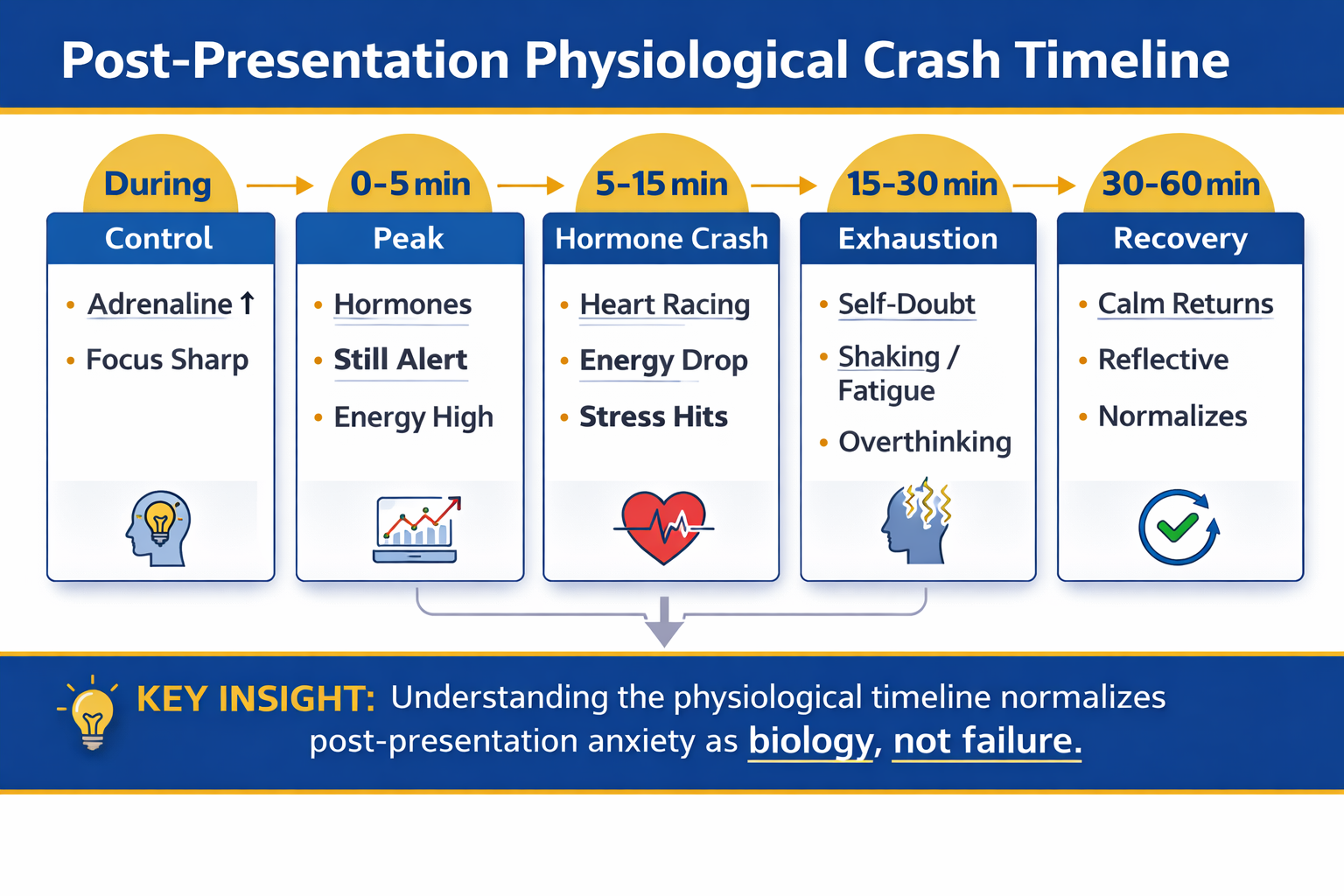
0–5 minutes after presentation: You feel relief, maybe a rush of positive energy. Adrenaline is still high but you’re no longer under threat. Your body is still in sympathetic activation.

5–15 minutes after: This is where the crash often happens. Your cognitive threat is resolved, but your neurochemical state hasn’t caught up. Adrenaline is rebounding. Your heart rate is still elevated. Some people experience sudden drops in blood sugar. Others feel numbness or dissociation. Some feel emotionally intense or tearful.

15–30 minutes after: Your parasympathetic system is working to bring you back to baseline, but if you’ve had no physical outlet, the process is slower and more uncomfortable. You might feel exhausted suddenly. Or you might experience the “second wind”—a final surge of adrenaline.

The key: you need to help this transition happen faster and more smoothly. That’s where somatic intervention comes in.

The Shutdown Response (And Why It’s Different From the Crash)

Some executives don’t experience post-presentation crashes. They experience post-presentation shutdown. This is your nervous system moving too far in the opposite direction—from sympathetic activation straight into parasympathetic collapse.

You finish the presentation feeling numb, disconnected, or emotionally flatlined. You can’t access your usual emotions. You might feel foggy or depersonalised. Some people describe it as feeling like they’re watching themselves from outside their body.

This is your nervous system overcorrecting. After sustained threat activation, it swings too far into rest mode. Your body has essentially frozen.

The intervention is different from the crash protocol. You need to gently activate your nervous system back up from the shutdown state, rather than bringing it down from hyperactivation. But the principle is the same: help your body transition back to baseline on your timeline, not on automatic.

The Post-Presentation Recovery Protocol

Calm Under Pressure gives you a somatic toolkit specifically for the post-presentation window. This is the exact 7-minute sequence that helps your nervous system transition from threat activation to baseline without the crash.

  • The four somatic techniques that stop the racing heart (no breathing—these are body-based)
  • How to discharge adrenaline safely even when you can’t physically exercise
  • The shutdown recovery sequence (if you freeze rather than spike)
  • Integration techniques for the 12 hours after (so the crash doesn’t come back)

Get Calm Under Pressure → £19.99

Used by executives who present weekly and need a protocol that works regardless of presentation length, audience size, or how the room responded.

Your heart is racing right now?

Get the Recovery Toolkit → £19.99

Immediate Interventions That Work

If you’re experiencing a post-presentation crash right now, here are four immediate interventions you can use without special equipment or privacy:

Intervention 1: The Cold Water Reflex. Splash cold water on your face or hold your wrists under cold water for 20–30 seconds. This triggers your mammalian dive reflex—an ancient response that immediately lowers your heart rate and activates your parasympathetic nervous system. It’s not pleasant, but it works within seconds.

Intervention 2: Grounding Through Sensation. Place your feet firmly on the floor. Feel the full contact. Press your feet down hard for 10 seconds. Release. Repeat three times. This activates your proprioceptive sense, which signals to your nervous system that you’re safe and stationary. It’s more subtle than cold water, but it interrupts the racing cycle.

Intervention 3: Deliberate Physical Action. Your body expected to discharge adrenaline through physical action during the presentation. Give it that outlet now. Walk briskly. Do 20 jumping jacks. Shake your arms and legs vigorously. Your nervous system will metabolise the adrenaline faster when you give it the action it was primed for.

Intervention 4: Bilateral Stimulation. Tap your knees alternately—left, right, left, right—in a steady rhythm for two minutes. This engages both hemispheres of your brain and interrupts the racing cycle. It’s discreet enough to do under a table during a client dinner.

The key: pick one that feels authentic to you and use it immediately. Don’t wait for the crash to settle on its own. Your nervous system is primed for action—give it what it needs.

Preventing This From Becoming a Pattern

A single post-presentation crash isn’t a problem. It’s a signal that your nervous system needs support transitioning after high-stakes delivery. The problem is when it becomes a pattern. You start anticipating the crash. Your nervous system learns to expect it. What started as a physiological response becomes an anxiety pattern.

To prevent this:

Build a post-presentation protocol into your routine. Don’t wait until the crash happens. After every significant presentation, spend 10 minutes doing deliberate nervous system work. It might be a walk, stretching, cold water, or grounding exercises. Whatever it is, make it consistent. Your nervous system learns through pattern. A consistent post-presentation protocol teaches your body that after presenting comes a specific regulated transition—not a crash.

Address the deeper pattern. If post-presentation anxiety is happening regularly, it’s worth exploring what your nervous system is learning about presentations. Are you interpreting every presentation as genuinely threatening? Are you not fully believing you’re safe once it’s over? These are patterns that shift with the right approach, but they require more than just physical interventions.

Deeper Than Somatic Tools

Immediate interventions work. But if post-presentation anxiety is a regular pattern, something deeper needs to shift. Calm Under Pressure includes the somatic toolkit, plus the framework for understanding what your nervous system is learning about presentations—and how to change that pattern at the root.

  • The nervous system patterns that fuel post-presentation crashes (and how they formed)
  • Reframing work that changes your nervous system’s relationship to threat
  • Seven-day integration protocol (somatic work + cognitive shifts + lifestyle anchors)
  • How to know when you’re genuinely “fixed” vs. just managing symptoms

Get Calm Under Pressure → £19.99

Used by senior executives at FTSE firms, investment banks, and multinationals who present weekly but didn’t realise the crashes were addressable.

The Bigger Picture

Post-presentation crashes are a symptom. They tell you your nervous system is treating presentations as threats. That’s not always wrong—some presentations are genuinely high-stakes. But if your body is responding to routine client updates or team presentations with full fight-or-flight activation, something in your threat detection system needs recalibration.

This connects to larger patterns. If you’re experiencing post-presentation anxiety, you might also notice presentation anxiety before client meetings, or you might have a history where a past presentation experience left a mark on your nervous system. These are all connected to the same system. Fixing one piece shifts the whole pattern.

You might also benefit from understanding the neurobiology of fight-or-flight and how to interrupt it—not just in the post-presentation window, but as a foundational shift.

Is This Right For You?

✓ This is for you if:

  • You experience a racing heart, trembling, or numbness 10–20 minutes after presenting
  • You deliver presentations confidently but then feel crashed or numb afterward
  • You’re not sure if what you’re experiencing is “normal” or a sign of a deeper anxiety issue
  • You present regularly (weekly or more) and the post-presentation crash is becoming a pattern
  • You want practical tools you can use immediately, not just cognitive reframing

✗ Not for you if:

  • You experience anxiety during the presentation itself (that requires a different intervention)
  • You’re looking for general stress management rather than post-presentation-specific support
  • Your post-presentation symptoms are severe (chest pain, severe shortness of breath) and you haven’t consulted a medical professional
  • You present very rarely (once or twice a year) and the crash doesn’t significantly impact your performance or wellbeing

The Real Cost of Not Addressing This

A single post-presentation crash is uncomfortable. But when it becomes a pattern, it shapes your behaviour. You start avoiding presentations. You over-prepare as a way to manage anxiety. You rehearse obsessively. You negotiate to get out of presenting. Or you deliver presentations but spend the next hours in a state of dysregulation.

The psychological cost: you begin to believe presentations are too stressful for you. The physiological cost: your nervous system learns that presenting = threat, so each subsequent presentation triggers a stronger response. The professional cost: you might miss opportunities to lead, present findings, or influence decision-making because you’re working around the anxiety pattern.

The intervention is straightforward. But it requires intention. You need to understand what’s happening in your nervous system and give it what it needs to transition back to baseline.

Want the exact somatic protocol?

Get Calm Under Pressure → £19.99

Three Quick Answers

Is a racing heart after presenting a sign I have anxiety disorder? Not necessarily. Adrenaline is a physical substance. When your body releases it during a presentation and then doesn’t have a physical outlet to metabolise it, your heart will race. This is physiology, not pathology. If the racing heart is happening regularly and you’re concerned, consult a medical professional. But in most cases, this is a signal that your nervous system needs a transition protocol, not that something is wrong with you.

Should I be taking medication for this? That’s a question for your doctor. What I can tell you: somatic interventions often work faster and more effectively than medication for post-presentation crashes because they address the physiological process directly. But everyone’s situation is different. If you’re on medication, work with your prescriber. If you’re not and you’re considering it, try somatic interventions first.

How long does it take to stop having post-presentation crashes? With consistent use of a post-presentation protocol, most people notice a shift within 2–3 weeks. The crash intensity decreases. The recovery time shortens. Your nervous system learns that there’s a regulation protocol after presenting, so it anticipates the intervention and activates it. Within 6–8 weeks, the pattern usually shifts significantly.

The Slide System Works for This Too

If post-presentation anxiety is a pattern for you, it’s often because you’re spending mental energy managing the presentation content when what you actually need is a slide structure that works effortlessly. The Executive Slide System includes frameworks that reduce cognitive load during delivery—which means less adrenaline activation during the presentation and less crash afterward. Fewer mental resources spent on managing the deck means your nervous system doesn’t need to work as hard.

Explore the Executive Slide System → £39

FAQ

Is it normal to feel emotionally intense or tearful after a presentation?

Yes. Adrenaline and cortisol can create emotional volatility as they metabolise. You might feel tearful, angry, or intensely joyful after a presentation even if you didn’t feel that way during it. This is your nervous system processing the activation. Use your post-presentation protocol and let the emotions move through. They usually pass within 10–30 minutes.

What if the crash happens hours after the presentation, not immediately?

Sometimes your nervous system is still in activation mode hours later and doesn’t “crash” until you’re in a safer environment (home, car, after the meeting ends). The protocol is the same—immediate intervention using somatic techniques. The delayed crash can actually indicate that you were working very hard to stay regulated during the presentation and the effort caught up with you once you could relax.

Can I prevent the crash by not thinking about it?

No. The crash is a physiological response, not a cognitive one. Ignoring it or trying to think your way out of it usually extends it. Your nervous system responds to physical interventions—movement, cold, grounding, bilateral stimulation. Use those rather than trying to manage the crash mentally.

Should I tell my team if I’m experiencing this?

You don’t have to. It’s your nervous system’s process. But some executives find it helpful to have a brief exit plan (“I’m going for a walk to decompress”) so they’re not caught off-guard by the need to step away. You don’t need to explain the crash—just the need for a few minutes of space.

The Path Forward

Your heart is racing after presentations because your body is doing exactly what it’s designed to do. You needed activation to manage the threat of presenting. Now you need help transitioning that activation back to baseline. The somatic tools in this article work. Use one immediately the next time you feel the crash. Then build a protocol you use consistently after every presentation—before the pattern solidifies into an anxiety disorder.

This is addressable. But it requires intention in the 10 minutes after you leave the stage—not weeks of therapy afterward.

Stay Updated

New frameworks for managing presentation stress land in The Winning Edge newsletter every Friday. Subscribe for approaches you can use immediately.

🆓 Free resource: Free PDF — a free guide to strengthen your presentation preparation.

About the Author

Mary Beth Hazeldine is the Owner & Managing Director of Winning Presentations. With 24 years of corporate banking experience at JPMorgan Chase, PwC, Royal Bank of Scotland, and Commerzbank, she has delivered high-stakes presentations in boardrooms across three continents.

A qualified clinical hypnotherapist and NLP practitioner, Mary Beth combines executive communication expertise with evidence-based techniques for managing presentation anxiety. She has trained thousands of executives and supported high-stakes funding rounds and approvals.

Book a discovery call | View services

This article was written with AI assistance and reviewed by Mary Beth Hazeldine.

07 Mar 2026
Professional presenter standing confidently at podium with empty chair visible in audience, navy and gold corporate tones, resilience and recovery atmosphere

Your Audience Just Walked Out of Your Presentation. Here’s Exactly What to Do in the Next 3 Seconds

Someone stood up and walked out in the middle of my presentation. Thirty people watched them leave.

For a moment—maybe two—I wanted to follow them. Disappear. Start over. The room went quiet. The kind of quiet that lasts three seconds but feels like thirty.

But I didn’t walk out. I stayed. And what happened next taught me more about presenting with confidence than years of perfect presentations ever could.

Quick Answer

When an audience member walked out during my board-level presentation, I recovered using a three-second reset technique that I’d learned from a previous on-stage freeze. I acknowledged the moment internally (not publicly), refocused on the people who were present, and finished strong. The walkout didn’t destroy the presentation—it actually strengthened my resilience and showed me exactly how to handle the worst-case scenario I’d feared for five years.

🚨 Scenario Diagnostic: The Mid-Presentation Walkout

Your pulse jumps. The room shifts. You think: “I’ve lost them. This is over.” But it’s not. A walkout—whether from disagreement, disinterest, or a genuine conflict—is not a reflection of your value as a presenter. It’s a moment. And moments can be recovered from. This article shows you exactly how.

What Actually Happened That Day

It was a quarterly business review with a client I’d been working with for three years. Twenty-eight employees in the room, plus two stakeholders I’d never met. I was forty minutes into a sixty-minute presentation on strategic initiatives for the coming year.

One of the new stakeholders was sitting three rows back. Professional. Quiet. Taking notes.

Then, without any visible change in their expression, they closed their notebook, stood up, and walked to the back of the room. They paused at the door, looked at their phone, and left. The door clicked shut.

I was mid-sentence. Something about quarterly targets. The words just… evaporated.

Twenty-eight people—including my client—were looking at me. Not at the person who left. At me. Their faces had that confused, slightly embarrassed expression people get when something unexpected happens in public.

I felt the heat rise from my neck to my face. My mouth went dry. For about two seconds, my brain offered me nothing but panic and shame.

Then I remembered something I’d learned the hard way five years earlier: The moment you acknowledge a disruption internally, you take back control of the room.

The Recovery Technique That Worked

Here’s what I did—and what you can do in the same situation:

Step 1: The Three-Second Internal Reset

I paused. Not dramatically. Just a natural beat, as if I’d been planning to pause anyway. During those three seconds, I did one thing: I accepted that the walkout happened and that it wasn’t mine to control.

That’s not positive thinking. That’s not “brushing it off.” It’s something sharper: radical responsibility. I didn’t cause the walkout. I don’t know their story, their deadline, their frustration level. So I released it.

Step 2: Refocus on the People Present

My eyes moved back to the people still in the room. I made direct eye contact with three people I knew well—my client, and two colleagues who always engaged. Their expressions told me everything: “Keep going. We’re still here.”

I made a conscious choice: I would not mention the walkout. I would not apologise for it. I would not make it mean anything about my presentation.

Step 3: Deliver the Next Sentence With Full Conviction

I said: “The targets I’m outlining represent a seventeen percent improvement over last quarter. Here’s how we get there.”

Not rushing. Not over-compensating. Just continuing. The room stayed with me.

After the presentation ended, I got three pieces of feedback: one person asked a thoughtful question about implementation, another said they appreciated the clarity, and my client pulled me aside to explain that the person who left had a family emergency and had to take an urgent call. They’d been professional enough not to interrupt, but they simply had to go.

The walkout had nothing to do with the presentation.

Why Audience Members Walk Out (And Why It’s Not Always About You)

This is crucial. Before I learned this distinction, I would have spent three days replaying the moment, analysing every word I’d said, convinced that the walkout proved I wasn’t a good presenter.

The reality is more nuanced—and more forgiving:

  • External emergencies: Family calls, health issues, work crises. In my case, this was exactly what happened.
  • Scheduling conflicts: Someone forgot they had another meeting and realised mid-presentation.
  • Disagreement: Sometimes, someone disagrees with you so fundamentally that they choose not to hear more. This is about your content—but it’s not about your worth.
  • Meeting fatigue: After attending five presentations in a day, some people simply hit their limit.
  • Unmet expectations: They expected a different type of content and realised quickly they weren’t going to get it.
  • Personal distress: You don’t know what’s happening in someone’s life. Mental health, grief, stress—these are silent.

Understanding this changed everything for me. A walkout is not a referendum on you. It’s a decision someone made based on information you don’t have.

The Three-Second Recovery Framework

I’ve now used this framework in three situations since that presentation: once with a genuine walkout, once with a technical failure, and once with a hostile question that could have derailed the entire room.

Here’s the framework:

Second 1: Pause and Breathe
Stop talking. Take one full breath. This isn’t about composure theatre—it’s about giving your nervous system one second to process. Your body will calm down faster if you give it permission.

Second 2: Acknowledge Reality Internally
Say to yourself: “That happened. I don’t control that. I do control what comes next.” This is not a mindset hack—this is a physiological fact. You cannot control audience behaviour. You can control your next words.

Second 3: Refocus Forward
Make eye contact with one friendly face. Then deliver your next sentence with the same conviction you had before the disruption. Not faster. Not louder. Same.

The entire cycle takes three seconds. You don’t need to be perfect. You need to be present.

The 3-Second Recovery infographic showing three steps: Pause, Anchor, and Resume with descriptions for mid-presentation recovery

Building Worst-Case Resilience Into Your Presentations

Recovery in the moment matters. But resilience built beforehand matters more.

After the walkout, I changed how I prepare for presentations. Here’s what actually moved the needle:

Pre-Presentation: Know Your Worst-Case Scenario

Before every presentation, I now ask: “What’s the one thing that would shake me most?” For me, it’s always some version of audience rejection—walkouts, hostile questions, visible disengagement. I name it. I picture it. I practice it.

Then I ask the follow-up: “If that happens, what will I do?” I rehearse my recovery, not my presentation content. That’s the work that changes everything.

Mental Rehearsal: The Worst-Case Run-Through

Once a week before a high-stakes presentation, I spend five minutes doing something most presenters skip: I mentally walk through the presentation with the worst-case scenario embedded in it. I see the walkout. I feel the pause. I notice myself recovering. I finish strong.

This isn’t doomsaying. This is inoculation. When the real worst-case moment comes, your nervous system recognises it. It’s not a shock—it’s a scenario you’ve already survived in your mind.

Content Design: Building In Flexibility

I also changed how I structure presentations. I now identify which sections are essential and which are flexible. If I need to cut content due to a disruption or an unexpected challenge, I know exactly what goes—and the core message survives.

This alone reduces the weight you carry into the room. You’re no longer holding “this has to go perfectly.” You’re holding “this core message will land, no matter what.”

Reactive vs Prepared presenter comparison infographic showing four scenarios: walkout, tech failure, public challenge, and post-presentation response

Resilience isn’t built during the presentation — it’s built before it. Conquer Speaking Fear gives you the mental rehearsal protocols and recovery frameworks that turn worst-case scenarios from threats into situations you’ve already survived in your mind. Get the programme → £39

The After-Presentation Debrief That Matters

What you do in the sixty minutes after a disrupted presentation determines whether you grow or spiral.

Here’s my process:

Don’t Rehash Immediately

Right after the presentation with the walkout, I didn’t text my team. I didn’t email my client asking what went wrong. I didn’t scroll through the presentation looking for flaws. I took a thirty-minute walk and got coffee.

Your nervous system needs time to regulate before you analyse anything. If you start the analysis while you’re still in a dysregulated state, you’ll confirm every fear you have. You’ll find evidence for failure that isn’t actually there.

Gather Actual Feedback (Not Invented Feedback)

After I’d calmed down, I reached out to my client—not to apologise for the walkout, but to ask a genuine question: “How did the material land with the group?”

The answer was clear: it landed well. The walkout had no impact on the room’s perception of the presentation.

The One Question That Matters

I ask myself this question in every debrief: “What did I learn about myself as a presenter from this?” In this case, the answer was: “I’m more resilient than I thought. I can recover. I can stay present even when something unexpected happens.”

That’s not false confidence. That’s evidence-based confidence. I have proof now. I’ve done it.

Present Without the Fear of the Worst-Case Scenario

If you’ve spent years preparing for the exact moment a walkout happens—if you’ve rehearsed this fear in your head a thousand times—it’s time to move from fear to framework.

Conquer Speaking Fear is a comprehensive programme that teaches you exactly how to handle the scenarios that keep you up at night. Not toxic positivity. Not false confidence. Real, tested recovery techniques for real worst-case moments.

Get Conquer Speaking Fear → £39

The Fear I Carried for Five Years

Before this walkout actually happened, I’d feared it for nearly five years. I’d imagined it countless times. I’d built entire narratives about what a walkout would mean: that I wasn’t good enough, that people could see through me, that I didn’t belong on stage.

The fear was worse than the reality.

When the walkout actually happened, two things surprised me: First, I could recover. I’d learned how, and when the moment came, the learning held. Second, the room didn’t collapse. The presentation didn’t fail. Thirty people stayed, listened, engaged, and learned something.

One person’s behaviour didn’t determine the value of what I was offering.

This is the thing about worst-case scenarios: they lose their power the moment you survive them. Not because they weren’t scary—they were. But because you now have evidence that you can handle what you feared.

Want the slides to match the recovery?

Preparation reduces anxiety. The Executive Slide System (£39) includes calm-presenter templates designed to minimise preparation stress when you are rebuilding confidence.

What Changed After the Walkout

I no longer rehearse the fear. I rehearse the recovery. I no longer ask, “What if someone walks out?” I ask, “If someone walks out, here’s exactly what I’ll do.”

That shift—from fear-based thinking to framework-based thinking—changed everything about how I show up in presentations. My anxiety dropped noticeably. My conviction increased. And paradoxically, since I stopped fearing walkouts, I’ve had far fewer of them.

I suspect this is because confidence is contagious. When you’re no longer radiating fear, audiences tend to stay engaged.

If you’re carrying the weight of a worst-case scenario—if you’re rehearsing what could go wrong rather than knowing what you’ll do if it does—this is your sign to break that cycle. The framework is learnable. The resilience is built. The recovery is possible.

The walkout I feared for five years lasted three seconds. The recovery framework I learned took twenty minutes to master. If you’re still rehearsing your fear instead of your response, the shift is faster than you think.

Stop Rehearsing Your Worst-Case Scenario on Repeat

The cycle of anxiety is simple: you fear something, you rehearse it mentally, the rehearsal feels real, the fear intensifies. You’re not broken — you’re caught in a loop. The exit is a framework, not willpower.

Get Conquer Speaking Fear → £39

Created by a clinical hypnotherapist who spent 5 years terrified of presenting — and now trains executives to present with confidence.

Is This Right For You?

This article—and the framework in it—is for you if:

  • You’ve experienced a disruption in a presentation and it knocked your confidence for days
  • You spend time before presentations imagining worst-case scenarios
  • You feel like you need to be perfect because any mistake means failure
  • You’ve been told to “just be confident” and that hasn’t helped
  • You’re in a high-stakes role where presentations matter—board meetings, client pitches, leadership communications
  • You want to get from “anxiety about what might happen” to “certainty about what I’ll do if it does”

This isn’t for everyone. If presentations don’t trigger anxiety for you, you don’t need this. But if you’ve ever felt that sick drop in your stomach when something unexpected happened on stage, this is for you.

What Five Years of Fear Actually Taught Me

I spent five years afraid of exactly what I’ve now survived and recovered from. That fear cost me opportunities, sleep, and peace of mind. Looking back, the only thing that moved the needle was learning the frameworks—not positive thinking, not breathing exercises, but real, practised recovery techniques.

Conquer Speaking Fear (£39, instant access) is the toolkit I built for senior professionals who need to recover from the moment that knocked them flat — combining clinical hypnotherapy, NLP, and physiological resets you can use minutes before walking on stage.

This is what changed everything for me. It is what I now use with senior professionals across financial services, consulting, technology, and government when their presentation confidence has been knocked down and needs to come back.

Get Conquer Speaking Fear → £39

People Also Ask

What should you do if someone walks out of your presentation?

First, pause internally (not externally). Acknowledge that you cannot control their behaviour. Refocus on the people still in the room. Continue your presentation with the same conviction you had before the walkout. Do not apologise or draw attention to it. The moment will pass, and thirty seconds later, the audience will have moved on—especially if you have.

How do you recover from a presentation that doesn’t go well?

Recovery happens in three stages: (1) Give yourself sixty minutes before analysing what happened; (2) Gather actual feedback from stakeholders, not invented feedback from your anxious mind; (3) Extract one specific learning about yourself or your approach that you can apply to the next presentation. Avoid the spiral of replaying the presentation endlessly or assuming it was worse than it was.

Is it normal to be anxious about presentations?

Yes. Presentation anxiety is one of the most common fears, even among experienced presenters and executives. The difference between anxious presenters and confident ones isn’t the absence of anxiety—it’s that confident presenters have frameworks for managing it. They know what they’ll do if something unexpected happens. They’ve rehearsed the recovery, not just the content.

Frequently Asked Questions

Can you recover from a walkout and still be respected?

Absolutely. In fact, how you handle a walkout is more memorable to an audience than the walkout itself. If you stay present, keep your composure, and continue with conviction, people will respect your professionalism. The person who walked out made a choice about them. Your response demonstrates something about you—specifically, that you’re not fragile and that you’re focused on serving the people who are still in the room.

What if the walkout is about your presentation?

It might be. Not all walkouts are emergencies—some are genuine disagreement or disengagement. Even then, the recovery is the same: you don’t chase them. You don’t apologise for their choice. You continue serving the people who are present. If there’s genuine feedback (not assumptions), gather it after the presentation. Use it to improve future presentations. But the fact that one person disagreed doesn’t invalidate the value you’re offering to everyone else in the room.

How do I stop being afraid of worst-case scenarios in presentations?

Stop trying to prevent them and start preparing for them. Fear thrives in uncertainty. The moment you have a framework for handling worst-case scenarios, the fear loses power. Learn about presentation anxiety recovery to understand how this works neurologically. Then practice the recovery framework until it’s automatic.

📬 Get Weekly Tactics for Confident Presenting

Every week, I send one framework that shifts how you show up in high-stakes presentations. No fluff. Just the techniques that work.

Subscribe to The Winning Edge

🆓 Free resource: 7 Presentation Frameworks — a free guide to strengthen your presentation preparation.

The One Thing to Remember

The walkout taught me something I couldn’t have learned any other way: I’m more resilient than my fear told me I was. The thing I’d rehearsed for five years turned out to be survivable, recoverable, and ultimately not even about me.

Your worst-case scenario is the same. It will probably happen someday—not because you’re destined to fail, but because you present to enough people over enough years that the odds catch up. And when it does, you’ll discover what I discovered: you can handle it.

The framework works. The recovery is real. And you’re more capable than your fear believes.

About the Author

Mary Beth Hazeldine is the Owner & Managing Director of Winning Presentations. With 25 years of corporate banking experience, she has delivered high-stakes presentations in boardrooms across three continents.

A qualified clinical hypnotherapist and NLP practitioner, Mary Beth combines executive communication expertise with evidence-based techniques for managing presentation anxiety. She advises senior professionals across financial services, consulting, technology, and government on building presentations that work — even when something unexpected happens.

27 Feb 2026
A professional woman standing alone at the end of an empty corporate boardroom after her presentation, surrounded by vacant leather chairs, capturing the silence and isolation when no one asks questions

No Questions After Your Presentation? That Silence Isn’t Approval

When nobody asks questions after your presentation, it rarely means unanimous agreement. It almost always means your audience disengaged before you finished. The silence feels comfortable in the moment — but the decision that follows is usually “deferred,” “let’s revisit,” or a quiet no. This article gives you three techniques to prevent post-presentation silence and one recovery protocol for when it’s already happened.

Eight executives. Forty-five minutes. Zero questions.

I was 18 months into my role at JPMorgan Chase, presenting a credit facility to the investment committee. I’d prepared for weeks. The analysis was tight. The recommendation was clear. When I finished and said “any questions?” — silence. Complete, polite, devastating silence.

I walked out thinking it went well. No pushback meant agreement, right?

The decision came back “deferred” — which in investment banking means nobody cared enough to engage. My presentation hadn’t failed on content. It had failed on engagement. The committee hadn’t disagreed with me. They’d stopped listening to me somewhere around slide 11.

The second time I presented to that committee, I planted three decision hooks throughout the deck — specific moments designed to make them lean in. Five questions in Q&A. Approved same meeting.

That was the day I learned: silence after a presentation isn’t the absence of objections. It’s the absence of interest. And interest is something you have to engineer deliberately.

Committee or leadership presentation this week?

Quick diagnostic: count the moments in your deck where you deliberately invite the audience to react — not at the end, but during the presentation. If the answer is zero, silence in Q&A is almost guaranteed. A structured engagement protocol fixes this before you walk in. See the Executive Q&A Handling System →

Why Silence Is Worse Than Tough Questions

Most professionals fear hostile questions. They shouldn’t. The most dangerous Q&A outcome isn’t a difficult question — it’s no questions at all.

Here’s why. When someone asks a tough question, they’re telling you three things: they listened, they care about the outcome, and they’re mentally engaged with your recommendation. Even a hostile question is a form of investment. That person is spending cognitive energy on your proposal.

Silence means none of those things happened.

In 25 years of corporate banking — across JPMorgan Chase, PwC, Royal Bank of Scotland, and Commerzbank — I’ve sat in hundreds of committee meetings. The presentations that got approved almost always generated questions. The ones that got deferred or quietly rejected? Silence.

Why does nobody ask questions after my presentation?

There are three common reasons: your content was too dense for the audience to process in real time, your structure didn’t create natural engagement points, or your conclusion didn’t require a decision. In all three cases, the fix is structural — not about your delivery or confidence. You need to build question-generating moments into your deck, not hope they emerge after it.

The pattern across executive presentations is consistent: silence is almost never about content quality. It’s about structural engagement. A brilliant 35-slide analysis that doesn’t create tension, choice points, or moments of surprise will get silence every time — regardless of how good the data is.

This is exactly what kills engagement in most corporate presentations — the assumption that good content automatically produces good discussion.

The Silence Protocol: 3 Prevention Techniques

After that JPMorgan experience, I spent years studying what separated presentations that generated rich Q&A from those that got polite silence. The difference was never the presenter’s confidence or charisma. It was always structural.

The presentations that generated questions had something built into them — deliberate engagement architecture. I call these the three prevention techniques.

Each one works by creating what psychologists call “knowledge gaps” — moments where the audience’s brain recognises it needs more information. When you create enough of these gaps during your presentation, questions become inevitable. The audience isn’t choosing to engage. They can’t help it.


Diagram showing The Silence Protocol with three prevention techniques: decision hooks, open loops, and planted controversy, plus one recovery method for post-presentation silence

Technique 1: Decision Hooks

A decision hook is a moment in your presentation where you explicitly frame a choice — and then move on without resolving it completely.

Here’s what this looks like in practice. Instead of presenting your recommendation as a conclusion, you present it as one of two possible paths: “There are two ways we could approach this implementation — a phased rollout over 12 months, or a full deployment in Q3. I’m recommending the phased approach, and I’ll show you why in the next three slides.”

The audience now has something to evaluate. They’re not passively receiving information. They’re mentally testing your recommendation against the alternative you just planted. By the time you reach Q&A, at least one person will ask about the path you didn’t recommend.

Where to place decision hooks: Slide 3 (after your executive summary), at the midpoint of your presentation, and one slide before your recommendation. Three hooks is the minimum. I plant them at the same points where I’d forecast likely questions using a question map — because the same structural moments that generate questions are the ones where hooks land hardest.

The formula: “There are [two/three] ways to approach [specific decision]. I’m recommending [option] because [one-sentence reason]. Let me show you the evidence.”

Diagram showing where to place decision hooks in a presentation: after the executive summary at slide 3, at the midpoint, and before the recommendation, with the decision hook formula and three reasons why it works

Turn Post-Presentation Silence Into Engaged, Productive Questions

The Executive Q&A Handling System (£39, instant access) gives you the complete framework for engineering audience engagement — including the question forecasting method, decision hook templates, and the Headline → Reason → Proof → Close structure that creates natural question points throughout any presentation.

  • The Question Forecasting method — predict and plant the exact questions your audience will ask
  • Engagement trigger templates that create knowledge gaps your audience can’t ignore
  • Recovery scripts for when silence has already happened (the “redirect and re-engage” protocol)
  • The 4-part answer structure that turns every question into a credibility-building moment

Get the Executive Q&A Handling System → £39

Built from 25 years of investment committee presentations. £39, instant access — no subscription.

Technique 2: Open Loops

An open loop is a piece of information you introduce but don’t complete. Your audience’s brain will hold that loop open until it gets resolved — and if you don’t resolve it fully during the presentation, they’ll ask about it in Q&A.

This isn’t manipulation. It’s how the brain processes incomplete information. Psychologists call it the Zeigarnik effect: unfinished tasks create cognitive tension that demands resolution.

Here’s an example from a real client presentation. A director was presenting a restructuring plan to the board. Instead of laying out every detail sequentially, she opened with: “This restructuring will affect three departments — but the impact on each is very different. I’ll walk you through engineering and operations today. The third department is where the real decision sits, and I’ve saved it for the end.”

The board was leaning forward by slide 4. By the time she reached the third department, two members had already prepared questions. The Q&A ran 20 minutes — exactly what she wanted.

How to create open loops:

  • The preview loop: “I’ll share the data that changed our recommendation — but first, let me show you what we originally assumed.”
  • The exception loop: “This approach works in every scenario except one. I’ll get to that exception in a moment.”
  • The contrast loop: “Our competitor took the opposite approach. The results are striking — and I’ll show you why our path is different.”

Each of these creates a gap your audience needs filled. And if you leave even one loop partially open, someone will ask about it. That’s not a risk — that’s the entire point.

Don’t want to write engagement triggers from scratch?

The Executive Q&A Handling System gives you the engagement trigger templates, decision hooks, and open-loop frameworks ready to use in any high-stakes presentation. £39, instant download — lifetime access.

Get the Q&A Handling System →

Is silence after a presentation good or bad?

In almost every corporate context, silence after a presentation is a negative signal. It typically indicates one of three things: the audience didn’t understand enough to form questions, the content didn’t create enough engagement to provoke curiosity, or the decision-makers have already mentally checked out. The rare exception is when the recommendation is so clear and well-supported that immediate approval follows — but in 25 years, I’ve seen that happen perhaps five times. If silence is followed by “we’ll come back to you” rather than an immediate decision, it wasn’t agreement. It was disengagement.

Technique 3: Planted Controversy

This is the technique most executives resist — and the one that works most reliably.

A planted controversy is a moment where you deliberately present a counterargument to your own recommendation. Not to undermine yourself — to create intellectual tension that demands discussion.

Here’s why it works. When you present a recommendation with no counterpoint, the audience has nothing to push against. Agreement is passive. But when you say “The strongest argument against this approach is X — and here’s why I still recommend it,” you’ve given the audience something to evaluate. You’ve shown intellectual honesty. And you’ve created a natural question point.

At Commerzbank, I watched a risk director use this brilliantly. He was recommending a credit line extension that the committee was likely to reject. Instead of pretending the risk didn’t exist, he opened his recommendation slide with: “The obvious concern with this extension is the sector’s volatility over the past two quarters. If I were sitting where you are, I’d ask why we’re recommending increased exposure.”

He then answered his own planted question with three data points. The committee didn’t need to voice the objection — he’d already addressed it. But the technique had a secondary effect: it opened the door for more nuanced questions. Instead of “isn’t this too risky?” they asked “what’s the exit strategy if volatility continues?” — a far more productive conversation.

How to plant controversy effectively:

  • Identify the strongest objection to your recommendation before you present
  • State it directly: “The biggest risk with this approach is…”
  • Answer it with evidence — but leave 10% of ambiguity
  • That 10% becomes a Q&A question you’ve already prepared for

This technique connects directly to question forecasting — if you can predict what the audience will object to, you can plant that controversy deliberately and control the conversation.

Stop Hearing Silence After Every Presentation You Give

The silence problem isn’t about your delivery or your data. It’s about structure — and structure is fixable. The Executive Q&A Handling System (£39, instant access) gives you the complete engagement architecture so you never face dead silence again.

  • Decision hook templates you can drop into any presentation in 10 minutes
  • The open loop formula that makes your audience need to ask questions
  • Planted controversy scripts for high-stakes committee presentations
  • The complete recovery protocol for when silence has already happened

Get the Executive Q&A Handling System → £39

Designed for executives presenting to investment committees, boards, and senior leadership — where silence means a deferred decision. £39, instant access.

The Recovery: When Silence Has Already Happened

Prevention is ideal. But sometimes you’re standing at the front of a room and it’s already happened. You’ve said “any questions?” and you’re staring at eight faces that aren’t going to speak.

First: do not fill the silence yourself. The instinct is to keep talking — to summarise, to add caveats, to ramble into your own recommendation. Every word you say in that moment reduces the pressure on the audience to engage. The silence is uncomfortable for them too. Let it work.

Wait a full five seconds. It will feel like thirty. Then use one of these recovery lines:

he Silence Recovery Protocol showing Step 0 wait 5 seconds followed by three recovery options: The Redirect, The Specific Question, and The Stakeholder Call, each with the exact script to use and why it works

The redirect: “Let me ask this a different way — if you were going to push back on one part of this recommendation, which part would it be?”

This works because it reframes the question from “do you have anything to say?” (which allows passivity) to “which specific thing would you challenge?” (which assumes engagement).

The specific question: “The implementation timeline is where I expect the most debate. What’s your reaction to the Q3 target?”

This works because it removes the paradox of choice. Instead of asking the audience to generate a question from nothing, you’re giving them a specific anchor to respond to.

The stakeholder call: “[Name], I know this affects your division directly — what’s your initial reaction?”

This works because it shifts from an open-room question (where diffusion of responsibility means nobody speaks) to a direct, personal invitation. One person speaking breaks the silence for everyone.

How do you encourage questions after a presentation?

The most effective way to encourage questions isn’t to ask for them differently at the end — it’s to build question-generating moments throughout the presentation itself. Decision hooks, open loops, and planted controversies all create cognitive gaps that the audience needs resolved. By the time you reach Q&A, the questions already exist in their minds. You don’t need to encourage them. You just need to create the space for them to emerge. If you’re already at the “any questions?” moment and facing silence, redirect with a specific prompt: “If you were going to challenge one part of this, which part would it be?” This reframes from passive to active and almost always breaks the silence.

Is This Right For You?

The Executive Q&A Handling System is built for you if:

  • You present to committees, boards, or senior leadership where Q&A determines the outcome
  • You’ve experienced post-presentation silence and the “deferred” decisions that follow
  • You want to engineer engagement into your presentation structure rather than hope it happens
  • You need recovery scripts for when silence has already occurred

It’s probably not right if you already get strong audience engagement and your Q&A sessions run long. In that case, you might benefit more from handling the difficult questions that do come up.

🎓 25 Years of Boardroom Q&A. One System.

The Executive Q&A Handling System is built from 25 years of corporate banking and 16 years coaching senior professionals across financial services, healthcare, technology, and government. Every framework — the engagement triggers, the silence prevention protocol, the recovery scripts — comes from real boardroom situations where the room’s response decided whether the proposal moved forward.

Designed for senior professionals who present to boards, investment committees, and executive sponsors where engagement signals decisions.

Get the Executive Q&A Handling System → £39

Instant download — lifetime access to every framework and template.

Frequently Asked Questions

What if the silence genuinely means they agree?

It’s possible but rare. In my experience, genuine agreement after a presentation is followed by an immediate decision — “approved,” “let’s proceed,” or a direct next-step conversation. If the silence is followed by “we’ll come back to you,” “let’s take this offline,” or “deferred for further review,” it wasn’t agreement. It was disengagement. The safest approach is to build engagement architecture into every presentation. If they genuinely agree, the techniques in this article won’t harm your outcome. If they don’t agree, the techniques will surface the real objections before the meeting ends.

Won’t planting controversy make me look uncertain about my own recommendation?

The opposite. Addressing the strongest counterargument to your own recommendation demonstrates intellectual honesty and thoroughness. Investment committees and senior leadership teams respect presenters who acknowledge risk rather than pretend it doesn’t exist. The key is in the execution: state the counterargument clearly, then answer it with evidence. You’re not expressing doubt — you’re showing you’ve already considered and resolved the most likely objection.

How many decision hooks is too many?

Three is the sweet spot for a 20–30 minute presentation. One after your executive summary, one at the midpoint, and one before your final recommendation. More than five and the audience feels manipulated — each hook creates cognitive work, and too many will exhaust rather than engage. Fewer than two and you’re relying on the content alone to generate questions, which rarely works in committee settings.

📬 The Winning Edge — Weekly Newsletter

One executive presentation insight per week. Real scenarios, real scripts, zero filler. Written for professionals who present to decision-makers.

Subscribe Free →

📊 Presenting a budget defence this quarter? When finance wants to cut your team’s funding, the wrong slide structure guarantees you lose. Read: The Budget Defence Presentation: When Finance Wants to Cut Your Team’s Funding

Your next step: Before your next committee or leadership presentation, count the engagement moments in your deck. If you have fewer than three decision hooks, open loops, or planted controversies, add them now. The difference between silence and five productive questions isn’t talent or confidence — it’s structure.

About the Author

Mary Beth Hazeldine is the Owner & Managing Director of Winning Presentations. With 25 years in corporate banking — including roles at JPMorgan Chase, PwC, Royal Bank of Scotland, and Commerzbank — she advises executives across financial services, healthcare, technology, and government on high-stakes presentations and committee-level Q&A. A qualified clinical hypnotherapist and NLP practitioner, Mary Beth combines boardroom experience with evidence-based psychology to help professionals present with authority and close with confidence.

16 Feb 2026
Professional pausing mid-presentation at glass whiteboard, finger on content, composed and thoughtful expression, colleagues visible in background

Why You Keep Losing Your Train of Thought Mid-Presentation (And the Fix)

Fourteen slides in, I forgot what country I was presenting about.

Quick answer: Losing your train of thought during a presentation isn’t a memory problem — it’s a cognitive overload problem. Your working memory can hold roughly four pieces of information at once, and presentation anxiety floods it with threat signals that push out your content. The fix isn’t memorising harder. It’s reducing the load on your working memory before you present, and having a 3-second recovery protocol for when it happens anyway. Both are learnable skills, not personality traits.

I was presenting a cross-border integration plan to forty people at Commerzbank. The London and Frankfurt teams. Senior management on both sides. I’d rehearsed. I knew the material cold. Then someone shifted in their chair during slide fourteen, and my brain decided that shift meant disapproval.

Mid-sentence, everything emptied. I couldn’t remember what I’d just said, what came next, or why I was standing there. The silence lasted maybe four seconds. It felt like a year.

I looked down at my slide title — “Regulatory Timeline: Phase 2” — and said: “So, the critical milestone here is the March deadline.” I was back. Nobody in that room knew I’d just experienced a total cognitive wipeout. That four-second gap taught me more about presentation recovery than five years of preparation ever had.

If you want a structured approach to managing presentation nerves: Explore Conquer Your Fear of Public Speaking →

A neuroscience-based programme for professionals who want to present with genuine confidence.

Why It Happens (It’s Not Your Memory)

The standard advice for losing your train of thought is “prepare better” or “practise more.” This is wrong — and understanding why it’s wrong is the first step to fixing it permanently.

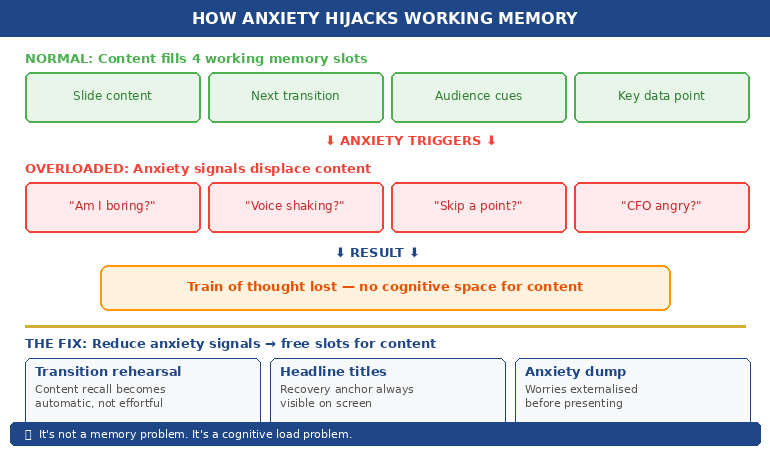
Your working memory — the part of your brain that holds what you’re saying right now, what you’re about to say next, and how your audience is responding — has a capacity of roughly four items. In a normal conversation, that’s plenty. But during a presentation, your working memory is also processing: “Are they bored? Was that the right word? Is my voice shaking? Did I skip a section? Is the CFO checking his phone?”

Each of those threat-monitoring thoughts takes up a slot. When all four slots are occupied by anxiety signals, there’s literally no cognitive space left for your content. Your train of thought doesn’t derail because you forgot. It derails because your brain prioritised danger detection over information delivery.

This is why it happens more to experienced professionals, not less. As a qualified clinical hypnotherapist, I’ve seen this pattern repeatedly with senior executives: the more senior you become, the higher the stakes feel, and the more working memory gets hijacked by threat monitoring. The VP presenting a quarterly update to peers loses their place more often than the graduate presenting their first project summary — because the VP’s brain calculates the cost of failure as higher.

The fight-or-flight response is the mechanism behind this. When your amygdala detects threat (even social threat like judgement), it diverts resources away from your prefrontal cortex — the part of your brain responsible for sequential thinking, language production, and working memory. Your brain is literally choosing survival over eloquence.

PAA: Why do I keep losing my train of thought when presenting?
Presentation anxiety triggers your threat-detection system, which floods your working memory with danger signals. Since working memory can only hold about four items at once, anxiety pushes out your content. This is a neurological response, not a preparation failure. Reducing the cognitive load before you present — through slide-title anchoring, transition rehearsal, and pre-presentation anxiety protocols — prevents the overload before it starts.

The System That Stops the Cognitive Hijack

Conquer Speaking Fear gives you the neurological reset protocols, pre-presentation anxiety tools, and in-the-moment recovery techniques that keep your working memory clear — so your content stays accessible when the pressure is highest.

Get Conquer Speaking Fear → £39

Built from clinical hypnotherapy training + 24 years presenting in high-stakes corporate environments at JPMorgan Chase, PwC, RBS, and Commerzbank.

The 3-Second Mid-Sentence Recovery

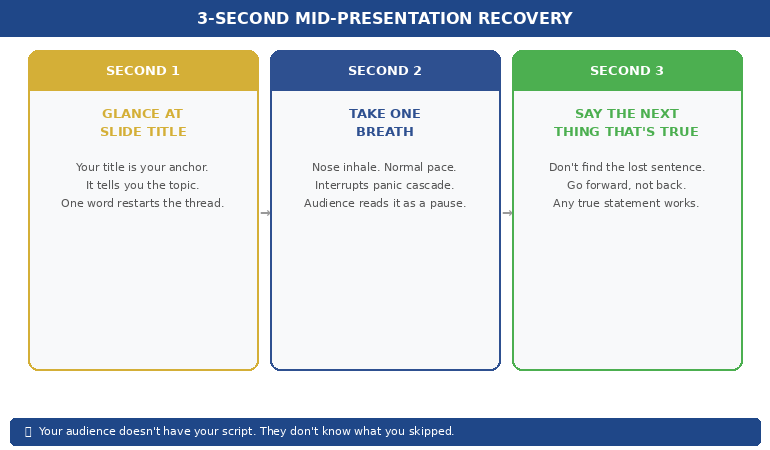
You’re mid-sentence and the thread vanishes. Here’s the protocol — three seconds, three steps. Practise it once and it becomes automatic.

Second 1: Glance at your slide title. Not the content. Not the data. The title. Your slide title is your anchor — it tells you exactly what this section is about. If your title says “Q3 Revenue by Region,” you immediately know the topic. That single piece of information is enough to restart your working memory because it gives your brain a category to pull from, not a specific sentence to recall.

Second 2: Take one breath. Not a dramatic pause. Not a deep meditation breath. One normal inhale through your nose. This does two things: it interrupts the panic cascade (your amygdala responds to controlled breathing as a safety signal), and it gives your prefrontal cortex one second to re-engage. Your audience reads this as a thoughtful pause, not a breakdown.

Second 3: Say the next thing that’s true. Don’t try to find the exact sentence you lost. Say whatever is true about the topic on your slide. “The key number here is…” or “What this means for us is…” or “The critical point on this slide is…” You’re not going back to where you were. You’re going forward from where you are. Your audience doesn’t have your script. They don’t know what you skipped.


Three-second recovery protocol for losing train of thought showing glance at slide title, breathe, say the next true thing

This is fundamentally different from the advice in our article on what to do when your mind goes blank, which covers total blank-outs. Losing your train of thought is a partial failure — you know the topic, you’ve lost the thread. The recovery is faster because you have more to work with. You just need to restart the sequence, not rebuild it from nothing.

🧠 Want the full recovery toolkit — including the pre-presentation protocols that prevent this?

Conquer Speaking Fear includes the neurological reset, anxiety-reduction sequences, and in-the-moment recovery techniques used in high-stakes boardrooms.

Get Conquer Speaking Fear → £39

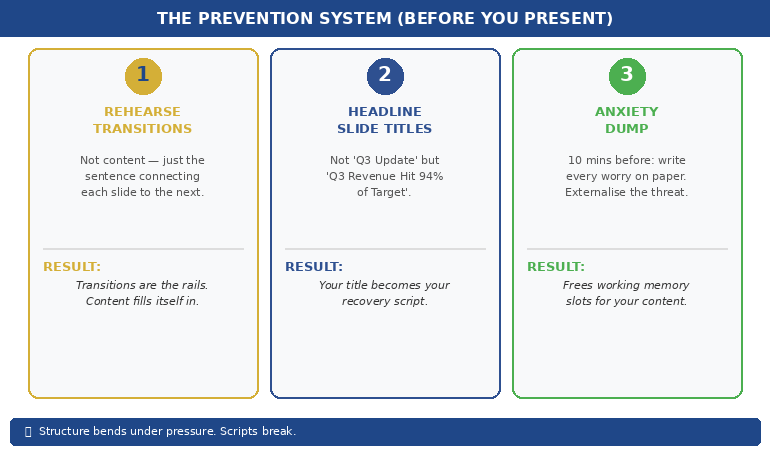
The Prevention System (Before You Present)

Recovery is essential. Prevention is better. Here are the three techniques that reduce the probability of losing your train of thought from “every presentation” to “rarely.”

1. Rehearse transitions, not content. Most people rehearse what they’ll say on each slide. This fills working memory with content recall — exactly the kind of load that gets displaced by anxiety. Instead, rehearse only the transitions: the single sentence that connects one slide to the next. “So that’s the revenue picture — now let’s look at what’s driving it.” When you know your transitions, you can lose the middle of any slide and still get to the next one. The transitions are the rails. The content fills itself in.

2. Write headline-complete slide titles. Generic titles like “Q3 Update” or “Market Analysis” give your brain nothing to work with during a blank. Headline titles like “Q3 Revenue Recovered to 94% of Target” or “Market Share Grew Despite Price Increase” tell you exactly what to say even if you’ve forgotten everything else. Your slide title becomes your recovery script. If you lose your thread, the title is sitting right there — and it contains the point you need to make.

3. Pre-presentation anxiety dump. Ten minutes before you present, write down every worry on a piece of paper. “They’ll think I’m underprepared.” “The CFO will ask about the variance.” “I’ll stumble on the technical section.” This isn’t journaling — it’s a cognitive offload. Research on expressive writing shows that externalising anxious thoughts frees working memory capacity. You’re literally clearing slots for your content by moving the worry out of your head and onto paper.

The professionals who over-explain during presentations are often doing so because they sense themselves losing the thread and compensate by adding more words. The prevention system stops the root cause — working memory overload — rather than treating the symptom.

PAA: How do I stop forgetting what to say during a presentation?
Rehearse your transitions between slides (not the content on each slide), write headline-complete slide titles that double as recovery scripts, and do a 10-minute anxiety dump before presenting. These three techniques reduce working memory load so your content stays accessible even when nerves are high. The goal isn’t perfect recall — it’s having a structure that keeps you moving forward regardless of what you forget.

The Prevention + Recovery System for High-Stakes Presenters

Conquer Speaking Fear gives you the complete anxiety management system — pre-presentation protocols that keep your working memory clear, in-the-moment recovery techniques, and the cognitive restructuring tools that break the anxiety cycle permanently.

Get Conquer Speaking Fear → £39

Used in board meetings, steering committees, and investor presentations. Built from clinical hypnotherapy training + 24 years in corporate banking.


Prevention system for losing train of thought showing three techniques: rehearse transitions, headline slide titles, pre-presentation anxiety dump

What to Do in the Worst Case (Total Blank)

Sometimes the 3-second recovery isn’t enough. You glance at the slide title and nothing comes. Your brain is fully offline. Here’s the escalation protocol.

Ask the room a question. “Before I continue — what’s your biggest concern about this timeline?” or “Quick check: does this match what you’re seeing in your region?” This does three things at once: it buys you 20–30 seconds while someone responds, it shifts the cognitive load to someone else temporarily, and it often triggers your own memory because hearing someone else’s perspective reactivates the neural pathway your content lives on.

Advance to the next slide. If you’re completely stuck on slide nine, move to slide ten. A new slide gives your brain a new anchor point — new title, new visual, new topic. The content on the previous slide can be addressed later (“Let me circle back to the implementation timeline”). Your audience doesn’t know you skipped forward. They assume you’re being efficient.

Narrate what you see. If everything has gone and you can’t move forward, describe what’s literally on the screen. “This chart shows our revenue trajectory over the past four quarters.” This is not insightful commentary — it’s a restart mechanism. The act of verbalising what you see re-engages your prefrontal cortex and typically breaks the freeze within 5–10 seconds. The first sentence is the hardest. Once you’re talking again, the thread comes back.

🧠 These recovery protocols are just one part of the system.

Conquer Speaking Fear includes the complete anxiety management toolkit — from pre-presentation reset to mid-presentation recovery to long-term confidence rewiring.

The Patterns That Make It Worse

Certain presentation habits dramatically increase the probability of losing your train of thought. Recognise any of these:

Scripting word-for-word. If you memorise a script, your brain is running a recall task — pulling exact words in exact order from long-term memory. This is an extraordinarily fragile process under stress. One missed word and the entire sequence collapses, because each word depends on the previous one. Professionals who present from structure (knowing their points, not their sentences) almost never lose their thread — because any sentence that makes the point is a correct sentence.

Avoiding eye contact. When you avoid eye contact, you lose the social feedback that keeps your brain anchored. Eye contact with one friendly face activates your social-engagement nervous system (the ventral vagal pathway), which actively suppresses the fight-or-flight response. One face, four seconds, per section. That’s enough to keep your threat-detection system quiet and your working memory clear.

Presenting too much information. Cognitive overload doesn’t start mid-presentation. It starts in the preparation phase. If you’re trying to cover twenty points in fifteen minutes, your brain is running a constant prioritisation algorithm that consumes working memory even before anxiety enters the picture. Fewer points means less cognitive load means more working memory available for delivery.

PAA: Can anxiety cause you to lose your train of thought?
Yes — this is the primary cause for most professionals. Anxiety activates your amygdala, which diverts cognitive resources away from your prefrontal cortex (responsible for working memory, sequential thinking, and language production). The result is that your content gets displaced by threat signals. This is a neurological mechanism, not a character flaw, and it’s more common in experienced professionals because higher seniority means higher perceived stakes.


Working memory diagram showing four cognitive slots normal versus overloaded with anxiety signals during presentations


Frequently Asked Questions

Is losing my train of thought a sign of poor preparation?

Almost never. The professionals who lose their thread most frequently are typically the best-prepared — because over-preparation creates rigidity, and rigidity collapses under anxiety. The fix is structural preparation (transitions + headline titles) rather than content memorisation. Structure bends under pressure; scripts break.

Should I use notes or a teleprompter to prevent this?

Notes as a safety net are fine. Notes as a script are dangerous. If you’re reading from notes, your brain is running two tasks simultaneously — reading and presenting — which doubles the cognitive load. A single card with your five transition sentences is more useful than three pages of scripted content. If you must use notes, write only your slide transitions and one key data point per section.

Does this get worse with age or seniority?

Yes, for most people — but not because of cognitive decline. It gets worse because seniority increases the perceived stakes. A director presenting to the board calculates higher personal consequences than an analyst presenting to their team, which triggers a stronger fight-or-flight response and greater working memory displacement. The techniques in this article work specifically because they address the anxiety mechanism, not the memory mechanism.

What if I lose my train of thought during a Q&A, not the presentation itself?

Q&A derailments are actually easier to recover from because the format is already conversational. Use the bridge technique: “That’s a good question — let me think about the best way to answer that.” This buys you 3–5 seconds and signals thoughtfulness, not confusion. Then answer whatever part of the question you do remember. If you’ve genuinely forgotten the question, ask them to repeat it — this is completely normal and nobody judges it.

📬 The Winning Edge Newsletter

Weekly strategies for speaking confidence, executive presence, and career-critical presentation moments. No fluff.

Subscribe free →

🎯 Free: Executive Presentation Checklist

The pre-presentation checklist that includes the working memory protection protocol, slide-title anchoring system, and transition rehearsal framework — everything in this article, condensed into a printable one-pager.

📊 Optional: Want the slides too?

Preparation reduces anxiety. The includes headline-complete slide templates designed to minimise working memory load — so you always have an anchor point to recover from.

Related: Losing your train of thought is magnified when you’re presenting under time pressure with no preparation. If you’ve been thrown into a last minute presentation, the 5-slide emergency framework gives you a structure that’s impossible to lose your place in — because each slide has exactly one job.

Losing your train of thought isn’t a preparation failure. It’s a working memory problem with a neurological solution. Glance at the title. Breathe. Say the next thing that’s true. And before you present, rehearse your transitions, write headline titles, and dump the anxiety on paper.

🎯 Present with the confidence that comes from knowing you can recover from anything.

Get Conquer Speaking Fear → £39

About the Author

Mary Beth Hazeldine is the Owner & Managing Director of Winning Presentations. A qualified clinical hypnotherapist and NLP practitioner who spent five years battling presentation terror before learning to overcome it, she now helps executives speak with confidence in high-stakes environments.

With 24 years of corporate banking experience at JPMorgan Chase, PwC, Royal Bank of Scotland, and Commerzbank, Mary Beth combines neurological understanding of presentation anxiety with practical frameworks tested in real boardrooms — not classrooms.

Book a discovery call | View services

11 Feb 2026
Professional pausing confidently mid-presentation, moment of composure

When Your Voice Cracks Mid-Sentence (The Recovery Nobody Teaches)

My voice cracked on the word “strategy.”

Two hundred people in the room. The CEO in the front row. And my voice — the one thing I needed to work — just… broke. Mid-word. Mid-sentence. Mid-thought.

What happened next is a blur. I remember heat rising to my face. I remember my throat tightening further. I remember thinking: “Everyone just heard that. Everyone knows.”

I finished the presentation somehow. Smiled through the Q&A. Walked calmly to the bathroom and cried for ten minutes.

That was fifteen years ago. It took me another five years — and training as a clinical hypnotherapist — to understand what actually happened in that moment, and what I could have done differently.

I’m sharing this now because voice cracking is the presentation fear people are most ashamed to admit. In 2026, I’m seeing more professionals struggle with this than ever — hybrid meetings with close-up cameras, AI transcription that captures every hesitation, and audiences who’ve forgotten how to be generous with speakers. If your voice has ever betrayed you, this article is for you.

Quick answer: If your voice cracks when presenting, it’s usually caused by stress-driven breath restriction and throat tension — not a “bad voice.” The fix isn’t “just relax” — it’s a quick downshift in arousal that often reduces tension for many speakers. Mid-presentation, you can recover in 3-5 seconds with a deliberate pause, a slow exhale, and a grounded restart. Long-term, you can train your nervous system to stay calmer so it’s less likely to happen.

Note: This article is educational and not medical advice. If voice cracking happens frequently outside stressful situations, or you experience pain or hoarseness, see an ENT specialist or speech-language pathologist.

After that presentation, I became hypervigilant about my voice. Every meeting, I’d monitor for signs of cracking. Which, of course, made it worse — because vigilance is tension, and tension is exactly what causes the problem.

I tried everything. Vocal exercises. Breathing techniques from YouTube. Drinking warm water. Avoiding dairy. None of it helped consistently, because none of it addressed the root cause.

When I trained as a hypnotherapist, I finally understood: the voice crack isn’t a voice problem. It’s a nervous system problem. And the nervous system doesn’t respond to willpower or tips. It responds to specific interventions that speak its language — like the breathing techniques and pre-presentation calming methods I now teach.

Now I teach executives the same techniques that ended my own five-year struggle. The techniques that turn “I hope my voice doesn’t crack” into “I know I can handle whatever happens.”

Why Your Voice Cracks (The Physiology)

Understanding why your voice cracks removes half the fear. It’s not weakness. It’s not lack of preparation. It’s biology.

The Fight-or-Flight Voice

When your brain perceives threat — and yes, 200 pairs of eyes qualifies — it triggers your sympathetic nervous system. Adrenaline floods your body. And your vocal apparatus responds:

  • Vocal cords tighten: Tension in the larynx restricts the smooth vibration your voice needs
  • Breathing shallows: Less air means less support for sustained sound
  • Throat constricts: The muscles around your larynx contract, raising your pitch and reducing control
  • Mouth dries: Saliva production decreases, making articulation harder

The result: your voice has less air, more tension, and reduced lubrication. Of course it cracks.

The Feedback Loop From Hell

Here’s where it gets worse. When your voice cracks:

You notice → You feel embarrassed → Your brain registers more threat → More adrenaline releases → Your voice tightens further → It cracks again

This is why “just push through” doesn’t work. Pushing through feeds the loop. What you need is an intervention that breaks it.

🎯 Conquer Speaking Fear — Complete Audio Programme

Train your nervous system to stay calm before and during presentations. This programme includes three guided audio sessions designed by a clinical hypnotherapist:

  • Full Guided Session (18-20 min): Deep nervous system reprogramming for lasting confidence
  • Quick 90-Second Reset: Use in the corridor before any presentation
  • Printable Reset Card: The 4-step protocol you can keep in your pocket

Get Conquer Speaking Fear → £39

Instant download. Developed from techniques that ended my own 5-year struggle with presentation anxiety.

The Mid-Presentation Recovery (3-5 Seconds)

Your voice just cracked. The room heard it. Now what?

Most people do one of two things: they speed up (trying to get past the embarrassment) or they freeze (deer in headlights). Both make it worse.

Here’s the recovery that actually works:

Step 1: Pause Deliberately (1-2 seconds)

Stop talking. Completely. Not a hesitation — a deliberate pause.

This feels counterintuitive. Your instinct screams “keep going, fill the silence, pretend it didn’t happen.” Ignore that instinct.

A deliberate pause does three things:

  • Breaks the panic spiral by giving you back control
  • Reads to the audience as confidence, not weakness
  • Creates space for the physiological reset you’re about to do

Professional speakers pause constantly. Your audience won’t think “their voice cracked.” They’ll think “they’re pausing for emphasis.”

Step 2: Exhale Slowly (2 seconds)

During the pause, release your breath slowly through slightly parted lips. Not a big dramatic sigh — just a quiet, controlled exhale.

A slower exhale can help many people feel calmer and reduce vocal tension. You can’t force your voice to relax, but you can exhale — and the relaxation often follows.

Step 3: Ground and Restart (1-2 seconds)

Feel your feet on the floor. Press them down slightly. Then restart your sentence — from the beginning of the thought, not from where you cracked.

Why restart? Because it gives you a clean vocal line. “As I was saying, the strategy requires…” sounds confident. Picking up mid-word sounds like you’re pretending the crack didn’t happen (which everyone notices).


Voice recovery protocol showing 3-step mid-presentation reset technique

The 3-5 Second Window

The entire recovery takes 3-5 seconds. To your audience, it looks like a confident pause. To your nervous system, it’s a chance to downshift.

I’ve watched executives use this technique in board meetings, investor pitches, and all-hands presentations. Nobody in the audience knows anything went wrong. The speaker knows — and they know they handled it.

Voice cracking is one of the most common physical symptoms of speaking fear — this recovery works because it targets the underlying fear response, not just the voice.

If you want this to be automatic under pressure, don’t wait until the next high-stakes moment. Save the 90-second reset now and use it before your next meeting.

The Conquer Speaking Fear programme (£39) includes a printable pocket card with this exact protocol — so you can review it in the corridor before any high-stakes presentation.

Preventing It Before You Present

Recovery is essential. But prevention is better. Here’s what actually works in the 5-30 minutes before you present:

The 90-Second Nervous System Reset

This is the protocol I use with executives before high-stakes presentations. It takes 90 seconds and can be done in a bathroom stall, empty corridor, or parked car:

Ground (15 seconds): Feel your feet. Press them into the floor. Notice the contact points. This activates your body awareness and begins pulling you out of your head.

Breathe (30 seconds): Inhale for 4 counts. Hold for 4 counts. Exhale for 6 counts. Repeat twice. The extended exhale is key — it helps shift your body toward a calmer state.

Anchor (30 seconds): Press your thumb and forefinger together. While holding this pressure, recall a moment when you felt completely confident and in control. Any moment — doesn’t have to be presenting. Hold the memory and the finger pressure together for 30 seconds.

Engage (15 seconds): Release the anchor. Take one normal breath. Say your opening line out loud — just once, at normal volume and pace. You’re ready.

The Warm-Up Most People Skip

Your voice is a physical instrument. Would a singer perform without warming up? Would an athlete sprint without stretching?

Five minutes before presenting:

  • Hum: Low, relaxed humming for 30 seconds loosens your vocal cords
  • Yawn: Three big, exaggerated yawns open your throat
  • Lip trills: Blow air through loosely closed lips (like a horse) to release tension
  • Range slides: Slide from your lowest comfortable note to your highest, then back down

This isn’t about sounding better. It’s about ensuring your vocal apparatus is loose and ready — not tight and primed to crack.

🎧 Three Audio Tools for Different Moments

Conquer Speaking Fear gives you the right tool for every situation:

  • Night before: Full 18-20 minute guided session — deep relaxation and mental rehearsal
  • Corridor before: 90-second quick reset audio — nervous system calm in under 2 minutes
  • In-the-moment: Printable pocket card — the 4-step recovery you can glance at anytime

Get All Three Tools → £39

Developed by a clinical hypnotherapist. Based on techniques that actually work with your nervous system, not against it.

Long-Term Nervous System Training

The techniques above work in the moment. But if voice cracking is a recurring problem, you need to retrain your nervous system’s baseline response to presentations.

Why “Practice More” Doesn’t Fix It

You’ve probably been told to practice until you’re comfortable. But here’s the problem: if you practice while anxious, you’re training your nervous system to associate presenting with anxiety. You’re reinforcing the pattern, not breaking it.

What works is practicing in a calm state while mentally rehearsing the challenging situation. This is what hypnotherapy does — it accesses the subconscious patterns that drive the anxiety response and rewires them at the source.

The Anchor Stack Technique

Over time, you can build what I call an “anchor stack” — multiple positive associations linked to the act of presenting:

Memory anchors: Link the thumb-forefinger press to memories of confidence, competence, and calm

Physical anchors: Develop a pre-presentation ritual (specific posture, specific breath pattern) that your body learns to associate with readiness

Visual anchors: Create a mental image of yourself presenting successfully that you can access before and during any presentation

When you have multiple anchors stacked together, your nervous system has multiple pathways to calm. One bad moment doesn’t derail you because you have backup systems.

The full guided session in Conquer Speaking Fear (£39) walks you through building these anchor stacks — reprogramming your nervous system’s response to presentations over repeated listening.

Releasing the Shame

Here’s what I wish someone had told me after my voice cracked in front of 200 people:

Everyone has experienced this. Every single person in that audience has had their voice crack, their face flush, their hands shake, their mind go blank. They’re not judging you. They’re relieved it wasn’t them this time.

It’s not a character flaw. Voice cracking isn’t weakness, inadequacy, or lack of preparation. It’s a physiological response to perceived threat. Your nervous system is trying to protect you. It’s just overreacting.

It’s fixable. Not with willpower. Not with “fake it till you make it.” But with specific techniques that work with your biology instead of against it.

One incident doesn’t define you. I’ve had my voice crack in presentations. I’ve also delivered presentations that moved people to tears, secured millions in funding, and changed careers. Both are true. The voice crack isn’t who I am — it was a moment I learned from.

The Reframe That Changed Everything

After years of dreading presentations, I finally asked myself: “What if the goal isn’t to never have my voice crack? What if the goal is to know I can handle it when it does?”

That reframe changed everything. I stopped trying to control the uncontrollable. I started building skills for recovery. And paradoxically, once I stopped fearing the crack, it almost never happened.

Your voice cracking isn’t the problem. Your fear of it cracking is the problem. Solve the fear, and the symptom often disappears.

🎯 The Complete Confidence System

Conquer Speaking Fear includes everything you need to end the voice-cracking cycle:

  • Full Guided Audio (18-20 min): Deep nervous system reprogramming with hypnotherapeutic techniques — progressive relaxation, future pacing, anchor building, and embedded suggestions for lasting confidence
  • Quick Reset Audio (90 seconds): The exact protocol to use in the corridor, bathroom, or car before any presentation
  • Printable Pocket Card: The 4-step recovery protocol you can keep with you and glance at anytime

Get Conquer Speaking Fear → £39

Instant download. Based on the techniques that ended my own 5-year struggle — methods I’ve used with executive audiences and clients over many years.

📬 PS: Weekly strategies for confident presenting and executive communication. Subscribe to The Winning Edge — practical techniques from a hypnotherapist who’s been there.

Frequently Asked Questions

Can voice cracking be a medical issue?

In rare cases, persistent voice problems can indicate medical conditions like vocal nodules or laryngeal tension dysphonia. If your voice cracks frequently outside of stressful situations, or if you experience pain or prolonged hoarseness, see an ENT specialist. But for most people, voice cracking during presentations is purely anxiety-driven — and the techniques in this article address that directly.

What if my voice cracks during a job interview or really high-stakes moment?

The recovery protocol works anywhere. Pause, exhale, restart. In an interview, you can even acknowledge it lightly: “Let me start that thought again.” This shows composure under pressure — which is exactly what interviewers want to see. The worst response is pretending it didn’t happen while clearly being rattled.

How long does it take to stop voice cracking permanently?

With consistent use of nervous system training (like the guided audio), many people notice improvement within a few weeks, though results vary. The goal isn’t “never crack again” — it’s building enough confidence in your recovery skills that the fear diminishes, which often stops the cracking from happening in the first place.

Does caffeine make voice cracking worse?

Yes. Caffeine increases adrenaline, tightens muscles, and dehydrates your vocal cords. If you’re prone to voice cracking, avoid coffee for 2-3 hours before presenting. Warm water with honey is a better choice — it hydrates and soothes the throat without stimulating your nervous system.

Related: Voice issues often surface during high-stakes executive presentations. If you’re presenting transformation updates or programme status to steering committees, read Transformation Program Updates That Make Executives Want to Fund You for the structure that builds champions instead of critics.

Fifteen years ago, my voice cracked on the word “strategy” and I thought my career was over.

It wasn’t. That moment became the catalyst for everything I now teach — the nervous system training, the recovery protocols, the deep understanding of how anxiety manifests physically and how to interrupt it.

Your voice cracking isn’t a verdict on your competence. It’s your nervous system asking for better tools. Give it those tools, and it will stop sending the distress signal.

Pause. Exhale. Ground. Restart.

You’ve got this.

About the Author

Mary Beth Hazeldine is the Owner & Managing Director of Winning Presentations. A certified hypnotherapist and NLP practitioner, she spent five years struggling with presentation anxiety before training in the techniques that finally worked.

With 24 years in corporate banking at JPMorgan Chase, PwC, Royal Bank of Scotland, and Commerzbank, Mary Beth understands the pressure of high-stakes executive presentations. She helps professionals overcome speaking fear using evidence-based approaches that work with the nervous system, not against it.

Book a discovery call | View services

03 Feb 2026
Professional woman experiencing emotional moment during presentation, showing vulnerability and composure

What Happens When You Cry During a Presentation (I Know Because I Did)

The tears came without warning.

I was presenting our quarterly results to 40 colleagues. Slide 7. Nothing emotional—just revenue figures. And suddenly my throat closed, my eyes burned, and I felt the first tear escape before I could stop it.

I’d been running on four hours of sleep for two weeks. My father had just been diagnosed with cancer. I hadn’t told anyone at work. And my body chose that moment—in front of my entire department—to finally break.

I excused myself for water. Came back. Finished the presentation with a shaky voice and mascara I was certain had migrated somewhere terrible. Spent the next three days convinced my career was over.

It wasn’t. But the shame lasted longer than it should have, because nobody had ever told me what I’m about to tell you.

Quick answer: Crying during a presentation feels catastrophic in the moment, but it’s rarely the career-ending disaster it seems. What matters most is your recovery—not preventing the tears entirely. The 30-second reset (pause, breathe, acknowledge briefly, continue) preserves far more credibility than fighting visible tears or fleeing the room. Crying happens because your nervous system is overwhelmed—by stress, exhaustion, personal circumstances, or accumulated pressure. It’s a physiological response, not a character flaw. This article covers what actually happens when you cry during a presentation, why it occurs, and the specific recovery techniques that protect your professional standing.

⚡ Presenting Soon and Worried About This?

If you’re reading this because you have a presentation coming up and you’re afraid of losing composure, here’s the emergency protocol:

  1. Before: Press your thumbnail hard into your index finger during high-emotion moments. The mild pain interrupts the crying reflex.
  2. If tears start: Pause. Say “Give me just a moment.” Take three slow breaths. Nobody judges a brief pause.
  3. To continue: Lower your voice slightly and slow your pace. This signals control even when you don’t feel it.
  4. Afterwards: Do NOT apologise repeatedly. One brief acknowledgment maximum, then move forward.

This won’t solve the underlying vulnerability, but it will get you through the immediate situation. For the deeper work, keep reading.

Why Crying During Presentations Happens

Tears during presentations aren’t about weakness. They’re about nervous system overload.

Your body has a threshold for stress. When cumulative pressure exceeds that threshold—sleep deprivation, personal problems, work stress, the presentation itself—your nervous system needs to discharge the excess. Tears are one discharge mechanism. So is trembling. So is the urge to flee.

The cruel irony: the harder you try to suppress tears, the more pressure builds, and the more likely they become. Fighting the crying reflex is like trying to hold back a sneeze—sometimes you can, but often the effort makes it worse.

Common triggers include:

  • Accumulated stress that finally finds an outlet
  • Sleep deprivation (your emotional regulation is significantly impaired after poor sleep)
  • Personal circumstances you’re carrying while trying to perform professionally
  • Feeling attacked or criticised during Q&A
  • Talking about something you genuinely care about (passion and tears share neural pathways)
  • The frustration of not being heard or feeling dismissed

None of these make you unprofessional. They make you human.

For more on the physiological side of presentation anxiety, see my article on managing high-stakes presentation nerves.

What Others Actually See (It’s Not What You Think)

Here’s what I wish someone had told me after that quarterly review:

You experience your tears from the inside. Everyone else sees them from the outside.

From the inside, crying feels like complete loss of control. Humiliation. Exposure. The end of any credibility you’d built.

From the outside? People see a colleague who got emotional for a moment. Most feel empathy, not judgment. Many have been there themselves. The ones who judge harshly reveal more about themselves than about you.

What actually damages credibility:

  • Fleeing the room in visible distress
  • Apologising repeatedly throughout the rest of the presentation
  • Bringing it up again and again in the following days
  • Making others feel responsible for managing your emotions

What preserves credibility:

  • A brief pause to collect yourself
  • Continuing with quiet dignity
  • One brief acknowledgment (“I apologise for that moment”) and then moving on
  • Not making it a bigger deal than it needs to be

The research on this is clear: how you handle emotional moments matters far more than whether they occur. Leaders who show authentic emotion and recover gracefully are often rated more trustworthy than those who seem robotically controlled.

Comparison of internal experience versus external perception when crying during a presentation, plus the 30-second recovery protocol

🎯 Build Unshakeable Presentation Composure

Conquer Speaking Fear is a comprehensive programme for professionals who want to present with genuine confidence—not performed confidence that cracks under pressure. Developed from clinical hypnotherapy and NLP techniques that address the nervous system directly.

What’s included:

  • Nervous system regulation techniques
  • The emotional anchor method
  • Recovery protocols for high-pressure moments
  • Long-term resilience building

Get Conquer Speaking Fear → £39

Instant download. Built for high-pressure professional moments: quarterly updates, steering committees, and senior stakeholder meetings.

The 30-Second Recovery Protocol

If you feel tears coming or they’ve already started, here’s the protocol that works:

Step 1: Pause (5 seconds)

Stop speaking. Don’t try to power through while visibly crying—it makes everyone uncomfortable and damages your credibility more than a pause would.

Simply stop. Look down at your notes or take a sip of water if available.

Step 2: Breathe (10 seconds)

Take two or three slow, deep breaths. This isn’t just calming—it physiologically interrupts the crying reflex by activating your parasympathetic nervous system.

Breathe in for 4 counts, out for 6. The extended exhale is what triggers the calming response.

Step 3: Acknowledge Briefly (5 seconds)

One sentence maximum. Choose based on context:

  • “Give me just a moment.” (neutral, professional)
  • “This topic matters to me. Let me collect myself.” (if the content is genuinely emotional)
  • “I apologise—let me continue.” (if you need to move past it quickly)

Do NOT over-explain. Do NOT apologise repeatedly. One acknowledgment, then move forward.

Step 4: Continue with Adjusted Delivery (10 seconds to recalibrate)

When you resume, speak slightly slower and slightly lower in pitch than normal. This signals control and authority even when you don’t feel it internally.

If you have notes, use them more directly for the next few minutes. Nobody expects perfect recall after an emotional moment.

🎯 Want the complete recovery toolkit? Conquer Speaking Fear (£39) includes in-the-moment recovery protocols plus the deeper nervous system work that reduces vulnerability over time.

Managing the Aftermath

What you do in the hours and days after matters almost as much as the recovery itself.

The First Hour

Don’t flee immediately. If possible, stay for a few minutes after the presentation. Chat normally with a colleague or two. This signals that you’re fine and prevents the “dramatic exit” narrative.

Don’t apologise to everyone individually. One acknowledgment in the room was enough. Going person to person saying “I’m so sorry about that” makes it a bigger deal than it needs to be.

The First Day

If someone brings it up kindly: “Thank you—I had a lot going on that day. I appreciate your understanding.” Then change the subject.

If someone brings it up critically: “I’m human. It won’t affect my work.” No further explanation needed. You don’t owe anyone a justification for having emotions.

The Following Week

Deliver something excellent. The best way to move past an emotional moment is to demonstrate competence in your next visible contribution. Don’t hide—show up and perform.

Don’t keep bringing it up. If you make self-deprecating jokes about it for weeks, you’re the one keeping it alive. Let it fade.

For more on managing the anxiety that can follow difficult presentation experiences, see my article on presentation anxiety before meetings.

💡 The Shame is Usually Worse Than the Reality

In my experience—both personal and working with professionals across industries—the internal experience of crying during a presentation is almost always worse than the external impact. Most colleagues are more empathetic than you expect. Most have their own vulnerable moments they remember. The shame you carry is usually disproportionate to the actual professional consequences.

Reducing Vulnerability Long-Term

While you can’t guarantee you’ll never cry during a presentation, you can significantly reduce your vulnerability.

Address the Basics

Sleep. Emotional regulation is severely impaired when you’re sleep-deprived. Before high-stakes presentations, prioritise sleep above extra preparation.

Stress load. If you’re carrying significant personal stress, consider whether this is the right time for optional high-visibility presentations. Sometimes the wisest choice is to postpone or delegate.

Build Nervous System Resilience

Your nervous system can be trained to handle higher levels of activation without triggering emotional overflow. Techniques include:

  • Regular breathwork practice (not just in emergencies)
  • Progressive exposure to speaking situations
  • Anchoring techniques from NLP that create instant access to calm states
  • Somatic practices that discharge accumulated stress before it reaches overflow

Reframe the Stakes

Often, we cry during presentations because we’ve made the stakes impossibly high in our minds. This presentation will determine my career. Everyone will judge me. I must be perfect.

Realistic reframing: This is one presentation among many. People are mostly thinking about themselves. Imperfection is human and often more relatable than polish.

For deeper work on the panic response that can precede tears, see my article on managing panic attacks before presentations.

🎯 Transform Your Relationship with Presentation Pressure

Conquer Speaking Fear isn’t about suppressing emotions—it’s about building genuine resilience so your nervous system can handle pressure without overwhelm. Developed from clinical hypnotherapy and NLP, used by professionals who need to present under real pressure.

The programme includes:

  • Nervous system regulation foundations
  • The emotional anchor technique
  • In-the-moment recovery protocols
  • Long-term resilience building
  • Reframing techniques for high-stakes situations

Get Conquer Speaking Fear → £39

Instant download. Build the resilience that prevents overwhelm before it starts.

Frequently Asked Questions

What causes crying during presentations?

Crying during presentations is a nervous system overflow response. It occurs when cumulative stress exceeds your current capacity—triggered by factors like sleep deprivation, personal circumstances, feeling attacked or criticised, passion about the topic, or accumulated work pressure. It’s physiological, not a character flaw. Your body needs to discharge excess activation, and tears are one mechanism for that discharge.

How do you stop yourself from crying mid-presentation?

The most effective technique is the extended exhale: breathe in for 4 counts, out for 6-8 counts. This activates your parasympathetic nervous system and interrupts the crying reflex. Physical interrupts also work—pressing your thumbnail into your finger or pressing your tongue to the roof of your mouth. However, if tears have already started, trying to suppress them often makes it worse. A brief pause to collect yourself preserves more credibility than visibly fighting tears while continuing to speak.

What should you say if you start crying during a presentation?

Keep it brief—one sentence maximum. Options include: “Give me just a moment” (neutral), “This topic matters to me—let me collect myself” (if content is genuinely emotional), or simply “I apologise, let me continue” (if you want to move past it quickly). Do not over-explain, repeatedly apologise, or provide detailed context for why you’re emotional. One acknowledgment, then continue.

Is it unprofessional to cry during a presentation?

Having emotions is human, not unprofessional. What matters is how you handle the moment. A brief pause, composure recovery, and continuing with dignity actually demonstrates emotional intelligence and resilience. What damages professionalism is fleeing the room in distress, apologising repeatedly, or making others feel responsible for managing your emotions. Research shows leaders who show authentic emotion and recover gracefully are often rated more trustworthy than those who seem artificially controlled.

Can you recover professionally after crying in front of colleagues?

Yes, absolutely. The key is not making it a bigger deal than necessary. Don’t apologise to everyone individually, don’t keep bringing it up, and don’t hide afterwards. Show up, deliver excellent work in your next visible contribution, and let the moment fade. Most colleagues are more understanding than you expect—many have their own vulnerable moments they remember. Your subsequent performance matters far more than one emotional moment.

Why do some people cry more easily than others?

Crying thresholds vary based on nervous system sensitivity, current stress load, sleep quality, hormonal factors, and life circumstances. Some people’s nervous systems are simply more reactive—this isn’t weakness, it’s biology. Additionally, accumulated stress lowers everyone’s threshold. Someone who cries easily during a difficult period may have much higher resilience when their overall stress load is lower. The good news: nervous system resilience can be trained and improved over time.

How long does it take to recover credibility after crying at work?

In most cases, much shorter than you fear. If you handle the moment with dignity and don’t keep drawing attention to it, colleagues typically move on within days. Your next solid contribution accelerates this. The exception is if you make the incident into an ongoing narrative—repeatedly apologising, making self-deprecating comments, or avoiding situations. That keeps it alive. The fastest path to recovery is demonstrating competence in your next visible moment and letting the incident fade naturally.

📧 The Winning Edge Newsletter

Weekly insights on presenting with confidence, managing presentation anxiety, and building genuine resilience under pressure. From a clinical hypnotherapist who’s been exactly where you are.

Subscribe Free →

📋 Free: 7 Presentation Frameworks

Structure reduces anxiety. These seven frameworks give you reliable starting points for any presentation situation—so you can focus on delivery instead of wondering what comes next.

Download Free Frameworks →

About the Author

Mary Beth Hazeldine is the Owner & Managing Director of Winning Presentations. With 24 years of corporate banking experience at JPMorgan Chase, PwC, Royal Bank of Scotland, and Commerzbank, she knows what it’s like to present under real pressure—and what it costs when it goes wrong.

A qualified clinical hypnotherapist and NLP practitioner, Mary Beth overcame five years of severe presentation anxiety using the techniques she now teaches. She works with thousands of executives on building genuine presentation confidence.

Mary Beth overcame five years of severe presentation anxiety using the techniques she now teaches.

Your Next Step

If you’re reading this because it already happened—I’m sorry. I know how it feels. The shame, the replaying, the certainty that everyone is talking about you.

They’re probably not. And even if they are, it will pass faster than you think.

What matters now is what you do next. Show up. Do good work. Don’t apologise again. Let it fade.

And if you’re reading this because you’re afraid it might happen—that fear itself increases the likelihood. The nervous system techniques in this article can help, but the deeper work is learning to present from a place of genuine resilience rather than performed control.

You’re allowed to be human. Even at work. Even during presentations.

Related: If you’re preparing for a high-stakes meeting and worried about composure, see today’s companion article on the all-hands meeting mistakes that destroy morale—because good structure reduces the pressure that leads to emotional overwhelm.

21 Dec 2025
What to do when your mind goes blank during a presentation - the 10-second recovery protocol

What to Do When Your Mind Goes Blank During a Presentation (The 10-Second Recovery)

A clinical hypnotherapist’s emergency protocol for the moment panic strikes — from a clinical hypnotherapist who specialises in presentation anxiety

Your mind goes blank during a presentation. You’re mid-sentence, the audience is watching, and suddenly — nothing. The words you knew seconds ago have vanished. Panic rises. Your heart pounds.

What you do in the next 10 seconds determines whether this becomes a minor blip or a spiralling disaster.

As a clinical hypnotherapist who specialises in presentation anxiety, I developed a recovery protocol that works because it targets your nervous system, not your memory.

Here’s exactly what to do when your mind goes blank during a presentation.

Why Your Mind Goes Blank During a Presentation (It’s Not Memory Failure)

Presenting soon?

If your mind goes blank under pressure, a recovery system matters more than more rehearsal. Explore Conquer Speaking Fear →

When your mind goes blank mid-presentation, your memory hasn’t failed. Your prefrontal cortex — the part of your brain responsible for working memory, language, and clear thinking — has temporarily gone offline.

Why? Stress hormones.

When your nervous system detects a threat (and it absolutely perceives an audience as a threat), it floods your body with cortisol and adrenaline in milliseconds. These hormones impair your prefrontal cortex to prioritise survival functions.

Your brain hasn’t forgotten your content. It’s just temporarily unable to access it because it thinks you’re being chased by a predator. This is biology, not incompetence.

This means the solution isn’t trying harder to remember. It’s calming your nervous system so your thinking brain can come back online.

Related: Overcome Fear of Public Speaking: A Hypnotherapist’s Complete Guide

The 10-Second Recovery When Your Mind Goes Blank in a Presentation

When your mind goes blank during a presentation, execute this protocol:

The 5-step recovery protocol when your mind goes blank during a presentation

Seconds 1-3: STOP and Breathe

Don’t keep talking. Don’t fill the silence with “um” or nervous chatter. Just stop.

Take one slow exhale — longer than your inhale. This immediately signals safety to your nervous system and begins to lower your heart rate.

The audience won’t notice a 3-second pause. To them, it looks like you’re gathering your thoughts. To your nervous system, it’s a reset button.

Seconds 4-6: Ground Yourself Physically

Feel your feet on the floor. Press them down slightly. This physical sensation anchors you in the present moment and interrupts the panic spiral.

If you’re holding notes or standing at a lectern, feel your hands on the surface. Physical grounding pulls your attention out of your racing mind and into your body — which is exactly what your nervous system needs to calm down.

Seconds 7-10: Use a Professional Recovery Phrase

Say one of these out loud:

  • “Let me check my notes on that…” (then actually check them)
  • “Let me think about how to phrase this…”
  • “Actually, let me come back to that point…”
  • “Give me a moment to find that figure…”

These phrases are professional, not apologetic. They buy you time while your prefrontal cortex comes back online.

Then glance at your notes, find your place, and continue. Your brain will have recovered.

Related: How to Calm Nerves Before a Presentation: The 5-Minute Reset

What NOT to Do When Your Mind Goes Blank During a Presentation

Avoiding these mistakes is as important as the recovery protocol itself:

Don’t apologise excessively. “Sorry, I’m so nervous, I completely forgot what I was saying” draws attention to the blank and makes it memorable. A simple pause and “Let me check my notes” is instantly forgettable.

Don’t speed up. Panic makes us rush. Rushing increases cognitive load, which makes blanks more likely. Deliberately slow down instead.

Don’t try to force the memory. Straining to remember increases stress, which keeps your prefrontal cortex offline. Relax, breathe, and let the memory return naturally.

Don’t catastrophise. One blank moment doesn’t ruin a presentation. The audience will forget it in seconds if you recover smoothly. They’re not analysing you — they’re thinking about the content.

🧠 Want the Complete System to Eliminate Presentation Anxiety?

The 10-second recovery is just one technique from my comprehensive 75-page workbook (£39, instant access): Conquer Your Fear of Public Speaking: A Hypnotherapist’s Complete System.

Inside you’ll get:

  • The full neuroscience of why your mind goes blank (and how to prevent it)
  • A Fear Type Assessment to identify YOUR specific anxiety pattern
  • 10 clinical techniques with guided exercises and worksheets
  • 5 scripts for different moments (pre-presentation, visualization, recovery)
  • Situation-specific protocols for meetings, client pitches, and board presentations
  • A complete 30-day plan to rewire your fear response permanently
  • 12 printable quick reference cards to carry with you

Get Conquer Your Fear of Public Speaking (£39) →

How to Prevent Your Mind Going Blank During Presentations

The best strategy is prevention. These techniques significantly reduce the likelihood of blank moments:

Know your opening cold. Memorise your first 2-3 sentences word-for-word. Starting strong builds momentum and confidence. Your brain is most likely to blank in the first 60 seconds when anxiety peaks — so make those seconds automatic.

Use notes strategically. Having notes visible reduces the fear of forgetting, which reduces the stress that causes forgetting. It’s not cheating — it’s professional. Even TED speakers use notes.

Pre-presentation calming. Five minutes of extended exhale breathing (inhale 4, hold 4, exhale 6) before you present keeps stress hormones lower, making blanks far less likely. I teach this to every executive I work with.

Practise recovery deliberately. In rehearsal, deliberately pause mid-sentence and practice your recovery phrase. When you’ve done it intentionally 10 times, the real thing feels manageable rather than catastrophic.

Reduce cognitive load. Simpler slides with fewer words. Familiar structure. Less to remember means less to forget.

Related: Presentation Confidence: How to Build It (And Why “Fake It Till You Make It” Doesn’t Work)

Blanking Out Isn’t a Memory Problem — It’s an Anxiety Response

Conquer Your Fear of Public Speaking gives you neuroscience-based protocols for managing the freeze response, recovering mid-presentation, and building mental resilience — £39, instant access.

Get the Programme →

Designed for executives who want to stop dreading presentations

Why Blank Moments During Presentations Feel Worse Than They Are

Here’s what I tell every client: blank moments feel catastrophic to you, but they’re barely noticeable to your audience.

When you pause for 3 seconds, you experience it as an eternity. The audience experiences it as a thoughtful pause — if they notice at all. When you say “let me check my notes,” they see professionalism. When you recover and continue, they’ve already forgotten the pause happened.

Research shows audiences significantly underestimate presenter nervousness. What feels like obvious panic to you is invisible to them.

The only way a blank moment becomes memorable is if you make it memorable — through excessive apology, visible panic, or complete shutdown.

Recover smoothly, and it disappears.

Your Emergency Cheat Sheet: What to Do When Your Mind Goes Blank

Save this for your next presentation — screenshot it or print it:

⚡ THE 10-SECOND RECOVERY

When your mind goes blank during a presentation:

  1. STOP — Don’t keep talking. Silence is fine.
  2. EXHALE — One slow breath out (longer than in).
  3. GROUND — Feel your feet firmly on the floor.
  4. SAY — “Let me check my notes on that…”
  5. CONTINUE — Find your place, keep going.

Total time: 10 seconds. The audience won’t remember it. You’ll be fine.

If blank moments happen regularly and the fear of forgetting is affecting your preparation, Conquer Speaking Fear (£39) includes the full nervous system retraining programme — so blanks become rare rather than feared.

Frequently Asked Questions About Mind Going Blank During Presentations

Why does my mind go blank when I present but not in normal conversation?

Your brain perceives an audience as a threat in a way it doesn’t perceive one-on-one conversation. Multiple people watching triggers a stronger stress response, flooding your system with hormones that impair your prefrontal cortex. The techniques above work because they directly counteract this stress response.

How do I stop my mind going blank during presentations permanently?

Consistent practice with nervous system regulation techniques rewires your brain’s threat response over time. Most people see significant improvement within 3-4 weeks of daily practice with techniques like extended exhale breathing and grounding. Full rewiring typically takes 2-3 months. The Conquer Your Fear of Public Speaking workbook includes a complete 30-day plan for this.

Should I memorise my entire presentation to avoid blanks?

No — this often makes blanks worse. When you memorise word-for-word, losing one word can derail the entire sequence. Instead, know your key points and opening/closing sentences. Use notes for the middle. This gives you structure without the fragility of full memorisation.

Your Next Step: Stop Fearing the Blank

Blank moments are survivable. With the right protocol, they become minor blips that the audience never remembers. With consistent practice, they become rare. And with proper nervous system training, your brain stops treating presentations as threats worth panicking over.

Choose your path forward:
The fear of going blank is often worse than the blank itself. Once you know you can recover in 10 seconds, the fear loses its power.

Go deeper: Overcome Fear of Public Speaking: A Hypnotherapist’s Complete Guide to Lasting Change


Mary Beth Hazeldine is a qualified clinical hypnotherapist and Owner & Managing Director of Winning Presentations. After spending 5 years terrified of presenting, she built a successful 25-year banking career at JPMorgan, PwC, Royal Bank of Scotland, and Commerzbank. She now applies evidence-based clinical techniques to help executives manage presentation anxiety.

The Winning Edge Newsletter

Weekly techniques for executives who present under pressure. Evidence-based, practical, no fluff.

Subscribe Free →