Tag: high-stakes presentations

15 Apr 2026
Female executive presenting to a sceptical boardroom, confident composed expression, navy boardroom setting

Presentation Structure for Hostile Audiences: The Framework That Turns Resistance Into Approval

Quick answer: A hostile audience presentation requires a fundamentally different sequence from a standard executive deck. Begin with shared ground rather than your proposal, build your evidence in layers that preempt known objections, and position your decision request only after the room has had room to shift. The structure is not about softening your message — it is about sequencing it so resistance has less to attach to.

Valentina had been in the boardroom before with a restructuring proposal. Eighteen months earlier, she had stood at the same table, presented what she believed was a compelling case, and watched the chairman shut it down inside seven minutes. The board had concerns about headcount, about timing, about what the proposal signalled to the market. She had answered each objection as it came. It made no difference.

When the same restructuring need resurfaced — more urgently this time — Valentina knew she could not walk in with the same structure. The board had not forgotten what they had already rejected. Two members had actively lobbied against it in the months since. She was not presenting to a neutral room. She was presenting to a room that had already made up its mind.

She rebuilt the deck from scratch. Instead of opening with the proposal, she opened with what the board had said they needed twelve months ago — their language, their stated priorities, their own risk appetite. She structured the evidence around those concerns rather than around her solution. She placed the decision slide at the back. The board approved it. One member said it felt like a completely different proposal. The fundamentals had not changed. The structure had.

If you are building a deck for a room that is already resistant, the Executive Slide System gives you slide templates and scenario playbooks for exactly these situations.

Explore the System →

Why Conventional Presentation Structure Fails With Hostile Audiences

Most executive presentations follow a logic that assumes a receptive room: open with the headline, build the case, address questions at the end. That sequence works well when your audience is broadly aligned with what you are there to say. It fails badly when they are not.

The problem is cognitive, not just interpersonal. When a senior audience has pre-existing reservations — about your proposal, your track record, or the last time this idea was raised — they do not process your opening headline neutrally. They process it through the filter of what they already believe. A strong opening statement that leads with your conclusion gives a hostile room an immediate target. The resistance organises itself around your first slide.

Conventional structure also tends to front-load what you want rather than what the audience cares about. For receptive rooms, this signals confidence. For resistant ones, it signals that you have not listened to their previous concerns. The moment a board member thinks “we have already been through this,” the rest of your presentation is uphill.

A hostile audience presentation also tends to surface objections early, which means you spend the session defending rather than persuading. Conventional decks rarely account for where objections will land — they address questions only in the Q&A, by which point the room has already formed its view. Restructuring your deck means thinking about when resistance is most likely to surface and neutralising it before it arrives, not after.

This is not a problem you can solve with better slides. It is a sequencing problem. The content may be strong. The order in which it reaches the room determines whether it is heard.

Executive Slide System — £39, instant access

Build Decks That Senior Decision-Makers Approve — Even When They Walk In Sceptical

The Executive Slide System is a practical toolkit for executives who present to boards, investors, and senior leadership teams. It contains professionally structured slide templates built around real executive scenarios — not generic business slides — alongside AI prompt cards to help you draft and refine your narrative, and scenario playbooks for high-resistance rooms.

  • Slide templates for board approvals, restructuring proposals, and funding presentations
  • AI prompt cards to structure your argument and anticipate objections
  • Framework guides for sequencing evidence in resistant rooms
  • Scenario playbooks for hostile and sceptical senior audiences

Get the Executive Slide System →

Designed for leaders who present to boards, investors, and senior leadership teams.

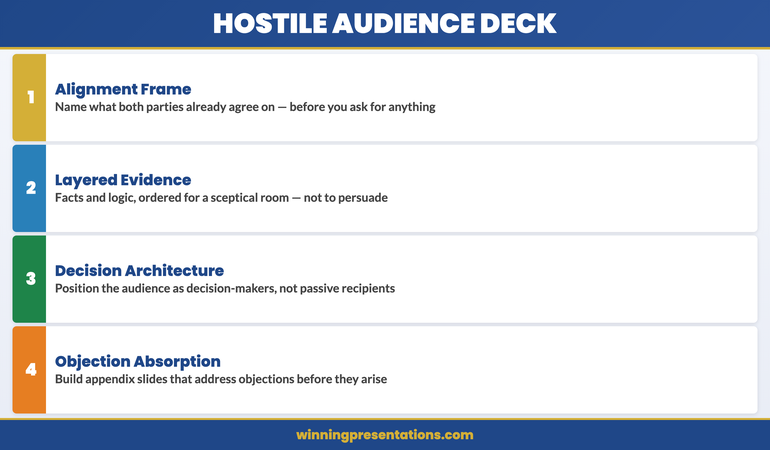
The Alignment Frame: What You Share Before What You Want

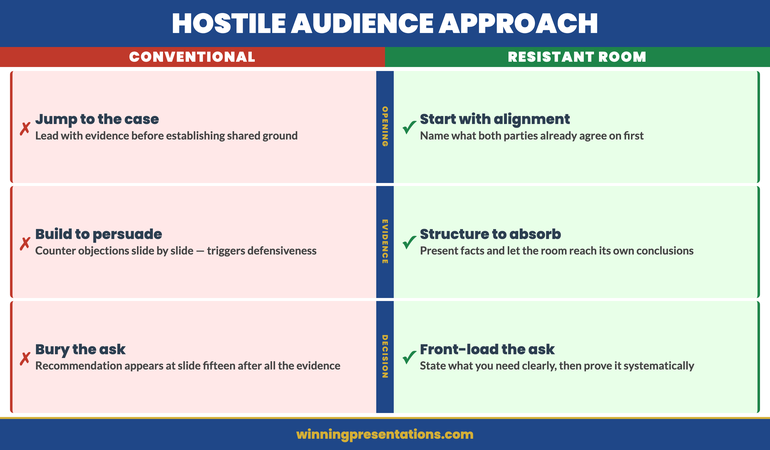
The single most effective structural shift for a resistant room is delaying your proposal and opening instead with alignment. This is not about softening your position — it is about establishing shared ground before you introduce anything contested.

An alignment frame works by surfacing the priorities, concerns, and stated objectives that your audience has already expressed. You are not inventing a shared starting point — you are reflecting their own language back to them. If the board said in the last meeting that they need to see cost containment before any structural changes, your opening slide acknowledges that priority directly. If a committee rejected a similar proposal on governance grounds, your opening addresses governance before you address anything else.

The practical structure looks like this: slide one establishes what the audience has told you they care about most. Slide two confirms what has and has not changed since the last relevant discussion. Slide three outlines the problem you are addressing, framed in terms of their priorities — not yours. Only then do you move toward your proposal.

This sequence does two things. It signals that you have listened, which reduces the defensive posture that hostile rooms adopt when they expect to be steamrolled. And it narrows the distance between where they are and where you need them to go before you make a single ask. By the time your proposal appears, the room has already spent several minutes thinking in alignment with you rather than in opposition to you.

For executives working on strategy presentations that require buy-in from resistant leadership teams, this alignment-first sequence applies equally — the principle holds whether you are presenting to a board, an investment committee, or a senior leadership group that has publicly doubted the direction.


Diagram showing the alignment-first presentation sequence for hostile audiences: shared ground, context, problem, evidence, proposal, decision

Structuring Evidence for a Sceptical Room

Evidence sequencing in a hostile audience presentation is not the same as evidence sequencing in a neutral one. In a neutral room, you build from general context to specific proof. In a resistant room, you need to think about which objections exist, what evidence directly counters each one, and what order allows the evidence to land before the objection has been voiced.

The starting point is a simple exercise: before you open a slide deck, write down the three most predictable objections from this specific audience. These are not hypothetical — they are based on what the room has said previously, what you know about individual members’ priorities, and what the political landscape looks like. Once you have those objections listed, you can work backwards into your evidence structure.

Each major evidence section should address one of those objections — before it is raised. The goal is not to pre-emptively defend yourself, which reads as anxious. The goal is to demonstrate that you have already considered what the audience is about to say, and that your evidence accounts for it. When done well, this approach often means that objections are not raised at all, because the room can see they have been addressed.

Layering also matters. Present your strongest evidence early within each section, not at the end. Resistant audiences are less patient with build-up than receptive ones — they want to know whether you have a point before they invest attention in how you are making it. A headline finding followed by supporting data is more effective than a data walkthrough that arrives at a headline on the final bullet.

Keep your evidence slides clean and literal. Sceptical audiences look for gaps in reasoning and will scrutinise anything ambiguous. Complex visualisations, indirect language, or data presented without a clear interpretive label give hostile rooms something to challenge that is separate from your actual proposal. Remove that friction by being explicit: state what the data shows, what it means, and why it matters — in that order, on every evidence slide.

For executives building decks for resistant or sceptical senior audiences, the Executive Slide System provides scenario-specific frameworks for exactly this type of presentation.

Where to Place the Decision in Your Deck

One of the most common structural errors in a hostile audience presentation is placing the decision slide too early. In a standard executive deck, many presenters open with a clear ask — this is good practice for a receptive room, where leading with the conclusion saves time and signals clarity. For a resistant room, it is the wrong move.

When a hostile audience sees your decision request on slide two, they spend the rest of the presentation looking for reasons to say no. The ask has been made, their resistance has been activated, and every subsequent slide is processed through the lens of “why I should reject this.” You have effectively handed the room a target before you have given them any reason to shift.

In a resistant room, the decision slide belongs near the end — after the alignment frame, after the evidence layers, and after you have addressed the known objections. This does not mean you are being evasive. You can signal early in the presentation that a decision will be requested: “By the end of this session, I will be asking for board approval on one of three options.” That signals intent without triggering resistance before you are ready.

When the decision slide does arrive, it should present options rather than a binary yes/no. Hostile audiences often resist a single recommendation because it removes their agency. Offering three options — one of which is clearly your preferred path — gives the room the feeling of choice, which reduces resistance to the act of deciding, even when the preferred option is the one selected.

This approach is particularly relevant when presenting competitive or contentious strategies. Presentations where client resistance or competitive pressure is already present benefit from the same delayed-decision sequencing — the audience needs to feel they have moved with you before they are asked to commit.


Visual showing the decision slide positioned near the end of a hostile audience presentation structure, following alignment frame and layered evidence sections

Managing Objections Without Defensive Slides

Many executives respond to the challenge of a hostile room by adding more slides — a risks section, a counter-arguments slide, a “we hear your concerns” summary. This instinct is understandable, but these slides almost always backfire. They signal anxiety, they invite scrutiny of the objections themselves, and they slow the narrative at exactly the moment you need momentum.

The more effective approach is to address objections inside your substantive slides rather than in dedicated counter-argument sections. If cost is a known concern, your financial modelling slide addresses it directly — not by flagging it as a concern, but by showing that your numbers account for it. If governance is the issue, your implementation timeline includes governance milestones, not because you are managing the objection, but because the proposal genuinely addresses it.

This embedded approach requires preparation. You need to know what the objections are before you build the deck, not after you finish it. The most common failure pattern is executives who build the full deck first and then try to add objection handling at the end. That produces defensive slides because the content is genuinely defensive — it is been added as an afterthought rather than integrated into the logic.

For live Q&A, the structural principle carries forward. Practising how to handle the most predictable hostile questions without becoming defensive is a separate skill from building the deck, but it works in tandem with the structure you have created. Preparing for hostile Q&A through structured simulation is one of the most reliable ways to enter a resistant room with composure rather than defensiveness — and the structure of your deck makes that composure easier to sustain, because you have already addressed most of what the room is likely to raise.

One practical addition: a pre-read. For particularly hostile rooms, circulating a one-page summary of your proposal — framed around their stated priorities — before the meeting can allow initial resistance to surface in writing rather than in the room. Board members who have already asked their sharpest questions in email tend to be less combative in session, because the most charged moments have already passed.

Executive Slide System — £39, instant access

Build Your Deck in Less Time — With Frameworks That Already Account for Resistance

If you are under time pressure and presenting to a difficult room, the Executive Slide System removes the guesswork. Ready-built scenario playbooks mean you are not starting from a blank deck — you are adapting a structure that has already been designed for resistant senior audiences. Get to a solid draft faster, and spend your preparation time on rehearsal rather than architecture.

Get the Executive Slide System →

The Visual Language of a Hostile Audience Presentation

The visual choices in a resistant-room deck are not decorative — they affect how authority is read and how easily the audience can find things to challenge. A deck that looks informal, cluttered, or inconsistent gives a hostile room a low-stakes place to direct its energy. A deck that is visually clear and structurally deliberate signals that the work behind it is similarly rigorous.

Slide titles matter more than most presenters realise. In a resistant room, titles are often the first thing read — and the last thing remembered. Titles that make assertions (“Cost savings exceed initial modelling”) are more useful than titles that describe (“Financial overview”). An assertive title makes your evidence interpretive before anyone has had a chance to reframe it.

Data visualisation should be conservative. Resistant audiences tend to scrutinise data more closely than receptive ones, and they will look for inconsistencies in your charts, your axes, your source notes. This is not a reason to limit your data — it is a reason to present it with care. Use standard chart types rather than novel ones. Label everything explicitly. Cite your sources on the slide rather than in a footnote.

Colour and density also signal intent. A deck with too many slides, too much text per slide, or too many colour variations reads as unedited — and hostile audiences interpret that as a lack of rigour. For a resistant room, aim for fewer slides with more deliberate content. Each slide should have one clear point. If a slide is trying to do three things, it is trying to do too much.

Finally, your cover slide and your appendix are structural tools, not afterthoughts. A clearly labelled appendix signals that you have done more work than fits in the main deck — which is reassuring in a room that will want to dig. And a clean cover slide that includes the date, the presenting executive’s name, and a subtitle that frames the purpose of the session signals that this is a formal, considered piece of work — not a reactive one.

The visual language of your deck contributes to how seriously the room takes your argument before you have spoken a word. In a hostile audience presentation, that first impression — formed before slide two — is not something you can afford to leave to chance. For more detail on how deck structure and outline choices interact, the executive presentation outline framework covers the sequencing decisions that underpin every element described in this article.

Frequently Asked Questions

What makes a hostile audience different from a sceptical one?

A sceptical audience is unconvinced — they need evidence and a clear rationale before they will agree. A hostile audience has already formed a negative view, often based on prior experience, political positioning, or a direct conflict of interest with what you are proposing. Scepticism is a starting position that evidence can shift; hostility involves active resistance that structural and interpersonal strategy must address before evidence can land. The structural response to each is different. Sceptical rooms need stronger evidence sequencing. Hostile rooms need an alignment frame first, then evidence, then the decision ask — in that order.

Should you acknowledge the resistance directly in your presentation?

In most cases, acknowledging prior concerns is more effective than ignoring them — but the framing matters significantly. Referencing what the board or committee raised previously (“I know the timeline was a concern in our last discussion”) signals that you have listened and adapted. This is different from framing your entire opening around defensiveness or apology. You are acknowledging the prior conversation, not conceding the argument. Naming the resistance briefly and constructively — then moving forward — tends to reduce the temperature in the room rather than raise it. What you want to avoid is excessive hedging or a structure that signals you expect to lose.

How long should a hostile audience presentation be?

Shorter than you think. Resistant audiences lose patience faster than receptive ones, and a longer deck gives them more opportunity to interrupt, challenge, or redirect. Aim for a main deck of no more than twelve to fifteen slides, with a well-stocked appendix available if questions require deeper evidence. A focused, tight deck signals that you have done the editorial work — you know what matters most and you have not buried it. The appendix handles the detail without slowing your central argument. If you cannot make your case in fifteen slides for a senior board, the structure is not yet clear enough, and adding slides will not solve that.

The Winning Edge — Weekly Newsletter

Practical Executive Presentation Advice, Every Thursday

Each week, The Winning Edge delivers one focused insight on executive communication — structure, delivery, influence, and the mechanics of getting senior audiences to yes. Straightforward, applicable, and written for people who present under pressure.

Subscribe to The Winning Edge →

Free download: The Executive Presentation Checklist — a structured pre-presentation review covering structure, evidence sequencing, and delivery preparation.

About the Author

Mary Beth Hazeldine — Owner & Managing Director, Winning Presentations

With 25 years of corporate banking experience at JPMorgan Chase, PwC, Royal Bank of Scotland, and Commerzbank, she advises executives across financial services, healthcare, technology, and government on structuring presentations for high-stakes funding rounds and approvals.

01 Apr 2026

Box Breathing for Executives: Why Navy SEALs Use It Before High Stakes

Box breathing is a physiological reset button—a four-step technique that brings your nervous system back into balance within minutes. Navy SEALs use it before covert operations. Emergency room surgeons use it before complex procedures. And senior executives use it before board meetings, earnings calls, and regulatory hearings where composure determines the outcome. The technique is simple, evidence-backed, and discreet enough to use in a conference room lavatory or in the five minutes before you walk into a shareholder meeting.

The Story: Henrik’s Regulatory Hearing

Henrik sat in the corridor of the regulatory office with nine minutes to spare before presenting a critical approval hearing. As Chief Financial Officer of a pharmaceutical company, he’d presented to boards and regulators dozens of times—but this was different. A competitor’s recent failure in a similar category had made the regulator more scrutinising. His hands were cold. His jaw was tight. His voice, when he’d rehearsed it an hour earlier, had sounded thin and uncertain.

He’d tried everything: positive affirmations (felt hollow), visualisation (his mind wandered), pacing (made him more anxious). Then a former Navy officer on his executive advisory board had mentioned something in passing at a networking event: box breathing. Not meditation. Not mindfulness. Just a structured breathing pattern that resets the autonomic nervous system in under five minutes.

Henrik pulled up a quiet side room and spent four minutes doing exactly that. Four counts in. Four counts hold. Four counts out. Four counts hold. Repeat. When he walked into the hearing room, something had shifted. His voice was steady. His thoughts were clear. He moved through the presentation with the kind of composed authority the regulators needed to see. The approval came through three weeks later.

The reality of presentation anxiety

Anxiety before high-stakes presentations isn’t a personal failing—it’s a physiological response to perceived threat. Your body doesn’t distinguish between physical danger and reputational risk. When you’re about to present to a board or speak at a regulatory hearing, your sympathetic nervous system activates, flooding your system with cortisol and adrenaline. Box breathing counteracts this directly by engaging your parasympathetic nervous system. It’s not about feeling confident. It’s about getting your physiology out of the way so your competence can show.

The Neuroscience Behind Box Breathing

Your autonomic nervous system has two branches: the sympathetic (fight-or-flight) and the parasympathetic (rest-and-digest). When you’re facing a high-stakes moment, your sympathetic system dominates. Your breathing becomes shallow and rapid. Your heart rate climbs. Blood pools in your muscles instead of your prefrontal cortex. This is useful if you’re facing a predator. It’s catastrophic if you’re trying to communicate complex information clearly.

Box breathing works because extended exhalation—particularly the pause at the end of the breath—directly activates the vagus nerve, which controls parasympathetic activation. The equal counting pattern (four in, four hold, four out, four hold) creates a rhythm that your nervous system recognises and responds to. Within minutes, your heart rate variability improves, your cortisol begins to drop, and your prefrontal cortex—the part of your brain responsible for rational thought, composure, and articulation—comes back online.

This isn’t speculation or wellness theory. The physiological mechanisms have been studied in military contexts, clinical psychology, and sports performance for decades. The technique appears in trauma protocols, anxiety management programmes, and athlete preparation routines because it works at a biochemical level that doesn’t require belief or motivation. Your body simply responds.

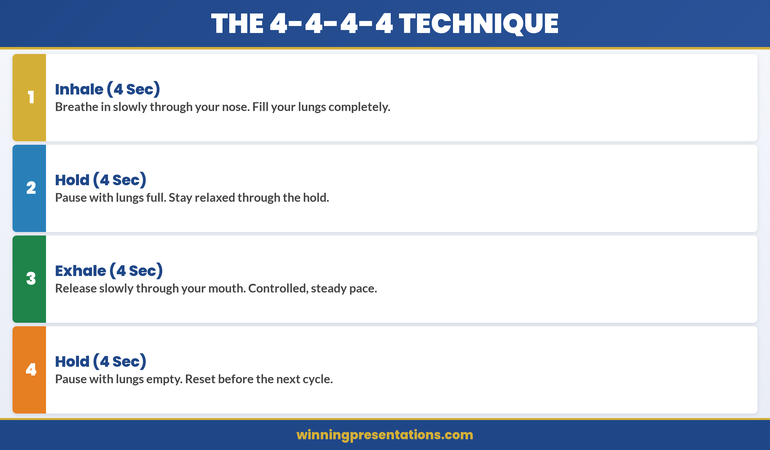
The 4-4-4-4 Technique: Step by Step

Box breathing for executives is deliberately straightforward. There’s nothing to remember beyond counting. Here’s the method:

Step 1: Exhale completely
Before you begin the pattern, expel all the air in your lungs with a slow, deliberate exhale. This triggers an immediate parasympathetic response and signals to your body that you’re intentionally shifting your state.

Step 2: Inhale for four counts
Close your mouth if you’re in a shared space and breathe slowly through your nose. Count steadily: one, two, three, four. Inhale with intention but without strain.

Step 3: Hold for four counts
Once you’ve inhaled, pause without forcing. One, two, three, four. This pause is crucial—it allows your body to absorb the oxygen and signals a return to equilibrium.

Step 4: Exhale for four counts
Slowly release the breath over four counts through your mouth or nose. This is the longest part of your breathing cycle in terms of nervous system effect. Extended exhalation is where the parasympathetic activation happens.

Step 5: Hold for four counts
Pause again for four counts. You’ve completed one cycle of box breathing.

Repeat this cycle five to ten times. Three to five minutes is typically enough to restore composure before a presentation. Some executives do it for longer before particularly high-stakes moments, but diminishing returns set in after ten cycles.

The count can be adjusted if four feels uncomfortable. Some people use five or six counts per phase. The critical variables are that all four phases are equal in duration and that you’re breathing slowly and deliberately—roughly one full cycle every 20 seconds.

Ready to master your nervous system before high-stakes presentations?

Conquer Speaking Fear gives you box breathing, grounding techniques, and frameworks to manage anxiety when your reputation is on the line.

Take Control of Your Nervous System

Step-by-step box breathing technique diagram for executives before high-stakes presentations

Why Executives Resist Box Breathing

The most capable executives often resist breathing techniques, and it’s worth understanding why. There are three consistent objections.

First, it feels too simple. After years of building complex financial models and navigating geopolitical market dynamics, a four-count breathing pattern can feel trivial. The executive brain interprets simple as ineffective. But physiology doesn’t care about complexity. Your vagus nerve doesn’t require intellectual sophistication. It responds to the pattern regardless of whether you believe in it.

Second, there’s a perception problem. Some worry that using a breathing technique signals weakness or that they need external props to manage their state. The reality is inverted: controlling your physiology before a high-stakes moment is a mark of professionalism and preparation. Navy SEALs, emergency surgeons, and Olympic athletes aren’t weak. They’re disciplined about managing the variables they can control.

Third, they haven’t learned it during low-stakes moments. Attempting box breathing for the first time ten minutes before a regulatory hearing adds cognitive load when you can least afford it. The technique works best when it’s already familiar, when your body recognises the pattern and responds automatically. This is why rehearsal matters.

When to Use Box Breathing: Timing and Context

Box breathing isn’t a tool you pull out only in crisis. The executives who benefit most from it integrate it into routine preparation. Here are the most effective moments:

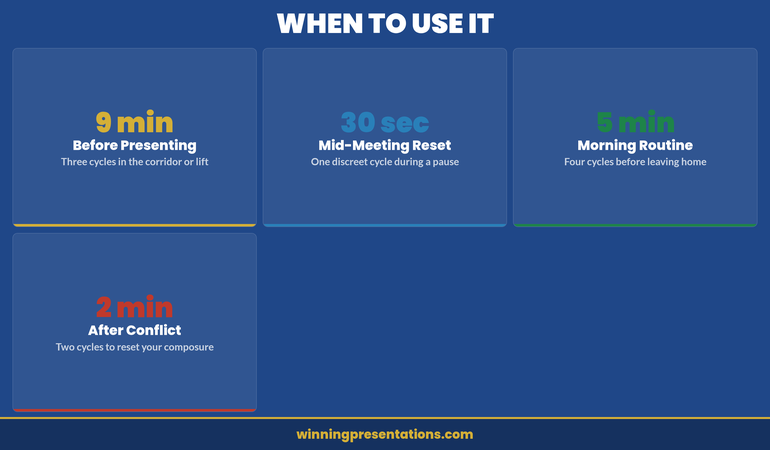
Fifteen to thirty minutes beforehand. This is the optimal window. Your nervous system has time to absorb the reset, but you’re close enough to the event that the effect persists. If you practise earlier, arousal will begin to climb again as you move closer. If you try it two minutes before, you might not have enough time to feel the shift.

During breaks in longer presentations or meetings. If you’re presenting for an hour with a break halfway through, use that break to do one or two cycles of box breathing. It resets your energy and brings you back into a composed state for the second half.

As part of your morning routine on presentation days. Starting the day with three to five minutes of box breathing sets your baseline lower. When the presentation happens later that day, you’re starting from a calmer physiological state, which means you don’t have as far to climb in terms of arousal.

In the moment, if you feel anxiety climbing during the presentation itself. If you’re mid-presentation and notice your heart rate rising or your thoughts becoming scattered, you can excuse yourself for 90 seconds, find a private space, do one or two cycles of box breathing, and return. The reset is noticeable even in such a compressed timeframe.

Adapting Box Breathing for Corporate Settings

The advantage of box breathing for executives is that it’s invisible. You’re not lighting scented candles. You’re not chanting. You’re not wearing any special equipment. You’re simply breathing in a particular pattern, which you can do anywhere without drawing attention.

In a conference room waiting for a board meeting to start, you can do two cycles of box breathing while reviewing your notes. In a client dinner before a major pitch, you can excuse yourself to the restroom for a discreet reset. Before stepping into a shareholder meeting, you can use the elevator ride as your practice window. The technique adapts to the environment because it requires nothing but your breath and your attention.

Some executives integrate it into their pre-presentation routine as casually as they’d check their slides or review their opening line—a standard part of preparation, not a special intervention. This normalisation is precisely what makes it sustainable over time.

If you’re concerned about appearing unusual, remember: most people are too focused on themselves to notice your breathing pattern. And if anyone does notice you taking slow, deliberate breaths before a presentation, the only conclusion they’ll draw is that you’re composed and in control.

Struggling with the structural side of your presentation?

Conquer Speaking Fear combines breathing techniques with frameworks for clarity and confidence under pressure.

Advanced Variations and Adaptations

Once you’re comfortable with the basic 4-4-4-4 pattern, several variations can be useful depending on your situation and what your nervous system needs in the moment.

Extended exhale. If you’re particularly activated, lengthen the exhale phase: 4 counts in, 4 counts hold, 6 counts out, 4 counts hold. The extended exhale amplifies parasympathetic activation. This is particularly useful if you’re feeling panic or very high arousal.

Variable pacing. You can adjust the base count from four to six or even eight, depending on your lung capacity and what feels natural. A 6-6-6-6 pattern gives you a longer cycle, which some people find more meditative. The absolute values matter less than the consistency—equal pacing across all four phases.

Layered breathing in the morning. Some executives combine box breathing with other techniques as part of their morning routine. Five minutes of box breathing, followed by a three-minute visualisation of the day’s presentations going well, followed by a grounding exercise (feet on the floor, five senses awareness). This layered approach creates a robust baseline of composure that persists throughout the day.

Real-time use during the presentation. As you become more practised, you can integrate subtle breathing patterns into your speaking without pausing. Between major points or while your audience is digesting information, you can use shortened versions of the pattern—2-2-2-2 or 3-3-3-3—to maintain a calm, centred state throughout the entire presentation.

Build your complete presentation confidence toolkit

Beyond breathing techniques, you need frameworks for handling objections, managing complex narratives, and staying composed under pressure. That’s what Conquer Speaking Fear covers.

Explore Conquer Speaking Fear

When and where executives can use box breathing in corporate settings

Frequently Asked Questions

How quickly does box breathing work?

Most people notice a physiological shift within 60–90 seconds of starting the technique. Heart rate decreases, breathing slows, and the subjective sense of calm increases. The speed of effect depends on your baseline arousal level and how practised you are. Regular practitioners report faster onset—sometimes within 30 seconds.

Can you do box breathing too much?

In practical terms, no. Box breathing is a self-regulating technique: once your nervous system reaches a calm baseline, the technique simply maintains that state. There’s no risk of over-calming yourself into lethargy before a presentation. If anything, regular practice trains your autonomic nervous system to return to baseline faster, which is a performance advantage.

What if I feel lightheaded during box breathing?

Lightheadedness usually means you’re breathing too deeply or holding too long. Reduce the count from 4 to 3 seconds, and ensure you’re breathing into your diaphragm rather than your chest. If lightheadedness persists, stop the technique and breathe normally. You may also be hyperventilating slightly—focus on the exhale being complete before starting the next inhale.

Does box breathing work if you don’t believe in it?

Yes. Box breathing works through direct physiological mechanisms—specifically, vagus nerve activation and CO2 regulation—not through placebo or belief. Your autonomic nervous system responds to the breathing pattern regardless of your cognitive stance. Sceptical executives often report being surprised by how quickly it works precisely because they didn’t expect it to.


Stay Composed Under Pressure

Box breathing is a tool for executives who want to control the variables they can influence. You can’t control whether the board will approve your proposal. You can’t control market conditions or regulatory decisions. But you can control your physiology in the minutes before you walk into the room. You can control whether your voice is steady, whether your thinking is clear, and whether your audience perceives you as composed and in command of the situation.

Those who integrate breathing techniques into their preparation routine aren’t less capable than those who don’t. They’re more disciplined. They treat their physiology the same way they treat their slides and messaging—as a critical component that requires planning and rehearsal.

Join The Winning Edge newsletter for weekly strategies on presentation structure, executive communication, and managing high-stakes moments.

Subscribe to The Winning Edge

Need to structure the presentation itself? The Executive Slide System gives you slide templates and frameworks for high-stakes executive scenarios.


See also from today:


Further reading on presentation anxiety:


About the Author

Mary Beth Hazeldine is the Owner & Managing Director of Winning Presentations. With 24 years of corporate banking experience at JPMorgan Chase, PwC, Royal Bank of Scotland, and Commerzbank, she advises executives across financial services, healthcare, technology, and government on structuring presentations for high-stakes funding rounds and approvals.

31 Mar 2026
Executive boardroom prepared for a succession planning discussion with leadership pipeline slides on screen

Succession Planning Presentations: The Format That Makes the Conversation Productive

Succession planning presentations fail when they’re built like status updates. You walk into the room with slides about the timeline, the candidate profile, and the transition plan, but what you get back is hesitation, questions you didn’t anticipate, and a “let’s revisit this later” that means the board has reservations you never heard.

Jump to: What makes these presentations different | The five-section structure | Handling objections | Building credibility | Common missteps

The problem is structural. Ines, a Chief Operating Officer at a financial services firm, spent six weeks preparing a succession plan for her retiring Head of Operations. She’d done the hard work: identified the internal candidate, mapped the knowledge transfer, assessed the risk. But when she presented to the board, the conversation stalled. Board members asked for more detail on capability gaps. They wanted to see the bench. They wondered whether promoting from within was even the right move. Ines walked out having to restart the conversation entirely.

What Ines lacked wasn’t information—it was structure. A succession planning presentation isn’t a briefing. It’s a persuasion architecture. It needs to surface stakeholder concerns early, build confidence in your reasoning, and move people from scepticism to alignment. That’s a different format entirely.

Struggling with high-stakes presentations? The Executive Slide System is built for moments like this. Learn the framework that structures difficult conversations—succession, restructuring, investment cases—so stakeholders hear your reasoning first, not your conclusion. Explore the system →

What makes succession planning presentations different

Succession planning sits in a narrow band of corporate conversation. It’s not a routine update. It’s not a crisis. It sits between approval-seeking and reputation-building, where the stakes feel high to everyone in the room because people’s careers are on the line—yours included.

The listeners—board members, senior executives, investors—are thinking three things simultaneously: Is this person ready? Is this process sound? And am I comfortable with the risk? They’re not hostile. They’re protective. They want to buy in, but they’re also doing their job by stress-testing your recommendation.

A standard presentation format doesn’t account for this. It leads with the conclusion (promote candidate X), then supports it with evidence (credentials, track record, transition plan). But that reverses how people actually evaluate succession moves. They evaluate from risk down to recommendation. They ask themselves: What could go wrong? How have you thought about alternatives? Why this person, not someone else?

The succession planning presentation format inverts this. It leads with the stakes and the risks, shows how you’ve thought them through, builds confidence in your process, and then presents the recommendation as the logical outcome of sound reasoning.

Executive Slide System £39

Master the exact format financial services, healthcare, and technology leaders use to gain alignment on succession, restructuring, and major decisions. Includes templates, framework guides, and real-world examples.

View System (£39) →

The five-section structure that builds alignment

The productive succession planning presentation has five sections. Each one serves a specific function in moving stakeholders from scepticism to agreement.

1. The Context & Constraints
Start by naming the decision that needs to be made and the timeline you’re working within. Be explicit about constraints: regulatory requirements, board expectations, market conditions. This grounds the conversation in reality and shows you’ve already done the systems thinking. It also signals that this isn’t a whim—it’s a necessary move aligned with business strategy.

2. The Risks & Mitigations
Name the specific risks stakeholders are thinking about but haven’t said out loud. Loss of institutional knowledge. Capability gaps. Retention risk among other candidates. Market disruption during transition. Then, for each risk, articulate how you’ve thought about mitigation. Not as bullet points that wave them away, but as genuine strategies. This is where you build credibility. You’re not hiding the hard problems—you’re showing you’ve already solved them mentally.

3. The Evaluation Process
Walk through how you evaluated options. Did you consider internal candidates, external candidates, or both? What criteria did you use? How did you weight them? This section is about transparency of thinking. It reassures stakeholders that you haven’t rushed to a conclusion. The recommendation that follows will land more firmly because people have seen the methodology.

4. The Recommended Candidate & Case
Now you present the recommendation. Lead with why this person solves the strategic problem you named at the start. Not their CV, not a skills matrix, but the argument: What does this organisation need from this role in the next three years, and why is this person the best positioned to deliver it? This is where you connect dots between capability and strategy.

5. The Transition & Success Metrics
Close with the practical plan: the transition timeline, who they’ll work with, the key milestones, and the metrics you’ll use to measure success in the first 100 days, first year. This moves people from abstract approval to concrete execution. It says: I’m not just recommending this person, I’m committing to making them successful.

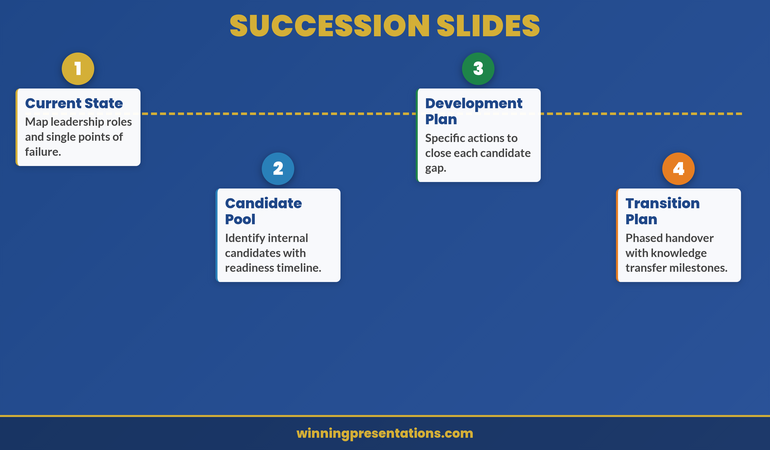
Succession planning slide structure showing four elements: current state, candidate pool, development plan, and transition plan

Within this five-section framework, your slides need to cover four concrete deliverables that the board expects to see. The first is the current state: a clear map of leadership roles and single points of failure. If one person’s departure would cripple an entire function, that’s the urgency the board needs to feel. Don’t assume they already understand the risk. Show them the org chart with the gaps circled.

The second deliverable is the candidate pool: who are the internal candidates, and what’s the readiness timeline for each? This isn’t a list of names with job titles. It’s an honest assessment of who could step into the role in six months, who needs twelve months of development, and who’s a longer-term prospect. Readiness timelines force you to be specific, and specificity is what gives the board confidence that you’ve thought beyond the immediate vacancy.

The third is the development plan: specific actions to close each candidate’s gaps. Not “we’ll provide coaching and mentoring” — that’s generic and the board will hear it as wishful thinking. Instead: “Priya needs exposure to regulatory reporting. We’re placing her on the compliance steering committee for Q2 and Q3 and assigning her to lead the next FCA submission.” That’s a plan the board can evaluate and hold you accountable for.

The fourth is the transition plan: a phased handover with knowledge transfer milestones. When does shadowing begin? When does the outgoing leader step back from day-to-day decisions? When is the new leader accountable for outcomes? Milestones create checkpoints where the board can assess whether the transition is on track — and that mechanism of oversight is often what converts their hesitation into approval.

Handling objections before they arise

The most powerful move in a succession planning presentation is to voice objections yourself before anyone else does. Not all of them—that would seem defensive—but the critical ones.

For example: “Some of you may be thinking we should look outside the organisation. Here’s why I’ve chosen to recommend from within, and here’s what I’ve validated about external alternatives.” This isn’t you being defensive. It’s you being thorough. It shows you’ve already tested your own recommendation and it held up. It also gives you control of the conversation. You’re bringing objections into the open where you can address them, rather than having them linger unspoken in the back of stakeholders’ minds.

The key is specificity. Don’t say “some people worry about capability.” Say “the role requires deep knowledge of our derivatives operations, and I want to address whether John’s background in equities is a limitation.” Now you’re talking about a real concern, and your answer carries weight.

This technique—naming and mitigating objections in your presentation—is covered in depth in our first board presentation guide, which walks through how to build board confidence in high-stakes moments.

When you present the Executive Slide System, you’ll see this principle embedded throughout. It’s the difference between a presentation that feels defensive and one that feels authoritative.

The role of confidence and credibility

A succession planning presentation is also a test of your credibility as a leader. Stakeholders are evaluating not just your candidate, but your judgment. Are you thoughtful? Have you considered second and third-order consequences? Do you understand the political landscape? Can people trust you with a decision this important?

This is why the structure matters so much. The format I’ve outlined—starting with context and constraints, moving through risks and evaluation process, then to recommendation—builds credibility with every section. You’re not asking stakeholders to trust you on assertion. You’re showing them your thinking. You’re letting them see that you’ve thought hard, evaluated fairly, and arrived at a conclusion that’s justified.

Equally important is tone. Succession planning presentations can’t be soft. But they can’t be rigid either. They need to be direct, precise, and conversational. You’re talking to peers who have legitimate concerns. Treat them that way. Acknowledge the weight of the decision. Show that you’ve felt the responsibility and done the work accordingly.

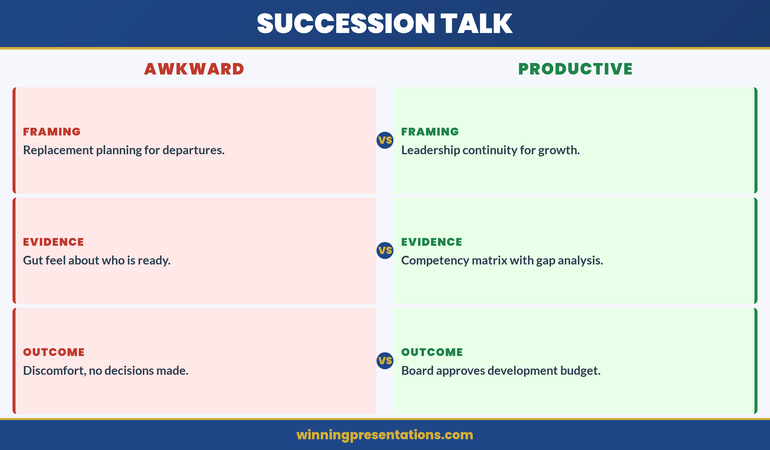
Comparison of awkward versus productive succession planning conversations across framing, evidence, and outcome

The difference between an awkward succession conversation and a productive one comes down to three dimensions. The first is framing. Awkward conversations frame succession as replacement planning for departures — someone is leaving, and we need to fill the gap. That framing carries anxiety because it centres on loss. Productive conversations frame succession as leadership continuity for growth — we’re building the next generation of capability because the organisation is evolving. That framing carries momentum. The board responds differently when the narrative is about growth rather than risk management.

The second dimension is evidence. Awkward succession presentations rely on gut feel about who is ready — “I’ve worked with James for five years and I believe he’s the right person.” That’s an assertion, not evidence. Productive presentations use a competency matrix with gap analysis: here are the five capabilities the role requires, here is where each candidate stands against them, and here are the gaps we’ve identified with specific development actions to close them. The matrix transforms a subjective opinion into a defensible process. Boards can challenge a gut feeling. They struggle to challenge a rigorous framework.

The third dimension is outcome. Awkward succession conversations end in discomfort and deferred decisions — no one wanted to say no, but no one was ready to say yes. Productive succession conversations end with the board approving a development budget, endorsing a transition timeline, or requesting a follow-up in 90 days with specific milestones. The difference isn’t the quality of the candidate. It’s the quality of the presentation structure that carried them there.

Common missteps in succession planning presentations

Most succession planning presentations fail not because the recommendation is weak, but because the format doesn’t create the conditions for stakeholders to feel confident in the decision.

Misstep 1: Leading with the candidate
You put the person’s photo and credentials on slide two. But stakeholders need to understand the problem and the decision context first. They need to know why this decision matters to the organisation. Only then does the candidate’s background become relevant.

Misstep 2: Treating risks as obstacles to get past, not problems to solve
When you name a risk and then quickly move on, stakeholders hear “this person has a gap and we’re hoping it doesn’t matter.” When you name a risk and articulate a specific mitigation strategy, they hear “we’ve thought about this and we have a plan.” The second builds confidence.

Misstep 3: Being vague about the evaluation process
“We looked at both internal and external candidates and decided that internal was the right move.” Too vague. Better: “We identified six candidates who met our criteria for the role. Four were internal, two external. We evaluated them against three dimensions: technical depth, leadership capability, and cultural fit. Here’s the outcome of that evaluation and why the recommendation emerged from that process.” Now people see you’ve been rigorous.

Misstep 4: Skipping the transition plan
The recommendation is the easy part. The transition is where things actually happen or fall apart. Stakeholders know this. When you walk through your transition plan—who the candidate will shadow, what handover looks like, what support you’re putting in place—you signal that you’re not just promoting someone and hoping for the best. You’re engineering a successful transition.

Ready to master executive-level presentations? The Executive Slide System includes real templates for succession planning, investment cases, and restructuring announcements. Learn the framework used by leaders in financial services, healthcare, and technology.

View System (£39) →

Common questions

Should I present the internal candidate’s main competitor as an alternative?

Only if you’re genuinely unsure which is the stronger recommendation, or if board members have specifically asked you to compare. If you’ve already concluded internally, presenting a serious alternative can confuse the conversation and make stakeholders worry you lack conviction. Instead, acknowledge that other candidates were considered and articulate why your recommendation emerged. You’ve done the hard comparison work already—stakeholders don’t need to see someone else in the presentation for it to feel like a fair process.

How much detail should I include about the candidate’s weaknesses?

Only the material ones—gaps that might genuinely affect success, paired with mitigation. Don’t list every small area for development. That reads as defensive list-making and undermines your recommendation. Instead, select one or two genuine capability gaps, name them clearly, and articulate how they’ll be addressed: through mentorship, external coaching, paired leadership, etc. This shows you’ve thought about development, not that you’ve settled for a mediocre candidate.

What if the candidate is a controversial choice?

If the recommendation is genuinely controversial—because of a past mistake, a difficult relationship, or a different career path—you need to address it directly in your presentation. Don’t hide it and hope board members don’t notice. Name the concern, acknowledge why it’s a fair thing to worry about, then articulate why you believe it’s not a disqualifying factor. Show what’s changed, what you’ve learned, or why the role is a different context. This gives stakeholders permission to move past their hesitation.


A succession planning presentation isn’t a status update. It’s a moment to demonstrate your judgment, your process, and your commitment to making the right decision for the organisation. When you structure it properly—moving from context to risks to evaluation to recommendation to transition—you create the conditions for stakeholders to hear your reasoning, evaluate it fairly, and move from scepticism to alignment.

The format works because it respects how senior leaders actually evaluate succession decisions. They don’t decide from conclusions down—they evaluate from risks up. Give them what they need, in the order they need it, and they’ll buy in.

Stay ahead in executive communication

Get insights on structuring high-stakes presentations, board conversations, and funding pitches. Delivered to your inbox weekly.

Join The Winning Edge →

Prefer a checklist? Download our Executive Presentation Checklist (free) and audit your next high-stakes presentation against the framework senior leaders expect.

See related articles: Learn how to structure a department update presentation or master your lateral move presentation.

Start with your transition narrative. Build the case from there.


Mary Beth Hazeldine is Owner & Managing Director of Winning Presentations. With 24 years of corporate banking experience at JPMorgan Chase, PwC, Royal Bank of Scotland, and Commerzbank, she advises executives across financial services, healthcare, technology, and government on structuring presentations for high-stakes funding rounds and approvals.

30 Jan 2026
Executive in boardroom looking concerned after realizing he said the wrong thing, colleagues visible in background

I Lost a £4M Deal in a 30-Minute Presentation. The Mistake Took 5 Seconds.

“That’s an interesting perspective, but let me show you why the data disagrees.”

Seventeen words. Five seconds to say them. £4 million gone.

The CFO had raised a concern about implementation risk. I had prepared for this question. I had three slides of data proving our risk mitigation was solid. I was ready.

So I corrected him. Politely. Professionally. With impeccable data.

And I watched his face close. Not angry—worse. Neutral. The engaged executive who’d been leaning forward for 20 minutes leaned back, crossed his arms, and didn’t ask another question for the rest of the presentation.

The deal died in that moment. Everything after was theatre.

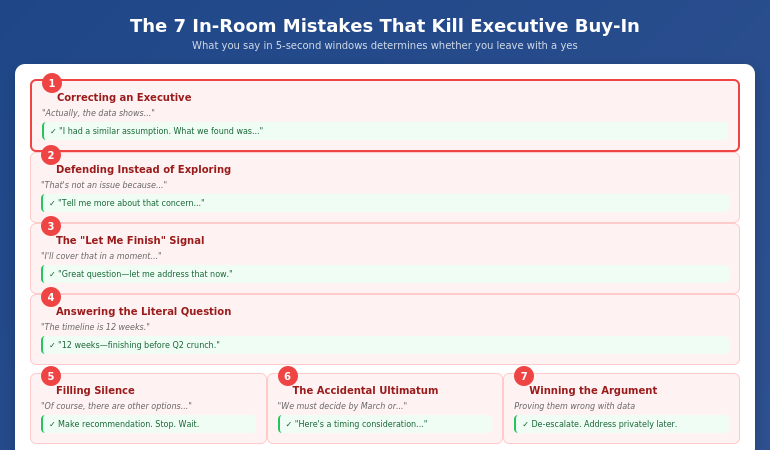
Quick answer: The most expensive executive presentation mistakes aren’t about slides, structure, or preparation. They’re about the words you say in critical moments—responding to a question, handling an objection, or reacting to resistance. I’ve lost deals with perfect decks and won deals with mediocre ones. The difference was almost always something I said (or didn’t say) in a 5-second window. This article covers the 7 in-room mistakes that kill executive buy-in and the exact language patterns that prevent them.

Why 5 Seconds Can Undo 5 Weeks of Work

After 24 years in corporate banking—JPMorgan Chase, PwC, Royal Bank of Scotland, Commerzbank—I’ve been in hundreds of rooms where deals lived or died. The pattern I’ve observed is humbling: preparation gets you to the table, but what you say in critical moments determines whether you leave with a yes.

Here’s why those 5-second windows matter so much:

Executives are constantly evaluating two things: your proposal AND you. They’re asking themselves: “Is this person someone I can work with? Do they listen? Do they get defensive? Will they be a problem when things go wrong?”

Your slides answer the first question. Your in-room behaviour answers the second.

A single defensive response can flip their mental model from “this person is competent” to “this person will be difficult.” And once that flip happens, your data doesn’t matter anymore. They’re not evaluating your proposal—they’re looking for reasons to say no.

The CFO I mentioned earlier? He later told my colleague: “The proposal was solid. But when I raised a concern, he made me feel stupid. I don’t want to work with someone who does that.”

I hadn’t made him feel stupid intentionally. I’d just corrected him. With data. Professionally.

But in executive dynamics, being right isn’t the same as being effective.

The 7 in-room mistakes that kill executive buy-in with fixes for each

Mistake #1: Correcting an Executive (Even When You’re Right)

This is the mistake that cost me £4M, and I see it constantly.

An executive says something that’s factually incorrect or based on outdated information. You have the data that proves otherwise. Your instinct is to correct them—politely, of course.

What you say: “Actually, the data shows something different…” or “That’s not quite accurate—let me explain…”

What they hear: “You’re wrong and I’m about to prove it in front of your colleagues.”

Executives have egos. More importantly, they have positions to protect. Correcting them publicly—even gently—triggers a defensive response. They stop listening to your content and start protecting their status.

What to say instead:

“That’s a really important point. I had a similar assumption initially. What we found when we dug deeper was…”

This does three things: validates their thinking, admits you once thought the same (so they’re not stupid for thinking it), and introduces new information as discovery rather than correction.

Or try: “You’re right that [acknowledge the valid part of their concern]. The piece that changed our thinking was…”

Find the kernel of truth in what they said—there almost always is one—and build from there rather than contradicting.

⭐ Master the Critical Moments That Win (or Lose) Executive Buy-In

The Executive Buy-In Presentation System teaches you exactly what to say—and what never to say—in the high-stakes moments that determine whether you get approval.

You’ll learn:

  • Language patterns that turn resistance into engagement
  • How to handle objections without triggering defensiveness
  • The psychology behind executive reactions (and how to work with it)
  • Scripts for the 10 most common deal-killing moments

See the Executive Buy-In System on Maven →

Cohort-based programme for senior professionals. See Maven for dates.

Mistake #2: Defending Instead of Exploring

When an executive raises an objection, your instinct is to address it. To explain why it’s not a problem. To defend your proposal.

This instinct is wrong.

What you say: “I understand the concern, but here’s why it’s not an issue…” or “We’ve actually addressed that—let me show you…”

What happens: You’ve just entered an adversarial dynamic. They raised a concern; you dismissed it. Now they have to either accept that their concern was invalid (unlikely) or push harder to prove they were right to raise it (likely).

I watched a colleague lose a £2M consulting engagement this way. The client mentioned concerns about timeline. My colleague immediately launched into a detailed explanation of why the timeline was achievable. Fifteen minutes of defending.

The client wasn’t asking for reassurance. She was asking to be heard.

What to say instead:

“Tell me more about that concern. What specifically worries you about [X]?”

Or: “That’s worth exploring. When you think about [the concern], what would need to be true for you to feel comfortable?”

This does something powerful: it moves you from opposing positions to the same side of the table. You’re now exploring the concern together, not defending against an attack.

Often, when you explore, you discover the stated concern isn’t the real concern. The executive worried about “timeline” might actually be worried about resource allocation, or political dynamics, or a past project that went badly. You can’t address the real concern if you’re busy defending against the stated one.

Mistake #3: The “Let Me Finish” Signal

You’re explaining a key point. An executive interrupts with a question. You say some version of: “I’m going to cover that in a moment” or “Let me just finish this thought” or “Hold that—I’ll get there.”

What you intend: Orderly presentation flow. You have a structure and you’re sticking to it.

What they experience: Their question isn’t important enough to answer now. You value your agenda over their curiosity.

Executives interrupt because something you said triggered a thought they want to explore. That interruption is engagement. It’s interest. It’s exactly what you want.

When you defer their question, you’re telling them their engagement doesn’t matter. Many will stop engaging entirely.

What to say instead:

“Great question—let me address that now.” Then answer it, even if it disrupts your flow. Your slides can wait. Executive engagement cannot.

If the question truly would be answered better with context from later slides: “That’s actually the perfect lead-in to the next section. Mind if I show you something that’ll help frame the answer?” Then go directly to that section.

The key insight: their agenda matters more than your agenda. Flexible presenters who follow executive interest build more trust than rigid presenters who stick to their script. If you struggle with staying composed when your flow is disrupted, see my article on how to stop rambling when nervous.

Mistake #4: Answering the Question They Asked

This sounds counterintuitive, but stay with me.

An executive asks: “What’s the implementation timeline?”

You answer: “Twelve weeks for phase one, then another eight weeks for full rollout.”

Factually accurate. Completely unhelpful.

Because the question behind the question was probably: “Is this going to disrupt Q2?” or “Will this conflict with the ERP migration?” or “Am I going to have to explain a delay to the board?”

The mistake: Answering the literal question without addressing the underlying concern.

What to say instead:

“Twelve weeks for phase one—so we’d complete before the Q2 crunch you’re navigating.” Or: “Twelve weeks, and I’ve coordinated with Sarah’s team to make sure we’re not competing for the same resources as the ERP work.”

If you don’t know the underlying concern, ask: “Before I answer, help me understand what’s driving that question. Is there a timing constraint I should know about?”

Executives are often asking about implications, not facts. The presenter who answers implications builds more trust than the one who answers facts.

⭐ Learn to Read What Executives Are Really Asking

The Executive Buy-In Presentation System teaches you to hear the question behind the question—and respond in ways that build trust instead of triggering resistance.

The programme includes:

  • Decoding executive questions: what they ask vs. what they mean
  • Response frameworks that address concerns without being defensive
  • Practice scenarios with real executive objection patterns
  • Recovery techniques when you sense you’ve lost the room

See the Executive Buy-In System on Maven →

For executives and senior professionals who present to decision-makers.

Mistake #5: Filling Silence

You make your recommendation. The room goes quiet. Executives are thinking.

The silence feels uncomfortable. So you fill it: “Of course, there are other options we could consider…” or “I know this is a big decision…” or “Let me show you a few more supporting points…”

What you’ve just done: Undermined your own recommendation. Signalled that you’re not confident. Given them reasons to delay.

Silence after a recommendation is often good. It means they’re processing. They’re considering. They’re taking you seriously.

When you fill that silence, you interrupt their processing. Worse, you often plant doubts that weren’t there: “Other options? Maybe I should ask about those.”

What to do instead:

Make your recommendation. Then stop talking. Let the silence sit for 5-10 seconds (it will feel like an hour). If you must say something, try: “I’m happy to answer questions, or if it would be helpful, I can walk through the alternatives we considered and why we landed here.”

Notice the difference: you’re offering to provide more information if they want it, not volunteering it out of nervousness.

The executives who get buy-in most consistently are comfortable with silence. They make their case, then wait. They project confidence by not needing to fill every gap.

Mistake #6: The Accidental Ultimatum

You’re trying to convey urgency. The window for this opportunity is closing. You want them to act.

What you say: “If we don’t move forward by March, we’ll lose this opportunity” or “This is a now-or-never situation.”

What they hear: You’re pressuring them. You’re trying to force a decision before they’re ready. You don’t trust them to make good choices on their own timeline.

Even if the urgency is real, framing it as an ultimatum triggers resistance. Executives don’t like being told what to do. They especially don’t like feeling manipulated into decisions.

What to say instead:

“I want to flag a timing consideration. The vendor’s pricing is locked until March 15th—after that, we’re looking at a 20% increase. I’m not trying to rush the decision, but I wanted you to have that context.”

Or: “There’s a window here that I think is worth noting. Here’s what changes if we move in Q1 versus Q2…” Then present the trade-offs neutrally.

The difference: you’re providing information for their decision, not pressuring them toward your preferred outcome. Same facts, different framing, completely different response.

Mistake #7: Winning the Argument, Losing the Room

An executive pushes back. Hard. They’re wrong—you can prove it. You have data, precedents, expert opinions. You can win this argument.

So you do. Point by point, you dismantle their objection. You’re thorough. You’re factual. You’re right.

And you’ve just lost the room.

Because every other executive watched you publicly defeat one of their peers. They’re now thinking: “If I raise a concern, will I get the same treatment?”

The room goes quiet. Not because they’re convinced—because they’ve decided not to engage. They’ll raise their concerns after you leave, in conversations you’re not part of, where decisions will be made without your input.

What to do instead:

When you sense an argument forming, de-escalate: “I think we might be looking at this from different angles. Can we step back? Help me understand the core concern here.”

Or try: “You’re raising something important. Let me make sure I understand it fully before I respond.”

If they’re genuinely wrong about something material, address it one-on-one after the meeting, not publicly in the room. Save their face. Preserve your relationship. Get the same outcome without the collateral damage.

For more on presenting to senior audiences without triggering these dynamics, see my guide on presenting to senior leadership.

What’s the most common mistake that kills executive buy-in?

Correcting executives publicly, even when you’re factually right. When you contradict an executive in front of their peers, you trigger a defensive response that has nothing to do with your proposal. They stop evaluating your idea and start protecting their status. Instead, validate first (“That’s an important point”), then introduce new information as discovery rather than correction (“What we found when we explored further was…”).

How do I handle executive objections without being defensive?

Explore before you defend. When an executive raises a concern, your instinct is to explain why it’s not a problem. Resist this instinct. Instead, ask: “Tell me more about that concern” or “What specifically worries you about that?” This moves you from opposing positions to exploring together. Often, the stated concern isn’t the real concern—and you can’t address what you don’t understand.

What should I do when an executive interrupts my presentation?

Answer their question immediately, even if it disrupts your flow. Interruptions are engagement—exactly what you want. When you defer with “I’ll cover that later,” you signal that your agenda matters more than their interest. Executives who feel unheard stop engaging. Your slides can wait; executive engagement cannot.

⭐ Stop Losing Deals in Critical Moments

The Executive Buy-In Presentation System gives you the exact language, frameworks, and practice you need to handle high-stakes moments without triggering resistance.

What you’ll master:

  • The psychology of executive decision-making under pressure
  • Scripts for the 10 most common buy-in killers
  • Recovery techniques when you sense you’ve lost the room
  • Practice scenarios with feedback from senior peers

See the Executive Buy-In System on Maven →

Cohort-based on Maven. See current dates and availability.

Frequently Asked Questions

Can I recover if I make one of these mistakes mid-presentation?

Sometimes. If you catch yourself early, you can course-correct: “Actually, let me reframe that. What I should have said was…” Acknowledging the misstep shows self-awareness. If you’ve lost an executive (they’ve gone quiet or defensive), consider addressing it directly: “I sense I may have missed something important in how I responded to your question. Can you help me understand what I should be considering?” Humility can recover what defensiveness cannot.

What if the executive is genuinely wrong about something material?

Address it privately if at all possible—after the meeting, one-on-one. If you must address it in the room, use the “I had the same assumption” frame: “That was actually my initial read too. What changed my thinking was…” This corrects without contradicting. You’re sharing a learning journey, not proving them wrong.

How do I know if I’ve lost the room?

Watch for: executives who were engaged going quiet, crossed arms or leaning back, checking phones or watches, questions that become pointed or skeptical rather than curious, and the senior decision-maker deferring to others (“What do you all think?”) instead of engaging directly. These signals don’t mean you’re definitely lost, but they warrant a check-in: “I want to pause and make sure we’re tracking. Is this addressing what matters, or should we shift focus?”

Is it better to prepare answers for tough questions or respond naturally?

Both. Prepare frameworks for common objection patterns, but don’t script word-for-word answers. Scripted responses sound rehearsed and often miss the nuance of the actual question. Know the categories of concerns you might face (timeline, cost, risk, resources, political implications) and have a general approach for each. Then listen carefully to the specific question and adapt. The combination of preparation and presence beats either one alone. For strategic pre-meeting work, see my guide on stakeholder mapping for presentations.

📧 The Winning Edge Newsletter

Weekly insights on executive presentations, stakeholder strategy, and the language patterns that win buy-in.

Subscribe Free →

The 5-Second Difference

That CFO who killed my £4M deal taught me something I couldn’t learn from any presentation training: what you say in critical moments matters more than everything else combined.

Preparation gets you in the room. Slides give you credibility. But the words you choose when an executive pushes back, questions your assumptions, or goes quiet—those 5-second windows determine whether you leave with a yes.

I’ve since learned to pause before responding to tough questions. To validate before correcting. To explore before defending. To welcome interruptions as engagement rather than disruption.

These aren’t natural instincts—they’re learned behaviours that feel wrong until you see them work.

The good news: once you recognise the patterns, you can prepare for them. You can practice the language. You can build the reflexes that turn deal-killing moments into deal-making ones.

Five seconds is long enough to lose everything. It’s also long enough to win.

18 Jan 2026
Presentation anxiety before meetings - the executive reset technique for calming nerves before high-stakes presentations

Presentation Anxiety Before Meetings: The Executive Reset That Actually Works

Presentation anxiety before meetings isn’t a character flaw—it’s your nervous system misfiring a protection response. The executives I’ve trained don’t eliminate anxiety; they reset it. The technique takes 5 minutes: interrupt the pattern, redirect the energy, and anchor to your message. This works whether you’re presenting to the board, leading a steering committee, or delivering a quarterly update to senior leadership.

If you want the complete system for conquering presentation anxiety—not just tips, but the psychological framework that creates lasting change—Conquer Speaking Fear gives you the tools I’ve used with hundreds of executives.

I spent five years terrified of presenting.

Not nervous. Terrified. The kind where you wake at 3am before a big meeting, heart pounding, rehearsing disaster scenarios. The kind where you sit in the car park for ten minutes because your hands won’t stop shaking.

I was a senior banker at JPMorgan Chase. I’d closed multi-million pound deals. But standing up in front of the executive committee? My body acted like I was being chased by a predator.

That’s what drove me to train as a clinical hypnotherapist. Not because I wanted to help other people—at first, I just wanted to fix myself.

What I discovered changed everything: presentation anxiety before meetings isn’t about confidence. It’s about your nervous system. And once you understand that, you can reset it.

Here’s the exact technique I now teach to executives who face the same thing I did.


⭐ Stop the Anxiety Spiral Before Your Next Meeting

A hypnotherapist’s toolkit for calming your nervous system when the dread kicks in.

Includes:

  • The 60-second reset you can do at your desk before walking in
  • Breathing patterns that interrupt the anxiety response
  • Physical grounding techniques that work in real time

Get Calm Under Pressure → £19.99

Created by a clinical hypnotherapist who’s helped hundreds overcome presentation anxiety.

Why Presentation Anxiety Hits Hardest Before Big Meetings

Your brain doesn’t distinguish between physical danger and social threat. When you’re about to present to the board, your amygdala fires the same alarm as if you were about to be attacked.

The result: cortisol floods your system. Your heart races. Your palms sweat. Your mind goes blank or starts racing through worst-case scenarios.

This isn’t weakness. This is evolution.

For most of human history, being rejected by the group meant death. Your brain learned to treat social evaluation as a survival threat. Standing in front of senior leaders—people who control your career, your income, your professional identity—triggers that ancient wiring.

The problem? Most advice tells you to “just relax” or “think positive thoughts.” That’s like telling someone with a racing heart to simply slow it down. The conscious mind doesn’t control the stress response.

What works instead: interrupt the pattern, redirect the energy, anchor to purpose.

This is the foundation of the work I do with executives who need to overcome fear of public speaking at a deeper level than surface-level tips provide.

The 5-Minute Executive Reset

This technique works because it addresses all three channels your nervous system uses: physical, cognitive, and intentional.

Do this 5-30 minutes before any high-stakes meeting. Not the night before (too early). Not as you walk into the room (too late). The sweet spot is the gap between arriving and presenting.

Phase 1: Interrupt (90 seconds)

Break the anxiety loop with a physical pattern interrupt. Options:

  • Cold water on your wrists and the back of your neck
  • 10 slow, deep exhales (exhale longer than inhale)
  • Squeeze your fists tight for 5 seconds, then release completely

Phase 2: Redirect (90 seconds)

Shift from threat-focus to task-focus. Ask yourself:

  • “What’s the ONE thing I need them to understand?”
  • “What decision do I need from this room?”
  • “What’s the best outcome for the people I’m presenting to?”

Phase 3: Anchor (2 minutes)

Connect to your purpose and competence:

  • Recall one specific moment when you presented well (even if small)
  • Remind yourself: “I know this material. I’ve done the work.”
  • Set one micro-intention: “I will speak slowly for the first 30 seconds”

This entire reset takes 5 minutes. It doesn’t eliminate anxiety—it channels it into focus.

Only have 2 minutes? Use the emergency version: splash cold water on your wrists, take three slow exhales, and say “I know this material. My only job is to help them understand one thing.” It covers all three phases in 30 seconds—enough to take the edge off before you walk in.

Want the full reset protocol?

Conquer Speaking Fear includes the complete nervous system reset—plus the deeper psychological work that makes the change permanent.

Get the Complete System — £39 →


The 5-minute executive reset for presentation anxiety showing the three-phase approach

Phase-by-Phase Breakdown: Why Each Step Works

Phase 1: Interrupt — Breaking the Loop

Anxiety feeds on itself. The more you notice your racing heart, the more it races. The more you worry about going blank, the more likely you are to go blank.

A physical pattern interrupt breaks this loop by giving your nervous system something else to process. Cold water works because it triggers the dive reflex—a parasympathetic response that naturally slows your heart rate. Deep exhales work because they activate the vagus nerve, signalling safety to your brain.

The key: make it physical, make it immediate, make it intense enough to notice.

Phase 2: Redirect — From Threat to Task

Anxiety narrows your focus onto threat. You start thinking about what could go wrong, who might judge you, how you might fail.

Redirection expands your focus back to the task. When you ask “What’s the ONE thing I need them to understand?”, you shift from self-focused fear to audience-focused purpose.

This is why well-prepared presenters often feel less anxious: their attention is on the message, not on themselves. If you’re presenting an OKR update to executives, knowing exactly what decision you need makes anxiety harder to sustain.

Phase 3: Anchor — Competence and Purpose

Your brain believes evidence over affirmation. “I’m confident” means nothing if your body doesn’t believe it. “Last month, I explained the Q3 results clearly and the CEO nodded—I can do this” is specific, real, and your nervous system responds to it.

The micro-intention (“I will speak slowly for the first 30 seconds”) gives you one thing to focus on when you start. It’s small enough to achieve, which builds momentum.


⭐ Pre-Meeting Anxiety Is a Body Problem — Not a Mindset Problem

These techniques work at the physiological level, so you’re not fighting your own nervous system.

Includes:

  • Vagus nerve activation that shifts you out of fight-or-flight
  • The calming sequence to use the morning of important meetings
  • Emergency reset when anxiety spikes 5 minutes before you present

Get Calm Under Pressure → £19.99

Used by executives who present to leadership, clients, and boards.

What to Do the Morning of a High-Stakes Meeting

The morning of a big presentation is when anxiety peaks. Here’s the routine I recommend to executives:

The night before:

  • Review your slides once—no more. Over-rehearsing increases anxiety.
  • Write down your opening sentence. Memorise just that.
  • Set your clothes out. Remove decision fatigue.

The morning:

  • Exercise if possible—even a 15-minute walk changes your neurochemistry
  • Eat protein, not sugar. You need stable energy, not a spike and crash.
  • Avoid checking emails about the presentation. New information creates new anxiety.

30 minutes before:

  • Run the 5-minute Executive Reset
  • Review your opening sentence and your closing ask
  • Arrive early enough to test tech and claim your space

This routine isn’t about eliminating nerves. It’s about arriving in a state where you can perform despite them.

For deeper work on building sustainable presentation confidence, the principles here are a starting point—but lasting change requires addressing the underlying patterns.

Ready to address the underlying patterns?

Conquer Speaking Fear goes beyond techniques to rewire how your nervous system responds to high-stakes presentations.

Get Conquer Speaking Fear — £39 →

People Also Ask

Why do I get so anxious before presenting at work?

Your brain interprets evaluation by senior colleagues as a social survival threat. This triggers the same fight-or-flight response as physical danger. It’s not weakness or lack of preparation—it’s your nervous system doing what it evolved to do. The solution isn’t to eliminate the response but to reset and redirect it.

How do I calm down before a big presentation?

Use a physical pattern interrupt (cold water, deep exhales, muscle tension-release), then redirect your focus from self to task by asking “What’s the one thing I need them to understand?” Finally, anchor to a specific moment of past competence. This 5-minute reset works better than generic deep breathing because it addresses all three channels: physical, cognitive, and intentional.

Is presentation anxiety a sign I’m not ready?

No. Many of the most prepared executives experience significant anxiety before high-stakes presentations. Anxiety is about perceived threat, not actual competence. The goal isn’t to feel no anxiety—it’s to perform well despite it. Some research suggests moderate anxiety actually improves performance by increasing focus and energy.

3 Mistakes That Make Presentation Anxiety Worse

Mistake 1: Over-Rehearsing the Night Before

Rehearsing more than twice the evening before a presentation increases anxiety, not confidence. Your brain starts finding new things to worry about. Review once, write down your opening line, then stop. Trust that you know the material.

Mistake 2: Trying to “Feel Confident”

Confidence isn’t a feeling you summon—it’s a result of action. Telling yourself to feel confident when your body is screaming threat creates cognitive dissonance that makes anxiety worse. Instead, focus on one small action: “I will speak slowly for the first sentence.” Action builds confidence; waiting to feel confident prevents action.

Mistake 3: Avoiding the Anxiety

The more you try to suppress or avoid anxiety, the stronger it gets. This is well-documented in psychology research. Instead, acknowledge it: “I notice I’m feeling anxious. That’s my nervous system doing its job. I’m going to do the reset and then present anyway.” Acceptance reduces the secondary anxiety—the anxiety about being anxious.

These mistakes are why quick tips often fail. The deeper approaches to calming nerves address the underlying patterns, not just the symptoms.


⭐ Ready to Stop Dreading Meetings Entirely?

Go beyond managing symptoms — rewire how your brain responds to presentations so the anxiety stops before it starts.

Includes:

  • The complete fear-to-confidence transformation system
  • Mental rehearsal techniques that build genuine calm
  • Cognitive reframing methods from clinical hypnotherapy

Get Conquer Speaking Fear → £39

The complete system for professionals who want to present without dread — not just survive it.

Frequently Asked Questions

How long does it take for the Executive Reset to work?

The reset itself takes 5 minutes and provides immediate relief for most people. However, lasting change—where you stop experiencing severe anticipatory anxiety—typically takes 4-8 weeks of consistent practice. The reset is a tool for the moment; the deeper work in Conquer Speaking Fear addresses the underlying patterns.

What if I have to present in 2 minutes and don’t have time for the full reset?

Use the 30-second emergency version: splash cold water on your wrists, take three slow exhales, and say to yourself “I know this material. My only job is to help them understand one thing.” This covers all three phases in compressed form. It won’t eliminate anxiety, but it will reduce it enough to perform.

Does this work for virtual presentations too?

Yes, and virtual presentations have advantages: you can do the reset without anyone noticing, keep notes visible off-camera, and control your environment. The same technique applies—interrupt, redirect, anchor—just adapted for the virtual context. Many executives find virtual presentations less anxiety-inducing once they learn to use the format strategically.

I’ve tried deep breathing and it doesn’t work for me. Will this be different?

Deep breathing alone often fails because it only addresses one channel (physical) and can actually increase focus on the anxiety. The Executive Reset works differently: it interrupts the anxiety loop, redirects cognitive focus away from threat, and anchors to competence and purpose. If deep breathing hasn’t worked, that’s exactly why this three-phase approach exists.

Get Weekly Confidence-Building Insights

Join executives who receive one actionable technique every week for presenting with confidence and clarity—even under pressure.

Subscribe to The Winning Edge →

Your Next Step

Presentation anxiety before meetings is your nervous system doing what it evolved to do. You can’t eliminate it by willpower, but you can reset it in 5 minutes.

The Executive Reset: Interrupt the loop (physical pattern break), redirect your focus (from self to task), and anchor to competence (specific past success + micro-intention).

Use it before your next high-stakes meeting. Notice what shifts.

And if you’re ready to do the deeper work—to change the pattern itself, not just manage the symptoms—Conquer Speaking Fear gives you the complete system I’ve developed from my own journey and 15+ years of working with executives who face the same thing.

Not ready to buy today? Start with this free resource:

Download the Executive Presentation Checklist—it includes a pre-meeting anxiety check that pairs with the reset technique above.

Download Free Checklist →

13 Dec 2025
What 24 years in banking taught me about high-stakes presentations

What 24 Years in Banking Taught Me About High-Stakes Presentations

📅 Updated: December 2025

What 25 years in banking taught me about high-stakes presentations

If you want a ready-made framework for executive presentations: Explore The Executive Slide System →

Templates, AI prompts, and scenario playbooks for building board-ready slides.

Quick Answer

Executive presentation training rarely teaches what actually matters. After 25 years $2 JPMorgan, PwC, RBS, and Commerzbank, I learned that high-stakes presentations aren’t won with better slides — they’re won with better preparation, political awareness, and the ability to read a room. The presenters who consistently got approvals weren’t the most polished speakers. They were the ones who’d done the work before they walked in.

🎁 FREE DOWNLOAD

Executive Presentation Checklist

12-point checklist I wish I’d had when I started. One page. Print it before your next big meeting.

Download Free Checklist →

No spam. Unsubscribe anytime.


I still remember my first presentation to JPMorgan’s Executive Committee.

I was 26. I’d spent three weeks building a 45-slide deck. I knew every number, every assumption, every footnote. I’d rehearsed my talking points until I could recite them in my sleep.

Seven minutes in, the Global Head of Operations held up his hand. “What’s the ask?”

I froze. My ask was on slide 38.

“I’ll… I’ll get to that,” I managed.

“I don’t have time for you to get to it. What do you want us to do?”

I fumbled forward, completely thrown off my script. The meeting ended with a polite “send us a one-pager” — which in banking means no.

That moment was the beginning of everything I know about high-stakes presentations.

Lesson 1: The Decision Happens Before the Meeting

Here’s what they don’t teach in executive presentation training: by the time you walk into that room, most decisions are already made.

At a UK hight street bank, I watched a colleague present a flawless recommendation for a £3M technology investment. Perfect slides. Clear ROI. Confident delivery.

The CFO said no in under two minutes.

What my colleague didn’t know: the CFO had already committed that budget to another initiative. The decision was made three weeks earlier in a conversation he wasn’t part of.

The best presenters I worked with at JPMorgan spent more time before the meeting than during it. They’d walk the halls, grab coffee with stakeholders, understand the politics. By the time they presented, they already knew who would support them, who would push back, and what objections they’d face.

The presentation wasn’t where they made their case. It was where they confirmed what they’d already built.

Lesson 2: Executives Buy Confidence, Not Content

In 2008, I was presenting a risk assessment to the bank’s board during the financial crisis. Markets were collapsing. Nobody knew what would happen next.

I had two options: present the uncertainty honestly, or project confidence I didn’t feel.

I chose honesty. I said: “I don’t know what’s going to happen. Nobody does. But here’s what we do know, here’s what we’re watching, and here’s how we’ll respond to each scenario.”

After the meeting, the Chief Risk Officer pulled me aside. “That was the most credible presentation I’ve seen all week. Everyone else is pretending they have answers. You gave us a framework for decisions we can actually make.”

Confidence isn’t about having all the answers. It’s about being clear on what you know, what you don’t know, and what you recommend despite the uncertainty.

Executives don’t expect you to predict the future. They expect you to help them make good decisions with incomplete information. That’s what they do every day.

If you want the slide frameworks distilled from decades of corporate presenting, The Executive Slide System gives you 22 ready-made templates to start from.

Seven lessons from 25 years of banking presentations

Lesson 3: Your Slides Are Not Your Presentation

At PwC, I worked with a partner who was legendary for client presentations. He’d walk in with three slides — sometimes two — and walk out with seven-figure engagements.

I once asked him how he did it.

“The slides are a prop,” he said. “They’re not the show. The show is what happens in the room. The conversation. The questions. The moment you see them lean forward because you’ve said something that matters to them.”

He was right. I’ve seen beautiful 50-slide decks put people to sleep. I’ve seen scribbled whiteboards close deals.

The difference isn’t the slides. It’s the presenter’s ability to:

  • Read the room and adjust in real-time
  • Answer questions they didn’t prepare for
  • Make the audience feel heard, not talked at
  • Create space for the decision to emerge naturally

Related: Executive Presentation Template: 12 Slides That Command the Room

📄
Want the Checklist?

12 things to do before every executive presentation. The prep work that actually matters.

Download Free →

Build Your Next High-Stakes Presentation in Under an Hour

The Executive Slide System gives you 10 board-ready slide templates and 30 AI prompt cards.

Executive Slide System — £39, instant access.

  • 10 executive presentation templates (QBR, board update, budget request, and more)
  • 30 AI prompts to build each slide type in minutes
  • Narrative structure built in — no blank-slide panic

Designed for directors and senior managers who present to boards, leadership teams, and investors.

Lesson 4: The Question You Don’t Expect Will Define You

At a US Investment Bank., I was presenting a £8M operations initiative to the regional CEO. Everything was going perfectly. Slides landing. Heads nodding. I was about to close with my ask.

Then the CEO asked: “What happens to the 47 people in Mumbai whose jobs this eliminates?”

I hadn’t prepared for that question. It wasn’t in my risk assessment. It wasn’t in my stakeholder analysis. I’d been so focused on ROI and efficiency that I’d completely missed the human element.

I stumbled through something about “redeployment opportunities” and “natural attrition.” It was vague and everyone knew it.

The CEO said: “Come back when you’ve thought about the people, not just the numbers.”

That presentation taught me something that’s shaped every executive conversation since: the question you don’t expect reveals what you haven’t thought through. And executives notice.

The best way to prepare for unexpected questions isn’t to anticipate every possible question. It’s to think more broadly about your recommendation in the first place. Who’s affected? What could go wrong? What would make you change your mind?

Related: How to Present to a CFO: The Finance-First Framework

Lesson 5: Vulnerability Builds More Trust Than Perfection

This one took me years to learn.

Early in my career, I thought executive presentations were performances. I needed to appear competent, polished, in control. Any sign of uncertainty was weakness.

Then I watched a Managing Director at RBS do something that changed my perspective.

She was presenting a strategy that had partially failed. Instead of burying the failure in positive spin, she opened with: “I want to tell you what went wrong, what I learned, and what I’d do differently.”

The room leaned in. For the next 20 minutes, she had complete attention. When she finished, the Chief Executive said: “That’s the most useful strategy review I’ve heard this year.”

She got more budget, not less.

Executives are surrounded by people telling them what they want to hear. Honesty — even uncomfortable honesty — is rare and valuable. The presenter who admits what didn’t work, explains why, and shows they’ve learned is more credible than the one with a perfect track record they can’t explain.

Lesson 6: Presence Trumps Content Every Time

At Commerzbank, I sat through hundreds of presentations. I started noticing a pattern.

The presenters who got approvals weren’t always the ones with the best analysis. They were the ones who:

  • Walked in like they belonged there
  • Made eye contact with decision-makers, not their slides
  • Spoke at a pace that commanded attention
  • Paused after making important points
  • Handled pushback without getting defensive

Executive presence is hard to define but easy to recognise. You know it when you see it. And it’s not about being the most charismatic person in the room — some of the most effective presenters I’ve worked with were quiet, understated people who simply projected certainty.

It can be learned. I’ve seen people transform their presence in a matter of months. But it requires deliberate practice, feedback, and usually someone who can show you what you can’t see in yourself.

Lesson 7: AI Won’t Save You

I’ve been using AI tools for presentations since they became available. They’re remarkable for certain things — generating first drafts, formatting consistently, iterating quickly.

But here’s what 24 years taught me that no AI can replicate:

  • Knowing that the CFO and COO don’t speak to each other, so you need separate pre-meetings
  • Sensing that the room has turned and you need to skip ahead
  • Hearing the question behind the question
  • Building relationships that mean your call gets answered

AI makes the mechanical parts of presentations faster. That’s valuable. But the mechanical parts were never the hard part.

The hard part is everything that happens between humans — the trust, the politics, the unspoken dynamics. That’s where presentations are won or lost. And that hasn’t changed in 24 years.

Related: Why AI Won’t Replace Presentation Skills (But Will Amplify Them)

The best presenters spent more time before the meeting than during it

The presentation is the opening act. The Q&A is where trust is built or lost.

The Executive Slide System gives you the frameworks to structure both.

Executive Slide System — £39, instant access.

Designed for executives who present where decisions are made.

What I’d Tell My 26-Year-Old Self

If I could go back to that first JPMorgan Chase presentation, here’s what I’d say:

Stop building slides. Start building relationships. The people in that room are more important than anything on your screen. Know what they care about before you walk in.

Lead with the ask. Respect their time. Tell them what you want, then justify it. Not the other way around.

Prepare for the conversation, not the presentation. Your slides will take 15 minutes. The Q&A will take 45. Prepare accordingly.

Get comfortable being uncomfortable. The moment that terrifies you — the hard question, the pushback, the silence — is where trust is built. Don’t run from it.

Find people who’ll tell you the truth. You can’t see your own blind spots. Get feedback from people who’ll be honest, not kind.

Why I Started Teaching This

After 25 years in banking, I’d collected a lot of lessons. Most of them learned the hard way.

When I moved into training, I discovered that most executive presentation training focused on the wrong things. Slide design. Speaking techniques. Body language tips.

All useful. But none of it addressed what actually determines outcomes: the strategic preparation, the stakeholder management, the ability to read a room and adapt in real-time.

So I built a programme that teaches what I wish I’d known at 26. Not theory — the actual skills and frameworks that worked in real boardrooms with real money on the line.

Reading vs. Doing

What You Get Free Articles AI-Enhanced Mastery (£249)
Awareness of what matters
structured frameworks (AVP, 132, S.E.E.) Mentioned ✓ Deep training
8 structured learning modules ✓ Self-paced
Live coaching sessions ✓ 2 sessions
Templates & prompt packs Examples ✓ Full library
Before/after transformations ✓ Real examples
Outcome Know what to do Actually do it

Frequently Asked Questions

How is executive presentation training different from regular presentation skills?

Regular presentation training focuses on delivery — how to stand, how to speak, how to use slides. Executive presentation training focuses on outcomes — how to get decisions, how to manage stakeholders, how to handle high-stakes situations. The audience, the stakes, and the dynamics are fundamentally different.

Can presentation skills really be taught?

Yes, but not through lectures. The skills that matter — reading a room, handling pushback, projecting confidence — require practice with feedback. That’s why the Maven course includes live coaching sessions, not just video content.

What if I don’t work in banking?

The principles apply across industries. I’ve trained executives in biotech, SaaS, consulting, and manufacturing. The dynamics of high-stakes presentations — managing stakeholders, leading with conclusions, handling tough questions — are universal.

How long does it take to see improvement?

Most people see significant improvement within their first 2-3 presentations after training. The frameworks give you structure immediately. The confidence builds with practice.

📧
The Winning Edge Newsletter

Weekly insights on executive presentations from 16 years of training executives leaders. No fluff. No theory. Just what works.

Subscribe Free →

Related Reading

About the Author

Mary Beth Hazeldine spent 25 years in corporate banking at JPMorgan Chase, PwC, Royal Bank of Scotland, and Commerzbank before moving into executive training. She teaches at Winning Presentations and is launching the AI-Enhanced Presentation Mastery course in January 2026.