

Business Presentation Skills Training UK: What Executive Programmes Actually Deliver
Quick Answer
Business presentation training in the UK ranges from half-day workshops on slide design to comprehensive programmes covering executive-level structure, stakeholder analysis, and AI-assisted preparation. What separates credible programmes from generic courses is specificity: training built around the presentation types executives actually deliver — board updates, investment committee pitches, budget proposals — rather than general public speaking advice.
Jump to section:
Parveen had been a divisional director at a FTSE 250 for three years when her CEO asked her to present the digital transformation business case to the board. She knew the material — she had built the strategy herself. What she lacked was a framework for structuring a twenty-minute argument that would convince eight non-executive directors to approve £12 million. She searched for presentation skills courses and found dozens: a £49 online course promising “boardroom confidence in two hours,” a £3,500 two-day London workshop, and everything in between. The cheaper options covered slide design and body language. The expensive workshops focused on group role-plays with no connection to investment committee dynamics. None addressed her actual challenge: structuring an argument so a sceptical board understood the recommendation before slide three. She eventually found a programme that broke executive presentations down by scenario — board approvals, budget pitches, stakeholder updates — and gave her a methodology she could apply to this case and every presentation after it. The board approved the investment on the first hearing. The difference was not confidence. It was structural.
If you want a structured programme designed for executives who present at board level and to senior stakeholders — the AI-Enhanced Presentation Mastery programme covers executive structure, stakeholder analysis, and AI-assisted preparation across 8 modules. Explore AI-Enhanced Presentation Mastery →
What Executive Presentation Training Should Cover
The challenges executives face are fundamentally different from those addressed by general presentation courses. A finance director presenting a restructuring proposal to a board needs a structural methodology that sequences the argument for a sceptical audience under time pressure — not tips on slide transitions or vocal projection.
Credible executive training addresses four capabilities. First, structural methodology — how to lead with the recommendation, position evidence strategically, and address risk before the audience raises it. Second, stakeholder analysis: a board of non-executive directors evaluates differently from an investment committee, which evaluates differently from a leadership team. Training that treats all audiences as interchangeable produces presentations that are competent but not persuasive.
Third, scenario-specific practice. The presentation types executives deliver — annual budget presentations, risk committee updates, project approvals — each have their own structural logic. Generic role-plays miss this entirely. Fourth, Q&A preparation: for many executives, it is the question-and-answer session that determines the outcome, not the presentation itself.
If you are evaluating training options, the guide on choosing a presentation skills course for executives provides a detailed comparison framework.
A Complete Executive Presentation Programme — Self-Paced, Structured, Practical
AI-Enhanced Presentation Mastery covers the full executive presentation skill set: structural methodology, stakeholder analysis, AI-assisted preparation, and delivery under pressure. Self-paced. 8 modules. 83 lessons. £499/seat.
- ✓ 8 structured modules covering executive presentation methodology
- ✓ 83 lessons — work through at your own pace, no deadlines
- ✓ 2 optional live coaching sessions with Mary Beth (fully recorded)
- ✓ AI-assisted preparation techniques for faster, sharper presentations
Explore the Programme → £499/seat
Enrolment is open — join at your own pace. Self-paced. 8 modules. 83 lessons. Optional coaching sessions — fully recorded.
Red Flags in Budget Presentation Courses
Many courses marketed as “executive” or “advanced” are repackaged entry-level content with a higher price tag. Knowing what to avoid saves money and the opportunity cost of training that does not transfer to the presentations you actually deliver.
Generic content with executive branding. If the curriculum covers slide design basics, vocal projection, and “power poses” without addressing structural logic for board-level presentations, it is designed for a general audience regardless of how it is marketed.
One-day transformation promises. Complex skills do not transfer in a single workshop. Programmes that promise “boardroom confidence in eight hours” are selling motivation, not capability. Lasting improvement requires structured practice across scenarios, with feedback.
No scenario differentiation. A risk committee presentation requires a fundamentally different structure from a team strategy update. Courses that teach one framework for all contexts miss the point.
Trainer credentials without executive experience. Trainers with backgrounds in theatre or general communication may teach delivery well but struggle with executive-level structure. Look for trainers with corporate experience at the level you present to.
What Good Programmes Actually Include
The programmes that consistently improve executive presentation performance share several characteristics worth understanding before you evaluate marketing pages.
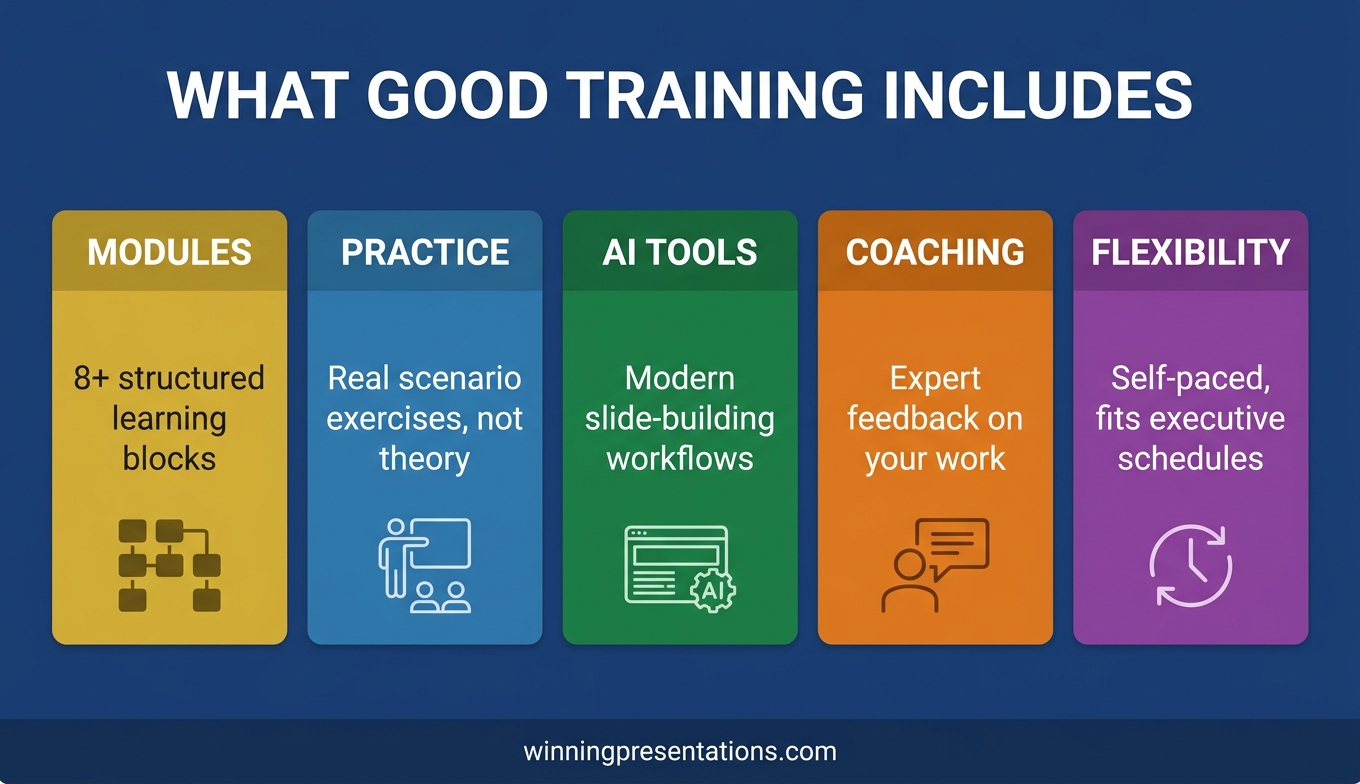
A repeatable structural methodology. The best programmes teach a framework covering argument sequencing (recommendation first, evidence second, risk addressed early), headline construction, and audience-specific framing. Once learned, this methodology accelerates preparation for every future presentation.
Scenario-based modules. Effective programmes break executive presentations into distinct types — board updates, budget proposals, investment pitches, strategic reviews — and address the structural logic of each.
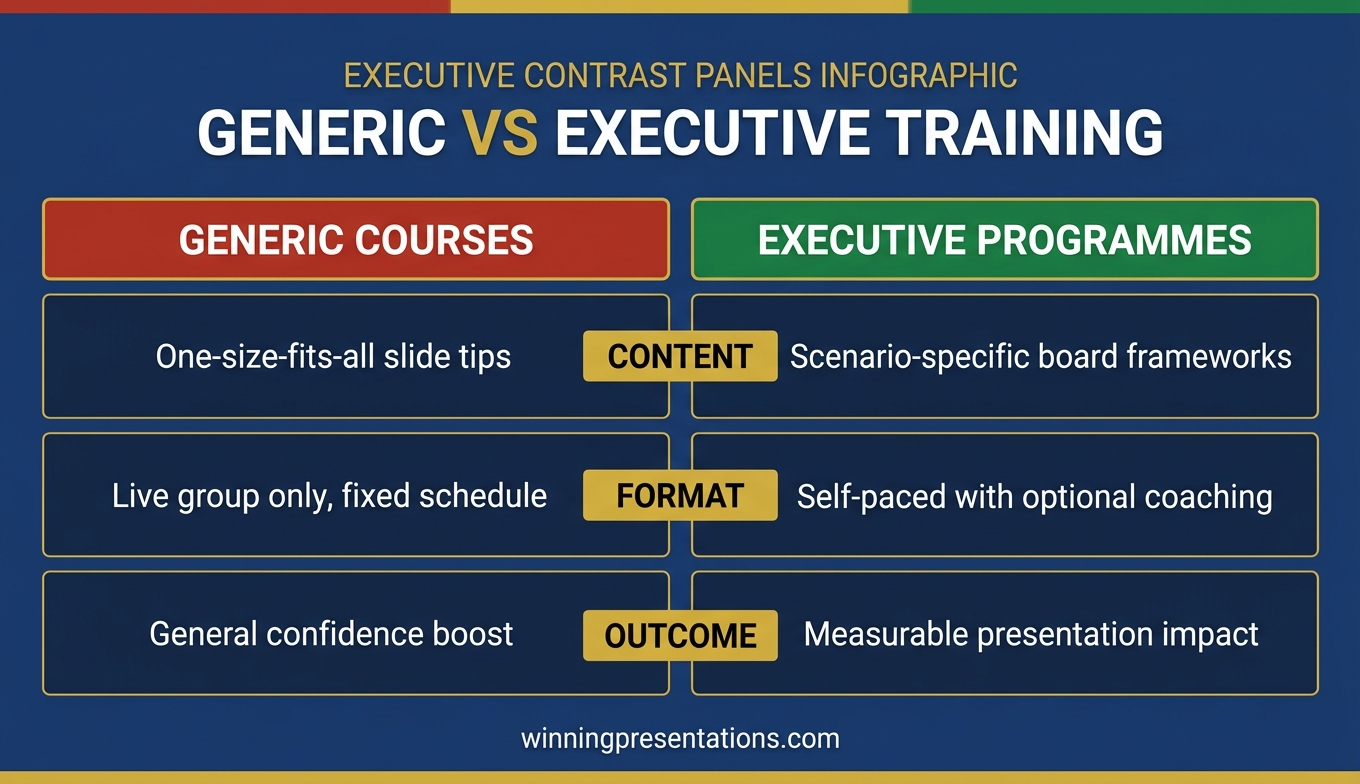
AI integration. The most current programmes now incorporate AI-assisted preparation — teaching executives how to use tools like Copilot, ChatGPT, or Gemini effectively for presentation development. The critical distinction is between programmes that teach prompt engineering for executive scenarios specifically (where the structural methodology informs the AI prompts) and those that simply demonstrate generic AI features.
Flexible access. Senior executives rarely have the schedule flexibility for multi-day residential workshops. Programmes that offer self-paced learning — with optional live coaching for those who want direct feedback — respect the reality that most participants are fitting professional development around demanding roles.
For a deeper look at what distinguishes executive-level courses from standard offerings, the guide on executive presentation masterclasses online examines what the market currently offers and where the gaps remain.
Do presentation courses improve confidence?
Confidence in executive presentations is primarily a function of preparation quality, not personality. Executives who have a clear structural methodology — who know their recommendation is on the right slide, their evidence is sequenced correctly, and their risk mitigation is positioned before the audience raises it — present with significantly more confidence than those relying on general delivery techniques. The most effective training builds confidence indirectly, by giving presenters a reliable preparation framework rather than coaching them to “appear confident” through body language adjustments.
Self-Paced Versus Live Formats
The format question — self-paced online learning versus live workshops — is one of the first decisions when choosing presentation skills training. Both formats have genuine strengths, and the right choice depends on the executive’s primary gap.
Self-paced programmes work well for structural skills. Learning how to sequence an argument or prepare for board-level Q&A does not require a live instructor. These skills benefit from reflection and application — working through a module, applying the framework to an upcoming presentation, then returning with real experience to build on.
Live workshops have an advantage for delivery feedback: pacing, presence, and the ability to read the room. However, for executives whose primary challenge is structural, a live workshop may address the symptom (delivery confidence) while missing the cause (weak argument architecture).
The hybrid model — self-paced structural methodology with optional live coaching — is increasingly common and offers the benefits of both.
The AI-Enhanced Presentation Mastery programme uses this hybrid approach — 83 self-paced lessons covering executive methodology, with two optional live coaching sessions that are fully recorded for those who cannot attend in real time.
How long does it take to improve presentation skills?
Structural presentation skills — argument sequencing, headline framing, evidence positioning — can be applied immediately. An executive who learns to lead with the recommendation rather than build up to it will see an immediate difference in how board members engage with their next presentation. Delivery skills take longer because they involve habit change, but most executives see noticeable improvement within four to six weeks of structured practice. The key is consistent application: each presentation becomes a practice opportunity when you have a methodology to apply.
How to Evaluate the ROI of Presentation Training
Most organisations evaluate training on satisfaction scores rather than on whether it changed presentation outcomes. A more useful framework looks at three indicators.
Preparation time. Presentations that currently take four to six hours should take one to two hours after effective training. If the programme provides structural frameworks, preparation becomes assembly rather than invention. This saving alone often justifies the investment.
Decision outcomes. If an executive consistently faces “come back next month with more detail” responses, the issue is almost always structural. Effective training reduces the number of presentations that require a follow-up session before a decision is reached.
Stakeholder feedback quality. After effective training, questions shift from “what are you asking us to approve?” to substantive challenges — assumptions, implementation detail, risk mitigation. This shift indicates the audience is engaging with the argument rather than struggling to find it.
For senior leaders preparing for high-stakes scenarios, the article on senior executive presentation skills explores the specific capabilities that distinguish competent presenters from genuinely persuasive ones at the highest levels.
Invest in the Methodology, Not Just the Motivation
AI-Enhanced Presentation Mastery is a self-paced programme for executives who want a repeatable system for structuring presentations that win decisions. 8 modules. 83 lessons. 2 optional coaching sessions. £499/seat — a career investment that applies to every high-stakes presentation from this point forward.
Explore the Programme → £499/seat
Self-paced. 8 modules. 83 lessons. Optional coaching sessions — fully recorded.
Choosing the Right Programme for Your Role
The “right” programme depends on the gap you are trying to close.
If your gap is structural — you know the material but struggle to build arguments that land with senior audiences — prioritise programmes that teach methodology, not delivery coaching. Look for modules organised by scenario type rather than skill type.
If your gap is delivery — your content is sound but you struggle with nerves or presence — a programme with live coaching is more valuable. For executives dealing with genuine anxiety, the guide on managing stomach-churning nerves before presentations addresses the physiological dimension that many programmes overlook.
If your gap is both — common for executives promoted into roles requiring more senior presentations — a comprehensive programme covering structure, preparation, and delivery is the most efficient path.
Finally, evaluate the trainer. The most credible trainers have worked directly with senior leaders in corporate environments, not just taught presentation skills in academic settings. Industry experience gives them an understanding of the decision dynamics and political sensitivities that shape how executive presentations succeed or fail.
Can AI replace presentation training?
AI tools accelerate preparation but do not replace the structural knowledge that determines whether a presentation persuades a senior audience. If the executive does not know the correct structure for a board approval versus a budget proposal, AI output will be fluent but structurally generic. The most effective approach combines structural training with AI tools. Without the structural foundation, AI produces more slides faster — but they remain the wrong slides for executive audiences.
Frequently Asked Questions
How much does executive presentation training cost in the UK?
Executive presentation training in the UK ranges from under £100 for self-paced digital programmes to £2,000–£5,000 per day for bespoke in-person delivery with a senior consultant. Mid-range options — typically £300–£800 — often include structured modules, scenario-based exercises, and some form of coaching or feedback. The price alone does not determine quality; what matters is whether the programme addresses the specific presentation types you deliver (board updates, investment committee pitches, stakeholder proposals) rather than generic public speaking or slide design.
What should executive presentation training include?
Credible executive presentation training should cover four areas: structural methodology (how to sequence arguments for senior audiences), stakeholder analysis (adapting content and delivery to different decision-makers), scenario-specific practice (board presentations, budget proposals, executive approvals — not generic role-plays), and a framework for handling Q&A under pressure. Programmes that focus primarily on body language, vocal projection, or slide design are typically designed for general business audiences, not executives presenting at board level or to investment committees.
Is online presentation training as effective as in-person?
For structural and strategic presentation skills — how to frame an argument, sequence evidence, and build a recommendation — online training can be equally effective, particularly when delivered as self-paced modules that allow executives to apply concepts between sessions. Where in-person training has an advantage is in real-time delivery feedback: body language, voice modulation, and room presence. The best approach depends on what the executive needs most. If the gap is structural (decks that fail to persuade despite clear delivery), online or self-paced programmes address the core issue efficiently.
How do I choose the right presentation training programme?
Start by identifying the specific gap: is the challenge structural (arguments that do not land with senior audiences), delivery-related (nerves, pacing, presence), or both? Then evaluate programmes against four criteria: does it address your specific presentation scenarios (not just generic business contexts), does the trainer have credible experience with senior audiences, does it include practical application (not just theory), and does the format fit your schedule (self-paced versus scheduled workshops)? Avoid programmes that promise transformation through a single workshop — presentation skills improve through structured practice, not one-off sessions.
The Winning Edge
Weekly insights on executive presentations, stakeholder communication, and career-defining moments at the podium — for professionals who present at the highest stakes.
About the author
Mary Beth Hazeldine is the Owner & Managing Director of Winning Presentations. With 24 years of corporate banking experience at JPMorgan Chase, PwC, Royal Bank of Scotland, and Commerzbank, she advises executives across financial services, healthcare, technology, and government on structuring presentations for high-stakes scenarios.