Tag: executive communication training

03 May 2026
Diverse small group of three senior executives gathered around a polished wooden meeting table in a modern executive learning environment, leaning slightly forward and engaged

Presentation Skills Workshop for Executives: How to Choose One That Works

Quick Answer: A presentation skills workshop for executives is the wrong format if it teaches the basics of slide design or public speaking. The right one starts from the assumption that you can already present and works on the structural patterns that earn senior decisions — deck architecture, decision-first framing, and Q&A under pressure. Self-paced formats with optional live coaching now outperform multi-day in-person workshops for most senior calendars.

Rafaela had been promoted to chief operating officer of a mid-market healthcare company three months earlier. She knew her board was watching her quarterly presentations more closely than her predecessor’s. She was already a competent presenter — she had been doing it for fifteen years. What she needed was a structural step-up. She asked her HR partner to find her “a good presentation skills workshop for executives”.

What came back was a list of seven options. A two-day in-person residential at a well-known leadership institute (£3,500). A six-week live cohort programme delivered by a US-based university (£2,800). A self-paced online programme with optional live coaching (£499). A one-on-one coaching arrangement at £850 per session. Three local UK training providers offering customised in-house workshops at varying price points.

She did not know how to evaluate them. Most of the marketing copy promised the same outcomes. The price range was wide enough that “you get what you pay for” felt unreliable as a heuristic. She wanted to know what an executive at her level should actually look for, not what the brochures said.

If you are evaluating presentation training for an executive role

The Maven AI-Enhanced Presentation Mastery programme is built specifically for senior leaders — self-paced, with optional live coaching, designed around real executive scenarios rather than generic public speaking technique.

Explore the Programme →

Why most presentation workshops fail senior leaders

Most presentation skills workshops are designed for an audience that does not match a senior executive’s situation. The implicit user is a mid-career professional who needs to learn the basics of slide design, vocal projection and structuring a presentation. The content reflects that.

For a senior executive, this is the wrong starting point. You can already structure a presentation. You can already deliver in front of a room. The skill gap is structural and audience-specific: how to architect a deck that earns a decision from a risk-averse CEO, how to handle Q&A from an investment committee, how to land a strategic case in front of a board that is allocating capital. A workshop that spends two hours on body language fundamentals is wasting the time of an executive who needs the next-level material.

Three patterns of workshop that frequently underperform for senior leaders:

The all-purpose corporate training course. Often delivered by HR-procured providers, designed for cohorts that include managers, technical leads and senior leaders together. The content is set at the level of the most junior participant. The senior executive learns nothing new and dis-engages within the first hour.

The motivational keynote speaker. Polished delivery, strong presence, branded methodology. The content is largely about confidence, charisma and personal storytelling. None of it transfers to a Tuesday morning capex committee. Senior leaders who attend these report enjoying them and applying very little.

The residential leadership institute. Multi-day, expensive, designed around peer learning and reflection. Useful for mid-career leaders building their executive identity. Less useful for an executive who needs specific structural fixes for the meetings they have on the calendar this quarter. The cost-to-applicability ratio is poor.

What an executive-grade workshop actually teaches

An executive-grade presentation programme — whether delivered as a workshop, a course, or a coaching engagement — covers a specific set of competencies that the generic workshops skip.

  • Deck architecture by audience type. A board deck, a finance committee deck, an investor pitch and a customer presentation each have different structural rules. A workshop that teaches “how to structure a deck” generically teaches none of them well.
  • Decision-first framing. The opening sentence, opening slide and opening five minutes of any high-stakes executive presentation should anchor the decision being asked for. Most generic workshops still teach “tell them what you’re going to tell them” openings, which actively hurt executive credibility.
  • Risk and downside structure. Senior executives present to senior decision-makers, who are usually risk-aware. The structure for surfacing downside, naming residual risk and proposing mitigation is what earns approval — and it is rarely covered in generic training.
  • Q&A under pressure. The hostile question, the question you cannot answer, the question that reveals a gap in your case — all of these have specific techniques that the generic workshops do not address.
  • Remote, hybrid and in-person variants. The structural rules for each format differ enough that an executive needs to be fluent in all three. A workshop that only addresses one format is incomplete.
  • Slide design at executive standard. Not “use less text”. Specific patterns — the question-led title, the headline-answer slide, the appendix navigation pattern — that experienced executives recognise as senior.
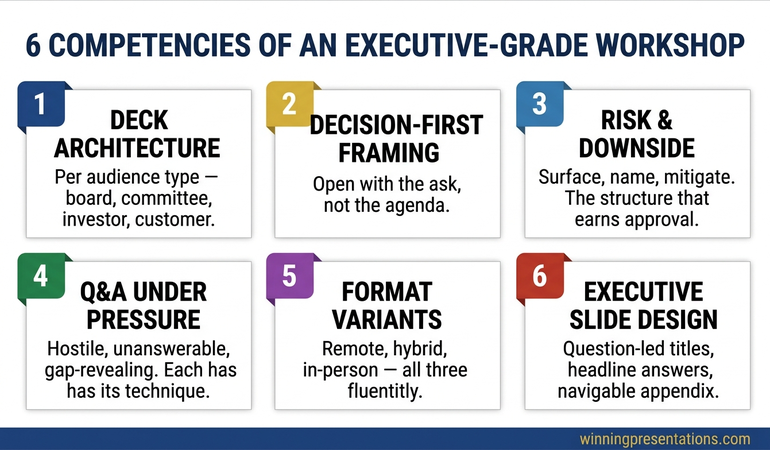
Stacked cards infographic showing the six competencies an executive-grade presentation skills workshop must cover: deck architecture by audience, decision-first framing, risk and downside structure, Q&A under pressure, format variants, executive slide design

If a programme cannot show you specifically how it teaches each of these six competencies, it is not built for an executive audience — regardless of how the marketing positions it.

MAVEN AI-ENHANCED PRESENTATION MASTERY — £499

A self-paced executive programme with optional live coaching

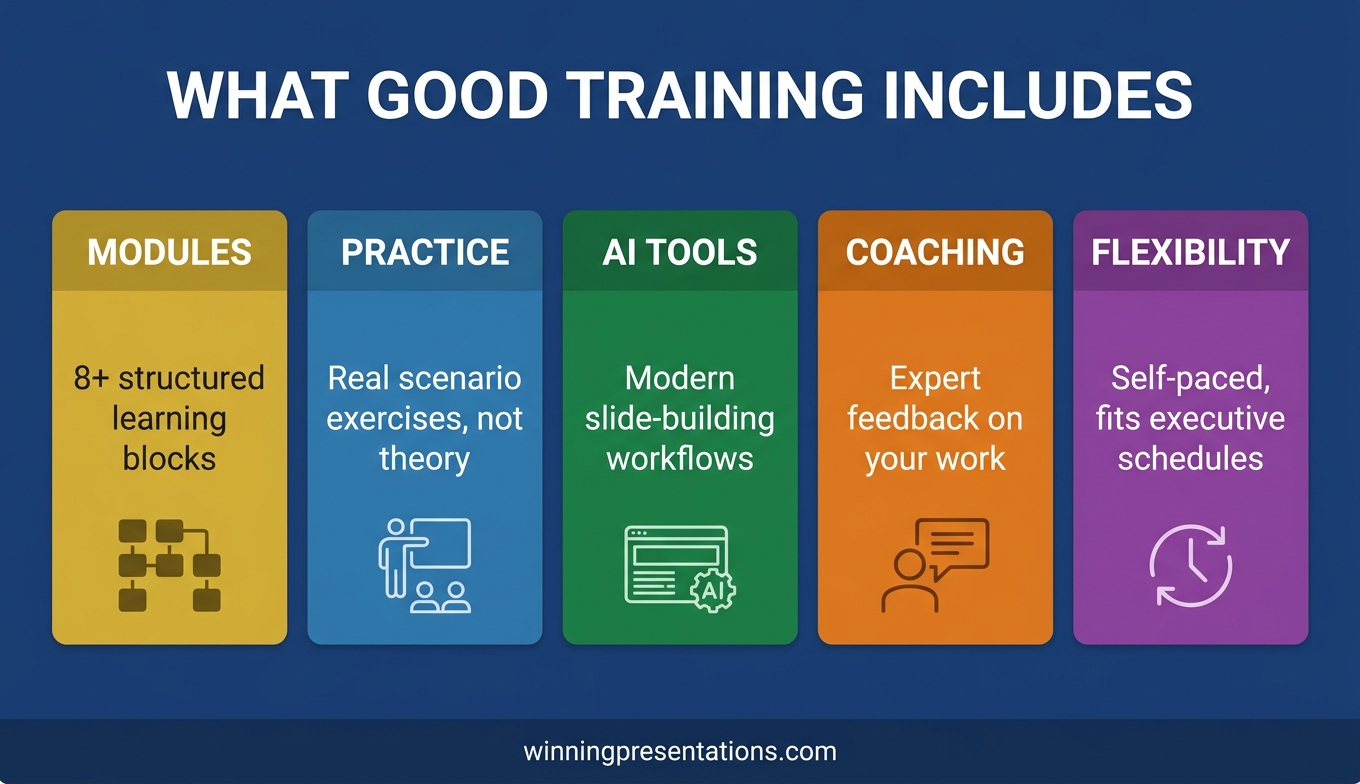
AI-Enhanced Presentation Mastery is the self-paced Maven programme for senior leaders — 8 modules, 83 lessons, optional live coaching sessions with Mary Beth (fully recorded). Built around the executive scenarios listed above, with AI-assisted slide preparation patterns. New cohorts open every month. £499 per seat. Enrolment is open — join at your own pace.

Explore the Programme →

Designed for senior leaders presenting to boards, investment committees and senior stakeholders.

Formats: live, self-paced, hybrid

The format question matters as much as the content question. A two-day in-person residential delivers content that a five-hour self-paced programme can also deliver, often at a fraction of the price. The choice depends on what an executive actually needs.

Live in-person workshop (1–3 days). Best for: leaders whose primary need is peer interaction, role-play and direct feedback in front of others. Cost typically £1,500–£5,000 per seat. Time investment is significant — including travel, this is usually 3–5 days out of the calendar.

Live virtual cohort (multi-week). Best for: leaders who value structured pacing, peer accountability and live discussion but cannot lose multiple days to travel. Cost typically £500–£3,000. Calendar load is 1–2 hours per week over several weeks.

Self-paced online programme. Best for: senior executives whose calendars cannot accommodate fixed live sessions. Cost typically £200–£800. Time investment is fully under the executive’s control. The trade-off is no live peer cohort — though some self-paced programmes now offer optional live coaching to bridge this.

One-on-one coaching. Best for: a specific upcoming high-stakes presentation, or a leader who has identified one or two structural patterns to fix. Cost typically £400–£1,500 per session. Highly targeted; less suited to broader skill development.

Hybrid programmes. A growing number of providers now combine self-paced course material with optional live coaching sessions and an asynchronous cohort. This is the format that has performed best for the senior executives I work with in 2025–2026 — it removes the calendar pain of pure live programmes while preserving access to coaching when it is genuinely useful.

The Maven AI-Enhanced Presentation Mastery programme runs in this hybrid format: self-paced lessons with optional, fully recorded live coaching sessions and a community of peers progressing at their own pace.

For executives whose specific need is the senior-stakeholder presentation skill set, the related senior executive presentation skills guide covers the competency map in more detail.

The questions to ask any provider before committing

Five questions that will quickly tell you whether a presentation skills workshop is built for senior executives or for a broader audience.

Who is the typical participant? The right answer is some version of “senior leaders, executives, partners, directors”. The wrong answer is “professionals at all levels”. A workshop that aims at all levels will land at the level of the most junior participant.

Can you show me the curriculum module by module? A serious provider can. A provider running a generic workshop will offer marketing language (“you’ll discover the secrets of…”) instead of specific module titles. The curriculum tells you what the workshop actually teaches.

What real-world executive scenarios does the programme work through? The right answer names specific scenarios — board presentations, investor pitches, committee approvals, stakeholder briefings. The wrong answer is generic (“you’ll be able to present in any business setting”).
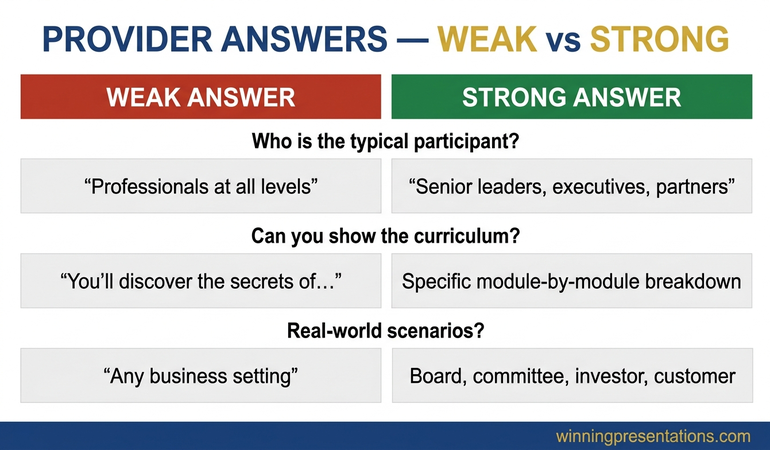
Split comparison infographic showing weak provider answers versus strong provider answers across audience type, curriculum specificity, scenarios covered, format suitability and reference clients

Who delivers it, and what is their executive background? A workshop for executives should be delivered by someone with substantive experience advising executives — not by a trainer who has only delivered training. Ask for the lead instructor’s biography. Look for evidence they have advised at the level you operate at.

Can I speak to a recent senior participant? If the answer is yes — with a specific reference name, not “we’ll send you some testimonials” — that is a strong signal. If the answer is evasive, that is a weak signal regardless of how good the marketing looks.

What to budget

For an individual senior executive choosing for themselves, the practical budget bands are:

  • Under £100: A book, a short course or a single piece of structured material. Useful for a specific narrow skill. Not a substitute for a programme.
  • £100–£500: A self-paced executive programme or a focused short course. The most cost-effective tier for a competent presenter who needs a structural step-up.
  • £500–£1,500: A hybrid programme with live coaching, a multi-week virtual cohort, or one or two coaching sessions. The right tier when you have a specific upcoming presentation challenge.
  • £1,500–£5,000: Live in-person workshops, residential programmes or extended coaching engagements. The right tier when peer learning, immersive practice or in-person feedback is the primary need.
  • £5,000+: Bespoke executive coaching, multi-month engagements, custom in-house workshops for a leadership team. The right tier when the development is part of a broader executive transition.

The pattern most senior executives in 2026 use is to start in the £500–£1,500 band with a hybrid programme, and add one or two targeted coaching sessions only if a specific gap remains afterwards.

Choosing for yourself versus your team

Choosing a workshop for yourself is one decision. Procuring training for a team of senior leaders is a different one. The procurement choice has additional considerations.

For a leadership team, fewer formats work well. In-person residential programmes scale poorly — they impose the same calendar burden on every participant simultaneously. Self-paced programmes scale better — each leader works through the material at their own pace, with optional cohort or coaching elements where useful. Hybrid programmes (self-paced plus live coaching) are now the dominant format for senior team development for this reason.

If you are choosing on behalf of a team, the additional questions to ask: Does the provider offer a team licence model that does not require everyone to be in the same cohort? Can the lead instructor deliver one or two custom sessions specifically for your team’s context? What does the post-programme reinforcement look like — the gap between training delivery and actual on-the-job application is where most workshops fail.

For team members who specifically need the executive-PowerPoint and AI-assisted slide skills, the related executive PowerPoint training online guide covers that specific competency.

FOR SENIOR LEADERS WHO NEED THE STRUCTURAL STEP-UP

A self-paced executive programme designed around real scenarios

Maven AI-Enhanced Presentation Mastery covers the six executive competencies referenced above — deck architecture, decision-first framing, risk structure, Q&A, format variants and slide design — in a self-paced format with optional live coaching. New cohorts open every month. £499 per seat.

Explore the Programme →

Frequently Asked Questions

Are in-person workshops better than online for senior executives?

Not generally. In-person formats deliver more peer interaction and immersive practice, but at a high calendar cost. For most senior executives, the decision criterion is whether peer interaction or live coaching is the primary need. If yes, live formats add value. If the primary need is structural skill development, well-designed self-paced or hybrid programmes deliver equivalent outcomes at a lower cost and time burden.

How long should a presentation skills workshop for executives take to complete?

The realistic time investment is 8–15 hours of focused learning, plus practice on real upcoming presentations. Programmes that promise transformation in two hours usually deliver inspiration without skill change. Programmes that require 40+ hours over multiple months tend to lose senior leaders to calendar pressure. The 8–15 hour band is where most credible executive programmes land.

Is one-on-one coaching better than a workshop for executives?

It depends on the goal. For a specific upcoming high-stakes presentation, targeted coaching is more efficient. For broader skill development, a structured programme covers more ground than coaching for the same investment. Many senior executives use both — a programme for the structural skills, coaching as needed for specific events.

What if my employer pays for training — should I pick something more expensive?

The price tier matters less than the fit. An employer-funded £3,000 in-person workshop that does not address your actual gap is worse value than a self-funded £499 programme that does. Use the budget to pick the right format and content rather than the most expensive option. If the budget is significant, consider combining a structured programme with one or two coaching sessions for the highest impact.

Presentation playbooks, delivered Thursdays

The Winning Edge newsletter covers the structures real executives use for high-stakes meetings — the practical frameworks the workshops do not always teach. One issue per week, typically read in four minutes.

Subscribe to The Winning Edge →

Not ready for a full programme? Start here instead: download the free Executive Presentation Checklist — a one-page structural review for any high-stakes presentation you are preparing.

Partner post: If your immediate need is a virtual board presentation rather than broader skill development, the virtual board meeting presentation guide covers the structural rules for that scenario.

Your next step: Before you compare workshops, write down the three specific presentation scenarios you have on the calendar in the next quarter. Use them as the test for any programme. If the curriculum does not address those scenarios specifically, it is not the right programme — regardless of price.

About the Author

Mary Beth Hazeldine is Owner & Managing Director of Winning Presentations Ltd. With 24 years of corporate banking experience at JPMorgan Chase, PwC, Royal Bank of Scotland, and Commerzbank, she advises executives across financial services, healthcare, technology, and government on structuring presentations for high-stakes funding rounds and approvals.

29 Apr 2026
Professional woman leads a business meeting, pointing to a whiteboard with a strategic flow diagram while colleagues listen around a long conference table in a glass-walled office with city skyscrapers outside.

Business Presentation Skills Training UK: What Executive Programmes Actually Deliver

Quick Answer

Business presentation training in the UK ranges from half-day workshops on slide design to comprehensive programmes covering executive-level structure, stakeholder analysis, and AI-assisted preparation. What separates credible programmes from generic courses is specificity: training built around the presentation types executives actually deliver — board updates, investment committee pitches, budget proposals — rather than general public speaking advice.

Parveen had been a divisional director at a FTSE 250 for three years when her CEO asked her to present the digital transformation business case to the board. She knew the material — she had built the strategy herself. What she lacked was a framework for structuring a twenty-minute argument that would convince eight non-executive directors to approve £12 million. She searched for presentation skills courses and found dozens: a £49 online course promising “boardroom confidence in two hours,” a £3,500 two-day London workshop, and everything in between. The cheaper options covered slide design and body language. The expensive workshops focused on group role-plays with no connection to investment committee dynamics. None addressed her actual challenge: structuring an argument so a sceptical board understood the recommendation before slide three. She eventually found a programme that broke executive presentations down by scenario — board approvals, budget pitches, stakeholder updates — and gave her a methodology she could apply to this case and every presentation after it. The board approved the investment on the first hearing. The difference was not confidence. It was structural.

If you want a structured programme designed for executives who present at board level and to senior stakeholders — the AI-Enhanced Presentation Mastery programme covers executive structure, stakeholder analysis, and AI-assisted preparation across 8 modules. Explore AI-Enhanced Presentation Mastery →

What Executive Presentation Training Should Cover

The challenges executives face are fundamentally different from those addressed by general presentation courses. A finance director presenting a restructuring proposal to a board needs a structural methodology that sequences the argument for a sceptical audience under time pressure — not tips on slide transitions or vocal projection.

Credible executive training addresses four capabilities. First, structural methodology — how to lead with the recommendation, position evidence strategically, and address risk before the audience raises it. Second, stakeholder analysis: a board of non-executive directors evaluates differently from an investment committee, which evaluates differently from a leadership team. Training that treats all audiences as interchangeable produces presentations that are competent but not persuasive.

Third, scenario-specific practice. The presentation types executives deliver — annual budget presentations, risk committee updates, project approvals — each have their own structural logic. Generic role-plays miss this entirely. Fourth, Q&A preparation: for many executives, it is the question-and-answer session that determines the outcome, not the presentation itself.

If you are evaluating training options, the guide on choosing a presentation skills course for executives provides a detailed comparison framework.

A Complete Executive Presentation Programme — Self-Paced, Structured, Practical

AI-Enhanced Presentation Mastery covers the full executive presentation skill set: structural methodology, stakeholder analysis, AI-assisted preparation, and delivery under pressure. Self-paced. 8 modules. 83 lessons. £499/seat.

  • ✓ 8 structured modules covering executive presentation methodology
  • ✓ 83 lessons — work through at your own pace, no deadlines
  • ✓ 2 optional live coaching sessions with Mary Beth (fully recorded)
  • ✓ AI-assisted preparation techniques for faster, sharper presentations

Explore the Programme → £499/seat

Enrolment is open — join at your own pace. Self-paced. 8 modules. 83 lessons. Optional coaching sessions — fully recorded.

Red Flags in Budget Presentation Courses

Many courses marketed as “executive” or “advanced” are repackaged entry-level content with a higher price tag. Knowing what to avoid saves money and the opportunity cost of training that does not transfer to the presentations you actually deliver.

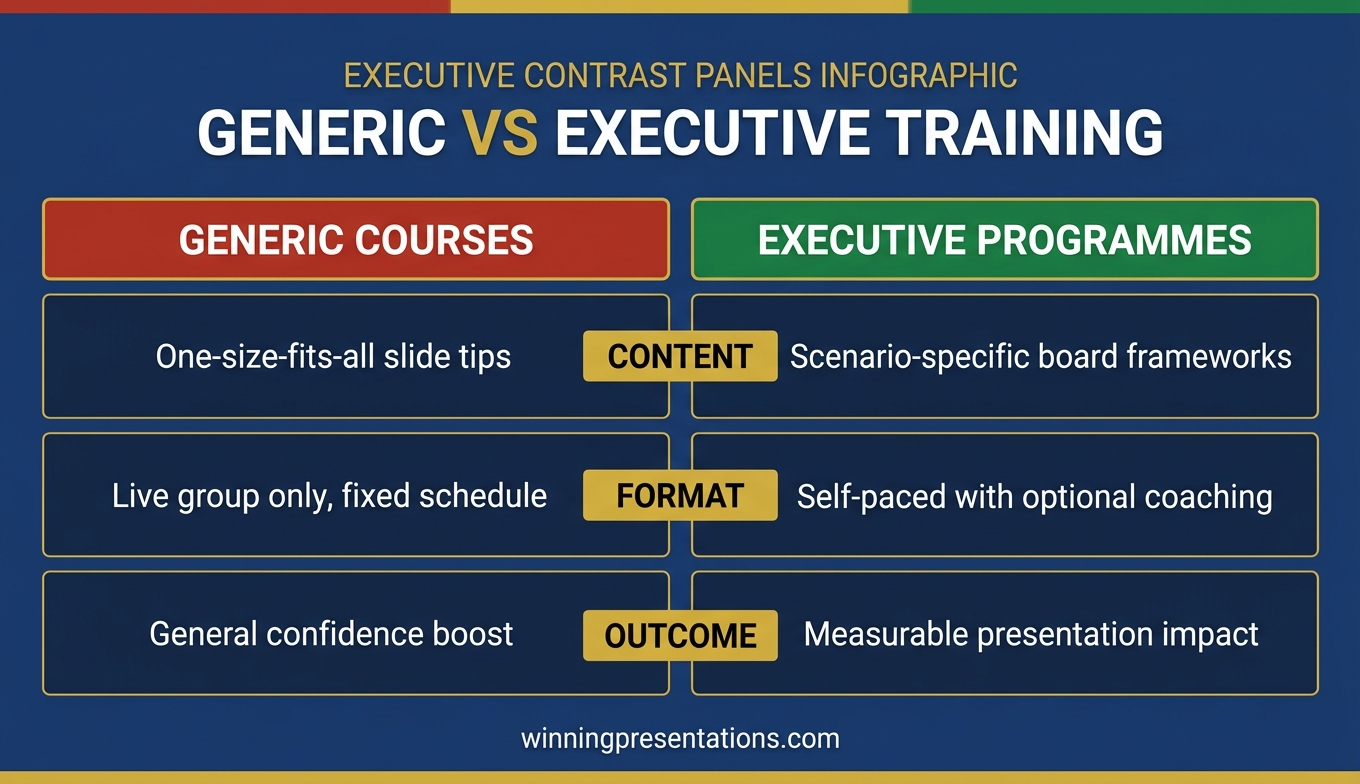
Generic content with executive branding. If the curriculum covers slide design basics, vocal projection, and “power poses” without addressing structural logic for board-level presentations, it is designed for a general audience regardless of how it is marketed.

One-day transformation promises. Complex skills do not transfer in a single workshop. Programmes that promise “boardroom confidence in eight hours” are selling motivation, not capability. Lasting improvement requires structured practice across scenarios, with feedback.

No scenario differentiation. A risk committee presentation requires a fundamentally different structure from a team strategy update. Courses that teach one framework for all contexts miss the point.

Trainer credentials without executive experience. Trainers with backgrounds in theatre or general communication may teach delivery well but struggle with executive-level structure. Look for trainers with corporate experience at the level you present to.

What Good Programmes Actually Include

The programmes that consistently improve executive presentation performance share several characteristics worth understanding before you evaluate marketing pages.

A repeatable structural methodology. The best programmes teach a framework covering argument sequencing (recommendation first, evidence second, risk addressed early), headline construction, and audience-specific framing. Once learned, this methodology accelerates preparation for every future presentation.

Scenario-based modules. Effective programmes break executive presentations into distinct types — board updates, budget proposals, investment pitches, strategic reviews — and address the structural logic of each.

Comparison chart showing what executive presentation training should include versus what generic courses typically cover: structural methodology, scenario-specific practice, stakeholder analysis, and Q&A frameworks versus slide design, body language tips, and generic role-plays

AI integration. The most current programmes now incorporate AI-assisted preparation — teaching executives how to use tools like Copilot, ChatGPT, or Gemini effectively for presentation development. The critical distinction is between programmes that teach prompt engineering for executive scenarios specifically (where the structural methodology informs the AI prompts) and those that simply demonstrate generic AI features.

Flexible access. Senior executives rarely have the schedule flexibility for multi-day residential workshops. Programmes that offer self-paced learning — with optional live coaching for those who want direct feedback — respect the reality that most participants are fitting professional development around demanding roles.

For a deeper look at what distinguishes executive-level courses from standard offerings, the guide on executive presentation masterclasses online examines what the market currently offers and where the gaps remain.

Do presentation courses improve confidence?

Confidence in executive presentations is primarily a function of preparation quality, not personality. Executives who have a clear structural methodology — who know their recommendation is on the right slide, their evidence is sequenced correctly, and their risk mitigation is positioned before the audience raises it — present with significantly more confidence than those relying on general delivery techniques. The most effective training builds confidence indirectly, by giving presenters a reliable preparation framework rather than coaching them to “appear confident” through body language adjustments.

Self-Paced Versus Live Formats

The format question — self-paced online learning versus live workshops — is one of the first decisions when choosing presentation skills training. Both formats have genuine strengths, and the right choice depends on the executive’s primary gap.

Self-paced programmes work well for structural skills. Learning how to sequence an argument or prepare for board-level Q&A does not require a live instructor. These skills benefit from reflection and application — working through a module, applying the framework to an upcoming presentation, then returning with real experience to build on.

Live workshops have an advantage for delivery feedback: pacing, presence, and the ability to read the room. However, for executives whose primary challenge is structural, a live workshop may address the symptom (delivery confidence) while missing the cause (weak argument architecture).

The hybrid model — self-paced structural methodology with optional live coaching — is increasingly common and offers the benefits of both.

The AI-Enhanced Presentation Mastery programme uses this hybrid approach — 83 self-paced lessons covering executive methodology, with two optional live coaching sessions that are fully recorded for those who cannot attend in real time.

How long does it take to improve presentation skills?

Structural presentation skills — argument sequencing, headline framing, evidence positioning — can be applied immediately. An executive who learns to lead with the recommendation rather than build up to it will see an immediate difference in how board members engage with their next presentation. Delivery skills take longer because they involve habit change, but most executives see noticeable improvement within four to six weeks of structured practice. The key is consistent application: each presentation becomes a practice opportunity when you have a methodology to apply.

Decision framework for choosing between self-paced and live presentation training formats: comparing flexibility, structural skills, delivery feedback, schedule fit, and cost considerations for executive professionals

How to Evaluate the ROI of Presentation Training

Most organisations evaluate training on satisfaction scores rather than on whether it changed presentation outcomes. A more useful framework looks at three indicators.

Preparation time. Presentations that currently take four to six hours should take one to two hours after effective training. If the programme provides structural frameworks, preparation becomes assembly rather than invention. This saving alone often justifies the investment.

Decision outcomes. If an executive consistently faces “come back next month with more detail” responses, the issue is almost always structural. Effective training reduces the number of presentations that require a follow-up session before a decision is reached.

Stakeholder feedback quality. After effective training, questions shift from “what are you asking us to approve?” to substantive challenges — assumptions, implementation detail, risk mitigation. This shift indicates the audience is engaging with the argument rather than struggling to find it.

For senior leaders preparing for high-stakes scenarios, the article on senior executive presentation skills explores the specific capabilities that distinguish competent presenters from genuinely persuasive ones at the highest levels.

Invest in the Methodology, Not Just the Motivation

AI-Enhanced Presentation Mastery is a self-paced programme for executives who want a repeatable system for structuring presentations that win decisions. 8 modules. 83 lessons. 2 optional coaching sessions. £499/seat — a career investment that applies to every high-stakes presentation from this point forward.

Explore the Programme → £499/seat

Self-paced. 8 modules. 83 lessons. Optional coaching sessions — fully recorded.

Choosing the Right Programme for Your Role

The “right” programme depends on the gap you are trying to close.

If your gap is structural — you know the material but struggle to build arguments that land with senior audiences — prioritise programmes that teach methodology, not delivery coaching. Look for modules organised by scenario type rather than skill type.

If your gap is delivery — your content is sound but you struggle with nerves or presence — a programme with live coaching is more valuable. For executives dealing with genuine anxiety, the guide on managing stomach-churning nerves before presentations addresses the physiological dimension that many programmes overlook.

If your gap is both — common for executives promoted into roles requiring more senior presentations — a comprehensive programme covering structure, preparation, and delivery is the most efficient path.

Finally, evaluate the trainer. The most credible trainers have worked directly with senior leaders in corporate environments, not just taught presentation skills in academic settings. Industry experience gives them an understanding of the decision dynamics and political sensitivities that shape how executive presentations succeed or fail.

Can AI replace presentation training?

AI tools accelerate preparation but do not replace the structural knowledge that determines whether a presentation persuades a senior audience. If the executive does not know the correct structure for a board approval versus a budget proposal, AI output will be fluent but structurally generic. The most effective approach combines structural training with AI tools. Without the structural foundation, AI produces more slides faster — but they remain the wrong slides for executive audiences.

Frequently Asked Questions

How much does executive presentation training cost in the UK?

Executive presentation training in the UK ranges from under £100 for self-paced digital programmes to £2,000–£5,000 per day for bespoke in-person delivery with a senior consultant. Mid-range options — typically £300–£800 — often include structured modules, scenario-based exercises, and some form of coaching or feedback. The price alone does not determine quality; what matters is whether the programme addresses the specific presentation types you deliver (board updates, investment committee pitches, stakeholder proposals) rather than generic public speaking or slide design.

What should executive presentation training include?

Credible executive presentation training should cover four areas: structural methodology (how to sequence arguments for senior audiences), stakeholder analysis (adapting content and delivery to different decision-makers), scenario-specific practice (board presentations, budget proposals, executive approvals — not generic role-plays), and a framework for handling Q&A under pressure. Programmes that focus primarily on body language, vocal projection, or slide design are typically designed for general business audiences, not executives presenting at board level or to investment committees.

Is online presentation training as effective as in-person?

For structural and strategic presentation skills — how to frame an argument, sequence evidence, and build a recommendation — online training can be equally effective, particularly when delivered as self-paced modules that allow executives to apply concepts between sessions. Where in-person training has an advantage is in real-time delivery feedback: body language, voice modulation, and room presence. The best approach depends on what the executive needs most. If the gap is structural (decks that fail to persuade despite clear delivery), online or self-paced programmes address the core issue efficiently.

How do I choose the right presentation training programme?

Start by identifying the specific gap: is the challenge structural (arguments that do not land with senior audiences), delivery-related (nerves, pacing, presence), or both? Then evaluate programmes against four criteria: does it address your specific presentation scenarios (not just generic business contexts), does the trainer have credible experience with senior audiences, does it include practical application (not just theory), and does the format fit your schedule (self-paced versus scheduled workshops)? Avoid programmes that promise transformation through a single workshop — presentation skills improve through structured practice, not one-off sessions.

The Winning Edge

Weekly insights on executive presentations, stakeholder communication, and career-defining moments at the podium — for professionals who present at the highest stakes.

Subscribe Free

About the author

Mary Beth Hazeldine is the Owner & Managing Director of Winning Presentations. With 24 years of corporate banking experience at JPMorgan Chase, PwC, Royal Bank of Scotland, and Commerzbank, she advises executives across financial services, healthcare, technology, and government on structuring presentations for high-stakes scenarios.

17 Apr 2026
Senior female executive presenting at head of boardroom table to four board members, city skyline visible, navy attire

Executive Communication Skills Training Online

Quick Answer

Executive communication skills training online covers structured communication for the settings where it matters most: board presentations, senior stakeholder briefings, committee hearings, and investment conversations. While “executive communication” is a broad discipline, the highest-leverage skill for most senior professionals is the ability to build and deliver structured presentations that drive decisions. Online programmes designed specifically for executives — rather than general business communication courses — focus on strategic framing, decision architecture, and handling high-stakes questions rather than generic presentation tips. The AI-Enhanced Presentation Mastery programme on Maven is a structured online programme that works through exactly this skill set — 8 self-paced modules with optional live coaching sessions, combining strategic presentation structure with AI tools for executives presenting at board and senior leadership level. The the next available cohort new cohorts open monthly — the next start date.

Valentina had spent twelve years in investment banking before moving into a senior strategy role at a FTSE 250 company. She could run a meeting, chair a working group, and handle a difficult conversation. None of that prepared her for the first time she had to present to the main board. “I knew the material better than anyone in the room,” she told me later. “But the moment I started speaking, I could hear myself losing the thread. I was answering questions they hadn’t asked yet. I was over-explaining the numbers. I was so busy communicating that I forgot to structure what I was saying.” She had excellent communication skills. What she lacked was the specific form of communication that boards respond to: structured, decision-focused, built around what the audience needs to hear rather than what the presenter feels compelled to say. That gap is what executive communication skills training is designed to close.

Looking for structured executive communication training online? The AI-Enhanced Presentation Mastery programme is a structured online cohort for senior professionals presenting at board and leadership level — 8 self-paced modules, optional live coaching sessions, lifetime access. the next available cohort — explore the programme details →

What Executive Communication Actually Means at Senior Level

Executive communication is not a single skill. It is a cluster of related capabilities that become more critical as seniority increases. At junior levels, good communication means being clear, concise, and responsive. At senior levels, the stakes shift: communication becomes the mechanism through which decisions are made, resources are allocated, and organisations change direction.

The cluster includes written communication — board papers, investment memos, briefing notes. It includes conversational communication — stakeholder management, crisis conversations, one-to-one influencing. And it includes structured presentation — the formal or semi-formal delivery of a case, argument, or proposal to a group that has the authority to approve, reject, or escalate it.

All three matter. But they are not equally difficult to develop, and they are not equally consequential when they go wrong. Written communication can be reviewed and revised before it reaches the reader. Conversational communication is recoverable — you can sense the room shifting and adjust. Structured presentation in front of a board or senior leadership team is the one form of executive communication where there is almost no margin for recovery in the moment.

The skills that serve you well in written documents and one-to-one conversations — nuance, qualification, thoroughness — can actively work against you in a structured presentation. Boards are time-constrained. They are evaluating multiple proposals simultaneously. They need information structured for decision-making, not for comprehensiveness. The connection between executive presence and how you structure a presentation is tighter than most executives realise until they experience the gap first-hand.

Why Structured Presentations Are the Highest-Leverage Skill

Of the three strands of executive communication, structured presentation is typically the one that receives the least deliberate development. Most executives receive some form of coaching on executive presence or stakeholder management at some point in their career. Very few receive structured training on how to build and deliver a decision-focused presentation to a senior audience.

The consequence is a pattern that repeats across sectors. A senior professional with genuine expertise, credibility, and the right answer prepares a presentation. They know their material. They prepare the slides. They deliver the content. And the board defers, asks for more information, or approves something narrower than what was proposed. Not because the content was wrong — but because the structure did not make the decision easy to take.

Structured presentation is high-leverage because its effects compound. A finance director who consistently structures board updates in a way that supports clean decision-making develops a reputation for clarity and credibility that carries across every other form of executive communication. A strategy director who secures approval at the first presentation — rather than going back for a second hearing — saves weeks of elapsed time and builds institutional authority. The return on a well-structured board presentation is not just the immediate approval: it is the ongoing currency of being someone whose thinking is trusted.

The 15-minute framework for board presentations covers the structural logic in detail — and understanding that framework makes it considerably easier to see why general communication training often misses what executives actually need.

AI-Enhanced Presentation Mastery — Maven Programme

A structured online programme for senior professionals who present at board and leadership level. 8 self-paced modules, optional live coaching sessions with Mary Beth, and lifetime access to all content. Combines strategic presentation structure with AI tools (Copilot and ChatGPT). £499 per seat — the next cohort new cohorts open monthly — 26 the current month.

  • ✓ Strategic presentation structure for board and senior leadership settings
  • ✓ AI tools integrated into the presentation-building workflow
  • ✓ Optional live coaching sessions with direct access to the programme lead (fully recorded)
  • ✓ Structured Q&A handling for high-stakes environments

Explore the Maven Cohort → £499/seat

New cohorts open every month — enrol and begin with the next available start date.

What Online Executive Communication Training Should Cover

Not all online communication programmes are equivalent. The term covers everything from generic business writing courses to highly specialised board presentation coaching. When evaluating what an online executive communication programme should cover, it helps to distinguish between foundational skills and advanced executive skills.

Foundational skills — structuring arguments logically, using clear language, adapting message to audience — are worth having but are rarely the gap for senior professionals. By the time someone reaches director or C-suite level, they have typically developed these capabilities through experience. What they often lack is the next layer: how to build the strategic frame before the deck is designed; how to structure the opening of a board presentation to secure attention in the first ninety seconds; how to anticipate the questions a sceptical committee member is likely to raise and build the answers into the narrative before they are asked.

A well-designed executive communication programme will also address the preparation process, not just the delivery. The quality of a board presentation is determined substantially by the work done in the two weeks before the room — the conversations with key decision-makers, the mapping of potential objections, the selection of the two or three messages that the presentation must land regardless of how the discussion evolves.

The stakeholder alignment work that precedes a formal presentation is often the factor that separates a smooth approval from a three-meeting discussion cycle. Programmes that cover only the delivery ignore more than half of what executive communication at board level actually involves. If you’re also exploring the full landscape of online training options, the related guide on executive presentation training online covers the broader market in detail.

Where AI Tools Fit Into Executive Communication

The integration of AI tools — Copilot in Microsoft 365, ChatGPT, and similar tools — into executive communication workflows is changing how senior professionals build presentations. The change is significant, but it requires careful calibration. AI tools are highly capable at generating draft content, structuring initial outlines, and producing alternative versions of a message. They are not capable of making the strategic judgements that determine whether a presentation is designed for a board or for a general audience.

The executives who use AI tools most effectively in their communication workflow treat the tools as accelerators of their own thinking, not substitutes for it. They use AI to get to a first draft faster; they then apply their own strategic understanding to determine what needs to change. This requires knowing what a strong board presentation structure looks like, what language senior stakeholders respond to, and what to cut when the material is too dense.

For executives who are still developing their structural intuition, AI tools can create a new problem: they produce high volumes of polished-sounding content that lacks strategic focus. A well-structured but generic presentation is worse than a direct, occasionally rough document that makes the ask clearly and backs it with the right evidence. Learning to prompt AI tools effectively for executive communication purposes is a distinct skill — and one that most generic AI training does not address.

The AI-Enhanced Presentation Mastery cohort addresses this directly, working through how to use Copilot and ChatGPT in the context of board-level and senior leadership presentations rather than general business communication.

How to Choose the Right Online Programme

The executive communication training market has expanded considerably over the last decade. Narrowing the options down to a programme that fits a specific professional context requires a few practical filters.

The first filter is specificity. A programme designed for executives presenting to boards and investment committees is a different product from one designed for general management communication or public speaking on a stage. The former should address decision architecture, stakeholder mapping, and how to handle a hostile committee member. The latter may be perfectly good at what it does, but will not close the gap for someone preparing for their next board presentation.

The second filter is format. Self-paced recorded courses offer flexibility but provide no opportunity for application feedback or live Q&A. Live cohort programmes — where participants work through material with a group and a programme lead in real time — are more effective for executives because the challenges tend to surface in live discussion rather than in watching a recording. The ability to ask a specific question about a specific presentation you are building has more immediate value than watching someone else’s scenario unfold.

The third filter is practitioner credibility. Communication training is a field where the credentials of the programme lead matter considerably. The relevant question is not what degrees or certifications the lead holds, but what operational experience they bring — ideally in a corporate setting where high-stakes presentations were part of the actual role, not just studied from outside.

With 25 years in corporate banking at JPMorgan Chase, PwC, Royal Bank of Scotland, and Commerzbank — and 16 years delivering executive communication training — Mary Beth Hazeldine brings direct operational context to every aspect of the Maven programme. The methodology is built on what actually works in boardrooms, investment committees, and senior leadership settings, not on academic frameworks developed outside those environments.

New Cohorts Open Monthly

AI-Enhanced Presentation Mastery on Maven is a structured online programme for senior professionals presenting at board and leadership level — 8 self-paced modules, optional live coaching sessions, lifetime access. £499 per seat. the next cohort new cohorts open monthly — 26 the current month.

View the Programme on Maven → £499/seat

Frequently Asked Questions

Is executive communication skills training online UK the same as a general presentation course?

Not in content or outcome, though many courses use similar terminology. General presentation courses tend to focus on delivery mechanics: how to manage nerves, how to use slides, how to structure a basic talk. Executive communication training at a senior level is concerned with a different problem — how to structure a case for a decision-making audience, how to handle technically hostile questions, and how to align stakeholders before the formal meeting. If you are preparing for board presentations, investment committees, or senior leadership briefings, look for programmes that explicitly address those contexts rather than general public speaking or presentation skills.

What does an online executive communication course typically cover?

Content varies considerably by provider. The most relevant areas for senior professionals are: strategic framing and decision architecture (how to build the opening argument), slide structure for executive audiences (what boards expect to see and in what order), Q&A preparation and handling under pressure, stakeholder alignment before the formal presentation, and — increasingly — how to use AI tools in the presentation-building workflow. Programmes that include live cohort sessions and direct feedback on real work-in-progress tend to produce faster results than self-paced recordings for executives operating at board or senior leadership level.

How to improve executive communication if I already have strong technical skills?

Technical expertise and executive communication are separate skills that do not automatically transfer. The most common gap for technically strong professionals is the ability to translate detailed knowledge into a structured case that a non-technical board can evaluate and approve. The fix involves learning to lead with the recommendation rather than the analysis, selecting the three or four data points that carry the decision rather than presenting everything, and anticipating the governance questions a committee will ask rather than the technical objections a peer would raise. Structured practice in a context that mirrors the actual board environment is consistently more effective than generic coaching for this specific gap.

What should I look for in leadership communication training online?

Practitioner credibility matters more than certification in this field. Look for a programme led by someone with direct experience presenting at the level you are targeting — not just coaching others to do it. The format should include opportunities for live application and feedback rather than passive video watching. The content should be specific to executive and leadership contexts rather than adapted from general communication theory. And the programme should address both the preparation process and the delivery — the quality of a board presentation is largely determined before anyone enters the room.

Is executive presence training online effective for board-level communication?

It depends on how “executive presence” is defined by the programme. Generic executive presence training often focuses on body language, vocal delivery, and personal brand — all of which are useful but do not address the structural and strategic dimensions of board communication. Presence in a boardroom is largely a function of the clarity and confidence that comes from knowing your material is structured correctly and your case is sound. Programmes that combine presence development with structural presentation skills tend to produce more durable improvements than those that focus on presence as a standalone quality.

The Winning Edge

Weekly insights on executive presentations, board communication, and leadership credibility.

Subscribe Free

Preparing for a high-stakes board presentation? Download the Executive Presentation Checklist — a structured framework for building decision-ready slides from first draft to final review.

About the author

Mary Beth Hazeldine, Owner & Managing Director, Winning Presentations. With 25 years of corporate banking experience at JPMorgan Chase, PwC, Royal Bank of Scotland, and Commerzbank, she advises executives across financial services, healthcare, technology, and government on structuring presentations for high-stakes approvals and board-level communication.