Tag: professional presentation skills

19 Apr 2026
Female executive attending live online training cohort on laptop in professional home office, focused and engaged, navy and gold tones

Business Presentation Course Online UK

Quick Answer

Most business presentation courses available online in the UK teach general communication skills that do not address what senior professionals actually face: structuring a board update under time pressure, using AI tools to build a credible deck, or making a case to a sceptical executive committee. The most effective online presentation training for UK professionals combines live instruction, small-group feedback, and direct application to real presentations β€” not hypothetical exercises.

Valentina had been in asset management for seventeen years. She had presented to investment committees, chaired client briefings, and sat on boards. When her firm moved her into a regional director role, she found herself presenting to the executive committee monthly β€” and for the first time in her career, she could feel her credibility slipping. The committee was polite. The decisions that emerged from her presentations were often inconclusive. She searched for business presentation training online and found dozens of courses: confidence building, slide design, public speaking for beginners. Nothing that addressed what she was actually struggling with β€” the logic of a board argument, the structure of a high-stakes recommendation, the difference between informing a committee and moving one. She eventually found the right training. When she presented her Q3 regional strategy two months later, the committee approved her full budget recommendation without amendment. The gap had not been her confidence. It had been her structure.

Looking for a business presentation course online in the UK? The Executive Buy-In Presentation System is a self-paced online programme for senior professionals β€” covering strategic structure, board-level case-building, and the presentation architecture that moves committees to a decision. New cohorts open monthly. Explore the programme β†’

What Most Online Courses Miss for Senior Professionals

Type “business presentation course online UK” into any search engine and you will find a large number of options. Udemy, Coursera, LinkedIn Learning, and various coaching platforms all offer presentation skills training at a range of price points. Some of it is competent. Much of it addresses the wrong level.

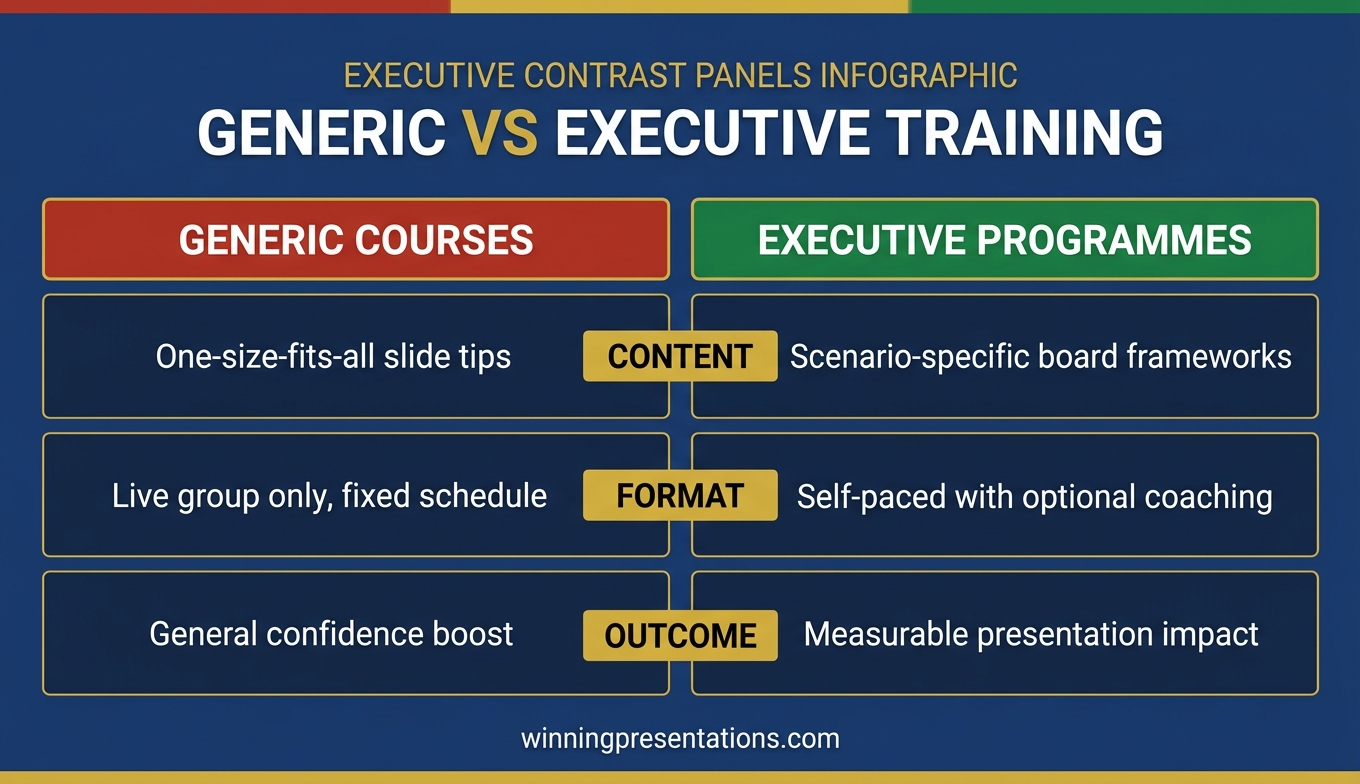
The majority of online presentation courses are designed for people who are new to presenting in professional settings. They focus on managing nerves, structuring a basic argument, and making slides look cleaner. For someone who has been presenting to senior audiences for a decade or more, none of this is the gap. The gap is usually strategic: how to build an argument that moves a sceptical committee; how to structure a multi-stakeholder recommendation where different parts of the room want different things; how to use AI tools to build credible decks without losing the strategic logic that makes them work.

There is also a format problem. Most online courses are pre-recorded and self-paced. That format works for skills acquisition β€” learning software, building knowledge. It does not work well for presentation development, which requires feedback on your specific content, your specific audiences, and your specific presentation habits. Watching videos about how to structure a board presentation is not the same as having an expert review the board presentation you are actually about to give.

A third issue is the American frame of reference. A significant proportion of online presentation courses are produced for US corporate audiences. The presentation culture, the stakeholder dynamics, and the risk appetite around directness differ between US and UK boardrooms in ways that matter. Advice to “lead with confidence and project authority” lands differently in a UK financial services context, where the culture rewards precision and understatement over self-projection.

Understanding the structural framework for executive presentations is the starting point β€” before design, before delivery, before AI tools. Structure is what a committee evaluates, even when they could not articulate exactly why they approved one recommendation and deferred another.

When the Room Has to Say Yes β€” Build That Presentation.

The Executive Buy-In Presentation System is built for senior professionals who present recommendations, strategies, and investment cases to boards and committees. Self-paced. Β£499. New cohorts open monthly.

Explore the Programme β†’

Build Board-Ready Presentations in 30 Minutes

The Executive Slide System gives you 22 templates, 51 AI prompt cards, and 15 scenario playbooks β€” designed for senior professionals who present to boards, committees, and executive leadership. Β£39, instant access, no subscription.

Get the Executive Slide System β†’

Designed for executives presenting at board level and senior leadership meetings

What Business Presentation Training Actually Needs to Cover

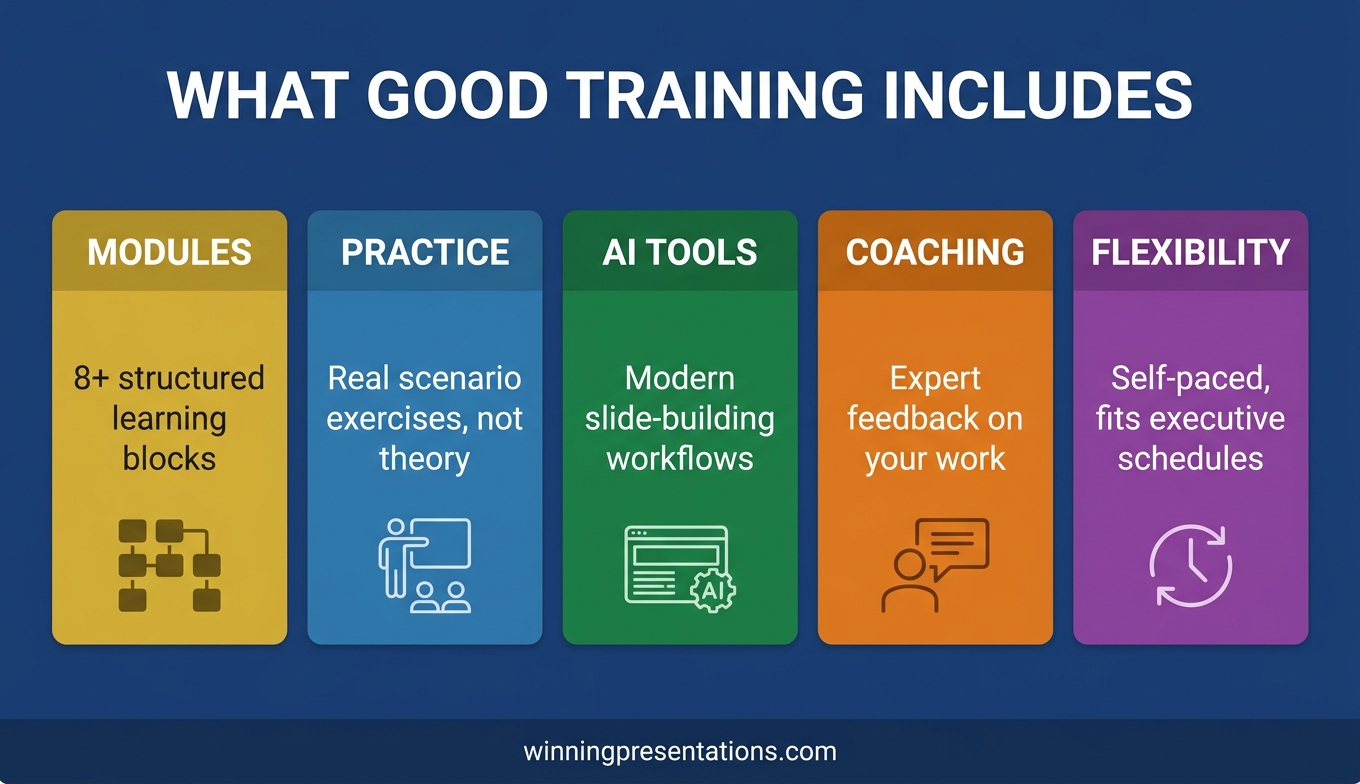
Effective business presentation training for senior professionals needs to address three distinct areas. The first is structure β€” not a generic three-part structure, but the specific architecture of a high-stakes recommendation: how to frame the ask, how to sequence the evidence, how to anticipate and pre-empt the objections that will arise during Q&A rather than waiting to be surprised by them.

The second area is audience intelligence. Senior stakeholders in UK organisations β€” executive committees, boards, investment committees, audit committees β€” have specific decision-making patterns, risk tolerances, and information preferences. Training that treats all audiences as equivalent misses the specific dynamics of the contexts where the stakes are highest. A skills training course online UK should prepare you for the room you are actually walking into, not a generic corporate audience.

The third area is AI integration. The use of AI tools in building presentations has shifted from novelty to standard practice in most large organisations. What has not kept pace is the skill of using AI to strengthen structure rather than simply to generate content. AI-generated slide drafts are frequently fluent and visually coherent but strategically weak β€” they produce arguments that sound plausible rather than arguments that are decision-ready. Training that addresses AI as a structural tool, rather than a drafting shortcut, is a genuine differentiator.

These three areas β€” structure, audience intelligence, and AI integration β€” are what distinguish advanced presentation training for senior professionals from the general-purpose courses that make up most of the online training market. When searching for a business presentation skills course UK, the question to ask of any programme is: does it address these three areas explicitly, with examples drawn from the actual senior contexts you work in?

For the structural side specifically, the stakeholder alignment process that precedes major presentations is often the overlooked element β€” the preparation that happens before the first slide is opened. Effective training addresses the full process, not just the delivery moment.

Why UK Context Matters in Presentation Training

My own background is twenty-five years in corporate banking β€” spanning JPMorgan Chase, PwC, Royal Bank of Scotland, and Commerzbank β€” followed by sixteen years working with executives across financial services, healthcare, technology, and government. That experience spans London, Edinburgh, Frankfurt, and Zurich. What I have observed consistently is that presentation culture is genuinely different between UK and US corporate environments, and between UK financial services and UK technology or healthcare.

UK boardrooms, and particularly those in regulated industries, value epistemic humility. A presenter who projects certainty without acknowledging constraint will often lose credibility faster than one who acknowledges the limits of the data while articulating why the recommendation is still sound. The phrase “I am confident in the direction, though I want to flag two risks to the timeline” carries more weight in many UK executive committee rooms than “This will deliver Β£X million in returns.” Confidence is read through precision, not projection.

UK-specific contexts also matter: presentations to regulators, to audit committees under FCA scrutiny, to investment committees governed by FRC standards. These have specific structural expectations and specific risk tolerances around how claims are made and evidence is presented. Training designed for a US sales presentation context will not prepare you for a UK regulatory context β€” and the gap between them is consequential.

An online presentation skills course UK that does not account for this context will produce advice that technically correct but practically counterproductive. The best training is specific: specific to your seniority level, specific to the types of decisions you are asking audiences to take, and specific to the UK and European corporate environments in which those decisions are being made.

If you are preparing a board presentation as part of a live programme and want to review the structural elements in advance, the board presentation follow-up protocol covers the full post-presentation sequence β€” including how to maintain the momentum of a positive board meeting through to a confirmed decision.

For an overview of what makes the Executive Buy-In Presentation System different from generic online presentation courses, the Maven programme page sets out the curriculum structure, the learning outcomes, and the participant profile.

AI Tools and Presentation Structure: The New Competency Gap

The introduction of AI tools into the presentation-building workflow has created a new competency gap that most online business presentation training has not yet addressed. The gap is not technical β€” most senior professionals can open Copilot, ChatGPT, or Gemini and ask it to draft slides. The gap is strategic: knowing how to direct an AI tool to produce the argument you need, rather than accepting the argument the AI generates.

AI-generated presentations tend to be structured around the information the presenter has, rather than the decision the audience needs to take. This is a fundamental structural error, but it is invisible to the AI. A prompt asking for “a presentation on our Q3 performance and plans for Q4” will produce a document that covers Q3 performance and Q4 plans β€” but will not, without more specific direction, produce a document structured to move the committee to the specific decision the presenter is seeking. The logic of information sharing and the logic of decision facilitation are different, and AI does not distinguish between them automatically.

Training that integrates AI tools into the structural and strategic framework of executive presentations β€” rather than treating AI as a drafting tool and structure as a separate concern β€” is the format that produces measurable improvement in the shortest time. Senior professionals who learn to direct AI with structural precision produce better decks faster, and those decks are more likely to result in the decisions their organisations need.

This is the specific competency gap that the Executive Buy-In Presentation System addresses: not AI as a productivity shortcut, but the strategic and structural skills required to build presentations that move decision-makers to a clear yes.

The Executive Buy-In Presentation System

For executives who need their next high-stakes presentation to land a decision, not just inform one. Self-paced programme, Β£499, new cohorts open monthly.

Join the Next Cohort β†’

Is This Right for You?

The Executive Buy-In Presentation System is built for senior professionals who are already competent presenters and who are working at the level where presentations have direct commercial, strategic, or organisational consequences. It is not a beginner’s course. It is not a confidence-building programme for people new to public speaking.

The typical participant is a director, head of function, or senior manager who presents regularly to executive committees, boards, or major client or regulatory audiences. They have the experience to know what they want to achieve in a presentation β€” and the frustration of watching well-prepared presentations produce inconclusive outcomes. They want the structural and strategic tools to close that gap.

The programme is particularly suited to professionals preparing significant presentations in the near term β€” budget reallocations, strategic reviews, board approvals, or major client pitches. Being self-paced, the work you do in the modules applies directly to presentations you are building right now.

If you are looking for a business presentation skills course UK that covers both the foundations and the advanced strategic structure for senior-level contexts, the Executive Buy-In Presentation System delivers both β€” sequenced for people who already have the foundations and need to develop the senior-level application. New cohorts open monthly.

Frequently Asked Questions

What is the difference between business presentation training online UK and a public speaking course?

Public speaking courses focus primarily on delivery: voice, body language, managing nerves, and engaging an audience. Business presentation training for UK professionals addresses a broader and more strategic set of skills β€” how to structure a recommendation, how to build a case for a specific decision, how to read a senior audience and adapt in real time, and how to use tools including AI to build decks that hold up to scrutiny. For senior professionals, delivery is rarely the limiting factor. Strategy and structure are.

Are online presentation courses effective for senior professionals in the UK?

They can be β€” but the format matters significantly. Pre-recorded self-paced courses produce limited results for senior professionals because they do not include feedback on the specific presentations those professionals are building. Live cohort programmes, where participants work on real presentations and receive expert and peer feedback, are substantially more effective. The key differentiator is whether the training is applied to your actual work or to generic hypothetical scenarios.

How does the executive presentation course on Maven differ from standard LinkedIn Learning content?

LinkedIn Learning and similar platforms offer video-based instruction that teaches general frameworks and principles. The Executive Buy-In Presentation System is a structured self-paced programme where participants work through the specific architecture of decision-focused presentations β€” built for senior professionals at director level and above, presenting to boards and committees in UK and European corporate contexts.

What does a business presentation skills course UK typically cost?

Online self-paced courses typically range from Β£20 to Β£200. Live coaching programmes for senior professionals typically range from Β£500 to Β£3,000+ per participant, depending on the level of personalisation and the seniority of the facilitator. The Executive Buy-In Presentation System is priced at Β£499 β€” a self-paced programme covering the complete architecture of board and committee presentations, with new cohorts opening monthly. It sits at the accessible end of the live-training market for senior professionals.

The Winning Edge

Weekly insights on executive presentations, strategic structure, and boardroom communication β€” for UK professionals who present at senior level.

Subscribe Free

Building a high-stakes presentation now? Download the Executive Presentation Checklist β€” a structured framework for senior professionals preparing board-level and executive committee presentations.

If you are preparing for an upcoming board meeting and want to think through the structural elements of your follow-up process, the follow-up deck for approval meetings covers exactly how to maintain decision momentum after a strong executive presentation.

About the author

Mary Beth Hazeldine, Owner & Managing Director, Winning Presentations. With 25 years of corporate banking experience at JPMorgan Chase, PwC, Royal Bank of Scotland, and Commerzbank, she works with executives across financial services, healthcare, technology, and government on structuring presentations for high-stakes approvals, board reviews, and senior stakeholder communication.

31 Dec 2025
Professional presentation skills that cap your career

Professional Presentation Skills: The Career Cap You Don’t See Coming (2026 Fix)

Last updated: December 31, 2025 Β· 7 minute read

Your professional presentation skills might be quietly capping your career β€” and nobody’s telling you.

You’re good at your job. Your work is solid. You hit your targets. Yet promotions go to others. Opportunities seem to land elsewhere. And nobody tells you the real reason.

After 24 years in corporate banking at JPMorgan, PwC, Royal Bank of Scotland, and Commerzbank, I’ve watched this pattern hundreds of times. The professionals who plateau share something in common β€” and it’s rarely about their technical skills or work ethic.

It’s how they present.

Not whether they present. Not how often. But whether they present in a way that makes senior leaders trust them with more responsibility β€” or merely tolerate them in the role they have.

At Winning Presentations, I’ve trained thousands of executives to fix this specific gap. Here’s what most professionals don’t realise about professional presentation skills and career advancement β€” and how to fix it in 2026.

⚑ Key Takeaways

  • Professional presentation skills are promotion gatekeepers β€” you can’t lead what you can’t communicate
  • There’s a difference between “solid” and “trusted” β€” trusted presenters get bigger opportunities
  • Technical excellence doesn’t translate automatically β€” many experts fail to communicate at the executive level
  • The skill that caps careers: inability to present recommendations with conviction and clarity
  • This is fixable β€” professional presentation skills are learnable, not innate

πŸ“₯ FREE DOWNLOAD: Executive Presentation Checklist

The pre-presentation routine used by executives who command respect.

Download Free β†’

Why Professional Presentation Skills Create an Invisible Career Cap

Here’s what nobody tells you in performance reviews: communication skills β€” particularly presentation skills β€” are promotion gatekeepers.

You can be technically excellent and still get passed over. Not because you lack capability, but because senior leaders can’t see you in a bigger role.

Why? Because bigger roles require influencing people you don’t manage, presenting to stakeholders who don’t report to you, and communicating ideas that span beyond your technical domain. If you can’t present effectively, you can’t do those things.

And so you stay where you are. Solid. Reliable. Capped.

I saw this constantly in banking. Brilliant analysts who couldn’t get promoted because they presented like analysts β€” drowning executives in data instead of driving decisions. Outstanding managers who couldn’t break into senior leadership because they couldn’t command a room of people who outranked them.

The work was excellent. The professional presentation skills weren’t. And the career stalled.

Trusted vs Tolerated: Professional Presentation Skills That Matter

Professional presentation skills comparison - trusted vs tolerated presenters

There’s a distinction that determines career trajectory: some professionals are trusted, others are merely tolerated.

Both deliver work. Both meet deadlines. Both show up for presentations. But watch what happens in the room, and you’ll see completely different dynamics.

Tolerated Presenters

  • Senior leaders check their phones during the presentation
  • Questions feel like challenges β€” defensive exchanges
  • The meeting runs long because the message isn’t landing
  • Decisions get deferred: “Let’s take this offline”
  • Feedback is polite but generic: “Good work, thanks”

Tolerated presenters are allowed to present. They’re not asked to present more.

Trusted Presenters

  • Senior leaders lean in, engaged from the first minute
  • Questions feel collaborative β€” building on ideas together
  • The meeting finishes early because the message was clear
  • Decisions happen: “I’m aligned. Let’s proceed.”
  • Feedback opens doors: “I want you to present this to the board”

Trusted presenters get invited to bigger rooms. They get asked to represent the team. They get promoted.

The difference isn’t charisma or natural talent. It’s specific professional presentation skills that can be learned.

The Professional Presentation Skills Gap That Caps Careers

After training thousands of executives, I’ve identified the single skill gap that most frequently caps careers:

The inability to present recommendations with conviction and clarity.

This sounds simple. It isn’t. Here’s what it actually involves:

Conviction Without Arrogance

Many professionals hedge. They say “I think we should consider…” instead of “I recommend…” They pepper their presentations with caveats that undermine their credibility.

This comes from a good place β€” intellectual honesty, awareness of complexity. But to senior leaders, it signals uncertainty. And uncertain people don’t get trusted with big decisions.

Professional presentation skills require stating your position clearly, defending it when challenged, and acknowledging uncertainty only where it genuinely exists β€” not as a protective habit.

For more on this pattern, see my article on why technical experts struggle with executive presentations.

Clarity Without Oversimplification

The opposite failure is oversimplifying to the point of uselessness. Executives don’t want dumbed-down content β€” they want complexity made accessible.

This requires understanding your material deeply enough to explain it simply, anticipating the questions that matter, and structuring information so the key insight lands immediately rather than emerging after 20 slides.

Executive Framing

Most professionals present the way they think: chronologically, comprehensively, building toward a conclusion.

Executives think differently: What’s the decision? What do you recommend? Why? What do you need from me?

Professional presentation skills require flipping your natural structure. Lead with the recommendation. Support it with evidence. End with the ask. This is learnable β€” but it requires deliberate practice.

For detailed frameworks, see my guide on executive presentations.

πŸ’‘ Present Like an Executive

The Executive Slide System includes 7 frameworks for structuring presentations the way senior leaders think β€” recommendation-first, evidence-based, action-oriented.

Stop building toward your point. Start with it.

Get the Executive Slide System β€” Β£39 β†’

How to Fix Your Professional Presentation Skills in 2026

If you recognise yourself in this article β€” if you suspect your professional presentation skills might be quietly capping your career β€” here’s how to fix it.

Step 1: Get Honest Feedback

The reason this gap stays invisible is that people don’t tell you. “Good presentation” is the polite default, regardless of impact.

Ask someone you trust β€” preferably someone senior β€” for specific, honest feedback. Not “how did I do?” but “what would make you more likely to approve this?” or “where did you lose interest?”

The answer might be uncomfortable. That’s the point.

Step 2: Study How Executives Present

Watch presenters who consistently get results. Not TED speakers β€” internal executives who consistently get buy-in.

Notice their structure. How quickly do they get to the point? How do they handle questions? What do they include β€” and what do they leave out?

Professional presentation skills are observable. Study the patterns that work.

For advanced techniques, see my guide on advanced presentation skills.

Step 3: Restructure How You Present

Most career-capping presentation habits come from structure, not delivery. You’re building toward conclusions when you should be leading with them. You’re being comprehensive when you should be selective.

The executive structure:

  1. Here’s my recommendation
  2. Here’s why (3 supporting points maximum)
  3. Here’s what I need from you
  4. Here’s what happens next

Everything else goes in backup slides or appendices. Ruthlessly cut anything that doesn’t serve the decision.

Step 4: Practice Under Realistic Conditions

Practicing alone, in comfortable settings, doesn’t prepare you for real stakes. You need to practice with challenge: time pressure, interruptions, sceptical questions.

Find colleagues who will push back. Present in conditions that make you uncomfortable. The skills that matter only develop under pressure.

Step 5: Get Structured Development

Some professional presentation skills can be self-taught. Many can’t β€” at least not efficiently. Structured programmes, coaching, and feedback accelerate development dramatically.

If presentation skills are genuinely capping your career, investing in systematic development isn’t an expense. It’s a career investment with compound returns.

πŸŽ“ Ready to Remove the Cap?

If 2026 is the year you want to break through the invisible ceiling, structured development accelerates results β€” executive frameworks, psychology-based confidence techniques, and expert feedback that creates lasting change.

The complete system for professional presentation skills that get you promoted. Let’s discuss what that looks like for you β†’

Professional Presentation Skills: The Career Decision

Here’s the honest reality: professional presentation skills separate careers that advance from careers that plateau.

You can be excellent at your job and still get capped. Technical skills get you in the door. Presentation skills determine how far you go once you’re inside.

The good news: this is fixable. Professional presentation skills are learnable, not innate. The executives who command rooms weren’t born that way β€” they developed specific skills through deliberate practice and often structured training.

If you’re setting presentation skills goals for 2026, make this the year you address the invisible cap. The investment in your professional presentation skills compounds for the rest of your career.

The question isn’t whether presentation skills matter. They obviously do.

The question is whether you’ll continue being tolerated β€” or start being trusted.

Your Next Step

πŸ“– FREE: Executive Presentation Checklist
The pre-presentation routine used by executives who command respect.
Download Free β†’

πŸ’‘ QUICK WIN: Executive Slide System β€” Β£39
7 frameworks for structuring presentations the way senior leaders think.
Get Instant Access β†’

πŸŽ“ COMPLETE SYSTEM: Structured Development
Executive frameworks, psychology, and expert coaching.
Let’s discuss what that looks like for you β†’

FAQs: Professional Presentation Skills and Career Growth

How do professional presentation skills affect career advancement?

Professional presentation skills are promotion gatekeepers. Senior roles require influencing people you don’t manage, presenting to stakeholders who don’t report to you, and communicating ideas beyond your technical domain. If you can’t present effectively, you can’t do those things β€” and you stay capped in your current role regardless of technical excellence.

What’s the difference between being “trusted” and “tolerated” as a presenter?

Tolerated presenters are allowed to present; trusted presenters are invited to present more. The difference shows in how senior leaders engage: do they lean in or check phones? Do questions feel collaborative or challenging? Do decisions happen in the room or get deferred? Trusted presenters get promoted. Tolerated presenters plateau.

What’s the specific skill gap that caps most careers?

The inability to present recommendations with conviction and clarity. This includes stating positions without excessive hedging, making complexity accessible without oversimplifying, and structuring presentations the way executives think (recommendation-first) rather than the way you naturally think (building toward conclusions).

Can professional presentation skills actually be learned, or are some people just natural presenters?

Professional presentation skills are absolutely learnable. The executives who command rooms weren’t born that way β€” they developed specific skills through deliberate practice and often structured training. Structure, conviction, and executive framing are all trainable. Waiting for natural talent to emerge is how careers stay capped.

How long does it take to improve professional presentation skills significantly?

With focused effort and structured feedback, most professionals see meaningful improvement within 90 days. The key is deliberate practice on specific weaknesses, not just more presentations. Restructuring how you present (leading with recommendations, cutting comprehensiveness) can show results immediately. Building conviction and handling pressure takes longer but is equally learnable.


Mary Beth Hazeldine is the Owner & Managing Director of Winning Presentations. She spent 24 years in corporate banking at JPMorgan Chase, PwC, Royal Bank of Scotland, and Commerzbank, watching professional presentation skills make and break careers at every level. She now trains executives to present with the conviction and clarity that earns trust β€” not just tolerance. Her clients have raised over Β£250 million using her frameworks.

Get Weekly Presentation Insights

Join 2,000+ professionals getting practical presentation tips every Tuesday.

Subscribe to The Winning Edge β†’

31 Dec 2025
Presentation skills goals for 2026 - what senior professionals need to improve

Presentation Skills Goals for 2026: What Senior Professionals Actually Need to Improve

Last updated: December 31, 2025 Β· 9 minute read

Most presentation skills goals fail before February.

Not because professionals lack discipline. Not because they’re too busy. But because they’re setting the wrong goals entirely.

“Present more confidently” isn’t a goal β€” it’s a wish. “Get better at slides” isn’t measurable. “Stop being nervous” isn’t achievable through willpower alone.

After 24 years in corporate banking and training over 5,000 executives at Winning Presentations, I’ve watched hundreds of professionals set presentation skills goals every January. The ones who actually improve share something specific: they treat presentation skills like a system, not an event.

Senior professionals who improve fastest invest in a working executive presentation toolkit rather than hoping a single course or book will fix the structural issues.

Here’s what actually works for setting presentation skills goals in 2026 β€” and why most advice gets it completely wrong.

⚑ Key Takeaways

  • Most presentation skills goals fail because they lack feedback loops, structure, and measurement
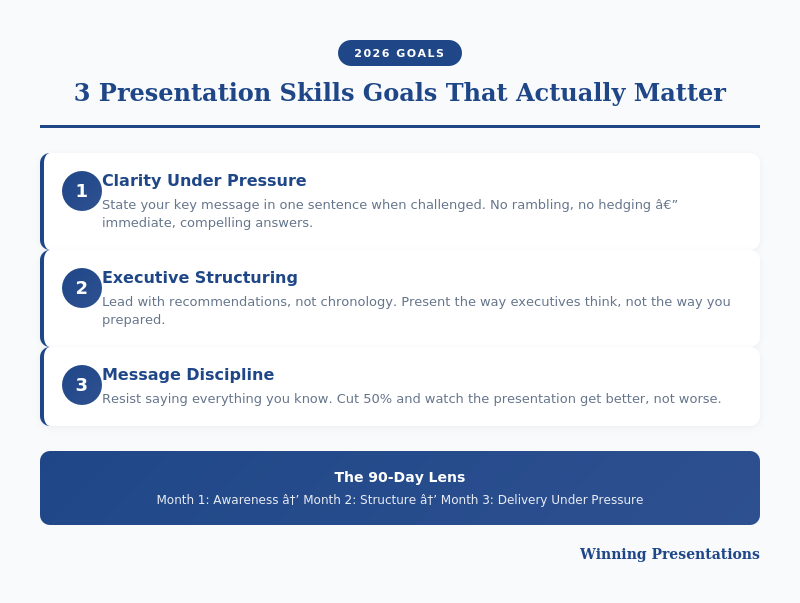
  • The 3 goals that matter: Clarity under pressure, executive structuring, and message discipline
  • 90-day improvement lens β€” Month 1: Awareness, Month 2: Structure, Month 3: Delivery under pressure
  • Systems beat motivation β€” deliberate practice compounds; random repetition doesn’t
  • Senior professionals think differently β€” they focus on skill systems, not presentation events

πŸ“₯ FREE DOWNLOAD: Executive Presentation Checklist

The pre-presentation routine I use before every high-stakes talk.

Download Free β†’

Why Most Presentation Skills Goals Fail

Every January, millions of professionals make some version of the same resolution: “This year, I’ll get better at presenting.”

By March, nothing has changed.

The problem isn’t motivation. Research on professional development consistently shows that intention alone doesn’t drive skill improvement. What does? Systems.

Here’s why most presentation skills goals fail:

No Feedback Loop

You present. It goes “okay.” You present again. It goes “okay.” Without specific, structured feedback, you’re just reinforcing existing habits β€” good and bad.

Most professionals never get real feedback on their presentations. Colleagues say “that was great” because they’re being polite. Your manager focuses on content, not delivery. You have no idea what’s actually working or failing.

No Structure

“Get better at presenting” isn’t a goal β€” it’s a direction. Better how? Better at what specifically? Better measured by whom?

Vague presentation skills goals produce vague results. Without structure, you’ll drift toward whatever feels comfortable rather than what actually needs improvement.

No Measurement

How do you know if you’ve improved? Most professionals can’t answer this question. They rely on feelings: “I think I’m better.” “That one went well.”

Feelings aren’t measurement. Without clear metrics β€” even simple ones β€” you can’t track progress or identify what’s working.

No Pressure Simulation

Practising presentations alone in your office isn’t the same as presenting to a sceptical board. The skills that matter most β€” composure under pressure, handling tough questions, reading the room β€” only develop under realistic conditions.

This is why many professionals “know” what to do but can’t execute when it matters. They’ve practised the easy part and avoided the hard part.

For more on building genuine confidence, see my guide on how to speak confidently in public.

The 3 Presentation Skills Goals That Actually Matter

3 presentation skills goals that actually matter for professionals

After training thousands of executives, I’ve identified the three presentation skills goals that actually differentiate senior professionals from everyone else.

These aren’t “soft skills.” They’re specific, measurable capabilities that directly impact whether you get the outcome you want from a presentation.

Goal 1: Clarity Under Pressure

Can you articulate your key message in one sentence when someone interrupts you mid-presentation and asks “what’s the bottom line?”

Most professionals can’t. They’ve prepared 20 slides but haven’t distilled their core message. When pressure hits β€” an unexpected question, a time cut, a sceptical executive β€” they ramble, hedge, or lose the thread entirely.

What this looks like in practice:

  • You can state your recommendation in under 15 seconds
  • You can explain your “why” without slides
  • You stay coherent when challenged or interrupted
  • Your answer to “so what?” is immediate and compelling

How to develop it: Practise the “elevator pitch” for every presentation. Before you open PowerPoint, write your one-sentence message. Then test yourself: can you deliver it under pressure?

Goal 2: Executive Structuring

Do you structure presentations the way senior leaders think β€” or the way you think?

Most professionals present chronologically: “Here’s what I did, here’s what I found, here’s what I recommend.” Executives want the opposite: “Here’s my recommendation, here’s why, here’s what I need from you.”

What this looks like in practice:

  • You lead with the decision or recommendation
  • You provide supporting evidence, not comprehensive data
  • You anticipate the three questions they’ll ask
  • You can present the same content in 5 minutes or 30 minutes

How to develop it: Study how your most effective executives present. Notice the structure. Then apply it to your own content β€” starting with the “so what” instead of building toward it.

For detailed frameworks, see my guide on executive presentations.

Goal 3: Message Discipline

Can you resist the urge to say everything you know?

The curse of expertise is wanting to share all of it. But senior leaders don’t want comprehensive β€” they want relevant. They don’t want thorough β€” they want clear.

What this looks like in practice:

  • You cut 50% of your slides and the presentation gets better
  • You answer questions directly without over-explaining
  • You let silence exist instead of filling it with caveats
  • Your backup slides contain more content than your main deck

How to develop it: After preparing any presentation, force yourself to cut it by half. Not by rushing β€” by prioritising. What’s essential? What’s “nice to have”? Kill the nice-to-haves.

πŸ’‘ Ready to Structure Like a Senior Leader?

The Executive Slide System includes 7 frameworks for structuring presentations the way executives think β€” recommendation-first, evidence-based, action-oriented.

Stop building toward your point. Start with it.

Get the Executive Slide System β€” Β£39 β†’

The 90-Day Improvement Lens for Presentation Skills Goals

Annual presentation skills goals are too distant. They let you procrastinate. “I have all year” becomes “I’ll start next month” becomes “maybe next year.”

Think in 90-day cycles instead. Three months is long enough to create real change, short enough to maintain urgency.

Month 1: Awareness

Before you can improve, you need to know what needs improving. Most professionals have blind spots β€” habits they don’t notice, weaknesses they’ve never identified.

Actions for Month 1:

  • Record yourself presenting (video, not just audio)
  • Ask 3 colleagues for specific, honest feedback
  • Identify your top 3 weaknesses β€” the specific things hurting your impact
  • Watch executives you admire β€” what do they do differently?

This month isn’t about changing anything. It’s about seeing clearly.

Month 2: Structure

Now that you know what to work on, build the systems that will drive improvement.

Actions for Month 2:

  • Create a pre-presentation routine you use every time
  • Develop 2-3 frameworks you apply to every presentation
  • Build a feedback system β€” how will you get input after each presentation?
  • Schedule deliberate practice, not just presentations

Structure turns intentions into habits. Without it, you’ll default to old patterns under pressure.

Month 3: Delivery Under Pressure

This is where most professionals skip. They practice alone, in comfortable settings, without stakes.

Actions for Month 3:

  • Present to colleagues who will challenge you β€” not support you
  • Practice with time constraints (you have 5 minutes, not 20)
  • Rehearse handling interruptions and tough questions
  • If possible, get coaching or join a structured programme

Skills that collapse under pressure weren’t really skills β€” they were comfort-zone performances.

For advanced techniques on handling pressure, see my guide on advanced presentation skills.

πŸŽ“ Want Structured Development?

If 2026 is the year you want to master presentation skills properly, structured development matters more than random practice.

Framework-based programmes with psychology techniques and expert feedback create lasting change β€” not just temporary motivation. If you’d like to discuss what structured development might look like for you, get in touch β†’

How Senior Professionals Think About Presentation Skills Goals

There’s a mental shift that separates professionals who continuously improve from those who plateau.

Skills vs Events

Plateau thinking: “I have a big presentation next month. I need to prepare for it.”

Growth thinking: “Presenting is a skill I’m developing. Each presentation is a data point.”

When you treat presentations as isolated events, you prepare, perform, and forget. When you treat presenting as an ongoing skill development, each presentation becomes an opportunity to test, learn, and refine.

Systems vs Motivation

Plateau thinking: “I need to feel confident before I can present well.”

Growth thinking: “I need systems that work even when I don’t feel confident.”

Motivation is unreliable. Systems are consistent. The executives who present brilliantly under pressure don’t rely on feeling good β€” they rely on preparation routines, structural frameworks, and recovery techniques that work regardless of how they feel.

Deliberate Practice vs Repetition

Plateau thinking: “The more I present, the better I’ll get.”

Growth thinking: “Purposeful practice on specific weaknesses improves skill. Random repetition just reinforces habits.”

Twenty years of presenting doesn’t automatically make you good. It makes you experienced. If you’ve been reinforcing bad habits for twenty years, you’re just an experienced bad presenter.

Deliberate practice means identifying specific weaknesses, designing exercises to address them, getting feedback, and adjusting. It’s uncomfortable. That’s why it works.

Making 2026 the Year You Actually Improve Your Presentation Skills Goals

Here’s the honest truth: most people reading this won’t do anything different in 2026.

Not because they lack ability or desire. But because they’ll set vague goals, rely on motivation, and treat presentation skills as an afterthought when they’re not actively presenting.

The professionals who actually improve will:

  • Set specific, measurable presentation skills goals (not wishes)
  • Build systems that don’t depend on motivation
  • Create accountability through feedback loops or structured programmes
  • Practice under realistic pressure, not comfortable conditions
  • Treat presenting as a skill to develop, not an event to survive

If that sounds like work, it is. Skill development always is. But the compound returns are substantial β€” in promotions, influence, credibility, and career opportunities.

The question isn’t whether presentation skills matter for your career in 2026. They obviously do.

The question is whether you’ll treat them like the strategic asset they are β€” or continue hoping that “more practice” will somehow produce different results.

Your Next Step

πŸ“– FREE: Executive Presentation Checklist
The pre-presentation routine I use before every high-stakes talk.
Download Free β†’

πŸ’‘ QUICK WIN: Executive Slide System β€” Β£39
7 frameworks for structuring presentations the way senior leaders think.
Get Instant Access β†’

πŸŽ“ COMPLETE SYSTEM: Structured Development
If you’re ready for comprehensive training with expert guidance, let’s discuss what that looks like for you β†’

FAQs: Presentation Skills Goals

What are the most important presentation skills goals to set for 2026?

The three presentation skills goals that matter most are: clarity under pressure (being able to state your key message when challenged), executive structuring (leading with recommendations instead of building toward them), and message discipline (resisting the urge to say everything you know). These directly impact whether you achieve your presentation outcomes.

How long does it take to improve presentation skills?

With deliberate practice and structured feedback, most professionals see meaningful improvement within 90 days. The key is focusing on specific weaknesses rather than general “practice.” Random repetition reinforces habits; deliberate practice changes them. Think in 90-day improvement cycles rather than annual goals.

Why do most presentation skills goals fail?

Most presentation skills goals fail because they lack four things: feedback loops (you don’t know what’s working or failing), structure (vague goals produce vague results), measurement (feelings aren’t data), and pressure simulation (practicing alone doesn’t prepare you for real stakes). Systems address all four.

How can I measure improvement in my presentation skills?

Measure presentation skills improvement through specific outcomes: Did you get the decision you wanted? Did stakeholders engage or disengage? How many clarifying questions did you get (fewer often means clearer communication)? Did you stay within your time limit? Recording yourself and comparing over time also provides objective measurement.

What’s the difference between deliberate practice and just presenting more?

Presenting more reinforces existing habits β€” good and bad. Deliberate practice involves identifying specific weaknesses, designing exercises to address them, getting feedback, and adjusting your approach. Twenty years of presentations doesn’t automatically make you skilled; it makes you experienced. The distinction determines whether you improve or plateau.


Mary Beth Hazeldine is the Owner & Managing Director of Winning Presentations. She spent 24 years in corporate banking at JPMorgan Chase, PwC, Royal Bank of Scotland, and Commerzbank, and has trained over 5,000 executives to present with impact. Her clients have raised over Β£250 million using her frameworks.

Get Weekly Presentation Insights

Join 2,000+ professionals getting practical presentation tips every Tuesday.

Subscribe to The Winning Edge β†’

27 Dec 2025
Professional presentation skills - what sets top performers apart in corporate environments

Professional Presentation Skills: What Sets Top Performers Apart

After 24 years in corporate banking, here’s what actually separates those who get promoted from those who don’t

In 24 years at JPMorgan, PwC, Royal Bank of Scotland, and Commerzbank, I watched hundreds of talented professionals present. Most were competent. Some were forgettable. A handful were exceptional β€” and they’re the ones who got promoted.

The difference wasn’t intelligence or even presentation “talent.” It was a specific set of professional presentation skills that most people never develop because no one teaches them explicitly.

I’m going to teach them to you now.

🎁 Free Download: 7 Presentation Frameworks β€” the structures top performers use consistently. Print-ready PDF.

What Professional Presentation Skills Actually Look Like

First, let’s define what we’re talking about. Professional presentation skills aren’t about being charismatic or having a “stage presence” personality. They’re about:

  • Clarity under pressure β€” delivering complex information simply, even when stakes are high
  • Executive alignment β€” structuring content for how senior leaders actually think
  • Credibility without arrogance β€” demonstrating expertise while remaining approachable
  • Decisive recommendations β€” telling the room what you think, not just presenting options
  • Composure during challenge β€” handling tough questions without defensiveness

These skills are observable, teachable, and learnable. They’re not personality traits. They’re behaviours you can practise until they become automatic.

Related: Business Presentation Skills: What Actually Matters in Corporate Environments

The 7 Professional Presentation Skills That Get You Promoted

I’ve distilled 24 years of observation into seven specific skills. Master these, and you’ll stand out in any corporate environment.

1. Lead With the Recommendation

Junior presenters build to their conclusion. Senior presenters start with it.

The executives I watched get promoted fastest all did this: they told the room what they wanted in the first 60 seconds. “I’m recommending we proceed with Option B. Here’s why.”

This isn’t arrogance β€” it’s respect for the audience’s time. It also forces clarity in your own thinking. If you can’t state your recommendation in one sentence, you haven’t thought hard enough.

What this looks like:

  • “I’m recommending we invest Β£2M in customer retention. Let me show you why.”
  • “My conclusion: we should proceed with the acquisition. Here’s the analysis.”
  • “Bottom line: this project is at risk unless we add resources. Here’s the evidence.”

2. Answer the Question Actually Being Asked

I’ve watched brilliant analysts torpedo their careers by answering the wrong question. A board member asks “What’s the risk?” and they launch into methodology. A CFO asks “Can we afford this?” and they explain the technical requirements.

Top performers listen to the actual question, pause, and answer it directly β€” even if briefly β€” before providing context.

The pattern:

  1. Answer the question in one sentence
  2. Provide essential context
  3. Check if that’s sufficient: “Does that address your concern?”

This sounds simple. In practice, it’s remarkable how few people do it.

3. Cut Your Content in Half (Then Cut Again)

Every presenter thinks they need more slides. Every executive wishes they had fewer.

The people who got promoted in my observation consistently presented with fewer slides than their peers. A 30-page deck became 10 pages. A 60-minute presentation became 20 minutes with 40 minutes for discussion.

This requires ruthless prioritisation: what absolutely must be said, versus what would be nice to say?

The test: For each slide, ask “If I cut this, would the recommendation change?” If no, cut it.

Related: How to Create Executive Presentations That Get Results

4. Own the Room Physically

Professional presentation skills include how you use space. Top performers:

  • Stand (when possible) rather than sit β€” it commands more attention
  • Use purposeful movement, not nervous pacing
  • Make eye contact with decision-makers during key points
  • Pause before important statements, rather than rushing through
  • Keep hands visible and gestures controlled

None of this requires natural confidence. It requires practice until the behaviours feel automatic.

5. Handle Challenge Without Defensiveness

This is where careers are made or broken. When a senior leader challenges your recommendation, how do you respond?

Defensive presenters:

  • Justify immediately
  • Explain why the challenger doesn’t understand
  • Get visibly flustered
  • Repeat their original point, louder

Professional presenters:

  • Acknowledge the challenge: “That’s a fair concern.”
  • Clarify if needed: “Can I ask what’s driving that question?”
  • Respond substantively, not emotionally
  • Concede when appropriate: “You’re right β€” I hadn’t considered that angle.”

The ability to receive challenge gracefully signals confidence more than any power pose ever will.

Presentation mistakes that stall careers - what to avoid and what to do instead

6. Show Your Thinking, Not Just Your Conclusion

This seems to contradict “lead with the recommendation” β€” but it doesn’t. You state your conclusion first, then briefly show how you got there.

The key word is “briefly.” You’re not walking through every step of your analysis. You’re highlighting the 2-3 key considerations that shaped your thinking.

Example: “I’m recommending Option B. The three factors that drove this: cost efficiency, implementation timeline, and team capacity. Let me show you each briefly.”

This builds credibility. It shows you’ve done rigorous work without subjecting the audience to all of it.

7. Close With Clarity

The final professional presentation skill: ending decisively. Too many presenters trail off: “So, um, that’s the analysis. Any questions?”

Top performers end like this:

“Based on what we’ve discussed, I’m recommending we proceed with Option B, starting in Q1. I need your approval today to begin procurement. Can I get that?”

Note what this does: restates the recommendation, specifies timing, names the ask, requests a decision. No ambiguity.

Related: Public Speaking Tips That Actually Work in Corporate Settings

Quick Reference for Your Next Presentation

The Public Speaking Cheat Sheets (Β£14.99) give you pocket-sized reminders for all seven skills β€” plus 15 more techniques for handling nerves, structuring content, and commanding attention.

What’s included:

  • 7-skill checklist from this article
  • Opening and closing templates
  • Body language quick reference
  • Tough question response frameworks

Get the Cheat Sheets β†’

Why Most Professionals Don’t Develop These Skills

If these professional presentation skills are so valuable, why don’t more people have them?

1. No one teaches them explicitly. Business schools teach case analysis, not presentation skills. Most corporate training focuses on slide design, not strategic communication.

2. Practice happens in high-stakes moments. You don’t get to rehearse a board presentation 20 times. You get one shot, under pressure, with your reputation on the line. That’s a terrible learning environment.

3. Feedback is rare and vague. “Good presentation” tells you nothing. “You answered the CFO’s question indirectly and it created doubt” β€” that’s actionable. But most professionals never receive feedback that specific.

4. The wrong things get rewarded. In many organisations, comprehensive decks are praised over concise ones. Being “thorough” is valued over being decisive. The incentives work against developing professional presentation skills.

This is why deliberate training matters. You need to practise these skills in a low-stakes environment with specific feedback before you deploy them in high-stakes situations.

Professional Presentation Skills vs. Natural Talent

I’ve trained thousands of professionals. The ones who improve fastest aren’t the naturally confident ones β€” they’re the ones who practise systematically.

Professional presentation skills are like any other skill: they improve with deliberate practice and specific feedback. The “natural” presenters often plateau because they’ve never had to work at it. The “nervous” presenters often surpass them because they’ve built robust systems.

Some of the best presenters I know still get nervous. The difference is they have frameworks that work regardless of how they feel.

Related: How to Present Like a CEO: Executive Presentation Skills for Leadership

Develop Professional Presentation Skills Systematically

AI-Enhanced Presentation Mastery teaches all seven skills from this article β€” plus AI-powered workflows that help you prepare faster and practise more effectively.

8 self-paced modules (January–April 2026):

  • The AVP Framework: Action-Value-Proof for executive-level structure
  • The 132 Rule: How to cut content ruthlessly without losing impact
  • Q&A handling frameworks for hostile and challenging questions
  • NLP delivery techniques for composure under pressure
  • AI prompts that accelerate preparation and practice

Plus: 2 live coaching sessions with personalised feedback on your real presentations.

Presale price: Β£249 (increases to Β£299, then Β£499)

60 seats total. Lifetime access.

See the full curriculum β†’

Frequently Asked Questions About Professional Presentation Skills

How long does it take to develop professional presentation skills?

You can see noticeable improvement in 2-4 weeks with deliberate practice. Mastery takes longer β€” typically 6-12 months of consistent application. The key is getting specific feedback on real presentations, not just reading about techniques.

Can introverts develop strong presentation skills?

Absolutely. Some of the best presenters I’ve trained are introverts. Professional presentation skills are about clarity and structure, not extroversion. Introverts often excel because they prepare more thoroughly and listen more carefully to questions.

What’s the single most important skill to develop first?

Lead with your recommendation. It forces clarity in your thinking and immediately differentiates you from presenters who build to their conclusion. Practice stating your recommendation in one sentence before you do anything else.

How do I practise when I don’t have many presentation opportunities?

Create opportunities. Present in team meetings, even briefly. Record yourself presenting to your laptop. Join groups like Toastmasters. The skills transfer β€” a 5-minute team update uses the same fundamentals as a board presentation.

Are professional presentation skills different in virtual settings?

The core skills are identical: lead with recommendation, answer questions directly, cut ruthlessly. What changes is execution: eye contact means looking at the camera, energy must be 20% higher to read through the screen, and visuals matter more when you’re competing with distractions.


Your Next Step: Pick One Skill and Master It

Don’t try to develop all seven professional presentation skills simultaneously. Pick the one that would make the biggest difference for you right now, and focus on it for your next 3-5 presentations.

For most people, I recommend starting with “Lead with the recommendation.” It’s the highest-leverage change and it forces improvement in everything else.

🎁 START FREE: Download 7 Presentation Frameworks β€” including the structures top performers use consistently.

πŸ“‹ GET THE QUICK REFERENCE (Β£14.99): Public Speaking Cheat Sheets β€” pocket-sized reminders for all seven skills plus body language, openings, closings, and Q&A handling.

πŸŽ“ MASTER IT ALL (Β£249): AI-Enhanced Presentation Mastery β€” 8 modules covering professional presentation skills, AI tools, and delivery. January–April 2026, 60 seats.

The professionals who get promoted aren’t more talented. They’ve developed skills that most people never bother to learn. You can be one of them.


Mary Beth Hazeldine spent 24 years in corporate banking at JPMorgan, PwC, Royal Bank of Scotland, and Commerzbank, observing which professionals advanced and which plateaued. She now trains executives in the professional presentation skills that drive career growth.