Tag: presentation skills training

29 Apr 2026
Professional woman leads a business meeting, pointing to a whiteboard with a strategic flow diagram while colleagues listen around a long conference table in a glass-walled office with city skyscrapers outside.

Business Presentation Skills Training UK: What Executive Programmes Actually Deliver

Quick Answer

Business presentation training in the UK ranges from half-day workshops on slide design to comprehensive programmes covering executive-level structure, stakeholder analysis, and AI-assisted preparation. What separates credible programmes from generic courses is specificity: training built around the presentation types executives actually deliver — board updates, investment committee pitches, budget proposals — rather than general public speaking advice.

Parveen had been a divisional director at a FTSE 250 for three years when her CEO asked her to present the digital transformation business case to the board. She knew the material — she had built the strategy herself. What she lacked was a framework for structuring a twenty-minute argument that would convince eight non-executive directors to approve £12 million. She searched for presentation skills courses and found dozens: a £49 online course promising “boardroom confidence in two hours,” a £3,500 two-day London workshop, and everything in between. The cheaper options covered slide design and body language. The expensive workshops focused on group role-plays with no connection to investment committee dynamics. None addressed her actual challenge: structuring an argument so a sceptical board understood the recommendation before slide three. She eventually found a programme that broke executive presentations down by scenario — board approvals, budget pitches, stakeholder updates — and gave her a methodology she could apply to this case and every presentation after it. The board approved the investment on the first hearing. The difference was not confidence. It was structural.

If you want a structured programme designed for executives who present at board level and to senior stakeholders — the AI-Enhanced Presentation Mastery programme covers executive structure, stakeholder analysis, and AI-assisted preparation across 8 modules. Explore AI-Enhanced Presentation Mastery →

What Executive Presentation Training Should Cover

The challenges executives face are fundamentally different from those addressed by general presentation courses. A finance director presenting a restructuring proposal to a board needs a structural methodology that sequences the argument for a sceptical audience under time pressure — not tips on slide transitions or vocal projection.

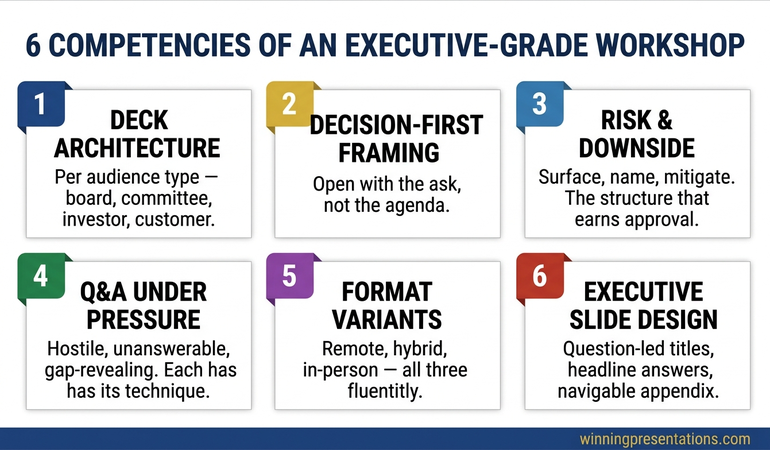
Credible executive training addresses four capabilities. First, structural methodology — how to lead with the recommendation, position evidence strategically, and address risk before the audience raises it. Second, stakeholder analysis: a board of non-executive directors evaluates differently from an investment committee, which evaluates differently from a leadership team. Training that treats all audiences as interchangeable produces presentations that are competent but not persuasive.

Third, scenario-specific practice. The presentation types executives deliver — annual budget presentations, risk committee updates, project approvals — each have their own structural logic. Generic role-plays miss this entirely. Fourth, Q&A preparation: for many executives, it is the question-and-answer session that determines the outcome, not the presentation itself.

If you are evaluating training options, the guide on choosing a presentation skills course for executives provides a detailed comparison framework.

A Complete Executive Presentation Programme — Self-Paced, Structured, Practical

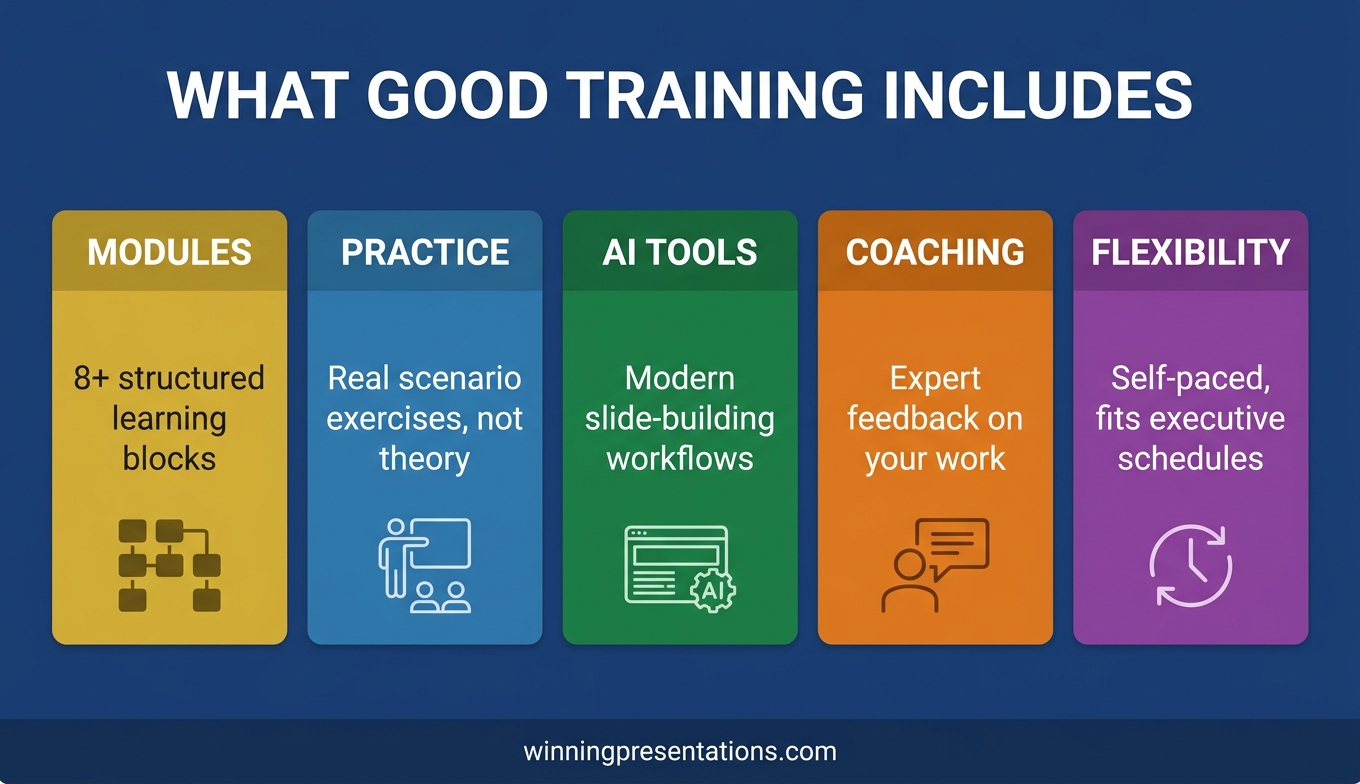
AI-Enhanced Presentation Mastery covers the full executive presentation skill set: structural methodology, stakeholder analysis, AI-assisted preparation, and delivery under pressure. Self-paced. 8 modules. 83 lessons. £499/seat.

  • ✓ 8 structured modules covering executive presentation methodology
  • ✓ 83 lessons — work through at your own pace, no deadlines
  • ✓ 2 optional live coaching sessions with Mary Beth (fully recorded)
  • ✓ AI-assisted preparation techniques for faster, sharper presentations

Explore the Programme → £499/seat

Enrolment is open — join at your own pace. Self-paced. 8 modules. 83 lessons. Optional coaching sessions — fully recorded.

Red Flags in Budget Presentation Courses

Many courses marketed as “executive” or “advanced” are repackaged entry-level content with a higher price tag. Knowing what to avoid saves money and the opportunity cost of training that does not transfer to the presentations you actually deliver.

Generic content with executive branding. If the curriculum covers slide design basics, vocal projection, and “power poses” without addressing structural logic for board-level presentations, it is designed for a general audience regardless of how it is marketed.

One-day transformation promises. Complex skills do not transfer in a single workshop. Programmes that promise “boardroom confidence in eight hours” are selling motivation, not capability. Lasting improvement requires structured practice across scenarios, with feedback.

No scenario differentiation. A risk committee presentation requires a fundamentally different structure from a team strategy update. Courses that teach one framework for all contexts miss the point.

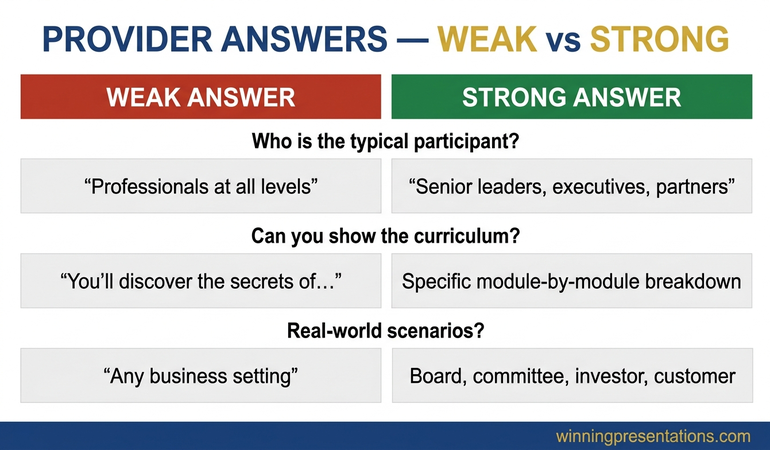
Trainer credentials without executive experience. Trainers with backgrounds in theatre or general communication may teach delivery well but struggle with executive-level structure. Look for trainers with corporate experience at the level you present to.

What Good Programmes Actually Include

The programmes that consistently improve executive presentation performance share several characteristics worth understanding before you evaluate marketing pages.

A repeatable structural methodology. The best programmes teach a framework covering argument sequencing (recommendation first, evidence second, risk addressed early), headline construction, and audience-specific framing. Once learned, this methodology accelerates preparation for every future presentation.

Scenario-based modules. Effective programmes break executive presentations into distinct types — board updates, budget proposals, investment pitches, strategic reviews — and address the structural logic of each.

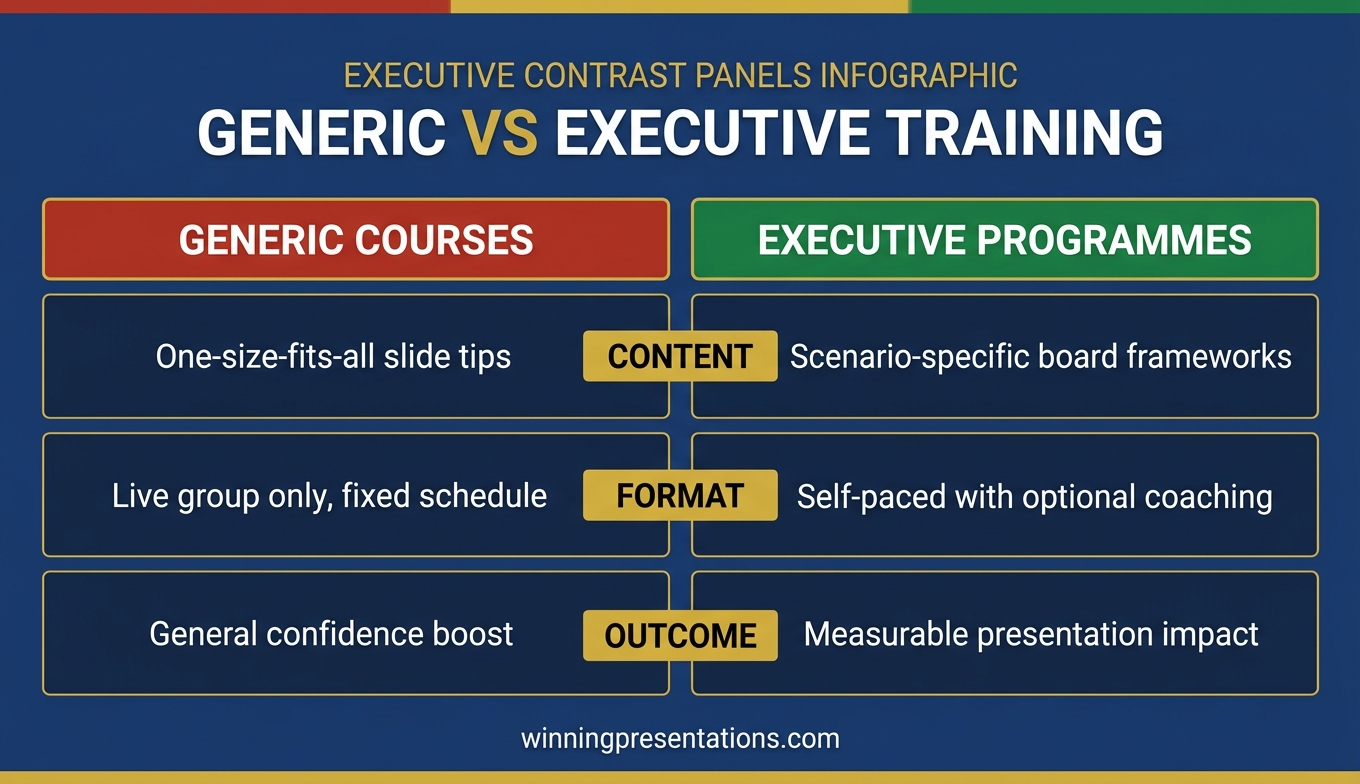
Comparison chart showing what executive presentation training should include versus what generic courses typically cover: structural methodology, scenario-specific practice, stakeholder analysis, and Q&A frameworks versus slide design, body language tips, and generic role-plays

AI integration. The most current programmes now incorporate AI-assisted preparation — teaching executives how to use tools like Copilot, ChatGPT, or Gemini effectively for presentation development. The critical distinction is between programmes that teach prompt engineering for executive scenarios specifically (where the structural methodology informs the AI prompts) and those that simply demonstrate generic AI features.

Flexible access. Senior executives rarely have the schedule flexibility for multi-day residential workshops. Programmes that offer self-paced learning — with optional live coaching for those who want direct feedback — respect the reality that most participants are fitting professional development around demanding roles.

For a deeper look at what distinguishes executive-level courses from standard offerings, the guide on executive presentation masterclasses online examines what the market currently offers and where the gaps remain.

Do presentation courses improve confidence?

Confidence in executive presentations is primarily a function of preparation quality, not personality. Executives who have a clear structural methodology — who know their recommendation is on the right slide, their evidence is sequenced correctly, and their risk mitigation is positioned before the audience raises it — present with significantly more confidence than those relying on general delivery techniques. The most effective training builds confidence indirectly, by giving presenters a reliable preparation framework rather than coaching them to “appear confident” through body language adjustments.

Self-Paced Versus Live Formats

The format question — self-paced online learning versus live workshops — is one of the first decisions when choosing presentation skills training. Both formats have genuine strengths, and the right choice depends on the executive’s primary gap.

Self-paced programmes work well for structural skills. Learning how to sequence an argument or prepare for board-level Q&A does not require a live instructor. These skills benefit from reflection and application — working through a module, applying the framework to an upcoming presentation, then returning with real experience to build on.

Live workshops have an advantage for delivery feedback: pacing, presence, and the ability to read the room. However, for executives whose primary challenge is structural, a live workshop may address the symptom (delivery confidence) while missing the cause (weak argument architecture).

The hybrid model — self-paced structural methodology with optional live coaching — is increasingly common and offers the benefits of both.

The AI-Enhanced Presentation Mastery programme uses this hybrid approach — 83 self-paced lessons covering executive methodology, with two optional live coaching sessions that are fully recorded for those who cannot attend in real time.

How long does it take to improve presentation skills?

Structural presentation skills — argument sequencing, headline framing, evidence positioning — can be applied immediately. An executive who learns to lead with the recommendation rather than build up to it will see an immediate difference in how board members engage with their next presentation. Delivery skills take longer because they involve habit change, but most executives see noticeable improvement within four to six weeks of structured practice. The key is consistent application: each presentation becomes a practice opportunity when you have a methodology to apply.

Decision framework for choosing between self-paced and live presentation training formats: comparing flexibility, structural skills, delivery feedback, schedule fit, and cost considerations for executive professionals

How to Evaluate the ROI of Presentation Training

Most organisations evaluate training on satisfaction scores rather than on whether it changed presentation outcomes. A more useful framework looks at three indicators.

Preparation time. Presentations that currently take four to six hours should take one to two hours after effective training. If the programme provides structural frameworks, preparation becomes assembly rather than invention. This saving alone often justifies the investment.

Decision outcomes. If an executive consistently faces “come back next month with more detail” responses, the issue is almost always structural. Effective training reduces the number of presentations that require a follow-up session before a decision is reached.

Stakeholder feedback quality. After effective training, questions shift from “what are you asking us to approve?” to substantive challenges — assumptions, implementation detail, risk mitigation. This shift indicates the audience is engaging with the argument rather than struggling to find it.

For senior leaders preparing for high-stakes scenarios, the article on senior executive presentation skills explores the specific capabilities that distinguish competent presenters from genuinely persuasive ones at the highest levels.

Invest in the Methodology, Not Just the Motivation

AI-Enhanced Presentation Mastery is a self-paced programme for executives who want a repeatable system for structuring presentations that win decisions. 8 modules. 83 lessons. 2 optional coaching sessions. £499/seat — a career investment that applies to every high-stakes presentation from this point forward.

Explore the Programme → £499/seat

Self-paced. 8 modules. 83 lessons. Optional coaching sessions — fully recorded.

Choosing the Right Programme for Your Role

The “right” programme depends on the gap you are trying to close.

If your gap is structural — you know the material but struggle to build arguments that land with senior audiences — prioritise programmes that teach methodology, not delivery coaching. Look for modules organised by scenario type rather than skill type.

If your gap is delivery — your content is sound but you struggle with nerves or presence — a programme with live coaching is more valuable. For executives dealing with genuine anxiety, the guide on managing stomach-churning nerves before presentations addresses the physiological dimension that many programmes overlook.

If your gap is both — common for executives promoted into roles requiring more senior presentations — a comprehensive programme covering structure, preparation, and delivery is the most efficient path.

Finally, evaluate the trainer. The most credible trainers have worked directly with senior leaders in corporate environments, not just taught presentation skills in academic settings. Industry experience gives them an understanding of the decision dynamics and political sensitivities that shape how executive presentations succeed or fail.

Can AI replace presentation training?

AI tools accelerate preparation but do not replace the structural knowledge that determines whether a presentation persuades a senior audience. If the executive does not know the correct structure for a board approval versus a budget proposal, AI output will be fluent but structurally generic. The most effective approach combines structural training with AI tools. Without the structural foundation, AI produces more slides faster — but they remain the wrong slides for executive audiences.

Frequently Asked Questions

How much does executive presentation training cost in the UK?

Executive presentation training in the UK ranges from under £100 for self-paced digital programmes to £2,000–£5,000 per day for bespoke in-person delivery with a senior consultant. Mid-range options — typically £300–£800 — often include structured modules, scenario-based exercises, and some form of coaching or feedback. The price alone does not determine quality; what matters is whether the programme addresses the specific presentation types you deliver (board updates, investment committee pitches, stakeholder proposals) rather than generic public speaking or slide design.

What should executive presentation training include?

Credible executive presentation training should cover four areas: structural methodology (how to sequence arguments for senior audiences), stakeholder analysis (adapting content and delivery to different decision-makers), scenario-specific practice (board presentations, budget proposals, executive approvals — not generic role-plays), and a framework for handling Q&A under pressure. Programmes that focus primarily on body language, vocal projection, or slide design are typically designed for general business audiences, not executives presenting at board level or to investment committees.

Is online presentation training as effective as in-person?

For structural and strategic presentation skills — how to frame an argument, sequence evidence, and build a recommendation — online training can be equally effective, particularly when delivered as self-paced modules that allow executives to apply concepts between sessions. Where in-person training has an advantage is in real-time delivery feedback: body language, voice modulation, and room presence. The best approach depends on what the executive needs most. If the gap is structural (decks that fail to persuade despite clear delivery), online or self-paced programmes address the core issue efficiently.

How do I choose the right presentation training programme?

Start by identifying the specific gap: is the challenge structural (arguments that do not land with senior audiences), delivery-related (nerves, pacing, presence), or both? Then evaluate programmes against four criteria: does it address your specific presentation scenarios (not just generic business contexts), does the trainer have credible experience with senior audiences, does it include practical application (not just theory), and does the format fit your schedule (self-paced versus scheduled workshops)? Avoid programmes that promise transformation through a single workshop — presentation skills improve through structured practice, not one-off sessions.

The Winning Edge

Weekly insights on executive presentations, stakeholder communication, and career-defining moments at the podium — for professionals who present at the highest stakes.

Subscribe Free

About the author

Mary Beth Hazeldine is the Owner & Managing Director of Winning Presentations. With 24 years of corporate banking experience at JPMorgan Chase, PwC, Royal Bank of Scotland, and Commerzbank, she advises executives across financial services, healthcare, technology, and government on structuring presentations for high-stakes scenarios.

22 Jan 2026
Corporate executive preparing for a presentation.

Presentation Skills Training That Actually Sticks? I Found It After 3 Failures.

I spent £4,200 on presentation training over five years. Two weeks after each course, I was back to my old habits.

Quick answer: Most presentation skills training fails because it fights how your brain actually learns. The forgetting curve erases 70% of new information within 24 hours—and traditional one-day workshops ignore this completely. Training that sticks uses spaced repetition, immediate application, and framework-based learning that anchors to situations you already face. The difference isn’t motivation; it’s methodology.

In practice, effective presentation skills training should build automatic habits for structure, delivery, and composure—so you can perform under pressure without consciously “remembering tips.”

Last updated: January 2026 — with current research on adult learning and skill retention.

📅 Presenting in the next 7 days? Do this now:

  1. Pick one framework (LEAD: Lead with decision, Evidence, Anticipate objections, Define next steps)
  2. Rewrite your slide order to match it (30 minutes)
  3. Practice transitions once out loud
  4. Use the same structure again next week to reinforce it

This won’t replace proper training—but it’s the fastest way to improve your next presentation while you decide on a longer-term approach.

After my third failed course, I started asking different questions. Not “which training is best?” but “why doesn’t any of it stick?”

The answer changed how I approach skill development entirely—and eventually led me to design training that works the opposite way from everything I’d tried before.

If you’ve invested in presentation training and watched the skills fade within weeks, you’re not the problem. The methodology is.

Why Most Presentation Training Doesn’t Stick

Here’s what typically happens with presentation skills training:

You attend a workshop. You learn techniques. You feel energised. You tell yourself “I’m going to use this.” Two weeks later, you’re presenting exactly the way you did before—maybe with one or two small changes that eventually fade too.

I watch this pattern repeat constantly: executives invest in training, see temporary improvement, then gradually return to baseline. It’s not lack of effort. It’s a fundamental mismatch between how training is delivered and how adults actually retain skills.

A client of mine—a technology director named Rachel—had done four different presentation courses before we worked together. “I have binders full of notes,” she told me. “Tip sheets, frameworks, checklists. I pull them out before big presentations, skim them, and then forget everything the moment I start speaking.”

She wasn’t lacking information. She was drowning in it—with none of it anchored deeply enough to access under pressure.

The problem isn’t the content of most training. It’s the delivery model: compressed timeframes, generic examples, no structured practice, and zero connection to the specific situations you actually face.

⭐ Training Designed to Actually Stick

AI-Enhanced Presentation Mastery uses spaced learning, framework-based methodology, and immediate application—the three elements that make skills permanent, not temporary.

What makes it different:

  • Spaced modules (not a single overwhelming day)
  • Frameworks you apply to your actual presentations
  • Live cohort for accountability and practice

See the Course Methodology →

Built from 24 years in corporate banking + hypnotherapy training in how adults actually learn and change.

📦 What You Get (Specifically):

  • 4 executive presentation frameworks — decision slides, board updates, stakeholder buy-in, high-stakes pitches
  • AI-enhanced creation workflow — cut slide creation time by 70% while increasing quality
  • Live cohort sessions — practice with peers, get real-time feedback, build accountability
  • Framework application exercises — apply each framework to presentations you’re actually giving
  • Spaced learning structure — modules across weeks, not crammed into one overwhelming day

The Forgetting Curve Nobody Mentions

In 1885, psychologist Hermann Ebbinghaus discovered something that should have changed training forever: we forget approximately 70% of new information within 24 hours, and 90% within a week—unless we actively reinforce it.

This is called the forgetting curve. And almost every presentation training programme ignores it completely.

Think about the typical format: an intensive one-day or two-day workshop. You’re hit with dozens of techniques, tips, and frameworks in a compressed timeframe. Your brain is overwhelmed. You leave feeling like you learned a lot—but the forgetting curve is already erasing most of it before you reach your car.

⏱️ Quick test: Think about the last presentation training you did. Can you name three specific techniques you learned? Can you describe exactly when and how to use each one? If you’re struggling, you’ve experienced the forgetting curve firsthand.

I experienced this myself after a two-day executive communication workshop. I filled an entire notebook. I was convinced I’d transformed. Six weeks later, a colleague watched me present and asked if I’d ever had any training. The techniques were gone—not because I didn’t value them, but because my brain had no structure for retaining them.

The solution isn’t more training. It’s differently structured training that works with how memory actually functions.

For more on why traditional approaches fail, see why most presentation training fails.

The forgetting curve showing how presentation skills training fades without spaced repetition and structured reinforcement

The 3 Elements That Make Training Permanent

After researching adult learning, cognitive psychology, and behaviour change, I identified three elements that separate training that sticks from training that fades:

1. Spaced Repetition (Not Compressed Delivery)

Your brain consolidates learning during sleep and through repeated exposure over time. A single intensive day fights this process. Spaced learning—where you encounter concepts multiple times across days or weeks—works with it.

A VP of marketing named David had done three intensive workshops. When he joined a spaced programme instead, he noticed something different: “I kept coming back to the same frameworks in new contexts. By the third week, I wasn’t thinking about the techniques anymore—I was just using them.”

That’s the difference between information you’ve heard and skills you’ve internalised.

2. Framework-Based Learning (Not Tips)

Tips are easy to teach but hard to remember. “Make eye contact.” “Start with a hook.” “Use the rule of three.” These float in your mind as disconnected fragments that you can’t access under pressure.

Frameworks are different. A framework is a mental structure that organises multiple techniques into a coherent system. When you learn a framework, you’re not memorising tips—you’re building a mental architecture that guides decisions automatically.

I’ll explain this more in the next section, but here’s the key: presentation skills training that relies on tips will always fade. Training built on frameworks becomes permanent because the framework itself is the memory structure.

3. Immediate Application (Not Future Promise)

Most training operates on delayed application: learn now, use later. But “later” rarely comes in a structured way, so the skills atrophy before you need them.

Effective training builds application into the learning itself. You don’t just learn a framework for structuring executive presentations—you immediately apply it to a presentation you’re actually giving next week.

A finance director named James told me this was the turning point for him: “In previous courses, the examples were hypothetical. In this one, I was restructuring my actual board presentation while learning. The framework stuck because it was already attached to something real.”

Want training built on these three elements? AI-Enhanced Presentation Mastery uses spaced learning, framework-based methodology, and immediate application to your real presentations. See How It Works →

Framework-Based vs. Tips-Based Learning

Let me show you the difference between tips and frameworks with a concrete example.

Tips-based approach:

  • “Start with a compelling hook”
  • “State your key message early”
  • “Use data to support your points”
  • “End with a clear call to action”

These are all true. They’re also almost useless under pressure because they’re disconnected fragments you have to consciously remember and sequence.

Framework-based approach:

The LEAD framework: Lead with the decision, Evidence that supports it, Anticipate objections, Define next steps.

One mental structure. Four components that flow logically. You don’t have to remember tips—you just move through the framework.

A client named Sarah switched from tips-based thinking to framework-based thinking after years of struggling. “I used to stand up and think ‘okay, hook, message, data, action…’ and I’d freeze trying to remember the sequence,” she told me. “Now I just think ‘LEAD’ and the structure unfolds. It’s not something I’m remembering—it’s something I’m using.”

This is why presentation skills training built on frameworks creates lasting change while tips-based training fades. The framework becomes the memory architecture itself.

Related: See how the presentation skills gap affects career progression—and why framework-based learning closes it faster.

Framework-based learning versus tips-based learning showing how frameworks create lasting presentation skills

⭐ Framework-First Presentation Mastery

AI-Enhanced Presentation Mastery teaches frameworks—not tips—so your skills become permanent mental architecture, not forgettable fragments.

Core frameworks you’ll master:

  • Executive decision frameworks (for board-level buy-in)
  • Story architecture (for memorable delivery)
  • AI-enhanced creation workflow (70% faster, higher quality)

Explore the Frameworks →

Live cohort learning with fellow senior professionals. Next cohort starting soon.

Why Immediate Application Changes Everything

Here’s something I learned from my hypnotherapy training that most presentation trainers miss: knowledge becomes skill only through contextual application.

Reading about how to structure an executive presentation is knowledge. Structuring your actual Q1 board update using that framework is skill development. The difference isn’t semantic—it’s neurological. Applied learning creates different, stronger neural pathways than theoretical learning.

This is why the “learn now, apply later” model fails. By the time “later” arrives, the neural pathways have weakened. You’re essentially starting over.

Effective presentation skills training eliminates the gap between learning and application. You don’t learn frameworks in the abstract—you learn them while applying them to presentations you’re already scheduled to give.

A product director named Michael described the shift: “In my previous training, I learned how to structure a stakeholder update. Then I went back to work and… kept doing what I’d always done because the moment had passed. This time, I restructured my actual stakeholder update during the session. I presented it two days later. The framework was already attached to a real outcome.”

That’s not just better retention. It’s a fundamentally different relationship between learning and doing.

If you’re building your slides alongside learning, see the common slide mistake executives make—one of the patterns we fix in the framework application exercises.

Ready for training that applies immediately? Every module in AI-Enhanced Presentation Mastery connects to presentations you’re actually giving—so skills stick from day one. See the Application Model →

Presentation Skills Training: Common Questions

Why doesn’t presentation skills training stick?

Most presentation skills training fails because it’s delivered in compressed timeframes (fighting the forgetting curve), relies on disconnected tips (instead of integrated frameworks), and separates learning from application (so skills atrophy before use). Training that sticks uses spaced repetition, framework-based learning, and immediate application to real presentations you’re already giving.

What makes presentation skills training effective?

Effective presentation training has three elements: spaced learning (concepts revisited over days/weeks, not crammed into one day), framework-based methodology (mental structures that organise multiple techniques), and immediate application (learning attached to presentations you’re actually giving). When all three are present, skills become permanent rather than temporary.

How long does it take to improve presentation skills?

With the right methodology, you can see meaningful improvement within 2-3 weeks—not because you’re learning faster, but because you’re retaining more. Traditional training shows initial improvement that fades within weeks. Spaced, framework-based training shows gradual improvement that compounds over time. Most professionals report feeling “transformed” within 6-8 weeks of consistent framework application.

Is This Training Right For You?

✓ This is for you if:

  • You’ve tried presentation training before and it didn’t stick
  • You’re a senior professional who presents to executives, boards, or clients
  • You want frameworks that become automatic, not tips you forget
  • You’re willing to apply what you learn to real presentations (not just theory)

✗ This is NOT for you if:

  • You’re looking for a quick fix or overnight transformation
  • You want generic tips without doing the application work
  • You’re not currently giving presentations at work
  • You’re at the start of your career (this is designed for senior professionals)

⭐ Presentation Training That Finally Works

AI-Enhanced Presentation Mastery is built on the three elements that make skills permanent: spaced learning, framework methodology, and immediate application to your real presentations.

What you’ll walk away with:

  • Frameworks that become automatic (not tips you forget)
  • Skills applied to your actual presentations (not hypotheticals)
  • AI-enhanced workflow that cuts creation time by 70%

Join the Next Cohort →

Live cohort format with senior professionals. Built from 24 years of corporate presentation experience.

FAQ

How is this different from other presentation training?

Most training compresses everything into 1-2 intensive days, teaches disconnected tips, and uses generic examples. This programme uses spaced learning (modules over weeks), framework-based methodology (integrated mental structures, not fragments), and immediate application (you work on your actual presentations, not hypotheticals). The result is skills that stick rather than skills that fade.

Will this work if I’ve tried training before?

Previous training likely failed because of the delivery methodology, not the content or your ability to learn. If you’ve experienced the “temporary improvement that fades” pattern, this approach addresses exactly that problem. The three-element methodology (spaced, framework-based, immediately applied) creates different outcomes than traditional compressed workshops.

How much time does this require?

The programme is designed for busy senior professionals. Modules are spaced across weeks rather than compressed into exhausting full days. You’ll spend roughly 2-3 hours per week—but because you’re applying frameworks to presentations you’re already giving, much of this time replaces (rather than adds to) your existing preparation work.

When will I see results?

Most participants report noticeable improvement within the first 2-3 weeks, as they apply frameworks to real presentations. The deeper transformation—where frameworks become automatic and you stop consciously thinking about technique—typically occurs around weeks 6-8. Unlike traditional training, these results don’t fade because the methodology addresses retention from the start.

📧 The Winning Edge Newsletter

Weekly insights on presentation mastery, executive communication frameworks, and the psychology of skill development. For senior professionals who want training that actually sticks.

Subscribe Free →

Your Next Step

If you’ve invested in presentation skills training before and watched the skills fade, you now understand why: the forgetting curve, tips-based content, and delayed application work against how your brain actually learns.

The question isn’t whether to invest in training—it’s whether to invest in training designed to stick.

Spaced learning. Framework-based methodology. Immediate application to presentations you’re already giving.

That’s what separates temporary improvement from permanent transformation.

To see how this methodology works in practice, explore AI-Enhanced Presentation Mastery.

About the Author

Mary Beth Hazeldine is the Owner & Managing Director of Winning Presentations and creator of AI-Enhanced Presentation Mastery. After spending £4,200 on presentation training that didn’t stick, she studied cognitive psychology and adult learning to understand why—then designed a methodology that actually works.

With 24 years of corporate experience at JPMorgan Chase, PwC, Royal Bank of Scotland, and Commerzbank, plus training as a clinical hypnotherapist, she brings a unique perspective on how professionals actually learn and retain presentation skills.

Book a discovery call | View services

19 Dec 2025
Presentation skills training comparison - traditional vs psychology and AI approach for lasting confidence

Presentation Skills Training: Why Most Programs Fail (And What Actually Works)

A hypnotherapist and ex-banker reveals why traditional presentation training doesn’t stick — and the psychology + AI approach that does

You’ve probably been through presentation skills training before. A one-day workshop. A corporate programme. Maybe even executive coaching.

And yet here you are, still searching for answers.

That’s not your fault. It’s a fundamental problem with how presentation training is designed. After 24 years presenting in corporate banking and treating hundreds of anxiety clients as a clinical hypnotherapist, I’ve seen exactly why most programmes fail — and what actually creates lasting change.

🎁 Free Download: Get my Executive Presentation Checklist — the pre-presentation routine I use before every high-stakes talk. A taste of what proper training includes.

Why Traditional Presentation Skills Training Doesn’t Work

Most presentation training focuses on the wrong things:

Problem #1: They teach techniques without addressing psychology.

“Make eye contact.” “Use gestures.” “Vary your tone.” These are surface-level tips that don’t help when your nervous system is in fight-or-flight mode. In my hypnotherapy practice, I saw this constantly — people who knew exactly what they should do but couldn’t do it when anxiety hit.

You can’t perform techniques when your hands are shaking and your mind is blank.

Problem #2: One-day workshops don’t create lasting change.

Research on skill acquisition is clear: lasting change requires spaced practice over time, not a single intensive session. Yet most corporate presentation training is a one-day event that’s forgotten within weeks.

Problem #3: They ignore the preparation bottleneck.

Most presentation anxiety comes from inadequate preparation — not lack of delivery skills. When you’re rushing to finish slides the night before, of course you’ll be nervous. But traditional training focuses almost entirely on delivery, not on how to prepare effectively.

Problem #4: They don’t adapt to how work has changed.

AI has transformed how we create content. Professionals who learn to use these tools effectively can prepare presentations in a fraction of the time — reducing anxiety and improving quality. Yet most presentation training ignores this entirely.

Related: Why Most Presentation Training Fails (And What Actually Works)

What Effective Presentation Skills Training Actually Looks Like

After training over 5,000 executives and treating hundreds of anxiety clients, I’ve identified what actually works:

1. Address the Psychology First

Before you can improve delivery, you need to manage your nervous system. This means learning techniques that work at the physiological level — breathing patterns that activate the parasympathetic response, anchoring techniques that access confident states on demand, and reframing methods that change how your brain interprets arousal.

This isn’t “mindset” fluff. It’s applied psychology from clinical practice.

Related: Public Speaking Tips: 15 Techniques That Actually Work

2. Fix the Preparation Problem

The executives I train who are most confident aren’t naturally gifted speakers — they’re exceptionally well-prepared. They have systems for structuring their message, creating compelling visuals, and rehearsing effectively.

Modern AI tools have made this dramatically easier. What used to take 6+ hours can now be done in 90 minutes — if you know how to use the tools correctly. That extra preparation time translates directly to confidence.

Related: AI Presentation Workflow: How I Cut Creation Time from 6 Hours to 90 Minutes

3. Space Learning Over Time

Skill development requires practice, feedback, and iteration. A single workshop can’t provide that. Effective training happens over weeks, with opportunities to apply techniques, get feedback, and refine your approach.

4. Combine AI Efficiency with Human Connection

AI can help you create better content faster. But the delivery — the presence, the connection, the ability to read the room and adapt — that’s irreducibly human. The best training teaches you to leverage AI for preparation while developing the human skills that make presentations memorable.

The 3Ps Framework: How My Clients Have Raised £250M+

Over 35 years, I’ve developed a methodology called the 3Ps Framework that addresses all three elements of effective presenting:

Proposition: What you’re actually saying — the structure, the argument, the story. Most presentations fail here before anyone opens their mouth. AI tools can dramatically accelerate this phase when used correctly.

Presentation: How the content is visualised and delivered. This includes slide design, pacing, and the technical aspects of delivery. Again, AI can help — but only if you know how to prompt it effectively.

Personality: The human element — presence, confidence, connection. This is where psychology matters most. No AI can give you executive presence. But the right techniques can unlock it.

Clients using this framework have raised over £250 million in funding. Not because they became different people — but because they learned to prepare effectively, manage their psychology, and deliver with authentic confidence.

Related: The 3Ps Framework: How My Clients Have Raised £250M+ in Funding

Presentation Skills Training That Actually Works

My AI-Enhanced Presentation Mastery course combines everything that makes training effective:

  • Psychology-based confidence techniques from my hypnotherapy practice
  • AI-powered preparation systems that cut creation time by 75%
  • Spaced learning over 8 modules with 2 live coaching sessions
  • Real-world application to your actual presentations

January cohort: £249 (increases to £499 in April)

Only 60 seats. Early bird ends December 31st.

See the full curriculum →

Who This Approach Works Best For

The psychology + AI approach to presentation skills training is particularly effective for:

Executives who present to boards and investors. High stakes require both confidence and preparation. The AI tools accelerate your preparation; the psychology techniques ensure you deliver with presence.

Professionals who’ve tried training before without lasting results. If you’ve done workshops that didn’t stick, you likely need the psychology component that was missing — not more tips on gestures and eye contact.

Anyone who spends too long preparing presentations. If you’re regularly working late on slides, AI-enhanced workflows can reclaim hours of your week while actually improving quality.

People who know their material but freeze under pressure. This is a classic sign that psychology, not knowledge, is the bottleneck. Clinical techniques for managing your nervous system will help more than any delivery tip.

Related: How to Create Executive Presentations That Get Results

What to Look for in Presentation Skills Training

If you’re evaluating options for presentation skills training, here’s what to look for:

Does it address psychology, not just technique? Look for programmes that teach anxiety management, confidence building, and mindset — not just “10 tips for better slides.”

Is it spaced over time or a one-day event? Lasting change requires practice and iteration. A single workshop is entertainment, not training.

Does it include modern tools? AI has changed how presentations are created. Training that ignores this is already outdated.

Is there personalised feedback? Generic advice only gets you so far. Look for programmes with live coaching or feedback on your specific presentations.

What’s the trainer’s actual experience? Theory is easy. Look for trainers who have presented in high-stakes environments themselves — not just taught others to do it.

Frequently Asked Questions

How is this different from corporate presentation training?

Most corporate training focuses on delivery tips (eye contact, gestures, voice) without addressing the psychology that prevents you from using those tips under pressure. It’s also typically a one-day event with no follow-up. The approach I teach addresses psychology first, uses AI to solve the preparation bottleneck, and is spaced over time for lasting change.

I’ve done presentation training before and it didn’t help. Why would this be different?

If previous training didn’t work, it likely focused on surface techniques without addressing your nervous system’s response to presenting. The psychology-based techniques I teach — drawn from clinical hypnotherapy — work at the physiological level where anxiety actually lives. That’s the missing piece for most people.

Do I need to be technical to use the AI components?

Not at all. The AI tools I teach (primarily Microsoft Copilot and ChatGPT) are designed to work with natural language prompts. If you can describe what you want, you can use these tools. The course includes exact prompts you can copy and adapt.

How much time does the training require?

The AI-Enhanced Presentation Mastery course includes 8 self-paced modules (about 30-45 minutes each) plus 2 live coaching sessions (90 minutes each). Most people complete it over 4-6 weeks while applying techniques to real presentations.

What if I’m already a confident presenter?

The AI components alone can save you 4+ hours per presentation. Even confident presenters benefit from more efficient preparation and advanced techniques for reading the room, handling difficult questions, and adapting on the fly.

Is there a guarantee?

Yes. Maven offers a full refund until the halfway point of the course. If it’s not working for you, you get your money back.


Your Next Step

If you’re serious about improving your presentation skills — not just attending another workshop that doesn’t stick — here’s what I recommend:

  1. Start with the fundamentals. Read my guide to 15 Public Speaking Tips That Actually Work and try the techniques in your next presentation.
  2. Download the checklist. Get the Executive Presentation Checklist and use it before your next high-stakes talk.
  3. Consider structured training. If you want the complete system — psychology, AI tools, and live coaching — the AI-Enhanced Presentation Mastery course covers everything.

The January cohort has 60 seats at £249 (early bird pricing ends December 31st). After that, the price increases to £499.

Ready for Presentation Training That Actually Works?

AI-Enhanced Presentation Mastery

Psychology-based confidence + AI-powered preparation + Live coaching

£249 £499

Early bird ends December 31st • 60 seats • Full refund guarantee

Enrol Now →


Mary Beth Hazeldine is a qualified clinical hypnotherapist and Managing Director of Winning Presentations. She spent 24 years in corporate banking at JPMorgan, PwC, Royal Bank of Scotland, and Commerzbank, and has trained over 5,000 executives to present with impact. Her clients have raised over £250M using her frameworks.

09 Dec 2025
Why most executive presentation training fails - 90% of skills lost within 1 week - January 2026 Maven course on executive presentations with only 60 seats

Why Most Presentation Training Fails (And What Actually Works) [2026]

📅 Published: December 9, 2025 — New AI-enhanced executive presentation training course launching January 2026

Updated 27 March 2026 — Revised for the latest Microsoft Copilot and ChatGPT capabilities.

I’m going to say something that might upset the training industry: most presentation training is a waste of money.

I’ve been on both sides. I’ve sat through corporate presentation workshops that cost £10,000 and changed nothing. I’ve also delivered training that transformed how executives communicate.

The difference isn’t the content. It’s not the slides. It’s not even the trainer’s credentials.

After 25 years in corporate banking and a decade of training executives, I’ve identified exactly why most presentation training fails — and the three elements that make training actually stick.

If you want a ready-made framework for executive presentations: Explore The Executive Slide System →

Templates, AI prompts, and scenario playbooks for building board-ready slides.

The Uncomfortable Truth About Presentation Training

Here’s what typically happens:

A company books a presentation skills workshop. An enthusiastic trainer delivers two days of content. Participants practice, get feedback, feel inspired. Everyone leaves with a workbook they’ll never open again.

Three weeks later? They’re presenting exactly the same way they did before.

Research backs this up. Studies on corporate training show that 90% of new skills are lost within a week if not reinforced. The “forgetting curve” is brutal — and most presentation training ignores it completely.

So why do companies keep spending money on training that doesn’t work?

Because the problem isn’t obvious. The training feels valuable. People enjoy it. HR can tick a box. But behaviour change? That’s much harder to achieve — and measure.

Why Traditional Executive Presentation Training Fails

I’ve analysed hundreds of presentation training programmes. The failures cluster around three core problems:

Problem #1: Generic Content for Specific Challenges

Most presentation training teaches universal principles: make eye contact, use fewer bullet points, tell stories.

That’s fine. But it ignores the reality that a board presentation requires completely different skills than a sales pitch. A biotech investor deck has different conventions than a SaaS demo. An internal strategy update isn’t the same as an external keynote.

The symptom: Participants learn “presentation skills” but can’t apply them to their actual high-stakes moments.

I spent 25 years at JPMorgan Chase, PwC, Royal Bank of Scotland, and Commerzbank. I know that a presentation to a credit committee requires surgical precision. A pitch to private equity demands a different energy. A board update needs executive brevity. Generic training doesn’t address any of this.

Problem #2: No Practice Under Pressure

Presenting in a safe training room is nothing like presenting when it matters.

When the CEO is watching. When £5 million is on the line. When your promotion depends on the next 15 minutes. That’s when nerves kick in. That’s when habits take over. That’s when all that training evaporates.

The symptom: People perform well in workshops but freeze in real situations.

Effective presentation training must simulate pressure. Not artificial pressure — real pressure. With stakes. With feedback that stings a little. With enough repetition that new behaviours become automatic.

Problem #3: One-and-Done Events

A two-day workshop is an event, not a transformation.

Real skill development requires:

  • Spaced repetition (practice over weeks, not hours)
  • Real-world application between sessions
  • Feedback on actual presentations, not role-plays
  • Accountability to implement changes

The symptom: Temporary enthusiasm followed by permanent reversion to old habits.

This is why executive coaching works better than workshops — but costs £500-1,000 per hour. Most people can’t access that level of support.

Three reasons presentation training fails: generic content for specific challenges, no pressure practice, and one-and-done events leading to permanent reversion to old habits

A DIFFERENT APPROACH TO EXECUTIVE PRESENTATION TRAINING

AI-Powered Executive Presentations

Live cohort course designed to fix everything wrong with traditional training

Join the January Waitlist

£249 early bird • Only 60 seats • Launching January 2026

The 3 Elements of Presentation Training That Actually Works

Not all training fails. Some transforms careers. Here’s what separates effective executive presentation training from expensive theatre:

Element #1: Context-Specific Application

Effective training starts with your actual presentations. Not hypotheticals. Not case studies from other industries. Your board deck. Your investor pitch. Your client presentation.

What this looks like:

  • Participants bring real presentations they’re working on
  • Feedback addresses their specific challenges
  • Templates and frameworks match their industry context
  • Practice scenarios mirror their actual high-stakes moments

When I train investment bankers, we work on pitch books and credit committee presentations. When I train biotech executives, we focus on investor days and scientific advisory boards. When I train SaaS leaders, we refine demo flows and QBR structures.

The principles are universal. The application must be specific.

Element #2: Distributed Practice with Accountability

The research is clear: distributed practice beats massed practice. Five one-hour sessions over five weeks creates more lasting change than one five-hour workshop.

What this looks like:

  • Training spread over weeks, not crammed into days
  • Assignments to apply learning between sessions
  • Peer accountability and feedback loops
  • Real presentations reviewed and refined throughout

This is why cohort-based courses outperform self-paced learning. You’re not just learning — you’re implementing, getting feedback, and iterating. The social pressure of a cohort keeps you accountable.

Element #3: Modern Tools Integration

Here’s where most executive presentation training is stuck in 2015.

AI tools like PowerPoint Copilot have fundamentally changed how presentations are created. Executives who master these tools save 10+ hours per week. Those who don’t are competing with one hand tied behind their back.

What this looks like:

  • Training that integrates AI tools from day one
  • Prompts and workflows specific to executive presentations
  • Focus on human + AI collaboration, not replacement
  • Practical application: use AI to build your actual presentations during training

The future of executive communication isn’t choosing between presentation skills and AI skills. It’s mastering both — using AI to handle the tedious work so you can focus on strategy, storytelling, and delivery.

💡 The Compound Effect: Executives who combine strong presentation skills with AI mastery don’t just save time — they produce better work. The AI handles structure and first drafts. The human brings judgment, nuance, and persuasion. Together, they’re unbeatable.

What Changes When Training Actually Works

I’ve seen what happens when executive presentation training is done right:

A VP of Strategy went from dreading board meetings to requesting them. Her proposals started getting approved on first presentation instead of being deferred for “more analysis.”

A startup founder raised his Series A in half the meetings his advisors predicted. His pitch wasn’t just clearer — it was structured to address investor objections before they were raised.

A management consultant got promoted two years ahead of peers. Her partners specifically cited her “exceptional client communication” — skills she developed in eight weeks of focused training.

The common thread? They didn’t just learn presentation skills. They transformed how they communicate under pressure, in their specific context, using modern tools.

The Hidden Cost of Bad Presentations

Let’s talk about what ineffective presentations actually cost:

Direct costs:

  • Deals lost to competitors with better pitches
  • Budgets rejected and projects delayed
  • Strategies misunderstood and poorly executed
  • Hours wasted on presentations that don’t land

Career costs:

  • Promotions that go to people who “present well”
  • Ideas attributed to whoever communicated them best
  • Executive presence questions that stall advancement
  • Confidence erosion from repeated underwhelming performances

Opportunity costs:

  • Influence you could have but don’t
  • Relationships that never deepen because communication falls flat
  • The compounding effect of years of suboptimal presentations

Most executives don’t calculate these costs. They accept mediocre presentations as normal. But the executives who invest in genuine skill development? They pull ahead — and keep pulling ahead.

Calculate Your ROI

If better presentations helped you close one extra deal, secure one budget approval, or accelerate one promotion — what’s that worth? For most executives, it’s 10-100x the cost of proper training.

See Course Details →

Why I’m Launching a Different Kind of Course

After years of corporate training, I kept hitting the same frustrations:

Companies wanted two-day workshops. I knew those don’t create lasting change.

Budgets limited training to generic content. I knew context-specific application is essential.

Traditional formats ignored AI tools. I knew these tools are transforming executive productivity.

So I designed something different.

AI-Powered Executive Presentations is an 8-week cohort course that addresses everything wrong with traditional executive presentation training:

Instead of generic content: You’ll work on your actual presentations throughout the course. Board decks. Investor pitches. Client presentations. Whatever high-stakes moments you’re facing.

Instead of one-and-done: Eight weeks of distributed learning with assignments, peer feedback, and accountability. The research-backed approach to lasting skill development.

Instead of ignoring AI: Deep integration of Copilot, ChatGPT, and other tools. You’ll learn to use AI as a force multiplier — saving hours while producing better work.

Instead of passive learning: Live cohort sessions. Hot seats where participants present and get real-time feedback. A community of peers facing similar challenges.

AI-Powered Executive Presentations 8-week curriculum covering foundations, AI creation, high-stakes delivery, and application with live cohort learning for January 2026

What You’ll Master in 8 Weeks

Weeks 1-2: Executive Communication Foundations

  • The 3Ps Framework (Proposition, Presentation, Personality) — the methodology behind the Executive Slide System gives you exactly what to type, updated for the latest Copilot and ChatGPT capabilities.

    Who This Course Is For

    This isn’t for everyone. It’s specifically designed for:

    Executives and senior managers who present to boards, leadership teams, or external stakeholders — and want those presentations to drive decisions, not just inform.

    Founders and entrepreneurs raising capital or pitching to enterprise clients — where every presentation directly impacts the business.

    Consultants and advisors whose credibility depends on how they communicate recommendations — and who want to stand out from peers.

    High-potential professionals who know that executive presence and communication skills are the difference between good careers and exceptional ones.

    If you’re already an excellent presenter, this course will make you exceptional. If you’re struggling with high-stakes presentations, this course will give you the skills and confidence to perform under pressure.

    Who This Course Is NOT For

    To be direct:

    Not for passive learners. This course requires active participation. You’ll present, get feedback, and iterate. If you want to sit back and absorb content, this isn’t the right fit.

    Not for people seeking quick fixes. Transformation takes eight weeks of consistent effort. If you’re looking for a magic bullet, you’ll be disappointed.

    Not for those uncomfortable with AI. This course integrates AI tools throughout. If you’re resistant to using Copilot and ChatGPT, you won’t get full value.

    Not for beginners. This is executive-level training. If you’ve never given a business presentation, start with foundational resources first.

    Stop Rebuilding Every Deck From Scratch

    22 executive slide templates, 51 AI prompts, and 15 scenario playbooks — designed so you can structure any board presentation, investment case, or strategic review in 30 minutes. Executive Slide System — £39, instant access.

    Get the Executive Slide System →

    Designed for executives and senior managers presenting in high-stakes environments.

    Start With a Framework, Not a Blank Slide

    The three elements of effective presentation training — context-specific application, distributed practice, and modern AI integration — are built into the Executive Slide System.

    10 board-ready templates. 30 AI prompts. Each template is structured around the frameworks that actually drive decisions in high-stakes executive environments.

    Executive Slide System — £39, instant access.

    Designed for executives and senior managers presenting to boards, leadership teams, and investors.

    Frequently Asked Questions

    How is this different from other presentation courses?

    Three key differences: (1) You work on your actual presentations, not generic exercises. (2) AI tools are integrated throughout, not ignored. (3) The cohort format with distributed practice creates lasting change, not temporary inspiration.

    What if I can’t attend all live sessions?

    Sessions are recorded. But the value comes from live participation, hot seats, and peer interaction. If you can’t commit to most live sessions, consider waiting for a future cohort.

    I’m not technical. Will I be able to use the AI tools?

    Yes. We start from basics and provide step-by-step guidance. By week 4, you’ll be using AI tools confidently — regardless of your starting point.

    What presentations can I work on during the course?

    Any high-stakes business presentation: board decks, investor pitches, client proposals, internal strategy presentations, QBRs, or keynotes. The more important the presentation, the more value you’ll get.

    Is there a guarantee?

    If you actively participate in the first two weeks and don’t find value, I’ll refund your investment. I’m confident in the methodology — it’s the same approach that has transformed how executives communicate under pressure.

    Why only 60 seats?

    Cohort size matters. Too large, and you lose the personalised feedback and community connection. Sixty participants is the maximum for maintaining quality while creating diverse peer interactions.

    Start Improving Today

    Whether or not the course is right for you, here are resources to improve your executive presentations now:

    About Mary Beth Hazeldine

    After 25 years in corporate banking at JPMorgan Chase, PwC, Royal Bank of Scotland, and Commerzbank, Mary Beth now trains executives to communicate with impact. She’s particularly focused on helping leaders integrate AI tools like Copilot into their workflow — creating better presentations in less time. She runs Winning Presentations and is launching the AI-Powered Executive Presentations course on Maven in January 2026.