

Vendor Selection Presentation: How to Win the Final Shortlist Meeting
A vendor selection presentation is not a product demonstration. It is a risk-reduction exercise for the buying committee. The team that wins the final shortlist meeting is rarely the one with the most features or the lowest price—it is the one that makes the decision feel safe. Here is how to structure your slides so the room chooses you with confidence.
Chiara had been through six months of relationship building, two discovery workshops, and a pilot programme that generated measurable results. Her company was one of three vendors on the final shortlist for a £2.8 million enterprise contract. She walked into the selection meeting with a forty-slide deck that recapped every feature, every integration point, every case study. The procurement lead stopped her at slide twelve. “We’ve seen the capabilities. What we need to understand is what happens in month three when our legacy system migration stalls and your implementation team is stretched across four other clients.” Chiara didn’t have a slide for that. She improvised an answer—competent but generic. The contract went to a competitor whose entire presentation had been built around three questions: what could go wrong, what would they do about it, and who specifically would be responsible. Chiara’s deck had been a capability showcase. The winner’s deck had been a risk mitigation plan. She never made the same mistake again.
Preparing for a vendor selection meeting? The Executive Slide System includes decision-focused templates and frameworks designed for high-stakes client presentations.
Jump to section:
Why Buying Committees Choose Safety Over Capability
Every vendor on the final shortlist can do the job. That is why they are on the shortlist. By the time the selection committee sits down for the final vendor selection presentation, capability differentiation has already been assessed through RFP responses, reference calls, and pilot results. The committee is no longer asking “can they do it?” They are asking “what happens if it goes wrong?”
This shift matters because it changes the purpose of your presentation entirely. A capability presentation says: “Here is what we can do for you.” A risk-reduction presentation says: “Here is what we will do when things don’t go to plan.” The first invites comparison. The second invites trust. And trust is the currency that decides final shortlist meetings.
Buying committees are composed of people who will be held accountable for the decision. The IT director who champions a vendor that fails will carry that failure for years. The procurement lead who approves a contract that overruns will face scrutiny at every quarterly review. These individuals are not optimising for the best possible outcome. They are optimising for the least painful failure. Your presentation must speak to that psychology.
The structural implication is straightforward: lead with risk, not with capability. Show the committee that you have anticipated what could go wrong, that you have specific plans for each scenario, and that named individuals on your team are accountable for delivery. This reframes your vendor selection presentation from a sales pitch into a governance conversation—and governance conversations are where procurement committees feel most comfortable making decisions.
Structure Your Vendor Pitch for Decision-Ready Clarity
The Executive Slide System gives you presentation templates and decision frameworks—so your shortlist meeting earns approval by addressing risk before the committee raises it.
- ✓ Presentation templates for executive and client scenarios
- ✓ AI prompt cards to build structured decks fast
- ✓ Framework guides for high-stakes decision presentations
Get the Executive Slide System → £39
Designed for executives preparing high-stakes presentations
The Three-Slide Framework That Wins Final Shortlists
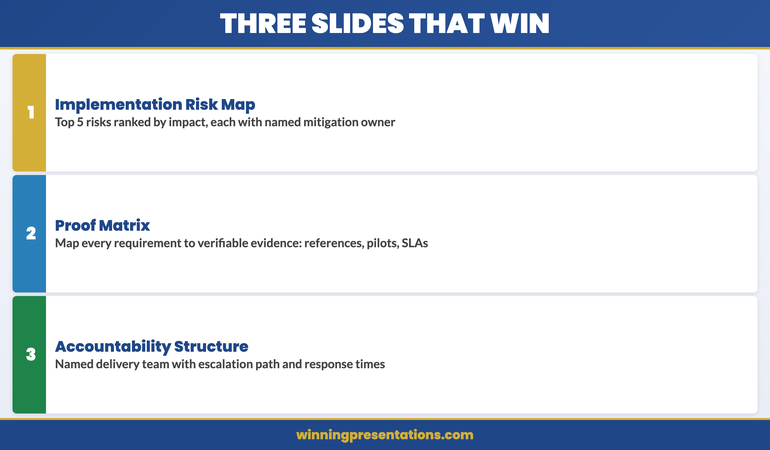
The most effective vendor selection presentations can be distilled to three core slides that address the committee’s actual decision criteria. Everything else—features, architecture, pricing detail—is supporting material for Q&A.
Slide 1: The Implementation Risk Map. List the five most likely risks to successful delivery, ranked by probability and impact. For each risk, provide a specific mitigation with a named owner from your team. This slide does more than demonstrate preparedness. It tells the committee you have done this before—because only experienced teams know which risks actually materialise. Generic risk statements like “timeline overrun” signal inexperience. Specific risks like “data migration from legacy ERP systems typically encounters schema mismatches in the first two weeks” signal expertise.
Slide 2: The Proof Matrix. Map each of the committee’s stated requirements to a specific piece of evidence: a reference client, a pilot result, a benchmark metric, or a contractual commitment. The key word is “specific.” Claiming you have “extensive experience in financial services” is a feature. Stating that “Zurich Financial completed their implementation in fourteen weeks against a sixteen-week target, with the project lead available as a reference” is proof. The proof matrix converts assertions into verifiable claims.
Slide 3: The Accountability Structure. Show who will be responsible for delivery. Not a generic organisational chart—a specific team structure with named individuals, their relevant experience, and their availability commitment. Include the escalation path: who the client calls when something goes wrong, and the guaranteed response time. This slide answers the committee’s most important unspoken question: “When this gets difficult, who will actually fix it?” For more on structuring your pipeline review presentations, that guide covers how sales leaders can track and present deal progress systematically.
Building a Proof Architecture That Survives Scrutiny
Claims without evidence are noise in a vendor selection meeting. Procurement committees are trained to discount assertions and weigh verifiable proof. Your presentation needs a deliberate proof architecture—a systematic approach to backing every significant claim with evidence the committee can independently verify.
The hierarchy of proof in procurement is consistent across industries. Contractual commitments carry the most weight—service level agreements, penalty clauses, and performance guarantees that create financial accountability. Reference calls rank second—direct conversations with comparable clients who can describe their actual experience. Pilot results rank third—measurable outcomes from work you have already done for this specific client. Case studies and credentials rank lowest—useful for context but insufficient for decision-making.
Structure your evidence accordingly. For every critical requirement, present the highest-ranking proof available. If you can offer a contractual guarantee, lead with it. If your strongest evidence is a reference client, prepare that client for a follow-up call and state this explicitly in the presentation: “Our reference contact at [company] is available this week for a direct conversation.” Offering the committee immediate access to verification demonstrates confidence. Promising to “arrange references after the meeting” signals that you are still preparing your case.
The proof architecture also protects you from the most common selection meeting trap: the hypothetical scenario. Committees will test vendors with questions like “What would you do if our data migration took three times longer than planned?” A proof-based response references a specific instance where you managed a similar challenge: “When we implemented at [comparable client], the initial data migration estimate was twelve weeks. Actual migration took nineteen weeks due to legacy schema complexity. Here’s how we managed the overrun without impacting the go-live date.” Hypothetical answers lose to historical proof every time.
Presenting Through the Procurement Lens
The procurement representative in a vendor selection meeting has different priorities from the business sponsor. The sponsor cares about capability and outcomes. Procurement cares about contract risk, total cost of ownership, and vendor stability. Your vendor selection presentation must satisfy both audiences simultaneously, and the structure must make it obvious that you understand what procurement values.
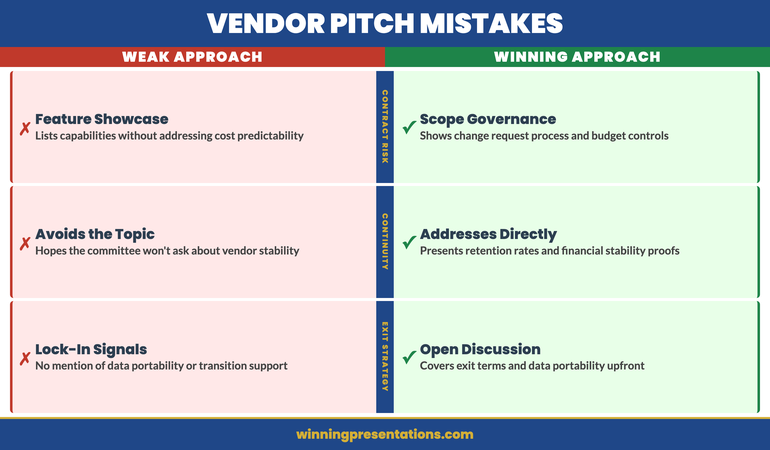
Three procurement priorities shape every shortlist decision. First, contract predictability: will the total cost match the proposal? Procurement teams are evaluated on budget adherence, not on the quality of the vendor they select. Address this by including a slide on scope governance—how you manage change requests, how you price out-of-scope work, and how you prevent the “scope creep to budget overrun” pattern that procurement has seen repeatedly from other vendors.
Second, vendor continuity: will your organisation still exist and still care about this client in three years? For established companies, this is straightforward—reference your tenure and client retention rates. For smaller firms, address it directly: explain your financial stability, your growth trajectory, and the contractual protections you offer for business continuity. Avoiding this topic does not make it disappear. It simply means the committee will discuss it after you leave the room, without your input.
Third, exit strategy: what happens if the relationship needs to end? Procurement professionals always want to know the exit terms before they sign. Include a brief slide on data portability, transition support, and contract termination terms. This may feel counterintuitive—discussing the end of the relationship before it begins—but it signals maturity and reduces the committee’s perception of lock-in risk. The vendor who openly discusses exit terms appears confident. The vendor who avoids the topic appears dependent. For more on handling client escalation presentations, that guide covers the communication approach when existing relationships face pressure.
If you’re structuring a vendor deck for the first time, the Executive Slide System provides the structural templates that ensure every slide addresses a decision criterion, not just a feature.
Closing the Decision Without Closing the Sale
The final minutes of a vendor selection presentation determine whether the committee leaves the room ready to decide or ready to deliberate further. Deliberation is not your friend. Every additional week of deliberation introduces new variables—budget freezes, stakeholder changes, competitor counter-offers—that reduce your probability of winning. Your closing must create the conditions for an immediate decision.
Do not ask for the business. The committee knows you want the contract. A closing that says “We’d love to work with you” adds no information and sounds like every other vendor. Instead, close with a decision architecture. Present the committee with a clear next step that is easy to say yes to: “We propose a two-week contract review period, with our legal team available for mark-up sessions starting Monday. If the committee is aligned on vendor selection today, we can have a signed agreement within three weeks.”
This framing works because it removes the committee’s biggest friction point: the gap between “we’ve decided” and “we’ve signed.” By presenting a specific, time-bounded implementation pathway, you convert the decision from abstract to concrete. The committee is no longer voting on whether they like your company. They are agreeing to a specific next step with a defined timeline.
End with a single summary slide that restates three things only: the business outcome you will deliver, the named person who will be accountable, and the proposed timeline to value. No feature recaps, no benefit lists, no “why us” statements. The summary exists to give the committee a clear, simple framework for their deliberation. When the chair turns to the room after you leave and asks “What do we think?”—your summary slide should be the frame through which they discuss their decision. If it is clear enough, they’ll use your language. And when a committee uses your language to discuss the decision, you have already won. For guidance on structuring the contract renewal presentation that follows a successful vendor selection, that guide covers the annual review framework that retains long-term clients.
Win the Shortlist Meeting With a Decision-Ready Deck
Stop presenting features. Start presenting risk mitigation. The Executive Slide System gives you the templates and frameworks to build vendor presentations that close—for £39.
Frequently Asked Questions
How long should a vendor selection presentation be?
The core presentation should be fifteen to twenty minutes, leaving forty to fifty minutes for committee questions. Most selection meetings are scheduled for sixty to ninety minutes. The committee has already reviewed your written proposal—they do not need a comprehensive recap. A shorter presentation signals confidence and leaves more time for the governance-style Q&A where decisions actually form. Aim for ten to twelve slides: three core slides (risk map, proof matrix, accountability structure), supported by a brief context opener, a financial summary, and a decision-close slide.
Should I address competitor weaknesses in a vendor presentation?
Never directly. Committees view negative selling as a sign of insecurity. Instead, address competitor weaknesses indirectly by strengthening your own proof in the areas where competitors are weak. If you know a competitor lacks implementation capacity, emphasise your named delivery team and their availability. If a competitor has no comparable reference clients, lead with your proof matrix showing specific, verifiable references. The committee will draw the comparison themselves—and a conclusion they reach independently is far more persuasive than one you hand them.
What is the biggest mistake vendors make in final shortlist presentations?
Presenting the same deck they used for the initial pitch. The audience, the context, and the decision criteria have all evolved since the first meeting. The initial pitch was about establishing capability and generating interest. The final shortlist meeting is about reducing risk and facilitating a decision. Vendors who recycle their pitch deck force the committee to do the translation work—mapping features to risks, promises to proof, and enthusiasm to accountability. The vendor who builds a presentation specifically for the selection committee’s decision framework demonstrates that they understand the buying process, not just the product.
The Winning Edge
Weekly insights on executive presentations, slide strategy, and boardroom communication.
Building a vendor pitch deck? Download the Executive Slide System checklist for a quick framework to structure your next shortlist presentation.
If your vendor relationship also requires managing internal cost pressures, our guide to cost reduction presentations covers the slide architecture that frames budget cuts as strategic investment.
About the author
Mary Beth Hazeldine, Owner & Managing Director, Winning Presentations. With 24 years of corporate banking experience at JPMorgan Chase, PwC, Royal Bank of Scotland, and Commerzbank, she advises executives across financial services, healthcare, technology, and government on structuring presentations for high-stakes funding rounds and approvals.