Quick Answer
An internal transfer pitch succeeds when it is structured as a business case rather than a personal preference statement. The decision-maker needs to see three things: what the organisation gains by approving the move, what you bring that is directly relevant to the new role, and what the cost or risk of not moving you is. An internal pitch that frames itself around your career goals is a request. One that frames itself around organisational value is a proposal.
In This Article
- Why internal pitches fail when external pitches would succeed
- The three elements every internal pitch must address
- How to frame the move as a business decision
- Navigating the political dimension of an internal pitch
- Presenting your transition plan
- Handling the objections that always come up
- Frequently asked questions
Tomás had been in the same division for eight years. When a senior role opened in a part of the business he had been angling towards for two years, he put himself forward, prepared a thorough self-assessment, and requested time with the divisional director to discuss it.
The conversation lasted 11 minutes. The director told him the role would be filled externally.
What went wrong was not Tomás’s track record, which was strong. What went wrong was the structure of what he said. He spent the 11 minutes explaining why he wanted the role. The director spent those same 11 minutes silently calculating what losing Tomás from his existing team would cost him. Neither of them was having the conversation the situation required.
Internal transfer pitches fail in this way constantly. The candidate frames the conversation around their development. The decision-maker evaluates it through the lens of organisational disruption. Those two frames are not compatible, and without a structure that addresses both, the conversation ends in a polite “we’ll let you know” that usually means no.
Need a presentation structure for a high-stakes career conversation?
The Executive Slide System includes proposal templates and framework guides designed for making the business case in internal and external career-stage presentations.
Why Internal Pitches Fail When External Pitches Would Succeed
The most counterintuitive aspect of an internal transfer pitch is that your existing relationship with the organisation makes the conversation harder, not easier. External candidates start from zero. You start from a set of existing perceptions, existing dependencies, and existing political dynamics that shape how every word you say is received.
Your current manager hears your transfer pitch as a signal that their team is about to lose a high-performer. The hiring manager in the new division may have concerns about whether you can reposition yourself from a known role into an unknown one. The HR function is evaluating whether approving your move sets a precedent they are comfortable with. None of these stakeholders are against you, but none of them are reading your pitch as a neutral observer.
This means the internal pitch requires a more sophisticated structure than an external interview. An external candidate needs to establish credibility, demonstrate capability, and close on the opportunity. An internal candidate needs to do all three of those things and also address the costs and concerns that come with internal movement. The pitch has to make it easy for multiple stakeholders to say yes, not just the hiring manager.
The failure mode for most internal pitches is treating the conversation as if it were a performance review rather than a business proposal. The structure of a performance review is backward-looking: here is what I have done, here is how well I have done it, here is why I deserve the next thing. The structure of a business proposal is forward-looking: here is the problem that needs solving, here is my capability to solve it, here is what the organisation gets by backing this move. The second frame is far more persuasive in a decision setting.
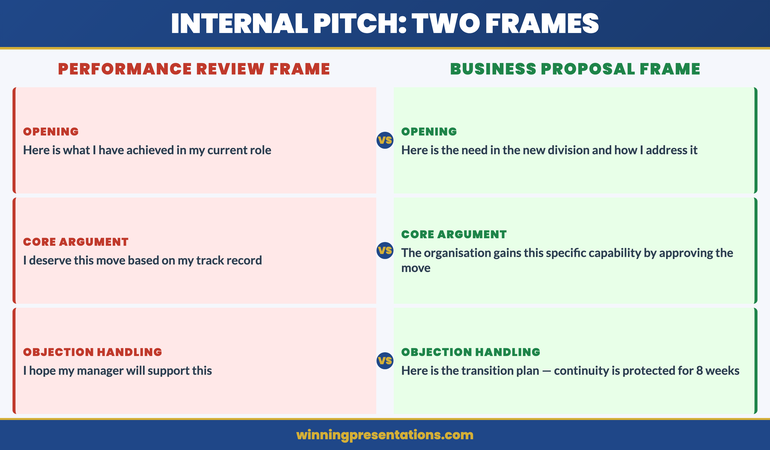
The Three Elements Every Internal Pitch Must Address
An internal transfer pitch that earns approval addresses three questions in sequence. These questions correspond to the concerns of the different stakeholders involved in the decision.
1. What does the organisation gain? This is the organisational value question, and it is the frame that makes an internal pitch a business proposal rather than a personal request. The answer should connect your specific skills and experience to a named need in the target role or division. Not “I have strong analytical capability” but “the new division is building a client-facing data function and I have spent three years building exactly this capability on the service delivery side, which is the experience they currently lack on the team.”
2. What do you bring that is directly relevant? This is not your full CV. It is the two or three pieces of your existing experience that are most directly transferable to the requirements of the new role. Be specific about the capability, and be explicit about the mechanism of transfer — not just “I have done X” but “the X I did on Project Meridian translates directly to the Y challenge I understand the new team is facing.” Internal decision-makers are generally more sceptical about transferability than external ones, because they have a clearer picture of the gap between your current role and the new one.
3. What is the cost or risk of the move not happening? This is the element most often absent from internal pitches, and it is the one that converts a polite conversation into a decision moment. The cost of the move not happening is rarely about you personally — it is about the organisational opportunity that is left unaddressed. “Without someone with this profile in the new team, the risk is that the function is built by people who understand the technology but not the client relationship dynamics. That is a gap that costs significantly more to correct after the fact.” This reframes the decision from “should we approve Tomás’s transfer?” to “what does it cost us not to put the right person in this role?”
How to Frame the Move as a Business Decision
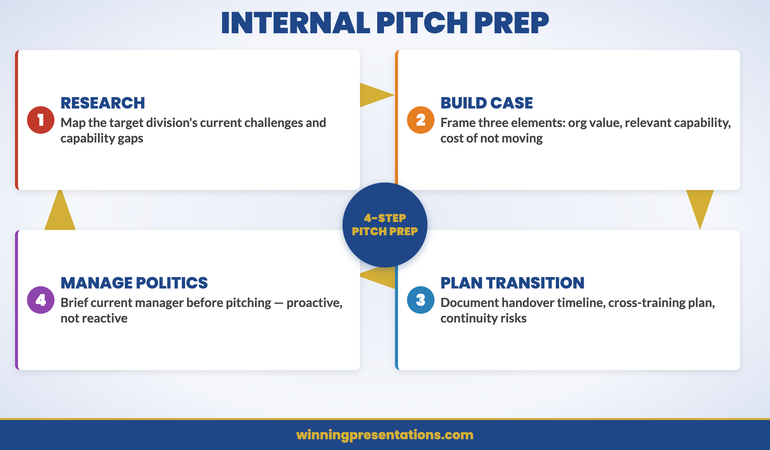
The business case frame for an internal transfer pitch requires you to research the target role with the same rigour you would apply to any significant business proposal. Before the conversation with the decision-maker, you should be able to answer three questions about the division you are moving into: what are the current performance challenges, what capability does the team currently lack, and what is the strategic priority that the role is expected to support?
This information is almost always available if you look for it. Department heads discuss their challenges in all-hands meetings and in conversations with peers. Annual reports and strategy presentations are public. If you have a contact in the division, a single conversation will surface the specific pressure points the team is dealing with. The point is to do this research before the pitch, so your opening framing is not “I would like to move to your team” but “I understand the team is building out its [specific capability] function, and I have direct experience in that area from my current role.”
This opening immediately repositions the conversation. Instead of a candidate asking for a favour, you are a senior professional who has identified a specific organisational need and is presenting a solution. That is the frame in which business proposals are evaluated, and it is far more likely to generate a substantive conversation than a general expression of interest.
Navigating the Political Dimension of an Internal Pitch
The political dimension of an internal transfer pitch is real and ignoring it does not make it disappear. Your current manager will find out about the pitch, if not from you then from the person you are pitching to. Managing that conversation proactively is always better than having it reactively.
The timing of when you inform your current manager is a judgment call that depends on the strength of your relationship and the culture of your organisation. In most settings, informing them before rather than after the pitch is the right move, framed as a professional courtesy rather than a request for permission. “I wanted you to hear this from me directly before I speak with anyone else: I am going to explore the opportunity in [division]. I am not planning to leave the team immediately — this is a longer-term development move — and I want to make sure we handle any transition in a way that does not leave the team exposed.”
This conversation also gives you an opportunity to address the most immediate concern your current manager has: continuity. If you can demonstrate that you have a clear transition plan before the pitch even happens, you remove the most significant source of resistance to an internal move. A manager who knows the handover will be handled well is far less likely to block or slow an internal transfer than one who feels the departure will be disruptive and unplanned.
The broader political landscape also includes relationships with peers who may be affected by the move or who have competing interests in how the new role is filled. It is worth thinking through who the decision influences and ensuring none of them are surprised in a way that creates unnecessary friction.
Presenting Your Transition Plan
Including a transition plan in your internal pitch is one of the most effective ways to signal that you are thinking about this as a business decision rather than a personal one. Most internal candidates do not do this. The ones who do demonstrate a level of organisational maturity that sets them apart from those who present only their own interests.
A transition plan for an internal pitch addresses three things: who takes over your current responsibilities, over what timeline, and what the risk to the current team’s output is during the transition period. It does not need to be detailed. A single slide or a two-paragraph summary is sufficient. The purpose is not to hand over the operational planning to the current manager — it is to demonstrate that you have already considered the disruption your departure causes and have a structured approach to minimising it.
“I would expect a transition of approximately eight weeks. In that time, I would document the [specific process] and cross-train Ngozi, who already has the background to take it on. The two areas of highest continuity risk are [X] and [Y], and I have a plan for both.” That is a transition plan. It takes two minutes to deliver and it removes the primary objection that most internal decision-makers have.
Once the transfer is approved and you are into the new role, the 90-day presentation framework for a new role covers how to structure your first significant update to the new team’s leadership — a presentation that signals you have arrived with a plan and are already making an impact. And for anyone stepping into a board-facing role for the first time, preparing for your first board presentation in a new role addresses the specific challenges of presenting to a board that does not yet have a relationship with you.
Build the Slides for Your Internal Pitch
The Executive Slide System — £39, instant access — includes proposal and initiative templates designed for making the business case in high-stakes internal conversations, including career-stage and role transition presentations.
- Initiative Proposal slide template adaptable for internal transfer business cases
- Strategic Recommendation template for framing the organisational value argument
- AI prompt cards to draft your three-element pitch narrative in under 20 minutes
- Framework guides for presenting transition plans and capability transfer arguments
Get the Executive Slide System →
Designed for executives making the business case in high-stakes internal conversations.
Handling the Objections That Always Come Up
Three objections appear consistently in internal transfer conversations. Preparing for them before the pitch is not optional.
“We need you where you are.” This is the most common objection and the most straightforward to handle, because the transition plan directly addresses it. “I understand that, and I have thought about the handover carefully. Here is how I would ensure continuity in my current role…” If you have done the transition planning work, this objection collapses on contact. If you have not, it is fatal.
“You don’t have experience in [specific area].” This is a capability gap objection. The response is to acknowledge the gap directly and then reframe it: “You are right that I have not done X in this context. What I have done is Y, which required the same underlying judgment in a different environment. I am confident the learning curve on the technical aspect of X is manageable; the harder part is the [specific judgment or relationship skill], and that is where my existing experience is directly relevant.” Acknowledging the gap first makes you more credible, not less.
“The hiring decision has not been finalised yet.” This is a timing objection, and it requires a specific response: “I understand. I am not asking for a decision today. I am asking for your awareness that I am interested and that I believe I can make a strong business case for the move. Can we schedule 20 minutes when the process is at the right stage for you to discuss it formally?” This keeps the conversation alive without pressuring a decision that has not yet been reached.
For the pitch structure itself, the executive presentation outline framework covers the sequencing principles that make a business case land well with senior decision-makers, whether the pitch is for an internal move, an external role, or a project proposal. And if you are doing this presentation virtually — which is increasingly common for internal conversations across different office locations — the virtual presentation energy guide covers the camera-presence techniques that ensure you read as authoritative and confident even through a screen.
If you are building the supporting slides for your internal pitch, the Executive Slide System includes initiative proposal templates and AI prompt cards for making the business case quickly.
Ready to Build the Slides for Your Business Case?
The Executive Slide System — £39, instant access — includes proposal templates and AI prompt cards you can use to build a structured internal pitch deck in under an hour.
- Initiative Proposal and Strategic Recommendation templates
- AI prompt cards for making the capability and business value arguments quickly
Get the Executive Slide System →
Designed for executives making high-stakes internal cases under time pressure.
Frequently Asked Questions
Should I prepare a formal presentation for an internal transfer pitch, or keep it conversational?
It depends on the culture of your organisation and the seniority of the decision-maker. At director level and above, a brief structured document or slide deck signals that you are treating this as a professional business proposal rather than an informal request — which is the right impression to create. At manager level, a well-prepared verbal conversation with a clear structure may be more appropriate. In all cases, the structure of what you say should follow the business case framework: organisational value, relevant capability, cost of not moving. Whether you use slides or not, that is the argument that needs to be made.
How do I pitch for a lateral move when I am already at a senior level?
Lateral moves at senior levels require the most careful framing, because the default assumption is that a senior professional who wants to move sideways is either dissatisfied in their current role or unable to progress vertically. The pitch needs to address this assumption directly. Frame the lateral move in terms of breadth of experience that prepares you for a specific future progression, or in terms of the strategic value to the organisation of having your specific capability in the new function. “I have taken my current division as far as I can in the current structure. Moving to the international team gives me the cross-regional experience that will make me a stronger candidate for the MD role when it becomes available” is a credible lateral pitch for a senior executive.
What if my current manager has already told me they will not support the move?
This is a common and genuinely difficult situation. The first step is understanding the specific objection your current manager has — whether it is genuinely about team continuity, or whether it reflects a different concern (e.g., they do not want to lose you from their headcount, or they have a relationship with the hiring manager that makes this awkward). Once you understand the actual objection, you can address it directly. If the objection is about continuity, a detailed transition plan is the most effective tool. If the objection is more political, you may need to involve HR or a senior sponsor to navigate the decision above the level of the immediate manager.
How long should an internal transfer pitch meeting be?
Twenty to thirty minutes is the appropriate range for an initial pitch conversation. This is long enough to present the business case, address the primary objections, and agree a next step, and short enough to respect the decision-maker’s time and signal that you have prepared efficiently. If the conversation runs beyond 30 minutes, it is usually a good sign — it means the decision-maker is engaged enough to explore the details. The worst outcome is a 10-minute conversation that ends politely, because it means you did not get deep enough into the case for the decision-maker to form a view.
The Winning Edge — Weekly Executive Communication Insights
Each Thursday: one high-stakes communication technique, one real case study, one action you can apply before your next meeting.
Download the free Executive Presentation Checklist — a one-page structure review for any high-stakes meeting.
About the Author
Mary Beth Hazeldine is the Owner & Managing Director of Winning Presentations. With 25 years of corporate banking experience at JPMorgan Chase, PwC, Royal Bank of Scotland, and Commerzbank, she has delivered high-stakes presentations in boardrooms across three continents.
A qualified clinical hypnotherapist and NLP practitioner, Mary Beth advises executives across financial services, healthcare, technology, and government on structuring presentations for high-stakes funding rounds and approvals.