
Tag: vendor selection

04 Apr 2026
Executive presenting a vendor selection pitch to a procurement committee in a modern glass boardroom, professional corporate photography

Vendor Selection Presentation: How to Win the Final Shortlist Meeting

A vendor selection presentation is not a product demonstration. It is a risk-reduction exercise for the buying committee. The team that wins the final shortlist meeting is rarely the one with the most features or the lowest price—it is the one that makes the decision feel safe. Here is how to structure your slides so the room chooses you with confidence.

Chiara had been through six months of relationship building, two discovery workshops, and a pilot programme that generated measurable results. Her company was one of three vendors on the final shortlist for a £2.8 million enterprise contract. She walked into the selection meeting with a forty-slide deck that recapped every feature, every integration point, every case study. The procurement lead stopped her at slide twelve. “We’ve seen the capabilities. What we need to understand is what happens in month three when our legacy system migration stalls and your implementation team is stretched across four other clients.” Chiara didn’t have a slide for that. She improvised an answer—competent but generic. The contract went to a competitor whose entire presentation had been built around three questions: what could go wrong, what would they do about it, and who specifically would be responsible. Chiara’s deck had been a capability showcase. The winner’s deck had been a risk mitigation plan. She never made the same mistake again.

Preparing for a vendor selection meeting? The Executive Slide System includes decision-focused templates and frameworks designed for high-stakes client presentations.

Why Buying Committees Choose Safety Over Capability

Every vendor on the final shortlist can do the job. That is why they are on the shortlist. By the time the selection committee sits down for the final vendor selection presentation, capability differentiation has already been assessed through RFP responses, reference calls, and pilot results. The committee is no longer asking “can they do it?” They are asking “what happens if it goes wrong?”

This shift matters because it changes the purpose of your presentation entirely. A capability presentation says: “Here is what we can do for you.” A risk-reduction presentation says: “Here is what we will do when things don’t go to plan.” The first invites comparison. The second invites trust. And trust is the currency that decides final shortlist meetings.

Buying committees are composed of people who will be held accountable for the decision. The IT director who champions a vendor that fails will carry that failure for years. The procurement lead who approves a contract that overruns will face scrutiny at every quarterly review. These individuals are not optimising for the best possible outcome. They are optimising for the least painful failure. Your presentation must speak to that psychology.

The structural implication is straightforward: lead with risk, not with capability. Show the committee that you have anticipated what could go wrong, that you have specific plans for each scenario, and that named individuals on your team are accountable for delivery. This reframes your vendor selection presentation from a sales pitch into a governance conversation—and governance conversations are where procurement committees feel most comfortable making decisions.

Structure Your Vendor Pitch for Decision-Ready Clarity

The Executive Slide System gives you presentation templates and decision frameworks—so your shortlist meeting earns approval by addressing risk before the committee raises it.

  • ✓ Presentation templates for executive and client scenarios
  • ✓ AI prompt cards to build structured decks fast
  • ✓ Framework guides for high-stakes decision presentations

Get the Executive Slide System → £39

Designed for executives preparing high-stakes presentations

The Three-Slide Framework That Wins Final Shortlists

The most effective vendor selection presentations can be distilled to three core slides that address the committee’s actual decision criteria. Everything else—features, architecture, pricing detail—is supporting material for Q&A.

Slide 1: The Implementation Risk Map. List the five most likely risks to successful delivery, ranked by probability and impact. For each risk, provide a specific mitigation with a named owner from your team. This slide does more than demonstrate preparedness. It tells the committee you have done this before—because only experienced teams know which risks actually materialise. Generic risk statements like “timeline overrun” signal inexperience. Specific risks like “data migration from legacy ERP systems typically encounters schema mismatches in the first two weeks” signal expertise.

Slide 2: The Proof Matrix. Map each of the committee’s stated requirements to a specific piece of evidence: a reference client, a pilot result, a benchmark metric, or a contractual commitment. The key word is “specific.” Claiming you have “extensive experience in financial services” is a feature. Stating that “Zurich Financial completed their implementation in fourteen weeks against a sixteen-week target, with the project lead available as a reference” is proof. The proof matrix converts assertions into verifiable claims.

Slide 3: The Accountability Structure. Show who will be responsible for delivery. Not a generic organisational chart—a specific team structure with named individuals, their relevant experience, and their availability commitment. Include the escalation path: who the client calls when something goes wrong, and the guaranteed response time. This slide answers the committee’s most important unspoken question: “When this gets difficult, who will actually fix it?” For more on structuring your pipeline review presentations, that guide covers how sales leaders can track and present deal progress systematically.
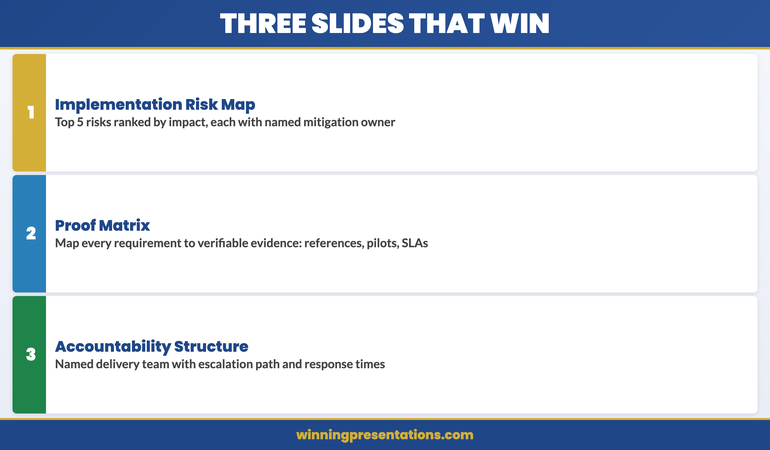
Three-slide framework for winning vendor selection presentations showing risk map, proof matrix, and accountability structure

Building a Proof Architecture That Survives Scrutiny

Claims without evidence are noise in a vendor selection meeting. Procurement committees are trained to discount assertions and weigh verifiable proof. Your presentation needs a deliberate proof architecture—a systematic approach to backing every significant claim with evidence the committee can independently verify.

The hierarchy of proof in procurement is consistent across industries. Contractual commitments carry the most weight—service level agreements, penalty clauses, and performance guarantees that create financial accountability. Reference calls rank second—direct conversations with comparable clients who can describe their actual experience. Pilot results rank third—measurable outcomes from work you have already done for this specific client. Case studies and credentials rank lowest—useful for context but insufficient for decision-making.

Structure your evidence accordingly. For every critical requirement, present the highest-ranking proof available. If you can offer a contractual guarantee, lead with it. If your strongest evidence is a reference client, prepare that client for a follow-up call and state this explicitly in the presentation: “Our reference contact at [company] is available this week for a direct conversation.” Offering the committee immediate access to verification demonstrates confidence. Promising to “arrange references after the meeting” signals that you are still preparing your case.

The proof architecture also protects you from the most common selection meeting trap: the hypothetical scenario. Committees will test vendors with questions like “What would you do if our data migration took three times longer than planned?” A proof-based response references a specific instance where you managed a similar challenge: “When we implemented at [comparable client], the initial data migration estimate was twelve weeks. Actual migration took nineteen weeks due to legacy schema complexity. Here’s how we managed the overrun without impacting the go-live date.” Hypothetical answers lose to historical proof every time.

Presenting Through the Procurement Lens

The procurement representative in a vendor selection meeting has different priorities from the business sponsor. The sponsor cares about capability and outcomes. Procurement cares about contract risk, total cost of ownership, and vendor stability. Your vendor selection presentation must satisfy both audiences simultaneously, and the structure must make it obvious that you understand what procurement values.

Three procurement priorities shape every shortlist decision. First, contract predictability: will the total cost match the proposal? Procurement teams are evaluated on budget adherence, not on the quality of the vendor they select. Address this by including a slide on scope governance—how you manage change requests, how you price out-of-scope work, and how you prevent the “scope creep to budget overrun” pattern that procurement has seen repeatedly from other vendors.

Second, vendor continuity: will your organisation still exist and still care about this client in three years? For established companies, this is straightforward—reference your tenure and client retention rates. For smaller firms, address it directly: explain your financial stability, your growth trajectory, and the contractual protections you offer for business continuity. Avoiding this topic does not make it disappear. It simply means the committee will discuss it after you leave the room, without your input.

Third, exit strategy: what happens if the relationship needs to end? Procurement professionals always want to know the exit terms before they sign. Include a brief slide on data portability, transition support, and contract termination terms. This may feel counterintuitive—discussing the end of the relationship before it begins—but it signals maturity and reduces the committee’s perception of lock-in risk. The vendor who openly discusses exit terms appears confident. The vendor who avoids the topic appears dependent. For more on handling client escalation presentations, that guide covers the communication approach when existing relationships face pressure.

If you’re structuring a vendor deck for the first time, the Executive Slide System provides the structural templates that ensure every slide addresses a decision criterion, not just a feature.
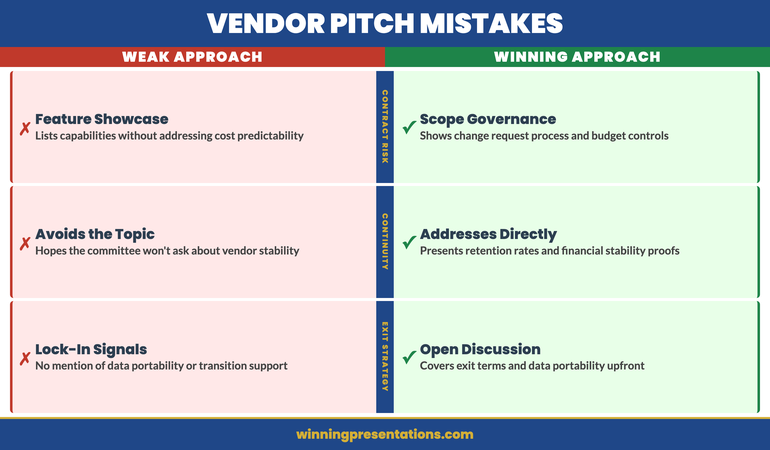
Procurement priorities in vendor selection presentations showing contract predictability, vendor continuity, and exit strategy

Closing the Decision Without Closing the Sale

The final minutes of a vendor selection presentation determine whether the committee leaves the room ready to decide or ready to deliberate further. Deliberation is not your friend. Every additional week of deliberation introduces new variables—budget freezes, stakeholder changes, competitor counter-offers—that reduce your probability of winning. Your closing must create the conditions for an immediate decision.

Do not ask for the business. The committee knows you want the contract. A closing that says “We’d love to work with you” adds no information and sounds like every other vendor. Instead, close with a decision architecture. Present the committee with a clear next step that is easy to say yes to: “We propose a two-week contract review period, with our legal team available for mark-up sessions starting Monday. If the committee is aligned on vendor selection today, we can have a signed agreement within three weeks.”

This framing works because it removes the committee’s biggest friction point: the gap between “we’ve decided” and “we’ve signed.” By presenting a specific, time-bounded implementation pathway, you convert the decision from abstract to concrete. The committee is no longer voting on whether they like your company. They are agreeing to a specific next step with a defined timeline.

End with a single summary slide that restates three things only: the business outcome you will deliver, the named person who will be accountable, and the proposed timeline to value. No feature recaps, no benefit lists, no “why us” statements. The summary exists to give the committee a clear, simple framework for their deliberation. When the chair turns to the room after you leave and asks “What do we think?”—your summary slide should be the frame through which they discuss their decision. If it is clear enough, they’ll use your language. And when a committee uses your language to discuss the decision, you have already won. For guidance on structuring the contract renewal presentation that follows a successful vendor selection, that guide covers the annual review framework that retains long-term clients.

Win the Shortlist Meeting With a Decision-Ready Deck

Stop presenting features. Start presenting risk mitigation. The Executive Slide System gives you the templates and frameworks to build vendor presentations that close—for £39.

Get the System Now → £39

Frequently Asked Questions

How long should a vendor selection presentation be?

The core presentation should be fifteen to twenty minutes, leaving forty to fifty minutes for committee questions. Most selection meetings are scheduled for sixty to ninety minutes. The committee has already reviewed your written proposal—they do not need a comprehensive recap. A shorter presentation signals confidence and leaves more time for the governance-style Q&A where decisions actually form. Aim for ten to twelve slides: three core slides (risk map, proof matrix, accountability structure), supported by a brief context opener, a financial summary, and a decision-close slide.

Should I address competitor weaknesses in a vendor presentation?

Never directly. Committees view negative selling as a sign of insecurity. Instead, address competitor weaknesses indirectly by strengthening your own proof in the areas where competitors are weak. If you know a competitor lacks implementation capacity, emphasise your named delivery team and their availability. If a competitor has no comparable reference clients, lead with your proof matrix showing specific, verifiable references. The committee will draw the comparison themselves—and a conclusion they reach independently is far more persuasive than one you hand them.

What is the biggest mistake vendors make in final shortlist presentations?

Presenting the same deck they used for the initial pitch. The audience, the context, and the decision criteria have all evolved since the first meeting. The initial pitch was about establishing capability and generating interest. The final shortlist meeting is about reducing risk and facilitating a decision. Vendors who recycle their pitch deck force the committee to do the translation work—mapping features to risks, promises to proof, and enthusiasm to accountability. The vendor who builds a presentation specifically for the selection committee’s decision framework demonstrates that they understand the buying process, not just the product.

The Winning Edge

Weekly insights on executive presentations, slide strategy, and boardroom communication.

Subscribe Free

Building a vendor pitch deck? Download the Executive Slide System checklist for a quick framework to structure your next shortlist presentation.

If your vendor relationship also requires managing internal cost pressures, our guide to cost reduction presentations covers the slide architecture that frames budget cuts as strategic investment.

About the author

Mary Beth Hazeldine, Owner & Managing Director, Winning Presentations. With 24 years of corporate banking experience at JPMorgan Chase, PwC, Royal Bank of Scotland, and Commerzbank, she advises executives across financial services, healthcare, technology, and government on structuring presentations for high-stakes funding rounds and approvals.

10 Mar 2026
Executive standing alone outside a boardroom, hand on glass wall, composed exterior masking visible tension, navy and gold accents

When Public Speaking Fear Becomes a Medical Emergency: Signs You Need More Than Techniques

I kept beta blockers in my desk drawer for three years.

Never took one. But knowing they were there — knowing I had an exit — was the only thing that got me into some meeting rooms on bad days. The shaking, the nausea, the voice that cracked regardless of how many times I’d rehearsed. I had all of it. For five years before I found what actually worked.

What I’ve learned since, from training thousands of executives, is that there’s a line most people don’t know how to find. On one side: normal performance anxiety that techniques can fix. On the other: something that has crossed into the nervous system so deeply that breathing exercises and positive self-talk aren’t touching it.

This article is for people who suspect they might be on the wrong side of that line.

Quick answer: Public speaking anxiety becomes a medical concern when it produces physical symptoms that are disproportionate, persistent, and interfering with professional function — vomiting, chest pain, blackouts, or days of anticipatory dread before a single meeting. These are signs the nervous system is operating in a trauma response, not just a performance stress response. Standard presentation techniques don’t reach this level. What does: nervous system regulation work, clinical-grade somatic techniques, and in some cases, medical consultation for anxiety disorders or specific phobia.

🚨 Have a presentation this week and physical symptoms are already starting? Calm Under Pressure (£19.99) is built specifically for in-the-moment physical symptom management — the 60-second resets for shaking, nausea, racing heart, and voice cracking, for the day of the presentation.

A C-suite executive I worked with had a secret she’d kept for three years.

She vomited before every major presentation. Not occasionally. Every single time, without exception, for three years. Her team thought she was one of the most composed presenters in the company. She had a 20-minute window in the bathroom before each meeting and a very precise mental ritual for walking back in as though nothing had happened.

She was referred to me after an incident that finally scared her: she blacked out briefly in the lift on the way to a board presentation. Came to in time, walked in, delivered the presentation. Nobody knew. But she knew.

That’s when we crossed from “I get nervous” into a different conversation entirely.

She didn’t need better techniques. She needed nervous system work that addressed what was actually happening in her body — not a list of tips for managing nerves. The techniques she’d tried for years hadn’t failed her because she hadn’t tried hard enough. They’d failed because they weren’t designed for what she was experiencing.


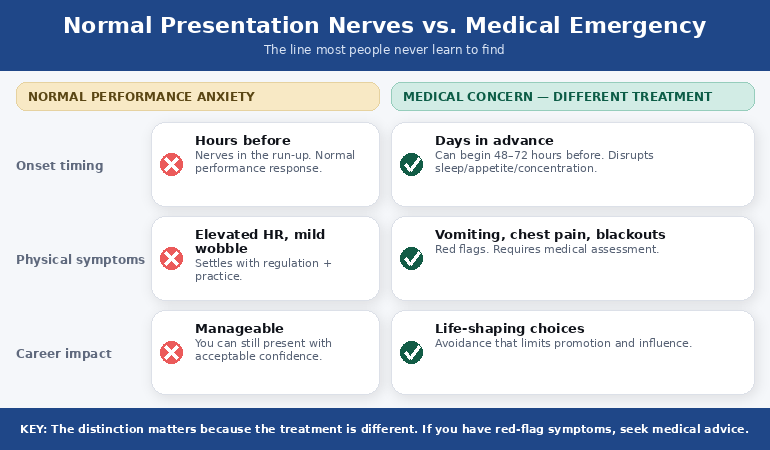
Comparison infographic showing normal presentation anxiety symptoms versus medical emergency warning signs in public speaking

Normal Presentation Nerves vs. Medical Emergency: What’s the Difference?

Some level of performance anxiety is physiologically normal. The autonomic nervous system interprets high-stakes visibility — standing in front of people who are evaluating you — as a threat signal. Heart rate increases. Cortisol rises. Muscle tension increases. That’s not malfunction. That’s your body trying to help.

What makes anxiety cross into concerning territory isn’t the presence of those symptoms. It’s the severity, the duration, and the functional impairment.

Normal performance anxiety: you feel nervous in the hours before a presentation. Your heart rate is elevated when you stand up to speak. Your voice might wobble slightly at the start. Within the first 60–90 seconds, the nervous system regulation kicks in and you settle.

Concerning anxiety: the dread starts days in advance. Physical symptoms — nausea, gastrointestinal distress, sleep disruption — begin 24–72 hours before the presentation. On the day, symptoms reach a level that impairs function: shaking that you can’t stop, voice loss, blanking on content you’ve rehearsed dozens of times, or physical symptoms severe enough to affect your health (vomiting, chest pain, difficulty breathing, pre-syncope or blackouts).

The distinction matters because the treatment is different. Techniques designed for normal performance anxiety — breathing exercises, visualisation, anchoring, positive self-talk — operate at the cortical level. They work on the thoughts. When anxiety is operating at the level of a trauma or phobia response, the threat signal is firing from subcortical brain structures that don’t respond to reasoning or intention. You can’t think your way out of a nervous system response that’s running below conscious control.

🧠 The 60-Second Resets That Stop Physical Symptoms Before They Take Over

Calm Under Pressure is built specifically for in-the-moment physical symptom management on presentation day — not theory, not mindset tips. The techniques from clinical hypnotherapy and NLP, adapted for high-pressure executive environments:

  • The 60-second nervous system reset for racing heart, shaking, or voice cracking — designed to be used in the corridor outside the meeting room
  • The pre-meeting vomiting and nausea protocol — specific techniques for gastrointestinal anxiety responses before high-stakes presentations
  • The voice recovery sequence — what to do when your voice cracks or tightens in the first 90 seconds
  • The blank-mind recovery technique — how to retrieve content your brain has temporarily blocked under threat response
  • The grounding sequence for dissociation and pre-syncope — for those who experience derealization or lightheadedness before presenting

Get Calm Under Pressure → £19.99

Evidence-based techniques from clinical hypnotherapy and NLP, adapted for executive environments. Used by presenters who had tried everything else first.

The Symptoms That Cross the Line

There is no single threshold, because individual nervous systems vary. But certain presentations of anxiety warrant medical assessment rather than (or in addition to) technique-based intervention:

Cardiovascular symptoms. Chest tightness, palpitations, or irregular heartbeat before or during a presentation should always be checked medically first, before attributing them to anxiety. The anxiety interpretation may be correct — but ruling out cardiac causes is not optional.

Pre-syncope or blackouts. Lightheadedness, tunnel vision, or actual loss of consciousness connected to presentation situations is a medical symptom. This can have anxiety-related causes (vasovagal syncope is common in high-stress situations) but it needs assessment.

Severe gastrointestinal distress. Vomiting before every presentation for months, or persistent gastrointestinal symptoms that begin days in advance and don’t resolve, may indicate a physiological anxiety disorder rather than a situational one. This is different from occasional nausea on a particularly high-stakes day.

Anticipatory dread lasting days. When anxiety about a presentation begins 48–72 hours in advance and is functionally impairing — disrupting sleep, appetite, or concentration on unrelated work — that’s a level of anticipatory anxiety that clinical intervention is designed for. Breathing exercises don’t reach anticipatory anxiety that’s already running three days ahead.

Avoidance that’s costing career opportunities. This is perhaps the most common threshold that goes unnamed. When a professional is declining presentations, turning down visibility, or shaping their entire career choices around avoiding public speaking — that’s a level of interference that warrants taking seriously. It doesn’t have to be dramatic symptoms. Chronic, career-shaping avoidance is its own form of severity.

For more on how the nervous system gets stuck in presentation trauma patterns, this article is relevant background: Presentation Trauma and the Nervous System.

Recognise any of those symptoms? Calm Under Pressure handles the in-the-moment physical responses — the ones that techniques like breathing exercises and visualisation don’t reach quickly enough on presentation day.

Get Calm Under Pressure → £19.99

Why Standard Techniques Stop Working at This Level

Most presentation anxiety advice — and most presentation coaches — operates at the behavioural level. Practice more. Breathe. Visualise success. Reframe your thoughts. These are legitimate techniques, and they work for a significant proportion of people with normal-range performance anxiety.

They don’t work when the anxiety has become a conditioned response. That’s the clinical distinction most presentation advice ignores.

A conditioned response is what happens when the nervous system has encoded “presentation” as a threat signal through repeated experience. You’ve presented while anxious. The anxiety was uncomfortable. The nervous system noted the correlation: presentation environment = threat. This encoding happens below conscious awareness — which is why telling yourself “there’s nothing to be afraid of” doesn’t change the physical response. The part of your brain generating the response doesn’t speak the language of rational reassurance.

The C-suite executive who vomited before every board meeting had been practising breathing techniques for two years before she came to me. The techniques weren’t wrong. They were just operating on the wrong part of the nervous system. When we shifted to somatic work — approaches that address the conditioned response directly through the body rather than through reasoning — the physical symptoms resolved in six weeks of consistent practice. Not years. Six weeks.

That’s the difference between treating the symptom and treating the signal. Standard techniques treat the symptom. Somatic and clinical approaches treat the signal — the nervous system’s learned association between presentation contexts and threat. You can’t always do deep somatic work on the day of a presentation. For in-the-moment management, you need a different set of tools. For the underlying pattern, you need to go deeper.

If you’ve tried the standard approaches and they haven’t worked, this is directly relevant: Treatment-Resistant Presentation Anxiety — What’s Actually Left to Try.


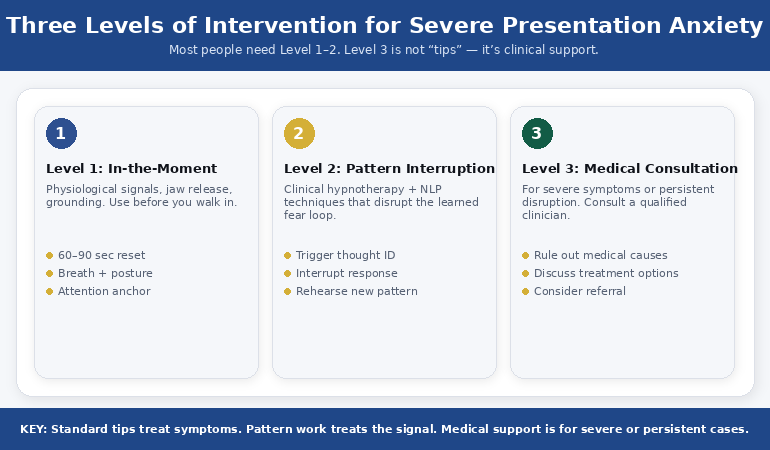
Three levels of intervention for severe presentation anxiety: in-the-moment, pattern interruption, and medical consultation

What Actually Works When Techniques Don’t

There are three levels of intervention for severe presentation anxiety, and the right one depends on what’s driving the symptoms.

Level 1: In-the-moment symptom management. For physical symptoms on the day — shaking, nausea, voice cracking, heart racing — somatic techniques work faster than cognitive ones. Physiological sighing (double inhale through the nose, extended exhale) reduces heart rate measurably within 60 seconds and doesn’t require sustained practice to work. Cold water on the wrists, jaw release, and specific grounding sequences address the physical presentation of the response rather than the thought behind it. These are the tools that work in the corridor outside the meeting room when you have 90 seconds and nowhere to hide.

Level 2: Pattern interruption. For anticipatory anxiety that begins days in advance, the intervention needs to work on the conditioned association rather than just the acute response. Techniques from clinical hypnotherapy and NLP — specifically those that work on the encoded memory structures behind the conditioned response — are effective here. This is where I do most of my individual client work. The executive who vomited before every board meeting saw resolution at this level: the acute response in the meeting room resolved once the underlying conditioned association was disrupted.

Level 3: Medical consultation. For symptoms that include chest pain, blackouts, or a level of impairment that’s affecting quality of life beyond presentation situations, medical assessment is appropriate. A GP can evaluate for specific phobia or social anxiety disorder, refer to a CBT or EMDR specialist, and assess whether medication is a useful adjunct (not a replacement) for the work above. There is no shame in this. There is also no award for suffering through a diagnosable condition without support.

Most people reading this need Level 1 and Level 2 — not a medical referral, but also not the standard advice they’ve already tried. The in-the-moment work and the pattern-interruption work are the gap between “I’ve tried everything” and “I’ve actually tried the right things.”

🛑 Stop Relying on Techniques That Were Never Designed for Severe Physical Symptoms

  • The clinical somatic techniques for in-the-moment management of shaking, nausea, heart racing, and voice cracking — designed for executive environments, not therapy rooms
  • The pre-meeting protocol for the morning of a high-stakes presentation when physical symptoms are already escalating

Get Calm Under Pressure → £19.99

Created by a qualified clinical hypnotherapist with 5 years of her own severe presentation anxiety — and 24 years watching executives face it in the highest-stakes rooms in global banking.

PAA: Quick Answers on Severe Presentation Anxiety

Is it normal to vomit before a presentation?
Occasional nausea before a very high-stakes presentation is within the range of normal performance anxiety. Vomiting before most or every significant presentation is not — it indicates a level of physiological activation that warrants clinical attention rather than more breathing exercises. This is a conditioned response, not weakness. It’s treatable.

Can presentation anxiety cause chest pain?
Yes — anxiety activates the cardiovascular system and can cause chest tightness, palpitations, and discomfort that mimics cardiac symptoms. However, chest pain should always be medically evaluated before attributing it to anxiety. This is non-negotiable. Once a cardiac cause is ruled out, anxiety-related chest symptoms respond well to somatic regulation techniques and, in persistent cases, clinical anxiety treatment.

I’ve tried everything for presentation anxiety. What’s left?
Usually the missing piece is the level of intervention, not the category. Most people have tried behavioural techniques (breathing, practice, visualisation) but haven’t worked at the somatic level — techniques that address the conditioned nervous system response directly rather than through reasoning. If you’ve tried techniques without sustained success, the panic attack before presentation framework explains the next level of what’s available.

Is Calm Under Pressure Right For You?

✔️ This is for you if:

  • You experience physical symptoms — shaking, nausea, voice cracking, racing heart — on presentation day and need something that works fast, in the moment
  • You’ve tried breathing exercises and standard anxiety techniques and they’re not enough on a high-stakes day
  • You have an upcoming presentation and want clinical-grade in-the-moment tools, not more theory

❌ This is NOT for you if:

  • Your challenge is the underlying anxiety pattern over months and years rather than acute day-of symptoms — for that level, Conquer Speaking Fear (£39) addresses the root cause rather than the in-the-moment response
  • Your presenting challenge is slide structure rather than anxiety — for that, see today’s executive slide structure article

If you recognised your own experience in the severe end of what’s described above, the gap isn’t willpower or more practice. It’s having the right intervention at the right level — clinical tools designed for the body’s response, not the mind’s.

🧪 Clinical Tools for Physical Symptoms — Built From 5 Years of My Own

I spent five years with the full range of physical presentation anxiety: nausea, shaking, voice cracking, face flushing. I also have clinical hypnotherapy and NLP qualifications. Calm Under Pressure is what I wish I’d had in those years — not theory, not motivation, but the specific techniques that address what the body is actually doing:

  • In-the-moment resets for every major physical symptom: shaking, nausea, voice cracking, racing heart, facial flushing, mind going blank
  • The pre-meeting morning protocol — what to do from the moment you wake up on a high-stakes presentation day
  • The 90-second grounding sequence for dissociation and lightheadedness
  • The vomiting and gastrointestinal anxiety protocol — the techniques I developed specifically because this symptom is almost never addressed anywhere else
  • Voice recovery techniques — somatic resets for tightening or cracking that work in the first 90 seconds of a presentation

Get Calm Under Pressure → £19.99

Your next presentation is already on your calendar. The symptoms are not going to resolve on their own. Get the tools that actually work for severe physical anxiety — on the day you need them.

Frequently Asked Questions

How do I know if my presentation anxiety needs professional help?

The thresholds to watch for: physical symptoms that are severe (vomiting, blackouts, chest pain), anticipatory dread that starts days in advance and disrupts your functioning, or career-shaping avoidance where you’re turning down opportunities because of the anxiety. Any of these warrant taking more seriously than standard self-help techniques. Starting with your GP is appropriate if you’re experiencing cardiovascular or other concerning physical symptoms. For anxiety that’s functioning but severe, a clinical hypnotherapist, CBT therapist, or EMDR practitioner who specialises in performance anxiety is a good route.

Are beta blockers effective for public speaking anxiety?

Beta blockers reduce the cardiovascular manifestations of anxiety — heart racing, trembling, voice shake — but they don’t address the underlying anxiety itself. They can be useful as a short-term bridge when the physical symptoms are impairing function and nothing else is working quickly enough. They are not a treatment for the conditioned anxiety pattern. Most people I work with who have used beta blockers find them less effective than they expected, or find they create a dependency on having them available (as I described with having them in my desk drawer) rather than actually resolving the problem.

Can presentation anxiety get worse over time even if I keep presenting?

Yes — this is counterintuitive but important. The standard advice is “present more, fear less.” For many people, this is true. For others, repeated experiences of presenting while highly anxious don’t reduce the anxiety — they reinforce the conditioned association. Every high-anxiety presentation can deepen the nervous system’s encoding of “presentation = threat.” This is why some people find their anxiety gets worse through their careers despite years of presenting regularly. More exposure isn’t the answer if the exposure is consistently aversive. The pattern needs interrupting, not reinforcing.

I have a board presentation in two weeks. What should I do right now?

Start with the in-the-moment physical tools — the grounding, breathing, and voice reset techniques that you can practise now and use on the day. These take two to three days of daily practice to work reliably under pressure. Don’t start them on the morning of the presentation. Alongside that, work on the preparation side — a well-structured deck reduces anxiety because it removes uncertainty about what comes next. For structure, see the due diligence presentation framework if it’s a high-stakes investor context, or the hypothetical questions framework if you’re anticipating a tough Q&A.

📊 Want better slides too?

Preparation reduces anxiety. The Executive Slide System (£39) includes confident-presenter templates designed to minimise preparation stress — so you walk into the room knowing the structure works, not hoping it does.

📬 The Winning Edge — Weekly Presentation Intelligence

One article per week on executive communication, presentation anxiety, and high-stakes performance. Evidence-based, executive-focused, no fluff.

Subscribe to The Winning Edge

🆓 Free resource: 7 Presentation Frameworks — a free guide to strengthen your presentation preparation.

Also published today: if your challenge is the slide structure for a high-stakes presentation rather than the anxiety, see The Due Diligence Presentation That Almost Killed a £50M Deal. And if you’re preparing for executive Q&A with difficult hypothetical questions, read The Hypothetical Trap.

About the Author

Mary Beth Hazeldine is the Owner & Managing Director of Winning Presentations. With 24 years of corporate banking experience at JPMorgan Chase, PwC, Royal Bank of Scotland, and Commerzbank, she has delivered high-stakes presentations in boardrooms across three continents.

A qualified clinical hypnotherapist and NLP practitioner, Mary Beth combines executive communication expertise with evidence-based techniques for managing presentation anxiety. She has trained thousands of executives and supported presentations for high-stakes funding rounds and approvals.
Book a discovery call | View services

21 Feb 2026
Female executive in navy blazer standing and presenting vendor comparison data with bar charts and pie chart on screen to a committee of seated professionals in a modern boardroom

The Vendor Selection Presentation: How to Get a £500K Decision in One Meeting

Quick answer: Vendor comparison presentations get deferred because they’re structured as evaluations — showing three options equally and asking the committee to choose. This creates choice paralysis. The Decision Architecture leads with your recommendation on slide 1, then uses the comparison data to validate your judgement rather than create a decision for the committee to make. One meeting. One decision.

⚡ Committee meets in 48 hours? Here’s your 6-slide structure:

Slide 1: Your recommendation + two reasons why. Slide 2: Evidence on the criteria that matter. Slide 3: Why the others fall short. Slide 4: Risk mitigation (pre-answer their top concern). Slide 5: Cost + timeline for your pick only. Slide 6: The specific approval you need. Full breakdown below.

I Presented 3 Vendors to the Committee. They Picked None. The Problem Was Slide 1.

Early in my banking career, I spent three weeks evaluating CRM vendors. Thorough analysis. Detailed scoring. Fair comparison across twelve criteria. I presented all three options with equal weight and asked the steering committee to choose.

They chose nothing. “Let’s revisit when we have more information.”

My manager told me something I’ve never forgotten: “You gave them a quiz. Executives don’t do quizzes. They validate recommendations. Tell them which vendor to pick and why — then let them confirm your judgement or challenge it.”

The next week, I presented the same data. Same three vendors. But I restructured entirely: “I recommend Vendor B. Here’s why. Here’s the risk. Here’s what Vendors A and C can’t do. Here’s the cost. Here’s what I need you to approve.” The committee approved in 12 minutes.

Same data. Different architecture. In the years since, I’ve seen this pattern repeated in every vendor selection, technology evaluation, and procurement decision I’ve been involved in. Neutral comparison slides create choice paralysis. Recommendation-first slides create decisions.

Why Neutral Comparison Slides Guarantee Deferrals

Here’s the slide structure most people use for vendor presentations:

❌ The Evaluation Format (produces deferrals):

Slide 1: “Vendor Selection — Three Options for Review.” Slide 2-4: Vendor A profile, Vendor B profile, Vendor C profile. Slide 5: Side-by-side comparison matrix (12+ criteria). Slide 6: Scoring table. Slide 7: “Recommendation: Vendor B.” Slide 8: Next steps.

This feels thorough. It feels objective. It feels fair. And it almost always produces deferrals. Here’s why:

By the time leadership reaches your recommendation on slide 7, they’ve spent 20 minutes absorbing equal information about three different options. Their mental state is comparative — they’re looking for differences, weaknesses, and risks across all three. The safest response from this mental state is “we need more time to evaluate.” They don’t feel confident enough to choose because you’ve spent the entire presentation showing them how difficult the choice is.

The executive decision framework applies directly here: decisions come from confidence, and confidence comes from seeing a clear recommendation first — not from wading through comparison data.

✅ The Decision Architecture (produces approvals):

Slide 1: “I recommend Vendor B. Here’s why.” Slide 2: Why Vendor B wins on the two criteria that matter most. Slide 3: Why Vendors A and C fall short. Slide 4: Risk mitigation for Vendor B. Slide 5: Cost and timeline. Slide 6: What I need approved today.

Same data. But the committee’s mental state is completely different. They’re not evaluating three options — they’re evaluating your recommendation. That’s a faster, more confident decision. They can confirm your judgement or challenge it, but they have a clear starting position rather than a blank slate.

Evaluation format showing eight slides with recommendation last leading to deferral versus Decision Architecture showing six slides with recommendation first leading to approval in 12 minutes

Get Vendor Decisions Approved in One Meeting

The Executive Slide System gives you the Decision Architecture for vendor selections, budget approvals, steering committees, and every presentation where you need a yes — not “let’s revisit.”

Get the Executive Slide System → £39

Built from 24 years of corporate experience. Used in vendor evaluations, procurement decisions, and technology selections.

The Decision Architecture for Vendor Presentations (6 Slides)

Slide 1: Your Recommendation (One Sentence). “I recommend Vendor B for the CRM implementation. They’re the strongest on the two criteria that matter most for this project: integration speed and data migration capability.” No build-up. No context. Your recommendation and the two reasons — in one slide.

❌ Wrong slide 1: “CRM Vendor Selection — Overview of Options”

✅ Right slide 1: “Recommendation: Vendor B (Strongest on Integration Speed + Data Migration)”

Slide 2: Why Vendor B Wins on What Matters. Not a 12-criteria comparison. The two or three criteria that are most important for this specific project, with Vendor B’s evidence. “Integration: Vendor B completes in 6 weeks (A: 14 weeks, C: 10 weeks). Data migration: Vendor B has done this exact migration for three similar organisations.”

Slide 3: Why Vendors A and C Fall Short. This is the slide that prevents “but what about Vendor A?” objections. Show the specific weaknesses that eliminated them — not a comprehensive comparison, but the deal-breakers. “Vendor A: 14-week integration timeline puts the March deadline at risk. Vendor C: No UK data centre, creating GDPR compliance complexity.”

This Decision Architecture is exactly what the Executive Slide System gives you — for vendor selections, budget approvals, and any presentation where you need a decision.

Get the Executive Slide System → £39

Slide 4: Risk Mitigation for Your Recommendation. The committee will have concerns about your recommended vendor. Anticipate the top two and address them before they’re raised. “Risk: Vendor B is a mid-size company (stability concern). Mitigation: £22M revenue, 15-year track record, reference clients include three FTSE 250 companies.” This is the slide that prevents deferrals — you’ve already handled the objection. The same approach that works for steering committee decisions applies here.

Slide 5: Cost and Timeline. Total cost, payment schedule, and implementation timeline for your recommended vendor only. Don’t show all three vendors’ costs side-by-side — that reopens comparison mode. “Total: £480K over 18 months. Phase 1 live in 8 weeks. Full deployment by September.”

Slide 6: What You Need Approved. The specific action. “Approve Vendor B contract at £480K. Authorise procurement to begin contract negotiation. Target: signed by end of March.” One clear ask. If you need help structuring this slide, the executive summary slide framework gives you the format.

Evaluation format showing eight slides with recommendation last leading to deferral versus Decision Architecture showing six slides with recommendation first leading to approval in 12 minutes

The Full Vendor Presentation — Wrong vs. Right

❌ Evaluation Format (8 slides, produces deferrals):

1. Title/overview → 2. Evaluation criteria → 3. Vendor A profile → 4. Vendor B profile → 5. Vendor C profile → 6. Comparison matrix → 7. Scoring → 8. Recommendation

Recommendation arrives last, after 25 minutes of comparison. The committee is in evaluation mode, not decision mode.

✅ Decision Architecture (6 slides, produces approvals):

1. Recommendation + why → 2. Evidence for your choice → 3. Why others fall short → 4. Risk mitigation → 5. Cost + timeline → 6. What to approve

Recommendation arrives first. Evidence supports your judgement. The committee confirms rather than evaluates.

The Executive Slide System (£39) includes the Decision Architecture for vendor selections, budget approvals, and steering committee decisions — with slide-by-slide structures you can apply tonight.

Pre-Answering the Three Objections Committees Always Raise

Vendor selection committees have three predictable objections. Build answers into your deck rather than waiting for Q&A:

1. “Are we sure we’ve looked at enough options?” Address this in your opening: “We evaluated seven vendors. Three met our minimum requirements. I’m recommending the strongest of those three.” This shows thoroughness without creating seven-way comparison paralysis.

2. “What if the recommended vendor fails to deliver?” This is your risk mitigation slide. Include contract protections, exit clauses, and a fallback plan. “If Vendor B misses the Phase 1 milestone by more than two weeks, we invoke the performance clause. Vendor C remains on standby as a backup — their proposal is valid until June.”

3. “Can we see the full comparison?” Keep it in your appendix, not your main deck. “The full 12-criteria comparison is in the appendix if you’d like to review it. I’ve focused the main presentation on the three criteria that differentiate the vendors for this specific project.” This respects their time while showing you’ve done the work.

The Executive Slide System (£39) includes objection-handling frameworks and decision structures for vendor selections, budget approvals, and executive governance meetings.

Common Questions About Vendor Selection Presentations

How do you present a vendor recommendation to senior leadership?

Lead with your recommendation on slide 1 — the specific vendor and the two reasons they win. Then show evidence for your choice, explain why alternatives fall short, address the top two risks, present cost and timeline for your recommendation only, and end with the specific approval you need. This recommendation-first structure lets leadership validate your judgement rather than evaluate three options from scratch, which consistently produces faster decisions.

What should a vendor comparison presentation include?

A vendor comparison presentation that gets approved in one meeting includes six elements: your recommendation (slide 1), evidence for your choice on the two criteria that matter most (slide 2), specific reasons the other vendors were eliminated (slide 3), risk mitigation for your recommendation (slide 4), cost and timeline for the recommended vendor only (slide 5), and the specific approval you need (slide 6). Keep the full comparison matrix in the appendix.

How do you get a vendor decision approved without deferral?

Three structural changes prevent deferral: First, lead with your recommendation rather than a neutral comparison — this puts the committee in decision-confirmation mode instead of evaluation mode. Second, include a risk mitigation slide that pre-answers the top two concerns before they’re raised. Third, show cost and timeline for your recommended vendor only — showing all three vendors’ costs reopens comparison mode and invites “let me think about it.”

One Meeting. One Decision. No Deferrals.

The Executive Slide System gives you the Decision Architecture for vendor selections, plus slide structures for steering committees, board meetings, and every presentation where you need approval — not “let’s revisit.”

Get the Executive Slide System → £39

Used in vendor evaluations, procurement decisions, and technology selections across corporate and consulting teams.

Frequently Asked Questions

Won’t leading with my recommendation seem biased?

Leadership hired you to evaluate vendors and make a recommendation — not to create a multiple-choice test. Leading with your recommendation shows confidence and judgement. The comparison data is still there (in slide 3 and the appendix) for anyone who wants to validate your analysis. Every procurement professional and IT leader I’ve worked with who switched to recommendation-first saw faster approvals with no pushback about bias.

What if the committee disagrees with my recommendation?

Good. Disagreement is faster than deferral. If the committee says “we prefer Vendor A,” that’s a decision — and you can discuss why. If the committee says “let’s revisit,” that’s a delay that costs time and money. The Decision Architecture is designed to provoke a clear response (agree or disagree) rather than the ambiguous “we need more information” that neutral comparison slides produce.

Should I show pricing for all three vendors?

No. Show pricing only for your recommended vendor. Showing all three reopens comparison mode and invites line-by-line cost analysis that delays the decision. If the committee asks about other vendors’ pricing during Q&A, you’ll have it in your appendix. But your main deck should focus attention on the one vendor you’re recommending, not on three-way price shopping.

What if my organisation requires a neutral evaluation format?

Many procurement processes require documented evaluation of multiple vendors. This doesn’t mean your presentation has to be structured neutrally. Complete the formal evaluation documentation as required, but structure your presentation using the Decision Architecture. Open with your recommendation, use the evaluation data to support it, and include the full comparison matrix in the appendix for compliance. The presentation is for decision-making. The documentation is for the audit trail.

Get Weekly Presentation Intelligence

Slide structures, decision frameworks, and the executive communication strategies that get procurement and vendor decisions approved — delivered every week.

Join the Newsletter

Related: If your vendor presentation goes to a cross-functional committee, read Presenting Cross-Functionally: Why Your Best Slides Fail Outside Your Department — the Audience Translation Method for restructuring the same data for different stakeholder priorities.

Your next step: Open your vendor comparison deck. Move your recommendation to slide 1. Cut the neutral comparison matrix to the appendix. Present six slides instead of eight — and get the decision in one meeting.

Want the complete Decision Architecture for vendor selections, budget approvals, and steering committee presentations?

Get the Executive Slide System → £39

About the Author

Mary Beth Hazeldine is the Owner & Managing Director of Winning Presentations. With 24 years of corporate banking experience at JPMorgan Chase, PwC, Royal Bank of Scotland, and Commerzbank, she specialises in executive-level presentation skills and decision-focused slide architecture.

A qualified clinical hypnotherapist and NLP practitioner, Mary Beth combines executive communication expertise with evidence-based techniques. She has spent 15 years training executives for vendor selections, procurement decisions, and high-stakes approval presentations.

Read more articles at winningpresentations.com