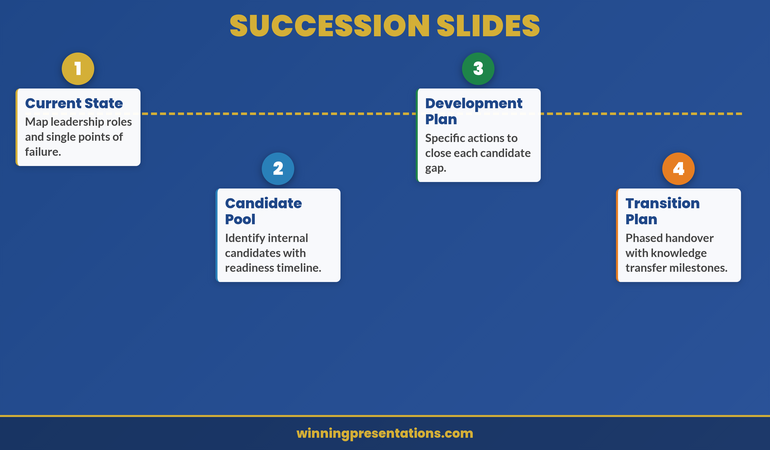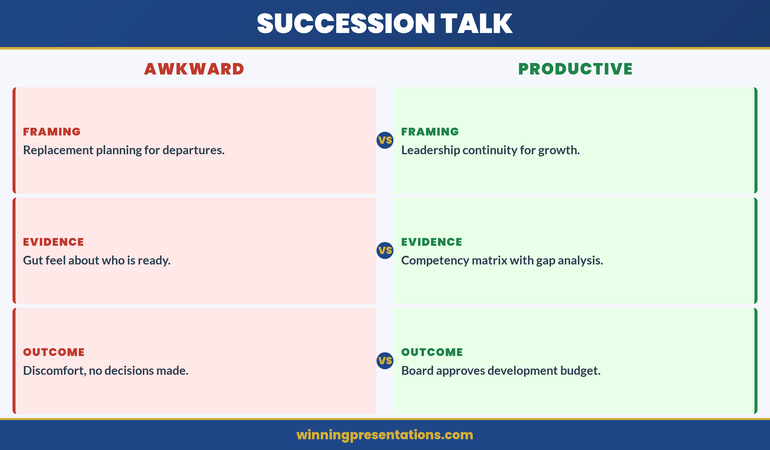
Quick answer: Succession planning slides get killed in the same board meetings that put them on the agenda because the standard succession deck is structurally wrong for what the board is actually deciding. The deck typically presents a list of names against a list of roles, with readiness ratings beside each name. The board does not want a list. The board wants to know whether the organisation has a credible plan for orderly transition at each critical role, what the gap looks like at the weakest position, and what the chief executive intends to do about it in the next twelve months. A succession planning presentation for the board needs a four-part structure: organisational risk profile, role-by-role readiness with named gaps, the twelve-month development plan that addresses the gaps, and the emergency cover map for the worst-case scenario. The names matter, but they are the last layer, not the first.
JUMP TO:
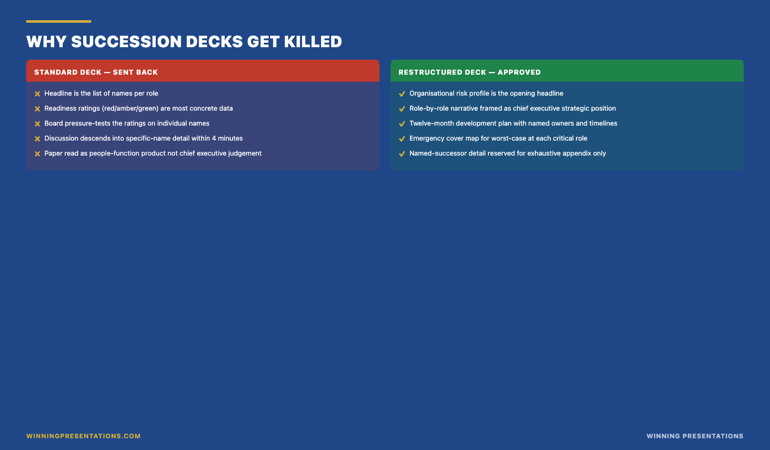
In 2017 I worked with the chief people officer of a publicly-listed European industrial group through a board succession review. The board had specifically asked her, six weeks earlier, to bring a succession planning presentation to the September meeting. She built a deck that I would recognise as the standard succession planning format: twenty-two slides, each role across the executive committee on its own slide, three named successors per role colour-coded against readiness (red, amber, green), and an executive summary at the front showing the headline ratios — eleven roles with at least one green-ready successor, six roles with only amber, three roles with red across the board. The deck took her team about four weeks to assemble through structured interviews with each executive committee member, a 360-style review of each named successor, and a calibration session between her and the chief executive. The data was strong. The deck was clean. The board killed it inside thirty minutes.
What I mean by “killed” is specific. The board did not reject the recommendation; there was no recommendation to reject. The board did not approve the recommendation; there was no recommendation to approve. The board listened to the first six slides, asked a series of increasingly pointed questions about three or four specific names, lost confidence in the data underlying the ratings, then asked the chief executive to take the paper back and bring a “more thought-through” version to the December meeting. That was the polite version of “this is not what we asked for”. The chief people officer left the room believing the failure was about the data — that the readiness ratings had been challenged on detail and the deck had not survived the detail. She was partly right. The deeper structural reason was different: the board had asked for a succession planning presentation and the chief people officer had delivered a succession data presentation, and the two are not the same paper.
(This article was created with AI assistance; all stories and insights are based on 35 years of real client work.)
I have now worked with somewhere over fifteen senior leaders preparing a succession planning presentation for a board, across sectors as different as financial services, life sciences, professional services, and central government. The structural failure pattern is consistent enough across that population that I can predict, within the first ten minutes of seeing a draft deck, whether the deck will land in the board meeting or be sent back. The deck that lands looks structurally different from the deck that gets sent back, and the difference is not about the quality of the underlying data. It is about whether the deck is built around the question the board is trying to decide, or around the list of names the chief people officer’s team spent six weeks compiling. The cases that landed all followed something close to a four-part structure that I treat now as a near-prescription for any succession planning paper going to a board.
If you have a succession planning paper going to your board and you want it to land:
The Executive Buy-In Presentation System covers the structural patterns sensitive board papers need. Self-paced, 7 modules, monthly cohort enrolment, optional recorded Q&A calls. Chief people officers and chief operating officers preparing succession papers use module four (the proof layer) and module six (the Q&A taxonomy) most heavily.
Why succession decks die in the room that asked for them
The first counter-intuitive truth about succession planning presentations is that the board almost always asks for them and almost always finds the resulting paper unsatisfying when it arrives. The board asks because they have a fiduciary responsibility to know that the organisation can survive the loss of any of its critical role-holders. The paper that arrives, however, is usually built by the people function around the data the people function holds — the names of the successors, the readiness ratings, the development plans. That data is necessary but not sufficient for what the board is actually trying to decide, which is closer to a risk-and-mitigation judgement than a personnel review. The board reads the deck looking for the risk profile and finds a list of names. The disconnect is structural.
The second reason succession decks die is that the readiness ratings — the red-amber-green colour-coding that almost every standard succession deck uses — are exactly the kind of data the board is structurally well-positioned to challenge and exactly the kind of data the deck cannot defend in any depth without spending an inordinate amount of time on individual names. A director asks “why is this person amber rather than green?”, the chief people officer gives a reasonable but somewhat subjective answer about specific gaps, the director asks a follow-up about how the gaps were assessed, and within three or four minutes the conversation has descended into the kind of individual-name discussion the deck was supposed to abstract above. The deck’s structure invites that descent because the ratings are the most concrete-looking data points on the page, and concrete-looking data points are what experienced directors instinctively pressure-test.
The third reason is that succession is, structurally, a sensitive topic in a way that other board topics are not. The names on the deck are real human beings whose careers are being judged in absentia, in a room they are not in, by people most of them have never met. Even the most calmly-conducted succession discussion has a moment of weight in it — the moment when a particular person’s readiness for a particular role becomes the live subject of the conversation. The standard succession deck, structured around individual names, forces that moment into the live presentation rather than reserving it for the deeper discussion the board may not need to have. The deck that lands separates the strategic question (does the organisation have a credible plan?) from the personal question (is this specific person ready?), and lets the board decide how deep into the personal question they want to go.
What the board is actually trying to decide about succession
The board is trying to decide three related things when they review a succession plan, and almost none of the standard decks I have seen are structured to surface those three decisions cleanly. The first is whether the organisation has a coherent, credible plan for orderly transition at each critical role — not whether every role has a named ready-now successor (that is almost never true and the board knows it), but whether there is a plan that closes the gap inside a reasonable horizon. The second is whether there is sufficient emergency cover for the worst-case scenario at each role — what happens, structurally, if the chief financial officer or the chief technology officer leaves with three weeks’ notice tomorrow. The third is whether the chief executive’s assessment of the gaps and the development plan to close them is itself credible — is the chief executive seeing the organisation clearly enough that the board can rely on the succession judgement.
The third decision is the one the standard succession deck almost never speaks to, and it is often the decision the board cares most about. The board is partly assessing the chief executive’s judgement through the quality of the succession paper. A succession paper that is mostly a list with ratings reads as something the people function produced; a succession paper that is structured around organisational risk and the chief executive’s mitigation strategy reads as something the chief executive owns. The first version triggers questions about the data. The second version triggers a conversation about the strategy. The two conversations have completely different shapes, and the second is the one the board would prefer to have. The chief people officer in my 2017 example was reading the data quality criticism as the main feedback and missing the deeper feedback, which was that the paper had not been positioned as the chief executive’s strategic view of the succession risk.
I worked with a different chief people officer in 2019 at a mid-cap consulting firm who had been through a similar paper-sent-back experience the year before and used the intervening twelve months to restructure the entire succession review process. The resulting deck for the next board meeting was twelve slides rather than twenty-two, opened with a single-page organisational risk profile across all critical roles, devoted four slides to the role-by-role readiness narrative with the names appearing only as supporting detail rather than as the headline structure, and reserved a separate four-page appendix for the named-successor detail in case any director wanted to drill into specific names. The board read the headline first, did not need to descend into the appendix until two specific roles, and approved the development investment the deck recommended inside the meeting. The deck was structurally completely different from the one that had been sent back twelve months earlier, and the people function’s underlying data was almost identical. The structure carried the meeting.
The four-part structure that survives sensitive board scrutiny
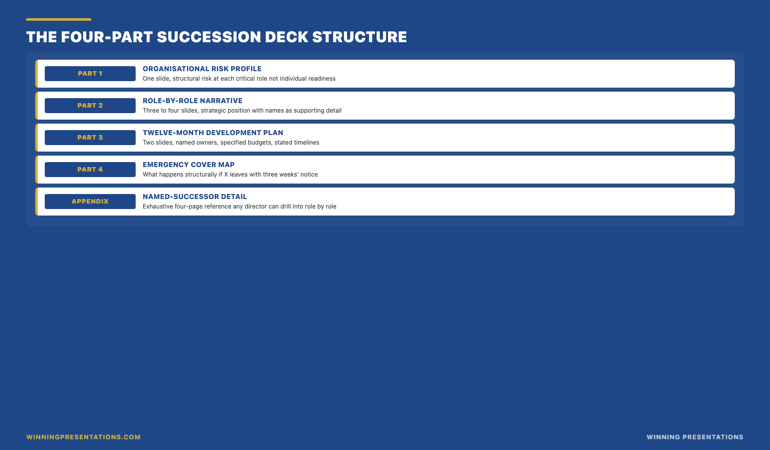
The four-part structure that consistently lands succession papers at board level has the same shape regardless of sector. The first part is the organisational risk profile. One page, ideally one slide, that shows the critical roles across the executive committee and the risk position at each — not the readiness of named individuals, but the structural risk to the organisation if that role were suddenly empty. Some roles carry high risk because the role-holder is unique and difficult to replace; some carry medium risk because the role can be temporarily covered while a longer search runs; some carry low risk because the function is structurally redundant in some way. The risk profile is the framing that everything else hangs from. It is the one slide the board will return to again and again as the discussion unfolds, so it has to be clean enough to anchor an hour of conversation without further decoration.
The second part is the role-by-role readiness narrative. Three to four slides covering the critical roles, presented as a narrative about the readiness position at each role rather than as a list of names against ratings. “At chief financial officer, we have one internal candidate who is ready inside twelve months with targeted development, and one who is ready inside twenty-four months. We do not have ready-now internal cover; for an unplanned vacancy we would conduct a search with a four-month bridge using the deputy CFO as interim.” That paragraph contains the same information as a standard readiness slide would, but it is framed as the chief executive’s strategic position rather than as a list. The board reads it as a strategic statement they can engage with rather than as data they need to challenge. The names appear in the supporting detail underneath, but they are not the headline.
The third part is the twelve-month development plan. Two slides at most. What specific development investments the organisation will make over the next twelve months to close the gaps named in the readiness narrative — targeted external coaching, specific stretch assignments, exposure to board-level meetings for selected high-potential successors, external assessment for the most senior roles. The board cares deeply about whether the development plan is real or notional. A real development plan has named owners, specified budgets, and stated timelines. A notional plan has none of those. The board can tell the difference inside thirty seconds, and the difference is what determines whether the succession paper is read as a credible strategic position or as a holding pattern. The fourth and final part is the emergency cover map — the structural answer to “what happens if X leaves tomorrow” for each critical role. The Executive Buy-In Presentation System covers this kind of risk-framing structure across its 7 modules, and the case-construction module in particular is heavily used by chief people officers preparing succession papers.
Stop rewriting your succession paper three times only to hear “we’ll think about it”.
The Executive Buy-In Presentation System teaches the structure that gets decisions, not delays — 7 self-paced modules covering stakeholder analysis, case construction, and the presentation structures that hold up under board scrutiny. The case-construction and Q&A taxonomy modules are the ones most used for sensitive board papers. Monthly cohort enrolment, optional recorded Q&A calls. £499, lifetime access to materials.
- 7 self-paced modules covering stakeholder analysis, case construction, and presentation structure
- Optional live Q&A / coaching calls, fully recorded — watch back anytime
- Monthly cohort enrolment — join the next cohort whenever suits you
- Lifetime access to all course materials, no deadlines
Why the names belong at the back of the deck, not the front
The single most counter-intuitive structural move in a succession planning presentation is reserving the named-successor detail for the appendix rather than placing it in the main body of the deck. Almost every standard succession deck puts the names front and centre because the people function’s work product is the names and ratings, and the team that built the deck wants the work to be visible. The board, however, does not need to see the work; the board needs to see the strategic position the work supports. When the names are in the main deck, the board pressure-tests the names. When the names are in the appendix, the board engages with the strategic position and only descends to the named detail when a specific role-and-name combination demands it. The same data is available in both versions. The structural difference is where the conversation starts.
The named-successor appendix should be exhaustive. One page per critical role, with each named successor, their current position, the specific development gap, the planned closure of that gap, and the emergency-cover position. Four pages of appendix typically cover a full executive committee. The appendix exists so that any director who wants to drill into a specific role can do so without slowing the main meeting. Most directors will not drill, because most directors trust the chief executive’s assessment if the strategic framing of the deck is sound. The directors who do drill almost always have a specific concern about one specific role — usually the role they themselves have most relevant prior experience in — and the appendix lets the conversation about that role happen cleanly without forcing the whole meeting through the same depth on every other role. For the broader pre-meeting and follow-through protocol, see the Executive Buy-In Masterclass overview and the wider presentation services catalogue.
The other reason the names belong at the back is that the appendix structure creates the discretion the chief executive needs around individual cases. If a particular named successor is in a delicate position — recently passed over, recently considered for a role that went elsewhere, currently in a difficult personal situation — the chief executive can structurally control how much detail the board sees by deciding what goes into the appendix and at what depth. The main deck does not force that detail into the meeting. The board can ask for more if they want it. The chief executive can offer to follow up offline if the matter is genuinely sensitive. The discretion is preserved without the deck looking evasive, because the appendix is the structurally normal place for individual-name detail. A deck that puts the names in the main body cannot offer the same discretion, because the names are already on the screen the moment the slide loads.
For the slide-level structure that supports the four-part succession deck — the templates, the prompt library for risk-and-mitigation framing, the specific scenario playbook for board-level sensitive papers — pair the buy-in framework with the Executive Slide System (£39). It contains 26 executive templates including the organisational risk profile and the role-by-role narrative structures referenced in this article, 93 AI prompts for drafting the case, and 16 scenario playbooks covering sensitive board topics. Most chief people officers preparing succession papers find the templates cut their drafting time roughly in half.
Designed for senior professionals who present decisions to boards, investment committees, and executive sponsors.
The Executive Buy-In Presentation System — 7 self-paced modules covering the psychology and structure that earn serious approval, including the case-construction patterns sensitive board papers need. Monthly cohort enrolment, optional recorded Q&A sessions. £499, lifetime access to materials.
Frequently asked questions
Will the board read the appendix if the named-successor detail is not in the main deck?
Some directors will and some will not, and that is the point. The board does not need to read the appendix in the live meeting to feel that the deck is complete — the appendix’s presence is what does that work. The directors who want to engage with specific names will signal it by asking; the chief executive can then point to the appendix entry and the conversation drops into the relevant detail without forcing the entire room through the same depth on every role. Most boards I have observed using this structure descend into the appendix on no more than two or three roles in a typical succession review, even though the appendix covers all of them. The discretion is structurally valuable; not every role needs the same level of board attention every time.
Is this structure appropriate for a board that has specifically asked for the full readiness data on every role?
Yes, with one adjustment. If the board has explicitly asked for the full named-readiness data in the main deck rather than in the appendix, give them what they have asked for — but lead with the organisational risk profile and the strategic framing first, and only then move into the role-by-role detail. The structural mistake is not having the names visible; it is letting the names structure the meeting. A deck that opens with the strategic framing and then moves into the named detail in part two preserves the conversation the board wants to have at the strategic level before descending into the individual cases. The names can be visible; they should not be the headline.
What is the most common mistake chief people officers make on succession decks?
Treating the deck as a people function product rather than as a chief executive product. The succession paper is structurally the chief executive’s view of the organisation’s succession risk; the people function is the analytical engine behind it, but the deck should read as the chief executive’s strategic position. The most common failure mode is a deck that reads as a people function report — the team’s methodology is visible, the data tables look like HR work product, the framing is operational rather than strategic. The board reads that deck and instinctively pressure-tests the methodology rather than engaging with the strategy. The correction is structural rather than cosmetic: the deck has to be built around the strategic decisions the board is being asked to make, with the people function’s data serving the strategy rather than being the headline.
How long should the live presentation be for a succession review?
Shorter than most chief people officers expect — usually no more than twenty minutes of live presentation, with the rest of the slot reserved for board discussion. The four-part structure can be walked through in fifteen minutes if the deck is built around the framework rather than around the data, and the shorter live presentation reads as confidence in the strategic position. A longer live presentation reads as the chief executive wanting to cover themselves on the detail, which signals to the board that the strategic position is not fully owned. The board would generally rather have more discussion time and less presentation time on succession; they want to test the chief executive’s judgement through the conversation, not have it transmitted at them through forty-five minutes of slides.
The Winning Edge — weekly newsletter
The Winning Edge is a weekly newsletter for senior professionals who present at the executive level. One short email a week on the structural moves that separate decks committees back from decks they defer. Subscribe to The Winning Edge →
For the wider library of presentation assets that pair with the buy-in framework on sensitive board topics — the slide system, the storytelling primer, the Q&A taxonomy — the Complete Presenter bundle (£99) collects them in one place.
About the author
Mary Beth Hazeldine is Owner & Managing Director of Winning Presentations Ltd. With 24 years of corporate banking experience at JPMorgan Chase, PwC, Royal Bank of Scotland, and Commerzbank, she advises executives across financial services, healthcare, technology, and government on structuring presentations for high-stakes funding rounds, board approvals, and strategic decisions.
The next time you build a succession planning paper for the board, do three things instead: open with the organisational risk profile rather than the list of names; restructure the role-by-role section as a narrative of the chief executive’s strategic position rather than as a table of ratings; and move the named-successor detail into an exhaustive appendix the board can drill into role by role only when they want to. The succession paper that survives is the one that reads as the chief executive’s strategic view, not as the people function’s work product. The names matter, but they are the last layer, not the first.