
Tag: strategy presentation structure

22 Mar 2026
CEO presenting strategy to formal board table with engaged Non-Executive Directors, large screen showing clean structured strategy slide with navy and gold accents, corporate governance atmosphere

Board Strategy Presentation: The 20-Minute Format That Gets Non-Executive Directors to Engage

Quick Answer: Effective board strategy presentations are compact and decision-focused. Rather than comprehensively covering the detail, a 6-slide format that isolates the strategic choice, frames the trade-offs, and requests explicit board approval delivers clarity in 20 minutes. This structure helps the CEO make the required decision clearer for Non-Executive Directors.

If you’re presenting strategy to the board in the next two weeks:

This article walks you through the exact 6-slide structure that keeps NEDs (Non-Executive Directors) engaged and moves strategic decisions in under 30 minutes. You’ll learn how to isolate the choice you actually need the board to make, and how to frame trade-offs in language directors understand.

The CEO Who Lost the Board at Slide 8

Jonathan was the CEO of a £85 million professional services firm. He’d spent three weeks building a 34-slide strategy deck with his leadership team. It covered market analysis, competitive positioning, operational restructuring, technology investments, and a new service line launch. Every slide had been carefully researched. The data was solid.

He walked into the boardroom confident. By slide 8, something had shifted. One Non-Executive Director was checking her phone. Another was making notes that didn’t look like engagement — they looked like distraction. The Chair was leaning back in his chair, not forward.

Jonathan kept going. Slide 12. The Chair interrupted: “Jonathan, I appreciate the depth here. But what’s the one strategic choice you’re recommending we make today? What decision do you actually need from this board?”

Jonathan paused. He hadn’t led with that. The recommendation was somewhere in slides 18-24, embedded in operational detail. He’d framed everything as context first, decision second. By the time he got to the ask, the board’s attention had already dissolved.

Two months later, Jonathan restructured his board presentation completely. Six slides. One clear strategic choice. The same board dynamics, the same NEDs. But this time they leaned forward. They took notes. One NED asked a sharp clarifying question about the trade-offs. The Chair said, “Approved — let’s move the decision to the 90-day implementation plan.” Twenty-two minutes. Done.

Why Comprehensive Strategy Decks Fail with NEDs

Non-Executive Directors occupy a unique cognitive position. They have deep experience in business, but they see your company once a month (or quarterly). They are NOT immersed in your operational reality. They don’t live with your market challenges or your internal constraints.

What they do have is a sharp ability to smell whether a strategy is clear or muddled. And they have limited time and attention. A 34-slide deck that tries to comprehensively justify every detail before revealing the ask is a form of cognitive tax on NEDs. It forces them to hold competing pieces of information in memory, waiting for you to finally name the choice.

The second problem: comprehensive decks rarely isolate the real choice. Instead, they present a menu of activities (market entry, technology investment, org restructuring, product launch) with the implicit message, “We’re doing all of this.” NEDs don’t feel they’re being asked to decide. They feel they’re being briefed on a done deal wrapped in a presentation.

The third problem: comprehensive decks hide the trade-offs. When you bury the limitations and risks in slides 22-30, NEDs never see the complete risk picture. They approve something incomplete and later discover constraints they didn’t know existed.
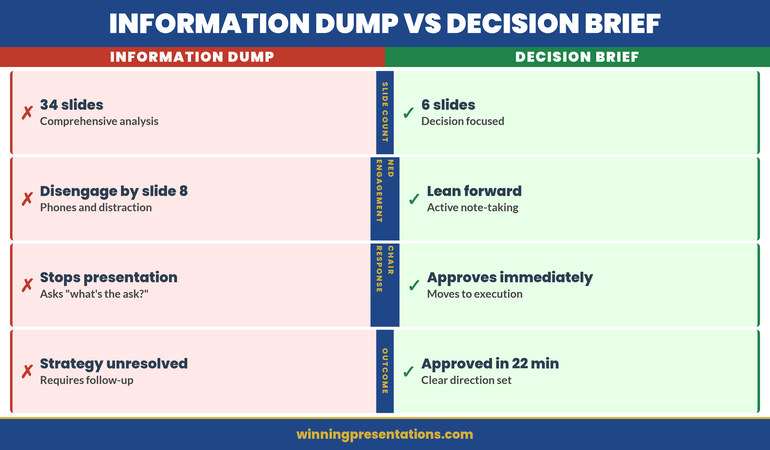
Information Dump vs Decision Brief comparison: left panel shows 34 slides, covers everything, NEDs disengage by slide 8, chair asks 'what's the ask?', strategy unresolved; right panel shows 6 slides, one clear recommendation, NEDs lean forward, chair says 'approved', strategy moves in 22 minutes

The Six-Slide Board Strategy Framework

A board strategy presentation that moves decisions in under 25 minutes has a precise structure. It’s not about oversimplifying — it’s about structuring complexity so NEDs can follow your logic and reach the same conclusion you have.

The framework isolates six decision moments, each on its own slide:

Slide 1: The Strategic Context

What has changed since the last board meeting that makes a new strategic decision necessary right now? (Market shift, competitor move, internal capability change, regulatory change.) This is not the full market analysis. This is the precipitating factor that triggered the need for board-level decision-making.

Slide 2: The Choice We Face

Two or three genuine options. Not one obvious option with two strawmen. Describe each option clearly, in language that reveals what each choice means for the business (growth rate, market position, risk profile). Real choices feel uncomfortable because each option has genuine merit and genuine limitations.

Slide 3: Our Recommendation

One clear recommendation with the single most important reason. Not three reasons. Not a comprehensive justification. The one thing that tipped the decision. NEDs will remember a crisp one-reason recommendation more than they’ll absorb three supporting arguments.

Slide 4: The Trade-Offs We’re Accepting

What we’re choosing NOT to do and why. This is the slide that builds credibility. You’re not pretending the choice is risk-free. You’re naming what you’re giving up and demonstrating you’ve thought it through. This is where NEDs feel heard because you’re acknowledging their likely concerns.

Slide 5: The 90-Day Actions

What starts happening in the next quarter if the board approves this strategy. Name the three or four actions that will be underway before the board meets again. This answers the question NEDs always ask: “How will we know this is working?”

Slide 6: The Decision We Need Today

A one-sentence, crystal-clear request for a specific board resolution. Not “approve the strategy.” Rather: “Approve the acquisition of TechCorp as our market entry mechanism” or “Approve the organisational restructuring to separate the operations and client service divisions.” Say exactly what resolution the board needs to pass.

Isolating the Strategic Choice You Actually Need

Most strategy decks fail at Slide 2 because the “choice” isn’t actually a choice. The CEO has already decided. The presentation is an elaborate justification, not a decision point.

A real strategic choice in front of a board should feel mutually exclusive. If you choose Option A, you explicitly do not choose Options B and C. There should be reasonable people — reasonable NEDs — who could argue for each option based on different risk tolerances or different interpretations of the market.

If your three options are (A) Acquire the competitor, (B) Acquire the competitor, or (C) Acquire the competitor, then you don’t have a choice. You’re presenting a done deal as though it’s a decision. NEDs will sense that immediately.

Real choices for boards often look like this:

Option A: Enter the North American market via organic growth. Invest £12M over 24 months. Lower short-term revenue impact. Higher execution risk. Slower market share capture.

Option B: Acquire a local North American player. Invest £22M upfront. Accelerated revenue. Known execution risks (integration). Higher short-term earnings pressure.

Option C: Partner with a North American distributor. Invest £2M. Minimal capital. Market risk (we don’t control the customer relationship). Slower long-term upside.

Now the board is facing a real decision. The CFO might lean toward Option C (capital efficiency). The growth-focused NED might lean toward Option B (speed to market). The risk-conscious Chair might prefer Option A (control, phased capital). Your job is to take a position, acknowledge that reasonable people could choose differently, and say why you recommend what you do.

When presenting strategy to a board, clarify your actual choice first.

Ask yourself: “If the board said no to my recommendation and chose a different option instead, would the business be substantively changed?” If the answer is no — if any of your three options would produce essentially the same business outcome — then you don’t have a real choice yet. Go back to your leadership team and refine the trade-offs until each option produces a materially different outcome.

Board Meeting This Week? Use the 6-Slide Structure

The Executive Slide System includes board strategy slide templates designed for the decision-focused format — each with context-setting, option framing, and trade-off language ready to adapt. Start with a structure that isolates the choice and frames the trade-offs before you walk in.

  • ✓ Board strategy slide templates for the 6-slide decision format
  • ✓ Trade-off framing guides to prepare Slide 4
  • ✓ Decision-slide frameworks for isolating the strategic choice
  • ✓ AI prompt cards to generate context and option language

Get Started →

The Trade-Offs Conversation NEDs Will Remember

Slide 4 is the most underrated slide in executive presentations. It’s the moment you shift from selling to credibility-building.

Most CEOs write Slide 4 reactively — “Here are the risks we’ve considered.” That’s passive. Instead, write it actively: “Here’s what we’re choosing not to do and why.”

If your recommendation is to enter the North American market via acquisition, your trade-offs might be:

“We’re choosing not to pursue organic growth because our window to establish market position is 18 months. Competitors are moving faster. We’re trading 18-24 months of higher capital expenditure for entry speed and known market position. We’re accepting the integration risk because the acquisition target’s client list is worth the execution complexity.”

Notice what that does: it answers the questions NEDs were already thinking. It shows you’ve weighed the alternatives. It makes the case that you’re not being reckless — you’re being strategic about which risks you’re willing to take and which you’re not.

This is where the board’s trust in you either deepens or erodes. If your trade-offs sound incomplete (“We’re not worried about integration issues”), NEDs will question your judgment. If your trade-offs sound honest and fully considered (“Integration risk is real; here’s our playbook to mitigate it”), you’ve built credibility.

One more principle: frame trade-offs in terms NEDs care about, not terms that matter to you internally. Your operations team cares about resource allocation. Your board cares about risk profile and shareholder value impact. Translate.

Moving from Presentation to Decision

The 90-day actions slide (Slide 5) serves a critical function. It signals to the board: “If you approve this, here’s what we’re actually doing. Here’s the resource commitment. Here’s the visible progress you’ll see by Q2.”

Many boards say no to strategies not because the strategy is bad, but because the CEO hasn’t convinced them that the business can execute. Your 90-day actions directly address that doubt.

What goes in the 90-day actions? The three or four initiatives that you will have visibly started before the board meets again. Not everything. Not the 12-month roadmap. The immediate next moves that prove you’re serious and capable.

If your strategy is to acquire TechCorp, your 90-day actions might be: (1) establish due diligence team, (2) sign NDA and begin deep financial review, (3) map integration playbook, (4) identify retention risks for key TechCorp staff. By the next board meeting, the board can see tangible progress. They know you’re executing.

The final slide — the resolution you need — should feel like a natural conclusion, not an abrupt ask. You’ve walked the board through context, options, your recommendation, trade-offs, and actions. The resolution slide is simply: “We need the board to pass the following resolution…” and you name it, one sentence, crystal clear.

If you’ve built the case well, NEDs won’t need time to think. They’ll be ready to pass the resolution in the meeting.
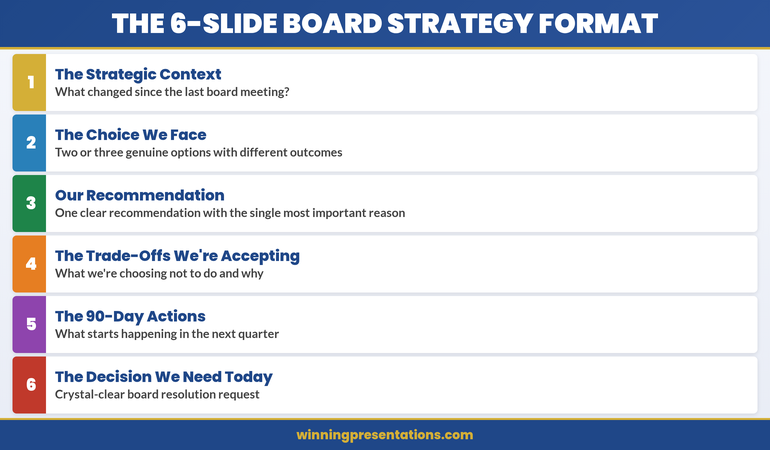
The 6-Slide Board Strategy Format: Card 1 shows Strategic Context, Card 2 shows The Choice We Face, Card 3 shows Our Recommendation, Card 4 shows Trade-Offs We're Accepting, Card 5 shows 90-Day Actions, Card 6 shows Decision We Need Today

The Mistakes That Extend Board Meetings

A board strategy presentation should take 18-22 minutes. If yours is consistently running 45 minutes or longer, one of these mistakes is happening:

Mistake 1: Comprehensive context instead of precipitating change. You’re giving the board a full market analysis when you should be naming the one thing that changed. Boards don’t need to relearn your market. They need to know why you’re asking them to make a decision now.

Mistake 2: Presenting options as though they’re all bad. If you frame Option A as “we could do this but it’s complicated,” and Option B as “we could do this but it’s risky,” then you’re not presenting real options. You’re presenting a predetermined conclusion disguised as choices. NEDs will feel manipulated, and they’ll slow down to ask clarifying questions to verify your options aren’t strawmen.

Mistake 3: Burying the recommendation. If it takes 12 minutes before you say what you actually recommend, you’ve lost the board’s permission to lead. Frame your recommendation early (Slide 3), then use Slides 4-5 to build the case.

Mistake 4: Trade-offs that sound defensive. “We’re aware of the integration risk.” That’s passive. “We’re accepting the integration risk because gaining market position in 12 months is worth the execution complexity, and here’s our mitigation plan.” That’s active and credible.

Mistake 5: 90-day actions that are too vague or too comprehensive. “We’ll begin implementation” isn’t an action. “We’ll have the due diligence team assembled and the first round of financial review complete” is. Name three or four specific, visible milestones.

Mistake 6: A resolution that sounds like a question. “Do you think we should consider approving the acquisition?” No. “We need the board to pass a resolution approving the acquisition of TechCorp pending satisfactory completion of due diligence.” That’s a request, not an inquiry.

Structuring your board presentation takes time the first time.

Most CEOs need 2-3 iterations before the choice, the recommendation, and the trade-offs all land cleanly. That’s normal. What matters is that you’re not starting from a 34-slide data dump. You’re starting from a framework that forces clarity. Our guide to executive presentation structure walks you through how to isolate the core decision and build your argument efficiently.

Is This Right For You?

  • ✓ You present strategic decisions to a board or governance committee — and you’ve noticed NEDs disengage when presentations exceed 25 minutes.
  • ✓ You struggle to isolate a clear strategic choice — your “options” feel like variations on a predetermined answer.
  • ✓ Board approval cycles are longer than they should be — you’re giving boards too much information and not enough clarity on what decision you need.

Frequently Asked Questions

What if the board asks for more detail during the presentation?

Embrace the question. If a NED asks for more detail on a specific point (market size, competitor positioning, integration timeline), you have that detail in your supporting deck. Say, “Good question — that’s in our detailed market analysis. Let me pull that up.” Then address the question without losing the board’s focus on the core decision. The 6-slide structure is your presentation; supporting materials are your backup.

How do I present three genuine options when I have a strong preference for one?

Present the options objectively, then make your recommendation clear on Slide 3. The key is that each option should be defensible — reasonable people with different risk tolerances could choose any of them. Your job is to name what you prefer and why, not to make the other options look foolish. If you can’t make a case that reasonable people could choose Option B or C, then they’re not real options. Go back and refine them so they are.

What if the board doesn’t approve my recommendation?

That’s the board doing its job. You’ve presented genuine options, they’ve chosen differently, and now you execute their choice. You don’t undermine it or lobby for yours. Your credibility depends on adapting to board direction and proving you can execute their chosen path as effectively as you would have executed yours. If you can’t do that with genuine commitment, you have a governance problem that a better presentation won’t solve.

The Winning Edge — Weekly insights for executives

Every Tuesday, we send a short email with one insight on presentation strategy, decision-making, or governance. Practical ideas you can use in your next board meeting. No promotional noise.

Sign Up for The Winning Edge

One more thing: your choice of whether to present a comprehensive deck or a decision-focused deck signals something to your board about your leadership. Comprehensive says, “Here’s everything I know, please decide.” Decision-focused says, “Here’s the choice I’ve made, here’s why, and here’s what I need from you.” NEDs reward clarity and decisiveness. They reward confidence balanced with honest acknowledgement of trade-offs. The 6-slide format isn’t about dumbing down complexity — it’s about proving you’ve thought the complexity through and can articulate why you’re recommending what you do.

When your next board meeting approaches, ask yourself: “Can I explain my strategic recommendation in six slides, naming the choice, the trade-offs, and what I need from the board?” If the answer is yes, you’re ready. If the answer is no, you probably don’t have a clear recommendation yet.

Not ready for the full system? Start here instead: download the free Executive Presentation Checklist — a one-page audit covering clarity of recommendation, trade-off framing, and decision readiness before you walk into any board room.

If you’re presenting multiple strategies to different boards, you’ll want to look at our guide to decision slides for executives, which goes deeper into how to frame the specific decision moment so NEDs move from listening to approving. And if your strategy involves multiple stakeholder groups, stakeholder mapping for presentations will help you tailor your framing for each audience.

Author: Mary Beth Hazeldine is Owner & Managing Director of Winning Presentations. With 24 years of corporate banking experience at JPMorgan Chase, PwC, Royal Bank of Scotland, and Commerzbank, she advises executives across financial services, healthcare, technology, and government on structuring presentations for high-stakes funding rounds and approvals.

The choice is not whether to be clear — it’s whether to be clear with the board in your presentation, or clear with yourself after the meeting when they reject the muddled recommendation.

05 Feb 2026
Executive woman gesturing while presenting strategy to boardroom with data slides visible on screen

My CEO Stopped Me on Slide 4. “Start Over,” She Said. “But Start With the Decision.”

I’d spent three weeks on that strategy deck.

Market analysis. Competitor benchmarking. Trend data from four research firms. Financial projections modelled in three scenarios. Forty-two slides that told a comprehensive, logical story from problem to solution.

The CEO let me get to slide four—the market overview—before she held up her hand.

“I can see where this is going,” she said. “You want to expand into Nordic markets. Just tell me: should we do it, what will it cost, and what happens if we don’t? I don’t need the journey. I need the destination.”

I stood there with 38 unused slides and a career lesson I’ve never forgotten: CEOs don’t want your strategy presentation to teach them something. They want it to help them decide something.

Quick Answer: The strategy presentation format CEOs actually want is decision-first, not analysis-first. Lead with your recommendation and the decision required, then provide only the evidence that supports the decision. A 12-slide strategy deck that starts with the answer outperforms a 40-slide deck that builds to it—because executives don’t have time to follow your logic. They need to evaluate your conclusion.

⏱️ Presenting Strategy This Week? Your 15-Minute Fix

Before your next strategy presentation, restructure the first three slides:

  1. Slide 1: The decision (5 min) — State exactly what you’re asking leadership to approve. One sentence. “I recommend we [specific action] by [date] at a cost of [amount].”
  2. Slide 2: Why now (5 min) — The consequence of delay. What happens if this decision isn’t made this quarter?
  3. Slide 3: What it takes (5 min) — Investment required, timeline, and the one metric that will prove it’s working.

These three slides should be strong enough to stand alone. Everything after them is supporting evidence—appendix material the CEO may never need.

🎯 Is This Your Situation?

  • You’re presenting strategy to a CEO or C-suite and need a clear, proven format
  • Your last strategy deck was too long, too detailed, or didn’t get a decision
  • You’ve been told to “get to the point faster” but aren’t sure how to structure that
  • You need to present a strategic recommendation, not just a strategic overview
  • The stakes are high enough that the format matters as much as the content

This article gives you the exact slide structure. Keep reading.

What That CEO Taught Me About Strategy Presentations

After the meeting, I sat with that CEO for fifteen minutes. She wasn’t unkind—she was direct.

“You’re not the only one who does this,” she told me. “Every strategy presentation I see starts with the problem. Market trends. Competitive landscape. Internal challenges. By slide ten, I’ve already formed my own conclusion. Then I spend the next twenty slides wondering if yours matches mine.”

She drew something on a napkin. Two boxes with an arrow.

The first box said: “Here’s what I recommend.” The second box said: “Here’s why.”

“That’s the entire format,” she said. “Everything else is appendix.”

I rebuilt that strategy deck in two hours. Twelve slides instead of forty-two. Led with the recommendation. Supported it with three evidence points. Closed with the specific decision I needed.

She approved the Nordic expansion the following week. Same strategy. Different format. Different outcome.

Why Most Strategy Decks Use the Wrong Format

Most strategy presentations follow what I call the “analyst format”—the structure you’d use to present research to peers. It looks like this:

— Situation overview (slides 1-8)
— Market analysis (slides 9-15)
— Competitive landscape (slides 16-22)
— Options considered (slides 23-30)
— Recommendation (slide 31)
— Implementation plan (slides 32-38)
— Financial projections (slides 39-42)

This format makes sense to the presenter. It shows your working. It demonstrates rigour. It builds logically to a conclusion.

But it’s wrong for CEOs—because CEOs don’t need to follow your analytical journey. They need to evaluate your conclusion.

The analyst format forces the CEO to hold everything in working memory until slide 31. By then, they’ve mentally checked out, formed their own view, or started thinking about the next meeting. Your recommendation arrives when their attention is lowest.

For more on how to structure the executive summary that opens your strategy deck, see my guide on the executive summary slide.

How CEOs Actually Process Strategy Presentations

After twenty-four years presenting to senior executives in banking—from managing directors at JPMorgan to board members at Commerzbank—I’ve learned that CEOs process strategy through a specific mental framework.

It’s not the same framework you used to develop the strategy. Understanding the difference is the key to formatting your deck correctly.

CEO processing framework:

Question 1: “What are you asking me to decide?”
If this isn’t answered in the first 90 seconds, they’ll ask it themselves—and your carefully structured build-up crumbles.

Question 2: “What’s the risk if I say yes?”
Not the upside. The risk. CEOs are paid to manage risk. They want to know the downside scenario before they evaluate the upside.

Question 3: “What happens if we do nothing?”
The cost of inaction is often more persuasive than the benefit of action. If nothing bad happens from waiting, they’ll wait.

Question 4: “Who else supports this?”
Social proof matters at the top. They want to know that the CFO has seen the numbers, that operations has validated the timeline, that this isn’t one person’s enthusiasm.

Your strategy deck format should answer these four questions—in this order. Everything else is supporting evidence they may request but shouldn’t have to wade through.

12-slide strategy presentation format showing decision first on slides 1-3, evidence on slides 4-8, and the close on slides 9-12 with appendix for everything else

⭐ Strategy Slides Built for CEO-Level Decisions

The Executive Slide System includes ready-made strategy presentation templates designed around the decision-first format—so you stop building 40-slide analysis decks and start presenting 12-slide decision decks.

Inside the system:

  • Decision-first slide templates for strategy presentations
  • Executive summary frameworks that answer the CEO’s four questions
  • Risk and implementation slides formatted for senior leadership

Get the Executive Slide System → £39

Built for strategy decks, board updates, and CEO decision meetings. Instant download.

The 12-Slide Strategy Format That Gets Decisions

This is the format I now use for every strategy presentation, and the one I teach to executives who present strategic recommendations to leadership.

THE DECISION BLOCK (Slides 1-3)

Slide 1: The Recommendation
One sentence. “I recommend we [do X] by [date] at a cost of [amount].” No preamble. No context. Just the answer. This is the most important slide in the deck—and it goes first.

Slide 2: The Cost of Inaction
What happens if the CEO doesn’t approve this? Revenue lost. Market share ceded. Competitive position weakened. Make inaction feel riskier than action.

Slide 3: The Investment and Timeline
Total cost. Key milestones. The one metric that will tell you it’s working within 90 days. CEOs want to know when they’ll see evidence that this was the right call.

THE EVIDENCE BLOCK (Slides 4-8)

Slide 4: Market Evidence
Not a full market analysis. The two or three data points that directly support your recommendation. Curated evidence, not comprehensive analysis.

Slide 5: Competitive Evidence
What competitors are doing—or not doing—that makes this the right moment. One slide. Not a landscape.

Slide 6: Internal Readiness
Why the organisation can execute this now. Capabilities, resources, team. Demonstrates you’ve validated feasibility, not just desirability.

Slide 7: Risk Assessment
Top three risks and your mitigation plan for each. CEOs respect people who’ve thought about what could go wrong. It builds trust faster than optimistic projections.

Slide 8: Financial Summary
Investment required. Expected return. Break-even timeline. One slide, not five. The CFO can request detail offline.

THE DECISION BLOCK (Slides 9-12)

Slide 9: What You Need From Them
The specific approval requested. Budget sign-off? Resource allocation? Green light to proceed? Be precise.

Slide 10: Implementation Roadmap
High-level only. Quarterly milestones. Who’s accountable for what. Demonstrates this isn’t theoretical—there’s a plan.

Slide 11: Success Metrics
How you’ll measure whether this strategy is working. Three metrics maximum. Tied to the timeline in slide 3.

Slide 12: The Ask (Repeated)
Restate the recommendation from slide 1. This creates a closed loop. The presentation started with the decision and ends with the decision. No ambiguity about what you need.

Everything else—detailed market analysis, financial models, competitive deep-dives—goes in an appendix. Available if requested. Never presented unless asked.

The Decision Slide: The Only Slide That Really Matters

Of the twelve slides, one determines everything: Slide 1.

If your opening slide is a market overview, an agenda, or—worst of all—your company logo with a title, you’ve already lost the CEO’s attention. They’re waiting for the point. Every second before the point is friction.

Decision slide format:

Headline: Your recommendation in one sentence (max 15 words)
Supporting line: The single most compelling reason
The ask: What specific decision you need today
The number: The investment or return figure they need to evaluate

Example:

Headline: “Expand into Nordic markets by Q3 to capture £12M recurring revenue”
Supporting line: “Three competitors are already there. Two more are entering this year.”
The ask: “Approve £2.1M investment and 8-person team allocation”
The number: “Break-even in 14 months. ROI of 5.7x over 3 years.”

That’s one slide. And for some CEOs, it’s the only slide they need. Everything after it answers the questions that slide raises.

For a deeper look at how this fits within broader presentation structures, see my guide on executive presentation structure.

⭐ Build Strategy Decks CEOs Actually Approve

Stop spending weeks on 40-slide analysis decks. The Executive Slide System gives you the decision-first templates that match how senior leaders actually process strategy—so your recommendation lands, not your research.

Get the Executive Slide System → £39

Designed to force clarity on Slide 1: the decision. Instant download.

Three Strategy Presentation Mistakes That Kill Momentum

Even with the right format, these three mistakes undermine strategy presentations more than any other.

Mistake 1: Presenting Options Instead of a Recommendation

“Here are three options. What do you think?”

This feels democratic. It’s actually a failure of leadership. When you present options without a recommendation, you’re asking the CEO to do your job. They hired you to have a point of view. Present it.

The fix: present one recommendation, supported by the reasoning. Mention that alternatives were considered—briefly—and explain why this option is superior. The CEO can always ask about alternatives. They should never have to choose between them without your guidance.

Mistake 2: Building Suspense

“Let me walk you through the analysis, and you’ll see why we reached this conclusion.”

This is the analyst format disguised as storytelling. It builds to a reveal. CEOs hate reveals. They want to know the ending first, then decide whether the supporting evidence is convincing.

The fix: state your recommendation on slide 1. Let them evaluate the evidence knowing where it leads. This actually makes the evidence more persuasive—because they’re evaluating it against a specific conclusion, not trying to guess where you’re headed.

Mistake 3: Death by Data

Forty-two data points on twelve slides. Charts that require explanation. Footnotes that reference methodology.

Data doesn’t persuade CEOs. Curated data persuades CEOs. The three data points that directly support your recommendation are worth more than thirty that demonstrate your thoroughness. Thoroughness is your job. Clarity is your presentation.

For more on how to present like senior leaders actually do, see how CEOs actually present.

Adapting the Format for Different Strategy Types

The 12-slide structure works across strategy types, but the emphasis shifts depending on what you’re presenting.

Annual Strategic Plan
Heavy emphasis on Slides 2 (cost of inaction) and 10 (implementation roadmap). The CEO wants to know: what changes from last year, and how will we execute? Keep market evidence to one slide—they’ve likely seen the same trends.

Growth/Expansion Strategy
Heavy emphasis on Slides 4-5 (market and competitive evidence) and 8 (financial summary). The CEO needs to see that the opportunity is real, the timing is right, and the numbers work.

Transformation/Change Strategy
Heavy emphasis on Slide 2 (cost of inaction) and 7 (risk assessment). Transformation is uncomfortable. The CEO needs to feel that not transforming is riskier than transforming. Risk assessment must be honest—understating risk destroys credibility.

Defensive/Turnaround Strategy
Heavy emphasis on Slide 1 (the recommendation—be bold) and 3 (investment and timeline). In turnaround situations, clarity and speed matter more than thoroughness. The CEO wants a confident recommendation delivered fast.

How should I format a strategy presentation for my CEO?

Lead with your recommendation on slide 1—not background, not analysis. CEOs process strategy by evaluating your conclusion, not following your analytical journey. Use a 12-slide decision-first format: recommendation, cost of inaction, investment required, then supporting evidence. Keep detailed analysis in an appendix.

How many slides should a strategy presentation have?

Twelve core slides is optimal for most strategy presentations to senior leadership. The first three should be strong enough to stand alone (recommendation, urgency, investment). Slides 4-8 provide evidence. Slides 9-12 close with the specific ask. Additional detail belongs in an appendix that’s available if requested.

What do CEOs look for in strategy presentations?

CEOs evaluate strategy presentations against four questions: What decision is required? What’s the risk of saying yes? What happens if we do nothing? Who else supports this? Format your deck to answer these questions in order, and you’ll hold their attention far longer than a comprehensive analysis would.

⭐ The Executive Slide System — Strategy Decks That Get Approved

Every template in the Executive Slide System follows the decision-first format. Strategy presentations, board updates, steering committee decks—all structured around how CEOs actually process information.

What’s inside:

  • Decision-first templates for strategy, board, and leadership presentations
  • Executive summary slide frameworks with recommendation-first structure
  • Risk assessment and financial summary templates formatted for C-suite

Get the Executive Slide System → £39

Decision-first format. Every template starts with the recommendation, not the background. Instant download.

Frequently Asked Questions

Should I present my analysis or just the recommendation?

Present the recommendation first, then curated evidence that supports it. Your full analysis belongs in an appendix. CEOs want to evaluate your conclusion—not follow your entire analytical journey. If they need more detail on any point, they’ll ask. Most won’t.

What if my CEO prefers detailed presentations?

Even detail-oriented CEOs prefer knowing the destination before the journey. Start with the recommendation and the decision required, then provide as much supporting detail as they want. The difference is structural: lead with the answer, then go deep. Don’t build to the answer through forty slides of context.

How do I handle a strategy presentation where there’s genuine uncertainty?

Present your best recommendation with the uncertainties clearly stated in the risk slide. CEOs don’t expect certainty—they expect a point of view. Saying “based on what we know today, I recommend X, with these caveats” is far stronger than presenting three options and asking them to choose.

Can I use this format for a strategy update, not a new strategy?

Yes—adapt slides 1-3. Slide 1 becomes “Here’s where we are versus plan.” Slide 2 becomes “Here’s what needs to change.” Slide 3 becomes “Here’s what I need from you.” The decision-first principle applies to updates too: don’t make leadership wait for the conclusion about whether the strategy is working.

Get Weekly Executive Presentation Insights

Practical frameworks for strategy decks, board presentations, and leadership communication—no fluff.

Subscribe to The Winning Edge →

📋 Free: Executive Presentation Checklist

A quick-reference checklist for structuring any executive presentation—including strategy decks—around the decision-first format.

Download the Free Checklist →

Related: Presenting strategy to senior leadership can trigger intense anxiety—especially when the stakes are high. Read how to sound calm and credible when presenting to senior leadership for the delivery techniques that match this structural approach.

The Bottom Line

That CEO didn’t reject my strategy. She rejected my format.

The recommendation was sound. The analysis was thorough. The financial case was strong. But I’d buried all of it under thirty-eight slides of build-up that forced her to wait for the point.

When I restructured the same strategy into twelve decision-first slides, she approved it in one meeting. Same content. Different structure. Completely different outcome.

Your next step: Open your current strategy deck. Find the slide where you state your recommendation. Now move it to slide 1. Delete everything that came before it. Look at what’s left—that’s closer to the deck your CEO actually wants.

About the Author

Mary Beth Hazeldine is the Owner & Managing Director of Winning Presentations. With 24 years of corporate banking experience at JPMorgan Chase, PwC, Royal Bank of Scotland, and Commerzbank, she has presented strategy to boardrooms across three continents.

A qualified clinical hypnotherapist and NLP practitioner, Mary Beth combines executive communication expertise with evidence-based techniques for high-stakes presentations. She has trained senior teams and coached high-stakes approvals across banking, consulting, and corporate leadership.

Book a discovery call | View services