Tag: stakeholder management

23 Feb 2026
Executive woman standing with composed expression in boardroom while male colleague sits behind her with arms crossed — corporate presentation sabotage dynamics

The Executive Who Tried to Sabotage My Client’s Presentation (And How the Slides Saved Her)

Quick answer: Presentation sabotage — colleagues feeding contradictory data to decision-makers, lobbying against your recommendation before the meeting, or positioning themselves to benefit from your failure — is a structural problem, not a political one. The defence isn’t better office politics. It’s a slide architecture that makes sabotage irrelevant: decision-first sequencing, self-contained logic, pre-emptive objection handling built into the slide order. When the structure is unchallengeable, the saboteur has nothing to attack.

She Found Out 20 Minutes Before the Meeting. The Room Had Already Been Briefed Against Her.

A colleague had emailed the entire steering committee contradictory data the night before.

Not overtly. Not as an attack. As a “just wanted to flag some concerns about the numbers in tomorrow’s presentation” — the kind of corporate sabotage that looks like diligence but is designed to destroy credibility before you’ve said a word.

My client — a programme director at a global bank — found the email at 8:40am. The meeting was at 9:00. Twenty minutes. No time to address each point individually. No time to rally allies. No time to confront the colleague.

She presented anyway. The committee approved her recommendation in the room. The saboteur’s email was never discussed.

Not because she was politically brilliant. Not because she out-manoeuvred the colleague. Because the slide structure she used made the contradictory data irrelevant. Her architecture led with the decision, surfaced the objections before anyone could raise them, and made the recommendation logically inevitable — regardless of what anyone had been told beforehand.

The sabotage failed because the structure was unchallengeable. That’s not luck. That’s architecture.

Here’s the framework, and why it works when everything else doesn’t.

🚨 Presenting this week in a politically charged environment? Quick check: Does your first slide state the decision you’re asking for — or does it start with background? If it starts with background, any pre-briefed sceptic has 5-10 minutes to build their counter-argument before you’ve even asked for anything. Decision-first sequencing eliminates that window. → Need the exact slide structure? The Executive Slide System (£39) includes the templates that make sabotage structurally irrelevant.

Why Slide Structure — Not Politics — Is Your Only Reliable Defence

When someone sabotages your presentation, the instinctive response is political: confront the saboteur, rally allies, escalate to your manager, or try to discredit their intervention.

Every one of those strategies is unreliable, and here’s why.

Confrontation tips off the saboteur that you know what they’ve done. They adjust. They escalate. A political skirmish becomes a political war, and now the decision-makers are watching two colleagues fight rather than evaluating your recommendation.

Rallying allies requires time you don’t have. In my client’s case, she had twenty minutes. In most cases, you discover the sabotage hours before the meeting — or you don’t discover it at all until you see the sceptical faces. You can’t build a coalition in a corridor conversation.

Escalation makes you look weak. Running to your manager because a colleague sent a challenging email positions you as someone who can’t handle scrutiny. Decision-makers notice. Even if your manager intervenes, you’ve signalled that your recommendation can’t stand on its own.

Structure does something none of these approaches can do: it makes the sabotage irrelevant without addressing it directly. When your decision slide leads with the recommendation, the room evaluates your logic — not the saboteur’s pre-briefing. When your objection handling is built into the slide order, the contradictory data has already been addressed before anyone can raise it. When the evidence follows a self-contained sequence, the committee has no gaps to exploit.

The saboteur needs gaps. A bulletproof structure has none.

Diagram showing why political responses to presentation sabotage fail while structural defences succeed — confrontation, allies, and escalation versus decision-first architecture

The Sabotage-Proof Framework: 4 Slides That Make Attacks Irrelevant

This is the framework my client used. It works because each slide eliminates a specific attack vector that saboteurs rely on.

Slide 1: The Decision Statement. Not background. Not context. Not “Today I’d like to update you on…” The first slide states, in one sentence, exactly what you’re asking the room to approve. “I’m requesting approval to proceed with Option B at a cost of £2.4M, with implementation beginning Q3.” This eliminates the saboteur’s most powerful weapon: the build-up period. In a traditional presentation, the first 5-10 slides are background — and that’s where pre-briefed sceptics build their counter-narrative. By the time you reach your recommendation on slide 15, the room has already decided against you. Decision-first removes the build-up entirely.

Slide 2: The Decision Criteria. Not your evidence yet. The criteria the committee should use to evaluate ANY recommendation — yours or the alternative. “This decision should be evaluated against three factors: implementation risk, 18-month ROI, and team capacity.” This is the architectural masterstroke against sabotage. When you define the decision criteria before presenting your evidence, the saboteur’s contradictory data has to survive YOUR framework. If their “concerns” don’t map to your stated criteria, they’re irrelevant — and the committee sees that without you saying it.

Slide 3: Evidence Against Your Own Criteria. Now — and only now — you present your evidence, mapped directly to the criteria on Slide 2. Each criterion gets a clear data point. No gaps. No hand-waving. No “we’ll come back to that.” The committee can evaluate your recommendation against the framework you’ve already established. The saboteur’s pre-briefing exists in a different framework — one you’ve just made obsolete.

Slide 4: The Ask + Pre-Emptive Objection. Restate the decision. Then address the single most likely objection — proactively, on the slide itself. “The primary risk is implementation timeline. Our mitigation: phased delivery with Stage 1 complete by Week 8.” This removes the saboteur’s final weapon: the “but what about…?” challenge after your presentation. You’ve already answered it. On screen. In front of everyone. The saboteur has to either agree with your mitigation or reveal their objection was personal, not professional.

Four slides. Each one closes an attack vector. Together, they create a structure where sabotage has nowhere to land.

This 4-slide framework is the core architecture inside the Executive Slide System — including the decision-first templates, the criteria slide formula, and the pre-emptive objection structure that makes political attacks structurally irrelevant.

Slide Structure That Survives Corporate Politics

The Executive Slide System gives you the sabotage-proof architecture that makes contradictory pre-briefings, hostile lobbying, and political undermining structurally irrelevant — because the logic is self-contained and unchallengeable.

  • ✓ Decision-first templates that eliminate the build-up window saboteurs exploit
  • ✓ The Criteria Slide formula — force the room to evaluate YOUR framework, not the saboteur’s
  • ✓ Pre-emptive objection slides that close attack vectors before anyone opens them

Get the Executive Slide System → £39

Built from 24 years of executive presentations at JPMorgan, PwC, RBS, and Commerzbank — including high-stakes approvals where the politics were as dangerous as the numbers.

How to Build Pre-Emptive Objection Handling Into Your Slide Order

The difference between a presentation that survives sabotage and one that collapses under it is where the objection handling sits.

Most executives handle objections after the presentation, in Q&A. This is the worst possible position when you’re being sabotaged, because the saboteur has had your entire presentation to refine their challenge. They’ll frame their pre-briefed data as a question — “I noticed some discrepancies in the numbers…” — and now you’re defending yourself instead of advancing your recommendation.

Pre-emptive objection handling reverses this dynamic entirely. Here’s how it works in practice:

Step 1: Map the three most likely challenges to your recommendation. Not your weaknesses — the challenges. What would a reasonable sceptic push back on? What would a saboteur use? In my client’s case: implementation timeline, cost relative to the alternative, and the data discrepancy her colleague had flagged.

Step 2: Address each challenge inside the evidence slides, not after them. When you present your ROI data, include the cost comparison — proactively. When you show the implementation plan, include the risk mitigation — proactively. The saboteur’s ammunition has already been detonated before they can use it.

Step 3: Use Slide 4’s explicit objection statement as the final seal. Name the biggest remaining objection out loud, on the slide, in front of the committee. “The primary concern is timeline risk. Here’s our mitigation.” This signals three things: you’re aware of the risk, you’ve addressed it, and you’re confident enough to name it publicly. A saboteur who raises it now looks like they’re repeating what you’ve already covered.

This is how structure gives you credibility in front of senior leadership — not by avoiding difficult topics, but by owning them before anyone else can weaponise them.

What to Do When Sabotage Happens During the Presentation

Sometimes the sabotage isn’t pre-meeting. Sometimes it’s live: an interruption, a challenge, a “just a quick question” designed to derail your flow at the worst possible moment.

The Sabotage-Proof Framework handles this too, because it changes the room’s expectations about how the presentation should unfold.

When your first slide states the decision, everyone in the room knows what they’re evaluating. A mid-presentation interruption that doesn’t relate to the decision criteria looks like what it is — a distraction. The room self-polices. “Can we let her finish the framework before we go into questions?” happens naturally when the structure is clear.

When your criteria are already established, an off-topic challenge has no anchor. “That’s an interesting point — does it map to one of the three criteria we’re evaluating against?” This isn’t confrontation. It’s a structural redirect. You’re not dismissing the saboteur. You’re applying the framework the room has already accepted.

When your objections are already addressed, a repeated challenge reveals the saboteur’s intent. “As I covered on slide 4, the timeline risk mitigation is phased delivery. Was there an additional concern beyond what’s shown?” The room sees the repetition. The saboteur’s credibility drops.

The framework creates a situation where continued sabotage exposes the saboteur. You don’t need to say a word about the politics. The structure says it for you.

Every template in the Executive Slide System is built with this defensive architecture — the decision-first sequence, criteria-based evaluation, and pre-emptive objection handling that makes political attacks structurally irrelevant, whether they happen before or during the meeting.

The 4-slide Sabotage-Proof Framework showing how each slide eliminates a specific attack vector that corporate saboteurs rely on

Stop Letting Office Politics Decide Whether Your Recommendation Gets Approved

You’ve watched good ideas die because someone lobbied against them before the meeting. You’ve seen colleagues with weaker proposals win because they played the politics better. The Executive Slide System makes the politics irrelevant — your structure does the defending.

  • ✓ Stop losing approvals to colleagues who brief against you — make pre-meeting lobbying irrelevant
  • ✓ Stop scrambling to counter sabotage you discover 20 minutes before the meeting
  • ✓ Stop relying on political alliances to get decisions — let your slide architecture carry the logic

Get the Executive Slide System → £39

The same framework used by my client who got approval 20 minutes after discovering a colleague had briefed the entire committee against her.

Common Questions About Presentation Sabotage

How do you present when someone is actively undermining you?

The counter-intuitive answer: you don’t address the undermining at all. You use a slide structure that makes it irrelevant. Decision-first sequencing eliminates the build-up window where pre-briefed sceptics formulate their challenges. A criteria slide forces the room to evaluate your framework rather than the saboteur’s narrative. Pre-emptive objection handling detonates the saboteur’s ammunition before they can use it. The structure does the defending — you focus on presenting the recommendation clearly and confidently. The executives I’ve worked with across JPMorgan, RBS, and Commerzbank consistently found that structural defence outperformed political manoeuvring, because it doesn’t require you to know what the saboteur has done in advance.

Can slide structure actually protect against corporate politics?

Yes, because corporate sabotage exploits structural weaknesses in traditional presentations. The build-up period (slides 1-10 as background) gives sceptics time to build counter-narratives. Objection handling in Q&A gives saboteurs the last word. Evidence without evaluation criteria lets challengers reframe the decision on their terms. The Sabotage-Proof Framework closes each of these gaps: decision first (no build-up), criteria defined (your framework), evidence mapped to criteria (no gaps), objections addressed proactively (no ammunition left). Politics thrive in ambiguity. Structure eliminates ambiguity.

What do you do when a colleague sabotages your presentation?

If you discover sabotage before the meeting: restructure your opening to lead with the decision and define the evaluation criteria — this makes the saboteur’s pre-briefing compete against your framework rather than your credibility. If sabotage happens during the meeting (interruptions, challenges, “just a quick question” designed to derail): redirect to your criteria slide. “That’s worth discussing — does it map to one of the three criteria we established?” This isn’t confrontation. It’s a structural redirect that the room accepts because the framework was established at the start. The executive presentation framework covers the full architectural approach.

Is the Executive Slide System Right For You?

✓ This is for you if:

  • You present in politically charged environments where colleagues compete for budget, headcount, or strategic priority
  • You’ve had recommendations rejected because someone lobbied against you before the meeting — and you need a structural defence
  • You want slide templates that make your logic unchallengeable regardless of what’s happening behind the scenes
  • You’re tired of winning on evidence and losing on politics

✗ This is NOT for you if:

  • Your presentations are informal team updates with no political stakes (this is built for decision meetings)
  • You’re looking for political strategy or relationship management advice (this is a structural framework)
  • Your presentations don’t involve a specific ask or recommendation (the framework is built around decision-first architecture)

24 Years of High-Stakes Approvals Where the Politics Were as Dangerous as the Numbers. Now Available as Templates.

Every template in the Executive Slide System was built in environments where sabotage, pre-meeting lobbying, and political manoeuvring were standard operating procedure — global banking, consulting, and corporate governance at JPMorgan, PwC, RBS, and Commerzbank.

  • ✓ Decision-first templates tested in steering committees, board meetings, and programme governance
  • ✓ AI prompts to build your sabotage-proof deck in 25 minutes
  • ✓ Before/after examples from real executive presentations where the politics were hostile

Get the Executive Slide System → £39

Used by programme directors, VPs, and department heads presenting in politically charged environments where the structure has to carry the argument — because the politics won’t.

Frequently Asked Questions

What if the saboteur is more senior than me?

Seniority makes the sabotage more dangerous — but the structural defence works identically. In fact, it works better against senior saboteurs, because the decision-first framework shifts the room’s attention from hierarchy to logic. When your first slide states the decision and your second slide defines the evaluation criteria, the committee is evaluating the framework — not the relative seniority of the people in the room. A senior colleague who challenges your data after you’ve already addressed it on Slide 4 looks like they haven’t been paying attention. You don’t need to confront seniority. The structure makes seniority irrelevant to the decision process.

Does this work if decision-makers have already been briefed against me?

Yes — this is the exact scenario the framework is designed for. Pre-briefing creates a counter-narrative in the decision-makers’ minds. Traditional presentations (background first, recommendation last) give that counter-narrative 10-15 minutes to solidify before you’ve even asked for anything. Decision-first sequencing bypasses the counter-narrative entirely. By slide 2, you’ve defined the evaluation criteria — and the pre-briefing has to survive YOUR framework. Most pre-briefed “concerns” don’t map to rigorous evaluation criteria. The committee sees the mismatch without you pointing it out.

What if sabotage happens DURING my presentation — live interruptions and challenges?

The framework handles live sabotage through structural authority. When your criteria are established on Slide 2, every interruption is filtered through that framework. “That’s worth discussing — how does it relate to the criteria we’ve established?” This redirect is powerful because the room has already accepted the criteria. The saboteur has to either map their challenge to your framework (where you’ve already addressed it) or reveal that their objection doesn’t fit the evaluation criteria at all. Continued off-topic challenges expose the saboteur’s intent to the room. You don’t need to call it out. The structure makes it visible.

Get Weekly Presentation Intelligence

Structural frameworks for politically charged environments, plus the slide architecture and communication strategies that make executive presentations unchallengeable — delivered every week.

Join the Newsletter

Related: If the political pressure triggers anxiety about the presentation itself — the fear of being publicly challenged, the dread of walking into a hostile room — that’s a separate problem with a separate fix. Read Glossophobia at the C-Suite: Why Successful Executives Still Struggle for the clinical techniques that break the executive anxiety cycle.

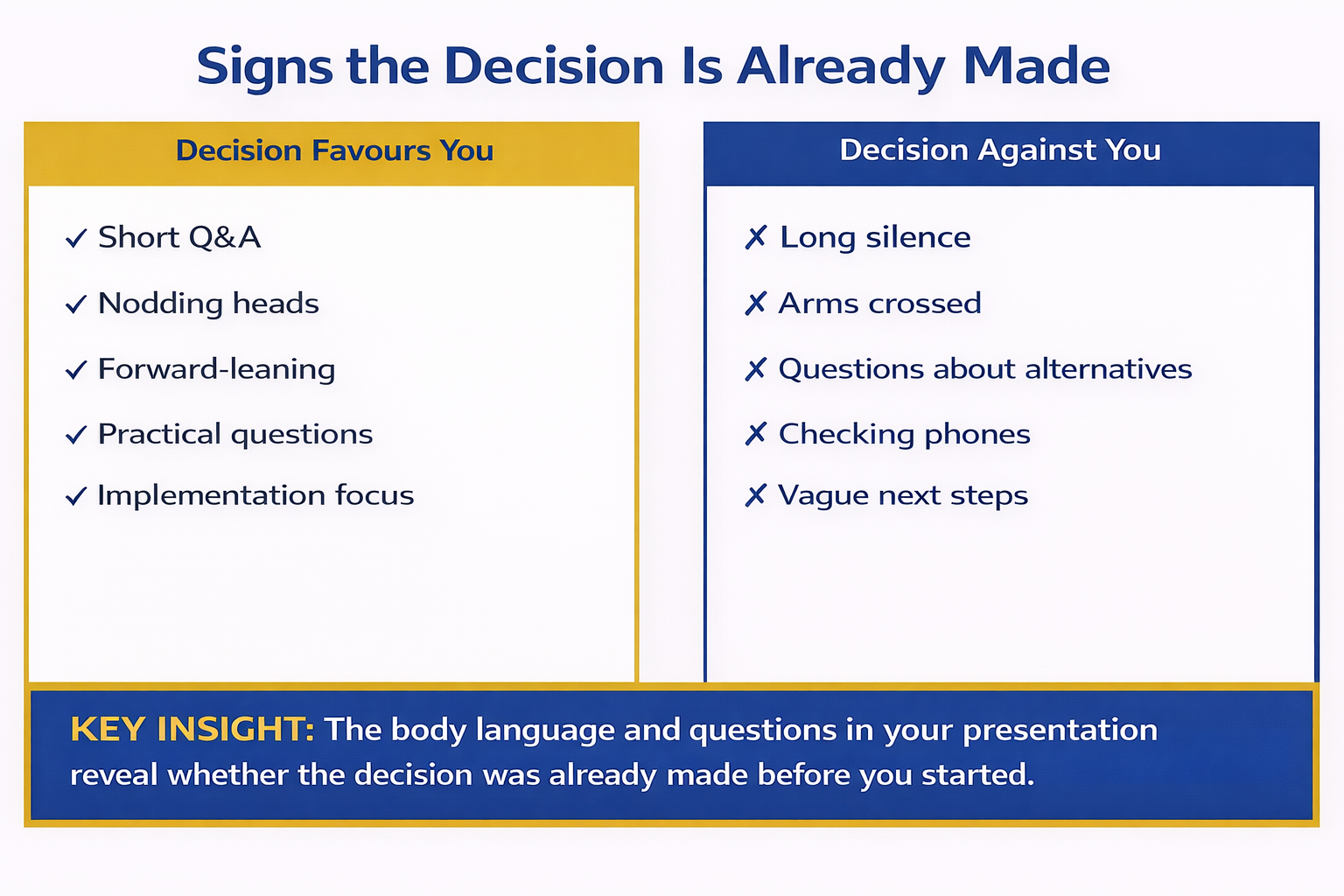
Also today: If the problem isn’t a specific saboteur but a room that has collectively decided against your recommendation before you’ve spoken, the structural approach is different. Read The Presentation You Give When the Room Has Already Decided Against You for the reversal framework.

Your next step: Open the deck for your next steering committee, programme board, or Monday exec meeting. Check: Does Slide 1 state the decision? Does Slide 2 define the evaluation criteria? If not, your structure has gaps — and gaps are where sabotage lands. Fix the architecture before the saboteur makes their next move.

Your next SteerCo, programme board, or leadership meeting has politics. Your slides need to handle it. Build the structure that makes sabotage irrelevant — before the saboteur makes their next move.

Get the Executive Slide System → £39

About the Author

Mary Beth Hazeldine is the Owner & Managing Director of Winning Presentations. With 24 years of corporate banking experience at JPMorgan Chase, PwC, Royal Bank of Scotland, and Commerzbank, she has delivered and supported high-stakes presentations in environments where the politics were as dangerous as the numbers — steering committees, programme boards, and executive governance meetings where sabotage, pre-briefing, and political manoeuvring were part of the operating landscape.

A qualified clinical hypnotherapist and NLP practitioner, Mary Beth has trained thousands of executives and supported high-stakes funding rounds and approvals across banking, consulting, and corporate environments.

Book a discovery call | View services

06 Feb 2026
Senior executive in thoughtful pose considering a business decision in modern corporate office

Why Executives Say ‘Let Me Think About It’ (And How to Prevent It)

“Let me think about it” cost me six months and nearly derailed my career.

I’d just delivered what I thought was a flawless presentation to the executive committee at Commerzbank. Forty-five minutes of carefully constructed slides. Every question answered. Every objection pre-empted. The CFO nodded throughout. The COO asked thoughtful questions. I left feeling confident.

Then came the response: “This is excellent work. Let me think about it and we’ll circle back.”

They never circled back. Two months later, I followed up. “Still considering.” Three months: “The timing isn’t right.” Six months: the initiative quietly died, and I spent the next year rebuilding credibility.

It took years — and dozens of similar experiences across 25 years in corporate banking — to understand what “let me think about it” actually means. And more importantly, what causes it.

The answer changed how I approach every executive presentation.

Quick answer: “Let me think about it” rarely means an executive needs more time to consider your proposal. It usually signals one of five hidden barriers: insufficient information to decide confidently, unspoken political concerns, unclear personal benefit, fear of being wrong, or lack of urgency. The solution isn’t a better follow-up strategy — it’s preventing these barriers from forming before you present.

Presenting tomorrow and worried you’ll hear “let me think about it”?

If you can’t do the pre-work, use these three questions to force specificity in the room:

  1. “What would you need to see to decide today?” Surfaces hidden information gaps.
  2. “What concern would make ‘yes’ feel risky?” Brings objections into the open.
  3. “If I can address that concern now, can we move forward?” Forces a decision path.

These won’t guarantee a yes — but they prevent vague deferral. For the full framework, see the Executive Buy-In Presentation System.

What ‘Let Me Think About It’ Actually Means

Let’s be direct: “Let me think about it” is almost never what it sounds like.

Executives are paid to make decisions. They make dozens of them daily. If your proposal required genuine deliberation, they’d ask specific questions, request particular data, or schedule a follow-up with defined parameters. “Let me think about it” — with no specifics — means something else entirely.

Here’s what it usually means:

“I don’t have enough information to say yes confidently.” Something is missing. They can’t articulate what, but the decision doesn’t feel safe. So they defer.

“I have concerns I don’t want to raise in this forum.” There are political dynamics, relationship issues, or historical context that make a public “no” awkward. Deferral is the polite exit.

“I don’t see how this benefits me or my priorities.” Every executive has personal objectives — visibility, budget, headcount, strategic positioning. If your proposal doesn’t connect to those, it becomes low priority.

“I’m not sure this is the right call, and I don’t want to be wrong.” Risk aversion is real. When the upside isn’t clear and the downside could reflect poorly, deferral feels safer than decision.

“This doesn’t feel urgent enough to decide now.” Without a compelling reason to act today, everything can wait. And things that can wait often wait forever.

Notice what’s missing from this list: “I need time to carefully weigh the merits of your proposal.” That’s what we want to believe. It’s rarely what’s happening.

⭐ Build the case your stakeholders can’t defer

The Executive Buy-In Presentation System is a self-paced framework — 7 modules walking you through stakeholder analysis, case construction, and the presentation structures that get decisions rather than delays. £499, lifetime access to materials.

What’s covered:

  • Identifying the hidden barriers that cause decision stalling
  • Stakeholder psychology and political navigation approaches
  • Creating genuine urgency that makes “decide now” feel natural
  • Bonus Q&A calls (optional, fully recorded — watch back anytime)

Explore the Buy-In System on Maven →

Self-paced with monthly cohort enrolment.

The Five Hidden Reasons Executives Stall

Understanding why executives defer decisions is the first step to preventing it. Here’s what’s usually happening beneath the surface:

The 5 hidden reasons executives say let me think about it with prevention strategies

Reason 1: Information Asymmetry

You’ve spent weeks or months on this proposal. You know every detail, every implication, every edge case. The executive has spent 45 minutes listening to your summary. The information asymmetry is enormous.

When executives don’t have enough information to feel confident, they defer. Not because they want more data — but because the decision doesn’t feel “safe” yet. They can’t point to what’s missing, so they ask for time.

The fix: Don’t just present information. Transfer confidence. Help them see what you see. Make the decision feel as obvious to them as it does to you.

Reason 2: Political Complexity

Every proposal exists in a political context. Your initiative might threaten someone’s budget. It might contradict a position someone else has already taken. It might create winners and losers among the executive’s peers or reports.

Executives don’t want to create political problems for themselves. If saying yes creates conflict they’d rather avoid, they defer. The politics are invisible to you but very real to them.

The fix: Map the political landscape before you present. Understand who wins and loses. Pre-wire the people who might object. Make yes politically easy.

Reason 3: Missing Personal Connection

Every executive has personal priorities: what they’re trying to accomplish this quarter, what they want to be known for, what metrics they’re measured on. Your proposal might be objectively good for the company but irrelevant to their personal objectives.

Proposals that don’t connect to personal priorities become “important but not urgent.” And important-but-not-urgent proposals get deferred indefinitely.

The fix: Know what each decision-maker cares about. Frame your proposal in terms of their priorities, not just organisational benefit.

For more on connecting proposals to executive priorities, see my guide on how to present to a CFO.

Reason 4: Fear of Being Wrong

Executives are evaluated partly on judgment. Being wrong — especially publicly wrong — carries career risk. When the right decision isn’t obvious, deferral feels safer than commitment.

This is especially true for decisions that are visible, irreversible, or outside the executive’s core expertise. The less confident they feel, the more likely they are to defer.

The fix: Reduce perceived risk. Show what happens if it doesn’t work. Create off-ramps. Make saying yes feel safe.

Reason 5: Lack of Urgency

Without a compelling reason to decide now, executives will defer. It’s not malicious — it’s just how human attention works. Urgent things get attention. Non-urgent things wait.

If your proposal can be decided next week just as easily as today, it will be decided next week. Or next month. Or never.

The fix: Create genuine urgency. Not artificial scarcity, but real consequences of delay. What opportunity closes? What cost increases? What risk materialises?

How to Prevent Decision Stalling Before You Present

The best response to “let me think about it” is prevention. Here’s how to address each barrier before it forms:

For Information Asymmetry:

Don’t assume your presentation will transfer enough understanding. Preview your key insights with decision-makers before the formal meeting. When they’ve already processed the core information privately, the presentation becomes confirmation rather than revelation.

Also: present with recommendations, not options. Executives don’t want to make your decision for you. They want to approve a confident recommendation. Give them something to say yes to.

For Political Complexity:

Do the political work before you present. Talk to anyone who might object. Understand their concerns. Where possible, incorporate their input so they feel ownership. When potential blockers feel heard, they’re less likely to block.

Critically: don’t surprise anyone in the room. If someone is going to hear about your proposal for the first time during your presentation, you’ve already lost.

For Missing Personal Connection:

Research what each decision-maker cares about. What are they measured on? What do they want to be known for? What problems keep them up at night?

Then frame your proposal explicitly in those terms. “This addresses the customer retention issue you raised in Q3” is more compelling than “This improves customer retention.” Same proposal, different framing.

For Fear of Being Wrong:

Make saying yes feel safe. Show that you’ve considered what could go wrong. Present contingency plans. Propose pilot approaches that limit downside. Create checkpoints where the decision can be revisited.

The goal isn’t to eliminate risk — it’s to make the executive feel that saying yes is a reasonable, defensible choice. They need to be able to justify the decision if it doesn’t work out.

For Lack of Urgency:

Build real urgency into your proposal. What window is closing? What competitive advantage erodes with delay? What cost increases the longer we wait?

If there’s genuinely no urgency, consider whether this is the right time to present. Sometimes the answer is to wait for a moment when urgency naturally exists.

For more on structuring proposals that drive decisions, see my guide on the 3-slide system that gets executive decisions fast.

No deadlines, no mandatory attendance. Executive Buy-In Presentation System — 7 self-paced modules, £499, lifetime access to materials.

Explore the Buy-In System →

What to Do If You Hear It Anyway

Despite your best preparation, you might still hear “let me think about it.” Here’s how to respond:

Don’t accept vague deferral. Instead, ask: “I want to make sure I’ve addressed everything you need. What specifically would be helpful for you to consider?” This forces them to articulate the barrier — which gives you something to address.

Propose a specific next step. “Would it help if I sent over [specific information] and we reconnected on Thursday?” This creates a commitment rather than an open-ended deferral. A defined follow-up is better than “we’ll circle back.”

Ask about concerns directly. “I want to make sure there isn’t a concern I haven’t addressed. Is there anything about this that doesn’t sit right?” This gives them permission to voice the real objection.

Check for political dynamics. “Is there anyone else whose input would be valuable before we move forward?” This surfaces hidden stakeholders who might be influencing the decision.

Create a decision point. “I understand you want to consider this. Just so I can plan accordingly, when would you expect to have a view?” This creates mild accountability without being pushy.

The goal isn’t to pressure — it’s to understand. “Let me think about it” is a symptom. Your job is to diagnose the underlying barrier so you can address it.

For more on building executive buy-in, see my guide on how to get executives to say yes.

⭐ Stop rewriting your proposal three times only to hear “we’ll think about it”

The Executive Buy-In Presentation System teaches the structure that gets decisions, not delays — 7 self-paced modules with optional recorded Q&A calls. £499, lifetime access.

Explore the Buy-In System on Maven →

Self-paced with monthly cohort enrolment.

⭐ Built on 25 years in corporate banking

The Executive Buy-In Presentation System is the structured framework developed across 25 years in corporate banking and 16 years coaching senior professionals across financial services, insurance, consulting, and technology. £499, lifetime access to materials.

What you get:

  • 7 self-paced modules covering psychology, structure, and delivery
  • Frameworks for identifying real decision-makers and hidden barriers
  • Approaches for creating genuine urgency without manufactured scarcity
  • Bonus Q&A calls (optional, fully recorded — watch back anytime)
  • Lifetime access to all materials

Explore the Buy-In System on Maven →

Self-paced with monthly cohort enrolment — new cohort opens every month.

Frequently Asked Questions

Is “let me think about it” ever genuine?

Sometimes, yes — particularly for very large decisions with significant organisational impact. But even genuine deliberation should come with specifics: what they’re considering, what information would help, when they expect to decide. Vague deferral with no parameters is usually a polite no. If an executive genuinely needs time, they’ll tell you what they need time to consider.

How long should I wait before following up?

This depends on what you agreed in the meeting. If you proposed a specific check-in (“I’ll send the additional data and follow up Thursday”), honour that timeline. If the meeting ended with vague deferral, follow up within 3-5 business days with something valuable — new information, an article relevant to their concerns, clarification of a point raised. Don’t just ask “have you decided?” Give them a reason to re-engage.

What if they keep deferring despite my follow-ups?

Multiple deferrals usually mean one of two things: the proposal is genuinely low priority for them, or there’s a barrier they’re unwilling to articulate. At this point, it’s worth a direct conversation: “I want to respect your time. Should I interpret the timing as a signal that this isn’t a priority right now? I’d rather know than keep following up if the answer is no.” This gives them permission to say no, which is often better than indefinite limbo.

How do I create urgency without seeming manipulative?

Real urgency isn’t manufactured — it’s surfaced. What genuinely changes if you wait? Market conditions, competitive dynamics, cost increases, opportunity windows, resource availability? If there’s real urgency, articulate it clearly. If there isn’t, don’t fabricate it. Executives see through artificial scarcity, and it damages your credibility. Sometimes the honest answer is that there’s no urgency — in which case, consider waiting for a moment when urgency naturally exists.

Your Next Step

The next time you prepare a presentation, don’t just think about what you’ll say. Think about the five barriers that cause executives to defer.

What information might they be missing? What political dynamics exist? How does this connect to their personal priorities? What might make them afraid to say yes? Why should they decide now rather than later?

Address those questions before you present, and you’ll hear “let me think about it” far less often.

📧 Get the Winning Edge Newsletter

Weekly insights on executive communication, stakeholder psychology, and the dynamics of getting buy-in — from 25 years in corporate banking.

Subscribe free →

Related reading: Decision stalling often happens in recurring meetings like MBRs and QBRs. If your regular updates keep getting deferred, the problem might be structural. Read Monthly Business Reviews That Don’t Bore Everyone to Death for the 20-minute format that drives decisions rather than deferrals.

About the Author

Mary Beth Hazeldine is the Owner & Managing Director of Winning Presentations. With 25 years of corporate banking experience at JPMorgan Chase, PwC, Royal Bank of Scotland, and Commerzbank, she heard “let me think about it” more times than she can count — and eventually learned what it really meant.

Now she teaches senior professionals the stakeholder psychology and decision architecture that transforms deferrals into approvals. She combines executive communication expertise with evidence-based influence techniques.

04 Feb 2026
Executive preparing objection responses before a high-stakes boardroom presentation

The Objection Map: How to Find Resistance Before It Finds You

The Objection Map: How to Find Resistance Before It Finds You

Three words killed a £4M proposal before the presenter finished slide two.

“We’ve tried that.”

The room shifted. Arms folded. The CFO glanced at her phone. And the presenter — a senior director who’d spent two weeks perfecting those slides — had no response prepared. He stumbled through a vague “this is different because…” and never recovered.

I was in the room. I was his coach. And the worst part? I knew that objection was coming. We’d talked about it in our prep session. But we hadn’t built a specific response into the presentation itself, because he thought his data was strong enough to pre-empt it.

It wasn’t.

Quick answer: An Objection Map is a structured pre-presentation exercise that identifies every likely point of resistance, traces it to the stakeholder most likely to raise it, and builds your response directly into your slides — before you ever enter the room. Most executive presentations fail not because the idea is weak, but because predictable objections went unaddressed. The Objection Map eliminates that failure mode.

⏰ Presenting tomorrow? Do this in 60 seconds:

1. Write down your top 3 likely objections — the ones that make you uncomfortable.
2. For each one, identify which slide should address it — and move that slide earlier.
3. Prepare one sentence per objection that acknowledges the concern and bridges to your evidence.

That’s your minimum viable resistance map. For the complete framework, keep reading.

I learned about objection mapping the hard way — during my years at Commerzbank, when I was presenting restructuring proposals to committees that existed to say no.

The first time I presented to a credit committee, I prepared 40 slides of analysis. Bulletproof data. Waterfall charts. Scenario models. I was convinced the numbers would speak for themselves.

They didn’t. The head of risk asked one question about regulatory exposure, and I froze. Not because I didn’t know the answer — I did — but because I hadn’t anticipated needing to deliver it under pressure, in that room, to that face.

After that, I started building what I now call an Objection Map before every significant presentation. In 24 years across JPMorgan Chase, PwC, Royal Bank of Scotland, and Commerzbank, I’ve refined it into a repeatable system. It’s one of the core frameworks inside the Executive Buy-In Presentation System, and it’s the skill that changed my career from “good presenter” to “the person who gets approvals.”


Why Objections Kill Presentations (Even Good Ones)

Here’s what most professionals misunderstand about executive objections: they’re rarely about the quality of your idea.

They’re about risk. Executives don’t sit in presentation rooms asking “Is this a good idea?” They ask “What goes wrong if I say yes?” Every objection is a risk signal, and when you fail to address it, you’re not just leaving a gap in your argument — you’re confirming the risk is real.

I’ve coached executives through hundreds of high-stakes presentations, and the pattern is always the same. The presenter assumes the strength of the proposal will overcome doubt. The audience, meanwhile, is mentally stress-testing every claim. The gap between those two mindsets is where proposals die.

Research from the Harvard Business Review confirms this: stakeholder buy-in depends more on addressing concerns than on presenting benefits. Benefits create interest. Addressed objections create confidence. And confidence is what gets decisions made.

The most dangerous objections aren’t the ones that get voiced. They’re the ones that stay silent — the concerns that make an executive say “Let me think about it” and then never follow up. An Objection Map forces those silent concerns to the surface before you present, so you can address them proactively rather than reactively.

How do you handle unexpected objections in an executive presentation?

Acknowledge the objection immediately — don’t dismiss it or deflect. Reframe it as a valid concern (“That’s exactly the question I’d ask too”), then bridge to your strongest evidence. If you genuinely don’t have the answer, say so and commit to a specific follow-up timeframe. Executives respect honesty far more than improvised answers.


What an Objection Map Actually Is

An Objection Map is a four-column document you create before any significant presentation. It looks simple. It is simple. That’s why it works — because busy professionals actually use it.

The four columns:

Column 1 — The Objection. Write the exact words someone might use. Not a sanitised version. Not what you hope they’ll say. The blunt, uncomfortable version. “We’ve tried that.” “The timing is wrong.” “This won’t scale.”

Column 2 — The Source. Which specific person in the room is most likely to raise this? Name them. If you don’t know who’ll be in the room, find out. Presenting to strangers is gambling.

Column 3 — The Root Cause. Why does this person have this concern? It’s rarely about the words. “We don’t have budget” usually means “I don’t trust this will work.” “The timing is wrong” usually means “I have a competing priority you’re threatening.”

Column 4 — The Pre-Emptive Response. How will you address this concern inside your presentation — before it’s raised? This is the critical difference between an Objection Map and simple preparation. You’re not preparing answers for Q&A. You’re restructuring your narrative to remove the objection entirely.

When I work with clients on high-stakes presentations — proposals involving significant budgets, restructuring plans, or board-level approvals — the resistance map typically surfaces between five and twelve concerns. Of those, two or three will be presentation-killers: objections that, if left unaddressed, will prevent a decision regardless of how strong everything else is.

Four-column objection map framework showing objection, source, root cause, and pre-emptive response for executive presentations


Stop guessing what the room is thinking.

The Executive Buy-In Presentation System teaches you the complete Objection Map framework, plus stakeholder analysis, champion recruitment, and the slide structures that turn resistance into approval. Self-study modules with live Q&A calls — study at your own pace.

Join the Executive Buy-In System →

Training started 2 Feb — join anytime. New modules released weekly. All calls recorded.


How to Build Your Objection Map in 30 Minutes

You don’t need hours. You need thirty focused minutes and a willingness to be honest about the weak points in your proposal.

Step 1: List every reason someone could say no (10 minutes). Sit with a blank page and write down every objection you can imagine — including the ones you don’t want to think about. Budget. Timing. Priority. Capability. Past failures. Political concerns. If a colleague has ever pushed back on a similar idea, write that down. If your manager has flagged a risk, write that down. Aim for at least eight.

Step 2: Assign each objection to a person (5 minutes). Who in the room is most likely to raise each concern? If you can’t name the person, you don’t know your audience well enough. This is where the psychology of executive buy-in becomes practical. Every objection has a human source, and understanding their motivation is half the battle.

Step 3: Dig to the root cause (10 minutes). For each objection, ask “Why would this specific person care about this specific concern?” The surface objection is almost never the real one. “We’ve tried that” means “I was involved in the last attempt and it made me look bad.” “The data doesn’t support it” means “I don’t trust the methodology.” Finding the root cause tells you which evidence will actually change their mind.

Step 4: Write your pre-emptive responses (5 minutes). For each concern, draft a single sentence — or a single slide — that addresses the root cause directly. Not a defensive rebuttal. A confident acknowledgment that demonstrates you’ve thought about this from their perspective.

How do you anticipate objections before a presentation?

Start by listing every decision-maker who’ll be in the room and their known priorities. Then ask yourself: “If I were them, what would worry me about saying yes to this?” Test your list against a trusted colleague — ideally someone who’ll challenge you. The objections that make you uncomfortable are usually the ones that matter most.


Embedding Responses Into Your Slides

Here’s where most people get the Objection Map wrong. They build the map, identify the concerns, prepare their responses — and then save everything for Q&A.

That’s backwards.

If you know the CFO is worried about implementation cost, don’t wait for her to ask. Put your implementation cost slide before she has to. If the operations director will question timeline feasibility, show your phased delivery plan in the first third of the presentation, not the last.

The principle is straightforward: address objections before they form.

When an executive hears their concern addressed proactively — without having to raise it — two things happen. First, they feel understood. Someone has actually thought about this from their perspective. Second, they can’t use the objection as a blocker, because you’ve already removed the obstacle.

I call this “pre-emptive framing,” and it’s the difference between presentations that get “we need to think about it” and presentations that get “let’s move forward.”

In practice, this means restructuring your slide order around your pre-emptive objections worksheet. The slides that address the top three concerns should appear in the first half of your presentation. Supporting evidence comes second. The “nice to know” detail goes in an appendix — or gets cut entirely.

A client of mine presented a restructuring plan to a hostile board last year. Her resistance map identified “job losses” as the number-one unspoken concern. Instead of burying the headcount impact on slide 18, she addressed it on slide 3 — with specific redeployment plans, timeline, and support packages. The board approved the restructuring in a single meeting. The previous presenter, with a stronger plan but no objection preparation, had been sent away twice.


What the full pre-emptive framing system covers:

✓ The four-column resistance map (what you’ve started learning here)

✓ Stakeholder analysis — understanding who decides, who influences, and who blocks

✓ Champion recruitment — getting someone fighting for your proposal before you present

✓ Slide restructuring — embedding responses into your narrative so objections never surface

✓ The follow-through framework — turning “maybe” into a signed approval


The 7 Executive Objections That Appear in Every Room

After 24 years of corporate banking and coaching executives through high-stakes presentations, I’ve found that most objections are variations of seven core concerns. Once you recognise the pattern, you stop being surprised.

1. “We’ve tried that.” Root cause: fear of repeating a past failure. Your response must show what’s different this time — different approach, different conditions, different data.

2. “We don’t have budget.” Root cause: this proposal isn’t a high enough priority to fight for funding. Your response must reframe the cost of inaction, not the cost of action.

3. “The timing isn’t right.” Root cause: a competing priority the speaker hasn’t surfaced. Your response must acknowledge the competing demand and show how your proposal fits alongside it — not instead of it.

4. “Show me the data.” Root cause: the executive doesn’t trust the reasoning, so they’re demanding proof. Your response must address the trust gap, not just pile on more numbers.

5. “Who else supports this?” Root cause: the executive doesn’t want to be the first person to take the risk. This is why building a coalition before you present is essential.

6. “Let me think about it.” Root cause: unspoken concern they’re not willing to raise publicly. Your resistance map should have already identified what this concern might be — and addressed it in the presentation.

7. “Great presentation.” Root cause: polite rejection. When executives genuinely plan to act, they ask implementation questions. Compliments without follow-up questions are a warning sign. If you’re getting praise without decisions, your presentation is entertaining but not persuasive.

What are the most common objections in business presentations?

The seven most frequent objections revolve around past failures (“we’ve tried that”), budget constraints, timing concerns, requests for more data, lack of visible support from others, stalling (“let me think about it”), and polite rejection disguised as praise (“great presentation”). Preparing specific responses for each increases your approval rate significantly.


Ready to stop hearing “Let me think about it”? The Executive Buy-In Presentation System gives you scripts, templates, and the stakeholder strategy that turns resistance into approval.


What to Do When an Objection Lands Anyway

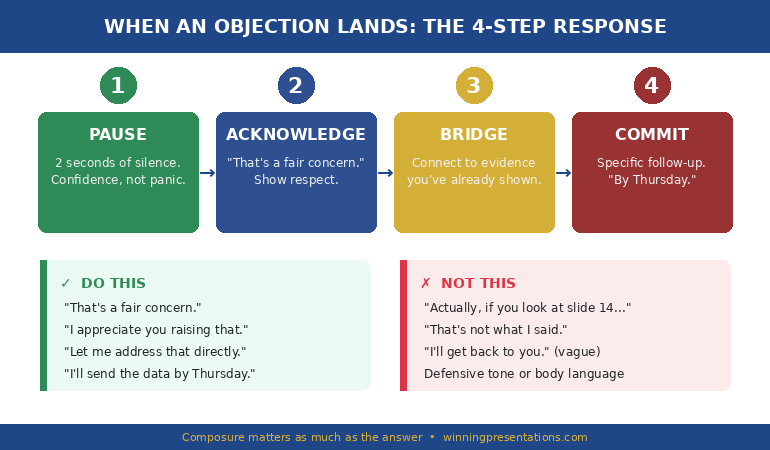
Even the best pre-emptive objections worksheet won’t catch everything. Someone will raise a concern you didn’t anticipate. Here’s the framework I teach for handling it in the moment:

Pause. Don’t respond immediately. Two seconds of silence communicates confidence. Rushing communicates panic.

Acknowledge. “That’s a fair concern” or “I appreciate you raising that.” This isn’t weakness — it’s emotional intelligence. The rest of the room is watching how you handle pushback, and your composure matters as much as your answer.

Bridge. Connect their concern to something you’ve already addressed. “That connects directly to the risk mitigation on slide 7 — would it help if I walked through that again?” This shows your presentation already accounts for their thinking.

Commit. If you don’t have the answer, say so. “I want to give you an accurate response on that. I’ll send the analysis by Thursday.” Executives respect specificity. “I’ll get back to you” is vague and forgettable. “I’ll send the analysis by Thursday” is a commitment they’ll remember.

The biggest mistake I see? Defensiveness. The moment you say “Actually, if you look at slide 14…” with an edge in your voice, you’ve turned a conversation into a confrontation. And nobody approves proposals from someone they’re arguing with.

If presentation anxiety makes handling objections harder — if the fear of being challenged is what keeps you up the night before — that’s a different problem with a different solution. Understanding what executives actually do before big presentations might help you separate the anxiety from the strategy.


Your next presentation doesn’t have to be a guessing game.

The Executive Buy-In Presentation System covers the full approval cycle: Objection Mapping, stakeholder analysis, champion recruitment, pre-emptive framing, and the follow-through that closes decisions. Self-study modules released weekly, with live Q&A calls (all recorded) so you learn on your schedule.

Join the Executive Buy-In System →

Training started 2 Feb — join anytime and access everything released so far. New modules every week. All Q&A calls recorded for on-demand viewing.

Executive presentation objection response framework showing Pause, Acknowledge, Bridge, Commit steps for handling resistance"


Frequently Asked Questions

How far in advance should I create an Objection Map?

At least three to five days before a significant presentation. You need time to research stakeholder concerns, test your responses with a trusted colleague, and restructure your slides based on what you find. Last-minute objection mapping catches the obvious concerns but misses the subtle political ones that actually derail approvals.

What if I don’t know who will be in the room?

Find out. Ask your sponsor, your manager, or the meeting organiser. If you genuinely can’t get an attendee list, prepare responses for the seven standard executive objections listed above. They cover most boardroom scenarios. But presenting without knowing your audience is a risk that’s entirely avoidable.

Does this work for virtual presentations too?

Yes — and it’s arguably more important. In virtual settings, you can’t read body language as easily, so objections are more likely to stay silent. An Objection Map ensures you address the most common concerns proactively, reducing the chance of a quiet “no” after the call ends.

How is this different from just preparing for Q&A?

Q&A preparation means having answers ready for when someone asks. Objection Mapping means restructuring your presentation so the question never needs to be asked. The first is reactive. The second is strategic. Executives who never have to voice their concern are far more likely to approve your proposal.


📬 The Winning Edge Newsletter

Weekly strategies for executive presentations, stakeholder buy-in, and speaking with confidence. No fluff — just what works.

Subscribe Free →


📋 Free: Executive Presentation Checklist

The pre-presentation checklist I use with every client — covers structure, stakeholder prep, slide order, and objection readiness.

Download Free Checklist →


Read next:

📊 Why “Great Presentation” Is the Worst Feedback You Can Get — what to do when you’re getting compliments but no decisions.

💊 Beta Blockers for Public Speaking: What Executives Actually Do Before Big Presentations — managing the physical symptoms that make handling objections harder.


Objections aren’t the enemy. Unpreparedness is.

Every objection in an executive presentation is predictable if you know your audience, understand their priorities, and have the humility to admit where your proposal is vulnerable. The resistance map gives you thirty minutes of structured preparation that eliminates the single biggest reason executive presentations fail: not the idea, but the resistance that nobody addressed.

Your next step: pick your most important upcoming presentation. Spend thirty minutes building your Objection Map using the four-column framework. Then restructure your slides to address the top three concerns before anyone has to raise them. If you want the full system — including stakeholder analysis, champion recruitment, and the follow-through framework that turns “maybe” into “yes” — the Executive Buy-In Presentation System is open now. Training is in progress, new modules release every week, and all live Q&A calls are recorded — so you can join anytime and study at your own pace.


About the Author

Mary Beth Hazeldine is the Owner & Managing Director of Winning Presentations. With 24 years of corporate banking experience at JPMorgan Chase, PwC, Royal Bank of Scotland, and Commerzbank, she has delivered high-stakes presentations in boardrooms across three continents.

A qualified clinical hypnotherapist and NLP practitioner, Mary Beth combines executive communication expertise with evidence-based techniques for managing presentation anxiety. She works with senior leaders preparing for board presentations, investor pitches, and high-stakes approvals — helping them structure slides, handle objections, and present with confidence.

Book a discovery call | View services

28 Jan 2026
Professional woman in enrollment conversation during coffee meeting, actively engaging with colleague about stakeholder buy-in

Pre-Meeting Executive Alignment: How to Get Approval Before You Present

The CFO approved £2 million before my client finished slide one.

Not because the presentation was brilliant. Not because the data was compelling. Because the decision had already been made — three days earlier, over a 12-minute conversation and one carefully crafted email.

The presentation? A formality. A public confirmation of a private agreement.

This is what pre-meeting executive alignment looks like when it’s done right. And it’s the skill that separates professionals who constantly fight for approval from those who walk into rooms where “yes” is already waiting.

Quick Answer: Pre-meeting executive alignment is the practice of socializing your recommendation with key stakeholders before the formal presentation. Done correctly, it surfaces objections early, builds champions, and transforms the meeting from a decision point into a confirmation ceremony. The most effective executives spend more time on pre-alignment than on slides.

📋 Presenting for Approval This Week? Do This First:

48-72 hours before your presentation:

  1. Identify the real decision-maker (often not the most senior person)
  2. Request 10 minutes — “I’d value your perspective before Thursday’s meeting”
  3. Share your recommendation (not all your slides — just the answer)
  4. Ask: “What concerns would you want me to address?”
  5. Send a follow-up email summarizing what you heard and how you’ll address it

This 10-minute conversation often determines the outcome more than the 30-minute presentation.

The Email That Changed Everything

Early in my banking career at JPMorgan, I watched a colleague present a flawless business case for a new trading system. The logic was airtight. The ROI was clear. The slides were polished.

The CFO said no.

Not because the proposal was weak — but because he’d been blindsided. He had concerns about implementation risk that were never addressed. He felt ambushed by a major capital request he hadn’t been prepared for. His “no” wasn’t about the merits. It was about the process.

A month later, I saw a more senior colleague get a larger budget approved in half the time. The difference? She’d spent 20 minutes with the CFO the week before, walking him through her thinking and asking what would make him comfortable.

By the time she presented, he was already her champion. He’d helped shape the proposal. His concerns were already addressed. The meeting was a formality.

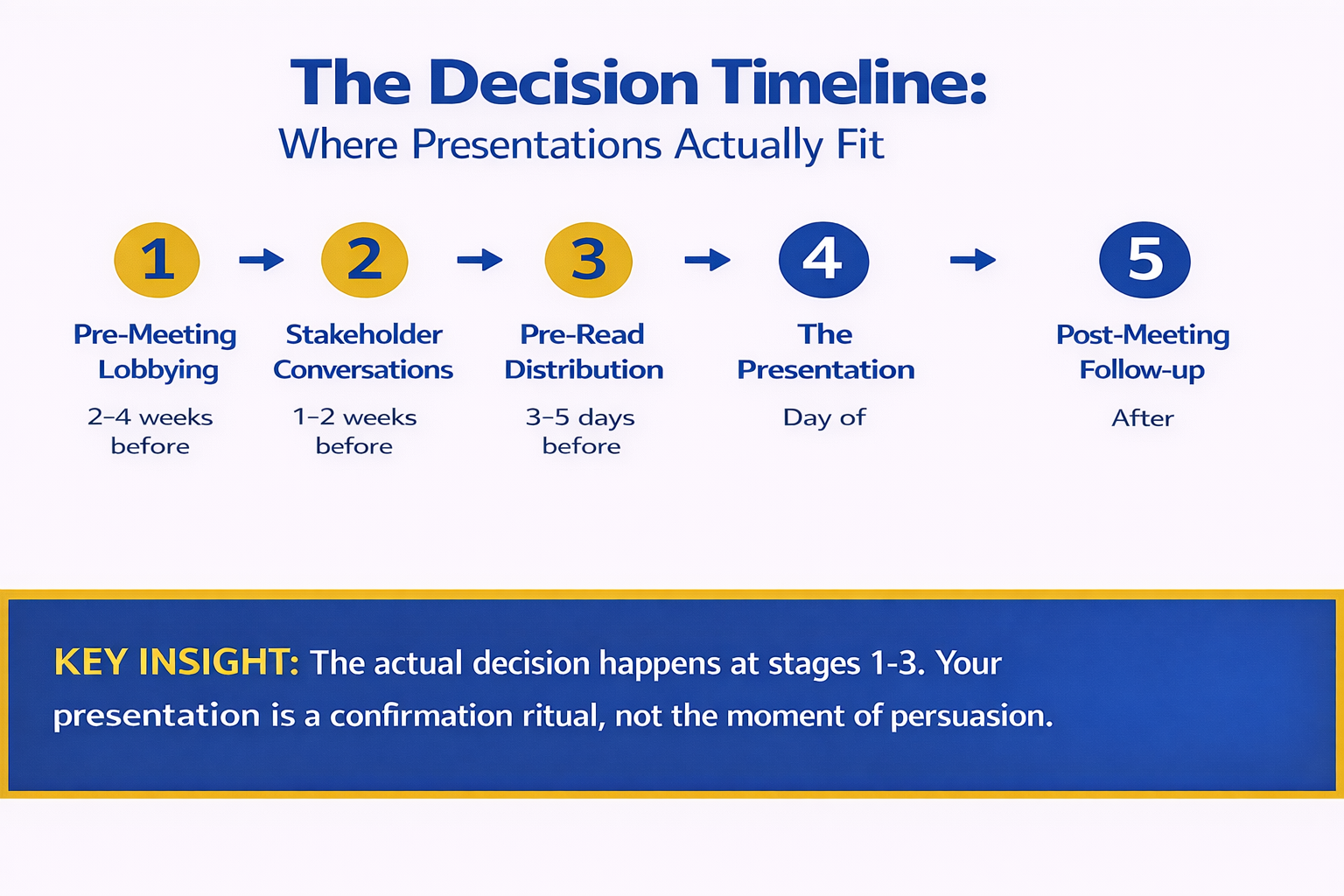
That’s when I understood: the presentation isn’t where the decision gets made. It’s where the decision gets announced.

Why Pre-Alignment Works

Pre-meeting alignment works because of three psychological principles that govern how senior people make decisions:

1. Executives hate surprises

Senior leaders are evaluated on judgment. Being caught off-guard in a meeting — especially by something they “should have known” — feels like a failure. When you pre-align, you’re protecting their reputation, not just selling your idea.

2. Ownership drives support

When someone contributes to shaping a proposal, they become invested in its success. The CFO who suggested adding a risk mitigation section will defend that section in the meeting. Pre-alignment turns potential blockers into co-authors.

3. Public positions are hard to reverse

Once someone takes a position in a meeting, backing down feels like losing face. If you surface objections privately, they can be addressed without anyone having to publicly change their mind. Private alignment prevents public conflict.

For more on how executives actually make decisions, see our guide to executive presentation structure.

How do you get stakeholder alignment before a meeting?

Get stakeholder alignment by having brief one-on-one conversations with key decision-makers 48-72 hours before your presentation. Share your recommendation (not all your slides), ask what concerns they’d want addressed, then incorporate their input. Follow up with a short email confirming what you heard. This transforms potential opponents into contributors who are invested in your success.

Timeline showing pre-alignment process: 1 week before identify stakeholders, 48-72 hours before have conversations, 24 hours before send summary email, meeting day present with confidence

⭐ Maven Flagship — Executive Buy-In

Walk into your next approval meeting prepared

The Executive Buy-In Presentation System gives you 7 self-paced modules covering stakeholder analysis, case construction, and the presentation structures that hold up to scrutiny.

Monthly cohort enrolment — £499, lifetime access.

Enrol in the Executive Buy-In System →

The 5-Step Pre-Alignment Process

Here’s the exact process I teach executives for pre-meeting alignment:

Step 1: Map Your Stakeholders (1 Week Before)

Before you build a single slide, answer these questions:

  • Who will be in the room?
  • Who has formal decision authority?
  • Who has informal influence? (Often more important)
  • Who might object, and why?
  • Who could be a champion if they understood the benefits?

Create a simple grid: Name | Role | Likely Position | Key Concern | How to Reach

Step 2: Prioritise Your Conversations (5-7 Days Before)

You can’t pre-align with everyone. Prioritise:

  1. The decision-maker (whoever actually signs off)
  2. Potential blockers (people likely to object)
  3. Influential voices (people others listen to)

Three to four conversations is usually enough. More than that becomes logistically difficult and can feel like you’re “working the room” too hard.

Step 3: Have the Conversations (48-72 Hours Before)

Request brief meetings: “I’m presenting to the steering committee on Thursday. I’d value 10 minutes of your perspective beforehand — would Tuesday or Wednesday work?”

In the conversation:

  • Share your recommendation in one sentence
  • Explain the core logic (2-3 minutes max)
  • Ask: “What concerns would you want me to address?”
  • Listen more than you talk
  • Thank them for their input

Do NOT present all your slides. This isn’t a preview — it’s a consultation.

How do you get executive buy-in for a project?

Executive buy-in comes from making “yes” feel safe, not from having the best data. The most reliable method is pre-meeting alignment: share your recommendation privately with key stakeholders before the formal presentation, address their concerns in advance, and let them contribute to shaping the proposal. By meeting time, they’re invested in your success.

Step 4: Incorporate and Acknowledge (24-48 Hours Before)

After your conversations:

  • Adjust your presentation to address the concerns you heard
  • Add a slide or talking point that directly acknowledges input: “Based on conversations with the team, I’ve added a section on implementation risk…”
  • Send a brief follow-up email to each person you spoke with

This follow-up email is crucial. It confirms you listened and creates a paper trail of their involvement.

Step 5: Present With Confidence (Meeting Day)

When you’ve done proper pre-alignment:

  • You know what objections are coming (because you asked)
  • You’ve already addressed the major concerns (in your slides)
  • Key stakeholders feel heard (because they contributed)
  • The decision-maker isn’t being surprised (because you briefed them)

The presentation becomes a confirmation, not a persuasion exercise.

For more on presenting to senior leadership, see our guide on how to present to a board of directors.

Need the slide structure that executives respond to?

Get the Executive Slide System → £39

The Email Template That Works

Here’s the follow-up email template I used with my client — the one that preceded the £2M approval:

Subject: Following up on our conversation — Thursday’s budget review

Hi [Name],

Thank you for taking time yesterday to share your perspective on the [project name] proposal.

I heard two key points:

  1. [Concern #1 they raised]
  2. [Concern #2 they raised]

I’ve updated the presentation to address both directly — specifically, I’ve added [what you added] and revised [what you changed].

Looking forward to Thursday. Please let me know if anything else comes to mind before then.

Best,
[Your name]

This email does three things:

  1. Confirms you listened (they see their concerns reflected back)
  2. Shows you acted (you made changes based on their input)
  3. Creates investment (they’re now part of the proposal’s development)

Comparison showing traditional approach vs pre-alignment approach: traditional leads to surprises and objections, pre-alignment leads to support and quick approval

What is pre-meeting alignment?

Pre-meeting alignment is the practice of having brief one-on-one conversations with key stakeholders before a formal presentation or decision meeting. The goal is to share your recommendation, surface concerns early, incorporate feedback, and build support — so the meeting becomes a confirmation of a decision that’s already been shaped collaboratively, rather than a debate.

⭐ The Slide Structure That Closes After Pre-Alignment

Pre-alignment gets stakeholders ready to say yes. The Executive Slide System gives you the structure that makes “yes” easy — recommendation-first, objection-addressed, decision-clear.

Inside the system:

  • The exact 6-slide structure executives prefer
  • How to lead with your recommendation (not context)
  • Where to place proof so it reassures, not defends
  • The decision slide format that gets action

Get the Executive Slide System → £39

Built from 24 years of corporate banking experience. Works for budget requests, board presentations, and client pitches.

Common Mistakes to Avoid

Pre-alignment is powerful, but it can backfire if done wrong:

Mistake #1: Presenting your full deck in the pre-meeting

The pre-alignment conversation is a consultation, not a preview. Share your recommendation and ask for input — don’t walk through 25 slides. If you do, the actual meeting feels redundant.

Mistake #2: Only talking to supporters

It’s tempting to pre-align with people you know will agree. But the value is in reaching potential blockers. The CFO who might object is exactly who you need to talk to beforehand.

Mistake #3: Ignoring what you hear

If someone raises a concern and you don’t address it, you’ve made things worse. They’ll feel unheard and may actively oppose you in the meeting. Either incorporate their feedback or explain why you couldn’t.

Mistake #4: Being too obvious about “working the room”

Pre-alignment should feel like genuine consultation, not political manoeuvring. Frame it as seeking input, not building a coalition. “I’d value your perspective” works. “I’m lining up support” does not.

Mistake #5: Skipping the follow-up email

The conversation creates alignment. The email locks it in. Without the written follow-up, people can forget what they said or claim they never agreed. The email creates accountability.

For the slide structure that works after you’ve done pre-alignment, see our guide to CFO-approved budget presentations.

Ready to structure slides that close after pre-alignment?

Get the Executive Slide System → £39

When Pre-Alignment Isn’t Possible

Sometimes you can’t pre-align — you don’t have access, there’s no time, or the culture doesn’t support it. In those cases:

  • Lead with your recommendation anyway. Even without pre-alignment, the structure still matters. Don’t build to your conclusion.
  • Anticipate objections yourself. If you can’t ask stakeholders what concerns them, use your judgment and address likely objections proactively.
  • Create space for input during the meeting. If they haven’t had a chance to shape the proposal, give them opportunities to contribute: “Before I continue, I’d welcome any initial reactions.”

Pre-alignment dramatically improves your odds. But even without it, the right structure helps.

Is Pre-Alignment Right For Your Situation?

Chart showing when pre-alignment works well vs when it may not be appropriate

⭐ Complete Your Approval Strategy

Pre-alignment opens the door. The Executive Slide System walks you through it — with the exact structure, format, and flow that executives respond to.

Everything you get:

  • The 6-slide executive structure (recommendation-first)
  • Real before/after transformations
  • Slide-by-slide breakdown with formatting guidance
  • Templates for budget, board, and client presentations

Get the Executive Slide System → £39

Instant download. The same structure I taught in corporate banking for budget approvals and steering committee decisions.

Frequently Asked Questions

Isn’t this just politics or manipulation?

Pre-alignment isn’t manipulation — it’s good communication. You’re not hiding information or going behind anyone’s back. You’re consulting stakeholders, incorporating their input, and making the formal meeting more productive for everyone. The alternative — blindsiding people with a major request in a public meeting — is actually less respectful of their time and position.

What if I don’t have access to the decision-makers beforehand?

Start with whoever you can reach. Even pre-aligning with one influential person is better than none. You can also ask your manager or sponsor to help facilitate introductions: “Would it be appropriate for me to brief [Name] before Thursday?” If truly no access is possible, focus on anticipating objections yourself and structuring your presentation to address them proactively.

How far in advance should I do pre-alignment?

48-72 hours before the meeting is ideal. Too early (more than a week) and priorities may shift or people forget. Too late (day before) and there’s no time to incorporate feedback or for them to process. The sweet spot gives you time to adjust your presentation while keeping the conversation fresh in everyone’s mind.

What if someone changes their mind in the actual meeting?

It happens, but it’s rare when you’ve done proper pre-alignment. If someone raises a new objection, don’t panic. Acknowledge it calmly: “That’s a fair point — I’d like to think through the implications. Can I follow up with you after the meeting?” This shows confidence and prevents the meeting from derailing. The follow-up email you sent creates a record of their earlier input, which usually keeps positions stable.

Get Weekly Executive Presentation Insights

Strategies for getting approval, building credibility, and presenting with confidence — from 24 years in corporate banking.

Subscribe to The Winning Edge →

📋 Free Resource: Executive Presentation Checklist

A quick-reference checklist covering structure, pre-alignment, and delivery. Use it before your next high-stakes presentation.

Download Free Checklist →

Your Next Step

The next time you have a presentation where you need approval, try the pre-alignment approach:

  1. Identify 2-3 key stakeholders
  2. Request 10 minutes of their time before the meeting
  3. Share your recommendation and ask what concerns they’d want addressed
  4. Incorporate their feedback and send a follow-up email

You’ll be surprised how much easier the actual presentation becomes when the groundwork is already laid.

P.S. Once you’re in the meeting, delivery matters too. If you struggle with projecting confidence, I wrote about how to project your voice without shouting — it’s more about resonance than volume.

P.P.S. If you’re spending too long building presentations, check out how to cut presentation creation time without cutting quality — the system approach that saves hours.

About Mary Beth Hazeldine
Owner & Managing Director of Winning Presentations. 24 years in corporate banking at JPMorgan Chase, PwC, RBS, and Commerzbank. I’ve seen hundreds of presentations succeed or fail based on what happened before the meeting started. Pre-alignment is the skill I wish someone had taught me in year one.

13 Dec 2025
What 24 years in banking taught me about high-stakes presentations

What 24 Years in Banking Taught Me About High-Stakes Presentations

📅 Updated: December 2025

What 25 years in banking taught me about high-stakes presentations

If you want a ready-made framework for executive presentations: Explore The Executive Slide System →

Templates, AI prompts, and scenario playbooks for building board-ready slides.

Quick Answer

Executive presentation training rarely teaches what actually matters. After 25 years $2 JPMorgan, PwC, RBS, and Commerzbank, I learned that high-stakes presentations aren’t won with better slides — they’re won with better preparation, political awareness, and the ability to read a room. The presenters who consistently got approvals weren’t the most polished speakers. They were the ones who’d done the work before they walked in.

🎁 FREE DOWNLOAD

Executive Presentation Checklist

12-point checklist I wish I’d had when I started. One page. Print it before your next big meeting.

Download Free Checklist →

No spam. Unsubscribe anytime.


I still remember my first presentation to JPMorgan’s Executive Committee.

I was 26. I’d spent three weeks building a 45-slide deck. I knew every number, every assumption, every footnote. I’d rehearsed my talking points until I could recite them in my sleep.

Seven minutes in, the Global Head of Operations held up his hand. “What’s the ask?”

I froze. My ask was on slide 38.

“I’ll… I’ll get to that,” I managed.

“I don’t have time for you to get to it. What do you want us to do?”

I fumbled forward, completely thrown off my script. The meeting ended with a polite “send us a one-pager” — which in banking means no.

That moment was the beginning of everything I know about high-stakes presentations.

Lesson 1: The Decision Happens Before the Meeting

Here’s what they don’t teach in executive presentation training: by the time you walk into that room, most decisions are already made.

At a UK hight street bank, I watched a colleague present a flawless recommendation for a £3M technology investment. Perfect slides. Clear ROI. Confident delivery.

The CFO said no in under two minutes.

What my colleague didn’t know: the CFO had already committed that budget to another initiative. The decision was made three weeks earlier in a conversation he wasn’t part of.

The best presenters I worked with at JPMorgan spent more time before the meeting than during it. They’d walk the halls, grab coffee with stakeholders, understand the politics. By the time they presented, they already knew who would support them, who would push back, and what objections they’d face.

The presentation wasn’t where they made their case. It was where they confirmed what they’d already built.

Lesson 2: Executives Buy Confidence, Not Content

In 2008, I was presenting a risk assessment to the bank’s board during the financial crisis. Markets were collapsing. Nobody knew what would happen next.

I had two options: present the uncertainty honestly, or project confidence I didn’t feel.

I chose honesty. I said: “I don’t know what’s going to happen. Nobody does. But here’s what we do know, here’s what we’re watching, and here’s how we’ll respond to each scenario.”

After the meeting, the Chief Risk Officer pulled me aside. “That was the most credible presentation I’ve seen all week. Everyone else is pretending they have answers. You gave us a framework for decisions we can actually make.”

Confidence isn’t about having all the answers. It’s about being clear on what you know, what you don’t know, and what you recommend despite the uncertainty.

Executives don’t expect you to predict the future. They expect you to help them make good decisions with incomplete information. That’s what they do every day.

If you want the slide frameworks distilled from decades of corporate presenting, The Executive Slide System gives you 22 ready-made templates to start from.

Seven lessons from 25 years of banking presentations

Lesson 3: Your Slides Are Not Your Presentation

At PwC, I worked with a partner who was legendary for client presentations. He’d walk in with three slides — sometimes two — and walk out with seven-figure engagements.

I once asked him how he did it.

“The slides are a prop,” he said. “They’re not the show. The show is what happens in the room. The conversation. The questions. The moment you see them lean forward because you’ve said something that matters to them.”

He was right. I’ve seen beautiful 50-slide decks put people to sleep. I’ve seen scribbled whiteboards close deals.

The difference isn’t the slides. It’s the presenter’s ability to:

  • Read the room and adjust in real-time
  • Answer questions they didn’t prepare for
  • Make the audience feel heard, not talked at
  • Create space for the decision to emerge naturally

Related: Executive Presentation Template: 12 Slides That Command the Room

📄
Want the Checklist?

12 things to do before every executive presentation. The prep work that actually matters.

Download Free →

Build Your Next High-Stakes Presentation in Under an Hour

The Executive Slide System gives you 10 board-ready slide templates and 30 AI prompt cards.

Executive Slide System — £39, instant access.

  • 10 executive presentation templates (QBR, board update, budget request, and more)
  • 30 AI prompts to build each slide type in minutes
  • Narrative structure built in — no blank-slide panic

Designed for directors and senior managers who present to boards, leadership teams, and investors.

Lesson 4: The Question You Don’t Expect Will Define You

At a US Investment Bank., I was presenting a £8M operations initiative to the regional CEO. Everything was going perfectly. Slides landing. Heads nodding. I was about to close with my ask.

Then the CEO asked: “What happens to the 47 people in Mumbai whose jobs this eliminates?”

I hadn’t prepared for that question. It wasn’t in my risk assessment. It wasn’t in my stakeholder analysis. I’d been so focused on ROI and efficiency that I’d completely missed the human element.

I stumbled through something about “redeployment opportunities” and “natural attrition.” It was vague and everyone knew it.

The CEO said: “Come back when you’ve thought about the people, not just the numbers.”

That presentation taught me something that’s shaped every executive conversation since: the question you don’t expect reveals what you haven’t thought through. And executives notice.

The best way to prepare for unexpected questions isn’t to anticipate every possible question. It’s to think more broadly about your recommendation in the first place. Who’s affected? What could go wrong? What would make you change your mind?

Related: How to Present to a CFO: The Finance-First Framework

Lesson 5: Vulnerability Builds More Trust Than Perfection

This one took me years to learn.

Early in my career, I thought executive presentations were performances. I needed to appear competent, polished, in control. Any sign of uncertainty was weakness.

Then I watched a Managing Director at RBS do something that changed my perspective.

She was presenting a strategy that had partially failed. Instead of burying the failure in positive spin, she opened with: “I want to tell you what went wrong, what I learned, and what I’d do differently.”

The room leaned in. For the next 20 minutes, she had complete attention. When she finished, the Chief Executive said: “That’s the most useful strategy review I’ve heard this year.”

She got more budget, not less.

Executives are surrounded by people telling them what they want to hear. Honesty — even uncomfortable honesty — is rare and valuable. The presenter who admits what didn’t work, explains why, and shows they’ve learned is more credible than the one with a perfect track record they can’t explain.

Lesson 6: Presence Trumps Content Every Time

At Commerzbank, I sat through hundreds of presentations. I started noticing a pattern.

The presenters who got approvals weren’t always the ones with the best analysis. They were the ones who:

  • Walked in like they belonged there
  • Made eye contact with decision-makers, not their slides
  • Spoke at a pace that commanded attention
  • Paused after making important points
  • Handled pushback without getting defensive

Executive presence is hard to define but easy to recognise. You know it when you see it. And it’s not about being the most charismatic person in the room — some of the most effective presenters I’ve worked with were quiet, understated people who simply projected certainty.

It can be learned. I’ve seen people transform their presence in a matter of months. But it requires deliberate practice, feedback, and usually someone who can show you what you can’t see in yourself.

Lesson 7: AI Won’t Save You

I’ve been using AI tools for presentations since they became available. They’re remarkable for certain things — generating first drafts, formatting consistently, iterating quickly.

But here’s what 24 years taught me that no AI can replicate:

  • Knowing that the CFO and COO don’t speak to each other, so you need separate pre-meetings
  • Sensing that the room has turned and you need to skip ahead
  • Hearing the question behind the question
  • Building relationships that mean your call gets answered

AI makes the mechanical parts of presentations faster. That’s valuable. But the mechanical parts were never the hard part.

The hard part is everything that happens between humans — the trust, the politics, the unspoken dynamics. That’s where presentations are won or lost. And that hasn’t changed in 24 years.

Related: Why AI Won’t Replace Presentation Skills (But Will Amplify Them)

The best presenters spent more time before the meeting than during it

The presentation is the opening act. The Q&A is where trust is built or lost.

The Executive Slide System gives you the frameworks to structure both.

Executive Slide System — £39, instant access.

Designed for executives who present where decisions are made.

What I’d Tell My 26-Year-Old Self

If I could go back to that first JPMorgan Chase presentation, here’s what I’d say:

Stop building slides. Start building relationships. The people in that room are more important than anything on your screen. Know what they care about before you walk in.

Lead with the ask. Respect their time. Tell them what you want, then justify it. Not the other way around.

Prepare for the conversation, not the presentation. Your slides will take 15 minutes. The Q&A will take 45. Prepare accordingly.

Get comfortable being uncomfortable. The moment that terrifies you — the hard question, the pushback, the silence — is where trust is built. Don’t run from it.

Find people who’ll tell you the truth. You can’t see your own blind spots. Get feedback from people who’ll be honest, not kind.

Why I Started Teaching This

After 25 years in banking, I’d collected a lot of lessons. Most of them learned the hard way.

When I moved into training, I discovered that most executive presentation training focused on the wrong things. Slide design. Speaking techniques. Body language tips.

All useful. But none of it addressed what actually determines outcomes: the strategic preparation, the stakeholder management, the ability to read a room and adapt in real-time.

So I built a programme that teaches what I wish I’d known at 26. Not theory — the actual skills and frameworks that worked in real boardrooms with real money on the line.

Reading vs. Doing

What You Get Free Articles AI-Enhanced Mastery (£249)
Awareness of what matters
structured frameworks (AVP, 132, S.E.E.) Mentioned ✓ Deep training
8 structured learning modules ✓ Self-paced
Live coaching sessions ✓ 2 sessions
Templates & prompt packs Examples ✓ Full library
Before/after transformations ✓ Real examples
Outcome Know what to do Actually do it

Frequently Asked Questions

How is executive presentation training different from regular presentation skills?

Regular presentation training focuses on delivery — how to stand, how to speak, how to use slides. Executive presentation training focuses on outcomes — how to get decisions, how to manage stakeholders, how to handle high-stakes situations. The audience, the stakes, and the dynamics are fundamentally different.

Can presentation skills really be taught?

Yes, but not through lectures. The skills that matter — reading a room, handling pushback, projecting confidence — require practice with feedback. That’s why the Maven course includes live coaching sessions, not just video content.

What if I don’t work in banking?

The principles apply across industries. I’ve trained executives in biotech, SaaS, consulting, and manufacturing. The dynamics of high-stakes presentations — managing stakeholders, leading with conclusions, handling tough questions — are universal.

How long does it take to see improvement?

Most people see significant improvement within their first 2-3 presentations after training. The frameworks give you structure immediately. The confidence builds with practice.

📧
The Winning Edge Newsletter

Weekly insights on executive presentations from 16 years of training executives leaders. No fluff. No theory. Just what works.

Subscribe Free →

Related Reading

About the Author

Mary Beth Hazeldine spent 25 years in corporate banking at JPMorgan Chase, PwC, Royal Bank of Scotland, and Commerzbank before moving into executive training. She teaches at Winning Presentations and is launching the AI-Enhanced Presentation Mastery course in January 2026.