

Quick Answer
Most senior presenters hit a confidence plateau between years two and three. The early progress that brought them composure across most meeting types stops producing new gains. Difficult meetings still feel difficult. The reading, the courses, the additional practice no longer move the needle. This plateau is not a regression and it is not a sign that the work has run its course. It is a signal that the next layer of growth requires a different kind of input — usually a step change in how the presenter prepares the substance of their message, not the delivery of it. The breakthrough move at this stage is rarely about confidence techniques. It is about adding a new tool layer to the preparation itself.
On this page
Tomás had been a senior strategy director at a European telecoms group for nine years. He had spent the first three deeply uncomfortable in front of executive committees and the next three building real composure through structured work. By year five he was the colleague other senior leaders sent in to handle a difficult board. By year seven he was stuck. The kind of stuck that is hard to name because nothing was going wrong. The presentations were still landing. The audience was still reading him as composed. He himself had stopped feeling the steady internal progress he had felt during years three and four. The work that used to produce visible improvements had quietly stopped producing them.
What Tomás was experiencing is the most common shape of senior presentation development that nobody markets a course for, because it is not a problem with confidence. It is the diminishing-returns boundary of delivery work. By the time a senior presenter has run two to three hundred high-stakes meetings, the structural and physiological side of presentation confidence has settled into a steady state. There is no more improvement available from refining gestures, voice, or pre-meeting routines because all of that has already been refined. The plateau is the body’s way of saying it has finished consolidating the layer it was working on. The next layer is somewhere else.
The question this article walks through is where that “somewhere else” actually is. The honest answer, observed across senior presenters in finance, biotech, professional services, and government, is that it is rarely about better delivery. It is almost always about a step change in how the substance of the presentation is built — and increasingly, in 2025 and 2026, about how AI tools are folded into that substance work. The plateau opens once the presenter stops trying to refine the delivery and starts working on a different layer entirely.
If you have plateaued and the standard advice no longer moves the needle
The breakthrough at this stage is usually not another delivery course. It is a structured approach to integrating AI into the substance work — the part that has the most room left to grow once delivery has been mastered.
What the year-three plateau actually feels like
The plateau is hard to name because nothing in the presenter’s working life is visibly going wrong. The meetings still go well. The colleagues still describe the presenter as confident. The board still appears to listen. From the outside, the presenter has arrived. From the inside, the experience is more textured.
The first signal is usually the morning of a high-stakes meeting. In years one and two, the morning of a board presentation produced an active sense of preparation — the feeling that the work being done would change the outcome. By year three, the same preparation morning produces a flatter feeling. The presenter has done this exact preparation a hundred times. The marginal improvement from the next iteration is small enough that the body has stopped registering it as effortful. There is competence without the felt sense of growth.
The second signal is what happens after the meeting. In year one, a successful meeting produced a recognisable lift — the body’s reward for having executed under pressure. By year three, the post-meeting lift has flattened. The meeting went well; the body’s response is closer to neutral. The presenter is no longer learning at the speed they used to. The internal feedback loop that produced steady improvement has gone quiet because the gap between “the meeting” and “what the presenter knew about presenting” has closed.
The third signal is harder to articulate and is the most reliable. The presenter starts to find that the same kind of meeting that previously felt high-stakes no longer does — and yet the next-level meeting, the one that should be growth-territory, still feels just out of reach. The senior leader who has settled into divisional reviews finds that the executive committee meeting is still slightly beyond their composed baseline. The leader who has settled into the executive committee finds that the analyst panel is still a stretch. There is a felt boundary between “fluent” and “stretching”, and the boundary is not moving the way it used to.
Why it happens — the diminishing returns of delivery work
The reason the plateau arrives is structural, not motivational. Delivery work — voice, pace, pre-meeting routine, recovery, eye contact, posture, handling questions under pressure — has a finite improvement curve. By year two of structured work, most senior presenters have absorbed the bulk of what delivery refinement can offer. The remaining gains in delivery are smaller, harder to extract, and produce less and less visible difference in the room.
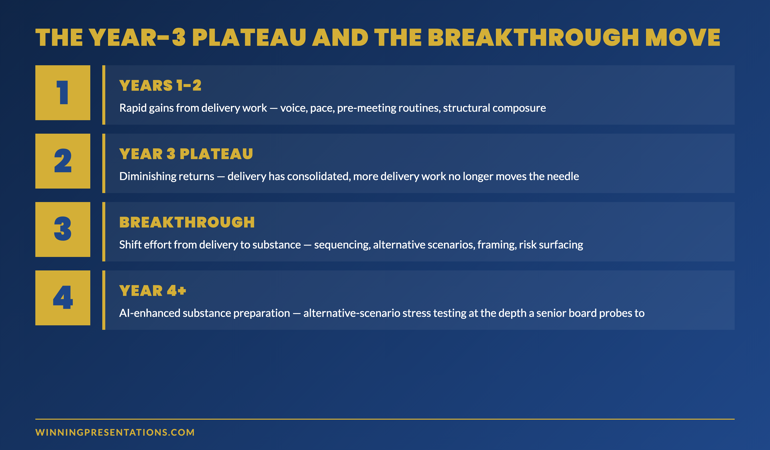
The presenter who hits the plateau and tries to push through it with more delivery work usually ends up over-refining things that no longer matter. They take a course on advanced executive presence; the course produces no measurable shift. They work with another voice coach; the coach makes small adjustments that the audience cannot detect. They invest more time in pre-meeting routines that already work. The effort goes in, the visible improvement does not come out, and the presenter often concludes — wrongly — that they have lost their edge or that the new senior environment is harder to crack than the old one. Neither is true. The right tools for years one and two are the wrong tools for year three.
The thing the presenter is actually missing is on the other side of the meeting. Not how they deliver. What they deliver. The substance of a senior presentation — the message architecture, the way the data is framed, the sequence in which the audience encounters the argument, the way alternative scenarios are made visible — has its own development curve. For most senior presenters that curve was never separately worked on. The substance was built however the presenter happened to build it. By year three, the substance work is the largest unworked layer. It is where the next several years of genuine improvement are sitting.
The breakthrough move — adding the substance layer
The breakthrough at the plateau is rarely a single move. It is a deliberate redirection of effort from delivery to substance. The presenter who has been refining how they speak shifts the same level of structured attention onto how they build the case the room is asked to evaluate.
The components of substance work look different from the components of delivery work. They include: the sequence in which an executive committee encounters new information so that scepticism is engaged early rather than at the end; the way alternative scenarios are made tangible enough that the room can actually compare them; the framing decisions that determine whether a strategic recommendation lands as ambitious or as reckless; and the structural choices that surface the genuine risks before a senior questioner does, rather than letting the questioner define the risk frame.
This is not the same skill set as building a clean deck. Deck design was the layer year one and year two consolidated. Substance work is one layer above. It is closer to the kind of structured argumentation that senior strategy consulting historically taught, and it is the part of presentation development that almost no leader has worked on systematically by the time they hit the year-three plateau.
The presenter who crosses the plateau usually does it by acquiring tools that were not in their delivery-era toolkit. The same Tomás from the opening of this article hit the plateau in year seven of his strategy director role. He moved past it not by another delivery course but by deliberately rebuilding the way he constructed the underlying argument of his board papers — the sequencing, the alternative-scenario logic, the way risks were surfaced upstream of the recommendation. The composure that had been the ceiling for two years became the floor of the next layer of work.
Why the AI layer changes what the plateau looks like
The substance layer has had its own quiet revolution since 2023. AI tools — used carefully and at executive level — change what an experienced presenter can do during the substance phase of preparation. They are not a substitute for the leader’s thinking. They are a way to widen the surface area of what the leader can examine before walking into the meeting.
The senior presenter who has plateaued at year three usually has the experience to make excellent strategic judgements but not enough preparation hours to stress-test those judgements against every alternative scenario the board might raise. AI tools, used as a structured part of substance preparation, change that equation. They do not write the argument. They make the alternative-scenario work tractable in the time the leader actually has. The presenter walks into the meeting with the full set of likely board challenges already pressure-tested, the alternative scenarios mapped at the level of detail an experienced board member will probe to, and the second-order implications of the recommendation already identified.
This is not a delivery improvement. It is a substance improvement. It produces a presenter who looks the same in the room — same voice, same pace, same composure that was settled by year two — but whose substance is operating at a different level. The room reads this within the first one or two questions. The senior board member who pushes on a particular assumption finds the presenter has already considered it; the alternative scenario the chair raises has already been examined. The audience does not need to know the AI was part of the preparation. They register the depth of the preparation, which is what they were always reading underneath the composure signals.
AI-Enhanced Presentation Mastery — £499/seat
A self-paced programme with monthly cohort enrolment, designed for senior leaders who have settled the delivery layer and want to add a structured AI-enhanced approach to substance preparation. 8 modules and 83 lessons covering the substance work that opens up after the year-three plateau.
- Self-paced with monthly cohort enrolment — no deadlines, no mandatory session attendance
- 2 optional live coaching sessions, fully recorded — watch back anytime
- Lifetime access to materials
- Designed for senior leaders ready to work on the substance layer above delivery
Explore AI-Enhanced Presentation Mastery →
£499/seat. Self-paced programme with monthly cohort enrolment. Optional recorded coaching sessions available.
What changes after the plateau
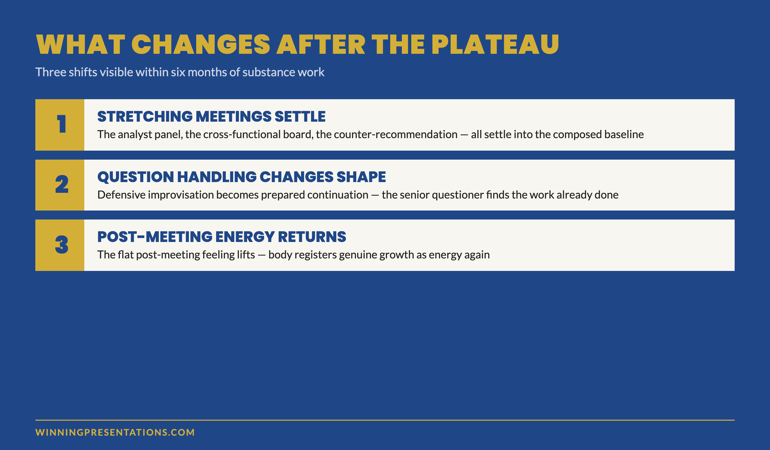
The presenter who crosses the plateau usually finds three changes within the first six months on the substance side.
The kinds of meetings that previously felt stretching settle. The analyst panel, the cross-functional board with members from outside the presenter’s discipline, the meeting where the recommendation runs counter to a previous senior judgement — these had been outside the composed baseline at the plateau. Within a few months of substance work they begin to settle into the same composed range as the previously fluent meetings. The composure was never the problem. The substance was, and the audience read the difference even when the presenter could not name it.
Question handling changes shape. The senior questioner who probes hard on an alternative scenario or a specific risk used to expose the gap between what the presenter had prepared and what the board could actually probe to. The substance layer closes that gap. Question handling stops being defensive and becomes a continuation of the same prepared analysis. The presenter is not improvising better answers; they have already considered the question.
The post-meeting energy returns. One of the quieter signals of the plateau is the flatter post-meeting feeling — the sense that the meeting went well but did not produce the lift that earlier meetings did. After the substance layer settles, the lift returns. Not because the meetings are easier. Because the presenter is doing work that is genuinely producing growth again, and the body registers growth as energy.
The lighter-weight starting point
For senior presenters who recognise the plateau but are not yet ready for a full programme, a lighter-weight starting point is to add a structured AI prompt layer to the existing substance preparation. The Executive Prompt Pack (£19.99, 71 prompts for ChatGPT and Copilot) gives a structured set of prompts for the substance work — alternative-scenario stress testing, question prediction, sequencing the senior audience’s encounter with new information. This is not the full plateau breakthrough, but it is the most practical first move for presenters who want to test whether substance work will move their plateau before committing to a deeper programme.
Frequently asked questions
Is the year-3 plateau the same for all senior presenters?
The shape is similar; the timing varies. Senior presenters who present three or more times a week often hit the plateau closer to year two. Those who present monthly or quarterly may not hit it until year four or five. The trigger is roughly the same number of accumulated high-stakes meetings, not the elapsed time. Around two to three hundred is the typical zone in which the delivery layer has fully consolidated and the next layer becomes the binding constraint.
How do I know I am at the plateau and not just having a hard quarter?
Two markers help distinguish them. A hard quarter usually involves specific identifiable factors — a difficult chair, an unusual board, a quarter where the underlying business was difficult. The plateau persists across quarters and across audience changes, and it is characterised by a flatter post-meeting feeling rather than a worse meeting outcome. If three consecutive quarters of normally varied work produce the same flat-but-competent feeling, the plateau is the more likely diagnosis.
Can I work on substance without working with AI tools?
Yes. Substance work pre-dates AI by decades. The components are sequencing, alternative-scenario thinking, framing, risk surfacing, and structural argumentation. AI tools accelerate certain parts of the work — specifically the breadth of alternative-scenario testing and the depth of question prediction — but the substance layer can be developed without them. AI tools change the slope of the curve, not its existence.
Will the plateau happen again later?
Most senior presenters report a second, smaller plateau between year six and year eight, after the substance layer has settled. The second plateau is usually less disorienting because the presenter has already absorbed the experience of one plateau and the breakthrough that followed. The pattern is similar — a layer above the current one becoming the binding constraint — and the resolution is similar: identify the next layer and work it deliberately rather than over-refining the current one.
For the companion piece on the broader timeline of how presentation confidence develops in the first two years, see How Long Does It Take to Build Presentation Confidence?
The Winning Edge — weekly, free
Each Thursday: one structural framework, one micro-story from senior coaching, one practical move you can use in this week’s meetings. Built for senior professionals who present at executive level.
Not ready for the full programme? Start here instead: download the free Executive Presentation Checklist — a one-page pre-meeting routine the senior leaders I work with use the morning of a board presentation.
About the author
Mary Beth Hazeldine is the Owner & Managing Director of Winning Presentations Ltd, founded in 1990. With 24 years of corporate banking experience at JPMorgan Chase, PwC, Royal Bank of Scotland, and Commerzbank, she advises executives across financial services, healthcare, technology, and government on structuring presentations for high-stakes funding rounds, board approvals, and senior reviews.