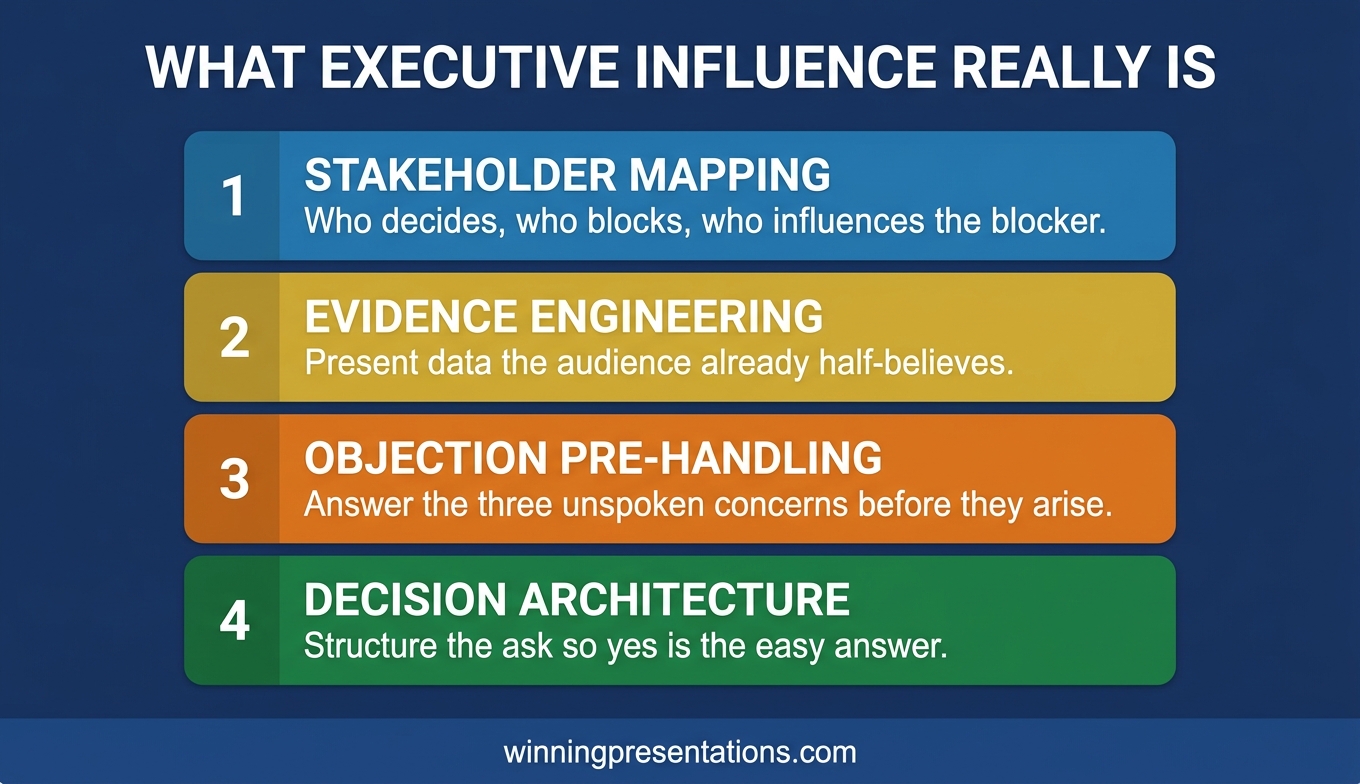
Quick Answer: Most leadership communication training online fails to change behaviour because it compresses a year of habit work into a weekend workshop. The programmes that actually shift how senior executives speak, structure and decide share four traits: self-paced modules you can revisit, behaviour-anchored practice, feedback on real decks and real meetings, and a structure that respects an executive diary.
JUMP TO:
- Why most leadership communication training online doesn’t change behaviour
- The five things to evaluate before paying for a programme
- Self-paced vs live cohort: which works for senior executives
- The behaviour change problem
- AI-enhanced training: what it actually means for executives
- The Winning Presentations approach
- Cost, time investment and realistic expectations
- FAQ
Beatriz had done three leadership communication programmes in five years. One at a European business school, one with a well-known London consultancy, one run in-house by her fintech’s people team. She is chief operating officer at a 600-person payments business. Each programme filled her performance review as “excellent.” Each gave her a certificate, a set of frameworks and a good week of reflection.
Her direct reports, asked six months after the most recent programme whether her communication had changed, said the same thing her chief of staff said quietly over coffee: not really. The same habit of opening board papers with context rather than the decision. The same tendency in town halls to explain before she committed. The same long email threads where one strong sentence would have closed the matter.
This is the problem with online programmes in this category. The experience is good. The content is often excellent. The behaviour back at the desk, three months later, is almost identical to the behaviour before. The executives who actually change share a different pattern: they worked with material they could return to, practised on their own real decks, and treated the programme as a six-month project rather than a three-day event.
If you are evaluating a programme for yourself or your leadership team
The Maven AI-Enhanced Presentation Mastery programme is built for senior executives who need to apply the work to real meetings, not hypothetical case studies. Eight modules, eighty-three lessons, self-paced, optional live coaching fully recorded.
Why most leadership communication training online doesn’t change behaviour
There is a specific reason senior executives finish a communication programme, give it strong feedback, and present the following Monday in exactly the same way they did the Friday before. The structure of the programme was designed for completion, not for change.
Most online leadership programmes are built around the weekend workshop or the two-week intensive. You block the diary. You absorb a large amount of content in a compressed window. You leave with frameworks, notes and a sense of clarity. Two weeks later, a board paper is due. By the time you use what you learned, the material has half-faded, the habits have not been rehearsed under real pressure, and the new behaviour has not had time to overwrite the old one.
Executives under time pressure revert to the shortest path. The shortest path is the habit you have already built. That is not a failure of discipline. It is how habits work in anyone running a real operating load.
The programmes that do shift behaviour share three architectural features. Material you can return to repeatedly without scheduling. Practice anchored to your real work, not generic scenarios. A time horizon of months, not weeks, with deliberate spacing between exposure and application. For the broader category view, see our guide to executive presentation training online.
MAVEN AI-ENHANCED PRESENTATION MASTERY — £499 PER SEAT
Built for executives who need the programme to fit around real work
Eight modules, eighty-three lessons, self-paced. Two optional live coaching sessions with Mary Beth, both fully recorded. Enrolment is open, new cohorts open monthly. £499 per seat, no subscription. Designed for chief executives, operating officers, finance directors and senior leaders applying the work to current board papers, investor meetings and stakeholder presentations.
Self-paced. Enrolment is open. New cohorts open monthly.
The five things to evaluate before paying for a programme
When a senior executive evaluates a programme, the decision usually collapses to brand and price. That produces predictable outcomes. The five criteria that separate programmes that change behaviour from programmes that feel good are rarely front of mind when the budget conversation happens.
1. Can you apply the work to your own real material? The best programmes let you bring your next board paper, your last town hall, your draft investor update. If the programme only trains on synthetic case studies, the transfer back to real work is almost always weak.
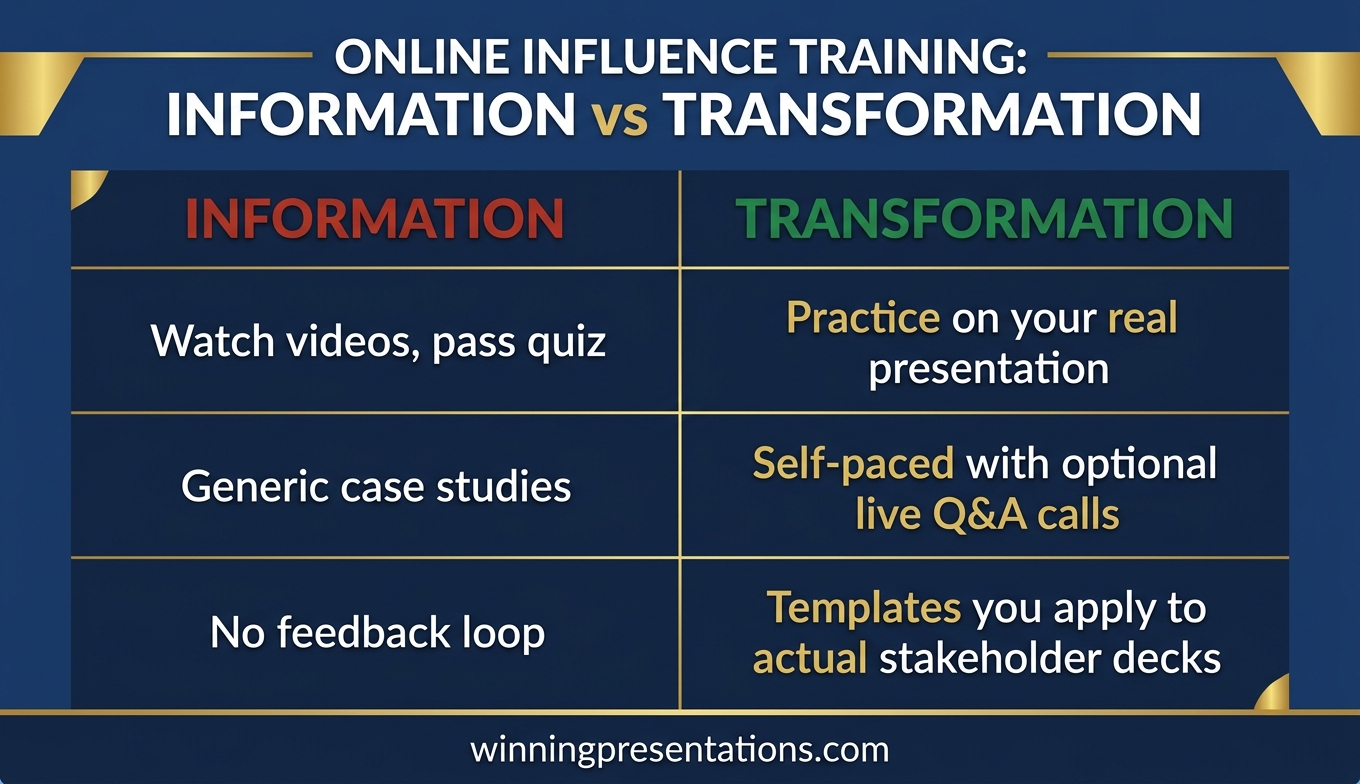
2. Does the structure fit an executive diary? A chief operating officer cannot commit to four consecutive Fridays. Programmes that demand synchronous attendance at fixed times either fail at enrolment or produce high drop-off. Self-paced programmes, with optional live sessions recorded for later viewing, match how senior executives actually consume material.
3. Is the content modular enough to revisit? Behaviour change happens on the third or fourth exposure, not the first. A programme you cannot return to is a programme you will not apply.
4. Is the feedback on your work, not on your theoretical understanding? Quizzes measure recall. Feedback on a real deck measures change. Any programme that does not give structured feedback on your output is training comprehension, not behaviour.
5. Does the price reflect the outcome, not the format? Online programmes range from £99 to £5,000 for equivalent content. The bottom is usually knowledge transfer only. The top often pays for brand and production. The band that works for serious executive programmes sits between £300 and £800 per seat for self-paced formats with optional coaching. The presentation skills course for executives guide applies the same criteria to the presentation-skills subcategory.
Self-paced vs live cohort: which works for senior executives
The debate between self-paced and live-cohort formats is often framed as learning-style preference. For senior executives, it is mostly a diary question with a behaviour-change consequence.
Live cohorts, where all participants attend the same sessions at the same time, work for professionals who can block the calendar. For a director or chief officer running an operating portfolio, fixed-time commitments collide with board dates, investor calls and crisis work. The result is one of two patterns: the executive drops the programme after missing a session, or attends but cannot give it full attention.
Self-paced formats solve the diary problem and the behaviour-change problem together. Material can be returned to when the work comes up — the module on opening a board presentation with the decision becomes useful the week a board paper is due. Executives who apply the material at the point of need show more visible change than those who consumed it all in a block. The best structure keeps a self-paced core and layers optional live sessions on top, recorded so missing one does not break the programme.
The behaviour change problem
Beatriz’s three completed programmes illustrate the central problem: completion is not change. An executive can finish a programme, score well on the end-of-module knowledge checks, receive the certificate and still present on Monday morning exactly the way they did before. This is the defining failure mode of most online leadership programmes, and the reason corporate learning and development teams often see diminishing returns on successive investments.
Behaviour in adults with long-established communication patterns changes under three conditions: repeated exposure to the new pattern across multiple contexts, deliberate practice under conditions that approximate the real environment, and feedback tight enough to correct error before it becomes the new default.
The implication for programme design is specific. A single weekend workshop gives you exposure once, in one context, with no practice and no feedback. A twelve-week structure with short daily work applied to real meetings gives you exposure fifty times, in varied contexts, with the feedback loop running inside your actual work. The second is harder to market and easier to underprice. It is also the one that produces visible change. The executive communication skills guide covers the specific behavioural markers to look for before and after.
AI-enhanced training: what it actually means for executives
“AI-enhanced” is increasingly attached to online training programmes, and the label can mean anything from a chatbot helping you navigate the course menu to a genuine augmentation of how the executive practises and receives feedback. The useful question is narrow: does the AI component reduce the friction between learning and application?
The version that adds value gives the executive a set of AI-enabled workflows they can run on their own material. A structured prompt that analyses a draft board paper for decision clarity. A workflow that rewrites a town hall opening to lead with the commitment. A prompt that generates three alternative closes for an investor pitch. None of these replace judgement. All of them compress the practice loop from hours to minutes.
The version that adds little is branding. A programme that mentions AI in the title but delivers standard webinar content with a single prompt library bolted on does not meaningfully change the learning experience. Useful AI-enhanced executive training ends each module with one or two workflows the executive will actually use in the following week, on real communications.
The Winning Presentations approach
Maven AI-Enhanced Presentation Mastery is built around the criteria laid out above. The structure assumes the executive is busy, senior, and applying the material to work already in flight.
The core is eight modules covering eighty-three lessons, moving from decision-first structure, through executive delivery, to the AI workflows that compress practice. Every module is self-paced. There are no deadlines, no mandatory session attendance, and no penalty for returning to a module six weeks later when the relevant work lands on your desk.
Two optional live coaching sessions are offered with each enrolment, both with Mary Beth, and both fully recorded. Executives who attend live get the discussion. Executives who cannot get the recording and can run the same questions through the AI workflows built into the programme.
The AI workflows are the component most often misunderstood. They are not a prompt pack bolted on at the end. They are embedded in each module and designed to run on the executive’s own material — the draft board paper, the investor update in progress, the town hall script being rewritten. Application, not comprehension, is the centre of the programme.
Enrolment is open, and new cohorts open monthly. “Cohort” describes the enrolment period, not a live structured programme — participants begin at their own pace with the next available cohort.
Cost, time investment and realistic expectations
The honest answer on cost and time matters more than the marketing language. Senior executives committing the money want to understand what the programme will ask of them and what they can reasonably expect to see back in their work.
Cost. Maven AI-Enhanced Presentation Mastery is £499 per seat. That sits at the lower end of the serious executive range and reflects the self-paced format with optional coaching rather than a high-touch bespoke engagement. For enterprise teams of five or more, tailored arrangements are possible.
Time investment. The programme is designed to run across approximately twelve weeks of part-time engagement, at three to four hours per week. Executives who front-load the first two modules and then apply the material to live communications typically report the highest visible change. The self-paced format allows participants to work through in six weeks or six months.
What to expect. Three specific changes. Your openings shift from context-first to decision-first. Your structure on board papers and investor communications becomes more consistent under time pressure. You build a small set of AI-enabled workflows you actually use, not a prompt library you never open. It is designed to move the specific behaviours that boards, investors and senior stakeholders weigh most heavily.
FOR EXECUTIVES SERIOUS ABOUT CHANGING THE BEHAVIOUR, NOT JUST COMPLETING A PROGRAMME
Maven AI-Enhanced Presentation Mastery — £499 per seat
Eight modules, eighty-three lessons. Optional live coaching, fully recorded. Self-paced structure designed for senior executives applying the work to current board papers, investor meetings and stakeholder presentations. Enrolment is open, new cohorts open monthly.
Frequently Asked Questions
How much does a leadership communication programme online cost?
Serious programmes aimed at senior executives typically range from £300 to £800 per seat for self-paced formats with some coaching. Bespoke one-to-one engagements run higher, often £2,000 to £10,000. Programmes under £100 are almost always knowledge-transfer only and rarely change behaviour in a measurable way. Maven AI-Enhanced Presentation Mastery is £499 per seat.
Is online training as effective as in-person?
For senior executives, online training is frequently more effective than in-person, for one structural reason: it can be returned to at the point of need. An in-person workshop happens once. A good online programme can be revisited the week before a board meeting or a town hall. The format that loses out is live-only online training, which combines the inflexibility of in-person with the lower engagement of a screen.
How long should a programme take?
Long enough for behaviour to change under real-world conditions, which means weeks rather than days. A two-day workshop is a knowledge transfer, not a behaviour change intervention. Programmes that produce visible change typically run over eight to sixteen weeks of part-time engagement, with the executive applying the material to real work in between sessions or modules.
What’s the difference between presentation training and leadership communication training?
Presentation training focuses on the specific act of presenting — structure, delivery, slides, handling questions. Leadership communication training is broader and covers written communications, one-to-one conversations, team meetings and public remarks. For most senior executives the two overlap heavily in practice, because the habits that make a board presentation strong also make a town hall and an investor email strong. A good programme in either category should cover the transferable habits, not just the format-specific tactics.
The Winning Edge — weekly
One short note every Thursday on what actually moves boards, investors and senior stakeholders. No filler.
Related reading: The partner guide on executive presentation training online covers the adjacent category. For founders, our pieces on investor pitch deck slide order and pitch rejection recovery cover the tactical layer that sits on top of the communication fundamentals.
Your next step: Before signing up for any programme, including this one, write down the three specific behaviours you want to change. If a programme cannot clearly answer how it will address those three, it is the wrong programme regardless of brand or price.
About the Author
Mary Beth Hazeldine, Owner & Managing Director of Winning Presentations, advises executives across financial services, healthcare, technology and government on structuring presentations for high-stakes funding rounds, board approvals and stakeholder buy-in. With 24 years of corporate banking experience at JPMorgan Chase, PwC, Royal Bank of Scotland and Commerzbank, she works at the intersection of finance, language and decision psychology.