

Quick Answer: Presenting critical feedback to someone senior requires a fundamentally different structure than presenting to peers. The upward feedback presentation fails when the critique feels personal — and succeeds when the data does the talking. The key: never state the problem directly. Build a slide sequence where the senior person’s own metrics reveal the gap. When the data critiques the strategy, you don’t have to.
⏰ Presenting Upward Feedback in the Next 48 Hours?
Run this 5-point check before you walk in:
☐ Slide 1 shows their objectives — not your findings
☐ Every critique is stated as “target vs actual” data — never as judgement
☐ You present 2-3 options (including “maintain current approach” with costed consequences)
☐ You’ve had a private pre-meeting with the senior person — no surprises in the room
☐ Your language uses “the data shows” — never “I found” or “the problem is”
In this article:
- Why upward feedback presentations fail (even when the feedback is right)
- The Mirror Structure: let their own data deliver the critique
- The 4 phrases that turn feedback into a career-ending move
- The political setup: who to talk to before you present
- When the senior person pushes back mid-presentation
- The 48 hours after: protecting the relationship
- Frequently asked questions
At Royal Bank of Scotland, I was asked to present a process review to a managing director. The review showed that a workflow he’d personally designed and championed was costing the department £380K annually in unnecessary steps.
He was in the room. His direct reports were in the room. His boss was in the room.
The easy version: soften the findings, praise the original intent, bury the numbers in context. Everyone smiles, nothing changes, and £380K continues to leak.
The honest version: present the data clearly, show the gap, recommend a restructure. The department improves, but the managing director feels publicly critiqued in front of his team and his boss.
I chose a third option. I presented his own KPIs — the metrics he’d chosen to track — and showed where the numbers had diverged from his original targets. I never said “this process is failing.” I said “these are your targets, and here’s where performance has drifted.”
He nodded. His boss nodded. The restructure was approved that afternoon.
The data critiqued the process. I didn’t have to critique the person.
🚨 Presenting feedback to someone senior this week? Quick check: Does your deck state the problem directly, or does it show the data that reveals the problem? If you’re stating it, you’re making it personal.
→ Need the Mirror Structure template? Get the Executive Slide System → £39
Why Upward Feedback Presentations Fail (Even When the Feedback Is Right)
The upward feedback presentation is the most politically dangerous format in corporate life. Here’s why: every other presentation type has built-in protection. When you present bad project news, you’re reporting reality. When you present a strategy recommendation, you’re offering a path forward. But when you present findings that critique a senior person’s work, you’re implicitly saying: “You got this wrong.”
It doesn’t matter if you’re right. In fact, being right makes it worse — because the senior person can’t dismiss your data, which means they have to sit with the discomfort of being corrected in front of their peers or team.
The three ways upward feedback presentations typically fail:
The softener trap. You dilute the feedback so much it doesn’t land. “There may be some opportunities for optimisation in the current workflow.” The senior person nods, changes nothing, and your credibility as an analyst drops because your findings were vague.
The direct hit. You present the critique clearly and without padding. “The current process costs £380K more than it should.” The data is right. The relationship is wrong. The senior person feels ambushed.
The sandwich. Praise, then critique, then praise. This is the most common approach — and the most transparent. Every executive recognises the sandwich. The moment you say something positive, they’re waiting for the “but.” The praise feels insincere. The critique lands harder because of it.
Related: If you’re delivering bad news more broadly, see the complete framework for presenting bad news without destroying credibility.
How do you present critical feedback to your boss?
You don’t — at least, not directly. The most effective approach is to let the data present the feedback for you. Build a slide sequence that starts with the senior person’s own goals or KPIs, then shows the current performance against those benchmarks. The gap between target and actual IS the feedback. You’re not critiquing their work — you’re showing their metrics. This keeps the critique impersonal and the data in charge.
The Mirror Structure: Let Their Own Data Deliver the Critique
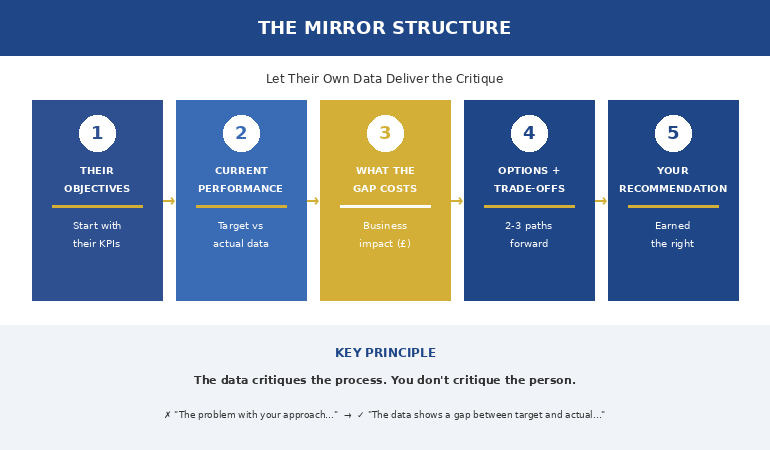
After the RBS experience, I developed what I now call the Mirror Structure. It’s designed specifically for presentations where the findings implicitly critique someone senior.
The principle: instead of presenting your conclusions (which feel like judgement), present their own targets and show where reality has diverged. You’re holding up a mirror, not pointing a finger.
Slide 1: Their stated objectives. Start with what the senior person said they wanted to achieve. Use their words, their KPIs, their original business case. “In Q2 2024, the department set three targets: reduce processing time by 30%, improve accuracy to 98%, and eliminate manual reconciliation.” This slide establishes shared ground — you’re not introducing a new standard, you’re using theirs.
Slide 2: Current performance against those objectives. Show the data cleanly. Target vs actual. No editorial. No colour commentary. “Processing time: target 30% reduction, actual 12%. Accuracy: target 98%, actual 91%. Manual reconciliation: target eliminated, actual 4.2 hours daily.” Let the numbers sit. The gap between target and actual IS your feedback.
Slide 3: What the gap costs. Translate the performance gap into business impact. “The 18-point gap in processing time costs approximately £380K annually in manual workarounds and represents 3.4 FTE of capacity.” This is where the critique becomes undeniable — but it’s the data’s critique, not yours.
Slide 4: Options with trade-offs. Present two or three paths forward. One of them can be “maintain current approach” (with the cost quantified). This gives the senior person agency — they’re choosing the path forward, not being told they failed. The decision slide structure works perfectly here.
Slide 5: Your recommendation + specific ask. Now — and only now — state what you’d recommend. “Based on the data, I recommend Option B: restructure the reconciliation step, which delivers £280K annual savings at a one-time cost of £45K.” You’ve earned the right to recommend because the data has already made the case.
⭐ Deliver Difficult Feedback Without the Career Damage
The Executive Slide System gives you the Strategic Recommendation template (Card 04) — the exact structure for presenting findings that implicitly critique someone senior. Built for the moment where the data is clear but the politics are dangerous.
Your upward feedback toolkit:
- Strategic Recommendation template — recommendation-first structure that keeps critique impersonal
- Executive Summary template — the “mirror” opening that starts with their objectives
- AI prompt: “Stress-test this as a skeptical CEO” — catches political landmines before the room does
- Scenario 04 playbook: Presenting Bad News — step-by-step template, prompt, and checklist
Get the Executive Slide System → £39
Built from 24 years of presenting difficult findings to managing directors and C-suite executives at JPMorgan, RBS, PwC, and Commerzbank.
The 4 Phrases That Turn Feedback Into a Career-Ending Move
Language matters more in upward feedback than in any other presentation format. One wrong phrase — even surrounded by perfect data — can turn a professional presentation into a perceived attack.
“The problem with the current approach is…” This directly attributes ownership. “The current approach” is the senior person’s approach. Saying there’s a “problem” with it is saying there’s a problem with their judgement. Instead: “The data shows a gap between the Q2 targets and current performance.”
“We need to change…” “We need to” implies the senior person hasn’t already seen the need — which implies they’re not doing their job. Instead: “The options for closing the performance gap include…”
“I found that…” This centrepieces YOU as the critic. When you say “I found,” you own the findings — which means the senior person’s response is to you, not to the data. Instead: “The Q3 data shows…”
“With respect…” Never. This phrase is universally understood as the precursor to disrespect. It signals that what follows will be uncomfortable — and primes the room to be defensive before you’ve said anything substantive.
The pattern: remove yourself as the agent. Let the data, the metrics, the benchmarks be the subject of every sentence. “The data shows” not “I found.” “The gap is” not “you missed.” “Options include” not “we need to.”
The AI prompts in the Executive Slide System include a “stress-test as a skeptical CEO” prompt that catches exactly these language landmines — before the room catches them for you. Get the Executive Slide System → £39
The Political Setup: Who to Talk to Before You Present
The Mirror Structure handles the presentation itself. But the most dangerous moment in an upward feedback presentation isn’t in the meeting — it’s the 24 hours before it.
If the senior person is blindsided by your findings in front of their team or their boss, no amount of structural elegance will save the relationship. You need to have one conversation before the meeting — with the senior person themselves.
What to say: “I’m presenting the process review on Thursday. The data shows some gaps between the Q2 targets and current performance. I wanted to walk you through the key findings beforehand so there are no surprises in the room.”
This conversation does three things. First, it shows respect — you’re not ambushing them. Second, it gives them time to process the feedback privately, which means they arrive at the meeting already past the emotional response. Third, it gives you their perspective, which may change your recommendation or add context your data doesn’t capture.
The executives who present like CEOs understand that the presentation is the formalisation of a decision that’s already been shaped in corridor conversations. This is especially true when the content is politically sensitive.
What’s the best way to present constructive criticism to leadership?
Three principles. First, use their own KPIs as the benchmark — not external standards they didn’t agree to. Second, present the gap as data, not judgement: “target vs actual” not “what went wrong.” Third, always give them a path forward with options, so they’re choosing the solution rather than receiving a verdict. And always — always — have a private conversation before the public presentation.
⭐ Stop Choosing Between Honesty and Career Safety
The Executive Slide System gives you the structure where both coexist. The Strategic Recommendation template builds the Mirror Structure into every slide — so the data delivers the critique and you deliver the solution.
Your difficult feedback deliverables:
- Strategic Recommendation template (Card 04) — recommendation-first with built-in trade-off framing
- Executive Summary opener — starts with THEIR objectives, not your conclusions
- AI prompt: “Review this for language that could feel like personal criticism” — political de-mining
- Pre-meeting conversation checklist — the 5 things to cover before the room hears anything
Get the Executive Slide System → £39
Built from presenting difficult findings to managing directors across JPMorgan, RBS, PwC, and Commerzbank — rooms where being right wasn’t enough.
When the Senior Person Pushes Back Mid-Presentation
Even with the Mirror Structure and the pre-meeting, there’s a moment many people dread: the senior person interrupts. “That’s not quite right.” “You’re missing context.” “The numbers don’t tell the full story.”
This is actually a good sign. It means they’re engaging with the data, not dismissing you. The danger is in how you respond.
What works: “That’s a fair point — can you share the context? It may change the recommendation.” This does three things: validates them, invites their expertise, and keeps you positioned as collaborative rather than adversarial. If their context genuinely changes the picture, adjust in real time. If it doesn’t, the room sees that you considered it and the data still stands.
What doesn’t: “Well, the data clearly shows…” Doubling down on your findings in the face of pushback from a senior person reads as stubbornness, not rigour. Even if you’re right, you’ve turned the presentation into a debate — and in a debate with someone senior, you lose even when you win.
What definitely doesn’t: “I understand your perspective, but…” Everything after “but” negates everything before it. The senior person hears “I understand” as a formality and “but” as dismissal.
Handling pushback from someone senior requires the same structural clarity that the initial presentation demands. The Executive Slide System includes 6 checklists covering structure, logic, and objection readiness — so you’ve anticipated pushback before it arrives. Get the Executive Slide System → £39
The 48 Hours After: Protecting the Relationship
The presentation ends. The data was clear, the recommendation was accepted, and the restructure is approved. You feel relief.
But the relationship with the senior person is now in a fragile state. They’ve just been publicly corrected — even if the correction was data-driven and structurally impeccable. What you do next determines whether they become an ally or an adversary.
Within 24 hours: Send a private note. Not about the data. About implementation. “I wanted to make sure the transition plan reflects your priorities — can I check a few things with you before I finalise the implementation steps?” This positions them as the authority on the path forward. The critique is over; now you’re asking for their expertise.
Within the week: Credit them publicly for the improvement. “David’s original framework created the foundation — this restructure builds on what was already working.” This isn’t dishonest. Every process, even a failing one, has elements worth preserving. Finding them and crediting them publicly costs you nothing and protects the relationship completely.
Related: If yesterday’s presentation didn’t go as planned, read the failing project presentation structure — the 6-slide recovery plan that gets decisions, not deferrals.
Is This Right For You?
✓ This is for you if:
- You need to present findings that implicitly critique someone senior’s strategy or decision
- You want a structure that delivers honest feedback without making it personal
- The senior person will be in the room when you present
✗ This is NOT for you if:
- You’re having a one-on-one feedback conversation (different format entirely)
- You’re presenting findings that don’t involve anyone in the room
⭐ The Structure I Used to Tell a Managing Director His Strategy Was Failing — and Get the Restructure Approved the Same Day
In 24 years of corporate banking, the hardest presentations weren’t the big pitches. They were the upward feedback moments — telling someone senior what the data showed about their decisions. The Executive Slide System is the structural framework that makes those presentations possible.
Inside:
- 22 executive slide templates — including Strategic Recommendation and Executive Summary
- 51 AI prompts — including “stress-test for language that could feel like personal criticism”
- 15 scenario playbooks — Scenario 04 (Presenting Bad News) covers the upward feedback dynamic
- 6 checklists covering structure, logic, political readiness, and objection handling
Get the Executive Slide System → £39
Instant download. 30-day money-back guarantee. Used by managers, directors, and consultants who need to say the hard thing — and keep the relationship intact.
Frequently Asked Questions
Should I use the sandwich method (positive-negative-positive)?
No. Every experienced executive recognises the sandwich. The moment you open with praise, they’re bracing for the critique — which means the praise feels manipulative and the critique lands harder. The Mirror Structure is more effective: lead with their own targets, show the performance gap in data, then present options. No false praise. No padding. Just data and a path forward. It’s more respectful than the sandwich because it treats the senior person as someone who can handle numbers without emotional buffering.
What if the senior person outranks me significantly?
The structure matters more, not less. The greater the power gap, the more important it is that the data does the critiquing and not you. Use their KPIs, their language, their original business case as the benchmark. When the gap between target and actual is on the slide, rank becomes irrelevant — the numbers are the numbers. And always have the pre-meeting conversation. Blindsiding someone who significantly outranks you is a career mistake no amount of good data can recover from.
What if my feedback is about a person, not a process?
A presentation is the wrong vehicle for personal feedback. If your findings are about an individual’s performance rather than a process or strategy, that’s a private conversation — not a slide deck. The Mirror Structure works specifically for systemic issues (processes, strategies, workflows, resource allocation) where the critique can be depersonalised through data. Personal performance feedback should be delivered one-on-one, ideally with HR guidance.
How do I handle it if they try to discredit the data?
Prepare for this by using only data sources they’ve already endorsed. If you’re using their KPIs, their dashboards, their reporting tools — it’s very difficult for them to discredit the data without discrediting their own systems. If they challenge methodology, respond with: “I used the same reporting framework the department uses for quarterly reviews. If there’s a more accurate source, I’d welcome using that for the follow-up analysis.” This keeps you collaborative while making it clear the data is sound.
📬 The Winning Edge — Weekly Newsletter
One executive presentation insight per week. Real boardroom scenarios, real structures, no filler. Written for professionals who present to people with more power than them.
Related: If the feedback you need to present is about a failing project, read The Failing Project Presentation Nobody Teaches You to Give — the 6-slide recovery structure.
Also: If Q&A after your feedback presentation worries you, read When You Don’t Know the Answer: 3 Responses That Save You in Q&A.
Your feedback presentation is on the calendar. The data is clear. Now get the structure that lets the data speak — so you don’t have to be the one critiquing the most powerful person in the room.
About the Author
Mary Beth Hazeldine is the Owner & Managing Director of Winning Presentations. With 24 years of corporate banking experience at JPMorgan Chase, PwC, Royal Bank of Scotland, and Commerzbank, she has delivered high-stakes presentations in boardrooms across three continents.
A qualified clinical hypnotherapist and NLP practitioner, Mary Beth combines executive communication expertise with evidence-based techniques for managing presentation anxiety. She has trained thousands of executives and supported presentations for high-stakes funding rounds and approvals.

