Tag: presentation trauma

08 Mar 2026
Executive sitting alone in an empty boardroom reflecting on a past presentation experience with dramatic lighting

The Shame Cycle: Why One Bad Presentation Creates a Decade of Fear

You’ve replayed that moment a thousand times. Not the entire presentation—just the 47 seconds when your voice cracked, or you lost your place, or someone’s expression shifted. Eleven years later, you can still feel the heat rising in your chest.

This isn’t anxiety about the next presentation. This is something deeper: a shame spiral that has reorganised your relationship with speaking itself. One moment of perceived failure created a psychological feedback loop that rewired your threat response. And unless you understand the mechanism, it will keep working against you.

Quick Answer: Shame cycles perpetuate presentation fear because they collapse the distinction between a single failure and your identity as a presenter. Your nervous system learned to treat any speaking situation as dangerous, not because of present risk, but because of a moment that was internalised as evidence of your inadequacy. The fear persists because the shame narrative runs automatically beneath conscious awareness.

🚨 Still replaying a bad presentation from years ago?

Quick check: Can you recall the exact moment the shame started?

  • Name the specific thought that triggers the memory
  • Notice whether you feel it physically (chest, stomach, throat)
  • Ask: “Am I the same presenter I was then?”

→ Ready to break the cycle for good? Get Conquer Speaking Fear (£39)

The Audience Judgment Loop (11 Years)

A senior finance director stood to present quarterly results to the board. Thirty seconds in, the screen froze. In the silence, she heard someone sigh—a small, barely perceptible sound. Her mind immediately filled the gap: They think I’m incompetent. They’re judging me.

She recovered. The presentation continued. The results were approved. By every objective measure, it was fine.

But something had shifted. That sigh—real or imagined—had planted a seed of doubt. From that moment, every time she entered a boardroom, her nervous system returned to that moment. Before the next presentation, she felt the same quickening in her chest. During it, she was acutely aware of faces, of shifts in posture, of any expression that might signal disapproval. After it, she ruminated: Did they judge me? Are they still judging me?

She turned down promotions that required regular presentations. She delegated important updates to colleagues. She rehearsed obsessively, trying to eliminate any possible reason for judgment. None of it worked, because the shame wasn’t about the next presentation—it was about what that sigh had convinced her was true: I am not a credible presenter.

Eleven years later, a reframing technique broke the cycle. She learned to separate the event (the freeze) from the meaning her shame had assigned to it. When the intrusive thought returned, she now recognises it for what it is: a protection mechanism, not a truth. Within three months, the physical anxiety responses began to fade.

The Presentation Shame Cycle infographic showing five stages: The Event, Shame Response, Nervous System Lock, Avoidance Pattern, and Reinforcement — illustrating how one bad presentation moment creates years of fear through identity-level encoding and avoidance behaviour

Shame Collapses the Boundary Between Event and Identity

Anxiety and shame are neurologically distinct experiences, and this distinction is critical to understanding why presentation fear can persist for decades.

Anxiety is about anticipating a future threat: Something bad might happen. It’s responsive, proportional, and it decreases when the threat is removed or mastered.

Shame is about present identity: Something is wrong with me. It’s absolute, internalised, and it doesn’t respond to evidence of competence because shame logic doesn’t operate in the realm of logic.

When you have a bad presentation, a brief moment of anxiety is normal and adaptive. Your nervous system registers: “That didn’t go well. Let me adjust next time.” But when shame enters, something different happens. That single failure becomes a permanent data point about who you are. The thought evolves from “I performed poorly in that moment” to “I am a poor presenter” to “I am fundamentally inadequate when people are watching me.”

This is the mechanism that transforms a single bad presentation into a decade of fear. Shame doesn’t live in the past—it colonises the future. Every presentation becomes a test of your identity, not an opportunity to communicate. The stakes stop being about the message and become entirely about whether you’ll be exposed as a fraud.

Why this matters: Anxiety management techniques—breathing exercises, positive self-talk, preparation strategies—can reduce the intensity of anxiety. But they often fail with shame-based fear because shame isn’t a miscalibration of threat response. It’s a story you’ve internalised about who you are. Standard anxiety interventions treat the symptom (nervousness) without addressing the root (identity collapse).

How Your Nervous System Encoded the Fear

From a neurobiological perspective, what happened in your bad presentation was this: Your amygdala (threat detector) registered a mismatch between what you expected to happen and what actually occurred. Your voice didn’t steady. The pause stretched too long. Someone’s face showed something you couldn’t interpret.

That mismatch triggered a cascade. Your sympathetic nervous system activated—heart rate increased, blood vessels constricted, digestion paused. Your prefrontal cortex (the rational, thinking part of your brain) was partially offline, which is why logical reassurance doesn’t touch the fear. You were in threat mode.

Here’s the critical part: Your nervous system didn’t just register “that moment was uncomfortable.” It registered that being watched while speaking triggered a threat response, and it did so in an environment marked by judgment and evaluation. Over subsequent presentations, your amygdala learned to pattern-match: the sound of a boardroom, the sight of faces, the sensation of attention—all became early-warning signals that threat was imminent.

This is called trauma conditioning, and it doesn’t require a genuinely dangerous event. It requires a moment of felt exposure, vulnerability, and perceived judgment. Your nervous system treats shame the same way it treats physical threat because shame, neurologically, activates threat circuits. Your body doesn’t distinguish between “I might be attacked” and “I might be exposed as inadequate.”

What reinforces this conditioning? Every time you avoid a presentation opportunity, your nervous system receives confirmation: “See? That situation was dangerous. You were right to protect yourself.” Avoidance feels like relief in the moment, but it’s actually the most powerful teacher your nervous system has. It’s saying: “Your fear response works. Keep it.”

The Thought Loop That Won’t Break

One of the most insidious features of shame-based presentation fear is that it becomes self-perpetuating through the mechanism I call the Audience Judgment Loop.

The loop operates like this:

  1. Pre-presentation: You anticipate being judged. Anxiety rises.
  2. During presentation: Hypervigilance increases. You interpret neutral expressions as critical. You notice the one person checking their phone and miss the three nodding along. Your attention narrows to threat signals.
  3. Post-presentation: You recall selectively—the moments of uncertainty, the face you misread, the question you didn’t answer perfectly. You construct a narrative: “They were unimpressed. I could tell.”
  4. Rumination: For days or weeks, you replay specific moments, analysing what you said and what their reactions meant. Each replay strengthens the neural pathway that connects “presenting” with “being judged.”
  5. Next presentation: Your nervous system is now primed. You anticipate judgment again, hypervigilance increases again, you find confirming evidence again. The loop tightens.

This is why presenting more doesn’t always fix shame-based fear. More presentations can actually deepen the loop if you’re still operating under the shame narrative. You’re collecting more evidence for the story you’ve already internalised: “I am not a good presenter, and this next experience will prove it again.”

The PAA question: “Why doesn’t exposure therapy fix presentation shame?” Because exposure without reframing still treats the shame narrative as true. You’re still accepting the premise that your value as a presenter is on trial. What breaks the loop isn’t more exposure—it’s a shift in the meaning assigned to the experience.

Why Avoidance Deepens the Shame Cycle

One of the paradoxes of shame is that the most natural coping mechanism—avoidance—is also the one that strengthens it most powerfully.

When you avoid a presentation, decline a promotion, delegate the board update, or cancel the team briefing, you experience immediate relief. That relief feels like the right choice. Your nervous system says: “See? I protected you.” But you’re teaching your nervous system something false—that the threat was real and your fear response kept you safe.

More importantly, avoidance prevents disconfirmation. Your shame narrative survives because it never encounters counter-evidence. You never stand in front of an audience as the person you are now—with years of additional competence, with a different understanding of what really matters, with a different nervous system than the one that struggled through that single bad presentation. Instead, you remain psychologically frozen in that moment, with only the shame to keep you company.

Over time, this creates a secondary shame: shame about the avoidance itself. Executives find themselves ashamed not just of their presentation anxiety, but of the opportunities they’ve missed, the visibility they’ve sacrificed, the promotions they’ve declined. Shame compounds shame, and the fear becomes layered.

This is why breaking the shame cycle often requires not just a shift in perspective, but a structured approach that helps your nervous system reprocess the original event while you’re simultaneously changing your behaviour. Standard willpower-based approaches—”just do the presentation anyway”—often backfire because they don’t address the shame narrative. You’re still operating under the belief that you’re inadequate; you’re just fighting through it. That’s not freedom. That’s exhaustion.

Breaking the Cycle: The Reframing Technique That Works

From clinical hypnotherapy and neuroscience, we know that traumatic or shame-based memories aren’t fixed. They’re reconsolidated—re-stored in memory—each time you recall them. This means that how you recall a memory can change how it’s stored and how it affects you.

The technique that broke the eleven-year shame cycle for that finance director involved three elements:

1. Separation: Isolating the event (the presentation freeze) from the meaning (I am inadequate). This is harder than it sounds because shame collapses these two things. She had to learn to say: “A presentation didn’t go as planned. That’s data about that moment, not data about me.”

2. Context restoration: Reconnecting with the version of herself that existed before the shame narrative took hold. What did she know about her own competence before that sigh? What evidence of capability existed then that she’d discounted? What was true about her abilities in other areas? This wasn’t positive thinking—it was historical accuracy.

3. Nervous system reset: Practising the reframed perspective while simultaneously managing her nervous system’s response. This meant that when the intrusive thought (“They’re judging me”) arose, she didn’t fight it or try to reason it away. She acknowledged it, recognised it as a protection mechanism, and then consciously returned to the separated, contextualised version of the story. Over time, her nervous system learned that this particular trigger wasn’t actually dangerous.

This is not the same as “positive self-talk” or “reframing your thoughts.” Those interventions often fail because they ask you to believe something your nervous system doesn’t accept. This technique works because it aligns the conscious narrative with nervous system learning. Both change together.

PAA question: “Can I fix shame-based presentation fear on my own?” You can begin to recognise the mechanism. But the deepest shifts usually happen when you have a structured process and someone who can hold the framework while your nervous system is learning something new. That’s where the real work happens.

Infographic of the Shame Response vs. the Recovery Response showing that recovery separates the event from the identity while shame fuses them together.

Break the Bad Presentation Shame Cycle Once and For All

The difference between executives trapped in presentation anxiety for a decade and those who move past it isn’t talent, preparation, or courage. It’s the ability to separate a single failure from identity, and to reprocess that original event so your nervous system stops treating speaking as dangerous.

Conquer Speaking Fear teaches you exactly how:

  • The neurobiological mechanism behind shame spirals—and why standard anxiety management fails when shame is the root
  • The separation technique that breaks the “event = identity” collapse that keeps presentation fear alive
  • How to reframe the original bad presentation in a way that resets your nervous system’s threat response
  • The 3-element reprocessing protocol used in clinical hypnotherapy for trauma-based presentation anxiety
  • A 30-day progression that moves you from avoidance to intentional, low-stress presentation practice

Get Conquer Speaking Fear → £39

Includes video training, reframing worksheets, and the full 30-day progression. Used by executives at FTSE-listed companies and professional services firms.

The thought loop is running on autopilot right now.

The reframing technique works because it doesn’t ask you to override your nervous system—it teaches your nervous system that the threat isn’t real. The executives who’ve used this approach report that intrusive thoughts about past presentations fade within weeks, not years.

Get Conquer Speaking Fear → £39

Understanding the Maintenance Loops That Keep Shame Cycles Alive

Even when executives recognise that shame-based fear isn’t serving them, the cycle persists because it’s maintained by multiple reinforcing patterns.

Perfectionism as shame-avoidance: Many executives who have internalised shame about presentation ability respond by raising standards obsessively. Over-preparation, scripting every word, anticipating every possible question—these look like diligence, but they’re often shame-management strategies. The underlying belief is: “If I can’t be natural and confident, I’ll at least be flawless.” This strategy fails because no amount of preparation can defend against the shame thought, and the effort required to maintain it becomes exhausting.

Identity-protective behaviour: Once shame has collapsed the boundary between event and identity, your nervous system actively protects the identity you’ve internalised. You unconsciously seek out environments and roles where you don’t have to present. You interpret neutral feedback as confirming evidence of inadequacy. You dismiss positive responses (“They were just being polite”). These aren’t conscious choices—they’re protective behaviours generated by your nervous system to avoid the dissonance of succeeding while still believing you’re inadequate.

Rumination as pseudo-control: Replaying the bad presentation over and over feels productive—as if understanding what went wrong will prevent it from happening again. But rumination is actually your nervous system trying to solve an unsolvable problem: “How do I make sure I’m never exposed as inadequate again?” You can’t solve it because the real problem isn’t the presentation logistics. It’s the shame narrative. But your mind keeps trying, and rumination becomes a compulsive loop that strengthens the neural pathways connecting “presenting” with “threat.”

PAA question: “What happens if I keep avoiding presentations?” The brain has remarkable plasticity, but it also has impressive durability. The longer shame-based patterns run, the more deeply encoded they become. An executive who has avoided presenting for five years has more nervous system learning to undo than one who avoided for one year. The mechanism doesn’t change, but the timeframe for resolution typically does. This isn’t meant to create urgency—it’s meant to clarify that the earlier you interrupt the cycle, the less entrenched the pattern becomes.

Stop Ruminating. Stop Avoiding. Stop Carrying the Shame.

The exhaustion of shame-based presentation fear isn’t just about nervousness—it’s about the constant mental load of avoidance, the opportunity cost of missed promotions, and the grinding discomfort of having your behaviour controlled by a fear mechanism you don’t understand.

  • End the rumination loop that replays bad presentations for years after they occur
  • Reclaim career opportunities by addressing the root cause, not just managing symptoms

Get Conquer Speaking Fear → £39

Evidence-based framework from clinical hypnotherapy and trauma-informed coaching.

Shame makes you small.

It narrows your choices, dims your visibility, and tells you your fear is justified. Breaking the cycle doesn’t mean becoming a naturally confident presenter. It means reclaiming the choice to present or not, based on what’s right for your career—not what’s safe for your shame narrative.

Get Conquer Speaking Fear → £39

Is This Right For You?

Conquer Speaking Fear is designed for executives who:

  • Have a specific bad presentation they’re still replaying (months or years later)
  • Recognise that their nervousness about presenting is actually shame-based—a belief about their inadequacy, not genuine risk
  • Have avoided presentation opportunities as a result, and want to stop
  • Have tried standard anxiety techniques (breathing exercises, more practice, positive thinking) and found they didn’t touch the core fear
  • Want to understand the mechanism so they can stop being controlled by it

It’s probably not the right fit if:

  • You’re looking for slide design tips or presentation structure frameworks (try The Operational Review That Gets Action instead)
  • You experience generalised social anxiety that extends beyond presentations
  • Your presentation anxiety is secondary to untreated clinical anxiety or depression

If you’re in the last two categories, working with a clinical psychologist or therapist first is the more appropriate path. Conquer Speaking Fear is specifically designed to address the shame-based, presentation-specific fear mechanism.

Built on 24 Years of Corporate Experience and Clinical Training

This isn’t motivational advice or willpower strategies. Conquer Speaking Fear draws from my background as a clinical hypnotherapist and NLP practitioner, combined with 24 years delivering high-stakes presentations in banking, professional services, and corporate environments. I’ve trained hundreds of executives who were trapped in exactly this cycle. The framework that works is built on evidence, not inspiration.

  • Grounded in trauma-informed reprocessing techniques from clinical hypnotherapy
  • Designed specifically for the shame cycle that standard anxiety management misses
  • Includes the exact reframing protocol used with executives at FTSE-listed firms and Big Four professional services
  • The 30-day progression moves from understanding the mechanism to practising reframed thinking to intentional low-stress presentations
  • Comprehensive worksheets and video training mean you have the full context, not just inspiration

Get Conquer Speaking Fear → £39

Complete video training, reframing worksheets, 30-day progression, and lifetime access. Hundreds of executives have used this to move from avoidance to intentional presenting.

Want the slides too?

Preparation reduces anxiety. The Executive Slide System (£39) includes confident-presenter templates designed to minimise preparation stress.

Frequently Asked Questions

How is shame-based presentation fear different from regular presentation anxiety?

Regular presentation anxiety is about performance concerns: “Will I remember my points? Will the audience engage?” Shame-based fear is about identity: “I am fundamentally inadequate when people are watching.” Anxiety responds to reassurance and practice. Shame doesn’t, because shame isn’t a miscalculation of risk—it’s a belief about who you are. This distinction is why some executives can prepare perfectly and still feel terrified, while others feel nervous but not ashamed. The shame narrative bypasses all the logical reassurance.

Can I break a decade-long shame cycle in 30 days?

The nervous system can shift much faster than most people expect once you interrupt the reinforcing pattern. In my experience, executives report significant shifts within 3-4 weeks when they’re actively using the reframing technique and simultaneously changing behaviour (moving from avoidance toward intentional practice). That said, “breaking the cycle” doesn’t mean the intrusive thought disappears entirely—it means the thought loses its power. It becomes a passing neural pattern, not a truth about your identity. Full consolidation of the new pattern takes longer, typically 2-3 months of consistent practice. Conquer Speaking Fear is designed to support exactly this timeline.

What if I’ve been avoiding presentations for years? Is it too late?

It’s never too late. Your nervous system has remarkable plasticity. The longer the pattern has run, the more intentional the reprocessing needs to be—but the mechanism for breaking it is the same. If you’ve avoided for ten years, it may take longer than thirty days to feel fully confident, but you’ll likely notice shifts in how the shame thought affects you within the first 2-3 weeks. The critical part is interrupting the avoidance cycle simultaneously, even at small scale. Avoidance is the most powerful reinforcer of shame-based fear, and also the most powerful tool for breaking it once you reverse it.

Is this for me if I’m naturally nervous about public speaking?

If you’re naturally somewhat nervous but you don’t feel ashamed, and you’re willing to present despite the nervousness, then standard anxiety management and practice usually work fine for you. This programme is specifically for the subset of people whose nervousness is accompanied by shame—the belief that their inadequacy is being exposed. If you’re unsure whether shame is the driver, ask yourself: “Would I feel nervous if no one was watching?” If the answer is no, shame is likely the core mechanism, and Conquer Speaking Fear is for you. If yes, you might benefit more from general anxiety management techniques.

📬 The Winning Edge

Weekly strategies for executives who present under pressure. Evidence-based techniques, not motivational platitudes.

Subscribe Free →

Today’s Other Articles

About the Author

Mary Beth Hazeldine is the Owner & Managing Director of Winning Presentations. With 24 years of corporate banking experience at JPMorgan Chase, PwC, Royal Bank of Scotland, and Commerzbank, she has delivered high-stakes presentations in boardrooms across three continents.

A qualified clinical hypnotherapist and NLP practitioner, Mary Beth combines executive communication expertise with evidence-based techniques for managing presentation anxiety. She has trained thousands of executives and supported presentations for high-stakes funding rounds and approvals.

Book a discovery call | View services

12 Feb 2026
Professional reflecting on past presentation experience with contemplative expression

Presentation PTSD Is Real: Signs You’re Still Carrying an Old Failure

It was seven years ago. I still remember exactly what I was wearing.

The room had 40 people. I was presenting quarterly results to the leadership team. Slide 12 — a chart I’d built myself — had an error. The CFO spotted it immediately. “These numbers don’t add up,” he said. Not quietly. Not kindly.

For the next three minutes, I stood there while he picked apart my work in front of everyone. My face burned. My voice disappeared. I wanted the floor to open and swallow me whole.

That presentation ended my confidence for years. Every time I stood up to speak after that, I wasn’t in the current room — I was back in that room, waiting for someone to find the error, waiting for the humiliation to start again.

If you’ve had a presentation experience that still affects how you feel about speaking — even years later — you’re not being dramatic. Your nervous system is doing exactly what it’s designed to do. It’s trying to protect you from a threat it still believes is real.

I’m writing about this now because presentation anxiety is increasingly recognised as a genuine psychological response, not a character flaw. Recent understanding of how trauma affects the nervous system explains why “just get over it” doesn’t work — and what actually does.

Quick answer: Presentation trauma occurs when a difficult speaking experience becomes encoded in your nervous system as a threat. Signs include physical reactions (racing heart, sweating, nausea) that seem disproportionate to the current situation, avoidance behaviours, intrusive memories of past failures, and anticipatory anxiety that starts days before a presentation. Recovery involves recognising the pattern, working with your nervous system rather than against it, and gradually rebuilding positive associations with speaking. Some people notice shifts relatively quickly; deeper patterns can take longer. The key is that recovery is possible — your nervous system learned this response, and it can learn something new.

⏰ Presenting in the next 48 hours?

Three things to do right now to calm your nervous system:

  1. Tonight: Use a guided nervous system reset before bed (18–20 min)
  2. Tomorrow morning: Avoid caffeine; do 5 minutes of slow breathing
  3. Minutes before: Use a 90-second physical reset in the corridor

If you’d rather work from a structured system, the Conquer Speaking Fear programme includes guided audio for each of those three moments.

Note: This article discusses presentation-related anxiety and trauma responses. While these experiences are common and the techniques here help many people, persistent or severe symptoms may benefit from support with a qualified mental health professional. The term “PTSD” is used colloquially here to describe trauma-like responses to presentation experiences — clinical PTSD is a specific diagnosis that requires professional assessment.

As a certified hypnotherapist who now works with executives on presentation anxiety, I’ve heard hundreds of these stories. The details differ — a forgotten line, a hostile question, a technology failure, a panic attack — but the pattern is remarkably consistent.

Something happened. It felt terrible. And now, years later, it still controls how you feel about presenting.

The good news: this isn’t permanent. Your nervous system learned this fear response, and it can unlearn it. But first, you need to understand what’s actually happening.

Signs You’re Carrying Presentation Trauma

Presentation trauma doesn’t always announce itself obviously. Sometimes it shows up as “I just don’t like presenting” or “I’m not a natural speaker.” But there are specific signs that suggest you’re carrying something from the past:

1. Your Body Reacts Before Your Mind Does

You get an email about an upcoming presentation. Before you’ve even processed what it says, your heart rate increases. Your stomach tightens. Your palms get clammy.

This instant physical response — before conscious thought — is a hallmark of trauma. Your nervous system has flagged “presentation” as a threat and is activating your fight-or-flight response automatically.

2. The Fear Seems Disproportionate

You’re presenting to three friendly colleagues about a topic you know well. Objectively, the stakes are low. But your body is reacting like you’re about to face a firing squad.

When the fear response doesn’t match the actual situation, it’s often because your nervous system is responding to a past threat, not the current one.

3. You Have Intrusive Memories

When you think about presenting, your mind automatically goes to that time it went wrong. You can see it clearly — the faces, the room, the moment everything fell apart. These memories arrive unbidden and feel uncomfortably vivid.

4. You Avoid at All Costs

You’ve turned down opportunities, delegated important moments to others, or restructured your career to minimise presenting. The avoidance has become a pattern that shapes your professional life.

5. Anticipatory Anxiety Starts Days (or Weeks) Early

A presentation is scheduled for next Thursday. By Sunday, you’re already feeling anxious. By Wednesday night, you can’t sleep. The dread builds exponentially as the date approaches.

6. You Experience Shame, Not Just Fear

There’s a difference between “I’m afraid of presenting” and “I’m ashamed of how I present.” Trauma often carries shame — a feeling that you are fundamentally flawed, not just that the situation is scary.

🎯 Release Presentation Trauma With Guided Nervous System Work

Conquer Speaking Fear — £39, instant access — uses hypnotherapy and NLP techniques specifically designed to work with your nervous system, not against it. The programme includes three audio tools for different moments:

  • Full Guided Session (18-20 min): Deep nervous system reprogramming — use the night before
  • 90-Second Reset Audio: Quick calm-down for the corridor or bathroom — minutes before
  • Printable Pocket Card: 4-step physical reset — in the moment when you need it

Get Conquer Speaking Fear → £39

Instant download. Created by a certified hypnotherapist who spent five years terrified of presenting — and found a way out.

Why Your Nervous System Won’t “Just Let It Go”

If you’ve ever been told to “just relax” or “it’s not a big deal,” you know how unhelpful that advice is. Here’s why your nervous system doesn’t respond to logic:

The Amygdala Doesn’t Have a Calendar

Your amygdala — the brain’s threat-detection centre — processes experiences without timestamps. A humiliating presentation from 2018 feels just as threatening as one happening right now, because to your amygdala, there’s no difference between “this happened” and “this is happening.”

Emotional Memories Are Stored Differently

Traumatic experiences aren’t filed away like regular memories. They’re stored in a fragmented, sensory way — which is why a particular room layout, a certain type of projector, or even a specific smell can trigger the whole response pattern.

Your Body Keeps the Score

The fear isn’t just in your mind — it’s encoded in your body. Your posture, your breathing pattern, your muscle tension all hold the memory. This is why cognitive approaches (“think positive thoughts”) often fail. The body remembers what the mind tries to forget.

Avoidance Reinforces the Fear

Every time you avoid presenting, your nervous system gets confirmation: “See? That was dangerous. Good thing we escaped.” The avoidance provides temporary relief but strengthens the fear response long-term.

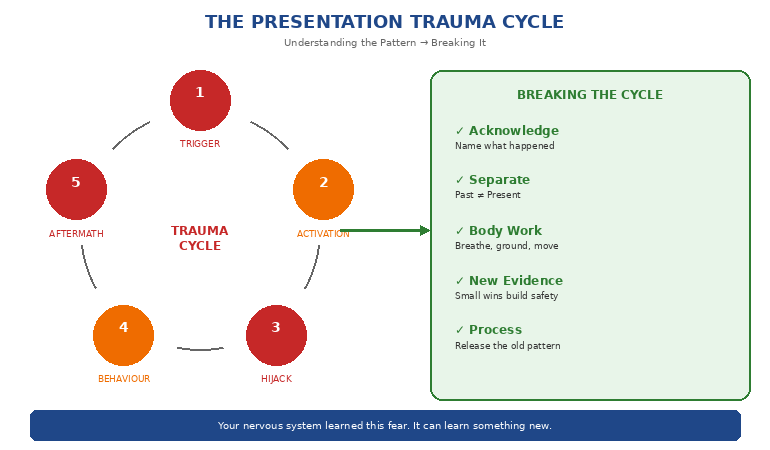
The Trauma Response Cycle

Understanding the cycle helps you interrupt it:

Stage 1: Trigger
Something reminds your nervous system of the original threat — a calendar invite, a request to present, even someone mentioning “presentation” in conversation.

Stage 2: Activation
Your fight-or-flight system activates. Heart rate increases, stress hormones release, blood flows away from your prefrontal cortex (thinking brain) toward your survival systems.

Stage 3: Hijack
Your rational mind goes offline. You can’t think clearly, can’t access your preparation, can’t remember that you’re actually safe. The past has hijacked the present.

Stage 4: Behaviour
You either fight (get defensive, speak too fast, overcompensate), flight (avoid, delegate, call in sick), or freeze (mind goes blank, voice disappears, body locks up).

Stage 5: Aftermath
Regardless of how the presentation actually went, you feel depleted, ashamed, and more convinced than ever that presenting is dangerous. The cycle reinforces itself.


Presentation trauma cycle showing trigger, response, and recovery pathway

Breaking the cycle means working with your body, not just your mind — the Conquer Speaking Fear programme (£39) is built around that principle, with guided audio that interrupts this exact pattern.

How to Release the Pattern

Recovery from presentation trauma isn’t about forcing yourself to present more (exposure therapy without proper support often makes things worse). It’s about working with your nervous system to create new associations.

Step 1: Acknowledge What Happened

Stop minimising. “It wasn’t that bad” or “I should be over it by now” keeps you stuck. Something happened that affected you. That’s real. Your response makes sense given what you experienced.

I spent years pretending my CFO moment didn’t bother me. Recovery only started when I admitted: that was humiliating, it hurt, and it changed how I felt about presenting.

Step 2: Separate Past from Present

When you notice the fear response activating, practice naming it: “This is my nervous system responding to 2018, not to today.” You’re not trying to make the feeling go away — you’re creating space between the trigger and your response.

Step 3: Work With Your Body

Because the trauma is stored in your body, body-based techniques are often more effective than cognitive ones:

  • Slow exhales: Longer exhales than inhales can help activate your parasympathetic nervous system
  • Grounding: Feel your feet on the floor, your weight in the chair — anchor yourself in the present moment
  • Movement: Shake out your hands, roll your shoulders — discharge the physical activation
  • Posture reset: Stand tall, open your chest — your body’s position affects your emotional state

Step 4: Create New Experiences

Your nervous system needs evidence that presenting can be safe. This doesn’t mean forcing yourself into high-stakes situations. It means starting small:

  • Speaking up in a meeting with one comment
  • Presenting to one trusted colleague
  • Recording yourself and watching without judgment
  • Gradually increasing the challenge as your nervous system adapts

Step 5: Process the Original Experience

Sometimes the old memory needs direct attention. Techniques like guided visualisation, timeline therapy, or working with a therapist can help you process what happened so it no longer controls your present.

This is where hypnotherapy-based approaches can be particularly effective — they work directly with the subconscious patterns that keep the trauma response active.

🧠 Nervous System Reprogramming for Presentation Trauma

Conquer Speaking Fear (£39, instant access) was created specifically for professionals carrying presentation trauma. The guided hypnotherapy session helps your nervous system release the old pattern and build new, calmer associations with speaking.

  • Work with your subconscious, not against it
  • Release the physical holding patterns
  • Build genuine confidence (not just “fake it”)
  • Three audio formats for different situations

Get Conquer Speaking Fear → £39

Instant download. Developed from hypnotherapy techniques that helped me release my own presentation trauma after five years of suffering.

Rebuilding Confidence After a Bad Experience

Once you’ve started releasing the trauma pattern, you can begin rebuilding genuine confidence:

Reframe the Original Story

The story you tell yourself about what happened matters. “I failed and everyone saw” is different from “I had a difficult experience and I survived it.”

My CFO story? I eventually reframed it: “I made an error, someone called it out publicly, and I handled a difficult moment without falling apart completely. I went back to work the next day. I kept presenting. I survived.”

Collect Counter-Evidence

Your brain has been selectively remembering the bad experience. Start noticing the neutral and positive ones. After each presentation — even a small one — note what went okay. Build a file of evidence that presenting doesn’t always mean disaster.

Prepare Differently

Trauma often creates over-preparation (spending 20 hours on a 10-minute presentation) or under-preparation (avoiding thinking about it until the last minute). Neither works.

Effective preparation for trauma recovery means: know your content well enough to feel secure, but accept that perfection isn’t the goal. Your safety doesn’t depend on getting everything right.

Build Physical Anchors

Create associations between specific physical actions and calm states. When you’re relaxed, practice a subtle gesture (touching your thumb to your finger, for example). Over time, this gesture can help trigger the calm state — giving you a tool you can use in the moment.

This anchoring technique is part of what makes nervous system-based approaches so effective for presentation anxiety.

What Recovery Actually Looks Like

Recovery from presentation trauma isn’t linear, and it doesn’t mean you’ll never feel nervous again. Here’s what realistic progress looks like:

Week 1-2: You start noticing the pattern — recognising when your nervous system is responding to the past rather than the present.

Week 3-4: The anticipatory anxiety begins to shorten. Instead of dreading a presentation for two weeks, you might dread it for a few days.

Month 2-3: You have a presentation that goes “okay” and notice it. The negative bias starts shifting.

Month 3-6: The physical symptoms become less intense. Your heart still races, but it doesn’t feel life-threatening. You can think while nervous.

Ongoing: Presenting becomes uncomfortable rather than terrifying. You can do it without it ruining your week. Eventually, some presentations feel almost… fine.

This timeline varies. Some people see significant shifts in weeks; others take longer. The key is that progress is possible — your nervous system can learn new patterns.

Frequently Asked Questions

Is “presentation PTSD” a real diagnosis?

The term is used colloquially to describe trauma-like responses to presentation experiences. Clinical PTSD is a specific diagnosis with defined criteria that requires professional assessment. However, the nervous system responses described in this article — hypervigilance, avoidance, intrusive memories, disproportionate fear responses — are real and well-documented, even if they don’t meet the clinical threshold for PTSD. Your experience is valid regardless of diagnostic labels.

How long does it take to recover from presentation trauma?

This varies significantly based on the severity of the original experience, how long ago it happened, and what support you have. Some people notice shifts within a few weeks; deeper patterns may take several months of consistent work. There’s no universal timeline — everyone’s nervous system responds differently. If you’re not seeing progress after sustained effort, consider working with a therapist who specialises in anxiety or trauma responses. The key is that recovery is possible — your nervous system learned this response, and it can learn a new one.

Should I force myself to present more to get over it?

Exposure without proper support can actually reinforce the trauma. Simply forcing yourself through more presentations while activated often strengthens the fear response. The goal is to present while regulated — which requires first developing tools to work with your nervous system. Gradual, supported exposure works; white-knuckling through high-stakes presentations usually doesn’t.

Can I fully recover, or will I always be anxious about presenting?

Most people don’t become completely anxiety-free — some presentation nerves are normal and even useful. What changes is the intensity and the control. Instead of anxiety hijacking your ability to think and speak, it becomes manageable background noise. Many people who’ve done this work eventually describe presenting as “uncomfortable but doable” rather than “terrifying and avoided at all costs.”

📬 PS: Weekly techniques for managing presentation anxiety and building genuine confidence. Subscribe to The Winning Edge — practical strategies from a hypnotherapist who’s been there.

Related: If presentation trauma is holding you back from career moments like requesting resources or budget, read The Headcount Request That Got Yes When Everyone Said No for a presentation structure that builds confidence through preparation.

That presentation from years ago — the one you still think about — doesn’t have to control your future.

Your nervous system is doing what it was designed to do: protect you from perceived threats. But the threat isn’t real anymore. The room is different. The audience is different. You are different.

Recovery is possible. Your nervous system learned to fear presenting, and it can learn something new.

It starts with acknowledging what happened, understanding why your body responds the way it does, and working with your nervous system rather than against it.

The past doesn’t have to own your present. You can let it go.

About the Author

Mary Beth Hazeldine is the Owner & Managing Director of Winning Presentations. With 25 years in corporate banking at JPMorgan Chase, PwC, Royal Bank of Scotland, and Commerzbank, she experienced presentation trauma firsthand — including five years of debilitating fear before finding techniques that actually worked.

Now a certified hypnotherapist and NLP practitioner, Mary Beth specialises in helping professionals release presentation anxiety at the nervous system level. She combines executive communication expertise with evidence-based approaches to fear and trauma recovery.

Book a discovery call | View services

09 Feb 2026
Person experiencing nervous system response before presentation with visible tension

Why Your Nervous System Remembers That Awful Presentation From 2019

It was six years ago. You’ve been promoted twice since then. You’ve delivered dozens of successful presentations. You’ve received praise, closed deals, earned respect.

And yet.

The moment you stand up to present to a group that reminds you of that room — same size, same setup, same type of senior faces watching — your heart rate spikes. Your palms dampen. Your voice tightens before you’ve said a word.

Your conscious mind knows you’re not that person anymore. Your nervous system didn’t get the memo.

I spent five years as a presentation coach wondering why intelligent, accomplished executives couldn’t “just get over” a single bad experience from years earlier. Then I trained as a clinical hypnotherapist, and everything made sense.

Your nervous system isn’t being irrational. It’s doing exactly what it evolved to do: protect you from threats it has identified. The problem is, it classified “presenting to senior stakeholders” as a survival-level threat — and it’s still running that programme.

Here’s how that happens, and more importantly, how to change it.

Quick answer: Your nervous system stores intense emotional experiences as survival data, bypassing rational thought. A humiliating or frightening presentation gets encoded the same way your brain encodes near-miss car accidents — as a threat to remember and avoid. This is why logic (“I’m prepared, I know my stuff”) doesn’t calm presentation anxiety. The response lives below conscious thought. To change it, you need techniques that work at the nervous system level, not the cognitive level.

Why Your Body Remembers What Your Mind Forgets

Your nervous system has one primary job: keep you alive.

To do this efficiently, it catalogues experiences into two categories: safe and dangerous. When something registers as dangerous, your nervous system creates a rapid-response protocol. The next time you encounter similar conditions, it triggers that protocol automatically — before your conscious mind even processes what’s happening.

This is brilliant for actual survival threats. You don’t want to consciously evaluate whether that car is going to hit you; you want your body to jump out of the way first.

The problem is, your nervous system can’t distinguish between physical danger and social danger. To your amygdala, the part of your brain that processes threat, humiliation registers the same as physical harm.

That presentation in 2019 — the one where you lost your train of thought, or the CFO cut you off, or you could see people checking their phones — your nervous system filed that as a near-death experience.

Not literally, of course. But in terms of how it’s stored and retrieved, the encoding is identical.

For a deeper understanding of the fear response, see my guide on overcoming fear of public speaking.

How Presentation Trauma Actually Forms

Not every bad presentation becomes encoded trauma. The nervous system has specific conditions for creating these rapid-response protocols:

Diagram showing how nervous system stores and retrieves presentation trauma

Condition 1: Intensity

The emotional charge needs to be high enough to trigger the encoding process. A mildly awkward presentation doesn’t create trauma. A presentation where you felt genuine humiliation, fear, or shame does.

Condition 2: Perceived helplessness

Trauma forms when you feel you had no control, no escape, no way to fix what was happening. Standing at the front of a room, unable to leave, while things fall apart — that’s a helplessness state.

Condition 3: Social evaluation

Your nervous system is especially sensitive to group judgment. Being negatively evaluated by a group — particularly a high-status group — triggers ancient threat responses related to tribal exclusion.

Condition 4: No completion

When an intense experience doesn’t have a clear resolution — when you just have to endure it until it’s over — the nervous system keeps the file “open.” It doesn’t know the threat has passed.

Put all four together, and you have the perfect recipe for a nervous system that believes presenting is genuinely dangerous.

🧠 Work With Your Nervous System, Not Against It

Conquer Speaking Fear uses clinical hypnotherapy techniques to address presentation anxiety at the nervous system level — where it actually lives. This isn’t about “thinking positive” or “power posing.” It’s about rewiring the automatic responses that hijack you before conscious thought kicks in.

  • Hypnotherapy audio sessions for nervous system reset
  • Somatic techniques to release stored presentation trauma
  • Pre-presentation protocols that calm the fear response

Get Conquer Speaking Fear (instant download) →

Developed by a clinical hypnotherapist with 24 years of corporate presentation experience.

Signs Your Nervous System Is Running an Old Programme

How do you know if your presentation anxiety is a nervous system response versus normal nerves? Here are the distinguishing signs:

The response is disproportionate to the actual risk.

You’re presenting a routine update to colleagues you’ve known for years. There’s nothing at stake. And yet your body is responding as if you’re about to face a firing squad. The gap between actual threat and physical response is the giveaway.

Logic doesn’t help.

You tell yourself you’re prepared. You remind yourself you’ve done this before. You know, rationally, that you’ll be fine. None of it makes a dent in the anxiety. That’s because the response is happening below the level where rational thought operates.

Specific triggers activate it.

Maybe it’s not all presentations — just ones with a certain type of audience, or in a certain room configuration, or with a certain person present. The specificity points to encoded memory, not generalised anxiety.

The response starts before the event.

Days before the presentation, you’re already anxious. Your sleep is disrupted. You’re running mental simulations of everything that could go wrong. Your nervous system is pre-activating the threat response.

Physical symptoms appear automatically.

Racing heart, sweating, voice tremor, shallow breathing, dry mouth, shaking hands — these aren’t choices. They’re your sympathetic nervous system activating whether you want it to or not.

If this describes your experience, see my article on Conquer Speaking Fear for techniques that work at the nervous system level.

How to Release Stored Presentation Trauma

If your presentation anxiety is encoded at the nervous system level, you need approaches that work at that level. Here’s what actually helps:

Approach 1: Somatic Release

Your body stores the incomplete threat response. Somatic techniques help complete the cycle your nervous system left open.

After a stressful presentation (or when recalling one), try this: Allow your body to shake, tremble, or move however it wants to for 2-3 minutes. This looks strange but mimics what animals do after escaping predators — they shake to discharge the stress hormones and reset their nervous system.

Approach 2: Bilateral Stimulation

Alternating stimulation of the left and right brain helps reprocess traumatic memories. You can do this by tapping alternately on your left and right knees while recalling the difficult presentation, or by moving your eyes left to right while holding the memory.

This is the basis of EMDR therapy, and it helps move memories from “active threat” to “past event” in your nervous system’s filing system.

Approach 3: Hypnotherapy

Clinical hypnotherapy accesses the subconscious directly — the level where trauma is stored. In a hypnotic state, it’s possible to revisit and reframe past experiences, essentially giving your nervous system new information about what that event meant.

This is how I work with presentation anxiety now, and it’s far more effective than any cognitive approach I used in my first decade of coaching.

Approach 4: Gradual Exposure with Safety

Controlled exposure to presentation situations — starting with low-stakes environments and gradually increasing — can help your nervous system learn that presenting doesn’t lead to the catastrophe it expects.

The key is “with safety.” Exposure without adequate support can retraumatise rather than heal.

For techniques to calm physical symptoms, see my guide on presentation breathing techniques.

🎯 Release What Your Mind Can’t Reach

The techniques that release presentation trauma aren’t the ones most training programmes teach. Conquer Speaking Fear gives you clinical hypnotherapy audio sessions designed specifically for presentation anxiety — the same approaches I use with executive clients who’ve carried these patterns for years.

Get Conquer Speaking Fear (instant download) →

Created by a qualified clinical hypnotherapist who overcame severe presentation anxiety herself.

Rewiring the Response

Releasing old trauma is half the work. The other half is giving your nervous system new experiences that create new patterns.

Stack successful experiences.

Your nervous system learns from repetition. Every presentation that goes “okay” (not perfect — just okay) adds a data point that contradicts the original trauma encoding. Over time, these accumulate into a new default expectation.

Create pre-presentation rituals.

Rituals signal safety to your nervous system. A consistent routine before presenting — the same breathing pattern, the same grounding exercise, the same mental preparation — creates predictability. Predictability calms the threat response.

Reframe the physical sensations.

The physical symptoms of anxiety and excitement are nearly identical: racing heart, heightened alertness, increased energy. You can train your nervous system to interpret these sensations as “ready” rather than “afraid” by consistently labelling them that way before presenting.

This isn’t pretending you’re not anxious. It’s recognising that the sensations themselves are neutral — it’s the interpretation that creates suffering.

Build a recovery practice.

After every presentation, take 5 minutes for nervous system recovery. Slow breathing, gentle movement, perhaps some bilateral tapping. This teaches your nervous system that presentations end, that you survive them, and that it can return to baseline.

For more calming techniques, see my guide on how to calm nerves before a presentation.

The Presentation From 2019 Doesn’t Define You

Here’s what I want you to understand: carrying presentation trauma doesn’t mean you’re weak, broken, or fundamentally anxious. It means your nervous system did what nervous systems do — it identified a threat and created a protection programme.

That programme served a purpose. It tried to keep you safe. And now it’s time to update it with new information: you’re not the person who gave that presentation in 2019. You’ve grown. You’ve learned. And with the right techniques, your nervous system can learn too.

The Conquer Speaking Fear programme was designed specifically for this — not to help you “manage” anxiety, but to address it at the level where it lives.

Because you deserve to present without that old experience hijacking your body every time.

🔓 Ready to Release What You’ve Been Carrying?

Conquer Speaking Fear combines clinical hypnotherapy, NLP techniques, and somatic practices to address presentation anxiety at the nervous system level. Stop managing symptoms. Start changing the pattern.

  • Clinical hypnotherapy audio sessions
  • Nervous system reset techniques
  • Pre-presentation calming protocols
  • 30-day email support

Get Conquer Speaking Fear (instant download) →

Created by a clinical hypnotherapist with 24 years of corporate experience and her own presentation trauma recovery story.

Frequently Asked Questions

How long does it take to release presentation trauma?

This varies significantly. Some people experience shift after a single hypnotherapy session. For others, especially those with multiple traumatic presentation experiences, it may take several weeks of consistent practice. The nervous system doesn’t operate on rational timelines — it changes when it feels safe enough to change.

Is this the same as PTSD?

Presentation trauma operates on similar mechanisms to PTSD but is typically less severe and more specific in its triggers. The nervous system encoding process is the same, which is why PTSD treatments like EMDR can be effective for presentation anxiety. However, if you have symptoms that significantly impair daily functioning, please consult a mental health professional.

Will the anxiety ever go away completely?

For most people, the goal isn’t zero anxiety — it’s functional anxiety. Some activation before presenting can actually improve performance. The goal is to move from a hijacked, disproportionate response to a manageable, appropriate one. Many people who do this work find that presentations become neutral or even enjoyable over time.

Can I do this work on my own, or do I need a therapist?

Many of these techniques can be practised independently, especially somatic release and bilateral stimulation. For deeper trauma, or if self-practice isn’t creating change, working with a qualified hypnotherapist or trauma-informed therapist can accelerate the process significantly. The audio sessions in Conquer Speaking Fear are designed to give you access to clinical techniques you can use on your own.

📧 Weekly insights: Subscribe to The Winning Edge →

Related: Difficult presentations create trauma — but so does delivering difficult news. See How to Present Cost Cuts Without Destroying Trust for the framework that protects relationships while delivering hard messages.

About the Author

Mary Beth Hazeldine is the Owner & Managing Director of Winning Presentations. After 24 years in corporate banking and consulting, she trained as a clinical hypnotherapist to address the presentation anxiety she saw (and experienced) throughout her corporate career.

Mary Beth combines executive communication expertise with clinical techniques for managing the nervous system responses that derail even the most prepared presenters. She has worked with senior professionals across industries to transform their relationship with high-stakes presentations.