Tag: presentation tips

16 Dec 2025
How to Start a Presentation: 15 Powerful Openers That Grab Attention

How to Start a Presentation: 15 Powerful Openers That Grab Attention

Quick Answer: The best way to start a presentation is to grab attention in the first 10 seconds with a surprising statistic, a bold statement, a relevant story, or a thought-provoking question. Avoid starting with “Today I’m going to talk about…” — you’ll lose your audience before you begin.

I’ve watched over 500 executive presentations in my career. Investment bankers pitching billion-pound deals. Biotech founders presenting to skeptical investors. Senior leaders defending budgets to hostile boards.

And I can tell you exactly when most of them lost their audience: the first 30 seconds.

The opening of your presentation isn’t just important — it’s everything. Get it wrong, and you’re fighting an uphill battle for the next 20 minutes. Get it right, and your audience leans in, ready to hear what you have to say.

After 25 years in investment banking at JPMorgan, PwC, RBS, and Commerzbank — plus 16 years coaching executives on high-stakes presentations — I’ve identified exactly what works. Here are 15 powerful openers that grab attention and set you up for success.

Want 50 ready-to-use opening lines?

My Presentation Openers & Closers Swipe File gives you structured opening lines for every situation — from board meetings to investor pitches.

Get 50 Opening Lines →

Why the First 10 Seconds Matter More Than Anything Else

Neuroscience tells us something uncomfortable: your audience decides whether to pay attention within the first 10 seconds. Not 10 minutes. Ten seconds.

This is called the “primacy effect” — we remember beginnings and endings far more than middles. And in those crucial first moments, your audience is asking one question:

“Is this going to be worth my time?”

If you start with “Good morning, my name is Sarah and today I’m going to talk about our Q3 results…” — you’ve already answered that question. And the answer is no.

Here’s what the best presenters do differently.

15 Powerful Ways to Start a Presentation

15 Powerful Presentation Openers Infographic

1. The Shocking Statistic

Numbers that surprise create instant engagement. The key is contrast — show them something that challenges their assumptions.

Example: “75% of venture-backed startups fail. But the companies that master investor presentations are 40% more likely to get funded. Today, I’m going to show you exactly what separates the funded from the forgotten.”

Why it works: You’ve created a gap between what they know and what they need to know. Now they have to keep listening.

2. The Bold Statement

Make a claim that’s unexpected or even slightly controversial. This triggers curiosity and positions you as someone with a point of view.

Example: “Everything you’ve been taught about presenting to boards is wrong. And it’s costing you promotions.”

Why it works: You’ve challenged the status quo. Even if they disagree, they want to hear your reasoning.

3. The Relevant Story

Stories activate different parts of the brain than data alone. A well-chosen story creates emotional connection and makes abstract concepts concrete.

Example: “Three years ago, I sat in a boardroom in Frankfurt and watched a CFO lose a £4 million budget approval in eleven words. He opened with ‘I know we’re over budget, but let me explain.’ The meeting was over before it started.”

Why it works: Stories create suspense. Your audience wants to know what happened next — and how to avoid the same fate.

4. The Thought-Provoking Question

Questions engage the brain differently than statements. They force your audience to think, which means they’re actively participating rather than passively listening.

Example: “When was the last time you sat through a presentation and thought, ‘I wish this was longer’?”

Why it works: You’ve made them smile and acknowledged a shared frustration. You’re on the same side now.

5. The “Imagine” Scenario

Invite your audience into a future state. This technique, borrowed from hypnotherapy, creates a vivid mental picture that makes your solution feel tangible.

Example: “Imagine walking into your next board presentation completely calm. You know exactly what to say. The executives are nodding. And when you finish, the CEO says, ‘That was exactly what we needed.’ What would that be worth to you?”

Why it works: You’ve made them feel the outcome before you’ve explained the process.

6. The Counterintuitive Truth

Share something that goes against conventional wisdom. This positions you as an expert with insider knowledge.

Example: “The best presentations I’ve ever seen had zero bullet points. None. And they won billion-pound deals.”

Why it works: You’ve challenged a default assumption. Now they need to understand why.

Stop Fumbling Your Presentation Openings

The Executive Slide System gives you structured opening frameworks that command attention immediately — so you walk into every presentation knowing exactly how to start.

Executive Slide System →

7. The Specific Promise

Tell them exactly what they’ll get from the next few minutes. Be specific and benefit-focused.

Example: “In the next 12 minutes, I’m going to give you the three-slide structure that’s helped my clients raise over £250 million in funding. You can implement it in your next presentation tomorrow.”

Why it works: You’ve set clear expectations and promised immediate value. They know what’s coming and why it matters.

8. The Shared Problem

Articulate the pain your audience is experiencing. When people feel understood, they trust you to provide the solution.

Example: “You’ve spent three weeks on this presentation. You’ve rehearsed it a dozen times. And you still can’t shake the feeling that when you stand up, your mind will go blank and everyone will see you’re not ready.”

Why it works: You’ve demonstrated that you understand their world. You’re not just another presenter — you’re someone who gets it.

Struggling with presentation anxiety?

My Calm Under Pressure Toolkit gives you breathing techniques, confidence frameworks, and mental preparation strategies used by professional speakers.

Get the Confidence Toolket →

9. The Behind-the-Scenes Insight

Give them access to information they wouldn’t normally have. This creates a sense of exclusivity and trust.

Example: “I’ve sat in due diligence meetings at four global banks. And I can tell you exactly what the investment committee says after you leave the room…”

Why it works: You’re offering insider knowledge. They’re getting something not everyone gets access to.

10. The Historical Parallel

Connect your topic to a famous moment in history. This adds weight and context to your message.

Example: “In 1984, Steve Jobs stood in front of shareholders and said three words that changed Apple forever. Those three words weren’t about technology — they were about belief. And they’re the same three words you need in your next pitch.”

Why it works: You’ve borrowed credibility from a known success story and created curiosity about the connection.

11. The Live Demonstration

Show rather than tell. A well-executed demo captures attention like nothing else.

Example: Start by silently walking to the front of the room, pausing for three full seconds, and making eye contact with five people before saying a word. Then say: “That silence made you pay attention. Today, I’m going to show you how to command a room before you even speak.”

Why it works: You’ve demonstrated your expertise in real-time. No one is checking their phone now.

12. The Personal Failure

Vulnerability creates connection. When you share a mistake, you become human — and your audience trusts you more.

Example: “The worst presentation of my career was in front of 200 people at a banking conference. I blanked on my own name. Literally forgot who I was. And what I learned in the next 30 seconds saved my career.”

Why it works: They want to know how you recovered. And they believe you’ll help them avoid the same fate.

13. The Unexpected Object

Bring a physical prop. Objects create visual interest and give you something to anchor your message.

Example: Hold up a single slide printout. “This is the only slide that mattered in a £50 million deal. One slide. The other 47 were background noise. Today, I’ll show you how to find your one slide.”

Why it works: Physical objects break the pattern of typical presentations. People pay attention to what’s different.

14. The Direct Challenge

Challenge your audience to think differently or take action. This creates engagement through a sense of urgency.

Example: “By the end of this presentation, you’ll either change how you open every meeting — or you’ll keep losing your audience in the first 30 seconds. The choice is yours.”

Why it works: You’ve raised the stakes. This isn’t just information — it’s a decision point.

15. The Silence

Sometimes the most powerful opening is no words at all. Strategic silence commands attention and demonstrates confidence.

Example: Walk to the front. Stand still. Look at your audience for 5 full seconds. Then, quietly: “Now that I have your attention… let’s talk about why most presentations lose it.”

Why it works: Silence is unexpected. In a world of noise, quiet commands the room.

The Openings That Kill Your Credibility

Now that you know what works, here’s what to avoid:

❌ “Can everyone hear me?” — Start as if you’re already in command.

❌ “I’m just going to quickly talk about…” — The word “just” diminishes your message before you’ve delivered it.

❌ “I know you’re all busy, so I’ll try to be quick…” — You’ve just signaled that what you’re about to say isn’t important.

❌ “Today I’m going to talk about…” — Boring. They know you’re going to talk. Show them why they should care.

❌ “Let me just share my screen…” — Technical fumbling kills momentum. Have everything ready before you speak.

❌ Apologizing for anything — Never open with an apology. It puts you on the back foot immediately.

A Powerful Opening Deserves an Equally Powerful Deck

The Executive Slide System pairs your strong opening with a decision-first slide structure that keeps executives engaged from your first word to your final ask.

Executive Slide System →

If you want opening slides that command attention from the first second, The Executive Slide System gives you 22 ready-made templates to start from.

How to Choose the Right Opening for Your Situation

Not every opener works for every context. Here’s how to match your opening to your audience:

Board presentations: Use the Bold Statement, Specific Promise, or Shocking Statistic. Executives want confidence and clarity.

Investor pitches: Use the Relevant Story, Specific Promise, or Behind-the-Scenes Insight. Investors need to trust you before they trust your numbers.

Team meetings: Use the Shared Problem, Thought-Provoking Question, or “Imagine” Scenario. Internal audiences need to feel included.

Sales presentations: Use the Counterintuitive Truth, Direct Challenge, or Personal Failure. Buyers are skeptical — surprise them.

Conference keynotes: Use the Live Demonstration, Silence, or Historical Parallel. Large audiences need theatrical moments to stay engaged.

Ready to Transform How You Present?

For immediate help:

For complete transformation:

My AI-Enhanced Presentation Mastery course covers everything — from opening to closing, from confidence to content. Live cohort starts January 2026.

Join the Maven Course →

The 30-Second Opening Framework

If you remember nothing else from this article, use this simple framework for your next presentation:

Second 1-5: Establish presence (pause, make eye contact, breathe)

Second 6-15: Hook them (statistic, story, question, or bold statement)

Second 16-25: Create relevance (why this matters to THEM)

Second 26-30: Preview the value (what they’ll get from the next X minutes)The 30-Second Opening Framework: Presence, Hook, Relevance, Preview

That’s it. Thirty seconds to change the trajectory of your entire presentation.

One More Thing — Before You Go

If you want a complete presentation system — not just a strong opening — the Executive Slide System gives you the full structure from first slide to final close.

Explore the System

What Happens After a Great Opening

A powerful opening does more than grab attention — it changes the dynamic of the entire presentation.

When you open strong, you feel more confident. Your audience is engaged. You have momentum. Everything that follows is easier.

When you open weak, you spend the rest of the presentation trying to recover. You can feel the room’s attention drifting. You rush. You doubt yourself.

The difference between a presentation that wins and one that’s forgotten often comes down to those first 30 seconds.

Choose your opening carefully. Practice it until it’s second nature. And walk into that room knowing that before you’ve even finished your first sentence, you’ve already won half the battle.


Mary Beth Hazeldine is an executive presentation coach with 25 years in investment banking (JPMorgan, PwC, RBS, Commerzbank) and 16 years training executives to present with confidence. She has trained over 10,000 executives through Winning Presentations.

Related Reading:

Frequently Asked Questions

How should I start a presentation to grab attention?

Open with a surprising statistic, a bold statement, a relevant story, or a thought-provoking question. The first 10 seconds determine whether your audience leans in or checks out. Avoid starting with your name, your agenda, or ‘Today I’m going to talk about…’ — these signal a routine presentation.

What is the best opening line for a business presentation?

The best opening lines create immediate relevance for the audience. Try a specific problem statement they recognise (‘Every quarter, we lose three days rebuilding the same slides’), a counterintuitive claim, or a brief client scenario. The key is making the audience feel the topic matters to them personally, not just to you.

How do you start a presentation without being nervous?

Prepare your opening line word-for-word and practise it until it feels natural. Arrive early, claim your space, and take one slow breath before speaking. Starting with a well-rehearsed line gives you momentum — nervousness typically drops after the first 30 seconds once you hear your own voice sounding confident.

Should I start a presentation with a joke?

Only if humour is natural to your style and the setting allows it. In executive and board settings, opening with a relevant observation or insight is more effective than a joke. A failed joke creates awkwardness that takes minutes to recover from, while a compelling question or story creates instant engagement with zero risk.

📧 The Winning Edge Newsletter

Weekly insights on executive presentations, QBR strategies, and what’s actually working in boardrooms right now.

Subscribe Free →

09 Dec 2025
Board Presentation Template 2025 - The 12-slide executive guide to boardroom success with structure used to secure £250M+ in board approvals

Board Presentation Template: The Executive’s Complete Guide to Boardroom Success [2026]

I’ve sat in boardrooms where £50 million decisions hung on a single presentation. I’ve watched executives with brilliant ideas fail because their board deck was a mess. And I’ve seen average proposals succeed because they were structured exactly right.

After 25 years $2 corporate banking — at JPMorgan Chase, PwC, Royal Bank of Scotland, and Commerzbank — I’ve delivered hundreds of board presentations. More importantly, I’ve helped clients raise over £250 million using the exact board presentation template I’m sharing today.

This isn’t theory. It’s the structure that gets budgets approved, strategies greenlit, and careers accelerated.

Need a Faster Way to Build Executive Slides?

Most executives spend hours on slides that still miss the mark. The Executive Slide System gives you a structured framework for building slides that land with senior audiences — without starting from scratch every time.

Explore the System →

What You’ll Learn in This Guide

  • The 12-slide board presentation template that works across industries
  • What board members actually want to see (and what makes them tune out)
  • Real before/after examples from clients who transformed their board decks
  • How to use AI tools like Copilot to create board presentations in 30 minutes
  • The 3 fatal mistakes that kill board presentations (and how to avoid them)

The Board Presentation Template: 12 Slides That Command the Room

12-slide board presentation template structure showing executive summary, problem, strategic alignment, solution, financial analysis, timeline, risks, resources, alternatives, governance, metrics, and the ask
Board members are busy. They’re reviewing multiple presentations, managing competing priorities, and making decisions that affect thousands of people. Your job is to make their decision easy.

Here’s the exact structure I use with clients:

Slide 1: Executive Summary (The Only Slide That Matters)

If board members only read one slide, this is it. Most presenters bury their ask on slide 15. That’s backwards.

What to include:

  • Your recommendation in one sentence
  • The investment required (money, time, resources)
  • The expected return (quantified)
  • The timeline for results

Example: “We recommend investing £2.4M in the Nordic expansion, projecting £8.2M revenue within 18 months (242% ROI) with break-even at month 11.”

That’s 28 words. A board member can read it in 5 seconds and know exactly what you’re asking for.

Slide 2: The Problem or Opportunity

Context matters. Before board members can evaluate your solution, they need to understand why it matters now.

What to include:

  • The business problem or market opportunity
  • Why it’s urgent (what happens if we don’t act)
  • Quantified impact on the business

Tip: Use the “So what?” test. After every statement, ask yourself “So what?” If you can’t answer with a business impact, cut it.

Slide 3: Strategic Alignment

Board members think in terms of strategy. Show them how your proposal connects to what they’ve already approved.

What to include:

  • Link to company strategy or board-approved priorities
  • How this advances strategic goals
  • What happens to strategy if this isn’t approved

Slide 4: The Proposed Solution

Now — and only now — do you present your solution. By this point, you’ve established the problem, the urgency, and the strategic fit.

What to include:

  • Clear description of what you’re proposing
  • Why this approach (vs. alternatives)
  • Key components or phases

⭐ BEST VALUE FOR BOARD PRESENTATIONS

Updated 27 March 2026 — Revised for the latest Microsoft Copilot and ChatGPT capabilities.

Executive Slide System

Executive Slide System — £39, instant access. Board-ready templates and AI prompts to customise them instantly.

Get the Templates →

Designed for executives presenting to boards

Slide 5: Financial Analysis

This is where most board presentations fail. Not because the numbers are wrong, but because they’re presented wrong.

What board members want to see:

  • Total investment required (not just this year — full cost)
  • Expected returns (revenue, cost savings, or both)
  • ROI calculation
  • Payback period
  • NPV if applicable

What they don’t want: 47 rows of spreadsheet data copied into PowerPoint. Summarise. If they want the detail, they’ll ask.

Slide 6: Implementation Timeline

A visual roadmap showing key milestones. Board members want to know:

  • When does this start?
  • What are the major phases?
  • When will we see results?
  • What are the key decision points?

Pro tip: Include a “Quick Win” milestone in the first 90 days. It builds confidence that you’ve thought through execution.

Slide 7: Risk Assessment

Boards don’t expect zero risk. They expect you to have identified and planned for risks.

Format that works:

  • Risk description
  • Likelihood (High/Medium/Low)
  • Impact (High/Medium/Low)
  • Mitigation strategy

Three to five risks is the sweet spot. Fewer looks naive. More looks like you’re not confident in the proposal.

Slide 8: Resource Requirements

Beyond money, what do you need?

  • People (FTEs, contractors, specific expertise)
  • Technology or infrastructure
  • External partners or vendors
  • Other departments’ involvement

Slide 9: Alternatives Considered

This slide demonstrates rigour. Show the board you’ve evaluated options:

  • Option A: Do nothing (what happens?)
  • Option B: Your recommendation
  • Option C: Alternative approach

Brief pros/cons for each. Make it obvious why your recommendation is the right choice — but let the logic speak for itself.

💡 Pro Tip: The “Alternatives Considered” slide is where AI tools like Copilot shine. Use prompts like: “Generate three strategic alternatives for [your proposal] with pros, cons, and estimated ROI for each.” You’ll get a first draft in 30 seconds that would take an hour manually.

Slide 10: Governance & Accountability

Who’s responsible? Boards want to know there’s clear ownership:

  • Executive sponsor
  • Project lead
  • Steering committee (if applicable)
  • Reporting cadence to the board

Slide 11: Success Metrics

How will we know this worked? Define 3-5 measurable KPIs:

  • What you’ll measure
  • Current baseline
  • Target
  • When you’ll measure it

This slide creates accountability — and makes your next board update much easier to structure.

Slide 12: The Ask

End where you began. Restate your recommendation clearly:

“We request board approval for £2.4M investment in Nordic expansion, with quarterly progress updates beginning Q2 2026.”

Then stop talking. The most powerful thing you can do after your ask is be silent and let the board respond.

Board presentation in the next 30 days? For a complementary approach, see our guide to executive presentation templates.

The Executive Slide System includes a 12-slide board presentation template built around the structure in this guide — plus AI prompt cards so you can customise it to your specific proposal in under an hour.

The 3 Fatal Mistakes That Kill Board Presentations

I’ve seen brilliant proposals fail because of these errors. Don’t make them.

Mistake #1: Burying the Lead

If you wait until slide 15 to reveal what you’re asking for, you’ve lost them. Board members are scanning for the bottom line. Give it to them immediately.

Fix: Put your recommendation and ask on slide 1. Everything else is supporting evidence.

Mistake #2: Data Dumping

Copying your entire financial model into PowerPoint doesn’t demonstrate rigour — it demonstrates that you don’t know how to communicate to executives.

Fix: One insight per slide. If a board member wants the backup, have it ready in an appendix or leave-behind document.

Mistake #3: Ignoring the Politics

Every board has dynamics. Who are the decision-makers? Who might oppose this? What concerns have they raised before?

Fix: Pre-wire your presentation. Talk to key board members before the meeting. Address their concerns in your deck. By the time you present, approval should feel like a formality.

Stop Guessing What to Type. Start Building in 25 Minutes.

The Executive Prompt Pack gives you 71 tested prompts for ChatGPT and Copilot — structured by scenario so you know exactly what to type:

  • Build from scratch — scenario prompts for board reviews, budget requests, and investor decks
  • Rescue and rewrite — audit an existing deck, condense it, or fix one slide at a time
  • Industry-specific prompts for financial services, banking, consulting, and executive audiences
  • Power modifiers that transform any prompt into board-ready output
  • The 25-minute deck workflow that replaces 3–4 hours of manual building

Works with ChatGPT, Microsoft Copilot, and Edit with Copilot (formerly Agent Mode). Updated March 2026.

Get the Executive Prompt Pack → £19.99

Using AI to Create Board Presentations Faster

Here’s a reality: the board presentation template I’ve shared takes 4-6 hours to create manually. With AI tools like PowerPoint Copilot’s new Agent Mode, you can get a solid first draft in 30-45 minutes.

How I use Copilot for board presentations:

  1. Structure first: Use the prompt: “Create a 12-slide board presentation structure for [proposal] requesting [amount] for [objective]”
  2. Section by section: Generate each section with specific prompts, then refine
  3. Data visualisation: “Create a chart showing ROI trajectory over 18 months with break-even at month 11”
  4. Risk assessment: “Generate 5 potential risks for [project] with likelihood, impact, and mitigation strategies”

The new Agent Mode in Copilot (released December 2025) can even research your industry and pull in relevant market data automatically.

Related: 50 Best Copilot Prompts for PowerPoint Presentations

Board Presentation Examples: Before & After

Here’s what transformation looks like:

Before: A Client’s Original Executive Summary Slide

  • Title: “Q3 Strategic Initiative Update”
  • 12 bullet points covering everything from market research to team structure
  • No clear ask
  • No financials visible
  • Required 5 minutes to explain what it meant

Board presentation transformation showing cluttered 12-bullet slide deferred twice versus clear 4-line executive summary approved unanimously

After: The Transformed Version

  • Title: “Recommendation: £2.4M Nordic Expansion”
  • 4 lines: Ask, Investment, Return, Timeline
  • Visual showing 242% ROI
  • Clear “Approve / Reject / Defer” framing
  • Understood in 10 seconds

Result: Approved unanimously in the first board meeting. The previous version had been deferred twice.

For 71 tested prompts covering every scenario — build from scratch, rescue an existing deck, or fix individual slides — the Executive Prompt Pack gives you exactly what to type, updated for the latest Copilot and ChatGPT capabilities.

What Board Members Really Think (But Won’t Tell You)

After 25 years of working with boards, here’s what I’ve learned they’re actually thinking:

“Get to the point.” They have 6 more presentations after yours. Respect their time.

“What’s this going to cost me?” Not just money — political capital, resources from other projects, risk to their reputation if it fails.

“Has this person done their homework?” They’re evaluating you as much as your proposal. Sloppy deck = sloppy thinking.

“What’s the catch?” If your proposal sounds too good to be true, they’ll assume it is. Address risks proactively.

“Can I defend this decision?” Board members are accountable to shareholders, regulators, and each other. Give them the evidence they need to say yes.

Board Presentation Checklist

Board presentation checklist with 12 verification items including executive summary on slide 1, financial analysis, risk assessment, and pre-wiring with decision makers

Before you present, verify:

  • ☐ Executive summary on slide 1 with clear ask
  • ☐ Problem/opportunity quantified with business impact
  • ☐ Strategic alignment explicitly stated
  • ☐ Financial analysis summarised (detail in appendix)
  • ☐ Implementation timeline with milestones
  • ☐ 3-5 risks with mitigation strategies
  • ☐ Alternatives considered (including “do nothing”)
  • ☐ Clear success metrics defined
  • ☐ Governance and accountability assigned
  • ☐ Final slide restates the ask
  • ☐ Presentation under 20 minutes
  • ☐ Pre-wired with key decision makers

71 Prompts. Every Scenario Covered.

Build from scratch, rescue an existing deck, or perfect individual slides — the Executive Prompt Pack covers every scenario. Works with ChatGPT, Copilot, and Edit with Copilot. Updated March 2026.

Get the Prompts → £19.99

The 12-slide structure above works for any board presentation. Getting the slides right is the hard part.

The Executive Slide System gives you all 12 slide types as ready-made templates — with AI prompt cards that generate your executive summary, risk assessment, and financial analysis in minutes.

Executive Slide System — £39, instant access.

Designed for executives presenting to boards, investors, and senior leadership teams.

Frequently Asked Questions

How long should a board presentation be?

12-15 slides maximum for the main presentation. If you need more, put it in an appendix. Most board presentations should take 15-20 minutes to present, leaving time for questions.

Should I send the board deck in advance?

Yes, always. Send it 48-72 hours before the meeting. This allows board members to review, formulate questions, and come prepared. Surprises in board meetings rarely go well.

What if a board member challenges my numbers?

Have your backup ready. Keep detailed financial models and source data accessible (laptop open, appendix printed). Answer calmly with specifics. If you don’t know something, say so and commit to following up.

How do I handle a hostile board member?

Pre-wire. If you know someone is likely to oppose your proposal, meet with them before the board meeting. Understand their concerns. Address them in your presentation. Sometimes the most vocal opponent becomes your strongest advocate when they feel heard.

Can I use animations and transitions?

Sparingly, if at all. Board members generally prefer clean, professional slides that don’t distract from the content. A subtle fade is fine. Flying text is not.

What’s the best font for board presentations?

Stick with clean, professional fonts: Arial, Calibri, or your company’s brand font. Size should be minimum 24pt for body text, 32pt+ for headers. If someone needs to squint, your font is too small.

Related Resources

Continue building your board presentation skills:


📧 The Winning Edge Newsletter

Weekly insights on executive presentations, QBR strategies, and what’s actually working in boardrooms right now.

Subscribe Free →

About the Author

Mary Beth Hazeldine spent 25 years in corporate banking at JPMorgan Chase, PwC, Royal Bank of Scotland, and Commerzbank before becoming a presentation skills specialist. She’s She’s particularly passionate about helping leaders use AI tools like Copilot to create better presentations in less time.

📂 READY TO BUILD YOUR BOARD DECK?

Get Board-Ready Templates + AI Prompts

Stop starting from scratch. Get the templates used by executives who present to boards and senior leadership.

Get the Executive Slide System →

03 Dec 2025
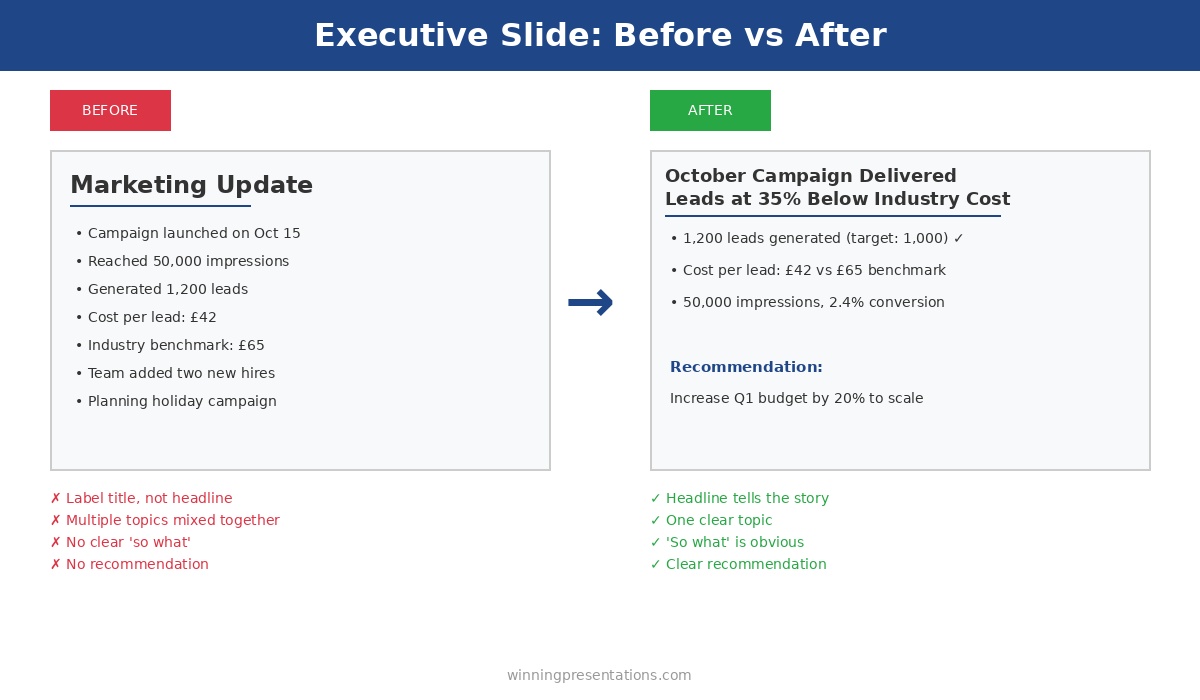
Executive slide before and after example - transforming a weak marketing update into a clear headline with recommendation

Stop Writing Slide Titles Like This (Before and After Examples)

Your slide titles are probably costing you approvals, buy-in, and promotions.

After reviewing thousands of presentations across 24 years in corporate banking and 16 years of training executives, I can tell you the single biggest mistake I see: label slide titles instead of headline slide titles.

“Q3 Financial Results” is a label. It tells me what category of information I’m about to see.

“Q3 Revenue Up 12% Despite Market Headwinds” is a headline. It tells me what I need to know — even if I never read the rest of the slide.

This distinction in slide titles sounds small. It’s not. It’s the difference between presentations that get skimmed and ignored versus presentations that drive decisions.

Here are 10 before-and-after examples to transform your slide titles today.

Executive slide before and after example - transforming a weak marketing update into a clear headline with recommendation
The same slide, transformed: label slide titles become headlines that communicate the key message

Why Slide Titles Matter More Than You Think

Executives don’t read presentations. They scan them.

They flip through slide titles looking for red flags, key decisions, and anything that requires their attention. If your slide titles are labels, you’re invisible. They’re scanning past your slide titles without absorbing anything.

But when your slide titles are headlines — complete messages that communicate the “so what” — executives can get your story just from the slide titles. They know what you’re saying before they read a single bullet point.

This changes everything about how your presentation lands.

The Slide Titles Test That Reveals Weak Presentations

Here’s how to know if your slide titles are working:

Read only the slide titles of your presentation, in order. Do they tell a coherent story? Does someone scanning just the slide titles understand your key message and recommendation?

If yes, you have headline slide titles. If no — if the slide titles are just labels that require reading the slide content — you have work to do.

Let’s fix your slide titles.

10 Slide Titles Transformations: Before and After

Slide Titles Example 1: Financial Results

❌ Before: “Q3 Financial Results” ✅ After: “Q3 Revenue Up 12%, Margins Stable at 42%”

Why this slide title is better: The executive knows exactly how the quarter went without reading anything else. The before slide title requires them to dig into the content to understand if Q3 was good or bad.

Slide Titles Example 2: Project Status

❌ Before: “Project Status Update” ✅ After: “Project Green: 3 Weeks Ahead, 10% Under Budget”

Why this slide title is better: The slide title communicates health, timeline, and budget in one line. An executive scanning these slide titles knows immediately this project doesn’t need attention.

Slide Titles Example 3: Market Analysis

❌ Before: “Competitive Landscape” ✅ After: “We Lead in 3 of 5 Categories; Gap in Enterprise”

Why this slide title is better: The slide title tells the strategic story — mostly winning, but with one clear weakness. The executive knows exactly where to focus the discussion from the slide title alone.

Slide Titles Example 4: Budget Request

❌ Before: “Budget Proposal” ✅ After: “Requesting £500K for Platform Upgrade — 6-Month Payback”

Why this slide title is better: The slide title states the ask and the return. The executive is already doing the mental math before seeing the details.

Want slide titles already written for you?

Every template in The Executive Slide System has headline-style slide titles built in — just fill in your numbers. No more staring at blank slide titles wondering what to write.

Slide Titles Example 5: Team Update

❌ Before: “Team Performance” ✅ After: “Team at Full Capacity — All KPIs Green for Q3”

Why this slide title is better: The slide title answers the question leadership actually has: is this team performing? Instead of making them hunt for the answer, your slide title delivers it immediately.

Slide Titles Example 6: Risk Assessment

❌ Before: “Risk Register” ✅ After: “2 High Risks Require Board Attention — Mitigations in Place”

Why this slide title is better: The slide title tells leadership exactly what they need to know: how many risks, severity level, and current status. They know immediately if this slide needs discussion from the slide title.

Slide Titles Example 7: Customer Metrics

❌ Before: “Customer Satisfaction” ✅ After: “NPS Up 15 Points to 72 — Highest in Company History”

Why this slide title is better: The slide title celebrates a win with specifics. The executive knows from the slide title this is good news worth acknowledging — maybe even sharing with the board.

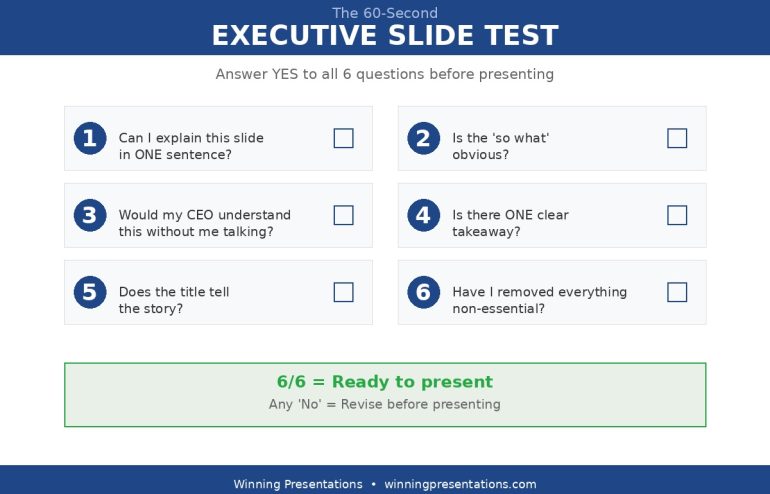
The 60-second executive slide test - 6 questions every presentation slide must pass before presenting to leadership
Testing your slide titles is #5 on the 60-second check: “Does the title tell the story?”

Slide Titles Example 8: Strategic Recommendation

❌ Before: “Strategic Options” ✅ After: “Recommend Option B: Fastest Time-to-Market at Moderate Risk”

Why this slide title is better: The slide title leads with the recommendation. The executive knows your position before reviewing the options — which focuses the discussion on your reasoning rather than re-evaluating everything from scratch.

Struggling to write strong slide titles?

The Executive Slide System includes 30 AI prompts — one specifically generates 5 headline slide title options for any slide. The same prompts I’ve used to help clients secure over £250 million in funding.

Slide Titles Example 9: Challenges

❌ Before: “Current Challenges” ✅ After: “Churn at 8% — Above Target; Mitigation Plan in Progress”

Why this slide title is better: The slide title is honest about the problem but also shows you’re addressing it. It demonstrates accountability in the slide title rather than hiding bad news behind a vague label.

Slide Titles Example 10: Next Steps

❌ Before: “Next Steps” ✅ After: “Decision Needed by Friday to Meet Q1 Launch Date”

Why this slide title is better: The slide title creates urgency and specifies exactly what you need. “Next Steps” could mean anything; this slide title tells leadership precisely what action you’re requesting.

The Slide Titles Formula That Always Works

Every strong slide title follows this pattern:

The Headline Slide Titles Formula

[Subject] + [Key Message] + [Number or Context]

Slide titles examples:

  • • “Revenue + Up 12% + Despite Market Headwinds”
  • • “Project + On Track + 3 Weeks Ahead of Schedule”
  • • “Churn + Above Target + Mitigation in Progress”

Numbers are particularly powerful in slide titles. “Performance Improved” is vague. “Performance Up 23%” is specific and credible. Wherever possible, include a number in your slide titles.

Common Slide Titles Mistakes to Avoid

Mistake 1: Single-word slide titles. “Overview,” “Summary,” “Appendix” — these slide titles tell the reader nothing. Every slide should have a message, and the slide title should communicate it.

Mistake 2: Questions as slide titles. “What Did We Learn in Q3?” forces the reader to dig for the answer. “Q3 Taught Us Enterprise Is Our Growth Engine” delivers the answer in the slide title.

Mistake 3: Slide titles that need the slide to make sense. If your slide title only makes sense after reading the content, it’s backwards. The slide title should make sense first, then the content provides supporting detail.

Mistake 4: Slide titles that are too long. Slide titles should be scannable — ideally under 12 words. If you can’t communicate your message in 12 words, your slide might be trying to say too much.

FAQs About Slide Titles

Should every slide have a headline slide title?

Yes, with rare exceptions. Even “Agenda” can become “Today: 3 Decisions Required.” The only slides that might keep label slide titles are section dividers in long presentations — and even those slide titles can often be improved.

What about title slides with just the presentation name?

Title slides are the one exception for slide titles. “Q3 Business Review” is fine as a presentation title. But slide 2 onwards should all have headline slide titles, not labels.

Won’t headline slide titles give away my conclusions too early?

That’s the point. Executives want to know your conclusions immediately. Leading with conclusions in your slide titles shows confidence and respects their time. Building suspense is for movies, not presentations.

How do I write headline slide titles for complex topics?

Focus on the “so what” for your slide titles. Even complex analysis has a key takeaway. “Analysis Results” tells me nothing. “Analysis Shows Market Entry Viable in Q2” tells me the conclusion. Start with the takeaway and work backwards to write your slide title.

Transform Your Slide Titles Today

Open your most recent presentation. Look at the slide titles only — don’t read the content.

Ask yourself: if an executive only read these slide titles, would they understand my message?

For any slide title where the answer is no, apply the formula: Subject + Key Message + Number or Context.

This takes 10 minutes. It will transform how your presentation lands.

I’ve seen careers change because of slide titles. A VP at one of my client companies told me she started getting invited to board meetings after she fixed her slide titles. The content hadn’t changed — just the slide titles. But suddenly, executives could actually see her strategic thinking instead of having to dig for it.

Your slide titles are the first thing leadership reads. Make them count.

The Executive Slide System complete package - 10 PowerPoint templates, 30 AI prompts, and quick start guide for executive presentations

Get Templates With Headline Slide Titles Built In

Stop staring at blank slides. The Executive Slide System includes 10 PowerPoint templates with headline-style slide titles already written — just fill in your numbers and present.

Plus 30 AI prompts including one that generates 5 headline slide title options for any slide.

GET INSTANT ACCESS → £39

10 templates • 30 AI prompts • Instant download • 30-day guarantee


Related: How to Create Executive Presentations That Get Approved in 2025 — the complete guide covering all 10 executive presentation types with headline slide titles and structures.

03 Dec 2025
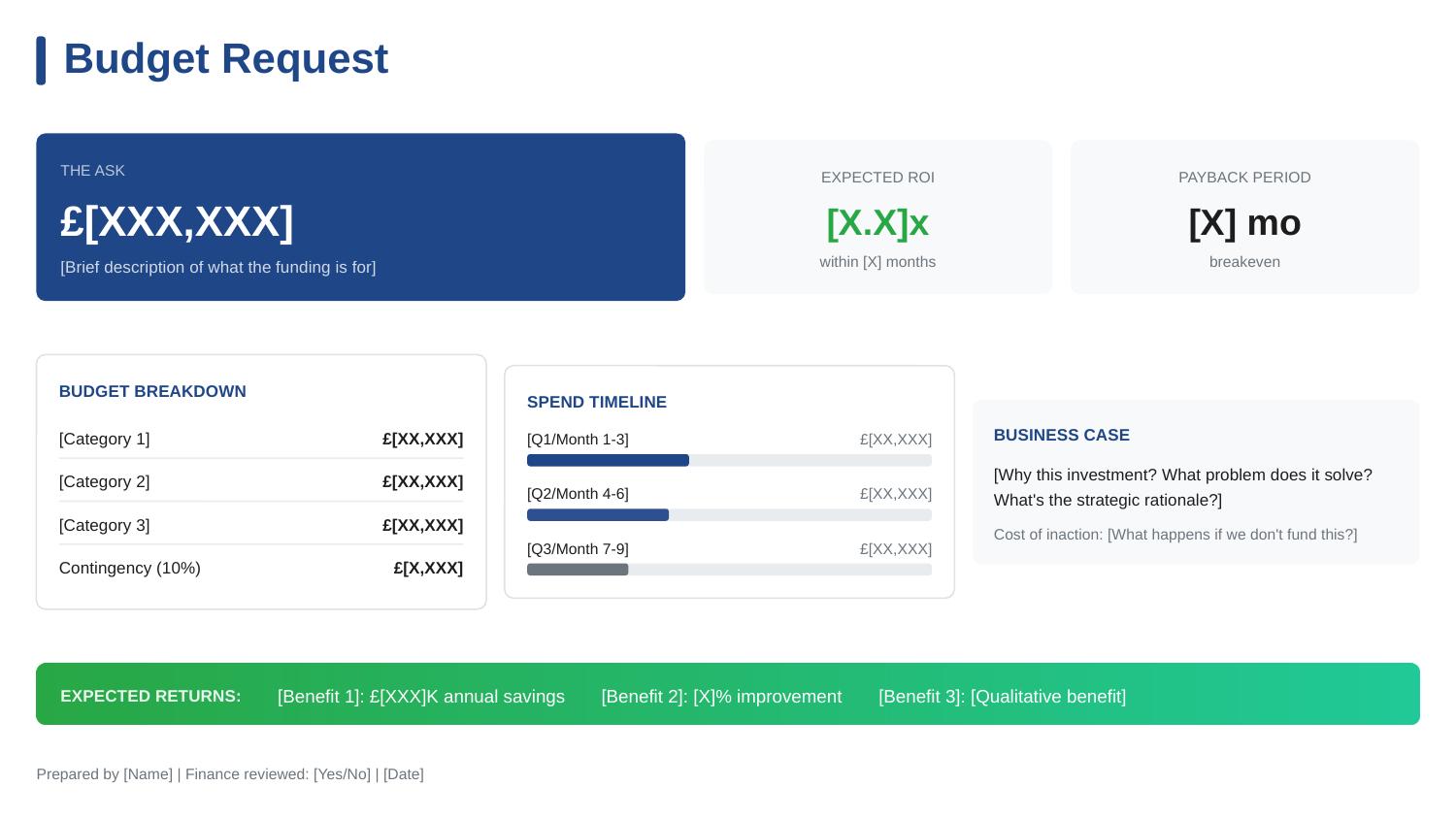
Budget request slide template - executive approval structure with ROI, cost breakdown, and payback timeline

How I Helped a Client Get a £2m Budget Approved (The Slide That Did It)

A single budget presentation slide secured £2M in funding for my client — in one 20-minute meeting.

No follow-up meetings. No “let me think about it.” No death by committee. The CFO reviewed the budget presentation, asked three questions, and approved on the spot.

This wasn’t luck. After 24 years in corporate banking at JPMorgan Chase, PwC, Royal Bank of Scotland, and Commerzbank, I’ve seen hundreds of budget presentations. Most fail — not because the request is unreasonable, but because the budget presentation makes it hard to say yes.

Here’s exactly how we structured the budget presentation that worked, and why most budget requests get stuck in approval limbo.

Budget request slide template - executive approval structure with ROI, cost breakdown, and payback timeline

The budget presentation structure that secured £2M approval

Why Most Budget Presentations Fail to Get Approved

Before I show you what worked, let me explain what doesn’t — because I see these mistakes in almost every budget presentation I review.

Mistake 1: Leading with the problem instead of the ask.

Most budget presentations spend 10 slides building up to the request. By the time the actual number appears, the executive has lost patience or checked out entirely. Your budget presentation should state the ask in the first 30 seconds.

Mistake 2: Hiding the total cost.

Some presenters break costs across multiple slides in their budget presentation, hoping the piecemeal approach makes the total less scary. It doesn’t. It makes executives suspicious. Your budget presentation needs one clear number, prominently displayed.

Mistake 3: Missing the “do nothing” cost.

Executives don’t just evaluate whether your budget presentation request is worth funding — they evaluate whether it’s worth funding compared to doing nothing. If your budget presentation doesn’t show what happens if they say no, you’ve made their decision easy: defer.

Mistake 4: No clear payback timeline.

CFOs think in terms of ROI and payback periods. A budget presentation that says “this will improve efficiency” without quantifying when and how much is asking for faith, not approval.

The Budget Presentation Structure That Got Approved

My client needed £2M for a platform modernisation project. She’d been trying to get this approved for 18 months. Previous budget presentations had been deferred three times.

Here’s what we changed in her budget presentation:

Budget Presentation Element 1: The Ask — Front and Centre

The budget presentation opened with one line:

“I’m requesting £2M for platform modernisation, with full payback in 8 months.”

That’s it. No preamble, no context-setting, no “as you may recall from previous discussions.” The CFO knew exactly what he was evaluating before she said another word.

Most budget presentations bury this on slide 8. We put it in the first sentence of her budget presentation.

Budget Presentation Element 2: The Cost of Inaction

Immediately after the ask, the budget presentation showed what happens if they don’t approve:

Cost of Doing Nothing:

  • 3 system failures per quarter at £200K each = £2.4M annual risk
  • Compliance audit finding in Q3 requires remediation by Q1 — estimated 3x cost if reactive
  • Two key engineers have cited system frustration in exit interviews

This reframed the budget presentation entirely. She wasn’t asking for £2M. She was offering to prevent £2.4M+ in annual losses. Saying no suddenly had a price tag.

Budget Presentation Element 3: The ROI Summary

The budget presentation included a simple ROI calculation — not buried in an appendix, but on the main slide:

Investment Year 1 Savings Payback
£2M £3.1M 8 months

The CFO didn’t need to do mental maths. The budget presentation did it for him. Eight-month payback is exceptional — and stating it plainly made approval easy.

Budget Presentation Element 4: The Breakdown

The budget presentation showed exactly where the money goes:

  • Platform licensing: £800K (40%)
  • Implementation partner: £600K (30%)
  • Internal resources: £400K (20%)
  • Contingency: £200K (10%)

Notice the contingency line. Most budget presentations try to appear precise by excluding contingency. Experienced CFOs know this is unrealistic. Including 10% contingency in the budget presentation actually increased credibility — it showed she understood projects don’t go perfectly.

Want the exact budget presentation template from this story?

The Budget Request template is one of 10 executive presentations in The Executive Slide System, with the budget presentation structure already built in. Just fill in your numbers.

Budget Presentation Element 5: The Decision Required

The budget presentation ended with an explicit ask:

“I’m requesting approval to proceed with vendor selection this week. The implementation timeline requires a decision by Friday to meet our Q1 compliance deadline.”

This created appropriate urgency without being pushy. The budget presentation connected the ask to an external deadline (compliance), not an internal preference. The CFO couldn’t defer without accepting compliance risk.

Executive slide before and after example - transforming a weak marketing update into a clear headline with recommendation

Most budget presentations bury the ask and miss the cost of inaction — the structure makes the difference

The Three Questions the CFO Asked About the Budget Presentation

After reviewing the budget presentation, the CFO asked exactly three questions:

Question 1: “What’s the confidence level on the £3.1M savings?”

She was ready for this. “Conservative estimate based on eliminating current incident costs only. Doesn’t include productivity gains or reduced technical debt — those would add another £500K-800K annually.”

Question 2: “Why 10% contingency?”

“Industry standard for projects of this complexity. If we don’t use it, it returns to the budget. But I’d rather ask for it now than come back in Q3 asking for more.”

Question 3: “Who’s the implementation partner?”

“We’ve shortlisted three. I’ll bring the recommendation to you next week — but I need budget presentation approval to proceed with final negotiations.”

Three questions. Twenty minutes total. Budget presentation approved.

The Budget Presentation Framework That Works Every Time

Here’s the framework for any budget presentation, based on what I’ve seen work across hundreds of requests:

Budget Presentation Framework

  1. The Ask: Total amount requested — first sentence of your budget presentation
  2. The ROI: Expected return with specific payback timeline
  3. The Cost of Inaction: What happens if they say no — make this concrete
  4. The Breakdown: Where the money goes — include contingency
  5. The Timeline: Key milestones and when returns materialise
  6. The Decision: Exactly what approval you need and by when

Every element of this budget presentation framework serves the same purpose: making it easy for the approver to say yes. A budget presentation isn’t about impressing people with analysis — it’s about removing obstacles to approval.

Building a budget presentation this quarter?

The Executive Slide System includes the Budget Request template with this exact budget presentation structure, plus AI prompts that help you calculate and present ROI clearly. Clients have used these frameworks to secure over £250 million in approved funding.

Common Budget Presentation Mistakes to Avoid

Don’t split the request across meetings. “Phase 1 is £500K, we’ll discuss Phase 2 later” invites approval for Phase 1 and indefinite deferral of everything else. If you need £2M, ask for £2M in one budget presentation.

Don’t undersell contingency. Asking for the bare minimum in your budget presentation signals either inexperience or sandbagging. Include 10-15% contingency and explain why.

Don’t assume they remember previous conversations. Your budget presentation should stand alone. Include all context needed to decide — don’t rely on “as we discussed.”

Don’t hide risks. If there’s implementation risk or dependency on other projects, address it in your budget presentation. Finding out later destroys trust.

FAQs About Budget Presentations

How long should a budget presentation be?

One slide for budget presentation requests under £500K. Two to three slides for larger requests. If your budget presentation is longer than 5 slides, you’re including too much detail — move supporting analysis to an appendix.

Should I present multiple options in a budget presentation?

Only if the options represent genuinely different approaches in your budget presentation. “Option A: £2M for full scope, Option B: £1M for reduced scope” can work. “Option A: £2M, Option B: £1.8M, Option C: £2.2M” just creates confusion.

What if my budget presentation gets deferred?

Ask specifically what’s needed to approve your budget presentation. “What additional information would help you decide?” is better than accepting “we need to think about it.” Get concrete next steps before leaving the room.

How do I present a budget presentation when ROI is hard to quantify?

Focus on risk reduction and cost avoidance in your budget presentation. “This prevents £X in potential losses” is often more compelling than “this generates £X in new revenue.” Executives understand downside protection.

Your Next Budget Presentation

You probably have a budget presentation coming up — next quarter if not sooner. Before you build another slide, apply this framework:

  • State the total ask in the first sentence of your budget presentation
  • Show the cost of doing nothing
  • Include a clear ROI with payback timeline
  • Break down where the money goes (with contingency)
  • End with the specific decision you need

This budget presentation structure won’t guarantee approval — bad ideas still fail. But it will ensure that good ideas don’t fail because of poor budget presentation structure.

My client’s £2M request had been deferred three times over 18 months. Same project, same numbers, same business case. The only thing that changed was how the budget presentation was structured.

Twenty minutes later, she had approval.

The Executive Slide System complete package - 10 PowerPoint templates, 30 AI prompts, and quick start guide for executive presentations

Get the Budget Presentation Template

The exact budget presentation structure from this story is built into The Executive Slide System — ready to fill in with your numbers. Plus 9 more executive presentation templates and 30 AI prompts.

Clients have used these budget presentation frameworks to secure over £250 million in approved funding.

GET INSTANT ACCESS → £39

10 templates • 30 AI prompts • Instant download • 30-day guarantee


Related: How to Create Executive Presentations That Get Approved in 2025 — the complete guide covering all 10 executive presentation types, including the budget presentation structure.

01 Dec 2025
The 60-second executive slide test - 6 questions every presentation slide must pass before presenting to leadership

The 60-Second Test Every Executive Slide Should Pass

Every executive slide you create gets judged in three seconds.

That’s how long leadership spends deciding whether your slide is worth reading — or skipping. After reviewing thousands of executive slides across 25 years in corporate banking at JPMorgan Chase, PwC, and Royal Bank of Scotland, I’ve found that the same six problems kill presentations over and over.

The good news: you can catch all of them in 60 seconds.

Here’s the executive slide test I run before anything leaves my desk. My clients have used these same standards to present slides that helped raise

The 60-second executive slide test - 6 questions every presentation slide must pass before presenting to leadership
The 60-second executive slide test — print this and use it before every presentation

The 60-Second Executive Slide Test

Six questions. Answer “yes” to all six, or revise before presenting.

1. Can I explain this executive slide in ONE sentence?

This is the clarity test.

If you need two sentences to explain what a slide is about, the slide is trying to do too much. Split it or simplify it.

I once watched a director present a “Project Update” slide that covered timeline, budget, risks, team changes, and next steps. Five topics, one slide. The executive’s response: “What’s the headline here?”

There wasn’t one. That’s the problem.

The fix: Before you add anything to an executive slide, write one sentence describing what it communicates. If you can’t write that sentence, you don’t have a clear slide yet.

Examples:

  • Weak: “This slide shows our Q3 performance across several dimensions including revenue, costs, and headcount, with some notes on challenges.”
  • Strong: “This slide shows Q3 revenue beat target by 12%.”

The strong version might need supporting slides for costs and headcount. That’s fine. One clear message beats three muddy ones.

2. Is the “so what” obvious on this executive slide?

This is the relevance test.

Every executive slide should answer an unspoken question: why am I looking at this?

Data without interpretation is just noise. “Revenue was £4.2M” tells me a number. “Revenue was £4.2M — 15% above target, driven by Enterprise expansion” tells me what it means.

Executives don’t have time to figure out why something matters. That’s your job. If the “so what” isn’t obvious within three seconds, you’ve failed.

The fix: Add the implication to every data point. Don’t just show the number — show what it means for the business, the project, or the decision at hand.

Examples:

  • Weak: “Customer churn: 8.3%”
  • Strong: “Customer churn: 8.3% — above 5% threshold, requires immediate action”

3. Would my CEO understand this executive slide without me talking?

This is the standalone test.

Here’s something most people don’t think about: your slides will get forwarded. The executive you present to will send them to their boss, their peers, their team. Those people won’t have you there to explain.

Your executive slide needs to communicate without a voiceover.

This doesn’t mean cramming in more text. It means the text you include must be self-explanatory. No jargon that requires context. No acronyms without definitions. No charts that need narration to interpret.

The fix: Imagine emailing this slide to someone who wasn’t in the room. Would they understand it? If not, what’s missing?

Test it: Show the slide to a colleague for 10 seconds. Ask them what it’s about. If they can’t tell you, it doesn’t stand alone.

4. Is there ONE clear takeaway from this executive slide?

This is the focus test.

Multiple messages = no message.

When you put three key points on an executive slide, the audience remembers zero. When you put one point on a slide, they remember one. The maths is simple.

I know it feels efficient to pack information together. It’s not. It’s confusing. Executives are scanning while half-listening to you and thinking about their next meeting. Give them one thing to take away, and they might actually take it.

The fix: Identify the single most important thing you want the audience to remember. Make that the headline. Everything else is supporting evidence.

The discipline: If you have three key points, you have three slides. Accept it.

5. Does the title tell the story?

This is the headline test — and it’s where most executive slides fail.

“Q3 Financial Results” is a label, not a title. It tells me what category of information I’m about to see. It tells me nothing about what I should think or do.

“Q3 Revenue Up 12% Despite Market Headwinds” is a headline. It delivers the message before I read anything else. If I’m scanning a 30-slide deck, I can get the story just from the titles.

This is how executives actually read presentations. They scan titles, look for red flags, and only dig into detail when something catches attention. If your titles are labels, you’re invisible.

The fix: Rewrite every title as a complete sentence that communicates the key message. The title should make sense even if the audience reads nothing else on the executive slide.

Examples:

  • Label: “Project Status” → Headline: “Project On Track for March Launch”
  • Label: “Q3 Hiring Update” → Headline: “Q3 Hiring Complete — Team at Full Capacity”
  • Label: “Budget Analysis” → Headline: “Budget Request: £250K for Q1 Platform Upgrade”

6. Have I removed everything non-essential?

This is the discipline test.

Every element on your executive slide should earn its place. Every bullet point, every data label, every logo in the corner. If it doesn’t contribute to your one message, it’s noise.

This is hard because it feels like deleting things is losing value. It’s not. It’s adding clarity. The stuff you remove wasn’t helping — it was competing for attention with the stuff that matters.

The fix: Go through every element and ask: “Does this help communicate my one key message?” If the answer is no, delete it.

Common offenders:

  • Decorative images that don’t convey information
  • Logos on every slide (once at the start is enough)
  • Data points that don’t support the main message
  • Bullet points that repeat what the title already said
  • “Agenda” or “Overview” slides that waste time

Want this checklist as a printable PDF?

The “Before You Present” cheat sheet is included in The Executive Slide System — the same templates and prompts my clients use to present at board level. One client used these frameworks to secure significant funding.

How to Test Every Executive Slide in 60 Seconds

Don’t try to run all six questions in your head. Print this list or keep it on a sticky note by your monitor.

For every executive slide:

  1. Finish the slide
  2. Step away for 2 minutes (get coffee, check email)
  3. Come back with fresh eyes
  4. Run through all six questions
  5. Fix any “no” answers before moving on

This takes 60 seconds per slide. For a 10-slide deck, that’s 10 minutes of quality control. It will save you from the “what’s the point of this slide?” question that derails presentations.

The Executive Slide System includes slide templates that are pre-built to pass this test — so you start from a position of strength every time.

What Executives Are Really Thinking

These six tests map directly to what leadership thinks when reviewing your executive slides: For the full framework on how executives actually evaluate presentations, see our guide on executive presentation skills CEOs use.

Your Test What the Executive Is Thinking
Can I explain this in one sentence? “What is this about?”
Is the “so what” obvious? “Why should I care?”
Would my CEO understand this? “Can I forward this to my boss?”
Is there ONE clear takeaway? “What do I need to remember?”
Does the title tell the story? “Can I skim this deck?”
Have I removed everything non-essential? “Is this going to waste my time?”

When you pass all six tests, you’ve built an executive slide that answers every question before they ask it.

Real Example: Executive Slide Before and After

Here’s how the test works in practice.

BEFORE — The typical executive slide:

Title: “Marketing Update”

  • Campaign launched on Oct 15
  • Reached 50,000 impressions
  • Generated 1,200 leads
  • Cost per lead: £42
  • Industry benchmark: £65
  • Team added two new hires
  • Planning holiday campaign

Running the test:

  1. One sentence? No — covers campaign performance, team changes, and future plans.
  2. “So what” obvious? Partially — benchmark comparison hints at success, but it’s buried.
  3. Standalone? No — “Campaign” and “holiday campaign” need context.
  4. One takeaway? No — at least three different topics.
  5. Title tells story? No — “Marketing Update” is a label.
  6. Non-essential removed? No — team hires and future plans don’t belong with campaign metrics.

Score: 0/6. This executive slide needs work.

Executive slide before and after example - transforming a weak marketing update into a clear headline with recommendation
The same information, restructured: label title → headline title, data dump → clear recommendation

AFTER — The revised executive slide:

Title: “October Campaign Delivered Leads at 35% Below Industry Cost”

  • 1,200 leads generated (target: 1,000) ✓
  • Cost per lead: £42 vs. £65 industry benchmark
  • 50,000 impressions, 2.4% conversion rate
  • Recommendation: Increase Q1 budget by 20% to scale results

Running the test again:

  1. One sentence? Yes — “Our campaign outperformed on cost efficiency.”
  2. “So what” obvious? Yes — we beat the benchmark, so we should do more.
  3. Standalone? Yes — all terms are clear.
  4. One takeaway? Yes — the campaign worked, scale it up.
  5. Title tells story? Yes — headline delivers the key message.
  6. Non-essential removed? Yes — team hires and holiday planning are separate slides now.

Score: 6/6. This executive slide is ready.

Print This Executive Slide Checklist

Here’s the test in a format you can print or screenshot:

The 60-Second Executive Slide Test

Answer “yes” to all six before presenting

  1. ☐ Can I explain this slide in ONE sentence?
  2. ☐ Is the “so what” obvious?
  3. ☐ Would my CEO understand this without me talking?
  4. ☐ Is there ONE clear takeaway?
  5. ☐ Does the title tell the story?
  6. ☐ Have I removed everything non-essential?

What Happens When You Skip the Executive Slide Test

I’ll tell you exactly what happens, because I’ve seen it hundreds of times. In many cases, the decision was already leaning one way — and a weak slide just confirmed it.

You present a slide. An executive asks a clarifying question. You answer. They ask another question. You realise you’re explaining things that should have been on the slide in the first place. The meeting runs long. The decision gets deferred. You leave thinking “that could have gone better.”

For executives who refuse to leave slide quality to chance, the Executive Slide System (£39) provides the frameworks and templates to get it right the first time.

It could have. Sixty seconds of review would have caught the problem.

The executives I’ve worked with at JPMorgan, PwC, and Royal Bank of Scotland didn’t get to those positions by tolerating unclear communication. They have no patience for slides that waste their time. And they shouldn’t.

Your job is to make their job easier. The 60-second test is how you do it.

Every Slide You Present Is a 60-Second Decision About Your Credibility

The Executive Slide System gives you 12 structured slide templates that pass the 60-second test every time — plus AI prompt cards and frameworks to build executive-ready decks in under an hour. No more second-guessing whether your slides will land.

Get the Executive Slide System

Used by VPs and directors at FTSE 250 companies before board reviews and investor meetings.

FAQs About Executive Slides

How many bullet points should an executive slide have?

Three to five maximum. If you have more than five bullets, you’re trying to say too much. Split the content across multiple slides or cut what’s non-essential.

Should I use complete sentences in bullet points?

Fragments are fine for bullets, but your title should always be a complete sentence that communicates the key message. Bullets support the title — they don’t replace it.

How do I know if my executive slide is too busy?

Apply the squint test: squint at your slide from arm’s length. If you can’t identify the main message and structure, it’s too busy. Simplify until the hierarchy is obvious.

What’s the ideal number of slides for an executive presentation?

Fewer than you think. For a 30-minute meeting, aim for 8-12 slides maximum. That’s about 2-3 minutes per slide, which leaves time for discussion. Executives prefer fewer, clearer slides over comprehensive data dumps.

The Winning Edge — Free Weekly Newsletter

Every Thursday, one executive communication tactic you can use immediately. No fluff. No theory. Just what works in real boardrooms.

Subscribe Free

Your Next Executive Slide

Open your last presentation. Pick one slide — any slide. Run the test.

I’d bet money at least one question comes back “no.”

Fix it. Then do the next slide. By the time you’ve done 10 slides, the test will be automatic. You’ll start catching problems while you’re still building, not after you’re done.

That’s when your executive slides start getting approved instead of questioned.

The Executive Slide System complete package - 10 PowerPoint templates, 30 AI prompts, and quick start guide for executive presentations


Related: How to Create Executive Presentations That Get Approved in 2025 — the complete guide covering all 10 executive presentation types with structures and AI prompts.

10 Nov 2025
Professional using Copilot PowerPoint prompts to create executive presentation

50 Best Copilot PowerPoint Prompts That Actually Work [2026]

The best Copilot PowerPoint prompts follow a 5-element formula: Action + Content Type + Topic/Data + Audience + Tone/Style. Vague prompts like “make a slide about revenue” produce generic output. Specific prompts like “Create a revenue slide showing Q3 results for the board with a waterfall chart and 3 key drivers” produce executive-ready slides. Below you’ll find 50+ copy-paste prompts organised by category — updated for Agent Mode — plus the modifiers that control layout, tone, and structure.

📋 Jump to Section:

⚡ Presenting Tomorrow? The 3-Step Rescue

Updated 27 March 2026 — Revised for the latest Microsoft Copilot and ChatGPT capabilities.

No time to read 50 prompts. Use this:

  1. Open your draft deck in PowerPoint with Copilot enabled
  2. Paste this prompt: “Review this presentation for a [senior leadership / board / client] audience. Identify the 3 weakest slides and suggest specific improvements for clarity and impact.”
  3. Then for each weak slide: “Rewrite this slide for a time-poor executive. Lead with the insight, not the data. Maximum 3 bullets, 10 words each.”

That sequence alone has rescued dozens of decks the night before high-stakes meetings.

“I’ve wasted three hours trying to fix this. Copilot is useless.”

That message landed in my inbox last month from a Director at a consulting firm. She’d typed “Create a client presentation about our Q3 results” and gotten 12 slides of generic bullet points, stock icons, and zero insight.

I asked her to try one prompt I’d refined over months of testing: a 47-word instruction that specified the slide type, the three metrics that mattered, the audience (partner-level), and the tone (data-driven, no fluff). Seven minutes later, she had a board-ready executive summary.

The difference wasn’t the tool. It was the prompt.

After testing hundreds of variations with clients across banking, biotech, and SaaS — and now with Agent Mode changing the workflow — I’ve identified the patterns that consistently produce slides worth presenting. Here they are.

Looking for ready-to-use AI prompts for executive presentations?

The Executive Prompt Pack gives you 71 structured prompts for ChatGPT and Copilot — covering board decks, investor pitches, quarterly reviews, and strategy presentations.

Explore the Prompt Pack →

Why Most Copilot Prompts Fail (And How to Fix Them)

After training professionals on Microsoft Copilot for PowerPoint over the past year, I see the same three mistakes repeatedly:

Mistake 1: Prompts Are Too Vague

Examples that fail:

  • “Make this look professional.”
  • “Improve this slide.”
  • “Create a presentation about marketing.”

Vague prompts force Copilot to guess. That’s how you get slides that could belong to any company in any industry. Related: Fix Generic Copilot Slides in 5 Minutes

Mistake 2: Prompts Are Overloaded

Example: “Create a 45-slide board presentation covering Q1–Q4 performance, market trends, competitor analysis, customer feedback, operational improvements, and financial projections with detailed charts and executive summaries.”

Overloaded prompts produce unfocused decks. You still end up rebuilding most of it.

Mistake 3: No Audience, No Objective

Most prompts never mention who the deck is for, or what the slide must achieve (decision, approval, update). Copilot then defaults to safe, generic language that doesn’t drive action.

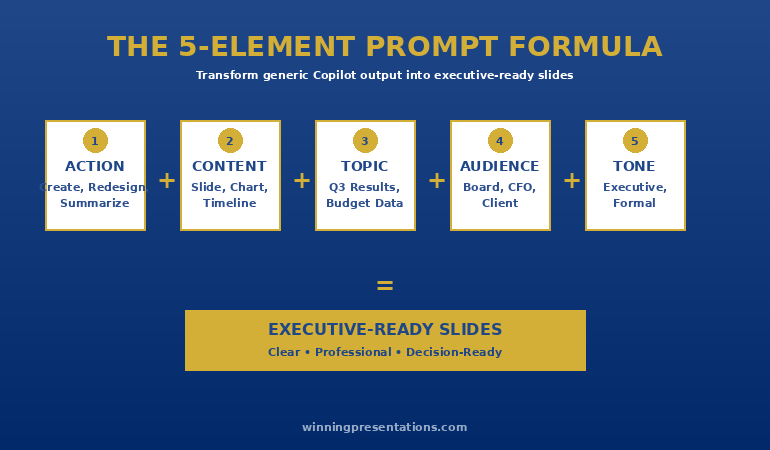
The 5-Element Copilot Prompt Formula

Every effective Copilot prompt includes these five elements:

  1. Action — what you want (create, rewrite, summarise, improve)
  2. Content Type — slide type or section (agenda, executive summary, comparison, roadmap)
  3. Topic & Data — what it’s about and the key numbers/messages
  4. Audience — who will see it (board, investors, internal team, clients)
  5. Tone & Style — how it should sound and look (executive, concise, data-driven, clean layout)

Formula: Action + Content Type + Topic/Data + Audience + Tone/Style

Example:

“Create a 7-slide executive update for the senior leadership team on our Q4 2025 results. Include: headline results, key drivers, risks, mitigation actions, and 3 decisions we need from them. Use a concise, data-driven tone and a clean layout with generous white space and minimal text per slide.”

Power Modifiers That Instantly Improve Output

Add these phrases to almost any prompt:

  • “Use a clean, minimalist layout with plenty of white space.”
  • “Avoid clipart or cartoon icons.”
  • “Keep bullets concise — maximum 10 words per bullet.”
  • “Write for a time-poor executive audience.”
  • “Highlight the three most important points.”

For a complete tutorial on Copilot’s capabilities, see our PowerPoint Copilot Complete Guide.

The 5-Element Copilot Prompt Formula showing Action plus Content Type plus Topic and Data plus Audience plus Tone and Style equals executive-ready slides

Agent Mode Prompts

Microsoft’s Agent Mode introduces conversational AI that builds presentations through multi-turn dialogue. Instead of writing one detailed prompt and hoping, you can have a back-and-forth conversation where Copilot asks clarifying questions and refines as you go.

What Agent Mode adds:

  • Conversational slide creation — describe what you need, answer Copilot’s questions, iterate
  • Work IQ — Copilot remembers your preferences across sessions
  • SharePoint Asset Library integration — pulls brand-approved images automatically
  • “Explain this” feature — select any text, table, or slide for instant explanation
  • Image editor integration — edit images directly within PowerPoint

Note: Availability varies by organisation, platform, and rollout schedule. Check your Microsoft 365 Copilot release notes or tenant settings for current feature access.

Agent Mode Conversation Starters (Prompts 51-55)

51. Full Deck Build: “I need a 10-slide board presentation on our Q4 results. Can you help me build it slide by slide? Start by asking what metrics matter most to my board.”

52. Iterative Refinement: “I have a draft deck open. Walk me through each slide and suggest improvements. Ask me questions about audience and purpose as we go.”

53. Brand-Consistent Build: “Create a client presentation using our corporate template. Pull images from our SharePoint asset library. Ask me about the key messages before you start building slides.”

54. Multi-Source Integration: “I’m referencing /Q4-report.docx and /sales-data.xlsx. Build a presentation that tells the story of our quarter. Ask clarifying questions about what to emphasise.”

55. Rapid Revision: “Make slide 3 more visual. Add a timeline to slide 5. Change the tone of slide 7 to be more confident. Then show me the updated deck.”

Old workflow: Write detailed prompt → Wait → Review → Write another prompt → Wait → Fix manually

Agent Mode workflow: Describe what you need → Answer Copilot’s questions → Watch slides generate → Say “make slide 3 more visual” → Done

Executive Summary & High-Level Slides (Prompts 1-5)

1. Executive One-Slider: “Create a one-slide executive summary for [audience] explaining [project/initiative]. Include: 1 key headline, 3 bullet points on impact, and 1 clear ask. Write for very busy senior leaders.”

2. Board-Level Update: “Create a board update slide summarising [topic, e.g., Q4 performance]. Focus on: results vs target, 3 key drivers, and 2 decisions required from the board. Use concise, non-technical language.”

3. Strategic Recommendation: “Create a strategic recommendation slide that compares Option A vs Option B for [decision]. Show: summary, pros/cons, risks, and a recommended option with one-sentence justification.”

4. Leadership Snapshot: “Create a one-slide ‘Leadership Snapshot’ for [initiative]. Include: current status (RAG), top 3 wins, top 3 risks, and the next major milestone with date.”

5. Vision Slide: “Create a vision slide for [programme/strategy] that explains: where we are now, where we want to be in 3 years, and the high-level path to get there. Use simple, inspiring language.”

For more on executive summary slides, see: The Executive Summary Slide: How to Write the Only Slide That Matters

Stop Guessing What to Type. Start Building in 25 Minutes.

The Executive Prompt Pack gives you 71 tested prompts for ChatGPT and Copilot — structured by scenario so you know exactly what to type:

  • Build from scratch — scenario prompts for board reviews, budget requests, and investor decks
  • Rescue and rewrite — audit an existing deck, condense it, or fix one slide at a time
  • Industry-specific prompts for financial services, banking, consulting, and executive audiences
  • Power modifiers that transform any prompt into board-ready output
  • The 25-minute deck workflow that replaces 3–4 hours of manual building

Works with ChatGPT, Microsoft Copilot, and Edit with Copilot (formerly Agent Mode). Updated March 2026.

Get the Executive Prompt Pack → £19.99

Data & Chart Slides (Prompts 6-10)

6. Revenue Performance: “Create a revenue performance slide showing [time period] actual vs target, with % variance and 3 drivers of the result. Use a clean chart plus 3 short bullets interpreting the data.”

7. KPI Dashboard: “Create a KPI dashboard slide for [business area]. Show 5–7 KPIs with current value, target, and RAG status, plus one line under the chart summarising overall performance.”

8. Trend Analysis: “Create a slide showing the trend for [metric] over the last [X] quarters. Include a simple line chart and 3 bullets explaining what changed, why, and what it means.”

9. Before/After Impact: “Create a before/after comparison slide showing the impact of [initiative]. Left side: baseline metrics. Right side: improved metrics. Underneath, add 3 bullets on what drove the improvement.”

10. Risk Heatmap: “Create a risk heatmap slide for [project]. Show likelihood on one axis and impact on the other, with 6–9 key risks plotted. Add 3 bullet points summarising overall risk posture.”

These prompts give you content — but keeping them organised matters. The Copilot Prompt Pack (£9.99) has all 55 prompts sorted by slide type so you can find what you need in seconds.

Story & Narrative Slides (Prompts 11-15)

11. Problem–Solution Story: “Create a slide that tells the story of [client/problem]. Structure it as: context, problem, impact if not solved, our solution, and expected outcome. Use concise, story-like language.”

12. Customer Journey: “Create a customer journey slide showing the stages from [awareness] to [renewal or advocacy] for [customer segment]. Highlight pain points in red and opportunities in green.”

13. Case Study: “Create a one-slide case study describing how we helped [client] achieve [result]. Include: client situation, what we did, and quantified outcome. Use 3–5 short bullets.”

14. Before/After Storyboard: “Create a two-column slide comparing the ‘Before’ and ‘After’ experience of [process/solution] from the user’s perspective. Use 3 bullets per column with clear, specific language.”

15. Origin Story: “Create a slide telling the origin story of [project or product]. Explain why it started, what problem it aims to solve, and what success looks like. Use simple, engaging language.”

Meeting, Agenda & Structure Slides (Prompts 16-20)

16. Value-Focused Agenda: “Create an agenda slide for a [type of meeting] with 4–6 items. For each item, include one line explaining the value or outcome for the audience, not just the topic.”

17. Decision-Focused Agenda: “Create an agenda slide for a decision-focused meeting with [stakeholders]. Emphasise: context, options, evaluation, recommended decision, and next steps.”

18. Timeline / Roadmap: “Create a timeline slide showing [project] phases from [start date] to [end date]. Include 5–7 key milestones with dates. Use a horizontal visual layout.”

19. Next Steps: “Create a ‘Next Steps’ slide with 4–6 action items. For each, include: owner, deadline, and one-line description. Format as a clear table or list.”

20. Meeting Recap: “Create a meeting recap slide summarising: key decisions made, open questions, action items with owners, and date of next meeting. Keep it to one page.”

Comparison & Evaluation Slides (Prompts 21-25)

21. Option Comparison Table: “Create a comparison slide evaluating [Option A] vs [Option B] vs [Option C]. Use a table with rows for: cost, timeline, risk, and strategic fit. Highlight the recommended option.”

22. Vendor Evaluation: “Create a vendor comparison slide for [category]. Compare 3–4 vendors on: features, pricing, support, and implementation time. Use a scoring system (1–5) and highlight the winner.”

23. Pros and Cons: “Create a pros and cons slide for [decision]. Two columns: 4–5 pros on the left, 4–5 cons on the right. Add a summary line at the bottom with a recommendation.”

24. Feature Matrix: “Create a feature comparison matrix for [product/service]. Rows = features, columns = competitors. Use checkmarks for included features, X for missing. Highlight our advantages.”

25. Investment Prioritisation: “Create a prioritisation slide for [initiatives]. Use a 2×2 matrix with ‘Impact’ on one axis and ‘Effort’ on the other. Plot 6–8 initiatives and label each quadrant.”

Comparison slides are where presentations win or lose. If you’re presenting options to leadership, having the right prompt ready makes the difference. The Copilot Prompt Pack (£9.99) includes prompts for every decision-slide type.

For 71 tested prompts covering every scenario — build from scratch, rescue an existing deck, or fix individual slides — the Executive Prompt Pack gives you exactly what to type, updated for the latest Copilot and ChatGPT capabilities.

Financial & Budget Slides (Prompts 26-30)

26. Budget Request: “Create a budget request slide for [project]. Include: amount requested, what it funds, expected ROI, and payback period. Write for a CFO audience.”

27. P&L Summary: “Create a P&L summary slide showing [time period] results. Include: revenue, costs, gross margin, operating expenses, and net income. Compare to budget and prior year.”

28. ROI Calculation: “Create an ROI slide for [investment]. Show: total investment, expected returns over 3 years, payback period, and key assumptions. Use a simple table format.”

29. Cost Breakdown: “Create a cost breakdown slide for [project/initiative]. Show categories as a pie chart or bar chart, with percentages and absolute values. Highlight the largest cost driver.”

30. Forecast vs Actual: “Create a forecast vs actual slide for [metric]. Show monthly data with forecast line and actual line. Add variance analysis with 3 bullets explaining the gap.”

Team & People Slides (Prompts 31-35)

31. Team Introduction: “Create a team slide introducing [X] people. For each: name, role, and one sentence on relevant experience. Use photos if available. Clean grid layout.”

32. Org Chart: “Create an org chart slide showing the structure of [department/team]. Include reporting lines, names, and titles. Keep it to one level of detail.”

33. RACI Matrix: “Create a RACI slide for [project]. Rows = key activities, columns = stakeholders. Fill in R (Responsible), A (Accountable), C (Consulted), I (Informed).”

34. Stakeholder Map: “Create a stakeholder map for [initiative]. Plot stakeholders on a 2×2 grid with ‘Influence’ and ‘Interest’ as axes. Label each quadrant with engagement strategy.”

35. Skills Matrix: “Create a skills matrix slide for [team]. Rows = team members, columns = key skills. Use a 1–5 rating or colour coding. Identify gaps and strengths.”

Full Presentation Structures (Prompts 36-40)

36. 10-Slide Investor Pitch: “Create a 10-slide investor pitch for [company]. Structure: problem, solution, market size, business model, traction, team, competition, financials, ask, and contact. Executive tone.”

37. QBR Presentation: “Create a 12-slide QBR presentation for [client]. Include: executive summary, KPI performance, wins, challenges, account health, renewal status, and next quarter priorities.”

38. Board Presentation: “Create a 15-slide board presentation covering: company performance, strategic initiatives, financial results, risks, and decisions needed. Use executive language and minimal text.”

39. Multi-Slide Narrative: “Create a 10-slide presentation for [audience] on [topic]. Structure it as: context, problem, impact, options, recommended solution, implementation plan, risks, and next steps.”

40. Story-First Redraft: “Restructure this presentation so it tells a clear story: starting situation, tension/problem, turning point, solution, and outcome. Propose a new slide order based on that story arc.”

Meeting-Specific Prompts (41-45)

41. Budget Meeting Opener: “Create a budget meeting opening slide for [project]. Include: amount requested, strategic alignment, and the one question you need answered today.”

42. Board Meeting Opener: “Create a board meeting opening slide for [date/meeting]. Include: purpose, key topics, and decisions required today, in one clear overview.”

43. QBR Overview: “Create a QBR overview slide for [client/business unit]. Show: period covered, key achievements, main challenges, and priorities for next quarter.”

44. Escalation Slide: “Create an escalation slide to senior leadership about [issue]. Include: brief summary, impact, what we’ve tried, and what decision/support we now need.”

45. Change Approval: “Create a slide requesting approval for [change]. Include: why change is needed, options considered, recommended option, and risks/mitigation.”

71 Prompts. Every Scenario Covered.

Build from scratch, rescue an existing deck, or perfect individual slides — the Executive Prompt Pack covers every scenario. Works with ChatGPT, Copilot, and Edit with Copilot. Updated March 2026.

Get the Prompts → £19.99

Training & FAQ Slides (Prompts 46-50)

46. How It Works: “Create a ‘How it works’ slide explaining [process/tool] in 3–5 simple steps. Use short descriptions suitable for training non-expert users.”

47. Dos and Don’ts: “Create a ‘Dos and Don’ts’ slide for [topic]. Include 4–6 dos and 4–6 don’ts, written as clear behavioural guidance.”

48. FAQ Slide: “Create an FAQ slide answering the 4–6 most common questions about [topic]. Keep answers to one sentence each.”

49. Onboarding Overview: “Create an onboarding overview slide for new users of [system/tool]. Include: what they need to know in week 1, key training, and where to get help.”

50. Playbook Summary: “Create a slide that summarises the key rules for using PowerPoint Copilot effectively. Focus on: prompt structure, audience focus, and layout clarity.”

FAQ: Best Copilot PowerPoint Prompts

How long should a good Copilot prompt be?

The sweet spot is 3–5 sentences (around 50–100 words). Short prompts produce generic output. Overly long prompts become confusing. Aim for clear, focused detail that includes audience, objective, and specific content requirements.

What’s the difference between standard Copilot and Agent Mode?

Standard Copilot requires you to guide each step with separate prompts. Agent Mode works conversationally — asking questions, maintaining context, and allowing surgical edits like “make slide 3 more visual” without rewriting your entire prompt. Feature availability varies by organisation and platform.

Should I use the same prompts in ChatGPT and PowerPoint Copilot?

Not exactly. ChatGPT excels at content generation (outlines, talking points, rewriting text). PowerPoint Copilot excels at slide creation (layouts, charts, visual structure). Use them together, but with different prompt styles for each tool.

What if Copilot ignores parts of my prompt?

This usually happens when your prompt contradicts earlier context, you’re asking for something Copilot can’t do (e.g., external data without the right integrations), or your instructions are too vague. Fix it by tightening the prompt, numbering your instructions, and running it on a single slide at a time.

Can I rely on Copilot for high-stakes presentations?

Copilot is excellent for speed and structure — but it doesn’t replace your judgement. For high-stakes decks, use Copilot to get to a strong first draft quickly, then apply your own expertise to refine story, emphasis, and nuance. If presenting makes you nervous, see our guide on how to calm nerves before a presentation.

Is the Copilot Prompt Pack worth £9.99 if these prompts are free?

The free prompts here give you examples you can bookmark or copy. The Prompt Pack gives you a structured, searchable document you can reference instantly while working — organised by slide type, with power modifiers and Agent Mode scripts included. If you use Copilot weekly, it pays for itself in the first deck.

📧 Get Weekly Copilot Tips

Join executives getting my best prompts, frameworks, and Copilot updates every Thursday.

Subscribe to The Winning Edge →

📄 Want the Top 10 Prompts in a Printable Cheat Sheet?

Get the 10 most essential Copilot prompts plus power modifiers in a one-page PDF — free.

Download Free Cheat Sheet →

Your Next Step

You now have 55 prompts that actually work — including the Agent Mode conversation starters. Pick 3–5 that match the slides you create most often (executive summary, data slide, next steps) and use them consistently for the next month.

If you want all 55 prompts organised, searchable, and ready to copy-paste while you’re working, the Copilot Prompt Pack (£9.99) is the fastest way to level up your Copilot workflow.


PS: If you create board updates, budget requests, or stakeholder presentations regularly, the Executive Slide System (£39) gives you the templates and frameworks that turn Copilot output into slides that actually get approved.


About the Author: Mary Beth Hazeldine spent 25 years in corporate banking at JPMorgan Chase, PwC, Royal Bank of Scotland, and Commerzbank. She now coaches executives on high-stakes presentations and tests every Copilot update on real client work.

Last updated: January 25, 2026