
Last updated: December 31, 2025 · 9 minute read
Most presentation skills goals fail before February.
Not because professionals lack discipline. Not because they’re too busy. But because they’re setting the wrong goals entirely.
“Present more confidently” isn’t a goal — it’s a wish. “Get better at slides” isn’t measurable. “Stop being nervous” isn’t achievable through willpower alone.
After 24 years in corporate banking and training over 5,000 executives at Winning Presentations, I’ve watched hundreds of professionals set presentation skills goals every January. The ones who actually improve share something specific: they treat presentation skills like a system, not an event.
Senior professionals who improve fastest invest in a working executive presentation toolkit rather than hoping a single course or book will fix the structural issues.
Here’s what actually works for setting presentation skills goals in 2026 — and why most advice gets it completely wrong.
⚡ Key Takeaways
- Most presentation skills goals fail because they lack feedback loops, structure, and measurement
- The 3 goals that matter: Clarity under pressure, executive structuring, and message discipline
- 90-day improvement lens — Month 1: Awareness, Month 2: Structure, Month 3: Delivery under pressure
- Systems beat motivation — deliberate practice compounds; random repetition doesn’t
- Senior professionals think differently — they focus on skill systems, not presentation events
📋 In This Guide
📥 FREE DOWNLOAD: Executive Presentation Checklist
The pre-presentation routine I use before every high-stakes talk.
Why Most Presentation Skills Goals Fail
Every January, millions of professionals make some version of the same resolution: “This year, I’ll get better at presenting.”
By March, nothing has changed.
The problem isn’t motivation. Research on professional development consistently shows that intention alone doesn’t drive skill improvement. What does? Systems.
Here’s why most presentation skills goals fail:
No Feedback Loop
You present. It goes “okay.” You present again. It goes “okay.” Without specific, structured feedback, you’re just reinforcing existing habits — good and bad.
Most professionals never get real feedback on their presentations. Colleagues say “that was great” because they’re being polite. Your manager focuses on content, not delivery. You have no idea what’s actually working or failing.
No Structure
“Get better at presenting” isn’t a goal — it’s a direction. Better how? Better at what specifically? Better measured by whom?
Vague presentation skills goals produce vague results. Without structure, you’ll drift toward whatever feels comfortable rather than what actually needs improvement.
No Measurement
How do you know if you’ve improved? Most professionals can’t answer this question. They rely on feelings: “I think I’m better.” “That one went well.”
Feelings aren’t measurement. Without clear metrics — even simple ones — you can’t track progress or identify what’s working.
No Pressure Simulation
Practising presentations alone in your office isn’t the same as presenting to a sceptical board. The skills that matter most — composure under pressure, handling tough questions, reading the room — only develop under realistic conditions.
This is why many professionals “know” what to do but can’t execute when it matters. They’ve practised the easy part and avoided the hard part.
For more on building genuine confidence, see my guide on how to speak confidently in public.
The 3 Presentation Skills Goals That Actually Matter
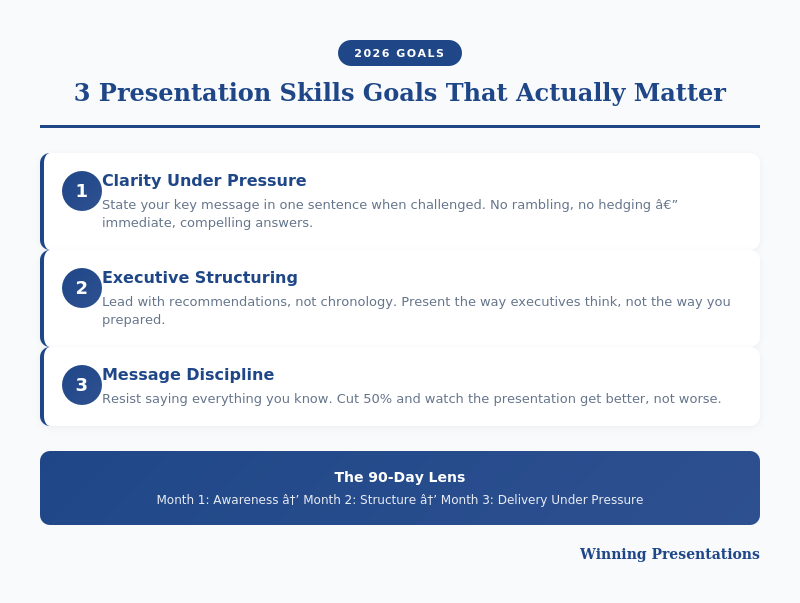
After training thousands of executives, I’ve identified the three presentation skills goals that actually differentiate senior professionals from everyone else.
These aren’t “soft skills.” They’re specific, measurable capabilities that directly impact whether you get the outcome you want from a presentation.
Goal 1: Clarity Under Pressure
Can you articulate your key message in one sentence when someone interrupts you mid-presentation and asks “what’s the bottom line?”
Most professionals can’t. They’ve prepared 20 slides but haven’t distilled their core message. When pressure hits — an unexpected question, a time cut, a sceptical executive — they ramble, hedge, or lose the thread entirely.
What this looks like in practice:
- You can state your recommendation in under 15 seconds
- You can explain your “why” without slides
- You stay coherent when challenged or interrupted
- Your answer to “so what?” is immediate and compelling
How to develop it: Practise the “elevator pitch” for every presentation. Before you open PowerPoint, write your one-sentence message. Then test yourself: can you deliver it under pressure?
Goal 2: Executive Structuring
Do you structure presentations the way senior leaders think — or the way you think?
Most professionals present chronologically: “Here’s what I did, here’s what I found, here’s what I recommend.” Executives want the opposite: “Here’s my recommendation, here’s why, here’s what I need from you.”
What this looks like in practice:
- You lead with the decision or recommendation
- You provide supporting evidence, not comprehensive data
- You anticipate the three questions they’ll ask
- You can present the same content in 5 minutes or 30 minutes
How to develop it: Study how your most effective executives present. Notice the structure. Then apply it to your own content — starting with the “so what” instead of building toward it.
For detailed frameworks, see my guide on executive presentations.
Goal 3: Message Discipline
Can you resist the urge to say everything you know?
The curse of expertise is wanting to share all of it. But senior leaders don’t want comprehensive — they want relevant. They don’t want thorough — they want clear.
What this looks like in practice:
- You cut 50% of your slides and the presentation gets better
- You answer questions directly without over-explaining
- You let silence exist instead of filling it with caveats
- Your backup slides contain more content than your main deck
How to develop it: After preparing any presentation, force yourself to cut it by half. Not by rushing — by prioritising. What’s essential? What’s “nice to have”? Kill the nice-to-haves.
💡 Ready to Structure Like a Senior Leader?
The Executive Slide System includes 7 frameworks for structuring presentations the way executives think — recommendation-first, evidence-based, action-oriented.
Stop building toward your point. Start with it.
The 90-Day Improvement Lens for Presentation Skills Goals
Annual presentation skills goals are too distant. They let you procrastinate. “I have all year” becomes “I’ll start next month” becomes “maybe next year.”
Think in 90-day cycles instead. Three months is long enough to create real change, short enough to maintain urgency.
Month 1: Awareness
Before you can improve, you need to know what needs improving. Most professionals have blind spots — habits they don’t notice, weaknesses they’ve never identified.
Actions for Month 1:
- Record yourself presenting (video, not just audio)
- Ask 3 colleagues for specific, honest feedback
- Identify your top 3 weaknesses — the specific things hurting your impact
- Watch executives you admire — what do they do differently?
This month isn’t about changing anything. It’s about seeing clearly.
Month 2: Structure
Now that you know what to work on, build the systems that will drive improvement.
Actions for Month 2:
- Create a pre-presentation routine you use every time
- Develop 2-3 frameworks you apply to every presentation
- Build a feedback system — how will you get input after each presentation?
- Schedule deliberate practice, not just presentations
Structure turns intentions into habits. Without it, you’ll default to old patterns under pressure.
Month 3: Delivery Under Pressure
This is where most professionals skip. They practice alone, in comfortable settings, without stakes.
Actions for Month 3:
- Present to colleagues who will challenge you — not support you
- Practice with time constraints (you have 5 minutes, not 20)
- Rehearse handling interruptions and tough questions
- If possible, get coaching or join a structured programme
Skills that collapse under pressure weren’t really skills — they were comfort-zone performances.
For advanced techniques on handling pressure, see my guide on advanced presentation skills.
🎓 Want Structured Development?
If 2026 is the year you want to master presentation skills properly, structured development matters more than random practice.
Framework-based programmes with psychology techniques and expert feedback create lasting change — not just temporary motivation. If you’d like to discuss what structured development might look like for you, get in touch →
How Senior Professionals Think About Presentation Skills Goals
There’s a mental shift that separates professionals who continuously improve from those who plateau.
Skills vs Events
Plateau thinking: “I have a big presentation next month. I need to prepare for it.”
Growth thinking: “Presenting is a skill I’m developing. Each presentation is a data point.”
When you treat presentations as isolated events, you prepare, perform, and forget. When you treat presenting as an ongoing skill development, each presentation becomes an opportunity to test, learn, and refine.
Systems vs Motivation
Plateau thinking: “I need to feel confident before I can present well.”
Growth thinking: “I need systems that work even when I don’t feel confident.”
Motivation is unreliable. Systems are consistent. The executives who present brilliantly under pressure don’t rely on feeling good — they rely on preparation routines, structural frameworks, and recovery techniques that work regardless of how they feel.
Deliberate Practice vs Repetition
Plateau thinking: “The more I present, the better I’ll get.”
Growth thinking: “Purposeful practice on specific weaknesses improves skill. Random repetition just reinforces habits.”
Twenty years of presenting doesn’t automatically make you good. It makes you experienced. If you’ve been reinforcing bad habits for twenty years, you’re just an experienced bad presenter.
Deliberate practice means identifying specific weaknesses, designing exercises to address them, getting feedback, and adjusting. It’s uncomfortable. That’s why it works.
Making 2026 the Year You Actually Improve Your Presentation Skills Goals
Here’s the honest truth: most people reading this won’t do anything different in 2026.
Not because they lack ability or desire. But because they’ll set vague goals, rely on motivation, and treat presentation skills as an afterthought when they’re not actively presenting.
The professionals who actually improve will:
- Set specific, measurable presentation skills goals (not wishes)
- Build systems that don’t depend on motivation
- Create accountability through feedback loops or structured programmes
- Practice under realistic pressure, not comfortable conditions
- Treat presenting as a skill to develop, not an event to survive
If that sounds like work, it is. Skill development always is. But the compound returns are substantial — in promotions, influence, credibility, and career opportunities.
The question isn’t whether presentation skills matter for your career in 2026. They obviously do.
The question is whether you’ll treat them like the strategic asset they are — or continue hoping that “more practice” will somehow produce different results.
Your Next Step
📖 FREE: Executive Presentation Checklist
The pre-presentation routine I use before every high-stakes talk.
Download Free →
💡 QUICK WIN: Executive Slide System — £39
7 frameworks for structuring presentations the way senior leaders think.
Get Instant Access →
🎓 COMPLETE SYSTEM: Structured Development
If you’re ready for comprehensive training with expert guidance, let’s discuss what that looks like for you →
FAQs: Presentation Skills Goals
What are the most important presentation skills goals to set for 2026?
The three presentation skills goals that matter most are: clarity under pressure (being able to state your key message when challenged), executive structuring (leading with recommendations instead of building toward them), and message discipline (resisting the urge to say everything you know). These directly impact whether you achieve your presentation outcomes.
How long does it take to improve presentation skills?
With deliberate practice and structured feedback, most professionals see meaningful improvement within 90 days. The key is focusing on specific weaknesses rather than general “practice.” Random repetition reinforces habits; deliberate practice changes them. Think in 90-day improvement cycles rather than annual goals.
Why do most presentation skills goals fail?
Most presentation skills goals fail because they lack four things: feedback loops (you don’t know what’s working or failing), structure (vague goals produce vague results), measurement (feelings aren’t data), and pressure simulation (practicing alone doesn’t prepare you for real stakes). Systems address all four.
How can I measure improvement in my presentation skills?
Measure presentation skills improvement through specific outcomes: Did you get the decision you wanted? Did stakeholders engage or disengage? How many clarifying questions did you get (fewer often means clearer communication)? Did you stay within your time limit? Recording yourself and comparing over time also provides objective measurement.
What’s the difference between deliberate practice and just presenting more?
Presenting more reinforces existing habits — good and bad. Deliberate practice involves identifying specific weaknesses, designing exercises to address them, getting feedback, and adjusting your approach. Twenty years of presentations doesn’t automatically make you skilled; it makes you experienced. The distinction determines whether you improve or plateau.
Mary Beth Hazeldine is the Owner & Managing Director of Winning Presentations. She spent 24 years in corporate banking at JPMorgan Chase, PwC, Royal Bank of Scotland, and Commerzbank, and has trained over 5,000 executives to present with impact. Her clients have raised over £250 million using her frameworks.
Get Weekly Presentation Insights
Join 2,000+ professionals getting practical presentation tips every Tuesday.