
Tag: presentation planning

02 Feb 2026
Executive professional in thoughtful planning pose with pen before opening laptop, demonstrating strategic presentation preparation order

I Stopped Preparing Slides First. My Approval Rate Doubled.

I used to spend six hours on a presentation and still get rejected.

Beautiful slides. Careful animations. Colour-coordinated charts. The CFO would look at it for three minutes and say, “This isn’t what we need. Can you redo it?”

I thought I had a slides problem. I didn’t. I had a preparation order problem.

The moment I stopped opening PowerPoint first, everything changed. Same amount of time. Same audiences. Dramatically different results.

Here’s what I learned: the order you prepare a presentation determines whether it succeeds or fails. Most professionals get it backwards—and wonder why their approval rates are so low.

Quick answer: The optimal presentation preparation order is: (1) Decision—what do you need from this audience? (2) Audience—what do they care about and what’s blocking them? (3) Structure—what’s the logical flow that leads to your ask? (4) Slides—only now do you open PowerPoint. Most people start at step 4 and wonder why they keep getting sent back to the drawing board. This article explains each step and why the order matters more than the time you spend.

⚡ Presenting Tomorrow? The 12-Minute Reset

If you’re presenting soon and don’t have time for the full process, do this now:

  1. Write one sentence: “I need [audience] to approve [specific thing].” (2 min)
  2. List their top concern: What’s the #1 reason they might say no? (3 min)
  3. Check slide 1: Does it state your recommendation? If not, rewrite it. (5 min)
  4. Delete 20%: Cut any slide that doesn’t address their concern or your ask. (2 min)

This won’t fix everything, but it will dramatically improve your odds. For the complete framework, keep reading.

Why Most Preparation Is Backwards

Watch how most professionals prepare a presentation:

  1. Open PowerPoint
  2. Pick a template
  3. Start typing content onto slides
  4. Rearrange slides until it “flows”
  5. Add charts and formatting
  6. Hope it works

This approach feels productive. You can see progress—slides appearing, content filling in, a deck taking shape. But it’s an illusion.

Here’s the problem: you’re making structural decisions while distracted by visual decisions. You’re asking “what should slide 7 say?” before you’ve answered “what does my audience actually need to hear?”

The result is predictable: a presentation that looks complete but doesn’t accomplish anything. You’ve built a house without a blueprint—and now you’re surprised when the client says it’s not what they wanted.

I made this mistake for years. I’d spend hours perfecting slides, then watch executives flip through them in 90 seconds and ask questions my deck didn’t answer. The slides were fine. The thinking behind them was absent.

For more on why structurally sound presentations still get rejected, see my article on why good presentations get rejected.

The Four-Step Preparation Order

After years of trial and error—and training thousands of executives—I’ve identified the preparation order that consistently gets results:

  1. Decision — What do you need from this audience?
  2. Audience — What do they care about? What’s blocking them?
  3. Structure — What’s the logical flow that leads to your ask?
  4. Slides — Only now do you open PowerPoint

Notice what’s missing from steps 1-3: any mention of slides, templates, or visuals. That’s intentional. The first 60-70% of effective preparation happens before you touch presentation software.

This feels counterintuitive. Slides are the deliverable, so shouldn’t you start there? No—for the same reason architects don’t start by choosing paint colours. The visible output is the last step, not the first.
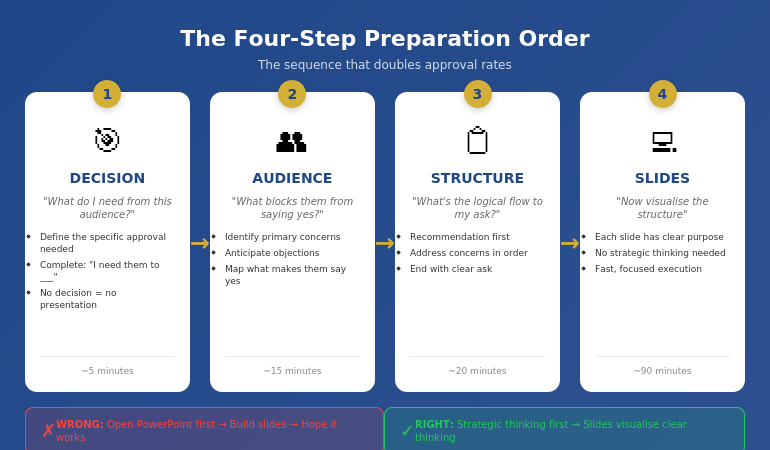
The four-step presentation preparation order: Decision, Audience, Structure, then Slides

Step 1: Decision First

Before anything else, answer one question: What decision do I need from this audience?

Not “what do I want to tell them?” Not “what information should I share?” What decision do you need?

Examples:

  • “I need approval to hire two additional engineers”
  • “I need the board to greenlight the expansion budget”
  • “I need the client to sign the contract today”
  • “I need leadership to prioritise this project over Project X”

If you can’t complete the sentence “I need them to _____,” you’re not ready to prepare a presentation. You’re ready to prepare a document—which is a different thing entirely.

Why this matters: Every element of your presentation should move toward this decision. If a slide doesn’t advance the decision, it doesn’t belong. But you can’t make that judgment until you know what you’re deciding.

Most presentations fail because the presenter never clarified what they wanted. They shared information. They presented data. They “updated” stakeholders. But they never asked for anything—so they didn’t get anything.

📊 Structure Your Presentation for Decisions

The Executive Slide System gives you decision-first templates built around the preparation order that actually works. Stop guessing what goes where—use structures proven to get executive approval.

Inside:

  • The 10-slide decision framework
  • Recommendation-first templates
  • Executive summary formats that work
  • Before/after examples from real approvals

Get the Executive Slide System → £39

Used by professionals who need approvals, not just presentations.

Step 2: Audience Second

With your decision clear, the next question is: What does this specific audience care about, and what might block them from saying yes?

This isn’t general audience analysis. It’s decision-focused analysis. You’re not asking “who are they?” You’re asking “what stands between them and approving this?”

For each key stakeholder, consider:

  • What’s their primary concern? (Risk? Cost? Timeline? Reputation?)
  • What would make them say no? (Insufficient data? Wrong timing? Political issues?)
  • What would make them say yes? (ROI proof? Risk mitigation? Alignment with their goals?)
  • What questions will they definitely ask?

If you’re presenting to a CFO, the blocking concern is probably financial risk or unclear ROI. If you’re presenting to a board, it might be strategic alignment or competitive positioning. If you’re presenting to a client, it might be trust or implementation complexity.

The key insight: your presentation should answer their concerns, not your talking points. Most presenters build decks around what they want to say. Effective presenters build decks around what the audience needs to hear to say yes.

This step typically takes 10-15 minutes but saves hours of revision later. When you understand the audience’s blocking concerns, you build a presentation that addresses them. When you don’t, you build a presentation that gets sent back with “good start, but can you add…”

📋 Want templates built around executive concerns? The Executive Slide System (£39) includes decision-first structures that anticipate what leadership actually wants to see.

Step 3: Structure Third

Now—and only now—do you think about structure. But not slide structure. Argument structure.

The question is: What’s the logical flow that leads from where my audience is now to the decision I need?

For most executive presentations, the structure is simpler than people think:

  1. Recommendation — Here’s what I’m asking for
  2. Why it matters — Here’s the problem/opportunity this addresses
  3. How it works — Here’s the approach (briefly)
  4. What could go wrong — Here are the risks and how we’ll mitigate them
  5. What it costs — Here’s the investment required
  6. The ask — Here’s specifically what I need you to approve

Notice this structure is recommendation-first, not background-first. You don’t build up to your point—you start with it. Executives have limited time and attention. Respect that by leading with the answer.

At this stage, I write the structure as bullet points on paper or in a notes app. No slides. No formatting. Just the logical flow.

For example:

  • Recommendation: Approve £200K for customer portal upgrade
  • Why: Current portal causing 23% support ticket increase, costing £15K/month
  • Approach: Phase 1 (self-service), Phase 2 (AI chat), Phase 3 (integration)
  • Risks: Integration complexity—mitigated by phased approach
  • Cost: £200K over 6 months, ROI positive by month 9
  • Ask: Approve budget and project start date of March 1

That’s the entire presentation in six bullet points. Everything else is supporting detail.

For more on executive-ready structures, see my guide to executive presentation structure.

📊 Structures That Get Yes

The Executive Slide System includes proven structures for board presentations, budget requests, project approvals, and strategic recommendations. Each template follows the decision-first order that executives actually respond to.

Get the Executive Slide System → £39

Templates + examples + the exact slide order that works.

Step 4: Slides Last

Only now do you open PowerPoint.

But here’s the difference: you’re not figuring out what to say anymore. You already know what to say. You’re just visualising it.

This changes everything about slide creation:

  • Each slide has a clear purpose (it maps to your structure)
  • You know what belongs and what doesn’t (does it advance the decision?)
  • You can work faster (no strategic thinking mixed with visual thinking)
  • You make better visual choices (because you understand the point each slide needs to make)

The slide creation process becomes almost mechanical. Structure point 1 becomes slides 1-2. Structure point 2 becomes slides 3-4. And so on.

For the example above, the slide deck might be:

  1. Executive Summary: Approve £200K portal upgrade (ROI positive month 9)
  2. The Problem: Support tickets up 23%, costing £15K/month
  3. Root Cause: Current portal lacks self-service capabilities
  4. Solution Overview: Three-phase portal modernisation
  5. Phase Details: Timeline and deliverables
  6. Risk Mitigation: Phased approach reduces integration risk
  7. Investment: £200K over 6 months
  8. ROI Analysis: Break-even month 9, £180K annual savings
  9. Ask: Approve budget and March 1 start date
  10. Appendix: Technical details (if asked)

Ten slides. Clear logic. Decision-focused. And it took less time than the “start with slides” approach because there was no backtracking, no restructuring, no “wait, what’s my point again?”

For guidance on what makes an effective executive summary slide, see how to write the executive summary slide.

How This Actually Saves Time

The objection I hear most often: “I don’t have time for a four-step process. I just need to get the deck done.”

I understand. But consider the true time cost of the “just start with slides” approach:

  • Hours building slides → Presentation rejected → Hours rebuilding
  • Deck looks done → Stakeholder asks unexpected question → Scramble to add slides
  • Send for review → “This doesn’t address the real issue” → Start over

The four-step process typically takes the same total time—or less—because you eliminate rework. Thirty minutes of strategic thinking before slides prevents three hours of revision after slides.

Typical time breakdown:

  • Step 1 (Decision): 5 minutes
  • Step 2 (Audience): 15 minutes
  • Step 3 (Structure): 20 minutes
  • Step 4 (Slides): 60-90 minutes

Total: About 2 hours for a solid executive presentation. Compare that to 4-6 hours of meandering slide creation followed by revision cycles.

The professionals who “don’t have time” for strategic preparation are the same ones working weekends to fix presentations that should have been right the first time.

What order should you prepare a presentation?

The optimal order is: Decision (what do you need?), Audience (what blocks them?), Structure (what’s the logical flow?), then Slides (visualise the structure). Most people start with slides and work backwards, which is why most presentations get rejected or require extensive revision. Starting with the decision ensures every element of your presentation serves a purpose.

Should you write your presentation before making slides?

Yes—but not word-for-word scripts. You should clarify your decision, understand your audience’s concerns, and outline your logical structure before touching slide software. This typically means 30-45 minutes of thinking and notes before opening PowerPoint. The slides then become a visualisation of clear thinking rather than a substitute for it.

Why do most presentations fail to get approval?

Most presentations fail because they’re built around what the presenter wants to say rather than what the audience needs to hear to say yes. When you start with slides, you naturally focus on your content. When you start with the decision, you naturally focus on what moves the audience toward that decision. The preparation order determines the outcome.

📊 Skip the Guesswork

The Executive Slide System gives you decision-first templates so you never start from a blank screen. Each structure is built around the preparation order that gets approvals—not just presentations.

You’ll get:

  • 10-slide decision frameworks for every scenario
  • Executive summary templates that lead with the ask
  • Before/after examples showing the transformation
  • The exact slide order executives expect

Get the Executive Slide System → £39

For professionals who need approvals, not just slide decks.

Frequently Asked Questions

How long should presentation preparation take?

For a standard executive presentation (10-15 slides), allow 2-3 hours total: 30-45 minutes for strategic thinking (steps 1-3) and 90-120 minutes for slide creation (step 4). This assumes you’re working from templates rather than starting from scratch. Complex presentations or unfamiliar topics may require more time, but the ratio should stay similar—about 30% strategy, 70% execution.

Should I use a presentation template or start from scratch?

Use a template—but choose one that matches your strategic structure, not just your visual preferences. A template saves time only if it’s built around decision-first logic. A beautiful template with the wrong structure will still get rejected. The best approach is using templates designed for your specific presentation type (board update, budget request, project approval) rather than generic “professional” templates.

What if I’m given a slide deck to present that someone else created?

Run through steps 1-3 anyway. Clarify the decision you need, identify audience concerns, and check whether the existing structure addresses them. Often, inherited decks need restructuring—they contain good content in the wrong order. Taking 20 minutes to validate (or adjust) the structure before presenting will dramatically improve your results compared to just “learning the slides.”

Does this process work for short presentations too?

Yes—and it’s arguably more important. When you only have 5 minutes or 5 slides, every element must earn its place. The four-step process ensures you’re putting the right content in limited space. For very short presentations, steps 1-3 might take just 10 minutes total, but skipping them is how people end up with 5 slides that don’t accomplish anything.

📧 The Winning Edge Newsletter

Weekly insights on executive presentations, approval strategies, and what actually works in corporate boardrooms.

Subscribe Free →

📋 Free: Executive Presentation Checklist

A one-page checklist covering all four preparation steps. Use it before your next presentation to ensure you’re not skipping the strategic work.

Download Free Checklist →

About the Author

Mary Beth Hazeldine is the Owner & Managing Director of Winning Presentations. With 24 years of corporate banking experience at JPMorgan Chase, PwC, Royal Bank of Scotland, and Commerzbank, she has delivered high-stakes presentations in boardrooms across three continents.

A qualified clinical hypnotherapist and NLP practitioner, Mary Beth combines executive communication expertise with evidence-based techniques for managing presentation anxiety. She has trained thousands of executives and supported high-stakes funding rounds and executive approvals.

Book a discovery call | View services

Your Next Step

The next time you need to create a presentation, resist the urge to open PowerPoint immediately. Instead, take 30 minutes to work through steps 1-3:

  1. What decision do I need?
  2. What concerns might block my audience?
  3. What’s the logical flow that addresses those concerns and leads to my ask?

Then—and only then—build your slides.

It feels slower. It isn’t. And the results will show you why preparation order matters more than preparation time.

If presentation anxiety is part of what’s holding you back, see today’s companion article on why therapy doesn’t always fix presentation fear.

29 Jan 2026
Executive sitting alone at boardroom table with hand on forehead after failed presentation, colleagues walking away in background

Stakeholder Mapping for Presentations: The 4-Quadrant Method

The project was dead before I walked into the room.

Five executives. Five hidden agendas. And a significant infrastructure project that several stakeholders had already decided to reject—I just didn’t know it yet.

Quick answer: A stakeholder map is a strategic document that identifies who influences your presentation’s outcome, what each person actually cares about, and how to engage them before you present. The executives who consistently win approval don’t have better slides—they have better stakeholder intelligence. This article shows the mapping approach developed across 25 years in banking and 16 years coaching senior professionals.

Presenting for approval this week? Start with a stakeholder map.

  1. Who actually decides? It’s rarely the most senior person in the room.
  2. What does each person need to say yes? Public criteria and private concerns are different.
  3. Who can kill this before it reaches the room? Name them — then meet them first.

For the complete mapping framework and pre-meeting conversation structure, see the Executive Buy-In Presentation System.

What Is Stakeholder Mapping (And Why Slides Won’t Save You)

Most professionals prepare for presentations backwards. They spend 80% of their time on slides and 20% on understanding the room. The executives who consistently win approval do the opposite.

Stakeholder mapping is the process of identifying every person who influences your presentation’s outcome—not just who’s in the room, but who whispers in the decision-maker’s ear before and after. It answers three questions most presenters never ask:

  • Who actually decides? (Hint: it’s rarely the most senior person)
  • What does each person need to hear to say yes? (Their public criteria and private concerns are different)
  • Who can kill this before it reaches the room? (The blocker you don’t see coming)

I learned this the hard way at JPMorgan Chase. Beautiful deck. Compelling ROI. Standing ovation from the team. The steering committee rejected it in four minutes because I’d missed the one person whose support I actually needed—the operations director who’d been burned by a similar project two years earlier.

The CFO told me afterwards: “Your slides were fine. Your stakeholder work was invisible.”

That conversation changed how I approach every high-stakes presentation. If you’re presenting to senior leadership and fear of being judged is holding you back, know this: judgment often comes from misreading the room, not from your delivery.

The Meeting That Changed Everything

Three years later, I faced the same situation—but with very different preparation.

The project: a significant infrastructure upgrade that would disrupt operations for six months. The room: five regional directors, each protecting their own territory. The politics: two of them had competing projects that would lose funding if mine was approved.

The old me would have built a brilliant deck proving ROI. The new me spent three weeks building a stakeholder map instead.

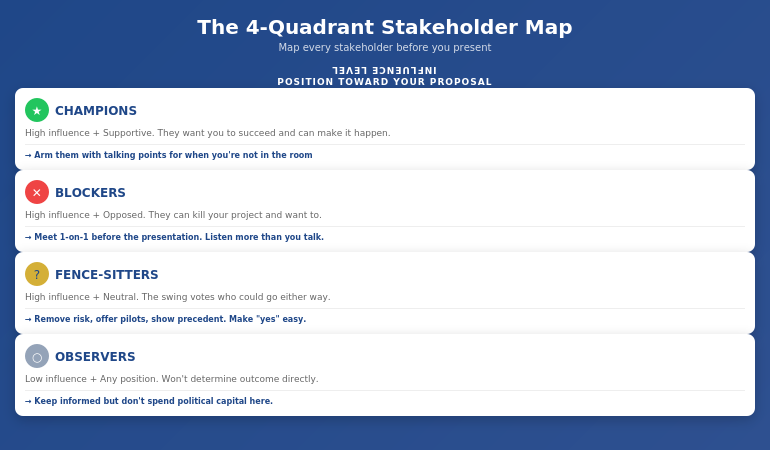
4-Quadrant Stakeholder Map showing Champions, Blockers, Fence-Sitters, and Observers with recommended actions for each quadrant

What I discovered changed everything:

  • The “decision-maker” (the CFO) actually deferred to the operations director on anything that touched day-to-day workflows
  • The loudest opponent wasn’t against the project—he was against being surprised by it
  • The quiet supporter in the corner had tried to push a similar initiative three years ago and been shut down. She had data I needed.
  • Two directors had a private rivalry that had nothing to do with my project but would influence how they voted

Armed with this map, I didn’t walk into the presentation hoping for approval. I walked in knowing I had it.

How? Because I’d had five separate conversations before the meeting. Each stakeholder felt heard. Each concern had been addressed. The presentation wasn’t where I won approval—it was where I confirmed it.

The 4-Quadrant Stakeholder Framework

After using stakeholder mapping across projects of varying scale and stakes, I’ve refined it into a simple framework anyone can use. Every stakeholder falls into one of four quadrants based on two factors: their influence over the decision and their current position toward your proposal.

Quadrant 1: Champions (High Influence + Supportive)

These stakeholders want your project to succeed and have the power to make it happen. Your job: arm them with ammunition. Give them the talking points they’ll use when you’re not in the room. Ask them: “What objections will come up, and how should I address them?”

Quadrant 2: Blockers (High Influence + Opposed)

The most dangerous quadrant. These stakeholders can kill your project, and they want to. Your job: understand their real concern (it’s rarely what they say publicly). Often, blockers aren’t against your idea—they’re against not being consulted, or they’re protecting something you haven’t considered. Meet them one-on-one before the presentation. Listen more than you talk.

Quadrant 3: Fence-Sitters (High Influence + Neutral)

These stakeholders could go either way. They’re often the swing votes. Your job: make it easy to say yes. Remove risk, offer pilot options, show precedent. They don’t want to champion your project—they want to not look foolish for approving it.

Quadrant 4: Observers (Low Influence + Any Position)

These stakeholders won’t determine the outcome, but they might influence someone who does. Your job: don’t ignore them completely—a frustrated observer can become a vocal critic. Keep them informed, but don’t spend your political capital here.

For each person in your stakeholder map, document: their quadrant, their public position, their private concern, who influences them, and what they need to hear from you.

⭐ Walk into your next approval meeting prepared

The Executive Buy-In Presentation System gives you 7 self-paced modules covering stakeholder analysis, case construction, and the presentation structures that hold up to scrutiny. Monthly cohort enrolment — £499, lifetime access to materials.

What’s covered:

  • Stakeholder mapping frameworks for high-stakes decisions
  • Pre-meeting conversation approaches that surface hidden objections
  • The enrollment versus alignment distinction for creating champions
  • Bonus Q&A calls (optional, fully recorded — watch back anytime)

Explore the Buy-In System on Maven →

Self-paced with monthly cohort enrolment.

The Pre-Meeting Conversations That Win Votes

The stakeholder map tells you who to talk to. But what do you actually say?

Most professionals make one of two mistakes: they either skip pre-meeting conversations entirely (hoping their slides will speak for themselves), or they pitch their idea to everyone they meet (creating resistance before the formal presentation).

The executives who consistently win approval do something different. They have discovery conversations—structured dialogues designed to surface concerns, build relationships, and create ownership.

Here’s the framework I use:

No deadlines, no mandatory attendance. Executive Buy-In Presentation System — 7 self-paced modules, £499, lifetime access to materials.

Explore the Buy-In System →

The 3-Part Pre-Meeting Conversation:

Part 1: Understand Their World (70% of the conversation)

“I’m presenting on [topic] next week. Before I finalize anything, I wanted to understand your perspective. What would you need to see for something like this to work for your team?”

Notice: you’re not pitching. You’re learning. Most stakeholders have never been asked what they actually need. This question alone creates goodwill.

Part 2: Surface Hidden Concerns (20% of the conversation)

“What concerns would you have? What’s worked—or not worked—when similar initiatives have been tried before?”

This is where blockers reveal their real objections. Often, they’ll tell you things they’d never say in a group setting. A operations director once told me: “I don’t care about the ROI. I care about not being blamed when something goes wrong during the transition.” That concern never appeared in the official feedback—but it was the only thing that mattered.

Part 3: Create Ownership (10% of the conversation)

“Based on what you’ve shared, here’s how I’m thinking about addressing [their concern]. Does that make sense to you?”

When a stakeholder helps shape your proposal, they become invested in its success. They’re no longer evaluating your idea—they’re defending their own input.

How to Uncover Hidden Agendas

Every executive room has hidden agendas. The question isn’t whether they exist—it’s whether you know what they are before you present.

Across 25 years at JPMorgan Chase, PwC, Royal Bank of Scotland, and Commerzbank, I watched technically superior proposals lose to politically savvy ones. Not because politics is more important than substance—but because ignoring politics is a form of arrogance that executives punish.

Here’s how to uncover what’s really driving the decision:

Ask the Executive Assistant

The EA often knows more about what’s really happening than anyone in the room. A simple question—”Is there anything I should be aware of before this meeting?”—can reveal landmines you’d never see coming.

Follow the Budget Trail

Who else is competing for the same resources? What got funded last quarter—and what got cut? Your proposal doesn’t exist in isolation. It exists in a portfolio of competing priorities.

Map the Relationships

Who mentored whom? Who’s been passed over for promotion? Who has a track record of opposing this type of initiative? Understanding how to present to a board of directors means understanding that board dynamics are rarely about the agenda item in front of them.

Look for the “Real Decision-Maker”

The person with the highest title isn’t always the person who decides. In the infrastructure project above, the CFO had final authority—but he would never approve anything the operations director opposed. The real decision was made in a hallway conversation I wasn’t part of. My stakeholder map told me that. My pre-meeting work made sure that conversation went in my favour.

⭐ Stop guessing what your stakeholders need to say yes

The Executive Buy-In Presentation System is the self-paced framework for decoding stakeholder resistance and building the case that addresses it — 7 modules, monthly cohort enrolment, optional recorded Q&A. £499, lifetime access.

Explore the Buy-In System on Maven →

Self-paced with monthly cohort enrolment.

3 Stakeholder Mapping Mistakes That Kill Projects

After years coaching senior professionals through high-stakes presentations, I see the same mistakes repeatedly. Each one is easy to make and expensive to fix.

Mistake #1: Mapping Titles Instead of Influence

Your stakeholder map lists “CFO, COO, VP Operations” because those are the names on the meeting invite. But influence doesn’t follow org charts. The CFO might defer to their trusted advisor on technical matters. The COO might be checked out on this topic entirely. The VP Operations might have the CEO’s ear because they golf together.

The fix: For each stakeholder, ask: “Who do they listen to? Who influences their thinking on this topic specifically?” Map the shadow org chart, not the official one.

Mistake #2: Assuming Silence Means Support

You present your proposal. Three executives nod. Two stay quiet. You assume the quiet ones are fine with it.

They’re not. They’re waiting. They’ll voice their objections later—in the hallway, in a follow-up email, in a private conversation with the decision-maker. By then, your proposal is dead and you don’t know why.

The fix: Silence is a warning sign, not a green light. If someone hasn’t expressed a position, you don’t have their support—you have their tolerance. Find out what they’re really thinking before the meeting, not after.

Mistake #3: Treating All Stakeholders Equally

You have a week to prepare. You spend equal time with every stakeholder. The result: you know a little about everyone and not enough about anyone.

The fix: Your stakeholder map should be prioritized ruthlessly. Spend 80% of your pre-meeting time on the 20% of stakeholders who will actually determine the outcome. A deep relationship with two key influencers beats shallow relationships with ten observers.

Understanding what it takes to get executive buy-in means accepting that some stakeholders matter more than others—and acting accordingly.

What is stakeholder mapping in presentations?

Stakeholder mapping is the process of identifying every person who influences your presentation’s outcome, understanding their position, and strategically engaging them before you present. It answers three questions: Who actually decides? What does each person need to hear? Who can kill this quietly? The goal is to secure approval through pre-meeting work, so the presentation confirms what’s already been agreed—not where you hope to persuade.

How do you identify key stakeholders for a presentation?

Start with the meeting invite, then expand. Ask: Who influences the decision-maker? Who has veto power? Who’s been burned by similar proposals? Who has competing priorities? Map both formal authority (titles) and informal influence (relationships, expertise, history). The most important stakeholders often aren’t in the room—they’re the people the decision-maker calls after the meeting.

How do you present to multiple stakeholders with different agendas?

You don’t try to address every agenda in the room—you address each agenda before the room. Use your stakeholder map to have individual conversations where you surface each person’s real concerns and incorporate their input into your proposal. When you present, acknowledge the different perspectives: “I know some of you are focused on risk, others on timeline, others on budget. Let me show you how this addresses each.” The preparation makes the presentation feel effortless.

⭐ Built on 25 years in corporate banking

The Executive Buy-In Presentation System is the structured framework developed across 25 years in corporate banking and 16 years coaching senior professionals across financial services, insurance, consulting, and technology. £499, lifetime access to materials.

What you get:

  • 7 self-paced modules on stakeholder analysis, structure, and delivery
  • Pre-meeting conversation frameworks with exact language
  • Approaches for identifying real decision-makers and influencers
  • Bonus Q&A calls (optional, fully recorded — watch back anytime)
  • Lifetime access to all materials

Explore the Buy-In System on Maven →

Self-paced with monthly cohort enrolment — new cohort opens every month.

Frequently Asked Questions

Isn’t this just office politics?

Stakeholder mapping isn’t manipulation—it’s respect. You’re taking the time to understand what each person actually needs, rather than assuming your brilliant slides will convince everyone. The executives who dismiss this as “politics” are often the ones who get blindsided by rejections they didn’t see coming. Understanding organizational dynamics is a professional skill, not a character flaw.

What if I don’t know the stakeholders well enough?

Start with what you know, then expand. Ask your sponsor or champion: “Who should I talk to before this meeting?” Ask trusted colleagues: “What should I know about the people in this room?” Even thirty minutes of stakeholder research is better than none. The goal isn’t perfect intelligence—it’s better intelligence than you had before.

How much time does stakeholder mapping actually take?

For a typical steering committee or board presentation, plan for 3-5 hours of stakeholder work spread across 1-2 weeks. That includes creating the initial map (1 hour), having pre-meeting conversations (2-3 hours total), and refining your approach based on what you learn. This time investment pays for itself many times over—a rejected proposal wastes far more than 5 hours.

What if the stakeholder landscape changes at the last minute?

It will. Someone gets pulled into another meeting. A new executive joins. Priorities shift overnight. Your stakeholder map isn’t a static document—it’s a living framework. Update it as you learn new information. The executives who handle last-minute changes well are the ones who’ve done enough stakeholder work to understand the underlying dynamics, not just the surface positions.

📧 The Winning Edge Newsletter

Weekly insights on executive presentations, stakeholder strategy, and high-stakes communication. No fluff—just what works.

Subscribe Free →

📋 Free: Executive Presentation Checklist

The pre-presentation checklist I use before every high-stakes meeting. Covers stakeholder prep, slide structure, and room setup.

Download Free Checklist →

Your Next Step

The stakeholder map for that infrastructure project took three hours to create. The conversations it enabled took another six hours spread across two weeks. The approval that followed took about four minutes once I walked into the room.

If you’re preparing for a high-stakes presentation—budget approval, project sign-off, board update, client pitch—start your stakeholder map today. Identify the four quadrants. Find your champions and your blockers. Have the pre-meeting conversations that turn a stressful presentation into a predictable formality.

And if you want the complete system—templates, scripts, frameworks, and live feedback on your actual presentations—join the Executive Buy-In Presentation System on Maven.

The decision isn’t made in the meeting. It’s made before. Your stakeholder map makes sure you’re part of those conversations.

Related: If presentation anxiety is part of what’s holding you back from stakeholder conversations, read how to handle the fear of being judged when speaking.

About Mary Beth Hazeldine
Owner & Managing Director of Winning Presentations. 25 years in corporate banking at JPMorgan Chase, PwC, Royal Bank of Scotland, and Commerzbank taught me that the best proposals fail without stakeholder work. The pre-meeting map is the step separating presentations that get approved from presentations that get “tabled for further review.”

02 Jan 2026
How to make a presentation outline - template showing structure before slides

How to Make a Presentation Outline: The Planning Step Most People Skip [2026]

The secret to making presentations faster isn’t better software or fancier templates. It’s making a presentation outline before you open PowerPoint.I’ve watched hundreds of professionals waste hours staring at blank slides, moving bullet points around, deleting entire sections and starting over. The problem is never the slides. It’s that they skipped the outline.

A solid presentation outline takes 10-15 minutes to create. It saves 2-3 hours of confused slide-shuffling later.

In this guide, I’ll show you exactly how to make a presentation outline — with templates you can use for any situation and any time limit.

This is a deep dive on the planning phase. For the complete presentation process, see: How to Make a Presentation: The Complete Guide.

🎁 Free Download: Get my 7 Presentation Outline Templates — ready-to-use frameworks for pitches, updates, proposals, and more.

The outline is the first step in any working executive presentation toolkit — without it, the rest of the deck fights its own structure.

Why a Presentation Outline Changes Everything

Here’s what happens when you skip the presentation outline and go straight to slides:

  • You create 15 slides, then realise slide 3 should come after slide 9
  • You spend 20 minutes formatting a slide you later delete
  • You finish the deck and realise you forgot your main point
  • You run out of time and rush the ending
  • Your audience leaves confused about what you wanted

A presentation outline prevents all of this. It’s your thinking made visible — before you commit to slides.

The rule: If you can’t explain your presentation in 60 seconds using just your outline, your audience won’t follow it in 30 minutes with slides.

How to Make a Presentation Outline in 4 Steps

Creating a presentation outline takes 10-15 minutes. Here’s the process:

Step 1: Write Your Destination (2 minutes)

Before you outline anything, answer this question in one sentence:

“What do I want my audience to think, feel, or do after this presentation?”

This isn’t your topic. It’s your destination.

Examples:

Topic Destination
“Q3 results” “Approve increased marketing spend for Q4”
“New software system” “Commit to the migration timeline”
“Project update” “Continue funding without scope changes”
“Team restructure” “Support the new reporting lines”

Write your destination at the top of your outline. Everything else serves this.

Step 2: Choose Your Framework (2 minutes)

Every presentation outline needs a framework — the logical structure that moves your audience from where they are to your destination.

Three frameworks work for 90% of presentations:

Framework 1: Problem → Solution → Action

Best for: Pitches, proposals, requesting approval

Framework 2: What → So What → Now What

Best for: Updates, reports, presenting data

Framework 3: Context → Options → Recommendation

Best for: Complex decisions, strategy presentations

Pick one. Write it under your destination. Your presentation outline now has a spine.

Step 3: Fill in the Sections (5-8 minutes)

Now expand each section of your framework with 2-4 bullet points. Each bullet point = one slide.

Example presentation outline using Problem → Solution → Action:

DESTINATION: Get board approval for £50K marketing investment

PROBLEM (3 slides)

  • Lead generation down 23% vs last quarter
  • Competitor X launched aggressive campaign in September
  • Current pipeline won’t hit Q4 targets

SOLUTION (4 slides)

  • Proposed campaign: targeted LinkedIn + retargeting
  • Why this approach vs alternatives
  • Expected results: 150 qualified leads in 8 weeks
  • Investment required: £50K (breakdown)

ACTION (2 slides)

  • Timeline: launch in 2 weeks if approved today
  • The ask: approve £50K and campaign brief

That’s 9 slides. The presentation outline took 10 minutes. The slides will practically make themselves.

Step 4: Test Your Outline (2 minutes)

Before you create a single slide, test your presentation outline:

  1. The 60-second test: Can you explain your presentation using only the outline? Time yourself.
  2. The “so what” test: After each bullet, ask “so what?” If there’s no clear answer, cut it or clarify.
  3. The destination test: Does every section move toward your destination? Remove anything that doesn’t.

If your outline passes all three tests, you’re ready to build slides.

How to make a presentation outline - template showing structure before slides

Use this template for any presentation — fill in your destination and framework first

How Many Points for Your Presentation Outline? The Time Guide

A common mistake: creating a presentation outline with too many points for your time slot.

Here’s the formula:

1 main point = 2-3 minutes of speaking = 1 slide

Use this guide to size your presentation outline:

Presentation outline time guide - how many slides and points for 5, 10, 15, 30 and 60 minute presentations

Match your outline to your time slot — fewer points, more impact
Time Slot Main Points Slides Outline Sections
5 minutes 2-3 3-5 Opening + 2 points + Close
10 minutes 3-4 5-7 Opening + 3 points + Close
15 minutes 4-6 7-10 Full 3-section framework
30 minutes 8-12 12-18 Full framework + depth
60 minutes 15-20 20-30 Full framework + examples

The mistake: Trying to fit a 30-minute presentation outline into a 10-minute slot. You’ll rush, your audience will struggle, and your message won’t land.

The fix: Cut ruthlessly. Every point you remove makes the remaining points stronger.

Presentation Outline Examples for Common Situations

Here are ready-to-use presentation outlines for situations you’ll face:

Project Update Outline (10-15 minutes)

Framework: What → So What → Now What

WHAT (Status)

  • Progress since last update (metrics)
  • What’s on track
  • What’s behind (if anything)

SO WHAT (Implications)

  • Impact on timeline/budget/scope
  • Risks and mitigation

NOW WHAT (Next steps)

  • Key activities next period
  • Decisions or support needed

Proposal/Pitch Outline (15-20 minutes)

Framework: Problem → Solution → Action

PROBLEM

  • The situation today (pain point)
  • Cost of the status quo
  • Why now (urgency)

SOLUTION

  • What I’m proposing
  • How it works
  • Why this approach (vs alternatives)
  • Expected results
  • Investment required

ACTION

  • Timeline
  • The specific ask

Strategy/Decision Outline (20-30 minutes)

Framework: Context → Options → Recommendation

CONTEXT

  • Background/history
  • Current situation
  • Constraints and requirements
  • Criteria for success

OPTIONS

  • Option A: Description, pros, cons
  • Option B: Description, pros, cons
  • Option C: Description, pros, cons

RECOMMENDATION

  • Recommended option and why
  • Implementation approach
  • Risk mitigation
  • Request for decision

📋 Need More Outline Templates?

The Presentation Openers & Closers Swipe File (£9.99) includes outline templates for 12 common presentation types — plus 50+ scripts for starting strong and ending memorably.

The One-Idea-Per-Slide Rule

When converting your presentation outline to slides, follow this rule:

Each bullet point in your outline = exactly one slide.

If a bullet point contains two ideas, split it into two bullets (and two slides).

This rule prevents the most common presentation mistake: cramming multiple points onto one slide.

Bad outline bullet: “Our sales increased and customer satisfaction improved”

Good outline bullets:

  • “Sales increased 23% YoY”
  • “Customer satisfaction up from 72 to 89 NPS”

That’s two slides, not one. Your audience will understand and remember both points.

Common Presentation Outline Mistakes

Mistake 1: Starting with slides, not outline.

Fix: Force yourself to write 5 bullet points on paper before opening any software.

Mistake 2: Too many points for the time slot.

Fix: Use the time guide above. Cut until it hurts, then cut one more.

Mistake 3: No clear destination.

Fix: Write “After this presentation, my audience will…” and complete the sentence before anything else.

Mistake 4: Presenter-first structure.

Fix: Organise by what your audience needs to hear, not what you want to say.

Mistake 5: Outline is too detailed.

Fix: Keep bullets to 5-7 words max. Detail comes when you build slides.

How to Make a Presentation Outline: FAQs

Should I write my presentation outline on paper or digitally?

Paper is often better for initial outlining. It prevents you from jumping into slide design too early. Once your outline is solid, transfer it to your presentation software as slide titles.

How detailed should a presentation outline be?

Each bullet should be 5-7 words maximum — just enough to capture the point. If you’re writing full sentences, you’re being too detailed. Save the detail for your slides and speaker notes.

Can I change my presentation outline once I start making slides?

Yes, but be cautious. Small adjustments are normal. Major restructuring usually means your outline wasn’t solid. If you find yourself reorganising significantly, stop and return to the outline.

What if I have more content than fits my time slot?

Cut it. Ruthlessly. A focused presentation that lands 3 points is better than a rushed one that skims 8. Put extra content in backup slides or a follow-up document.

How long should it take to make a presentation outline?

10-15 minutes for most presentations. If it’s taking longer, you either don’t know your content well enough, or you’re being too detailed too early.

Your Presentation Outline Toolkit

Start with these resources:

🎁 FREE: 7 Presentation Outline Templates
Ready-to-use frameworks for pitches, updates, proposals, and more. Print and fill in.


📋 SCRIPTS + TEMPLATES (£9.99): Presentation Openers & Closers
12 outline templates + 50 scripts for openings and closings that work.


🎯 BEST VALUE — The Presentation Confidence Bundle (£29.99)

Outline templates + delivery cheat sheets + anxiety guide:

  • Public Speaking Cheat Sheets (£14.99 value)
  • Presentation Openers & Closers (£9.99 value)
  • Calm Under Pressure Guide (£19.99 value)

Total value: £44.97 → Bundle price: £29.99


🏆 COMPLETE SYSTEM: The Executive Slide System (£39)
17 templates + 51 AI prompts + video training. For presentations to executives, boards, and investors.

🎓 Master Executive Presentations

A presentation outline is just the start. The Executive Buy-In Presentation System teaches you how to structure for approval, handle tough questions, and deliver with confidence.

  • The Decision Definition Canvas (advanced outlining)
  • 7 modules of video training
  • Executive-ready templates
  • Live Q&A sessions

Learn More About the Course →


Related Articles:

📧 Get The Winning Edge

Weekly presentation tips, templates, and frameworks from 24 years in corporate boardrooms.

Subscribe Free →


Mary Beth Hazeldine spent 24 years in corporate banking at JPMorgan Chase, PwC, Royal Bank of Scotland, and Commerzbank. She now trains professionals on high-stakes presentations through Winning Presentations. Her clients have raised over £250 million using her frameworks.