Your mouth goes dry. Three seconds into your deck, and you’re reaching for water that’s nowhere near you. The more you think about it, the worse it gets. Dry mouth presenting is one of the most common physical symptoms executives report—and it’s entirely manageable once you understand what’s happening.
Dry mouth before presenting isn’t a character flaw. It’s your sympathetic nervous system responding to perceived threat. The good news: there’s a 3-minute protocol that actually works, and you can deploy it the moment you feel it happening.
Contents
- Why Dry Mouth Happens During Presentations
- The 3-Minute Protocol: Your Recovery Roadmap
- What NOT to Do (The Mistakes That Backfire)
- Managing Dry Mouth Once You’re Presenting
- Long-Term Fixes That Reduce Recurrence
- Frequently Asked Questions
Why Dry Mouth Happens During Presentations
When you step in front of an audience, your amygdala registers threat. Your body floods with cortisol and adrenaline. Your sympathetic nervous system—the fight-or-flight branch—takes over.
One of the first physiological changes: reduced saliva production. Your mouth redirects resources away from digestion and non-essential functions. Blood flow concentrates where you’ll need it for survival: heart, lungs, large muscles. Salivary glands are deprioritised. The result is the sticky, cottony sensation that makes speaking feel like pushing through concrete.
This is not a flaw in your system. It’s ancient programming designed to help you survive. But in a boardroom, it works against you.
The trigger is anticipatory anxiety. Your mind projects into the future—what if I stumble? What if they ask a question I can’t answer?—and your body responds as if the threat is happening now. Over 72% of executives report presentation physical symptoms before they step onto a stage. Dry mouth is the most underestimated of them all.
Why? Because most people don’t know how to address it until the moment it’s happening. And by then, they’re improvising instead of executing a protocol.
Control Your Nervous System Before You Present
Your mouth is dry because your sympathetic nervous system is in overdrive. The Calm Under Pressure guide contains nervous system regulation protocols designed for high-stakes presentations.
- ✓ Breathing techniques designed to activate your parasympathetic nervous system
- ✓ Pre-presentation hydration and salivary gland activation protocols
- ✓ In-the-moment recovery techniques you can use during your presentation
Designed for executives facing presentation pressure
The 3-Minute Protocol: Your Recovery Roadmap
You have three minutes before you present. Here’s the exact sequence that works.
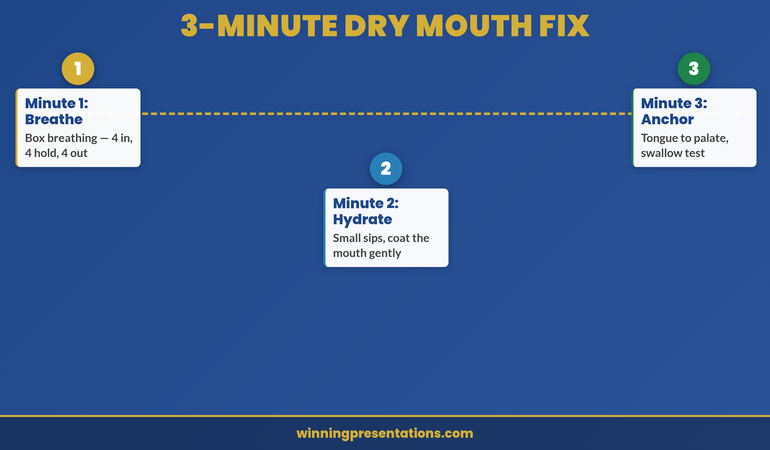
Minute 1: Sympathetic Reset
Do box breathing. Breathe in for a count of 4, hold for 4, exhale for 4, hold for 4. Repeat four times. This activates your vagus nerve—the “off switch” for fight-or-flight. Your heart rate drops. Your nervous system begins to recognise safety. Your salivary glands start to reactivate.
The science is solid: controlled breathing directly signals your parasympathetic nervous system. Within 60 seconds, your body chemistry begins to shift from cortisol-dominant to a calmer state.
Minute 2: Physical Rehydration
Drink water. Not a sip—a full glass if you have it. Water does two things: it directly hydrates your mouth, and the act of swallowing stimulates your salivary glands. If water isn’t available, place your tongue on the roof of your mouth and move it in small circles. This activates the palatal glands. It feels odd. It works.
Some executives keep a lozenge in their pocket. Sucking a lozenge stimulates saliva production faster than water alone. Choose something sugar-free so your mouth doesn’t become sticky again mid-presentation.
Minute 3: Mental Anchor
Shift your focus. Stop thinking about your dry mouth. Instead, run through your opening line. Say it aloud, quietly. Feel yourself speaking with authority. Your mind and body are linked—when you speak with confidence in rehearsal, your nervous system registers safety. Your salivary glands stay engaged.
This is the critical shift. You’re no longer in panic mode. You’re in preparation mode. Your body recognises the difference.
Priya, a VP of Strategy at a tech firm, used this protocol 45 minutes before a Series B funding pitch to investors worth £8.2m. She’d struggled with dry mouth before every major presentation for years. “I did the box breathing in the lift, drank a full glass of water in the washroom, and then stood outside the conference room and ran through my first minute of the pitch aloud,” she told me. “By the time I walked in, my mouth felt normal. I didn’t think about it once during the presentation. That pitch closed in 18 days.”
The protocol works because it addresses both the physiology and the psychology. You’re not just hydrating your mouth—you’re signalling safety to your nervous system and reclaiming your focus.
Need nervous system techniques for presenting?
The Calm Under Pressure guide includes evidence-based protocols for managing physical symptoms of presentation anxiety.
Stop Treating Dry Mouth as Your Problem
Dry mouth presenting is a symptom of nervous system activation. The Calm Under Pressure guide contains full protocols for managing the 6 most common presentation physical symptoms—dry mouth, shaking hands, voice cracking, heart racing, and more.
- ✓ Before-presentation nervous system reset techniques
- ✓ During-presentation recovery manoeuvres
- ✓ Post-presentation nervous system reset to prevent spiralling
Evidence-based practice and executive coaching approaches.
What NOT to Do (The Mistakes That Backfire)
Don’t Use Caffeine
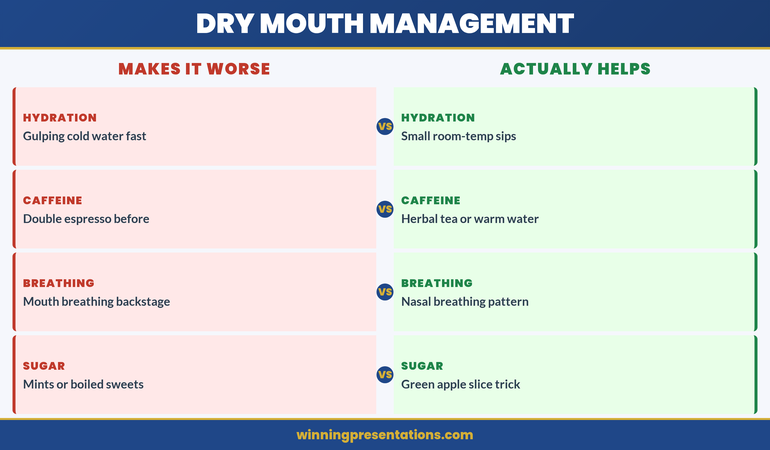
Coffee and tea dry your mouth further. They also spike cortisol, making your nervous system more reactive. If you’re struggling with dry mouth, caffeine 90 minutes before your presentation is self-sabotage. Stick to water.
Don’t Mouth-Breathe Before You Present
Breathing through your mouth dries your mouth and signals your nervous system that you’re in danger. Nose breathing activates your parasympathetic nervous system. The 3-minute protocol uses nose breathing deliberately for this reason.
Don’t Skip the Swallow Test
Before you step in front of your audience, swallow deliberately. If you can’t swallow easily, your nerves are still in control. Go back to your protocol. Do another round of box breathing. Give your nervous system five more minutes if you need them. A dry swallow on camera is worse than taking 300 seconds to prepare properly.
Don’t Rely on Sugar
Boiled sweets feel like they work because they trigger saliva production quickly. But the sugar rush also spikes blood glucose, which triggers cortisol release. You’ll feel better for 90 seconds, then worse. If you use a lozenge, use sugar-free only.
Managing Dry Mouth Once You’re Presenting
You’ve done the protocol. You step in front of the room. And halfway through your third slide, the dryness returns.
This is normal. It happens because the moment you’re presenting, your sympathetic nervous system reactivates. You’re managing threat in real time. The key is to have a 90-second recovery you can deploy without stopping your presentation.
The Pause Technique: Stop speaking. Swallow deliberately. Take a breath in through your nose. Reach for water if it’s available and take a sip—not a huge gulp, just enough to wet your mouth. Swallow again. Then resume speaking. The entire sequence takes 8–10 seconds. Your audience interprets this as a thoughtful pause, not panic.
The Tongue Anchor: If you don’t have water, use your tongue. Place it on the roof of your mouth. This stimulates your palatal glands immediately. You can do this whilst speaking—your audience won’t see it. Within 10 seconds, saliva production increases noticeably.
Both techniques break the feedback loop: dry mouth → panic about dry mouth → more dryness. You interrupt the cycle by introducing a physical action that rehydrates and signals safety.
See also: How to Fix Your Voice Getting Higher When You’re Nervous. Dry mouth often accompanies voice cracking and pitch elevation. These physical symptoms are linked—managing one often helps manage the others.
Long-Term Fixes That Reduce Recurrence
Hydration Baseline
The week before a major presentation, drink 2.5 litres of water daily minimum. This primes your salivary glands and ensures your nervous system isn’t already working from a deficit. Dehydration amplifies presentation anxiety. Most executives don’t hydrate deliberately enough.
Nervous System Conditioning
Practise box breathing daily, not just before presentations. Five minutes a day, five days a week, for six weeks. This trains your parasympathetic nervous system to activate more readily. Over time, your body learns to downregulate threat faster. Dry mouth becomes less severe and less frequent.
This is not meditation or relaxation. It’s nervous system fitness. You’re building capacity.
Presentation Practice Under Pressure
Practice your presentation in front of people. Not in front of the mirror. In front of 2–3 colleagues who will ask questions and challenge you. This exposes your nervous system to the actual threat stimulus in a controlled environment. Over time, your body habituates. Presentations feel less threatening. Your sympathetic activation weakens.
This is why executives who present weekly are rarely bothered by dry mouth. They’ve desensitised their threat response.
Post-Presentation Recovery
After you present, your nervous system stays elevated for 30–90 minutes. Most executives ignore this. They crash into their next task without recovering properly. This means your nervous system stays in a heightened state heading into your next high-stakes situation. Over time, this creates cumulative anxiety.
After you present, spend five minutes in deliberate recovery: box breathing, a walk outside, or a conversation with a trusted colleague. This signals to your nervous system that the threat has passed. You recover properly. Your baseline anxiety drops.
For more on this, read Post-Presentation Anxiety: Why Your Heart Is Still Racing After.
Frequently Asked Questions
Q: Does anti-anxiety medication help with dry mouth presenting?
Medication can help with overall presentation anxiety. However, many anti-anxiety medications actually worsen dry mouth as a side effect. If you’re considering medication, discuss this with your doctor. The behavioural protocols (box breathing, nervous system conditioning) often work as well or better without medication side effects.
Q: Can I prevent dry mouth by eating before I present?
Light eating can help—a banana, a handful of nuts, or a piece of toast 60–90 minutes before you present provides steady glucose and prevents blood sugar drops that amplify anxiety. However, eating right before you present can make you feel sluggish or create additional anxiety about your breath. Eat early. Present later.
Q: What if I don’t have time for the full 3-minute protocol?
Do box breathing. It’s the most important element. 90 seconds of box breathing—just four rounds—will shift your nervous system state meaningfully. If you have one more minute, add water. If you have a third minute, add the mental anchor. But even one minute of box breathing is better than nothing.
Q: Does dry mouth presenting mean I’m not cut out for public speaking?
No. The most seasoned executives still experience dry mouth before high-stakes presentations. It’s not a sign of weakness—it’s a sign that your nervous system recognises that the moment matters. What separates confident presenters from anxious ones isn’t the absence of dry mouth. It’s having a protocol to manage it before it manages you.
The Winning Edge
Weekly presentation strategies for executives who present under pressure.
Dry mouth presenting is one of the most correctable presentation symptoms you’ll face. You’re not powerless. You have a nervous system you can regulate, a protocol that works, and the capacity to present with vocal control. The 3-minute fix isn’t magic—it’s applied neuroscience.
Use it before your next presentation. Then read about Restructuring Your Presentation Team for Trust and Impact to ensure the content you’re delivering lands with the same confidence as your delivery.
About the Author
Mary Beth Hazeldine is Owner & Managing Director of Winning Presentations. With 24 years of corporate banking experience at JPMorgan Chase, PwC, Royal Bank of Scotland, and Commerzbank, she advises executives across financial services, healthcare, technology, and government on structuring presentations for high-stakes funding rounds and approvals.