

Quick answer: Presentation panic attacks are triggered when the brain’s threat-detection system — the amygdala — misinterprets a high-stakes speaking situation as a physical danger. The result is a flood of adrenaline and cortisol that produces racing heart, shallow breathing, mental blanking, and an overwhelming urge to escape.
The key to regaining control is not willpower or positive thinking — it is nervous system regulation. Techniques such as controlled breathing, grounding exercises, and cognitive reframing interrupt the panic cycle before it escalates, and with practice, they can prevent attacks from occurring altogether.
In this article:
- What triggers panic attacks during presentations — and why your brain reacts this way
- The difference between presentation anxiety and a panic attack
- What to do during a panic attack on stage
- Prevention protocols that reduce the likelihood of an attack
- Building long-term resilience against presentation fear
- Frequently asked questions
Linnea had presented quarterly results to her division head dozens of times. She was good at it — structured, clear, well-prepared. So when the company asked her to present the same figures to the full executive committee, she assumed it would feel no different.
It was different. Standing in the boardroom with twelve senior leaders watching, she felt her chest tighten thirty seconds before she was due to speak. Her mouth went dry. Her hands began trembling so badly she could not advance her slides. The room seemed to narrow around her, and for a terrible moment she genuinely believed she might pass out in front of every person who controlled her career trajectory.
She did not pass out. She stumbled through the opening, excused herself for water, and recovered enough to finish. But the experience left a mark. For the next three months, every meeting invitation triggered a wave of dread — not ordinary nerves, but the visceral, full-body alarm of someone who had experienced a presentation panic attack and now lived in fear of the next one.
What happened to Linnea was not a character flaw. It was neuroscience. And understanding that distinction is the first step toward regaining control.
If presentation anxiety has moved beyond ordinary nerves into something that feels physical and overwhelming, you are not alone — and there are structured approaches that can help. Conquer Your Fear of Public Speaking is a neuroscience-based programme designed specifically for professionals who experience acute fear before and during presentations.
What triggers panic attacks during presentations — and why your brain reacts this way
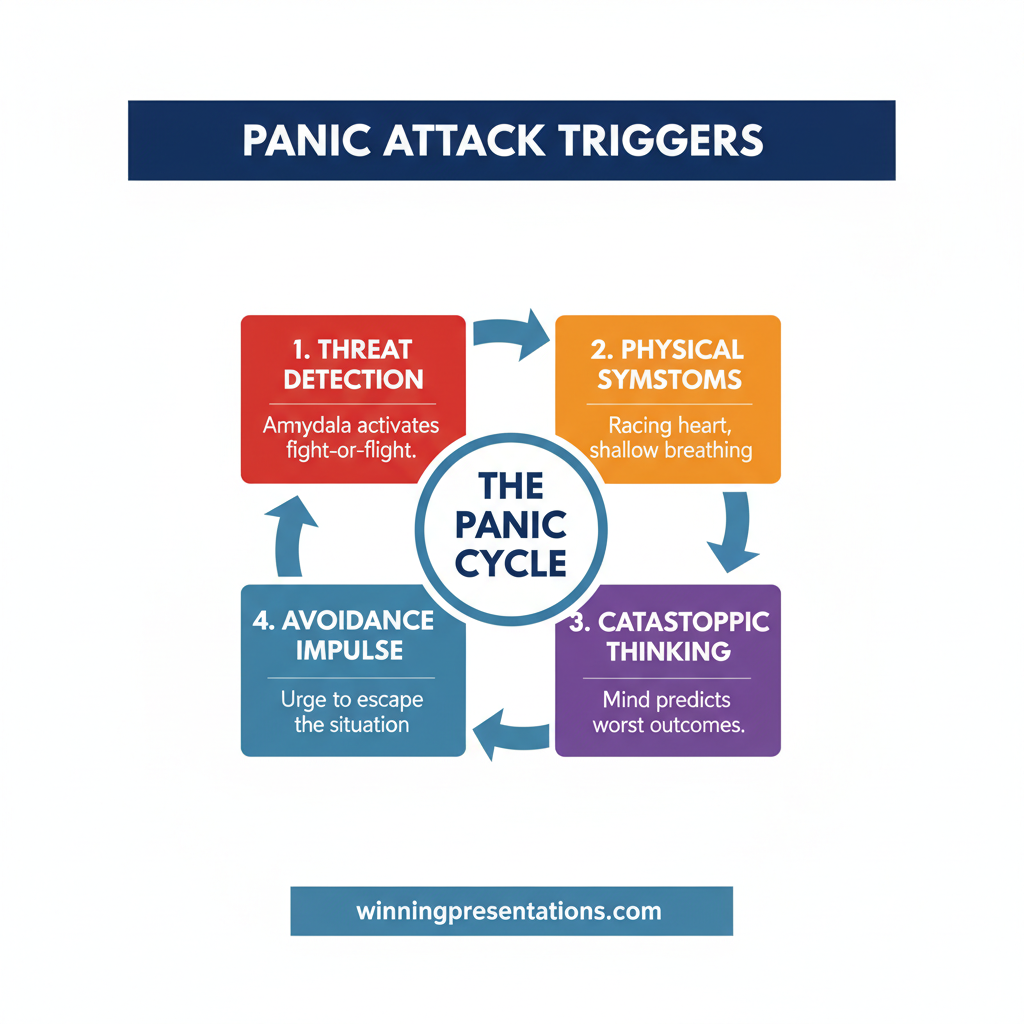
To understand presentation panic attacks, you need to understand what the brain is actually doing when one occurs. The amygdala — a small, almond-shaped structure deep in the brain — is responsible for scanning your environment for threats. When it detects danger, it triggers the sympathetic nervous system before your conscious mind has any say in the matter.
In a genuinely dangerous situation, this response saves lives. In a boardroom, it creates chaos. Your heart rate spikes, breathing becomes shallow, blood redirects to your limbs, and your prefrontal cortex — responsible for structured thinking and articulate speech — essentially goes offline.
Several factors make the amygdala more likely to misfire in presentation contexts:
- Perceived social evaluation: being watched and judged by people who hold power over your career activates the same neural pathways as physical threat
- Previous negative experiences: one bad presentation can sensitise the amygdala, making it fire more easily in similar settings
- Sleep deprivation and chronic stress: a depleted nervous system has a lower threshold for triggering fight-or-flight
- Perfectionism and catastrophic thinking: mental rehearsal of worst-case scenarios primes the brain to treat the presentation as a genuine threat
- Unfamiliar environments: a new room, a larger audience, or a higher-stakes context removes the safety cues that normally keep the amygdala calm
The critical insight is that panic attacks are not a failure of courage or competence. They are a neurological event — the brain’s alarm system activating inappropriately. This is why approaches that focus on treating presentation anxiety at the nervous system level tend to be more effective than simple advice to “just relax” or “think positively.”
When presentation fear has become physical, you need more than advice — you need a structured system
Conquer Your Fear of Public Speaking — £39, instant access — is a neuroscience-based programme built for professionals who experience acute anxiety before and during presentations. It covers nervous system regulation, cognitive reframing, physical symptom management, and pre-presentation protocols — the specific mechanisms that interrupt the panic cycle before it takes hold.
If you recognise the pattern Linnea experienced — the tightening chest, the racing thoughts, the dread that builds for days before a presentation — this programme addresses exactly those responses.
Instant digital download. Work through it at your own pace.
The difference between presentation anxiety and a panic attack
Most professionals experience some degree of presentation anxiety. Butterflies before a big meeting, a slight tremor in the voice during the opening minute, a heightened awareness of being watched — these are normal nervous system responses that often improve performance by sharpening focus.
A panic attack is qualitatively different. It is not an amplified version of nerves; it is a distinct neurological event with specific characteristics:
- Sudden onset: panic attacks typically peak within minutes, often without clear warning
- Physical intensity: heart pounding, chest tightness, dizziness, nausea, tingling in the hands, difficulty breathing — symptoms that feel medical, not psychological
- Cognitive disruption: thoughts fragment, words disappear, the ability to follow a logical sequence collapses
- Sense of unreality: the room may feel distant or distorted, and there is often a powerful conviction that something catastrophic is about to happen
- Urge to escape: the drive to leave the room is overwhelming and feels non-negotiable
The distinction matters because the management strategies differ. Ordinary anxiety responds well to preparation and positive self-talk. Panic attacks require physiological intervention — you need to address what is happening in the body before you can regain access to the thinking brain.
One pattern particularly common among executives is the “secondary fear cycle.” After experiencing a single panic attack during a presentation, the fear of having another one becomes its own trigger. The anticipation of panic creates the very conditions that make the next attack more likely. Breaking this cycle is central to any effective recovery approach.
What to do during a panic attack on stage
If you feel a panic attack beginning while you are presenting, the single most important thing to understand is this: the attack will pass. Panic attacks typically last between two and ten minutes. Your body cannot sustain the level of adrenaline output indefinitely. The worst of it will subside — but what you do in those minutes determines whether you recover in the room or need to leave it.
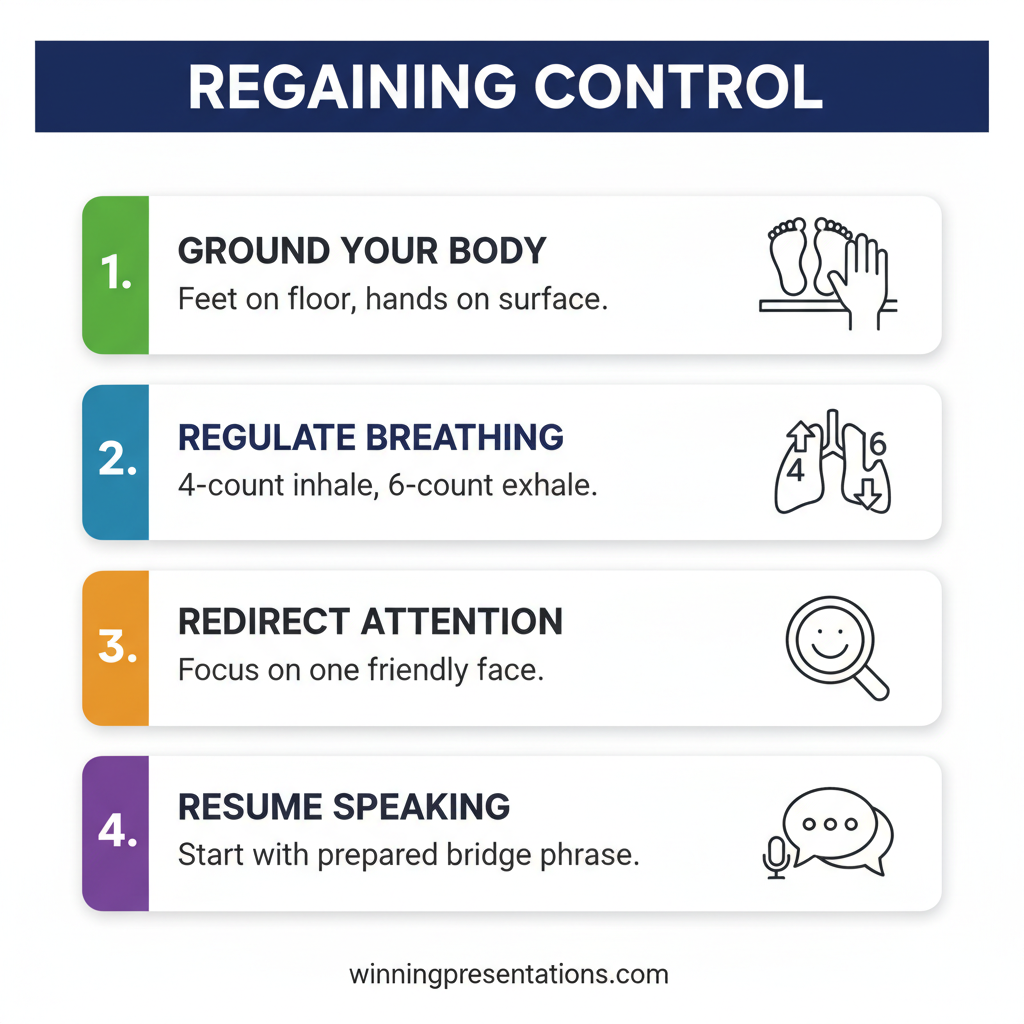
Step 1: Slow your exhale. The fastest way to activate the parasympathetic nervous system — the body’s calming mechanism — is to make your exhale longer than your inhale. Breathe in for four counts, out for six or eight. This is not a metaphor or a relaxation technique; it directly stimulates the vagus nerve, which sends a chemical signal to slow your heart rate. Box breathing for executives is one structured approach that works well in these moments.
Step 2: Ground yourself physically. Press your feet firmly into the floor. If you are standing at a lectern, grip the edges. Touch something solid. These physical anchors send sensory data to your brain that competes with the threat signals — a technique known as “sensory grounding.” Your brain cannot process the panic response and detailed sensory input simultaneously.
Step 3: Use a transition phrase. Have a prepared sentence that buys time without signalling distress: “Let me check my notes on this next point.” The audience does not know what you are experiencing internally — a brief pause looks like thoughtfulness, not panic.
Step 4: Narrow your focus. Find one person who appears engaged and supportive, and speak directly to them. Reducing the social scope lowers the amygdala’s threat assessment. You are no longer presenting to a room of evaluators; you are having a conversation with one person.
Step 5: Accept, do not fight. Trying to suppress a panic attack intensifies it. Acknowledge internally: “This is a panic response. It is uncomfortable but not dangerous. It will pass.” This cognitive labelling engages the prefrontal cortex and begins to reassert executive function.
If you want a structured system that walks you through each of these techniques in depth, Conquer Your Fear of Public Speaking covers nervous system regulation, cognitive reframing, and pre-presentation protocols designed for exactly these situations.
Prevention protocols that reduce the likelihood of an attack
Managing a panic attack in real time is important, but prevention is where the real progress happens. The goal is to reduce your baseline nervous system arousal so that the threshold for triggering a panic response is significantly higher.
Build a pre-presentation protocol. A consistent routine in the 60 to 90 minutes before a presentation trains the nervous system to associate preparation with calm rather than threat. This might include controlled breathing exercises, a physical walk, reviewing your opening lines (not the entire deck), and a brief grounding exercise. Consistency matters more than the specific activities — the brain learns to recognise the routine as a safety cue.
Address anticipatory anxiety early. For many executives, the worst part of a presentation is not the presentation itself — it is the days of dread beforehand. Anticipatory anxiety floods the system with stress hormones long before you walk into the room, leaving you depleted and sensitised by the time you need to perform. Learning to interrupt the anticipatory cycle — through scheduled worry periods, cognitive defusion techniques, or structured rehearsal — prevents the nervous system from being pre-loaded when the moment arrives.
Rehearse in graduated exposure. Avoidance maintains fear. If you have experienced a presentation panic attack, the natural response is to avoid similar situations — or to over-prepare to the point of exhaustion. Neither approach works long-term. Instead, gradually increase your exposure to presentation-like conditions: practise in front of one trusted colleague, then a small group, then a slightly larger audience. Each successful experience rewires the amygdala’s threat assessment for that context.
Manage physical state before cognitive state. Sleep quality, caffeine intake, and physical exercise directly influence nervous system reactivity. An executive who slept four hours and consumed three espressos before a board meeting has a significantly lower panic threshold than one who arrived physically regulated.
Create environmental safety cues. Visit the presentation room beforehand if possible. Stand where you will stand, test the technology, sit in the audience seats. Familiarity reduces novelty, and novelty is one of the amygdala’s primary threat indicators.
Build your own pre-presentation protocol
Conquer Your Fear of Public Speaking — £39, instant access — gives you a structured approach to nervous system regulation, physical symptom management, and cognitive reframing. Rather than relying on willpower or hoping the fear fades with experience, you get a repeatable system designed for professionals who face high-stakes presentations regularly.
Instant digital download. No subscription, no expiry.
Building long-term resilience against presentation fear
Acute strategies and prevention protocols are essential, but lasting change requires building the kind of deep resilience that makes panic attacks progressively less likely over time. This is not about eliminating nervousness entirely — some degree of activation before a high-stakes presentation is both normal and useful. It is about raising the threshold so far above your typical presentation demands that the panic response simply does not trigger.
Reframe the narrative. Many executives who experience panic attacks before presentations internalise a story about themselves: “I am someone who cannot handle pressure,” or “There is something wrong with me that other people do not have.” This narrative strengthens the fear cycle. The reframe is neurological, not motivational — your brain had a threat response in a specific context. That response can be reconditioned. It is not a permanent feature of who you are.
Separate preparation from rumination. Effective preparation — reviewing content, practising your opening, testing slides — reduces anxiety. Rumination — imagining everything that could go wrong, replaying past failures — increases it. If your “preparation” involves sitting at your desk feeling dread, that is rumination, and it is making your next presentation harder.
Build a bank of successful experiences. Every presentation you complete — even imperfectly — updates your amygdala’s threat assessment. The brain learns from experience, not theory. Each successful presentation in a slightly more challenging context teaches the nervous system that this type of situation is survivable.
Consider professional support when needed. If panic attacks related to presentations are frequent or significantly limiting your career, working with a professional who understands performance anxiety is a strategic decision. Cognitive-behavioural approaches have a strong track record with situation-specific panic.
The ability to manage high-stakes presentations with composure is not a personality trait that some people have and others lack. It is a skill built on neurological understanding, deliberate practice, and the right support structures — whether that involves presenting to senior stakeholders or delivering quarterly results to the board.
Frequently asked questions
Can you have a panic attack during a presentation even if you have never had one before?
Yes. A combination of factors — high stakes, poor sleep, unfamiliar environment, or accumulated stress — can push the nervous system past its threshold for the first time. The first experience often creates a sensitisation effect, making subsequent presentations feel more threatening. Understanding the neurological mechanism and learning regulation techniques can prevent it from becoming a recurring pattern.
How do you hide a panic attack while presenting?
Most panic attack symptoms are far less visible to the audience than they feel to the person experiencing them. Internal sensations — racing heart, dizziness, cognitive disruption — are largely invisible from outside. Use a transition phrase to buy time, slow your breathing with extended exhales, ground yourself physically, and narrow your focus to one person. The goal is not to suppress the experience but to manage it while the physiological wave passes.
Should you tell your employer about panic attacks related to presenting?
This depends on your workplace culture and your relationship with your manager. In many organisations, disclosing performance anxiety is met with support — reasonable adjustments such as presenting seated or having a co-presenter. In others, the stigma may create career risk. What you should absolutely do is take active steps to address the issue, whether through structured self-help resources, professional support, or both.
Join The Winning Edge
A weekly newsletter for executives who want to present with more confidence and clarity. Practical strategies, no fluff.
Mary Beth Hazeldine | Owner & Managing Director, Winning Presentations. With 24 years of corporate banking experience at JPMorgan Chase, PwC, Royal Bank of Scotland, and Commerzbank, she advises executives across financial services, healthcare, technology, and government on structuring presentations for high-stakes funding rounds and approvals.