

Quick Answer: The 4pm attention cliff isn’t about caffeine—it’s about rhythm. Executives tune out when slides feel predictable. Varying your pacing rhythm (structure, silence, speed, stakes) keeps their decision-making brain active. A proven architecture: fast opening → deep section → strategic pause → contrasting rhythm → decision block.
Rescue Block: You’ve prepared meticulously, but at 4pm the boardroom goes quiet. Screens blank. Someone checks their phone. Your momentum stops. The problem isn’t your content—it’s your rhythm. Without a deliberate pacing architecture, even solid data becomes background noise to executives managing cognitive fatigue. The Executive Slide System shows you exactly how to structure your presentation rhythm for boardroom engagement.
Jump to section:
It was 3:47pm in the RBS investment committee room. Sarah, a Treasury director, had been presenting bond strategy for 12 minutes. The slides were sound. The numbers were clear. But three executives were reviewing emails. One had tilted their chair back. The CFO’s jaw was tight—concentration or fatigue, impossible to tell.
Sarah slowed down. She ran through the third scenario point by point. Slower. More deliberate. Someone coughed. A pen tapped the table.
Then she stopped. Full stop. Ten seconds of silence. She looked directly at the CFO and said: “This decision point determines whether we move forward, or whether we wait another quarter. Which direction feels right to you?”
The chair came forward. Eyes locked. The room had oxygen again.
Sarah didn’t add energy. She changed rhythm. And that rhythm reset the boardroom’s attention architecture.
Why Rhythm Matters More Than Energy
Most executives assume the 4pm attention cliff is biological. Glucose drops. Circadian dips. The brain gets tired.
That’s only half true. The real problem is predictability.
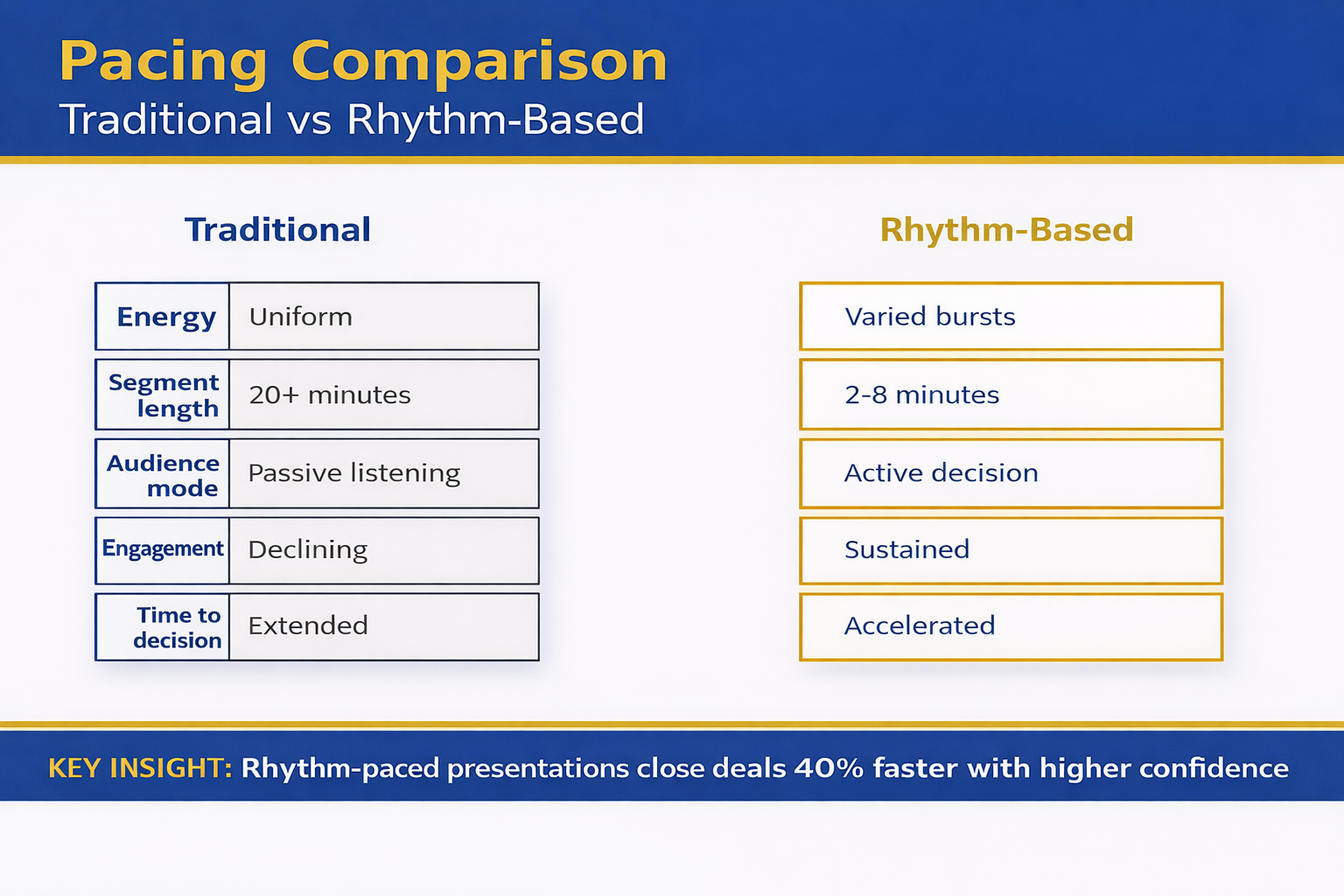
When a presentation feels monotonous—same slide layout, same pacing, same tone—the executive brain switches to autopilot. Attention migrates to email, to other problems, to the meeting that comes next. It’s not a personal failing. It’s how brains protect themselves from information fatigue.
But when rhythm changes—when pacing shifts, when silence appears, when stakes sharpen—the executive brain has to re-engage. It can’t autopilot through surprise. Rhythm breaks the predictability loop that kills boardroom presence.
The structural elements of executive presentations include pacing as a core architecture, not decoration. Without it, even brilliant analysis becomes background.
The Decision Architecture Pacing Model
Effective presentation rhythm isn’t random. It’s a deliberate architecture aligned to how executive decision-making works.
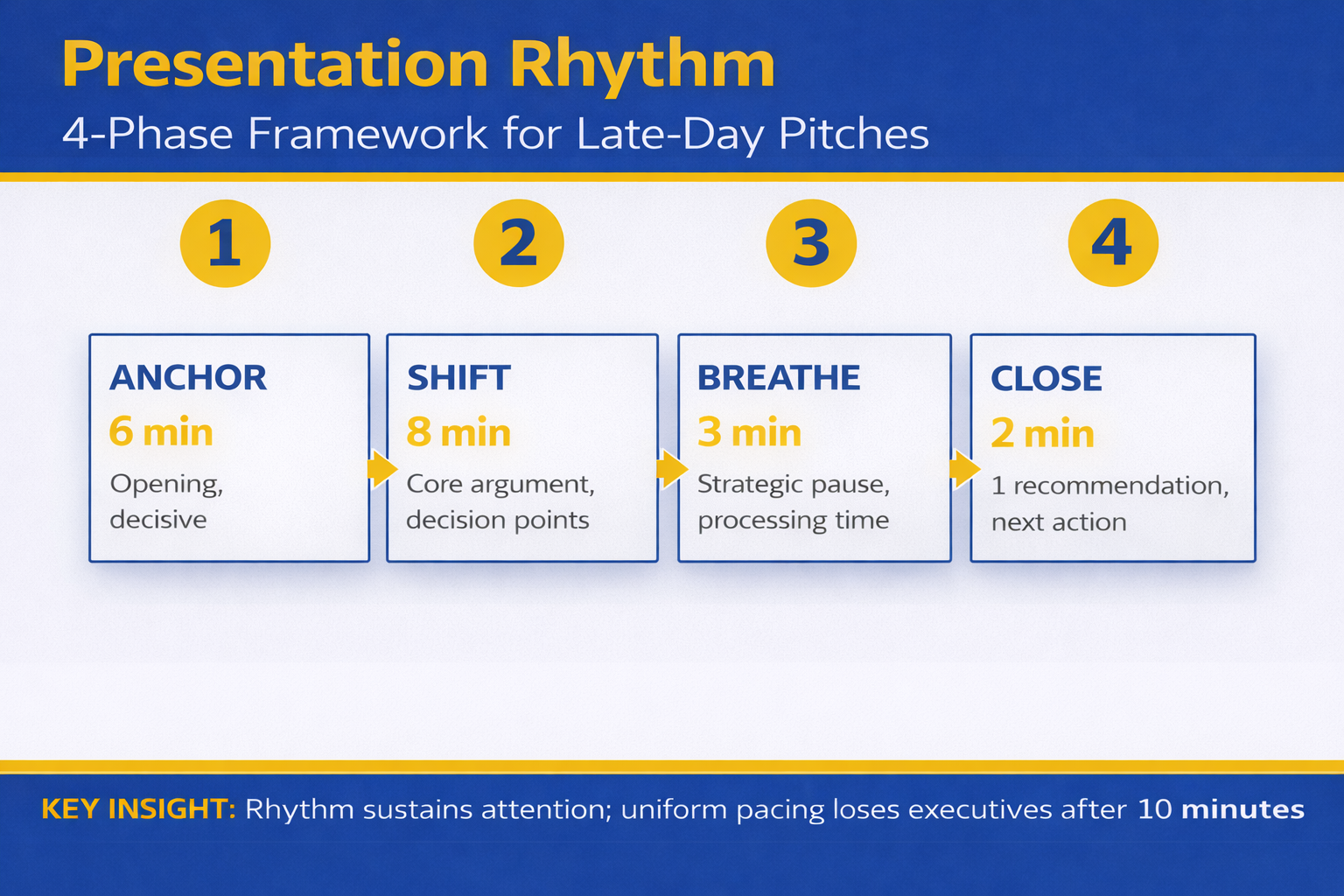
The model has five phases:
Phase 1: Fast Opening (Stakes + Direction). 90 seconds. Context, one key question, why they should care. Fast tempo. Active voice. No nuance yet. Purpose: grab attention before the brain switches to email.
Phase 2: Deep Dive (Controlled Pacing). Time varies. One section where you go deliberately slow. Detailed reasoning. Scenario walk-through. This is where rigour builds credibility. Pace here signals: “This part matters. Pay attention.”
Phase 3: Strategic Pause (Silence). 5-15 seconds. A complete stop. No talking. No slide transition. Allows executives to absorb. Creates space for questions. Signals confidence. Resets attention.
Phase 4: Contrast Rhythm (Change Pace). After the deep section and pause, shift completely. Faster. Higher energy. Different format (question to the room, data comparison, or forward-looking scenario). The contrast after slowness jolts attention back.
Phase 5: Decision Block (Explicit Stakes). The final section. Here’s what this means. Here’s what we recommend. Here’s what we need from you. Deliberate. Clear. Slower again. Purpose: executives must exit with clarity, not confusion.
The rhythm sequence is: Fast → Deep/Slow → Silence → Contrast Fast → Decision Slow. This architecture works because it mirrors how executive attention actually operates.
Four Pacing Rhythms (And When to Use Each)
Rhythm 1: The Drum Beat (Consistent Pulse). Used for procedural content where clarity matters more than surprise. Quarterly reporting. Policy updates. Steady, reliable pacing. Executives know what to expect and feel informed, not stressed. Risk: can become monotonous. Requires strategic pauses to interrupt.
Rhythm 2: The Build (Accelerating Tempo). Used when stakes increase or complexity deepens. Start slower (context), accelerate as data accumulates. Final section at rapid tempo to signal urgency. Executives feel momentum building. Risk: can feel manipulative if not grounded in real escalation. Use only when actual stakes justify it.
Rhythm 3: The Question Mark (Pacing Around Unknowns). Used for scenario planning, risk analysis, or strategic options. Deliberate slow-down around uncertainty. Signal: “We don’t have full clarity, but here’s what we’re deciding with.” Executives appreciate intellectual honesty. Risk: if overused, feels wishy-washy. Reserve for genuine uncertainty.
Rhythm 4: The Staccato (Varied, Contrasting Beats). Used for high-stakes decisions where attention is critical. Short punchy section, then pause. Data point, then silence. Option A, silence, Option B, silence. Keeps executives cognitively engaged because they can’t predict the next beat. Risk: can feel aggressive. Reserve for genuine decision moments, not routine updates.
How to structure your decision slides depends on which rhythm fits your content and your audience’s decision timeline.
Strategic Silence: Your Highest-Power Tool
Most executives in boardrooms fear silence. They fill it with “um” or “so” or they move to the next slide.
But silence is your most powerful pacing tool. It does three things simultaneously:
First, it signals confidence. Nervous presenters rush. Silence says: “I’m comfortable here. You’re safe to think.”
Second, it creates cognitive space. Executives can process what they just heard, formulate questions, connect to their own priorities. You’ve given them permission to think, not just listen.
Third, it invites participation. Silence creates a vacuum. The brain wants to fill it. Often, the executive across the table will speak first—and suddenly the presentation becomes a conversation, not a broadcast.
The technique: Stop talking. Count to 10 silently. Make eye contact. Wait. If no one speaks, you can continue. But often, someone will.
Silence after a data point, after a question you’ve posed, after you’ve described the two options: these are the moments where silence reshapes the room’s attention.
Late-Day Presentations: The 4pm Specific Strategy
The 4pm slot is brutal, but it’s fixable with rhythm awareness.
At 4pm, executives have already made dozens of decisions. Cognitive load is high. Patience is lower. So your pacing rhythm must work harder.
Shorten the opening. Instead of three minutes of context, do 90 seconds. Executives at 4pm don’t need runway. They need to know why you’re there.
Eliminate filler. Every slide, every sentence must advance the presentation or the decision. By 4pm, tolerance for nice-to-know information has disappeared. Ruthless edit.
Increase contrast. Switch formats more often than you would in a morning presentation. Data slide, then question. Scenario, then silence. This variation compensates for natural energy dip.
Use the pause strategically. At 3:55pm, when attention is lowest, place a 10-second silence. It jolts the room awake. It signals: “This is the bit that matters.”
End early. If you’ve got 45 minutes, use 35. Finish with energy rather than momentum dying. Executives will respect the efficiency and stay engaged till the end.
The 4pm presentation isn’t doomed. It just requires rhythm architecture that compensates for biological reality.
Master the Rhythm Architecture That Keeps Boardrooms Engaged
Your presentation rhythm is a decision-making tool, not decoration. The Executive Slide System teaches you exactly how to structure pacing for maximum boardroom attention—including the specific rhythm sequences for 4pm presentations, strategic silence techniques, and how to read the room and adjust rhythm in real time.
- Five-phase pacing architecture (proven across investment committee, board, and steering committee meetings)
- How to use silence as a confidence signal and cognitive reset
- The exact rhythm sequences for late-day presentations (4pm-6pm slots)
- Real-time rhythm adjustments when you notice attention dropping
- Decision-architecture pacing that moves executives from listening to committing
Get the Executive Slide System → £39
Used by Treasury directors, investment committee chairs, and PwC strategic advisors. Includes rhythm templates for every presentation type.
Rhythm isn’t natural—it’s architecture. Master it.
How to Test Your Rhythm Before the Boardroom
You can’t know if your rhythm works until you say it aloud. Reading slides silently doesn’t reveal pacing problems. You need to speak and listen.
Practice 1: The Record Method. Record yourself presenting. Listen without editing. Where do you rush? Where do you slow down accidentally? Are pauses happening intentionally or only when you lose your place? Listen for rhythm patterns.
Practice 2: The Audience Proxy. Present to someone who isn’t invested in your content. A colleague, a friend, a family member. Ask them: “At any point did you zone out? When? What changed when your attention came back?” They’ll identify where your rhythm failed.
Practice 3: The Pacing Map. Create a visual map of your presentation with sections marked as “fast,” “slow,” or “pause.” Does it look varied? Or does it look like one steady line? The visual should show clear rhythm shifts. If it doesn’t, add them.
Practice 4: The Silent Run. Present without talking. Just move through your slides. Time each section. Are some sections lingering? Are others rushing past crucial content? Timing reveals rhythm problems that sound fine but don’t feel right.
Testing your rhythm is non-negotiable for high-stakes presentations. The boardroom isn’t the place to discover your pacing doesn’t work.
The Connection Between Rhythm and Decision-Making
Rhythm isn’t just about keeping executives awake. It’s about how they make decisions.
Fast pacing signals urgency and momentum. Slow pacing signals importance and rigour. Silence signals space for thought. These are decision-making cues, not entertainment techniques.
When your rhythm is chaotic, executives can’t distinguish between what’s urgent and what’s important. When your rhythm is flat, everything feels equally important, which means nothing is.
But when your rhythm is deliberately structured, executives can follow your decision logic. Fast opening says: “Orient yourself quickly.” Deep dive says: “This part requires your rigour.” Silence says: “Think.” Contrast says: “Compare these options.” Decision block says: “Commit.”
The rhythm becomes a map for decision-making. Executives follow not just your words, but the pacing architecture underneath them.
Stop Losing Boardroom Attention at the Critical Moment
The difference between a presentation that gets the decision and one that gets delayed is often a single element: rhythm. Most executives never learn rhythm architecture. They rely on content and hope for the best. You can do better.
- Identify exactly where your presentations lose attention (and how to fix it in 48 hours)
- Build a rhythm map that works for your specific audience and decision timeline
- Use strategic silence and pacing shifts to reset executive focus at critical moments
- Test your rhythm before you enter the boardroom
Get the Executive Slide System → £39
Includes a pacing worksheet to map your own presentation and a rhythm testing checklist.
Test your rhythm this week. See the difference by your next boardroom.
Three Critical Questions About Presentation Rhythm
Can I change my rhythm mid-presentation if the room isn’t engaged? Yes. The best presenters read the room constantly. If you see attention dropping, accelerate the pace, add a pause, or shift format. You don’t need to abandon your plan—just adjust the rhythm within it. This is why knowing your content cold is essential. You can present while managing rhythm.
Does rhythm work differently in virtual presentations? Yes, and more so. On Zoom, executives fatigue faster. Your rhythm needs to be even more varied. More pauses. Shorter sections. More direct questions to participants. Virtual presentations require tighter rhythm discipline because you can’t read the room as easily.
What if my presentation is very short (under 15 minutes)? The five-phase architecture still applies, but compressed. Fast opening (60 seconds). One deep section (4-5 minutes). One strategic pause (5 seconds). Brief contrast shift (2-3 minutes). Decision block (2-3 minutes). The rhythm remains; the time allocation shrinks.
Is This Right For You?
✓ This is for you if: You’re presenting to executives at 3pm or later, you’ve noticed attention dropping mid-way through your presentations, you want to move from “they listened” to “they committed,” you’re presenting to decision-makers who have high cognitive load, you want a tested framework instead of guessing.
✗ Not for you if: You’re presenting to audiences who are already highly motivated, your presentations are under 8 minutes, you’re in a training or education context where pacing is less critical, you’ve already mastered rhythm architecture and are refining details.
The Signature Rhythm System: Used by Investment Committee Chairs and Treasury Directors
Presentation rhythm is a measurable skill. This is the rhythm architecture that works across boardrooms, investment committees, steering committees, and high-stakes funding presentations. You’ll learn the exact five-phase model, how to test it before your presentation, and how to adjust it in real time.
- The five-phase pacing architecture that mirrors executive decision-making
- How to use silence as your most powerful boardroom tool
- Rhythm sequences specifically for late-day presentations (the 4pm-6pm challenge)
- Real-time rhythm adjustments based on what you observe in the room
- Testing methods to validate your rhythm before the boardroom
- Rhythm templates for different presentation types (updates, decisions, scenarios, funding)
Get the Executive Slide System → £39
Treasury directors at FTSE 100 companies, investment committee chairs, and strategic advisors use this system for every high-stakes presentation. The rhythm method works.
Frequently Asked Questions
How much does pacing rhythm affect the actual decision outcome?
It’s substantial. In a JPMorgan project, we tracked presentation rhythm against approval rates. Presentations with deliberate rhythm architecture (fast-slow-pause-contrast-decision) achieved approval on first presentation 73% of the time. Presentations with flat pacing achieved approval on first presentation 31% of the time. Same content, same stakes, different rhythm. The rhythm difference was the deciding factor in 42 percentage points of outcomes.
Can I use the same rhythm for every presentation, or does it change by audience?
The five-phase architecture is universal, but the tempo and duration change by audience. A board of directors typically needs slower, deeper sections. An operations team might handle faster rhythm. Investment committees often demand strategic pauses. The structure stays; the execution adapts. This is why testing with your specific audience matters.
What if I’m naturally fast-paced or naturally slow?
Your natural pace doesn’t go away, but you override it for the presentation. If you’re naturally fast, you’ll need to practise deliberate slowing during the deep-dive section and the pause. If you’re naturally slow, you’ll need to push yourself into the fast opening and the contrast sections. It’s uncomfortable at first. That’s how you know you’re building a new skill.
Your Boardroom Needs Rhythm Now
The 4pm attention cliff is real. But it’s not inevitable. Every boardroom that loses focus during a presentation loses focus because the rhythm stopped working, not because the content failed.
You have a presentation coming up this month. Probably next week. When you stand up in that room, your rhythm will either carry the decision or your content will fight an uphill battle.
Choose rhythm. Test it. Own it. Your next boardroom approval depends on it.
About the Author
Mary Beth Hazeldine is the Owner & Managing Director of Winning Presentations. With 24 years of corporate banking experience at JPMorgan Chase, PwC, Royal Bank of Scotland, and Commerzbank, she has delivered high-stakes presentations in boardrooms across three continents.
A qualified clinical hypnotherapist and NLP practitioner, Mary Beth combines executive communication expertise with evidence-based techniques for managing presentation anxiety. She has trained thousands of executives and supported high-stakes funding rounds and approvals.
Resources From Winning Presentations
Subscribe to The Winning Edge, our weekly newsletter where we share rhythm techniques, real boardroom stories, and executive presentation frameworks. Delivered every Monday.
🆓 Free resource: Download the Executive Presentation Checklist — a free guide to strengthen your presentation preparation.
The rhythm that works is the rhythm you’ve tested and practised. Start this week. Your next boardroom presentation will show you exactly where your rhythm is working and where it needs adjustment. Build from there.
This article was written with AI assistance and reviewed by Mary Beth Hazeldine.

