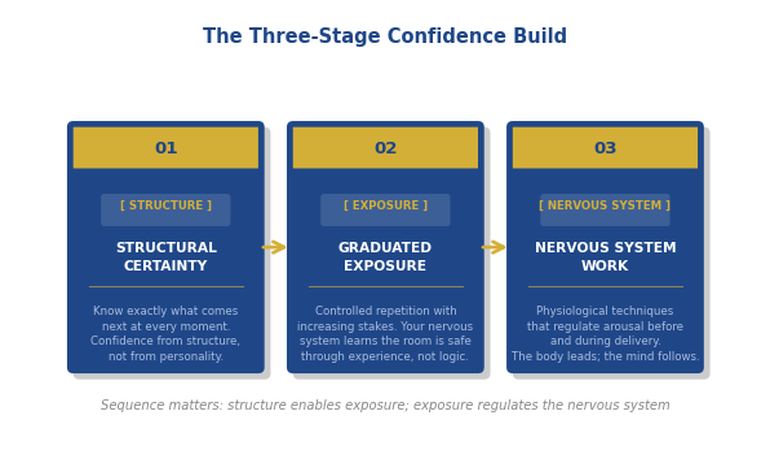
She delivered the presentation perfectly. Clear structure, confident delivery, sharp answers in Q&A. The senior leadership team thanked her warmly. Three weeks later, when the project was being discussed at board level, her name didn’t come up. Someone else’s did.
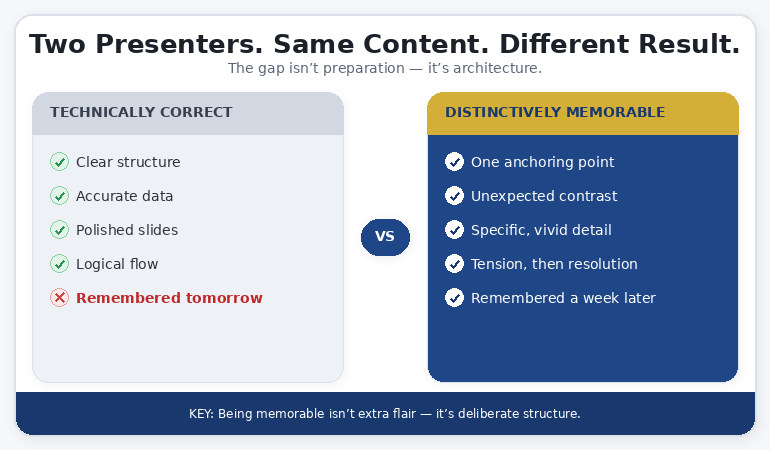
She wasn’t passed over because she failed. She was passed over because she hadn’t registered. The presentation had been technically correct and entirely unmemorable — and in the room where careers advance, those two things are not the same as doing well.
Stage fright gets diagnosed. It gets talked about, treated, trained away. The fear of being forgettable is quieter — but for the executives I work with, it is often the more accurate description of what they are actually afraid of. Not that it will go wrong. That it will go fine, and nobody will notice.
Quick answer: The fear of being forgettable is not a performance problem — it is a distinctiveness problem. Technically correct presentations fail to register because they are built to avoid failure rather than to create impression. The fix is the one decision point that every presentation needs and most executives skip: what single thing do you want the room to remember when everyone has left? That question, answered before the deck is built, changes the structure, the language, and the moment in the room that makes you memorable.
🎯 Worried your presentations land and then disappear? Conquer Speaking Fear (£39) includes the memorability framework — the single structural change that makes executive presentations stick rather than slide off the room.
Jump to:
I spent 24 years in corporate banking at JPMorgan Chase, PwC, Royal Bank of Scotland, and Commerzbank. I sat in hundreds of presentations — some of which I still think about today, and most of which I cannot recall a single detail of. The ones I remember were not always the most technically accomplished. They were the ones where the presenter had made a decision about what to leave behind.
The fear of being forgettable is almost never named as a fear. It presents as something else: a vague dissatisfaction with your own presentations, a frustration that you prepare thoroughly and deliver competently but don’t seem to build momentum, a nagging sense that you’re getting positive feedback but not advancement. What sits underneath all of that is the knowledge — accurate, if unarticulated — that the room is processing your presentation in real time and discarding most of it within 48 hours.
This is not a confidence problem. Many of the executives I work with are entirely confident in front of a room. They are confident and forgettable, and the combination is more frustrating than stage fright, because stage fright at least has a diagnosis.
What the Fear of Being Forgettable Actually Is
The fear of being forgettable is not anxiety about the presentation itself. It is anxiety about what happens after the presentation — specifically, about whether the work you put into the room will translate into anything that changes how people think about you, your ideas, or your capability.
It is existential in a way that stage fright is not. Stage fright is about a visible, acute failure — the stumble, the blank, the meltdown. The fear of being forgettable is about an invisible, chronic failure — the presentation that goes smoothly from start to finish and changes nothing. It is possible to manage stage fright and still live with the fear of being forgettable. They are different problems.
The fear is rational. Most executive presentations are, in fact, forgettable. Not because the presenters are weak — because they are built to survive the room rather than to shape it. Built to avoid objections rather than to create impressions. Built for correctness rather than distinctiveness, and correctness, as a standard, produces adequate presentations at best.
The presentation confidence that most people work to build is about managing their own state in front of a room. That matters. But it does not solve the fear of being forgettable — because forgettable presentations are delivered by confident people every day. Confidence is necessary. It is not sufficient.
🎯 From Technically Correct to Genuinely Memorable: The Framework Inside Conquer Speaking Fear
Conquer Speaking Fear addresses both the anxiety that makes you hold back and the structural problem that makes you forgettable — because they are connected. The memorability framework inside includes:
- The single decision that changes how your presentation is built — the one question most executives skip that determines whether the room retains anything
- The structural change that creates impression without changing your delivery style or requiring you to be more extroverted
- The moment-in-the-room technique — how to create one point of genuine distinctiveness that travels out of the room after you’ve left
- Why technically correct presentations fail to register — and the three specific elements that create retention
- Scripts and frameworks for building distinctiveness into any presentation, including updates and committee briefings
Get Conquer Speaking Fear → £39
Built from 24 years of reviewing what makes executives memorable — from performance coaching, but in banking boardrooms where careers advance on the quality of the impression you leave behind.
Why GettingIt Right Isn’t the Same as Being Remembered
There is a common assumption that technical competence in presentation leads to memorability. That if you structure your content well, deliver it clearly, and handle Q&A professionally, the impression will follow. It does not work this way.
Technically correct presentations are processed by the audience as expected. Expected things are not memorable. The brain’s memory systems are optimised for novelty, significance, and pattern disruption — not for competent execution of a familiar format. When a presentation ticks every box and surprises no one, the audience experiences it as confirmation of baseline. That confirmation does not generate lasting impression.
There are three specific elements that create memorability in executive presentations. The first is a distinctive frame: a way of seeing the topic that the audience has not encountered before, and cannot easily dismiss. The second is a moment of genuine specificity — a number, a story, a piece of evidence so precise that it does not generalise. The third is a closing that creates tension rather than resolution: something the audience leaves with that has not yet been answered, or a commitment so specific that it follows them out of the room.
Most presentations have none of these. They are built on the assumption that clarity is sufficient for impact. Clarity is necessary for impact. It is not impact.
Preparing a presentation where being remembered genuinely matters? Conquer Speaking Fear (£39) includes the three-element memorability checklist and the templates to build each element into any presentation format.
The One Decision That Makes You Memorable
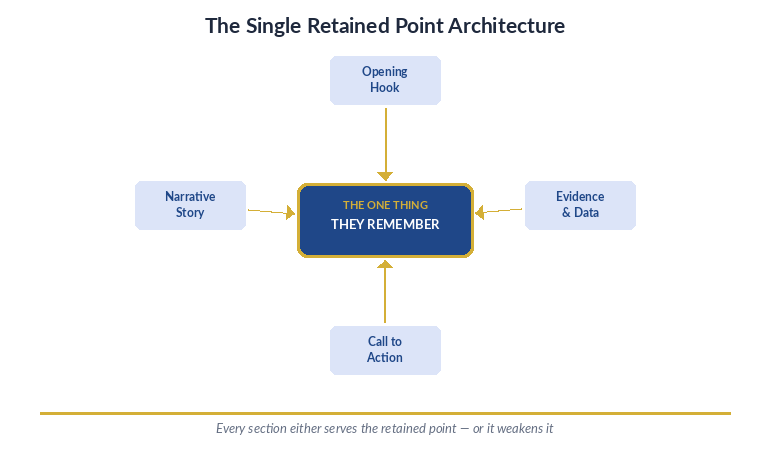
Before building any presentation, answer this question: what is the single thing you want the room to remember when everyone has left, the coffee cups have been cleared, and two other presentations have happened since yours?
Not the key messages — there are always three or five of those. Not the overall objective. The single thing. The one sentence that you would consider the presentation successful if it was still in someone’s head three days later.
Most executives cannot answer this question without several attempts. Not because they haven’t thought about the presentation — they have thought about it extensively — but because they have been building toward comprehensive communication rather than toward a single retained point. The question forces a prioritisation that comprehensive communication never requires, and that prioritisation is what makes the difference.
Once the single point is identified, it changes the structure, the language, the evidence selection, and the closing. Every section of the deck can be evaluated against one criterion: does this section serve the single point, or is it here because it belongs in a complete treatment of the topic? A complete treatment of the topic is for a report. A presentation that leaves one point behind is for a room.
This is not the same as simplifying your content. The evidence, the depth, the rigour — all of that remains. What changes is the architecture: everything is built to deposit one thing in the room’s memory, and everything that does not serve that deposit is moved to an appendix or removed entirely.
⚠️ Stop Presenting Well and Being Forgotten
Technical competence is not the problem. The problem is building presentations that aim for correctness rather than impression. Conquer Speaking Fear (£39) gives you the framework to identify your single retained point and build the rest of the deck to serve it — so you leave something behind when you leave the room.
Get Conquer Speaking Fear → £39
Used by executives who present confidently and want to know why they’re not advancing as fast as their performance warrants.
The Structural Change That Creates Impression
Once you have identified your single retained point, there is one structural change that consistently makes it land: give it three times more space than you think it needs.
Most executives identify the central point of their presentation and give it a slide. They present it in the same format as every other slide — the same visual weight, the same amount of speaking time, the same level of evidence. The audience processes it as one of many points and does not distinguish it as the point they are meant to carry with them.
A presentation built for memorability gives the central point a different kind of attention. It arrives at the point from two directions — an evidence approach and a case study approach. It lingers there rather than moving on. It uses language that is slightly more precise, slightly more surprising, than the surrounding sections. And it returns to the point at the close — not as a summary, but as a reframing that shows the audience something they have just been made to see that they could not see before the presentation began.
The fear of being judged when speaking often produces exactly the opposite structure: executives rush through the material to minimise exposure to judgment, and the rushed pace means no single section gets enough space to register. Slowing down at the central point — deliberately, visibly, without apology — is both a confidence signal and a memorability technique.
The Moment in the Room That People Carry With Them
There is a specific type of moment in executive presentations that travels out of the room with the audience. It is not the best slide. It is not the sharpest Q&A answer. It is the moment where the presenter says something that the audience had not heard formulated that way before — and that formulation makes something they already knew suddenly more useful.
This moment is not spontaneous. It is engineered. The best presenters I observed over 24 years in financial services had prepared two or three formulations that they delivered as if they were occurring to them in real time. The sentences were precise, unexpected, and impossible to improve. They stuck because they had been sharpened in advance to a point that could not be blunted by the audience’s existing vocabulary.
The technique is to write one sentence that your audience will want to use themselves. Not a quotable headline — a usable thought. Something that gives them language for a problem they already have. When an executive leaves a presentation and says to someone in the corridor, “she said something interesting — she said that…” the sentence they complete is the one the presenter put there deliberately.
This is not manipulation. It is the same precision that good writing requires — the sentence that could not have been written differently and still meant the same thing. Presentations that are remembered tend to contain at least one of these sentences. Presentations that are forgotten contain none.
The process of overcoming public speaking fear often focuses on managing internal state in front of a room. That work is valuable. But the executive who has resolved their anxiety and still presents forgettably needs a different intervention: not less fear, but more considered preparation of the specific moment that will travel.
Also published today: International Presentations: The Cultural Mistakes That Kill Deals Before Slide One — the structural adjustments that make you read as credible rather than problematic in cross-cultural rooms.
Common Questions About the Fear of Being Forgettable in Presentations
Is the fear of being forgettable the same as imposter syndrome?
They are related but different. Imposter syndrome is the belief that you are not as capable as others perceive you to be. The fear of being forgettable is the belief that even if you perform well, you will not make an impact. Many executives experience both — but the fear of being forgettable is often the more accurate fear, because it is a response to real feedback: presentations that go well and produce no change. Imposter syndrome is a distortion of self-perception. The fear of being forgettable is often an accurate assessment of a structural problem in how presentations are being built.
How do I become more memorable without changing my personality or presentation style?
The memorability techniques in this article and in Conquer Speaking Fear are structural, not stylistic. You do not need to become more energetic, more performative, or more extroverted. You need to identify your single retained point, give it disproportionate space in the presentation, and engineer one sentence that your audience will want to use themselves. These changes live in the preparation, not in the delivery. Your personality, your voice, your style — none of that changes. What changes is the architecture of the deck and the precision of one or two key sentences.
What if the content I’m presenting doesn’t lend itself to being memorable — like a budget update or a quarterly review?
Every presentation can contain one memorable moment, regardless of topic. A budget update can contain one framing that changes how the audience thinks about a number they have seen before. A quarterly review can contain one sentence that gives the audience language for a pattern they have been observing but haven’t been able to articulate. The technique works across presentation types because it does not depend on the subject matter being inherently interesting — it depends on the presenter doing the preparation work to find the single formulation that makes the familiar suddenly more useful.
Is This Right For You?
This article and Conquer Speaking Fear are for executives who present competently and know it, but who are not seeing the career impact that their presentation performance should generate. If you are getting consistent positive feedback and not advancing, if you are being told your presentations are good but not being remembered after them, or if you sense that you are technically doing everything right and still not registering — the memorability framework is the relevant intervention.
If your primary challenge is managing anxiety or fear in front of a room, Conquer Speaking Fear addresses that too. The memorability work and the anxiety management work are covered together because they connect: the executives who are most afraid of being forgettable tend to rush through their material to reduce exposure, and that rushed pace is exactly what prevents the central point from landing with enough weight to be retained.
Frequently Asked Questions
Does being memorable require being controversial or provocative?
No, and in many executive contexts, controversy is actively counterproductive. Memorability in executive presentations comes from precision and distinctiveness, not from provocation. The formulation that makes you memorable is more likely to be a precisely articulated insight that your audience already half-knows than a deliberately provocative claim. Controversial presentations are remembered, but often for the wrong reasons. The goal is to be remembered for the quality of your thinking, not for having caused friction in the room.
How long does the memorability preparation take?
The critical question — what is the single thing I want the room to remember? — takes 15–30 minutes to answer well if you have not done it before. The first answers are usually too broad. The useful answer is specific enough that you could repeat it to someone who wasn’t in the room and they would understand both the point and why it matters. Once you have that answer, the structural adjustments to the deck take 30–60 minutes for a presentation you have already built. The one engineered sentence takes longer — sometimes a day of writing and revision — because it needs to be precise enough to survive a room full of people who will immediately try to improve it.
📊 Want the slides too?
Preparation reduces anxiety. The Executive Slide System (£39) includes templates designed for executives who want their deck to carry the weight of the memorable moment — so your delivery can focus on the room rather than on the slides.
About the Author
Mary Beth Hazeldine is the founder of Winning Presentations and has spent over two decades advising executives on high-stakes communication. Her background includes roles at JPMorgan Chase, PwC, Royal Bank of Scotland, and Commerzbank. She has observed hundreds of executive presentations across board and leadership contexts and developed Conquer Speaking Fear from the patterns that separated the presentations people still talk about from the presentations nobody remembers. She works with senior leaders on both performance anxiety and the structural problem that lies beneath it.
Free resource: Executive Presentation Checklist — includes the memorability check for every presentation: the five signals that indicate your central point has enough structural weight to be retained.
The Winning Edge Newsletter
Practical executive presentation guidance, once a week. No padding, no noise — just the techniques that matter when the room is full of people whose time is expensive.

 Why ‘Be Yourself’ Fails in High-Pressure Contexts