Tag: presentation anxiety

05 Mar 2026
Confident executive woman presenting with structured slide deck visible on screen behind her in modern boardroom

Why a Proven Slide Structure Makes You 10x More Confident Than Practice Alone

The most confident executive presenter I’ve ever worked with rehearsed less than anyone else in her organisation. She simply had a better structure.

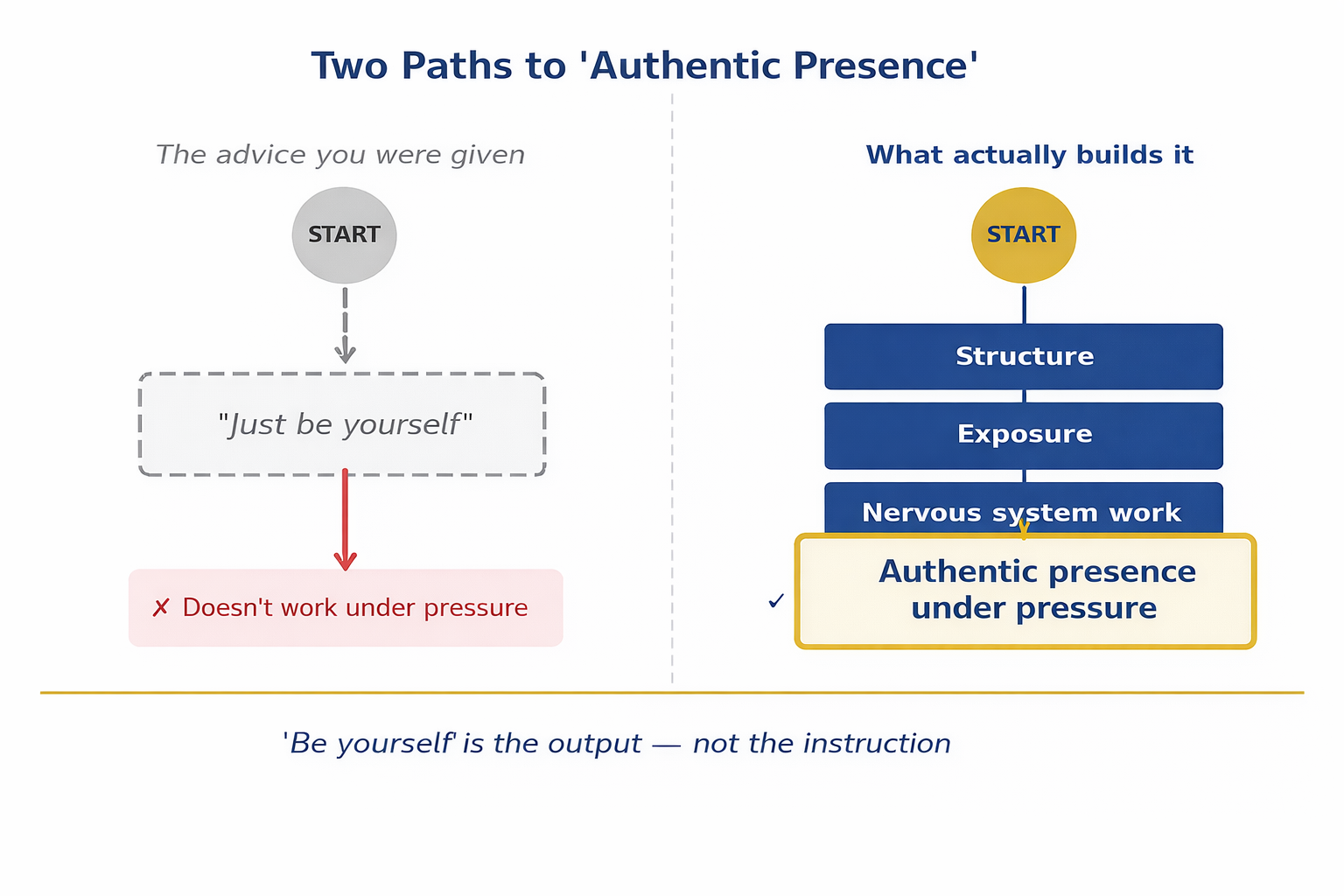
Most people try to fix presentation anxiety with more practice. More rehearsal. More hours in front of the mirror. And it helps, to a point. But if you’ve ever over-rehearsed a presentation and still felt shaky walking into the room, you already know: practice has a ceiling. After 24 years coaching executives, I can tell you what actually removes the nerves. It’s not confidence. It’s not charisma. It’s structure. A proven, tested system that tells you exactly what goes on each slide, in what order, and why.

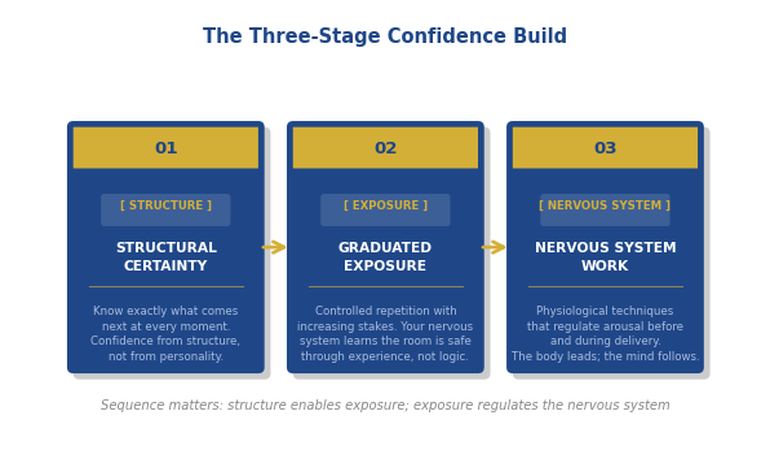
Quick answer: Presentation confidence doesn’t come from rehearsal alone—it comes from structural certainty. When you know your slide architecture is proven, your opening is designed to land, your evidence sequence is tested, and your close drives a decision, your nervous system stops treating the presentation as a threat. Structure replaces uncertainty. And uncertainty is what your body reads as danger. Executives who use a proven presentation system report feeling fundamentally calmer—not because they’ve practised more, but because they’ve eliminated the guesswork.

Tired of rehearsing endlessly and still feeling underprepared?

The problem isn’t practice—it’s that you’re building every presentation from scratch. The Executive Slide System gives you a tested architecture for every slide, every transition, and every close. When the structure is proven, the confidence follows.

Explore the Executive Slide System → £39

The Two Directors Who Presented to the Same Board

Last year I coached two directors at the same FTSE-listed company. Both were presenting strategic proposals to the board on the same afternoon. Both had strong ideas. Both were intelligent, articulate leaders. One spent three weeks rehearsing. She practised in the car, at her desk, in the shower. She could recite her presentation by heart. The other spent two days building her deck using a structured system I’d given her—a tested slide architecture with a decision-first format, an evidence sequence, and a pre-built close.

The first director walked in looking polished but tense. You could see it in how she held her clicker, in the micro-pauses where she was searching for memorised phrasing. When a board member interrupted with a question, she lost her thread for ten seconds. That ten seconds cost her momentum. She recovered, but the room’s energy had shifted.

The second director walked in calm. Not rehearsed-calm. Actually calm. She knew what her first slide would accomplish. She knew the evidence sequence was proven. She knew the close would drive a decision because she’d seen it work before. When a board member interrupted, she handled it easily—because she wasn’t holding a memorised script in her head. She was following a structure she trusted.

Both proposals were approved. But the second director was asked to present the combined strategy at the annual investor meeting. The board didn’t choose her because she was more senior or more experienced. They chose her because she looked like someone who could handle a room. That composure came from structure, not talent.

After 24 years of coaching, I’ve watched this pattern repeat hundreds of times. The executives who look most confident aren’t the ones who practise most. They’re the ones who trust their structure.

Stop Building Presentations From Scratch

Every time you start with a blank slide deck, your nervous system registers one thing: uncertainty. The Executive Slide System eliminates that uncertainty entirely.

  • A decision-first slide architecture tested across 1,200+ executive presentations
  • Evidence sequence framework that answers “Why this?”, “Why now?”, and “Why us?” in the order boards actually process information
  • Stakeholder-specific templates: CFO version, Operations version, Board-level version
  • Objection-handling slides for the eight most common executive concerns—built in, not bolted on
  • Closing framework that drives decisions, not just applause

Get the Executive Slide System → £39

Used by 1,200+ executives. Average approval rate: 72% on first presentation.

Why Practice Has a Confidence Ceiling

Rehearsal does build familiarity. It smooths your delivery, tightens your timing, helps you internalise key points. Nobody is arguing against practice. The problem is that practice alone doesn’t eliminate the uncertainty that causes anxiety.

When you rehearse a presentation you’ve built from scratch, you’re practising delivery—but you’re still carrying a deeper question: Is this the right structure? Will the board engage with this opening? Will they follow my logic? Will the close land? Am I presenting the evidence in the right order?

Those structural doubts don’t disappear with rehearsal. You can practise a badly structured presentation a hundred times and still feel uneasy about it, because your subconscious knows the architecture is uncertain. You haven’t tested whether this sequence of ideas actually works on this type of audience. You’re hoping it does.

Hope is not confidence. Confidence comes from knowing.

When executives tell me they “just don’t feel confident presenting,” I almost always find the same root cause: they’ve been working without a tested structure. They’re assembling slides from instinct, convention, or whatever worked last time, and then trying to rehearse away the underlying uncertainty. That’s like memorising a route through an unfamiliar city instead of using a map. You might get there, but you’ll be anxious the entire way.

The Structure Effect: What Certainty Does to Your Nervous System

Your nervous system is constantly scanning for threat. In a presentation context, the primary threat it detects isn’t the audience—it’s unpredictability. Will this work? Will they follow? Am I going to lose the room?

When you use a proven structure—a slide architecture that’s been tested with hundreds of similar audiences—your nervous system registers something entirely different: certainty. You’re not wondering whether the opening will land, because you’ve seen this opening work. You’re not anxious about the evidence sequence, because it follows a tested logic. You’re not worried about the close, because the framework is designed to drive a decision.

This is why I say structure makes people 10x more confident. It’s not a motivational claim. It’s a nervous system observation. When your brain doesn’t have to solve the “will this work?” problem during the presentation, it frees up an enormous amount of cognitive resource. That resource becomes presence, composure, and the ability to respond to the room rather than cling to a memorised script.

Think about the difference between driving a familiar route and navigating somewhere new. On the familiar route, you can have a conversation, notice the scenery, react to other drivers easily. On an unfamiliar route, your attention narrows, your grip tightens, and you can barely hold a conversation. Same skill—driving. Completely different experience, because one involves structural certainty and the other doesn’t.

Presenting works exactly the same way. A proven structure is your familiar route. It frees you to be present instead of panicking about what comes next.


The Structure-Confidence Effect infographic comparing how presenting without a proven structure triggers nervous system threat response versus how a proven template activates confidence response

Five Ways a Proven System Eliminates Presentation Anxiety

1. It removes the blank-slide problem

The moment of highest anxiety in presentation preparation isn’t the rehearsal—it’s the blank first slide. That’s when your brain confronts the full weight of “I have to figure out what to say, in what order, with what evidence, for this specific audience.” A proven system eliminates this entirely. You open the template, and each slide already has a purpose, a position in the sequence, and a tested rationale. Preparation becomes assembly, not invention.

2. It answers the “will this work?” question in advance

When you’ve built a presentation from scratch, you carry a low-level doubt through every rehearsal and into the room itself. A tested system removes that doubt because the structure has already worked. You’re not the first person to use this evidence sequence or this decision-first opening. It’s been tested with boards, investors, executive committees, and sceptical audiences. Knowing that shifts your internal state from “I hope this works” to “I know this works.”

3. It handles interruptions for you

One of the biggest anxiety triggers in executive presentations is the fear of interruption. What if someone asks a question mid-slide? What if you lose your place? When your confidence depends on a memorised sequence, any interruption is a threat. But when your confidence comes from a proven structure, interruptions become manageable because you always know where you are in the architecture. You can address the question and return to your position without panic, because the structure holds whether or not you deliver it in perfect sequence.

4. It makes your preparation faster (and calmer)

Executives who work without a system often spend days or weeks building a presentation—and then need additional time to rehearse it. The preparation itself generates anxiety because it consumes so much time and mental energy. A proven system cuts preparation time dramatically. When the structure is settled, all you’re doing is populating it with your specific content. This means less time in preparation mode and more time feeling ready—which is itself a confidence multiplier.

5. It gives you permission to stop rehearsing

Over-rehearsal is a real problem. When you’ve practised too much, your delivery becomes wooden, your responses to questions feel scripted, and you start second-guessing phrasing mid-sentence. A proven structure gives you permission to stop rehearsing earlier because you trust the architecture. You don’t need to practise the presentation fifteen times when the system has already been tested by hundreds of other executives. You familiarise yourself with it, personalise the content, and walk in.

Still assembling presentations from scratch?

The Executive Slide System gives you the architecture so you can focus on the content. Templates for every slide type, a proven evidence sequence, and objection-handling built in. Stop building from blank—start building from proven.

Get the Executive Slide System → £39

What a Confidence-Building Structure Actually Looks Like

Not all structures are equal. A confidence-building presentation structure has specific characteristics that differentiate it from a basic template or outline.

It leads with the decision, not the background. Most presentations start with context, history, and data before arriving at the ask. This creates anxiety because you’re spending the first ten minutes wondering whether the audience is following your logic. A decision-first architecture puts your recommendation on the first slide. The audience knows immediately what you’re proposing, and every subsequent slide exists to support that decision. You’re not building toward a reveal—you’re providing evidence for a position you’ve already stated.

It sequences evidence in the order audiences process it. Executives process information in a specific sequence: What’s the risk? What’s the return? What’s the timeline? A proven structure mirrors that processing order. You’re not guessing which evidence to present first—you’re following the cognitive sequence that board members naturally use to evaluate proposals. This makes your presentation feel logical and inevitable, which in turn makes you feel confident delivering it.

It pre-builds objection responses. Half of presentation anxiety comes from fear of challenge. What if they push back on the budget? What if they question the timeline? A confidence-building structure includes objection-handling slides built directly into the flow. You don’t need to improvise under pressure because the most common objections are already addressed in your architecture.

It closes with a specific action, not a vague summary. “Any questions?” is the weakest ending in executive presentations—and it’s the one that generates the most post-presentation anxiety. A proven structure closes with a clear decision framework: what you’re asking for, by when, and what happens next. You walk out knowing exactly what you asked for and what the next step is. That eliminates the lingering anxiety of “Did I get through to them?”

Your Next Presentation, Without the Guesswork

  • Decision-first architecture: stop burying your ask on slide 15
  • Evidence framework that follows how executives actually process proposals
  • Pre-built objection-handling slides for the questions that keep you up at night
  • Closing framework that drives a decision instead of trailing off into “Any questions?”

Get the Executive Slide System → £39

The same system used by board presenters, strategy directors, and CEOs at FTSE companies


Structure vs More Practice comparison infographic showing six categories where a proven slide architecture outperforms rehearsal: starting point, core question, preparation time, interruptions, and confidence source

Structure vs. More Practice: Where Executives Get This Wrong

The instinct when presentations feel shaky is always the same: practise more. Run through it again. Rehearse in the car. Record yourself. This instinct is understandable and not entirely wrong—but it usually addresses the symptom rather than the cause.

Here’s what I’ve observed over two decades of coaching: when an executive feels underprepared, the issue is almost never delivery. They can speak clearly, they know their material, they’re intelligent professionals. The issue is structural uncertainty. They’re not sure the deck is in the right order. They’re not sure the opening will connect. They’re not sure the close will land. And no amount of rehearsal resolves structural uncertainty, because you can’t practise your way to a better architecture—you can only practise the architecture you have.

This is where the 10x confidence factor comes from. When the structure is settled, rehearsal becomes productive instead of anxious. You’re no longer practising to discover whether the presentation works. You’re practising to refine your delivery of a presentation you already know works. That is a completely different psychological experience.

Think of it as the difference between rehearsing a play with a finished script and rehearsing while the writer is still changing the plot. One is productive. The other just compounds anxiety.

The same principle applies to hybrid presentations, where structural certainty is even more important because you’re managing in-room and remote audiences simultaneously. Without a clear architecture, the cognitive load doubles and confidence drops.

Structure first, rehearsal second.

The Executive Slide System gives you the proven architecture. Once you’ve populated it with your content, you’ll find you need far less rehearsal—because the structural confidence is already there.

Get the Executive Slide System → £39

Is This the Right Approach for You?

A structure-based approach to presentation confidence works when the underlying issue is uncertainty about your material’s architecture—not a clinical anxiety condition. If you’re an executive who knows your subject, can speak competently, but still feels unsettled walking into the room, structural certainty is very likely the missing piece.

This applies to you if: you spend more time worrying about your slide order than your content. If you rearrange your deck three times before every presentation. If you feel confident about what you know but anxious about how you’re presenting it. If you’ve ever looked at another executive and thought “how are they so calm?”—the answer is usually that they have a system.

If your anxiety is more pervasive—if it extends well beyond presentations into other areas of professional life, or if it involves severe physical symptoms that don’t respond to preparation changes—then you may benefit from a more clinical approach. For the majority of executives, though, structural confidence is the transformation they didn’t know they needed.

24 Years of Boardroom Presentations, Distilled Into One System

  • Complete decision-first architecture with real-world examples from every major executive scenario
  • 10+ pitch templates: strategy, budget, operational change, technology adoption, innovation—all with proven slide sequences
  • Stakeholder-specific decks for CFOs, Operations directors, and board-level audiences
  • Objection-handling templates for the 8 most common executive concerns
  • Language guide with 50+ proven phrases and framings for executive contexts

Get the Executive Slide System → £39

Trusted by 1,200+ executives. Average approval rate: 72% on first presentation.

Frequently Asked Questions About Presentation Structure and Confidence

Does using a template make my presentations feel generic?

The opposite. A proven structure frees you to focus on your specific content, data, and storytelling—because you’re not spending cognitive energy on architecture. Templates provide the skeleton; your expertise provides the substance. Nobody in the boardroom thinks about your slide order. They think about whether your argument is compelling. Structure makes your argument more compelling, not less personal.

I’m already a strong speaker. Do I still need a system?

Strong speakers benefit the most from structure, because the system eliminates the one thing that still creates anxiety: uncertainty about the material’s architecture. You may be brilliant at delivery, but if your slide order isn’t optimised for how executives process information, you’re working harder than you need to. A system lets your speaking ability shine by removing the structural friction underneath it.

How is this different from just following a standard presentation format?

Standard formats (introduction, body, conclusion) tell you what to include but not how to sequence it for decision-making audiences. A decision-first architecture is fundamentally different from a conventional presentation flow. It leads with the recommendation, structures evidence in the order executives process it, and closes with a specific ask. Standard formats leave the most important decisions to you—a tested system has already made them.

How quickly will I notice a confidence difference?

Most executives report feeling different during preparation—not just during delivery. The moment you open a template and see a clear architecture waiting for your content, the “where do I start?” anxiety disappears. By the time you’ve populated the structure with your specific data and arguments, you’ll feel a level of preparedness that would normally take three times the preparation hours to achieve. The confidence shift is immediate because it’s based on structural certainty, not accumulated rehearsal.

Get executive presentation insights every week.

The Winning Edge newsletter delivers real strategies for the presentation moments that matter. Techniques, frameworks, psychology. Once a week, practical. No fluff.

Subscribe to The Winning Edge

🆓 Free resource: Executive Presentation Checklist — a free guide to strengthen your presentation preparation.

Explore related articles:

About the Author

Mary Beth Hazeldine has spent 24 years coaching executives, board members, and senior leaders through high-stakes presentations. She created the Executive Slide System after observing that the most confident presenters weren’t the most practised—they were the most structured. The system distils the architecture of successful executive presentations into a reusable framework that removes guesswork and builds genuine confidence from the first slide.

Next step: If you have a presentation coming up and you’re already dreading the preparation, try this: before you open PowerPoint, write down the decision you want from the audience. Then write the three strongest pieces of evidence for that decision. Then write your close. If you can do that in 15 minutes, you’ve already built a skeleton that’s more effective than most executive presentations. If you want the complete architecture—tested, templated, and ready to populate—the Executive Slide System gives you exactly that.


04 Mar 2026
Clinical hypnotherapy approach to treatment-resistant presentation anxiety in corporate setting

When Therapy, Coaching, AND Practice Haven’t Fixed Your Presentation Fear

You’ve done everything right. You’ve sat in therapy, talking through your childhood fears and perfectionism. You’ve invested in coaching programmes that promised to rewire your confidence. You’ve rehearsed your presentations until you could deliver them in your sleep. Yet when you stand up to speak, your body hijacks you anyway. Your heart races. Your voice trembles. The fear is still there—just as visceral as it was five years ago.

This isn’t a reflection on your intelligence, your preparation, or your commitment to change. It means you’re experiencing treatment-resistant presentation anxiety, and you need a different approach.

When traditional therapy, coaching, and practice haven’t resolved your presentation fear, the issue isn’t your willpower—it’s your nervous system’s regulation. Clinical hypnotherapy and nervous system-focused techniques work differently than talk therapy because they address the body’s threat response directly, not just the thoughts about the threat. If you’ve exhausted conventional approaches, a clinical framework designed specifically for treatment-resistant speaking anxiety may be the missing piece.

Tried therapy, coaching, and practice—still dreading your next presentation?

The pattern repeats: preparation feels thorough, yet your nervous system floods with adrenaline the moment you step on stage. This is treatment-resistant presentation anxiety, and it requires a nervous system approach—not more talking.

  • Recognise why traditional anxiety treatment sometimes fails for public speaking
  • Understand the specific mechanism your nervous system is stuck in
  • Access a clinical protocol designed for people who’ve tried everything

Ready for the clinical approach?

Get Conquer Speaking Fear → £39

The Story That Changed How I Understand Presentation Fear

I spent five years terrified of presenting. Not anxious. Terrified. When I was asked to present, my body responded as though I were facing physical danger: nausea, shaking, voice that cracked mid-sentence, hands that wouldn’t stay still. I tried talking therapy, which helped me understand my perfectionism but didn’t stop the physical response. I tried techniques: breathing exercises, positive affirmations, exposure practice. They helped slightly, but not enough.

The breakthrough came when I began my clinical hypnotherapy training and learned that my nervous system didn’t believe I was safe, no matter what my conscious mind knew. Cognitive work alone wasn’t addressing the subcortical threat response. Once I applied nervous system regulation techniques—the ones I now teach in Conquer Speaking Fear—the physical symptoms resolved within weeks, not years. That experience shaped everything I now teach about treatment-resistant presentation anxiety.

Why Traditional Approaches Fall Short for Treatment-Resistant Presentation Anxiety

When your presentation fear persists despite years of therapy, coaching, and practice, it’s not because these approaches are ineffective in general. They work brilliantly for many people. But for a subset of individuals—those with treatment-resistant presentation anxiety—the conventional toolbox hits a ceiling.

Therapy, particularly talk-based approaches, excels at helping you understand the origins of your fear: the critical parent, the early experience of public failure, the perfectionism that became armour. This understanding is valuable. But understanding doesn’t always change the nervous system’s threat response. Your amygdala—the brain’s threat detector—doesn’t operate primarily through language. It operates through subcortical pathways that bypass conscious reasoning. You can intellectually know you’re safe, and your body still floods with adrenaline.

Coaching and presentation skills training work on competence: more preparation, more rehearsal, more exposure. The assumption is sound—confidence builds through mastery. But when your nervous system interprets the presentation context as a threat, more exposure can actually reinforce the association. You practise, you feel afraid, your nervous system learns: “This environment is dangerous.” The loop tightens.

This is where treatment-resistant presentation anxiety differs from garden-variety nervousness. It’s not that you lack confidence in your content or your ability to deliver. It’s that your threat-detection system has become miscalibrated. It fires even when the evidence for danger is absent.

What Your Nervous System Is Actually Doing

To understand why traditional approaches sometimes fail, you need a precise picture of what’s happening in your body when you present.

Your nervous system has three core states: sympathetic (fight-or-flight), parasympathetic (rest-and-digest), and social-engagement (calm-but-alert). Most people move fluidly between these states depending on context. In low-threat situations, you’re parasympathetic. When you step up to present, your sympathetic system activates appropriately—your heart rate increases, blood flows to your muscles, your awareness sharpens. This is useful. It’s supposed to happen.

But in treatment-resistant presentation anxiety, your sympathetic system doesn’t calibrate. It floods. Your nervous system assigns the same threat level to a boardroom presentation as it would to a physical attack. This is what produces the nausea, shaking, voice disruption, and mental fog you experience. Your body is preparing you to flee or fight—and neither option is available in the presentation context, so you freeze instead.

The critical insight: this isn’t a thinking problem. It’s a nervous system regulation problem. Your conscious mind may be telling you, “This is safe, you’re prepared, you know this content,” but your nervous system isn’t listening because it operates according to patterns encoded much deeper than conscious thought. These patterns live in procedural memory, emotional conditioning, and somatic (body-based) imprints. Talk therapy reaches the cortex. Treatment-resistant presentation anxiety needs subcortical intervention.

Why CBT, Coaching, and Exposure Sometimes Aren’t Enough

Cognitive-behavioural therapy is genuinely effective for many anxiety conditions. It works by challenging distorted thoughts and gradually exposing yourself to the feared situation until your nervous system learns it’s safe. The theory is sound. The mechanism is this: repeated exposure without catastrophe should extinguish the fear response.

But exposure therapy has a known limitation for treatment-resistant cases: it can flatten the fear response temporarily without changing the underlying nervous system calibration. You give a presentation, nothing terrible happens, yet three weeks later, the anxiety is back at full intensity. Why? Because your nervous system never actually re-encoded safety. The fear was merely suppressed or you white-knuckled through it using willpower. The subcortical threat pattern remains intact.

Rehearsal and practice, taken to extremes, can even worsen treatment-resistant presentation anxiety. More hours at the podium sometimes means more opportunities for your nervous system to practice the threat response. You condition yourself deeper into the pattern.

Coaching works well when the barrier is skill or confidence. But when the barrier is nervous system dysregulation, coaching is asking the wrong system to change. You can have a coach point out every strength you possess, and your amygdala still won’t care. It’s operating from a different information set: procedural memory and somatic patterns, not rational evaluation.

The pattern is this: traditional approaches assume the nervous system will self-correct once the thinking changes or the experience repeats. For treatment-resistant anxiety, this assumption breaks. The nervous system needs direct intervention—techniques that speak its language.

How Hypnotherapy and Nervous System Approaches Work Differently

Clinical hypnotherapy isn’t stage hypnosis or entertainment. In a clinical context, hypnotherapy is a method for achieving focused attention and accessing the parts of the nervous system that aren’t reachable through conscious discussion.

When you’re in hypnotic trance (which feels like a relaxed, concentrated state—not sleep, not loss of control), your critical conscious mind becomes less dominant, and your nervous system becomes more accessible. This is where the reframing happens, not in your thoughts, but in how your body interprets threat and safety.

A clinical hypnotherapist working with treatment-resistant presentation anxiety isn’t trying to convince you that presentations are safe. You already know that intellectually. Instead, the work is subcortical: recalibrating your nervous system’s threat-detection threshold. Through techniques like nervous system anchoring and somatic resourcing, your body learns a new physiological response to the presentation context.

Neuro-Linguistic Programming (NLP) operates from a similar principle: it works with the structure of your experience—how you’re internally representing the threat—rather than trying to think your way out of it. An NLP practitioner helps you interrupt the automatic pattern and install a resourced response in its place.

Both approaches share a critical difference from talk therapy and coaching: they work with the nervous system directly. They don’t ask your thinking to change your physiology; they change your physiology and allow your thinking to follow.

The Clinical Mechanism: From Theory to Regulation

Here’s the specific mechanism that makes clinical approaches effective for treatment-resistant presentation anxiety:

Pattern interruption. Your presentation anxiety has become automatic. You think of presenting, and your body responds with threat activation before you’ve consciously processed what you’re afraid of. A clinical approach interrupts this automatic sequence. It breaks the conditioned link between “presentation context” and “threat activation.”

Subcortical re-encoding. Once the automatic pattern is interrupted, your nervous system can be guided into a new encoding. Not through logic, but through direct nervous system work. You’re literally teaching your amygdala that presentations are safe—not by telling it, but by activating a genuinely resourced physiological state while simultaneously encountering the presentation context. This is how nervous system learning occurs.

Resource anchoring. Clinical protocols typically establish what’s called a “resourced state”—a physiological condition of genuine safety, calm alertness, and confidence. This state is anchored (associated) with specific triggers or contexts. When you subsequently encounter a presentation opportunity, those anchors activate the resourced state rather than the threat response. Your body remembers a different pattern.

Somatic integration. The goal isn’t intellectual acceptance. It’s bodily integration. You should be able to stand in front of an audience and feel genuinely calm—not managing anxiety, not white-knuckling through it, but physiologically present and regulated. This is what becomes possible when you work at the nervous system level.

What a Clinical Approach Actually Looks Like

If you’ve decided that treatment-resistant presentation anxiety requires a clinical intervention, here’s what that process actually involves:

Assessment of your nervous system patterns. A clinical approach begins by understanding precisely how your nervous system is triggering. Is it a full sympathetic flood from the moment you think about presenting? Does it spike only when you’re in front of people? Does it manifest as a freeze response rather than fight-or-flight? The specifics matter because they determine the intervention.

Guided nervous system regulation. You’ll learn techniques to access and activate your parasympathetic (calm) system and your social-engagement system (the nervous system state of safe connection). These aren’t breathing exercises in the traditional sense. They’re precise physiological interventions that shift your nervous system state measurably.

Reprocessing in context. Once you can reliably access a resourced nervous system state, the clinical work involves reprocessing the presentation context while you’re in that state. The goal is to decouple “presenting” from “threat.” Your nervous system learns: “This is a context where I’m calm, capable, and connected.”

Rehearsal with regulation. Unlike traditional practice, which can reinforce anxiety patterns, clinical rehearsal is done while maintaining nervous system regulation. You’re practising presentations from a resourced state, which teaches your nervous system a completely different pattern.

Maintenance and integration. The final phase ensures the changes are durable. You learn to maintain nervous system regulation under increasing pressure, and you develop ways to access resourced states independently, without relying on a practitioner.

Present Without the Adrenaline Hijack

When traditional methods haven’t worked, the clinical nervous system approach delivers what they couldn’t: genuine physiological calm during presentations.

  • Learn the specific nervous system techniques used by clinical hypnotherapists to decouple threat responses from presentation contexts
  • Regain access to your resourced nervous system state on demand, even under pressure
  • Move beyond anxiety management to actual resolution—no more white-knuckling, no more suppression
  • Integrate new nervous system patterns through guided practice that rewires, rather than reinforces, old fear responses
  • Develop lasting capacity to present with genuine calm and executive presence

Get Conquer Speaking Fear → £39

Created by a clinical hypnotherapist who spent 5 years terrified of presenting and developed these techniques to resolve her own treatment-resistant anxiety.

Not sure if this is for you? If you’ve exhausted therapy, coaching, and practice and your presentation fear persists, a nervous system approach is specifically designed for your situation. You can explore Conquer Speaking Fear risk-free and see if it resolves what traditional methods couldn’t.

Comparison of traditional anxiety treatment approaches versus nervous system-focused clinical approach for presentation fear

Stop Dreading Every Presentation on Your Calendar

You shouldn’t have to spend weeks in advance worrying about a 30-minute talk. You shouldn’t wake up the morning of a presentation with your stomach in knots.

  • Replace the dread-preparation-adrenaline cycle with genuine nervous system calm
  • Show up to presentations feeling resourced, not just competent

Get Conquer Speaking Fear → £39

A 30-day programme using nervous system regulation techniques from clinical hypnotherapy—designed specifically for people who’ve tried everything.

The turning point: When you realise your presentation fear isn’t a personal failing or a thinking problem, but a nervous system that needs re-education, everything shifts. That turning point is available to you.

Timeline showing nervous system regulation progression through clinical hypnotherapy treatment for presentation anxiety

Questions People Ask About Treatment-Resistant Presentation Anxiety

What if I’ve already tried hypnotherapy and it didn’t work?

Clinical hypnotherapy for presentation anxiety is highly specific. If you’ve had a session with a general hypnotherapist, that’s quite different from working with someone trained specifically in nervous system regulation for presentation fear. The depth, duration, and focus matter enormously. A single session is unlikely to resolve treatment-resistant anxiety; a structured programme with nervous system-specific techniques is what creates lasting change.

How is this different from just learning to manage anxiety?

Management and resolution are fundamentally different. Anxiety management is about learning to tolerate or suppress the fear while you present—breathing techniques, grounding strategies, cognitive reframes. Resolution is about actually changing your nervous system so that the fear doesn’t activate in the first place. You’re not managing a response; you’re creating a different physiological response.

How long does it take to see results?

With a properly designed clinical protocol and consistent practice, most people report significant shifts within 2-4 weeks and substantial resolution within 30 days. This is faster than traditional therapy because you’re working directly with the nervous system rather than waiting for cognitive shifts to produce physiological changes. However, durability requires integration—continuing the practices that maintain your nervous system regulation.

Is This Right For You?

A clinical nervous system approach is specifically for people in this situation:

  • You’ve invested in talk therapy or coaching and made progress intellectually, but your body still responds to presentations with fear
  • Your presentation anxiety is treatment-resistant—it hasn’t resolved despite your best efforts
  • You experience physical symptoms (nausea, shaking, voice disruption, mental fog) that appear automatic and beyond your control
  • You’re willing to work directly with nervous system techniques, not just more thinking or more practice
  • You want resolution, not just management

If this describes you, then exploring why therapy alone didn’t resolve your presentation fear is the next logical step toward finding what will.

From 5 Years of Terror to Teaching Thousands

My own treatment-resistant presentation anxiety shaped everything I teach about nervous system regulation for public speaking.

  • Learn the exact nervous system techniques I developed to move from terror to teaching
  • Access a 30-day structured programme that combines clinical hypnotherapy, nervous system regulation, and presentation rehearsal
  • Get guided audio sessions for nervous system anchoring and resourced practice
  • Work through a framework designed by someone who has lived treatment-resistant presentation anxiety and resolved it
  • Join hundreds of professionals who’ve moved from dread to genuine executive presence using these techniques

Get Conquer Speaking Fear → £39

30-day clinical programme using nervous system regulation from hypnotherapy. Designed for people who’ve tried everything else.

Want the slides too?

Preparation reduces anxiety. The Executive Slide System (£39) includes confident-presenter templates designed to minimise preparation stress.

Frequently Asked Questions About Treatment-Resistant Presentation Anxiety

Is this a self-help course or a clinical intervention?

Conquer Speaking Fear is a structured self-guided programme built on clinical nervous system principles. It’s not a substitute for working with a licensed therapist if you have diagnosed mental health conditions, but it’s specifically designed for people who want to apply clinical techniques independently to resolve treatment-resistant presentation anxiety. You’ll have access to guided sessions, frameworks, and integration practices—everything needed to work at the nervous system level yourself.

Will this work if my anxiety is rooted in trauma?

If your presentation anxiety is connected to past trauma, a clinical programme is a useful tool, but you may benefit from working with a trauma-trained therapist in parallel. The nervous system regulation techniques in Conquer Speaking Fear are safe and supportive, but trauma resolution typically requires additional guidance. The programme is designed to work alongside professional support if you’re currently engaged with a therapist.

What if I’m taking medication for anxiety?

Medication and nervous system regulation work beautifully together. If you’re on medication prescribed by your doctor, continue taking it as directed. The nervous system techniques in Conquer Speaking Fear complement pharmaceutical support—they’re not in conflict. You’re still addressing the root nervous system regulation, and medication helps stabilise your baseline while you do that work.

Ready for deeper insights?

Join our weekly newsletter for practitioner-level articles on nervous system regulation, presentation psychology, and the clinical approaches that actually work for treatment-resistant anxiety.

Subscribe to The Winning Edge

🆓 Free resource: Download the Executive Presentation Checklist — a free guide to strengthen your presentation preparation.

The Path Forward

Treatment-resistant presentation anxiety tells you something important: the approaches that work for others aren’t working for you, which means you need a different system. That system exists. It’s clinical, it’s evidence-based, and it works at the level where your anxiety actually lives—your nervous system.

You’ve already proven you’re capable of change. You’ve done the work. The question now is whether you’re willing to try a method that speaks directly to the part of your nervous system that has been stuck. If you are, everything that follows is possible.

Mary Beth Hazeldine, clinical hypnotherapist and presentation coach

Mary Beth Hazeldine is a clinical hypnotherapist and presentation coach who specialises in treatment-resistant presentation anxiety. She spent 5 years terrified of presenting before developing the nervous system regulation techniques now taught in Conquer Speaking Fear. Her work combines clinical hypnotherapy, NLP, and executive coaching for professionals who’ve exhausted conventional approaches.

Explore Conquer Speaking Fear →

04 Mar 2026
Executive at podium facing unexpected questions during Q&A session in corporate boardroom

Why Q&A Terrifies You More Than the Presentation Itself

A senior banker delivered a flawless 20-minute strategy presentation. Slides were crisp. Narrative flowed. The room was engaged. Then came the words every executive dreads: “Any questions?”

Forty-seven seconds into the first question—an unexpected probe from a board member about risk assumptions—she froze. Not because she didn’t know the answer. Not because the question was hostile. But because the presentation had shifted from scripted performance to unscripted performance. Control had evaporated. She had practised every slide. She hadn’t practised uncertainty.

That freeze—and the cascading panic that followed—was not a presentation failure. It was a control failure.

The Quick Answer

Your Q&A anxiety is worse than your presentation anxiety because your brain treats them as fundamentally different threats. A presentation is scripted, rehearsed, and contained. Q&A is unscripted, unpredictable, and exposes gaps in your expertise in real time. Control—not competence—is what your nervous system is actually tracking. When you lose the ability to predict what’s coming next, threat activation shoots upward, even when your actual knowledge is solid.

Q&A session coming up and dreading the questions more than the presentation?

The anxiety you’re feeling isn’t about what you don’t know—it’s about losing control of the narrative. Your brain is primed to detect threats in unscripted exchanges. But this threat response can be rewired through prediction and structure.

  • Map likely questions before the room opens for Q&A
  • Practise response frameworks, not word-for-word answers
  • Shift your mindset from “defence” to “demonstration”

→ Want the system that predicts questions before they’re asked? Get the Executive Q&A Handling System (£39)

The Control Theory of Q&A Anxiety

There is a psychological principle called “threat of the unknown.” Your brain’s threat-detection system (the amygdala) is exceptionally sensitive to unpredictability. Not actual danger—unpredictability.

When you deliver a presentation, you have rehearsed it. You know what slide comes next. You know your transition words. You’ve practised your pacing. You’ve anticipated where the audience attention might flag. This rehearsal creates narrative control. Your brain can predict the next 60 seconds. Prediction dampens threat activation.

Q&A removes prediction. A question lands that you didn’t anticipate. Your brain doesn’t know what’s coming. You don’t know what follow-up will land. You can’t script your way out because every response generates new uncertainty. This unpredictability is what triggers the panic—not the intellectual challenge of answering.

This is why some of the most competent, knowledgeable executives report that Q&A feels more threatening than delivering the presentation itself. It’s not about expertise. It’s about the loss of control over the information landscape.

Why Your Brain Treats Q&A Differently: The Scripted vs. Unscripted Divide

Your nervous system operates on two different threat-assessment channels when comparing presentations to Q&A:

The Presentation Channel: Scripted, contained, predictable. You have engineered certainty. Your body recognises this as “practised performance,” which carries lower threat weight. Even if you feel nervous, your body knows the structure. The outcome is bounded. You finish at slide 20. The threat window closes.

The Q&A Channel: Unscripted, open-ended, unpredictable. You have engineered uncertainty. Your body recognises this as “real-time performance,” which carries higher threat weight. You don’t know when it ends. You don’t know what angle the next question takes. Every answer you give creates new exposure points. The threat window stays open.

This is not weakness. This is neurobiology. Your amygdala is doing what it evolved to do: flag unpredictable situations as higher-threat than predictable ones—regardless of actual risk.

A carefully scripted presentation about organisational risks feels safer than an unscripted discussion of those same risks, even though the latter is the real conversation where your judgment actually matters. Your brain hasn’t caught up to this paradox.

The Three Types of Q&A Anxiety Executives Face

Not all Q&A anxiety feels the same because not all threats are the same. Understanding which threat you’re actually experiencing helps you target your preparation differently.

1. Competence Threat

This is the fear that you don’t know the answer and will be exposed as unprepared or uninformed. “What if they ask me something I can’t answer?” This anxiety often strikes executives who are new to a role, presenting in unfamiliar domains, or speaking to highly technical audiences.

Competence threat is the easiest to address because it responds to preparation. Map likely questions. Research gaps. Build answer frameworks. When you’ve done the work, competence threat drops significantly because you’ve reduced actual unpredictability. You’ve moved from “I don’t know what questions will come” to “I’ve considered 80% of likely questions already.”

2. Status Threat

This is the fear that answering poorly will damage your reputation, credibility, or standing in the room. “If I stumble, will they lose confidence in me? Will this affect my next promotion?” Status threat is particularly acute for executives presenting upwards (to boards, investors, executives several levels above) or to peers during high-stakes decisions.

Status threat is about self-image projection. You’re not just answering a question. You’re managing how others perceive your competence, judgment, and authority. This amplifies anxiety because the stakes feel personal, not just professional. A stumbled answer during Q&A feels like it broadcasts weakness directly to decision-makers.

3. Ambush Threat

This is the fear that a question will be hostile, loaded, or designed to trap you. “What if someone deliberately tries to make me look bad?” Ambush threat surfaces most often in adversarial contexts: contentious board meetings, regulatory presentations, stakeholder challenges to your strategy, or internal politics where approval isn’t guaranteed.

Ambush threat creates hypervigilance. You’re scanning for hostile intent rather than preparing substantive answers. This diverts cognitive resources away from actual Q&A preparation toward threat-detection, making you less prepared for the meeting itself.

Understanding which threat is dominant in your situation matters because the preparation strategy differs. Competence threat requires knowledge work. Status threat requires confidence work (anchoring your self-worth separately from a single answer). Ambush threat requires strategic preparation (anticipating hostile angles and having response frameworks ready).

How Preparation Shifts the Control Equation

The antidote to Q&A anxiety is not confidence-building in the generic sense. It’s control restoration through prediction.

When you prepare for Q&A properly, you’re not trying to memorise answers. You’re doing something more strategic: you’re shrinking the threat window by reducing unpredictability.

This happens in stages:

Stage 1: Prediction Mapping

You identify the likely questions before the room opens for Q&A. What will this specific audience care about? What gaps might they spot? What assumptions might they challenge? What decisions hinge on your presentation?

This single step—moving from “I don’t know what will be asked” to “I’ve considered the likely angles”—begins shifting control back to you. Your brain is no longer scanning blindly for threat. It’s working with a bounded set of scenarios.

Stage 2: Response Frameworks

You don’t memorise answers. You build flexible frameworks for responding. This distinction matters. A memorised answer breaks if the question lands at a slightly different angle. A framework adapts. Frameworks give you control because you can handle variations without feeling unprepared.

Stage 3: Narrative Anchoring

You anchor every Q&A response back to your core presentation narrative. This prevents Q&A from becoming a disconnected interrogation and keeps you in the role of presenter explaining your thesis, not defendant justifying your position. Narrative anchoring restores psychological control because you’re still in charge of the conversation direction.

When executives go through this three-stage preparation properly, something shifts neurologically. Q&A still feels different from the presentation. But it no longer feels like walking into an ambush. It feels like continuing a conversation you’ve already shaped.

Reframing Q&A as Your Advantage (Not Your Vulnerability)

The most overlooked insight about Q&A anxiety is this: Q&A is actually your competitive advantage if you reframe what’s happening.

During a presentation, you’re broadcasting. The audience is receiving. You set the pace, the narrative, the framing. They have minimal agency.

During Q&A, the audience reveals what actually matters to them. Their questions expose gaps, concerns, priorities, and objections that you can now address in real time. You get direct feedback on what’s resonating and what’s still unclear.

If you’re prepared, Q&A isn’t a threat-exposure session. It’s an opportunity to demonstrate thinking, flexibility, and depth in real time. It’s where you move from “presenting information” to “thinking with your audience.”

This reframe doesn’t eliminate the nervousness. But it redirects it. Instead of defending your position, you’re demonstrating your confidence in it. Instead of dreading what you’ll be asked, you’re curious about what matters to them.

Executives who make this shift report that Q&A becomes the part of the presentation where they feel most like themselves—because they’re no longer performing a script. They’re having a genuine conversation with people who are invested in what they have to say.

Walk Into Q&A Knowing 80% of Questions Before They’re Asked

Preparation that restores control isn’t about cramming information. It’s about strategic prediction and response architecture. When you know the likely angles your audience will probe, your nervous system shifts from hypervigilance to readiness.

  • Map the questions your specific audience will ask (not generic Q&A)
  • Build flexible response frameworks that adapt to variations
  • Anchor every answer back to your core narrative
  • Practice thinking on your feet within structured boundaries
  • Transform Q&A from ambush to advantage

Get the Executive Q&A Handling System → £39

Used by 4,000+ executives across banking, technology, and investment. Includes question mapping templates and response frameworks for high-stakes Q&A.

Need the Q&A prep system?

The Executive Q&A Handling System walks you through prediction mapping, response frameworks, and real-time thinking techniques. Get it now (£39).

Control equation diagram showing how preparation reduces Q&A unpredictability and restores executive confidence

Stop Dreading the Words “Any Questions?”

The physical dread that hits when those words are spoken doesn’t disappear through willpower. It dissolves through preparation that proves to your nervous system that you’re not walking into unknown territory. You’re walking into a conversation you’ve already mapped.

  • Your Q&A anxiety is a signal that your preparation has focused on delivery, not dialogue
  • Shift preparation toward the questions, not just the presentation

Get the Executive Q&A Handling System → £39

Includes a specific diagnostic to identify whether you’re facing competence threat, status threat, or ambush threat—and the preparation strategy for each.

Different threat, different strategy.

The system walks you through identifying your primary Q&A threat and the exact preparation steps that address it. Learn your strategy (£39).

Common Questions About Q&A Anxiety

What’s the difference between presentation nerves and Q&A nerves?

Presentation nerves typically peak before you start speaking and then settle as you get into flow. Q&A nerves build throughout the presentation as you anticipate the unknown. They’re driven by unpredictability, not the act of speaking. Even confident presenters report elevated Q&A anxiety because the threat model is different—you’re no longer controlling the narrative.

Can you really prepare for questions you haven’t anticipated?

Yes, through response frameworks rather than memorised answers. When you know your core narrative deeply and have thought through the likely angles your audience will probe, you can adapt to unexpected questions because you’re not relying on script. You’re thinking within a prepared structure. This is qualitatively different from trying to memorise answers to “unknown” questions.

Does anxiety about Q&A mean I’m not ready for the presentation?

No. Q&A anxiety and presentation readiness are separate dimensions. You can be thoroughly prepared on content and still experience control threat during Q&A because the formats trigger different nervous system responses. Addressing Q&A anxiety requires specific preparation for dialogue, not just delivery.

Is This Right For You?

Q&A anxiety becomes your focal point if you recognise yourself in any of these scenarios:

  • You’ve rehearsed your presentation meticulously, but the thought of Q&A still triggers physical dread
  • You perform well in scripted delivery but feel exposed once the audience can ask anything
  • You freeze or stumble when an unexpected question lands, even on topics you know well
  • You’ve delivered dozens of presentations, but Q&A still feels like the uncontrolled part
  • You worry that how you answer in the moment will damage your credibility or authority
  • You sense that your presentation would land harder if you were more confident fielding questions

If your Q&A anxiety is higher than your presentation anxiety—or if you’re avoiding high-stakes Q&A situations because of it—this is a control issue, not a competence issue. The solution is preparation that specifically addresses unpredictability and response flexibility.

Proven Q&A Preparation System for Senior Executives

Developed over 24 years of high-stakes boardroom presentations and refined through clinical work with presentation anxiety, this system gives you the exact prediction and response architecture that transforms Q&A from threat to advantage.

  • Question mapping templates customised for your audience and industry
  • Response frameworks that adapt to variations and follow-up probes
  • Narrative anchoring technique to keep control of the conversation
  • Real-time thinking protocols for handling ambush questions
  • Diagnostic tools to identify your specific Q&A threat type

Get the Executive Q&A Handling System → £39

4,000+ executives have used this system to transform Q&A from the most dreaded part of presentations into their competitive advantage.

FAQ: Q&A Anxiety and Control

Why do executives with deep expertise still freeze during Q&A?

Because expertise addresses competence threat, not control threat. You can know your subject deeply and still experience panic when the narrative shifts from scripted delivery to unpredictable dialogue. Your nervous system is responding to loss of predictability, not lack of knowledge. Preparation that specifically addresses Q&A scenarios—not just deeper content mastery—is what settles the nervous system.

Can you overcome Q&A anxiety through breathing techniques or mindset alone?

Breathing and grounding techniques can help manage the physical activation in the moment. But they don’t address the underlying threat: unpredictability. Without preparation that actually reduces unpredictability (question mapping, response frameworks), the anxiety resurfaces. Mindset shifts (“Q&A is an opportunity”) help reframe the threat, but they work best alongside structural preparation that proves to your nervous system that you’re ready.

How long before Q&A anxiety actually decreases?

Most executives report noticeable shifts within 2-3 presentations after implementing proper Q&A preparation. The first presentation using question mapping and response frameworks still feels slightly uncertain. But by the second or third, your nervous system recognises the pattern: you’ve prepared, you’ve anticipated the likely angles, and you handle follow-ups confidently. This repetition builds a new template. Your brain learns that Q&A preparation works.

Want more on executive communication?

Join The Winning Edge newsletter for weekly insights on presentation strategy, Q&A mastery, and high-stakes communication. Sent every Friday to 8,000+ executives and communicators.

Subscribe Now

Related Reading:

The Shift From Dread to Confidence

Q&A anxiety won’t disappear completely. But it can shift from “dread of the unknown” to “readiness for dialogue.” That shift happens when your nervous system has evidence that you’ve prepared for likely scenarios and have flexible frameworks for handling the rest.

The senior executive who froze mid-Q&A in the opening story didn’t return to her team and memorise more content. She spent two hours mapping the likely questions her board would ask, building response frameworks, and practising how to anchor answers back to her strategic narrative. At her next presentation, the same type of unexpected question landed. This time, she didn’t freeze. She recognised it as a variation of an anticipated angle, adapted her response within a prepared framework, and brought the conversation back to her core thesis. Her answer wasn’t perfect. But her confidence was.

That confidence came from control—not overconfidence in having all the answers, but earned confidence in having done the preparation that matters.

About the Author

Mary Beth Hazeldine is the Owner and Managing Director of Winning Presentations. With 24 years of corporate banking experience at JPMorgan Chase, PwC, Royal Bank of Scotland, and Commerzbank, she has delivered high-stakes presentations in boardrooms across three continents.

A qualified clinical hypnotherapist and NLP practitioner, Mary Beth combines executive communication expertise with evidence-based techniques for managing presentation anxiety. She has trained thousands of executives and supported presentations for high-stakes funding rounds and approvals.

Book a discovery call | View services

03 Mar 2026
The Perfectionism Trap: Why Over-Preparing Makes Presentation Anxiety Worse

The Perfectionism Trap: Why Over-Preparing Makes Presentation Anxiety Worse

Sarah spent 14 hours preparing a 15-minute presentation. She rehearsed it 11 times. She could recite every transition. And she was more terrified walking into that room than she’d ever been.

Quick Answer: Presentation perfectionism creates a paradox: the more you prepare beyond a critical threshold, the more anxious you become. Over-preparation amplifies anxiety because it shifts your focus from communicating a message to performing a script perfectly. Your brain registers perfection as the standard, so any deviation — a stumbled word, a missed phrase, an unexpected question — feels catastrophic. The fix isn’t less preparation. It’s different preparation that targets confidence rather than control.

🚨 Spending hours over-preparing and still feeling terrified?

Quick diagnostic:

  • Do you rehearse more than 3 times and feel worse with each run-through?
  • Does changing a single word in your script feel like starting over?
  • Do you prepare for every possible question but still dread the Q&A?

→ That’s the perfectionism trap. More preparation won’t help — you need a different approach to pre-presentation anxiety. Conquer Speaking Fear (£39) includes the cognitive reframing techniques that break the over-preparation cycle.

Sarah was a senior programme manager at a consulting firm. She’d been presenting to clients for six years and considered herself well-prepared. Before every presentation, she’d write a full script, rehearse it until she could recite it from memory, then rehearse it again “just in case.”

She came to me because the anxiety was getting worse, not better. “I prepare more than anyone on my team,” she told me. “I should be the most confident person in the room. Instead, I’m the most terrified.”

When I watched her prepare, the problem was obvious. By rehearsal four, she’d stopped communicating and started performing. Every word had to be exact. Every transition had to land perfectly. She’d built a standard so rigid that any deviation felt like failure — and her nervous system responded to that perceived failure with escalating anxiety.

We restructured her preparation. Three rehearsals maximum. Bullet points instead of scripts. The instruction: “Know your message, not your words.” Her anxiety dropped significantly within two presentations. Not because she prepared less, but because she prepared differently.

Infographic showing the diminishing returns curve of presentation preparation with confidence peaking at moderate preparation and anxiety rising with over-preparation

The Diminishing Returns Curve of Preparation

Preparation follows a predictable curve. Early preparation builds confidence rapidly: understanding your content, structuring your argument, knowing your key messages. Each hour invested yields measurable improvement in both competence and confidence.

Then the curve flattens. You know your material. Your structure is solid. Additional preparation doesn’t improve your presentation — it polishes what’s already finished. At this point, each additional hour yields marginal improvement in quality but measurable increase in anxiety.

Then the curve inverts. Beyond the threshold, more preparation actively damages your performance. You memorise phrasing instead of understanding concepts. You rehearse transitions until they feel mechanical. You optimise for perfection, which is impossible, rather than communication, which is achievable. Presentation anxiety before meetings often escalates precisely at this point — when preparation has crossed from useful to harmful.

The paradox: the presenters who prepare most obsessively are often the most anxious, while presenters who prepare sufficiently but not excessively appear more confident, more natural, and more persuasive.

Why More Preparation Makes Anxiety Worse (The Psychology)

Three psychological mechanisms explain why over-preparation amplifies anxiety rather than reducing it.

Mechanism 1: Perfectionism creates a failure-sensitive mindset. When you rehearse a presentation to the point of memorisation, your brain registers the memorised version as “correct.” Any deviation — a different word, a missed phrase, an off-script moment — registers as an error. Your nervous system responds to perceived errors with anxiety. The more perfect your preparation, the more error-sensitive your performance becomes.

Mechanism 2: Rehearsal without variation reduces adaptability. Real presentations involve interruptions, questions, technical issues, and audience reactions. If you’ve rehearsed a rigid script, any interruption forces you to abandon your memorised pathway. That moment of disorientation — finding your place again — triggers acute anxiety. Presenters who prepare with flexibility can adapt without panic. Scriptmemorising presenters cannot.

Mechanism 3: Over-preparation signals threat to your nervous system. When you spend hours preparing for a 15-minute presentation, your subconscious draws a conclusion: “This must be dangerous — otherwise, why would I need to prepare this much?” The preparation intensity itself communicates threat, and your body responds accordingly. This is similar to the pattern described in why confident presenters still get nervous — the relationship between preparation and anxiety is more complex than “prepare more, fear less.”

The Preparation Threshold: Where Confidence Peaks

The preparation threshold is the point where additional preparation stops building confidence and starts building anxiety. It’s different for everyone, but there are reliable markers.

You’ve hit the threshold when: You can explain your key message in one sentence without notes. You can answer “what’s the point of this presentation?” instantly. You know your opening, your three main points, and your close. You can present the core argument to a colleague in conversation without slides.

You’ve crossed the threshold when: You’re rehearsing word-for-word phrasing rather than concepts. You feel worse after each additional rehearsal. You’re spending more time on transitions than on content. You’re anticipating every possible question and scripting answers. You’re unable to present without looking at your notes because you’ve memorised a sequence, not understood an argument.

Most presentations reach the threshold after two to three focused preparation sessions. Everything beyond that is anxiety management disguised as preparation.

Stop the Over-Preparation Cycle That’s Making Your Anxiety Worse

If you’re spending hours preparing and feeling more terrified with each rehearsal, the problem isn’t your preparation quantity — it’s your preparation approach. Conquer Speaking Fear includes:

  • The cognitive reframing technique that breaks the perfectionism-anxiety loop
  • The confidence threshold method — know exactly when to stop preparing
  • Clinical hypnotherapy protocols that calm your nervous system before you present
  • The “know your message, not your words” framework that replaces rigid scripting

Get Conquer Speaking Fear → £39

Designed for the presenter who prepares obsessively and still feels terrified — because the preparation itself is the problem.

What to Do Instead: Preparation That Builds Confidence

The goal isn’t to prepare less. It’s to prepare in a way that builds confidence rather than anxiety. This requires three structural changes to how you approach presentation preparation.

Replace scripts with bullet frameworks. Write three to five bullet points per section, not sentences. Your job is to know the argument, not the words. This forces you to communicate rather than recite, and communication is what builds confidence. If you lose your place, you can reconstruct the argument from the bullet — something impossible with a memorised script.

Rehearse with variation, not repetition. Each time you practise, change something deliberately. Use different phrasing. Start from a different section. Present to a different person. This builds adaptability — the skill that prevents panic when real presentations don’t go exactly as planned. Variation trains your brain to handle the unexpected, which reduces threat perception.

Cap your rehearsals at three. The first rehearsal identifies gaps. The second rehearsal smooths the flow. The third confirms you’re ready. Everything beyond three is anxiety management, not preparation. If you still feel anxious after three rehearsals, the solution isn’t a fourth rehearsal — it’s addressing the anxiety directly through techniques like managing anxiety the night before a presentation.

2. presentation-perfectionism-anxiety-in-article-2.png — Alt text: Infographic comparing perfectionist preparation versus confident preparation showing scripts versus bullet frameworks and rigid rehearsal versus varied practice

Breaking the Perfectionism Cycle Before Your Next Presentation

Perfectionism is a cycle: you prepare obsessively, perform rigidly, notice every imperfection, conclude you need to prepare more next time, and prepare even more obsessively. Breaking the cycle requires interrupting it at the right point.

Before your next presentation, set a preparation budget. Decide in advance how many hours you’ll spend preparing and how many times you’ll rehearse. Write it down. When you reach your limit, stop — regardless of how you feel. The discomfort you feel at stopping is the perfectionism, not the preparation.

After your next presentation, audit the gaps. Were there moments where your preparation failed? Probably not. Were there moments where you deviated from your script and it was fine? Probably yes. Collect this evidence. Perfectionism survives on the belief that anything less than perfect preparation leads to disaster. Your own experience will disprove this.

Redefine success. A perfect presentation isn’t one where every word was scripted and delivered exactly. A successful presentation is one where your audience understood your message and took the action you wanted. These are fundamentally different standards — and the second one is both achievable and less anxiety-producing.

Stop Spending Hours Preparing and Still Walking In Terrified

The perfectionism trap keeps you preparing longer and feeling worse. Conquer Speaking Fear gives you the clinical techniques to break the cycle — so you can prepare confidently and present without the paralysing anxiety that comes from chasing perfection.

Get Conquer Speaking Fear → £39

Built from 24 years of working with executives who prepared obsessively and still dreaded every presentation.

Is This Right For You?

✓ This is for you if:

  • You prepare more than most of your colleagues but feel more anxious than they do
  • You’ve noticed that more rehearsal makes you feel worse, not better
  • You script presentations word-for-word and panic when you deviate
  • You want a structured approach to breaking the over-preparation habit

✗ This is NOT for you if:

  • You genuinely under-prepare and your presentations suffer from lack of structure
  • Your anxiety is specifically about physical symptoms like shaking or voice cracking rather than preparation
  • You’re looking for a presentation template rather than an anxiety management approach

If your anxiety shows up as physical symptoms rather than perfectionism, breathing techniques may address the immediate response while you work on the underlying pattern.

From 5 Years of Terror to Teaching Thousands — I Know This Trap Personally

I spent five years terrified of presenting. I over-prepared obsessively — scripts, rehearsals, contingency plans for every possible scenario. The preparation made me feel in control. The anxiety told me I was anything but. It took clinical hypnotherapy and cognitive restructuring to break the cycle. Conquer Speaking Fear gives you:

  • The exact cognitive reframing protocols that broke my perfectionism-anxiety loop
  • Clinical hypnotherapy techniques for calming your nervous system before you present
  • The preparation framework that replaces rigid scripting with flexible confidence
  • Evidence-based techniques tested with thousands of executives who over-prepare

Get Conquer Speaking Fear → £39

30-day programme including the reframing techniques, nervous system protocols, and preparation restructuring that allows you to present confidently without over-preparing.

If your perfectionism extends to slide design — spending hours adjusting fonts, colours, and layouts instead of focusing on your message — the Executive Slide System (£39) provides pre-built executive slide frameworks so you spend less time designing and more time communicating.

Frequently Asked Questions

How do I know if I’m over-preparing or genuinely under-prepared?

Under-prepared presenters can’t articulate their core message without notes. Over-prepared presenters can recite their presentation word-for-word but feel worse after each rehearsal. The test: can you explain your key argument conversationally, without slides, in under two minutes? If yes, you’re prepared enough. If you can do that but still feel anxious, the anxiety isn’t a preparation problem — it’s an anxiety problem requiring a different solution.

Won’t reducing preparation make my presentation quality worse?

No — and this is the counter-intuitive part. Audiences respond to confident communication, not perfect recitation. When you present from understanding rather than memorisation, you make better eye contact, respond more naturally to the room, and sound more conversational. These qualities improve perceived presentation quality even if you occasionally use an imperfect phrase. Perfection is invisible to audiences. Confidence is immediately visible.

What if my role genuinely requires word-perfect presentations?

Some contexts require precise language — regulatory presentations, legal disclosures, earnings calls. In these cases, the preparation approach changes: memorise the mandatory language but prepare the surrounding context flexibly. The rigid portions should be short and clearly marked. Everything else should be bullet-based. This hybrid approach maintains compliance without triggering the perfectionism trap across your entire presentation.

📬 Want these insights in your inbox? Presentation strategies for executives managing high-stakes communication, twice weekly. Subscribe to Winning Presentations insights.

🆓 Free resource: 7 Presentation Frameworks for Confident Delivery — bullet-based frameworks that replace rigid scripting with structured confidence.

Related articles from today: If perfectionism is derailing your client reviews, see how the client retention quarterly format reduces preparation load by focusing on outcomes rather than scripts. And when over-preparation meets live Q&A, learn how to handle compound questions without the scripted responses that perfectionism demands.

About the Author

Mary Beth Hazeldine is the Owner & Managing Director of Winning Presentations. With 24 years of corporate banking experience at JPMorgan Chase, PwC, Royal Bank of Scotland, and Commerzbank, she has delivered high-stakes presentations in boardrooms across three continents.

A qualified clinical hypnotherapist and NLP practitioner, Mary Beth combines executive communication expertise with evidence-based techniques for managing presentation anxiety. She has trained thousands of executives and supported high-stakes funding rounds and approvals.

Book a discovery call | View services

Your next presentation doesn’t need to be perfect. It needs to be understood. If over-preparation is amplifying your anxiety instead of reducing it, the preparation approach is the problem. Break the perfectionism cycle before your next high-stakes presentation.

01 Mar 2026
Professional standing composed at podium moments before a high-stakes presentation

Why Confident Presenters Still Get Nervous Before Every Talk

She was voted the best presenter in her division. She’d vomited in the toilets ten minutes earlier.

For three years, a C-suite executive I worked with had a secret ritual: arrive early, find a private bathroom, be sick, rinse her mouth, walk into the boardroom, and deliver a presentation so composed that colleagues asked her how she stayed so calm.

Quick Answer: Confident presenters still get nervous because the nervous system doesn’t distinguish between “good stress” and “bad stress.” Nervousness isn’t a sign that you’re not ready — it’s a sign that your body recognises the stakes. The difference between confident and anxious presenters isn’t the absence of nerves. It’s their relationship with them.

🚨 Presentation this week and the nerves are already building?

Quick check — which of these describes you right now?

  • You’ve presented dozens of times but the dread hasn’t reduced
  • You know you’re good at this — but your body disagrees
  • You’ve tried breathing exercises and they help for about 30 seconds

→ Need the system that changes your nervous system response (not just your mindset)? Get Conquer Speaking Fear (£39)

I was terrified of presenting for five years. Not mildly uncomfortable — physically terrified. Nausea, shaking hands, voice cracking, face flushing. I was a senior professional at a global bank, and I couldn’t stand up in a meeting without my body betraying me.

I assumed confident presenters didn’t feel this way. That one day, the nerves would simply stop.

They didn’t. What changed was my understanding of what nervousness actually is. As a trained clinical hypnotherapist, I eventually learned that trying to eliminate nerves was the problem — not the solution. And that insight changed everything about how I present and how I train others.

Here’s what I wish someone had told me during those five years.

Professional standing composed at podium moments before a high-stakes presentation

The “Confident = Calm” Myth (And Why It Makes Anxiety Worse)

The biggest lie in presentation advice is this: that confident presenters feel calm before they speak.

They don’t.

Nearly every experienced presenter I’ve worked with — CEOs, managing directors, people who present weekly — reports some form of nervousness before significant presentations. I’ve written about this pattern in the context of presentation anxiety before meetings, and the data is consistent. Not stage fright. Not panic. But a heightened state that looks, from the inside, remarkably like anxiety.

The problem with the “confident = calm” myth is that it creates a second layer of distress. You’re not just nervous — you’re nervous about being nervous. “If I were really good at this, I wouldn’t feel this way.”

That thought loop is more damaging than the original nerves.

It makes you interpret a normal physiological response as evidence that something is wrong with you. And every time you step into a meeting room and feel that familiar stomach drop, the loop reinforces itself: Here it is again. I’ll never get past this.

But there’s nothing to “get past.” The response is doing exactly what it’s designed to do.

What’s Actually Happening in Your Nervous System

When you’re about to present something that matters — a board update, a budget request, a pitch to a client — your brain registers the situation as high-stakes. Not dangerous, necessarily. But consequential.

Your sympathetic nervous system activates. Adrenaline releases. Heart rate increases. Muscles tense. Blood flow redirects from your digestive system to your limbs. Your body is preparing you to perform.

This is not malfunction. This is your nervous system doing its job.

The difference between the executive who presents with visible confidence and the one who freezes isn’t the presence or absence of this response. It’s how each person interprets it.

Interpretation A (anxiety spiral): “My heart is racing. I’m going to lose my words. They’ll see I’m nervous. This is going to go badly.”

Interpretation B (performance readiness): “My heart is racing. My body is getting ready. I’ve done this before. The energy will help once I start.”

Same physiology. Completely different experience. And here’s the critical part: Interpretation B isn’t just positive thinking. It’s neurologically accurate. The adrenaline response genuinely improves focus, recall, and vocal projection — if you let it.

When you fight it, the energy turns inward. When you channel it, the energy sharpens your delivery.

Infographic showing the nervous system response flow from trigger through adrenaline to interpretation and performance

Present Without the Adrenaline Hijack

Conquer Speaking Fear is a 30-day programme built from clinical hypnotherapy and NLP — not another “just breathe” course. It’s designed for experienced professionals who present regularly but still dread it.

  • Nervous system regulation techniques that work before, during, and after presentations
  • The reframing protocol that stops the anxiety spiral before it starts
  • Evidence-based approaches from clinical practice, adapted for executive environments
  • Designed for people who’ve tried breathing exercises, CBT, and coaching — and still struggle

Get Conquer Speaking Fear → £39

Created by a clinical hypnotherapist who spent 5 years terrified of presenting — and now trains executives to present with confidence.

The Reframe That Changes Everything

Here’s the single most useful thing I can tell you: stop trying to eliminate the nerves. Start working with them.

Most presentation anxiety advice focuses on suppression. Deep breathing to slow your heart rate. Visualisation to “calm yourself down.” Power poses to “trick your body” into confidence.

These approaches share a common assumption: that nervousness is the problem and calmness is the goal.

But that assumption is wrong.

The real shift happens when you reframe the physiological response from threat to readiness. This isn’t a semantic trick. It’s a genuine change in how your brain processes the signals from your body.

In clinical hypnotherapy, we call this “reappraisal.” Instead of interpreting the racing heart as “I’m panicking,” you practise interpreting it as “I’m activating.” The sensation is identical. The meaning is different. And meaning drives experience.

Once you’ve made this shift — and it takes practice, not just understanding — the pre-presentation nerves become fuel rather than friction. You still feel them. But they stop controlling you.

This is why experienced speakers still feel anxious. They haven’t eliminated the response. They’ve changed what it means.

Tired of the anxiety loop before every presentation?

Conquer Speaking Fear teaches the reappraisal technique in a structured 30-day format — so it becomes automatic, not something you have to remember mid-panic.

Get Conquer Speaking Fear → £39

Three Techniques Experienced Presenters Use (That Nobody Talks About)

These aren’t from a textbook. They’re from working with thousands of executives who present under pressure.

1. The pre-presentation anchor. Experienced presenters create a physical association with their “presenting self.” It might be adjusting their watch, touching their pen, or standing in a specific posture. This isn’t superstition — it’s a conditioned response. Over time, the physical action triggers the mental state. It’s the same principle behind any well-rehearsed routine.

2. The 90-second rule. Nearly every presenter I’ve trained reports that the worst anxiety lasts approximately 90 seconds after they start speaking. Once they’re past the first few sentences, the nervous system recalibrates. Experienced presenters know this. They design their opening to be so well-rehearsed that they can deliver it on autopilot while the adrenaline settles. The first 90 seconds are a bridge, not a performance.

3. The post-presentation debrief. Anxious presenters replay what went wrong. Confident presenters run a structured debrief: What worked? What would I change? What question caught me off guard? This isn’t about positivity. It’s about replacing the emotional replay with a factual review. Over time, it trains the brain to process presentations as learning events, not threat events.

Infographic showing three techniques experienced presenters use with comparison of anxious versus experienced approaches

The Danger of Chasing “No Nerves”

Let me be direct about something: if your goal is to feel nothing before you present, you’re chasing the wrong outcome.

Presenters who feel nothing aren’t calm — they’re disengaged. (This is related to what I call the confidence slipping pattern — where suppression creates a different problem.) The flatness that comes from emotional suppression shows in delivery: monotone voice, low energy, disconnected eye contact. Audiences can feel it, even if they can’t name it.

The executives I work with who present most effectively describe their pre-presentation state as “alert.” Not panicked. Not calm. Alert. Their system is activated, their focus is sharp, and their energy is slightly elevated. That state produces better delivery, better Q&A handling, and more persuasive communication than artificial calmness ever could.

So the question isn’t “how do I stop being nervous?” The question is “how do I use this energy instead of fighting it?”

That shift — from elimination to utilisation — is the difference between someone who dreads every presentation and someone who walks in nervous but ready.

People Also Ask:

Do professional speakers get nervous?
Yes. Most professional speakers report some level of activation before they speak, even after years of experience. The difference is that they’ve learned to interpret the sensation as performance readiness rather than anxiety. The nerves don’t disappear — the relationship with them changes.

Is it normal to feel sick before a presentation?
Physical symptoms like nausea, shaking, and increased heart rate are common nervous system responses to high-stakes situations. They don’t indicate a disorder or weakness. They indicate that your brain has correctly identified the situation as important. If physical symptoms are severe or debilitating, techniques from clinical hypnotherapy can help regulate the response. (See also: beta blockers for public speaking — why medication alone rarely solves it.)

Why do I still get anxious even though I’ve presented many times?
Experience reduces the intensity of the response for most people, but it rarely eliminates it entirely. This is because the nervous system responds to perceived stakes, not to familiarity. A high-stakes board presentation will trigger activation regardless of how many low-stakes team meetings you’ve done. The key is learning to work with the activation rather than against it.

Stop Dreading Every Presentation on Your Calendar

The 30-day programme inside Conquer Speaking Fear rewires how your nervous system responds to presenting — so you walk in ready, not wrecked.

Get Conquer Speaking Fear → £39

Evidence-based techniques from clinical hypnotherapy and NLP, adapted for high-pressure executive environments.

Is Conquer Speaking Fear Right For You?

This is for you if:

  • You present regularly but still experience significant anxiety before each presentation
  • You’ve tried breathing techniques, coaching, or CBT and the anxiety keeps returning
  • You’re a competent professional whose nervousness doesn’t match your actual ability
  • You want to change your relationship with nerves, not just suppress the symptoms

This is NOT for you if:

  • You present rarely and the nervousness is situational rather than persistent
  • Your anxiety is mild and settles quickly once you begin speaking — this article is sufficient.
  • Your primary challenge is slide structure and content — a presentation skills course focused on anxiety is not what you need right now.

If the anxiety is recurring and does not improve with experience, Conquer Speaking Fear is the structured system for breaking that cycle.

📊 Want the slides too?

Preparation reduces anxiety. The Executive Slide System (£39) includes confident-presenter templates designed to minimise preparation stress.

Frequently Asked Questions

Can you be confident and still have presentation anxiety?

Absolutely. Confidence and anxiety are not opposites. Confidence is a belief in your ability to perform. Anxiety is a nervous system response to perceived stakes. Many highly confident professionals experience significant anxiety before presentations — and perform excellently despite it. The two can coexist, and in many cases, the anxiety actually sharpens performance.

How long does it take for presentation nerves to go away?

For most people, the most intense nerves subside within the first 90 seconds of speaking. The pre-presentation anxiety may never fully disappear — and that’s normal. What changes with experience and proper technique is the intensity and duration. With nervous system regulation techniques, most professionals notice a significant shift within 2-4 weeks of consistent practice.

Should I tell my audience I’m nervous?

Generally, no. Audiences rarely notice nervousness as much as you feel it. Announcing your nerves shifts the audience’s attention from your message to your state, which increases self-consciousness. The exception is if vulnerability serves your message — for example, if you’re speaking about overcoming fear. Otherwise, channel the energy into your delivery and let the audience experience your content, not your anxiety.

📬 The Winning Edge Newsletter

Weekly techniques for executives who present under pressure. Evidence-based, not motivational. One actionable insight every week.

Subscribe Free →

🆓 Want to start free? Download the Executive Presentation Checklist first.

Read next: If your board presentation is the source of the nerves, read how to structure your first board presentation as a new director — the structure alone will reduce the anxiety. And if the Q&A is what you’re dreading, see the Q&A preparation checklist senior executives use.

About the Author

Mary Beth Hazeldine is the Owner & Managing Director of Winning Presentations. With 24 years of corporate banking experience at JPMorgan Chase, PwC, Royal Bank of Scotland, and Commerzbank, she has delivered high-stakes presentations in boardrooms across three continents.

A qualified clinical hypnotherapist and NLP practitioner, Mary Beth combines executive communication expertise with evidence-based techniques for managing presentation anxiety. She advises executives across financial services, healthcare, technology, and government on building the composure that holds under sustained pressure.

Book a discovery call | View services

Your next presentation is on the calendar. The nerves will come. They always do. But now you know what they actually are — and that changes everything.

23 Feb 2026
Senior executive woman in navy blazer standing alone in office corridor with visible tension in her expression — glossophobia at the executive level

Glossophobia at the C-Suite: Why Successful Executives Still Struggle (And What Actually Fixes It)

Quick answer: Glossophobia doesn’t disappear with seniority — it intensifies. The higher you climb, the more scrutiny each presentation carries, and your nervous system learns to treat every speaking event as a career-defining threat. Generic advice (“breathe,” “visualise success,” “practice more”) fails senior executives because the fear isn’t about skill — it’s a conditioned neurological response. Breaking it requires clinical-grade techniques that interrupt the anxiety cycle at the nervous system level, not the confidence level.

I Was a Senior Banker Who Couldn’t Present Without Vomiting. Nobody Knew.

I spent five years terrified of presenting.

Not as a graduate. Not as a junior analyst. As a senior professional at JPMorgan Chase, PwC, and Royal Bank of Scotland — the kind of person who was supposed to have it figured out.

Before every presentation, I would vomit. My hands shook so visibly I couldn’t hold the clicker. I’d rehearse fifty times and still lose my train of thought the moment I saw a boardroom full of faces. I turned down opportunities. I cancelled meetings. I structured my career around avoiding the thing that was supposed to define it.

Nobody knew. That’s the part people don’t understand about glossophobia at the executive level. It’s invisible. You learn to mask it with preparation, delegation, and strategic avoidance. But the fear doesn’t shrink. It compounds. Every presentation you survive adds another data point to the part of your brain that says: that was close — next time will be worse.

It took clinical hypnotherapy to break the cycle. Not tips. Not confidence tricks. Not another rehearsal. A neurological reset that changed how my nervous system responded to speaking.

That’s what I want to explain today — and why everything you’ve tried hasn’t worked yet.

🚨 Presentation this week and dreading it? Quick check: Can you name the exact thought that triggers your anxiety? Not “I’m nervous” — the specific sentence your brain produces. (“They’ll see I don’t belong.” “I’ll forget what to say.” “My voice will shake.”) If you can’t name it, that’s the first fix. The anxiety isn’t general — it’s a specific thought loop, and it can be interrupted. → Need the clinical techniques to break the cycle? Conquer Speaking Fear (£39) was built for exactly this.

The Escalation Trap: Why Glossophobia Gets Worse the More Senior You Become

Most people assume glossophobia fades with experience. You present more, you get better, the fear subsides. That’s how it works for most skills.

Glossophobia doesn’t follow that pattern. For senior executives, the fear escalates — and it does so for three structural reasons that have nothing to do with skill.

Reason 1: The stakes genuinely increase. A graduate presenting to their team risks embarrassment. A VP presenting to the board risks a career. Your nervous system isn’t irrational — it’s responding to a real escalation in consequences. The higher you climb, the more each presentation matters, and your amygdala adjusts its threat assessment accordingly. That “disproportionate fear” your therapist mentioned? At the executive level, it’s not disproportionate at all.

Reason 2: The masking becomes the problem. Every technique you’ve developed to manage the fear — over-preparing, memorising scripts, arriving early to “settle in,” avoiding Q&A, delegating presentations you could do yourself — these adaptations reinforce the anxiety. Your brain interprets each workaround as proof that the threat is real. “If it weren’t dangerous,” your nervous system reasons, “you wouldn’t need all these defences.”

Reason 3: Identity fusion. At the senior level, your identity becomes inseparable from your professional competence. A bad presentation doesn’t just feel like a bad presentation — it feels like evidence that you don’t belong. Imposter syndrome and glossophobia fuel each other in a loop that tightens with every promotion. The more successful you become, the more you feel you have to lose.

This is the Escalation Trap. And it’s why generic stage fright advice written for students and first-time speakers makes executive glossophobia worse, not better.

Diagram showing the Executive Glossophobia Escalation Trap — how fear of presenting intensifies with seniority through higher stakes, more scrutiny, and identity threat

How the Executive Brain Processes Presentation Fear Differently

When a junior professional feels nervous before a presentation, their prefrontal cortex (the rational, planning part of the brain) is still largely in charge. The nervousness is uncomfortable but manageable. They can reason their way through it: “This is normal. I’ll be fine once I start.”

Executive glossophobia operates differently. After years of high-stakes presentations, the fear response has been conditioned into the limbic system — the part of the brain that handles threat detection and operates below conscious thought. By the time you’re aware you’re anxious, the neurological cascade has already started: cortisol spike, adrenaline release, blood flow redirected from the prefrontal cortex to survival systems.

This is why rational self-talk doesn’t work. You’re trying to use the part of your brain that’s been taken offline by the very response you’re trying to manage. It’s like trying to reason with a smoke alarm — the alarm doesn’t care about your logic. It detected smoke, and it’s doing its job.

The executive brain has also developed something I call anticipatory looping — the tendency to run anxiety simulations days or weeks before the presentation. Junior professionals get nervous the morning of. Senior executives start the anxiety cycle the moment the meeting appears in their calendar. By presentation day, they’ve already experienced the fear response dozens of times. Their nervous system is exhausted before they’ve said a single word.

This anticipatory looping is the single biggest drain on executive performance — and it’s completely invisible to anyone watching from the outside. The executive who presents calmly to senior leadership may have spent the previous 72 hours in a low-grade panic state that nobody sees.

Present Without the Executive Anxiety Spiral

Conquer Speaking Fear gives you the clinical techniques that interrupt glossophobia at the nervous system level — not the confidence level. Built specifically for senior professionals whose fear has escalated with their career.

  • ✓ The Anticipatory Loop Breaker — stop the anxiety cycle before presentation day
  • ✓ Limbic reset techniques adapted from clinical hypnotherapy for executive environments
  • ✓ The Identity Separation Protocol — decouple your self-worth from your last presentation

Conquer Speaking Fear → £39

Created by a clinical hypnotherapist who spent 5 years terrified of presenting — and now trains thousands of executives to present with confidence.

Why ‘Just Breathe’ and ‘Practice More’ Fail Senior Professionals

The standard glossophobia advice falls into three categories, and all three fail at the executive level for the same reason: they target the wrong system.

Category 1: Breathing and relaxation techniques. “Take three deep breaths before you start.” “Do box breathing in the corridor.” These techniques work for mild nervousness. For conditioned executive glossophobia, they’re trying to calm a nervous system that has already been hijacked. By the time you’re standing outside the boardroom doing breathing exercises, the cortisol cascade started three days ago. You’re applying a plaster to a fracture. If you want to understand why breathing techniques alone don’t work for severe presentation anxiety, the neuroscience explains it clearly.

Category 2: Exposure and practice. “The more you present, the more comfortable you’ll get.” This is true for mild nervousness. For conditioned glossophobia, repeated exposure without intervention does the opposite — it reinforces the neural pathway. Every presentation you survive while terrified teaches your brain: “See? That was dangerous. Good thing we were on high alert.” You don’t desensitise. You re-traumatise.

Category 3: Cognitive reframing. “Reframe the anxiety as excitement.” “Tell yourself they want you to succeed.” These techniques require your prefrontal cortex to override your limbic system. At the executive level of glossophobia, the limbic system has already taken the prefrontal cortex offline. You can’t reframe what you can’t think through. It’s like telling someone mid-panic-attack to “choose to be calm.”

The reason these categories fail is that they all operate at the conscious level — and executive glossophobia is a subcortical, conditioned response. Conquer Speaking Fear works at the level where the fear actually lives — the nervous system — using clinical techniques adapted from hypnotherapy and NLP for executive environments.

Comparison showing why generic public speaking advice fails for executive glossophobia — surface-level techniques versus clinical interventions that address the neurological fear loop

The Clinical Intervention That Breaks the Executive Anxiety Cycle

After five years of living with executive glossophobia, I trained as a clinical hypnotherapist. Not because I wanted to change careers — because I wanted to understand why nothing was working, and what would.

What I discovered changed everything I understood about presentation fear. The techniques that actually break executive glossophobia share three characteristics that standard advice doesn’t have:

Characteristic 1: They bypass the conscious mind. Clinical techniques work at the limbic/subcortical level — the same level where the fear response operates. Instead of trying to think your way out of an anxiety response (which doesn’t work when the thinking brain has been taken offline), these techniques interrupt the neurological pattern directly. The fear response is a conditioned loop. You break it by intervening at the point where the loop starts — not at the point where you’re already shaking.

Characteristic 2: They address the specific trigger, not “anxiety in general.” Executive glossophobia isn’t generalised anxiety. It’s a conditioned response to a specific stimulus: being watched while speaking in a professional context where your competence is being evaluated. The intervention has to match the specificity of the trigger. Generic “anxiety management” misses the target entirely.

Characteristic 3: They create a new default response. The goal isn’t to eliminate nervousness (some adrenaline improves performance). The goal is to replace the catastrophic fear response with a functional activation response. Same stimulus, different neurological pathway. When the meeting invitation appears in your calendar, your nervous system activates preparation mode instead of survival mode. The difference between those two states is the difference between presenting with clarity and presenting while trying not to pass out.

This is the architecture behind Conquer Speaking Fear — clinical techniques from hypnotherapy and NLP, adapted specifically for the executive environment where the fear response has been conditioned by years of high-stakes presentations.

If your glossophobia has escalated with your career rather than fading with experience, you don’t need more practice — you need a neurological intervention. That’s exactly what Conquer Speaking Fear delivers — the clinical techniques that break the executive anxiety cycle, not manage it.

Stop Dreading Every Senior Meeting on Your Calendar

The anticipatory looping. The sleepless nights before board meetings. The career decisions you’ve made around avoidance. Conquer Speaking Fear breaks the cycle where it actually lives — your nervous system.

  • ✓ End the days-long anxiety spiral that starts the moment a presentation hits your calendar
  • ✓ Stop structuring your career around avoidance — take the opportunities you’ve been turning down
  • ✓ Replace the catastrophic fear response with functional activation (calm energy, not paralysis)

Conquer Speaking Fear → £39

Built from clinical hypnotherapy and NLP techniques, adapted for high-pressure executive environments where generic advice has already failed.

Common Questions About Glossophobia in Senior Executives

Why do successful executives still fear public speaking?

Because glossophobia is a conditioned neurological response, not a skill deficit. Executive glossophobia escalates through three mechanisms: genuinely higher stakes (career consequences are real), masking behaviours that reinforce the fear (over-preparation, avoidance, delegation), and identity fusion (your self-worth becomes inseparable from your professional performance). These three factors create the Escalation Trap — a cycle where each promotion increases the fear rather than reducing it. The executives who present confidently haven’t eliminated nervousness. They’ve replaced the catastrophic fear response with a functional activation response — same adrenaline, different neurological pathway.

Can glossophobia get worse with age and seniority?

Yes, and this is the most misunderstood aspect of presentation anxiety. Research on conditioned fear responses shows that without clinical intervention, repeated exposure to the fear stimulus strengthens the neural pathway rather than weakening it — particularly when each exposure carries higher consequences. A VP presenting to a board has more at stake than a manager presenting to a team. The nervous system registers the escalation and adjusts its threat response accordingly. This is why “just keep presenting” makes executive glossophobia worse, not better.

How do senior leaders overcome presentation anxiety for good?

The executives who genuinely resolve glossophobia (rather than managing it) use techniques that operate at the subcortical level — the same level where the conditioned fear response lives. This includes clinical approaches adapted from hypnotherapy and NLP that interrupt the neurological pattern directly, without relying on the prefrontal cortex (which goes offline during a fear response). The key distinction: they don’t try to think their way out of the fear. They retrain the nervous system’s automatic response to the speaking stimulus. This creates a permanent change in how the brain processes the trigger, rather than a temporary coping strategy.

Is Conquer Speaking Fear Right For You?

✓ This is for you if:

  • You’re a senior professional whose presentation fear has intensified with each promotion — not faded
  • You’ve tried breathing exercises, visualisation, and “just present more often” and none of it has stuck
  • You’ve structured career decisions around avoiding presentations (turning down opportunities, delegating talks you should give yourself)
  • You want clinical-grade techniques that work at the nervous system level, not another list of confidence tips

✗ This is NOT for you if:

  • You get mild butterflies but can present effectively once you start (that’s normal activation, not glossophobia)
  • You’re looking for slide design or presentation structure help (the Executive Slide System covers that)
  • You need in-person therapy for clinical anxiety disorder (this is a self-study programme, not a replacement for professional mental health treatment)

From 5 Years of Executive Presentation Terror to Training Thousands of Executives. This Is How.

I didn’t learn these techniques from a textbook. I developed them because I had to — five years of glossophobia at JPMorgan, PwC, and RBS nearly ended my career before I trained as a clinical hypnotherapist and discovered what actually works.

  • ✓ Clinical techniques from a qualified hypnotherapist who lived with executive glossophobia
  • ✓ NLP interventions adapted specifically for boardroom and committee environments
  • ✓ The Escalation Trap exit strategy — break the cycle that worsens with every promotion

Conquer Speaking Fear → £39

24 years in corporate banking. Qualified clinical hypnotherapist and NLP practitioner. Thousands of executives trained through high-stakes presentations, board updates, and committee meetings.

📊 Want the slides too?

Preparation reduces anxiety. The Executive Slide System (£39) includes confident-presenter templates designed to minimise preparation stress — so the structural side of your next presentation is handled, and you can focus entirely on managing the fear response.

Frequently Asked Questions

What if my glossophobia is too severe for a self-study programme?

Conquer Speaking Fear uses clinical-grade techniques from hypnotherapy and NLP — the same approaches used in therapeutic settings. For most executive glossophobia (fear that’s conditioned by workplace experience, not a pre-existing clinical anxiety disorder), these techniques are effective in a self-study format because the work is neurological, not conversational. You’re retraining a conditioned response, not processing complex emotional trauma. However, if you have a diagnosed anxiety disorder or your fear extends well beyond professional speaking (social situations, daily interactions, panic attacks outside of work), I’d recommend working with a clinical professional alongside this programme.

Does executive coaching work better than clinical techniques for glossophobia?

Executive coaching addresses performance and skill — how you structure your message, manage your delivery, and handle questions. Clinical techniques address the neurological fear response — why your hands shake, why you can’t think clearly, why the anxiety starts days before the presentation. They solve different problems. Most senior executives with glossophobia don’t have a performance problem. They have a neurological conditioning problem. Coaching improves what you do. Clinical techniques change how your brain responds to the trigger. For executive glossophobia, you usually need the clinical intervention first — once the fear response is resolved, coaching becomes dramatically more effective.

Can glossophobia come back after treatment?

The conditioned fear response can be re-triggered by a particularly intense experience — a public failure, a hostile audience, an unexpected ambush in a high-stakes meeting. However, once you’ve learned the clinical intervention techniques, you have the tools to interrupt the re-conditioning before it takes hold. The difference between pre-treatment and post-treatment isn’t that the fear never surfaces — it’s that you can intervene within seconds instead of being trapped in a weeks-long anxiety spiral. Most of the executives I’ve worked with describe it as having a “reset button” they didn’t have before.

Get Weekly Presentation Intelligence

Clinical techniques for managing executive anxiety, plus the slide structures and communication strategies that reduce preparation stress — delivered every week.

Join the Newsletter

Related: If your glossophobia is compounded by workplace politics — colleagues who undermine you or hostile rooms — read The Executive Who Tried to Sabotage My Client’s Presentation (And How the Slides Saved Her). When your slide structure is bulletproof, the political attacks bounce off — which reduces the fear response significantly.

Also today: If you’re presenting to a room that’s already decided against you, your glossophobia isn’t irrational — it’s responding to real resistance. Read The Presentation You Give When the Room Has Already Decided Against You for the structural approach that reverses pre-decided rooms.

Your next step: Open your calendar right now. Find the next board update, senior leadership meeting, earnings call, or steering committee. Notice the thought your brain produces when you look at it. That thought — not the event itself — is what Conquer Speaking Fear interrupts. If that meeting is this week, fix the nervous system loop before you rehearse the slides.

Your next board meeting, leadership update, or committee presentation is already in your diary. The anxiety has already started. Break the cycle before the meeting, not during it.

Conquer Speaking Fear → £39

About the Author

Mary Beth Hazeldine is the Owner & Managing Director of Winning Presentations. With 24 years of corporate banking experience at JPMorgan Chase, PwC, Royal Bank of Scotland, and Commerzbank, she has delivered high-stakes presentations in boardrooms across three continents — and spent five of those years living with the glossophobia she now helps executives overcome.

A qualified clinical hypnotherapist and NLP practitioner, Mary Beth combines executive communication expertise with evidence-based clinical techniques for resolving presentation anxiety. She has trained thousands of executives and supported high-stakes funding rounds and approvals across banking, consulting, and corporate environments.

Book a discovery call | View services

19 Feb 2026
Presentation anxiety career impact infographic showing three steps to break the avoidance cycle: identity separation, controlled exposure, and nervous system reframe

Presentation Anxiety Is Ruining My Career — What Actually Fixes It (The 3-Step System)

She turned down a promotion because it required monthly board presentations. Eighteen months later, she turned down another. The third time, the promotion went to someone she’d trained.

Quick answer: If presentation anxiety is ruining your career, generic advice like “just practice more” or “imagine the audience naked” isn’t going to fix it — because the problem isn’t a skills gap. It’s a nervous system pattern that has become wired into your professional identity. You avoid. The avoidance costs you. The cost confirms the belief that presenting is dangerous. And the cycle tightens. Breaking it requires three things in this order: separating the fear from your identity, controlled exposure that doesn’t re-traumatise you, and reframing the physical symptoms your body produces. As a qualified clinical hypnotherapist who spent five years terrified of presenting in high-stakes corporate settings, I built the system that finally broke my own pattern — and I’ve since used it with executives at many career stages.

The Promotion She Let Someone Else Take

A client came to me after fifteen years in financial services. Technically brilliant — one of the strongest people on her team. But when a director role opened that required monthly board presentations, she said no. Told her manager she preferred “the analytical side.”

Eighteen months later, a similar role opened. Same structure — monthly presentations to a senior committee. She declined again. “Not the right time.” The third time, she watched a colleague she’d mentored take the role she wanted. Not more qualified. Just willing to stand up and speak.

When she told me that story, I felt it in my chest — because that could have been me. I spent five years terrified of presenting in high-stakes corporate settings. The only difference was that I got help before the avoidance pattern cemented itself into my career. She’d let it run for fifteen years. By the time she found me, the cost wasn’t discomfort. It was career trajectory. Years of it, compounding silently.

She didn’t need more presentation tips. She needed to dismantle the pattern.

🧠 Stop the Avoidance Cycle — For Good

Conquer Speaking Fear is the three-audio system I built after five years of presentation terror in corporate banking. The Client Session gives you the cognitive framework — attention redirection and evidence auditing. The Clinical Hypnotherapy Session rewires the subconscious pattern driving your avoidance. The Pre-Presentation Reset is a 90-second protocol for the morning of any high-stakes session.

Get Conquer Speaking Fear — £39

Three audio sessions + pocket card. Built from clinical hypnotherapy, NLP, and 24 years of real corporate experience. Instant download.

The Real Career Cost (It’s Not What You Think)

Most people think presentation anxiety costs them confidence. It doesn’t. It costs them compound visibility.

Every time you let someone else present your work, you transfer your credibility to them. Every time you decline a stretch assignment because it involves speaking, you remove yourself from the promotion pipeline. Every time you stay quiet in a meeting where you had the best idea, you teach senior leaders that you’re not ready for the next level.

None of this happens in one dramatic moment. It accumulates across dozens of small decisions over years. You don’t notice the pattern until someone with less experience, less knowledge, and fewer results gets the role you wanted — because they were visible and you weren’t.

PAA: Can presentation anxiety affect your career?
Yes — and it affects it in ways most people underestimate. Research on workplace visibility consistently shows that professionals who present regularly are promoted faster, receive higher performance ratings, and are more likely to be identified as “high potential” by senior leadership. Presentation anxiety doesn’t just create discomfort — it creates a systematic visibility deficit that compounds over time. The longer you avoid presenting, the wider the gap between your actual capability and your perceived capability becomes.

The cruelest part? The more experienced you become, the worse the gap gets. At five years into your career, nobody notices if you’re quiet. At fifteen years, everyone notices — and they draw conclusions about your readiness that have nothing to do with your actual skill.

Why “Tips” Don’t Work for Career-Level Anxiety

If you’re searching “presentation anxiety ruining my career,” you’ve almost certainly already tried the standard advice. Deep breathing. Power poses. Practice in front of a mirror. Arrive early to “own the room.”

These work for people with mild nerves. They don’t work for you because your anxiety isn’t situational — it’s structural. It’s woven into how you see yourself as a professional. You’ve built an entire career strategy around avoiding the thing that scares you, and that avoidance has become part of your identity.

I’ve written about why therapy alone often doesn’t fix presentation fear. The same principle applies to tips: they address the symptom (nerves before a specific presentation) but not the system (a deeply embedded pattern of avoidance that has been reinforced by years of successful escape).

PAA: Why can’t I overcome my fear of presenting?
Because most approaches treat presentation anxiety as a skills problem or a confidence problem. For career-level anxiety — the kind that changes your decisions about roles, projects, and visibility — the fear has become part of your professional identity. You don’t just feel afraid before presenting; you’ve organised your entire career around not having to present. Breaking that pattern requires working at the identity level, not the symptom level. That’s why tips, practice, and even some therapy approaches don’t create lasting change for people at this stage.

Diagram showing the presentation anxiety avoidance cycle: fear triggers avoidance, avoidance reduces visibility, reduced visibility limits career progression, and limited career reinforces the original fear

Step 1: Separate the Fear From Your Identity

The first step isn’t learning to manage your nerves. It’s recognising that “I’m not a presenter” is a story you’ve told yourself so many times it feels like a fact.

You are not your anxiety. You are a professional who developed a fear response that served you at one point — it protected you from perceived danger — but is now actively working against your career interests. The fear and the person are two separate things.

This sounds simple. It isn’t. When you’ve spent a decade making career decisions based on “I can’t present,” that belief has roots in every part of your professional identity. Pulling it out requires more than positive thinking. It requires structured work — the kind I do using NLP techniques that specifically target identity-level beliefs.

The practical exercise: Write down “I am someone who avoids presenting.” Now write down three decisions you’ve made in the last two years because of that belief. Seeing the career cost on paper — in your own handwriting — starts the separation between you and the pattern.

The Clinical Hypnotherapy Session inside Conquer Speaking Fear works at the subconscious level where avoidance patterns are stored — the same NLP and hypnotherapy techniques I used to break my own five-year pattern.

Get Conquer Speaking Fear — £39

Step 2: Controlled Exposure (Not Trial by Fire)

“Just do it more” is the worst advice for career-level presentation anxiety. Forcing yourself into a high-stakes presentation when your nervous system is in full threat mode doesn’t build confidence — it creates another traumatic data point that confirms the fear.

I’ve written about why your nervous system remembers bad presentations. The same memory system that’s trapping you in the avoidance cycle needs to be given new evidence — but gently, in controlled doses, with the right scaffolding around it.

Controlled exposure means starting with presentations where three conditions are true: the audience is small (three to five people), the stakes are low (no decisions riding on it), and the content is something you know cold. You’re not proving anything. You’re giving your nervous system one data point that says: “I presented, and nothing bad happened.”

Then you increase one variable at a time. Slightly larger audience. Slightly higher stakes. Slightly less familiar content. Each successful exposure doesn’t just build confidence — it physically rewires the neural pathway that currently connects “presenting” with “danger.”

The timeline most people need: Four to six controlled exposures over three to four weeks before the nervous system begins treating presenting as manageable rather than threatening. Not months. Not years. Weeks — if the exposure is structured correctly.

🔄 The Structured Programme That Breaks the Pattern

Conquer Speaking Fear is three audio sessions designed to be listened to in order. The Client Session gives you the cognitive reframe. The Hypnotherapy Session rewires the subconscious pattern. The Pre-Presentation Reset calms your nervous system on the day. Designed for professionals who’ve been avoiding presentations for years — not beginners with mild nerves.

Get Conquer Speaking Fear — £39

Three audios + pocket card. Instant download. Listen in order before your next presentation.

Step 3: Reframe What Your Body Is Doing

Your racing heart, sweating palms, and shallow breathing aren’t malfunctions. They’re your body’s preparation system doing exactly what it was designed to do: flooding you with adrenaline to perform under pressure.

The problem isn’t the physical response. It’s your interpretation of it. When an Olympic sprinter’s heart races before a race, they call it “being ready.” When you feel the same thing before a presentation, you call it “I’m going to fail.” Same physiology. Opposite meaning. Opposite outcome.

I’ve written about the fight-or-flight hack from hypnotherapy that teaches you to relabel these sensations in real time. The technique takes ninety seconds. But it only works after Steps 1 and 2 have loosened the identity-fear bond. Without that groundwork, relabelling is just another tip that doesn’t stick.

PAA: How do I stop anxiety from holding me back at work?
Start by recognising that the anxiety itself isn’t what’s holding you back — the avoidance is. The fear creates discomfort; the avoidance creates career consequences. Separate your identity from the fear (you are not “someone who can’t present”), begin controlled low-stakes exposure to give your nervous system new evidence, and learn to reinterpret your body’s stress response as preparation rather than danger. This three-step sequence — Identity, Exposure, Reframe — works because it addresses the pattern, not just the symptoms.

Conquer Speaking Fear is three audio sessions — cognitive framework, clinical hypnotherapy, and a 90-second pre-presentation reset. It’s what I wish existed during my five years of presentation terror in banking. Instant download, listen in order.

Get Conquer Speaking Fear — £39

🎯 Your Career Shouldn’t Be Capped by a Nervous System Pattern

Conquer Speaking Fear gives you three audio sessions to break the avoidance cycle that’s been silently limiting your career. The Client Session reframes the cognitive pattern. The Hypnotherapy Session rewires the subconscious loop. The Pre-Presentation Reset steadies your nervous system on the day. Built from clinical hypnotherapy, NLP, and 24 years of real corporate experience.

Get Conquer Speaking Fear — £39

Used by professionals who’ve stopped accepting “I’m just not a presenter” as the final answer.

Frequently Asked Questions

How severe does presentation anxiety need to be before it affects your career?

If you’ve turned down a role, declined a project, stayed quiet in a meeting, or let someone else present your work because of how presenting makes you feel — it’s already affecting your career. You don’t need a clinical diagnosis for the avoidance pattern to create real professional consequences. The impact is cumulative: each avoided opportunity slightly reduces your visibility, and that visibility gap compounds over years. Most people don’t recognise the full career cost until they see someone less qualified get the role they wanted.

How long does it take to fix presentation anxiety that’s been going on for years?

The identity-separation work typically takes one to two weeks of focused exercises. The controlled exposure phase takes three to four weeks (four to six low-stakes presentations with gradually increasing challenge). The reframing becomes automatic after six to eight uses. Most professionals see a noticeable shift within four to six weeks — not because the fear disappears entirely, but because the avoidance pattern breaks and they start making different career decisions. The fear reduces further with each successful presentation after that.

What if my presentation anxiety is clinical — should I see a therapist instead?

If your anxiety extends well beyond presenting — into social situations, daily worry, or panic attacks unrelated to work — yes, a therapist should be your first step. But if your anxiety is specifically triggered by presenting or speaking in professional settings and you function normally otherwise, a structured self-directed programme can be highly effective. Many of the techniques in Conquer Speaking Fear are drawn from the same clinical hypnotherapy and NLP approaches used in therapeutic settings, adapted for professionals who don’t need full therapy but do need more than tips.

Get weekly speaking confidence strategies

Evidence-based techniques for managing presentation anxiety — from a clinical hypnotherapist who lived it.

Subscribe to the Newsletter

Related: If the fear is about structure — not knowing what to put on your slides or how to organise your deck — that’s a different problem with a different fix. Read The Executive Pre-Read That Gets Decisions Before You Walk In for the structural side of high-stakes presenting.

About the Author

Mary Beth Hazeldine is the Owner & Managing Director of Winning Presentations. With 24 years across banking and consulting — including JPMorgan Chase, PwC, Royal Bank of Scotland, and Commerzbank — she has delivered high-stakes presentations in boardrooms across three continents.

A qualified clinical hypnotherapist and NLP practitioner, Mary Beth combines executive communication expertise with evidence-based techniques for managing presentation anxiety. She has supported presentations for high-stakes funding rounds and approvals across 15+ years of executive training.

Book a discovery call | View services

Your next step: Open a blank document right now and write down three professional opportunities you’ve declined, avoided, or handed to someone else because they involved presenting. Don’t judge them. Just look at them. That list is the real cost of your presentation anxiety — and it’s the reason generic tips will never be enough. The pattern needs a system, not a workaround.

18 Feb 2026
Professional woman standing alone in boardroom with golden sunset light behind her, hands clasped, quiet composure after overcoming the audience judgment anxiety loop that held her back for years

The ‘Audience Is Judging You’ Thought Loop: How One Executive Broke 11 Years of It

She could run a £40M P&L. She couldn’t stand in front of twelve people without hearing the voice that said they know you’re faking it.

Quick answer: The audience judgment loop is the repeating thought cycle where you believe the audience is evaluating your competence, which triggers self-monitoring, which degrades your performance, which confirms the belief that they were judging you all along. It’s the most common anxiety pattern in experienced professionals because it gets worse with seniority — the higher the stakes, the louder the loop. This article follows one senior director’s eleven-year struggle with the loop and the three specific shifts that broke it. Not theory. Not affirmations. The actual cognitive and behavioural changes — in the order they happened.

I nearly didn’t take the call. The email said “senior director, financial services, eleven years of presentation anxiety.” I assumed it was someone who got nervous before big pitches — the standard pattern I see weekly.

It wasn’t. When we spoke, she told me she’d turned down three promotions because each one required more visibility. She’d declined two conference speaking invitations that her CEO had personally recommended her for. She’d built a career strategy around minimising the number of times she had to stand in front of a room — and it had worked, until it hadn’t. The new role she wanted required monthly board updates. She couldn’t avoid it anymore.

Her name was Claire. What she described wasn’t nervousness. It was an eleven-year-old thought loop that had quietly shaped every career decision she’d made.

Details changed to protect identity. The patterns and timeline are drawn from real coaching work.

Trapped: What 11 Years Inside the Loop Looks Like

Claire’s loop had four stages, and they fired in the same order every time:

Stage 1 — The trigger: Any situation where she’d be visible to more than five people. Team meetings were fine. Anything with senior stakeholders, clients, or cross-functional audiences activated it. The trigger wasn’t the audience size. It was the perceived consequence of being seen as less than competent by people who mattered.

Stage 2 — The surveillance shift: The moment she stood up to present, her attention split. Half went to the content. Half went to monitoring the audience for signs of judgment. A furrowed brow. Someone checking their phone. A whispered conversation. Every ambiguous signal got interpreted as confirmation: they can see through you.

Stage 3 — The performance collapse: Because her attention was split, her delivery suffered. She’d lose her place. Over-explain things. Rush through sections. Add unnecessary caveats. The presentation she’d rehearsed as a confident, clear-headed professional came out as something noticeably less — because the cognitive load of self-monitoring left no bandwidth for actual presenting.

Stage 4 — The confirmation: After every presentation, Claire would replay every micro-expression she’d noticed, every pause that felt too long, every question that felt pointed. And the conclusion was always the same: See? They noticed. They could tell. This “evidence” fed Stage 1, making the next trigger stronger.

Eleven years of this. Not because Claire lacked skill — she was exceptionally good at her job. But because the loop was self-reinforcing. Each cycle made the next one more automatic. By the time she called me, the loop fired before she even opened her mouth. The anxiety before meetings had become the defining feature of her professional life.

The Loop Doesn’t Break With Willpower. It Breaks With Structure.

Conquer Speaking Fear is a three-audio programme built for experienced professionals whose anxiety has become automatic. The Client Session gives you the cognitive reframe. The Hypnotherapy Session rewires the subconscious pattern. The Pre-Presentation Reset gives you a 12-minute protocol for the morning of. This isn’t confidence advice — it’s a clinical intervention for the loop itself.

Get Conquer Speaking Fear → £39

Instant download. Three audio sessions built by a qualified clinical hypnotherapist who spent five years trapped in the same loop.

Shift #1: The Attention Redirection (Week 2)

The first thing I asked Claire to do had nothing to do with confidence, breathing, or positive thinking. I asked her to tell me what the CFO was wearing in her last board update.

She couldn’t. She’d been in a room with twelve people for forty minutes and she couldn’t tell me what a single one of them looked like. Because she hadn’t been looking at them. She’d been looking for signs from them. Those are fundamentally different modes of attention.

The judgment loop runs on surveillance — scanning for threat signals. The fix isn’t to stop scanning (you can’t suppress attention). The fix is to redirect it to something useful. We replaced “What are they thinking about me?” with a specific task: after each section of your presentation, identify one person who nodded and direct the next section to them.

This works for three reasons. First, it gives the brain a concrete job that competes with the surveillance habit. Second, it forces you to notice positive signals instead of ambiguous ones (you can’t find a nodder without looking for agreement). Third, it creates a feedback loop that reinforces connection rather than threat.

Claire tried it in a team meeting first — low stakes. Then a cross-functional update. Then a client review. The results weren’t dramatic at first. But by the third attempt, she noticed something she’d never experienced before: a moment during the presentation where she forgot to be afraid. Not the whole time. Just a moment. But after eleven years, a moment was a breakthrough.

PAA: Why does the audience judgment loop get worse with seniority?
Because the perceived cost of failure increases. A junior analyst who stumbles in a presentation faces mild embarrassment. A senior director who stumbles risks credibility with stakeholders who control budgets, promotions, and strategic decisions. The loop isn’t irrational — the stakes genuinely are higher. The problem is that the loop’s response to higher stakes (increased self-monitoring) is precisely the behaviour that degrades performance. The more you have to lose, the harder the loop runs, and the worse you present. This is why experienced professionals often describe their anxiety as getting worse, not better, with career progression.


Four-stage audience judgment anxiety loop diagram showing Trigger to Surveillance to Collapse to Confirmation Bias cycle with descriptions of what happens at each stage

Shift #2: The Evidence Audit (Week 4)

Two weeks into the attention redirection, Claire was presenting better — but the post-presentation replay was still running. She’d finish a meeting, feel reasonably good for about ten minutes, and then the voice would start: Did you see how Mark looked at his phone? Sarah’s question was probably testing whether you actually knew the numbers. The silence after section three was too long.

The loop wasn’t just running during presentations. It was running after them, rewriting the experience to match the anxiety narrative. This is the part that most presentation confidence advice misses entirely — you can deliver a perfectly competent presentation and still feel like it went badly because the post-event processing is distorted.

The Evidence Audit is a structured debrief that forces factual analysis instead of emotional replay. Within one hour of the presentation, Claire wrote down three things:

1. Three observable facts about how the audience responded. Not interpretations. Facts. “Sarah asked a follow-up question about the implementation timeline.” “David stayed for fifteen minutes after the meeting to discuss phase two.” “The CFO approved the budget increase I recommended.” These are things that happened, not things she felt.

2. One thing she did well (with evidence). Not “I felt more confident” — that’s a feeling, not evidence. “I answered the risk question in under fifteen seconds without notes.” “I maintained eye contact with three different stakeholders during the recommendation section.” Observable, verifiable.

3. One thing to adjust next time (with a specific plan). Not “be less nervous” — that’s a wish, not a plan. “Next time, pause for two seconds before answering questions instead of jumping in immediately.” Concrete, actionable.

The first time Claire did this, she was surprised. The evidence told a completely different story from her emotional replay. Mark hadn’t been checking his phone dismissively — he’d been looking up the reference she’d mentioned. Sarah’s question wasn’t testing her — it was genuine interest in the implementation. The silence after section three was six seconds, not the eternity it had felt like.

After four presentations with the Evidence Audit, Claire told me something that stopped me: “I’ve been lying to myself about how these go. For eleven years.”

This is what the imposter syndrome pattern does — it rewrites real events to match the internal narrative. The Evidence Audit doesn’t argue with the narrative. It just introduces facts that the narrative can’t absorb.

🎧 The Conquer Speaking Fear programme includes the Clinical Hypnotherapy Session that rewires the subconscious pattern driving the post-presentation replay.

Plus the Pre-Presentation Reset audio for the morning of any high-stakes session.

Get Conquer Speaking Fear → £39

Three Audios. Three Layers of the Loop.

The Client Session gives you the cognitive framework Claire used — attention redirection, evidence auditing, and the exposure reframe. The Hypnotherapy Session works at the subconscious level where the loop is stored. The Pre-Presentation Reset is your 12-minute protocol before any high-stakes situation. One programme, three layers, designed to break the pattern — not just manage it.

Get Conquer Speaking Fear → £39

Instant download. Built by a qualified clinical hypnotherapist and NLP practitioner who spent five years trapped in this exact loop before training to break it.

Shift #3: The Exposure Reframe (Week 7)

By week seven, Claire was presenting more competently and processing the aftermath more accurately. But she was still avoiding. She’d take the meetings she had to take. She wouldn’t volunteer for the ones she didn’t. The loop had weakened, but the avoidance pattern it had created over eleven years was still running.

This is where most anxiety interventions stop — at “managing the symptoms.” Claire didn’t need to manage symptoms. She needed to reverse eleven years of career-shaping avoidance. That required a reframe of what exposure meant.

The old frame: Every presentation is a test of my competence. Under this frame, exposure is risk. More presentations = more chances to fail publicly. No wonder she avoided them.

The new frame: Every presentation is data collection about how audiences actually respond to me. Under this frame, exposure is research. More presentations = more evidence. And the evidence, as she’d discovered through four weeks of auditing, overwhelmingly contradicted the loop’s narrative.

The shift isn’t semantic. It changes the neurological response. “Test” activates threat circuitry. “Data collection” activates curiosity circuitry. Same situation, different neural pathway, different physiological response.

Claire volunteered for a conference panel. Not a keynote — a panel, where she’d share the stage and the pressure. She prepared using the attention redirection. She did the Evidence Audit afterwards. And the data she collected was unambiguous: two people approached her after the panel to ask about her framework. The moderator emailed her the next day to say she’d been the strongest panellist. Her CEO mentioned it in their next one-to-one.

None of that data was available while she was avoiding. The loop had kept her in a closed system where the only evidence was the distorted replay in her own head. Exposure — reframed as data collection — opened the system.

PAA: Can you completely eliminate the audience judgment thought loop?
Not entirely, and you wouldn’t want to. A degree of awareness about how your audience is receiving your message is healthy and useful — it’s what makes you responsive rather than robotic. What you can eliminate is the surveillance version: the hypervigilant scanning for threat signals that splits your attention and degrades your delivery. The goal is to shift from threat-scanning to connection-seeking. You’ll still notice the room. You just won’t be terrified of what you notice.


Three-stage transformation timeline showing how to break the audience judgment anxiety loop — Attention Redirection at Week 2, Evidence Audit at Week 4, and Exposure Reframe at Week 7 with outcomes for each stage

After: What Changed — and What Didn’t

I followed up with Claire six months later. Here’s what had changed:

She’d taken the role requiring monthly board updates. She’d delivered seven of them. She’d accepted one of the conference invitations she’d previously declined. She’d stopped building her career strategy around avoiding visibility.

Here’s what hadn’t changed: she still felt a spike of anxiety before high-stakes presentations. She still noticed the voice — they’re watching, they’re evaluating — in the first thirty seconds. She still preferred small meetings to large audiences.

The difference is that the loop no longer controlled her decisions. The anxiety still showed up. It just didn’t run the show. She noticed it, let it pass through the first thirty seconds, and then her attention locked onto the task: find the nodder, deliver the section, move forward.

“The voice is still there,” she told me. “But now it talks and I present anyway. It used to talk and I’d cancel.”

That’s the realistic outcome. Not fearlessness. Not effortless confidence. A loop that used to be invisible and automatic becoming visible and optional. Eleven years of avoidance replaced by a new pattern: show up, present, collect the evidence, let the evidence speak louder than the voice.

PAA: How long does it take to break the audience judgment anxiety loop?
Claire’s timeline was seven weeks from first shift to the conference panel. Some people move faster; others take longer — particularly if the loop has been reinforced by a specific traumatic presentation experience. The three shifts (attention redirection, evidence audit, exposure reframe) need to happen in order because each one builds on the previous. Trying to jump straight to exposure without the cognitive tools tends to reinforce the loop rather than break it. If your anxiety is severe or has a strong physical component, consider working with a therapist who specialises in performance anxiety alongside any self-directed programme.

🎧 The three-audio programme follows the same sequence: cognitive reframe first, subconscious rewiring second, real-world protocol third.

Built by someone who spent five years in Claire’s exact position before training as a clinical hypnotherapist to break the pattern.

Get Conquer Speaking Fear → £39

I Spent Five Years Trapped in This Loop. Then I Trained to Break It.

I’m Mary Beth Hazeldine — clinical hypnotherapist, NLP practitioner, and former presentation-phobic executive. Conquer Speaking Fear contains the exact three-layer intervention I developed after my own recovery: the cognitive framework (Client Session), the subconscious rewiring (Hypnotherapy Session), and the real-world protocol (Pre-Presentation Reset). Three audios. Listen in order. Let the loop weaken.

Get Conquer Speaking Fear → £39

Instant download. Three audio sessions. Designed for experienced professionals whose anxiety has become automatic — not beginners who just need practice.

Frequently Asked Questions

Is the audience judgment loop the same as imposter syndrome?

Related but different. Imposter syndrome is the belief that you don’t deserve your position and will eventually be “found out.” The audience judgment loop is a real-time attentional process that runs during and after presentations. You can have one without the other — though they often co-occur. Someone with imposter syndrome might avoid presenting entirely; someone with the judgment loop might present regularly but experience intense self-monitoring and distorted post-event processing every time. The interventions overlap (evidence-based cognitive work helps both), but the judgment loop requires specific attention redirection techniques that imposter syndrome work doesn’t always address.

Will the audience judgment loop come back after I break it?

It can re-activate during periods of high stress, role transitions, or after a genuinely poor presentation experience. This is normal and doesn’t mean the work has failed. The difference is speed of recovery: before intervention, a re-activation can spiral for weeks or months. After intervention, you recognise the loop, apply the attention redirection and evidence audit, and it typically resolves within one or two presentation cycles. The tools become faster with practice. Claire reported a brief re-activation when she changed roles eighteen months later — it lasted two meetings before the pattern reasserted itself.

Should I tell my manager about my audience judgment anxiety?

That depends on your relationship with your manager and your organisation’s culture. In supportive environments, disclosing can lead to useful accommodations (presenting in smaller groups first, co-presenting to share the pressure). In less supportive environments, disclosure can reinforce the very judgment you’re afraid of. A middle path: ask for specific structural support without labelling it as anxiety. “I’d like to present this section to a smaller group first to test the messaging” achieves the same outcome as “I’m too anxious to present to the full board” without the career risk. If your anxiety is significantly impacting your work, consider speaking with a therapist who specialises in performance anxiety for confidential support.

📬 The Winning Edge Newsletter

Weekly strategies for executive presentations, speaking confidence, and career-critical communication. No fluff.

Subscribe free →

Related: The judgment loop doesn’t just affect delivery — it affects how you handle questions afterwards. If the Q&A is where your anxiety peaks, the structural approach in handling high-stakes presentation Q&A gives you a framework that works alongside the cognitive shifts in this article.

Eleven years. Three promotions declined. Two conferences avoided. A career strategy built around staying invisible. Claire’s loop wasn’t about skill — she had plenty. It was about a thought pattern that had become so automatic she didn’t recognise it as a pattern anymore. Attention redirection. Evidence audit. Exposure reframe. Three shifts, seven weeks, and a voice that still shows up but no longer runs the show. The loop breaks when you stop trying to silence it and start collecting evidence that contradicts it.

Optional add-on: Preparation reduces anxiety. The Executive Slide System (£39) includes confident-presenter templates designed to minimise preparation stress. Or get confidence, slides, Q&A, storytelling, and delivery in one package — The Complete Presenter (£99). Save over 50%.

About the Author

Mary Beth Hazeldine is the Owner & Managing Director of Winning Presentations. A qualified clinical hypnotherapist and NLP practitioner, she spent five years trapped in her own audience judgment loop during a 24-year career in banking and consulting at JPMorgan Chase, PwC, Royal Bank of Scotland, and Commerzbank. She trained as a hypnotherapist specifically to understand — and break — the patterns she’d experienced.

She now helps experienced professionals whose presentation anxiety has become automatic rather than situational.

Book a discovery call | View services

17 Feb 2026
(1200×675)Professional's hand gripping the edge of a podium during a presentation, knuckles visible, warm golden stage lighting in background

Severe Hand Shaking During Presentations: What’s Actually Happening (And What Works)

She was holding a single sheet of A4 paper. The entire room could see it vibrating.

Quick answer: Severe hand shaking during presentations — the kind where you can’t hold a clicker, turn a page, or point at a slide without the whole room noticing — is not ordinary nervousness. It’s a full sympathetic nervous system overload: your body has flooded with adrenaline and your fine motor control has been temporarily disabled. The standard advice to “just relax” or “breathe deeply” doesn’t work at this severity level because the shaking is happening below conscious control. What does work is a three-part protocol that targets the physiological chain: cool the hands (vasoconstriction reset), engage the large muscles (burn off the adrenaline), and switch to gross motor actions (eliminate tasks requiring fine motor control). This article covers each step.

I know what severe hand shaking feels like because I lived it for five years. Not a mild tremor that nobody notices. The kind where I couldn’t hold my notes without the paper rattling against the microphone. The kind where I pressed my hands flat on the table to hide it and prayed nobody asked me to point at anything on a slide.

At Commerzbank, I once had to present a credit risk analysis to a room of twenty senior bankers. By slide three my hands were shaking so visibly that I put the clicker down on the table and started advancing slides by reaching over and pressing the laptop keyboard. I told myself it was a “style choice.” Everyone in the room knew it wasn’t. That moment — the shame of it — is what eventually drove me to train as a clinical hypnotherapist and solve this problem properly.

Why Severe Shaking Is Different From Normal Nerves

Most people experience some level of nervous energy before presenting. Mild hand tremor, slightly elevated heart rate, a bit of restlessness. That’s your sympathetic nervous system preparing you for performance — it’s functional and it usually settles within the first thirty seconds of speaking.

Severe shaking is a different physiological event. When your body perceives the presentation as a genuine threat — not a performance opportunity but a survival situation — it triggers a full fight-or-flight response. Adrenaline floods your bloodstream. Blood is redirected from your extremities (hands, fingers) to your large muscles (legs, core). Your fine motor control shuts down because your body is preparing to run or fight, not to hold a clicker or turn a page.

This is why the shaking feels uncontrollable — because it is. You cannot consciously override a sympathetic nervous system response with willpower. Telling yourself to “stop shaking” is like telling yourself to stop sweating. The instruction goes to the wrong part of your brain. The shaking is being controlled by your autonomic nervous system, which doesn’t take orders from your conscious mind.

The key insight: you can’t stop severe shaking by thinking about it. You stop it by changing the physiological conditions that caused it. That’s what the protocol below does — it targets the body, not the mind. If you’re experiencing other nervous system responses to presentation trauma, the same principle applies: address the physiology first.

PAA: Why do my hands shake so badly when presenting?
Severe hand shaking during presentations is caused by a full sympathetic nervous system activation — a fight-or-flight response that floods your body with adrenaline and redirects blood away from your extremities. Your fine motor control shuts down because your body is preparing for physical action, not precise hand movements. This is different from mild nervousness and cannot be controlled through willpower alone. Effective management requires targeting the physiological chain: cooling the hands, engaging large muscles to burn off adrenaline, and eliminating tasks that require fine motor control during the presentation.

Get the Physical Symptoms Under Control — Before Your Next Presentation

Calm Under Pressure is a programme designed specifically for the physical symptoms of presentation anxiety — hand shaking, racing heart, shallow breathing, nausea. It works on the nervous system directly, not just the mindset. Created by a qualified clinical hypnotherapist who spent five years dealing with severe presentation shaking firsthand.

Get Calm Under Pressure → £19.99

Instant download. Techniques you can use the night before or morning of any presentation. Built from clinical hypnotherapy training + personal experience with severe presentation anxiety.

The 3-Step Protocol (Before You Present)

This protocol works best when applied 10–20 minutes before you’re due to present. It targets the three physiological mechanisms that cause severe shaking. (This is educational, not medical advice. If your hands shake outside of presentation situations — at rest, during meals, or in daily tasks — consult a clinician to rule out other causes.)

Step 1: Cool the hands (2 minutes). Run your wrists and the backs of your hands under cold water for 60–90 seconds. If no sink is available, hold a cold drink can or a bottle of cold water against your inner wrists. This triggers a vasoconstriction response — your blood vessels narrow slightly, reducing the tremor amplitude. It also activates your mammalian dive reflex, which nudges your nervous system toward parasympathetic (calming) mode. This is not a placebo effect — it’s a recognised physiological response that many professionals find effective.

Step 2: Engage the large muscles (3 minutes). Find somewhere private — a toilet cubicle, a stairwell, an empty corridor. Do wall push-ups (15–20), or press your palms together as hard as you can for 10-second holds (repeat 5 times), or squeeze your thighs by sitting and pressing your knees together hard. The goal is to burn off the excess adrenaline that’s causing the tremor. Adrenaline was designed to fuel large muscle action. When you give it large muscles to work with, the surplus gets metabolised and the fine motor tremor reduces. This is the single most effective intervention for severe shaking.

Step 3: Slow exhale breathing (2 minutes). Breathe in for 4 counts. Breathe out for 8 counts. Repeat 6 times. The extended exhale activates the vagus nerve, which is the main brake pedal on your sympathetic nervous system. Standard “deep breathing” advice (breathe in deeply!) actually makes anxiety worse because it over-oxygenates your blood. The key is the long exhale, not the deep inhale. Four in, eight out. Six rounds. That’s all.


Three-step pre-presentation protocol showing cool hands then engage large muscles then slow exhale breathing with time estimates

The order matters. Cool first (reduce blood flow to trembling extremities), muscle engagement second (burn off adrenaline), breathing third (activate the calming brake). If you skip to breathing without doing steps 1 and 2, the adrenaline is still circulating and the breathing alone won’t be enough for severe shaking.

For milder shaking, the 30-second nervous system reset may be sufficient. But if your shaking is severe enough that you can’t hold a clicker or turn a page, you need the full three-step protocol.

🎧 Want a guided version of this protocol you can use before any presentation?

Calm Under Pressure is an programme that walks you through the nervous system reset — designed for severe physical symptoms, not just general nerves.

Get Calm Under Pressure → £19.99

What to Do If You’re Already Shaking Mid-Presentation

Sometimes the shaking starts after you’ve begun presenting. You’re two slides in, you reach for your water glass, and you see your hand trembling. Panic compounds the problem — the awareness of shaking triggers more adrenaline, which triggers more shaking. Here’s how to interrupt the cycle:

Put everything down. Clicker on the table. Notes on the lectern. Water glass back down. Don’t try to hold anything while your hands are shaking — it makes the tremor more visible, not less. Resting your hands on the table or the sides of the lectern is completely natural and nobody will question it.

Press your fingertips together. Bring both hands together in front of you with fingertips touching (like a steeple). Press firmly for 5 seconds. This engages the small muscles in your hands isometrically, which temporarily reduces the visible tremor. It also looks deliberate and thoughtful — nobody reads steepled hands as nervousness.

Speak more slowly. When adrenaline surges, your speech speeds up, which speeds up your breathing, which increases the shaking. Deliberately slowing your speech by 20% creates a feedback loop in the opposite direction: slower speech → slower breathing → calming signal to the nervous system → reduced tremor. You will feel like you’re speaking absurdly slowly. You’re not. You’re speaking at normal pace for the first time.

Use anchor gestures. Instead of pointing at slides (which requires fine motor precision and makes tremor visible), use broad palm-up gestures or hold one hand steady on the table while gesturing with the other. Anchor one hand and free the other. This halves the visible tremor and gives your body a stable reference point.

PAA: How do I stop my hands shaking during a presentation?
If you’re already shaking mid-presentation, put everything down (clicker, notes, water), press your fingertips together in a steeple for 5 seconds (isometric engagement reduces visible tremor), slow your speech by 20% (creates a calming feedback loop), and use anchor gestures (one hand steady on the table, gesture with the other). The key is to stop trying to hide the shaking — which makes it worse — and instead switch to positions and movements that naturally reduce it.

The Night-Before Reset That Changes the Morning After

Calm Under Pressure is designed to be used the evening before or morning of a presentation. The technique works directly on the nervous system responses that cause severe shaking, racing heart, and shallow breathing — so you walk into the room with your physiology already calmer.

Get Calm Under Pressure → £19.99

Instant download.  Programme built from clinical hypnotherapy training. Designed specifically for physical presentation symptoms at the severe end.


Mid-presentation recovery techniques showing put everything down then steeple press then slow speech then anchor gestures

The Equipment Strategy (Eliminate the Evidence)

One of the smartest things you can do for severe hand shaking is eliminate every situation where the shaking becomes visible. This isn’t avoidance — it’s tactical presentation design:

Ditch the clicker. Use a wireless keyboard shortcut to advance slides (press the right arrow key on a laptop at the table), or ask a colleague to advance slides for you. Saying “next slide, please” is completely normal in corporate settings. Nobody questions it. And you’ve just eliminated the single biggest tremor-revealing object.

Never hold paper. If you need notes, put them flat on the table or the lectern. A vibrating sheet of paper amplifies hand tremor by a factor of ten — it’s the most visible possible evidence of shaking. Flat notes on a surface are completely invisible.

Use a heavy water glass. If you need water during the presentation, choose the heaviest glass available. A lightweight plastic cup trembles visibly. A heavy glass tumbler dampens the tremor. Better yet, take a sip before you start and don’t touch the glass during the presentation.

Stand behind something. A lectern, a table edge, a standing desk. Not to hide — but to give your hands a natural resting place. Hands resting on a surface don’t shake visibly. Hands hanging at your sides or holding objects do. Choose your position strategically.

🎧 Address the root cause — not just the tactics.

Calm Under Pressure works on the nervous system directly so the shaking is less severe before it starts. Equipment strategies help in the moment. The programme helps long-term.

Get Calm Under Pressure → £19.99

The Long-Term Fix (Rewiring the Response)

The protocol and equipment strategies manage the symptom. The long-term fix addresses the cause: your nervous system has learned to classify “presenting” as a threat, and it needs to be retrained to classify it as safe.

This is not about positive thinking or affirmations. It’s about systematic desensitisation — gradually exposing your nervous system to the presentation stimulus while keeping your body in a calm state, so your brain learns a new association: presenting = safe.

Graduated exposure. Start with the lowest-stakes presentation you can find. A team standup. A 2-minute update in a small meeting. Present something low-risk to people who don’t evaluate you. Then increase the stakes gradually — slightly larger group, slightly more important topic, slightly higher scrutiny. Each time your nervous system experiences “presenting” without a threat materialising, it recalibrates. This is the same principle used in clinical treatment of phobias.

Pre-presentation rehearsal. Stand in the actual room where you’ll present, if possible. Run through your opening sixty seconds — out loud, at full volume, standing in the position you’ll use. Your nervous system responds to environmental cues (the room, the standing position, the sound of your own voice). Rehearsing in the real environment teaches your body that this specific context is safe. Rehearsing at your desk with notes doesn’t achieve this.

Post-presentation processing. After each presentation, write down three things: (1) What was the worst moment? (2) Did the audience actually react negatively? (3) What would I do differently? This creates a feedback loop that corrects your nervous system’s threat assessment. Almost always, the worst moment was invisible to the audience, they didn’t react negatively, and the “evidence” of failure exists only in your own perception.

If you’ve experienced a full panic attack before presenting, the graduated exposure approach is especially important — start smaller than you think necessary, and build up more slowly than feels logical.


Long-term fix showing graduated exposure then rehearse in real environment then post-presentation processing feedback loop

PAA: Can you permanently fix hand shaking when presenting?
Yes, but it requires retraining your nervous system, not just managing the symptoms. The approach combines graduated exposure (starting with low-stakes presentations and building up), rehearsal in the actual presentation environment, and post-presentation processing to correct your brain’s threat assessment. Clinical techniques like hypnotherapy and systematic desensitisation can accelerate this process. Most people see significant improvement within 6–8 weeks of consistent practice — the shaking doesn’t disappear overnight, but it reduces progressively as your nervous system learns that presenting is safe.

Start Rewiring Your Nervous System Before Your Next Presentation

Calm Under Pressure combines clinical hypnotherapy techniques with practical nervous system management — designed specifically for the physical symptoms that standard presentation coaching doesn’t address. Use it the night before. Walk in calmer.

Get Calm Under Pressure → £19.99

Instant download. Built from clinical hypnotherapy training + five years of personal experience with severe presentation anxiety. Designed for the physical end of the spectrum.

Frequently Asked Questions

Should I tell the audience my hands are shaking?

Generally no. Drawing attention to the shaking amplifies your awareness of it (which triggers more adrenaline, which increases the shaking). Most audiences either don’t notice or don’t care — they’re focused on your content, not your hands. The exception: if the shaking is so severe that ignoring it feels absurd, a brief, confident acknowledgement can actually reduce the pressure. “I’ve got a bit of adrenaline going — let me set this down” is honest and human. Then move on immediately. Don’t dwell on it.

Could the shaking be a medical condition rather than anxiety?

If your hands shake in situations other than presenting — at rest, while eating, during normal daily tasks — it’s worth consulting a doctor to rule out essential tremor, thyroid issues, or other medical causes. Anxiety-related presentation shaking is situation-specific: it happens before and during presentations and stops afterwards. If the shaking persists outside of high-pressure situations, seek medical advice before assuming it’s anxiety-related.

Does beta-blocker medication help with presentation shaking?

Beta-blockers (such as propranolol) are sometimes prescribed for performance anxiety and can reduce the physical symptoms including hand tremor. They work by blocking the effects of adrenaline on your heart and muscles. However, they require a prescription, they affect everyone differently, and they address the symptom without changing the underlying nervous system response. If you’re considering medication, discuss it with your GP. The techniques in this article can be used alongside medication or as an alternative — they’re not mutually exclusive.

How long before a presentation should I start the protocol?

The three-step protocol (cool, muscle engagement, breathing) works best 10–20 minutes before you’re due to present. Starting too early means the effects wear off. Starting too late means you don’t have time for all three steps. If you only have 5 minutes, prioritise step 2 (muscle engagement) — it’s the single most effective intervention for burning off adrenaline. If you only have 2 minutes, do the extended exhale breathing (4 in, 8 out, 6 rounds).

📬 The Winning Edge Newsletter

Weekly strategies for presentation confidence, nervous system management, and career-critical communication. No fluff.

Subscribe free →

Optional next step: Start with Calm Under Pressure for the physical symptoms. If your presentation anxiety goes beyond the body — if you avoid presentations entirely, procrastinate on preparation, or experience dread days before presenting — Conquer Speaking Fear (£39) addresses the psychological root causes alongside the physical management.

Related: Physical symptoms are one side of the coin. If you’re also preparing for a high-stakes presentation like a job interview presentation, getting the structure right reduces anxiety — because when you know your material is well-organised, your nervous system has less reason to panic.

Severe hand shaking during presentations is a physiological event, not a character flaw. Cool the hands. Engage the large muscles. Breathe on the exhale. Design your equipment to eliminate evidence. And start the long-term work of teaching your nervous system that presenting is safe. The shaking will reduce. It did for me.

🎧 Start with the nervous system reset — use it before your next presentation.

Get Calm Under Pressure → £19.99

Optional bundle: Calm Under Pressure handles the physical symptoms. But if you also want the slide structure, Q&A preparation, and psychological confidence framework alongside it — The Complete Presenter (£99) includes all seven Winning Presentations products plus three bundle-only bonuses. Everything you need to walk in prepared and stay calm through to the last question.

About the Author

Mary Beth Hazeldine is the Owner & Managing Director of Winning Presentations. With 24 years of corporate banking experience at JPMorgan Chase, PwC, Royal Bank of Scotland, and Commerzbank, she spent five of those years dealing with severe presentation anxiety — including the hand shaking, racing heart, and avoidance that come with it.

She trained as a clinical hypnotherapist and NLP practitioner specifically to solve the problem, and now helps executives manage the physical and psychological dimensions of presentation anxiety so they can present with confidence when it matters most.

Book a discovery call | View services

16 Feb 2026
Professional pausing mid-presentation at glass whiteboard, finger on content, composed and thoughtful expression, colleagues visible in background

Why You Keep Losing Your Train of Thought Mid-Presentation (And the Fix)

Fourteen slides in, I forgot what country I was presenting about.

Quick answer: Losing your train of thought during a presentation isn’t a memory problem — it’s a cognitive overload problem. Your working memory can hold roughly four pieces of information at once, and presentation anxiety floods it with threat signals that push out your content. The fix isn’t memorising harder. It’s reducing the load on your working memory before you present, and having a 3-second recovery protocol for when it happens anyway. Both are learnable skills, not personality traits.

I was presenting a cross-border integration plan to forty people at Commerzbank. The London and Frankfurt teams. Senior management on both sides. I’d rehearsed. I knew the material cold. Then someone shifted in their chair during slide fourteen, and my brain decided that shift meant disapproval.

Mid-sentence, everything emptied. I couldn’t remember what I’d just said, what came next, or why I was standing there. The silence lasted maybe four seconds. It felt like a year.

I looked down at my slide title — “Regulatory Timeline: Phase 2” — and said: “So, the critical milestone here is the March deadline.” I was back. Nobody in that room knew I’d just experienced a total cognitive wipeout. That four-second gap taught me more about presentation recovery than five years of preparation ever had.

If you want a structured approach to managing presentation nerves: Explore Conquer Your Fear of Public Speaking →

A neuroscience-based programme for professionals who want to present with genuine confidence.

Why It Happens (It’s Not Your Memory)

The standard advice for losing your train of thought is “prepare better” or “practise more.” This is wrong — and understanding why it’s wrong is the first step to fixing it permanently.

Your working memory — the part of your brain that holds what you’re saying right now, what you’re about to say next, and how your audience is responding — has a capacity of roughly four items. In a normal conversation, that’s plenty. But during a presentation, your working memory is also processing: “Are they bored? Was that the right word? Is my voice shaking? Did I skip a section? Is the CFO checking his phone?”

Each of those threat-monitoring thoughts takes up a slot. When all four slots are occupied by anxiety signals, there’s literally no cognitive space left for your content. Your train of thought doesn’t derail because you forgot. It derails because your brain prioritised danger detection over information delivery.

This is why it happens more to experienced professionals, not less. As a qualified clinical hypnotherapist, I’ve seen this pattern repeatedly with senior executives: the more senior you become, the higher the stakes feel, and the more working memory gets hijacked by threat monitoring. The VP presenting a quarterly update to peers loses their place more often than the graduate presenting their first project summary — because the VP’s brain calculates the cost of failure as higher.

The fight-or-flight response is the mechanism behind this. When your amygdala detects threat (even social threat like judgement), it diverts resources away from your prefrontal cortex — the part of your brain responsible for sequential thinking, language production, and working memory. Your brain is literally choosing survival over eloquence.

PAA: Why do I keep losing my train of thought when presenting?
Presentation anxiety triggers your threat-detection system, which floods your working memory with danger signals. Since working memory can only hold about four items at once, anxiety pushes out your content. This is a neurological response, not a preparation failure. Reducing the cognitive load before you present — through slide-title anchoring, transition rehearsal, and pre-presentation anxiety protocols — prevents the overload before it starts.

The System That Stops the Cognitive Hijack

Conquer Speaking Fear gives you the neurological reset protocols, pre-presentation anxiety tools, and in-the-moment recovery techniques that keep your working memory clear — so your content stays accessible when the pressure is highest.

Get Conquer Speaking Fear → £39

Built from clinical hypnotherapy training + 24 years presenting in high-stakes corporate environments at JPMorgan Chase, PwC, RBS, and Commerzbank.

The 3-Second Mid-Sentence Recovery

You’re mid-sentence and the thread vanishes. Here’s the protocol — three seconds, three steps. Practise it once and it becomes automatic.

Second 1: Glance at your slide title. Not the content. Not the data. The title. Your slide title is your anchor — it tells you exactly what this section is about. If your title says “Q3 Revenue by Region,” you immediately know the topic. That single piece of information is enough to restart your working memory because it gives your brain a category to pull from, not a specific sentence to recall.

Second 2: Take one breath. Not a dramatic pause. Not a deep meditation breath. One normal inhale through your nose. This does two things: it interrupts the panic cascade (your amygdala responds to controlled breathing as a safety signal), and it gives your prefrontal cortex one second to re-engage. Your audience reads this as a thoughtful pause, not a breakdown.

Second 3: Say the next thing that’s true. Don’t try to find the exact sentence you lost. Say whatever is true about the topic on your slide. “The key number here is…” or “What this means for us is…” or “The critical point on this slide is…” You’re not going back to where you were. You’re going forward from where you are. Your audience doesn’t have your script. They don’t know what you skipped.


Three-second recovery protocol for losing train of thought showing glance at slide title, breathe, say the next true thing

This is fundamentally different from the advice in our article on what to do when your mind goes blank, which covers total blank-outs. Losing your train of thought is a partial failure — you know the topic, you’ve lost the thread. The recovery is faster because you have more to work with. You just need to restart the sequence, not rebuild it from nothing.

🧠 Want the full recovery toolkit — including the pre-presentation protocols that prevent this?

Conquer Speaking Fear includes the neurological reset, anxiety-reduction sequences, and in-the-moment recovery techniques used in high-stakes boardrooms.

Get Conquer Speaking Fear → £39

The Prevention System (Before You Present)

Recovery is essential. Prevention is better. Here are the three techniques that reduce the probability of losing your train of thought from “every presentation” to “rarely.”

1. Rehearse transitions, not content. Most people rehearse what they’ll say on each slide. This fills working memory with content recall — exactly the kind of load that gets displaced by anxiety. Instead, rehearse only the transitions: the single sentence that connects one slide to the next. “So that’s the revenue picture — now let’s look at what’s driving it.” When you know your transitions, you can lose the middle of any slide and still get to the next one. The transitions are the rails. The content fills itself in.

2. Write headline-complete slide titles. Generic titles like “Q3 Update” or “Market Analysis” give your brain nothing to work with during a blank. Headline titles like “Q3 Revenue Recovered to 94% of Target” or “Market Share Grew Despite Price Increase” tell you exactly what to say even if you’ve forgotten everything else. Your slide title becomes your recovery script. If you lose your thread, the title is sitting right there — and it contains the point you need to make.

3. Pre-presentation anxiety dump. Ten minutes before you present, write down every worry on a piece of paper. “They’ll think I’m underprepared.” “The CFO will ask about the variance.” “I’ll stumble on the technical section.” This isn’t journaling — it’s a cognitive offload. Research on expressive writing shows that externalising anxious thoughts frees working memory capacity. You’re literally clearing slots for your content by moving the worry out of your head and onto paper.

The professionals who over-explain during presentations are often doing so because they sense themselves losing the thread and compensate by adding more words. The prevention system stops the root cause — working memory overload — rather than treating the symptom.

PAA: How do I stop forgetting what to say during a presentation?
Rehearse your transitions between slides (not the content on each slide), write headline-complete slide titles that double as recovery scripts, and do a 10-minute anxiety dump before presenting. These three techniques reduce working memory load so your content stays accessible even when nerves are high. The goal isn’t perfect recall — it’s having a structure that keeps you moving forward regardless of what you forget.

The Prevention + Recovery System for High-Stakes Presenters

Conquer Speaking Fear gives you the complete anxiety management system — pre-presentation protocols that keep your working memory clear, in-the-moment recovery techniques, and the cognitive restructuring tools that break the anxiety cycle permanently.

Get Conquer Speaking Fear → £39

Used in board meetings, steering committees, and investor presentations. Built from clinical hypnotherapy training + 24 years in corporate banking.


Prevention system for losing train of thought showing three techniques: rehearse transitions, headline slide titles, pre-presentation anxiety dump

What to Do in the Worst Case (Total Blank)

Sometimes the 3-second recovery isn’t enough. You glance at the slide title and nothing comes. Your brain is fully offline. Here’s the escalation protocol.

Ask the room a question. “Before I continue — what’s your biggest concern about this timeline?” or “Quick check: does this match what you’re seeing in your region?” This does three things at once: it buys you 20–30 seconds while someone responds, it shifts the cognitive load to someone else temporarily, and it often triggers your own memory because hearing someone else’s perspective reactivates the neural pathway your content lives on.

Advance to the next slide. If you’re completely stuck on slide nine, move to slide ten. A new slide gives your brain a new anchor point — new title, new visual, new topic. The content on the previous slide can be addressed later (“Let me circle back to the implementation timeline”). Your audience doesn’t know you skipped forward. They assume you’re being efficient.

Narrate what you see. If everything has gone and you can’t move forward, describe what’s literally on the screen. “This chart shows our revenue trajectory over the past four quarters.” This is not insightful commentary — it’s a restart mechanism. The act of verbalising what you see re-engages your prefrontal cortex and typically breaks the freeze within 5–10 seconds. The first sentence is the hardest. Once you’re talking again, the thread comes back.

🧠 These recovery protocols are just one part of the system.

Conquer Speaking Fear includes the complete anxiety management toolkit — from pre-presentation reset to mid-presentation recovery to long-term confidence rewiring.

The Patterns That Make It Worse

Certain presentation habits dramatically increase the probability of losing your train of thought. Recognise any of these:

Scripting word-for-word. If you memorise a script, your brain is running a recall task — pulling exact words in exact order from long-term memory. This is an extraordinarily fragile process under stress. One missed word and the entire sequence collapses, because each word depends on the previous one. Professionals who present from structure (knowing their points, not their sentences) almost never lose their thread — because any sentence that makes the point is a correct sentence.

Avoiding eye contact. When you avoid eye contact, you lose the social feedback that keeps your brain anchored. Eye contact with one friendly face activates your social-engagement nervous system (the ventral vagal pathway), which actively suppresses the fight-or-flight response. One face, four seconds, per section. That’s enough to keep your threat-detection system quiet and your working memory clear.

Presenting too much information. Cognitive overload doesn’t start mid-presentation. It starts in the preparation phase. If you’re trying to cover twenty points in fifteen minutes, your brain is running a constant prioritisation algorithm that consumes working memory even before anxiety enters the picture. Fewer points means less cognitive load means more working memory available for delivery.

PAA: Can anxiety cause you to lose your train of thought?
Yes — this is the primary cause for most professionals. Anxiety activates your amygdala, which diverts cognitive resources away from your prefrontal cortex (responsible for working memory, sequential thinking, and language production). The result is that your content gets displaced by threat signals. This is a neurological mechanism, not a character flaw, and it’s more common in experienced professionals because higher seniority means higher perceived stakes.


Working memory diagram showing four cognitive slots normal versus overloaded with anxiety signals during presentations


Frequently Asked Questions

Is losing my train of thought a sign of poor preparation?

Almost never. The professionals who lose their thread most frequently are typically the best-prepared — because over-preparation creates rigidity, and rigidity collapses under anxiety. The fix is structural preparation (transitions + headline titles) rather than content memorisation. Structure bends under pressure; scripts break.

Should I use notes or a teleprompter to prevent this?

Notes as a safety net are fine. Notes as a script are dangerous. If you’re reading from notes, your brain is running two tasks simultaneously — reading and presenting — which doubles the cognitive load. A single card with your five transition sentences is more useful than three pages of scripted content. If you must use notes, write only your slide transitions and one key data point per section.

Does this get worse with age or seniority?

Yes, for most people — but not because of cognitive decline. It gets worse because seniority increases the perceived stakes. A director presenting to the board calculates higher personal consequences than an analyst presenting to their team, which triggers a stronger fight-or-flight response and greater working memory displacement. The techniques in this article work specifically because they address the anxiety mechanism, not the memory mechanism.

What if I lose my train of thought during a Q&A, not the presentation itself?

Q&A derailments are actually easier to recover from because the format is already conversational. Use the bridge technique: “That’s a good question — let me think about the best way to answer that.” This buys you 3–5 seconds and signals thoughtfulness, not confusion. Then answer whatever part of the question you do remember. If you’ve genuinely forgotten the question, ask them to repeat it — this is completely normal and nobody judges it.

📬 The Winning Edge Newsletter

Weekly strategies for speaking confidence, executive presence, and career-critical presentation moments. No fluff.

Subscribe free →

🎯 Free: Executive Presentation Checklist

The pre-presentation checklist that includes the working memory protection protocol, slide-title anchoring system, and transition rehearsal framework — everything in this article, condensed into a printable one-pager.

📊 Optional: Want the slides too?

Preparation reduces anxiety. The includes headline-complete slide templates designed to minimise working memory load — so you always have an anchor point to recover from.

Related: Losing your train of thought is magnified when you’re presenting under time pressure with no preparation. If you’ve been thrown into a last minute presentation, the 5-slide emergency framework gives you a structure that’s impossible to lose your place in — because each slide has exactly one job.

Losing your train of thought isn’t a preparation failure. It’s a working memory problem with a neurological solution. Glance at the title. Breathe. Say the next thing that’s true. And before you present, rehearse your transitions, write headline titles, and dump the anxiety on paper.

🎯 Present with the confidence that comes from knowing you can recover from anything.

Get Conquer Speaking Fear → £39

About the Author

Mary Beth Hazeldine is the Owner & Managing Director of Winning Presentations. A qualified clinical hypnotherapist and NLP practitioner who spent five years battling presentation terror before learning to overcome it, she now helps executives speak with confidence in high-stakes environments.

With 24 years of corporate banking experience at JPMorgan Chase, PwC, Royal Bank of Scotland, and Commerzbank, Mary Beth combines neurological understanding of presentation anxiety with practical frameworks tested in real boardrooms — not classrooms.

Book a discovery call | View services