

I watched the dark patches spread across my shirt in real-time. Thirty executives were watching me present—and watching me visibly fall apart.
Quick answer: Sweating during presentations is your sympathetic nervous system responding to perceived threat. The harder you try to stop it, the worse it gets—because fighting the response adds more stress to an already activated system. The technique that works: a 60-second parasympathetic reset that calms your nervous system from the inside out, stopping the sweat response before it becomes visible.
In practice, stopping presentation sweating means working WITH your nervous system rather than against it—using specific breathing patterns, grounding techniques, and pre-presentation protocols that prevent the cascade before it starts.
Written by Mary Beth Hazeldine — executive presentation coach, trained clinical hypnotherapist, 24 years corporate banking experience. Last updated: January 2026.
🚨 Presenting TODAY? The 2-minute emergency protocol:
- Bathroom reset: Run cold water on your wrists for 30 seconds + 3 slow exhales
- Temperature drop: Remove jacket until right before you present; stay in cooler areas
- First 30 seconds script: Memorize your opening line so you don’t have to think while nervous
- Anchor object: Hold a pen or clicker—gives your hands something to do and hides any trembling
This won’t eliminate the response, but it will reduce visible symptoms enough to get through. For lasting change, use the full protocol below.
📅 Presenting in the next 7 days? Do this now:
- 10 minutes before: Find a private space and do the 4-7-8 breath (inhale 4, hold 7, exhale 8) three times
- 5 minutes before: Press your feet firmly into the floor and notice 3 things you can see
- Right before you stand: Exhale completely, then take one slow breath
- If sweating starts: Slow your speech, press your feet down, and let the wave pass (60 seconds)
This works because it activates your parasympathetic nervous system—the “rest and digest” mode that naturally reduces sweating.
After my shirt incident, I spent three years learning everything I could about the nervous system and presentation anxiety. What I discovered changed everything—and it had nothing to do with “confidence tips” or “just relaxing.”
The executives who don’t visibly sweat aren’t less nervous. They’ve learned to work with their nervous system instead of against it.
If sweating during presentations has ever made you dread speaking up, this article gives you the exact technique that finally worked for me—and the hundreds of executives I’ve taught since.
In this article:
Why You Sweat During Presentations (It’s Not What You Think)
Here’s what’s actually happening when you start sweating during presentations:
Your brain detects a threat. Not a physical threat—a social one. The possibility of judgement, embarrassment, or failure. To your ancient nervous system, social rejection was genuinely dangerous. So it responds the same way it would to a predator.
Your sympathetic nervous system activates. Adrenaline floods your system. Your heart rate increases. Blood flow shifts to your muscles (preparing you to run). And your body starts cooling itself down—because it thinks you’re about to need to sprint.
That’s why you sweat. Your body is preparing for physical exertion that never comes.
I see this pattern constantly: high-performing executives who are calm in genuinely high-stakes situations—negotiations, crises, difficult conversations—but who visibly sweat the moment they have to present to a group. It’s not about competence or confidence. It’s about how your nervous system has learned to respond to this specific trigger.
A finance director named Sarah told me: “I can face a hostile CFO in a one-on-one meeting without breaking a sweat. But put me in front of a group with a PowerPoint, and I’m drenched within five minutes. It makes no sense.”
It makes perfect sense—once you understand it’s not a character flaw. It’s a nervous system pattern. And patterns can be changed.
Why “Just Relax” Makes Sweating Worse
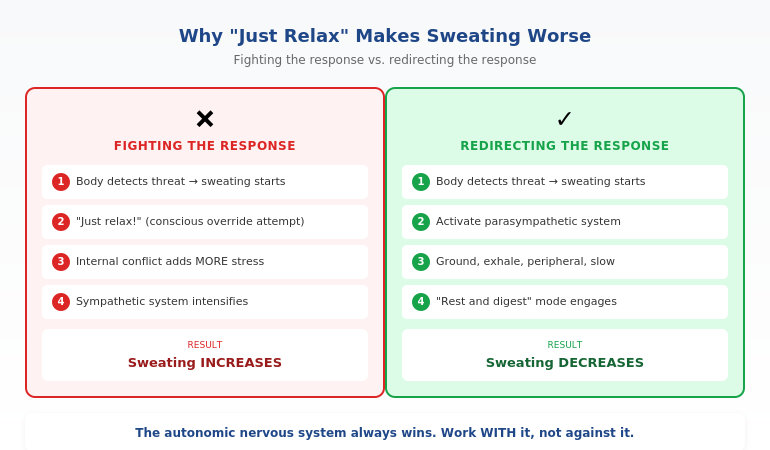
The worst advice anyone can give someone who sweats during presentations: “Just relax.”
Here’s why this backfires: trying to relax when your sympathetic nervous system is activated creates internal conflict. Part of you is saying “danger!” while another part is saying “stop reacting to danger!” This conflict adds more stress to an already stressed system.
The result? You sweat more.
A client named James described it perfectly: “I’d be standing there telling myself to calm down, and I could feel myself getting hotter. The harder I tried to relax, the worse it got. It was like my body was fighting itself.”
That’s exactly what was happening. His conscious mind was trying to override his autonomic nervous system—and the autonomic system always wins that fight.
The solution isn’t to fight the response. It’s to redirect it.
⭐ Stop the Sweat Response Before It Starts
Calm Under Pressure gives you the complete nervous system toolkit—the exact techniques that stop visible sweating by working WITH your biology, not against it.
What’s inside:
- The 60-second parasympathetic reset (works mid-presentation)
- Pre-presentation protocol (prevents activation entirely)
- Emergency recovery techniques (when sweating has already started)
Get Calm Under Pressure → £19.99
Built from clinical hypnotherapy training + 24 years coaching executives through high-stakes moments.
Instant download • Use it today • Keep forever
📦 What You Get (Specifically):
- The complete 60-second reset — step-by-step technique you can use invisibly during presentations
- Pre-presentation protocol — the 10-minute sequence that prevents nervous system activation
- Emergency recovery guide — what to do when sweating has already started
- The science explained simply — understand why these techniques work (so you trust them)
- Quick-reference cards — pocket-sized reminders for before you present
📌 What Calm Under Pressure gives you that this article can’t:
- The complete guided walkthrough — not just what to do, but exactly how to do it with timing cues
- The layered protocol — techniques that build on each other for cumulative nervous system retraining
- The emergency recovery scripts — word-for-word phrases for when sweating starts mid-presentation
This article gives you the method. The product gives you the repeatable system you can use in 7 minutes.
The 60-Second Parasympathetic Reset
This is the technique that finally stopped my visible sweating during presentations. It works because it activates your parasympathetic nervous system—the “rest and digest” mode that naturally opposes the stress response.
You can do this invisibly, even while presenting.
Step 1: Ground Your Feet (5 seconds)
Press your feet firmly into the floor. Feel the pressure. This activates sensory pathways that signal “safety” to your nervous system. You’re not running. You’re grounded.
Step 2: Extended Exhale (15 seconds)
Take a breath in through your nose (4 counts). Then exhale slowly through your mouth (8 counts). The extended exhale is the key—it directly stimulates the vagus nerve, which activates parasympathetic response.
One breath with this ratio can begin shifting your nervous system state.
Step 3: Peripheral Vision (20 seconds)
Without moving your head, expand your awareness to the edges of your vision. Notice what’s in your peripheral field. This is counterintuitive, but it works: peripheral vision activates a different neural pathway than focused vision—one associated with calm alertness rather than threat detection.
Step 4: Slow Your Speech (20 seconds)
Deliberately slow down your words. Pause between sentences. This creates a feedback loop: slow speech signals to your nervous system that there’s no emergency, which reduces activation, which makes it easier to speak slowly.
A product director named Michael told me this was the breakthrough: “I always rushed when I was nervous, which made me more nervous. When I forced myself to slow down—even though it felt uncomfortable—my body actually calmed down. It was like I was telling my nervous system ‘we’re safe’ through my behavior.”
The entire sequence takes 60 seconds. And the sweat response begins to subside.
For more on breathing techniques, see the complete guide to presentation breathing.
Want the complete 60-second reset with guided walkthrough? Calm Under Pressure includes the full technique plus audio guidance you can use before any presentation. Get the Full Technique → £19.99
Instant download • Use it today • Keep forever
The Pre-Presentation Protocol (Prevent Before It Starts)
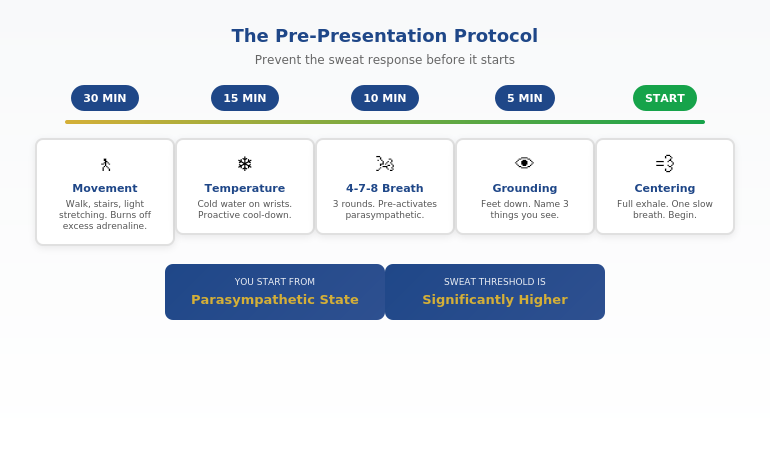
The best way to stop sweating during presentations is to prevent the nervous system cascade from starting in the first place. This requires a specific pre-presentation protocol—not “psych yourself up” motivation, but deliberate nervous system preparation.
Here’s the protocol I use with executives:
30 Minutes Before: Movement
Get your body moving. Walk briskly. Take stairs. Do some light stretching in a private space. This burns off excess adrenaline before you need to stand still and present.
A VP of sales named Rebecca told me: “I used to sit and review my notes obsessively before presenting. Now I walk the hallway. It sounds too simple, but the difference is dramatic.”
15 Minutes Before: Temperature Management
Cool down proactively. Splash cold water on your wrists. If possible, stand somewhere cooler than the presentation room. Your body sweats to cool down—if you’re already cool, the threshold is higher.
10 Minutes Before: The 4-7-8 Sequence
Find a private space. Do three rounds of 4-7-8 breathing: inhale for 4 counts, hold for 7, exhale for 8. This pre-activates your parasympathetic system so you start from a calmer baseline.
5 Minutes Before: Grounding + Observation
Press your feet into the floor. Look around the room and name (silently) three things you can see. This anchors you in the present moment rather than future catastrophizing.
Right Before You Start: The Centering Breath
Exhale completely. Then take one slow, full breath. Begin speaking on the exhale of that breath. This ensures you start from a parasympathetic state rather than a sympathetic one.
Related: See how to calm nerves before a presentation for additional pre-presentation techniques.
⭐ If You Sweat Even When You’re Fully Prepared
That’s the most frustrating part—you know your content, but your body doesn’t get the memo. Calm Under Pressure works on the nervous system level, not the “confidence” level.
Specifically designed for:
- Executives who sweat despite thorough preparation
- Presenters whose sweating is paired with racing heart or shaky voice
- Professionals who’ve tried “just relaxing” and made it worse
Get Calm Under Pressure → £19.99
Works because it targets the autonomic nervous system—not your mindset.
Instant download • Use it today • Keep forever
What to Do If Sweating Starts Mid-Presentation
Sometimes, despite preparation, the sweat starts. Here’s how to handle it without making things worse.
Don’t Acknowledge It
The instinct is to apologize or call attention to it. “Sorry, it’s warm in here.” Resist this. Drawing attention to sweating increases your self-consciousness, which increases sympathetic activation, which increases sweating.
Most people notice sweating far less than you think. And if they do notice, they’ll forget within minutes—unless you make it memorable by talking about it.
Use the 60-Second Reset (Invisibly)
Press your feet down. Take a slow breath with an extended exhale. Expand your peripheral vision. Slow your speech. You can do all of this while continuing to present—no one will notice.
Take a Strategic Pause
Ask a question. “Before I continue, does anyone have questions about what I’ve covered so far?” This gives you 30-60 seconds where attention is on the audience, not you. Use that time to do the reset.
A marketing director named David told me this saved him in a board presentation: “I could feel the sweat starting. Instead of powering through, I asked a question. While they were thinking, I did the grounding and breathing. By the time I continued, the wave had passed.”
Let the Wave Pass
Here’s the most important thing to understand: the acute sweat response lasts about 60-90 seconds. If you can ride through that window without adding more stress (by fighting it or catastrophizing), the intensity naturally decreases.
Your job isn’t to stop the wave. It’s to not make the wave bigger. The techniques above help you do that.
If you’re also dealing with other physical symptoms during high-stakes presentations, see what senior leaders actually do about high-stakes nerves.
Want the complete emergency recovery guide? Calm Under Pressure includes exactly what to do when sweating starts mid-presentation—plus techniques for other physical symptoms. Get Emergency Recovery Guide → £19.99
Instant download • Use it today • Keep forever
Frequently Asked Questions
Why do I sweat so much when presenting?
Sweating during presentations happens because your sympathetic nervous system detects social evaluation as a threat and triggers the stress response. Your body prepares for physical exertion (fight or flight) by cooling itself down—hence the sweating. This is a normal nervous system response, not a character flaw. The solution is learning to activate your parasympathetic system (the “rest and digest” mode) through specific techniques like grounding, extended exhales, and peripheral vision.
How do I stop nervous sweating when presenting?
To stop nervous sweating when presenting, use the 60-second parasympathetic reset: press your feet firmly into the floor (grounding), take a breath with an extended exhale (4 counts in, 8 counts out), expand your peripheral vision, and deliberately slow your speech. This activates your parasympathetic nervous system, which naturally opposes the sweat response. Prevention is even more effective—use the pre-presentation protocol starting 30 minutes before you speak.
Can you train yourself not to sweat when nervous?
Yes. Sweating when nervous is a learned nervous system pattern, and patterns can be retrained. With consistent practice of parasympathetic activation techniques—before, during, and after presentations—your nervous system learns that presenting isn’t actually dangerous. Most executives I work with see significant improvement within 4-6 presentations using the pre-presentation protocol and 60-second reset consistently.
Does everyone notice when I’m sweating during a presentation?
Far less than you think. When you’re sweating, your attention is hyperfocused on the sensation—which makes it feel enormous. But audiences are focused on your content, not your forehead. Unless you draw attention to it (“Sorry, it’s so hot in here”), most people won’t notice or remember. And even if they notice, they’ll attribute it to the room being warm, not to you being nervous.
What if I start sweating before I even begin speaking?
This is anticipatory anxiety, and the pre-presentation protocol is specifically designed for it. Start the protocol 30 minutes before: movement, temperature management, 4-7-8 breathing, grounding. If sweating starts despite this, use the 60-second reset before you begin. You can do this while waiting to be introduced—press feet down, extended exhale, peripheral vision. Start speaking only after one centering breath.
Are there clothes that help hide presentation sweating?
Yes—but this should be backup, not primary strategy. Dark colors (navy, black, charcoal) hide sweat marks better than light colors. Natural fabrics (cotton, wool) breathe better than synthetics. Layering with a jacket gives you coverage. But more important than clothing is the nervous system work—the techniques in this article will reduce sweating at the source, not just hide it.
Should I tell the audience I’m nervous?
Generally, no. While vulnerability can build connection, drawing attention to sweating often backfires—it increases your self-consciousness and primes the audience to watch for signs of nervousness. A better approach: acknowledge nothing, use the 60-second reset, and let the wave pass. If someone directly asks if you’re okay, a simple “I’m good, thanks” is sufficient.
Is This Right For You?
✓ This is for you if:
- You experience visible sweating when presenting (even when prepared)
- You’ve tried “just relaxing” and it made things worse
- You want techniques that work WITH your nervous system
- You’re willing to practice the protocol consistently
✗ This is NOT for you if:
- You have a medical condition causing excessive sweating (see a doctor first)
- You’re looking for a pill or quick fix
- You’re not willing to practice techniques before presentations
- You want generic “confidence tips”
⭐ The Technique That Finally Stopped My Visible Sweating
After my shirt incident in front of 30 executives, I spent three years learning the nervous system. Calm Under Pressure is everything that actually worked—distilled into techniques you can use before your next presentation.
What you’ll use immediately:
- 60-second parasympathetic reset
- Pre-presentation protocol (30-minute countdown)
- Emergency recovery techniques
Get Calm Under Pressure → £19.99
Built from clinical hypnotherapy training + 24 years coaching executives through visible anxiety.
Instant download • Use it today • Keep forever
📧 The Winning Edge Newsletter
Weekly techniques for presentation confidence, nervous system management, and the psychology of high-stakes speaking. For professionals who want to present without visible anxiety.
Your Next Step
If sweating during presentations has made you dread speaking up, you now understand why—and more importantly, what to do about it.
The executives who present without visible sweating aren’t less nervous. They’ve learned to work with their nervous system instead of against it. Grounding. Extended exhales. Peripheral vision. Slowing down. These aren’t “tips”—they’re direct interventions in your autonomic response.
Start with the 60-second reset in your next presentation. Practice the pre-presentation protocol. Let the wave pass without fighting it.
For the complete system with guided techniques, get Calm Under Pressure → £19.99.
If you’re also facing a high-stakes presentation where the content itself is difficult (like presenting after a project failure), see how to present after failure without destroying your credibility—today’s partner article on the structure that rebuilds trust.
About the Author
Mary Beth Hazeldine is the founder of Winning Presentations and creator of Calm Under Pressure. The “shirt incident” that opened this article happened to her—and it launched a three-year deep dive into nervous system science that changed how she approaches presentation anxiety.
With 24 years of corporate experience at JPMorgan Chase, PwC, Royal Bank of Scotland, and Commerzbank, plus training as a clinical hypnotherapist, she brings a unique perspective on the physiological reality of presentation nerves—and how to actually change it.