

Quick Answer
Filler words in presentations signal cognitive overload to your audience — even when you know your material cold. The fix is not “just slow down.” It’s replacing the nervous system habit that reaches for “um” or “you know” with a trained behaviour: the deliberate pause. Once you understand why filler words happen and practise the pause as a replacement, the habit shifts within two to three weeks of focused work.
In this article
I once watched a senior director lose a room in six minutes.
She was presenting a restructuring proposal to a group of eight executives — a high-stakes conversation she had prepared thoroughly for. Her analysis was rigorous. Her recommendation was sound. But within the first ninety seconds, something shifted in the room. Eyes moved to phones. The CFO started annotating his copy of the paper. The energy dropped.
I counted afterwards, from the recording: forty-one filler words in the first six minutes. Not just “um” and “uh” — though there were plenty of those. “Sort of.” “You know what I mean.” “Basically.” “Obviously.” “If that makes sense.” Each one a tiny signal of uncertainty, stacking up into a pattern the room had registered at a level below conscious awareness.
She knew her material. She had rehearsed. The filler words weren’t coming from unpreparedness — they were coming from a nervous system habit she had never been shown how to address. The content was excellent. The delivery was quietly dismantling her credibility one word at a time.
Struggling with verbal habits that undermine your delivery?
Conquer Speaking Fear gives you the evidence-based techniques to retrain the nervous system habits behind filler words, hesitation, and vocal uncertainty — so your delivery matches the quality of your thinking.
Why Filler Words Happen — Even When You Know Your Material
The conventional explanation for filler words is that they’re a sign of not knowing what to say next. This explanation is wrong often enough to be unhelpful. Many of the executives I work with who use the most filler words are the most knowledgeable people in the room. Their filler words are not a symptom of ignorance — they’re a symptom of a nervous system under mild stress.
When we speak in high-stakes situations, the prefrontal cortex — the part of the brain responsible for word retrieval, sequencing, and articulation — is competing with the threat-response system for processing resources. Even when there is no genuine threat, the social pressure of presenting to a senior audience activates a low-level arousal response that slightly degrades the fluency of speech production.
The brain, faced with a brief processing delay, reaches for a learned verbal placeholder to maintain the impression of continuity. “Um.” “Uh.” “Sort of.” These are not random sounds — they are trained habits that developed over years of speaking in classrooms, meetings, and conversations where silence felt uncomfortable. The placeholder fills the silence. Over time, the behaviour becomes automatic.
This matters because it means the fix is not intellectual. You cannot think your way out of a nervous system habit. You have to replace it with a different trained behaviour — and the most effective replacement for a filler word is a deliberate pause. The techniques for eliminating “um” from your speech all work through this mechanism: replacing an automatic avoidance behaviour with a controlled alternative.
The Filler Words Beyond “Um” That Damage Credibility
Most advice about filler words focuses on “um” and “uh.” These are the most obvious and the easiest to hear, but they are not always the most damaging. The filler words that cause more subtle but persistent credibility erosion are the ones that sound like content but function like noise.
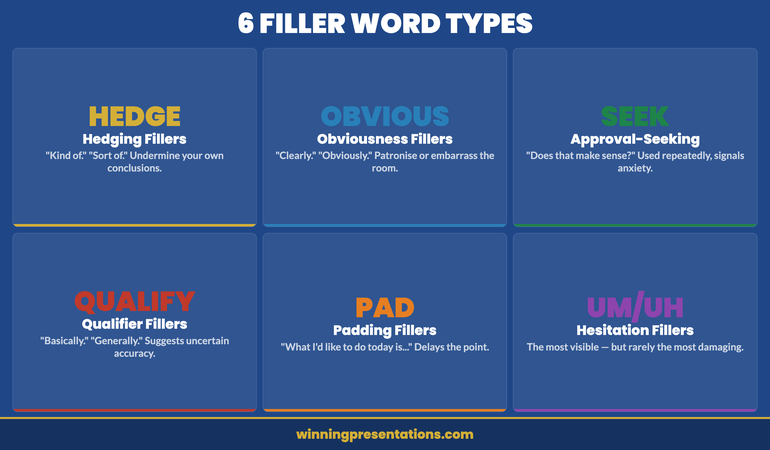
Hedging fillers are phrases that undermine the confidence of your own statements. “Kind of.” “Sort of.” “In a way.” “I suppose.” When you say “The data kind of suggests we should proceed,” you are communicating uncertainty about a statement you may be entirely certain about. Hedging fillers are particularly damaging in executive contexts because they signal that you don’t fully trust your own analysis.
Obviousness fillers are phrases that imply the audience should already know what you’re telling them. “Obviously.” “Clearly.” “Of course.” “As you’ll all be aware.” These carry a dual risk: they can patronise an audience that does know the thing, and they can embarrass an audience member who doesn’t. Neither serves you. They also signal that you haven’t thought carefully about the audience’s actual knowledge level — which itself reads as poor preparation.
Approval-seeking fillers are question tags and checking phrases that seek validation mid-sentence. “Does that make sense?” “You know what I mean?” “Right?” “If that makes sense.” Used once, these are fine — they can be genuine invitations for questions. Used repeatedly, they signal anxiety about whether the audience is following you, which amplifies rather than resolves the tension in the room.
Qualifier fillers are words that technically modify a statement but function as verbal hedges. “Basically.” “Generally speaking.” “In most cases.” “Typically.” These are sometimes genuinely necessary — you may be making a statement that genuinely has exceptions. But when they appear on statements that don’t require qualification, they suggest you’re not quite sure whether what you’re saying is accurate.
Padding fillers are extended phrases that don’t add information. “What I’d like to do today is take you through…” “So what we’re going to look at is…” “The thing about this is that…” These typically appear at the beginnings of sentences, before the actual information starts. They delay the moment of value and create a rhythm that makes the speaker seem less direct than the content deserves.
From Verbal Habits to Vocal Authority
Filler words are one symptom of a broader pattern: a nervous system that hasn’t learned to feel safe in high-stakes speaking situations. Conquer Speaking Fear — £39, instant access — addresses the root cause, not just the surface habit:
- Nervous system regulation techniques drawn from clinical hypnotherapy
- Evidence-based methods for retraining habitual speech patterns under pressure
- A 30-day programme that builds lasting vocal confidence, not just temporary fixes
- In-the-moment techniques you can use before and during high-stakes presentations
Designed for executives whose delivery doesn’t yet match the quality of their thinking.
What Filler Words Signal to Your Audience
Audiences process filler words at a level below conscious analysis. They rarely think “this speaker uses too many filler words” — they experience a vague sense of uncertainty, a slight reduction in confidence in what they’re hearing. The effect is cumulative and largely invisible to the speaker.
In executive settings, the cost is specific. Filler words signal four things that are particularly damaging in high-stakes presentations.
They signal cognitive overload — the impression that you are working harder than expected to retrieve the information you’re presenting, which raises the question of whether you have truly mastered the material.
They signal uncertainty about your own conclusions. Hedging fillers in particular create the impression that you are not fully convinced by your own analysis. An executive who hedges their recommendations is less persuasive than one who states them directly.
They signal anxiety — which, in a room of senior executives, activates a subtle assessment of whether you are ready for the level of responsibility the presentation implies. This is rarely fair. But it is real.
And they signal lack of preparation — even when the opposite is true. Because filler words are associated with thinking out loud, an audience that hears many of them will often conclude the speaker hasn’t fully prepared, regardless of the quality of the underlying content.
The relationship between presentation confidence and credibility perception is well documented in professional contexts: the way you sound when you present your ideas affects how those ideas are received, independently of the ideas themselves. This is worth taking seriously.
If the pattern you recognise in yourself goes beyond filler words to broader delivery anxiety, Conquer Speaking Fear is built specifically for executives dealing with the gap between their knowledge and their delivery.
The Technique That Replaces Filler Words Permanently
The single most effective technique for eliminating filler words is the deliberate pause. Not a hesitation pause — that’s what produces the filler word in the first place. A deliberate pause: a conscious, controlled moment of silence that you use in place of the filler word.
The deliberate pause works because it replaces the nervous system habit at the point of activation. When the brain reaches for a verbal placeholder, you train it to reach for silence instead. Silence, unlike “um,” signals confidence. It gives the impression that you are choosing your words carefully — which you are. It creates emphasis. It gives the audience a moment to absorb what you’ve just said before you continue.
The primary obstacle to using the deliberate pause is that silence feels much longer to the speaker than it does to the audience. What feels like an uncomfortable three-second pause to you typically registers as a natural one-second beat to your listeners. This mismatch is the reason most people default to filler words — they are filling a silence that doesn’t actually exist in the audience’s experience.
The technique requires practice to internalise. You need to experience the pause in low-stakes situations until your nervous system registers that silence does not create the negative reaction you are expecting. Once that recalibration happens, the pause becomes available to you under pressure.
The presentation pause technique in detail: at the moment you feel the impulse to say “um,” close your mouth, breathe once, and allow the pause to exist. Make eye contact with one person in the room during the pause — this transforms what might feel like a gap into a moment of connection. Then continue.
How to Practise This So It Holds Under Pressure
Knowing the technique is the easy part. Making it available when you are presenting under real pressure requires a specific practice approach. Here is the method that produces reliable results.
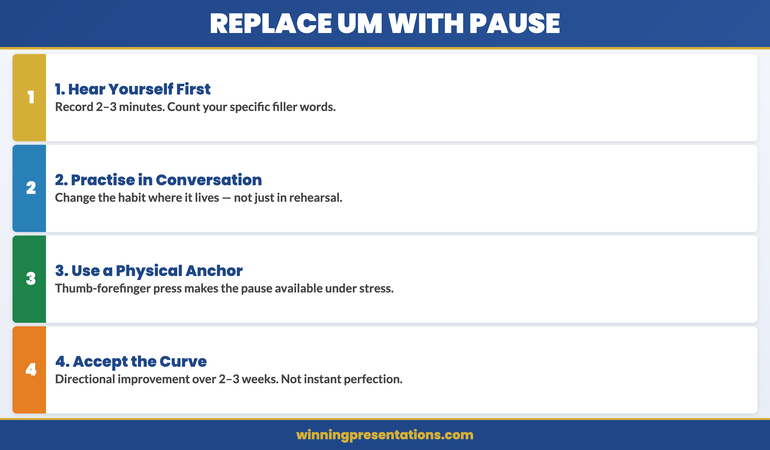
Step 1: Hear yourself first
Record two to three minutes of yourself speaking — on any topic — without trying to control filler words. Listen back and note the specific words and phrases you use most frequently. Most people are surprised by both the frequency and the variety of their own filler words. You cannot change a habit you haven’t clearly identified.
Step 2: Practise in conversation, not just rehearsal
Catching filler words in a rehearsed speech is relatively straightforward because the script gives you structure. The harder and more valuable work is practising the pause in conversation — in meetings, phone calls, and informal exchanges — where you don’t have a prepared script to fall back on. This is where the habit is actually formed and where it needs to be changed.
Step 3: Use a physical anchor
During early practice, pair the deliberate pause with a physical sensation — pressing your thumb and forefinger together, or feeling your feet on the floor. This creates a proprioceptive anchor for the behaviour, which makes it more accessible under stress. The physical anchor gives the nervous system something concrete to reach for when the usual verbal placeholder habit activates.
Step 4: Accept the learning curve
In the early stages of changing this habit, you will sometimes produce filler words in situations where you are actively trying not to. This is normal. Habit change is not linear. The goal is directional improvement over two to three weeks of consistent practice — not immediate perfection from the first session. Tracking your frequency over time (via recording) will show you the trend even when individual sessions feel inconsistent.
See today’s related articles for context on the broader picture: how to present a pilot as a commercial case, how to take a technology roadmap to the board, and the structured approach to building lasting presentation skills at work.
Stop Letting Delivery Habits Undermine Your Ideas
Conquer Speaking Fear — £39, instant access — is a 30-day programme that addresses the nervous system patterns behind filler words and verbal uncertainty, so your delivery reflects the quality of your thinking rather than working against it.
Designed for executives whose delivery doesn’t yet match the quality of their thinking.
Frequently Asked Questions
How long does it take to stop using filler words in presentations?
With consistent daily practice — recording yourself, catching the habit in conversation, and using the deliberate pause technique — most people notice a measurable reduction within two to three weeks. Eliminating filler words in scripted presentations typically happens faster than in spontaneous conversation, because the script provides structure that reduces the cognitive load that triggers filler words. The more challenging work is sustaining the change under the pressure of high-stakes presentations, which is where nervous system training becomes important alongside habit change.
Is it bad to use any filler words at all in a presentation?
Occasional filler words are unremarkable and entirely human. The problem is frequency and pattern — a speaker who uses one “um” in ten minutes barely registers with an audience; a speaker who uses forty registers as uncertain and underprepared. The goal is not complete elimination but deliberate control. A well-placed pause is consistently more effective than a filler word in any situation, but the occasional “um” in an otherwise authoritative delivery is not a credibility issue.
Why do I use more filler words with senior audiences than with peers?
Because the perceived stakes are higher, which activates a stronger stress response, which degrades speech fluency more significantly. This is a normal neurological response, not a sign that you’re particularly anxious or underprepared. The mitigation is nervous system regulation before and during high-stakes presentations — bringing your baseline arousal level down before you speak so that the prefrontal cortex has more processing resource available for articulation. The deliberate pause also helps in the moment: it creates a brief circuit break from the stress response that allows fluency to return.
The Winning Edge — Weekly Presentation Intelligence
Every Thursday, one framework or technique for high-stakes speaking — drawn from 24 years in boardrooms and 16 years training executives. Join The Winning Edge →
About the Author
Mary Beth Hazeldine is the Owner & Managing Director of Winning Presentations. With 25 years of corporate banking experience at JPMorgan Chase, PwC, Royal Bank of Scotland, and Commerzbank, and 16 years training executives in high-stakes presentation delivery, she advises senior leaders across financial services, healthcare, technology, and government on the full range of presentation performance — from structure to delivery to anxiety management.

