
Tag: handling questions presentation

11 May 2026
Featured image for “Can You Show Me That Prompt?”: Handling The Question Mid-Presentation

“Can You Show Me That Prompt?”: Handling The Question Mid-Presentation

Quick answer: “Can you show me that prompt?” is a question that often arrives mid-presentation when an executive has just demonstrated something built with AI. It can be entirely well-intentioned and it can also be a status move from a junior colleague testing whether you know what you are talking about. The answer that protects your authority is short, calm, redirects the room back to the decision being made, and offers to share the prompt offline. Three sentences, total. Never improvise the prompt aloud.

Kenji is a director on the leadership team of a UK telecoms operator. He had built a customer-segmentation analysis using a series of Copilot prompts, and he was presenting the resulting board pre-read in a leadership session. Forty seconds in, a senior manager from a different function — newer, technically fluent, two layers down from Kenji — raised a hand: “Sorry to interrupt — can you show me that prompt? I would love to see how you got Copilot to do that.” Kenji felt the room shift. The prompt was on the screen of his desktop in his office, not in his head. He hesitated for two seconds longer than was comfortable, then said, “I will send it round after the meeting” — and watched the room interpret his hesitation.

Nothing about that exchange was disastrous. But Kenji left the meeting knowing he had not handled it as well as he could have, and the small ambiguity about whether he actually knew his own prompt sat uncomfortably with him for the rest of the day. The question is harder than it looks because it has two layers — what is being asked, and what the room is hearing. The response has to handle both.

If you want a structured starting point

The Executive Q&A Handling System is the structured framework for the questions that knock senior presenters off course — including the new pattern of AI-related challenges that have emerged over the last 18 months.

Explore the Q&A Handling System →

Why this question disproportionately destabilises senior presenters

Most well-prepared executives have rehearsed answers for the obvious challenges — assumption questions, methodology questions, financial counter-cases. “Can you show me that prompt?” is in a different category. It does not test the analysis. It tests whether the executive built the analysis themselves. And it does so in front of a room where the assumed answer is yes.

The destabilisation comes from three places at once. First, the prompt itself is rarely something senior people memorise — it is the output that matters, not the keystrokes. Second, the question lands in real-time and there is no comfortable way to say “I do not remember the exact wording.” Third, the implicit framing of the question — “show me how you did this” — sounds collaborative on the surface but can read to a senior audience as “let’s see if this person actually knows what they are talking about.”

The discomfort is not a weakness. It is an accurate read of a complicated social moment. The fix is not to memorise prompts; it is to have a practiced response that handles the moment without trying to satisfy the underlying request in real time.

The two versions of the question (and how to tell them apart)

The same words can carry two very different intentions. Reading the room correctly determines which response to give.

Version 1: Genuine interest. A colleague — often more junior, often more technically fluent than they need to be in their own role — is genuinely curious about your method. They have probably tried something similar themselves and want to see how you approached it. The body language is open, the tone is warm, the timing is usually after you have made a strong point. The room is on your side. The response can be brief and warm.

Version 2: Status check. A colleague is testing whether the analysis is yours or whether it was handed to you. The body language is more measured, the tone is more flat, the timing is often right after you have demonstrated something visually impressive. The question is not really about the prompt. It is about provenance. The room is watching to see how you respond. The response has to be confident and brief, not defensive and elaborate.

The same three-sentence response works for both — but the energy underneath it shifts. For genuine interest, the energy is “happy to share.” For a status check, the energy is “happy to share, and let’s keep moving.” The structural fix is the same; only the warmth dial moves.

The three-sentence response that protects authority and the agenda

The response is short, calm, redirects the room back to the decision being made, and offers to share offline. In that order.

Sentence 1 — acknowledge. “Good question — happy to share it.” (Acknowledges the asker, signals confidence, takes 2 seconds.)

Sentence 2 — redirect. “I will send the full prompt round after the session — for now, the bit that mattered for this analysis was [one sentence describing the analytical step the prompt produced — not the prompt itself].” (Returns the room’s attention to the analysis. The asker gets confirmation they will get the prompt; the room gets confirmation that you understand what the prompt produced, which is what they actually care about.)

Sentence 3 — recover the agenda. “On the back of that segmentation, the recommendation we want to land in the next 10 minutes is [primary recommendation].” (Closes the side conversation and re-opens the main conversation. The room follows you back.)

Total: 12–18 seconds. Nobody is left feeling brushed off. The asker has a clear path to what they wanted. The agenda is back on track. And the room has watched you handle an unexpected question with the calm of someone who understands the analysis well enough not to need the prompt in front of them.
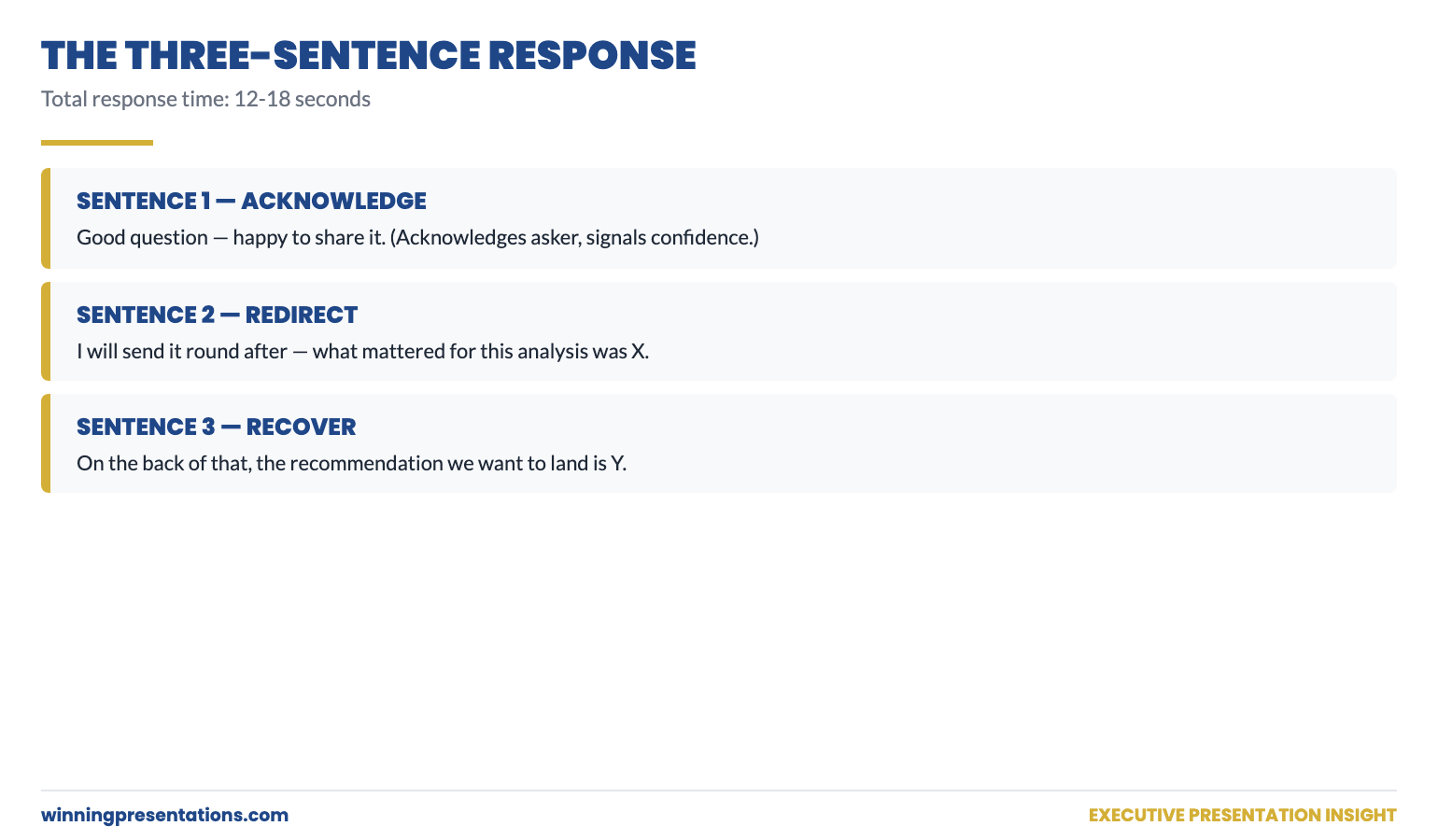
The Three-Sentence Response Framework for Show Me That Prompt: Sentence 1 Acknowledge, Sentence 2 Redirect to Analysis, Sentence 3 Recover the Agenda — each sentence shown as a card with an example phrase, total response time 12 to 18 seconds.

Three things never to do when this question lands

Mistake 1: trying to recall the prompt aloud. If you remember the exact wording, fine. If you do not, do not try to reconstruct it on the fly. Every “I think it was something like…” erodes the room’s confidence further than just saying “I will send it round.” Improvising a prompt out loud is a low-upside, high-downside move.

Mistake 2: deflecting to a colleague. “Actually, my analyst built that — Priya, do you want to take this?” might feel collaborative but reads to the room as confirmation that the analysis is not really yours. There are situations where shared credit is the right move, but a mid-presentation interruption is not one of them. Take the question yourself. Share credit later, in writing, where it lands properly.

Mistake 3: getting defensive about the question itself. “Why are you asking that?” or “Is there a particular concern?” makes the room aware there might be a concern. The fastest way to make a status-check question land harder is to react as if it landed hard. Treat both versions of the question as genuine interest — your tone alone determines whether the room reads it as a friendly exchange or an awkward moment.

A structured way through every question that knocks executives off course

“Can you show me that prompt?” is one of a growing family of AI-era questions that did not exist five years ago. The Executive Q&A Handling System is the structured framework for the full range of board-level questions — including the newer ones that catch senior presenters out.

  • Frameworks for the question patterns that most reliably destabilise executive presenters
  • The 45-second response structure for tough questions where you need authority and brevity
  • Pre-meeting preparation tools for anticipating and rehearsing hostile or awkward questions
  • £39, instant access, lifetime access

Get the Executive Q&A Handling System — £39 →

Built for senior professionals who present to boards and executive committees.

Pre-meeting preparation: the prompt-card you bring with you

The cleanest way to handle this question is to have prepared for it before the meeting. Not by memorising prompts, but by carrying a one-page document that lists every prompt you used to build the analysis, with the analytical purpose of each prompt next to it. Print it. Bring it.

If the question lands, you can pause briefly, glance at the card, and reference the relevant prompt with a level of accuracy that no one would remember from memory. The room reads the glance not as “you forgot” but as “you brought the working.” The implicit message is that you have been doing this work seriously and methodically — which is the message you want the room to receive.

The prompt-card has a second use. After the meeting, you can hand it to the colleague who asked. They get more than they actually wanted — every prompt, with its purpose. You get the credit for being prepared, organised, and willing to share your method. The interaction that started as a status check ends as a goodwill exchange.
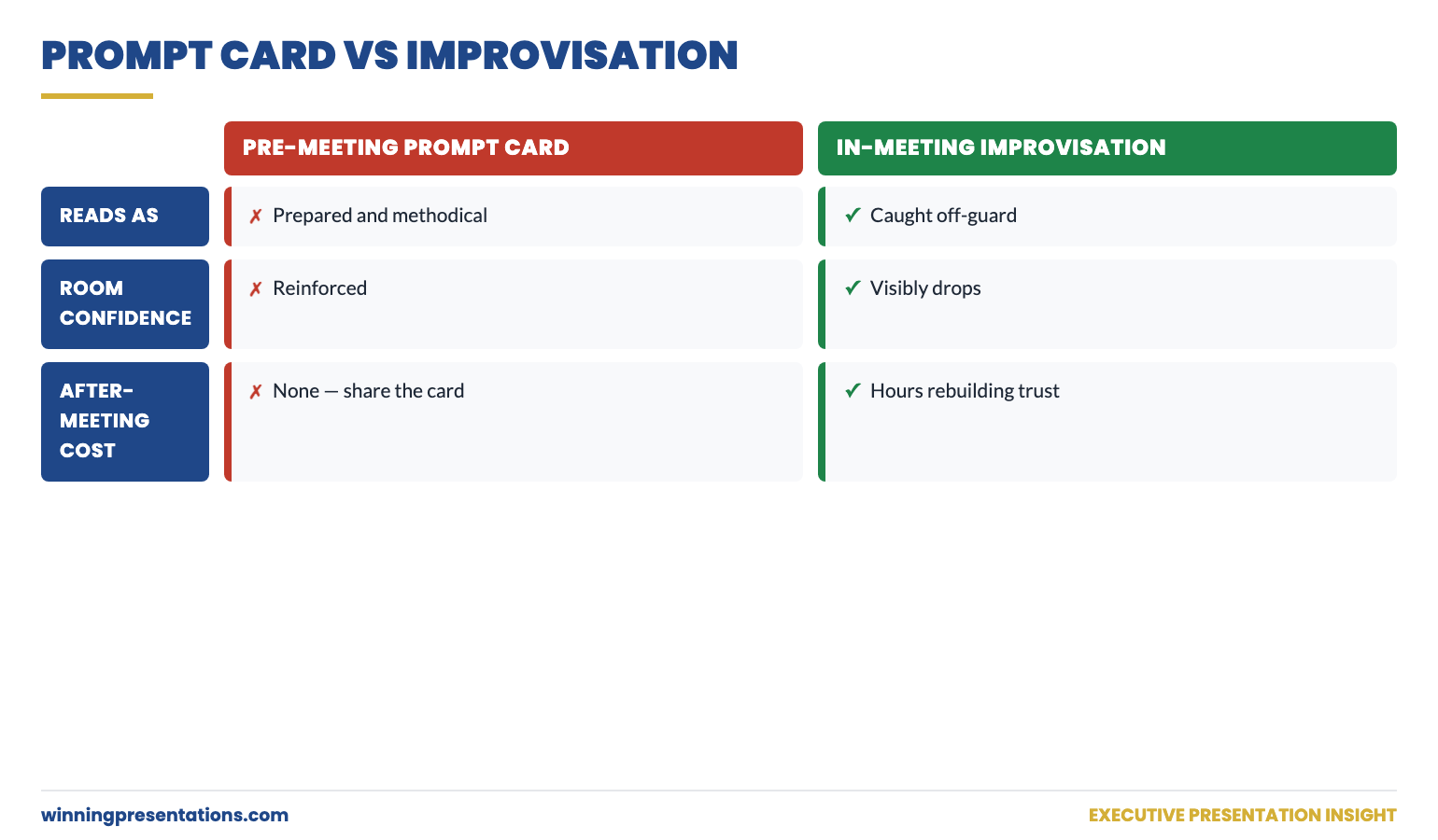
The Pre-Meeting Prompt Card vs The In-Meeting Improvisation comparison: the left column shows the printed prompt card with prompt purpose and exact wording labelled by analysis step; the right column shows the alternative improvised response and the visible cost in room confidence.

The follow-up that turns the question into a relationship asset

Within 24 hours of the meeting, send the prompt to the asker — by email or chat, with a short note. Two sentences are enough. “Here is the prompt I used for the segmentation step we discussed yesterday. Happy to walk you through how I iterated on it if useful — drop me a line.” That is it.

The follow-up does three things. It honours the commitment you made in the meeting. It opens a relationship channel with someone who clearly cares about how the work is done. And — most importantly — it frames you as the kind of senior leader who shares method generously, which is exactly the read you want the rest of the room to take from any version of “can you show me that prompt?”

Done well, this question becomes one of the easiest opportunities you get all week to model executive composure under unexpected scrutiny. Done badly, it becomes the moment the room starts wondering. The framework is small. The repetition matters. Practice the three-sentence response out loud, alone, until it lands without effort.

For executives who are increasingly building presentations with AI assistance and want to be ready for the full spectrum of related questions, the practical primer on how to make Copilot prompts produce executive-grade output is a useful companion piece — most of the questions that arise in the room are easier to handle when the underlying work is genuinely yours and genuinely strong.

For the broader set of board-level question handling — beyond AI-specific questions — the foundational article on handling difficult questions in executive presentations covers the wider response patterns that this article specialises.

Be ready for the full range of board-room questions

The Executive Q&A Handling System — frameworks for the questions that most reliably catch senior presenters out. £39, instant access, lifetime access.

Get the Executive Q&A Handling System →

Designed for senior professionals presenting to boards and executive committees.

Want sharper Copilot prompts to share when you do?

If colleagues are asking to see your prompts, the answer is more useful when the prompts are genuinely good. The Executive Prompt Pack contains 71 ChatGPT and Copilot prompts written for senior-level presentation work — the kind worth sharing.

Executive Prompt Pack — £19.99 →

FAQ

What if the asker keeps pushing for the prompt right then in the room?

Hold the line. “I want to do it justice — I will send the full prompt with the working after the session, and we can pick it up there.” Said calmly, this is the senior response. The room reads persistence after a clear redirect as the asker’s problem, not yours.

What if I genuinely cannot remember the analytical purpose of the prompt either?

Then there is a deeper problem than the question itself — you do not own the analysis well enough to be presenting it. In that situation the safest move is to acknowledge it directly: “Honestly, my team led on the prompt design — let me get you the full method after this.” The room respects honesty about provenance. It does not respect bluffing.

Should I share the prompt with the whole room, or only the asker?

With the whole room — and frame it as such: “I will send the prompt round to everyone after the session.” This costs you nothing, removes any lingering perception that you are guarding something, and turns the prompt into a shared resource rather than a private one.

Does this same response work for “what tool did you use?” or “did you use AI for this?”

The structure works; the words shift. “What tool did you use?” — answer briefly, then redirect to the analysis. “Did you use AI for this?” — answer honestly (“yes, Copilot built the first draft and I edited”), then redirect. The principle is the same: short answer, redirect to the substance, recover the agenda.

Get The Winning Edge — weekly

One sharp, story-led idea every Thursday on executive presentation craft, the questions that reliably catch senior presenters out, and the small habits that change how senior audiences receive you.

Subscribe to The Winning Edge →

If you want a primer on the structures that hold any executive presentation together — including the Q&A section — download the free 7 Presentation Frameworks Quick Reference Card.

Practice the three-sentence response out loud tonight. Once. Twice. Three times. The next time the question lands in a meeting, you will hear yourself give the answer before you have consciously chosen to.


About the author. Mary Beth Hazeldine is Owner & Managing Director of Winning Presentations Ltd, founded 1990. With 24 years of corporate banking experience at JPMorgan Chase, PwC, Royal Bank of Scotland, and Commerzbank, she advises executives across financial services, healthcare, technology, and government on structuring presentations for high-stakes funding rounds and approvals.

20 Feb 2026
Why Executives Ask Questions They Already Know the Answer To (And What They're Really Testing)

Why Executives Ask Questions They Already Know the Answer To (And What They’re Really Testing)

Quick answer: When executives ask questions during your presentation, they usually aren’t looking for information — they’re running a trust test. They want to know whether you understand the real issue, whether you’ve thought beyond your slides, and whether you stay composed under pressure. Once you learn to decode what’s actually being tested, handling executive questions becomes a completely different skill.

The Question That Wasn’t Really a Question

The CFO already knew the answer. I could see it on his face.

We were in a quarterly review at Royal Bank of Scotland. I’d just presented the client retention numbers — solid figures, well-structured slide. Then the CFO leaned forward and asked: “What’s driving the 3% attrition in the Northern portfolio?”

I knew the answer. He knew I knew the answer. He already had the regional breakdown on his desk — I’d seen it there when I walked in.

But I panicked. I started over-explaining. I gave him the complete history of the Northern portfolio, the market conditions, the competitive dynamics. By the time I finished, two minutes had passed and the room had glazed over.

A colleague presented after me. The CFO asked her a similar question. She said: “Two factors. The repricing in March caught three mid-tier clients off guard, and our response time on renewals was too slow. We’ve already addressed both — I can share the specifics if useful.”

Twelve seconds. She was done. The CFO nodded and moved on.

That’s when I understood something that took me years to fully appreciate across 24 years in corporate banking: executive questions during presentations are almost never about getting information. They’re about testing whether you understand the information well enough to be trusted with what comes next.

Once I learned to decode what executives are actually testing — rather than just answering what they’re literally asking — handling questions in board presentations and senior leadership meetings became the strongest part of my presentations, not the most feared.

Stop Guessing What Executives Actually Want to Hear

The Executive Q&A Handling System gives you frameworks for decoding questions, structuring 15-second answers, and recovering when you don’t know — without losing credibility.

Get the Q&A Handling System → £39

Built from 24 years of boardroom experience across banking and consulting environments.

Why Executive Questions Are Never Really About the Question

Here’s what most presenters get wrong: they hear a question and immediately try to answer it. They treat executive Q&A like an exam — as if the goal is to prove they know the material.

But executives rarely ask questions to learn basic facts. They have analysts, reports, and dashboards for that. They ask questions to evaluate you. Specifically, they’re evaluating three things: your depth of understanding, your judgement, and your composure. This is why getting executive buy-in depends as much on how you handle questions as on what’s in your slides.

I saw this dynamic play out hundreds of times across my banking career. A managing director at JPMorgan once told me something I never forgot: “I already know 80% of what’s in your presentation before you start. The questions are how I figure out the 20% that matters — and whether you know which 20% that is.”

That single insight changes everything about how you prepare for executive Q&A. You stop memorising facts and start thinking about what the questioner is actually evaluating.

The Trust-Test Framework showing three types of executive questions: Knowledge Test, Alignment Test, and Pressure Test with what each is really evaluating

The Trust-Test Framework: 3 Types of Executive Questions

Every question an executive asks during your presentation falls into one of three categories. Once you can identify which type you’re facing, the correct response becomes obvious.

Type 1: The Knowledge Test. This is the question from my CFO story. They already know the answer — they’re testing whether you do. The trap is over-explaining. When you give a two-minute answer to something that requires ten seconds, you signal insecurity. You’re telling the room: “I’m not confident enough to be brief.”

❌ Wrong response to a Knowledge Test: “Well, there are several factors at play here. If you look at the Northern portfolio historically, we’ve seen a trend since Q3 of last year where the mid-tier segment has been under pressure from competitor repricing, and additionally our internal response times on renewal processing have been impacted by the system migration…”

✅ Right response: “Two factors: competitive repricing in March and slow renewal response times. Both addressed — happy to go into specifics.”

The right response does three things: it proves you know the answer, it shows you can prioritise, and it hands control back to the executive. If they want more detail, they’ll ask. If they don’t, you’ve just demonstrated exactly the kind of judgement they were testing for.

Type 2: The Alignment Test. This is the question that sounds like a challenge but is actually a check on whether you’ve thought about the issue from their perspective. At PwC, I watched a partner ask a senior consultant: “How does this recommendation affect the timeline for the regulatory submission?” The consultant’s recommendation was sound. But the partner wasn’t questioning the recommendation — he was checking whether the consultant had considered the one thing keeping him up at night.

❌ Wrong response to an Alignment Test: “The timeline shouldn’t be affected. Our analysis shows that the current approach is the most efficient option based on the data.”

✅ Right response: “It adds approximately two weeks to the regulatory timeline. I’ve mapped out how to absorb that within the existing buffer — slide 8 has the detail if you’d like to see it.”

The Q&A Handling System teaches you to decode what’s really being asked — and respond in 15 seconds or less, every time.

Get the Q&A Handling System → £39

The wrong response defends your work. The right response acknowledges the executive’s concern, shows you’ve already thought about it, and offers proof. That’s the difference between someone who presents information and someone who demonstrates judgement.

Type 3: The Pressure Test. This is the question designed to see how you react when challenged. It might sound aggressive: “Why should we believe this forecast when the last one was 15% off?” It might sound sceptical: “Isn’t this just what we tried in 2023?” At Commerzbank, I watched a board member deliberately challenge a strong proposal just to see if the presenter would fold or hold.

❌ Wrong response to a Pressure Test: “Well, the circumstances were different then, and I think if you look at the methodology we’ve used this time, you’ll see that we’ve improved our approach significantly, and the margin of error is much lower now…”

✅ Right response: “Fair challenge. The 2023 forecast used a single-scenario model. This one stress-tests three scenarios — worst case still delivers 8% above breakeven. The methodology comparison is on slide 14 if that’s useful.”

Notice what the right response does: it doesn’t get defensive, it doesn’t apologise, and it doesn’t over-explain. It acknowledges the challenge (“Fair challenge”), gives the key differentiator in one sentence, provides proof, and offers more detail only if the executive wants it.

The Wrong vs. Right Pattern That Applies to Every Executive Question

Across all three trust-test types, the pattern is the same. Here’s the formula that works in every executive-level presentation:

❌ Wrong pattern: Hear question → feel threatened → start explaining → add context → add more context → hope the executive stops you → realise you’ve been talking for 90 seconds → trail off weakly.

✅ Right pattern: Hear question → identify the trust test → give the headline answer (one sentence) → offer proof or a slide reference → hand control back.

The entire right pattern takes 10-15 seconds. That’s not a guess — I’ve timed hundreds of executive Q&A sessions across my career. The answers that build the most trust are almost always under 20 seconds. The answers that destroy trust are almost always over 60 seconds.

Here’s one more wrong/right comparison that captures the principle perfectly:

❌ What most people do when a board member asks “What’s the risk here?”: They list every risk they can think of, show they’ve done thorough analysis, and end up making the proposal sound dangerous. Two minutes later, the room is more worried than when the question was asked.

✅ What experienced presenters do: “The primary risk is execution timing — specifically the Q3 integration window. We’ve built in a two-week buffer and a fallback option. The risk register is in the appendix.” Fifteen seconds. The board member nods. The proposal still has momentum.

Wrong versus right response pattern showing the long rambling answer compared to the Trust-Test response of headline answer plus proof plus control handback

Turn Q&A Into the Strongest Part of Your Presentation

The Executive Q&A Handling System includes frameworks for predicting questions, structuring 15-second answers, and handling “I don’t know” moments — all built for boardroom-level conversations.

Get the Q&A Handling System → £39

Built from 24 years in banking and consulting environments. Used in board meetings, steering committees, and investor presentations.

What to Say When You Genuinely Don’t Know the Answer

Not every question is a trust test you can decode and pass. Sometimes you genuinely don’t know the answer. And this is where most presenters make the worst mistake of all: they bluff.

I watched a VP at Commerzbank try to answer a technical question about derivatives exposure that he clearly didn’t have the numbers for. He improvised for about 45 seconds. The CFO let him finish, then said: “That’s not what I asked.” The room went silent. His credibility for the rest of the meeting was gone.

The correct response when you don’t know is the simplest one — and the one that actually builds trust:

❌ Wrong: “That’s a great question. I believe the figure is somewhere around… let me think… I want to say it’s approximately 12%, but I’d need to verify that. The general trend has been…”

✅ Right: “I don’t have that specific figure to hand. I’ll confirm it by end of day and send it through. What I can tell you now is that the overall trend supports the recommendation — the exact number won’t change the direction.”

That response does four things: it’s honest, it commits to a specific follow-up action, it gives the executive something useful right now, and it reframes the gap as non-critical to the decision. Executives respect all four of those things far more than a guess.

If you struggle with the pressure of these high-stakes moments — where your career credibility is on the line — you’re not alone. Many of the executives I work with find that having a reliable presentation structure for career-defining conversations reduces the anxiety of Q&A significantly.

Knowing what to say — and what NOT to say — when you don’t have the answer is one of the most valuable executive communication skills. The Q&A Handling System covers exactly this.

Get the Q&A Handling System → £39

Common Questions About Handling Executive Questions in Presentations

Why do executives ask questions they already know the answer to?

Executives use questions as trust tests — not information requests. They’re evaluating whether you understand the material deeply enough to be brief, whether you’ve considered their priorities, and whether you stay composed under challenge. The question itself is rarely the point. Your response reveals your judgement, your preparation, and your confidence — all of which influence whether the executive trusts you with bigger responsibilities and decisions.

How do you handle tough questions from senior leadership in a presentation?

Identify which type of trust test you’re facing: a Knowledge Test (they know the answer — be brief), an Alignment Test (they want to know you’ve considered their concern — acknowledge and show you’ve planned for it), or a Pressure Test (they’re challenging to see your composure — acknowledge the challenge, give one differentiator, offer proof). In all three cases, keep your answer under 20 seconds and hand control back to the questioner.

What do board members want to hear during presentation Q&A?

Board members want brevity, honesty, and evidence of judgement. They want to hear that you understand the core issue (not just the surface question), that you’ve considered the risks and trade-offs, and that you can distinguish between what matters and what doesn’t. The fastest way to build trust in board Q&A is to answer in one sentence, offer a proof point, and let the board member decide if they want more detail.

The Q&A Is Where Decisions Actually Get Made

Your slides set up the case. The Q&A is where the executive decides whether to trust it. The Executive Q&A Handling System gives you the frameworks to pass every trust test — whether you know the answer or not.

Get the Q&A Handling System → £39

Built from 24 years in banking and consulting. Used in board meetings, steering committees, and investor presentations.

Optional: The Q&A Handling System is also available as part of The Complete Presenter (£99) — seven products covering slides, storytelling, confidence, and delivery.

Frequently Asked Questions

What if the executive question is genuinely hostile — not a trust test?

Genuine hostility is rarer than people think, but it happens. The response is the same: acknowledge, answer briefly, and don’t get defensive. “I hear your concern. Here’s what the data shows…” works in hostile environments because it refuses to escalate. The executive either accepts your response or pushes further — but either way, the room sees you as composed. That composure is itself a trust signal, and it often matters more than the content of your answer.

Can I prepare for trust-test questions in advance?

Yes — and you should. Before any executive presentation, identify the three questions the most senior person in the room is most likely to ask. For each one, prepare a headline answer (one sentence), a proof point, and a slide reference. This takes ten minutes and eliminates 80% of Q&A anxiety. The remaining 20% is unpredictable, but the framework still applies: identify the trust test, give the headline, offer proof, hand back control.

Does this work in virtual presentations where you can’t read body language?

The Trust-Test Framework works regardless of format because it’s about the structure of your answer, not the visual cues you’re reading. In virtual settings, the framework actually matters more because you have fewer signals to work with. The 15-second answer discipline is especially critical on video calls where attention spans are shorter and rambling is more noticeable. One practical adjustment: pause for a beat before answering. On video, this reads as thoughtful rather than slow.

What if my boss is in the room and the executive’s question reveals something my boss didn’t want raised?

This is one of the most politically sensitive Q&A scenarios — and one of the most common. The framework still applies: answer honestly but briefly, and don’t volunteer additional context that expands the issue. “That’s something we’ve identified and are addressing — I can share the plan after this meeting” buys you time without lying, deflecting, or putting your boss in a difficult position. The key is to never throw anyone under the bus and never make up an answer to cover for a gap. Executives can spot both instantly.

📬 Get Weekly Presentation Intelligence

Q&A frameworks, executive communication strategies, and the techniques that work in real boardrooms — delivered every week. No fluff. No spam.

Join the Newsletter

Related: If you’re preparing to present to the person who controls your pay, the Q&A portion is often where the real conversation happens. Read Presenting to the Person Who Will Decide Your Bonus — the 6-slide structure that reframes the entire conversation.

Your next step: Before your next executive presentation, identify the three most likely questions from the most senior person in the room. For each one, write a headline answer in one sentence. That’s it. That ten-minute exercise will change how you experience Q&A — permanently.

Want the complete framework for handling any executive question — including the ones you can’t predict?

Get the Q&A Handling System → £39

About the Author

Mary Beth Hazeldine is the Owner & Managing Director of Winning Presentations. With 24 years of corporate banking experience at JPMorgan Chase, PwC, Royal Bank of Scotland, and Commerzbank, she specialises in executive-level presentation skills and Q&A preparation.

A qualified clinical hypnotherapist and NLP practitioner, Mary Beth combines executive communication expertise with evidence-based techniques for managing presentation anxiety. She has spent 15 years training executives and supporting high-stakes board presentations, steering committee updates, and decision meetings.

Book a discovery call | View services