

Quick Answer: Trembling hands occur because your nervous system floods your body with adrenaline when facing perceived threat—a presentation stage feels high-stakes to your brain. You can manage this in the moment through grounding techniques, strategic breathing, and deliberate physical anchors. Most importantly, understanding that shaking hands is a sign of engagement (not failure) allows you to reframe the experience and regain control.
Hands Still Trembling? Get Professional Support
The Conquer Speaking Fear programme (£39) teaches you how to manage acute presentation anxiety in real time. You’ll discover the nervous system reset techniques that high-performing executives use to deliver under pressure—without medication, without sacrificing authenticity.
- Learn why your body reacts this way—and how to interrupt the fear response
- Master grounding and breathing protocols you can use moments before you speak
- Rewire your nervous system’s perception of presentations as safe, not dangerous
- Build the confidence to present even when anxiety shows up
Jump to:
The Moment It Clicked For Ananya
Ananya, a finance director at a mid-cap bank, dreaded quarterly board presentations. Her hands would visibly shake as she moved through slides—not because she didn’t know her numbers, but because she perceived the boardroom as a high-stakes judgment arena. Every tremor felt like a public announcement of her anxiety. During one presentation, a senior executive asked a challenging question. Her hands trembled so badly she had to grip the podium. That evening, she realised something crucial: the trembling wasn’t a sign of incompetence; it was a sign her body was doing exactly what it was designed to do—mobilise resources for a perceived threat. Once she understood the physiology and learned how to interrupt the adrenaline spike, her hands stabilised. Within three months, she was presenting to the board with visible ease. The shaking didn’t disappear overnight, but her relationship to it transformed completely.
Why Your Hands Shake When Presenting
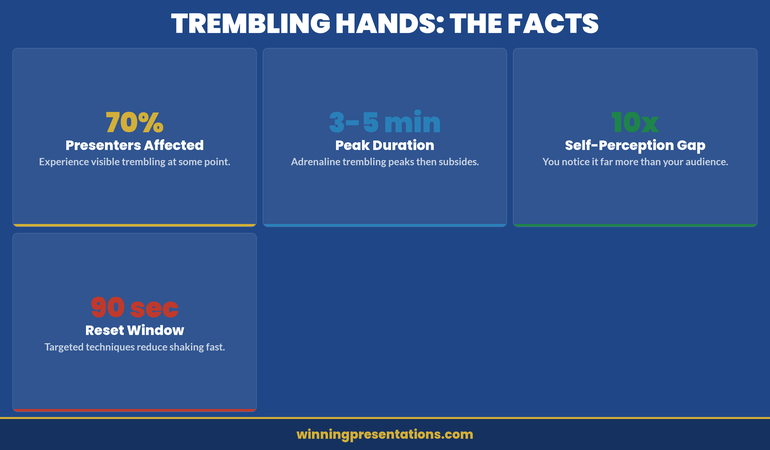
Trembling hands are one of the most visible and distressing physical symptoms of presentation anxiety. Unlike some symptoms that remain internal (racing heart, shallow breathing, tight chest), shaking hands are public. Everyone watching can see them. This visibility often creates a secondary layer of anxiety: “They can see I’m nervous, which proves I’m failing.”
The truth is more nuanced. Your hands shake because your nervous system is doing its job—perhaps a bit too well. When you step onto a presentation stage, your brain perceives it as a high-stakes social and professional situation. In evolutionary terms, it’s similar to standing before a group with status and resources at stake. Your nervous system responds by releasing adrenaline and cortisol, preparing your body for action. This is the fight-flight-freeze response.
Your hands are particularly sensitive to this activation because they are densely innervated—full of nerve endings connected directly to your sympathetic nervous system. When adrenaline floods your bloodstream, those fine motor nerves fire rapidly, creating the tremor you feel and see.
The irony is that mild trembling is often a sign that your nervous system is engaged and alert. The problem is one of degree and perception. For some presenters, a slight tremor is barely noticeable. For others, hands shake so visibly that concentration shifts from content to managing the tremor itself.
Stop Letting Anxiety Control Your Presentation Delivery
Your hands don’t have to shake. Your voice doesn’t have to waver. You don’t have to white-knuckle your way through presentations anymore.
Conquer Speaking Fear (£39) teaches you the nervous system protocols that corporate executives use to present with authority, even when anxiety shows up:
- Understand exactly why your body reacts this way—and how to interrupt the cascade
- Learn three breakthrough breathing and grounding techniques you can deploy in seconds
- Master the psychological reframe that transforms anxiety into readiness
- Build sustainable confidence so presentations feel manageable, not terrifying
- Access templates and scripts to manage self-doubt before you even step into the room
The Nervous System Explanation: Why This Happens Physiologically
To manage trembling hands, you need to understand the neurophysiology behind them. There are two branches of your nervous system: the sympathetic (fight-flight) and parasympathetic (rest-digest). Under normal circumstances, they’re in balance. When you face a presentation, your amygdala—the brain’s threat-detection centre—evaluates the situation. It doesn’t distinguish between a predator and a boardroom. It simply detects: “Multiple observers, evaluation implied, status at risk.”
Your sympathetic nervous system ignites. Adrenaline (epinephrine) and noradrenaline (norepinephrine) flood your bloodstream. Your heart rate increases, pupils dilate, and blood is shunted away from digestion and toward your muscles—preparing you to fight or flee. Your hands receive a massive surge of neurological activation, causing the fine tremors you experience.
This is not weakness. This is not a character flaw. This is neurology. The same mechanism that helped your ancestors survive predation is now misfiring in a conference room.
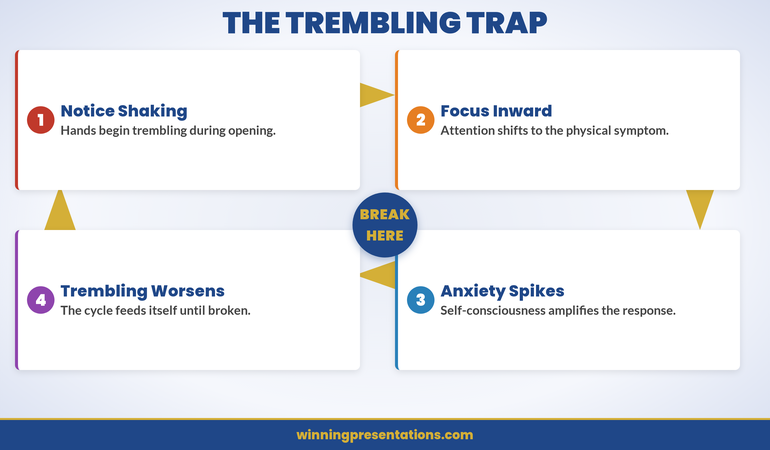
The additional layer: once you notice your hands shaking, you become hyperaware of them. This attention amplifies the tremor. You grip the podium harder, your muscles tense further, and the shaking actually intensifies. It becomes a vicious cycle: anxiety → trembling → awareness of trembling → increased anxiety → worse trembling.
Breaking this cycle is the focus of the Conquer Speaking Fear programme, which teaches you both the nervous system resets and the cognitive reframes that stop the amplification loop.
In-the-Moment Techniques to Stop Trembling
You cannot eliminate nervousness before a high-stakes presentation. You can, however, dramatically reduce the physical manifestation. Here are three techniques you can deploy minutes before stepping into the room—or during the presentation itself.
1. The 5-4-3-2-1 Grounding Protocol
This sensory anchoring technique shifts your nervous system from internal threat detection to external awareness. Before your presentation, identify: five things you can see (the presentation screen, the room setup, audience members), four things you can touch (the texture of your suit, the podium, your own arm), three things you can hear (background ambient sound, people settling in, air conditioning), two things you can smell, and one thing you can taste. Spend 10–15 seconds on each. This forces your brain to process external reality rather than ruminating on internal threat.
2. Box Breathing (Combat Reset)
Your hands shake partly because your breathing is shallow and rapid—typical of the fight-flight state. Box breathing reverses this. Inhale for a count of four, hold for four, exhale for four, hold for four. Repeat for 2–3 minutes. This parasympathetic activation signals safety to your nervous system. Your hands will noticeably steady within seconds of beginning this protocol. You can do this in a restroom, car, or even whilst walking to the presentation stage.
3. Progressive Muscle Relaxation (Targeted)
Tense every muscle in your body hard for five seconds—clench your fists, tighten your legs, tense your core. Then release completely. Repeat twice. This paradoxical technique (temporary tension → release) signals to your nervous system that the threat has passed. Your muscles literally relax, and the fine motor tremor diminishes.
The Real Problem: You’re Managing Anxiety Solo
These techniques work—but they’re only half the solution. You need both the in-the-moment tools AND a systematic approach to rewire your nervous system’s perception of presentations as safe. That’s what Conquer Speaking Fear provides—expert-backed protocols grounded in neuroscience and 24 years of working with high-performing executives.
Minimising Visible Shaking During Delivery
Even as you manage the internal physiology, there are practical delivery techniques that reduce the visibility of trembling:
Control Your Hand Positioning
Don’t gesture wildly or hold notes in your hand. Keep your hands below the lectern or in your pockets between gestures. When you do gesture, make them intentional and large—small, uncertain movements amplify the visibility of shaking. Large, purposeful gestures are both seen as more confident and actually steady your hands because they activate larger muscle groups rather than fine motor nerves.
Use Anchor Points
Rest one hand on the podium or lectern periodically. This provides physical grounding and makes the tremor far less visible. Avoid holding a glass of water or small objects—these become tremor amplifiers.
Lean Into Your Content
This sounds simple, but it works: the moment you focus genuinely on your content rather than on your hands, the tremor diminishes. Your nervous system receives the message that you’re engaged with the material, not threatened by the audience. This requires preparation—when you know your content inside out, you can shift attention away from self-monitoring and into genuine communication.
Move Strategically
Walking reduces fine motor tremor. Small, still presentations tend to amplify hand trembling because your body has no outlet for the mobilised energy. If you move slightly (not paced nervously, but purposefully between points), your larger muscle groups activate and the tremor in your hands becomes less pronounced.
The combination of psychological readiness and physical technique is taught comprehensively in Conquer Speaking Fear, which incorporates both nervous system reset and authentic delivery coaching.
Reframing Trembling as Readiness, Not Failure
Here’s the cognitive shift that changes everything: trembling hands are not a sign of weakness. They’re a sign of activation. Your body is mobilised. You’re ready. The problem is that our culture has taught us to interpret this activation as fear or failure rather than as preparation.
Research on anxiety and performance shows that the same nervous system activation that causes trembling can enhance performance if you reframe it. An athlete before a competition feels the same adrenaline surge, the same elevated heart rate. They call it excitement, not fear. The physiology is identical; the interpretation is different.
When your hands begin to shake during a presentation, you have a choice: “My hands are shaking; I must be failing” or “My hands are shaking; my nervous system is engaged and ready for this challenge.” The second interpretation is neurologically honest and psychologically protective.
This reframe is not positive thinking or denial. It’s accurate neuroscience. Your sympathetic nervous system activation is genuinely preparing you for enhanced performance—elevated alertness, faster information processing, heightened sensory perception. These are gifts, not failures.
Over time, as you repeatedly experience presentations where trembling doesn’t derail you—where you deliver excellently despite (or because of) nervous system activation—your amygdala recalibrates. It learns that presentations aren’t actually threats. The trembling becomes less frequent and less intense naturally, not through white-knuckling suppression, but through lived evidence that the situation is safe.
Your Hands Don’t Have to Shake Every Time
Conquer Speaking Fear gives you the complete system: the nervous system resets, the reframes, the delivery techniques, and the psychological coaching that executives need to move from anxiety-driven presentations to confident, authentic delivery.
- Master the neuroscience of presentation anxiety so you understand, not just manage, your symptoms
- Access battle-tested breathing and grounding protocols used by corporate leaders
- Learn the reframes that transform anxiety from threat to opportunity
- Build a sustainable foundation so presentations become easier, not harder, over time
- Get lifetime access to scripts, templates, and refresher modules
Want the slides too?
Preparation reduces anxiety. The Executive Slide System (£39) includes confident-presenter templates designed to minimise preparation stress.
Frequently Asked Questions
Can you completely eliminate hand trembling before presentations?
Not instantly, but significantly. With consistent practice of the nervous system reset techniques and cognitive reframing, most presenters experience a substantial reduction in trembling within 3–4 presentations. Some people continue to experience mild tremor under extreme stress, but they learn to manage it effectively and know it won’t derail their delivery. The goal is not to eliminate the response entirely, but to reduce its intensity and your emotional reaction to it.
What if the trembling is severe enough to be medically concerning?
Trembling that appears in other contexts (not just presentations), tremors that worsen over time, or shaking accompanied by other symptoms (weight loss, heat intolerance, palpitations) should be evaluated by a doctor. These could indicate medical conditions like thyroid disorder or essential tremor. The techniques in this article address presentation-specific anxiety. If you have underlying medical concerns, address those with your GP first.
Does Beta-blocking medication help with presentation trembling?
Some speakers do use beta-blockers (prescribed by their doctor) for anxiety-induced trembling. These medications reduce the physical symptoms by slowing heart rate and dampening adrenaline response. However, they don’t address the underlying nervous system miscalibration. Many high-performing executives prefer to master the psychological and physiological techniques so they’re not dependent on medication. Conquer Speaking Fear teaches the non-medication approach that builds lasting confidence.
Ready to master your presentation anxiety?
Join thousands of executives who’ve transformed their relationship with public speaking. Get weekly strategies, expert insights, and confidence-building techniques delivered to your inbox.
Related Reading:
Dealing with difficult questions in the boardroom? Read our companion article: How to Handle Hostile Questions in Board Meetings.
The Bottom Line: Trembling Hands Are Manageable
Trembling hands during presentations are not a character flaw. They’re a physiological response to a perceived threat. Once you understand the mechanism—the adrenaline surge, the nervous system activation—you can interrupt it. You have tools: grounding techniques, breathing protocols, reframing, and delivery adjustments that work immediately and compound over time.
The executives who present with visible confidence aren’t the ones who never feel nervous. They’re the ones who’ve learned to manage the nervousness, reframe it as readiness, and deliver excellently despite (and often because of) their activated nervous system.
If trembling hands have been holding you back from the presentations you need to deliver, Conquer Speaking Fear (£39) gives you the complete system to move past this. You’ll learn the techniques I’ve outlined here, plus the deeper psychological work that builds lasting confidence. Most importantly, you’ll understand that presentations don’t have to trigger this anxiety. That calibration is learnable.
Other Articles in This Series:
What to Do When Your Heart Is Racing After a Presentation
Recovering from Shame After a Bad Presentation
The Comparison Trap: How Watching Great Speakers Fuels Anxiety
About Mary Beth Hazeldine
Mary Beth Hazeldine is Owner & Managing Director of Winning Presentations and a qualified clinical hypnotherapist and NLP practitioner. Over 24 years in corporate banking, she worked with thousands of executives navigating high-stakes presentations. She spent 5 years battling severe presentation terror herself—until she cracked the neuroscience of it and built the systems that now help corporate leaders present with calm authority, regardless of anxiety.


