Tag: executive slide system

25 Apr 2026
Executive Slide Design: What Board-Level Presentations Actually Look Like — featured image

Executive Slide Design: What Board-Level Presentations Actually Look Like

Quick Answer

Executive slide design follows three principles that most corporate presentations ignore: recommendation-first structure, visual hierarchy that guides the eye to the decision, and restraint that treats empty space as a signal of confidence rather than missing content. Board-level slides look different from working-level slides because they serve a different purpose — they exist to support a decision, not to document research.

Henrik had spent two weeks building a fifty-two-slide deck for his division’s strategy presentation to the CEO. Every slide was dense with analysis. Charts, tables, footnotes, appendices — the kind of thorough documentation that had earned him promotions throughout his career as an analyst.

The CEO stopped him on slide four.

“What are you recommending?” she asked. Henrik explained that the recommendation was on slide thirty-eight, after the market analysis, competitive landscape, financial modelling, and risk assessment. The CEO looked at the COO. “Can someone send me a one-pager?” The meeting ended twelve minutes early.

Henrik’s analysis was excellent. His slide design was wrong for the audience. He had built a research document and presented it as a decision tool. At the executive level, these are fundamentally different artefacts — and the design principles that make one effective actively undermine the other.

Designing slides for a board or C-suite presentation?

Before you add another chart or bullet list, check whether your slides are designed for the audience in the room. Quick pressure test:

  • Can a decision-maker grasp each slide’s point in under eight seconds?
  • Does your recommendation appear in the first three slides, not the last three?
  • Is there enough white space that each slide looks intentional, not overcrowded?

Explore the Executive Slide System →

Why Most Executive Slides Look Wrong for the Room They Are In

The default approach to executive slide design is to compress a working-level presentation into fewer slides. Take the forty-slide analyst deck, consolidate the content into fifteen slides, increase the font size slightly, and call it “board-ready.” This approach produces slides that are neither thorough enough for analysts nor clean enough for executives. They sit in an awkward middle ground that satisfies nobody.

The problem is conceptual, not aesthetic. Working-level slides are designed to document analysis — they show the work, justify the methodology, and present data in granular detail. Executive slides are designed to support decisions — they present recommendations, evidence, and trade-offs in a format that enables a room of senior people to say yes, no, or ask one clarifying question.

These are different design jobs. A working-level slide might contain a detailed waterfall chart showing quarterly revenue by product line, region, and customer segment. An executive slide covering the same topic would show total revenue against target with a single sentence explaining the variance. The analyst’s slide answers “what happened in detail?” The executive’s slide answers “are we on track, and if not, what should we do about it?”

When you design executive slides using working-level principles — more data, more detail, more backup — you force decision-makers to do analytical work they neither have time for nor expect to do. The slide becomes a reading exercise rather than a decision-support tool. And in a boardroom, reading exercises lose the room within minutes.

For a comprehensive look at how to structure an executive-level deck from start to finish, see our guide to executive presentation templates.

Recommendation-First Design: Putting the Answer Before the Evidence

The most important design principle for executive presentations is structural: the recommendation comes first, not last. This contradicts the logical progression most presenters learned in school and reinforced throughout their careers — build the case, present the evidence, arrive at the conclusion. At the executive level, that sequence is inverted.

Decision-makers want to know your recommendation within the first two minutes of the presentation. Not because they do not value the analysis, but because knowing the recommendation changes how they process everything that follows. If they know you are recommending Option B, they listen to your analysis through the lens of “does this evidence support that recommendation?” If they do not know the recommendation, they listen to your analysis through the lens of “where is this going?” — which is cognitively exhausting and emotionally frustrating.

In practical slide design terms, recommendation-first means your second or third slide states your recommendation in plain language. “We recommend expanding into the APAC market in Q3, with an initial investment of £2.4 million, targeting breakeven within eighteen months.” One slide. One sentence. One clear ask.

Everything after that slide is evidence, context, and risk analysis that supports the recommendation. The audience is no longer guessing where you are heading — they are evaluating whether your evidence is strong enough to justify your conclusion. That is a much more productive use of everyone’s time.

This structure also changes the Q&A dynamic. When the recommendation is visible early, questions during the presentation become more focused and more useful. Instead of “what’s your recommendation?” at slide thirty-eight, you get “how confident are you in the eighteen-month breakeven timeline?” at slide five. The second question is more valuable for everyone in the room.

Need Board-Ready Slides, Not Another Template Gallery?

Most slide templates give you layouts. The Executive Slide System — £39, instant access — gives you the decision-support frameworks that make executive presentations work:

  • Slide templates structured for recommendation-first executive communication
  • AI prompt cards to convert analyst-level data into board-level visual hierarchy
  • Scenario playbooks for board meetings, steering committees, and C-suite briefings
  • Executive summary frameworks designed for eight-second comprehension

Get the Executive Slide System → £39

Designed for executives and their teams who present to boards, steering committees, and C-suite leaders.

Visual Hierarchy for Decision-Makers Who Read Slides in 8 Seconds

Research on executive attention suggests that senior decision-makers spend approximately eight seconds on a slide before deciding whether it warrants further attention. In that eight seconds, they scan for three things: the point of the slide, the evidence that supports it, and whether they need to ask a question. Your visual hierarchy must deliver all three in that window.

The practical framework for executive visual hierarchy uses three tiers:

Tier 1: The headline (read in 1-2 seconds). Every slide should have a single-sentence headline that states the point of the slide — not a label, but a conclusion. “European Revenue Exceeded Target by 12%” is a conclusion. “European Revenue Q1 2026” is a label. Conclusions tell the decision-maker what to think about. Labels ask them to figure it out themselves. Use a large, bold font (minimum 24-point in a standard 16:9 slide) in a colour that contrasts clearly with the background.

Tier 2: The evidence (absorbed in 3-4 seconds). One chart, one data visualisation, or one three-to-four-bullet summary that supports the headline. Not two charts. Not a chart and a table. One piece of evidence, designed to be absorbed in a glance. If your evidence requires reading, it belongs in a pre-read document, not on a projected slide. Choose the visualisation type that communicates the point most quickly: bar charts for comparison, line charts for trends, tables only when exact numbers matter more than patterns.

Tier 3: The annotation (noticed in 1-2 seconds). A single line of context that answers the most likely question the audience will have after reading the headline and evidence. “Driven primarily by the Deutsche Bank contract signed in February” or “Represents a 3% improvement on the same period last year.” This annotation pre-empts the obvious question and saves time in discussion.

If you are designing slides for executives who make decisions quickly, the Executive Slide System (£39) provides the visual hierarchy frameworks and templates designed for exactly this three-tier approach.

The Restraint Principle: Why Less Content Signals More Authority

The instinct to fill every slide with content comes from a reasonable fear: that empty space looks like missing information. At the working level, this fear is sometimes justified — a sparse slide might genuinely indicate incomplete analysis. At the executive level, the opposite is true. A sparse slide signals that you have done the analytical work, made the judgement calls, and distilled the complexity down to what matters.

White space on an executive slide communicates three things: confidence in the recommendation, respect for the audience’s time, and mastery of the subject matter. When you leave space around a single chart and a clear headline, you are implicitly saying, “I know this topic well enough to tell you only what you need.” When you fill the slide with caveats, footnotes, and secondary data, you are saying, “I’m not sure what matters here, so I’m showing you everything.”

Practical restraint in board-level slide design means following a set of constraints:

One point per slide. If you cannot state the slide’s contribution to the argument in a single sentence, the slide is doing too many things. Split it or cut it. A twelve-slide deck where each slide makes one clear point is more effective than a six-slide deck where each slide makes three muddled ones.

Maximum three bullet points. If you have more than three supporting points, you have not prioritised ruthlessly enough. Rank them and present the top three. Move the rest to an appendix for anyone who wants the detail.

No decorative elements. Clip art, stock photography, gradient backgrounds, and animated transitions do not help executives make decisions. They add visual noise that competes with the content for attention. A clean, flat design with consistent typography and a restrained colour palette looks more authoritative than a “professionally designed” template with graphic embellishments.

Consistent typography. Use two fonts maximum — one for headlines, one for body text. Keep sizes consistent across slides. Inconsistent typography creates a subconscious sense of disorder that undermines the audience’s confidence in the presenter. If your slides look disorganised, the assumption is that your thinking is disorganised.

For detailed slide structure guidance tailored to board-level presentations, see our comprehensive framework for board presentation structure.

Five Slide Design Mistakes That Damage Executive Credibility

These five errors appear repeatedly in presentations delivered to boards, steering committees, and C-suite leaders. Each one is avoidable, and each one carries a credibility cost that exceeds the effort required to fix it.

1. Conclusion on the last slide. Saving the recommendation for the end works in academic presentations and courtroom dramas. In executive settings, it frustrates the audience and often means the recommendation never gets discussed — the meeting runs out of time because forty minutes were spent on background that should have been a pre-read. Move the recommendation to slide two or three.

2. Reading the slide aloud. If your speaking notes are identical to the text on the slide, the slide is a script, not a visual aid. Executives can read faster than you can speak. The moment they finish reading your slide — which takes about five seconds — they are waiting for you to add something the slide does not say. If you add nothing, the slide is redundant and so are you. Design slides that complement your narration, not duplicate it.

3. Charts without interpretation. A chart without a headline is an assignment, not a communication. It says to the audience: “Here is some data. Please analyse it and draw your own conclusions.” Executives do not want assignments. They want your interpretation. Every chart should have a headline that states what the chart means, not what the chart shows.

4. Inconsistent formatting across slides. Mixed fonts, varying alignment, different colour usage across slides, and inconsistent spacing signal a deck assembled from multiple sources without editorial oversight. Even if the content is strong, formatting inconsistency creates a perception of carelessness. Use a single master template and enforce it across every slide.

5. Appendix as a safety net. Including twenty appendix slides “just in case” is a sign that you have not decided what matters. A good appendix contains three to five slides that address the most likely technical questions. A bad appendix contains everything you cut from the main deck because you were not confident enough to leave it out entirely. If you would not present a slide under any circumstances, do not include it.

Stop Designing Slides That Get Interrupted on Page Four

The Executive Slide System — £39, instant access — gives you the board-ready templates and visual hierarchy frameworks that make designing executive presentations straightforward. Build recommendation-first decks that decision-makers can act on in one meeting.

Get the Executive Slide System → £39

Designed for professionals who present to boards, steering committees, and C-suite executives.

Frequently Asked Questions

How many slides should an executive presentation have?

Most effective executive presentations use ten to fifteen slides for a thirty-minute meeting, including one or two appendix slides for anticipated questions. The number matters less than the discipline: one point per slide, recommendation in the first three slides, and no slide that exists solely to demonstrate how much work went into the analysis. If your deck exceeds fifteen slides, ask whether every slide supports the decision the audience needs to make. Remove anything that serves your need to show thoroughness rather than their need to make a judgement.

What font and colour scheme works best for executive slides?

Use two fonts — one sans-serif for headlines (such as Calibri, Helvetica, or Inter) and one for body text (the same font at a smaller size works well). Avoid decorative or script fonts entirely. For colours, limit yourself to three: a dark primary colour for text and backgrounds, a contrasting accent colour for key data points and highlights, and white for negative space. Navy and gold is a classic executive palette. The goal is consistency and readability, not visual interest — the content provides the interest.

Should I use animations and transitions in executive presentations?

No. Animations and slide transitions add presentation time without adding decision value. They also create technical risk — transitions that work on your laptop may render differently on a boardroom projector, and animation timing often breaks when someone interrupts to ask a question mid-build. Use simple appear/disappear builds only when you need to reveal information sequentially to control the narrative. Otherwise, static slides are faster, more reliable, and look more professional to a senior audience.

How do I convert an analyst deck into an executive presentation?

Do not try to compress the analyst deck — build the executive deck separately, from scratch. Start with the recommendation, then identify the three to four pieces of evidence that most strongly support it. Each piece of evidence becomes one slide with a conclusion headline, one data visualisation, and one annotation line. Move the remaining analytical detail into a pre-read document or a short appendix. The executive deck and the analyst deck serve different purposes and should be designed independently, not derived from each other.

The Winning Edge — Weekly Presentation Intelligence

Every Thursday, I share one framework, one real-world example, and one practical technique drawn from 24 years of presenting in boardrooms across three continents. Join The Winning Edge newsletter →

Not ready for the full system? Start here instead: download the free Executive Presentation Checklist — a one-page reference covering the structure, visual hierarchy, and critical design elements every board-level presentation needs.

Great slides only work if you can deliver them with composure. See our guide to the presentation warm-up routine that calms your nervous system before you walk into the boardroom.

About the Author

Mary Beth Hazeldine is the Owner & Managing Director of Winning Presentations. With 24 years of corporate banking experience at JPMorgan Chase, PwC, Royal Bank of Scotland, and Commerzbank, she advises executives across financial services, healthcare, technology, and government on structuring presentations for high-stakes funding rounds and approvals.

Book a discovery call | View services

24 Apr 2026

Boardroom Presentation Skills: The Structured System for Executive Credibility

Quick Answer

Boardroom presentation skills are not about charisma or natural confidence. They are a structured set of competencies covering how you organise information for senior decision-makers, how you design slides that support rather than replace your argument, and how you handle questions from people who are paid to challenge your thinking. These skills can be learned systematically, and the executives who present most effectively in boardrooms are typically the ones who have invested in structured preparation — not the ones who rely on instinct.

Emeka had been presenting project updates to his line manager for three years with no issues. Then he was asked to present a strategic recommendation to the executive committee.

He built the same kind of deck he always built: detailed, thorough, twenty-eight slides covering every aspect of the proposal. He rehearsed the content until he could deliver it without notes. He arrived early, tested the projector, and felt reasonably prepared.

The CEO stopped him on slide five. “What are you asking us to decide?” Emeka paused. He knew the answer — it was on slide twenty-two. But the question exposed something he hadn’t considered: his deck was built to explain, not to persuade. In a boardroom, the audience doesn’t wait for the explanation to finish before they start making judgements. They are evaluating your recommendation from the moment you open your mouth. And if they have to wait twenty-two slides to find out what you’re recommending, you have already lost them.

That meeting changed how Emeka approached every subsequent board presentation. Not by learning to be more confident, but by learning to structure his content for the way board-level audiences actually process information.

Preparing for a boardroom presentation?

The Executive Slide System gives you the templates and frameworks designed specifically for board-level audiences — so your content is structured for how executives actually make decisions.

Explore the Executive Slide System →

What the Boardroom Requires That Other Settings Do Not

The boardroom is not simply a higher-stakes version of a team meeting. It operates under a different set of rules, and presenters who treat it as a scaled-up project update consistently underperform.

Board members and executive committees have three characteristics that distinguish them from other audiences. First, they are time-constrained. A board meeting covers multiple agenda items in a fixed window. Your slot is shorter than you think, and the expectation is that you will use it efficiently. A presentation that takes forty minutes when you were allocated twenty signals that you do not understand the audience you are presenting to.

Second, they are decision-oriented. Every item on a board agenda exists because a decision is required. If your presentation does not contain a clear recommendation and a specific ask, the board will wonder why it was on the agenda at all. Information for its own sake is not valued at this level — information that supports a decision is.

Third, they are adversarial by design. Board members are paid to challenge, question, and stress-test proposals. This is not personal. It is governance. A presenter who interprets board questions as criticism rather than due diligence will become defensive — and defensive presenters lose boardrooms. The ability to receive challenge calmly and respond with evidence is the single most important boardroom presentation skill.

Understanding board presentation best practices starts with accepting these three realities and building your presentation around them — not around what you want to communicate.

The Three Core Competencies of Boardroom Presenters

Effective boardroom presenters are not born. They are developed through deliberate practice in three specific areas.

Competency 1: Executive framing

Executive framing means structuring your content so that the recommendation comes first, the evidence comes second, and the detail comes only when requested. This is the inverse of how most professionals are trained to communicate — in academic and technical settings, you build the case before presenting the conclusion. In a boardroom, the conclusion is the starting point. Everything else is evidence the audience evaluates against the conclusion you have already stated.

The practical test: if a board member walked in five minutes late and heard only your opening three sentences, would they know what you are recommending? If not, your framing needs to change.

Competency 2: Visual discipline

Board slides serve a fundamentally different purpose from team slides. A team slide can carry detailed data, complex charts, and supporting text because the audience will spend time with it. A board slide needs to communicate one idea per slide — clearly, visually, and without requiring the audience to read paragraph-length text while you’re speaking. The best board decks are visually spare: headline, supporting visual or data point, and nothing else. Everything else goes in the appendix.

The executive presentation structure that works at board level follows this principle: fewer slides, each carrying a single clear message, arranged in the order the board needs to receive them — not the order you created them.

Competency 3: Composure under challenge

This is the competency that separates good boardroom presenters from adequate ones. When a board member challenges your numbers, questions your methodology, or pushes back on your recommendation, how you respond matters more than what you say. Composure signals preparation. Defensiveness signals insecurity. The response framework is simple: acknowledge the point, address it with specific evidence, and move on. If you don’t have the answer, say “I’ll confirm that and come back to you by end of day” — not “That’s a good question” followed by improvisation.

Build Boardroom-Ready Decks in Half the Time

The Executive Slide System — £39, instant access — gives you the templates, frameworks, and AI prompt cards designed specifically for board-level audiences:

  • 22 PowerPoint templates designed for executive and board presentations
  • 51 AI prompt cards to build board-ready slides quickly
  • Executive summary and strategic recommendation frameworks
  • 6 checklists covering board, investor, sales, and executive scenarios

Get the Executive Slide System →

Designed for professionals preparing to present at board and executive level.

Slide Design Principles for Board-Level Audiences

Board slides fail when they try to do too much. The most effective board presentations follow four design principles that keep the audience focused on the decision rather than the data.

One message per slide. If a slide communicates two ideas, split it into two slides. Board members process information in units. A slide that contains both a financial forecast and an implementation timeline forces the audience to switch context mid-slide — and most won’t. They will focus on one and miss the other.

Headlines that state conclusions, not topics. A slide titled “Q3 Financial Results” tells the audience what the slide is about. A slide titled “Q3 Revenue Exceeded Forecast by 12%” tells the audience what to think about it. The second approach saves time, reduces ambiguity, and lets the audience evaluate the evidence against a stated conclusion rather than trying to derive the conclusion from the evidence.

Data in context, not isolation. A chart showing revenue at £4.2 million means nothing without a reference point. Revenue at £4.2 million against a forecast of £3.8 million tells a story. Revenue at £4.2 million against a forecast of £3.8 million and a prior year of £5.1 million tells a different story entirely. Every data point on a board slide needs context: versus budget, versus prior period, versus target.

Appendix for depth. The main deck should be ten to fifteen slides. The appendix can be fifty. This structure lets you present a concise narrative while having detailed evidence available if a board member wants to go deeper on a specific point. Saying “That’s covered on appendix slide 34 — I can walk through the detail if helpful” is one of the most effective boardroom moves. It signals both preparation and respect for the board’s time.

The opening lines of a board presentation set the tone for everything that follows. Get the first slide right — clear headline, specific recommendation, confident framing — and the rest of the presentation flows from a position of strength.

If you need templates for these slide formats, the Executive Slide System includes board-ready PowerPoint templates with headline-first layouts and executive summary frameworks built for these exact scenarios.

Delivery Under Pressure: Pacing, Tone, and Presence

Boardroom delivery is not about performance. It is about clarity under pressure. The executives in the room are evaluating your competence through how you communicate — not just what you communicate.

Pacing. Most presenters accelerate under pressure. In a boardroom, this reads as nervousness. The deliberate counter-move is to speak slightly slower than feels natural. A presenter who pauses after key points and lets the room absorb them signals confidence. A presenter who rushes through thirty slides signals that they are afraid of being stopped — which, ironically, makes the board more likely to stop them.

Tone. Boardroom tone is conversational, not performative. You are not giving a keynote. You are briefing a group of senior colleagues on a matter that requires their input. The register should be the same as if you were explaining the proposal to a respected peer over coffee — informed, measured, direct. Avoid the presentation voice that many people adopt when they stand at the front of a room: higher pitch, faster pace, more filler words. If you notice yourself shifting into performance mode, pause, take a breath, and resume at conversational pace.

Presence. Presence in a boardroom is largely a function of preparation and composure, not personality. A quiet presenter who knows their material and handles questions with specificity will always outperform a confident presenter who improvises answers and glosses over gaps. The board is assessing whether you can be trusted with the decision you are recommending. That trust comes from demonstrating that you have thought about the problem more deeply than they have — not from demonstrating that you are comfortable in the spotlight.

Q&A at Board Level: How to Handle Challenge Without Losing Control

The Q&A is where boardroom presentations are won or lost. A strong deck can be undermined by weak question handling, and a competent Q&A performance can rescue a deck that was only adequate.

Anticipate the top five questions. Before every board presentation, write down the five most likely questions you will be asked. For each one, prepare a specific, evidence-based answer — not a general deflection. Board members ask questions they already know the answer to; they are testing whether you know it too.

Answer the question that was asked. Under pressure, presenters often answer the question they wish had been asked rather than the one that was. If a board member asks “What is the worst-case scenario?”, do not redirect to the expected scenario. Answer the specific question directly, then add context. The pattern is: direct answer, supporting evidence, context. In that order.

Own what you don’t know. “I don’t have that figure to hand, but I’ll confirm it and circulate to the board by end of day” is a perfectly acceptable boardroom answer. What is not acceptable is improvising a number, hedging with qualifiers, or visibly floundering. Board members have seen hundreds of presenters. They can tell the difference between a genuine knowledge gap and a competence gap. Owning the gap quickly and specifically is how you keep their confidence.

Do not argue with the chair. If the board chair redirects the conversation, closes a line of questioning, or asks you to move on, do so immediately. The chair controls the room. A presenter who pushes back against the chair’s direction — even politely — signals that they do not understand the governance dynamic. Save the additional point for a follow-up email.

See also how today’s related articles tackle adjacent challenges: structuring a budget overrun presentation for executive committees, adapting presentations for cross-cultural audiences, and the career cost of avoiding presentations at work.

Stop Building Board Decks From Scratch

The Executive Slide System — £39, instant access — includes 22 board-ready templates and 51 AI prompt cards that build your deck in half the time. No more starting from a blank slide.

Get the Executive Slide System →

Designed for professionals who present to boards and executive committees.

Frequently Asked Questions

How many slides should a boardroom presentation have?

Ten to fifteen in the main deck, with an appendix of as many as needed for supporting detail. The main deck should cover the executive summary, the recommendation, the key evidence, the risk assessment, and the ask — nothing more. Every additional slide dilutes the narrative and reduces the time available for Q&A, which is where the real decision-making happens.

What is the most important boardroom presentation skill?

Composure under challenge. The ability to receive a direct, sometimes sharp question from a senior executive and respond with specific evidence rather than defensive improvisation is the single most distinguishing skill of effective boardroom presenters. This is a learnable skill, not a personality trait — it comes from thorough preparation and rehearsed responses to the most likely challenges.

How do you prepare for a board presentation when you have never presented to one before?

Three steps. First, ask someone who has presented to this specific board what they expect — every board has its own culture, pace, and level of detail appetite. Second, build a modular deck: short core presentation with a comprehensive appendix. This lets you flex based on how the meeting evolves. Third, rehearse the Q&A more than the presentation itself. Write down the five hardest questions you might be asked and prepare specific, evidence-based answers for each. The presentation is the vehicle; the Q&A is the test.

Can boardroom presentation skills be learned or are they innate?

They are entirely learnable. The executives who appear most natural in boardrooms are almost always the ones who have invested the most in structured preparation, feedback, and deliberate practice. What looks like innate confidence is typically the result of repeated exposure, well-designed slide frameworks, and a systematic approach to Q&A preparation. Nobody is born knowing how to structure a board deck or handle a challenge from a non-executive director — these are acquired skills that improve with practice.

The Winning Edge — Weekly Presentation Intelligence

Every Thursday, I share one framework, one real-world example, and one practical technique drawn from 24 years of presenting in boardrooms across three continents. Join The Winning Edge newsletter →

Not ready for the full system? Start here instead: download the free Executive Presentation Checklist — a one-page reference covering the structure, opening, and critical elements every boardroom presentation needs before you walk in.

About the Author

Mary Beth Hazeldine is the Owner & Managing Director of Winning Presentations. With 24 years of corporate banking experience at JPMorgan Chase, PwC, Royal Bank of Scotland, and Commerzbank, she advises executives across financial services, healthcare, technology, and government on structuring presentations for high-stakes funding rounds and approvals.

Book a discovery call | View services

24 Apr 2026

Budget Overrun Presentation: How to Brief Executives When Projects Exceed Costs

Quick Answer

A budget overrun presentation succeeds when it leads with the size of the problem, explains the cause clearly, and presents a credible recovery path — all before anyone asks. The executives in the room do not need surprise minimised. They need enough information to make a decision about what happens next, and they need that information structured so they can act on it quickly.

Tomás was ninety seconds into his project status update when the CFO held up one hand and said, “Skip to the number.”

The number was £1.4 million over the approved budget — a 22 per cent overrun on a digital transformation programme that had been running for nine months. Tomás had prepared twelve slides explaining the circumstances: regulatory changes, vendor delays, scope additions requested by the business. All of it true. All of it irrelevant to what happened next.

The CFO looked at the COO. The COO looked at the programme sponsor. Somebody asked whether the project should be paused. Tomás spent the next forty minutes defending a project he had originally been asked to update on. By the time the meeting ended, the overrun was no longer the problem. The problem was that nobody in the room trusted the forecast anymore.

That meeting could have gone differently. Not because the numbers were wrong, but because the presentation was built to explain the overrun rather than to manage it.

Presenting a budget overrun to executives this quarter?

The Executive Slide System gives you the templates and frameworks to structure difficult financial briefings — so executives get the information they need to make decisions, not a defensive explanation they have to interpret.

Explore the Executive Slide System →

Why Budget Overruns Destroy Trust Faster Than Missed Deadlines

A missed deadline is a schedule problem. A budget overrun is a judgement problem. That distinction matters because it changes how executives interpret everything else you say.

When a project runs late, the typical assumption is that something took longer than expected — complexity, dependencies, resource availability. Most senior leaders have seen this before and can contextualise it. When a project runs over budget, the assumption is different: somebody either underestimated the costs, failed to control spending, or didn’t flag the issue early enough. All three are judgement failures, and judgement failures erode trust in the person presenting — not just the project.

This is why budget overrun presentations require a fundamentally different approach from standard project updates. A project update says “here is what’s happening.” A budget overrun briefing says “here is what went wrong, here is why I didn’t catch it sooner, and here is exactly what I’m going to do about it.” The order of those three elements matters more than most presenters realise.

The second complication is that budget overruns compound. An executive hearing about a £1.4 million overrun is not just thinking about £1.4 million. They are thinking: “Is this the final number, or is there more coming?” If your presentation doesn’t explicitly address forecast reliability — why they should believe the new number — you will face that question regardless. Better to answer it before it’s asked.

Understanding how to handle budget variance presentations is useful context here, but a variance and an overrun are not the same conversation. A variance is expected movement. An overrun is a breach of the approved envelope. The stakes are higher, and the presentation needs to reflect that.

The Three-Part Structure for Overrun Briefings

Every effective budget overrun presentation follows the same logic, regardless of the size of the overrun or the industry. It answers three questions in a specific order, and the order is non-negotiable.

Part 1: The current position — exactly how much and exactly why

Open with the number. Not the background, not the context, not the history of the project — the number. State the approved budget, the current forecast, and the variance in both absolute and percentage terms. Then explain the cause in no more than three clear categories. For example: “The overrun is driven by three factors. Regulatory requirements added to the scope accounted for £620,000. Vendor repricing after the contract mid-point accounted for £480,000. Internal resource reallocation from a parallel programme accounted for the remaining £300,000.”

Notice what this does not include: excuses, qualifications, or phrases like “due to unforeseen circumstances.” Every circumstance was unforeseen until it happened. What executives need is specificity, not apology.

Part 2: Forecast reliability — why they should believe this number

This is the part most presenters skip, and it is the part that determines whether the room trusts you or not. After presenting the current variance, explicitly address the question: “Is this the final number?” Explain the methodology behind your revised forecast. Show which cost categories are now fixed (contracted, committed, or delivered) and which still carry variance risk. If you are 85 per cent through the project with 90 per cent of costs committed, say so — that is a materially different risk profile from being 60 per cent through with significant uncommitted spend.

The best presenters I have worked with include a simple confidence indicator on their forecast slide: a three-tier assessment showing which cost lines are firm, which are estimated, and which carry identified risk. This gives the CFO what they actually want — not certainty, but a clear view of where uncertainty remains.

Budget overrun presentation structure showing three parts: Current Position with variance breakdown, Forecast Reliability with confidence indicators, and Recovery Plan with timeline and cost controls

Part 3: The recovery plan — what you are going to do about it

End with a specific, time-bound recovery or completion plan. This is not a list of good intentions. It is a slide that shows: revised completion timeline, remaining cost envelope, specific cost controls you have already implemented, and the decision you need from the room (additional funding approval, scope reduction, or a hybrid approach). If the project can be de-scoped to bring costs back within the original budget, show what that looks like alongside the full-scope option. Let executives choose — do not choose for them.

Need to Brief Executives on a Budget Overrun This Month?

Structuring a budget overrun presentation requires a different framework from a standard update. The Executive Slide System — £39, instant access — gives you the templates designed for exactly these high-stakes financial conversations:

  • Slide templates for financial variance and recovery plan briefings
  • AI prompt cards to structure your cost analysis and forecast slides
  • Executive summary frameworks for delivering difficult financial news
  • Stakeholder-ready formats that separate the problem from the plan

Get the Executive Slide System →

Designed for executives presenting financial decisions to senior leadership.

The Recovery Slide That Restores Executive Confidence

If the overrun slide breaks trust, the recovery slide rebuilds it. And the difference between a weak recovery slide and a strong one is specificity.

A weak recovery slide says: “We will implement tighter cost controls and review the project plan to identify savings.” This tells executives nothing. It reads like a response drafted by someone who has not yet worked out what to do.

A strong recovery slide shows four things:

1. What has already changed

List the cost controls you have already implemented — not the ones you plan to implement. This signals competence and urgency. For example: “Weekly spend reviews introduced from 1 April. Vendor change request approval now requires programme director sign-off. Non-essential scope items paused pending revised business case.”

2. Revised cost forecast with committed versus estimated split

Show the remaining budget in two columns: committed costs (contracted, invoiced, or in progress) and estimated costs (subject to change). This gives the CFO the risk transparency they need without pretending you have perfect information.

3. Completion timeline — realistic, not optimistic

An overly optimistic revised timeline after a budget overrun is worse than an honest one. If the project will take three additional months, say so. Executives would rather hear a credible timeline once than an optimistic timeline twice.

4. The decision required

End the recovery slide with a clear ask. “We are requesting approval for an additional £1.4 million to complete the full scope, with revised completion in Q4. Alternative: reduce scope to phase one only, completing within the original budget by Q3.” Give the committee options and the information to choose between them. This is what presenting bad news to senior leadership actually looks like when done well — not minimising the problem, but framing the decision.

If you need templates for structuring these recovery conversations, the Executive Slide System includes frameworks for financial variance briefings and executive decision slides that separate the problem from the recommendation.

Language That Backfires When Presenting Bad Financial News

The words you use in a budget overrun presentation matter as much as the numbers. Certain phrases — often used with good intentions — consistently make the conversation harder, not easier.

“Due to unforeseen circumstances”

This phrase raises a question it was intended to answer: if the circumstances were foreseeable, why didn’t you foresee them? And if they genuinely weren’t foreseeable, then what does that say about the original budgeting process? Replace it with specificity. “Regulatory changes published in February added £620,000 to the compliance workstream” is a fact. “Due to unforeseen circumstances” is a defence.

“The project is slightly over budget”

Minimising language is the fastest way to lose credibility in these conversations. If the overrun is 22 per cent, it is not “slight.” Executives can read a spreadsheet. When the language doesn’t match the numbers, they stop trusting the language — and by extension, everything else in the presentation. State the variance clearly, without qualification. The CFO will form their own view on whether it’s significant.

“We’re confident the revised forecast will hold”

Confidence claims without evidence are meaningless after a budget overrun — because the original budget was presumably also presented with confidence. Replace the claim with the basis for it: “Ninety-one per cent of remaining costs are committed or contracted, leaving £180,000 of estimated spend still subject to variance.” That is a reason for confidence. The word “confident” on its own is not.

Budget overrun language comparison showing three phrases to avoid and their specific, credible replacements for executive financial briefings

This kind of precise, honest communication is also central to effective cost reduction presentations — the same executives who need transparency about overruns also need it when you’re proposing cuts.

Handling the Hardest Questions in a Budget Overrun Q&A

The Q&A after a budget overrun presentation is where trust is either rebuilt or permanently damaged. Preparation is everything.

“Why didn’t we know about this sooner?”

This is the most common question, and the only honest answer addresses the reporting cycle directly. If the overrun materialised gradually and was identified at the most recent forecast review, say so. If the overrun was identifiable earlier but was not escalated, acknowledge that and explain what has changed in the reporting process. The worst response is to imply that the overrun only just happened when the data suggests otherwise. Executives who discover a delayed escalation after the fact will never trust the project team’s reporting again.

“What’s the worst case from here?”

Always have a worst-case number prepared. If the revised forecast is £1.4 million over, what is the maximum credible exposure? If the answer is £1.8 million under a specific set of adverse conditions, say so, and explain what those conditions would need to be. A presenter who can articulate the worst case calmly and specifically signals that they understand the risk landscape. A presenter who hesitates signals that they haven’t thought about it.

“Should we stop the project?”

This question often sounds more aggressive than it is. In most cases, the person asking wants to hear a clear case for continuation — they want to be persuaded. Respond with the sunk cost reality, the cost of stopping versus completing, and the business value that still justifies the investment. If the honest answer is that stopping should be considered, say that too. A recommendation to pause or descope is more credible than a recommendation to continue at all costs.

See also how today’s related articles tackle adjacent challenges: adapting executive presentations for cross-cultural audiences, the career cost of avoiding presentations at work, and building the structured system for boardroom credibility.

Turn a Difficult Briefing Into a Clear Decision

The Executive Slide System — £39, instant access — includes the financial briefing and recovery plan templates that turn a budget overrun conversation into a structured decision meeting. Stop improvising these slides under pressure.

Get the Executive Slide System →

Designed for executives delivering financial updates to senior leadership.

Frequently Asked Questions

How do you open a budget overrun presentation?

Open with the number. State the approved budget, the current forecast, and the variance in both absolute and percentage terms. Do not start with background, context, or a project timeline — these delay the conversation the room actually needs to have. Once the number is on the table, explain the cause in three clear categories and then move to the recovery plan. Executives facing a budget overrun want to understand the scale of the problem before anything else.

Should you present a budget overrun before the full picture is clear?

Yes, with appropriate caveats. A delayed escalation is always worse than an early one with acknowledged uncertainty. Present what you know, flag what you don’t, and commit to a specific date for the revised forecast. The phrase “the current estimated overrun is £X, with a further £Y still under review — we will have the full picture by [date]” is far more effective than waiting until you have perfect numbers. Executives consistently prefer incomplete but timely information over complete but late information.

What should the recovery plan slide include?

Four elements: actions already taken to control costs, the revised cost forecast split between committed and estimated spend, a realistic completion timeline, and the specific decision you need from the room. The recovery plan is not a list of intentions — it is a concrete proposal with options. Always present at least two options (full scope with additional funding, or reduced scope within the original budget) so executives can make a choice rather than simply react to a problem.

The Winning Edge — Weekly Presentation Intelligence

Every Thursday, I share one framework, one real-world example, and one practical technique drawn from 24 years of presenting in boardrooms across three continents. Join The Winning Edge newsletter →

Not ready for the full system? Start here instead: download the free Executive Presentation Checklist — a one-page reference covering the structure, opening, and critical elements every executive financial briefing needs.

About the Author

Mary Beth Hazeldine is the Owner & Managing Director of Winning Presentations. With 24 years of corporate banking experience at JPMorgan Chase, PwC, Royal Bank of Scotland, and Commerzbank, she advises executives across financial services, healthcare, technology, and government on structuring presentations for high-stakes funding rounds and approvals.

Book a discovery call | View services

24 Apr 2026

Cross-Cultural Presentation: Adapting Executive Communication for Global Audiences

Quick Answer

A cross-cultural presentation requires adapting your communication style — not your content — to the decision-making norms of the audience in the room. What reads as confident directness in London can read as aggressive in Tokyo. What feels like thorough preparation in Frankfurt can feel like over-engineering in New York. The content stays the same. The framing, structure, and delivery shift to match how your audience processes information and makes decisions.

Astrid had presented the same strategic recommendation to three different regional boards in the space of two weeks.

In Stockholm, she led with the data, presented two options with a clear recommendation, asked for questions, and had approval within twenty minutes. In Singapore, she followed the same structure. Forty minutes later, the board thanked her for the presentation and said they would discuss it internally. Two weeks passed before she received a response — a set of questions she had already answered on slide four. In São Paulo, the board interrupted her before the second slide, asked about the commercial implications, challenged the competitive assumptions, and approved the recommendation on the spot — but with a modification she hadn’t anticipated.

Same proposal. Same slides. Same presenter. Three completely different outcomes. The content wasn’t the variable. The audience’s decision-making culture was. And Astrid’s presentation hadn’t adapted to any of them.

Presenting to an international executive audience soon?

The Executive Slide System gives you adaptable templates and frameworks that work across different audience cultures — so you can structure your content once and adjust the delivery for any room.

Explore the Executive Slide System →

Why Presentation Style Matters More Than Language

Most advice about cross-cultural presentations focuses on language: speak slowly, avoid idioms, use simple vocabulary. This is useful but insufficient. The deeper challenge is not whether the audience understands your words — it is whether your presentation structure matches how they expect to receive and process information.

In high-context cultures — Japan, South Korea, parts of the Middle East — what you don’t say often matters as much as what you do. A direct recommendation delivered early in the presentation can feel presumptuous, as though you have decided before consulting the room. In these settings, the expected structure is context first, analysis second, recommendation last — and the recommendation may be framed as a suggestion rather than a conclusion.

In low-context cultures — the US, UK, Netherlands, Australia — the opposite applies. A presentation that spends fifteen minutes building context before reaching the recommendation will lose the room. These audiences want the conclusion first, then the evidence to evaluate it. Anything else feels like deliberate delay.

German-speaking audiences occupy a different position entirely: they want depth. A presentation that moves quickly from recommendation to action without comprehensive supporting analysis feels superficial. They are not impatient for the conclusion — they are evaluating whether the analysis is rigorous enough to support the conclusion.

None of these preferences are wrong. They are simply different norms for how decisions get made. A strong cross-cultural presenter recognises which norm applies and adapts their structure accordingly. A weak one delivers the same presentation everywhere and wonders why it works in some rooms and fails in others.

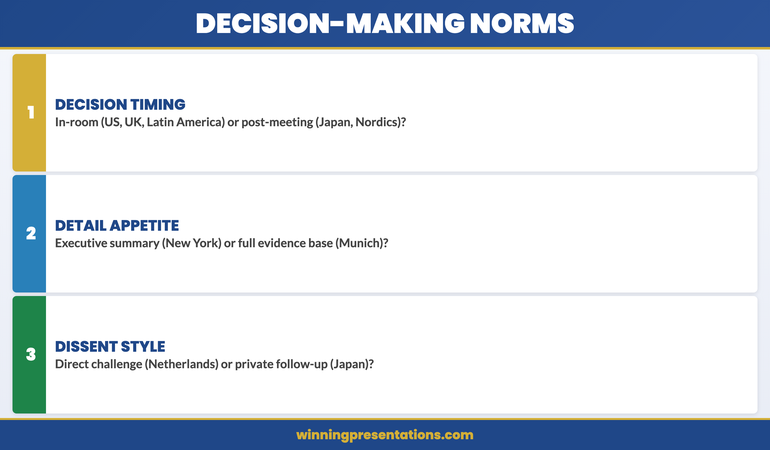
The Three Decision-Making Norms That Change Everything

Rather than memorising cultural generalisations by country, focus on three structural variables that drive how your audience will respond to your presentation. Assess these before you build your deck.

1. Decision timing: in-room or post-meeting?

Some audiences expect to make decisions during the presentation. The US, UK, and much of Latin America fall into this category — if the case is strong, the decision should happen now. Other audiences — Japan, South Korea, and many Nordic organisations — prefer to deliberate after the presentation. The decision happens in a conversation you are not part of. If you structure your presentation to force an in-room decision with an audience that prefers post-meeting deliberation, you will get silence, not agreement. Build in a clear “next steps” slide that acknowledges the deliberation process without pushing for immediate commitment.

2. Detail appetite: executive summary or full evidence?

A board in New York may want three slides and a recommendation. A board in Munich may want thirty slides and a detailed appendix. Neither is wrong. The signal you need to read is how much analytical depth the audience requires before they feel comfortable making a decision. When in doubt, build a short core presentation with a comprehensive appendix. This lets you flex: present the summary to an action-oriented audience and pull up appendix slides for a detail-oriented one. The executive presentation structure that works globally is one designed to be modular, not fixed.

3. Dissent style: direct challenge or private question?

How an audience signals disagreement varies dramatically across cultures. In the Netherlands and Israel, disagreement is voiced openly and directly — it is not personal, it is the process. In Japan and many Southeast Asian cultures, disagreement is expressed indirectly: through questions, through silence, or through a follow-up conversation after the meeting. In parts of the Middle East, disagreement may come through a senior figure who speaks last, after everyone else has indicated support. If you misread the dissent style, you may think you have agreement when you actually have unresolved concerns — or you may interpret a direct challenge as hostility when it is simply how the conversation works.

Three decision-making norms for cross-cultural presentations: decision timing, detail appetite, and dissent style — with examples of how different cultures approach each

One Deck, Any Audience — Built for Global Presenters

Presenting across cultures means building modular, adaptable decks — not starting from scratch for every region. The Executive Slide System — £39, instant access — gives you the templates designed for exactly this flexibility:

  • Modular slide templates that flex from executive summary to full evidence
  • AI prompt cards to adapt your messaging for different audience contexts
  • Framework guides for structuring presentations around decision-making norms
  • Executive summary formats that work for action-oriented and deliberation cultures

Get the Executive Slide System →

Designed for executives presenting strategic recommendations to global stakeholders.

Structural Adaptations for Different Audience Cultures

Once you understand which decision-making norms apply to your audience, the structural changes are straightforward. Here are the four most common adaptations.

Lead with context or lead with conclusion

For audiences that prefer deliberation (East Asia, Nordics, many Middle Eastern settings), start with the background, the analysis, and the options — then present your recommendation at the end. This respects the audience’s expectation that they should form their own view before hearing yours. For audiences that prefer action (US, UK, Latin America), invert the structure entirely: recommendation first, then the supporting evidence. These audiences find a context-first structure frustrating because they cannot evaluate the evidence without knowing what it is evidence for.

Adjust the level of explicit direction

Some cultures expect the presenter to tell the room what to do. “I recommend we proceed with Option B and sign off this week” is appropriate for a US or UK board. For a Japanese board, the equivalent might be: “Based on the analysis, Option B appears to address the criteria we discussed. We would welcome your guidance on the appropriate next steps.” The content is the same. The framing shifts from directive to facilitative. Getting this wrong does not just feel odd — it can actively undermine your credibility with the audience.

Build in deliberation space

For audiences that decide after the meeting, your presentation needs to work without you in the room. This means: clear written labels on every slide, no reliance on verbal commentary that won’t be available later, a summary slide that restates the recommendation and the key evidence, and printed or emailed materials that the group can review independently. Think of it as building a presentation that is also a document. For these audiences, the quality of your leave-behind material matters as much as the quality of your delivery.

Manage Q&A expectations explicitly

In some cultures, questions during the presentation are expected and welcomed. In others, questions are saved for the end — or asked through intermediaries after the meeting. If you are presenting to a mixed audience, make the Q&A format explicit at the start: “I’ll pause after each section for questions, or you’re welcome to raise them at the end — whichever is most useful for you.” This removes ambiguity and lets different cultural preferences coexist without awkwardness. The techniques for managing hybrid meeting facilitation apply here too — mixed formats require explicit ground rules.

If you need adaptable templates that flex across these structures, the Executive Slide System includes modular frameworks designed for executives presenting to diverse stakeholder groups across regions.

Presenting to a Mixed-Culture Audience

The most challenging cross-cultural presentation is not one delivered to a single unfamiliar culture. It is one delivered to a room containing multiple cultures simultaneously — a global steering committee, a cross-regional board, or a multinational client team.

In these settings, you cannot optimise for one culture without potentially alienating another. A direct, conclusion-first approach may engage the London and New York attendees while causing the Tokyo attendees to disengage. A context-first approach may lose the Americans before you reach the recommendation.

The practical solution is a layered structure that accommodates both preferences:

Layer 1: Executive summary on slide one

Open with a single slide that states the recommendation, the key evidence, and the ask. This satisfies the action-oriented attendees immediately. It also gives the deliberation-oriented attendees a frame for what follows — they now know where the presentation is going, which makes the supporting analysis easier to process.

Layer 2: Full supporting analysis

Walk through the evidence, the alternatives considered, and the risk assessment. This satisfies the detail-oriented attendees and gives the deliberation-oriented attendees the information they need to form their own view. For the action-oriented attendees who are already persuaded, these slides serve as validation rather than persuasion.

Layer 3: Clear next steps with flexible commitment

End with next steps that offer both immediate action and a deliberation path. “If the group is comfortable proceeding today, the next step is X. If you would prefer to review the materials and reconvene next week, I can have the supporting documentation to you by end of day.” This respects both norms without making either group feel pressured or sidelined.

Maintaining energy in virtual presentations is particularly important in cross-cultural settings, where audience engagement cues may be less visible — especially when cultural norms suppress visible reactions.

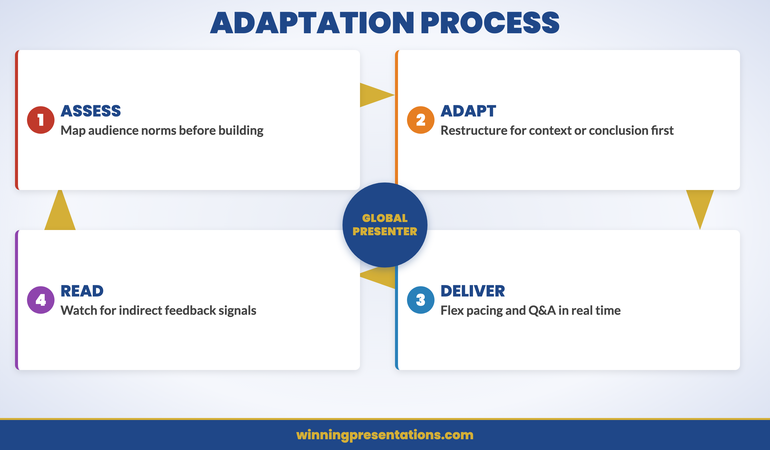
Cross-cultural presentation adaptation cycle: Assess Audience Norms, Adapt Structure, Deliver Flexibly, Read Feedback — continuous adaptation process for global presenters

Handling Q&A Across Cultural Expectations

Q&A dynamics change significantly across cultures, and misreading them can undo the work your presentation did.

When no one asks questions

In some cultures, an absence of questions does not mean agreement — it means the audience is processing, or that questions will come through private channels later. If you are presenting to a group that does not ask questions during the meeting, do not interpret the silence as assent. Instead, close with: “I expect there will be questions as you review the materials. I will follow up with each of you individually to address anything that needs further discussion.” This gives the audience a culturally appropriate channel for their concerns.

When questions come as challenges

In cultures with direct dissent norms (Netherlands, Israel, parts of Scandinavia), questions may feel like attacks — “Why didn’t you consider Option C?” or “These numbers don’t hold up under X scenario.” This is not aggression. It is rigorous evaluation, and it is a signal of engagement, not rejection. Respond with the same directness: acknowledge the point, address it with evidence, and move on. Becoming defensive in these settings signals that you haven’t thought through your position.

When questions are asked indirectly

In some East Asian and Middle Eastern settings, a question like “Have you also considered the implications for the regional team?” may actually mean “I disagree with the recommendation as it applies to our region.” Listen for the implicit concern behind the explicit question. Responding to the literal question without addressing the underlying concern will leave the issue unresolved — and it may surface as a block to the decision later.

See also how today’s related articles tackle adjacent challenges: structuring a budget overrun presentation for executive committees, understanding the career cost of avoiding presentations, and building structured boardroom presentation skills.

Build Decks That Work in Any Room

The Executive Slide System — £39, instant access — includes modular templates and AI prompt cards that adapt to different audience expectations. Stop rebuilding your deck for every region.

Get the Executive Slide System →

Designed for executives presenting strategic recommendations to global stakeholders.

Frequently Asked Questions

How do you adapt a presentation for an audience you haven’t met before?

Research the decision-making norms rather than the cultural stereotypes. Ask three questions: Does this audience typically decide in the room or after? Do they prefer high-level summaries or detailed evidence? Is dissent expressed openly or privately? You can often get answers from a local colleague or the person who arranged the meeting. Build a modular deck that lets you flex between a short executive summary and a full evidence walkthrough, and read the room’s energy in the first five minutes to adjust in real time.

What is the biggest mistake in cross-cultural presentations?

Assuming that silence means agreement. In many cultures, silence during a presentation is a sign of respect, processing, or deference to seniority — not consensus. The second biggest mistake is interpreting direct questions as hostility. In cultures with strong direct-dissent norms, challenging your analysis is a compliment — it means the audience is taking your proposal seriously enough to stress-test it.

Should you change your slide content for different cultures?

Rarely. The substance — the data, the analysis, the recommendation — should remain consistent. What changes is the structure and the framing. The order in which you present information, the level of explicit direction you give, the way you handle Q&A, and the amount of supporting detail you include in the main body versus the appendix. Think of cross-cultural adaptation as adjusting the delivery envelope, not rewriting the letter inside it.

The Winning Edge — Weekly Presentation Intelligence

Every Thursday, I share one framework, one real-world example, and one practical technique drawn from 24 years of presenting in boardrooms across three continents. Join The Winning Edge newsletter →

Not ready for the full system? Start here instead: download the free Executive Presentation Checklist — a one-page reference covering the structure, opening, and key elements every executive presentation needs before it goes to an international audience.

About the Author

Mary Beth Hazeldine is the Owner & Managing Director of Winning Presentations. With 24 years of corporate banking experience at JPMorgan Chase, PwC, Royal Bank of Scotland, and Commerzbank, she advises executives across financial services, healthcare, technology, and government on structuring presentations for high-stakes funding rounds and approvals.

Book a discovery call | View services

23 Apr 2026
Senior executive presenting pilot results to a steering committee in a polished boardroom, confident and authoritative, editorial photography style

Pilot to Contract Presentation: How to Convert a Successful POC Into a Full Programme

Quick Answer

A pilot to contract presentation succeeds when it reframes your results as proof of commercial value — not just technical success. Structure it around three questions every decision-maker is silently asking: Did it do what we needed? Can it scale? What does the business case look like at full deployment? Answer those three questions clearly, and the path from POC to signed contract becomes considerably shorter.

Priya had spent four months running a technology pilot that had exceeded every success metric.

Adoption rates were up 34 percentage points above the baseline. User satisfaction scores were the highest her company had seen in three years. The internal team who’d trialled the system had stopped using the old process entirely — not because they were required to, but because the new approach was simply better.

And yet, when she stood in front of the steering committee to present the results and seek approval to roll out across all twelve business units, the room went quiet in the wrong way. The CFO leaned back. The Chief Operations Officer asked whether this had been tested at sufficient scale. The head of IT raised procurement complexity. After forty-five minutes, the committee agreed to “think about it” and reconvene in six weeks.

Priya’s pilot hadn’t failed. Her presentation had. She had built a case for the pilot’s success but had forgotten to build the case for the contract. Those are two entirely different presentations.

Presenting pilot results to a sceptical committee this month?

The Executive Slide System gives you the templates and frameworks to structure your business case — so decision-makers can see exactly what a full deployment looks like and why it makes commercial sense.

Explore the Executive Slide System →

Why Successful Pilots Still Stall at Contract

The assumption behind most pilot presentations is that strong results speak for themselves. If the numbers are good, the contract should follow naturally. In practice, the opposite is frequently true: the better a pilot performs, the more complex the commercial conversation becomes.

There are three reasons a successful pilot stalls at the contract stage. First, the decision-making group often changes. The person who approved the pilot was typically a programme sponsor or operational lead. The full contract requires sign-off from finance, procurement, legal, and often the board — people who were not in the room during the pilot and have no emotional investment in its success.

Second, a pilot is a controlled environment. Stakeholders who weren’t involved know this, and they’re right to ask what happens when the constraints are removed: more users, more data, more edge cases, more integration complexity. Your pilot deck almost certainly doesn’t address this.

Third — and this is the one most presenters miss — decision-makers who weren’t involved in the pilot don’t just need to understand the results. They need to understand what they’re agreeing to. Scale, cost, implementation timeline, internal resource requirements, and ongoing support are all live questions. Your presentation needs to answer them before they’re asked.

The pilot programme results presentation is a technical document. The pilot to contract presentation is a commercial document. Most teams only build the first one.

The Three Questions Every Decision-Maker Is Asking

Before you design a single slide, write down the three questions that are running through every stakeholder’s mind in that room. Every element of your presentation should exist to answer one of these questions directly.

Question 1: Did it do what we actually needed?

This sounds obvious, but many pilot presentations report what happened rather than what was needed. If the business case for the pilot was “improve time-to-value for new client onboarding,” your results slide needs to show time-to-value data — not a selection of positive metrics that weren’t part of the original brief. Decision-makers who weren’t part of the pilot will look for the specific success criteria that were agreed upfront. If your results section doesn’t map directly to those criteria, you’ll face the question: “But does this actually solve the original problem?”

Question 2: Can it scale — and what does that involve?

The single biggest gap in pilot to contract presentations is the absence of a credible scale plan. Stakeholders who didn’t run the pilot need to see that you have thought through what deployment at full scale actually means: volume of users, integration points, implementation phases, internal change management requirements, and the realistic timeline for each. Without this, a successful pilot becomes a liability — it shows the thing works in a lab but doesn’t explain how it works in production.

Question 3: What is the business case at full deployment?

The ROI or business value calculation needs to be recalculated at scale, not extrapolated from the pilot. If the pilot involved fifty users and showed a specific efficiency gain, that gain at five hundred users is not simply ten times larger — there will be integration costs, change management overhead, and a transition period before the full value is realised. Decision-makers need to see a business case that accounts for full deployment costs, implementation timeline, and the point at which the investment becomes accretive. An honest, conservative model is significantly more persuasive than an optimistic extrapolation.

The Deck That Gets Your Pilot Approved at Scale

Structuring a pilot to contract presentation is one of the hardest things to get right — because it requires you to write for an audience who wasn’t in the room. The Executive Slide System — £39, instant access — gives you the templates and frameworks designed for exactly this scenario:

  • Slide templates for programme approval and rollout business cases
  • AI prompt cards to build your scale analysis and ROI model slide by slide
  • Stakeholder-readiness frameworks for presenting to new decision-makers
  • Executive summary templates that answer the three critical questions upfront

Get the Executive Slide System →

Designed for executives presenting commercial decisions to approval committees.

The Slide Structure That Converts POC Results

A pilot to contract presentation follows a different logic from a standard project update or results deck. Rather than moving chronologically through what happened, it moves commercially — from where we are now to what we’re recommending and why that recommendation makes financial and operational sense.

Here is a proven structure for this type of deck:

Slide 1 — Executive summary

This is your entire case on one slide: the original problem, the pilot result against each agreed success criterion, your recommendation (full deployment or a defined next phase), and the headline business case. Decision-makers who are pressed for time should be able to form a view from this slide alone. Everything that follows is supporting evidence.

Slides 2–3 — Results against original success criteria

Map every stated success criterion from the pilot approval to a specific result. Show the baseline, the target, and the actual outcome. If you exceeded some criteria and fell short on others, say so clearly. A presentation that only shows the wins loses credibility; a presentation that names the limitations and explains them builds it.

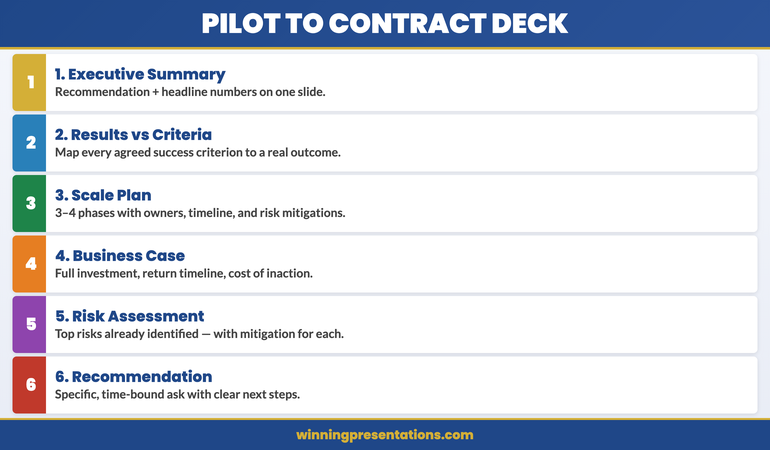
The Pilot to Contract Presentation framework showing 6 slides: Executive Summary, Results Against Criteria, Risk Assessment, Scale Plan, Business Case, and Recommendation

Slides 4–5 — Scale plan and implementation roadmap

Break deployment into three to four phases. Show what is required internally at each phase: resource, budget, timeline, and who owns what. Include the risks at each phase and how they will be mitigated. Decision-makers who were not involved in the pilot are particularly concerned about the transition — they have seen technology deployments fail at scale before. Your job is to show them you have thought through the entire journey, not just the destination.

Slides 6–7 — Business case at full scale

Build the investment case using the data you have, not the projections you’d like. Show the total cost of full deployment (including internal resource, change management, and integration), the expected return timeline, and the cost of inaction or delay. A well-constructed business case slide answers the question: “What happens if we don’t do this?” as clearly as “What happens if we do.”

Slide 8 — Risk assessment

This is a slide most presenters leave out, and its absence is noticed. Show the top four to six risks for full deployment and your mitigation approach for each. This is not an invitation for the committee to find problems — it’s a signal that you’ve already found them and planned for them. Committees approve proposals from people who demonstrate they understand the risks, not people who pretend the risks don’t exist.

Slide 9 — Recommendation and next steps

End with a specific, time-bound recommendation: what you are asking them to approve, by when, and what happens next if they do. Ambiguous endings are the enemy of contract approvals. “We recommend proceeding to full deployment by Q3, with phase one sign-off required by 30 April to maintain the implementation timeline” gives the committee something to say yes to.

The approach mirrors what the best stakeholder buy-in frameworks recommend: answer the questions in the room before they’re asked, then make the decision easy to say yes to.

If you need templates for any of these slide types, the Executive Slide System includes ready-to-use frameworks for programme approval decks, business case slides, and rollout roadmaps.

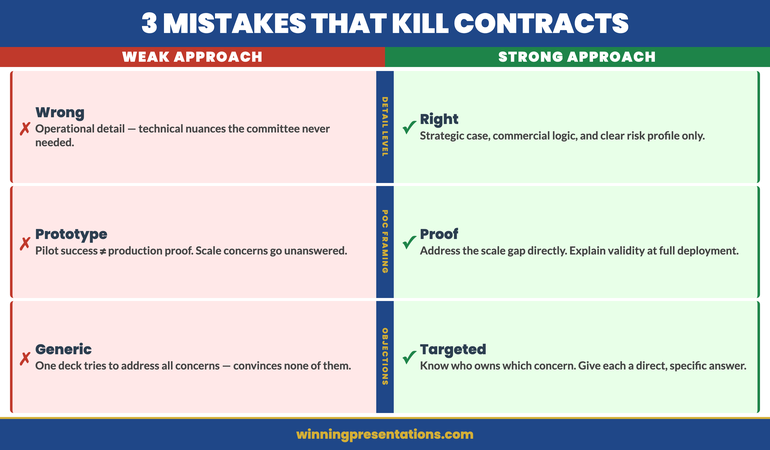
The Three Mistakes That Kill the Contract at the Finish Line

After reviewing dozens of pilot presentations, the patterns that cause contract stalls are remarkably consistent. Here are the three that come up most often.

Mistake 1: Presenting to the wrong level of detail

Pilot teams are close to the work. They know the nuance, the edge cases, the workarounds, and the technical challenges they overcame. The approval committee needs none of this. They need the strategic case, the commercial logic, and the risk profile. A presentation filled with operational detail signals to senior decision-makers that the presenter doesn’t understand the difference between informing and persuading. Strip it back. If the detail is needed, put it in the appendix and reference it only if asked.

Mistake 2: Treating the pilot as a proof of concept when the committee sees it as a prototype

In technical teams, “proof of concept” means the thing works. In commercial decision-making, it means “we tried something on a small scale to learn whether it was worth investing in at full scale.” Those are different definitions. When you present the results, explicitly address the prototype concern: yes, this was tested at limited scale; here is why the results are directionally valid at full deployment; here are the known differences and how we will manage them.

Mistake 3: Not knowing who owns the objection

The CFO’s concern about the business case is different from the COO’s concern about implementation complexity, which is different from the IT director’s concern about integration. A single presentation that tries to address all concerns simultaneously often addresses none of them convincingly. Where possible, identify who in the room holds which concern before you present, and ensure you have a specific, direct answer for each. The proof of concept presentation strategy that works is one tailored to the audience in the room, not the audience you imagined when you built the slides.

Three common pilot to contract presentation mistakes: wrong detail level, prototype perception gap, and unaddressed stakeholder objections — comparison of weak vs strong approaches

Handling Q&A When Stakeholders Push Back on Scale

Even a well-structured pilot to contract presentation will draw questions at the scale stage. Here is how to handle the most common challenges.

“Has this been tested at the scale you’re proposing?”

Don’t attempt to argue that the pilot is equivalent to full scale — it isn’t, and the committee knows it. Instead, acknowledge the scale difference directly and explain the basis for your confidence: benchmarking against similar implementations, vendor track record at scale, technical architecture analysis, or a phased deployment plan that limits exposure at each stage. The honest answer is almost always more persuasive than the defensive one.

“What happens if the integration is more complex than expected?”

Show your risk slide. If you don’t have a risk slide, promise one for the next conversation. More importantly, name the specific integration risks you have already identified, explain the mitigation approach for each, and be clear about what would trigger a pause or reassessment. Decision-makers are not asking because they want to stop the project — they are asking because they want to know you have a plan if something goes wrong.

“Can we see a cheaper or faster alternative?”

This question often signals that the business case hasn’t landed rather than genuine interest in alternatives. Before your next slide, restate the cost of inaction: what does the current process cost per year, what is the competitive risk of not deploying, and how does that compare to the investment you are proposing? If there are genuine alternatives worth considering, include them in an alternatives slide and explain why you have recommended this approach over the others.

See also how today’s related articles tackle adjacent challenges: structuring a technology roadmap presentation for the board, eliminating the habits that undermine your delivery credibility, and building a structured system to improve presentation skills at work.

Stop Losing Contracts After a Successful Pilot

The Executive Slide System — £39, instant access — includes the business case and programme approval templates that turn a successful pilot into a signed contract. Stop rebuilding these slides from scratch every time.

Get the Executive Slide System →

Designed for executives presenting commercial decisions to approval committees.

Frequently Asked Questions

How long should a pilot to contract presentation be?

For a steering committee or board approval, twelve to fifteen slides is the right target. The executive summary, results against criteria, scale plan, business case, risk assessment, and recommendation account for eight to ten core slides, with a further two to four for supporting analysis or appendix material. Anything longer and you risk losing the narrative; anything shorter and you risk leaving material questions unanswered. The goal is a deck that can be presented in twenty to thirty minutes with time left for Q&A.

What is the difference between a pilot results presentation and a pilot to contract presentation?

A pilot results presentation documents what happened and whether the pilot met its objectives. A pilot to contract presentation uses those results as evidence for a commercial recommendation. The results deck looks backwards; the contract deck looks forwards. Many teams make the mistake of delivering the same deck for both purposes, which leaves decision-makers without the information they need to approve the next stage.

How do you present a pilot that only partially met its objectives?

Directly and confidently. Identify the criteria that were met and those that weren’t. For the gaps, explain what caused them, whether they were within or outside the scope of the pilot, and how the full deployment plan addresses them. A partial success presented honestly is more persuasive than a selective success that leaves the committee wondering what you’re not telling them. Decision-makers have seen optimistic pilots before — the ones that build trust are the ones that acknowledge reality.

The Winning Edge — Weekly Presentation Intelligence

Every Thursday, I share one framework, one real-world example, and one practical technique drawn from 24 years of presenting in boardrooms across three continents. Join The Winning Edge newsletter →

Not ready for the full system? Start here instead: download the free Executive Presentation Checklist — a one-page reference covering the structure, opening, and slides every senior presentation needs before it goes to a committee.

About the Author

Mary Beth Hazeldine is the Owner & Managing Director of Winning Presentations. With 24 years of corporate banking experience at JPMorgan Chase, PwC, Royal Bank of Scotland, and Commerzbank, she advises executives across financial services, healthcare, technology, and government on structuring presentations for high-stakes funding rounds and approvals.

Book a discovery call | View services

23 Apr 2026
Male technology leader presenting a digital roadmap to a board in a modern boardroom, projected slides visible, editorial photography style

Technology Roadmap Presentation: How to Get Board and Executive Buy-In

Quick Answer

A technology roadmap presentation succeeds at board level when it frames technology decisions as business decisions. Executives don’t approve IT roadmaps — they approve investments in business capability, risk reduction, and competitive advantage. Structure your deck around those three levers, not around technical architecture, and the conversation shifts from “do we understand this?” to “when do we start?”

Henrik had prepared for six weeks.

The technology roadmap he was presenting covered the next three years of the company’s IT infrastructure: legacy system migration, cloud consolidation, cybersecurity uplift, and three new customer-facing platforms. He had worked with his team to cost every workstream, build the implementation timeline, and map out the interdependencies between each phase.

The board gave him twelve minutes before the chair interrupted. “Henrik, I appreciate the detail. But what I really need to understand is — if we approve this, what does the business look like in three years that it doesn’t look like today?”

Henrik hadn’t built that slide. He had built a technology roadmap. The board was asking for a business transformation story. Those are not the same presentation, even when they cover the same material.

That question — “what does the business look like in three years?” — is the question your technology roadmap presentation must answer before the chair has to ask it.

Taking a technology investment to the board this quarter?

The Executive Slide System gives you the templates to present technical decisions in the language executives actually use to approve investments — business capability, risk, and competitive positioning.

Explore the Executive Slide System →

Why Technology Roadmaps Fail at Board Level

The most common reason a technology roadmap presentation fails with a board or executive committee is not the technology. It’s the framing. Technical leaders build roadmaps from the inside out — starting with what the current architecture looks like, what needs to change, and how those changes will be implemented. Boards think from the outside in — starting with where the business needs to go and working backwards to what capabilities are required to get there.

When a technology roadmap is presented in technical sequence, it requires the board to do the translation work: to take what they’re being shown about infrastructure and API consolidation and reverse-engineer the business implication. Most boards won’t do that work. They’ll ask for a summary, defer the decision, or approve a smaller scope than you needed — because the full case didn’t land.

The fix is not to simplify the roadmap. It’s to reframe how the roadmap is presented. The technical detail should be available — in an appendix, in supporting slides, in a pre-read. But the main deck should tell the business story, with technology appearing as the mechanism that enables it rather than the subject of the presentation.

The approach that consistently works with boards is the same one that underpins effective digital transformation board presentations: lead with the outcome, justify with the evidence, close with the decision.

Translating Technical Decisions Into Business Language

Every major item on a technology roadmap maps to one of three business concerns: capability (what we can do), risk (what could hurt us), or efficiency (how much it costs to operate). Your job before you build a single slide is to make this mapping explicit — for yourself first, and then for your audience.

Capability language describes what the business will be able to do after the investment that it cannot do today. “We will be able to launch new products in six weeks instead of six months.” “Our sales team will have real-time visibility of customer activity across all channels.” “We will be able to process transactions in markets we are currently locked out of.” This is the language that makes boards lean forward.

Risk language describes what the business is exposed to if it does not invest. “Our current system has not received security patches since 2019 — every day it runs is a regulatory risk.” “We are operating on hardware for which spare parts are no longer available.” “Three of the five engineers who understand this architecture are planning to retire in the next two years.” Boards have strong risk appetite awareness. A well-framed risk case often moves faster than a capability case.

Efficiency language describes the cost of the current state versus the cost of the future state. “Our current architecture requires 14 separate integrations to do what a modern platform does natively.” “We are paying for five different systems that do essentially the same thing.” “Each new feature requires four weeks of development time because of the current technical debt.” This is the most straightforward translation — it’s a cost reduction story with a capital investment requirement.

Once you have mapped your roadmap to these three languages, building the board-facing deck becomes considerably more straightforward. Every technical decision has a business translation, and every business translation belongs in the main deck.

The Deck That Gets Technology Investment Approved

Translating a technical roadmap into a business case is one of the hardest things IT and technology leaders have to do. The Executive Slide System — £39, instant access — is built for exactly this challenge:

  • Slide templates for technology investment and digital transformation cases
  • Business case frameworks that translate technical decisions into board language
  • AI prompt cards to build ROI models and risk assessments slide by slide
  • Executive summary templates that lead with outcome, not architecture

Get the Executive Slide System →

Designed for executives presenting investment decisions to boards and senior committees.

The Slide Structure That Earns Executive Approval

The most effective technology roadmap presentations for boards follow a structure that starts with the strategic context, moves to the business case, and arrives at the technical plan — rather than the other way around.

Technology roadmap presentation structure showing 5 steps: Strategic Context, Business Case, Roadmap Overview, Investment Requirements, and Governance

Slide 1 — Strategic context

Where is the business now, and where does it need to be? This slide establishes the business direction that the technology roadmap is responding to. It should reference the organisation’s strategic priorities — not the IT strategy — and show the gap between current technical capability and what will be needed. Boards approve technology investments they can see are connected to business direction. They stall on investments that appear to be driven by internal IT preference.

Slides 2–3 — The business case

This is the capability, risk, and efficiency case translated into financial and operational terms. What is the cost of the current state? What does the improved future state deliver? What is the investment required, and over what timeline does the return accrue? Include a single summary table that shows the key numbers — total investment, operating cost change, expected capability outcomes, and risk reduction. Boards make investment decisions from this table. Everything else in the deck supports it.

Slide 4 — Roadmap overview

Show the three-year roadmap as a visual — phased by year, with each phase labelled by the business outcome it enables rather than the technical workstream it contains. “Year 1: Remove critical security risk and consolidate platforms” is more useful for a board than “Year 1: Network segmentation, patch management uplift, and SaaS consolidation.” The technical detail sits in supporting slides. The overview slide is for decision-making, not education.

Slide 5 — Investment requirements by phase

Break the total investment by year and by category: capital, operating, internal resource, and external partners. Show the dependencies — which phases are required before others can proceed, and what happens to the timeline and cost if phases are deferred or descoped. This slide is where boards often want to negotiate; having the dependency logic visible makes those conversations considerably more productive.

Slide 6 — Governance and oversight

How will the programme be governed? Who is accountable for each phase? What are the decision points at which the board will be asked to review progress? Boards are more willing to approve large investments when they can see they will have meaningful oversight of how the investment is being spent. A clear governance model signals maturity and professionalism; its absence raises the question of whether the technology leader has done this before.

Slide 7 — Recommendation and immediate next steps

As with any executive decision deck, end with the specific ask. “We are requesting approval of phase one investment of £X, with a programme review at the six-month stage before phase two funding is released.” This gives the board a bounded decision — they are not being asked to commit to the full three-year investment upfront, they are being asked to approve the first phase with defined review points.

The board presentation best practices that apply to technology roadmaps are the same as for any major investment: answer the strategic question first, justify the numbers clearly, and give the board a decision they can make in the room.

The Executive Slide System includes the investment case and roadmap slide templates that make this structure straightforward to build, even when you’re working with complex multi-year programmes.

How to Present Prioritisation Decisions Without Losing Credibility

One of the most delicate elements of any technology roadmap presentation is explaining why certain investments have been prioritised and others deferred. Boards understand that not everything can happen at once. What they are less tolerant of is a prioritisation rationale that appears arbitrary, politically driven, or disconnected from business need.

The strongest approach is to make your prioritisation criteria explicit before you show the roadmap. State the two or three criteria by which investments have been ranked: typically some combination of business impact, risk reduction, technical dependency (some things must happen before others), and investment required. Show the board your prioritisation matrix — which investments score highest across all criteria, which were deferred because they scored lower or are dependent on earlier phases, and which were excluded entirely and why.

This approach does two things. First, it demonstrates that the roadmap is the output of a disciplined process, not a wish list. Second, it gives board members a framework for asking questions: “Why does this score lower than that on business impact?” is a much more productive conversation than “Why isn’t X on the roadmap?”

Where items have been deferred due to budget rather than priority, say so directly. “We have included this in a future phase not because it’s lower priority but because the investment profile of phase one is at the limit of what we believe the organisation can absorb in a single year.” This is the kind of transparency that builds credibility with boards rather than eroding it.

Technology roadmap prioritisation framework showing four criteria: Business Impact, Risk Reduction, Technical Dependency, and Investment Required with scoring examples

Handling the Questions Boards Always Ask

Technology roadmap presentations generate a predictable set of board questions. Preparing for these in advance significantly reduces the risk of the presentation stalling.

“What happens if we only fund phase one?”

Have a clear answer for the partial investment scenario. What does phase one deliver in isolation? Is it useful on its own or is it a prerequisite for the phases that follow? If phase one is only valuable as the foundation for subsequent investment, say that directly — and explain what the cost is of then having to decommission or restart if the subsequent phases are not approved. This prevents boards from approving a small piece and then finding the full investment is required anyway.

“Have you considered buying rather than building?”

This is almost always worth including proactively in the deck. Show the build versus buy analysis — what you considered, why you selected the approach you’re recommending, and what the cost, capability, and risk trade-offs are. Boards that raise this question themselves feel it hasn’t been considered. Boards that see you’ve already addressed it feel confident the recommendation is robust.

“How do we know the costs won’t escalate?”

Reference your contingency provision and your governance model. Technology programmes routinely cost more than estimated — boards know this. What they want to see is that you have built this reality into your investment case rather than assumed everything will go to plan. A programme with a fifteen to twenty per cent contingency provision and a defined process for managing scope changes is more credible than one that presents a single-point estimate.

See also today’s related articles on converting a successful pilot into a contract, eliminating the delivery habits that undermine your credibility, and building lasting presentation capability at work.

Stop Watching Technology Budgets Stall in “Further Review”

The Executive Slide System — £39, instant access — gives you the business case templates and investment frameworks that translate technical decisions into the language boards use to approve spending. Build your next technology roadmap presentation in a fraction of the time.

Get the Executive Slide System →

Designed for executives presenting investment decisions to boards and senior committees.

Frequently Asked Questions

How do you present a multi-year technology roadmap without overwhelming the board?

Focus the main deck on the first phase and the high-level arc of the full programme. Show what the board is being asked to approve now, what they will see at each review point, and what the three-year destination looks like. The detail behind each subsequent phase belongs in supporting slides or a pre-read document. Boards that feel overwhelmed by detail defer decisions; boards that see a clear first phase with defined review points are considerably more likely to approve.

What is the right level of technical detail for a board technology presentation?

Almost none in the main deck. Board members are not evaluating your technical choices — they are evaluating the business logic of the investment. Technical architecture diagrams, system integration maps, and development methodology detail belong in appendix slides that you reference if specific questions arise. The main deck should be comprehensible to a non-technical director who is asking: “Does this make business sense?”

How do you handle a board member who is a technology expert and wants more detail?

Acknowledge their expertise and offer a deeper technical conversation outside the board session. In the main presentation, keep the business framing intact — changing pace and detail level for one board member risks losing the rest. Offer to send supporting technical documentation in advance of the next meeting, or propose a separate technical deep-dive with the interested director. This respects their interest while maintaining a presentation that works for the full board.

The Winning Edge — Weekly Presentation Intelligence

Every Thursday, frameworks and techniques from 24 years of presenting in boardrooms. Join The Winning Edge →

Not ready for the full system? Download the free Executive Presentation Checklist — a one-page reference for the structure and slides every board presentation needs.

About the Author

Mary Beth Hazeldine is the Owner & Managing Director of Winning Presentations. With 24 years of corporate banking experience at JPMorgan Chase, PwC, Royal Bank of Scotland, and Commerzbank, she advises executives across financial services, healthcare, technology, and government on structuring presentations for high-stakes funding rounds and approvals.

Book a discovery call | View services

23 Apr 2026
Professional preparing a polished board presentation on a laptop in a modern office, focused and confident, editorial photography style

How to Improve Presentation Skills for Work: The Structured Approach That Actually Works

Quick Answer

To improve presentation skills for work you need three things working in parallel: a reliable structure so you stop rebuilding every deck from scratch, a system for managing delivery under pressure, and deliberate practice in conditions that match the real stakes of the presentations you need to give. Courses that only address one of these three typically produce temporary improvement. This guide covers all three.

Kwame had been told to “work on his presentation skills” three times in four years.

Once by a line manager after a client pitch that didn’t land. Once in a 360-degree feedback report after a town hall that received mixed responses. And once — most directly — by the head of his division, who told him in a performance review that he was “technically exceptional but needed to develop his executive presence in front of senior stakeholders.”

Each time, Kwame tried to act on the feedback. He watched YouTube videos. He read books. He took a one-day communication course his company funded. He rehearsed more. None of it moved the dial in the ways that mattered. He still rebuilt every presentation from scratch. He still felt exposed in Q&A. His delivery still tightened when the room was senior enough to matter.

The problem wasn’t effort. It was that the advice he was following addressed surface symptoms — delivery tips, confidence mantras, filler-word elimination — without addressing the underlying structural deficits that were producing them. When your presentations don’t have a reliable skeleton, you will always be improvising. And improvisation under pressure produces exactly the symptoms he was trying to fix.

Told to improve your presentation skills but not sure where to start?

The Executive Slide System gives you the structural foundation that removes the rebuilding problem — so you walk into every presentation with a proven framework rather than starting from a blank slide.

Explore the Executive Slide System →

Why Most Presentation Tips Don’t Stick

The internet contains thousands of presentation tips. Most of them are accurate. Almost none of them produce lasting change when applied in isolation, because they address individual behaviours without building the system those behaviours need to operate within.

“Make eye contact” is a useful tip. But if you’re using working memory to track your place in a poorly structured deck, your attention is on the slides — not your audience. The eye contact tip won’t help until the structural problem is resolved.

“Speak more slowly” is a useful tip. But if you’re anxious because you don’t know how to handle the Q&A that’s coming, you’ll speed up again as soon as a challenging question arrives. The delivery tip won’t help until the Q&A preparation problem is resolved.

“Use pauses instead of filler words” is a useful tip. But if your nervous system hasn’t been recalibrated to tolerate the silence, the pause will feel unbearable and you’ll default to “um” within seconds. The filler word tip won’t help until the nervous system regulation problem is resolved.

This is why presentation improvement initiatives that focus on tips — however accurate — tend to produce temporary results. You leave the workshop feeling equipped. You apply the tips in the next few presentations. Then the high-stakes presentation arrives, and you revert to baseline. Because tips are not a system. Presentation skills training that actually sticks has to address the underlying components, not just the surface behaviours.

The Three Components of Lasting Improvement

To improve presentation skills for work in a way that holds under pressure, you need to work on three components simultaneously. Each one reinforces the others. Fixing only one or two will produce partial improvement at best.

Component 1: Structure — a repeatable framework for building presentations that you don’t have to reinvent for every new context. Most professionals spend the majority of their preparation time trying to figure out what to put on each slide and in what order. A reliable structure eliminates this problem. You know the architecture; the work becomes filling it with the specific content for this presentation.

Component 2: Delivery under pressure — the ability to maintain composure, clarity, and authority when the stakes are high, the room is difficult, or the Q&A goes somewhere unexpected. This is a nervous system and rehearsal challenge, not a knowledge challenge. You can know your material completely and still feel exposed when a senior executive asks a question you hadn’t anticipated.

Component 3: Deliberate practice — a method of building skill that goes beyond simply giving more presentations and hoping improvement happens. Most people’s presentation skills plateau because they keep practising the same behaviours in the same conditions. Deliberate practice targets the specific gaps that matter and creates conditions that are challenging enough to produce genuine improvement.

The Structural Foundation Every Executive Presenter Needs

If you are rebuilding every presentation from scratch, you are solving the wrong problem before every meeting. The Executive Slide System — £39, instant access — gives you the structural framework that removes that problem permanently:

  • 22 PowerPoint templates covering the executive scenarios you actually encounter
  • 51 AI prompt cards to build content into any template fast
  • Scenario playbooks for board presentations, budget cases, client pitches, and more
  • Checklists that catch the structural errors that lose rooms before Q&A begins

Get the Executive Slide System →

Designed for professionals who need to present with confidence at executive and board level.

Structure: The Fastest Lever to Pull

Of the three components, structure produces the fastest visible improvement because it addresses the most common root cause of weak presentations: the absence of a clear decision logic.

Most professionals build presentations by gathering all the relevant information and then arranging it in a logical sequence. The problem with this approach is that “logical sequence” usually means chronological — how the situation developed, how the analysis was done, what was found, and then what is recommended. This is the right order for a research paper. It is the wrong order for an executive presentation.

Executive audiences want to know the recommendation first, the supporting evidence second, and the analysis third — if at all. This is the pyramid principle applied to presentations, and it runs counter to how most professionals were trained to present information at school and university. The result is that competent, well-prepared professionals produce presentations that bury the point, overwhelm the audience with context before the recommendation, and leave senior stakeholders frustrated even when the underlying thinking is excellent.

The executive presentation structure that works consistently follows this pattern: start with the conclusion, support it with three to four reasons or evidence points, and provide the detail as supporting material rather than the main event. This structure is learnable and replicable. Once you have internalised it, every presentation becomes easier to build — because you always know what goes where.

The templates in the Executive Slide System are built around this structure — so you don’t have to reinvent the architecture for each new presentation, you just load your content into a proven framework.

Delivery: What Changes When the Stakes Are Real

Good delivery in a low-stakes environment does not automatically transfer to good delivery in a high-stakes one. This surprises many professionals who feel confident in informal presentations but notice their delivery deteriorating when the room is more senior or the decision more significant.

What changes under pressure is the availability of cognitive resources. When the stakes feel high, part of your working memory is occupied by threat-monitoring — tracking how the room is responding, anticipating questions, managing any anxiety symptoms. This leaves less resource available for fluency, word retrieval, and the deliberate choices that constitute good delivery: eye contact, pacing, pausing.

Improving delivery under pressure therefore requires two parallel approaches. First, reduce the cognitive load of the presentation itself — a reliable structure and well-rehearsed content means less working memory is needed for the material, leaving more available for delivery choices. Second, reduce the baseline activation level of the threat response — through preparation, rehearsal in conditions that mimic the real stakes, and where necessary, nervous system regulation techniques that bring down arousal before you begin.

The specific presentation skills development work that addresses delivery under pressure includes: practising in front of people whose opinion you care about (not just in front of a mirror), recording yourself in full-dress rehearsals and watching it back, and simulating the most challenging Q&A scenarios you are likely to face. Each of these creates the conditions for genuine improvement rather than improvement in controlled practice environments that don’t translate.

Deliberate Practice: How to Improve Without More Presentations

Most professionals improve their presentation skills by giving presentations and hoping the experience produces improvement. This works to a point — you do get more comfortable with the mechanics of presenting — but it stops working once your skills plateau, because you are practising the same strengths in the same conditions.

Deliberate practice is different. It targets the specific gap, creates challenge that is slightly beyond your current capability, and builds in feedback so you can see whether you improved. Here is what deliberate practice looks like for the three most common development areas.

For structure: Take a presentation you have already given and rebuild it using a different structural logic — starting with the conclusion rather than the context, or organising by stakeholder concern rather than analytical sequence. Compare the two versions and assess which one a senior audience would find easier to act on. Repeat with three to five different past presentations until the new structure becomes your default approach.

For delivery under pressure: Ask a trusted colleague or manager to play the role of a challenging committee member during a rehearsal — specifically tasked with asking questions you won’t have prepared for, expressing scepticism, or cutting across your slides mid-sentence. This is uncomfortable. It is also the only way to build the skills you need for those conditions. Rehearsal against a supportive audience does not prepare you for a difficult one.

For verbal habits and fluency: Record two minutes of yourself explaining your current project — without notes — and watch it back with the sound off, then again with sound only. The visual and audio separation often reveals habits that are invisible when you’re watching both together. Identify the single most distracting habit and target it explicitly in the following week’s practice sessions, rather than trying to fix everything at once.

See today’s related articles: the specific verbal habits that damage executive credibility, how to present a pilot as a commercial case, and how to take a technology roadmap to the board.

Stop Rebuilding Presentations From Scratch

The Executive Slide System — £39, instant access — gives you the structural foundation, templates, and AI prompt cards that remove the biggest time drain in presentation preparation. Build better presentations faster, and walk in with a structure you trust.

Get the Executive Slide System →

Designed for professionals who need to present with confidence at executive and board level.

Frequently Asked Questions

What is the fastest way to improve presentation skills for work?

Fix your structure first. Most presentation problems — unclear delivery, loss of confidence in Q&A, audiences that seem disengaged — trace back to a structural problem: the presentation doesn’t make the recommendation early enough, or doesn’t organise information in the way a senior audience expects to receive it. Once the structure is reliable, delivery and confidence tend to follow because you’re spending less cognitive resource on figuring out where you are in the deck and more on connecting with the room.

Is it worth taking a presentation skills course for work?

It depends entirely on what the course addresses. A one-day communication workshop that covers tips and techniques without addressing structure, Q&A handling, or delivery under pressure will produce limited lasting improvement. Look for resources that provide a replicable structural framework — one you can use in your actual work presentations rather than a course-specific exercise — and that address the specific challenges you face: whether that is senior audience management, anxiety, Q&A, or deck construction. The most effective development work is targeted, not generic.

How do I improve presentation skills when I don’t present very often?

Treat every meeting where you speak as a presentation opportunity. The informal explanation you give in a team meeting, the project update you provide on a call, the recommendation you make in a one-to-one — these are all opportunities to practise structuring your thinking, leading with the conclusion, and managing the question that follows. Frequency of formal presentations is less important than the quality of practice. Deliberate work on structure and delivery in everyday professional communication builds the same capabilities you need in formal presentations.

Why do my presentation skills seem to get worse when I’m presenting to senior people?

Because senior audiences activate a stronger threat response, which takes cognitive resource away from fluency and delivery. This is a normal neurological pattern, not a sign of inadequate preparation. The mitigation is twofold: reduce the cognitive load of the presentation itself through structure and rehearsal, and reduce your baseline arousal level before you present through preparation rituals and, where needed, nervous system regulation techniques. Most professionals find that the combination of better structure and targeted rehearsal in high-stakes conditions produces measurable improvement within four to six presentations.

The Winning Edge — Weekly Presentation Intelligence

Every Thursday, one framework or technique for high-stakes presenting at work — drawn from 25 years of boardroom experience and 16 years training executives. Join The Winning Edge →

Not ready for the full system? Start here: download the free Executive Presentation Checklist — a one-page reference covering the structure and slides every work presentation needs before it goes to a senior audience.

About the Author

Mary Beth Hazeldine is the Owner & Managing Director of Winning Presentations. With 25 years of corporate banking experience at JPMorgan Chase, PwC, Royal Bank of Scotland, and Commerzbank, she advises executives across financial services, healthcare, technology, and government on structuring presentations for high-stakes funding rounds and approvals.

Book a discovery call | View services

20 Apr 2026
Male executive reviewing structured executive presentation deck on large monitor, analytical expression, navy and gold corporate environment

PowerPoint Presentation Skills Training

Quick Answer

Most PowerPoint presentation skills training teaches design: cleaner slides, better fonts, smarter animations. For executives presenting to boards and senior committees, the gap is almost never visual. It is structural. A presentation that fails at the decision level fails because the logic is unclear, the ask is buried, or the argument does not sequence the evidence in a way that makes the conclusion feel inevitable. Effective training addresses structure first — design is the final step, not the foundation.

Marcus had been a programme director at a large infrastructure company for six years. He had built hundreds of slides. He was meticulous about formatting — consistent fonts, aligned boxes, colour-coded status indicators. When his company brought in a design consultancy to review internal presentations, his decks were rated the highest for visual quality. They were also rated the lowest for clarity of recommendation. The consultants’ feedback was specific: his slides told the story of what had happened and what was planned, but they never told the committee what it needed to do. The logic was all there — buried in the presenter notes and the narrative he delivered verbally. On the slides themselves, the decision was invisible. He had been spending his time on the wrong problem. The visual quality of his decks was a strength he had over-invested in. The structural clarity of his argument was the gap he had never noticed — because no one had ever told him that structure and design were separate skills.

Building slides for a board update, budget proposal, or executive approval? The Executive Slide System includes scenario-specific slide templates and framework guides for senior-level presentations. Explore the System →

Why Most PowerPoint Training Teaches the Wrong Thing

The PowerPoint training market is dominated by design-focused content. Search for “PowerPoint presentation skills training” and the majority of results will point you towards courses on slide layouts, colour theory, animation effects, and visual hierarchy. This content is useful if the limiting factor in your presentations is visual quality. For most senior professionals, it is not.

Design-focused training persists because it is easier to teach and easier to demonstrate. You can show a before-and-after slide in a course video and make the improvement immediately visible. You cannot do the same with argument structure — the quality of the logic is only apparent in the context of a specific recommendation, a specific audience, and a specific decision. That context requires more sophisticated instruction and more personalised feedback, which is harder to produce at scale.

The consequence is that a large number of senior professionals have received extensive training on how to make slides look better and almost no training on how to make slides argue better. They have learned to format a slide and not learned to structure one. The distinction matters because the senior audiences who evaluate their presentations are evaluating argument quality, not design quality.

A board director reviewing a capital investment proposal is asking: is the logic sound? Is the ask clear? Has this person considered the risks I will raise? Is the implementation credible? None of these questions are answered by font choices or alignment grids. They are answered by the structure of the argument — by which information appears in which sequence, by how the recommendation is framed, by whether the evidence builds to a conclusion or merely accumulates around a topic.

Effective PowerPoint presentation skills training starts with this distinction and builds from it. Design is the last step in a well-structured presentation, not the first. Understanding the structural framework for executive presentations is the prerequisite — before a single slide is formatted.

Executive Slide System — Scenario-Specific Templates for Senior Presentations

Stop starting from a blank slide. The Executive Slide System gives you decision-ready templates for the specific presentation scenarios senior professionals face — board updates, budget proposals, project pitches, and executive approvals. £39, instant download.

  • ✓ Scenario-specific slide templates for executive presentations
  • ✓ AI prompt cards for building decision-ready decks
  • ✓ Framework guides for structuring executive arguments
  • ✓ Instant download — apply directly to your next presentation

Get the Executive Slide System → £39

Instant access — designed for executives preparing high-stakes presentations

The Structure Gap: What Senior Audiences Actually Evaluate

Senior audiences — boards, executive committees, investment panels, audit committees — evaluate presentations along a specific set of dimensions that most presenters never receive training on. They are assessing: Is the ask clear? Is the evidence credible? Has the presenter considered the objections I am about to raise? Is the implementation realistic? Does this person understand the constraints I am working within?

These are structural questions. They are answered by how information is sequenced across slides, how the recommendation is positioned relative to the evidence, and whether the presentation anticipates the audience’s decision-making concerns rather than simply presenting information and waiting for the audience to draw their own conclusions. Most presentations fail at one or more of these structural tests — and most PowerPoint training does not address any of them.

The “so what” test is the most basic structural check, and it is the one most commonly failed. Every slide in an executive presentation should be able to answer the question: “So what does this mean for the decision we are being asked to take?” A slide that presents a chart without a headline that states the implication has failed this test. A slide that summarises activity without connecting it to a recommendation has failed this test. A slide that raises a risk without proposing a mitigation has failed this test. These are structural failures, not design failures.

The structure gap becomes particularly consequential in long or complex presentations. A board update covering six work streams over twelve months contains enough information to obscure the argument if it is not carefully structured. The skill — the one that advanced PowerPoint training for professionals rarely teaches — is knowing what to include, what to exclude, and how to order what remains so the committee follows the logic without effort.

For presentations that will be followed by a decision process spanning multiple meetings, the follow-up deck for approval meetings is an underused structural tool — a separate, decision-focused document sent within forty-eight hours of a positive meeting to maintain the approval momentum that the presentation created.

Slide Architecture for Executive Presentations

Slide architecture — the structural logic that determines what goes on each slide, in what sequence — is the skill that separates presentations that move committees from presentations that merely inform them. It has nothing to do with design and everything to do with decision logic.

The opening slide of an executive presentation carries the heaviest structural load. It needs to establish the context (why are we here?), state the recommendation (what are we being asked to approve?), and signal the structure (how will this be argued?). Many presenters spread this across three or four slides — a title slide, an agenda slide, a background slide, and then a “situation” slide. By the time they reach the recommendation, senior audiences have already formed an initial judgement based on what they have not yet been told. Leading with the ask, and then building the case, is structurally superior — and it is the standard that experienced board presenters learn to apply consistently.

The evidence sequence matters as much as the opening. A presentation that presents all the positive evidence before addressing risks is structurally weaker than one that acknowledges risks early and then demonstrates why the recommendation is sound despite them. Senior audiences are sceptical by training — they are looking for the problems, and if a presenter does not surface them, the audience will do so in Q&A, often more forcefully than the problem actually warrants. Pre-empting the objection is a structural technique, not a rhetorical one.

The closing slide — the ask — is where most presentations sacrifice structural clarity for polish. “Next steps” slides, “questions?” slides, and summary slides that relist all the main points are structural dead ends. The closing slide should do one thing: state what the committee is being asked to decide, when, and why the timing matters. Everything else is surplus.

If you are working on a major presentation and want to review the structural elements of your stakeholder preparation, the stakeholder alignment process that precedes board presentations covers the pre-meeting work that makes the structural case easier to land.

For the structural templates that apply this logic to specific presentation scenarios, the Executive Slide System gives you the decision-ready starting point for board updates, budget proposals, project pitches, and executive approvals — so the structural logic is built in before you begin customising for your specific situation.

Scenario-Specific Templates: Why Context Determines Structure

One of the most common errors in PowerPoint presentation skills training is treating all presentations as structurally equivalent. A board update, a budget proposal, a project pitch, and an executive approval request are four fundamentally different documents. They have different audiences, different decision contexts, different risk tolerances, and different structural requirements. Training that teaches a single “executive presentation framework” and applies it to all four will produce presentations that are adequate in most scenarios and excellent in none.

A board update is a monitoring document — its job is to give the board sufficient information to discharge their oversight function. The structure is: status, issues, decisions required. It should be short, specific, and clearly separated from the main presentation deck. Many programme directors conflate their update slides with their strategy slides and produce documents that serve neither purpose well.

A budget proposal is a persuasion document — its job is to make the case that a specific allocation of resource is the highest-value use of the available capital. The structure is: problem (the cost of not investing), proposal (the specific investment and its rationale), evidence (why this investment, why now, why at this level), and risk (what could go wrong and how it is managed). The most common structural failure in budget proposals is leading with the cost before establishing the value — a sequencing error that puts the committee in a defensive posture before the case has been made.

A project pitch is a credibility document — its job is to establish that the presenter has the capability, the plan, and the organisational support to deliver a defined outcome. Its structure prioritises the implementation over the vision, because senior audiences are generally more sceptical of execution than of ambition. A pitch that leads with the opportunity and buries the delivery plan will typically receive questions that the presenter experiences as hostile but that are simply the committee trying to find the execution logic that the structure has not made visible.

An executive approval request is a decision document — its job is to make the decision easy to take. Its structure is: here is exactly what you are approving, here is why it is the right decision, here are the conditions under which it is sound, and here is what you need to do to approve it. Anything that does not serve those four purposes belongs in the appendix.

Scenario-specific slide templates address this structural variety directly. Rather than starting from a blank slide and applying a generic framework, scenario-specific templates embed the structural logic for each presentation type — so the presenter’s energy goes into the content and the argument, not into reconstructing the architecture from scratch every time.

Is This Right for You?

The Executive Slide System is designed for senior professionals who build their own presentations for high-stakes executive audiences. It is most useful for directors, heads of function, senior managers, and project leads who present regularly to boards, investment committees, executive committees, or major clients — and who want a structural starting point that is calibrated for those audiences rather than generic corporate use.

It is not a design resource. If you are looking for aesthetic inspiration or visual templates for marketing or client-facing presentations, this is not the right tool. It is a structural resource — the logic of each template is built around the decision that the audience needs to take, not the visual impression the presenter wants to create.

The four scenario templates — board updates, budget proposals, project pitches, and executive approvals — cover the majority of high-stakes presentation contexts that senior professionals encounter regularly. The AI prompt cards within the system extend this into the specific challenge of directing AI tools to build structurally sound drafts, rather than producing fluent but logically weak content.

If you are also using AI tools like Copilot to build your slides, the Executive Prompt Pack (£19.99) includes 71 prompts built specifically for executive presentation scenarios — a complementary resource for professionals who want to go deeper on the AI-assisted drafting side of the process.

Structure Your Next Executive Presentation From the Right Starting Point

The Executive Slide System gives you scenario-specific templates and framework guides for board updates, budget proposals, project pitches, and executive approvals. £39, instant access — no more blank slides for high-stakes presentations.

Get the Executive Slide System → £39

Instant download — designed for executives presenting to boards and senior committees

Frequently Asked Questions

What should PowerPoint presentation skills training cover for executives?

For executives, PowerPoint presentation skills training should prioritise structure and narrative logic above design. The most common reason board and committee presentations fail is not visual quality — it is that the argument is unclear, the ask is buried, or the decision the audience needs to take is never explicitly stated. Effective training addresses slide architecture, decision framing, and how to sequence evidence so the conclusion is inevitable rather than optional.

How is executive PowerPoint training different from standard presentation training?

Standard PowerPoint training typically covers design principles, animation, and slide layout. Executive PowerPoint training focuses on how to structure slides so that a time-pressured senior audience can navigate the argument, understand the recommendation, and take a decision without needing the presenter to narrate every point. The distinction is between slides as a visual aid and slides as a standalone decision document.

How do I improve my PowerPoint presentations for an executive audience?

Start with the closing slide, not the opening. Write the specific ask — what the committee is being asked to decide, by when, and why the timing matters — before you build the preceding argument. This forces the entire deck to serve a single, clear purpose rather than accumulating information around a vague topic. Then work backwards: what evidence does the committee need to make this decision confidently? Structure those slides to build sequentially towards the conclusion you have already written. This approach consistently produces clearer, shorter, and more effective executive presentations than building forwards from context and background.

Why do executive presentations fail even when the slides look professional?

Professional-looking slides and structurally sound slides are not the same thing. A deck can be beautifully formatted and still fail to move a committee if the argument is not sequenced correctly, the ask is ambiguous, or the evidence does not build to an inevitable conclusion. Senior audiences evaluate presentations for the quality of the thinking, not the quality of the visual design. A slide that presents clear logic in a simple layout will outperform a designed slide that buries the point in visual complexity.

The Winning Edge

Weekly insights on executive presentations, slide structure, and boardroom communication — for professionals who present at the highest stakes.

Subscribe Free

Building a high-stakes presentation now? Download the Executive Presentation Checklist — a structured self-review framework for senior professionals preparing board-level and executive committee decks.

If you are developing a proof-of-concept presentation to secure the next stage of approval, the guide to structuring a proof-of-concept presentation covers the specific structural requirements of that high-stakes format.

About the author

Mary Beth Hazeldine, Owner & Managing Director, Winning Presentations. With 25 years of corporate banking experience at JPMorgan Chase, PwC, Royal Bank of Scotland, and Commerzbank, she works with executives across financial services, healthcare, technology, and government on structuring presentations for high-stakes approvals, board reviews, and senior stakeholder communication.

19 Apr 2026
Female executive attending live online training cohort on laptop in professional home office, focused and engaged, navy and gold tones

Business Presentation Course Online UK

Quick Answer

Most business presentation courses available online in the UK teach general communication skills that do not address what senior professionals actually face: structuring a board update under time pressure, using AI tools to build a credible deck, or making a case to a sceptical executive committee. The most effective online presentation training for UK professionals combines live instruction, small-group feedback, and direct application to real presentations — not hypothetical exercises.

Valentina had been in asset management for seventeen years. She had presented to investment committees, chaired client briefings, and sat on boards. When her firm moved her into a regional director role, she found herself presenting to the executive committee monthly — and for the first time in her career, she could feel her credibility slipping. The committee was polite. The decisions that emerged from her presentations were often inconclusive. She searched for business presentation training online and found dozens of courses: confidence building, slide design, public speaking for beginners. Nothing that addressed what she was actually struggling with — the logic of a board argument, the structure of a high-stakes recommendation, the difference between informing a committee and moving one. She eventually found the right training. When she presented her Q3 regional strategy two months later, the committee approved her full budget recommendation without amendment. The gap had not been her confidence. It had been her structure.

Looking for a business presentation course online in the UK? The Executive Buy-In Presentation System is a self-paced online programme for senior professionals — covering strategic structure, board-level case-building, and the presentation architecture that moves committees to a decision. New cohorts open monthly. Explore the programme →

What Most Online Courses Miss for Senior Professionals

Type “business presentation course online UK” into any search engine and you will find a large number of options. Udemy, Coursera, LinkedIn Learning, and various coaching platforms all offer presentation skills training at a range of price points. Some of it is competent. Much of it addresses the wrong level.

The majority of online presentation courses are designed for people who are new to presenting in professional settings. They focus on managing nerves, structuring a basic argument, and making slides look cleaner. For someone who has been presenting to senior audiences for a decade or more, none of this is the gap. The gap is usually strategic: how to build an argument that moves a sceptical committee; how to structure a multi-stakeholder recommendation where different parts of the room want different things; how to use AI tools to build credible decks without losing the strategic logic that makes them work.

There is also a format problem. Most online courses are pre-recorded and self-paced. That format works for skills acquisition — learning software, building knowledge. It does not work well for presentation development, which requires feedback on your specific content, your specific audiences, and your specific presentation habits. Watching videos about how to structure a board presentation is not the same as having an expert review the board presentation you are actually about to give.

A third issue is the American frame of reference. A significant proportion of online presentation courses are produced for US corporate audiences. The presentation culture, the stakeholder dynamics, and the risk appetite around directness differ between US and UK boardrooms in ways that matter. Advice to “lead with confidence and project authority” lands differently in a UK financial services context, where the culture rewards precision and understatement over self-projection.

Understanding the structural framework for executive presentations is the starting point — before design, before delivery, before AI tools. Structure is what a committee evaluates, even when they could not articulate exactly why they approved one recommendation and deferred another.

When the Room Has to Say Yes — Build That Presentation.

The Executive Buy-In Presentation System is built for senior professionals who present recommendations, strategies, and investment cases to boards and committees. Self-paced. £499. New cohorts open monthly.

Explore the Programme →

Build Board-Ready Presentations in 30 Minutes

The Executive Slide System gives you 22 templates, 51 AI prompt cards, and 15 scenario playbooks — designed for senior professionals who present to boards, committees, and executive leadership. £39, instant access, no subscription.

Get the Executive Slide System →

Designed for executives presenting at board level and senior leadership meetings

What Business Presentation Training Actually Needs to Cover

Effective business presentation training for senior professionals needs to address three distinct areas. The first is structure — not a generic three-part structure, but the specific architecture of a high-stakes recommendation: how to frame the ask, how to sequence the evidence, how to anticipate and pre-empt the objections that will arise during Q&A rather than waiting to be surprised by them.

The second area is audience intelligence. Senior stakeholders in UK organisations — executive committees, boards, investment committees, audit committees — have specific decision-making patterns, risk tolerances, and information preferences. Training that treats all audiences as equivalent misses the specific dynamics of the contexts where the stakes are highest. A skills training course online UK should prepare you for the room you are actually walking into, not a generic corporate audience.

The third area is AI integration. The use of AI tools in building presentations has shifted from novelty to standard practice in most large organisations. What has not kept pace is the skill of using AI to strengthen structure rather than simply to generate content. AI-generated slide drafts are frequently fluent and visually coherent but strategically weak — they produce arguments that sound plausible rather than arguments that are decision-ready. Training that addresses AI as a structural tool, rather than a drafting shortcut, is a genuine differentiator.

These three areas — structure, audience intelligence, and AI integration — are what distinguish advanced presentation training for senior professionals from the general-purpose courses that make up most of the online training market. When searching for a business presentation skills course UK, the question to ask of any programme is: does it address these three areas explicitly, with examples drawn from the actual senior contexts you work in?

For the structural side specifically, the stakeholder alignment process that precedes major presentations is often the overlooked element — the preparation that happens before the first slide is opened. Effective training addresses the full process, not just the delivery moment.

Why UK Context Matters in Presentation Training

My own background is twenty-five years in corporate banking — spanning JPMorgan Chase, PwC, Royal Bank of Scotland, and Commerzbank — followed by sixteen years working with executives across financial services, healthcare, technology, and government. That experience spans London, Edinburgh, Frankfurt, and Zurich. What I have observed consistently is that presentation culture is genuinely different between UK and US corporate environments, and between UK financial services and UK technology or healthcare.

UK boardrooms, and particularly those in regulated industries, value epistemic humility. A presenter who projects certainty without acknowledging constraint will often lose credibility faster than one who acknowledges the limits of the data while articulating why the recommendation is still sound. The phrase “I am confident in the direction, though I want to flag two risks to the timeline” carries more weight in many UK executive committee rooms than “This will deliver £X million in returns.” Confidence is read through precision, not projection.

UK-specific contexts also matter: presentations to regulators, to audit committees under FCA scrutiny, to investment committees governed by FRC standards. These have specific structural expectations and specific risk tolerances around how claims are made and evidence is presented. Training designed for a US sales presentation context will not prepare you for a UK regulatory context — and the gap between them is consequential.

An online presentation skills course UK that does not account for this context will produce advice that technically correct but practically counterproductive. The best training is specific: specific to your seniority level, specific to the types of decisions you are asking audiences to take, and specific to the UK and European corporate environments in which those decisions are being made.

If you are preparing a board presentation as part of a live programme and want to review the structural elements in advance, the board presentation follow-up protocol covers the full post-presentation sequence — including how to maintain the momentum of a positive board meeting through to a confirmed decision.

For an overview of what makes the Executive Buy-In Presentation System different from generic online presentation courses, the Maven programme page sets out the curriculum structure, the learning outcomes, and the participant profile.

AI Tools and Presentation Structure: The New Competency Gap

The introduction of AI tools into the presentation-building workflow has created a new competency gap that most online business presentation training has not yet addressed. The gap is not technical — most senior professionals can open Copilot, ChatGPT, or Gemini and ask it to draft slides. The gap is strategic: knowing how to direct an AI tool to produce the argument you need, rather than accepting the argument the AI generates.

AI-generated presentations tend to be structured around the information the presenter has, rather than the decision the audience needs to take. This is a fundamental structural error, but it is invisible to the AI. A prompt asking for “a presentation on our Q3 performance and plans for Q4” will produce a document that covers Q3 performance and Q4 plans — but will not, without more specific direction, produce a document structured to move the committee to the specific decision the presenter is seeking. The logic of information sharing and the logic of decision facilitation are different, and AI does not distinguish between them automatically.

Training that integrates AI tools into the structural and strategic framework of executive presentations — rather than treating AI as a drafting tool and structure as a separate concern — is the format that produces measurable improvement in the shortest time. Senior professionals who learn to direct AI with structural precision produce better decks faster, and those decks are more likely to result in the decisions their organisations need.

This is the specific competency gap that the Executive Buy-In Presentation System addresses: not AI as a productivity shortcut, but the strategic and structural skills required to build presentations that move decision-makers to a clear yes.

The Executive Buy-In Presentation System

For executives who need their next high-stakes presentation to land a decision, not just inform one. Self-paced programme, £499, new cohorts open monthly.

Join the Next Cohort →

Is This Right for You?

The Executive Buy-In Presentation System is built for senior professionals who are already competent presenters and who are working at the level where presentations have direct commercial, strategic, or organisational consequences. It is not a beginner’s course. It is not a confidence-building programme for people new to public speaking.

The typical participant is a director, head of function, or senior manager who presents regularly to executive committees, boards, or major client or regulatory audiences. They have the experience to know what they want to achieve in a presentation — and the frustration of watching well-prepared presentations produce inconclusive outcomes. They want the structural and strategic tools to close that gap.

The programme is particularly suited to professionals preparing significant presentations in the near term — budget reallocations, strategic reviews, board approvals, or major client pitches. Being self-paced, the work you do in the modules applies directly to presentations you are building right now.

If you are looking for a business presentation skills course UK that covers both the foundations and the advanced strategic structure for senior-level contexts, the Executive Buy-In Presentation System delivers both — sequenced for people who already have the foundations and need to develop the senior-level application. New cohorts open monthly.

Frequently Asked Questions

What is the difference between business presentation training online UK and a public speaking course?

Public speaking courses focus primarily on delivery: voice, body language, managing nerves, and engaging an audience. Business presentation training for UK professionals addresses a broader and more strategic set of skills — how to structure a recommendation, how to build a case for a specific decision, how to read a senior audience and adapt in real time, and how to use tools including AI to build decks that hold up to scrutiny. For senior professionals, delivery is rarely the limiting factor. Strategy and structure are.

Are online presentation courses effective for senior professionals in the UK?

They can be — but the format matters significantly. Pre-recorded self-paced courses produce limited results for senior professionals because they do not include feedback on the specific presentations those professionals are building. Live cohort programmes, where participants work on real presentations and receive expert and peer feedback, are substantially more effective. The key differentiator is whether the training is applied to your actual work or to generic hypothetical scenarios.

How does the executive presentation course on Maven differ from standard LinkedIn Learning content?

LinkedIn Learning and similar platforms offer video-based instruction that teaches general frameworks and principles. The Executive Buy-In Presentation System is a structured self-paced programme where participants work through the specific architecture of decision-focused presentations — built for senior professionals at director level and above, presenting to boards and committees in UK and European corporate contexts.

What does a business presentation skills course UK typically cost?

Online self-paced courses typically range from £20 to £200. Live coaching programmes for senior professionals typically range from £500 to £3,000+ per participant, depending on the level of personalisation and the seniority of the facilitator. The Executive Buy-In Presentation System is priced at £499 — a self-paced programme covering the complete architecture of board and committee presentations, with new cohorts opening monthly. It sits at the accessible end of the live-training market for senior professionals.

The Winning Edge

Weekly insights on executive presentations, strategic structure, and boardroom communication — for UK professionals who present at senior level.

Subscribe Free

Building a high-stakes presentation now? Download the Executive Presentation Checklist — a structured framework for senior professionals preparing board-level and executive committee presentations.

If you are preparing for an upcoming board meeting and want to think through the structural elements of your follow-up process, the follow-up deck for approval meetings covers exactly how to maintain decision momentum after a strong executive presentation.

About the author

Mary Beth Hazeldine, Owner & Managing Director, Winning Presentations. With 25 years of corporate banking experience at JPMorgan Chase, PwC, Royal Bank of Scotland, and Commerzbank, she works with executives across financial services, healthcare, technology, and government on structuring presentations for high-stakes approvals, board reviews, and senior stakeholder communication.

17 Apr 2026
Senior female executive presenting at head of boardroom table to four board members, city skyline visible, navy attire

Executive Communication Skills Training Online

Quick Answer

Executive communication skills training online covers structured communication for the settings where it matters most: board presentations, senior stakeholder briefings, committee hearings, and investment conversations. While “executive communication” is a broad discipline, the highest-leverage skill for most senior professionals is the ability to build and deliver structured presentations that drive decisions. Online programmes designed specifically for executives — rather than general business communication courses — focus on strategic framing, decision architecture, and handling high-stakes questions rather than generic presentation tips. The AI-Enhanced Presentation Mastery programme on Maven is a structured online programme that works through exactly this skill set — 8 self-paced modules with optional live coaching sessions, combining strategic presentation structure with AI tools for executives presenting at board and senior leadership level. The the next available cohort new cohorts open monthly — the next start date.

Valentina had spent twelve years in investment banking before moving into a senior strategy role at a FTSE 250 company. She could run a meeting, chair a working group, and handle a difficult conversation. None of that prepared her for the first time she had to present to the main board. “I knew the material better than anyone in the room,” she told me later. “But the moment I started speaking, I could hear myself losing the thread. I was answering questions they hadn’t asked yet. I was over-explaining the numbers. I was so busy communicating that I forgot to structure what I was saying.” She had excellent communication skills. What she lacked was the specific form of communication that boards respond to: structured, decision-focused, built around what the audience needs to hear rather than what the presenter feels compelled to say. That gap is what executive communication skills training is designed to close.

Looking for structured executive communication training online? The AI-Enhanced Presentation Mastery programme is a structured online cohort for senior professionals presenting at board and leadership level — 8 self-paced modules, optional live coaching sessions, lifetime access. the next available cohort — explore the programme details →

What Executive Communication Actually Means at Senior Level

Executive communication is not a single skill. It is a cluster of related capabilities that become more critical as seniority increases. At junior levels, good communication means being clear, concise, and responsive. At senior levels, the stakes shift: communication becomes the mechanism through which decisions are made, resources are allocated, and organisations change direction.

The cluster includes written communication — board papers, investment memos, briefing notes. It includes conversational communication — stakeholder management, crisis conversations, one-to-one influencing. And it includes structured presentation — the formal or semi-formal delivery of a case, argument, or proposal to a group that has the authority to approve, reject, or escalate it.

All three matter. But they are not equally difficult to develop, and they are not equally consequential when they go wrong. Written communication can be reviewed and revised before it reaches the reader. Conversational communication is recoverable — you can sense the room shifting and adjust. Structured presentation in front of a board or senior leadership team is the one form of executive communication where there is almost no margin for recovery in the moment.

The skills that serve you well in written documents and one-to-one conversations — nuance, qualification, thoroughness — can actively work against you in a structured presentation. Boards are time-constrained. They are evaluating multiple proposals simultaneously. They need information structured for decision-making, not for comprehensiveness. The connection between executive presence and how you structure a presentation is tighter than most executives realise until they experience the gap first-hand.

Why Structured Presentations Are the Highest-Leverage Skill

Of the three strands of executive communication, structured presentation is typically the one that receives the least deliberate development. Most executives receive some form of coaching on executive presence or stakeholder management at some point in their career. Very few receive structured training on how to build and deliver a decision-focused presentation to a senior audience.

The consequence is a pattern that repeats across sectors. A senior professional with genuine expertise, credibility, and the right answer prepares a presentation. They know their material. They prepare the slides. They deliver the content. And the board defers, asks for more information, or approves something narrower than what was proposed. Not because the content was wrong — but because the structure did not make the decision easy to take.

Structured presentation is high-leverage because its effects compound. A finance director who consistently structures board updates in a way that supports clean decision-making develops a reputation for clarity and credibility that carries across every other form of executive communication. A strategy director who secures approval at the first presentation — rather than going back for a second hearing — saves weeks of elapsed time and builds institutional authority. The return on a well-structured board presentation is not just the immediate approval: it is the ongoing currency of being someone whose thinking is trusted.

The 15-minute framework for board presentations covers the structural logic in detail — and understanding that framework makes it considerably easier to see why general communication training often misses what executives actually need.

AI-Enhanced Presentation Mastery — Maven Programme

A structured online programme for senior professionals who present at board and leadership level. 8 self-paced modules, optional live coaching sessions with Mary Beth, and lifetime access to all content. Combines strategic presentation structure with AI tools (Copilot and ChatGPT). £499 per seat — the next cohort new cohorts open monthly — 26 the current month.

  • ✓ Strategic presentation structure for board and senior leadership settings
  • ✓ AI tools integrated into the presentation-building workflow
  • ✓ Optional live coaching sessions with direct access to the programme lead (fully recorded)
  • ✓ Structured Q&A handling for high-stakes environments

Explore the Maven Cohort → £499/seat

New cohorts open every month — enrol and begin with the next available start date.

What Online Executive Communication Training Should Cover

Not all online communication programmes are equivalent. The term covers everything from generic business writing courses to highly specialised board presentation coaching. When evaluating what an online executive communication programme should cover, it helps to distinguish between foundational skills and advanced executive skills.

Foundational skills — structuring arguments logically, using clear language, adapting message to audience — are worth having but are rarely the gap for senior professionals. By the time someone reaches director or C-suite level, they have typically developed these capabilities through experience. What they often lack is the next layer: how to build the strategic frame before the deck is designed; how to structure the opening of a board presentation to secure attention in the first ninety seconds; how to anticipate the questions a sceptical committee member is likely to raise and build the answers into the narrative before they are asked.

A well-designed executive communication programme will also address the preparation process, not just the delivery. The quality of a board presentation is determined substantially by the work done in the two weeks before the room — the conversations with key decision-makers, the mapping of potential objections, the selection of the two or three messages that the presentation must land regardless of how the discussion evolves.

The stakeholder alignment work that precedes a formal presentation is often the factor that separates a smooth approval from a three-meeting discussion cycle. Programmes that cover only the delivery ignore more than half of what executive communication at board level actually involves. If you’re also exploring the full landscape of online training options, the related guide on executive presentation training online covers the broader market in detail.

Where AI Tools Fit Into Executive Communication

The integration of AI tools — Copilot in Microsoft 365, ChatGPT, and similar tools — into executive communication workflows is changing how senior professionals build presentations. The change is significant, but it requires careful calibration. AI tools are highly capable at generating draft content, structuring initial outlines, and producing alternative versions of a message. They are not capable of making the strategic judgements that determine whether a presentation is designed for a board or for a general audience.

The executives who use AI tools most effectively in their communication workflow treat the tools as accelerators of their own thinking, not substitutes for it. They use AI to get to a first draft faster; they then apply their own strategic understanding to determine what needs to change. This requires knowing what a strong board presentation structure looks like, what language senior stakeholders respond to, and what to cut when the material is too dense.

For executives who are still developing their structural intuition, AI tools can create a new problem: they produce high volumes of polished-sounding content that lacks strategic focus. A well-structured but generic presentation is worse than a direct, occasionally rough document that makes the ask clearly and backs it with the right evidence. Learning to prompt AI tools effectively for executive communication purposes is a distinct skill — and one that most generic AI training does not address.

The AI-Enhanced Presentation Mastery cohort addresses this directly, working through how to use Copilot and ChatGPT in the context of board-level and senior leadership presentations rather than general business communication.

How to Choose the Right Online Programme

The executive communication training market has expanded considerably over the last decade. Narrowing the options down to a programme that fits a specific professional context requires a few practical filters.

The first filter is specificity. A programme designed for executives presenting to boards and investment committees is a different product from one designed for general management communication or public speaking on a stage. The former should address decision architecture, stakeholder mapping, and how to handle a hostile committee member. The latter may be perfectly good at what it does, but will not close the gap for someone preparing for their next board presentation.

The second filter is format. Self-paced recorded courses offer flexibility but provide no opportunity for application feedback or live Q&A. Live cohort programmes — where participants work through material with a group and a programme lead in real time — are more effective for executives because the challenges tend to surface in live discussion rather than in watching a recording. The ability to ask a specific question about a specific presentation you are building has more immediate value than watching someone else’s scenario unfold.

The third filter is practitioner credibility. Communication training is a field where the credentials of the programme lead matter considerably. The relevant question is not what degrees or certifications the lead holds, but what operational experience they bring — ideally in a corporate setting where high-stakes presentations were part of the actual role, not just studied from outside.

With 25 years in corporate banking at JPMorgan Chase, PwC, Royal Bank of Scotland, and Commerzbank — and 16 years delivering executive communication training — Mary Beth Hazeldine brings direct operational context to every aspect of the Maven programme. The methodology is built on what actually works in boardrooms, investment committees, and senior leadership settings, not on academic frameworks developed outside those environments.

New Cohorts Open Monthly

AI-Enhanced Presentation Mastery on Maven is a structured online programme for senior professionals presenting at board and leadership level — 8 self-paced modules, optional live coaching sessions, lifetime access. £499 per seat. the next cohort new cohorts open monthly — 26 the current month.

View the Programme on Maven → £499/seat

Frequently Asked Questions

Is executive communication skills training online UK the same as a general presentation course?

Not in content or outcome, though many courses use similar terminology. General presentation courses tend to focus on delivery mechanics: how to manage nerves, how to use slides, how to structure a basic talk. Executive communication training at a senior level is concerned with a different problem — how to structure a case for a decision-making audience, how to handle technically hostile questions, and how to align stakeholders before the formal meeting. If you are preparing for board presentations, investment committees, or senior leadership briefings, look for programmes that explicitly address those contexts rather than general public speaking or presentation skills.

What does an online executive communication course typically cover?

Content varies considerably by provider. The most relevant areas for senior professionals are: strategic framing and decision architecture (how to build the opening argument), slide structure for executive audiences (what boards expect to see and in what order), Q&A preparation and handling under pressure, stakeholder alignment before the formal presentation, and — increasingly — how to use AI tools in the presentation-building workflow. Programmes that include live cohort sessions and direct feedback on real work-in-progress tend to produce faster results than self-paced recordings for executives operating at board or senior leadership level.

How to improve executive communication if I already have strong technical skills?

Technical expertise and executive communication are separate skills that do not automatically transfer. The most common gap for technically strong professionals is the ability to translate detailed knowledge into a structured case that a non-technical board can evaluate and approve. The fix involves learning to lead with the recommendation rather than the analysis, selecting the three or four data points that carry the decision rather than presenting everything, and anticipating the governance questions a committee will ask rather than the technical objections a peer would raise. Structured practice in a context that mirrors the actual board environment is consistently more effective than generic coaching for this specific gap.

What should I look for in leadership communication training online?

Practitioner credibility matters more than certification in this field. Look for a programme led by someone with direct experience presenting at the level you are targeting — not just coaching others to do it. The format should include opportunities for live application and feedback rather than passive video watching. The content should be specific to executive and leadership contexts rather than adapted from general communication theory. And the programme should address both the preparation process and the delivery — the quality of a board presentation is largely determined before anyone enters the room.

Is executive presence training online effective for board-level communication?

It depends on how “executive presence” is defined by the programme. Generic executive presence training often focuses on body language, vocal delivery, and personal brand — all of which are useful but do not address the structural and strategic dimensions of board communication. Presence in a boardroom is largely a function of the clarity and confidence that comes from knowing your material is structured correctly and your case is sound. Programmes that combine presence development with structural presentation skills tend to produce more durable improvements than those that focus on presence as a standalone quality.

The Winning Edge

Weekly insights on executive presentations, board communication, and leadership credibility.

Subscribe Free

Preparing for a high-stakes board presentation? Download the Executive Presentation Checklist — a structured framework for building decision-ready slides from first draft to final review.

About the author

Mary Beth Hazeldine, Owner & Managing Director, Winning Presentations. With 25 years of corporate banking experience at JPMorgan Chase, PwC, Royal Bank of Scotland, and Commerzbank, she advises executives across financial services, healthcare, technology, and government on structuring presentations for high-stakes approvals and board-level communication.