Tag: Executive Q&A System

10 Apr 2026
Female CFO responding with composed authority to a hostile question from a board member during a high-stakes presentation, investment committee setting, navy and gold tones, editorial photography style

Personal Attack Disguised as a Question: How to Identify and Defuse It

Quick Answer: A personal attack disguised as a question is a challenge framed as a request for information — but its actual purpose is to undermine your credibility, expose a weakness, or shift the power dynamic in the room. Recognising one when it arrives is the first skill. The second is responding in a way that addresses the surface question without rewarding the attack underneath it. Treating it as a genuine information request is the most common mistake; so is becoming visibly defensive.

Priya was presenting the Q3 financial results to the investment committee when a non-executive director she had never met before raised his hand. “Forgive me,” he said, with a smile that suggested he required no forgiveness, “but I’m curious — has someone with your background actually managed a portfolio this size before?” The room went quiet. The question was framed as curiosity. It was not curiosity.

Priya had two seconds to decide how to respond. She had seen this before — the surface question was about experience, but the actual message was a challenge to her authority in the room, delivered publicly, at the moment of maximum exposure. She took a breath and paused before answering. “That’s a fair question to raise. I’ve managed portfolios at a comparable scale in two previous roles, and I’m happy to share the specifics afterwards if that’s useful. What I’d like to focus on here is the Q3 performance and the Q4 outlook — which is what the committee has the data to assess today.”

She moved on. She didn’t apologise. She didn’t over-explain. She didn’t take the bait of defending herself at length in response to an ambush question. The NED asked one more question — a genuine one this time — and the dynamic shifted back to her. The recognition of the attack, and the calibrated response, were the entire difference between a presentation that regained its footing and one that didn’t.

Preparing for a high-stakes Q&A session?

The Executive Q&A Handling System gives you a framework for predicting difficult questions, structuring responses, and handling hostile or loaded challenges in real time — designed for board meetings, investment committees, and senior leadership forums.

Explore the System →

How to Recognise a Personal Attack Disguised as a Question

The defining characteristic of a personal attack disguised as a question is the gap between its grammatical form and its actual function. Grammatically, it asks for information. Functionally, it delivers a challenge to your credibility, experience, authority, or judgement. Recognising this gap in real time — before you begin formulating a response — is the foundational skill.

Several signals help identify an attack question quickly. The first is the framing device: attack questions often open with disarming language — “forgive me,” “I’m just curious,” “perhaps I’ve missed something” — that creates a veneer of reasonableness while signalling something less reasonable underneath. The disarming opener is frequently the giveaway. Genuine questions from engaged participants rarely begin with pre-emptive apologies for asking.

The second signal is the specificity mismatch. A genuine clarifying question is specific to something in the presentation — a data point, an assumption, a recommendation. An attack question is often specific to you rather than to the content: your experience, your credentials, your previous decisions, your organisation’s track record on something unrelated to the current matter. The target is you, not the presentation.

The third signal is the timing. Attack questions frequently arrive at moments of maximum exposure — immediately after a difficult number, during a complex section where you’re already managing complexity, or in the first few minutes before the room has had time to form a view. The timing is strategic, not coincidental.

Understanding how these questions differ structurally from loaded questions is useful — a loaded question embeds a false assumption; a personal attack question uses the question form as a vehicle for a challenge. The response frameworks differ accordingly.

The Four Most Common Forms of Attack Question

Personal attacks disguised as questions tend to cluster into recognisable patterns. Identifying the pattern before you respond helps you choose the right response structure rather than improvising under pressure.
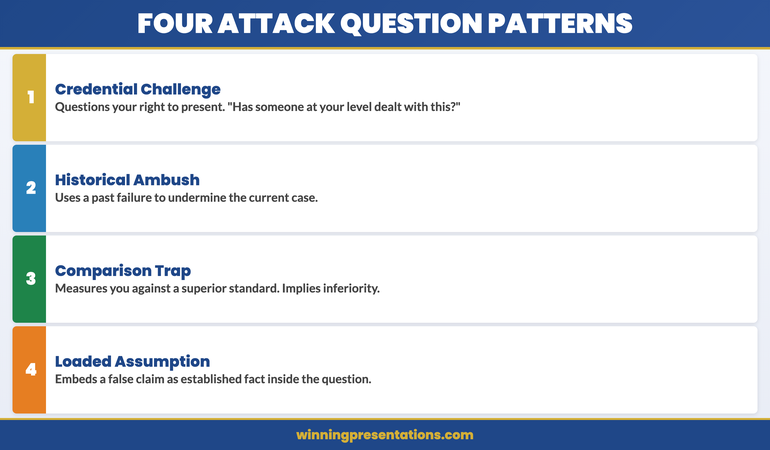
Recognising Attack Questions infographic showing four patterns: The Credential Challenge (questioning your authority), The Historical Ambush (citing past failures), The Comparison Trap (measuring against a superior standard), and The Loaded Assumption (embedding a criticism in the question)

The Credential Challenge. This questions your authority or experience directly: “Has someone at your level actually dealt with this before?” or “I’m wondering whether the team has the expertise to handle something of this complexity.” The grammatical form is a question. The actual content is a challenge to your right to be presenting at all. Responding to the literal question (by listing your credentials at length) is the most common mistake. The correct response acknowledges the question briefly and redirects to the substantive matter.

The Historical Ambush. This introduces a past failure — yours or your organisation’s — as a question: “Given what happened with the X project last year, I’m curious how you’d address the same risk here?” The question has legitimate surface content, but it is deployed in a way designed to establish a damaging narrative before the room has heard your current case. The correct response separates the historical reference from the current matter clearly, without becoming defensive about the history.

The Comparison Trap. This measures you against a superior standard in the form of a question: “Organisation Y manages to do this at half the cost — can you explain the gap?” The implied message is that your approach is inferior. The correct response examines whether the comparison is valid before engaging with it, rather than accepting the premise of the question and attempting to justify a gap that may not exist as framed.

The Loaded Assumption. This embeds a criticism in the question structure: “Given that this approach has already failed once, what makes you think it will work this time?” The word “failed” is doing significant work here — it is presented as established fact when it may be contested or misrepresented. The correct response surfaces and challenges the embedded assumption before addressing the question itself. Related technique: handling hostile questions in board meetings covers the broader category of adversarial Q&A in governance contexts.

Build a System for Handling Executive Q&A

The Executive Q&A Handling System gives you a structured approach to predicting the difficult questions that arise in board meetings, investment committees, and senior leadership forums — including hostile, loaded, and attack-style questions — and responding in a way that protects your credibility and controls the room.

  • Framework for predicting and categorising difficult questions in advance
  • Response structures for hostile, loaded, and personal attack questions
  • Bridge and redirect techniques for maintaining control of Q&A
  • Preparation system for high-stakes Q&A sessions

Get the Executive Q&A Handling System — £39

Designed for executives presenting to boards, investment committees, and senior leadership forums where challenging Q&A is expected.

What Drives Them: Motivation, Not Malice

Understanding the motivation behind a personal attack question changes how you respond to it — and, more usefully, how you feel about it in the moment. Most attack questions are not expressions of personal malice. They are expressions of something else: anxiety about a decision, a political position being asserted, a desire to demonstrate analytical rigour to others in the room, or a test of whether you can hold your ground under pressure.

The board member who challenges your credentials in front of the investment committee is often doing so because they are managing their own accountability — they want the record to show that they asked tough questions before approving a decision. The NED who deploys a historical ambush may be genuinely concerned about a pattern they believe they’ve identified, but expressing it through a challenge rather than a direct statement because that is the conversational norm in their context.

This matters practically because it changes your framing. A personal attack question is not evidence that the room is hostile to you. It is evidence that one person in the room is either managing their own agenda or testing your composure — and often both. Responding as though the whole room shares the sentiment of the questioner is the error that compounds the damage. In most cases, the rest of the room is watching to see how you handle it. How you handle it is the presentation.

The strategic pause technique is your most reliable first tool in this moment — a pause of three to five seconds before responding signals composure and creates the space for a considered response rather than a reactive one.

For a complete system for predicting and handling the full range of difficult Q&A scenarios — including attack questions, hostile challenges, and loaded assumptions — the Executive Q&A Handling System provides the preparation framework and response structures in one place.

The Response Framework: Defuse Without Surrendering Ground

The response to a personal attack disguised as a question needs to do several things simultaneously: acknowledge the surface question without accepting the attack embedded in it, respond with enough substance to be credible, and redirect to the matter at hand without appearing to flee from the challenge. This is a specific sequence, not a general principle of being calm or confident.
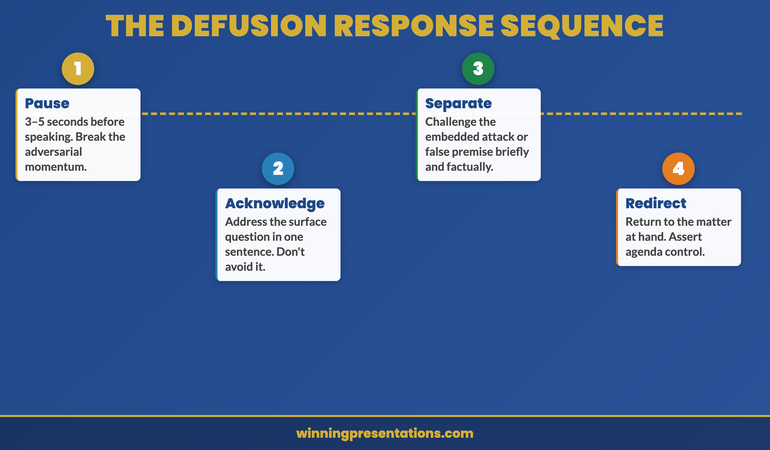
The Defusion Response Sequence roadmap infographic showing four steps: Pause (3–5 seconds, break adversarial momentum), Acknowledge (address the surface question in one sentence), Separate (challenge the embedded attack briefly and factually), Redirect (return to the substantive matter and assert agenda control)

Step 1 — Pause. Take three to five seconds before speaking. This breaks the adversarial momentum the question is designed to create and signals that you are choosing your response rather than reacting to provocation. It also gives the room a moment to register that you are not rattled.

Step 2 — Acknowledge the surface question briefly. Address what was literally asked in one sentence. For a credential challenge: “That’s a fair question to raise.” For a historical ambush: “The X project is worth addressing.” This prevents the questioner from repeating the challenge with the accusation that you avoided it.

Step 3 — Separate yourself from the embedded attack. This is the key move. Provide a short, factual response to the substance of the challenge — not a defensive monologue, but enough to remove the premise of the attack without inviting further discussion on that ground. For a credential challenge: one sentence on relevant experience, then stop. For a loaded assumption: name the assumption explicitly — “the premise of your question is that X has already been established; my reading of the situation is different” — then state your reading once.

Step 4 — Redirect. Return immediately to the matter the presentation is actually about. “What I’d like to bring the committee back to is…” This is not an avoidance move — it is an assertion of agenda control. The presenter who redirects cleanly after handling an attack question is demonstrating exactly the composure and authority that the question was designed to test.

See also the bridging technique for difficult questions — the bridge move in Step 4 is a specific skill that benefits from preparation in advance of the presentation.

Prepare for High-Stakes Q&A With a Structured System

The Executive Q&A Handling System gives you the preparation framework and response structures to handle the full range of difficult questions — from genuine challenges to hostile attacks — in board meetings and senior leadership forums.

Explore the Q&A Handling System

Designed for executives who present to boards, investors, and senior leadership forums where Q&A can be adversarial.

What Not to Do: The Three Most Common Mistakes

Understanding the correct response to a personal attack question is only half the preparation. Equally important is knowing the three response patterns that consistently make the situation worse — because under pressure, all three feel instinctively appropriate in the moment.

Mistake 1: Treating it as a genuine information request. The most common response to an attack question is to answer it as though it were a sincere request for information. This typically produces a lengthy, detailed response to the surface question — a full recitation of credentials, a complete account of the historical project, an exhaustive explanation of the methodology. The length of the response signals defensiveness even when the content is accurate. It also rewards the questioner by allowing them to occupy significant airtime with a move that was designed to destabilise rather than inform. A short, factual response followed by a redirect is the correct alternative.

Mistake 2: Becoming visibly defensive. A sharp change in posture, a faster speaking pace, or an audible increase in the emotional register of your voice — all of these signal to the room that the attack found its target. The questioner’s objective in most cases is to demonstrate that you can be destabilised under pressure. Visible defensiveness confirms the hypothesis they were testing. The correct response is composed, measured, and neither warm nor cold — factual in tone without being wooden.

Mistake 3: Inviting the questioner to elaborate. “That’s an interesting point — could you say more about what you mean?” This is a perfectly appropriate response to a genuine question. It is a damaging one in response to an attack question, because it hands the floor back to the person who has just challenged your authority and invites them to expand on the challenge at greater length. If clarification is genuinely needed, ask a very specific question: “When you say ‘someone at my level,’ what specific aspect of this presentation are you referring to?” This forces precision and often reveals the lack of a substantive underlying concern.

Frequently Asked Questions

Is it appropriate to address a personal attack question directly in front of the room?

Yes — briefly, and without displaying emotion. Attempting to avoid the question or deflect immediately signals discomfort. A short, factual acknowledgement followed by a redirect is the correct approach. The goal is to demonstrate that you noticed the nature of the question and chose how to respond to it — not that you were rattled by it or were unaware of what it was. The room notices the distinction and forms judgements accordingly.

What if the personal attack question contains a legitimate point?

Acknowledge the legitimate point directly and briefly. “There is a real question in there about X, and I’m happy to address it.” Then address X, and stop. The error is either to use the legitimate point as cover for ignoring the attack element entirely, or to become so focused on the attack element that you fail to address a genuine underlying concern. Separating the two — “the substantive question here is X; the framing of the question is a different matter” — is the cleanest approach.

How do you handle a personal attack question when it comes from the most senior person in the room?

The response framework is the same, but the tone calibrates upward. You are not adjusting the substance of your response based on seniority — you are still acknowledging briefly, providing a factual short answer, and redirecting to the substantive matter. What changes is the formality of the language and the explicit deference in tone. “That’s a fair challenge to raise, and I want to address it directly” works in any hierarchy. The key principle is that seniority of the questioner does not change your right to maintain the agenda of the presentation and the substance of your case.

The Winning Edge Newsletter

Weekly strategies for executive Q&A, difficult question handling, and high-stakes presentation preparation. Practical frameworks you can apply before your next board meeting.

Subscribe Free →

About Mary Beth Hazeldine

With 25 years of corporate banking experience at JPMorgan Chase, PwC, Royal Bank of Scotland, and Commerzbank, Mary Beth Hazeldine is Owner and Managing Director of Winning Presentations. She advises executives across financial services, healthcare, technology, and government on handling high-stakes Q&A and structuring responses to difficult and adversarial questions in board and investment committee contexts. View services | Book a discovery call

13 Mar 2026
Professional woman at a boardroom table holding composed focus while facing a question from a male executive — Q&A under pressure

Loaded Questions in Presentations: Recognising the Setup Before You Fall Into It

The question sounded straightforward: “Given what you’ve told us today, would you say the previous approach was a mistake?” It was not straightforward. It was a closed frame with a false binary embedded in it — and the moment you answered either yes or no, you had accepted a premise that was never yours to accept.

The executive who fell into it gave a careful, nuanced answer. What she didn’t do was recognise the question type before she started speaking. By the time she realised the frame was wrong, the answer was already in the room, and the follow-up question was waiting.

Loaded questions in presentations are not rare. They are a consistent feature of high-stakes Q&A — particularly in board meetings, investor sessions, regulatory reviews, and any room where someone has an interest in the answer being something specific. The executives who handle them well don’t have better answers. They recognise the setup faster.

Quick answer: A loaded question contains a false premise, a false binary, or an embedded accusation that forces you to accept the questioner’s framing before you can answer. The recognition test is simple: before answering, ask yourself whether the question’s framing is yours. If you can’t answer yes or no without accepting a premise you don’t hold, the question is loaded. The deflection technique is to name the frame before answering it — not to challenge the questioner, but to set the terms of your response before you begin.

🚨 Preparing for a Q&A where loaded questions are likely? The Executive Q&A Handling System (£39) includes the loaded question recognition framework, the three deflection patterns that work in executive rooms, and the preparation method that anticipates traps before you’re in the room.

I spent 24 years in corporate banking at JPMorgan Chase, PwC, Royal Bank of Scotland, and Commerzbank. In that time I observed and participated in a significant number of Q&A sessions that were designed, explicitly or implicitly, to produce a particular answer. Regulatory reviews, board challenge sessions, investor Q&As before difficult announcements — these are environments where questions are not always requests for information. Sometimes they are frames.

The executives who handled them best were not the most combative. They were the most methodical. They had a recognition process that ran faster than their instinct to answer, and they deployed it in the pause before every response. That pause — brief, unhurried, apparently natural — was where the recognition happened. By the time they began speaking, they had already decided whether to answer the question as framed or to name the frame first.

This article covers the three types of loaded question, the recognition test that distinguishes them from legitimate challenge, and the deflection pattern that works in rooms where you cannot afford to seem evasive but also cannot afford to accept a false premise.


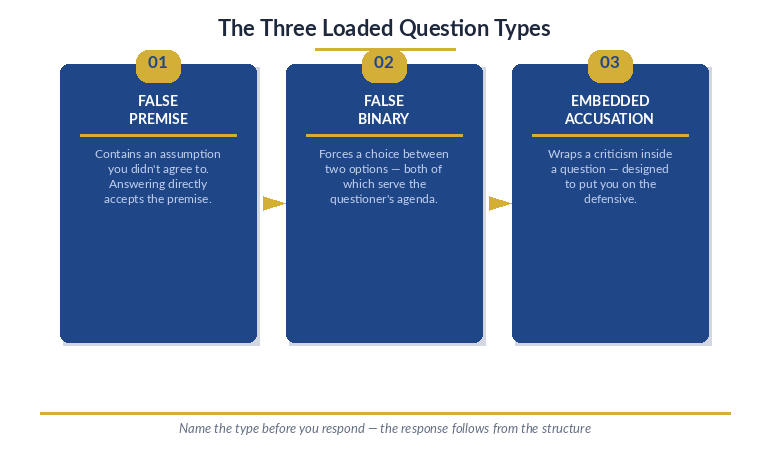
Three-part infographic showing the loaded question taxonomy: False Premise (contains an unaccepted assumption), False Binary (forces a two-option choice), and Embedded Accusation (criticism wrapped in a question)

The Three Types of Loaded Question

Not all difficult questions are loaded questions. A difficult question is one that requires a careful or uncomfortable answer. A loaded question is one where the framing itself is designed to constrain the answer — where accepting the question as posed means accepting a premise, a binary, or an implication that limits your options before you’ve said a word.

There are three types, and they operate differently. The false premise question contains a fact or assumption that is contestable, embedded inside what sounds like a straightforward enquiry. The false binary question presents two options as if they are the only options. The embedded accusation question wraps an implicit criticism inside a neutral grammatical structure so that answering it means implicitly accepting the criticism.

All three share a structural feature: they are more damaging when answered within the questioner’s frame than when answered outside it. The executive who recognises the type before answering can choose where to stand. The executive who answers within the frame has already conceded ground that may not be theirs to give.

The framework for handling difficult questions in presentations covers the broader category of challenging Q&A. Loaded questions are a specific subset that requires a specific recognition step before the handling technique applies.

🚨 Recognise the Trap Before You Walk Into It: The Executive Q&A Handling System

The Executive Q&A Handling System includes the complete loaded question framework — recognition, categorisation, and deflection — plus the preparation method that anticipates these questions before the session begins:

  • The three-type loaded question taxonomy with real examples from board, investor, and regulatory Q&A contexts
  • The recognition test — four questions that run in under five seconds and identify whether you’re inside a loaded frame
  • Three deflection patterns that work in executive rooms: reframe, acknowledge-and-replace, and explicit frame-naming
  • The preparation method for anticipating loaded questions before the session — including the stakeholder analysis that identifies who is likely to use them and why
  • Script templates for each deflection type — worded for executive contexts where you cannot appear evasive but cannot accept a false premise

Get the Executive Q&A Handling System → £39

Built from 24 years of observing Q&A sessions in banking boardrooms, investor meetings, and regulatory reviews — the environments where loaded questions are most consistently deployed.

The Recognition Test: Is the Frame Yours?

Before answering any question in a high-stakes Q&A, the recognition test runs as follows. Ask yourself: if I answer this question as posed — yes, no, or with the specific information requested — am I accepting a premise, a binary, or an implication that I would not otherwise accept?

If the answer is yes, the question is loaded. The framing does not belong to you, and accepting it will cost you something — credibility, flexibility, or the accuracy of your position — that may be more valuable than the question is worth to answer within its own terms.

The test takes less time to run than it takes to describe. With practice, it becomes automatic: a brief check, in the pause before you speak, that runs faster than your instinct to answer. The pause itself is useful — it signals that you are thinking about the question seriously rather than reacting to it, which is a credibility signal in itself. The pause is where the recognition happens. It is also where the answer is constructed.

Four specific signals indicate a loaded question: the word “still” (implying a prior behaviour or state you haven’t confirmed), the word “admit” (framing your answer as a concession), a question that begins with “given that” or “in light of” (embedding a premise before the actual question begins), and any question that presents exactly two options as the only available choices.

Heading into a session where loaded questions are predictable? The Executive Q&A Handling System (£39) includes the preparation template for anticipating loaded questions before the session — including the stakeholder analysis that identifies who is likely to use them and what their intent is.

Type 1: The False Premise Question

The false premise question embeds a contestable fact or assumption inside the question itself. Classic examples: “Now that the market has confirmed your original approach was too conservative, how are you adjusting?” — where “confirmed” is doing significant work. Or “Given that the board agreed to this approach in February, why have outcomes underperformed?” — where “agreed” may be a contested characterisation of a more complex discussion.

The mechanism is that the false premise is grammatically subordinate — it arrives inside a clause before the actual question begins, making it easy to miss when you’re processing the question. Your attention goes to the main clause; the premise slips through unexamined.

The deflection for a false premise question is to address the premise before addressing the question. Not aggressively — the framing does not need to be challenged as if the questioner is being dishonest. It simply needs to be placed differently before you continue. The pattern is: “I’d want to be careful about the framing there — [restatement of the accurate premise] — but to your underlying question: [answer].” This names the false premise without making the questioner defensive, places your own premise on record, and proceeds to answer the actual question, which demonstrates that you are not being evasive.


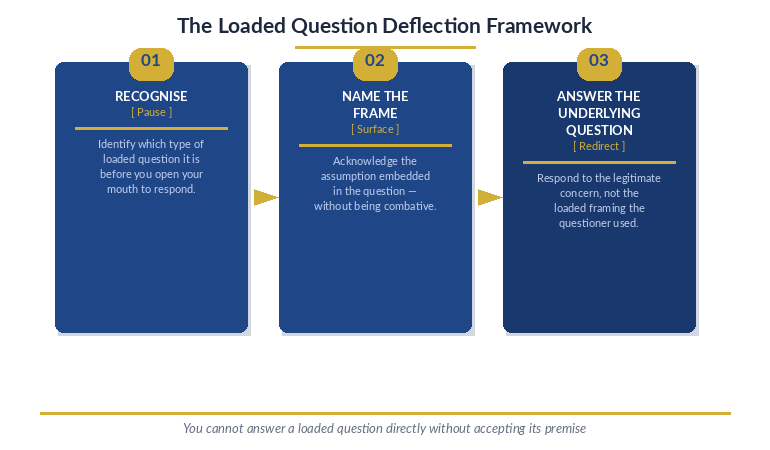
Three-step Loaded Question Deflection Framework: Recognise (identify the question type before responding), Name the Frame (surface the embedded assumption), Answer the Underlying Question (respond to the legitimate concern)

⚠️ Stop Accepting Frames That Aren’t Yours

Loaded questions are more damaging when answered within the questioner’s frame than when named and redirected. The Executive Q&A Handling System (£39) gives you the recognition test, the deflection scripts, and the preparation method that takes the trap away before the room sets it.

Get the Executive Q&A Handling System → £39

Used by executives preparing for board challenge sessions, investor Q&As, and regulatory reviews where questions are designed to produce specific answers.

Type 2: The False Binary Question

The false binary question presents two options as if they are the only options, when there is at least one other option the questioner has not offered. “Do you think the problem is in the strategy or the execution?” is a false binary if the honest answer is that the strategy and execution both contributed — or that neither is the primary problem, and the issue is something the question hasn’t named.

False binary questions are particularly common in investment and board contexts, where the questioner wants to establish accountability. The binary structure makes attribution easier: if you accept either option, the question has been answered in a way that assigns responsibility to one of two named causes. The option that assigns responsibility elsewhere — or that disputes the framing entirely — is never offered, because offering it would undermine the purpose of the question.

The deflection for a false binary is not to refuse to answer but to expand the option set before answering. The pattern is: “I don’t think it’s quite either of those — [name the third option or combination] — but if you’re asking where the most significant opportunity to improve is, that would be [answer].” This sidesteps the false binary, provides a more accurate answer, and demonstrates that you are engaging with the substance of what the questioner is actually trying to understand.

The short answer framework for executive Q&A is particularly useful here: the deflection and the answer combined should be shorter than the question was. Long responses to loaded questions create the impression that you are trying to talk your way out of something. Concise responses create the impression that you had the answer ready, which you did.

Type 3: The Embedded Accusation Question

The embedded accusation question wraps an implicit criticism inside neutral grammatical structure. “How are you planning to address the trust deficit that’s developed with the team?” embeds the accusation that a trust deficit exists. “What’s your explanation for the communication failures during the transition?” embeds the accusation that there were communication failures. Both are framed as requests for information; both contain an accusation in the subordinate clause that you would not accept if it were stated directly.

The embedded accusation is the most damaging of the three types because answering it within the frame means accepting the accusation. An answer that begins “To address the trust deficit…” has confirmed that the trust deficit exists. An answer that begins “The communication failures during the transition…” has confirmed that there were communication failures. The questioner has gotten the confirmation they wanted without having to make the accusation explicitly — and now the accusation is on record in your words, not theirs.

The deflection for an embedded accusation requires naming the assumption before responding. The pattern is: “I’d challenge the framing slightly — [specific restatement of the actual situation] — but your underlying concern is [acknowledgement], and here’s how I’d address that: [answer].” This does three things: it declines the embedded accusation, it demonstrates that you understand the concern behind the question, and it provides a substantive response that does not allow the questioner to claim you were being evasive.

The most common Q&A mistakes executives make in presentations include accepting frames they haven’t verified and providing long answers to deflect questions they should have deflected concisely. The embedded accusation type is where both mistakes are most likely to occur together.

Also published today: International Presentations: The Cultural Mistakes That Kill Deals Before Slide One — including how cultural context affects the Q&A dynamic and which loaded question types are most common by cultural profile.

Common Questions About Loaded Questions in Presentations

Is it always appropriate to name a loaded frame in a formal Q&A?
It depends on the room and the intent behind the question. In a regulatory review or a hostile board challenge, naming the frame directly — precisely but without aggression — is both appropriate and necessary. In an investor Q&A where the questioner is genuinely probing rather than trying to trap, naming the frame can come across as defensive. The recognition test helps here: if the framing genuinely limits your options in a way that would misrepresent your position, name it. If the framing is imprecise but the questioner’s intent is legitimate, you can widen the frame without naming it explicitly — just by answering from a broader position than the question offered.

What if I name a loaded frame and the questioner insists their framing is correct?
Acknowledge their view and hold your position. The pattern is: “I understand that’s how you’re reading it — my read of the situation is [restatement]. I’m happy to explain why I see it differently if that’s useful, but I wouldn’t want my answer to imply agreement with a characterisation I don’t hold.” This is firm without being combative, offers to continue the discussion, and makes clear that you’re not going to accept a premise under social pressure. Questioners who insist on their framing after this response are usually seeking confirmation, not information — and the room can see that.

How do I prepare for loaded questions before a session rather than handling them in the room?
The preparation method involves a stakeholder analysis for each person likely to ask questions: what is their current position relative to your presentation, what outcome serves their interests, and what framing of your work would produce that outcome? Once you have identified who might use a loaded question and what type it is likely to be, you prepare your recognition response and your deflection script in advance. The Executive Q&A Handling System includes a structured preparation template for this process — it takes 30–45 minutes and removes the most likely traps before you are in the room.

Is This Right For You?

This article and the Executive Q&A Handling System are for executives who face structured Q&A sessions where some participants are likely to use questions as framing tools rather than as genuine requests for information. Board challenge sessions, investor Q&As before difficult announcements, regulatory reviews, and competitive sales presentations all fit this profile.

If your Q&A sessions are largely collaborative — colleagues asking genuine questions about how to implement a proposal — the loaded question framework is less immediately relevant, though the recognition test is useful in any high-stakes room where you are accountable for your answers. If you are preparing for a session where you know from experience or context that some questions will be designed to constrain rather than to enquire, the preparation method and deflection scripts in the Executive Q&A Handling System will be the most efficient investment you can make before the meeting.

Frequently Asked Questions

Does the deflection technique work in writing as well as in spoken Q&A?
Yes, and in writing it is often more effective because you have more time to compose the response. Written loaded questions — in email, in committed papers, in written submissions to regulators — follow the same three-type structure. The false premise, false binary, and embedded accusation appear in written form as frequently as in spoken Q&A. The written deflection follows the same pattern: name the frame, restate the accurate position, and address the underlying question. In writing, the naming of the frame can be slightly more formal — “I note the question assumes X; the accurate position is Y” — because the written register supports more explicit framing without appearing combative.

Are there cultural differences in how often loaded questions are used?
Loaded questions are more common in adversarial cultural contexts — UK regulatory environments, US legal depositions, investment committee sessions with activist investors — and less common in consensus-oriented cultures where direct challenge is considered inappropriate. However, the false premise type appears across virtually all professional contexts, because it is often not intended as a trap — it is simply the questioner’s genuine belief. The recognition test does not assume bad intent: it identifies structural problems in framing regardless of motivation, which is why it is useful even when the questioner is not being deliberately manipulative.

About the Author

Mary Beth Hazeldine is the founder of Winning Presentations and has spent over two decades advising executives on high-stakes communication. Her background includes roles at JPMorgan Chase, PwC, Royal Bank of Scotland, and Commerzbank, where she participated in and prepared executives for board challenge sessions, investor Q&As, and regulatory reviews. She developed the Executive Q&A Handling System from the question patterns she observed consistently across those contexts, with particular focus on the recognition and deflection techniques that protect executives from accepting frames that are not theirs to accept.

The Winning Edge Newsletter

Practical executive presentation guidance, once a week. No padding, no noise — just the techniques that matter when the room is full of people whose questions are more than questions.

Subscribe Free →

12 Mar 2026
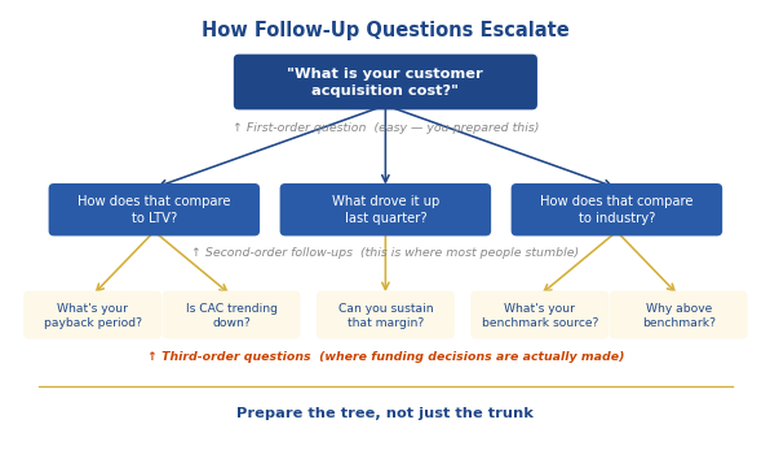
Investor Q&A follow-up questions that kill funding — second-order question map for founders preparing for investor conversations

Investor Q&A: The Follow-Up Questions That Kill Funding (And How to Prepare for Them)

Most investor presentations don’t collapse on the first question. They collapse on the second one.

The founder answers the opening question confidently — “what’s your customer acquisition cost?” — with a specific number and a clear explanation. Then the investor asks: “And how does that break down by channel?” Pause. Then: “What’s the trend over the last four quarters?” Another pause. Then: “What’s driving the increase in Q3?” By the fourth question, the founder is visibly reaching for data they don’t have immediately available. By the fifth, the room has reached a conclusion about how well the business is understood.

The first answer wasn’t wrong. The follow-ups revealed the boundaries of preparation. That’s where investor Q&A funding conversations are actually decided — not on whether you can answer the initial question, but on how far into the second order your preparation extends.

Quick answer: Investor Q&A follow-up questions follow predictable patterns. Every first-order question about metrics, strategy, or competitive positioning has three or four second-order follow-ups that experienced investors use to test the depth of understanding behind the initial answer. Preparing for the follow-ups — not just the opening questions — is what separates funded founders and executives from those who present well but leave investors uncertain. The preparation method is systematic: map each expected question, then generate the three most likely follow-ups for each, and prepare answers to all of them.

📋 Preparing for an investor Q&A this week? The Executive Q&A Handling System (£39) includes the investor Q&A framework with the second-order question map, preparation templates, and exact language for handling the questions most people aren’t ready for.

I spent 24 years in corporate banking at JPMorgan Chase, PwC, Royal Bank of Scotland, and Commerzbank. I have been in rooms where capital decisions were made — and in rooms where they weren’t, despite a strong headline pitch. The difference between those outcomes was rarely the first question and almost always what happened in the third and fourth.

Experienced investors are not trying to catch you out with follow-up questions. They’re trying to assess something specific: how deeply you understand your own business, and whether the answers you gave to the opening questions were genuinely grounded or were polished responses built for presentation rather than for interrogation.

The preparation framework that works isn’t “know your numbers.” Every funded founder knows their headline numbers. It’s “know the story behind every number, the story behind that story, and where the story breaks down.” That’s three levels deep. Most preparation stops at the first.


Investor Q&A follow-up question map showing first-order questions and three levels of second-order follow-ups across metrics, strategy, competitive, and risk categories

Why Follow-Up Questions Are Where Funding Is Decided

An investor who asks a follow-up question is not being difficult. They’re doing exactly what their role requires: assessing whether the person in front of them has the depth of understanding to manage the capital they’re being asked to commit.

The follow-up question serves a diagnostic function. If the first answer was memorised or prepared for the pitch, the follow-up will surface that. If the first answer was grounded in genuine understanding, the follow-up is easy — because the same understanding that produced the first answer produces the second one naturally, without additional preparation.

This is why investor Q&A preparation that only covers anticipated first-order questions consistently fails. Founders spend hours preparing answers to “what’s your CAC?” and “who are your main competitors?” and “what’s your burn rate?” — and are then derailed by “how does CAC vary by segment?” or “what’s your win rate against that competitor specifically?” or “at current burn, what’s your runway if the next round takes six months longer than expected?”

The follow-up isn’t harder to answer than the original question. It’s harder only if the answer to the original question was a prepared surface response rather than an expression of genuine understanding. The diagnostic function of the follow-up is precise: it distinguishes one from the other.

Today’s sister article on the investor relations presentation format covers how to structure the deck itself to prevent questions before they’re asked. This article covers the Q&A that follows — and specifically the follow-ups that most preparation misses.

📋 The Investor Q&A Framework That Prepares You Three Questions Deep

The Executive Q&A Handling System includes the investor Q&A preparation framework — the second-order question map, the preparation templates, and the exact language for handling follow-ups on metrics, strategy, competition, and risk:

  • The investor follow-up question map for each major Q&A category — what experienced investors ask second, third, and fourth
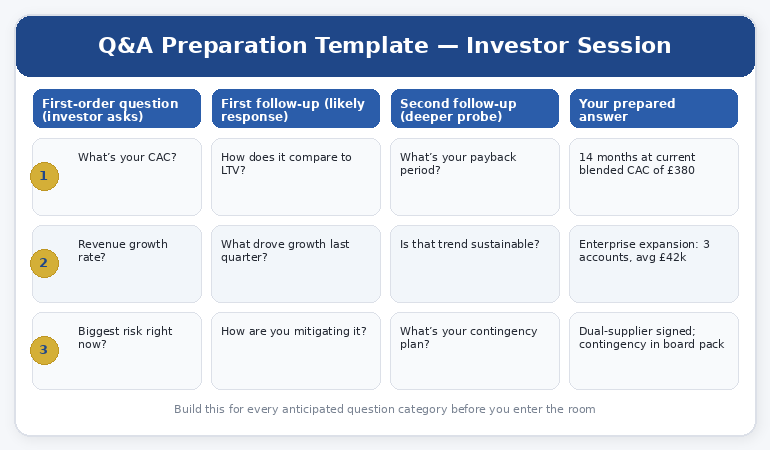
  • Preparation template: map your first-order answers and generate second-order questions systematically before the meeting
  • Language for handling questions where the honest answer isn’t the one you planned — without losing credibility
  • The bridging technique for redirecting follow-ups that are moving into territory you want to control
  • How to answer “I don’t know” in a way that builds rather than erodes investor confidence

Get the Executive Q&A Handling System → £39

Built from 24 years in corporate banking and executive Q&A preparation at JPMorgan Chase, PwC, and RBS — including preparing executives for investor presentations and funding rounds.

The Follow-Up Map: Metrics Questions

Every metric question an investor asks has a predictable set of follow-ups. Here are the most common, across the metrics categories that matter most in investor conversations.

Customer acquisition cost (CAC). First order: “What’s your CAC?” The follow-ups investors actually use: “How does that break down by channel?” “What’s the trend over the last four quarters?” “What’s driving the change?” “How does that compare to your LTV at different customer segments?” Preparation means knowing the channel breakdown, the trend, the driver, and the LTV-to-CAC ratio by segment — not just the headline CAC number.

Revenue growth. First order: “What’s your revenue growth rate?” Follow-ups: “New versus expansion revenue?” “Churn rate?” “Net revenue retention?” “What’s the growth rate of your top 10 accounts?” Most founders prepare the growth rate headline. Experienced investors are trying to understand whether that growth is healthy or fragile — new customer acquisition masking significant churn, or a stable expanding base. The follow-ups diagnose which.

Burn rate and runway. First order: “What’s your current burn?” Follow-ups: “How does that compare to six months ago?” “What are the main drivers of burn?” “What happens to burn if you hit your growth targets?” “What levers do you have if you need to extend runway?” Prepare the drivers, the sensitivity, and the optionality. Investors are stress-testing your understanding of the cash dynamics, not just the headline number.

Preparing for an investor meeting? The Executive Q&A Handling System (£39) includes the full investor follow-up question map across metrics, strategy, competitive, and risk categories.

The Follow-Up Map: Strategy Questions

Go-to-market strategy. First order: “What’s your GTM strategy?” Follow-ups: “What’s working best right now and why?” “What have you tried that hasn’t worked?” “What does the unit economics look like at scale?” “How does your GTM need to change when you move upmarket?” Most prepared answers describe the intended strategy. Investors want to know whether you’ve run it, what you’ve learned from running it, and whether your unit economics work beyond the current stage.

Pricing strategy. First order: “How did you arrive at that pricing?” Follow-ups: “Have you tested higher price points?” “Where do you lose deals on price?” “What’s the average contract value trend?” “How does your pricing compare to your top competitor in a head-to-head?” The follow-up questions are probing your pricing confidence — whether it’s based on customer research and competitive intelligence, or on a number that felt reasonable when you set it.

Expansion strategy. First order: “What’s your expansion plan?” Follow-ups: “What are the three biggest risks to the expansion timeline?” “What milestones do you need to hit before you can expand?” “Who else has expanded into that market and what happened to them?” “What does the team composition need to look like to execute?” Investors are looking for realistic planning versus aspirational planning. The follow-ups test whether you’ve worked the plan backwards from the risks.

The Follow-Up Map: Competitive Questions

Competitive positioning. First order: “Who are your main competitors?” The follow-ups: “What do customers choose them over you for?” “What’s your win rate against [specific competitor]?” “What would need to change for a customer to switch back to them?” “What are they doing now that concerns you?” Most competitive answers describe why you’re better. Investors want to understand whether you have accurate intelligence on your competitors’ strengths — not just their weaknesses.

Defensibility. First order: “What’s your competitive moat?” Follow-ups: “How long would it take a well-resourced competitor to replicate your key advantage?” “What assumptions is your moat argument dependent on?” “What happened to the last company that had this advantage?” The defensibility follow-up is almost always about identifying which assumptions the moat depends on. Prepare your moat argument and then prepare the honest answer to “what would need to be true for this advantage to erode?”


Investor Q&A preparation template showing how to map first-order questions to three levels of follow-up questions across competitive, risk, and metrics categories

⚠️ Stop Being Derailed by the Questions You Didn’t Prepare For

Most investor Q&A preparation covers the opening questions. The Executive Q&A Handling System (£39) includes the follow-up question maps that prepare you three levels deep — so you know exactly how to answer what comes after the first answer.

Get the Executive Q&A Handling System → £39

Used by executives and founders preparing for investor presentations, board meetings, and high-stakes funding conversations.

The Follow-Up Map: Risk Questions

Key person risk. First order: “What happens if you leave?” Follow-ups: “Who on your team could step up?” “What’s been documented so far?” “What would a succession plan look like?” “What would make you leave?” The key person question is expected. The follow-ups are probing whether you’ve actually thought about business continuity or whether “we’re building the team” is a placeholder answer.

Regulatory and legal risk. First order: “What are your main regulatory risks?” Follow-ups: “Have you had any regulatory interaction to date?” “What’s your current legal spend and what’s it for?” “What happens to your business model if [specific regulation] changes?” Prepare the honest answer to the regulatory question, then prepare the follow-up on what you’ve done about it, not just what the risk is.

Technology or execution risk. First order: “What’s the biggest technical risk to delivery?” Follow-ups: “What’s the fallback if that risk materialises?” “Have you had any incidents so far and how did you handle them?” “What does your testing and validation process look like?” Investors are testing whether you have realistic risk management or optimistic risk assessment. The follow-ups are designed to find out.

The CFO presentation framework uses the same principle: financial decision-makers always have prepared follow-ups for every first-order answer, and the presenter who knows what those follow-ups are enters the conversation at a significant advantage.

The Preparation System That Covers Second-Order Questions

The preparation method is straightforward once you understand what it’s for. It has four steps.

Step 1: List every question you expect. Not the questions you hope to get — every question that could reasonably arise across metrics, strategy, competitive positioning, team, and risk. This is your first-order question bank. Most founders have this. Most stop here.

Step 2: For each first-order question, generate three follow-ups. Ask yourself: if I give my planned answer to this question, what’s the next question an experienced investor would logically ask? Then ask it again: and if I answer that, what’s the next one? Three levels. Some questions will only have one or two logical follow-ups. Others will have five. The discipline of generating three forces you to think past your prepared surface answer.

Step 3: Prepare honest answers to the difficult follow-ups. Some of the follow-ups will surface genuine gaps — numbers you don’t know, assumptions you haven’t tested, risks you haven’t fully modelled. This is the most valuable part of the exercise: discovering your preparation gaps before the investor does. Where you have gaps, fill them. Where they can’t be filled before the meeting, prepare an honest, credible answer to “I don’t have that to hand, but here’s what I do know.”

Step 4: Run the preparation with a colleague who hasn’t seen it. The preparation that stays in your head isn’t tested. Having someone else ask you the first-order questions — then follow up unprompted — reveals whether your preparation is actually solid or whether it still has surface areas that look prepared but break down three questions in. The executive presentation structure that works in investor contexts is built to handle Q&A, not just delivery — and practising the Q&A is as important as rehearsing the deck.

Also published today: The Investor Relations Update Format That Prevents Awkward Questions — how to structure the deck itself so that many Q&A questions never need to be asked.

Common Questions About Investor Q&A Preparation

How many investor questions should I prepare for?
Prepare for every question you can anticipate, but the preparation that matters is the second-order follow-ups — not just additional questions. A bank of 40 first-order questions with no follow-up preparation is less valuable than 15 first-order questions, each with three follow-ups you’ve genuinely worked through. Quality of preparation depth matters more than quantity of questions covered.

What should I do when an investor asks a question I genuinely don’t know the answer to?
The honest answer is nearly always more effective than a deflection. The specific phrasing matters: “I don’t have that number with me, but I can tell you that [related thing you do know] — I’ll get you the exact figure after this meeting.” That response demonstrates honesty, demonstrates that related knowledge is solid, and demonstrates that you’ll follow through. What damages credibility is the visible search for an answer that isn’t there, or an answer that clearly isn’t what was asked.

How do investors use follow-up questions differently from opening questions?
Opening questions often probe what you know. Follow-up questions probe how you know it and how deeply. “What’s your CAC?” tests whether you have the number. “What’s driving the increase in Q3?” tests whether you understand why the number is what it is. Investors are assessing both layers simultaneously — but the follow-up is where the second layer is actually examined.

Is This Right For You?

✅ This is for you if:

  • You’re preparing for an investor presentation, board meeting, or funding conversation where Q&A is a significant part of the session
  • You’ve been caught out by follow-up questions in previous investor meetings and want to close those preparation gaps
  • You want a systematic method for preparing Q&A, not just a list of questions to memorise

❌ This is NOT for you if:

  • You’re preparing for an internal Q&A with colleagues rather than external investor scrutiny (the stakes and preparation depth differ)
  • You’re looking for guidance on the deck structure itself rather than the Q&A — that’s covered in the IR update format article published today

🏛️ The Q&A System Built From 24 Years of Watching What Investors Actually Test

The Executive Q&A Handling System is built on a simple premise: the questions that kill funding are not the ones you’ve prepared for. They’re the follow-ups that expose whether the prepared answers were grounded or polished:

  • The investor follow-up question map across metrics, strategy, competitive, and risk categories
  • The four-step preparation system for generating and answering second-order questions before the meeting
  • Language for handling difficult follow-ups — including the honest “I don’t know” that builds credibility rather than eroding it
  • The bridging technique for redirecting follow-ups into the territory you’ve prepared without appearing to deflect
  • Q&A preparation templates for the eight most common investor meeting formats

Get the Executive Q&A Handling System → £39

Built from 24 years in corporate banking at JPMorgan Chase, PwC, Royal Bank of Scotland, and Commerzbank — including preparing executives for investor Q&A, board scrutiny, and high-stakes funding conversations.

Frequently Asked Questions

How do follow-up questions in investor Q&A differ from those in a board presentation?

Board Q&A follow-ups are typically aimed at governance, accountability, and strategic direction — boards are testing whether management understands the decision they’re being asked to approve. Investor follow-ups are more specifically financial and risk-focused — investors are assessing whether the business model and management team warrant the capital commitment. The preparation principles are similar (prepare three levels deep, know the story behind every number), but the territory of the follow-ups is different. The investor Q&A preparation described in this article is specific to investor and fundraising contexts; for board Q&A preparation, the approach is adapted but the underlying method is the same.

What if an investor keeps following up with increasingly detailed questions I can’t fully answer?

The most effective response is to draw a clear line honestly: “That level of detail is in the data room rather than in my head — I’d rather give you accurate numbers than approximate ones. Can I get that to you by end of week?” This response is more credible than an attempted answer that turns out to be imprecise. Experienced investors understand that not every figure is memorised; what they’re assessing is whether the response to uncertainty is honest and organised, or defensive and evasive. The former is reassuring. The latter is not.

How long before a funding meeting should I start Q&A preparation?

The second-order question preparation is most effective when done at least five days before the meeting — not because the content changes, but because the follow-up mapping exercise surfaces preparation gaps that take time to close. If you identify a gap the day before the meeting, you may not be able to fill it; if you identify it a week out, you can get the number, build the analysis, or at least form a credible bridging response. The preparation itself takes three to four hours for a thorough investor meeting. The rehearsal — having a colleague ask first-order questions and follow up unprompted — needs a separate two-hour session.

Should I prepare differently for angel investors versus institutional VCs?

The depth of preparation required is broadly similar, but the territory of follow-up questions differs. Angel investors often focus heavily on founder background, motivation, and resilience — the follow-ups to “what’s your exit strategy?” or “why are you the right person to build this?” tend to be character and commitment-based. Institutional VCs are more likely to pursue financial model follow-ups, comparable transactions, and market sizing logic in detail. Preparing for both audiences requires the same systematic mapping approach, but with different follow-up question banks for each.

The Winning Edge — weekly insight on Q&A handling, executive presentations, and investor communication. Subscribe free →

Want everything in one place? The Complete Presenter Bundle (£99) includes the Executive Q&A Handling System, the Executive Slide System, Conquer Speaking Fear, and four additional products.

About the Author

Mary Beth Hazeldine is the Owner & Managing Director of Winning Presentations. With 24 years of corporate banking experience at JPMorgan Chase, PwC, Royal Bank of Scotland, and Commerzbank, she has delivered high-stakes presentations in boardrooms across three continents.

A qualified clinical hypnotherapist and NLP practitioner, Mary Beth combines executive communication expertise with evidence-based techniques for managing presentation anxiety. She has trained thousands of executives and supported high-stakes funding rounds and approvals.

Book a discovery call | View services