Tag: executive communication

25 Jan 2026
Professional evaluating executive presentation coaching options to find a programme worth the investment

Executive Presentation Coaching: What to Look For in 2026

I spent £8,000 on presentation coaching that taught me nothing I could use.

The coach was credentialed. The programme was respected. But after six sessions, I was still freezing in front of the board—because everything I’d learned was theory that collapsed under pressure.

Quick answer: The best executive presentation coaching in 2026 focuses on frameworks you can apply under pressure, not concepts you understand intellectually. It should address both structure (how to build slides that work for executive audiences) and delivery (how to present with authority when stakes are high). Most coaching fails because it teaches presentation theory without accounting for the stress response that hijacks your performance when it matters most.

When you find the right coaching:

  • You stop dreading presentations and start seeing them as career accelerators
  • Your recommendations get approved faster—because executives trust how you communicate
  • The skills compound: each presentation builds on the last instead of starting from scratch

Written by Mary Beth Hazeldine — Owner & Managing Director of Winning Presentations, 24 years in corporate banking (JPMorgan Chase, PwC, RBS, Commerzbank), qualified clinical hypnotherapist, and someone who’s been on both sides of executive presentation coaching—as a client who wasted money, and now as someone who teaches what actually works. Last updated: January 2026.

🚨 Evaluating a coaching programme THIS MONTH? Ask these 3 questions:

  1. Can you show me the exact frameworks I’ll use? (If they can’t, it’s theory-based)
  2. How do you address performance under pressure? (If they don’t, skills won’t transfer)
  3. What measurable outcomes have past participants achieved? (Vague answers = vague results)

These questions separate programmes that transform from programmes that teach.

I’ve helped senior professionals transform their executive presentations at global banks, consulting teams, and Fortune 100 companies—environments where one presentation can determine funding, strategy, or careers.

→ Want a programme designed for senior professionals? See the AI-Enhanced Presentation Mastery curriculum — frameworks-first approach for executives who present to decision-makers.

📅 Investing in your presentation skills this quarter?

This guide will help you evaluate any programme—including mine—so you invest in coaching that actually delivers results.

That £8,000 I spent? It taught me what not to look for. Over the next decade—through hundreds of executive presentations and eventually training senior leaders myself—I learned what actually creates transformation versus what just sounds impressive.

The difference isn’t subtle. And in 2026, with AI changing how presentations are created, the gap between effective coaching and outdated approaches has never been wider.

Why Most Executive Presentation Coaching Fails

The presentation coaching industry has a dirty secret: most programmes don’t produce lasting change.

Executives complete the training, feel inspired for a week, then revert to their old patterns the moment they’re under pressure. The coaching “worked” in the safe environment of the training room—but collapsed in the boardroom.

Here’s why:

Problem 1: Theory Without Application

Most coaching teaches concepts: “Lead with your conclusion.” “Use the pyramid principle.” “Make eye contact.”

These aren’t wrong—but they’re incomplete. Understanding a concept intellectually doesn’t mean you can execute it when your nervous system is in fight-or-flight mode.

The insight: Effective executive presentation coaching must bridge the gap between knowing and doing. That requires frameworks specific enough to follow under pressure, plus techniques for managing the stress response that blocks execution.

Problem 2: Generic Approaches

Many programmes teach the same content to everyone: entry-level employees, middle managers, and C-suite executives all get the same “presentation skills” curriculum.

But presenting to a board is fundamentally different from presenting to peers. The expectations, the communication patterns, the decision-making dynamics—all different.

The insight: Executive-level coaching should focus specifically on high-stakes, senior-audience scenarios. Generic “presentation skills” won’t cut it.

Problem 3: Ignoring the Stress Response

Here’s what most coaches don’t understand: the anxiety that executives feel before high-stakes presentations isn’t a mindset problem. It’s a physiological response.

When your brain perceives threat (and being evaluated by people who control your career IS a threat), it triggers hormonal cascades that impair verbal fluency, working memory, and executive function—the exact cognitive skills you need to present well.

The insight: Any coaching that doesn’t address nervous system regulation will fail when stakes are high. “Just be confident” isn’t a technique—it’s a wish.

📚 Research note: The Trier Social Stress Test (Kirschbaum et al., 1993)—the gold standard for measuring social evaluative threat—consistently shows that being judged by high-status observers produces stronger cortisol spikes than other stressors. Research on anxiety and working memory (Eysenck & Calvo’s Processing Efficiency Theory) explains why intelligent, knowledgeable executives can “blank” during presentations: anxiety consumes cognitive resources needed for verbal retrieval. The expertise is intact, but access is blocked. Effective coaching must account for this biological reality.

For more on why training fails, see the hidden reasons most programmes don’t stick.

Diagram showing why most executive presentation coaching fails: theory without application, generic approaches, and ignoring the stress response

What Actually Works: The 5 Non-Negotiables

After spending too much money on coaching that didn’t work, and then developing programmes that do, I’ve identified five elements that separate effective executive presentation coaching from expensive disappointments.

Non-Negotiable 1: Frameworks, Not Concepts

Effective coaching gives you specific, repeatable structures—not abstract principles.

Concept: “Lead with your conclusion.”
Framework: “Your first slide headline should state your recommendation + key benefit. Example: ‘Approve £500K for Q4 Campaign (2.3x Projected ROI).’ Here’s the template.”

The difference? A framework tells you exactly what to do. A concept requires you to figure it out yourself—which you can’t do under pressure.

What to look for: Can the coach show you the exact templates, structures, or scripts you’ll use? If it’s all principles and no specifics, keep looking.

Non-Negotiable 2: Pressure-Tested Techniques

Skills learned in calm conditions don’t automatically transfer to stressful ones. Effective coaching builds in stress inoculation—practicing under conditions that simulate real pressure.

What to look for: Does the programme include practice with realistic scenarios? Do they address what happens when anxiety spikes mid-presentation? Do they teach recovery techniques for when things go wrong?

Non-Negotiable 3: Executive-Specific Content

Presenting to a board requires different skills than presenting to a team meeting. Effective executive coaching focuses specifically on:

  • Decision-oriented structures (not information dumps)
  • Managing challenging questions from senior stakeholders
  • Building credibility with time-poor, skeptical audiences
  • The specific dynamics of high-stakes approval scenarios

What to look for: Is the content designed for senior audiences, or is it generic “presentation skills” repackaged?

Non-Negotiable 4: Both Structure AND Delivery

Some coaching focuses only on slide design. Others focus only on speaking skills. Neither alone is sufficient.

You need both: the ability to structure content that works for executive audiences AND the ability to deliver it with authority under pressure.

What to look for: Does the programme address both what you present (structure, slides, messaging) and how you present it (delivery, presence, managing nerves)?

Non-Negotiable 5: Modern Integration

In 2026, any executive presentation coaching that ignores AI is incomplete. Not because AI replaces presentation skills—but because AI changes how presentations are created.

The executives who thrive use AI to accelerate the mechanical work (drafts, formatting, research synthesis) while applying human judgment to the strategic work (what to include, how to frame it, what story to tell).

What to look for: Does the programme address how to leverage AI tools effectively? Or is it stuck in a pre-2023 world?

💬 “The framework changed how I structure every board presentation. I used to spend 6+ hours on decks that got questioned. Now I spend 90 minutes and get approval on the first pass.” — Senior Director, Global Consulting Firm

⭐ A Programme Built on These 5 Non-Negotiables

AI-Enhanced Presentation Mastery was designed specifically for senior professionals who present to decision-makers. It’s frameworks-first (not theory), addresses the stress response, and integrates modern AI workflows.

What’s included:

  • Executive presentation frameworks (decision slides, board updates, stakeholder pitches)
  • Techniques for calm authority under pressure
  • AI integration for faster, higher-quality presentation creation

See the Full Curriculum →

Cohort-based programme for senior professionals. Limited seats per session.

The 2026 Coaching Landscape: What’s Changed

The executive presentation coaching market has shifted dramatically. Here’s what’s different now:

Change 1: AI Has Raised the Bar

When anyone can generate a “decent” presentation in minutes using AI, the baseline has changed. Decent isn’t enough anymore.

The executives who stand out are those who can take AI-generated foundations and elevate them with strategic thinking, audience insight, and executive-level polish. Coaching that doesn’t address this reality is already outdated.

Change 2: Remote + Hybrid Has Become Permanent

Many executive presentations now happen on video—or hybrid with some participants in-room and others remote. This changes everything: how you build rapport, how you read the room, how you maintain engagement.

Coaching designed for in-person only is incomplete. Look for programmes that address the specific challenges of presenting through screens.

Change 3: Decision Speed Has Increased

Executives have less patience than ever. The “let me walk you through this” approach that worked a decade ago now loses audiences before you’ve made your point.

Modern coaching should emphasise decision-oriented structures: recommendation first, evidence second, context only when asked.

Change 4: Credentialism Matters Less, Results Matter More

Traditional presentation coaching often leaned on credentials: “trained at [famous institution]” or “certified in [methodology].”

Smart buyers now ask: “What outcomes have your participants achieved?” Credentials don’t guarantee results. Ask for evidence of transformation, not badges.

For more on what separates top performers, see why most presentation training fails senior professionals.

Looking for a programme designed for the 2026 reality? AI-Enhanced Presentation Mastery integrates frameworks, stress management, and modern AI workflows—specifically for senior professionals.

Red Flags: When to Walk Away

Not all coaching is worth the investment. Here are the warning signs:

Red Flag 1: “Everyone Needs the Same Training”

If a programme promises to help “everyone from interns to executives,” it’s not executive-focused. Generic content won’t address the specific challenges of high-stakes senior presentations.

Red Flag 2: All Theory, No Templates

If the coach can’t show you specific frameworks, templates, or structures you’ll walk away with, you’re paying for concepts you could read in a book.

Ask: “Can you show me an example of a framework I’ll learn?” If the answer is vague, walk away.

Red Flag 3: No Mention of Pressure or Nerves

If the programme doesn’t address performance anxiety, stress response, or presenting under pressure, it’s incomplete. Skills learned in calm conditions often collapse when stakes are high.

Red Flag 4: Outdated Content

If there’s no mention of AI, remote/hybrid presenting, or modern executive communication patterns, the content may be years out of date.

Ask: “How has this programme evolved in the last two years?”

Red Flag 5: No Evidence of Results

If the coach can’t point to specific outcomes from past participants—faster approvals, promotions, successful pitches—the programme may not deliver transformation.

Ask: “What measurable results have past participants achieved?”

Red flags when evaluating executive presentation coaching: generic content, no templates, ignoring nerves, outdated material, no evidence of results

⭐ A Programme That Passes Every Test

AI-Enhanced Presentation Mastery includes specific frameworks you can review before enrolling, addresses performance under pressure, and is updated for 2026 realities—including AI integration and remote/hybrid presenting.

You’ll get:

  • Frameworks you can see before you enrol (no mystery content)
  • Techniques for managing the stress response
  • Modern AI workflows that save hours per presentation

See the Full Curriculum →

Designed for senior professionals presenting to boards, executives, and key stakeholders.

How to Evaluate Any Programme

Use this framework to assess any executive presentation coaching you’re considering—including mine:

The 10-Question Evaluation

Content Quality:

  1. Is the content designed specifically for executive/senior audiences?
  2. Can they show you the exact frameworks and templates you’ll use?
  3. Does it address both structure (slides/content) AND delivery (presence/nerves)?
  4. Is it updated for 2026 realities (AI, remote/hybrid, decision speed)?

Practical Application:

  1. Does it include practice with realistic high-stakes scenarios?
  2. Do they address what happens when anxiety spikes mid-presentation?
  3. Will you walk away with tools you can use immediately?

Evidence of Results:

  1. Can they point to specific outcomes from past participants?
  2. Do they offer any guarantee or way to assess fit before full commitment?
  3. Does the programme structure support actual skill development (not just information transfer)?

Score it: If a programme doesn’t score at least 7/10, consider alternatives.

10-question coaching evaluation scorecard to rate any executive presentation coaching programme before committing

🎯 Choose Your Next Step Based on Your Timeline

If you present to ExCo/Board in the next 14 days: Focus on immediate fixes—review our decision slide framework and calm presence techniques. Long-term coaching can wait.

If you’re evaluating coaching this month: Use the 10-question scorecard above. Request curriculum details before any call. Compare at least 2-3 options.

If you’re planning Q1 development: Book now for early cohorts—quality programmes fill quickly in January. The AI-Enhanced Presentation Mastery next cohort has limited seats.

🎯 If you’re investing in coaching this quarter, do this TODAY:

  1. List the specific presentation challenges you need to solve (not vague “get better”—specific scenarios)
  2. Identify 2-3 programmes to evaluate using the 10-question framework above
  3. Request to see actual content before committing (frameworks, templates, curriculum)
  4. Ask for outcomes evidence from past participants in similar roles

This takes an hour. It prevents spending thousands on coaching that won’t deliver.

For more on presentation skill development, see what actually gets senior professionals ahead.

Want to evaluate AI-Enhanced Presentation Mastery? See the full curriculum and framework overview — you can review exactly what’s included before making any decision.

Frequently Asked Questions

How much should I expect to invest in executive presentation coaching?

Quality programmes range from a few hundred pounds for self-paced courses to several thousand for intensive 1:1 coaching. The question isn’t the absolute cost—it’s the return. A £500 programme that transforms your executive presentations delivers better ROI than a £5,000 programme that teaches theory you can’t apply.

Is 1:1 coaching better than group programmes?

Not necessarily. 1:1 offers personalisation; group programmes offer peer learning and accountability. The best choice depends on your learning style and specific needs. What matters more than format is whether the content meets the 5 non-negotiables.

How quickly should I expect results from coaching?

With framework-based coaching, you should see improvement in your very next presentation. Deep transformation—the kind that makes high-stakes presenting feel natural—typically takes 3-6 months of deliberate application.

Should I look for a coach with experience in my industry?

Industry experience can be helpful but isn’t essential. Executive presentation patterns are remarkably consistent across sectors. What matters more is whether the coach understands high-stakes, senior-audience dynamics—not the specifics of your industry.

Can AI tools replace executive presentation coaching?

AI can help you create slides faster, but it can’t teach you to present with authority under pressure. The mechanical parts of presentation creation are being automated; the human elements—strategic thinking, executive presence, managing the room—remain irreplaceable. The best coaching helps you leverage AI for efficiency while developing the skills AI can’t provide.

What if I’ve tried coaching before and it didn’t work?

The failure was likely in the approach, not in you. Most coaching fails because it’s theory-based, generic, or ignores the stress response. Use the evaluation framework in this article to find a programme that addresses those gaps. Don’t give up on coaching—find better coaching.

Does coaching work for people who are naturally nervous presenters?

Yes—in fact, naturally nervous people often see the biggest transformation. Here’s why: coaching that addresses the stress response (not just “presentation tips”) gives anxious presenters specific techniques to manage their physiology. They’re not trying to “stop being nervous”—they’re learning to present effectively despite the nerves. Many of the most composed executive presenters you see are naturally anxious people who’ve learned to channel that energy rather than display it.

Is This Right For You?

✓ Executive coaching is right for you if:

  • You present to boards, executives, or senior stakeholders
  • Your presentations affect decisions on funding, strategy, or career advancement
  • You want frameworks and techniques, not just theory
  • You’re ready to invest time in deliberate practice

✗ Executive coaching is NOT right for you if:

  • You mainly present to peers or direct reports (lower stakes)
  • You’re looking for quick tips rather than skill development
  • You’re not willing to practice between sessions
  • You expect transformation without applying what you learn

⭐ The £8,000 I Wasted Taught Me What Works

That expensive coaching that failed? It taught me exactly what to avoid—and what to build. AI-Enhanced Presentation Mastery is everything I wish that programme had been: frameworks-first, pressure-tested, and designed specifically for executives who present to decision-makers.

What you’ll get:

  • Executive presentation frameworks (not theory—templates you can use immediately)
  • Techniques for calm authority under pressure
  • Modern AI integration for faster, better presentations

See the Full Curriculum →

Cohort-based programme on Maven. Review the full curriculum before deciding.

📧 Optional: Get weekly executive presentation strategies in The Winning Edge newsletter (free).

Your Next Step

The right executive presentation coaching can transform how you communicate with decision-makers—and by extension, how your career progresses.

But the wrong coaching wastes thousands and leaves you no better than before. The difference is in knowing what to look for.

Use the 10-question evaluation on any programme you’re considering. Demand to see frameworks before you commit. Ask for evidence of results. And don’t settle for theory-based coaching that collapses under pressure.

Your ability to present to executives is one of the highest-leverage skills you can develop. Invest in coaching that actually delivers transformation—not just inspiration.

To review a programme designed around these principles, see the AI-Enhanced Presentation Mastery curriculum.

P.S. If your immediate challenge is structuring slides for executive approval, see how to build decision slides that get “yes” in 60 seconds. If it’s managing nerves when presenting to senior leadership, see how to sound calm and credible under pressure.

About the Author

Mary Beth Hazeldine is the Owner & Managing Director of Winning Presentations and a qualified clinical hypnotherapist. The £8,000 coaching failure that opens this article is real—and the decade that followed taught her what actually creates transformation in executive presentations.

After 24 years in corporate banking at JPMorgan Chase, PwC, Royal Bank of Scotland, and Commerzbank—where presenting to senior leadership was unavoidable—she now teaches the frameworks and techniques that actually work under pressure.

Book a discovery call | View services

20 Jan 2026
Executive presentation framework that AI can't replace - the human judgment layer that turns slides into decisions

Executive Presentation Framework: What AI Can’t Replace (And Never Will)

Quick answer: An executive presentation framework is the strategic thinking layer that determines what to say, in what order, to which audience, for what decision. AI tools can generate slides, but they cannot read the room, build your credibility, or structure content for your specific stakeholders’ decision-making style. The framework is what makes AI useful—not the other way around.

Master the framework, and AI becomes a powerful accelerator. Skip the framework, and AI produces polished slides that get polite nods and no action.

⚡ Before you open any AI tool, answer these 4 framework questions:

1. Decision: What specific decision or action do I need from this audience?

2. Objection: What’s their biggest concern or resistance?

3. Evidence: What proof will overcome that specific objection?

4. Structure: What order puts my strongest point where it matters most?

Now prompt AI with these answers. Watch the output transform.

The Presentation That AI Made Worse

A VP at a tech company came to me after a failed board presentation. She’d used every AI tool available—Copilot for the slides, ChatGPT for the script, Gamma for the visuals. The deck was beautiful.

The board said no.

“I don’t understand,” she told me. “The slides were better than anything I’ve made before.”

I reviewed the deck. She was right—the slides were polished. But the structure was wrong. She’d built up to her recommendation over 20 slides when the board wanted her position in the first 60 seconds. She’d included data that addressed her concerns, not theirs. She’d structured it for herself, not for how her CFO actually makes decisions.

AI had made her faster at building the wrong presentation.

That’s the trap nobody talks about.

⭐ Master the Framework That Makes AI Actually Useful

Stop producing polished slides that get polite nods. Learn the executive presentation methodology that turns AI from “fast but generic” into “fast and compelling.”

In this live cohort course:

  • The Decision-First Framework for executive audiences
  • How to read your stakeholders’ decision-making style
  • Structuring for your specific audience (not generic “best practices”)
  • Live feedback on your actual presentations

Includes a Decision-First briefing template you can reuse before every deck.

Join AI-Enhanced Presentation Mastery →

Live cohort with Mary Beth Hazeldine. 70% framework thinking, 30% AI execution. Works with any tool—Copilot, Gamma, ChatGPT, or whatever comes next.

If you have a board presentation or investor pitch in the next month, this will transform how it lands.

The 3 Things AI Cannot Do (And Never Will)

AI is extraordinarily good at certain tasks. It can generate slide layouts, suggest visual designs, produce draft content quickly, and format information cleanly.

But there are three capabilities at the heart of effective executive presentations that AI fundamentally cannot perform—and these aren’t limitations that will be solved with the next model update.

1. AI cannot read the room.

Executive presentations succeed or fail based on real-time audience response. The CFO who leans back when you mention the budget. The board member who checks their phone during your risk slide. The CEO who nods slightly at your third point.

These signals tell you what to emphasise, what to skip, and when to pivot. AI can’t see them. AI can’t adjust. AI doesn’t know that your COO makes decisions emotionally and justifies them rationally, while your CFO does the opposite.

You do. That’s the framework.

2. AI cannot build your credibility.

When you present to executives, they’re not just evaluating your slides. They’re evaluating you. Your command of the material. Your ability to answer unexpected questions. Your judgment about what matters.

AI can give you beautiful slides, but it can’t make you credible. When a board member asks “What happens if this fails?” and you give a thoughtful, unrehearsed answer that shows deep understanding—that’s what gets buy-in. That comes from framework thinking, not AI prompting.

3. AI cannot structure for your specific decision-maker.

Generic presentation advice says “lead with your conclusion” or “tell a story.” But your CFO might want numbers first and narrative second. Your CEO might want strategic context before tactical recommendations. Your board might want risk assessment before opportunity analysis.

AI produces average structures for average audiences. Your executive presentation framework must be tailored to how your specific stakeholders process information and make decisions. That’s human judgment. It always will be.


The three things AI cannot do in executive presentations: read the room, build credibility, and structure for specific decision-makersWhat an Executive Presentation Framework Actually Is

A framework isn’t a template. Templates are fill-in-the-blank structures that produce generic results. A framework is a decision-making methodology that produces tailored results.

The Decision-First Framework has four components:

Component 1: Decision clarity

Before anything else, define the specific decision you need. Not “inform them about the project” but “get approval for the £200K Phase 2 budget.” This clarity shapes everything that follows—what to include, what to cut, and how to structure the flow.

Component 2: Audience analysis

Who’s in the room? What are their concerns? How do they prefer to receive information? A framework helps you map each stakeholder’s decision-making style, objections, and priorities—then structure your content accordingly.

Component 3: Evidence selection

You have more data than you can present. A framework helps you select the evidence that specifically addresses your audience’s concerns—not the data that’s most impressive to you. This is where most AI-generated presentations fail: they include everything rather than selecting strategically.

Component 4: Structure optimization

The order of information matters enormously. A framework tells you whether to lead with recommendation or build to it, whether to address objections early or late, and where to place your strongest evidence for maximum impact. Learn more about executive presentation structure and how decision-first ordering works.

When you have this framework clear, AI becomes powerful. You’re not asking AI to think—you’re asking AI to execute your thinking faster. That’s the multiplier effect.

Want to master framework-first presentation thinking? AI-Enhanced Presentation Mastery teaches the complete Decision-First Framework with live practice on your actual presentations. See upcoming cohorts →

Framework as Multiplier: Why AI Needs You More Than You Need It

Here’s the uncomfortable truth about AI presentation tools: they multiply what you put in.

If you put in vague thinking, you get polished vagueness. If you put in generic structure, you get beautiful generic slides. If you put in framework-quality input—clear decision, specific audience analysis, selected evidence, optimized structure—you get executive-quality output at unprecedented speed.

Without framework:

“Create a presentation about our Q3 results for the board”

→ AI produces a generic quarterly review that looks like every other quarterly review the board has seen this month

With framework:

“Create a 6-slide presentation requesting £500K for market expansion. Board’s main concern is timeline risk. Lead with our mitigation plan, then show the opportunity cost of delay. CFO needs IRR and payback period on slide 3.”

→ AI produces a targeted, decision-ready deck tailored to your specific board’s priorities

Same AI. Same topic. Completely different output. The variable is the framework thinking you bring.

This is why I teach 70% framework, 30% AI tools. The framework is the skill. The AI is just the accelerator. If you have a solid AI presentation workflow, it’s because you have solid framework thinking underneath it.


Framework-first versus prompt-first approach showing how strategic thinking transforms AI output quality

⭐ The Framework That Makes Every AI Tool More Powerful

Learn the methodology that transforms AI from “fast at generic” to “fast at excellent.” Works with Copilot, Gamma, ChatGPT—or whatever tool comes next.

What you’ll master:

  • The 4-component Decision-First Framework
  • How to analyze any audience’s decision-making style
  • Evidence selection that addresses real objections
  • Structure optimization for executive buy-in

Join the Next Cohort →

Live sessions + direct feedback on your presentations. Framework skills that last a career.

This pays for itself the first time you get buy-in instead of polite nods.

Future-Proofing Your Presentation Skills

AI tools will keep improving. Copilot will get smarter. New competitors will launch. Models will advance.

But the executive presentation framework skills—reading your audience, building credibility, structuring for specific decision-makers—will remain human skills. They’re future-proof because they’re based on how humans make decisions, not on how technology generates content.

What becomes more valuable as AI improves:

  • Judgment about what to include — AI can generate anything; knowing what matters is human
  • Understanding of specific stakeholders — AI knows averages; you know your CFO
  • Ability to adapt in real-time — AI can’t see the room; you can read it
  • Credibility through deep knowledge — AI can script answers; you can think on your feet

What becomes less valuable:

  • Slide design skills (AI handles this well)
  • Content drafting speed (AI is faster)
  • Formatting consistency (AI is better)

The executives who thrive will be those who invest in the human judgment layer—the framework—and use AI to accelerate execution. Those who rely on AI for thinking will produce faster mediocrity.

The 3Ps Framework I’ve developed over 24 years in banking has helped clients raise more than £250M in funding. That wasn’t because of technology. It was because of strategic thinking applied to specific audiences.

Ready to build AI-proof presentation skills? AI-Enhanced Presentation Mastery teaches framework-first thinking that works with any tool and lasts a career. View course details →

Related: Framework thinking applies to every aspect of executive presentations. See how it shapes your executive presentation opening line and how it helps you manage high-stakes presentation nerves.

Common Questions About Executive Presentation Frameworks

What is an executive presentation framework?

An executive presentation framework is a decision-making methodology for structuring presentations to senior leaders. It includes four components: clarifying the specific decision you need, analyzing your audience’s concerns and decision-making style, selecting evidence that addresses their objections, and optimizing the structure for maximum impact. Unlike a template (fill-in-the-blank), a framework produces tailored results for each unique situation.

Can AI create executive presentations?

AI can create slides, but it cannot create effective executive presentations. The difference is judgment—knowing what to include, understanding your specific stakeholders, reading the room during delivery, and building credibility through deep knowledge. AI produces average content for average audiences. Executive presentations require tailored thinking that AI cannot perform. AI is best used to accelerate execution after you’ve done the framework thinking.

What makes executive presentations different?

Executive presentations are decision-focused, not information-focused. Senior leaders don’t want to learn about your topic—they want to make a decision and move on. This requires leading with recommendations, addressing specific objections, and structuring for their decision-making style rather than your preference. Generic presentation advice often fails with executives because it assumes audiences want information rather than clarity for action.

⭐ Build the Skill AI Can’t Replace

Framework thinking is the competitive advantage that makes AI useful. Learn the methodology that executives trust—and that technology can’t replicate.

Inside the course:

  • The complete Decision-First Framework
  • Audience analysis techniques for any stakeholder
  • How to brief AI for executive-quality output
  • Live practice with direct feedback

Enroll in AI-Enhanced Presentation Mastery →

Live cohort format with Mary Beth Hazeldine. Framework-first methodology developed from 24 years in corporate banking and executive coaching.

FAQ

Will AI replace presentation skills?

AI will replace some presentation tasks—slide design, content drafting, formatting—but not presentation skills. The human judgment layer (reading audiences, building credibility, structuring for specific decision-makers, adapting in real-time) remains irreplaceable because it depends on understanding specific people in specific contexts. Professionals who invest in framework thinking will use AI as an accelerator. Those who rely on AI for thinking will produce faster mediocrity.

What framework do consultants use for executive presentations?

Top consulting firms use variations of the Pyramid Principle—leading with the answer, then supporting with evidence. But the specific framework matters less than the underlying skill: analyzing your audience, clarifying the decision, selecting relevant evidence, and optimizing structure. Generic frameworks fail when applied without adaptation. The skill is knowing how to tailor any framework to your specific stakeholders.

How long does it take to learn a presentation framework?

The concepts can be learned in a few hours. Applying them fluently takes practice—typically 4-6 presentations with conscious framework application. Most professionals see improvement immediately (clearer structure, better audience response) and mastery within 2-3 months. The goal isn’t memorizing steps; it’s developing judgment that becomes automatic.

Does this work with Copilot/Gamma/ChatGPT?

Yes—the framework is tool-agnostic. Framework thinking improves your output from any AI tool because it improves your input. The specific prompting syntax varies slightly by tool, but the underlying methodology (decision clarity, audience analysis, evidence selection, structure optimization) applies universally. Learn the framework once, use it with whatever technology emerges.

📧 The Winning Edge Newsletter

Weekly insights on framework-first presentation thinking, AI-enhanced workflows, and executive communication. Practical methodology from 24 years in corporate banking—no AI hype, just what actually works with senior leaders.

Subscribe Free →

Your Next Step

AI generates slides. Frameworks generate buy-in.

Before your next executive presentation, spend 10 minutes on framework thinking: What decision do you need? What’s your audience’s main concern? What evidence addresses it? What structure puts your strongest point where it matters most?

Then use AI to execute your thinking. The output will transform—because you’ve transformed the input.

For the complete framework methodology with live practice and direct feedback, join AI-Enhanced Presentation Mastery.

About the Author

Mary Beth Hazeldine is the Owner & Managing Director of Winning Presentations and a former corporate banker with 24 years of experience at JPMorgan Chase, PwC, Royal Bank of Scotland, and Commerzbank. She has trained thousands of executives on high-stakes presentation skills and helped clients secure more than £250 million in funding and budget approvals.

Mary Beth is also a qualified clinical hypnotherapist and NLP practitioner. She developed the framework-first methodology after watching countless executives struggle with polished AI slides that failed to get buy-in—and discovering that the missing piece was always strategic thinking, never better technology.

Book a discovery call | View services

19 Jan 2026
Executive presentation structure diagram showing the Decision-First Framework for C-suite buy-in

Executive Presentation Structure: The Format That Gets Instant Buy-In

Quick answer: The best executive presentation structure leads with the decision, not the data. Put your recommendation on slide one, follow with business impact and risk, then provide supporting detail only if asked. This “decision-first” structure matches how executives actually process information—and it’s why some presenters get instant buy-in while others get “let’s circle back.”

⚡ Presenting to executives in the next 48 hours? Here’s your structure:

Slide 1: Decision — what you want + expected outcome

Slide 2: Impact — why it matters (revenue, cost, risk)

Slide 3: Risk — what could go wrong + mitigation

Slides 4–6: Evidence — only data that supports your ask

Backup: Detail on demand (methodology, deep analysis)

The 11-Word Slide That Rescued a £4M Budget Request

The right executive presentation structure can change everything. I learned this watching a client named Sarah lose—then win—the same £4 million budget request.

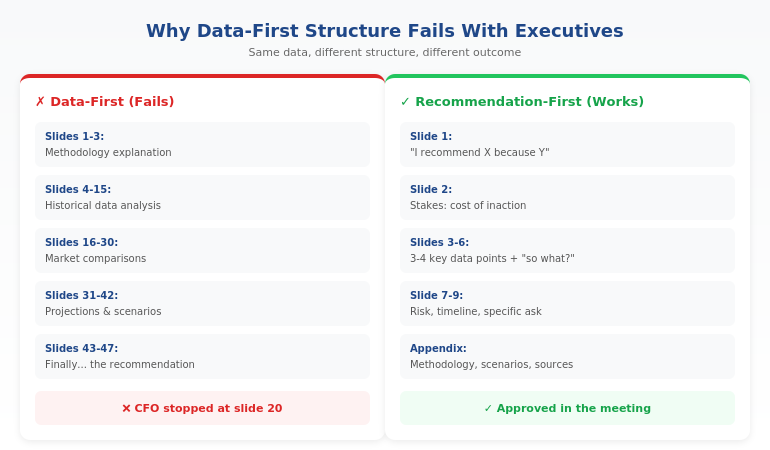
The first time, Sarah presented 47 slides. Background, methodology, analysis, findings, recommendations. Textbook structure. The CFO flipped through seven slides, said “I don’t see what you’re asking for,” and moved to the next agenda item. Fourteen hours of preparation, dismissed in 60 seconds.

Six weeks later, Sarah presented again. Same request. Same CFO. But this time, her opening slide contained exactly 11 words: “Request: £4M to reduce customer churn by 23% within 18 months.”

The CFO leaned forward. “Now we’re talking. Walk me through the numbers.”

She got her budget approved in that meeting.

The data hadn’t changed. The structure had. After 24 years in corporate banking at JPMorgan Chase, PwC, and Commerzbank, I’ve seen this pattern hundreds of times. The executives who get buy-in aren’t better at analysis. They’re better at structure.

⭐ Maven Flagship — Executive Buy-In

Build the case your stakeholders can’t dismiss

The Executive Buy-In Presentation System is a self-paced framework — 7 modules walking you through the structure, psychology, and delivery that get senior approval. Monthly cohort enrolment, optional recorded Q&A calls.

£499, lifetime access.

Enrol in the Executive Buy-In System →

Why the Structure You Learned Is Wrong for Executives

Most professionals structure presentations the way they were taught: background → methodology → analysis → findings → recommendation. This is logical. It’s how you think through problems. And it’s exactly why executives stop listening by slide three.

Here’s the disconnect: you build presentations chronologically, but executives don’t consume them that way.

When a CFO opens your deck, they’re not thinking “I can’t wait to understand your methodology.” They’re thinking: “What do you need? Why should I care? Can I say yes and move on?”

If those questions aren’t answered immediately, you’ve lost them. Not because they’re impatient—because they’re triaging. A typical C-suite executive makes 35+ decisions per day. Every slide that doesn’t answer “so what?” gets mentally filed under “I’ll review later.” (They won’t.)

The executives who command attention flip the traditional structure entirely. They lead with the end. They put the decision first and the supporting detail last.

The Decision-First Structure Executives Actually Want

The most effective executive presentation structure follows what I call the Decision-First Framework. It’s the opposite of how most presentations are built—and that’s exactly why it works.

Traditional structure (what you learned):

Background → Process → Data → Analysis → Recommendation

Decision-first structure (what executives want):

Recommendation → Impact → Risk → Supporting Data (if needed)

This structure works because it matches how executives actually think. They don’t need to understand your journey to make a decision. They need to understand the decision itself, what happens if they say yes, and what could go wrong.

When you lead with your recommendation, something remarkable happens: executives engage differently. Instead of waiting to find out what you want, they’re immediately evaluating whether to approve it. You’ve shifted from “presenter explaining things” to “advisor proposing solutions.”

This is exactly how top-tier consulting firms structure client presentations. It’s how I structured every pitch at JPMorgan Chase. And it’s how my clients consistently get faster decisions than their peers.

Want the complete framework with templates for different scenarios? The Executive Slide System includes everything you need to restructure your next presentation. Get instant access →

The Exact Slide Order for Executive Presentations

Here’s the executive presentation structure I teach to banking professionals and FTSE 100 leaders. This works for budget requests, strategic recommendations, project updates, and board presentations:

Slide 1: The Decision Slide

State exactly what you’re asking for and the expected outcome. No background. No preamble. Example: “Recommendation: Approve £2.1M for CRM upgrade. Expected ROI: 340% over 3 years.”

Slide 2: The Impact Slide

Show what happens if they say yes. Revenue impact, cost savings, risk reduction—whatever matters most to this audience. Make the benefit concrete and quantified.

Slide 3: The Risk Slide

Address what could go wrong and how you’ll mitigate it. Executives always think about downside. If you don’t address it, they’ll ask—and you’ll look unprepared.

Slides 4-6: Supporting Evidence

Only include data that directly supports your recommendation. If a slide doesn’t help them say yes, cut it.

Backup Slides: Detail on Demand

Put methodology, detailed analysis, and additional data in backup. You’ll rarely need it—but when an executive asks, you look thorough, not disorganised.

This structure typically reduces a 30-slide presentation to 8-12 slides. More importantly, it reduces decision time from “let’s reconvene” to “approved.”


Decision slide, Impact slide, Risk slide, Supporting evidence, then Backup slides

⭐ Stop Building Slides That Get Ignored

Get the complete Decision-First Framework with plug-and-play templates for every executive scenario.

Includes:

  • The exact slide order for budget requests, board updates, and strategic recommendations
  • Action-title formulas that eliminate “Overview” and “Background” slides
  • Before/after transformations from real presentations

Transform Your Presentation Structure → £39

Instant download. Apply to your next presentation immediately.

How to Apply This Structure to Your Next Presentation

You don’t need to rebuild your entire deck. Start with these three changes:

1. Rewrite your first slide as a decision.

Take whatever’s on your current slide 1 and replace it with: “[Action verb]: [What you want] to [achieve outcome].” If your current first slide says “Q3 Project Update,” change it to “Recommendation: Extend Q3 timeline by 2 weeks to protect £400K deliverable.”

2. Move your recommendation forward.

Find wherever your current recommendation lives (usually slide 15 or later). Move it to slide 1. Yes, it feels uncomfortable. Do it anyway. The supporting detail still exists—it’s just in the right place now.

3. Apply the “so what?” test to every slide.

For each slide, ask: “Does this directly support my recommendation?” If the answer is no, move it to backup. Most presentations lose 30-40% of their slides this way—and become dramatically more effective.

This is exactly how successful CFO presentations are structured. The content isn’t simpler—it’s organised for how finance leaders actually make decisions.

Want a step-by-step system for restructuring your slides? The Executive Slide System walks you through the entire process with templates and real examples. See what’s included →

Related: Great structure is only half the equation. If nerves undermine your delivery, read How to Stop Saying “Um” (Without Sounding Robotic).

Common Questions About Executive Presentation Structure

What is the best structure for an executive presentation?

The best executive presentation structure leads with your recommendation, followed by business impact, risks, and supporting evidence. This “decision-first” approach matches how executives process information. They want to know what you’re asking for before they evaluate whether to approve it. Traditional structures that build to a conclusion waste executive attention.

How do you structure a presentation for senior leadership?

Structure presentations for senior leadership around decisions, not information. Open with your recommendation and expected outcome. Follow with the business case (why it matters), risk assessment (what could go wrong), and supporting data. Keep the main presentation to 8-12 slides and put additional detail in backup slides for reference.

How many slides should an executive presentation have?

Most effective executive presentations have 8-12 slides, plus backup. The goal isn’t a specific number—it’s ensuring every slide directly supports your recommendation. If a slide doesn’t help executives make a decision, it belongs in backup or should be cut entirely. Your executive summary slide alone should convey the core message.

⭐ Present Like Someone Who Understands Executives

Get the complete system for structuring presentations that get immediate buy-in—not polite nods and forgotten follow-ups.

What’s included:

  • The Decision-First Framework with exact slide order
  • 12 executive slide templates (budget, board, strategy, updates)
  • Before/after examples from real presentations
  • Action-title formulas that eliminate weak slide titles

Get Instant Access → £39

The same framework used in FTSE 100 boardrooms, investment banking pitches, and C-suite budget approvals.

FAQ

How long does it take to restructure my existing slides?

Most people can restructure a 20-slide presentation in 60-90 minutes once they understand the Decision-First Framework. The first time takes longest because you’re learning the approach. After that, you’ll naturally build presentations this way from the start—which actually saves time because you’re not second-guessing your structure.

What if my executive actually prefers detailed presentations?

Executives who “prefer detail” actually prefer having detail available when they want it. Lead with your recommendation and keep supporting detail in backup slides. When they ask for more information, you’ll look prepared. In my experience, once executives see a well-structured presentation, they rarely ask for the backup—but they appreciate knowing it exists.

Does this structure work for technical presentations?

Especially for technical presentations. Technical experts often bury their conclusions under methodology because that’s how they solve problems. But executives don’t need to understand your process—they need to understand your conclusion and its business implications. The Decision-First structure forces you to separate “what I did” from “what it means.”

Should I use the same structure for board meetings?

Yes, with one adjustment: boards have even less time and need even clearer decisions. For board presentations, I recommend putting your recommendation AND the expected vote on slide one. Example: “Recommendation: Approve acquisition of XYZ Corp for £12M. Board action requested: Approval vote.” This immediately frames the entire discussion.

📧 The Winning Edge Newsletter

Weekly insights on executive communication, presentation structure, and career-building skills. No fluff—just actionable frameworks from 24 years in corporate banking.

Subscribe Free →

Your Next Step

The right executive presentation structure isn’t about simplifying your message—it’s about sequencing it for how leaders actually make decisions. Lead with the decision. Follow with impact and risk. Put supporting detail where it belongs: available but not in the way.

Try this with your next presentation: write your recommendation as slide one before you create anything else. Build the rest of your deck to support that single slide. You’ll be surprised how much easier the whole process becomes—and how differently executives respond.

If you want the complete framework with templates, examples, and step-by-step guidance, get the Executive Slide System.

📋 Free Resource: Executive Presentation Checklist

Not ready for the full system? Start with this free checklist covering the 10 structural elements every executive presentation needs.

Download Free Checklist →

About the Author

Mary Beth Hazeldine is the Owner & Managing Director of Winning Presentations and a former corporate banker with 24 years of experience at JPMorgan Chase, PwC, Royal Bank of Scotland, and Commerzbank. She has trained over 5,000 executives on high-stakes presentation skills and helped clients secure more than £250 million in funding and budget approvals.

Mary Beth is also a qualified clinical hypnotherapist and NLP practitioner, specialising in helping professionals overcome presentation anxiety. After spending five years battling her own fear of presenting at JPMorgan, she developed the techniques she now teaches to executives worldwide.

Book a discovery call | View services

16 Jan 2026
Client presentation skills framework showing useful vs impressive approach

Client Presentation Skills: Why ‘Impressive’ Loses and ‘Useful’ Wins Every Time

Quick Answer: The most effective client presentation skills focus on being useful rather than impressive. Clients don’t want to be dazzled—they want clarity on how you’ll solve their problem. Structure every slide around their decision, not your credentials. Lead with the answer, support with evidence, and close with clear next steps.

Three years ago, I watched a client presentation that should have been a slam dunk turn into a disaster.

The consulting firm had spent 47 hours perfecting their deck. Custom animations. Cinematic transitions. A video that cost more than my first car. Their credentials section alone was 12 slides of logos, awards, and testimonials.

The client—a FTSE 100 CFO—sat through all 58 slides without interrupting. When the lights came up, she asked one question: “Can you tell me specifically how this solves my inventory problem?”

Silence. The presenters looked at each other. They’d been so focused on being impressive that they’d buried the actual solution on slide 47.

The firm didn’t win that contract. A smaller competitor did—with a 9-slide deck that started with the client’s exact problem and ended with a clear implementation plan.

I know because I helped that smaller firm prepare their pitch.

After 24 years in corporate banking at JPMorgan Chase, PwC, RBS, and Commerzbank—and training over 5,000 executives on high-stakes presentations—I’ve seen this pattern repeat hundreds of times. The teams that try to impress almost always lose to the teams that choose to be useful.

This article will show you exactly why, and how to develop client presentation skills that actually close business.

⭐ Steal the Exact Slide Structure That Closes Client Deals

The best salespeople don’t convince—they structure. Get the plug-and-play frameworks that guide prospects to yes.

What’s inside:

  • The 9-slide client pitch framework
  • “No-Brainer Calculation” ROI template
  • Implementation timeline layouts

📊 Preview: Problem slide → Recommendation → ROI calculation → Implementation timeline → Next steps

“This turned our deck into a decision document overnight.” — Management Consultant, London

Used by executives in banking, consulting, and corporate finance to win time-critical pitches.

Built from frameworks behind £250M+ in funded pitches. Aggregate outcomes across multiple client pitches and funding rounds.

Download the Client Pitch Deck Templates → £39

Built for people who need a client pitch deck in the next 72 hours.

The ‘Impressive’ Trap That Kills Client Presentations

Here’s an uncomfortable truth I’ve learned from watching thousands of client presentations fail: being impressive is actually a defence mechanism.

When you’re unsure whether your solution truly fits the client’s needs, you compensate with credentials. When you haven’t done enough discovery, you hide behind animations. When you’re anxious about the outcome, you add more slides showing how brilliant your company is.

The problem? Clients see through it instantly.

Research cited by Corporate Visions (via Forrester) shows executive buyers strongly favour the seller who delivers value and insight early—not the one with the most impressive presentation. Clients aren’t sitting in your meeting thinking, “Wow, that transition was smooth.” They’re thinking, “Does this solve my problem or not?”

What makes a good client presentation?

A good client presentation leads with the client’s specific problem, presents a clear recommendation within the first few minutes, and closes with concrete next steps. It prioritises usefulness over impressiveness.

The Impressive Presentation Pattern

Most client presentations follow the same doomed structure:

  • Slides 1-5: Company history and credentials
  • Slides 6-15: Services overview (all of them, just in case)
  • Slides 16-25: Case studies (impressive ones, naturally)
  • Slides 26-35: Team bios and qualifications
  • Slides 36-40: Finally, something about the client’s actual situation
  • Slides 41-50: Methodology (in exhaustive detail)
  • Slide 51: Pricing
  • Slide 52: Questions?

By the time you reach the client’s actual problem, they’ve mentally checked out. Their attention peaked in the first three minutes—and you wasted it on your founding story.

Why “Impressive” Feels Safe (But Isn’t)

I understand the instinct. When I started presenting at PwC, I did exactly the same thing. My first major client pitch included a 15-minute section on our global footprint. I thought it showed credibility.

What it actually showed was that I didn’t understand what the client needed to make a decision.

The client didn’t care that PwC had offices in 157 countries. They cared whether we could fix their supply chain issue before Q4.

Comparison chart showing useful vs impressive client presentation approaches

What Clients Actually Want (It’s Not What You Think)

After sitting through more than 500 client presentations on the buying side during my banking career, I can tell you exactly what goes through a client’s mind:

“Get to the point. Help me make a decision. Don’t waste my time.”

That’s it. That’s what every client wants from every presentation. Everything else—the rapport building, the credibility establishing, the relationship developing—is secondary.

The 4 Questions Every Client Is Silently Asking

While you’re presenting, your client is running an internal checklist:

  1. Do they understand my specific situation? Not a generic version of my industry—MY situation, with MY constraints and MY priorities.
  2. Is their solution actually right for us? Not a solution they’ve sold to others—one that fits what we need.
  3. Can I trust them to deliver? Not impressive credentials—evidence they can execute.
  4. What happens next? Not a vague “we’ll be in touch”—a clear path forward.

Notice what’s missing? They’re not asking about your founding story. They’re not wondering how many awards you’ve won. They’re not impressed by your global headcount.

They’re asking: “Can this person solve my problem?”

How long should a client presentation be?

Most client presentations should be 15-20 minutes followed by discussion—typically 9-12 slides. Shorter presentations that hit every key point beat longer ones that lose audience attention.

The Shift from Impressive to Useful

When I work with clients on their client presentation skills, the first thing we do is flip the entire structure. Instead of building toward the solution, we lead with it.

Here’s how the same content looks when reorganized around usefulness:

  • Slide 1: The client’s specific problem (proving you understand)
  • Slide 2: Your recommended solution (the answer they came for)
  • Slide 3: Why this approach (supporting evidence)
  • Slides 4-6: How it works (implementation clarity)
  • Slide 7: What you’ll deliver (specific outcomes)
  • Slide 8: Investment required (pricing in context)
  • Slide 9: Next steps (clear path forward)

Credentials? They’re in an appendix—available if the client asks, invisible if they don’t.

This structure respects the client’s time and signals confidence. You’re saying: “I understand your problem so well that I can cut straight to the solution.”

The Useful Framework: 5 Pillars of Client Presentations That Win

After years of testing and refining, I’ve identified five pillars that separate client presentations that close from those that don’t.

Pillar 1: Lead with Their Problem, Not Your Credentials

Your opening slide should reflect the client’s world back to them. Not a generic industry challenge—their specific situation.

I had a client preparing to pitch a major retailer. Their original opening was: “About Our Agency: 15 Years of Retail Excellence.”

We changed it to: “Your Checkout Abandonment Problem: 34% of Customers Leave at Payment.”

The client leaned in immediately. Why? Because we’d shown in five seconds that we understood exactly what was keeping them up at night.

The rule: Your first slide should include at least one number specific to the client’s situation. If you can’t find one, you haven’t done enough discovery.

Pillar 2: Answer First, Explain Second

Most presenters build suspense: background, analysis, options, then finally the recommendation. Clients hate this.

They’re thinking: “Just tell me what you think I should do.”

The Pyramid Principle, pioneered at McKinsey, puts the answer first. You state your recommendation, then support it with evidence. This isn’t just more efficient—it builds trust.

When you hide your recommendation until the end, clients wonder what you’re hiding. When you lead with it, they see confidence.

Pillar 3: Show Implementation, Not Just Strategy

Strategy slides are cheap. Every consultant can create them. What clients pay for is execution.

A VP of Operations once told me: “I’ve seen 50 presentations that diagnosed my problem perfectly. I’ve seen two that convinced me the presenter could actually fix it.”

Your presentation needs to show the “how” as clearly as the “what.” This means:

  • Specific timelines with milestones
  • Named team members (not just roles)
  • Dependencies and risk mitigation
  • Communication and reporting cadence

The more concrete your implementation section, the more real your solution feels.

💡 Want the exact implementation slide layouts? The Executive Slide System includes ready-to-use implementation and timeline templates.

Client presentation implementation framework showing timeline and milestones

Pillar 4: Make the ROI Impossible to Ignore

Every client presentation should include a slide I call the “No-Brainer Calculation.”

This slide shows, in simple maths, why your solution is worth the investment. Not vague benefits—specific, calculated returns.

Example:

“Your current checkout abandonment rate costs £2.4M annually. Our solution has reduced abandonment by 23% for similar retailers. A 23% reduction = £552K annual revenue recovery. Our fee: £180K. Payback period: 4 months.”

When clients can see their own numbers in your calculation, the decision becomes obvious.

💡 Need the ROI calculation template? The Executive Slide System includes the “No-Brainer Calculation” slide layout ready to customise.

Pillar 5: Close with Momentum, Not Questions

The worst way to end a client presentation: “Any questions?”

This hands control to the room, invites objections, and creates uncertainty about what happens next.

The better approach: close with specific next steps and immediate action.

“Based on what we’ve discussed, here’s what I propose: We’ll send the detailed scope document by Thursday. You’ll review with your team and come back to us with any modifications by the following Tuesday. We can have the kickoff scheduled for February 1st. Does that timeline work for your team?”

Notice: you’re not asking IF they want to proceed. You’re asking WHEN.

This isn’t aggressive—it’s useful. You’re making their life easier by proposing the path forward.

How to Structure a Client Presentation That Closes

Let me give you the exact structure I use with clients who need to win competitive pitches.

The 9-Slide Client Presentation Framework

Slide 1: Their Problem (with specifics)
“Your inventory carrying costs have increased 34% over 18 months while turns have decreased.”

Slide 2: Your Recommendation
“We recommend implementing a demand-sensing system integrated with your existing ERP.”

Slide 3: Why This Approach
3-4 bullet points explaining why this solution fits their specific situation.

Slide 4: How It Works (Overview)
Visual showing the system architecture or process flow.

Slide 5: Implementation Timeline
Clear milestones: Week 1, Month 1, Month 3, Go-Live.

Slide 6: Expected Outcomes
Specific, measurable results: “15-20% reduction in carrying costs within 6 months.”

Slide 7: Investment Required
Pricing with context—show the ROI calculation here.

Slide 8: Why Us (One Slide Only)
2-3 proof points specific to this project. Not your whole history—just why you’re right for THIS.

Slide 9: Next Steps
Specific actions with dates and owners.

Appendix: Everything Else
Team bios, detailed methodology, additional case studies—available if asked.

This structure works because it respects the client’s time while giving them everything they need to make a decision. Learn more about persuasive presentation techniques that complement this framework.

⭐ Want This as a Ready-to-Use Client Pitch Deck?

If you’re building a client pitch this week, get plug-and-play slides so you’re not starting from scratch.

What’s inside:

  • The complete 9-slide client framework (ready to customise)
  • ROI “No-Brainer Calculation” template
  • Implementation timeline layouts

Get the Plug-and-Play Deck Frameworks → £39

What is the best structure for a client pitch?

The best client pitch structure leads with the client’s problem, presents your recommendation on slide 2, supports it with evidence and implementation details, then closes with pricing in context and specific next steps. Keep credentials in an appendix.

The First 30 Seconds

Your opening line sets the tone for everything that follows. Skip the pleasantries and get to value immediately.

Weak opening: “Thank you for having us today. We’re really excited to present our proposal. Before we dive in, let me tell you a bit about our company…”

Strong opening: “Your checkout abandonment rate is costing you £2.4 million annually. In the next 20 minutes, I’m going to show you exactly how we’ll cut that by at least 23%—and have it running before your Q4 peak.”

The strong opening passes the “So What?” test. The client immediately knows why this meeting matters.

For more on powerful openings, see how to start a presentation.

The 7 Client Presentation Mistakes That Lose Deals

I’ve watched brilliant solutions lose to mediocre competitors because of avoidable presentation mistakes. Here are the seven I see most often.

Mistake #1: Starting with Your Company History

The client doesn’t care about your founding story. They care about their problem. Every second you spend on your history is a second they’re mentally checking out.

Fix: Move all company information to an appendix. Only share it if the client asks.

Mistake #2: Generic Problem Framing

“Companies in your industry face digital transformation challenges.”

This tells the client nothing. It shows you’ve done surface-level research and are delivering a template presentation.

Fix: Use specific numbers from their situation. “Your customer acquisition cost has increased 47% over three years while lifetime value has stayed flat.”

Mistake #3: Too Many Options

Presenting three options seems helpful—”We’ll let them choose!”—but it actually creates decision paralysis.

Research by Sheena Iyengar shows that too many choices reduce decision-making confidence and increase the likelihood of choosing nothing.

Fix: Make a recommendation. Present one option with conviction. Mention alternatives briefly in the appendix.

Mistake #4: Burying the Price

Putting pricing on slide 47 of 52 signals that you’re nervous about it. Clients notice.

Fix: Present investment in context, early enough that you have time to discuss it. Frame it against the value delivered, not as a standalone number.

Mistake #5: Vague Next Steps

“We’d love to continue the conversation” isn’t a next step. It’s a platitude.

Fix: Propose specific actions with dates. “We’ll send the scope document by Thursday. Your review deadline would be the following Tuesday. Kickoff February 1st.”

Mistake #6: Reading the Slides

When you read your slides, you become redundant. The client can read faster than you can speak—so why are you there?

Fix: Your slides should be visual anchors, not scripts. Design them so they need you to explain them. For more on confident delivery, explore building presentation confidence.

Mistake #7: Ignoring the Decision-Maker

Sometimes the real decision-maker isn’t obvious. They might be the quietest person in the room.

Fix: Before your presentation, ask: “Who else will be involved in the decision?” During the presentation, watch for who others defer to. Address your key points to that person.

Common client presentation mistakes infographic with fixes

Case Study: From 23% Close Rate to 67% in 90 Days

Let me share a transformation that illustrates what’s possible when you shift from impressive to useful.

A management consultancy came to me after losing three major pitches in a row. Their presentations were polished—beautiful design, smooth delivery, comprehensive coverage of every service they offered.

The problem? They were winning only 23% of competitive pitches. Industry average was closer to 40%.

The Diagnosis

I sat through one of their dry-run presentations. Within five minutes, I understood the problem.

Their 44-slide deck spent the first 15 slides on company credentials. By the time they reached the client’s actual situation, we were 20 minutes into a 45-minute slot.

More critically, their recommendation was buried on slide 38. A client who lost focus—or had to leave early—would never reach it.

They were trying to impress their way to a contract. The clients weren’t buying it.

The Transformation

We restructured everything around the 9-slide framework I described earlier.

Original deck: 44 slides, credentials-first, recommendation on slide 38.

New deck: 9 slides, problem-first, recommendation on slide 2.

We moved their credentials section—all 15 slides of it—to an appendix. Their team was initially terrified. “But the client needs to know who we are!”

I reminded them: “The client already knows who you are. That’s why you’re in the room. What they don’t know is whether you understand their problem and can solve it.”

The Results

Over the next 90 days, they pitched seven new opportunities using the new structure.

Close rate: 67% (5 wins from 7 pitches).

Combined contract value: £3.2 million.

But here’s what surprised me: client feedback consistently mentioned how “refreshing” and “efficient” their presentations felt. Multiple prospects commented that it was the clearest proposal they’d received.

Being useful isn’t just more effective—it’s more appreciated.

What They Said

“The thing that changed everything was leading with the client’s numbers. Within 30 seconds, they knew we understood their situation. The rest of the presentation was just confirming what they already sensed: that we were the right choice.”

— Managing Director, the consultancy

⭐ Win the Pitch by Controlling the Decision

Most competitors show capability. You’ll show clarity, ROI, and execution—the things buyers actually decide on.

What’s inside:

  • Answer-first structure that builds trust fast
  • “No-Brainer Calculation” ROI slide template
  • Stakeholder framing for multi-buyer meetings

Download the Executive Slide Templates → £39

Frequently Asked Questions

How long should a client presentation be?

For most competitive pitches, aim for 15-20 minutes of presentation followed by discussion. This typically means 9-12 slides. Anything longer suggests you’re including content the client doesn’t need. Remember: shorter presentations that hit every key point beat longer presentations that lose audience attention. The goal is decision clarity, not comprehensive coverage.

Should I send the presentation before the meeting?

Generally no. Sending slides in advance removes your ability to control the narrative and lets competitors see your approach. If the client insists, send a 2-page executive summary instead—enough to confirm the meeting is worth their time, not enough to replace the meeting itself. Save the full deck for your live presentation where you can read reactions and adapt.

How do I handle multiple decision-makers with different priorities?

Map stakeholder priorities before the meeting and address them explicitly. Structure your presentation so each decision-maker hears their concern addressed directly: “For the finance team, here’s the ROI calculation… For operations, here’s the implementation impact…” This shows you understand the organisation’s complexity and have thought through implications for each stakeholder group.

What if I don’t have specific numbers for the client’s situation?

If you can’t find client-specific data, use industry benchmarks positioned as conversation starters: “Based on companies your size, we typically see X. During our discovery, we’ll validate this for your specific situation.” This demonstrates research effort while inviting the client to share their actual numbers. Often, they’ll correct you with more accurate data—which is exactly what you want.

How do I compete against larger, more established firms?

Focus on usefulness, not credentials. Large firms often rely on brand recognition and deliver template presentations. Your advantage is personalisation. A smaller firm that demonstrates deep understanding of the client’s specific situation will often beat a larger firm that treats them as one of hundreds of similar accounts. Lead with insight, not with size.

What’s the best way to handle pricing objections during the presentation?

Anchor the price to value before revealing it. Show the ROI calculation first: “This problem is costing you £X annually. Our solution delivers Y% improvement, which represents £Z in value.” Then present your price in that context. When clients see the value first, the price becomes a no-brainer rather than a negotiation point. Never apologise for your pricing—confidence in your value proposition is itself persuasive.

📧 Join 2,000+ professionals getting weekly presentation insights. Subscribe to The Winning Edge →

If you want the full slide frameworks (not just a checklist), the Executive Slide System turns this into ready-to-use decks.

📋 Free Resource: Sales Presentation Checklist

Before your next client presentation, run through this comprehensive checklist covering structure, messaging, and delivery. Includes the “No-Brainer Calculation” template and stakeholder mapping framework.

Download the Free Checklist →

Related Resources

Closing: Useful Wins. Every Time.

Remember that FTSE 100 CFO I mentioned at the start? The one who sat through 58 slides of impressive content?

She later told me what she was thinking during that presentation: “I kept waiting for them to tell me how they’d solve my problem. Instead, they told me about their awards.”

The firm that won her business—the one with 9 slides—understood something fundamental about client presentation skills: clients aren’t looking to be impressed. They’re looking for help.

Every slide you add that isn’t directly useful is a slide that risks losing your audience. Every credential you lead with is attention you could have spent on their problem. Every minute you spend impressing is a minute you’re not helping.

The best client presentations feel like conversations with a trusted advisor. They’re clear, direct, and focused entirely on the client’s success. They don’t try to dazzle—they try to be useful.

And useful, it turns out, is far more impressive than impressive ever could be.


About the Author

Mary Beth Hazeldine is a qualified clinical hypnotherapist, NLP practitioner, and Managing Director of Winning Presentations. After 5 years terrified of presenting, she built a 24-year banking career at JPMorgan Chase, PwC, RBS, and Commerzbank. She has treated hundreds of anxiety clients and trained over 5,000 executives.

This article was created with AI assistance; all stories and insights are based on 35 years of real client work.

13 Jan 2026
Speaking off the cuff techniques - how to use the PREP formula to sound prepared when speaking without notes

Speaking Off the Cuff: The PREP Formula That Saved My Career

Quick Answer: Speaking off the cuff becomes manageable when you have a framework ready. PREP (Point-Reason-Example-Point) works in almost any situation: state your position, explain why, give one example, restate. This structure buys thinking time while making you sound organised—even when you’re building your response in real-time.

The moment that changed my career happened in a Commerzbank elevator.

I was heading to lunch when the doors opened and the CEO stepped in. Just the two of us. Fourteen floors to go.

“Mary Beth,” he said, “I’ve been meaning to ask—what’s your honest assessment of the London integration?”

No warning. No preparation. The CEO of a major bank asking for my opinion with sixty seconds to deliver it.

Two years earlier, I would have panicked. Rambled. Said something forgettable or, worse, something I’d regret.

But by then, I had PREP. And in that elevator, it saved my career.

I took a breath, organised my thoughts around four letters, and delivered the most important sixty seconds of my professional life. Here’s exactly how—and how you can do the same.

⭐ Structure That Works With Zero Prep Time

The Executive Slide System teaches the same structural thinking that makes speaking off the cuff possible. When frameworks are internalised, you can organise thoughts instantly—whether presenting slides or answering an unexpected question.

Get the Executive Slide System → £39

What I Actually Said in That Elevator

Here’s the PREP response I delivered:

Point: “Honestly? The integration is six weeks behind where it should be, but it’s recoverable.”

Reason: “The delay is almost entirely regulatory—we underestimated the compliance requirements for cross-border data handling.”

Example: “For instance, the customer migration that was supposed to take two weeks has stretched to five because of documentation requirements we didn’t anticipate.”

Point: “So we’re behind, but the core integration is sound. The path to recovery is clear if we resource the compliance workstream properly.”

Forty-five seconds. Structured. Honest. Actionable.

The CEO nodded. “That’s the clearest answer I’ve had on this. Let’s discuss resourcing in Thursday’s meeting.”

That conversation led to my first direct presentation to the executive committee. Which led to visibility on strategic projects. Which led to promotions I wouldn’t have received if I’d rambled in that elevator.

PREP didn’t just help me answer a question. It changed my trajectory.


PREP formula for speaking off the cuff - Point, Reason, Example, Point with example response

Why PREP Works When Nothing Else Does

The genius of PREP is that it front-loads your conclusion.

Most people, when speaking without preparation, start with context. Background. Build-up. They’re buying time while figuring out their actual point. But they often never reach it—they run out of time, get interrupted, or lose their thread.

PREP forces you to state your position first. Even if you get cut off after one sentence, you’ve communicated your core message. Everything after is support.

This is exactly how executive communication works. Leaders don’t have patience for build-up. They want the answer first, then the reasoning. PREP trains you to think like an executive—which is why executives respond so well to it.

For a deeper dive into frameworks for any situation, see our complete guide to impromptu speaking.

The Practice That Makes It Automatic

PREP only works if it’s automatic. If you’re thinking about the framework under pressure, you’ve added cognitive load instead of removing it.

Here’s how I made PREP reflexive:

  • Every meeting question: Before answering, I’d mentally slot my response into PREP—even simple questions.
  • Every opinion: “What did you think of the film?” became PREP practice. Point, Reason, Example, Point.
  • Every status update: “Where are we with Project X?” got a structured response, not a ramble.

Within a month, I stopped thinking about PREP consciously. It became how I organised thoughts. The framework disappeared into competence.

That’s when speaking off the cuff stopped being terrifying and started being powerful.

🏆 Master Executive Communication Completely

The Executive Buy-In Presentation System goes beyond frameworks to give you complete command of high-stakes communication—prepared presentations, impromptu moments, and everything between.

Learn More → £399

📧 Join 2,000+ professionals getting weekly presentation insights. Subscribe to The Winning Edge →

Frequently Asked Questions

What does speaking off the cuff mean?

Speaking off the cuff means communicating without preparation—answering unexpected questions, giving impromptu updates, or presenting without notes. The phrase comes from speakers who wrote quick notes on their shirt cuffs. Master it with frameworks from our impromptu speaking guide.

How do I get better at speaking off the cuff?

Master one framework (PREP: Point-Reason-Example-Point) until it’s automatic. Practice it in low-stakes situations—casual conversations, meeting updates, dinner table opinions—so it’s ready when stakes are high.

Why do I struggle with off the cuff speaking?

Your brain is trying to decide WHAT to say and HOW to organise it simultaneously. Under pressure, this dual processing causes overload. A memorised framework handles the ‘how’ automatically, freeing you to focus on content. This principle also applies to building presentation confidence.

📥 Free Download: 7 Presentation Frameworks

Get PREP and six other frameworks that work for both prepared presentations and off-the-cuff moments.

Download Free →

Related: Impromptu Speaking: The Framework That Makes You Sound Prepared


Mary Beth Hazeldine spent 24 years at JPMorgan, PwC, RBS, and Commerzbank. She’s a clinical hypnotherapist and MD of Winning Presentations..

13 Jan 2026
impromptu speaking framework - how to sound prepared and confident even when speaking without preparation

Impromptu Speaking: The Framework That Makes You Sound Prepared (Even When You’re Not)

Quick Answer: The secret to confident impromptu speaking isn’t quick thinking—it’s having a framework ready before you need it. The PREP method (Point, Reason, Example, Point) works for almost any situation: state your position, explain why, give one concrete example, then restate. This structure buys you thinking time while making you sound organised and authoritative.

The most terrifying moment of my banking career happened in a JPMorgan conference room in 2008.

I was a mid-level analyst, sitting in the back of a quarterly review meeting. The CFO had just finished presenting, and the room was quiet. Then the CEO turned, looked directly at me, and said: “You’ve been working on the European integration. What’s your view on the timeline risks?”

Every head swivelled. Twelve senior executives waiting. I had exactly zero seconds to prepare.

My mind went completely blank. I felt my face flush. Words came out—I’m not sure which ones—and I rambled for what felt like an hour but was probably forty-five excruciating seconds. When I finally stopped talking, the CEO nodded politely and moved on.

I wanted to disappear.

That evening, I made a decision: I would never be caught unprepared again. Not by having all the answers—that’s impossible. But by having a framework that would let me respond coherently even when ambushed.

Over the next two decades, I’ve refined those frameworks through thousands of high-stakes moments—board meetings, investor calls, media interviews, client presentations. I’ve taught them to over 5,000 executives who face the same terror I felt that day.

The truth is, confident impromptu speaking has nothing to do with being quick-witted. It’s about structure. And structure can be learned.

⭐ Structure That Works With or Without Prep Time

The Executive Slide System teaches the same structural frameworks that make impromptu speaking possible. When you internalise these patterns, you can organise your thoughts instantly—whether you have a week to prepare or thirty seconds.

The principle is identical: Master the framework, and content flows naturally. Stop reinventing structure every time you speak.

Get the Executive Slide System → £39

Why Smart People Freeze When Put on the Spot

Here’s what’s actually happening when your mind goes blank:

Your brain is trying to solve two problems simultaneously: what to say and how to organise it. That’s an enormous cognitive load. Under pressure, with adrenaline flooding your system, it’s often too much.

The result? Your working memory overloads. Thoughts collide. You either freeze completely or start talking without direction—rambling, circling, losing your thread.

This happens to intelligent people precisely because they have so much to say. A simpler mind might blurt out the first thing that comes up. A sophisticated mind sees multiple angles, competing priorities, nuances to acknowledge. Without structure to channel that complexity, it becomes paralysis.

The solution isn’t to think faster. It’s to remove one of those cognitive tasks entirely.

When you have a framework memorised, you don’t need to figure out how to organise your response. That’s handled. Your entire brain can focus on what to say. The framework becomes a container that your content flows into automatically.

This is why the people who seem naturally eloquent often aren’t smarter or quicker than you. They’ve simply internalised structures that make organisation automatic. What looks like talent is really preparation meeting opportunity.

Why smart people freeze - diagram showing cognitive overload when trying to determine what to say and how to organise it simultaneously

The PREP Framework: Your Impromptu Safety Net

PREP is the framework I teach most often because it works in almost any situation:

P – Point: State your position clearly in one sentence.
R – Reason: Explain why you hold that position.
E – Example: Give one concrete example or piece of evidence.
P – Point: Restate your position (reinforces and signals you’re done).

Here’s how it sounds in practice:

“What’s your view on the timeline risks?”

Point: “The timeline has three significant risks we need to watch.”

Reason: “Each depends on external factors we don’t fully control—regulatory approval, vendor delivery, and legacy system migration.”

Example: “Take the regulatory piece. We’re assuming a six-week review, but similar applications in Q2 took eight to ten weeks. That alone could shift our go-live by a month.”

Point: “So those three risks—regulatory, vendor, and migration—are where I’d focus our contingency planning.”

That response takes about thirty seconds. It’s structured, specific, and actionable. It sounds like you knew exactly what you were going to say—even though you built it in real-time using the framework.

The power of PREP is that it forces you to lead with your conclusion. Most people, when nervous, bury their point at the end (if they reach it at all). PREP puts it first, which is exactly how effective presentation structure works.

3 More Frameworks for Different Situations

PREP handles opinions and recommendations. But some situations call for different structures:

Past-Present-Future (Status Updates)

When someone asks “Where are we with Project X?”:

  • Past: What we’ve accomplished so far
  • Present: Where we are right now, including any blockers
  • Future: What happens next and when

“We completed user testing last week with 94% satisfaction. Currently we’re in final QA with three bugs being fixed. We’ll be ready for soft launch by Friday.”

Problem-Cause-Solution (Troubleshooting)

When asked about issues or challenges:

  • Problem: Name the issue clearly
  • Cause: Explain why it’s happening
  • Solution: What you recommend doing about it

“We’re seeing a 15% drop in conversion. The cause appears to be the new checkout flow—users are abandoning at the payment step. I recommend A/B testing the original flow against the new one this week.”

What-So What-Now What (Making Information Actionable)

When sharing data or findings:

  • What: The fact or finding
  • So What: Why it matters
  • Now What: The action or decision needed

“Customer complaints increased 23% this quarter. That matters because it correlates with our highest churn segment. I think we need to prioritise the support ticket backlog before launching the new feature.”

Four impromptu speaking frameworks - PREP for opinions, Past-Present-Future for updates, Problem-Cause-Solution for issues, What-So What-Now What for data

How to Buy Thinking Time (Without Looking Evasive)

Even with frameworks, you sometimes need a few seconds to gather your thoughts. Here are techniques that buy time naturally:

Repeat the Question

“So you’re asking about the timeline risks specifically?” This confirms you understood, shows you’re taking the question seriously, and gives your brain 3-4 seconds to start organising.

Acknowledge the Importance

“That’s an important question, and I want to give you a thoughtful answer.” Not filler—genuine acknowledgment that earns you thinking time.

Take a Visible Breath

A deliberate pause reads as thoughtfulness, not uncertainty. The most authoritative speakers often pause before responding. It signals confidence, not confusion.

Bridge to Your Framework

“Let me break that down into three parts.” You’ve bought time AND signalled that a structured answer is coming. Your audience settles in to listen.

The Honesty Play

When truly caught off guard: “I haven’t thought about it from that angle before. Give me a moment.” Then pause, think, and respond. Authenticity beats stammering every time.

What you should never do: start talking before you know where you’re going. That’s how rambling happens. Better to pause for three seconds than wander for thirty.

How to Practice Impromptu Speaking Daily

Impromptu speaking improves dramatically with practice—but you don’t need to join Toastmasters or take a course. Everyday situations offer perfect training:

The Meeting Prep

Before any meeting, ask yourself: “What might I be asked about?” Pick two likely questions and mentally run through PREP responses. Even thirty seconds of preparation builds the habit.

The Elevator Conversation

When someone asks “How’s your project going?” use Past-Present-Future instead of “Fine, busy.” You’re practising structure in low-stakes situations so it’s automatic in high-stakes ones.

The Dinner Table

When asked your opinion on anything—a movie, a news story, a restaurant—use PREP. “I thought it was excellent [Point]. Here’s why [Reason]. For example [Example]. So yes, I’d recommend it [Point].”

The Daily Challenge

Pick a random topic each morning and give yourself sixty seconds to answer using a framework. Politics, sports, work issues, hypothetical questions. The topic doesn’t matter—the structure practice does.

Within a month of daily practice, frameworks become automatic. You stop thinking about the structure and start thinking entirely about content. That’s when impromptu speaking stops being terrifying and starts being powerful.

Daily practice opportunities for impromptu speaking - meetings, conversations, dinner table discussions, daily challenges

🏆 Master High-Stakes Communication at Every Level

The Executive Buy-In Presentation System goes beyond frameworks to give you complete mastery of executive communication—prepared and impromptu.

Learn how to command any room, handle unexpected questions with authority, and present with the confidence that comes from deep structural understanding.

Includes: Advanced frameworks, stakeholder psychology, real-time adaptation techniques, and live coaching sessions.

Learn More About the Programme → £399

Case Study: From Freezing to Fluent

Three years ago, I worked with a senior director at a pharmaceutical company—let’s call him David—who had a specific problem: he was brilliant in prepared presentations but fell apart when executives asked unexpected questions.

“I know the answers,” he told me. “I just can’t access them under pressure. My mind goes blank, and I start rambling. By the time I find my point, I’ve lost the room.”

David’s issue was classic: he was trying to think about content AND structure simultaneously under pressure. His intelligent mind saw too many angles, and without a framework to channel them, he became overwhelmed.

We spent four weeks drilling frameworks:

  • Week 1: PREP only. Every question, every conversation, every opinion—structured through PREP.
  • Week 2: Added Past-Present-Future for status questions and Problem-Cause-Solution for troubleshooting.
  • Week 3: Practised buying time techniques—repeating questions, bridging phrases, deliberate pauses.
  • Week 4: Simulated board meetings with rapid-fire questions, forcing framework selection under pressure.

His next board meeting was the test. When the CEO asked an unexpected question about market dynamics, David paused (deliberately), repeated the question (buying time), and then delivered a PREP response that took forty-five seconds.

“Where did that come from?” his boss asked afterward. “You sounded like you’d been preparing for that question all week.”

He hadn’t. He’d simply internalised structure to the point where it was automatic. The content was always there—he just finally had a container for it.

David’s experience reinforced what I’ve seen hundreds of times: impromptu speaking isn’t a talent. It’s a skill built on frameworks. And frameworks can be learned by anyone willing to practice them deliberately.

📧 Join 2,000+ professionals getting weekly presentation insights. Subscribe to The Winning Edge →

Frequently Asked Questions

How do I speak confidently when put on the spot?

Use a framework. The PREP method (Point, Reason, Example, Point) gives you instant structure. State your position, explain why, give one concrete example, then restate your position. This buys thinking time while sounding organised. The same principles apply to presentation structure.

Why do I freeze when asked to speak without preparation?

Your brain is trying to do two things at once: figure out WHAT to say and HOW to organise it. A memorised framework handles the ‘how’ automatically, freeing your brain to focus entirely on content. This is why structure is essential for presentation confidence.

How can I improve my impromptu speaking skills?

Practice frameworks until they’re automatic. Start with PREP (Point-Reason-Example-Point) for opinions, and Past-Present-Future for updates. Use everyday conversations—meeting questions, dinner table discussions, casual opinions—as practice opportunities.

What’s the best framework for impromptu speaking?

PREP works for most situations: Point (your position), Reason (why you believe it), Example (concrete evidence), Point (restate). For status updates, use Past-Present-Future. For problems, use Problem-Cause-Solution. For data, use What-So What-Now What.

How do I buy time when put on the spot?

Repeat the question back (“So you’re asking about our Q2 projections?”), take a visible breath, or use a bridging phrase (“That’s an important question. Let me address the core issue.”). These are natural, not evasive. Learn more techniques in our guide to handling difficult questions.

Can impromptu speaking skills be learned or are they innate?

Absolutely learned. The people who seem naturally eloquent have simply internalised frameworks through practice. What looks like talent is usually structure plus repetition. Anyone can develop this skill with deliberate practice.

📥 Free Download: 7 Presentation Frameworks

Get the structural frameworks that work for both prepared presentations and impromptu moments. When you internalise these patterns, speaking without notes becomes natural.

Download Free →

Related Resources

Continue building your communication skills:

The Framework Advantage

Impromptu speaking isn’t about being the smartest person in the room. It’s about having structure ready before you need it.

The PREP framework alone will handle 80% of situations you’ll face. Add Past-Present-Future, Problem-Cause-Solution, and What-So What-Now What, and you’re prepared for virtually anything.

The executives who seem naturally articulate aren’t smarter than you. They’ve simply practised these frameworks until they’re automatic. Structure plus repetition equals apparent eloquence.

Start today. Use PREP in your next meeting, your next conversation, your next dinner table discussion. Within a month, you’ll stop dreading “Can you say a few words?” and start welcoming it.

Because when you have structure, you don’t need preparation. You just need to open your mouth—and let the framework do its job.


Mary Beth Hazeldine is a qualified clinical hypnotherapist, NLP practitioner, and Managing Director of Winning Presentations. After 5 years terrified of presenting, she built a 24-year banking career at JPMorgan Chase, PwC, RBS, and Commerzbank. She has treated hundreds of anxiety clients and trained over 5,000 executives.

07 Jan 2026
Leadership communication skills - executive commanding boardroom with strategic brevity

Leadership Communication Skills: Why Executives Talk Too Much (And Persuade Too Little)

Quick Answer: Leadership communication skills are built on brevity, not volume. Research shows executives lose audience attention after 30 seconds of continuous speaking. The most persuasive leaders use the “headline first” framework: state your recommendation in under 10 words, pause, then provide only the context requested. This reverses the common mistake of building to your point—which loses senior audiences before you reach it.

“I’ve heard enough.”

Four words that ended a £4M budget request.

I watched it happen at Commerzbank. A VP—brilliant analyst, 15 years of experience—had requested 30 minutes with the CFO to present a technology investment. He’d prepared 47 slides. He’d rehearsed for hours. His leadership communication skills, he believed, were solid.

Eleven words into his opening, the CFO raised his hand.

“What’s the number and what do you need from me?”

The VP froze. He’d planned to build context for the first 10 minutes. His recommendation was on slide 34. He stumbled through an explanation of why background mattered first.

The CFO checked his phone. Then stood up. “Send me a one-pager. I don’t have time for this.”

The meeting was over. The budget request died.

I’ve replayed this scene hundreds of times across my 24 years at JPMorgan Chase, PwC, RBS, and Commerzbank. The pattern is always identical: technically excellent professionals who confuse thorough communication with effective communication.

They talk more. They persuade less.

True leadership communication skills work in reverse. You start with your point. You stop talking. You let the room come to you.

Here’s how to build the communication skills that actually move senior stakeholders to action.

🏆 FLAGSHIP PROGRAMME

The Executive Buy-In Presentation System

Stop losing senior stakeholders with over-communication. This comprehensive system teaches you the exact frameworks used by leaders who consistently win approval, secure budgets, and accelerate their careers through high-stakes presentations.

What transforms: How you structure recommendations, command executive attention, handle C-suite pushback, and get decisions made in a single meeting.

Develop Leadership Communication That Gets Buy-In →

Why Executives Talk Too Much (The Expertise Trap)

The more you know, the worse you communicate.

This counterintuitive truth explains why so many technically brilliant professionals fail to develop effective leadership communication skills. Psychologists call it the “curse of knowledge”—once you understand something deeply, you lose the ability to imagine not understanding it.

Here’s how it plays out in executive settings:

The expert’s instinct: “I need to share the complexity so they understand my recommendation.”

The executive’s reality: “I don’t need to understand. I need to decide.”

This gap explains the epidemic of over-communication in corporate leadership. Professionals build elaborate context because they needed that context to reach their conclusion. They don’t realize executives operate on different criteria: trust, confidence, and strategic fit—not technical detail.

Research from Harvard Business Review confirms the pattern. Executives report that 70% of the information they receive is unnecessary for decision-making. More damning: they form opinions about recommendations within the first 30 seconds. Everything after is confirmation or dismissal of that initial judgment.

When you talk for 10 minutes before reaching your point, you’re not building a case. You’re triggering impatience, skepticism, and disengagement.

True leadership communication skills require unlearning the instincts that made you an expert in the first place.

The Leadership Communication Skills Framework

Effective leadership communication rests on three principles that reverse how most professionals are trained to present:

Principle 1: Conclusion First

State your recommendation before your reasoning. This isn’t rude—it’s respectful. You’re signaling that you value their time and trust them to ask for context they need.

Instead of: “Let me walk you through the market analysis, competitive landscape, and financial projections that led us to conclude…”

Say: “I recommend we proceed with Option B at £2.4M. Here’s why.”

Principle 2: Minimum Viable Context

Provide only the context necessary for a decision—not the context necessary for full understanding. These are different things. Senior executives don’t need to understand the technical nuances; they need to understand the strategic implications.

Ask yourself before each point: “Would they ask for this if I didn’t offer it?” If not, don’t include it.

Principle 3: Pull, Don’t Push

Create space for questions rather than preemptively answering them. When you anticipate every objection, you signal anxiety. When you state your position and pause, you signal confidence.

The executives who master leadership communication skills speak less than anyone in the room. They make their point. They stop. They let the room come to them.

Leadership communication skills framework - conclusion first, minimum context, pull don't push

The Headline-First Method That Commands Rooms

The single most powerful leadership communication skill is also the simplest: lead with your headline.

Here’s the method:

Step 1: Write your core message in 10 words or fewer.
If you can’t, you haven’t clarified your thinking. The discipline of compression forces clarity. “We should invest £2.4M in platform migration to reduce costs 23% by Q4.”

Step 2: Deliver the headline. Then stop.
Don’t immediately explain. Don’t justify. Don’t contextualize. Say the headline, then pause for 2-3 seconds. This pause is uncomfortable—and powerful.

Step 3: Let them pull for more.
After your pause, one of two things happens. Either they accept the recommendation (you’re done), or they ask a question (you answer only what’s asked). Both outcomes are efficient.

Step 4: Answer questions, not topics.
When they ask “What’s the risk?”, answer the risk question. Don’t expand into related topics they didn’t ask about. Answer. Stop. Wait.

This method feels unnatural at first because we’re trained to build context before conclusions. But senior executives have already built mental models for most business situations. They don’t need your context—they need your position.

I’ve watched this single technique transform careers. One client went from consistently losing budget requests to a 90% approval rate. Same quality of thinking. Different sequence of delivery.

🏆 FLAGSHIP PROGRAMME

Master the Communication That Gets Executive Buy-In

The headline-first method is just one technique in a complete system. The Executive Buy-In System gives you frameworks for every high-stakes scenario—from budget requests to strategy presentations to crisis communication.

Get the Complete Executive Buy-In System →

Strategic Silence: The Most Underused Leadership Communication Skill

Junior professionals fill silence. Senior leaders use it.

Strategic silence is the secret weapon of executive communication. When you pause after a statement, you accomplish three things simultaneously:

1. You signal confidence. Only people who trust their words can let them hang in the air. Filling silence with qualifiers signals doubt.

2. You create space for processing. Senior executives are processing your recommendation against multiple competing priorities. Silence gives them room to think.

3. You shift power dynamics. The person who speaks next often loses subtle negotiating ground. When you pause after your recommendation, you force others to respond to your position—rather than the reverse.

How to Deploy Strategic Silence

After your headline: Deliver your core recommendation, then pause for 3 full seconds. Count in your head. It will feel eternal. It isn’t.

After answering questions: Answer what was asked, then stop. Don’t fill the silence with additional context. If they want more, they’ll ask.

When challenged: Pause before responding to pushback. This prevents defensive reactions and signals that you’re considering their point seriously.

When you don’t know: “I don’t have that data. I’ll follow up by end of day.” Then silence. Don’t apologize or over-explain.

The executives with the strongest leadership communication skills are often the quietest people in the room. They speak only when it advances the decision—and they let silence do the rest.

Leadership communication skills - strategic silence technique for executive influence

5 Leadership Communication Skills Mistakes That Kill Credibility

After training 5,000+ executives, these are the communication patterns I see destroy credibility most consistently:

Mistake 1: The Throat-Clearing Introduction

“Before I get into the recommendation, let me give you some background on how we got here…”

This signals that you don’t trust your recommendation to stand on its own. It also trains audiences to tune out your openings—because you’ve taught them nothing important happens at the start.

Fix: Delete your first paragraph. Start with your second.

Mistake 2: The Defensive Pre-Answer

“Now, I know some of you might be thinking…” followed by addressing objections nobody raised.

This creates objections that didn’t exist. You’re literally teaching the room what to push back on. Worse, it signals anxiety about your position.

Fix: Let objections emerge naturally. Address them when asked—and only when asked.

Mistake 3: The Expertise Showcase

Demonstrating depth of knowledge when the situation calls for clarity of recommendation.

Executives don’t promote people who know the most. They promote people who make decisions easier. Your expertise should be invisible—manifesting in confident recommendations, not lengthy explanations.

Fix: Ask yourself: “Am I sharing this for them or for me?” Be honest.

Mistake 4: The Hedge Word Epidemic

“I think we might want to consider possibly looking at…”

Every hedge word halves your perceived conviction. Senior leaders notice this immediately. It signals that you’re not confident enough in your analysis to stake a clear position.

Fix: Delete “I think,” “maybe,” “might,” “possibly,” “perhaps,” “sort of,” “kind of.” State positions as positions.

Mistake 5: The Runaway Answer

Someone asks a simple question. You answer it. Then you keep talking—adding context, related points, and caveats until you’ve lost everyone.

This happens because silence after answering feels uncomfortable. But every additional word dilutes your answer and tests patience.

Fix: Answer the question. Stop. Count to three. If they want more, they’ll ask.

Case Study: The CFO Who Lost £4M in 11 Words

Let me return to that Commerzbank meeting—because the failure illuminates exactly what leadership communication skills require.

The VP’s first 11 words were: “Thank you for making time. I’d like to walk you through…”

That’s when the CFO stopped him.

Why? Those 11 words signaled everything wrong with the approach:

“Thank you for making time” — Gratitude is fine, but leading with it signals you view this as a favor, not a business necessity. It subtly undermines the importance of what follows.

“I’d like to walk you through” — This announces a journey, not a destination. It tells the CFO that his time will be spent on your process, not his decision.

Now consider an alternative opening:

“I’m requesting £4M for platform migration. It reduces operating costs by 23% within 18 months. Net positive ROI by month 14.”

Same meeting. Same request. Completely different frame.

This opening accomplishes everything the original failed to do:

→ States the ask immediately (£4M)
→ Provides the outcome (23% cost reduction)
→ Establishes the timeline (18 months)
→ Preempts the obvious question (when does it pay off?)

The CFO now has everything he needs to engage. He might approve on the spot. He might ask about risks. He might question assumptions. But he’s engaged with the decision—not trapped in a presentation.

Six months later, I coached a different VP on the same request. He opened with the headline. He got approval in 12 minutes.

Same £4M. Same CFO. Different leadership communication skills.

Leadership communication skills case study - 11 words that lost £4M vs opening that wins approval

🏆 FLAGSHIP PROGRAMME

Get the System That Wins £4M Approvals

The difference between rejection and approval often comes down to the first 30 seconds. The Executive Buy-In System teaches you exactly how to open, structure, and close high-stakes requests—so you get decisions made in a single meeting.

Transform Your Executive Communication →

How to Build Leadership Communication Skills

Leadership communication skills develop through deliberate practice, not passive awareness. Here’s the progression that works:

Week 1-2: The Headline Discipline

Before every meeting, email, or presentation, write your core message in 10 words or fewer. Don’t proceed until you can. This single practice forces the clarity that underpins all executive communication.

Week 3-4: The Silence Practice

In every conversation, practice pausing for 2 seconds after making a point. Notice the urge to fill silence. Don’t. Let others respond first. Track how often your pause creates space for others to engage.

Week 5-6: The Audit

Record yourself in a meeting or presentation (with appropriate permissions). Review the recording and count: How many words before your main point? How many hedge words? How much silence after key statements? The numbers will be uncomfortable. That’s the point.

Week 7-8: The Cut

Take your next presentation and cut it by 50%. Not 10%. Not 25%. Half. This forces ruthless prioritization. You’ll discover that most of what you planned to say wasn’t necessary for the decision.

Ongoing: The Feedback Loop

After every high-stakes communication, ask yourself: Did I get the outcome I needed? If not, was it because they didn’t understand—or because I didn’t persuade? The answer is almost always the latter.

📧 Join 2,000+ professionals getting weekly insights on executive communication and leadership presence. Subscribe to The Winning Edge →

FAQ: Leadership Communication Skills

What’s the biggest leadership communication skills mistake?

Over-explaining. Senior leaders assume more context helps. It doesn’t. Every additional word dilutes your core message and signals uncertainty. The executives who command rooms use half the words and twice the conviction.

How do I develop leadership communication skills quickly?

Start with the “headline first” discipline. Before any meeting or presentation, write your core message in 10 words or fewer. If you can’t, you haven’t clarified your thinking. Practice delivering that headline, then stopping. The pause after forces others to engage.

Why do technically brilliant people struggle with leadership communication skills?

Technical expertise creates a curse of knowledge. You understand the complexity, so you feel compelled to share it. But executives don’t need to understand—they need to decide. The shift from “expert who explains” to “leader who recommends” requires deliberately simplifying, not showcasing depth.

How is leadership communication different from regular presentation skills?

Regular presentation skills focus on clarity and engagement. Leadership communication skills focus on decision and action. You’re not informing—you’re influencing. Every word should move the room closer to the outcome you need.

Can introverts develop strong leadership communication skills?

Absolutely. Introversion often produces better leadership communication because introverts naturally speak less and listen more. The key is strategic contribution—speaking only when it advances the decision. Many of the most effective executive communicators I’ve coached are introverts.

How do I communicate with leadership communication skills when I’m not the most senior person in the room?

Lead with your recommendation, not your credentials. Senior executives respect people who respect their time. State your position clearly, provide the minimum context needed, and let them pull for more if they want it. Confidence in delivery matters more than title on the org chart.

📋 Free Download: CFO Questions Cheatsheet

Know exactly what CFOs and senior executives will ask before they ask it. This cheatsheet covers the 10 questions that determine budget approval—so you can prepare the answers that get to yes.

Get Your Free Cheatsheet →

Related Reading

Closing: The Leaders Who Command Rooms Speak Less

That VP at Commerzbank taught me something I’ve never forgotten: expertise doesn’t equal influence. You can be the smartest person in the room and still lose the room—if you can’t communicate at the speed of decision.

Leadership communication skills aren’t about finding more articulate ways to share what you know. They’re about finding more efficient ways to move people to action.

Less context. More conviction.
Fewer words. More weight.
Less explaining. More recommending.

The executives who get things done aren’t the ones who talk the most. They’re the ones who know when to stop talking.

Master that—and every room becomes yours.


About the Author

Mary Beth Hazeldine is a qualified clinical hypnotherapist, NLP practitioner, and Managing Director of Winning Presentations. After 5 years terrified of presenting, she built a 24-year banking career at JPMorgan Chase, PwC, RBS, and Commerzbank. She has treated hundreds of anxiety clients and trained over 5,000 executives.

12 Dec 2025
How to present to a CFO - the finance-first framework for getting budget approval

How to Present to a CFO: The Finance-First Framework [2026]

📅 Updated: December 2025 — Includes CFO presentation templates and AI prompts

Quick Answer: How Do You Present to a CFO?

To present to a CFO successfully, lead with the financial ask and expected ROI in your first 30 seconds. CFOs don’t want context first — they want to know: what do you need, how much, and what’s the return? Structure your presentation as: (1) The Ask, (2) The ROI, (3) The Risk, (4) The Timeline, then supporting detail. This “finance-first” approach respects their time and speaks their language.

🎁 FREE DOWNLOAD

CFO Presentation Cheat Sheet

The 10 questions every CFO asks — with scripts for how to answer each one.

Download Free Cheat Sheet →

No spam. Unsubscribe anytime.


I’ll never forget the silence in that JPMorgan conference room.

I was three years into my banking career, presenting a £2 million technology investment to our divisional CFO. I’d spent two weeks preparing. Every slide polished. Every data point triple-checked. I walked in confident.

Twelve minutes in, he held up his hand.

“Mary Beth, I’m sure this is all very interesting. But what do you actually want, and what’s the return?”

I’d buried my ask on slide 14. He’d stopped listening by slide 6.

That moment changed how I present forever. Over the next 21 years — through JPMorgan, PwC, Royal Bank of Scotland, and Commerzbank — I watched hundreds of brilliant people make the same mistake I’d made. Smart proposals. Strong business cases. No approval.

The problem was never the idea. It was the presentation.

They were presenting like marketers. CFOs think like investors.

Since then, I’ve helped clients secure over £250 million in funding by fixing this one fundamental shift. This guide shows you exactly how to present to a CFO in a way that gets decisions, not deferrals.

How to present to a CFO - the finance-first framework for getting budget approval

Why Most CFO Presentations Fail

CFOs reject good ideas every day. Not because the ideas are bad — because the presentations don’t answer the questions CFOs actually care about.

Here’s what’s frustrating: the advice you’ve probably heard is making things worse.

The 3 Fatal Mistakes (That “Best Practice” Taught You)

Mistake 1: “Set the context first”

Every presentation course tells you to establish context before making your ask. Build the narrative. Take them on a journey. Create understanding.

CFOs hate this.

They’re thinking about 47 other budget requests, a board meeting on Thursday, and why IT costs are up 12%. They don’t have mental bandwidth for your journey. They want to know: what do you need, and what do I get?

When you bury your ask on slide 18, you’ve lost them by slide 6.

Mistake 2: “Focus on benefits”

Marketing taught us to sell benefits, not features. “This will improve efficiency.” “This will enhance collaboration.” “This will drive innovation.”

CFOs don’t buy benefits. They buy returns.

“Improve efficiency” is meaningless. “Reduce processing costs by £180,000 annually against a £50,000 investment” is a decision. CFOs think in payback periods, IRR, and opportunity costs. If you can’t quantify it, they can’t justify it.

Mistake 3: “Keep it positive”

You’ve been told to project confidence. Don’t dwell on risks — it makes you look uncertain. Sell the upside.

This destroys your credibility.

CFOs have seen projects fail. They’ve inherited budget disasters from optimistic predecessors. They’re paid to be skeptical. When you downplay risks, they assume either you haven’t thought them through — or there are risks you don’t even know about.

The CFO who approved my first major proposal told me why: “You were the first person all week who told me what could go wrong. Everyone else was selling. You were thinking.”

Related: Budget Presentation Template: How to Get Your Budget Approved First Time

The Finance-First Framework

This framework flips the traditional presentation structure. Instead of building to your ask, you lead with it — then provide the supporting evidence CFOs need to say yes.

The Finance-First Framework: Ask, ROI, Risk, Timeline, Detail

Step 1: The Ask (First 30 Seconds)

State your request immediately. In your first sentence if possible.

“I’m requesting £400,000 for marketing automation. Expected return is £1.2 million over 24 months. That’s 3x ROI with a 6-month payback. I need a decision by January 15th to hit our Q1 implementation window.”

That’s 42 words. The CFO now knows exactly what’s at stake before you’ve shown a single slide.

Compare that to: “Thank you for making time today. I wanted to walk you through some exciting developments in our marketing technology landscape and share some research we’ve been doing on automation platforms…”

The first version respects the CFO’s time. The second wastes it.

Step 2: The ROI (Make It Scannable)

After your opening ask, show the financial case in a format CFOs can evaluate in seconds:

Metric Value
Investment Required £400,000
Expected Return (24 months) £1,200,000
ROI 200%
Payback Period 6 months
Break-Even Point Month 8

Critical: Show your assumptions.

CFOs don’t trust black-box numbers. Add a line under your ROI table: “Based on 15% conversion improvement (industry benchmark: 12-18%) and current lead volume of 2,400/month.”

This shows you’ve done the work. It also gives them something to test — if they disagree with an assumption, you can discuss it rather than having the whole proposal dismissed.

Step 3: The Risk (Address It Before They Ask)

Every CFO is thinking: “What happens if this fails?”

Answer that question proactively:

Key risks and mitigation:

Implementation delay: Vendor has guaranteed 90-day deployment with penalty clause

Adoption risk: Phased rollout with 3 pilot teams before full deployment

ROI underperformance: Kill switch at Month 4 if we’re not seeing 10% improvement

That last point — the kill switch — is powerful. It tells the CFO: “I’ve thought about failure, and I have a plan to limit downside.”

Suddenly your £400,000 request feels much less risky. It’s not “give me £400,000 and hope for the best.” It’s “give me £400,000 with built-in checkpoints.”

Step 4: The Timeline (Show You’re Ready)

CFOs want to know you can execute. A clear timeline demonstrates operational readiness:

  • January: Vendor selection finalised, contracts signed
  • February-March: Implementation and integration
  • April: Pilot with 3 teams (50 users)
  • May: Checkpoint — evaluate results, go/no-go decision
  • June: Full rollout (200 users)
  • July: First ROI measurement

Note the checkpoint in May. This reinforces the kill switch and shows you’re not asking for blind faith.

Step 5: Supporting Detail (Only If Asked)

Everything else — market research, competitive analysis, vendor comparisons, implementation details — goes in an appendix or backup slides.

Don’t present it unless the CFO asks. If they want to dive deeper, you’re prepared. If they don’t, you haven’t wasted their time.

📄
Get the CFO Question Scripts

Download the 10 questions every CFO asks — with word-for-word scripts for how to answer each one confidently.

Download Free Cheat Sheet →

The 10 Questions Every CFO Asks

After hundreds of CFO presentations, I’ve found they ask variations of the same 10 questions. Prepare for these, and you’ll handle 90% of what comes your way.

Questions About the Ask

1. “What exactly are you asking for?”

Be specific: amount, timing, and what it funds. “£400,000 in Q1, split between £280,000 for software licensing and £120,000 for implementation services.”

2. “Why this amount? How did you arrive at it?”

Show your work. Break down the components. CFOs respect rigorous cost estimation.

3. “Why now? What happens if we wait?”

Quantify the cost of delay. “Each month we delay costs £45,000 in manual processing. Q1 pricing expires March 31st.”

Questions About the Return

4. “What’s the ROI, and how confident are you in these numbers?”

State your ROI and your confidence level honestly. “200% ROI based on conservative assumptions. Even at 50% of projected benefit, we break even in 14 months.”

5. “What assumptions are you making?”

List them explicitly. Better they challenge an assumption than dismiss the whole proposal.

6. “How does this compare to other uses of this money?”

This is the opportunity cost question. Know what else is competing for budget and why your proposal ranks higher.

Questions About the Risk

7. “What could go wrong?”

Have 3-4 risks ready with mitigation plans for each. Don’t minimize — demonstrate you’ve thought it through.

8. “What’s our exit strategy if this doesn’t work?”

The kill switch. Define checkpoints, success criteria, and what happens if you don’t hit them.

9. “Who else has done this? What were their results?”

Benchmarks and case studies. CFOs trust external validation over internal optimism.

Questions About Execution

10. “Can you actually deliver this?”

Show operational readiness: team, timeline, dependencies, and what you need from other departments.

Related: How to Create Executive Presentations That Get Results

What I Learned Sitting Next to a CFO for Six Months

At RBS, I spent six months on a project that put me in every CFO review meeting for our division. I wasn’t presenting — I was supporting the presenters with financial analysis. But I had a front-row seat to what happened after they left the room.

Three things I never forgot:

First, CFOs talk to each other. After one presenter left, the CFO turned to the Finance Director and said, “That’s the third request this month where nobody could tell me the payback period.” They keep mental scorecards of who wastes their time.

Second, they decide faster than you think. Most CFOs told me they knew within 90 seconds whether they’d approve something. The rest of the meeting was either confirming that instinct or looking for reasons to say no. If you haven’t landed your ask by then, you’re playing defence.

Third, they want to say yes. This surprised me most. CFOs aren’t trying to block good investments. They’re trying to make good capital allocation decisions. When someone brings a clear ask, solid ROI, and honest risk assessment, the CFO relaxes. You’ve done the work. They can trust the numbers.

The presenters who got approved weren’t better speakers. They were better prepared.

Real Example: How One Request Went from “No” to “Yes”

A marketing director I worked with had her £400,000 automation request rejected twice. Same CFO, same request, same underlying business case.

The third time, we restructured everything using the Finance-First Framework.

Original approach (rejected):

  • 22 slides building up to the ask
  • 10 minutes of market context before any numbers
  • ROI buried on slide 18
  • Risks mentioned briefly, no mitigation
  • “We need this” energy instead of “Here’s the return” evidence

Revised approach (approved):

  • 6 slides total
  • Ask and ROI in first 30 seconds
  • Clear assumptions, visible for challenge
  • 3 risks with specific mitigation plans
  • Kill switch at Month 4
  • Backup slides ready but not presented

The result? Not only approved — she got £500,000. The CFO added budget for training because he trusted she’d thought it through.

“The kill switch is what did it,” she told me later. “He said it was the first time someone had shown him they were prepared to fail fast.”

CFO Presentation Slide Structure

If you’re presenting to a CFO, use this 6-slide structure:

6-slide CFO presentation structure: Ask, ROI, Problem, Solution, Timeline, Risk

Slide 1: The Ask
Amount, expected return, payback period, decision deadline. All in the first 30 seconds.

Slide 2: The ROI
Investment table with assumptions visible. Make it scannable in 5 seconds.

Slide 3: The Problem (Cost of Inaction)
What is the current situation costing? Quantify the pain.

Slide 4: The Solution
What you’re proposing and why this option. Keep it tight.

Slide 5: The Timeline
Key milestones with checkpoints. Show operational readiness.

Slide 6: The Risk
Top 3 risks, mitigation for each, kill switch criteria.

Everything else? Appendix. Don’t present unless asked.

Related: Budget Presentation Template: The Complete 6-Slide Structure

How to Use AI to Prepare Your CFO Presentation

Tools like PowerPoint Copilot can help you build CFO presentations faster — but only with the right prompts.

Try this prompt:

"Create a 6-slide CFO presentation requesting [amount] for [project]. 

Slide 1: Executive ask with specific amount, expected ROI, payback period, and decision deadline.
Slide 2: ROI table showing investment, return, and key assumptions.
Slide 3: Cost of current problem (quantified).
Slide 4: Proposed solution (one slide, focused).
Slide 5: Implementation timeline with checkpoints.
Slide 6: Top 3 risks with mitigation and kill switch criteria.

Audience: CFO who values brevity, data, and risk awareness.
Tone: Confident but realistic. Show you've done the work."

This gives Copilot the structure and audience context to generate something useful — not generic corporate slides.

Related: Best Copilot PowerPoint Prompts That Actually Work

Why This Framework Gets Approvals

The Finance-First Framework works because it aligns with how CFOs actually think:

CFOs are portfolio managers. They’re constantly comparing your request against every other demand on capital. You need to make the comparison easy — ROI, payback, risk-adjusted return.

CFOs are skeptics by training. They’ve seen optimistic projections fail. They’ve inherited messes from approved projects that went sideways. When you acknowledge risks upfront, you build credibility.

CFOs are time-poor. They have dozens of decisions to make. Respecting their time by leading with the ask — instead of burying it — signals that you understand their world.

CFOs want to say yes. Contrary to popular belief, CFOs don’t enjoy rejecting good ideas. They reject presentations that don’t give them what they need to justify the spend. Give them the ammunition, and they’ll often become your advocate.

Why a Framework Isn’t Enough

The Finance-First Framework will help you structure better CFO presentations. But if you’re presenting to executives regularly, you’ve probably noticed:

Every presentation type needs a different structure.

A CFO presentation is different from a board update. A budget request is different from a QBR. A strategy presentation is different from a project status update.

You could spend hours adapting frameworks for each situation. Or you could use templates that have already done the work — with the right structure, the right prompts, and the right flow built in.

That’s why I created the Executive Slide System.

⭐ RECOMMENDED FOR CFO PRESENTATIONS

The Executive Slide System (£39)

Ready-to-use templates for every executive presentation type — including CFO-ready budget requests with ROI calculators built in.

What’s inside:

  • Budget request template with pre-built ROI calculator slide
  • CFO presentation structure matching the Finance-First Framework
  • Board update, QBR, and strategy templates — 10 templates total
  • 30 AI prompts mapped to each template for quick customisation
  • Executive slide checklists to verify your deck before presenting

Get the Executive Slide System — £39 →

Used by professionals at investment banks, consultancies, and Fortune 500 companies.

Free Framework vs. Executive Slide System

What You Get This Article Executive Slide System (£39)
Finance-First Framework
Ready-to-use CFO presentation template ✓ Pre-built structure
ROI calculator slide ✓ Plug in your numbers
AI prompts for customisation 1 example 30 mapped prompts
Board, QBR, and strategy templates ✓ 10 template types
Best for Learning the approach Getting CFO approval fast

“Got my £180K budget approved in the first meeting. The ROI calculator slide made the CFO’s decision easy.”

— James T., Head of Operations, Manchester

Before Your Next CFO Meeting

Download the 10 Questions Every CFO Asks — with scripts for how to answer each one.

Download Free Cheat Sheet →

FAQ: How to Present to a CFO

How long should a CFO presentation be?

6 slides maximum for the core presentation. Have backup slides ready, but don’t present them unless asked. CFOs value brevity — 15 minutes is usually plenty.

Should I send materials in advance?

Yes. Send a 1-page executive summary 24-48 hours before. This lets the CFO come prepared with questions, which actually speeds up approval.

What if the CFO challenges my assumptions?

Good — that means they’re engaged. Have sensitivity analysis ready: “If we only achieve 50% of projected benefit, we still break even in 14 months.” Show you’ve stress-tested the numbers.

How do I handle “Let’s revisit next quarter”?

Ask directly: “What would you need to see to make a decision today?” Often there’s a specific concern you can address on the spot. If they genuinely need time, ask for a specific follow-up date.

What’s the biggest mistake people make?

Burying the ask. CFOs spend the first 5 minutes wondering “What do they want?” Instead of listening to your brilliant context. Lead with the number.

📧
Get Weekly Executive Presentation Tips

Join executives getting my best frameworks, templates, and presentation strategies every Thursday.

Subscribe to The Winning Edge →

Related Resources

About the Author

Mary Beth Hazeldine spent 24 years in corporate banking at JPMorgan Chase, PwC, Royal Bank of Scotland, and Commerzbank — presenting to CFOs, boards, and investors on deals worth billions. Her clients have raised over £250 million in funding using her proprietary “3Ps” methodology. She now trains executives at Winning Presentations.