
Tag: Due Diligence

03 Apr 2026
Senior executive presenting M&A deal rationale to corporate board members in a modern glass boardroom with presentation screen showing financial charts

The M&A Presentation Structure That Earns Board Approval in One Meeting

A mergers and acquisitions presentation succeeds or fails before the first slide appears. The board’s decision hinges not on the financial model—they’ve seen that in the papers—but on how clearly you frame the strategic rationale, the integration risks you’ve anticipated, and the governance questions you’ve already answered. Here’s how to structure the deck that moves the room to approval.

Elara had spent four months leading the corporate development team through due diligence on a mid-market logistics acquisition. The numbers were compelling—a 22% margin uplift, geographic expansion into three underserved markets, and a management team willing to stay through integration. She’d built a seventy-slide deck that documented every financial assumption. Walking into the boardroom, she placed her laptop on the table and opened the presentation. The chair stopped her before slide three. “Elara, we’ve read the papers. Tell us what keeps you awake about this deal.” She paused. Then she closed the laptop and spoke for twelve minutes about three integration risks the data couldn’t fully resolve: cultural alignment between the two organisations’ sales teams, a key client contract with a change-of-control clause, and the target’s dependency on a single technology vendor. The board approved the acquisition that afternoon—not because the slides were persuasive, but because Elara demonstrated she understood where the real governance risk sat.

Preparing an M&A presentation for the board? The Executive Slide System includes board-ready templates and decision frameworks designed for high-stakes deal presentations.

The Strategic Rationale Slide: Why This Deal, Why Now

Every mergers and acquisitions presentation must open with a single slide that answers two questions: why this target, and why now. Not why the target is available, not why the price is attractive, not why the advisory team recommends proceeding. The board needs to understand how this acquisition connects to the strategic plan they’ve already approved. If the deal doesn’t advance a priority the board has already endorsed, you’re asking them to approve a new strategy and a new acquisition simultaneously. That’s two governance decisions in one meeting, and boards resist it instinctively.

The strategic rationale slide should contain no more than four elements: the specific strategic objective this deal accelerates, the capability or market gap it fills, the competitive window that makes timing critical, and the alternative if the board declines. That last element—the cost of inaction—is what separates a compelling rationale from a descriptive one. Boards are not persuaded by opportunity alone. They are moved by the consequence of missing it.

Frame the rationale in terms the board already uses. If the strategic plan references “geographic diversification,” your slide should use that exact phrase—not a paraphrase. If the annual risk assessment identified “single-market dependency,” connect the acquisition to that risk directly. You are not introducing a new argument. You are showing the board that this deal is the logical next step in a strategy they’ve already endorsed.

Where presenters frequently go wrong is leading with the target’s financial attractiveness. Revenue multiples, EBITDA margins, and synergy projections belong later in the deck. The first slide is about governance alignment: does this deal fit our stated direction? If the answer is clearly yes, the rest of the presentation is about execution. If the answer is ambiguous, no amount of financial modelling will compensate.

⭐ Maven Flagship — Executive Buy-In

Build the case your stakeholders can’t dismiss

The Executive Buy-In Presentation System is a self-paced framework — 7 modules walking you through the structure, psychology, and delivery that get senior approval. Monthly cohort enrolment, optional recorded Q&A calls.

£499, lifetime access.

Enrol in the Executive Buy-In System →

Framing Integration Risk Without Undermining the Deal

The integration risk section is where most M&A presentations either build or destroy credibility. Present too many risks and the board questions your conviction. Present too few and the board questions your judgement. The calibration is precise: you need to show that you’ve identified and categorised every material risk, then demonstrate that the mitigation plan for each one is specific, costed, and owned by a named individual.

Structure integration risks in three tiers. Tier one risks are deal-breakers if unresolved—regulatory clearance, change-of-control clauses on critical contracts, key person dependencies. These must be addressed before the board votes. Tier two risks are material but manageable—technology integration timelines, workforce harmonisation, brand migration. These require a mitigation plan with milestones. Tier three risks are known unknowns—cultural friction, customer retention during transition, competitor response. These require monitoring frameworks, not mitigation plans.

The slide discipline here is critical. One slide per tier. Each risk on the slide should have three columns: the risk, the mitigation, and the owner. Not a paragraph of explanation—a single line per risk. Boards process risk visually, not narratively. A wall of text about integration challenges reads as uncertainty. A structured table reads as preparedness.

What Elara understood instinctively—and what many corporate development leaders miss—is that discussing integration risk openly is not a sign of weakness. It’s a signal that you’ve stress-tested the deal. Boards approve acquisitions when they believe the presenting team has anticipated what could go wrong and has a plan. They reject acquisitions when they suspect the presenting team is too enthusiastic to see the risks clearly.
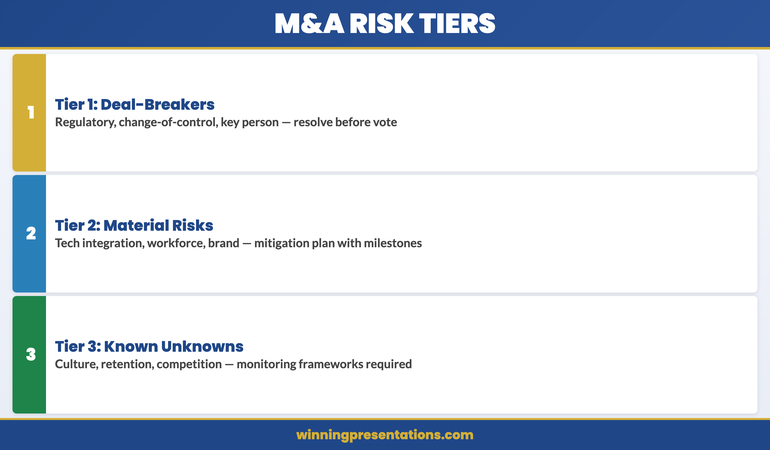
Three-tier integration risk framework for M&A board presentations showing deal-breaker, material, and known-unknown risk categories

The Financial Summary Board Members Actually Read

Your due diligence team has built a financial model with dozens of scenarios, sensitivity analyses, and synergy waterfall charts. The board will not read it in the meeting. They may have glanced at it in the board papers. What they will focus on during your mergers and acquisitions presentation is one slide: the deal economics summary.

This slide needs six numbers and nothing else: the enterprise value, the equity consideration, the implied multiple (and the comparable range), the expected synergy value (net of integration costs), the payback period, and the accretion or dilution impact in year one. These six numbers allow every board member—regardless of their financial fluency—to assess whether the deal makes economic sense relative to the strategic rationale you’ve already presented.

Resist the temptation to include the full synergy bridge, the DCF assumptions, or the sensitivity matrix on this slide. Those belong in the appendix for board members who want to interrogate the model during Q&A. The summary slide exists to establish economic credibility in under sixty seconds. If a board member needs more detail, they’ll ask. If they don’t ask, the summary was sufficient.

A useful benchmark: if you can’t explain the financial case in three sentences that match the six numbers on the slide, the model is too complex for governance-level decision-making. Simplify until the strategic logic and the financial logic align in a single narrative. For a deeper look at how to structure due diligence presentation slides, that guide covers the full deck architecture from term sheet to board vote.

Pre-Empting the Three Governance Questions Every Board Asks

Regardless of the target, the sector, or the deal size, three governance questions appear in virtually every board discussion of an acquisition. If your presentation addresses these proactively, the Q&A session shifts from interrogation to confirmation. If you leave them for the board to raise, you’re playing defence.

Question 1: “What happens if integration takes twice as long as planned?” This is a question about resilience, not pessimism. Build one slide that shows the financial impact of a 24-month integration timeline versus your base case 12-month scenario. Show what changes in terms of synergy realisation, cash flow, and the point at which the deal becomes value-neutral. If the deal still makes strategic sense at double the integration timeline, your governance case is robust. If it doesn’t, you need a different mitigation argument.

Question 2: “Who is accountable for integration delivery?” Boards want a name, not a committee. Your presentation should include a single slide with the integration governance structure: the named integration lead, the reporting line to the board, the milestone framework, and the escalation triggers. Abstract governance charts with dotted lines and matrix structures do not satisfy this question. A board member who asks “who is accountable?” wants to hear a first name and a surname, and they want to know that person has the authority and the bandwidth to deliver.

Question 3: “What’s our walk-away point?” Every acquisition has a price at which the deal no longer makes strategic sense. Your presentation must include a clear statement of the walk-away threshold—the valuation, the regulatory condition, or the due diligence finding that would cause you to recommend withdrawal. Boards respect this discipline. It demonstrates that you’re advising the board, not advocating for a deal you want to close. The investor relations presentation format guide covers similar governance framing for shareholder-facing communications.

Addressing these three questions proactively does more than save time. It signals to the board that you understand governance is about protecting downside, not celebrating upside. That distinction is what separates M&A presentations that earn approval from those that earn further diligence requests.

If you’re building an acquisition deck for the first time, the Executive Slide System provides the structural templates that ensure governance alignment is built into every slide, not bolted on afterwards.
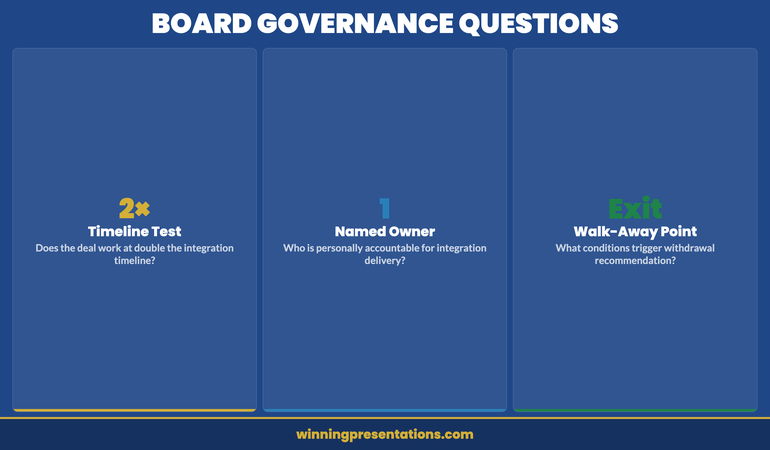
Three governance questions every board asks in M&A presentations covering integration timeline, accountability, and walk-away point

Structuring the Deal Timeline and Decision Architecture

The deal timeline slide is not a Gantt chart. It is a decision map. Each milestone on the timeline should correspond to a board decision point—not a workstream activity. The board doesn’t need to know when the data room closes or when HR harmonisation workshops begin. They need to know when they’ll be asked to make a binding commitment, when regulatory filing occurs, when the shareholder vote is scheduled, and when completion is expected.

Structure the timeline as a horizontal flow with four to six decision gates. At each gate, state the board action required: conditional approval, regulatory filing authorisation, final binding approval, or post-completion review. Between each gate, note the key dependency that must be resolved before the next decision. This gives the board a clear picture of their governance obligations over the deal lifecycle.

A common mistake is presenting the timeline as a fait accompli—as though the deal will inevitably proceed to completion. Boards resist this framing because it removes their governance role. Instead, frame each decision gate as a genuine checkpoint where the board has the authority and the information to proceed, pause, or withdraw. Even if you expect straightforward approval at each gate, the framing matters. It reassures the board that they’re governing the process, not rubber-stamping it.

Include a final slide that specifies the board action requested today. Not “approve the acquisition”—that’s the outcome, not the action. Instead: “Authorise management to proceed to binding due diligence and regulatory pre-filing, with final approval subject to [specific conditions].” This precision gives the board a clear governance mandate and protects them from the perception of having approved a deal prematurely.

Why Most M&A Presentations Lose the Board Before Slide Ten

The pattern is remarkably consistent across sectors. The corporate development team builds a comprehensive deck—thirty to fifty slides covering market analysis, competitive positioning, target financials, synergy detail, integration planning, and risk assessment. They present it sequentially, starting with market context. By slide eight, the chair interrupts. The conversation shifts to the three or four questions the board actually cares about. The remaining forty slides sit untouched.

This happens because most M&A presentations are structured as arguments—building a logical case from context to conclusion. Board presentations should be structured as decisions—starting with the conclusion and supporting it with targeted evidence. The board paper has already provided the argument. The presentation exists to address governance concerns, demonstrate preparedness, and request a specific action.

The structural fix is straightforward. Lead with the recommendation slide: “We recommend the board authorises [specific action].” Follow immediately with the strategic rationale slide. Then the deal economics summary. Then the integration risk framework. Then the governance questions you’ve pre-empted. Then the deal timeline with decision gates. Then the requested board action. That’s seven slides. Everything else is appendix material for Q&A.

If your mergers and acquisitions presentation cannot be delivered in seven slides and fifteen minutes, you’re presenting information, not facilitating a decision. Boards don’t reject deals because the presentation was too short. They reject deals because the presenter couldn’t distinguish between what the board needed to know and what the corporate development team wanted to share. The difference between these two is the difference between a board paper and a board presentation—and understanding when each is appropriate.

The seven-slide structure forces discipline. Every slide earns its place by answering a governance question. Every number connects to a strategic rationale. Every risk has a mitigation and an owner. If you can’t fit the case into seven slides, the deal logic isn’t clear enough yet—and that’s a signal worth heeding before you enter the boardroom.

Build an M&A Deck the Board Approves in One Meeting

Stop building fifty-slide decks the board won’t read. The Executive Slide System gives you the seven-slide governance framework, decision templates, and scenario guides that accelerate board approval—for £39.

Get the System Now → £39

FAQ: Mergers and Acquisitions Presentations

How many slides should an M&A board presentation have?

Seven core slides is the benchmark for governance-level M&A presentations: recommendation, strategic rationale, deal economics, integration risk framework, pre-empted governance questions, deal timeline with decision gates, and requested board action. Supporting detail—financial models, sensitivity analyses, market comparables—belongs in an appendix that board members can reference during Q&A. The core presentation should be deliverable in fifteen minutes, leaving the majority of the meeting for board discussion and governance scrutiny.

Should I present synergy projections in the main deck or the appendix?

The net synergy number belongs on the deal economics summary slide in the main deck—the board needs this to assess whether the acquisition price is justified. The detailed synergy waterfall, individual synergy line items, and the assumptions behind each projection belong in the appendix. Presenting synergy detail in the main deck invites line-by-line scrutiny that derails the governance conversation. Presenting only the net figure keeps the discussion at strategic level whilst giving financially oriented board members the option to probe deeper during Q&A.

What’s the biggest mistake in M&A presentations to the board?

Presenting the deal as though approval is a foregone conclusion. Boards govern by exercising independent judgement, and a presentation that reads as advocacy rather than governance advice triggers resistance. The fix is structural: include a clear walk-away threshold, present genuine alternative options (including “do nothing”), and frame every recommendation as “we advise the board to consider” rather than “we recommend the board approves.” This may sound like a semantic distinction, but it signals respect for the board’s governance role—and boards reward that respect with trust.

The Winning Edge

Weekly insights on executive presentations, slide strategy, and boardroom communication.

Subscribe Free

Building your first M&A deck? Download the Executive Slide System checklist for a quick framework to structure your acquisition presentation.

If your acquisition also involves managing stakeholder anxiety during organisational change, our guide to stakeholder change presentations covers the communication architecture that maintains trust through transition.

About the author

Mary Beth Hazeldine, Owner & Managing Director, Winning Presentations. With 24 years of corporate banking experience at JPMorgan Chase, PwC, Royal Bank of Scotland, and Commerzbank, she advises executives across financial services, healthcare, technology, and government on structuring presentations for high-stakes funding rounds and approvals.

10 Mar 2026
Executive presenting due diligence slides to an acquisition committee in a modern boardroom, navy and gold accents

The Due Diligence Presentation That Almost Killed a £50M Deal (And the 3 Slides That Saved It)

The biotech company had done everything right. Twelve months of preparation. A data room that ran to 4,000 pages. A management team that could answer any question the acquirer threw at them.

Their due diligence presentation was 54 slides.

On slide 11, the lead partner from the acquiring firm put down his pen. “We need to stop,” he said. “I’m still waiting to understand what you actually want us to know.”

The deal didn’t die in the room. But it came close.

Quick answer: A due diligence presentation that works has one job — give the acquirer confidence, fast. That means three structural anchors: a Deal Rationale slide (why this deal makes strategic sense), a Value Story slide (where the value is and why it’s real), and a Risk Map slide (the risks you’ve already found, and what you’ve done about them). Everything else is appendix. Most DD presentations bury these three slides inside 50 others. That’s what kills deals.

📋 Presenting in a due diligence process this month? The Executive Slide System (£39) includes an Investor Presentation template with the exact deal rationale, value story, and risk framing structures described in this article — ready to adapt in 30 minutes.

I’ve sat in a lot of due diligence rooms. On both sides. And the pattern is almost always the same.

The presenting company arrives with a deck that answers every question an acquirer might ask — in the order that felt logical to the team that built it. Market overview. Competitive landscape. Product roadmap. Financial history. Management team. Growth projections. Risk factors. Regulatory environment.

The acquirer’s team arrives with a very short list of questions. Not 54 slides worth. Usually three to five things they need to believe before they’ll proceed.

The mismatch is the problem. The presenting team is answering questions that weren’t asked. The acquirer is waiting for answers to questions that aren’t coming. By slide 20, the room has lost the thread. The acquirer’s attention has shifted to their own notes. The management team is presenting into a vacuum.

The biotech company I mentioned almost lost a £50M acquisition this way. What saved it wasn’t better data. It was rebuilding three slides — and understanding why those three, in that order, are the only slides that actually matter in a due diligence presentation.

The 3-slide structure for due diligence presentations: Deal Rationale, Value Story, and Risk Map with numbered framework

Why Most Due Diligence Presentations Fail

The failure is almost never about the quality of the business. It’s about the structure of the argument.

Most due diligence presentations are built by finance teams and lawyers who are trained to be comprehensive. Comprehensive is correct for a data room. It is the wrong instinct for a live presentation to an acquisition team.

Acquirers in a due diligence meeting are not reading. They are deciding. Their question isn’t “have you answered every question?” Their question is: “Should we keep moving?” Those are fundamentally different questions — and they require fundamentally different slide structures.

When a presentation doesn’t answer the “should we keep moving?” question fast enough, three things happen. The acquirer’s team starts asking clarifying questions earlier than expected. The presenting team interprets questions as scepticism and adds more detail. The room bogs down in specifics before the core argument has landed. That’s when a partner puts their pen down and says, “I’m still waiting to understand what you actually want us to know.”

📈 The Investor Presentation Structure That Moves Acquirers Forward

The Executive Slide System includes the Investor Presentation template — built around the deal rationale, value story, and risk framing structures that get acquisitions approved rather than deferred:

  • The Decision-First slide order for investor and M&A presentations — the exact sequence that answers “should we keep moving?” on slide 3
  • Deal Rationale, Value Story, and Risk Map templates — pre-built and ready to adapt with your specific deal data
  • AI prompt cards to draft investor-ready slide content in under 30 minutes
  • The Executive Summary structure used to get £50M+ acquisition approvals moving in a single meeting
  • Strategic Recommendation and Risk Assessment slide templates — with framing that shows rigour without burying the lead

Get the Executive Slide System → £39

Built from board-level presentations at JPMorgan, RBS, and Commerzbank — including transactions exceeding £50M. Board-ready in 30 minutes or less.

Slide 1: The Deal Rationale Anchor

The first thing an acquisition team needs to see isn’t your financials. It’s the strategic logic. Why does this deal make sense — for them?

Most presenting companies build a market overview slide first. The acquirer already knows the market. They’re in it. What they don’t know yet is: why this company, why now, and what they’d get that they can’t easily build themselves.

The Deal Rationale slide answers those three questions in 90 seconds. It should contain: the strategic gap the acquisition fills for the acquirer, the core capability or asset being acquired (one sentence, not a feature list), and the timing argument (why the window is now, not in two years). That’s it. No company history. No founding story. No market size graphic with a hockey stick.

The biotech company’s original deck opened with a 7-slide company overview. The acquirer’s team had read the IM. They already knew the overview. They were waiting for the deal rationale. When we moved the deal rationale to slide 2 (after a one-slide executive summary), the room shifted. The lead partner picked up his pen.

Need the slide template for this structure? The Executive Slide System includes the Strategic Recommendation and Investor Presentation templates with this exact Deal Rationale framing — including AI prompts to draft each section in minutes.

Get the Executive Slide System → £39

Slide 2: The Value Story

After deal rationale comes the value story — and this is where most presentations overcomplicate things.

The value story is not a financial model. It’s not a revenue bridge or a scenario analysis. Those live in the data room. The value story slide has one job: make the acquirer believe the value is real and accessible.

There are three components to a strong value story in due diligence: the headline number (the value created or to be realised), the proof point (the evidence that makes the number credible — a comparable transaction, a customer contract, a market share figure), and the access mechanism (what happens post-acquisition to unlock it — integration pathway, team retention, IP transfer).

Where presenting teams go wrong is building financial detail without giving the acquirer the narrative to interpret it. A revenue graph without a proof point is just a claim. A growth projection without an access mechanism is just optimism. The value story slide should be the narrative spine that makes the financial model believable — not a replacement for it.

For the biotech deal, the value story had been buried inside a 12-slide financials section. When we extracted it into a single slide with those three components — headline number, proof point (a signed licensing agreement worth £8M in year one), and access mechanism (the key relationship that came with the acquisition, not just the IP) — the acquirer’s team stopped asking sceptical questions and started asking integration questions. That’s the shift you’re looking for.


Before and after comparison of value story slide structure showing what makes acquirers believe the number is real

Slide 3: The Risk Map (The One Nobody Wants to Show)

Most due diligence presentations treat risk like a legal disclosure. They bury it at the back. They minimise it. They qualify everything.

That’s exactly the wrong approach — and acquirers know it.

An acquirer doing due diligence is actively looking for what you’re not showing them. If your risk section looks sanitised, they don’t feel reassured. They feel suspicious. They start digging harder. That’s when due diligence drags into month four and deals fall apart.

The Risk Map slide does the opposite. It puts the three to five most material risks on the table — clearly, with specifics. Not “regulatory risk” as a bullet point, but “EU regulatory approval for the lead compound requires a Phase 3 trial estimated at 18 months.” Then, for each risk: what you’ve already done to mitigate it.

This slide has a counterintuitive effect in the room. When an acquirer sees that you’ve identified the real risks and have mitigation plans in place, their confidence goes up — not down. They’re buying a management team as much as an asset. A team that knows its own risks and has thought through the responses is a team they want to own.

For the biotech company, this was the hardest slide to get agreement on. The finance team wanted to soften it. What went in was specific: three risks, with ownership, timelines, and mitigations. The lead partner read it carefully and then said, “This is the most honest risk page I’ve seen this year.” They moved to term sheet within three weeks.

If you’re preparing for a due diligence presentation, you might also find this article useful: Investor Pitch Deck Template — it covers the structural overlap between an investor deck and a DD presentation, and where the two formats diverge.

🛑 Stop Preparing Slides Your Acquirer Won’t Read

  • The exact deal structure templates that frame acquisitions the way acquirers think — not the way finance teams present
  • Risk framing language that builds confidence instead of triggering deeper scrutiny

Get the Executive Slide System → £39

Used in high-stakes M&A and funding presentations across global banking and consulting.

What Goes to the Appendix (and What Stays Out)

Once you have the three anchor slides — Deal Rationale, Value Story, Risk Map — everything else needs a test before it goes in the main deck.

The test: does this slide help the acquirer decide, or does it help the acquirer verify? If it’s verification material — detailed financial models, product roadmap timelines, team CVs, customer case studies — it belongs in the appendix. If it’s decision material — why this deal, why now, why you — it belongs in the main deck.

Acquirers will ask for appendix material when they need it. They will not dig for decision material buried on slide 38. Front-load the decision content. Let the appendix absorb everything else.

The practical rule: your main deck should not exceed 15 slides. The biotech company’s 54-slide deck restructured to 11 slides and an appendix of 43. The acquirer said they got more out of the 11-slide version than they had from an hour with the original deck.

For a deeper look at how decision-first structure works across different executive scenarios, see: Decision Slide That Gets Yes — the same structural principle applied to internal approvals.

Working on an executive or investor presentation right now? The executive presentation structure framework covers the decision-first ordering principle for high-stakes decks — useful background before using the templates.

PAA: Quick Answers on Due Diligence Presentations

How long should a due diligence presentation be?
A live due diligence presentation should be 10–15 slides in the main deck, with supporting material in the appendix. The goal is to answer the acquirer’s key decision questions — why this deal, why now, where is the value — before going into detail. Anything beyond 15 slides in the main deck means the structure hasn’t been resolved. Move verification material to the appendix.

What slides must be in a due diligence presentation?
Three slides anchor every effective due diligence deck: a Deal Rationale slide (strategic logic for the acquirer), a Value Story slide (where the value is, with proof), and a Risk Map slide (material risks with mitigations already in place). These three answer the only question that matters at this stage: should we keep moving?

Why do acquirers stop reading due diligence decks?
Usually because the deck is structured to answer the presenting company’s questions rather than the acquirer’s. Acquirers want to know: does this deal make strategic sense? Is the value real? What are the material risks? When those answers are buried behind market overviews and company history, attention drops. Put the decision material first.

Is the Executive Slide System Right For You?

✔️ This is for you if:

  • You’re preparing a due diligence, investor, or M&A presentation and need a structured template rather than starting from scratch
  • You’ve had a deal room meeting go flat and suspect the structure — not the data — was the problem
  • You need board-ready slides with clear decision framing and you have less than a week to prepare

❌ This is NOT for you if:

  • You need a full financial model or valuation tool — this is a presentation system, not a financial modelling toolkit
  • Your presentation challenge is speaking confidence rather than slide structure — for that, see When Public Speaking Fear Becomes a Medical Emergency

If you recognised your last deal room in any of the above, the structure isn’t the hard part — it’s having the right templates to implement it quickly under time pressure. That’s what the Executive Slide System is built for.

🏛️ The M&A Slide System Built From Deals, Not Textbooks

The Executive Slide System was built from 24 years inside global financial institutions — including due diligence and acquisition presentations at JPMorgan, PwC, and RBS. Not from theory. From rooms where £50M+ decisions were being made on slides like these:

  • 22 PowerPoint templates including Investor Presentation, Strategic Recommendation, and Risk Assessment — all with Decision-First structure
  • 51 AI prompt cards to draft and refine each slide, including the deal rationale and value story sections from this article
  • 15 scenario playbooks covering M&A, board approval, investor, and executive communication scenarios
  • 6 checklists including the Investor Presentation Checklist — covers the due diligence meeting structure step by step
  • The Executive Summary template that answers the acquirer’s three questions before slide 3

Get the Executive Slide System → £39

Your next due diligence meeting isn’t waiting. Get the framework that keeps acquirers at the table. Board-ready in 30 minutes or less.

Frequently Asked Questions

How is a due diligence presentation different from an investor pitch deck?

An investor pitch deck is designed to generate interest and create a first impression. A due diligence presentation comes after the acquirer or investor has already decided they’re interested — it’s designed to maintain momentum and answer the “should we keep moving?” question. The tone is less persuasive, more transparent. The risk framing that would be softened in a pitch deck should be direct and specific in a DD presentation. The structural logic is similar — decision-first, value-anchored — but the risk section is much more prominent and detailed.

Should the management team or the finance team lead the due diligence presentation?

The management team should lead — with finance supporting on the numbers sections. Acquirers are buying a team as much as an asset. The MD or CEO presenting the deal rationale and value story, and then handing to the CFO for the financials section, sends the right signal about capability and ownership. Presentations that are led entirely by bankers or advisers feel one step removed from the actual business, and acquirers notice.

What happens if the acquirer asks questions our deck doesn’t cover?

That’s the appendix’s job. Any question that goes beyond the 15 slides in your main deck should have an appendix slide ready. Prepare for the top 15–20 questions the acquirer is likely to ask — build corresponding appendix slides, know exactly where they are, and pull them into the conversation seamlessly. A smooth transition to appendix material signals preparation and confidence, not weakness. If you’re looking for a structured way to anticipate executive questions, the Hypothetical Trap framework is directly applicable to due diligence Q&A scenarios.

Can I use the same due diligence presentation for multiple acquirer meetings?

The structure should be consistent, but the Deal Rationale slide should be tailored for each acquirer. The strategic logic for why this acquisition makes sense varies depending on who’s buying. A financial acquirer looking for yield has different strategic priorities from a strategic acquirer looking for market entry. The Value Story and Risk Map can remain largely consistent, but the deal rationale — the 90-second argument for why this deal makes sense for them specifically — needs to be adapted for each room.

📬 The Winning Edge — Weekly Presentation Intelligence

One article per week on executive communication, slide structure, and high-stakes presentation strategy. No fluff, no generic advice.

Subscribe to The Winning Edge

🆓 Free resource: Investor Pitch Deck Checklist — a free guide to strengthen your presentation preparation.

Also published today: if the presentation itself isn’t the problem but the physical symptoms of nerves are, read When Public Speaking Fear Becomes a Medical Emergency. And if you’re facing Q&A from executives who like to test hypotheticals, The Hypothetical Trap covers exactly that.

About the Author

Mary Beth Hazeldine is the Owner & Managing Director of Winning Presentations. With 24 years of corporate banking experience at JPMorgan Chase, PwC, Royal Bank of Scotland, and Commerzbank, she has delivered high-stakes presentations in boardrooms across three continents.

A qualified clinical hypnotherapist and NLP practitioner, Mary Beth combines executive communication expertise with evidence-based techniques for managing presentation anxiety. She has trained thousands of executives and supported presentations for high-stakes funding rounds and approvals.

Book a discovery call | View services