

A cost reduction presentation fails the moment the audience hears it as bad news. The executive who frames budget cuts as strategic reallocation—redirecting resources from diminishing returns to higher-yield investments—earns approval. The one who frames them as austerity earns resistance. Here is how to structure the slides that make savings feel like strategy.
Kwadwo had been asked to present a £3.2 million reduction to the operations budget at the quarterly executive committee meeting. His first draft opened with a waterfall chart showing where every pound would be removed—headcount, travel, external consultants, software licences. He rehearsed it on a Tuesday evening, and his wife—a former operations director herself—listened from the kitchen doorway. “You’ve just told twelve senior people that everything they built last year was wasteful. They’ll spend the entire meeting defending their budgets instead of approving yours.” He rewrote the presentation overnight. The new version opened with a single slide showing the three strategic priorities the CEO had announced in January, followed by a comparison: current spend allocation versus the allocation required to fund those priorities. The £3.2 million wasn’t a cut—it was a reallocation from activities that no longer served the stated strategy to investments that would accelerate it. The executive committee approved the plan in forty minutes. The original version would have triggered forty minutes of arguments.
Building a cost reduction deck for the executive committee? The Executive Slide System includes strategic reframing templates and decision frameworks for high-stakes finance presentations.
Jump to section:
The Reallocation Frame: Why Language Determines Approval
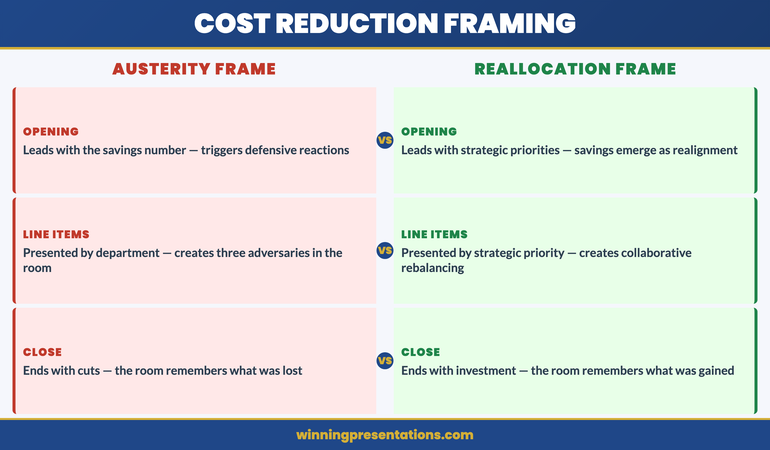
The difference between a cost reduction presentation that earns swift approval and one that triggers prolonged debate is almost entirely a matter of framing. When you present cuts, every line item has a defender in the room. When you present reallocations, every line item has a strategic justification that the audience has already endorsed.
The reallocation frame works because it borrows authority from decisions the executive team has already made. If the CEO announced three strategic priorities at the start of the year, your savings plan should map directly to those priorities. The question shifts from “Why are you cutting my budget?” to “How does our current spend support the strategy we all agreed to?” The first question is personal and adversarial. The second is structural and collaborative.
Build your opening slide around a simple visual: two columns. The left column shows current spend by category. The right column shows the spend allocation required to fund the stated strategic priorities. The gap between the two is your savings target. This single slide does more persuasive work than any waterfall chart because it makes the cuts feel inevitable rather than arbitrary. The audience sees the misalignment and reaches the conclusion before you state it.
Avoid the trap of opening with the savings number. Leading with “We need to find £3.2 million in savings” puts the audience on the defensive immediately. Leading with “The board approved three strategic priorities in January—here’s what it costs to fund them, and here’s where we’re currently spending that money on activities that predate the strategy” creates alignment before the number appears. The savings figure should arrive as a logical consequence of strategic alignment, not as an opening demand.
Frame Your Cost Reduction as Strategic Reallocation
The Executive Slide System gives you reframing templates and decision frameworks—so your savings presentation earns approval instead of resistance.
- ✓ Presentation templates for executive finance scenarios
- ✓ AI prompt cards to build structured decks fast
- ✓ Framework guides for high-stakes decision presentations
Get the Executive Slide System → £39
Designed for executives preparing high-stakes presentations
Connecting Every Saving to a Strategic Priority
The most common failure in cost reduction presentations is presenting savings by department or cost category. When you show a slide that reads “Marketing: -£400K / IT: -£600K / Operations: -£1.2M,” you’ve created three adversaries in the room. The marketing director, the CTO, and the COO are now calculating what they’ll lose, not what the organisation will gain.
The structural fix is to present savings by strategic priority, not by cost centre. Instead of “IT reduction: £600K,” present it as “Digital transformation acceleration: £600K redirected from legacy infrastructure maintenance to cloud migration.” The number is identical. The emotional response is entirely different. The CTO is no longer defending a cut—they’re participating in an investment.
For each savings line, build a three-column structure: the current spend being redirected, the strategic priority it now funds, and the expected return. This converts every line from a loss into an investment thesis. The executive committee is no longer approving cuts. They’re approving a portfolio rebalance. And portfolio rebalancing is the language of strategy, not austerity.
This approach also provides natural defence against the inevitable question: “Why this line item and not another?” When every saving is connected to a strategic priority, the answer is structural rather than political: “We redirected this spend because it was the clearest misalignment with the priorities the board approved in January.” This is a far stronger answer than “We chose this because it had the least operational impact,” which implies the decision was arbitrary and could have been made differently. For more on structuring restructuring presentations that maintain team trust, that guide covers the communication architecture for organisational change.
Addressing the People Impact Without Losing the Room
If your cost reduction includes headcount changes, the room will be thinking about it from the moment you start speaking—regardless of which slide you put it on. Acknowledging the people impact early, directly, and with a clear plan is essential. Burying it in the appendix or saving it for Q&A signals avoidance, and avoidance destroys credibility in executive meetings.
The approach that works is to dedicate one slide—not more—to the people impact framework. State three things: the scope (how many roles are affected), the support plan (redeployment, retraining, enhanced severance), and the timeline (when affected individuals will be informed, by whom, and through what process). This slide should be factual, respectful, and brief. It is not the place for emotional language or corporate euphemisms. “We are reducing thirty-two roles across three departments” is direct and honest. “We are right-sizing our organisation to unlock strategic agility” is evasive and will irritate everyone in the room.
Position this slide after the strategic alignment section and before the implementation timeline. This placement matters. By the time the audience reaches the people impact slide, they’ve already accepted the strategic logic for the reallocation. The question is no longer “should we do this?” but “how do we do this responsibly?” That’s a much more constructive conversation.
If the cost reduction does not involve headcount changes, say so explicitly. A single line—“This reallocation programme does not affect any current roles”—removes the concern that has been lurking in every audience member’s mind since the meeting invitation landed. For guidance on the specific communication challenges when reductions do involve job losses, our guide to redundancy announcement presentations covers the full communication sequence from board approval to individual notifications.
The Implementation Timeline That Builds Confidence
Executive committees approve cost reductions more readily when they can see exactly how and when the savings will materialise. An implementation timeline that shows quarterly milestones—with specific savings targets at each stage—converts an abstract number into a credible delivery plan.
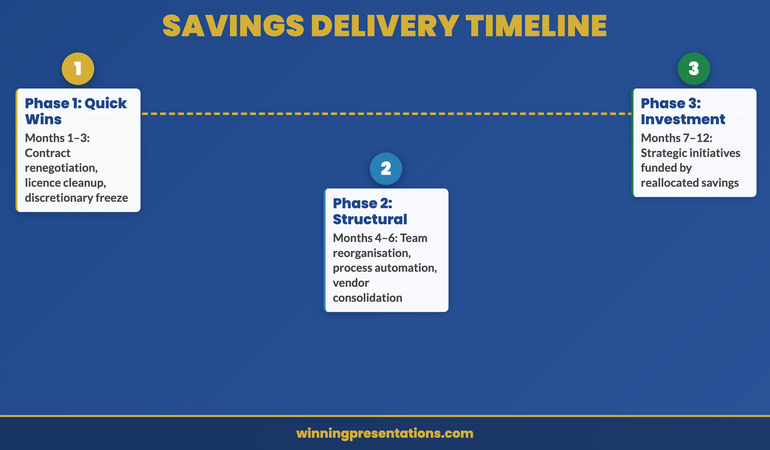
Structure the timeline in three phases. Phase one (months one to three): quick wins that demonstrate momentum. These are savings that require no structural change—contract renegotiations, discretionary spend freezes, duplicate licence elimination. Showing early results builds organisational confidence that the plan is achievable. Phase two (months four to six): structural changes that require planning and coordination—team reorganisations, process automation, vendor consolidation. Phase three (months seven to twelve): strategic investments that the savings fund—the initiatives that connect the cost reduction to the organisation’s growth agenda.
The three-phase structure is important because it tells a story of progression: from discipline to transformation to growth. The committee sees not just where money is being saved, but where it is going. This is the final piece of the reallocation frame. The cost reduction presentation doesn’t end with savings—it ends with investment. And investment is the language of leadership.
If you’re preparing a finance presentation that requires this kind of strategic reframing, the Executive Slide System includes the structural templates that ensure every slide advances the decision, not just the data.
The Governance Slide: Tracking Savings Delivery
The final slide before Q&A should address the question every executive committee member is silently asking: “How will we know this is working?” Present a governance framework that specifies four elements: what will be measured, how often it will be reported, who owns the delivery, and what triggers escalation.
A simple tracking structure works best. Monthly reporting on savings realisation versus target, with a RAG status for each savings line. Quarterly reviews at the executive committee to assess whether the reallocation is achieving its strategic objectives—not just whether the number has been met. An escalation protocol that defines the threshold at which a shortfall triggers a revised plan rather than a request for more time.
This governance slide achieves two things. First, it demonstrates that you’ve thought beyond the approval—you’ve planned the delivery. Second, it gives the committee a reason to approve today rather than requesting further analysis. The governance framework provides the safety net that allows the committee to say yes without feeling they’ve relinquished oversight. In crisis communication contexts where the financial situation demands urgent board-level transparency, our guide to presenting a data breach to the board demonstrates similar governance framing under pressure.
Build a Cost Reduction Deck the Committee Approves Fast
Stop presenting cuts. Start presenting strategic reallocation. The Executive Slide System gives you the templates and frameworks to build savings presentations that earn approval—for £39.
Frequently Asked Questions
Should I present the total savings number on the first slide?
No. Leading with the savings number triggers defensive responses before you’ve established the strategic logic. Open instead with the strategic priorities the organisation has already approved, then show the misalignment between current spend and those priorities. The savings number should arrive as a natural consequence of strategic realignment—typically on the third or fourth slide. By that point, the audience has already accepted the rationale, and the number feels like a logical outcome rather than an arbitrary target.
How do I handle pushback from department heads whose budgets are being cut?
Anticipate it by engaging department heads individually before the presentation. Share the strategic framing privately and ask for their input on implementation—not on whether the cuts should happen. This converts potential adversaries into collaborators. In the meeting itself, if pushback occurs, redirect to the strategic alignment frame: “The question isn’t whether marketing should keep this budget. The question is whether this spend serves the priorities we all committed to in January.” This makes the challenge about strategy, not territory.
What if the cost reduction was mandated from above with no strategic framing?
Create the strategic frame yourself. Even a top-down directive to “reduce costs by fifteen percent” can be connected to organisational priorities. The CEO didn’t mandate the cut in a vacuum—there’s a revenue shortfall, a margin pressure, or a board directive driving it. Find that connection and build your presentation around it. If you can’t identify a strategic link, frame the savings as funding a specific initiative: “This reallocation creates the capacity to invest in [initiative] without requesting additional budget.” The committee will respond better to “we’re funding growth” than “we’re following orders.”
The Winning Edge
Weekly insights on executive presentations, slide strategy, and boardroom communication.
Preparing a savings proposal for the board? Download the Executive Slide System checklist for a quick framework to structure your cost reduction presentation.
If your cost reduction programme also involves presenting to external stakeholders or pitching for new vendor contracts, our guide to vendor selection presentations covers the deck architecture that wins final shortlist meetings.
About the author
Mary Beth Hazeldine, Owner & Managing Director, Winning Presentations. With 24 years of corporate banking experience at JPMorgan Chase, PwC, Royal Bank of Scotland, and Commerzbank, she advises executives across financial services, healthcare, technology, and government on structuring presentations for high-stakes funding rounds and approvals.