Tag: confident speaking

01 Mar 2026
Professional standing composed at podium moments before a high-stakes presentation

Why Confident Presenters Still Get Nervous Before Every Talk

She was voted the best presenter in her division. She’d vomited in the toilets ten minutes earlier.

For three years, a C-suite executive I worked with had a secret ritual: arrive early, find a private bathroom, be sick, rinse her mouth, walk into the boardroom, and deliver a presentation so composed that colleagues asked her how she stayed so calm.

Quick Answer: Confident presenters still get nervous because the nervous system doesn’t distinguish between “good stress” and “bad stress.” Nervousness isn’t a sign that you’re not ready — it’s a sign that your body recognises the stakes. The difference between confident and anxious presenters isn’t the absence of nerves. It’s their relationship with them.

🚨 Presentation this week and the nerves are already building?

Quick check — which of these describes you right now?

  • You’ve presented dozens of times but the dread hasn’t reduced
  • You know you’re good at this — but your body disagrees
  • You’ve tried breathing exercises and they help for about 30 seconds

→ Need the system that changes your nervous system response (not just your mindset)? Get Conquer Speaking Fear (£39)

I was terrified of presenting for five years. Not mildly uncomfortable — physically terrified. Nausea, shaking hands, voice cracking, face flushing. I was a senior professional at a global bank, and I couldn’t stand up in a meeting without my body betraying me.

I assumed confident presenters didn’t feel this way. That one day, the nerves would simply stop.

They didn’t. What changed was my understanding of what nervousness actually is. As a trained clinical hypnotherapist, I eventually learned that trying to eliminate nerves was the problem — not the solution. And that insight changed everything about how I present and how I train others.

Here’s what I wish someone had told me during those five years.

Professional standing composed at podium moments before a high-stakes presentation

The “Confident = Calm” Myth (And Why It Makes Anxiety Worse)

The biggest lie in presentation advice is this: that confident presenters feel calm before they speak.

They don’t.

Nearly every experienced presenter I’ve worked with — CEOs, managing directors, people who present weekly — reports some form of nervousness before significant presentations. I’ve written about this pattern in the context of presentation anxiety before meetings, and the data is consistent. Not stage fright. Not panic. But a heightened state that looks, from the inside, remarkably like anxiety.

The problem with the “confident = calm” myth is that it creates a second layer of distress. You’re not just nervous — you’re nervous about being nervous. “If I were really good at this, I wouldn’t feel this way.”

That thought loop is more damaging than the original nerves.

It makes you interpret a normal physiological response as evidence that something is wrong with you. And every time you step into a meeting room and feel that familiar stomach drop, the loop reinforces itself: Here it is again. I’ll never get past this.

But there’s nothing to “get past.” The response is doing exactly what it’s designed to do.

What’s Actually Happening in Your Nervous System

When you’re about to present something that matters — a board update, a budget request, a pitch to a client — your brain registers the situation as high-stakes. Not dangerous, necessarily. But consequential.

Your sympathetic nervous system activates. Adrenaline releases. Heart rate increases. Muscles tense. Blood flow redirects from your digestive system to your limbs. Your body is preparing you to perform.

This is not malfunction. This is your nervous system doing its job.

The difference between the executive who presents with visible confidence and the one who freezes isn’t the presence or absence of this response. It’s how each person interprets it.

Interpretation A (anxiety spiral): “My heart is racing. I’m going to lose my words. They’ll see I’m nervous. This is going to go badly.”

Interpretation B (performance readiness): “My heart is racing. My body is getting ready. I’ve done this before. The energy will help once I start.”

Same physiology. Completely different experience. And here’s the critical part: Interpretation B isn’t just positive thinking. It’s neurologically accurate. The adrenaline response genuinely improves focus, recall, and vocal projection — if you let it.

When you fight it, the energy turns inward. When you channel it, the energy sharpens your delivery.

Infographic showing the nervous system response flow from trigger through adrenaline to interpretation and performance

Present Without the Adrenaline Hijack

Conquer Speaking Fear is a 30-day programme built from clinical hypnotherapy and NLP — not another “just breathe” course. It’s designed for experienced professionals who present regularly but still dread it.

  • Nervous system regulation techniques that work before, during, and after presentations
  • The reframing protocol that stops the anxiety spiral before it starts
  • Evidence-based approaches from clinical practice, adapted for executive environments
  • Designed for people who’ve tried breathing exercises, CBT, and coaching — and still struggle

Get Conquer Speaking Fear → £39

Created by a clinical hypnotherapist who spent 5 years terrified of presenting — and now trains executives to present with confidence.

The Reframe That Changes Everything

Here’s the single most useful thing I can tell you: stop trying to eliminate the nerves. Start working with them.

Most presentation anxiety advice focuses on suppression. Deep breathing to slow your heart rate. Visualisation to “calm yourself down.” Power poses to “trick your body” into confidence.

These approaches share a common assumption: that nervousness is the problem and calmness is the goal.

But that assumption is wrong.

The real shift happens when you reframe the physiological response from threat to readiness. This isn’t a semantic trick. It’s a genuine change in how your brain processes the signals from your body.

In clinical hypnotherapy, we call this “reappraisal.” Instead of interpreting the racing heart as “I’m panicking,” you practise interpreting it as “I’m activating.” The sensation is identical. The meaning is different. And meaning drives experience.

Once you’ve made this shift — and it takes practice, not just understanding — the pre-presentation nerves become fuel rather than friction. You still feel them. But they stop controlling you.

This is why experienced speakers still feel anxious. They haven’t eliminated the response. They’ve changed what it means.

Tired of the anxiety loop before every presentation?

Conquer Speaking Fear teaches the reappraisal technique in a structured 30-day format — so it becomes automatic, not something you have to remember mid-panic.

Get Conquer Speaking Fear → £39

Three Techniques Experienced Presenters Use (That Nobody Talks About)

These aren’t from a textbook. They’re from working with thousands of executives who present under pressure.

1. The pre-presentation anchor. Experienced presenters create a physical association with their “presenting self.” It might be adjusting their watch, touching their pen, or standing in a specific posture. This isn’t superstition — it’s a conditioned response. Over time, the physical action triggers the mental state. It’s the same principle behind any well-rehearsed routine.

2. The 90-second rule. Nearly every presenter I’ve trained reports that the worst anxiety lasts approximately 90 seconds after they start speaking. Once they’re past the first few sentences, the nervous system recalibrates. Experienced presenters know this. They design their opening to be so well-rehearsed that they can deliver it on autopilot while the adrenaline settles. The first 90 seconds are a bridge, not a performance.

3. The post-presentation debrief. Anxious presenters replay what went wrong. Confident presenters run a structured debrief: What worked? What would I change? What question caught me off guard? This isn’t about positivity. It’s about replacing the emotional replay with a factual review. Over time, it trains the brain to process presentations as learning events, not threat events.

Infographic showing three techniques experienced presenters use with comparison of anxious versus experienced approaches

The Danger of Chasing “No Nerves”

Let me be direct about something: if your goal is to feel nothing before you present, you’re chasing the wrong outcome.

Presenters who feel nothing aren’t calm — they’re disengaged. (This is related to what I call the confidence slipping pattern — where suppression creates a different problem.) The flatness that comes from emotional suppression shows in delivery: monotone voice, low energy, disconnected eye contact. Audiences can feel it, even if they can’t name it.

The executives I work with who present most effectively describe their pre-presentation state as “alert.” Not panicked. Not calm. Alert. Their system is activated, their focus is sharp, and their energy is slightly elevated. That state produces better delivery, better Q&A handling, and more persuasive communication than artificial calmness ever could.

So the question isn’t “how do I stop being nervous?” The question is “how do I use this energy instead of fighting it?”

That shift — from elimination to utilisation — is the difference between someone who dreads every presentation and someone who walks in nervous but ready.

People Also Ask:

Do professional speakers get nervous?
Yes. Most professional speakers report some level of activation before they speak, even after years of experience. The difference is that they’ve learned to interpret the sensation as performance readiness rather than anxiety. The nerves don’t disappear — the relationship with them changes.

Is it normal to feel sick before a presentation?
Physical symptoms like nausea, shaking, and increased heart rate are common nervous system responses to high-stakes situations. They don’t indicate a disorder or weakness. They indicate that your brain has correctly identified the situation as important. If physical symptoms are severe or debilitating, techniques from clinical hypnotherapy can help regulate the response. (See also: beta blockers for public speaking — why medication alone rarely solves it.)

Why do I still get anxious even though I’ve presented many times?
Experience reduces the intensity of the response for most people, but it rarely eliminates it entirely. This is because the nervous system responds to perceived stakes, not to familiarity. A high-stakes board presentation will trigger activation regardless of how many low-stakes team meetings you’ve done. The key is learning to work with the activation rather than against it.

Stop Dreading Every Presentation on Your Calendar

The 30-day programme inside Conquer Speaking Fear rewires how your nervous system responds to presenting — so you walk in ready, not wrecked.

Get Conquer Speaking Fear → £39

Evidence-based techniques from clinical hypnotherapy and NLP, adapted for high-pressure executive environments.

Is Conquer Speaking Fear Right For You?

This is for you if:

  • You present regularly but still experience significant anxiety before each presentation
  • You’ve tried breathing techniques, coaching, or CBT and the anxiety keeps returning
  • You’re a competent professional whose nervousness doesn’t match your actual ability
  • You want to change your relationship with nerves, not just suppress the symptoms

This is NOT for you if:

  • You present rarely and the nervousness is situational rather than persistent
  • Your anxiety is mild and settles quickly once you begin speaking — this article is sufficient.
  • Your primary challenge is slide structure and content — a presentation skills course focused on anxiety is not what you need right now.

If the anxiety is recurring and does not improve with experience, Conquer Speaking Fear is the structured system for breaking that cycle.

📊 Want the slides too?

Preparation reduces anxiety. The Executive Slide System (£39) includes confident-presenter templates designed to minimise preparation stress.

Frequently Asked Questions

Can you be confident and still have presentation anxiety?

Absolutely. Confidence and anxiety are not opposites. Confidence is a belief in your ability to perform. Anxiety is a nervous system response to perceived stakes. Many highly confident professionals experience significant anxiety before presentations — and perform excellently despite it. The two can coexist, and in many cases, the anxiety actually sharpens performance.

How long does it take for presentation nerves to go away?

For most people, the most intense nerves subside within the first 90 seconds of speaking. The pre-presentation anxiety may never fully disappear — and that’s normal. What changes with experience and proper technique is the intensity and duration. With nervous system regulation techniques, most professionals notice a significant shift within 2-4 weeks of consistent practice.

Should I tell my audience I’m nervous?

Generally, no. Audiences rarely notice nervousness as much as you feel it. Announcing your nerves shifts the audience’s attention from your message to your state, which increases self-consciousness. The exception is if vulnerability serves your message — for example, if you’re speaking about overcoming fear. Otherwise, channel the energy into your delivery and let the audience experience your content, not your anxiety.

📬 The Winning Edge Newsletter

Weekly techniques for executives who present under pressure. Evidence-based, not motivational. One actionable insight every week.

Subscribe Free →

🆓 Want to start free? Download the Executive Presentation Checklist first.

Read next: If your board presentation is the source of the nerves, read how to structure your first board presentation as a new director — the structure alone will reduce the anxiety. And if the Q&A is what you’re dreading, see the Q&A preparation checklist senior executives use.

About the Author

Mary Beth Hazeldine is the Owner & Managing Director of Winning Presentations. With 24 years of corporate banking experience at JPMorgan Chase, PwC, Royal Bank of Scotland, and Commerzbank, she has delivered high-stakes presentations in boardrooms across three continents.

A qualified clinical hypnotherapist and NLP practitioner, Mary Beth combines executive communication expertise with evidence-based techniques for managing presentation anxiety. She advises executives across financial services, healthcare, technology, and government on building the composure that holds under sustained pressure.

Book a discovery call | View services

Your next presentation is on the calendar. The nerves will come. They always do. But now you know what they actually are — and that changes everything.

28 Jan 2026
I Used to Repeat Myself Three Times in Every Meeting. Then I Learned This. How to Project Your Voice Without Shouting (The Technique Most People Get Wrong) "Sorry, could you say that again?" I heard those words in every meeting for the first three years of my banking career. I'd make a point. Silence. Someone would lean in. I'd repeat myself — louder this time, voice straining. By the third repetition, whatever authority I had was gone. The advice I got? "Just speak up." "Be more confident." "Project from your diaphragm." None of it worked. Because how to project your voice has almost nothing to do with volume — and everything to do with where the sound actually comes from. Quick Answer: Voice projection isn't about speaking louder — it's about resonance. When you breathe from your diaphragm (not your chest), relax your throat, and direct sound forward, your voice carries naturally without strain. Most quiet speakers are chest-breathing and tensing their throat, which traps sound. Fix the breathing, and the voice follows. 🎤 Need to Be Heard in a Meeting Today? Try This 30-Second Reset: Before you speak: Take one slow breath into your belly (not chest) — feel your stomach expand Drop your shoulders — tension rises to throat when shoulders are tight Speak on the exhale — let the breath carry the sound out Aim your voice at the back wall — not at the person nearest you This isn't about being louder. It's about letting your natural voice come through instead of trapping it. In This Article: Why Your Voice Doesn't Carry (It's Not What You Think) The Difference Between Volume and Resonance The 3 Physical Shifts That Change Everything The Anxiety Connection Most People Miss Voice Projection on Zoom and Teams FAQ Why Your Voice Doesn't Carry (It's Not What You Think) The turning point came during a presentation skills workshop — not a voice training course. The facilitator watched me present for 60 seconds, then stopped me. "You're breathing into your chest," she said. "Your shoulders are up by your ears. Your throat is tight. No wonder your voice doesn't carry — you're strangling it before it leaves your mouth." She was right. Every time I got nervous (which was constantly), my body did three things automatically: Shallow chest breathing (less air = less power) Shoulders rising toward ears (tension travels up) Throat tightening (voice gets thin and trapped) I wasn't speaking quietly because I was timid. I was speaking quietly because anxiety was physically constricting my voice. The fix wasn't "speak louder." It was learning to release the tension so my natural voice could come through. The Difference Between Volume and Resonance Here's the distinction that changed everything for me: Volume is how loud the sound is at the source — pushing more air, straining your vocal cords. Resonance is how the sound vibrates and carries — using your chest, throat, and head as amplifiers. When you try to "speak up" by increasing volume, you strain. Your voice sounds forced. You tire quickly. And paradoxically, a strained voice often carries less well than a relaxed one. When you speak with resonance, your voice fills the room naturally. You don't feel like you're shouting. Listeners don't feel like they're being shouted at. The sound just... arrives. Think of the difference between a speaker who sounds effortlessly authoritative versus one who sounds like they're trying too hard. That's resonance versus volume. How can I project my voice without yelling? Project your voice by focusing on resonance, not volume. Breathe from your diaphragm (belly expands, not chest), relax your throat and jaw, and direct sound forward as if speaking to someone at the back of the room. This creates natural carrying power without strain. Yelling pushes air harder; projection uses your body as an amplifier. ⭐ Voice Problems Often Start With Anxiety If your voice gets quiet, tight, or shaky when you're nervous, the fix isn't vocal exercises — it's addressing what's causing the tension in the first place. Conquer Speaking Fear gives you the complete system for rewiring your nervous system response to speaking situations. What's inside: The "Calm Command" protocol for pre-presentation anxiety Breathing techniques that release throat tension (not just "breathe deep") How to reset your nervous system in 60 seconds The mental rehearsal method that builds lasting confidence Get Conquer Speaking Fear → £39 Created by a qualified clinical hypnotherapist who spent 5 years terrified of presenting. Instant download. The 3 Physical Shifts That Change Everything Voice projection comes down to three physical changes. Get these right, and your voice carries naturally: Shift #1: Diaphragmatic Breathing Most people breathe into their chest — especially when nervous. Chest breathing is shallow and gives you less air to work with. Your voice runs out of fuel mid-sentence. Diaphragmatic breathing means breathing into your belly. When you inhale, your stomach should expand outward. Your chest and shoulders stay relatively still. Try this now: Place one hand on your chest, one on your belly. Breathe in slowly. Which hand moves first? If it's your chest, you're chest-breathing. To fix it: Exhale completely first. Then let the inhale happen naturally — it will go deeper. Practice until belly-first breathing becomes automatic. For a deeper dive on breathing for presentations, see our guide to presentation breathing techniques. Shift #2: Release Throat Tension When you're nervous, your throat tightens. It's a primitive protective response — the body preparing for threat. But a tight throat traps sound and makes your voice thin and strained. To release throat tension: Yawn (seriously) — this opens the throat naturally Hum gently for 10 seconds — you should feel vibration in your chest Drop your jaw slightly — most people clench without realising Relax your tongue — let it rest at the bottom of your mouth Before important meetings, I still do a few gentle hums in private. It's the fastest way to open up the vocal pathway. Shift #3: Direct Sound Forward Many quiet speakers direct their voice downward — toward their notes, their laptop, the table. Sound goes where you send it. Instead, imagine you're speaking to someone at the back of the room. Not shouting at them — just including them in the conversation. Your voice will naturally carry further without strain. In a meeting room, pick a point on the far wall and speak toward it. On Zoom, speak toward your camera as if the listener is sitting a few meters behind your screen. Why is my voice so quiet when I speak? A quiet voice usually comes from one of three causes: shallow chest breathing (not enough air), throat tension (voice gets trapped), or directing sound downward instead of outward. All three are often triggered by nervousness. When you're anxious, your body tenses up — and a tense body produces a thin, quiet voice. Address the physical tension, and your natural voice volume returns. Nervous tension killing your voice? Fix the root cause. Get Conquer Speaking Fear → £39 The Anxiety Connection Most People Miss Here's what vocal coaches rarely tell you: for most professionals, voice projection problems are anxiety problems in disguise. When your nervous system perceives threat (and yes, a boardroom full of executives counts), it triggers a cascade of physical responses: Breathing becomes shallow and rapid Muscles tense — including throat, jaw, and shoulders Blood flow shifts away from non-essential functions Fine motor control decreases Your quiet, shaky voice isn't a skill problem. It's your body's threat response showing up in your vocal cords. This is why "just speak up" doesn't work. You can't willpower your way past a nervous system response. You have to work with your body, not against it. The most effective approach combines the physical techniques (breathing, throat release, direction) with methods that calm the underlying anxiety response. When you're not fighting your nervous system, your voice has room to come through. If your voice also shakes when you're nervous, see our specific guide on voice shaking when speaking. ⭐ Stop Fighting Your Nervous System Conquer Speaking Fear teaches you to work with your body's response instead of against it — so your voice comes through naturally, without strain or force. The system includes: Pre-presentation protocols that calm your nervous system In-the-moment resets when anxiety spikes Long-term rewiring techniques for lasting change The hypnotherapist's approach to speaking confidence Get Conquer Speaking Fear → £39 The same techniques I use with private clients. Instant digital download. Voice Projection on Zoom and Teams Virtual meetings add a layer of complexity. Your microphone captures sound differently than human ears in a room. Here's how to adapt: Microphone positioning matters more than volume Speaking louder into a badly positioned mic just creates distortion. Position your microphone 6-8 inches from your mouth, slightly below chin level. Let the mic do the amplification work. Test your levels before important calls Both Zoom and Teams have audio testing features. Use them. Many "quiet" speakers on calls simply have their input levels set too low. Speak toward the camera, not the screen Just like directing sound to the back of a room, speak toward your camera. This creates better mic pickup and — as a bonus — better eye contact with viewers. The resonance principles still apply Diaphragmatic breathing, throat release, and forward direction all improve your virtual presence. A resonant voice sounds more authoritative through speakers, not less. For complete guidance on virtual presence, see our guide to looking confident when presenting. How do speakers project their voice? Professional speakers project their voice through three techniques: diaphragmatic breathing (breathing into the belly for more air support), releasing throat and jaw tension (so sound isn't trapped), and directing their voice outward toward the back of the room. This creates resonance — natural carrying power — rather than strained volume. Most also manage their anxiety, since nervousness causes the physical tension that kills projection. Ready to speak with natural authority? Get Conquer Speaking Fear → £39 The Practice Routine That Builds Lasting Change These techniques work immediately, but lasting change requires practice. Here's the 5-minute daily routine I recommend: Morning (2 minutes): 10 belly breaths (hand on stomach, feel it expand) 30 seconds of gentle humming (feel chest vibration) Speak one sentence out loud, directing voice across the room Before any meeting (30 seconds): One slow belly breath Drop shoulders Quick throat release (small yawn or hum) First words aimed at far wall/back of camera Within 2-3 weeks of consistent practice, the new patterns start to become automatic. Within 2-3 months, they're your default. ⭐ The Complete System for Speaking Confidence Voice projection is one piece. Conquer Speaking Fear gives you the complete system — from managing pre-presentation nerves to rewiring your long-term relationship with speaking situations. Everything included: The "Calm Command" pre-presentation protocol Breathing and body techniques that release tension In-the-moment anxiety resets Mental rehearsal methods for lasting confidence The hypnotherapist's approach to fear rewiring Get Conquer Speaking Fear → £39 Instant download. Created from clinical hypnotherapy training and 24 years of corporate experience. Frequently Asked Questions Will this work if my voice is naturally soft? Yes. "Naturally soft" voices are almost always under-projected voices — not permanently quiet voices. When you breathe properly and release tension, even traditionally soft voices carry well. You're not trying to sound like a drill sergeant; you're trying to let your natural voice come through without restriction. Most people are surprised by how much presence their voice has when it's not being strangled by tension. Does voice projection work on Zoom and Teams? Absolutely — and it might matter even more virtually. Microphones don't compensate for mumbling or trailing off the way human listeners sometimes do. The resonance techniques (diaphragmatic breathing, open throat, forward direction) all translate to virtual settings. Pair them with proper mic positioning and input levels for best results. How long does it take to see results? The 30-second reset technique works immediately — try it in your next meeting. Building lasting change takes longer: 2-3 weeks of daily practice to start feeling natural, 2-3 months to become your default. The key is consistency. Five minutes of daily practice beats an hour once a week. What if my voice still shakes when I'm nervous? Voice shaking is a specific anxiety symptom that requires targeted techniques. The diaphragmatic breathing helps, but if shaking persists, you likely need to address the underlying nervous system response more directly. That's where the anxiety-management components of Conquer Speaking Fear come in — it's designed specifically for professionals whose physical symptoms don't respond to "just relax" advice. Get Weekly Speaking Confidence Insights Techniques for projecting presence, managing nerves, and speaking with authority — from a clinical hypnotherapist with 24 years in corporate banking. Subscribe to The Winning Edge → 📋 Free Resource: 7 Presentation Frameworks Structure your next presentation with proven frameworks — so you can focus on delivery instead of figuring out what comes next. Download Free Frameworks → Your Next Step The next time you need to speak up in a meeting: Take one belly breath before you start Drop your shoulders Aim your voice at the back wall You'll feel the difference immediately. And so will everyone in the room. P.S. Voice projection matters most in high-stakes situations. If you're presenting for approval, I wrote about the pre-meeting alignment strategy that gets decisions made before you even open your slides. P.P.S. If you're spending too long building presentations, check out how to cut presentation creation time without cutting quality — the system approach that saves hours every week. About Mary Beth Hazeldine Qualified clinical hypnotherapist, NLP practitioner, and Owner of Winning Presentations. I spent 5 years terrified of presenting — voice quiet, hands shaking, avoiding every speaking opportunity I could. Learning to project my voice was part of a larger journey that changed my career. Now I help professionals find their voice, literally and figuratively.

How to Project Your Voice Without Shouting (The Technique Most People Get Wrong)

“Sorry, could you say that again?”

I heard those words in every meeting for the first three years of my banking career. I’d make a point. Silence. Someone would lean in. I’d repeat myself — louder this time, voice straining. By the third repetition, whatever authority I had was gone.

The advice I got? “Just speak up.” “Be more confident.” “Project from your diaphragm.”

None of it worked. Because how to project your voice has almost nothing to do with volume — and everything to do with where the sound actually comes from.

Quick Answer: Voice projection isn’t about speaking louder — it’s about resonance. When you breathe from your diaphragm (not your chest), relax your throat, and direct sound forward, your voice carries naturally without strain. Most quiet speakers are chest-breathing and tensing their throat, which traps sound. Fix the breathing, and the voice follows.

🎤 Need to Be Heard in a Meeting Today? Try This 30-Second Reset:

  1. Before you speak: Take one slow breath into your belly (not chest) — feel your stomach expand
  2. Drop your shoulders — tension rises to throat when shoulders are tight
  3. Speak on the exhale — let the breath carry the sound out
  4. Aim your voice at the back wall — not at the person nearest you

This isn’t about being louder. It’s about letting your natural voice come through instead of trapping it.

Why Your Voice Doesn’t Carry (It’s Not What You Think)

The turning point came during a presentation skills workshop — not a voice training course.

The facilitator watched me present for 60 seconds, then stopped me. “You’re breathing into your chest,” she said. “Your shoulders are up by your ears. Your throat is tight. No wonder your voice doesn’t carry — you’re strangling it before it leaves your mouth.”

She was right. Every time I got nervous (which was constantly), my body did three things automatically:

  • Shallow chest breathing (less air = less power)
  • Shoulders rising toward ears (tension travels up)
  • Throat tightening (voice gets thin and trapped)

I wasn’t speaking quietly because I was timid. I was speaking quietly because anxiety was physically constricting my voice.

The fix wasn’t “speak louder.” It was learning to release the tension so my natural voice could come through.

The Difference Between Volume and Resonance

Here’s the distinction that changed everything for me:

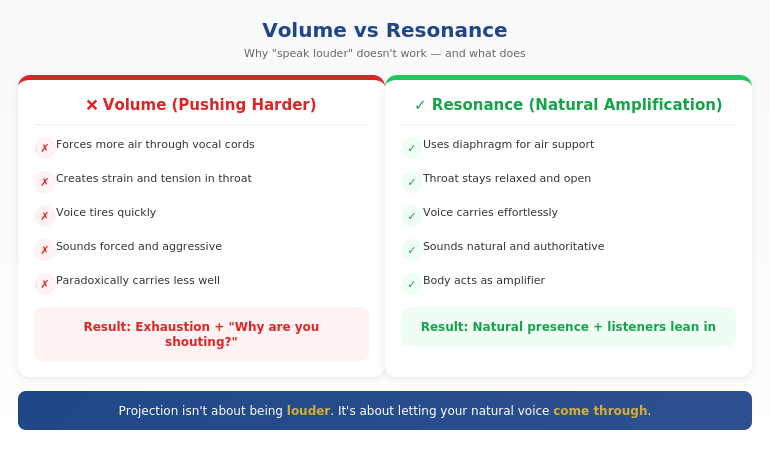
Volume is how loud the sound is at the source — pushing more air, straining your vocal cords.

Resonance is how the sound vibrates and carries — using your chest, throat, and head as amplifiers.

When you try to “speak up” by increasing volume, you strain. Your voice sounds forced. You tire quickly. And paradoxically, a strained voice often carries less well than a relaxed one.

When you speak with resonance, your voice fills the room naturally. You don’t feel like you’re shouting. Listeners don’t feel like they’re being shouted at. The sound just… arrives.

Think of the difference between a speaker who sounds effortlessly authoritative versus one who sounds like they’re trying too hard. That’s resonance versus volume.

How can I project my voice without yelling?

Project your voice by focusing on resonance, not volume. Breathe from your diaphragm (belly expands, not chest), relax your throat and jaw, and direct sound forward as if speaking to someone at the back of the room. This creates natural carrying power without strain. Yelling pushes air harder; projection uses your body as an amplifier.

Diagram showing volume vs resonance: volume creates strain and thin sound, resonance creates natural carrying power using diaphragm breathing

⭐ Voice Problems Often Start With Anxiety

If your voice gets quiet, tight, or shaky when you’re nervous, the fix isn’t vocal exercises — it’s addressing what’s causing the tension in the first place. Conquer Speaking Fear gives you the complete system for rewiring your nervous system response to speaking situations.

What’s inside:

  • The “Calm Command” protocol for pre-presentation anxiety
  • Breathing techniques that release throat tension (not just “breathe deep”)
  • How to reset your nervous system in 60 seconds
  • The mental rehearsal method that builds lasting confidence

Get Conquer Speaking Fear → £39

Created by a qualified clinical hypnotherapist who spent 5 years terrified of presenting. Instant download.

The 3 Physical Shifts That Change Everything

Voice projection comes down to three physical changes. Get these right, and your voice carries naturally:

Shift #1: Diaphragmatic Breathing

Most people breathe into their chest — especially when nervous. Chest breathing is shallow and gives you less air to work with. Your voice runs out of fuel mid-sentence.

Diaphragmatic breathing means breathing into your belly. When you inhale, your stomach should expand outward. Your chest and shoulders stay relatively still.

Try this now: Place one hand on your chest, one on your belly. Breathe in slowly. Which hand moves first? If it’s your chest, you’re chest-breathing.

To fix it: Exhale completely first. Then let the inhale happen naturally — it will go deeper. Practice until belly-first breathing becomes automatic.

For a deeper dive on breathing for presentations, see our guide to presentation breathing techniques.

Shift #2: Release Throat Tension

When you’re nervous, your throat tightens. It’s a primitive protective response — the body preparing for threat. But a tight throat traps sound and makes your voice thin and strained.

To release throat tension:

  • Yawn (seriously) — this opens the throat naturally
  • Hum gently for 10 seconds — you should feel vibration in your chest
  • Drop your jaw slightly — most people clench without realising
  • Relax your tongue — let it rest at the bottom of your mouth

Before important meetings, I still do a few gentle hums in private. It’s the fastest way to open up the vocal pathway.

Shift #3: Direct Sound Forward

Many quiet speakers direct their voice downward — toward their notes, their laptop, the table. Sound goes where you send it.

Instead, imagine you’re speaking to someone at the back of the room. Not shouting at them — just including them in the conversation. Your voice will naturally carry further without strain.

In a meeting room, pick a point on the far wall and speak toward it. On Zoom, speak toward your camera as if the listener is sitting a few meters behind your screen.

Why is my voice so quiet when I speak?

A quiet voice usually comes from one of three causes: shallow chest breathing (not enough air), throat tension (voice gets trapped), or directing sound downward instead of outward. All three are often triggered by nervousness. When you’re anxious, your body tenses up — and a tense body produces a thin, quiet voice. Address the physical tension, and your natural voice volume returns.

Nervous tension killing your voice? Fix the root cause.

Get Conquer Speaking Fear → £39

The Anxiety Connection Most People Miss

Here’s what vocal coaches rarely tell you: for most professionals, voice projection problems are anxiety problems in disguise.

When your nervous system perceives threat (and yes, a boardroom full of executives counts), it triggers a cascade of physical responses:

  • Breathing becomes shallow and rapid
  • Muscles tense — including throat, jaw, and shoulders
  • Blood flow shifts away from non-essential functions
  • Fine motor control decreases

Your quiet, shaky voice isn’t a skill problem. It’s your body’s threat response showing up in your vocal cords.

This is why “just speak up” doesn’t work. You can’t willpower your way past a nervous system response. You have to work with your body, not against it.

The most effective approach combines the physical techniques (breathing, throat release, direction) with methods that calm the underlying anxiety response. When you’re not fighting your nervous system, your voice has room to come through.

If your voice also shakes when you’re nervous, see our specific guide on voice shaking when speaking.

The anxiety-voice connection: threat response triggers shallow breathing, throat tension, and muscle tightening, which creates thin quiet voice

⭐ Stop Fighting Your Nervous System

Conquer Speaking Fear teaches you to work with your body’s response instead of against it — so your voice comes through naturally, without strain or force.

The system includes:

  • Pre-presentation protocols that calm your nervous system
  • In-the-moment resets when anxiety spikes
  • Long-term rewiring techniques for lasting change
  • The hypnotherapist’s approach to speaking confidence

Get Conquer Speaking Fear → £39

The same techniques I use with private clients. Instant digital download.

Voice Projection on Zoom and Teams

Virtual meetings add a layer of complexity. Your microphone captures sound differently than human ears in a room. Here’s how to adapt:

Microphone positioning matters more than volume

Speaking louder into a badly positioned mic just creates distortion. Position your microphone 6-8 inches from your mouth, slightly below chin level. Let the mic do the amplification work.

Test your levels before important calls

Both Zoom and Teams have audio testing features. Use them. Many “quiet” speakers on calls simply have their input levels set too low.

Speak toward the camera, not the screen

Just like directing sound to the back of a room, speak toward your camera. This creates better mic pickup and — as a bonus — better eye contact with viewers.

The resonance principles still apply

Diaphragmatic breathing, throat release, and forward direction all improve your virtual presence. A resonant voice sounds more authoritative through speakers, not less.

For complete guidance on virtual presence, see our guide to looking confident when presenting.

How do speakers project their voice?

Professional speakers project their voice through three techniques: diaphragmatic breathing (breathing into the belly for more air support), releasing throat and jaw tension (so sound isn’t trapped), and directing their voice outward toward the back of the room. This creates resonance — natural carrying power — rather than strained volume. Most also manage their anxiety, since nervousness causes the physical tension that kills projection.

Ready to speak with natural authority?

Get Conquer Speaking Fear → £39

The Practice Routine That Builds Lasting Change

These techniques work immediately, but lasting change requires practice. Here’s the 5-minute daily routine I recommend:

Morning (2 minutes):

  • 10 belly breaths (hand on stomach, feel it expand)
  • 30 seconds of gentle humming (feel chest vibration)
  • Speak one sentence out loud, directing voice across the room

Before any meeting (30 seconds):

  • One slow belly breath
  • Drop shoulders
  • Quick throat release (small yawn or hum)
  • First words aimed at far wall/back of camera

Within 2-3 weeks of consistent practice, the new patterns start to become automatic. Within 2-3 months, they’re your default.

⭐ The Complete System for Speaking Confidence

Voice projection is one piece. Conquer Speaking Fear gives you the complete system — from managing pre-presentation nerves to rewiring your long-term relationship with speaking situations.

Everything included:

  • The “Calm Command” pre-presentation protocol
  • Breathing and body techniques that release tension
  • In-the-moment anxiety resets
  • Mental rehearsal methods for lasting confidence
  • The hypnotherapist’s approach to fear rewiring

Get Conquer Speaking Fear → £39

Instant download. Created from clinical hypnotherapy training and 24 years of corporate experience.

Frequently Asked Questions

Will this work if my voice is naturally soft?

Yes. “Naturally soft” voices are almost always under-projected voices — not permanently quiet voices. When you breathe properly and release tension, even traditionally soft voices carry well. You’re not trying to sound like a drill sergeant; you’re trying to let your natural voice come through without restriction. Most people are surprised by how much presence their voice has when it’s not being strangled by tension.

Does voice projection work on Zoom and Teams?

Absolutely — and it might matter even more virtually. Microphones don’t compensate for mumbling or trailing off the way human listeners sometimes do. The resonance techniques (diaphragmatic breathing, open throat, forward direction) all translate to virtual settings. Pair them with proper mic positioning and input levels for best results.

How long does it take to see results?

The 30-second reset technique works immediately — try it in your next meeting. Building lasting change takes longer: 2-3 weeks of daily practice to start feeling natural, 2-3 months to become your default. The key is consistency. Five minutes of daily practice beats an hour once a week.

What if my voice still shakes when I’m nervous?

Voice shaking is a specific anxiety symptom that requires targeted techniques. The diaphragmatic breathing helps, but if shaking persists, you likely need to address the underlying nervous system response more directly. That’s where the anxiety-management components of Conquer Speaking Fear come in — it’s designed specifically for professionals whose physical symptoms don’t respond to “just relax” advice.

Get Weekly Speaking Confidence Insights

Techniques for projecting presence, managing nerves, and speaking with authority — from a clinical hypnotherapist with 24 years in corporate banking.

Subscribe to The Winning Edge →

📋 Free Resource: 7 Presentation Frameworks

Structure your next presentation with proven frameworks — so you can focus on delivery instead of figuring out what comes next.

Download Free Frameworks →

Your Next Step

The next time you need to speak up in a meeting:

  1. Take one belly breath before you start
  2. Drop your shoulders
  3. Aim your voice at the back wall

You’ll feel the difference immediately. And so will everyone in the room.

P.S. Voice projection matters most in high-stakes situations. If you’re presenting for approval, I wrote about the pre-meeting alignment strategy that gets decisions made before you even open your slides.

P.P.S. If you’re spending too long building presentations, check out how to cut presentation creation time without cutting quality — the system approach that saves hours every week.

About Mary Beth Hazeldine
Qualified clinical hypnotherapist, NLP practitioner, and Owner of Winning Presentations. I spent 5 years terrified of presenting — voice quiet, hands shaking, avoiding every speaking opportunity I could. Learning to project my voice was part of a larger journey that changed my career. Now I help professionals find their voice, literally and figuratively.