

Your 90-day presentation is the moment you move from onboarding to leadership authority. Structure it correctly, and you’ll establish credibility that shapes your entire tenure. Get it wrong, and you risk appearing unprepared or unrealistic.
The Story: Tomás Takes the Stage
Tomás had spent four years building relationships across his organisation before promotion. When he was named Vice President of Commercial Operations at a mid-sized pharmaceutical firm, his peers expected he’d walk into that boardroom knowing exactly what needed fixing. Instead, Tomás sat silent for the first six weeks—listening to sales team frustrations, observing regulatory handoffs, reviewing contract approvals that were taking far too long.
On day 89, he faced the C-suite and board. Not with a 100-day plan ready to execute, but with five core observations and three strategic recommendations rooted in what he’d actually learned. His presentation wasn’t polished theatre. It was structured evidence of thoughtfulness. By the end of that 45-minute session, the CFO had already committed budget to pilot his first initiative. The CEO asked him to lead a cross-functional task force by week two.
The difference wasn’t that Tomás had all the answers. It was that he’d structured his first major update as a credible peer raising intelligent questions—not a new executive trying to prove his worth on day one.
Preparing your first leadership update? The Executive Slide System includes templates and frameworks built for exactly this kind of executive transition moment.
Jump to Section
- Why the 90-Day Presentation Defines Your Leadership Trajectory
- The Three-Phase Framework: Listen, Diagnose, Propose
- What to Include (And What to Leave Out) at Day 90
- Structuring Slides for a Leadership Audience That Already Has Opinions
- The Credibility Trap: Proving Yourself Without Overpromising
- Final Preparation: Questions Over Answers
Why the 90-Day Presentation Defines Your Leadership Trajectory
In your first three months, you’re invisible to most of the organisation. You’re absorbing context, reading files, asking questions that might sound naive but are actually crucial. Your team watches. Your peers wait. The board assumes you’re still learning the lay of the land.
Then comes day 90. You’re asked for your perspective. Whether it’s a formal board update, a CEO one-on-one, or an all-hands presentation on your strategic priorities, this moment is when the organisation decides if you’re a peer-level thinker or still on-ramping.
A weak 90-day presentation signals that you’re still figuring things out. A strong one—and this is critical—doesn’t claim you have all the answers. Instead, it demonstrates that you’ve listened, synthesised what you’ve heard, and formed intelligent hypotheses about what the organisation should address first.
This is your inflection point. The 90-day presentation isn’t about dazzling the room with strategy you invented in week two. It’s about proving you think like the people in the room think. That you ask good questions. That you understand what matters.
Master Your 90-Day Leadership Moment
Your first major update sets the tone for your entire tenure. The Executive Slide System gives you field-tested templates and frameworks specifically designed for executives making their mark in the critical first three months.
- ✓ Executive presentation templates for leadership updates
- ✓ AI prompt cards to structure your message fast
- ✓ Scenario guides for high-stakes executive meetings
Get the Executive Slide System → £39
Designed for executives preparing high-stakes presentations
The Three-Phase Framework: Listen, Diagnose, Propose
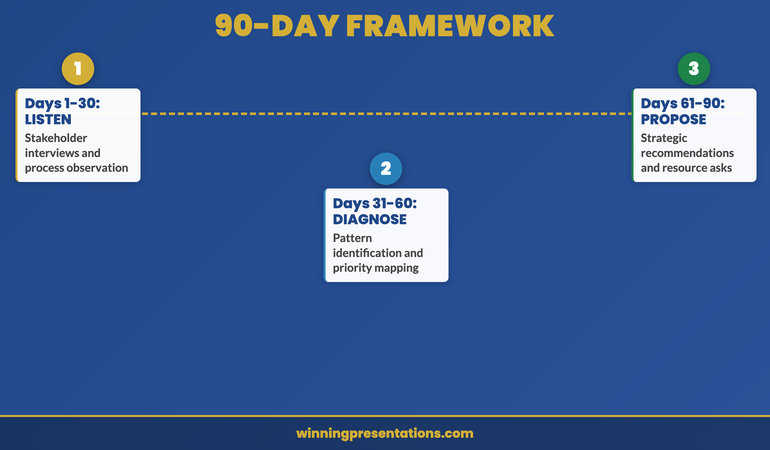
Every strong 90-day presentation follows the same psychological progression. The audience needs to believe three things: that you’ve actually listened to what matters in the organisation, that you understand the real constraints and opportunities, and that your recommendations are grounded in what you’ve learned—not in what you brought with you from your previous role.
Phase One: Listening. Dedicate your first 15 slides to demonstrating what you’ve learned. Not in a patronising way. Instead, show the organisation through your own observations. “In my first six weeks, I attended 34 meetings across sales, operations, and regulatory. I noticed three patterns that surprised me…” This isn’t padding. It’s proof that you’re not parachuting in with a pre-made plan.
Phase Two: Diagnosis. Move from observations to analysis. This is where you name the real constraints the organisation faces. Not problems—constraints. The difference matters. A problem implies fault. A constraint is real, acknowledged, and strategic. “Our contract approval cycle is 47 days longer than industry benchmark. We’ve acknowledged this drives customer churn. Here’s what I learned about why that cycle exists…” Now you’re thinking like a peer, not a critic.
Phase Three: Proposal. Only after listening and diagnosing do you recommend action. And here’s the discipline: propose no more than three initiatives in your 90-day presentation. Each one should be connected to what you’ve learned. Each one should address a constraint the organisation already knows is real. This isn’t about being ambitious. It’s about being credible.
What to Include (And What to Leave Out) at Day 90
Your instinct at day 90 will be to show how much you’ve learned and how much value you’re going to bring. That instinct will almost always lead you to overstuff your presentation. A new role presentation that tries to prove everything becomes credible about nothing.
What to include: Observations from your listening phase, three core constraints you’ve identified, your strategic priorities aligned to those constraints, resource requirements for your first initiatives, and a timeline for early wins. Include metrics that matter to the organisation—not vanity metrics you can control, but real measures of progress.
What to leave out: Criticism of decisions made before you arrived. Comparisons to how your previous organisation did things. More than three recommendations. Promises about outcomes you can’t guarantee. Detailed execution plans that suggest you’ve known what to do since week two. Any data you haven’t verified. Jargon your audience doesn’t use.
The 90-day presentation lives or dies on discipline. Every slide should answer one of two questions: either “What did I learn?” or “What should we do about it?” If a slide doesn’t answer those questions, remove it.
This is where executive presentation structure becomes your strategic tool. When you’re under pressure to prove yourself, a strong framework keeps you focused on what actually matters to your audience.
Structuring Slides for a Leadership Audience That Already Has Opinions
Here’s what you’re working against: your audience has already formed opinions about what needs to change in your area. The CEO has a view. The board has a view. Your peers have a view. You’re not presenting to blank slates.
This changes how you structure every slide. You can’t be subtle or indirect. You need to surface disagreement early, acknowledge what your audience already believes, and then show why your perspective adds clarity or reveals something they hadn’t considered.
Start each section not with your conclusion, but with the conventional wisdom. “Most organisations in our sector assume they need to upgrade technology first. In my assessment, we need to redesign process before we invest in tools.” Now you’ve signalled that you understand the existing opinion and you’re offering a different lens. That’s peer-level thinking.
Use a slide structure that builds credibility. Lead with what you’ve learned. Then surface the tension between what you’ve heard and what the data suggests. Then propose your recommendation. The audience follows your reasoning because you’ve shown them the thinking, not just the conclusion.
Consider how strategy presentations to CEOs work. They don’t ask for acceptance. They make a case. Your 90-day presentation should do the same.
The Credibility Trap: Proving Yourself Without Overpromising
The moment you step into a new executive role, you feel pressure to prove you deserve the position. You want to show confidence. You want to demonstrate you’ve got a plan. You want to protect yourself by overstating what you can deliver.
Every one of those instincts will undermine your 90-day presentation. Executives can smell desperation to prove value. They see overpromising as a red flag. And they don’t trust executives who claim certainty after 90 days in a role.
The counterintuitive path to credibility in your first three months is to be intellectually honest about what you still need to learn. “I’ll have clarity on our supply chain constraints in week 16. For now, here’s what I can see…” That’s credible. It says: I’m competent enough to know what I don’t know yet.
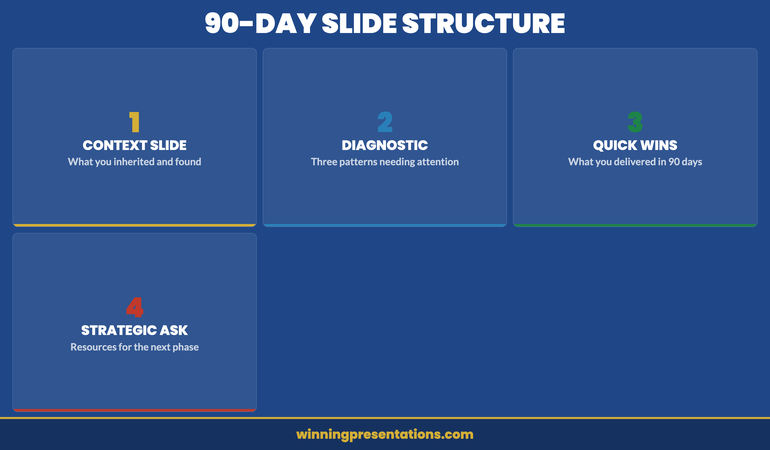
Build your 90-day presentation on what you’ve validated, not what you hope. Show quick wins you can deliver—not because you’re trying to prove yourself, but because you’ve listened to what matters most to your team and your board. When you deliver against those commitments, you’ll have earned trust that lasts for years.
This is where many executives stumble. They read the pressure to perform, and they respond by overstating their confidence or their roadmap. Instead, let your first leadership update answer a simpler question: Do I understand this organisation well enough to be a credible peer? If your presentation answers yes, you’ve won.
Final Preparation: Questions Over Answers
In your final week before the presentation, shift your preparation focus. Stop refining your recommendations. Instead, prepare for questions you’ll be asked and make sure you know why your audience will ask them.
Your board might ask: “Why shouldn’t we hire external talent to lead this transformation?” Your team might ask: “How does this align with what corporate told us about our direction?” Your peers might ask: “What happens if this timeline slips?” These aren’t gotcha questions. They’re tests of whether you’ve thought through the real tensions in your strategy.
Prepare answers that show you’ve wrestled with these questions, not that you have perfect solutions. “That’s a fair question. Here’s why I think internal development serves us better in this case, and here’s where I think we might prove that wrong…” That’s executive-level dialogue.
By the time you present, your slides should feel almost incidental. You should be able to have a strategy conversation with your audience because you’ve done the listening and the thinking. The presentation is just the structure. The real work is the thinking behind it.
Ready to Structure Your Leadership Moment?
The Executive Slide System includes scenario templates, AI prompt cards, and frameworks specifically designed for the presentations that define your executive career.
Frequently Asked Questions
How long should a 90-day presentation be?
Between 35 and 50 minutes, including questions. If you’re presenting to your CEO, assume 20–30 minutes. If it’s a board update, 45 minutes is standard. The key is finishing before your audience runs out of energy, not filling time with slides. A crisp 30-minute presentation that builds a compelling case beats a 60-minute marathon every time.
What if the board expects me to have a detailed 12-month plan by day 90?
Show them what you can validate in three months, then surface the assumptions you’re still testing. “Here are my core priorities for months 4–6, and here’s what I need to learn to refine them.” You’re not avoiding accountability. You’re being transparent about how you actually make decisions. Most experienced boards will respect that more than a plan you’ve invented with confidence you don’t yet have.
Should I include slides about my background or my previous achievements?
No. Your new organisation already knows who you are. They hired you. A 90-day presentation isn’t about establishing who you were—it’s about demonstrating who you are in their context. Use your credibility strategically. Reference specific experience only when it helps you explain a decision you’ve made about their organisation.
Move from Onboarding to Leadership Authority
Your 90-day presentation is a threshold moment. It’s where you stop being the new executive and start being a trusted leader. If you structure it right—grounding every recommendation in what you’ve learned, showing intellectual honesty about what you still need to discover, and demonstrating that you think like the peers in the room—you’ll have influence that lasts for years.
The pattern Tomás followed works because it respects how executives think. You observe. You synthesise. You propose. You don’t oversell. You earn trust by being thoughtful, not by being brilliant.
If you’d like a comprehensive template for building this kind of leadership presentation, the first presentation after promotion framework will accelerate your preparation.
Stay ahead on executive communication. Join The Winning Edge, our newsletter for leaders navigating high-stakes presentations and board-level communication.
Free resource: Download our Executive Slide System checklist to structure your first leadership update in minutes.
Related Reading: Discover how non-executive directors structure board presentations for maximum influence and credibility.
About the Author
Mary Beth Hazeldine, Owner & Managing Director, Winning Presentations. With 24 years of corporate banking experience at JPMorgan Chase, PwC, Royal Bank of Scotland, and Commerzbank, she advises executives across financial services, healthcare, technology, and government on structuring presentations for high-stakes funding rounds and approvals.