
Quick Answer
Most speaking confidence courses are calibrated for people who have never presented before. Senior professionals who have presented for years and want to address persistent nerves, voice tightness, or pre-meeting dread need a different kind of programme — one that treats existing experience as the foundation rather than the problem. The components that distinguish a course that works for senior professionals from one that produces only a temporary lift include structural deck preparation tied to the executive context, voice and pace calibration for sustained authority, pre-meeting and post-meeting recovery routines, and explicit work on the specific anxiety patterns senior leaders carry rather than the ones a junior presenter faces.
On this page
Kenji had been a senior medical director at a UK biotech for eleven years when he booked an introductory call. He had been on three speaking confidence courses across the previous decade. Each one had produced a useful lift for several weeks, after which his presentation anxiety had quietly returned to the same baseline. He could quote the techniques from each programme accurately. He was visibly frustrated that none of them had stuck. The first thing I asked him was who the courses had been calibrated for. The answer was that he did not know, but the materials had felt aimed at someone earlier in their career — entry-level managers, people doing their first conference talks, junior consultants preparing for client meetings. None of the three programmes had been built for someone who had already presented several hundred times.
What Kenji had been experiencing is one of the most common patterns in senior professional development. The speaking confidence course market is dominated by programmes calibrated for the much larger entry-level audience. Senior professionals who go through them often experience an initial lift — the techniques are real, and any sustained focus on presentation skills produces some short-term improvement — followed by a return to baseline because the underlying drivers of senior-level presentation anxiety were never addressed. The course taught the right answers to the wrong questions for someone in Kenji’s position.
This article walks through what a speaking confidence course needs to contain to produce a durable shift for senior professionals — directors, partners, senior medics, executive committee members, divisional heads, anyone who has been presenting for at least five years and recognises that their anxiety has not been moved by the standard courses. The components are not exotic. They are deliberately calibrated for an experienced presenter with existing patterns rather than a beginner with none.
If standard speaking courses have not produced lasting change
A programme calibrated for senior professionals — built around the structural, vocal, and recovery components that move the anxiety patterns experienced presenters actually carry — produces a different kind of result.
Why senior professionals need a different course
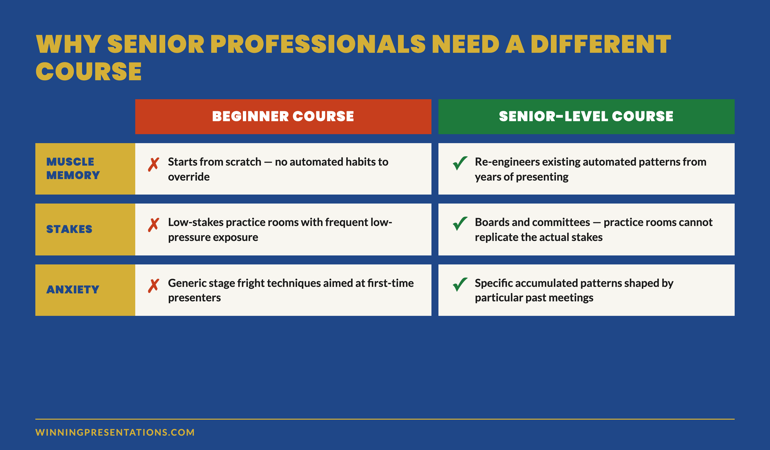
The argument for a senior-specific approach rests on three observable differences between an experienced presenter and a beginner. Each one shifts what the course needs to contain.
Difference 1 — Established muscle memory. A senior professional has presented hundreds of times. The body has automated a set of pre-meeting and in-meeting habits — some helpful, some less so. A course that ignores this and starts from “the basics” is asking the senior presenter to override habits that are already deeply automated. Most do not. They take the new techniques as a thin layer on top of the old ones, which is why the lift fades within weeks. A course that works at this level acknowledges the existing patterns and re-engineers them, which is harder to do but is the only route to durable change.
Difference 2 — Stakes that match the seniority. A junior presenter’s worst case is usually an embarrassing moment in a low-stakes meeting. A senior professional’s worst case is a board paper rejection that affects strategy, a client meeting that affects retention, a regulatory presentation that affects approval. The body knows the stakes are different. The techniques that work for low-stakes practice — frequent low-pressure exposure, learning by doing — do not translate cleanly because the senior presenter cannot create equivalent low-stakes practice rooms at their level. The course at senior level has to produce confidence without the practice volume that beginner courses rely on.
Difference 3 — Accumulated anxiety patterns. Senior professionals usually carry specific anxiety patterns that have been shaped by particular meetings — the chair who interrupted you in 2014, the question you could not answer in 2018, the meeting where the numbers did not support the recommendation. These patterns are real and persistent. A course that teaches general anxiety techniques does not address them; a course that addresses them works specifically with the pattern’s accumulated content. The anxiety is not generic for an experienced presenter. The course needs to engage with what is actually in it.
What to look for in a speaking confidence course at this stage
The components that distinguish a senior-appropriate course from a general one are specific. Knowing them in advance helps a senior professional evaluate a programme before investing time in it.
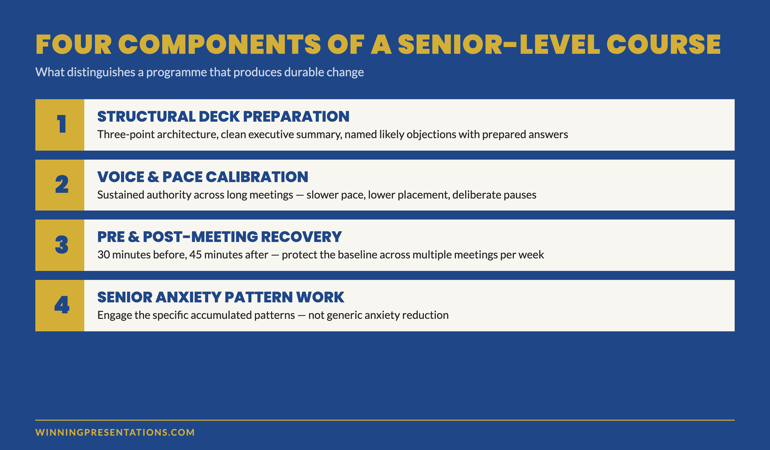
Component 1 — Structural deck preparation tied to the executive context. The course needs to spend genuine time on how the deck is built, not only on how the presenter speaks. Most speaking confidence courses treat the deck as fixed and work only on the delivery. For senior professionals, the structure of the deck is one of the most powerful confidence levers available — a clear three-point architecture, a clean executive summary, named likely objections with prepared answers — and it needs to be a substantive component of any senior-level programme.
Component 2 — Voice and pace calibration for sustained authority. The vocal work in a senior course is different from the vocal work in a beginner course. Beginners are usually being taught to project; experienced presenters are usually being taught to slow down. The deliberate slower pace, lower vocal placement, and deliberate pauses that produce sustained executive authority are not the techniques of a beginner course. They are the calibration adjustments of a senior one.
Component 3 — Pre-meeting and post-meeting recovery routines. A senior professional running multiple high-stakes meetings per week needs a recovery practice as much as a preparation practice. The course needs to address what happens in the 30 minutes before the meeting and the 45 minutes after it, because those windows determine whether the presenter is operating from a settled baseline or an accumulating depleted one. Beginner courses rarely cover this because beginners do not yet have enough volume of meetings for it to matter.
Component 4 — Explicit work on senior anxiety patterns. The course needs to take seriously that the presenter has accumulated anxiety from specific past meetings, not generic stage fright. The techniques that work — desensitisation framed around specific past memories, structural reframes for the specific patterns the presenter recognises in themselves — are different from generic anxiety reduction. A senior course gives the presenter language for the specific pattern they have been carrying and tools that engage it directly.
The first three components are addressable in a self-paced format. The fourth — work on specific accumulated patterns — is sometimes addressed in the materials and sometimes requires complementary work with a specialist. The companion piece on clinical hypnotherapy for public speaking walks through when the specialised pattern work becomes necessary alongside the structural course.
What to avoid — the courses that produce only short-term lift
It is also useful to know what tends not to work for senior professionals, even when the materials look credible.
Courses that lead with motivational language. The “you can do this” framing reads as patronising to someone who has presented for fifteen years. The motivational layer is appropriate for someone who has not yet established that they can present at all. For an experienced senior professional, the question is not whether they can do it. It is why the same anxiety has persisted after hundreds of successful meetings, and that question requires structural rather than motivational work.
Courses that rely heavily on group practice with peers. The format is useful for skill-building at junior level. For senior professionals, the practice room cannot replicate the actual stakes of an executive committee or a board, which means the practice itself has limited transfer to the real meeting. A senior course needs to produce work that carries directly into the leader’s actual high-stakes meetings, not into a practice space that does not match them.
Courses that promise specific outcomes with timelines that are too short. A speaking confidence course that promises “complete confidence in two weeks” for a senior professional is selling something that is not deliverable. The honest timeline for senior-level confidence work was discussed in detail in How Long Does It Take to Build Presentation Confidence? — visible composure within 6 to 8 weeks, settled authority within 6 months, stable confidence across difficult rooms within 18 to 24 months. A course that promises faster than this for a senior professional is overstating what is structurally possible.
Courses with no recovery component. As discussed above, the recovery work is part of what makes the gains durable for senior professionals. A course that covers preparation but not recovery is missing half of the substance for someone running multiple meetings per week.
Self-paced versus live — which works at senior level
The format question matters less than most senior professionals expect. The components above can be delivered in either format. What matters is whether the senior presenter actually does the work.
Self-paced programmes have one significant advantage at senior level: they fit around the leader’s calendar, which is usually overcommitted. The leader who is asked to commit to a fixed-time live programme often misses sessions and ends up consuming the recordings, at which point the live element has been lost anyway. A self-paced programme that the senior leader can run in the early-morning hours or in the gaps between meetings is more likely to be completed than a live one that conflicts with their actual working week.
Live programmes have one significant advantage: the social commitment of showing up for sessions. For senior leaders who struggle with self-direction or who benefit from peer accountability, a live element can produce completion rates that a self-paced programme does not. The trade-off is the calendar friction.
The most useful framing is to ask which format the leader will actually complete. A 60% completed self-paced programme produces more lift than a 30% completed live programme. The senior professional who knows themselves well enough to know which they will finish has the answer.
Conquer Your Fear of Public Speaking — £39, instant access
A structured self-paced programme calibrated for senior professionals. Covers the four components that distinguish senior-level confidence work — structural deck preparation, voice and pace calibration, pre-meeting and recovery routines, and engagement with the specific anxiety patterns experienced presenters carry.
- Structural deck preparation tied to executive context
- Voice and pace calibration for sustained authority across long meetings
- Pre-meeting and post-meeting recovery routines for senior presenters
- Designed for executives presenting to boards, exec committees, and senior stakeholders
Get Conquer Your Fear of Public Speaking →
£39, instant access. Designed for senior professionals presenting to executive audiences.
Is this right for you?
A senior-level speaking confidence course is the right starting point for professionals who have presented for at least five years, recognise that their anxiety has not moved with general courses, and want a structural approach that fits around an executive working week. It is calibrated for senior professionals — directors, partners, senior medics, executive committee members, divisional heads — rather than entry-level managers or beginners.
It is not the right starting point for clinical-level public speaking phobia, panic attacks, or severe physiological symptoms (uncontrolled shaking, fainting, persistent voice loss). Those conditions need specialised work, often in combination with the structural course. For senior professionals whose anxiety includes specific physical symptoms in the moment — sweating, heart racing, voice tremor — the lighter-touch in-the-moment techniques in Calm Under Pressure (£19.99) work alongside the structural course and address the physiological component specifically.
Frequently asked questions
How is a speaking confidence course for professionals different from a general public speaking course?
A general public speaking course is calibrated for people who are new to presenting or who present infrequently in low-stakes contexts. A senior-professional course assumes the participant has already presented hundreds of times and works on the established patterns and anxiety that experienced presenters carry — patterns that general courses tend not to address because their target audience has not yet developed them.
How long does a speaking confidence course take to complete?
The structured part of the programme typically runs across 6 to 8 weeks of active work, after which the techniques become ambient and continue to settle across the next several months. The visible composure shift the audience reads tends to land within the first 6 weeks; the internal feeling of confidence catches up by week 7 or 8. Full settlement across all meeting types takes 6 months. This is the structural reality and is largely the same across senior-level programmes regardless of format.
Can a speaking confidence course replace working with a coach?
For most senior professionals, the structural components are the same whether delivered as a course or by a coach. The course produces durable results when the participant actually does the work. A coach adds value when the participant needs accountability, when there are specific anxiety patterns that need direct engagement, or when the leader is working at a level where individualised feedback is the binding constraint. Many senior professionals find a structured course is the right starting point and add a coach later for specific layered work.
Does the course work for introverts and extroverts equally?
The components apply to both. Introverts often benefit more from the recovery and pre-meeting routine layers; extroverts often benefit more from the structural deck preparation and voice/pace calibration. The companion piece on Presentation Confidence for Introverts walks through the introvert-specific calibration that overlays the standard programme.
What if I have done several courses already and they have not worked?
This is the most common starting point for senior professionals at this stage. Previous courses tend not to work for senior professionals because they were calibrated for a different audience. The fact that earlier programmes did not produce durable change is not a sign that the participant is unteachable — it is a sign that the programmes were not aimed at them. A senior-calibrated course often produces a different result for the same participant.
The Winning Edge — weekly, free
Each Thursday: one structural framework, one micro-story from senior coaching, one practical move you can use in this week’s meetings. Built for senior professionals who present at executive level.
Not ready for the full system? Start here instead: download the free Executive Presentation Checklist — a one-page pre-meeting routine the senior leaders I work with use the morning of a board presentation.
About the author
Mary Beth Hazeldine is the Owner & Managing Director of Winning Presentations Ltd, founded in 1990. With 24 years of corporate banking experience at JPMorgan Chase, PwC, Royal Bank of Scotland, and Commerzbank, she advises executives across financial services, healthcare, technology, and government on structuring presentations for high-stakes funding rounds, board approvals, and senior reviews.