Tag: AI presentation framework

25 Feb 2026
Executive with glasses evaluating AI-generated presentation on laptop screen, chin resting on hand in critical thought, printed slide documents on desk beside him

AI Presentation Structure: AI Can Write Your Slides. It Can’t Structure Your Argument.

I watched a board ignore 22 perfect AI-written slides — because not one of them asked for a decision.

Quick Answer: AI generates content — clear sentences, reasonable data points, professional formatting. What it can’t generate is AI presentation structure: the decision architecture that determines which slide goes where, what the room needs to decide, and why the evidence is sequenced to lead them there. If you ask AI to “create a board presentation,” you’ll get 15-20 slides of competent content with no argument. The fix: build the structural skeleton first (what decision, what recommendation, what evidence in what order), then use AI to fill each section.

A client — a VP at a technology company — sent me his board presentation and asked for feedback. It was 22 slides. Beautifully written. Consistent formatting. Every slide had clear bullet points and supporting data.

He’d used ChatGPT to build it, and the output was impressive. Clean language. Professional tone. Relevant content.

One problem: nowhere in 22 slides did it say what decision the board needed to make.

There was no recommendation. No “I’m asking for X by Y date.” No comparison of options with trade-offs. No cost of inaction. Just 22 slides of well-written information, sequenced in the order the AI had generated it — which was the order of his prompt, not the order of a decision-first argument.

I asked him: “If the board reads only slide 1, do they know what you’re asking for?” He looked at slide 1. It was a project overview. They wouldn’t know the decision until slide 19.

We restructured in 90 minutes. Same data, same AI-written content — but reorganised around a decision architecture. Recommendation on slide 2, evidence supporting it, options with trade-offs, specific ask with a deadline.

The board approved it in the first 10 minutes.

🚨 Built a presentation with AI and it feels flat? Quick check: Does slide 1 tell the room what decision you need? If the decision is on slide 15+, you have a content deck, not an argument.

→ Need the structural skeleton that makes AI output land? Get the Executive Slide System → £39

The Difference Between Content and Structure (And Why AI Only Gives You One)

Content is what your slides say. Structure is the order they say it in and why.

AI is extraordinarily good at content. Ask ChatGPT to “write a slide about Q3 revenue performance” and you’ll get a clear, professional summary with relevant data points. Ask it to “write 15 slides for a board presentation on Project Phoenix” and you’ll get 15 clear, professional slides.

What you won’t get is an argument. Because an argument requires something AI doesn’t have: knowledge of the decision-maker, the political context, the urgency, the alternatives, and the specific outcome you need from the room.

AI presentation structure fails because AI sequences content in the order it was prompted, not in the order that leads a room to a decision. It generates in narrative order (background → context → analysis → findings → recommendation) when executive communication requires decision-first order (recommendation → evidence → options → ask).

This is the fundamental gap. It’s not about better prompts, more specific instructions, or a different AI tool. It’s about the structural logic that determines what goes on slide 1, what goes on slide 5, and what the room is doing on slide 10.

For more on the difference between AI-enhanced and AI-generated presentations, see the full comparison.

Why do AI-generated presentations fail with executives?

Because executives read slides in decision mode — they’re looking for the recommendation, the risk, the cost, and the ask. AI generates slides in information mode — sequenced to inform, not to persuade. When an executive hits slide 5 and still doesn’t know what you’re asking for, they check out. The content might be better than anything you’d write manually. But without decision architecture, it’s like having a perfectly worded email with no subject line.

Why AI Presentations Fail in Executive Settings

After reviewing hundreds of AI-generated executive decks — from clients using ChatGPT, Copilot, Gamma, and others — I see the same three structural failures every time.

Failure 1: The recommendation is buried. AI typically generates in chronological or logical order: background first, analysis second, conclusions third, recommendation last. In a 20-slide deck, the recommendation lands on slide 17-20. By then, three executives have left and two more are on their phones. Executive presentations need the recommendation on slide 1 or 2 — everything after that is evidence supporting the ask.

Failure 2: No options or trade-offs. AI generates a single recommendation because that’s what it was asked for. But decision-makers need options. “I recommend A” gives the room two choices: yes or defer. “Here are three options with costed trade-offs, and I recommend A because…” gives them agency. AI doesn’t create options unless specifically prompted — and even then, it doesn’t quantify the trade-offs the way an executive audience needs.

Failure 3: No cost of inaction. The most powerful slide in any decision deck is the one that shows what happens if the room doesn’t decide. AI never generates this slide because it doesn’t understand that executive meetings exist to make decisions, and that deferral is the default outcome unless you make it expensive. The decision slide structure includes this by default — AI doesn’t.

⭐ Give AI the Structure It’s Missing — Then Let It Do What It’s Good At

The Executive Slide System gives you 22 structural skeletons — the decision architecture AI can’t generate. Each template tells you what goes on every slide and why. Then the 51 matched AI prompts (Draft → Refine → Executive Polish) fill the structure with content that sounds like you.

Your structure-first AI toolkit:

  • 22 executive slide templates — the structural skeleton for board decks, status updates, proposals, and recommendations
  • 51 AI prompts in 3 stages: Draft (generate content), Refine (sharpen for audience), Polish (stress-test as a skeptical CEO)
  • 15 scenario playbooks — find your exact situation, follow the template + prompt sequence like a recipe
  • Decision architecture built into every template — recommendation, options, cost of inaction, specific ask

Get the Executive Slide System → £39

Built from 24 years of executive presentations — the structural logic AI doesn’t have.

The Structure-First AI Workflow: Decision → Skeleton → AI

The fix is simple but counterintuitive: you need to build the structural skeleton BEFORE you open AI. Most people do the opposite — they prompt AI first, then try to restructure the output. That’s backwards.

Step 1: Define the decision. Before you write a single prompt, answer: “What specific decision do I need from this room?” Not “inform them about the project.” Not “update them on progress.” A decision: “Approve £400K additional budget by March 7.” If you can’t state the decision in one sentence, you’re not ready to build slides — with or without AI.

Step 2: Build the skeleton. Choose a template that matches your scenario. A board presentation needs a different skeleton than a project status update, which needs a different skeleton than an investment proposal. The skeleton determines what goes on each slide and in what order — recommendation first, evidence second, options third, ask last.

Step 3: Prompt AI to fill each section. Now — and only now — use AI. But not with a single prompt like “create a board presentation.” Instead, prompt section by section: “Write the executive summary for a £400K technology investment. The recommendation is to approve. The key evidence is…” When AI fills a pre-built structure, the output has the decision architecture the room needs.

This is the approach that turned my client’s 22-slide information deck into a 12-slide decision deck — same data, same AI-generated language, fundamentally different outcome.

For a library of proven prompts, see the complete guide to ChatGPT prompts for presentations.

The 3-Prompt System: Draft → Refine → Executive Polish

One prompt doesn’t produce executive-quality output. Three prompts do — if they’re sequenced correctly.

Prompt 1: Draft. Generate the content for a specific slide or section. Be specific about the scenario, the audience, and the data. “Create content for a Q3 business review for the finance committee. Include: revenue vs target, three significant wins with quantified impact, two challenges with root causes, and three priorities for next quarter.”

Prompt 2: Refine. Sharpen the output for the specific audience. “Make this more impactful for a CFO audience. Each win should quantify business impact. Challenges should include what we’re doing about them. Remove metrics that don’t connect to business outcomes.”

Prompt 3: Executive Polish. Stress-test it. “Review this through the eyes of a CEO with five other meetings today. What would they skip? What questions would they ask? Strengthen the ‘so what’ for each point. Ensure the decision is specific and time-bound.”

Each prompt layer adds something the previous one didn’t: the Draft gives you content, the Refine makes it audience-specific, and the Polish makes it decision-ready. Without the structural skeleton underneath, all three layers produce better-written information. With the skeleton, they produce an argument.
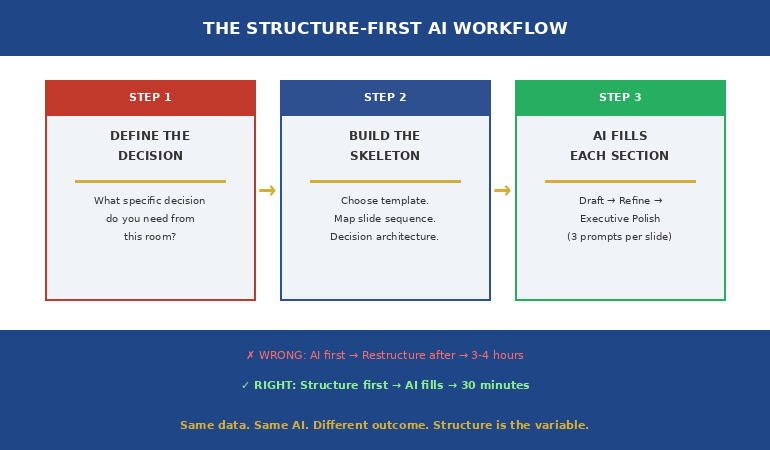
The Structure-First AI Workflow showing three steps from decision definition through structural skeleton to AI content filling

The 51 AI prompts in the Executive Slide System are pre-written in the Draft → Refine → Polish sequence for every template — so you’re not writing prompts from scratch. Open the template, run the three matched prompts, and the structural skeleton fills itself with executive-quality content. Get the Executive Slide System → £39

What AI IS Good At (Once the Structure Exists)

This isn’t an anti-AI article. AI is transformative for presentations — but only when it fills a structure rather than creating one.

Once you have the decision architecture in place, AI excels at: generating clear, professional language for each section; stress-testing your content from the audience’s perspective; finding gaps in your logic that you’ve become blind to; polishing language to be more concise and direct; and creating supporting data visualisations.

The combination of human structure + AI content is more powerful than either alone. You bring the judgement (what decision, what audience, what politics). AI brings the execution speed (clear language, consistent tone, gap identification). The structural skeleton is the interface between the two.

The professionals who are most effective with AI aren’t the ones writing the best prompts. They’re the ones who know what the room needs BEFORE they open ChatGPT. Structure first. AI second. That’s the workflow that gets decisions.

⭐ Stop Getting 22 Slides of Information and Zero Decisions

The Executive Slide System is the structural skeleton that makes AI output actually work in executive meetings. Each of the 22 templates includes the decision architecture — recommendation position, evidence sequence, options framing, specific ask — that AI can’t generate on its own.

Your structure-first AI deliverables:

  • 22 structural templates — recommendation-first, decision-ready, each with mapped slide sequence
  • 51 matched AI prompts — 3 per template (Draft → Refine → Executive Polish), pre-written and ready to paste
  • 15 scenario playbooks — find your exact situation, follow template + prompt sequence in under 30 minutes
  • 6 checklists — verify decision readiness, argument logic, and executive clarity before presenting

Get the Executive Slide System → £39

The structural logic from 24 years of executive banking + 51 AI prompts that fill it in minutes. Structure first. AI second. Decisions always.

The 15 scenario playbooks in the Executive Slide System tell you which template to open AND which AI prompts to run for your specific situation — so the structure-first workflow takes 30 minutes, not 3 hours. Get the Executive Slide System → £39

Is This Right For You?

✓ This is for you if:

  • You’ve used AI for presentations but the output feels flat, informational, or doesn’t get decisions
  • You want the structural logic that makes AI-generated content land with executive audiences
  • You want pre-written AI prompts matched to specific executive scenarios

✗ This is NOT for you if:

  • You don’t use AI for presentations and don’t plan to start
  • You’re looking for visual design templates (this is structural logic, not design)

⭐ 24 Years of Board-Level Decision Decks — Now a Structure AI Can’t Mess Up

Every template in the Executive Slide System was built from real executive approvals — board papers, SteerCo recommendations, ExCo investment cases. The decision architecture that got those approved is now the skeleton your AI fills.

Your AI-ready decision architecture:

  • Decision slide order that forces “what are you asking for?” onto slides 1–2 (not slide 19)
  • Options + trade-off slide formats executives actually use to decide — with costed consequences
  • Cost-of-inaction slide prompts — the missing slide in 90% of AI-generated decks
  • 51 matched AI prompts (Draft → Refine → Executive Polish) pre-written for every template

Get the Executive Slide System → £39

Built from board approvals, SteerCo recommendations, and ExCo investment cases at JPMorgan, RBS, PwC, and Commerzbank. Instant download. 30-day money-back guarantee.

Frequently Asked Questions

Can’t I just write better prompts instead of using templates?

Better prompts produce better content — but content isn’t the problem. The problem is structural logic: what goes on slide 1, what goes on slide 5, why the evidence is sequenced the way it is. No prompt, however sophisticated, gives AI the knowledge of your decision-maker, the political dynamics in the room, or the specific decision the meeting exists to make. Templates provide the structural skeleton that prompts can’t. Then prompts fill it brilliantly.

Does this work with ChatGPT, Copilot, and other AI tools?

Yes — because the structural problem is universal across all AI tools. ChatGPT, Copilot, Gamma, Claude, and every other AI presentation tool generates content in information mode. None of them generate in decision-first mode unless you provide the structure first. The templates work with any tool. The 51 AI prompts are written for ChatGPT-style interfaces but adapt to any conversational AI.

How long does the structure-first workflow take?

About 30 minutes for a complete executive deck. Five minutes to choose the right template for your scenario (the playbooks tell you which one). Five minutes to define the decision, recommendation, and key evidence points. Twenty minutes to run the three prompts per section and review the output. Compare that to 3-4 hours of prompt-iterate-restructure-prompt cycles when starting with AI alone.

What if my presentation is informational, not decision-based?

Most presentations that claim to be “informational” actually contain an implicit decision. A project status update implicitly asks “should we continue as planned?” A quarterly review implicitly asks “is this team performing?” If you genuinely need to inform without seeking a decision — a training session or a knowledge-share, for example — AI alone works fine. But for any presentation to leadership, there’s almost always a decision embedded. Find it, make it explicit, and build the structure around it.

📬 The Winning Edge — Weekly Newsletter

One executive presentation insight per week. AI workflows, structural frameworks, and the decision-first thinking that makes both work. No filler.

Subscribe Free →

Read next: AI handles slides. Q&A handles everything else. Read When You Don’t Know the Answer: 3 Responses That Save You in Q&A — the scripts for when AI can’t help.

Read next: If your next presentation involves giving sensitive feedback, read The Sandwich Feedback Trap: Why It Fails When You Critique Up (And the Mirror Structure That Works).

If your board pack goes out tomorrow morning — or your SteerCo pre-read is due by 5pm — don’t let AI decide the slide order. Build the structural skeleton first. Then let AI fill it. That’s how 22 slides of information become 12 slides that get a decision.

About the Author

Mary Beth Hazeldine is the Owner & Managing Director of Winning Presentations. With 24 years of corporate banking experience at JPMorgan Chase, PwC, Royal Bank of Scotland, and Commerzbank, she has delivered high-stakes presentations in boardrooms across three continents.

A qualified clinical hypnotherapist and NLP practitioner, Mary Beth combines executive communication expertise with evidence-based techniques for managing presentation anxiety. She has trained thousands of executives and supported presentations for high-stakes funding rounds and approvals.

Read more articles at winningpresentations.com

03 Feb 2026
Executive mapping presentation framework on glass whiteboard with structured diagrams before using AI tools

Framework First: The Order That Makes AI Presentations Compelling

Quick answer: Most professionals open ChatGPT or Copilot and start prompting before they’ve decided what the presentation needs to achieve. The result is polished slides with no strategic backbone. Reverse the order — framework first, AI second — and the output transforms from generic to compelling in the same amount of time.

⏰ Presenting in less than 24 hours?

Do these four things right now — 12 minutes total:

1. Write one sentence: “By the end, my audience will decide to ___.” (2 min)
2. List the 3 objections standing between them and that decision. (3 min)
3. Write 6–9 slide headlines as assertions, not labels. (5 min)
4. Prompt AI slide-by-slide against your skeleton. (2 min to start)

That sequence alone will produce a sharper deck than three hours of open-ended prompting. Read on for the full method — or if you want the complete system with templates:

🎓 AI-Enhanced Presentation Mastery — The self-study programme that teaches the complete framework-first workflow, with templates for every step. Explore the programme → £249

The CFO rejected it in 11 words: “This is a lot of slides that say nothing useful.”

My client Marcus had spent three hours with ChatGPT the night before. He’d prompted carefully. The slides looked professional — clean typography, consistent formatting, relevant data points. Every slide had a heading, a supporting visual, and a transition that made logical sense.

The problem wasn’t the slides. The problem was that Marcus had opened AI before opening his brain.

He’d typed “Create a presentation about our Q3 cloud migration progress” and let the tool structure his thinking for him. What came out was a chronological summary of everything that had happened — technically accurate, strategically empty. No recommendation. No decision point. No clear reason for the CFO to care.

I’ve watched this pattern repeat across senior teams throughout my 24 years in corporate banking. The professionals who produce genuinely compelling AI presentations aren’t better at prompting. They’re better at something that happens before the first prompt: they build the framework first.

That single shift in order — framework before AI, not AI before framework — is the difference between presentations that get polite nods and presentations that get decisions.

🎓 Master the Framework-First System

AI-Enhanced Presentation Mastery teaches the complete framework-first workflow — from strategic thinking to AI execution. Self-study with live Q&A calls.

Explore AI-Enhanced Presentation Mastery → £249

The programme is live now — January and February modules are already available, with new modules releasing through April. Join any time and start with the full library so far.

Why Most AI Presentations Are Built Backwards

Here’s the workflow most professionals follow when they need a presentation:

Open ChatGPT or Copilot. Describe the topic. Let AI generate the structure. Edit the output. Present it.

It feels efficient. It is efficient — at producing mediocre work.

The problem is that AI is optimised to generate plausible content, not strategic content. When you say “Create a presentation about our cloud migration,” the tool doesn’t know that your CFO cares about cost overruns but not technical architecture. It doesn’t know that the VP of Engineering is already a supporter while the Head of Procurement is a sceptic. It doesn’t know that the real decision being made is whether to approve another £800K for Phase 2.

Without that context, AI does what AI does well: it creates something that looks like a presentation. Chronological structure. Balanced coverage of all topics. Professional formatting. And absolutely no strategic backbone.

I saw this constantly during my years at JPMorgan Chase and PwC. The decks that got approvals weren’t the ones with the most data or the cleanest slides. They were the ones where you could feel the strategic thinking underneath — the ones where every slide existed for a reason, and that reason pointed toward a specific decision.

AI can’t generate that strategic thinking. But it can execute brilliantly once you’ve done the thinking yourself.

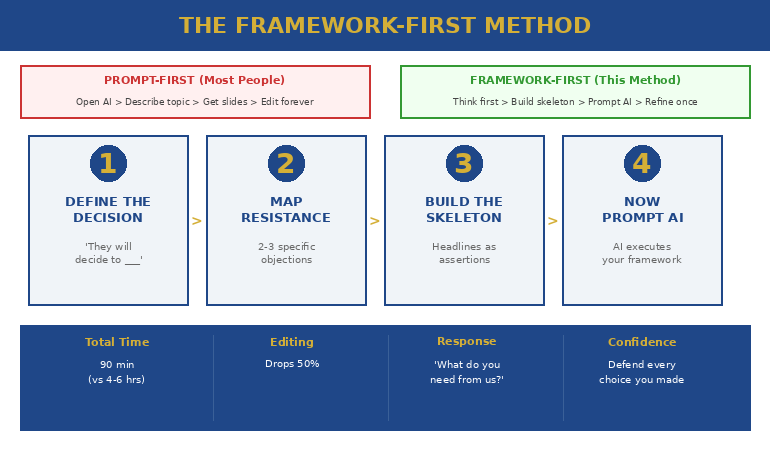
The Framework-First Method (4 Steps)

The structure-before-prompting approach reverses the standard AI workflow. Instead of prompting first and structuring later, you build the decision architecture before touching any AI tool.

Step 1: Define the Decision (Not the Topic)

Most people describe their presentation by topic: “It’s about Q3 results.” Framework-first starts with the decision: “I need the board to approve £800K for Phase 2 of cloud migration.”

That single sentence changes everything. Now every slide either supports that decision or it doesn’t belong in the deck.

Write one sentence: “By the end of this presentation, my audience will decide to ___________.” If you can’t complete that sentence, you’re not ready to open AI.

Step 2: Map the Audience Resistance

Before building slides, identify the two or three objections that stand between your audience and the decision you need. Not theoretical objections — the specific concerns this group of people will have.

Marcus’s CFO had one concern: cost. The VP of Engineering had a different concern: timeline risk. The Head of Procurement worried about vendor lock-in. Three people, three different resistance points, all sitting in the same meeting.

A generic AI prompt produces one presentation for all three. This approach produces one presentation that addresses each resistance point in sequence, building toward the decision.

Step 3: Build the Slide Skeleton

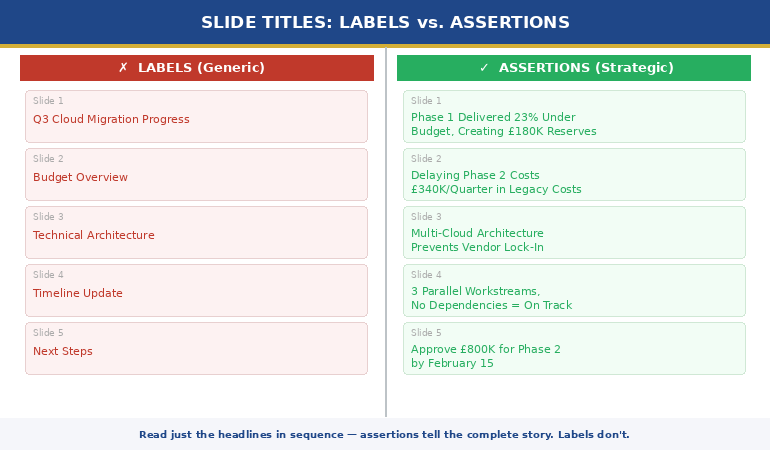
Not full slides — just the architecture. Write the headline for each slide as a complete assertion, not a label. “Q3 Migration Progress” is a label. “Phase 1 Delivered 23% Under Budget, Creating £180K in Reserves for Phase 2” is an assertion.

Your skeleton might be six slides. It might be twelve. The number doesn’t matter. What matters is that each slide headline tells the complete story if you read them in sequence — no body content needed.

This is the strategic thinking that AI cannot do for you. And it’s the thinking that separates presentations executives act on from presentations executives forget.


Slide skeleton example showing assertion-based headlines versus generic label-based slide titles

🎓 AI-Enhanced Presentation Mastery — The self-study programme walks through this skeleton-building process with real executive examples across finance, operations, and strategy contexts. See the full curriculum → £249

Step 4: Now Prompt AI (With the Framework)

This is where AI becomes genuinely powerful. You’re no longer asking it to think — you’re asking it to execute. Instead of “Create a cloud migration presentation,” your prompt becomes:

“I need supporting content for a 9-slide executive presentation. The decision: approve £800K for Phase 2. Slide 3 headline: ‘Phase 1 Delivered 23% Under Budget, Creating £180K in Reserves for Phase 2.’ Generate 3 data points and one visual recommendation that support this assertion.”

The output from this prompt is categorically different from the output of a topic-based prompt. It’s specific. It’s strategic. It supports the decision architecture you’ve already built.

Executive mapping presentation framework on glass whiteboard with structured diagrams before using AI tools

What Changes When You Lead With Structure

The before-and-after is striking. I’ve watched executives switch from prompt-first to structure-first and produce dramatically better output in less total time.

Here’s what shifts:

Editing time drops by half. When AI executes against a clear framework, the output requires refinement rather than restructuring. You’re adjusting language, not rethinking strategy. Most executives I work with report cutting their total deck-building time from four to six hours down to 90 minutes — not because the AI is faster, but because they’re not rebuilding the structure three times.

Audience response changes. Presentations built in this order generate questions about next steps rather than clarifying questions about intent. That’s the signal that your strategic thinking landed. When the first question after your presentation is “So what do you need from us to move forward?” — you’ve built it in the right order.

Confidence increases. This is the part nobody talks about. When you know every slide exists for a strategic reason, you present differently. You’re not narrating slides — you’re building an argument. That comes through in your voice, your posture, and especially in how you handle questions. If the structure of your deck reflects genuine strategic thinking rather than AI-generated organisation, you can defend every choice because you made every choice.

📐 The Complete Framework-First Workflow

AI-Enhanced Presentation Mastery includes the full decision-architecture method, audience resistance mapping templates, and slide skeleton builders — plus how to prompt any AI tool to execute against your framework.

Explore AI-Enhanced Presentation Mastery → £249

Modules cover decision framing, audience mapping, skeleton building, and AI execution for every presentation type.

3 Frameworks That Work With Any AI Tool

You don’t need a new framework for every presentation. Most executive presentations fall into one of three structural patterns, and each one gives AI a clear execution brief.

The Recommendation Framework

Use when: You need a decision. Budget approvals, strategy pivots, vendor selections.

Structure: Recommendation → Evidence → Risks Addressed → Ask. Four to eight slides maximum. The recommendation appears on slide one, not slide twenty. This structure works because executives scan for the conclusion first — give it to them, then prove it.

AI execution: Prompt AI to generate supporting evidence for each assertion in your skeleton. The framework tells AI what to prove, not what to explore.

The Progress Framework

Use when: You’re reporting on work in progress. QBRs, project updates, migration reviews.

Structure: Where We Said We’d Be → Where We Are → What Changed → What We Need Next. Resist the chronological pull. AI will default to “what happened in order” — your framework forces it to highlight the gaps between plan and reality, which is what the audience actually cares about.

AI execution: Prompt AI to generate variance analysis and impact statements rather than activity summaries. The framework prevents AI from producing a timeline when what you need is a gap analysis.

The Problem-Solution Framework

Use when: You’re proposing something new. Process changes, team restructures, new initiatives.

Structure: Cost of the Current Problem → Root Cause → Proposed Solution → Expected Impact → Resources Needed. The key is quantifying the cost of inaction before presenting the cost of action. When the audience sees that doing nothing costs £2M annually, the £400K solution looks different.

AI execution: Prompt AI to quantify impact in the audience’s currency — time, revenue, risk, headcount. Your framework tells AI which currency matters to this specific audience.

Each of these frameworks transforms how AI generates content. Instead of producing generic slides about a topic, AI produces specific content that supports a strategic argument. The full AI presentation workflow covers how to integrate these frameworks into your existing tools.

🎓 AI-Enhanced Presentation Mastery — Includes ready-to-use templates for all three frameworks with worked examples from real executive contexts. Explore the programme → £249


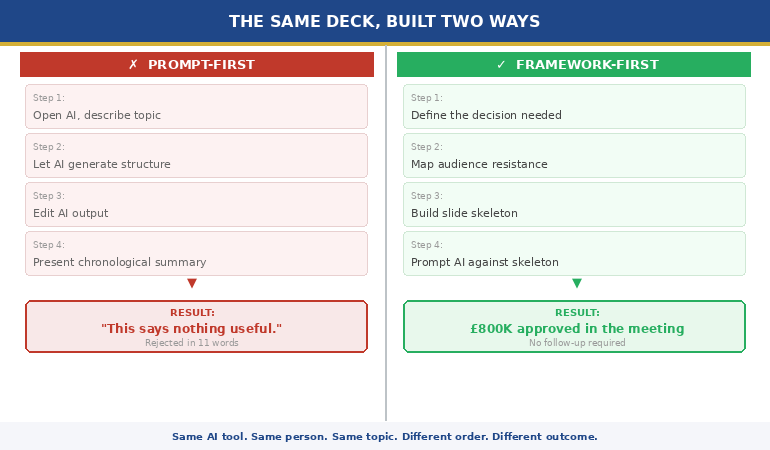
Side-by-side comparison of prompt-first versus framework-first AI presentation results

Real Example: The Same Deck Built Both Ways

Let me show you what this looks like in practice. Same presenter, same topic, same AI tool, same meeting. Different order.

Prompt-First Version (What Marcus Built)

Marcus opened ChatGPT and typed: “Create a 12-slide presentation on our Q3 cloud migration progress for the executive team.”

What AI produced: a chronological summary. Slide 1: Title. Slide 2: Agenda. Slide 3: Q3 Objectives. Slide 4: What We Completed. Slide 5: Technical Architecture Update. Slides 6-9: Detailed progress by workstream. Slide 10: Challenges. Slide 11: Next Steps. Slide 12: Questions.

Every slide was accurate. None of them built toward a decision. The CFO sat through twelve slides waiting for the point, then rejected it in 11 words.

Framework-First Version (What We Built Together)

We started with the decision sentence: “I need the board to approve £800K for Phase 2 of cloud migration.”

We mapped three resistance points: cost (CFO), timeline risk (VP Engineering), vendor lock-in (Head of Procurement).

We wrote the skeleton — nine slide headlines, each an assertion:

1. Phase 2 Requires £800K — Here’s Why It Pays for Itself in 14 Months
2. Phase 1 Delivered 23% Under Budget, Creating £180K in Reserves
3. Delaying Phase 2 Costs £340K/Quarter in Legacy Maintenance
4. Timeline Risk Is Contained: 3 Parallel Workstreams, No Dependencies
5. Vendor Flexibility Built In: Multi-Cloud Architecture Prevents Lock-In
6. Cost Comparison: Phase 2 vs. Extending Phase 1 Support
7. Resource Ask: Same Team, Extended Timeline
8. Risk Mitigation: Phase Gates at 30/60/90 Days
9. Decision Required: Approve Phase 2 by February 15

Then we prompted AI — slide by slide — to generate supporting content for each assertion. The output was specific, strategic, and directly addressed each stakeholder’s concerns.

The board approved the budget in the meeting. No follow-up required.

Same AI tool. Same person. Different order. Completely different outcome.

🧠 Stop Prompting First. Start Thinking First.

AI-Enhanced Presentation Mastery is a self-study programme that gives you the complete framework-first system: decision architecture, audience resistance mapping, slide skeleton templates, and AI execution prompts for every executive presentation type. Study at your own pace, with live Q&A calls when you need direct feedback.

Explore AI-Enhanced Presentation Mastery → £249

Self-study modules + decision-architecture templates + live Q&A. Built for executives who use AI but want better results.

Does the framework-first method work with ChatGPT and Copilot?

Yes — framework-first is tool-agnostic. Whether you use ChatGPT, Copilot, Claude, or Gemini, the principle is identical: do the strategic thinking before the first prompt. The framework becomes the brief that any AI tool executes against. The difference is in the quality of your input, not the brand of your AI.

How long does it take to build a framework before using AI?

Typically 15 to 25 minutes for the decision sentence, resistance mapping, and slide skeleton. That investment saves two to four hours of restructuring and editing on the back end. Most executives find the total deck-building time drops from four to six hours to under 90 minutes once the framework-first habit is established.

What if I don’t know what decision I need from my audience?

That’s the most valuable signal the framework-first method gives you. If you can’t write the decision sentence, you’re not ready to build the presentation — regardless of whether you’re using AI or not. Clarifying the decision before you start is what separates persuasive presentations from information dumps.

Frequently Asked Questions

Can I use the framework-first method for informal presentations like team updates?

Absolutely. Even a five-minute team update benefits from a decision sentence: “I need the team to prioritise workstream B this week.” The framework doesn’t have to be elaborate — even a two-slide skeleton built in three minutes produces sharper AI output than an open-ended prompt. The method scales from boardroom pitches down to Slack presentation summaries.

What if my manager just wants me to share information, not drive a decision?

Information-sharing presentations still benefit from a framework because they need a “so what.” Define what you want the audience to take away: “After this update, the team will understand that Phase 1 is on track and no escalation is needed.” That framing gives AI a clear brief and prevents the chronological data dump that makes people stop listening at slide four.

Is framework-first slower than just letting AI generate the whole thing?

In the first ten minutes, yes. In total time, no. Executives who prompt AI without a framework spend 15 minutes generating slides, then two to four hours restructuring, re-prompting, and editing. Framework-first spends 20 minutes thinking, 20 minutes prompting, and 30 minutes refining. The total is consistently shorter because you’re not rebuilding the strategic backbone after the fact.

📬 The Winning Edge Newsletter

Weekly frameworks, AI presentation strategies, and executive communication techniques — delivered in under 3 minutes.

Subscribe free →

📋 Free: 7 Presentation Frameworks

Download the framework reference sheet used in our executive training — including the Recommendation, Progress, and Problem-Solution structures covered in this article.

Download free →

Also published today:

📊 The All-Hands Meeting That Destroyed Morale (And How to Avoid It) — The structural mistakes that turn company updates into resignation triggers.

💛 What Happens When You Cry During a Presentation (I Know Because I Did) — A recovery framework for the moment emotion takes over.

Your next step: Before your next presentation, spend 15 minutes writing the decision sentence and three slide headlines as assertions. Then open your AI tool. You’ll feel the difference in the output immediately — and your audience will feel it in the room. If you want the complete system with templates and worked examples, explore AI-Enhanced Presentation Mastery.

About the Author

Mary Beth Hazeldine is the Owner & Managing Director of Winning Presentations. With 24 years of corporate banking experience at JPMorgan Chase, PwC, Royal Bank of Scotland, and Commerzbank, she has delivered high-stakes presentations in boardrooms across three continents.

A qualified clinical hypnotherapist and NLP practitioner, Mary Beth combines executive communication expertise with evidence-based techniques for managing presentation anxiety. She has trained thousands of executives and supported presentations in high-stakes funding rounds and approvals.