

A client escalation presentation is the highest-pressure slide deck most account managers will ever build — because the audience has already decided you’ve failed. The difference between losing a key account and strengthening the relationship comes down to how you structure those first six slides. This article gives you the exact framework, language choices, and slide sequence that turn a crisis meeting into a retention conversation.
Quick Navigation
- Why Most Escalation Presentations Make Things Worse
- The Accountability-First Framework
- Slide-by-Slide Breakdown
- Language That Rebuilds vs. Language That Inflames
- What Happens After the Meeting Closes
- Frequently Asked Questions
The Story: Tomás and the Shipping Disaster That Nearly Cost £3M
Tomás ran a logistics partnership with a retail chain worth £3.2M annually. In November, a warehouse system migration caused 340 late deliveries across a three-week window — right before their peak season. The client’s Chief Commercial Officer requested an escalation meeting within 48 hours. The email used the phrase “considering alternative providers.” That phrase doesn’t appear in emails where people are bluffing.
Tomás did what most account leaders do under pressure: he built a presentation explaining what happened. Fifteen slides. Root cause analysis. Timeline of the migration. Technical architecture diagrams. A Gantt chart showing the recovery plan. It was thorough, well-designed, and entirely wrong.
His colleague Fatima looked at it and said something that changed the entire approach: “You’ve built a presentation for *you*. They don’t want to understand your system migration. They want to know whether you understand what happened to *their* customers.”
Tomás rebuilt the deck in four hours. Six slides. No technical architecture. The first slide was a single sentence: “340 of your customers received their orders late because of a decision we made. Here’s what we’re doing about it.” He kept the account. The CCO later told him it was the most honest vendor presentation she’d ever sat through.
Building an escalation deck this week?
Explore the Executive Slide System → pre-built layouts and messaging frameworks for high-stakes client scenarios.
Why Most Client Escalation Presentations Make Things Worse
The instinct in a client escalation presentation is to explain. That instinct is fatal. Explanation, in a crisis context, reads as deflection. Your client didn’t call this meeting to learn about your internal processes. They called it because they need to decide whether to trust you with their business for another year.
Most escalation decks fail on three predictable fronts:
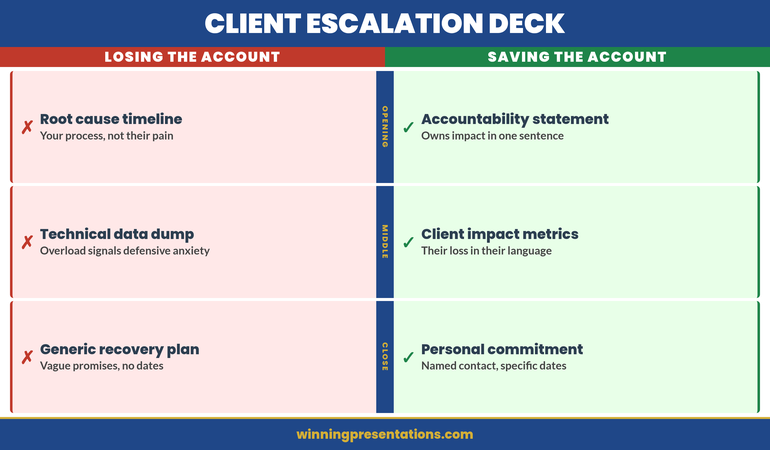
Leading with root cause analysis. When your first slide is a timeline or a fishbone diagram, you’re signalling that understanding the problem is more important to you than acknowledging its impact. The client hears: “We’re more interested in our process than your pain.”
Burying the accountability statement. Many executives put the apology on slide six, after the explanation. By slide six, the client has mentally written you off. Accountability must come first — before context, before cause, before your recovery plan.
Overloading with data to demonstrate competence. Twelve charts showing you’ve investigated thoroughly don’t rebuild trust. They signal anxiety. Your client reads it as: “They’re worried, so they’re proving they’ve done work.” Confidence comes from brevity and directness, not volume.
The common thread: these decks are built for the presenter’s emotional needs (defending, explaining, proving), not the client’s decision needs (Can I trust them? Will this happen again? What changes now?).
The Accountability-First Framework: Six Slides That Retain Accounts
This framework inverts the conventional escalation deck. Instead of building from cause to solution, it builds from accountability to commitment. The sequence matters — each slide earns the right to show the next one.
Slide 1: The Accountability Statement. One sentence. No hedging. “We caused [specific impact] to [specific number] of your customers because of [our decision/our failure].” No passive voice. No “unfortunately, due to circumstances.” You did it. Say so. This slide takes 20 seconds to deliver and buys you the right to present the other five.
Slide 2: Impact Acknowledgement. Not your internal impact — their business impact. Revenue affected. Customers inconvenienced. Service level agreements breached. Show that you measured the damage from *their* perspective, not yours. If you can quantify it, do. If you can’t, say what you’ve heard from their team about the consequences.
Slide 3: What Happened (Brief Context). Now — and only now — explain what went wrong. One slide. Three to five bullet points. No technical jargon unless your audience is technical. The goal is clarity, not thoroughness. “We migrated our warehouse system. We underestimated the data transfer window. Orders queued for 72 hours before we identified the bottleneck.”
Slide 4: What We’ve Already Done. Actions taken, not planned. Past tense. “We’ve rolled back the migration. We’ve expedited all delayed orders. We’ve credited the affected service charges.” This demonstrates that you moved before the meeting, not because of it.
Slide 5: What Changes Going Forward. Systemic changes, not just fixes. “We’re adding a parallel testing window for all future migrations. We’re creating a dedicated escalation channel with a named contact from our side. We’re committing to 48-hour impact reports for any service disruption above [threshold].”
Slide 6: Our Commitment to You. Personal. Specific. Time-bound. “I will personally review your account’s service metrics weekly for the next 90 days. You’ll receive a direct report from me every Friday. If any SLA breach occurs in that period, we’ll credit [amount] automatically.” This isn’t a corporate promise. It’s a personal one.
Build Your Escalation Deck Efficiently
The accountability-first framework above needs the right visual structure to land with impact. Pre-built slide layouts remove the design burden so you can focus on the message.
- ✓ Executive slide templates for crisis and escalation scenarios
- ✓ Messaging frameworks for accountability-first presentations
- ✓ Slide structure guides for high-stakes client meetings
- ✓ Framework layouts designed for executive escalation conversations
Explore the Executive Slide System →
Designed for high-stakes client scenarios
Slide-by-Slide Design Choices That Signal Accountability
Structure matters, but so does visual execution. An escalation deck that looks polished and corporate can accidentally signal “We had time to make it pretty, so we weren’t that worried.” An escalation deck that looks rushed signals chaos. The sweet spot is clean, minimal, and direct.
Slide 1 (Accountability Statement): Dark background. White text. One sentence, centre-aligned. No logo, no graphics, no charts. The visual emptiness forces attention onto the words. This is the most important slide in the deck precisely because it contains the least.
Slide 2 (Impact Acknowledgement): Use their metrics, not yours. If they measure customer satisfaction scores, show the score impact. If they measure on-time delivery, show the deviation. Mirror their language. If their internal reports say “fulfilment failures,” your slide says “fulfilment failures” — not “delivery exceptions” or “service disruptions.”
Slide 3 (What Happened): Timeline format works here — but horizontal, not vertical. Three to five points on a single line. No Gantt charts. No swimlanes. The simpler the visual, the more credible the explanation feels.
If you’re preparing a restructuring presentation alongside a client escalation, the same trust-first principle applies: lead with acknowledgement, not justification.
Slides 4–5 (Actions Taken + Going Forward): Split into “Done” and “Planned.” Use checkmarks for completed actions and calendar dates for future ones. Every future commitment needs a date. “We’ll improve our testing process” means nothing. “We’ll complete parallel testing protocols by April 15″ means everything.
Slide 6 (Personal Commitment): Include your name and direct contact details on this slide. Not a generic team email. Not a ticket system. Your name, your phone number, your personal commitment. That’s what turns a corporate response into a relationship-saving moment.
The Executive Slide System includes pre-built layouts for exactly these slide types — accountability statements, impact dashboards, and commitment frameworks that look professional without looking rehearsed.
Language That Rebuilds Trust vs. Language That Inflames
The words you choose in a client escalation presentation carry more weight than in any other business context. Your client is listening for signals: Are they taking responsibility? Do they understand the severity? Are they minimising?
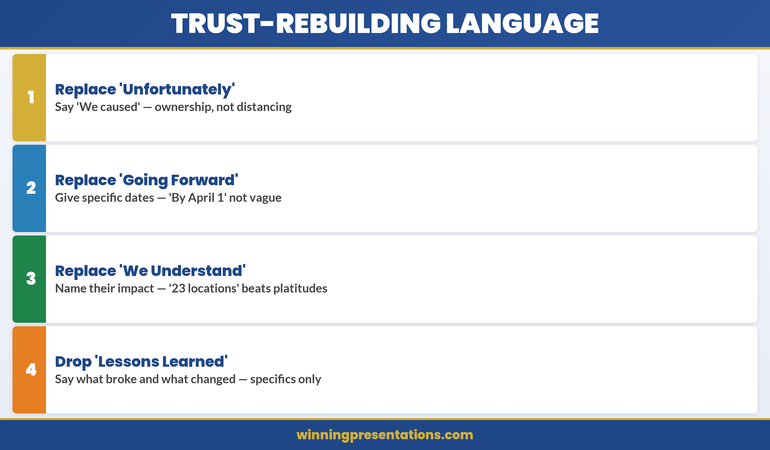
Replace “unfortunately” with “we caused.” “Unfortunately, deliveries were delayed” is passive and distancing. “We caused 340 late deliveries” is direct. The first sounds like a weather report. The second sounds like ownership.
Replace “going forward” with specific dates. “Going forward, we’ll ensure this doesn’t happen again” is meaningless. “By April 1, we’ll have implemented parallel testing that prevents this specific failure mode” is a commitment you can be held to.
Replace “we understand your frustration” with specific impact. “We understand your frustration” is a platitude. “Your northeast region missed their weekend restocking window, which your team told us affected footfall at 23 locations” shows you’ve listened.
Never say “lessons learned.” This phrase has become so corporate-generic that it actively undermines credibility. Say instead: “Here’s what we found was broken, and here’s the specific change we’ve made.”
The same language discipline applies to client retention quarterly presentations — specificity and accountability always outperform corporate platitudes.
What Happens After the Escalation Meeting Closes
The presentation is the visible part of the escalation response. What happens in the 72 hours after the meeting determines whether the account actually stays.
Send a written summary within 4 hours. Not a polished document — an email. “Here’s what we committed to in today’s meeting. Here are the dates. Here’s my direct contact.” Speed matters more than formatting. Every hour of silence after an escalation meeting erodes the trust you just rebuilt.
Deliver the first commitment early. If you promised weekly reports starting Friday, send the first one on Wednesday. Under-promise, then visibly over-deliver. The psychological impact of receiving something earlier than expected is disproportionately powerful after a trust breach.
Brief your internal team before the client hears anything. Your operations team, your delivery team, your technical team — everyone who touches this account needs to know what was promised and what their part is. Nothing undermines a recovery faster than a client contacting your team and hearing “I wasn’t aware of that commitment.”
Understanding how pre-decision conversations shape executive approvals can help you anticipate what the client’s internal stakeholders will discuss after your meeting.
Schedule the 30-day check-in before you leave the room. Don’t say “We’ll follow up in a month.” Say “Can we book 30 minutes on [specific date] to review progress?” Getting the meeting in the diary before you leave the room signals that you’re not going to disappear once the pressure drops.
The Three Questions Your Client Is Silently Asking
Throughout every client escalation presentation, your audience is running a parallel evaluation. They’re not just hearing your slides. They’re answering three questions for themselves:
1. “Do they actually understand what happened to us?” Not what happened technically. What happened to their customers, their reputation, their internal credibility. If your deck only addresses the technical failure, you’ve failed this test.
2. “Will this happen again?” Your recovery plan needs to address the systemic cause, not just the immediate fix. “We’ve resolved the delayed orders” answers a different question than “We’ve changed how we test system migrations.” The first fixes today. The second prevents tomorrow.
3. “Is this person someone I can trust going forward?” This is the one that matters most — and it’s not answered by any slide. It’s answered by your tone, your directness, your willingness to say “We got this wrong” without flinching, and your specificity about what changes. Trust is rebuilt in specifics, not in promises.
Is This Right For You?
✓ You have an escalation meeting within the next two weeks and need to build a deck that retains the account
✓ You’ve had client escalations before where the deck made things worse, not better
✓ You want a structured slide framework rather than starting from scratch under pressure
✗ You’re looking for generic presentation templates — this is specifically for high-stakes executive scenarios
✗ Your escalation is purely technical with no executive audience — a written report may serve better
Frequently Asked Questions
How long should a client escalation presentation be?
Six slides maximum. Escalation meetings are trust-rebuilding conversations, not information dumps. Your deck should take 12–15 minutes to present, leaving the remaining time for questions and direct conversation. Every slide beyond six dilutes your accountability message and signals that you’re defending rather than committing.
Should I include a root cause analysis in the escalation deck?
Yes, but limited to one slide with three to five bullet points. The root cause exists to show you understand what broke — not to explain your internal systems. If the client wants deeper technical detail, offer to provide it as a separate follow-up document. The escalation presentation is about accountability and commitment, not forensic analysis.
What if the failure wasn’t entirely our fault?
Lead with your part. Always. Even if external factors contributed, your client doesn’t want to hear about shared responsibility in the escalation meeting. Own your portion completely and specifically. If external factors are genuinely relevant, mention them briefly — one sentence, maximum — after you’ve established full accountability for your role. Clients respect partners who own their mistakes far more than those who distribute blame.
The Winning Edge — Weekly Presentation Intelligence
Frameworks, slide strategies, and executive communication insights delivered every week. Trusted by professionals who present to boards, clients, and senior leadership.
Free resource: Download the Executive Presentation Checklist — a quick-reference guide for structuring any high-stakes executive deck.
If you’re also preparing a lateral move presentation, the same principle of leading with accountability and clarity applies — different context, same structural discipline.
Your next escalation meeting will define whether that client stays or goes. The accountability-first framework above, paired with clean visual execution, creates the conditions for a difficult conversation to turn into genuine account recovery.
About the Author
Mary Beth Hazeldine is Owner & Managing Director of Winning Presentations. With 24 years of corporate banking experience at JPMorgan Chase, PwC, Royal Bank of Scotland, and Commerzbank, she advises executives across financial services, healthcare, technology, and government on structuring presentations for high-stakes funding rounds and approvals.