

Your Department Is on the Chopping Block. Here’s the Reorg Presentation That Protects Your Team.
I watched a director lose his entire 14-person team in a reorg at RBS. Not because they weren’t performing — they were one of the strongest units in the division. He lost them because when leadership asked every department head to present their case for survival, he showed up with a 22-slide activity report. His colleague across the hall showed up with 6 slides that connected every team output to a revenue line. Guess whose team survived.
Quick Answer: During a restructure, your presentation isn’t an update — it’s a defence case. You need to prove three things in under 15 minutes: what your team protects (revenue, clients, institutional knowledge), what breaks if you’re cut (specific costs, delays, and risks), and what your team delivers in the new structure that nobody else can. The executives making reorg decisions have 8-12 of these presentations to sit through. They’re looking for reasons to consolidate. Don’t give them one.
In this article:
- Why Activity Reports Get Teams Killed in Reorgs
- The Three-Pillar Framework: Value, Impact, Vision
- The ‘Cost of Cutting Us’ Slide Nobody Thinks to Build
- The Institutional Knowledge Argument That Stops Mergers
- What Leadership Actually Evaluates in Reorg Presentations
- How to Structure Your Reorg Deck in 90 Minutes
- Frequently Asked Questions
🚨 Restructure announced and your department is at risk? Quick 60-second check: Can you name, right now, three specific revenue lines your team protects? Can you quantify what happens to those lines if your team is dissolved? If you can’t answer both, your survival presentation has a gap.
→ Need the exact reorg deck templates? Get the Executive Slide System (£39)
In my years at JPMorgan and later at Commerzbank, I lived through four major restructures. The first one, I was junior enough to just keep my head down. By the third and fourth, I was helping directors prepare their cases.
What I noticed was brutal in its consistency: the leaders who survived weren’t always the ones running the best teams. They were the ones who could articulate why their team mattered — in the language the decision-makers cared about. Revenue protection. Client retention risk. Regulatory exposure. Cost of transition.
One director I worked with at Commerzbank had 48 hours’ notice before presenting to the integration committee. She didn’t have time to build a polished deck from scratch. But she had a structure — a framework for proving value under pressure. She kept every single person. The director next door, who’d had the same notice and arguably a stronger team, lost six of his twelve.
The difference wasn’t the team’s performance. It was the presentation’s structure.
Why Activity Reports Get Teams Killed in Reorgs
Here’s what happens when a restructure is announced: every department head is asked — formally or informally — to justify their team’s existence. Most leaders default to what they know. They pull together a deck that shows everything their team has been doing. Projects completed. Initiatives underway. Headcount and budget utilisation.
This is an activity report. And it’s the single most dangerous thing you can present during a reorg.
Why? Because the people evaluating you aren’t asking “What does your team do?” They’re asking “What happens if your team doesn’t exist tomorrow?” Those are fundamentally different questions, and an activity report answers only the first.
Activity reports also invite comparison. If you list 12 projects and the team being considered for merger lists 15, you’ve handed leadership a reason to combine you — or worse, absorb your work into their headcount. You’ve turned your survival case into a feature list, and feature lists get consolidated.
How do you present during a restructure? You present a value case, not an activity report. A value case answers three questions: what you protect, what breaks without you, and what you deliver next. Everything else is background noise that gives decision-makers permission to cut.
The Three-Pillar Framework: Value, Impact, Vision
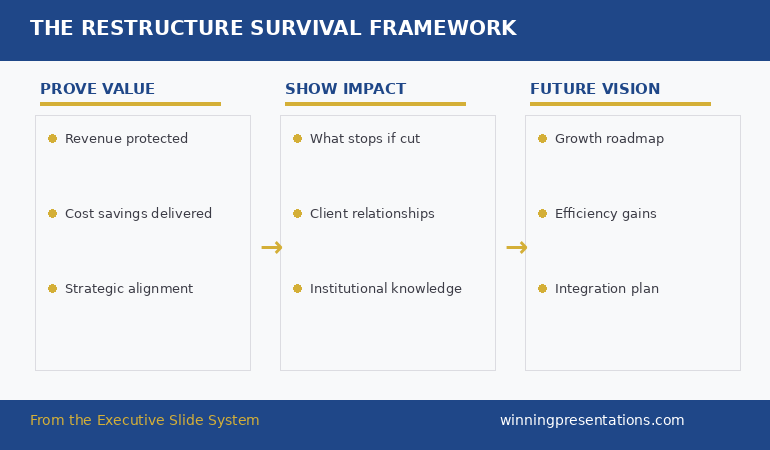
Every reorg survival presentation needs to rest on three pillars. Miss one and your case has a structural weakness that leadership will find — or worse, that a rival department head will point out.
Pillar 1: Value Protection. This is the anchor slide. What revenue, clients, or regulatory obligations does your team currently protect? Not “manage” — protect. The language matters. “We manage £8M in client accounts” is passive. “We protect £8M in annual recurring revenue across 14 enterprise clients, three of whom are in active contract renewals” is a value statement that makes cutting you feel dangerous.
Pillar 2: Cost of Disruption. This is where most presentations fail because leaders are uncomfortable quantifying negative outcomes. But this is exactly what the decision-makers need. What happens to those 14 clients during a 6-month transition? What institutional knowledge walks out the door? What deadlines get missed? Be specific. “Client relationship risk” is vague. “Three contract renewals worth £2.4M are due in Q3 — our account leads have managed these relationships for 4+ years” is a number that makes the finance director pause.
Pillar 3: Future Value. This is where you stop defending and start building. What does your team deliver in the new structure that no other unit can? This is your forward-looking slide, and it should connect directly to whatever strategic priorities the restructure is supposedly serving. If the reorg is about efficiency, show your efficiency roadmap. If it’s about growth, show your growth plan. Mirror their language back to them.
The Restructure Deck That Proves Your Team’s Value in 6 Slides
Your department is at risk. You don’t have weeks to figure out the right structure. The Executive Slide System gives you:
- The executive summary template — pre-built for high-stakes survival presentations where the first slide determines whether they keep listening
- The strategic recommendation framework — connects your team’s output directly to revenue and risk lines leadership cares about
- 51 AI prompts to draft your reorg defence deck in under 90 minutes — including prompts that generate cost-of-disruption analysis
- The scenario playbook — step-by-step guidance for exactly this situation
Get the Executive Slide System → £39
Built from restructure presentations at JPMorgan, RBS, and Commerzbank — including integration committees where entire departments were at stake.
The ‘Cost of Cutting Us’ Slide Nobody Thinks to Build
This single slide has saved more teams in reorgs than any amount of “we’re a great team” messaging. And almost nobody builds it.
The Cost of Cutting slide works because it reframes the conversation. Instead of asking leadership to reward you for past performance (which feels like entitlement during a cost-cutting exercise), you’re asking them to calculate the risk of removing you (which feels like financial due diligence).
Here’s what goes on this slide:
Transition costs: How long does it take to redistribute your team’s work? What does that cost in contractor hours, overtime, or delayed deliverables? Be specific — “6-month transition at an estimated £180K in temporary staffing” is harder to dismiss than “it would take time.”
Client continuity risk: Which client relationships are personally held by your team members? What’s the revenue at risk if those relationships reset during a transition period? Any contract renewals coming up that require continuity?
Knowledge loss: What does your team know that isn’t documented? Systems, processes, client preferences, regulatory history. This is often the most compelling argument because institutional knowledge is genuinely irreplaceable in the short term.
Regulatory or compliance exposure: Does your team hold any regulatory responsibilities that can’t be easily transferred? In financial services, this alone has saved departments from the axe.
If you’re building a reorg survival deck this week, the Executive Slide System includes the strategic recommendation and budget request templates that work perfectly as a cost-of-disruption framework — with AI prompts to populate them fast.
The Institutional Knowledge Argument That Stops Mergers
What should you include in a reorg survival presentation? Beyond revenue and cost metrics, the institutional knowledge argument is the one that most frequently changes minds in the room — because it’s the one thing that can’t be solved with money or time.
I worked with a director at PwC whose team was being considered for a merger with a larger consulting unit. On paper, the merger made sense — the combined team would have broader capability and lower per-head cost. The numbers favoured consolidation.
But she built one slide that changed the conversation: a map of every key client relationship her team held, with the length of each relationship and the specific institutional knowledge attached to it. Three clients had been with her team for 7+ years. Two had regulatory requirements that her team members understood because they’d been involved since the original compliance build.
The merger was restructured to keep her team intact as a sub-unit rather than dissolving them. That single slide — client relationships mapped to institutional knowledge — was the reason.
If your team holds knowledge that can’t be transferred in a document, build a slide that shows it. Name the relationships. Quantify the tenure. Map the dependencies. Make the cost of losing that knowledge feel real and immediate.
What Leadership Actually Evaluates in Reorg Presentations
Having sat through reorg evaluation meetings from the other side of the table, I can tell you what the decision-makers are actually scoring — and it’s not what most presenters think.
They’re not comparing team performance. They’re comparing strategic fit. The question isn’t “which team performed better last year?” It’s “which configuration of teams best serves where we’re going?” If your presentation only looks backward, you’re answering the wrong question.
They’re looking for leaders who get it. When a director presents their team’s case and it’s clear they understand the strategic rationale for the reorg — even while arguing against their own team’s dissolution — that signals executive maturity. Leaders who resist the reorg as a concept rather than making a strategic case within it tend to lose.
They’re watching for cost awareness. If you present your team’s value without once mentioning cost, you look detached from the financial reality driving the restructure. Include your team’s cost base, then show the ROI. “This team costs £620K fully loaded and protects £4.2M in revenue” is a ratio that speaks for itself.
How do you prove your team’s value during reorganisation? Prove it in the language of the restructure’s goals. If the reorg is about cost reduction, prove your team’s cost efficiency. If it’s about strategic focus, prove your team’s alignment to the new direction. Mirror the decision criteria back to the decision-makers.
Stop Going Into Reorg Meetings With an Activity Report
Activity reports get departments consolidated. Value cases get them protected. The Executive Slide System gives you the structure that keeps teams intact:
- 22 executive templates (15 executive + 7 framework) — including the strategic recommendation format that reframes activity as value
- 15 scenario playbook pages — with step-by-step guidance for exactly this kind of high-stakes survival presentation
- 6 checklists and guides — including the before-you-present audit that catches the gaps leadership will exploit
Get the Executive Slide System → £39
The same structure used in integration committees at global banks — where department survival depended on six slides, not sixty.
The leaders who survive restructures aren’t the ones with the longest track record — they’re the ones who present their case in the format leadership is evaluating. The Executive Slide System gives you that format, pre-built and ready to populate.
How to Structure Your Reorg Deck in 90 Minutes
You probably don’t have days to prepare this. Most reorg timelines give department heads a week at best, and you’ve got a day job running alongside. Here’s how to build a credible survival deck in 90 minutes.
Minutes 1-15: The executive summary slide. One slide. Your recommendation (keep the team), three supporting reasons (one sentence each), and the specific ask (what you need leadership to decide). This slide goes first. If you only get 3 minutes instead of 15, this slide carries the whole case. Use the executive summary slide structure — recommendation first, evidence second.
Minutes 15-40: The value protection slide. Map every revenue line, client relationship, and strategic deliverable your team owns. Connect each to a number. This is your Pillar 1.
Minutes 40-60: The cost-of-disruption slide. Quantify what happens if your team is cut. Transition costs, client risk, knowledge loss, regulatory exposure. This is your most powerful slide — build it carefully.
Minutes 60-75: The future value slide. Show what your team delivers in the new structure. Connect it to the stated goals of the reorganisation.
Minutes 75-90: The ask slide and review. State the specific decision you want. “Retain the team as a standalone unit” or “Preserve the core team of 8 within the new structure.” Be explicit. Then review the whole deck once for clarity and remove anything that doesn’t directly support the case.
That’s 5-6 slides built in 90 minutes. If your company’s restructure has been announced and your team is at risk, you can find more about the presentation structure to defend your funding when finance wants cuts.
Is the Executive Slide System Right for Your Reorg Presentation?
✓ This is for you if:
- Your company has announced a restructure and your department is at risk of being merged, downsized, or dissolved
- You’ve been asked (formally or informally) to present your team’s case to leadership
- You need a credible deck structure fast — not in two weeks, but this week
- You want to present a value case, not an activity report
✗ This is NOT for you if:
- You’re the one delivering the reorg announcement (see: restructuring announcement presentation)
- You’re looking for HR templates for restructuring communications
- Your team’s position is already confirmed safe
24 Years of Restructure Presentations at JPMorgan, RBS, and Commerzbank. Now Available as Templates.
I’ve been on both sides of restructure decisions — presenting my team’s case and evaluating other departments’ presentations. The Executive Slide System is built from what actually works in those rooms:
- 22 templates covering every executive presentation scenario — including the exact formats used in integration committees and restructure evaluations
- 51 AI prompts that draft your survival deck in under 90 minutes
- The scenario playbook — step-by-step guidance for high-pressure situations where your team’s existence is on the line
Get the Executive Slide System → £39
Instant download. Start building your reorg deck today.
Frequently Asked Questions
What if I don’t have hard data to prove my team’s impact?
Use proxy metrics. If you can’t show direct revenue, show what your team enables: “We process 340 client requests per month — average resolution time 2.4 hours. Industry benchmark for outsourced handling is 8+ hours.” If your team’s value is in speed, reliability, or institutional knowledge, quantify those. Decision-makers need numbers, but they don’t have to be revenue numbers.
How much time do I realistically have to prepare?
In my experience across four restructures, department heads typically get 5-10 working days between the announcement and the evaluation meetings. Some get less. The 90-minute deck structure above is designed for exactly this constraint — it gives you a credible case fast, then you refine if time allows.
What if my boss is the one proposing the restructure that eliminates my team?
This is more common than people think. Your presentation needs to go above your boss to whoever is making the final decision. Frame your case in terms of organisational risk, not personal loyalty. The cost-of-disruption argument works regardless of who proposed the reorg because it’s about financial impact, not politics.
Should I involve my team in preparing the presentation?
Selectively. Your team members are your best source of data — they know the client relationships, the institutional knowledge, the dependencies. But be careful about creating anxiety. Ask for specific information (“Can you list every client relationship you manage and the annual value?”) rather than announcing “We need to fight for our survival.” Get the data you need without triggering panic.
The Winning Edge Newsletter
Weekly strategies for executive presentations that get decisions, approvals, and buy-in. Trusted by thousands of executives.
Optional free resource: Executive Presentation Checklist — a pre-meeting audit to stress-test your reorg deck.
Also today: If you’re also facing the Q&A after your reorg presentation, read how AI can help you predict and prepare for every hard question before you walk in the room.
The restructure has been announced. The evaluation meetings are coming. Your team is watching to see what you do next. Build the deck that keeps them together.
→ Get the Executive Slide System (£39) and start building your reorg deck today.
About the Author
Mary Beth Hazeldine is the Owner & Managing Director of Winning Presentations. With 24 years of corporate banking experience at JPMorgan Chase, PwC, Royal Bank of Scotland, and Commerzbank, she has delivered high-stakes presentations in boardrooms across three continents.
A qualified clinical hypnotherapist and NLP practitioner, Mary Beth combines executive communication expertise with evidence-based techniques for managing presentation anxiety. She has trained thousands of executives and supported presentations for high-stakes funding rounds and approvals.