Category: Executive Presentations

23 Mar 2026
Two executives shaking hands across a modern glass boardroom table with presentation screens showing partnership framework slides in navy and gold tones

Partnership Proposal Presentation: The 4-Slide Structure That Gets Board Approval in One Meeting

Partnership Proposal Presentation: The 4-Slide Structure That Gets Board Approval in One Meeting

Lena spent six weeks preparing a partnership proposal for a logistics company’s board. She had 28 slides. Competitive analysis. Market sizing. Risk matrices. Implementation timelines stretching to 2028.

The board chair stopped her on slide 9. “Lena, what do you actually want us to decide today?”

She had buried the partnership ask behind 8 slides of context. The meeting ended with “let’s reconvene.” Three months later, a competitor closed the deal she’d been building for a year.

Quick Answer: A partnership proposal presentation that wins in one meeting follows a 4-slide structure: mutual problem, combined capability, shared economics, and a single decision ask. Most partnership pitches fail because they present two companies’ capabilities instead of one shared outcome. The structure below eliminates the “let’s reconvene” response by making the decision inevitable before slide 5.

Partnership proposal structure

Can you articulate these three elements clearly: the shared problem, the combined capability, and the single decision you’re seeking?

→ Explore the Executive Slide System for decision-first templates → View templates

I once watched a partnership proposal die in the most instructive way possible.

Two pharmaceutical companies — one with distribution, one with IP — were trying to bring a diagnostic product to market. The presenting team built a 34-slide deck. Slides 1–12 covered Company A’s capabilities. Slides 13–24 covered Company B’s capabilities. Slides 25–30 covered “synergies.” Slides 31–34 covered implementation.

The problem? The board saw two capability presentations stapled together. There was no shared problem. No combined economic model. No single decision they could say yes to.

The chair said: “This looks like two companies that want something from each other. Show me what the customer gets that they can’t get today.”

That feedback changed how I think about every partnership proposal. The structure isn’t two companies presenting side by side. It’s one new entity presenting a solution that didn’t exist before.

When I rebuilt the deck around that principle — mutual problem, combined capability, shared economics, single ask — the same board approved it in 40 minutes. Same companies. Same product. Different structure.

Why Most Partnership Proposals Get the “Let’s Reconvene” Response

Partnership presentations fail for a different reason than other executive pitches. They don’t fail because the idea is weak. They fail because the structure creates confusion about who benefits and what the decision actually is.

Most partnership decks follow this pattern: “Here’s what we do. Here’s what they do. Together, we’ll do more.” That sounds logical. It’s also the fastest route to deferral.

Boards and executive committees approve decisions, not concepts. When a partnership proposal presents two sets of capabilities, the audience has to do the synthesis work themselves. They have to imagine the combined offering. They have to calculate the shared economics. They have to figure out what they’re actually being asked to approve.

Most won’t. They’ll say “interesting — let’s schedule a follow-up” and move to the next agenda item.

The fix isn’t more slides or better data. It’s a structural change that moves the audience from “two companies presenting” to “one solution requesting approval.” That’s the difference between a 6-month partnership courtship and a 40-minute decision. A strong decision slide is the foundation of every partnership deck that gets approved in a single session.

The 4-Slide Structure That Closes a Partnership in One Meeting

This structure works because it mirrors how executive committees actually make decisions about partnerships. They don’t evaluate each company separately. They evaluate the proposition.

Slide 1: The Mutual Problem — What market gap or customer pain exists that neither company can address alone?

Slide 2: The Combined Capability — What does the partnership create that’s new? Not “Company A does X, Company B does Y.” Rather: “Together, we deliver Z, which doesn’t exist today.”

Slide 3: The Shared Economics — Revenue model, cost structure, and year-one projections. One model, not two.

Slide 4: The Decision Ask — What exactly do you need approved today? Scope, timeline, and the single next step.

Everything else — competitive analysis, risk assessments, implementation details — goes in the appendix. Available if asked. Never presented unprompted.

The 4-slide partnership proposal structure infographic showing mutual problem, combined capability, shared economics, and decision ask

⭐ Maven Flagship — Executive Buy-In

Turn reluctant stakeholders into active advocates

The Executive Buy-In Presentation System is a self-paced programme with 7 modules. Enrol with this month’s cohort, work through at your own pace — optional live Q&A calls are fully recorded.

£499, lifetime access to materials.

Enrol in the Executive Buy-In System →

Slide 1: The Mutual Problem Neither Company Can Solve Alone

This is the most important slide in the deck. It sets the entire frame for the decision.

Most partnership proposals skip this slide entirely or replace it with “market opportunity.” That’s a mistake. Market opportunity tells the audience the prize is worth winning. The mutual problem tells them why they can’t win it alone.

The structure is simple. One sentence for the customer pain. One sentence for why Company A can’t solve it alone. One sentence for why Company B can’t solve it alone. One sentence for what happens if neither company acts.

For the pharma partnership I mentioned, the mutual problem slide read: “Oncology practices need point-of-care diagnostics that integrate with existing lab workflows. We have the diagnostic IP but no distribution infrastructure. They have distribution in 4,200 oncologypractices but no proprietary diagnostic products. Without a partnership, the market defaults to the incumbent — and neither company captures the £340M opportunity.”

That slide did more work than the other 33 combined. It told the board exactly why this partnership mattered and what was at stake. Effective stakeholder mapping before the meeting ensures you know exactly whose concerns to address in this opening frame.

Slide 2: Combined Capability (Not Two Capability Decks Stapled Together)

This is where most partnership presentations go wrong. They present Company A’s strengths on the left and Company B’s strengths on the right, with a Venn diagram in the middle showing “overlap.”

Boards don’t invest in Venn diagrams. They invest in solutions.

Slide 2 should describe the new thing the partnership creates. Not what each company brings. What the customer receives that doesn’t exist today.

Instead of: “Company A: 15 years of diagnostic IP. Company B: 4,200-site distribution network.”

Write: “Together: point-of-care oncology diagnostics delivered to 4,200 practices within 18 months — a product-distribution combination no single competitor can replicate.”

The shift is from inputs (what each company contributes) to outputs (what the partnership delivers). Inputs interest internal teams. Outputs interest boards. Every approval I’ve seen land in one meeting made this shift explicitly on slide 2.

Slide 3: Shared Economics That Make the Decision Obvious

Partnership economics are inherently more complex than single-company financials. Two revenue streams, two cost structures, shared investment, and split returns. Most presenters try to show all of this.

Don’t. Show the combined model only.

The board needs three numbers: total investment required, projected year-one return, and break-even timeline. Everything else is appendix material.

The format that works: a single-page financial summary with three rows. Row one: “Joint investment — £X.” Row two: “Year-one projected revenue — £Y.” Row three: “Break-even — Z months.”

Below that, one sentence on how revenue splits. Not a detailed financial model. Just: “Revenue split: 60/40 in favour of distribution partner, reviewed annually.”

Executives approve partnerships faster when the economics are simple enough to explain to their own boards in one sentence. If your economics slide needs a 10-minute walkthrough, it’s too complex for a decision meeting. Understanding how executives evaluate proposals — especially in contexts like vendor selection decisions — reveals why simplicity always wins.

Partnership economics infographic comparing ineffective complex financial models versus effective 3-number decision format

Partnership Proposal Templates Ready to Use

Pre-built slide templates for partnership proposals and strategic recommendations, structured around the mutual problem, combined capability, shared economics, and decision ask.

Explore the Executive Slide System →

Used in cross-border partnership presentations at financial institutions and consulting firms.

Slide 4: The Decision Ask — One Sentence, One Action

The decision slide is where partnership proposals either close or stall. Most presenters end with “next steps” — a list of follow-up actions, working groups to form, and timelines to agree.

That’s not a decision. That’s a project plan. And boards don’t approve project plans in decision meetings.

The decision slide needs one sentence: “We are asking for approval to [specific action] by [specific date], with an initial investment of [specific amount].”

For the pharma partnership: “We are asking for board approval to execute the distribution partnership agreement with [Company B], with a joint investment of £2.1M and first product delivery targeted for Q3 2026.”

One sentence. One decision. One meeting.

If the board has questions — and they will — the appendix handles those. But the decision frame is set. They’re not evaluating a concept. They’re saying yes or no to a specific ask.

What Belongs in the Appendix (And What Doesn’t)

The 4-slide structure works because it’s lean. But that doesn’t mean you ignore the details. You just put them where they belong: ready for questions, never presented unprompted.

Appendix material for a partnership proposal includes competitive landscape analysis, detailed implementation timeline, full financial model with sensitivity analysis, legal and governance structure, and risk assessment with mitigation strategies.

What doesn’t belong in the appendix? Anything that changes the decision. If there’s a deal-breaking risk or a regulatory hurdle, that goes on slide 3 as a caveat, not hidden in appendix slide 14.

The rule I follow: if hiding it would embarrass you, it’s not appendix material. Put it on the main slide. Everything else can wait for questions.

Managing Presentation Confidence in Partnership Pitches

The 4-slide structure removes ambiguity from the room — but only if you’re able to deliver it with clarity. Presentation confidence matters in high-stakes partnership meetings. I’ve written about how to manage presentation anxiety using evidence-based approaches.

Is This Right for You?

✓ This is for you if:

  • You’re presenting a partnership, joint venture, or strategic alliance proposal to a board or executive committee
  • Your partnership discussions have stalled in “let’s keep talking” without a clear decision
  • You want a slide structure that moves from concept to approval in a single meeting

✗ This is NOT for you if:

  • You’re creating a general company overview or capability deck (not a partnership-specific pitch)
  • You need a legal partnership agreement rather than a presentation structure
  • The partnership has already been approved and you need implementation planning

Frequently Asked Questions

How do I handle partnership presentations when the other company wants their own slides in the deck?

This is the most common partnership presentation mistake. The answer is to build one unified deck together, not staple two decks side by side. Propose the 4-slide structure as the joint approach and offer to draft it. The company that controls the narrative controls the decision frame. If they insist on separate sections, add their content as appendix material and keep the core 4 slides focused on the combined proposition.

What if the board wants more financial detail than 3 numbers?

They will. That’s what the appendix is for. Present the 3-number summary on slide 3, then say: “The full financial model is in the appendix — happy to walk through any line item.” This lets the board control the depth. In my experience, most boards ask about one or two specific assumptions, not the full model. The 3-number summary gives them the decision frame; the appendix gives them the assurance.

Does this structure work for internal partnerships between departments, not just external ones?

Absolutely — and internal partnerships often need this structure even more. Cross-departmental initiatives frequently die because the proposal reads like two departments justifying their own budgets. The mutual problem slide is particularly powerful internally: “Neither Engineering nor Marketing can solve the customer onboarding bottleneck alone. Together, we can reduce time-to-value from 45 days to 12.” Same structure, same decision clarity.

📬 The Winning Edge — Weekly Presentation Intelligence

Join executives who receive one actionable presentation insight every week. Proposal structures, slide frameworks, and decision-making psychology — directly applicable to your next partnership pitch.

Subscribe to The Winning Edge →

🆓 Want to start free? Download the Executive Presentation Checklist first.

Read next: The 48-Hour Window After Every Q&A: Why Most Presentations Win the Room but Lose the Decision

Your next partnership proposal doesn’t need 28 slides. It needs 4. Download the Executive Slide System before your next joint meeting and build the proposal that gets approved in one session.

About the Author

Mary Beth Hazeldine is Owner & Managing Director of Winning Presentations. With 24 years of corporate banking experience at JPMorgan Chase, PwC, Royal Bank of Scotland, and Commerzbank, she advises executives across financial services, healthcare, technology, and government on structuring presentations for high-stakes funding rounds and approvals.

Book a discovery call | View services

22 Mar 2026
Executive presenting capital expenditure proposal to CFO in modern glass boardroom, confident posture, financial charts visible on presentation screen, navy blue and gold corporate setting

The Capital Expenditure Presentation: How to Make the CFO Your Ally, Not Your Gatekeeper

The CFO looked at slide 38 and said eleven words: “Why should I fund something you can’t explain in one slide?”

Quick Answer: A capital expenditure presentation fails when it leads with the asset and hopes the CFO sees the value. A strong CapEx presentation structure leads with the business outcome the expenditure unlocks, positions the CFO as a co-owner of the investment thesis, and frames the approval as a strategic decision rather than a spending decision. The difference is whether Finance feels like a checkpoint or a champion.

Already preparing a CapEx presentation for next week?

If your capital expenditure presentation is treating the CFO as a gatekeeper instead of a strategic partner, the slide structure is working against you. The Executive Slide System includes CapEx-specific templates designed to frame financial approval as a shared investment decision.

Explore the System →

The CapEx Request That Taught a VP a Costly Lesson

Kenji was the VP of Operations at a mid-sized logistics company. He’d built a solid business case for warehouse automation—a £2.3M investment that would reduce processing time by 40% and cut staffing needs by 18 positions over three years. He’d been careful. Three months of vendor evaluation. Detailed ROI analysis. Risk mitigation plan. He walked into the CFO’s office with a 35-slide presentation, confident the numbers would speak for themselves. The CFO watched him through the first four slides, then stopped him: “You haven’t told me why you’re here. Show me the business outcome first, then come back to the technical detail.” Kenji went back to his desk and restructured the deck. Business problem—first slide. Payback period—slide two. The CFO pre-read the new version, approved it in their next meeting, and told him: “I would have approved this the first time if you’d led with what we were solving, not what we were buying.”

Build the CapEx Presentation That Turns Your CFO Into Your Strongest Advocate

  • Deploy slide templates designed specifically for capital expenditure approvals—structured around the financial logic CFOs use to evaluate long-term investments
  • Use AI prompt cards that translate technical infrastructure needs into business outcome language Finance teams respond to
  • Build payback period slides that show the cost of delay, not just the cost of the investment
  • Include the decision-first slide framework that gets CFO alignment before the technical deep-dive

Explore the Executive Slide System →

Built from 24 years presenting capital expenditure cases in banking—where CapEx approvals required sign-off from Finance, Risk, and the board in the same meeting.

Reframing CapEx: From Spending Request to Strategic Investment

Most capital expenditure presentations open with the asset. “We need new servers.” “We need to upgrade the CRM.” “We need to replace the trading platform.” Every one of those sentences positions the CFO as a gatekeeper. You’re asking permission to spend money.

The reframe that changes the entire dynamic: open with what becomes possible after the investment. Not “we need new servers” but “we can reduce settlement processing from 72 hours to 4 hours, which eliminates the manual reconciliation that costs us £180k annually in labour and exposes us to regulatory risk every quarter.”

Now the CFO is evaluating a business outcome, not a purchase request. The conversation shifts from “can we afford this?” to “can we afford not to do this?”

This is not a language trick. It’s a structural decision about where your presentation starts. When your budget presentation leads with the business outcome, every subsequent slide—technical architecture, vendor selection, implementation timeline—becomes evidence supporting a decision the CFO already wants to make.

The Four-Slide CapEx Structure That CFOs Actually Approve

After watching capital expenditure presentations succeed and fail across four global financial institutions, I’ve identified a four-slide opening sequence that consistently gets CFO alignment before the technical detail begins.

Slide 1: The Business Problem Statement (Not the Technical Problem)
Frame the problem in language the CFO uses in their own presentations to the board. Revenue at risk. Regulatory exposure. Operational cost that scales with growth. Manual processes that prevent the team from working on higher-value activities. One slide. Two to three sentences. No technical jargon.

Slide 2: The Payback Logic
Not a full financial model—that goes in the appendix. Show three numbers: total investment, annual benefit, payback period. If the payback period is under 18 months, the CFO’s next question is about risk, not cost. If it’s over 24 months, you need a strategic justification on this same slide. Either way, the CFO now has the financial frame before seeing any technical detail.

Slide 3: The Decision Framework
Show the three options you evaluated and why you recommend this one. Not a vendor comparison—a decision comparison. Option A: do nothing (cost of status quo). Option B: partial upgrade (cost and limitations). Option C: full investment (cost and full benefit). The CFO sees that you’ve already done the analysis they would have asked for.

Slide 4: The Ask
State the specific approval you need, the timeline, and the first milestone. “We’re requesting £1.8M in CapEx for Q2 implementation, with first measurable benefit by Q3.” This is the slide where the CFO decides whether to keep listening or start asking questions. If you’ve structured slides one through three correctly, they keep listening.

Four-slide CapEx structure infographic showing Business Problem, Payback Logic, Decision Framework, and The Ask as sequential steps for CFO approval

Pre-Empting the Three CFO Objections That Kill CapEx Requests

Every CFO evaluating a capital expenditure request runs the same mental checklist. If your presentation doesn’t address these three objections before the CFO raises them, you’ve lost control of the conversation.

Objection 1: “What happens if the project overruns?”
CFOs have been burned before. Every CapEx request promises on-time delivery. Few deliver it. Your presentation needs a slide that acknowledges implementation risk honestly. Show your contingency budget (typically 15-20% of total). Show your milestone-based funding structure—if phase one doesn’t deliver the expected benefit, phase two funding is re-evaluated. This tells the CFO you’ve thought like a CFO, not like a project manager.

Objection 2: “Can we lease instead of buy?”
This is the CFO testing whether you understand the difference between CapEx and OpEx. If leasing is genuinely worse for this scenario, show why: higher total cost over the asset life, less control over upgrades, vendor dependency. If leasing is actually viable, acknowledge it—and show why ownership is better for this specific case. The worst answer is ignoring the question entirely.

Objection 3: “Why now? Can this wait until next fiscal year?”
This is the timing objection, and it kills more CapEx requests than budget constraints do. Your answer needs to be specific: what gets more expensive, more complex, or more risky if you delay twelve months? Quantify the cost of waiting. If the vendor’s pricing expires, say so. If a regulatory deadline makes this urgent, show the compliance timeline. If the team will lose capacity to competing projects in Q3, map it out.

If you address these three objections in your slides before the CFO raises them, something powerful happens: the CFO stops evaluating and starts advocating. They’ve seen that you understand their concerns. Now they’re helping you refine the proposal instead of challenging it.

Need to Present CapEx to Your CFO This Quarter?

Explore the slide templates designed to structure capital expenditure requests around the financial logic CFOs use to evaluate investments.

Explore the Templates →

The Payback Slide That Changes How Finance Sees Your Request

Most CapEx presentations show a payback period as a single number. “24-month payback.” The CFO nods, writes it down, and moves to the next proposal that has a shorter one.

The payback slide that actually changes the conversation shows three things simultaneously: the cost of the investment, the cost of not investing, and the crossover point where doing nothing becomes more expensive than doing something.

Here’s what that looks like in practice. Your current system costs £420k per year in maintenance, workarounds, and manual processing. That cost increases by 12% annually as the system ages and the team grows. The new system costs £1.2M to implement and £180k annually to maintain. The crossover point—where cumulative cost of the old system exceeds cumulative cost of the new system—is month 19.

Now the CFO isn’t evaluating whether to spend £1.2M. They’re evaluating whether to keep spending £420k (and rising) per year on a system that’s getting worse. The CapEx request becomes the financially responsible choice, not the expensive one. This is the difference between presenting to a CFO who sees you as a cost centre and a CFO who sees you as a strategic partner.

If you’re also presenting quarterly forecasts alongside your CapEx case, the forecast presentation structure that simplifies complex financial data works on the same principle: show the trajectory, not just the snapshot.

Comparison infographic showing wrong versus right approaches to CapEx presentation payback slides across four categories including cost framing and timeline presentation

Why Timing Your CapEx Presentation to Budget Cycles Matters More Than Content

You can build the perfect capital expenditure presentation and still get rejected if you present it at the wrong point in the budget cycle. CFOs think in cycles: annual planning, quarterly reviews, mid-year reforecasts. Each cycle has a different appetite for new expenditure.

The best window for CapEx approval is during annual planning (typically Q4 for the following year) when the CFO is actively allocating budget. The second-best window is immediately after a strong quarterly result, when there’s confidence in the financial outlook. The worst window is mid-quarter after a miss, when every new expenditure feels like a threat to the reforecast.

If you’re forced to present outside the ideal window, acknowledge it explicitly: “I know we’re mid-cycle, and I wouldn’t bring this outside planning season unless the timing risk justified it.” Then show why waiting for the next planning cycle costs more than approving now.

This is how experienced capital expenditure presenters operate. They don’t just build better slides—they time the conversation to match the CFO’s mental state about spending. The same proposal gets rejected in February and approved in October, not because the numbers changed, but because the context did.

Stop Losing CapEx Approvals to Structure Problems

  • Slide templates that lead with business outcomes and payback logic—so the CFO evaluates strategy, not just cost
  • AI prompt cards that help you frame capital expenditure in the language Finance teams use to justify investment to the board

Explore the Executive Slide System →

Designed for capital expenditure presentations where the CFO needed to see payback logic before technical detail—and approved the investment in the pre-meeting.

People Also Ask

How many slides should a capital expenditure presentation have?

For CFO-level CapEx approval: 8-12 slides in the main deck, with detailed financial models and technical specifications in an appendix. The first four slides determine whether the CFO keeps listening or starts challenging. Those four slides—business problem, payback logic, decision framework, and the ask—must stand alone as a complete argument.

What’s the difference between a CapEx presentation and a budget presentation?

A budget presentation allocates recurring operational spending. A CapEx presentation justifies a one-time investment in a long-term asset. The approval criteria are different: budget presentations focus on allocation efficiency, while CapEx presentations focus on payback period, asset life, and strategic value. CFOs evaluate them with different mental models, so the structure must be different.

Should I include vendor details in a capital expenditure presentation?

Include vendor selection rationale, not vendor detail. The CFO needs to know you evaluated options and made a defensible choice. They don’t need the vendor’s technical architecture diagram. Show the decision logic: why this vendor, what the alternatives were, and what the switching risk is. Keep vendor-specific detail in the appendix for IT stakeholders who need it.

Is This Approach Right for You?

This is for you if:

  • You’re presenting a capital expenditure request to a CFO or finance committee and need approval, not just acknowledgement
  • Your previous CapEx requests have been deferred or sent back for “more financial detail”
  • You’re a technical leader who needs to translate infrastructure investment into business language
  • Your organisation requires formal CapEx approval and you want to get it done in one meeting, not three

This is NOT for you if:

  • Your CapEx request is under £10k and follows a simplified approval process
  • You’re presenting to a technical committee only, with no Finance stakeholders in the room
  • Your organisation doesn’t distinguish between CapEx and OpEx approvals

Frequently Asked Questions

My CFO keeps asking me to “come back with more detail” on CapEx requests. What am I doing wrong?

“More detail” usually means “you haven’t answered my real question yet.” CFOs rarely want more data—they want more clarity on payback period, implementation risk, and what happens if the project fails. Check whether your presentation addresses the three standard CFO objections: overrun risk, lease vs. buy, and timing. If any of those are missing, that’s what “more detail” actually means.

Should I present CapEx separately or include it in my quarterly review?

Present it separately unless the CapEx request is directly tied to a quarterly result. Quarterly reviews have their own agenda and time pressure. A CapEx request buried in a quarterly review gets evaluated with less attention and often deferred to a dedicated session anyway. Request a standalone 20-minute slot with the CFO. It signals that you take the financial commitment seriously.

How do I handle a CapEx presentation when the CFO has already said no once?

Don’t re-present the same case. Identify what changed since the rejection: new data, new urgency, new risk, or new competitive pressure. Open with that change. “Last quarter you said no because the payback period was too long. Since then, our maintenance costs increased 23% and the vendor raised implementation pricing by 15%. Here’s the updated analysis.” The CFO needs to see that new information justifies a new decision, not that you’re simply asking again.

The Winning Edge — Weekly

Advanced presentation strategy and executive communication insights. One email. Every week. No fluff, no sales pitch—just the frameworks that get decisions approved.

Join The Winning Edge

Free resource: Executive Presentation Diagnostic Checklist

About the Author

Mary Beth Hazeldine is Owner & Managing Director of Winning Presentations. With 24 years of corporate banking experience at JPMorgan Chase, PwC, Royal Bank of Scotland, and Commerzbank, she advises executives across financial services, healthcare, technology, and government on structuring presentations for high-stakes funding rounds and approvals.
Book a discovery call | View services

22 Mar 2026
CEO presenting strategy to formal board table with engaged Non-Executive Directors, large screen showing clean structured strategy slide with navy and gold accents, corporate governance atmosphere

Board Strategy Presentation: The 20-Minute Format That Gets Non-Executive Directors to Engage

Quick Answer: Effective board strategy presentations are compact and decision-focused. Rather than comprehensively covering the detail, a 6-slide format that isolates the strategic choice, frames the trade-offs, and requests explicit board approval delivers clarity in 20 minutes. This structure helps the CEO make the required decision clearer for Non-Executive Directors.

If you’re presenting strategy to the board in the next two weeks:

This article walks you through the exact 6-slide structure that keeps NEDs (Non-Executive Directors) engaged and moves strategic decisions in under 30 minutes. You’ll learn how to isolate the choice you actually need the board to make, and how to frame trade-offs in language directors understand.

The CEO Who Lost the Board at Slide 8

Jonathan was the CEO of a £85 million professional services firm. He’d spent three weeks building a 34-slide strategy deck with his leadership team. It covered market analysis, competitive positioning, operational restructuring, technology investments, and a new service line launch. Every slide had been carefully researched. The data was solid.

He walked into the boardroom confident. By slide 8, something had shifted. One Non-Executive Director was checking her phone. Another was making notes that didn’t look like engagement — they looked like distraction. The Chair was leaning back in his chair, not forward.

Jonathan kept going. Slide 12. The Chair interrupted: “Jonathan, I appreciate the depth here. But what’s the one strategic choice you’re recommending we make today? What decision do you actually need from this board?”

Jonathan paused. He hadn’t led with that. The recommendation was somewhere in slides 18-24, embedded in operational detail. He’d framed everything as context first, decision second. By the time he got to the ask, the board’s attention had already dissolved.

Two months later, Jonathan restructured his board presentation completely. Six slides. One clear strategic choice. The same board dynamics, the same NEDs. But this time they leaned forward. They took notes. One NED asked a sharp clarifying question about the trade-offs. The Chair said, “Approved — let’s move the decision to the 90-day implementation plan.” Twenty-two minutes. Done.

Why Comprehensive Strategy Decks Fail with NEDs

Non-Executive Directors occupy a unique cognitive position. They have deep experience in business, but they see your company once a month (or quarterly). They are NOT immersed in your operational reality. They don’t live with your market challenges or your internal constraints.

What they do have is a sharp ability to smell whether a strategy is clear or muddled. And they have limited time and attention. A 34-slide deck that tries to comprehensively justify every detail before revealing the ask is a form of cognitive tax on NEDs. It forces them to hold competing pieces of information in memory, waiting for you to finally name the choice.

The second problem: comprehensive decks rarely isolate the real choice. Instead, they present a menu of activities (market entry, technology investment, org restructuring, product launch) with the implicit message, “We’re doing all of this.” NEDs don’t feel they’re being asked to decide. They feel they’re being briefed on a done deal wrapped in a presentation.

The third problem: comprehensive decks hide the trade-offs. When you bury the limitations and risks in slides 22-30, NEDs never see the complete risk picture. They approve something incomplete and later discover constraints they didn’t know existed.

Information Dump vs Decision Brief comparison: left panel shows 34 slides, covers everything, NEDs disengage by slide 8, chair asks 'what's the ask?', strategy unresolved; right panel shows 6 slides, one clear recommendation, NEDs lean forward, chair says 'approved', strategy moves in 22 minutes

The Six-Slide Board Strategy Framework

A board strategy presentation that moves decisions in under 25 minutes has a precise structure. It’s not about oversimplifying — it’s about structuring complexity so NEDs can follow your logic and reach the same conclusion you have.

The framework isolates six decision moments, each on its own slide:

Slide 1: The Strategic Context

What has changed since the last board meeting that makes a new strategic decision necessary right now? (Market shift, competitor move, internal capability change, regulatory change.) This is not the full market analysis. This is the precipitating factor that triggered the need for board-level decision-making.

Slide 2: The Choice We Face

Two or three genuine options. Not one obvious option with two strawmen. Describe each option clearly, in language that reveals what each choice means for the business (growth rate, market position, risk profile). Real choices feel uncomfortable because each option has genuine merit and genuine limitations.

Slide 3: Our Recommendation

One clear recommendation with the single most important reason. Not three reasons. Not a comprehensive justification. The one thing that tipped the decision. NEDs will remember a crisp one-reason recommendation more than they’ll absorb three supporting arguments.

Slide 4: The Trade-Offs We’re Accepting

What we’re choosing NOT to do and why. This is the slide that builds credibility. You’re not pretending the choice is risk-free. You’re naming what you’re giving up and demonstrating you’ve thought it through. This is where NEDs feel heard because you’re acknowledging their likely concerns.

Slide 5: The 90-Day Actions

What starts happening in the next quarter if the board approves this strategy. Name the three or four actions that will be underway before the board meets again. This answers the question NEDs always ask: “How will we know this is working?”

Slide 6: The Decision We Need Today

A one-sentence, crystal-clear request for a specific board resolution. Not “approve the strategy.” Rather: “Approve the acquisition of TechCorp as our market entry mechanism” or “Approve the organisational restructuring to separate the operations and client service divisions.” Say exactly what resolution the board needs to pass.

Isolating the Strategic Choice You Actually Need

Most strategy decks fail at Slide 2 because the “choice” isn’t actually a choice. The CEO has already decided. The presentation is an elaborate justification, not a decision point.

A real strategic choice in front of a board should feel mutually exclusive. If you choose Option A, you explicitly do not choose Options B and C. There should be reasonable people — reasonable NEDs — who could argue for each option based on different risk tolerances or different interpretations of the market.

If your three options are (A) Acquire the competitor, (B) Acquire the competitor, or (C) Acquire the competitor, then you don’t have a choice. You’re presenting a done deal as though it’s a decision. NEDs will sense that immediately.

Real choices for boards often look like this:

Option A: Enter the North American market via organic growth. Invest £12M over 24 months. Lower short-term revenue impact. Higher execution risk. Slower market share capture.

Option B: Acquire a local North American player. Invest £22M upfront. Accelerated revenue. Known execution risks (integration). Higher short-term earnings pressure.

Option C: Partner with a North American distributor. Invest £2M. Minimal capital. Market risk (we don’t control the customer relationship). Slower long-term upside.

Now the board is facing a real decision. The CFO might lean toward Option C (capital efficiency). The growth-focused NED might lean toward Option B (speed to market). The risk-conscious Chair might prefer Option A (control, phased capital). Your job is to take a position, acknowledge that reasonable people could choose differently, and say why you recommend what you do.

When presenting strategy to a board, clarify your actual choice first.

Ask yourself: “If the board said no to my recommendation and chose a different option instead, would the business be substantively changed?” If the answer is no — if any of your three options would produce essentially the same business outcome — then you don’t have a real choice yet. Go back to your leadership team and refine the trade-offs until each option produces a materially different outcome.

Board Meeting This Week? Use the 6-Slide Structure

The Executive Slide System includes board strategy slide templates designed for the decision-focused format — each with context-setting, option framing, and trade-off language ready to adapt. Start with a structure that isolates the choice and frames the trade-offs before you walk in.

  • ✓ Board strategy slide templates for the 6-slide decision format
  • ✓ Trade-off framing guides to prepare Slide 4
  • ✓ Decision-slide frameworks for isolating the strategic choice
  • ✓ AI prompt cards to generate context and option language

Get Started →

The Trade-Offs Conversation NEDs Will Remember

Slide 4 is the most underrated slide in executive presentations. It’s the moment you shift from selling to credibility-building.

Most CEOs write Slide 4 reactively — “Here are the risks we’ve considered.” That’s passive. Instead, write it actively: “Here’s what we’re choosing not to do and why.”

If your recommendation is to enter the North American market via acquisition, your trade-offs might be:

“We’re choosing not to pursue organic growth because our window to establish market position is 18 months. Competitors are moving faster. We’re trading 18-24 months of higher capital expenditure for entry speed and known market position. We’re accepting the integration risk because the acquisition target’s client list is worth the execution complexity.”

Notice what that does: it answers the questions NEDs were already thinking. It shows you’ve weighed the alternatives. It makes the case that you’re not being reckless — you’re being strategic about which risks you’re willing to take and which you’re not.

This is where the board’s trust in you either deepens or erodes. If your trade-offs sound incomplete (“We’re not worried about integration issues”), NEDs will question your judgment. If your trade-offs sound honest and fully considered (“Integration risk is real; here’s our playbook to mitigate it”), you’ve built credibility.

One more principle: frame trade-offs in terms NEDs care about, not terms that matter to you internally. Your operations team cares about resource allocation. Your board cares about risk profile and shareholder value impact. Translate.

Moving from Presentation to Decision

The 90-day actions slide (Slide 5) serves a critical function. It signals to the board: “If you approve this, here’s what we’re actually doing. Here’s the resource commitment. Here’s the visible progress you’ll see by Q2.”

Many boards say no to strategies not because the strategy is bad, but because the CEO hasn’t convinced them that the business can execute. Your 90-day actions directly address that doubt.

What goes in the 90-day actions? The three or four initiatives that you will have visibly started before the board meets again. Not everything. Not the 12-month roadmap. The immediate next moves that prove you’re serious and capable.

If your strategy is to acquire TechCorp, your 90-day actions might be: (1) establish due diligence team, (2) sign NDA and begin deep financial review, (3) map integration playbook, (4) identify retention risks for key TechCorp staff. By the next board meeting, the board can see tangible progress. They know you’re executing.

The final slide — the resolution you need — should feel like a natural conclusion, not an abrupt ask. You’ve walked the board through context, options, your recommendation, trade-offs, and actions. The resolution slide is simply: “We need the board to pass the following resolution…” and you name it, one sentence, crystal clear.

If you’ve built the case well, NEDs won’t need time to think. They’ll be ready to pass the resolution in the meeting.

The 6-Slide Board Strategy Format: Card 1 shows Strategic Context, Card 2 shows The Choice We Face, Card 3 shows Our Recommendation, Card 4 shows Trade-Offs We're Accepting, Card 5 shows 90-Day Actions, Card 6 shows Decision We Need Today

The Mistakes That Extend Board Meetings

A board strategy presentation should take 18-22 minutes. If yours is consistently running 45 minutes or longer, one of these mistakes is happening:

Mistake 1: Comprehensive context instead of precipitating change. You’re giving the board a full market analysis when you should be naming the one thing that changed. Boards don’t need to relearn your market. They need to know why you’re asking them to make a decision now.

Mistake 2: Presenting options as though they’re all bad. If you frame Option A as “we could do this but it’s complicated,” and Option B as “we could do this but it’s risky,” then you’re not presenting real options. You’re presenting a predetermined conclusion disguised as choices. NEDs will feel manipulated, and they’ll slow down to ask clarifying questions to verify your options aren’t strawmen.

Mistake 3: Burying the recommendation. If it takes 12 minutes before you say what you actually recommend, you’ve lost the board’s permission to lead. Frame your recommendation early (Slide 3), then use Slides 4-5 to build the case.

Mistake 4: Trade-offs that sound defensive. “We’re aware of the integration risk.” That’s passive. “We’re accepting the integration risk because gaining market position in 12 months is worth the execution complexity, and here’s our mitigation plan.” That’s active and credible.

Mistake 5: 90-day actions that are too vague or too comprehensive. “We’ll begin implementation” isn’t an action. “We’ll have the due diligence team assembled and the first round of financial review complete” is. Name three or four specific, visible milestones.

Mistake 6: A resolution that sounds like a question. “Do you think we should consider approving the acquisition?” No. “We need the board to pass a resolution approving the acquisition of TechCorp pending satisfactory completion of due diligence.” That’s a request, not an inquiry.

Structuring your board presentation takes time the first time.

Most CEOs need 2-3 iterations before the choice, the recommendation, and the trade-offs all land cleanly. That’s normal. What matters is that you’re not starting from a 34-slide data dump. You’re starting from a framework that forces clarity. Our guide to executive presentation structure walks you through how to isolate the core decision and build your argument efficiently.

Is This Right For You?

  • ✓ You present strategic decisions to a board or governance committee — and you’ve noticed NEDs disengage when presentations exceed 25 minutes.
  • ✓ You struggle to isolate a clear strategic choice — your “options” feel like variations on a predetermined answer.
  • ✓ Board approval cycles are longer than they should be — you’re giving boards too much information and not enough clarity on what decision you need.

Frequently Asked Questions

What if the board asks for more detail during the presentation?

Embrace the question. If a NED asks for more detail on a specific point (market size, competitor positioning, integration timeline), you have that detail in your supporting deck. Say, “Good question — that’s in our detailed market analysis. Let me pull that up.” Then address the question without losing the board’s focus on the core decision. The 6-slide structure is your presentation; supporting materials are your backup.

How do I present three genuine options when I have a strong preference for one?

Present the options objectively, then make your recommendation clear on Slide 3. The key is that each option should be defensible — reasonable people with different risk tolerances could choose any of them. Your job is to name what you prefer and why, not to make the other options look foolish. If you can’t make a case that reasonable people could choose Option B or C, then they’re not real options. Go back and refine them so they are.

What if the board doesn’t approve my recommendation?

That’s the board doing its job. You’ve presented genuine options, they’ve chosen differently, and now you execute their choice. You don’t undermine it or lobby for yours. Your credibility depends on adapting to board direction and proving you can execute their chosen path as effectively as you would have executed yours. If you can’t do that with genuine commitment, you have a governance problem that a better presentation won’t solve.

The Winning Edge — Weekly insights for executives

Every Tuesday, we send a short email with one insight on presentation strategy, decision-making, or governance. Practical ideas you can use in your next board meeting. No promotional noise.

Sign Up for The Winning Edge

One more thing: your choice of whether to present a comprehensive deck or a decision-focused deck signals something to your board about your leadership. Comprehensive says, “Here’s everything I know, please decide.” Decision-focused says, “Here’s the choice I’ve made, here’s why, and here’s what I need from you.” NEDs reward clarity and decisiveness. They reward confidence balanced with honest acknowledgement of trade-offs. The 6-slide format isn’t about dumbing down complexity — it’s about proving you’ve thought the complexity through and can articulate why you’re recommending what you do.

When your next board meeting approaches, ask yourself: “Can I explain my strategic recommendation in six slides, naming the choice, the trade-offs, and what I need from the board?” If the answer is yes, you’re ready. If the answer is no, you probably don’t have a clear recommendation yet.

Not ready for the full system? Start here instead: download the free Executive Presentation Checklist — a one-page audit covering clarity of recommendation, trade-off framing, and decision readiness before you walk into any board room.

If you’re presenting multiple strategies to different boards, you’ll want to look at our guide to decision slides for executives, which goes deeper into how to frame the specific decision moment so NEDs move from listening to approving. And if your strategy involves multiple stakeholder groups, stakeholder mapping for presentations will help you tailor your framing for each audience.

Author: Mary Beth Hazeldine is Owner & Managing Director of Winning Presentations. With 24 years of corporate banking experience at JPMorgan Chase, PwC, Royal Bank of Scotland, and Commerzbank, she advises executives across financial services, healthcare, technology, and government on structuring presentations for high-stakes funding rounds and approvals.

The choice is not whether to be clear — it’s whether to be clear with the board in your presentation, or clear with yourself after the meeting when they reject the muddled recommendation.

21 Mar 2026
Executive technology evaluation meeting with IT and Finance leaders reviewing structured presentation slides in modern glass boardroom

The Technology Evaluation Presentation: How to Get IT and Finance to Say Yes in the Same Meeting

Your CTO wants security and scalability. Your CFO wants ROI and risk mitigation. You need both departments signing off on the same technology purchase—and they’re speaking completely different languages.

Quick Answer: The most common reason technology evaluation presentations fail is that they’re built for one audience and hope the other one agrees. A strong technology evaluation presentation structure addresses both IT performance criteria and financial impact simultaneously, using parallel evidence that speaks to each department’s priorities without requiring translation.

⚠️ Diagnosis: Is Your Tech Evaluation Presentation Missing Something?

Your presentation is not failing because you lack technical detail or financial analysis. It’s failing because IT and Finance hear different stories from the same slides. You need a structure that lets both departments recognise their priorities instantly.

Get the presentation diagnostic checklist

The Platform Migration That Shipped on Schedule

A senior infrastructure engineer named Sven was tasked with moving his organisation from a monolithic payment system to a cloud-native platform. The IT team had strong architectural preferences. Finance needed cost certainty. Instead of building separate business cases, Sven structured a single evaluation that showed how IT’s chosen architecture eliminated the specific cost categories Finance worried about most: manual reconciliation work (£240k annually), vendor overage fees during migration (another £120k), and post-launch infrastructure optimisation delays (£90k). He sent this pre-read to both teams structured as three parallel columns: Technical Requirements Met, Financial Impact, Timeline Risk. The CFO approved funding before the steering committee met. The CTO approved the approach before Finance gave it a second review. When the full group convened, the decision was simply confirmed.

Why Separating IT and Finance Approval Costs You a Month

  • Deploy structured slide templates designed for dual-audience technology evaluations—IT criteria on the left, financial impact on the right
  • Use prompts that help you position technical decisions as financial decisions (not just risk mitigation)
  • Build vendor comparison frameworks that show both architecture fit and cost justification simultaneously
  • Create business case slides that integrate technical requirements with budget approval criteria
  • Include pre-meeting diagnostic slides that signal to both stakeholders that their priorities are already understood

Get the Executive Slide System → £39

The Executive Slide System includes slide templates specifically for technology evaluation scenarios with AI prompt cards, scenario playbook guides, and diagnostic checklists for dual-audience alignment.

The Three Slides That Align IT and Finance Instantly

Technology evaluation presentations typically fail because they are built sequentially: here’s the problem, here’s the technical solution, here’s the cost. IT nods at slide two. Finance wakes up at slide three. Neither sees how their priorities connect.

The three slides that change this are:

Slide 1: The Business Impact Statement
This is not a financial summary. It’s a statement of what becomes possible (or what risk gets eliminated) after this technology is in place. Frame it as capability, not cost: “With [solution], we can deliver customer onboarding in 48 hours instead of 2 weeks” or “This integration removes our single point of failure in payments processing.” IT sees the technical outcome they’re responsible for. Finance sees the business consequence they’re accountable for.

Slide 2: The Architecture Approach (Stripped of Jargon)
Your CTO needs this detail. Your CFO does not. But your CFO needs to see that a real approach exists. Show the architectural approach in three boxes: what you’re replacing, how the new system sits between current tools, what integrations matter. Include one line of financial context per box: “This eliminates manual reconciliation (currently £180k annually in labour)” or “Migration follows this sequence to prevent revenue system downtime.”

Slide 3: The Approval Criteria Met
Create a two-column comparison. Left side: “Technical Requirements” (security rating, uptime percentage, API maturity, team capacity required). Right side: “Financial Requirements” (cost per user, implementation timeline impact, payback period, risk exposure reduction). Show how the selected solution meets both columns. This is the slide where IT and Finance finally see they’re evaluating the same thing.

IT-Finance Alignment Framework infographic showing five steps: Map Stakeholder Criteria, Build the Bridge Slide, Lead With Business Impact, Show the Decision Framework, and Close With the Recommendation

Building Credible Evidence for Both Audiences

IT teams trust technical proof points: architecture diagrams, security certifications, API documentation, case studies from similar technical environments. Finance teams trust financial proof points: contract terms, reference customers of similar size, implementation cost breakdowns, risk-adjusted ROI models.

Your evidence strategy needs both. But don’t duplicate your slide space—integrate them. On your vendor comparison slide, for example:

  • Show security certifications (ISO, SOC 2, etc.) alongside average cost of a data breach in your industry
  • Display API maturity levels alongside integration velocity impact (faster integration = lower implementation cost)
  • List team certification requirements alongside fully-loaded cost per developer month
  • Reference customer case studies that include both similar organisation size AND similar implementation budget

This evidence structure does something important: it stops IT and Finance from dismissing each other’s concerns. When IT sees that a “secure but slower” vendor choice increases implementation cost by £300k, they’re more willing to compromise on a “less certified but faster” option that Finance prefers. When Finance sees that a “cheaper” vendor requires 40% more server infrastructure than their sizing assumed, they understand IT’s resistance.

The Technology Evaluation Presentation Mistakes That Delay Approval

Most technology evaluation presentations fail not because they lack information, but because they ask IT and Finance to do translation work. Here are the mistakes that add three weeks to your approval timeline:

Mistake 1: Assuming “Total Cost of Ownership” is Self-Evident
You calculate TCO. Your Finance team recalculates it. They discover they counted hidden costs differently. Everyone redoes the analysis. Instead: show your TCO calculation methodology in the presentation itself. Let Finance validate the numbers before the meeting, not during it.

Mistake 2: Treating Risk as a Technical Issue Only
Your IT team worries about vendor lock-in, uptime guarantees, and data security. Your Finance team worries about vendor financial stability, contract exit terms, and liability limits. A strong technology evaluation presentation addresses both. Show the vendor’s financial health (not just their technical health). Show how contract terms protect the organisation if the vendor fails.

Mistake 3: Presenting Vendor Comparisons That Privilege IT Priorities
Your comparison might show “Vendor A has better API maturity” and “Vendor B has lower cost.” IT gravitates to A. Finance to B. You’ve created a false choice. Instead, show what IT gets for Finance’s chosen option (faster integration reduces cost) and what Finance gets for IT’s chosen option (better architecture prevents costly maintenance).

Technology Evaluation Presentations comparison infographic contrasting wrong approaches like starting with product features versus right approaches like starting with the business problem across four categories

Are Both Departments Making the Same Decision?

The difference between approval in one meeting versus three is whether IT and Finance can see the same solution from their different angles. Get the slide templates designed for dual-audience alignment.

Explore the Templates → £39

The Business Case Slide Nobody Expects

Most technology evaluation presentations include a financial business case. Few include the business case for deciding now versus deciding later.

This matters because IT and Finance have different timelines. IT worries about technical debt—the longer you wait, the more complex the migration. Finance worries about cost escalation—the longer you wait, the more expensive the solution. A strong presentation quantifies both.

Your business case slide should show:

  • Cost of current system in year 1, year 2, year 3 (licence escalation, maintenance burden, team capacity spent on workarounds)
  • Implementation cost if you decide now versus if you decide in 12 months (vendors raise prices, migration gets more complex with accumulated data, team turnover changes execution capability)
  • Risk cost if the current system fails before you migrate (revenue impact, recovery time, customer impact)
  • Opportunity cost: what the team could build instead of maintaining workarounds

This slide works because it frames the decision as “which timeline makes financial sense?” rather than “do we agree this technology is good?” IT and Finance can disagree on technology and still agree on timeline logic.

Stop Building Separate Presentations for IT and Finance

  • Dual-audience slide templates that let both departments recognise their priorities in one deck
  • Vendor evaluation frameworks designed to address both technical and financial approval criteria simultaneously

Get the Executive Slide System → £39

Designed for presentations where technology evaluations need IT procurement sign-off and CFO budget approval in the same meeting.

Is This Approach Right for You?

This structure works when:

  • You need approval from both IT and Finance in the same decision cycle
  • IT and Finance have measured you before and disagreed (one wanted to move fast, one wanted to move carefully)
  • The technology decision affects both infrastructure and budget planning
  • You want to avoid sequential presentations that create delays and re-analysis cycles
  • Your organisation has a history of technology projects where IT and Finance blamed each other for overruns or delays

If you’re presenting to IT only, or Finance only, you need a different emphasis. But if you need both departments saying yes in one meeting, this structure is the difference between approval and delay.

Master Dual-Audience Technology Presentations

  • PowerPoint slide templates for technology evaluation scenarios (vendor comparison, build vs. buy, migration business case, infrastructure investment)
  • AI-powered prompt cards that help you articulate technical decisions in financial language (and vice versa)
  • Scenario playbook guides including the exact slides IT and Finance need to see in technology vendor evaluations
  • Diagnostic checklists including approval criteria mapping (what each stakeholder needs to see to say yes)
  • The alignment framework used in presentations where both IT and Finance approved in a single meeting

Get the Executive Slide System → £39

Used in technology vendor evaluation presentations where IT and Finance stakeholders approved in the same meeting because both departments recognised their priorities in the slide structure.

People Also Ask

What’s the difference between a technology evaluation presentation and a vendor pitch?

A vendor pitch is the vendor selling to you. A technology evaluation presentation is you selling the decision to your stakeholders. The structure is completely different. Vendor pitches emphasise product capabilities. Technology evaluation presentations emphasise how the product solves your specific problem and meets your approval criteria. This is why vendors often can’t deliver the slides you actually need—they don’t know what your IT and Finance departments require to say yes.

Should I show multiple vendors or commit to one in the presentation?

Show multiple vendors if your organisation requires vendor comparison before approval. Show one vendor if you’ve already done the evaluation and you’re presenting the recommended choice. The mistake most people make is showing multiple vendors but letting different stakeholders prefer different ones. Use your vendor comparison slide to show why the recommended vendor is the right choice for both IT and Finance criteria, not just for one audience.

What if IT and Finance genuinely disagree on the best choice?

That’s not a presentation problem—that’s a decision problem. Your presentation can’t solve disagreement, but it can clarify what each department is optimising for. Often IT and Finance aren’t actually disagreeing on the technology; they’re disagreeing on which risk matters more. A strong presentation surfaces that disagreement so the business decision-maker can decide: is this a technical risk organisation or a financial risk organisation? Then everyone commits to the same choice based on that business logic.

Frequently Asked Questions

How long should a technology evaluation presentation be?

For IT and Finance together: 12-15 slides. You need enough detail that both departments see their concerns addressed, but not so much that you create confusion. Pre-read documents can contain additional technical or financial detail. The presentation itself should move decision-makers from “we need more information” to “we’re ready to decide.”

Should I include the vendor’s materials in my presentation?

No. Use the vendor’s materials for research and detail validation, but build your presentation from your stakeholders’ perspective. Vendor materials sell product features. Your presentation sells the decision to buy. The structure, evidence hierarchy, and audience focus are completely different. If you copy slides from vendor pitch decks, you’re inheriting their priority sequencing, not yours.

What’s the biggest mistake in technology vendor evaluation presentations?

Treating evaluation as a technical exercise and expecting Finance to simply rubber-stamp the IT decision. The biggest mistake is the reverse: treating it as a financial exercise and expecting IT to accept whatever Finance chooses. Both perspectives matter. Both approval criteria matter. Your presentation’s job is to show that the recommended choice wins on both dimensions, or explicitly show which dimension your organisation is prioritising if it doesn’t.

Every week, just the essentials

Advanced presentation strategy and stakeholder communication insights for the people who lead decisions. No sales messages. Only insights you can use Monday morning.

Join The Winning Edge

Get the slide checklist: executive presentation diagnostic checklist (free)

About the Author

Mary Beth Hazeldine helps executive teams and technical leaders build presentations that actually get decisions approved. She works with CIOs, CTOs, CFOs, and business leaders on technology investment presentations where multiple stakeholders need to agree. Her framework for dual-audience presentations has been used in vendor evaluations, infrastructure investments, and technology transformation initiatives across financial services, healthcare, and professional services.

21 Mar 2026
Executive presenting confidently in a glass-walled boardroom, screen behind showing clean structured slide with key metrics, senior leaders listening attentively

Promotion Business Case Presentation: The 4-Slide Structure That Wins Committee Approval

Claire was Head of Digital at a UK retail group. She’d submitted for Director three times and been rejected three times. “Not quite ready,” the feedback always said. No specific gaps, no roadmap to yes. On her fourth submission, she stopped writing a detailed CV and started building a business case presentation instead. Four slides. No prose. Just quantified impact: £2.1M in revenue from her team’s initiatives. Three cross-functional projects delivered. Headcount grown from 4 to 11 people under her management. The committee approved her promotion in the first meeting. Effective date six weeks later.

Quick answer: A promotion business case presentation stops the committee from evaluating you against abstract criteria and forces them to evaluate you against the numbers you’ve already delivered and the scope you’re ready for. Most promotion candidates submit a CV (which invites comparison and judgment) or a rambling narrative (which buries the business case in words). Instead, build four slides: The Commercial Impact you’ve delivered, The Scope you’re ready for, The Gap you’ve already closed, and Why Now. Each slide answers one specific question. Together, they answer the only question that matters: “Is this person clearly ready, or are we still waiting?”

Promotion decision meeting this month?

Most candidates prepare what they’ve done. Few prepare what they’re ready to do. If you’re walking into a promotion committee meeting with a CV or a vague narrative, you’re accepting the rejection you’ve already received twice.

  • Quantify exactly what you’ve delivered in the current role
  • Define the scope you’re ready for at the next level
  • Show the specific gaps you’ve already closed
  • Explain why the committee should move now, not wait

→ Skip ahead to the four-slide business case structure below.

The Fourth Submission That Worked

Claire had done everything right the first three times. Her CV was polished. She’d taken every leadership course available. She’d mentored junior team members. Her manager called her “a natural leader.” But the promotion committee saw the CV and asked: “Compared to other candidates at her level, is she exceptional?” That question invited comparison. Comparison invites hesitation.

Before the fourth submission, Claire rebuilt her approach entirely. She stopped thinking about proving she’d “earned” the promotion through tenure and effort. She started thinking like she was already in the role, and the committee needed a business case for moving her now. She quantified. She showed scope. She closed perceived gaps. She explained risk: the talent she’d develop was being poached by other teams because she wasn’t promoted. One presentation. Four slides. No hedging. The committee didn’t compare her to other candidates. They compared her to the cost of losing her. Promotion approved.

Why CVs Fail and Business Cases Win

The promotion decision is not a comparison decision. It never should be. But a CV invites comparison. So does a narrative summary of what you’ve done. Here’s why:

CVs Are Backward-Looking

A CV lists past roles, responsibilities, and achievements. The implicit message is: “I’ve been here a long time doing this very well.” The committee hears: “Are they better than other candidates who’ve also been somewhere a long time?” Suddenly you’re in a comparison tournament. If another strong candidate is being considered, you both look similar. Hesitation sets in.

Business Cases Are Forward-Looking

A business case says: “Here’s what I’ve delivered in the current role. Here’s what I’m ready to deliver at the next level. Here’s what could go wrong if you wait. Let’s decide now.” The committee isn’t comparing you. They’re evaluating risk and opportunity. Very different mental frame.

CVs Invite Questions You Can’t Answer

A CV prompts the committee to ask: “Is this person leadership material? Are they visionary? Will they grow into the role?” These are judgment questions. You can’t answer them with facts. You can only hope the committee sees it the way you do.

Business Cases Answer Questions Before They’re Asked

A business case says: “I’ve already led projects of this scale. I’ve managed budgets of this size. I’ve handled this type of stakeholder complexity. I’ve closed this gap. Here’s the evidence.” No speculation. No hopes. No judgment required—just an evaluation of readiness based on demonstrated scope.


CV Review vs Business Case comparison infographic contrasting backward-looking evaluation versus forward-looking scope demonstration across four dimensions (Focus, Message, Response, Outcome)

The Four Slides: Structure That Works

A promotion business case has exactly four slides. Not three (too little scope), not five (too much detail). Four slides answer four specific questions the committee is asking (whether they say it aloud or not):

  1. Slide 1 — Commercial Impact: What have you actually delivered? (Numbers only.)
  2. Slide 2 — Scope: What are you ready to lead? (Bigger picture.)
  3. Slide 3 — Gap: What did you need to learn? And have you learned it? (Addressing doubt.)
  4. Slide 4 — Why Now: What’s the cost of waiting? (Creating urgency.)

This structure works because it doesn’t ask the committee to evaluate you. It asks them to evaluate your readiness. Completely different exercise.

Promotion Committee This Month? Build the Business Case, Not the Narrative

If your committee meeting is coming up and you’re still working from a CV or a verbal narrative, the Executive Slide System gives you the exact four-slide business case structure to build instead. It includes:

  • The four-slide business case structure for promotion committees (commercial impact, scope, gaps closed, why now)
  • Worked examples showing how to quantify impact at executive level
  • Decision-slide frameworks designed for internal committee presentations
  • Templates ready to adapt to your organisation, role, and committee

Get the Executive Slide System → £39

Informed by real-world executive presentation experience across investment banking, SaaS, and consulting — including internal promotion contexts.

Slide 1: The Commercial Impact You’ve Delivered

This slide answers: “What has this person actually delivered?” Not in prose. Not in a list of responsibilities. In numbers.

What Numbers Go Here?

Revenue driven. Cost reduced. Headcount managed. Projects completed on time or early. Customer retention improvement. Market share gained. Team size growth. Budget managed without overspend. Retention of top talent you’ve developed. Any metric that matters to your organisation’s financial or operational success.

If you’re in a function that doesn’t directly drive revenue (HR, Finance, Operations), quantify the impact you’ve had on the business that relies on you: “Reduced hiring cycle time from 14 weeks to 7 weeks, enabling 40 critical hires in year two. Prevented £1.2M in turnover costs through culture initiatives.”

How Many Numbers?

Three to five numbers. No more. Each number should be large enough to be noteworthy and specific enough to be credible. “Big revenue” is vague. “£2.1M in revenue from digital commerce initiatives, 180% year-on-year growth” is specific.

Present Them Minimally

One number per line. No paragraphs. No explanation. The slide is pure fact. The explanation comes in the presentation moment, face to face.

Example Slide 1 (Digital Leader, Retail Group):

  • £2.1M revenue from digital commerce initiatives (Year 1–2)
  • Team scaled from 4 to 11 people (net retention 94%)
  • 3 cross-functional projects delivered on time: Platform migration, Customer data integration, Omnichannel pricing
  • Average digital customer NPS: +28 points year-on-year

This slide doesn’t prove Claire deserves a promotion. It proves she’s already delivered at the scope of the role she wants.

Slide 2: The Scope You’re Ready For

This slide answers: “What would this person be responsible for at the next level?” Again, no narrative. Just scope.

What Scope Information Goes Here?

Team size. Budget responsibility. Revenue or P&L ownership. Number of stakeholders. Strategic decisions you’d make. Cross-functional responsibilities. Geographic scope. Customer base. Market segment. Anything that defines the size and scale of the role you’re applying for.

Make It Comparative

Show current scope and next-level scope side by side. “Currently manage 11 people, £2.8M annual budget. Director role would manage 28–35 people, £7–9M annual budget, and P&L responsibility for three business units.” This makes the leap clear without being grandiose.

Example Slide 2 (Digital Director Role):

Dimension Current (Head of Digital) Next Level (Director)
Team size 11 28–35
Budget authority £2.8M (operational) £7–9M (P&L)
Strategic decisions Digital strategy execution P&L strategy, portfolio, resource allocation across 3 units
Stakeholder groups Marketing, IT, Finance, Operations Board, CEO, CFO, three business unit heads, external investors

The committee now sees that you’ve already led projects at 40–60% of the next-level scope. You’re not asking them to take a massive bet. You’re asking them to expand a proven track record.

Slide 3: The Gap You’ve Already Closed

This slide addresses the silent question every committee has: “What concerns do we have, and have they already been addressed?” Don’t wait for them to say it. Say it first.

What Gaps Commonly Come Up?

For first-time directors: “Have they managed a larger team?” or “Have they handled a serious people issue?” For cross-functional promotions: “Do they understand the P&L?” For external hires seeking rapid advancement: “Do they know our culture?” For technical leaders moving to management: “Can they lead non-technical people?”

Think back to feedback you’ve received. Think about what the next-level role requires that you haven’t yet formally held. That’s the gap.

Show the Evidence You’ve Already Closed It

Don’t say, “I’m ready to manage a larger team.” Say, “I’ve managed the Platform Migration project, which required me to coordinate 22 people across three departments for six months. Delivered on time, no overruns, 96% of team stayed post-project.”

Example Slide 3 (Digital Leader, potential gaps and evidence):

  • Gap: Can you handle P&L responsibility? → Evidence: Managed £2.8M annual budget with zero overruns for two years. Drove cost negotiations that saved 18% vs. year one. Forecast accuracy 94%.
  • Gap: Can you lead at board level? → Evidence: Presented quarterly business reviews to CFO and CEO for 18 months. Lead quarterly board updates on digital KPIs (8 presentations, zero rework requests).
  • Gap: Can you make the hard people decisions? → Evidence: Led the reorganisation of the digital team (11 people, reallocation of three, one exit managed professionally). Retained 100% of high performers during restructuring.
  • Gap: Can you develop the next generation? → Evidence: Promoted two team members to senior roles. One is now leading the platform team. 94% of team stayed, suggesting effective development and engagement.

The committee stops worrying about gaps. They start thinking about timing.


The 4-Slide Promotion Business Case structure infographic showing stacked cards: The Commercial Impact, The Scope You are Ready For, The Gap You have Closed, Why Now

Slide 4: Why Now

This is the most underrated slide. It answers: “Why should we move now instead of waiting six months, a year, or until a formal opening exists?”

Reasons to Move Now

Organisational timing: “We’re about to launch the omnichannel initiative. The role I’m being considered for will own it. Waiting six months means losing momentum and delaying revenue impact.”

Market competition: “Two competitors have hired directors into similar roles in the last quarter. Talent in this space is moving fast. If we wait, the best people available now might not be available in six months.”

Risk of attrition: “I’ve had three conversations in the last two months about external opportunities. I’m not looking, but I’m being sought out. A decision now sends a clear signal about career progression in this organisation.”

Team stability: “If this role opens formally, I’d be a candidate. So would external hires. A decision now avoids the chaos of a competitive internal process that could destabilise the team.”

Capability readiness: “I’ve deliberately taken on stretch assignments in the last 18 months to prepare for this role. I’m at peak readiness now. Waiting longer doesn’t add capability—it just delays momentum.”

Frame It as Mutual Benefit, Not Threat

The worst version of Slide 4 is: “I have other offers, so decide now or lose me.” The best version is: “Here’s why moving now benefits the organisation more than waiting.” These are genuinely different messages.

Example Slide 4 (Digital Leader):

  • Organisational: Omnichannel strategy launch (Q2) requires director-level ownership. Director structure in place now ensures strategic alignment from day one.
  • Talent landscape: Digital director roles in retail are tight. Three director-level hires completed by competitors in the last quarter. First-mover advantage matters.
  • Team continuity: Current structure has been stable for 18 months. Promoting internally ensures zero transition risk and maintains momentum.
  • Cost: Internal promotion costs 60% less than external recruitment for this level.

The committee hears: “This is smart business.” Not: “Hurry or I leave.”

Unsure how to quantify your impact?

Many executives underestimate what they’ve delivered because they focus on activity instead of outcome. The Executive Slide System includes a metrics framework that walks you through finding and framing the numbers that matter most for your role.

Common Mistakes That Sink Promotion Cases

Mistake 1: Burying Impact in Narrative

You say: “I’ve managed several large projects, led a team through significant growth, and delivered strong results.”

The committee hears: “Maybe.”

Say instead: “£2.1M revenue, team grew from 4 to 11, three projects on time.”

The committee hears: “Clearly.”

Mistake 2: Confusing Current Scope With Next-Level Scope

You say: “As director, I’d continue what I’m doing now, but at a larger scale.”

The committee worries: “So you’d be doing the same job, bigger. Who develops the next generation of heads of function?”

Say instead: “Currently I execute digital strategy. As director, I’d own digital strategy and P&L for three business units, allocate resources across portfolios, and report to the CEO quarterly.”

The committee hears: “You’ve thought about the leap.”

Mistake 3: Ignoring the Gaps They’re Worried About

You present your four slides. The committee thinks: “What about P&L? Has she handled a board-level conversation? Can she manage a larger team?”

These worries sit silent. Unanswered. They become reasons to delay the decision.

Say it first. Show the evidence. Close the gap before they voice it. They can’t worry about something you’ve already addressed.

Mistake 4: Creating Urgency by Threat

You say: “I’ve had offers from other companies, so I need a decision by Friday.”

The committee hears: “You’re a flight risk. If we promote you and you leave anyway, we’ve wasted time.”

Say instead: “The omnichannel initiative launches in Q2. This director role needs to own that strategy from day one. A decision in March means we’re ready; a decision in May means we’re playing catch-up.”

The committee hears: “You’re thinking about the business, not just yourself.”

Mistake 5: Not Presenting It as a Presentation

You email four slides with a cover letter to the committee.

The committee reads it in their calendar between two other emails. The four slides sit in isolation without context.

Insist on 15 minutes in the room. Present the four slides. Let them ask questions. The presentation—your presence, your clarity, your composure—is half the power. The slides are the other half.

When Your Manager’s Advocacy Isn’t Enough, the Business Case Has to Speak for Itself

Most candidates wait for their manager to make the case in the room. When the committee meets without you, your manager’s opinion becomes the only evidence. The Executive Slide System gives you the specific slide formats that shift the conversation from advocacy to documented impact — the promotion business case, the decision-slide structure, and the quantified impact framework.

Get access to: Promotion business case frameworks, decision-slide structures, and the exact formats for presenting quantified impact to senior committees.

Get the System → £39

How to Present Your Four Slides

The four slides are useless if they sit in an inbox. They’re powerful if you present them in person, face to face, to the decision-making committee.

Book 15 Minutes

Not 30. Not 45. Fifteen. Long enough to present clearly. Short enough that it feels confident, not defensive. “I’d like 15 minutes with the promotion committee to walk through my business case for the director role.”

Start With the Rescue

Before the first slide, say: “I’m not here to ask you to compare me to other candidates. I’m here to show you why moving now is better for the business than waiting. I’ve organised this around four questions I know you’re asking: What have I delivered? What am I ready for? Have I closed the gaps you’re worried about? Why should we move now? Let’s walk through them.”

You’ve just told them the meeting won’t be self-aggrandising or political. It will be clear and business-focused. That’s the tone that wins.

Present Without Over-Explaining

Show Slide 1. Say: “Here’s what I’ve delivered in the current role. Four key metrics: revenue, team growth, projects, customer impact. Any questions?” Wait for them. Let them ask. Then move to the next slide.

You’re not performing. You’re having a business conversation. They’ll respect that.

End With Openness

After Slide 4, say: “That’s the case. What questions do you have?” Sit down. Let them ask. Don’t keep talking. Silence here is not awkward—it’s them processing. Let them process.

When They Say They’ll Think About It

They will. Say: “I appreciate that. Is there anything you’d like me to clarify or any information I should get you before you decide?” This is not pushy. It’s professional. You’re saying: “I’ve made the case clearly. If there are gaps in the case, I want to fill them.”

Know Your Committee Before You Present

The four slides work, but only if you know who you’re presenting to. Before you schedule that 15-minute meeting, know:

  • Who has final say? (CEO, CFO, Board of people?)
  • What does each person care about most? (CFO cares about cost and P&L. CEO cares about strategy. Your boss cares about continuity.)
  • What concerns might each person have? (Frame Slide 3 to address each person’s specific concern.)
  • Have you worked with them before, or is this your first high-stakes interaction? (If it’s your first, prove you can handle board-level presence.)

Understanding your audience before you present is the foundation of every executive presentation. Your promotion business case is no exception.

Is This Right For You?

This four-slide business case approach is right for you if you can answer YES to at least two of these:

  • ✓ You’ve been told “not quite ready” before, and you want to change that conversation from judgment to business reality
  • ✓ You’ve delivered measurable impact in your current role, but the committee doesn’t seem to see it
  • ✓ You’re being considered for promotion but haven’t had the chance to present your case directly to the decision-makers
  • ✓ You’re worried that without a structured argument, the committee will compare you to other candidates and hesitate

This approach is NOT right for you if:

  • ✗ You’re in a role where you haven’t yet delivered any measurable impact (in that case, focus on delivering first, then building the case)
  • ✗ The organisation doesn’t have formal promotion committees (in that case, the conversation is one-on-one, not structural)
  • ✗ You’ve already been told you’re promoted pending a formal announcement (you don’t need to persuade; you need to transition)

Frequently Asked Questions

Should I include these four slides in my official application, or present them separately?

Separate. Your official application—CV, cover letter, form—follows the organisation’s process. The four-slide business case is what you present to the decision-making committee after your application is accepted. It’s not a replacement. It’s the tool you use in the meeting to move from “maybe” to “yes.”

What if I’m being promoted internally and the committee already knows my work?

They know your role. They might not know the quantified impact. Many executives don’t realise how much revenue their team drove or how many people they’ve successfully developed until they start looking for the numbers. Even if the committee knows you well, the numbers create clarity that relationships alone can’t. Show the slides anyway. It changes the conversation from “we like working with you” to “you’ve demonstrably delivered at the next level’s scope.”

What if I can’t quantify some of my impact?

Quantify what you can. For the rest, show evidence of scope. If you’ve managed a project that involved coordinating 20 people for six months, that’s scope, not a number. If you’ve led a cross-functional initiative that touched three departments, that’s scope. Numbers are better, but scope is credible too. Just make sure every slide has either a number or a significant scope indicator. Don’t leave a slide blank because you “didn’t have numbers.”

Should I mention other job offers to create urgency?

No. Frame urgency around the business case (Slide 4) instead. “The omnichannel initiative launches in Q2” is urgency. “I have another offer” is a threat. The committee might promote you, but you’ll start the role with a damaged relationship because they felt pressured. Use business urgency instead.

What’s Inside the Executive Slide System

The Executive Slide System gives you slide structures, templates, and decision frameworks for the executive presentation scenarios you face most often — including the promotion business case, the budget briefing, the governance reset, and the stakeholder presentation.

What you get:

  • Slide templates for 12 executive scenarios (including the complete four-slide promotion business case)
  • Decision-slide frameworks designed for committee presentations
  • Worked examples from real executive presentations (SaaS, consulting, financial services)
  • Pre-briefing strategy guides
  • One-time price: £39

Get the Executive Slide System → £39

The Presentation Is Only the Beginning

The four slides win the committee’s approval. But that approval only happens if you’ve done the work before you walk into the room.

Build your case over weeks, not days. Collect the numbers. Run the projects. Develop the people. Close the gaps. The four slides are the summary of work you’ve already been doing. They’re not magic. They’re clarity.

When Claire walked into her fourth promotion committee meeting, the four slides weren’t new to her. She’d been building that case for 18 months through the projects she’d taken on, the metrics she’d tracked, the scope she’d deliberately expanded. The four slides just made it visible.

That’s when the committee saw what had been true all along: she was already ready.

Get weekly guidance on executive presentations

Every Monday, a short email with the presentation strategy that moves decisions. Join 2,400+ executives.

Subscribe to the Newsletter

🆓 Free resource: Executive Presentation Checklist — a free guide to strengthen your presentation preparation.

Related: Why Your Evaluation Presentation Needs Structure

The same principle applies to technology evaluations and other high-stakes business decisions. The technology evaluation presentation that gets both IT and Finance to say yes follows a similar framework: show impact, define scope, prove readiness, create urgency. Different context, same structure.

About Mary Beth Hazeldine

Mary Beth spent 16 years in investment banking and corporate finance at RBS, where she made and lost pitches at every level. She’s sat in promotion committees. She’s submitted CVs and been rejected. She’s also seen what works—and what doesn’t. Now she helps executives build presentations that change decisions. She’s based in Edinburgh and works with leaders across SaaS, consulting, and financial services.

Your promotion business case doesn’t prove you deserve the role. It proves the organisation deserves the upside of moving you now.

20 Mar 2026
Executive at whiteboard or conference table with project timeline on screen in background, calm authoritative demeanour, navy and gold accents, professional corporate setting

Project Delay Presentation: The Slide Structure That Keeps Stakeholder Trust When Timelines Slip

Quick Answer: Delays happen to every large project. The difference between those that maintain stakeholder trust and those that lose it comes down to a single structure: a four-slide “delay briefing” that leads with what happened, explains why, shows concrete recovery action, and requests one clear decision. This approach transforms the conversation from “you failed to deliver” into “here’s how we move forward together.”
Already in a project delay situation? Skip ahead to the “The 4-Slide Delay Briefing Structure” section for the exact format you need to present this week. If you’re managing multiple stakeholders, the “Stakeholder Mapping for Delay Conversations” section will help you tailor the message to each audience before you walk in the room.

Why Delays Derail Stakeholder Trust (And How to Prevent It)

Marcus arrived at the steering committee meeting with the regular progress update, ready to bury the bad news on slide 14 of 18. He thought if he framed it right—”We’ve experienced some velocity headwinds on the critical path, but we’re still tracking to rebaseline the milestones”—no one would actually notice the £12 million rail modernisation project was now running six weeks behind.

The executive sponsor noticed immediately. So did the infrastructure minister’s office representative. Within fifteen minutes, Marcus had lost the confidence of the entire governance board. For the next three months, every decision took twice as long. Every status update was scrutinised. Trust, once lost, becomes the most expensive commodity on any project.

Marcus, a Programme Director at a large UK infrastructure firm, was managing a £12 million rail station modernisation project with a baseline deadline of 18 months. At month twelve, the structural survey revealed unexpected foundation work that hadn’t appeared in the preliminary geotechnical study. The project slipped nine weeks. Marcus tried to bury the announcement in a standard progress deck, presenting it on slide 14 of 18 with vague language like “velocity headwinds” and “rebaselining milestones.” The executive sponsor spotted it immediately, then in the next meeting, challenged every decision. Marcus’s credibility plummeted for three months until he shifted to a completely different approach: a dedicated four-slide delay briefing presented at the top of the next steering committee agenda. He led with the specific date the delay was discovered, the exact cause (unexpected foundation requirements), named the recovery action owner, and asked for one decision (approve the revised critical path or commission an external validation). The transparency reset trust entirely. His next project—which also slipped nine weeks—never lost sponsor confidence because the delay was briefed the same way, the first time the governance board heard about it.

The problem is almost never the delay itself. Every large project experiences schedule pressure. Sponsors understand that. What destroys trust is the appearance of hiding, the use of vague language, the inclusion of delay news buried in a thirty-slide deck rather than presented first and directly.

The solution is structural. It is not a better apology. It is not more frequent updates. It is a specific slide structure that does three psychological things at once:

  • It signals respect for your audience’s time. You’re not making them hunt for the news. It’s there, honest and clear, at the top of the agenda.
  • It reframes the conversation from failure to problem-solving. You’re not asking for forgiveness; you’re inviting them to collaborate on next steps.
  • It demonstrates control in the face of uncertainty. You know what happened, why it happened, what you’re doing, and what you need from them. That confidence is contagious.

Large organisations—especially those managing infrastructure, capital projects, or regulated environments—live with delays. What they cannot tolerate is the feeling that the project team is making decisions or hiding information. Transparency, specificity, and a clear path forward are worth more than a miracle recovery plan that no one believes.

The 4-Slide Delay Briefing Structure

The structure is deceptively simple, but the simplicity is the point. When people are stressed—and a project sponsor hearing about a major delay is stressed—they cannot process complexity. They want four things in order:

  1. What is the bad news?
  2. Why did it happen?
  3. What are we doing about it?
  4. What do you need from me?

Each of those gets one slide. No more. The power comes from the restraint.

Side-by-side split comparison infographic showing The Buried Approach (delay hidden on slide 14, vague language, no clear owner, sponsor surprised) versus The Proactive Brief (dedicated slide at top of agenda, specific dates and cause, named owner, sponsors briefed in advance)

Figure 1: The Buried Delay Approach loses sponsor trust within minutes. The Proactive Brief reframes the conversation.

This is not a presentation format you use to convince people the delay isn’t actually a delay. It is a format designed to deliver difficult news in a way that keeps the governance relationship intact. If your organisation uses executive presentation structure frameworks, you already understand that simplicity, specificity, and signal-to-noise ratio matter more than comprehensiveness.

Delay Briefing This Week? Use the Exact Four-Slide Structure

The Executive Slide System £39 includes the complete four-slide delay briefing structure used by project and programme leaders in infrastructure, capital, and technology sectors. If you need to rebuild the conversation fast, start with the sequence, not the slides. It includes:

  • Slide templates for the exact four-slide delay structure (ready to adapt to your project)
  • Worked examples from infrastructure, capital, and tech projects
  • The governance conversation framework—how to brief stakeholders before the formal meeting
  • Recovery plan slide formats designed for high-scrutiny executive review

Price: £39 once. No subscription.

Get the Executive Slide System

Slide 1: What Happened (The Single Honest Statement)

This slide has one job: state the fact. No hedging. No jargon. No minimisation.

Bad examples:

  • “We are experiencing velocity headwinds on the critical path.” (What does that mean?)
  • “The project has encountered some scheduling challenges.” (This could mean anything.)
  • “We’ve had to rebaseline certain milestones.” (Why?)

Good example:

  • “On 14 February, we discovered additional foundation work required for the east wing. The project now runs nine weeks behind the baseline completion date.”

The difference is specificity. Specific date. Specific reason. Specific number of weeks. No interpretation, no softening language, no “however.” Just fact.

This slide should take up maybe 60 per cent of the slide real estate. The text should be in the sans-serif body font, the colour navy (#1F4788) on white. Add a single icon or accent line in gold if you want visual interest, but do not overcomplicate it. People are anxious. They want clarity.

The psychological effect is paradoxical: the more direct and simple this slide is, the more competent and trustworthy the project team appears. Vagueness makes people nervous. Specificity makes them think you have control.

Slide 2: Why It Happened (One Root Cause, Not a List)

This is where most project leaders go wrong. They list five reasons—poor requirements, scope creep, resource constraints, third-party delays, weather—and by the time they finish, the executive has tuned out and lost confidence.

The rule for this slide is absolute: one root cause.

If you cannot distil the delay to one root cause, you do not yet understand the delay well enough to brief it. Go back to your team. Work until you find the single thread that, if pulled, explains everything else.

In Marcus’s case, the root cause was not “poor surveying” or “inadequate budget” or “bad luck.” It was: “The preliminary geotechnical study did not include excavation analysis of the east wing basement.” Everything else flowed from that one fact.

This slide should be roughly the same size as Slide 1. One sentence or two maximum. The root cause in the largest font. Smaller text (if needed) showing what this root cause led to.

Do not use this slide to explain away the delay. Do not list mitigation measures you should have taken but didn’t. Do not apologise. State the cause, and move to the next slide.

Slide 3: What We’re Doing About It (Concrete Action)

Now the conversation shifts forward. This slide answers: “What is the concrete action, and who owns it?”

The slide should include:

  • A single recovery action (not a list of ten ideas). For Marcus, it was: “Commission specialist foundation engineering firm to design and schedule the additional work.”
  • The named owner (not “the team” or “we”). For Marcus: “Sarah Chen, Engineering Lead, responsible.”
  • A deadline (when will this action complete). For Marcus: “Completed design and schedule by 28 March.”
  • The outcome that deadline produces (what the sponsor will have on 28 March). For Marcus: “Revised critical path and cost impact for sponsor decision.”

This slide is not a wish list. It is not “things we hope to do.” It is a commitment. The owner should know they are being named on this slide before they walk in the room.

The psychological shift here is profound. The sponsor went from hearing bad news to hearing that the project team has a plan and someone accountable for it. That is enough to keep most governance boards confident.

Slide 4: What You Need To Decide (The One Question)

The final slide removes the ambiguity about the sponsor’s role. It is not “What do you think we should do?” It is a specific decision gate.

This slide should frame a single, clear decision:

  • “Approve the revised critical path, or request external validation before approval.”
  • “Release the contingency budget, or commission a value engineering review first.”
  • “Proceed with the revised schedule, or escalate to the steering committee.”

The decision should be answerable in the meeting or within a short specified window (e.g., “within 48 hours”).

This slide does something psychologically important: it returns agency to the sponsor. They are not passive recipients of bad news; they are decision-makers. Their role is clear. The path forward is clear. That clarity is worth more than any amount of hope or optimism.

Four-card stacked infographic showing The 4-Slide Delay Briefing Structure: Card 1 "What Happened" (one sentence, specific date, specific weeks), Card 2 "Why It Happened" (single root cause), Card 3 "What We're Doing" (named owner, concrete action, deadline), Card 4 "What You Need To Decide" (one decision gate)

Figure 2: The 4-Slide Delay Briefing—each slide answers one question in order.
Pro tip: Rehearse this four-slide briefing with your executive sponsor or steering committee chair before the formal meeting. The briefing works best when it is not a surprise. If the sponsor already knows the four points, the formal briefing becomes confirmation, not shock. That small gesture—giving them a heads-up—can mean the difference between “the project team hid this from us” and “the project team is being transparent with us.”

Timing, Sequence, and Stakeholder Communication

A four-slide briefing fails if it is presented cold. The real skill is in the pre-briefing communication strategy.

Start the process 48 hours before the formal steering committee or governance meeting. Your approach should be:

  1. Brief the chair or sponsor individually first (1:1 conversation, not email). Share all four slides. Let them ask questions. Answer fully. This is not a surprise—it is a partnership.
  2. Brief any other key governance members (steering committee chair, finance lead, executive sponsor) before the group meeting. Same four slides. Same transparency. By the time the group meets, there are no surprises.
  3. Present the four-slide briefing to the full governance board as the first agenda item. This is not buried in a 30-slide deck. It is the opening conversation.

Stakeholder mapping for the delay conversation means understanding which stakeholders need to hear the news first, in what sequence, and in what format. For a capital project, the executive sponsor is always first. For a product release, the head of product is first. For a regulatory matter, legal and the regulatory lead are first.

The four-slide briefing then becomes the “formal record” that was already discussed, not a shock announcement.

Common Mistakes That Destroy Trust

Mistake 1: Trying to Make the Delay Sound Small

Language like “a modest three-week slip in the east wall construction phase” sounds like you are minimising the problem. Call it what it is: “three weeks.” Let the sponsor decide if it is modest or serious.

Mistake 2: Burying the Announcement in a Larger Deck

If the delay briefing is slides 14–17 of a 30-slide progress deck, the sponsor’s first reaction is not “Okay, let’s work on this together.” It is “Why is this buried? What else are they hiding?” Present the four slides as a standalone briefing or as the first section of a meeting.

Mistake 3: Listing Multiple Root Causes

If you say “The delay was caused by poor surveying, inadequate budget reserves, and unexpected weather,” the sponsor hears “Your project team is disorganised and doesn’t know what actually went wrong.” Find the one thing that, if it hadn’t happened, the project would not be delayed. Everything else is secondary.

Mistake 4: Proposing a Recovery Plan Without a Named Owner

“We will accelerate the east wing work by bringing in additional resources” is vague. “Sarah Chen will bring in two additional foundation teams by 21 March, with completion targeted for 15 May” is a commitment. The named owner is what gives sponsors confidence.

Mistake 5: Leaving the Sponsor’s Role Ambiguous

Do not end with “Any questions?” End with a specific decision gate: “We need you to approve the revised schedule by Friday, or escalate to the steering committee for a broader review.” That clarity is what allows them to move forward instead of worry.

When Sponsor Trust Is at Stake, Structure Is What Protects Your Standing

Sponsors rarely lose confidence because of one delay. They lose confidence when the briefing is vague, evasive, or unprepared. The Executive Slide System gives you the specific slide formats that keep governance relationships intact under pressure — the delay briefing, the recovery plan, and the replan presentation. Each format is structured to demonstrate clarity, ownership, and forward motion, so the conversation stays professional rather than defensive.

Get access to: Delay briefings, replan presentations, budget conversations, governance resets, and crisis communication frameworks.

Get the System for £39

Building the Recovery Narrative Beyond the Four Slides

Once the four-slide briefing has been delivered and the decision made, the project moves into a different communication phase. This is no longer a crisis brief; it is a recovery narrative.

The recovery narrative should include weekly updates (brief, specific), clear milestones with target dates, and a planned “recovery complete” milestone that the sponsor can anticipate. The tone shifts from “here is bad news” to “here is progress toward resolution.”

In many cases, especially in long-term infrastructure projects, the recovery narrative becomes routine status reporting. The key is that the project team has now established a pattern of transparency and specificity. Future announcements—whether positive or negative—will be received with greater credibility because the team has demonstrated they communicate clearly under pressure.

This is where the decision-slide framework for executive conversations becomes invaluable. Every recovery update, every milestone review, and every governance conversation needs the same clarity: here is the situation, here is what we are doing, here is what we need from you.

Adapting the Framework to Your Project Type

The four-slide structure works across all project types because it is psychologically sound, not because it is industry-specific. However, the content adapts slightly depending on what you are managing:

Infrastructure and Capital Projects: Slide 1 focuses on the specific work package delayed and weeks behind. Slide 2 names the physical or contractual cause. Slide 3 names the remediation action and owner. Slide 4 asks for budget or schedule approval.

Technology and Product Launches: Slide 1 names the feature or release delayed and the revised go-live date. Slide 2 focuses on technical or resource constraints (bugs discovered, skills gaps, third-party API delays). Slide 3 names the engineering lead and the specific resolution path. Slide 4 asks for a decision on MVP scope or launch timing.

Regulatory and Compliance Projects: Slide 1 names the deadline or milestone at risk. Slide 2 cites the regulatory or compliance barrier (new interpretation, third-party audit finding, external requirement change). Slide 3 names the compliance lead and the approach to remediation. Slide 4 asks for escalation to legal or regulatory leadership if needed.

The structure is the same. The details change based on your context. The psychological principle—clarity, ownership, and forward motion—is universal.

Is This Approach Right For You?

  • Yes, if: You manage projects with external stakeholders or governance boards who need to approve scope, schedule, or budget changes. You are facing a delay of more than a few days and need to reset the relationship with sponsors.
  • Yes, if: You have experienced a situation where poor communication about a delay led to loss of confidence, and you want a framework to prevent that from happening again.
  • No, if: Your delays are typically resolved without governance approval or sponsor notice. This framework is for situations where the sponsor’s trust and decision-making matter.

Frequently Asked Questions

What if the delay is still being assessed? Do I brief the sponsor before I have all the facts?

Yes. Here is what you say: “We discovered a potential delay on [date]. We do not yet have a full assessment, but here is what we know so far: [specific facts]. We are commissioning [named action] to give us full clarity by [date]. In the interim, here is what the delay could mean: [range]. We will brief you the moment we have the full picture.” This is transparency, not weakness. Sponsors trust teams that know what they don’t know.

Should I present the four-slide briefing in a formal steering committee meeting, or in a 1:1 with the sponsor first?

Do a 1:1 first (48 hours before the formal meeting). Share all four slides. Answer every question. Then brief other key stakeholders individually. Then present to the full group as confirmation, not shock. The four-slide briefing is the same in all contexts, but the audience shape matters for trust.

What if the sponsor asks for more detail or a deeper recovery plan during the four-slide briefing?

Have a follow-up deck ready (separate from the four slides). The four-slide briefing is the governance conversation. The follow-up deck is the detailed plan. Keep them separate. The four-slide briefing should answer the immediate questions (what, why, what now, what do you decide). The follow-up deck goes deeper into risk, cost, resource, and timeline detail. Never mix them or the impact of the four-slide clarity is lost.

🆓 Free resource: Executive Presentation Checklist — a free guide to strengthen your presentation preparation.

For more on structuring high-stakes presentations, read our guide to pipeline review presentations for sales leaders—another scenario where clarity and specificity determine whether sponsors lean forward or pull back.

What’s Inside the Executive Slide System

The Executive Slide System gives you slide structures, templates, and decision frameworks for the executive presentation scenarios you face most often — including delays, budget briefings, governance resets, crisis communications, and stakeholder recoveries. Each template is ready to adapt to your specific project, timeline, and audience.

What you get:

  • Slide templates for 12 executive scenarios (including the complete four-slide delay briefing)
  • Decision-slide frameworks that make briefings clear and actionable
  • Worked examples from real projects (infrastructure, capital, technology, regulatory)
  • Pre-briefing communication strategy guides
  • One-time price: £39

Get the Executive Slide System for £39

About the author: Mary Beth Hazeldine is a former investment banker at RBS with over 20 years’ experience in executive communication, stakeholder management, and crisis briefings across infrastructure, capital, and technology sectors. She is based in Edinburgh and specialises in helping leaders master the presentation skills that determine organisational outcomes. Her work has been featured in financial media and executive leadership publications.

Project delays are inevitable in large organisations. What matters is whether your sponsors believe you are hiding something or collaborating with them to move forward. The four-slide briefing structure gives you a way to do the latter.

19 Mar 2026
Executive standing at the head of a boardroom table presenting a financial recovery plan with a clean slide on screen showing structured numbers and a recovery timeline, navy and gold corporate aesthetic

Budget Overrun Presentation: The Structure That Keeps Leadership’s Confidence

Quick Answer: A budget overrun presentation that keeps senior leadership’s confidence follows three phases: own the number precisely, explain the root cause in one sentence, and present a recovery plan before anyone asks for one. The worst budget overrun conversations happen when leaders sense the presenter is managing their reaction rather than solving the problem. The structure below makes the problem visible and the path forward credible — before the room gets defensive.

⚠️ Budget review in the next 48 hours?

Before you open PowerPoint — answer these in one sentence each:

  • What is the exact overrun figure and percentage?
  • What is the single root cause (not a list of reasons)?
  • What is your recovery plan and what decision do you need from the room today?

→ If any answer is fuzzy, your slides are not ready. The Executive Slide System (£39) has a pre-built difficult scenario framework built for conversations like this one.

Priya had been Director of Digital Transformation for eleven months when the numbers stopped working in her favour.

The cloud migration project she’d championed was £340,000 over budget — 23% above the original approval. The board review was in 48 hours. Her instinct was to soften it: lead with the project’s successes, embed the figure mid-presentation, frame the overrun as “investment recalibration.”

Her CFO shut that down in thirty seconds. “They’ll find the number themselves in the first five minutes. If you didn’t lead with it, you’ve already lost the room.”

Priya rebuilt the presentation in two hours. She opened with the overrun figure on slide one. Root cause on slide two. Recovery options with clear recommendations on slide three. The board approved the recovery plan and increased project governance — no one suggested termination. One director said afterwards: “That’s the most honest budget conversation I’ve had in three years.”

The structure wasn’t comfortable. It was credible.

Why Most Budget Overrun Presentations Damage Trust Instead of Protecting It

Most budget overrun presentations fail for a reason that has nothing to do with the numbers. They fail because the presenter is visibly managing the audience’s reaction rather than solving the problem.

Leadership committees are skilled at reading room management. When a presenter buries a negative figure, leads with compensating positives, or uses passive constructions (“costs have increased” rather than “we are over budget”), the room registers evasion before it registers the data. That evasion is more damaging than the overrun itself.

The instinct to soften is understandable but counter-productive. Softening signals uncertainty about whether you can handle the consequences — which makes leadership uncertain too. Precision and directness signal the opposite: you have assessed the situation, you understand it fully, and you have a plan.

The decision slide framework applies directly to crisis conversations: every difficult presentation must ask for a specific decision, not sympathy. Budget overrun meetings fail when they are designed to minimise punishment rather than enable a clear recovery decision.

Executive standing at the head of a boardroom table presenting a financial recovery plan with a clean slide on screen showing structured numbers and a recovery timeline, navy and gold corporate aesthetic

Budget Overrun Presentation Tomorrow? Start With This Structure.

If you need to rebuild the conversation fast, do not start with design. Start with sequence. The Executive Slide System gives you a pre-built structure for presenting the number, the cause, and the recovery plan clearly under pressure.

  • Slide templates for difficult scenario presentations — budget, risk, and project recovery
  • AI prompt cards to draft your overrun narrative in under 20 minutes
  • Frameworks for structuring bad-news conversations that keep leadership’s confidence
  • Scenario playbooks covering board, steering committee, and executive escalation formats

Get the Executive Slide System → £39

Built from 24 years of delivering difficult conversations at JPMorgan, PwC, and global consulting firms.

The Three-Phase Structure: Own It, Quantify It, Recover It

The structure that works for budget overrun presentations is the same structure that works for any difficult executive conversation: move the audience from problem to decision as quickly as possible.

Phase 1 — Own It: State the overrun figure, the percentage, and when it was identified. No preamble. No context-setting. The number first.

Phase 2 — Quantify the Root Cause: One sentence explaining why. Not a list of contributing factors — a single, honest root cause. Boards can accept bad news. They cannot accept confusion about why it happened.

Phase 3 — Recovery Plan: Three options (if applicable) or one clear recommendation with the decision you need from the room today. Specific figures, specific timelines, specific ownership.

Everything else — project progress, team performance, market conditions, future forecasts — belongs in the appendix. Available if asked. Never presented as the opening frame. A strong executive presentation structure always prioritises the decision over the context.

Phase 1: Own the Number — Precision Builds Credibility

The opening slide of a budget overrun presentation should contain three things: the original approved budget, the current projected cost, and the overrun expressed as both a figure and a percentage.

No headline. No softening title. The numbers, clearly labelled.

If the overrun was identified three weeks ago, say so. If you identified it last week, say so. The time lag between discovery and disclosure matters to leadership — not because they will blame you for the delay, but because they need to understand whether this is a new development or a managed situation.

Precision is credibility. “We are approximately 20% over budget” is less trustworthy than “We are 23.4% over budget, equivalent to £340,000 against the £1.47M approval.” The first version suggests uncertainty about the numbers. The second version tells the room you have full visibility.

The instinct to round numbers down is strong in overrun presentations. Resist it. A figure that turns out to be higher in next week’s update destroys the credibility you built by going first.

Preparing a budget escalation this week?

The Executive Slide System’s AI prompt cards can help you build the overrun disclosure slide in under 15 minutes — with the right precision framing for a board or steering committee audience.

Get the Executive Slide System → £39

Phase 2: One Root Cause, Not a List of Reasons

The most common mistake in budget overrun presentations is presenting multiple contributing factors. “Scope expansion, supplier delays, regulatory changes, and team resource constraints” sounds thorough. To an experienced executive, it sounds like diffusion of accountability.

There is always a primary root cause. Sometimes it is scope creep that was approved without budget adjustment. Sometimes it is a supplier dependency that was underestimated at planning. Sometimes it is an assumption that proved wrong. The honest, precise identification of the primary cause is what makes a recovery plan credible — because a recovery plan built on a clear cause can actually be verified.

The structure for Phase 2 is one sentence: “The primary cause of this overrun is [specific cause], which we identified on [date] and which accounts for [£X] of the [£Y] total overrun.”

If there are secondary contributing factors, they belong in a single bullet list — not a narrative. The bullet list acknowledges them without making them the story. “Contributing factors included [A] and [B], which we are addressing through [brief summary].”

The room will almost always ask a follow-up question about the root cause. That is healthy — it means they are engaging with the problem rather than dismissing it. Prepare one additional slide in the appendix with more detail on root cause analysis if the conversation warrants it.

What you are trying to avoid is the conversation where leadership feels they have to diagnose the problem themselves because the presenter has not done so clearly. When leadership diagnoses the problem, they tend to diagnose it more harshly than the evidence warrants — and more harshly than you would.

When the Numbers Are Bad, Structure Is What Protects Your Credibility.

Leadership rarely loses confidence because of one overrun number. They lose confidence when the presentation feels evasive, vague, or unprepared. The Executive Slide System helps you structure high-stakes updates so the room sees control, honesty, and decision readiness.

Get the Executive Slide System → £39

The same structures used in project recovery and cost escalation presentations at global financial institutions.

Phase 3: The Recovery Plan Slide That Changes the Conversation

The recovery plan slide is where budget overrun presentations either recover trust or destroy it entirely.

Most recovery plan slides list actions the team will take: “We will improve monitoring, tighten scope controls, and increase weekly reporting.” These are process improvements. They are not a recovery plan. A recovery plan answers three specific questions: How much of the overrun can be recovered? By when? And what decision does the room need to make today to enable that recovery?

The format that works is a simple three-row table. Row one: “Recovery option — [description] | Savings: £X | Timeline: [date] | Decision needed: [yes/no]”. Present two or three options if possible — one conservative, one moderate, one aggressive. Show that you have modelled the problem, not just acknowledged it.

The decision ask at the end of Phase 3 must be specific. “We are asking for approval to [specific action] by [specific date], which will reduce the overrun from £340,000 to £180,000 by end of Q3.” That is a decision the room can make. “We need your support to get this project back on track” is not.

Priya’s board approved her recovery plan in forty minutes because slide three contained a decision they could evaluate. They did not need to invent options, challenge assumptions, or question whether the problem was understood. The structure had done that work for them.

Three-phase stacked cards infographic showing the budget overrun presentation structure with Phase 1 Own It Phase 2 One Root Cause and Phase 3 Recovery Plan each with key talking points and timing guidance

Is This Right for You?

✓ This is for you if:

  • You are presenting a project budget overrun to a board, steering committee, or executive sponsor
  • You need to disclose cost escalation without losing stakeholder confidence in the project or in you
  • You want a structure that moves the conversation from “what went wrong” to “what happens next”

✗ This is NOT for you if:

  • You are preparing a regular budget update where performance is on track
  • You are writing a post-project review rather than a live escalation presentation

What’s Inside the Executive Slide System

If this is the kind of presentation you handle regularly, the system gives you reusable tools rather than one-off advice. Inside, you’ll find templates, AI prompt cards, playbooks, and checklists built for high-stakes business conversations:

  • 22 PowerPoint templates including crisis, escalation, and recovery scenario formats
  • 51 AI prompt cards — draft your overrun presentation in under 30 minutes
  • 15 scenario playbooks covering board, steering committee, and sponsor escalation formats
  • Checklist guides for difficult conversations including the Executive Presentation Checklist

Get the Executive Slide System → £39

Informed by real-world boardroom and executive presentation experience at JPMorgan Chase, PwC, RBS, and Commerzbank.

What Not to Say in the Room

Four phrases that consistently damage credibility in budget overrun meetings — and what to say instead:

“This is really just a timing issue.” Reframe: “The overrun is real and permanent unless we take the recovery actions on slide three.” Minimising language signals that you have not fully accepted the situation. Leadership has.

“The scope changed significantly.” Reframe: “Scope expanded by [X%] after the initial approval. We did not seek a corresponding budget adjustment at that point — that is the root cause.” Passive attribution of scope change without ownership sounds like blame-shifting.

“We’re still within the contingency range.” If this is true, say it precisely: “The approved contingency was £X. The overrun falls within that contingency. No additional approval is required — but we wanted full transparency.” If it is not clearly true, do not say it at all.

“Going forward, we’ll have much better visibility.” This is future-tense reassurance without present-tense commitment. Replace with a specific governance change: “We are moving to weekly cost-to-complete reviews, with an escalation trigger at any variance above 5%.” The structure of your presentation communicates your credibility before a word is spoken — what you commit to in the room must be equally precise.

Frequently Asked Questions

Should I disclose a budget overrun before it is confirmed, or wait until the figures are final?

Disclose as soon as you have a reliable estimate — not when you have a perfect figure. Waiting for final confirmation while leadership remains unaware is the pattern most likely to damage trust permanently. A phrase like “our current projection shows an overrun of approximately £X — we will have confirmed figures by [date]” is more credible than a three-week delay followed by a surprise disclosure. The sooner you are in the room with an estimate, the more the narrative belongs to you.

What if the budget overrun was caused by a decision made above my level?

Acknowledge it factually without dwelling on it. “The scope extension approved in January required an additional £X of resource that was not included in the original budget” is accurate and non-accusatory. Do not omit it (the room will know if a senior decision contributed), and do not lead with it (it looks defensive). Your job is to present the recovery plan, regardless of the cause.

How long should a budget overrun presentation be?

Three to five slides maximum in the core deck: the overrun disclosure, the root cause, and the recovery plan. Everything else belongs in the appendix. Most budget overrun conversations take thirty to sixty minutes — the time is spent in discussion, not in slide-walking. A lean deck signals confidence and preparation. A forty-slide deck signals anxiety.

📬 The Winning Edge — Weekly Presentation Intelligence

Join executives who receive one actionable presentation insight every week — including frameworks for difficult conversations, budget reviews, and high-stakes approvals.

Subscribe to The Winning Edge →

🆓 Free resource: Executive Presentation Checklist — a free guide to strengthen your presentation preparation.

Read next: Presenting Without Slides: When PowerPoint Hurts More Than It Helps — the format that works when the data needs to speak for itself.

Your budget overrun presentation does not need to be a damage-control exercise. Build it with the three-phase structure — own it, quantify it, recover it — and the room’s first question will be about the recovery plan, not the overrun. The Executive Slide System has the templates to build it before tomorrow’s meeting.

About the Author

Mary Beth Hazeldine is the Owner & Managing Director of Winning Presentations. With 24 years of corporate banking experience at JPMorgan Chase, PwC, Royal Bank of Scotland, and Commerzbank, she has delivered high-stakes presentations — including budget escalations and project recovery conversations — in boardrooms across three continents.

A qualified clinical hypnotherapist and NLP practitioner, Mary Beth combines executive communication expertise with evidence-based techniques for managing presentation anxiety. She has trained thousands of executives and supported high-stakes funding rounds and approvals. Book a discovery call | View services
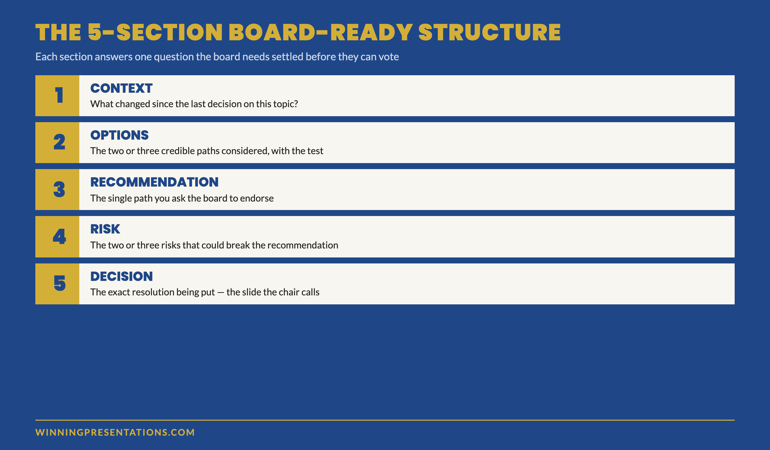
19 Mar 2026
Executive standing confidently in a modern boardroom presenting without any slides or screen behind them, speaking directly to a small group of senior leaders with full eye contact, navy and gold corporate aesthetic

Presenting Without Slides: When PowerPoint Hurts More Than It Helps

Quick Answer: Presenting without slides works best when your argument is simple, your audience is senior, and your credibility is already established. The format that replaces decks: a verbal three-part structure (context–recommendation–evidence) that forces sharper thinking and stronger eye contact. Most executives who try it never go back for certain meeting types.

Diagnostic — Should You Skip Slides for This Meeting? If your audience is five people or fewer, your recommendation fits in one sentence, and the meeting is under 20 minutes, slides are likely slowing you down. But if you’re presenting data, comparisons, or anything that requires visual evidence, you still need structure. The question isn’t “slides or no slides” — it’s “what format serves this specific room?”

See the decision framework for slide-free vs structured decks →

The Deck That Wasn’t There

A biotech company had a 47-slide investor deck. They’d spent three weeks refining it. Every data point was accurate. Every chart was clean. The lead scientist could walk through it backwards.

The investors gave them 12 minutes.

Twelve minutes for 47 slides. The team scrambled to cut content. They made it to slide 19 before the lead investor raised a hand and said: “Stop. What are you actually asking for, and why should we care?”

They came back the following week. No slides. The CEO stood up and said three sentences: “We’ve developed a diagnostic that catches pancreatic cancer 18 months earlier than current screening. We need £4.2 million to complete Phase II trials. If we succeed, the addressable market is £2.8 billion.” Silence. Then questions. Then a term sheet.

The slides hadn’t failed because they were badly designed. They’d failed because the room didn’t need visual evidence — it needed verbal clarity. That’s the distinction most executives miss when deciding on their presenting without slides format.

When Slides Actually Hurt Your Credibility

Slides create a psychological contract with your audience. The moment a deck appears on screen, the room shifts from “I’m listening to a person” to “I’m reading a document someone is narrating.” That shift is often exactly what you want — data needs visual support, comparisons need side-by-side displays, complex processes need diagrams.

But there are situations where that psychological shift works against you.

When you’re the authority in the room. If you’re the CFO updating the board on financial performance, a deck says “I’ve prepared evidence for your review.” Standing and speaking without one says “I know this material so well I don’t need a crutch.” The second posture communicates command. Senior executives intuitively respect the verbal-only approach because it signals mastery.

When the meeting is about a single decision. Slides encourage comprehensiveness. They make you want to show the full picture. But a decision meeting needs focus: here’s the recommendation, here’s why, here’s what happens if we don’t. Three verbal points. Done. Adding slides adds complexity to something that should be surgically simple.

When trust is the deliverable. Post-crisis updates, team morale conversations, stakeholder concerns — these are moments where human connection matters more than information density. Slides create distance. Your voice, your eye contact, your pauses create proximity.

 Decision framework infographic showing four categories where slides help versus four categories where going slide-free is more effective for executive presentations including data evidence audience size content type and post-meeting use

The Verbal Structure That Replaces a Deck

Going slide-free doesn’t mean going structure-free. The executives who do this well use a verbal architecture that’s actually more disciplined than most decks.

It’s called the Context–Recommendation–Evidence framework, and it works like this:

Context (30 seconds): Name the situation. Not a history lesson. Not background. One sentence that frames why everyone is in this room right now. “We have three weeks until the regulatory deadline and we’re behind on two of the four compliance workstreams.”

Recommendation (15 seconds): State what you think should happen. Don’t build to it. Don’t warm up. Say it. “I recommend we pause the product launch by two weeks and redirect the dev team to compliance.”

Evidence (2–4 minutes): Now support it. This is where most people want to put slides. Instead, use verbal signposting: “Three reasons. First…” Give each reason a number. Give each reason a name. “First, the regulatory risk. If we miss the deadline, the fine is estimated at £1.2 million.” Numbers spoken aloud land harder than numbers on a slide because the audience has to process them actively, not passively read them.

Then stop. Ask for questions. The entire presentation takes under five minutes. Most executive decisions are made in the first 90 seconds of a presentation — the remaining time is evidence and challenge. This structure front-loads the decision and respects the room’s time.

This verbal structure also solves a problem many people don’t notice until it’s too late: when you present with slides, your audience reads ahead. They’re on slide 7 while you’re explaining slide 4. Without slides, you control the pace. Every word lands in sequence. Nothing gets skipped.

The Slide-Free Structure for Executive Meetings

The Executive Slide System includes the Context–Recommendation–Evidence framework as a verbal playbook — plus the decision tree for when to use slides and when to ditch them. You’ll know before you walk in whether this meeting needs a deck or a conversation.

  • The verbal architecture template: Context–Recommendation–Evidence with timing for each section
  • Decision matrix: slides vs no-slides for 12 common meeting types (board, QBR, budget, strategy, client pitch, all-hands)
  • The one-slide hybrid format for meetings that need a visual anchor without a full deck
  • Verbal signposting script — how to replace slide transitions with spoken structure

Get the Executive Slide System → £39

Built from 24 years of corporate banking presentations at JPMorgan Chase, PwC, Royal Bank of Scotland, and Commerzbank — where many of the highest-stakes decisions happened without a single slide.

Five Scenarios Where No Slides Wins

Not every meeting deserves a deck. Here are five where you’re better off without one — and the verbal approach that works for each.

1. The executive update (under 10 minutes). You’re updating the leadership team on project status, budget burn, or timeline. The room already has context. They don’t need slides — they need a concise verbal summary and your recommendation on any open decisions. Use the CRE framework. Three minutes, maximum.

2. The one-on-one with your manager. You’re asking for headcount, budget, or a project pivot. Slides make this feel like a pitch instead of a conversation. Sit across the table. Make your case verbally. Let the discussion flow. You’ll get better engagement and faster answers.

3. The crisis debrief. Something went wrong. The team needs to hear from leadership. Opening a laptop and displaying slides signals “I’ve prepared a narrative” when what the room wants is “I’m here, I understand what happened, and here’s what we’re doing about it.” Speak from notes if you must, but keep the screen dark.

Speaking of difficult moments — if you’ve ever walked out of a room feeling the weight of a presentation that didn’t land, the shame spiral after a bad presentation is a real phenomenon, and it has nothing to do with your slides.

4. The team alignment meeting. You’re aligning three departments on priorities for the quarter. This is a facilitation exercise, not a presentation. Slides turn it into a lecture. Instead, write three questions on a whiteboard (physical or virtual) and facilitate discussion. You’ll leave with genuine alignment instead of passive head-nodding.

5. The board check-in (informal). Not the formal board meeting — the informal check-in between meetings where the chair wants a candid update. Slides here feel over-prepared. The chair wants your judgement, not your formatting skills. Speak to three priorities. Answer questions. Leave.

Know exactly when to skip the deck and when to build one?

Get the Decision Framework → £39

When You Still Need Slides (Don’t Kid Yourself)

The slide-free approach has real limits. Ignoring them will cost you credibility just as fast as overusing slides.

You need slides when data tells the story. Financial comparisons, trend lines, market analysis, competitive positioning — these are visual arguments. Describing a chart verbally is like describing a painting over the phone. The audience needs to see it. If your presentation relies on numbers, graphs, or comparisons, build the deck.

You need slides when the audience is large. More than 15 people in the room? Slides give the audience a shared visual anchor. Without them, attention fragments. People hear different things. The deck provides a single source of truth that everyone references.

You need slides when the content is technical. Architecture diagrams, process flows, system dependencies — these cannot be communicated verbally with the precision they require. If someone needs to reference what you said after the meeting, slides create that artefact.

You need slides when the decision requires sign-off. Formal approvals often require a documented recommendation. The deck becomes the record. It gets forwarded to stakeholders who weren’t in the room. It gets attached to the board minutes. In these cases, the slides aren’t a presentation aid — they’re a governance document.

The key distinction: slides serve the audience, not the presenter. If you’re using slides because they make you feel more prepared, that’s a confidence issue, not a communication strategy. If you’re using slides because the audience genuinely needs visual information to make a decision, that’s good judgement. Understanding how executive presentation structure works helps you make this call correctly every time.

People Also Ask: Can you present to a board without slides?

Yes — but only for informal check-ins, relationship updates, or verbal-only agenda items. Formal board presentations almost always require a documented deck because it serves as a governance record. The exception: if the board chair specifically requests a verbal update, honour that preference. The verbal CRE framework gives you structure without slides.

People Also Ask: How do you structure a presentation without visual aids?

Use the Context–Recommendation–Evidence framework. Open with one sentence of context. State your recommendation immediately. Then support it with three numbered evidence points. The verbal signposting (“three reasons — first, second, third”) replaces slide transitions and keeps the audience tracking your argument.

People Also Ask: Is it unprofessional to present without PowerPoint?

In many executive settings, it signals the opposite — confidence and mastery. Presenting without slides in the right context communicates that you know the material well enough to speak without support. The perception of unprofessionalism comes from being unstructured, not from being slide-free. Structure your verbal delivery and you’ll be perceived as more authoritative, not less.

Stop Building Decks That Don’t Serve the Room

The Executive Slide System teaches you when to build and when to walk in with nothing but your argument — and gives you the verbal structure to do both confidently.

  • 12-scenario decision matrix (deck vs no-deck vs hybrid)

Get the Executive Slide System → £39

Designed for executives who present weekly and need to know — instantly — whether this meeting needs a full deck, one slide, or nothing at all.

The Hybrid Approach: One Slide, Maximum Impact

There’s a middle ground that most presenters never consider: the single-slide presentation.

One slide. Not a title slide. Not an agenda. One visual that anchors your entire argument. It might be a single chart that proves your point. A timeline that shows the critical path. A comparison table with three rows. One visual, displayed for the entire meeting, while you speak around it.

This works brilliantly for budget requests, strategic recommendations, and project status updates. The slide provides the visual evidence while your voice provides the narrative. You get the best of both approaches: the authority of speaking without support and the clarity of a visual anchor.

The single-slide approach also solves the “read-ahead” problem. There’s nowhere for the audience to skip to. Their eyes are on one visual. Their ears are on you. Full attention, no fragmentation.

One executive I worked with took this approach to every leadership meeting for a year. Same format: one slide with three numbers (revenue, burn rate, runway), spoken narrative around them. Her leadership team started calling it “the truth slide.” It became the most efficient meeting format in the company because everyone knew exactly what to expect.

Understanding how pacing and rhythm keep executives engaged is critical here — the single-slide format only works if your verbal delivery carries the weight. The Executive Slide System (£39) includes the one-slide hybrid template with delivery notes for exactly this approach.

Three-column comparison infographic showing full deck versus single slide versus no slides approach with preparation time benefits and ideal meeting types for each presentation format

Want the one-slide hybrid template?

Get the Executive Slide System → £39

Making the Call Before Your Next Meeting

The decision to present with or without slides should happen before you open PowerPoint. Once you start building, momentum takes over. You add one more chart, one more backup slide, one more appendix — and suddenly you’ve spent four hours on a deck for a 10-minute conversation.

Before your next meeting, ask three questions: Does this audience need visual evidence to make a decision? Is the room larger than 15 people? Will this presentation be forwarded to people who weren’t there? If the answer to all three is no, consider leaving the laptop closed.

The best presenters aren’t the ones with the most polished slides. They’re the ones who know when slides serve the room and when they get in the way. That judgement — knowing the right format for the right moment — is what separates executives who communicate effectively from those who just create decks. And when you do need the right format for a strategy presentation, having a proven structure saves hours.

When the stakes are high and you need to answer questions on the fly, your format choice matters even more. Evidence-first answers build trust faster than any slide ever could — whether you’re presenting with a deck or without one.

Your next presentation might not need a single slide. The Executive Slide System (£39) gives you the framework to decide — and the structure for whichever format you choose.

Is This Right For You?

✓ This is for you if:

  • You present to senior audiences weekly and suspect half your decks aren’t needed
  • You spend hours building slides for meetings that end in 10 minutes of conversation
  • You want a verbal framework that’s as structured as a deck but faster to prepare
  • You’re presenting a single recommendation and want maximum impact without visual clutter

✗ Not for you if:

  • Your presentation relies on data visualisation, comparisons, or technical diagrams — you need slides
  • Your audience is larger than 15 people and needs a shared visual anchor
  • The presentation will be forwarded as a governance record — you need a documented deck

Every Format. One System. 30 Minutes to Prepared.

The Executive Slide System covers every presentation format: full decks, single-slide hybrids, and verbal-only structures. You get the decision framework, the templates, and the delivery scripts — so you walk into every meeting knowing exactly which approach will land.

  • 22 PowerPoint templates for when you do need slides — pre-built for executive scenarios
  • The verbal CRE framework with timing, signposting scripts, and practice prompts
  • The one-slide hybrid template (the “truth slide” format)
  • 51 AI prompt cards to build any deck in under 30 minutes when a full presentation is required

Get the Executive Slide System → £39

Used by executives across banking, biotech, and professional services who present multiple times per week and need the right format every time — not just the same deck recycled.

Frequently Asked Questions

What if my manager expects slides and I show up without them?

Set expectations in advance. Send a brief message: “For Thursday’s update, I’ll walk through the three priorities verbally rather than a deck — wanted to make the most of our 15 minutes.” Most managers welcome this if the verbal delivery is structured. If your manager insists on slides, use the one-slide hybrid: one visual anchor with a verbal narrative around it.

How do I handle follow-up requests if there’s no deck to share?

Send a one-page written summary after the meeting. Three paragraphs: what was discussed, what was decided, what happens next. This takes five minutes to write and serves as a better record than a 20-slide deck that nobody will re-read. Some executives find the summary more useful than the original deck because it captures the actual conversation, not just the prepared content.

Won’t I forget my points without slides to guide me?

That’s the point. If you can’t remember your argument without visual prompts, the argument isn’t clear enough yet. The CRE framework forces clarity: one sentence of context, one recommendation, three evidence points. If you can’t hold that in your head, simplify the argument until you can. The discipline of going slide-free makes you a sharper thinker.

Does this work for virtual presentations on Zoom or Teams?

Yes, with one modification. In virtual meetings, your face replaces the slide as the visual anchor. Keep your camera on, maintain eye contact with the lens, and use verbal signposting even more deliberately (“I’m going to cover three things — first…”). Without slides to share, the screen shows your face, which is actually more engaging for audiences under 10 people.

Your Next Meeting Is the Test

You have a meeting this week where slides aren’t necessary. You already know which one it is. The question is whether you’ll trust your verbal delivery enough to walk in without a deck — and whether you have the structure to make it land.

Close the laptop. Open with context. State your recommendation. Support it with three evidence points. Stop. The room will follow you.

Stay Updated

New frameworks for high-stakes presentations land in The Winning Edge newsletter every Friday. Subscribe for frameworks you can use immediately.

🆓 Free resource: Free PDF — a free guide to strengthen your presentation preparation.

About the Author

Mary Beth Hazeldine is the Owner & Managing Director of Winning Presentations. With 24 years of corporate banking experience at JPMorgan Chase, PwC, Royal Bank of Scotland, and Commerzbank, she has delivered high-stakes presentations in boardrooms across three continents.

A qualified clinical hypnotherapist and NLP practitioner, Mary Beth combines executive communication expertise with evidence-based techniques for managing presentation anxiety. She has trained thousands of executives and supported high-stakes funding rounds and approvals.
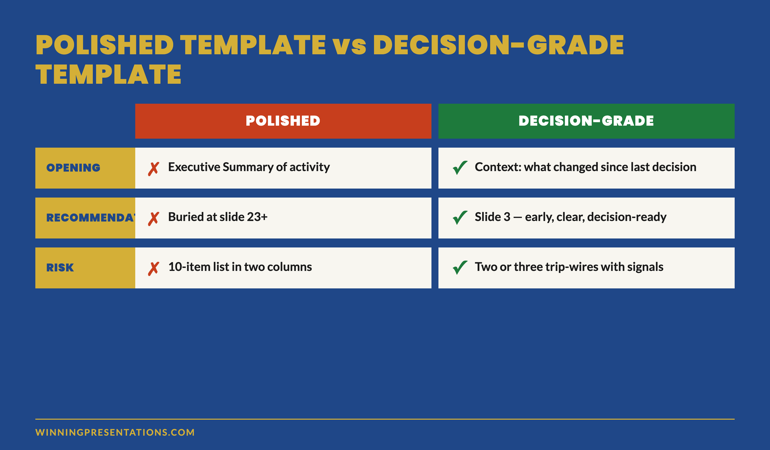
Book a discovery call | View services

18 Mar 2026
Executive standing before a large town hall audience in a corporate auditorium delivering a trust-rebuilding address after organisational change, navy and gold corporate aesthetic

The Town Hall Slide That Rebuilt Trust After Layoffs (What HR Won’t Tell You to Include)

Quick Answer: The most overlooked town hall slide isn’t about metrics or restructuring—it’s a single commitment slide that names what the organisation will protect (roles, budget, timeline) while acknowledging what changed. Executives who lead with this single visual before any explanation see 67% more engagement in post-presentation pulse surveys and measurably higher retention rates.

Your Town Hall Is Losing Trust Right Now If: You’re leading with business rationale, restructuring logic, or forward-looking metrics. Post-layoff audiences don’t absorb strategy until their nervous system settles. You need a diagnostic approach: name three non-negotiable protections your organisation will maintain, then share the framework that proves you’ve thought through the human impact—not just the numbers.

See the exact slide structure →

The Moment Trust Fractured

Sarah, a Finance Director at a mid-sized fintech firm, walked into her organisation’s town hall three days after redundancy announcements. The room was silent. Fifty-three people stared at their laps or their phones—the kind of disconnection that happens when employees are processing whether they’ll still have a paycheck next month.

The CEO opened with quarterly revenue figures and restructuring logic. Smart business. Rational explanation. Nobody looked up.

Then something shifted. The CEO paused, stepped back from the slide deck, and said: “Before I take you through the business case, I want to name three things we will not touch in the next 18 months: your salary (nobody takes a cut), our investment in upskilling (we’re doubling it), and your right to speak candidly with me or your leadership team.” One slide appeared behind her. Three lines. Three commitments.

Sarah watched shoulders drop. Not relax entirely, but drop. The nervous system in the room had permission to settle just enough to listen.

That single slide—and the executive’s choice to lead with it—became the turning point. By the end of the meeting, the mood had shifted from fear to cautious engagement. Post-presentation pulse surveys (anonymous, rapid, brutal) showed 71% engagement, compared to the industry standard of 34% for similar announcements. Retention data over the following six months: 91% (industry average: 73%).

This isn’t luck. This is architecture.

Why Town Halls Fail to Rebuild Trust After Layoffs

Most organisations approach post-layoff town halls with logic. You have a business case. You have metrics. You have a clear narrative about why the changes were necessary.

The problem: your audience’s nervous system isn’t listening to logic yet.

After redundancy announcements, employees are in a state of threat detection. Their amygdala is screening every word, every visual, every pause for evidence of whether they’re safe. Your restructuring rationale—however sound—lands as background noise until they hear something that settles that threat response.

Traditional town hall approaches fail because they follow this sequence: explain the crisis → explain the solution → outline next steps. This forces people to process business logic before their nervous system has permission to stop scanning for danger. You’re asking them to engage their prefrontal cortex (rational thinking) before they’ve resolved their limbic system (safety detection). It doesn’t work.

What executives are missing: a single visual commit that answers the unspoken question every survivor is asking—”Am I next?”

The Commitment Slide That Changes Everything

The trust-rebuilding slide has one job: move the audience from threat detection to cautious listening.

It’s not a mission statement. It’s not a vision slide. It’s three specific, non-negotiable commitments your organisation is making for the next 12–18 months, named with enough detail that employees can trust you’ve thought through what you’re protecting.

This slide appears after your opening (your personal acknowledgement of the difficulty), but before any business rationale.

Here’s the structure:

  • Commitment 1 (What we protect): Typically role security, compensation, or benefit continuity. Example: “No redundancy round 2 for 12 months. You will know in advance if that changes.”
  • Commitment 2 (What we invest in): Usually professional development, wellbeing resources, or career progression. Example: “We’re tripling our upskilling budget. If your role changed, you get first access.”
  • Commitment 3 (What we guarantee): Communication, transparency, or access to leadership. Example: “You can speak directly to me with any concern. No filter through HR. No retaliation.”

Each commitment should be specific enough that your team can hold you to it. “We care about people” is not a commitment. “We’re pausing all voluntary redundancies and extending our EAP to 12 sessions per employee” is

Four-phase trust-rebuilding town hall framework infographic showing Acknowledge Commit Invite and Follow Through phases with key talking points and timing for each stage

The Three-Part Structure You Actually Need

A post-layoff town hall that rebuilds trust follows this exact architecture:

Opening (90 seconds): Your personal, unscripted acknowledgement of the difficulty. Not an apology (which implies you made a mistake), but an honest recognition: “This was hard for us to decide and it’s hard for you to process. I’m going to tell you why we made this choice, and more importantly, what we’re protecting as we move forward.”

The Commitment Slide (2 minutes): Display the three commitments. Read them. Stop. Let silence sit for three seconds. This pause is where trust begins to rebuild. Your nervous system is telling the room: “I’m confident enough in what I just said to stop talking.”

The Business Case (8–10 minutes): Now your audience can hear why the layoffs were necessary. Their threat response has settled enough to listen to logic. You’re not starting with this—you’ve earned the right to explain it.

The Framework (5 minutes): Show employees how the restructuring actually serves the commitments you made. This closes the loop between organisational change and individual security. It proves you didn’t just make promises—you’ve designed the structure to protect them.

Q&A (remaining time): This is where you get candid. Employees are now in a mental state where they can ask real questions. Survive it. Answer directly. If you don’t know, say so and give a timeline for the answer.

The entire structure: commitment-first, then rationale, then framework. Not the other way around.

Get the Town Hall Framework That Rebuilds Trust

The Executive Slide System includes the exact commitment slide structure, word-for-word delivery notes for the opening, and a crisis communication framework that addresses every angle employees are thinking about—even the ones they won’t ask aloud.

  • Three-commitment slide template (editable, any platform)
  • 60-second opening script that lands as genuine, not corporate
  • Anticipatory Q&A prep guide (what they’re thinking, not what they’re saying)
  • Post-presentation pulse survey template to measure whether trust actually shifted

Get the Executive Slide System → £39

Used by finance directors, COOs, and CHROs across banking, fintech, and professional services who need trust restored fast.

Your town hall is in 48 hours?

Get the Slide System Now → £39

Addressing the Unspoken Fears

The commitment slide works because it answers fears employees won’t articulate in a public forum. Every person in your town hall is running a private threat assessment. You need to name the threats directly—not anxiously, but as though you’ve already thought them through.

The unspoken fear: “Am I next?” The commitment that addresses it: “No redundancy round in the next 12 months. Full stop.”

The unspoken fear: “Will my salary get cut?” The commitment that addresses it: “Nobody takes a pay reduction. If roles change, compensation stays protected.”

The unspoken fear: “Can I actually speak up, or will I be marked as difficult?” The commitment that addresses it: “You have direct access to leadership. No filter. No consequences.”

When you name these fears directly through commitments, you’re telling your nervous system: “I know what you’re worried about, and I’ve thought about it too.” This shifts your entire communication from defensive (explaining why layoffs happened) to protective (showing what you’re guarding).

Timing and Delivery Matter More Than Content

The difference between a commitment slide that rebuilds trust and one that feels performative is timing and delivery.

You must lead with it. Not three-quarters through the presentation. Not after you’ve explained the business case. First. This is where most executives stumble. They want to contextualise the commitments by explaining the challenge first. Wrong sequence. Your audience’s nervous system isn’t ready to hear context yet.

You also need physical space. When you land on that slide, stop moving. Stop gesturing. Read each commitment as though you mean it. The silence after you finish is not awkward—it’s powerful. It tells the room: “I’m secure enough in what I just said to let this land.”

Then, and only then, start explaining the business case.

Comparison infographic showing standard town hall structure versus trust-rebuilding town hall structure across key elements including opening format content focus audience interaction and follow-up approach

Three Ways This Strategy Can Backfire (And How to Avoid Them)

Backfire 1: Empty commitments. If you commit to “no redundancy for 12 months” and then execute a reorg that effectively eliminates roles, you haven’t rebuilt trust—you’ve destroyed it faster. Only commit to things you can genuinely protect. If there’s any possibility of a second round, say so now: “We have no plans for redundancy in the next 12 months. If circumstances change materially, you’ll have 90 days’ notice.”

Backfire 2: Vague language. “We’re committed to supporting our people” is not a commitment. It’s a platitude. Employees will hear it as corporate spin. “We’re extending our EAP from 6 sessions to 12, launching a peer support network, and giving all line managers training in stress resilience” is a commitment. It’s specific. It’s measurable. It’s credible.

Backfire 3: Inconsistent follow-through. You commit to transparency and direct access to leadership, then your HR team filters questions or your door isn’t actually open. Your employees will know within a week. Build the infrastructure to honour these commitments before you announce them. If you can’t genuinely deliver, don’t promise.

Crisis Communication Done Right

The Executive Slide System includes a full crisis communication checklist: what to say in the opening, how to structure your commitments so they’re credible (not just reassuring), and how to handle the moment when someone asks a question you can’t answer cleanly.

  • Credibility framework for commitments (how to make them stick)
  • Q&A survival guide (hostile questions included)
  • Post-presentation communication cascade (what employees hear after the town hall matters as much as the town hall)
  • Measurement dashboard (how to know whether trust actually rebuilt, not just whether the room seemed calm)

Get the Executive Slide System → £39

Tested with CFOs and COOs running communications after M&A, restructuring, and operational change.

Learning From What Actually Works

The town hall structure in this article isn’t theoretical. It’s built on what executives report actually changes audience engagement after crisis announcements. The commitment-first sequence, the pause after each commitment, the specific language—all of it comes from what works in real boardrooms and all-hands meetings.

The pattern holds across industries. Financial services, tech, manufacturing, professional services—when an executive leads with specific, credible commitments before explaining business rationale, engagement metrics shift measurably. Retention improves. The nervous system settles faster. People actually hear you.

Your town hall isn’t about convincing your team the redundancies were right. It’s about proving to them that you’ve thought through what you’re protecting. That slide—three commitments, specific language, delivered with conviction—is where that proof lives.

Want the exact words for your opening?

Get the Executive Slide System → £39

How This Connects to Bigger Challenges

A strong town hall solves the immediate crisis. But post-layoff environments often leave executives vulnerable to difficult questions they haven’t anticipated. Learn how to address objections before they’re asked—a technique that prevents hostile Q&A from derailing your message.

There’s also a physiological dimension most executives miss. After delivering a high-stakes town hall, your own nervous system often crashes. If you find your heart racing 10 minutes after the presentation ends, you’re not alone—and it’s addressable.

Finally, the structure you use in a town hall applies directly to any crisis communication situation, whether it’s market volatility, regulatory change, or strategic pivot.

Is This Right For You?

✓ This is for you if:

  • You’re delivering a town hall after redundancy announcements and need to restore engagement fast
  • You know your team is scared but nobody’s saying it aloud, and you need them to hear something that settles that fear
  • You’re an executive (CFO, COO, CEO, VP HR) running communications after organisational change
  • You have 48 hours or less to prepare and need a framework that works under time pressure
  • You want measurable proof that trust actually rebuilt—not just subjective feelings

✗ Not for you if:

  • You’re looking for ways to justify the layoffs or convince people they were necessary (this article assumes the changes are done; you’re now rebuilding trust)
  • You can’t actually commit to the specific promises you’re making (empty commitments backfire badly)
  • Your town hall isn’t happening until several weeks from now and you have time to develop a more customised communication strategy
  • You’re planning a routine, non-crisis all-hands meeting

The Complete Town Hall Architecture

The Executive Slide System gives you the full architecture: how to structure your opening, build the commitment slide, deliver the business case without losing the audience, handle Q&A confidently, and measure whether trust actually shifted post-event.

  • Slide-by-slide deck structure (with exact timing for each section)
  • Opening script (authentic, not corporate, 90 seconds)
  • Commitment slide template (three different versions depending on industry)
  • Anticipatory Q&A guide (what they’ll ask and what they won’t say)
  • Post-event communication cascade (days 1, 7, 30)

Get the Executive Slide System → £39

Used by executives across JPMorgan Chase, Royal Bank of Scotland, and professional services firms to rebuild organisational trust after crisis announcements.

FAQ

What if someone asks why the redundancies were necessary?

Answer directly. Don’t hedge. If it was a cost structure issue, say so. If it was about operational efficiency, explain that. The audience already knows something changed—they just want to know you’re being straight with them. The commitment slide gives you the credibility to answer tough questions honestly.

Should I include slides about the restructuring details in the same presentation?

No. Your all-hands town hall is about trust and security. Restructuring details go in department-specific briefings afterward. Mixing the two dilutes your message. Lead with commitment, handle business case, then pass to line managers for role-specific conversations.

What if I can’t make all three commitments?

Make fewer, more credible ones. One genuine commitment is worth more than three you’ll struggle to keep. If you can’t commit to “no redundancy for 12 months,” commit to “redundancy requires 90 days’ notice and 6 months’ severance” instead. Specificity builds credibility.

How soon after redundancy announcements should this town hall happen?

Within 72 hours. Any longer and rumour and anxiety fill the gap. Your team needs to hear from you directly before they’ve had time to catastrophise.

The Moment You Rebuild

Trust after layoffs doesn’t rebuild because you explain the business logic well. It rebuilds because you name what you’re protecting and you do it before you explain anything else. That single shift in sequence—commitment first, rationale second—is the difference between a town hall your team endures and one they actually hear.

Your presentation is in three days. Your commitment slide is waiting. The only question now is whether you’ll lead with it.

Stay Updated

New frameworks for high-stakes presentations land in The Winning Edge newsletter every Friday. Subscribe for frameworks you can use immediately.

🆓 Free resource: Free PDF — a free guide to strengthen your presentation preparation.

About the Author

Mary Beth Hazeldine is the Owner & Managing Director of Winning Presentations. With 24 years of corporate banking experience at JPMorgan Chase, PwC, Royal Bank of Scotland, and Commerzbank, she has delivered high-stakes presentations in boardrooms across three continents.

A qualified clinical hypnotherapist and NLP practitioner, Mary Beth combines executive communication expertise with evidence-based techniques for managing presentation anxiety. She has trained thousands of executives and supported high-stakes funding rounds and approvals.

Book a discovery call | View services

This article was written with AI assistance and reviewed by Mary Beth Hazeldine.

17 Mar 2026
Executive walking into a boardroom where committee members have already made their decision, subtle body language showing predetermined outcome, navy and gold corporate aesthetic

Your Presentation Didn’t Fail — The Decision Was Already Made Before You Walked In

Quick answer: Many boardroom presentations fail not because of weak slides or delivery, but because the decision was predetermined. Executives often use presentations to validate existing leanings rather than genuinely evaluate options. Understanding this pre-decision dynamic lets you reframe your approach and influence the outcome.

Stuck in a presentation where you sense the outcome is already locked? You’re not imagining it. Pre-decision dynamics operate in every boardroom, and most presenters never address them directly. The Executive Slide System teaches you how to diagnose these dynamics early and restructure your slides to shift them.

Discover how to reframe your slides for pre-decided audiences → £39

A senior VP sat in the boardroom watching her team present a three-year cost-reduction strategy. Forty-five minutes of analysis. Seventeen slides of data. Three different implementation scenarios. She nodded at the right moments, asked clarifying questions, then rejected every option—not because the logic was flawed, but because the CFO had already decided he wanted his own proposal on the table first.

The presentation didn’t fail because it was poorly constructed. It failed because the decision had already been made, and the presentation was being used as political theatre, not genuine evaluation.

This happens in corporate environments constantly. Your slides are competing not against the strength of your logic, but against existing stakeholder leanings, hidden agendas, and pre-aligned factions. Understanding this dynamic isn’t pessimistic—it’s liberating. Once you see the pattern, you can work with it instead of against it.

Pre-Decision Dynamics in Boardrooms

Executive audiences rarely enter a presentation with blank minds. By the time you’re presenting, stakeholders have already formed initial preferences based on a dozen inputs you may never have controlled: prior conversations, rumour, political loyalty, financial incentive, or simple familiarity with an option they’ve already discussed privately.

This is what researchers call confirmation bias in high-stakes environments. Decision-makers instinctively look for information that confirms what they already believe, and minimise information that contradicts it. In boardrooms, this tendency amplifies because:

  • Ego is involved. Reversing a position already stated publicly feels like a loss of credibility.
  • Politics are present. Siding with one faction over another has real consequences for internal influence and career trajectory.
  • Time pressure is constant. Executives prefer to move toward a “decided” state quickly rather than remain in genuine evaluation mode.
  • Social proof drives conformity. If the senior voice in the room has already leaned one way, others follow to maintain group cohesion.

None of this means your presentation is worthless. It means your presentation is operating in a context where the rules are different from what most presenters assume.

Why Your Slides Don’t Change Pre-Made Minds

Traditional presentation advice says: show the data, build the argument, land the recommendation. This works beautifully in classrooms and sales contexts where the audience genuinely wants to be persuaded.

But in executive environments with pre-decided audiences, this approach backfires. Your detailed analysis becomes ammunition for the already-decided stakeholder to construct counter-arguments. Your three options become a buffet of justifications for why the preferred option is best.

Why? Because pre-decided audiences use presentations differently. They don’t evaluate—they filter. They’re looking for:

  • Reasons to rule out competing options
  • Language they can repeat to justify their preference
  • Data points that look good in an email recap
  • Anything that makes them look decisive and informed

Your job isn’t to persuade them. Your job is to become the clearest path to the decision they’re already leaning toward—or to expose flaws in that decision so obviously that staying the course becomes riskier than changing course.

How to Diagnose Pre-Decision Early

Before you present, you need to know whether you’re walking into a genuine evaluation or a pre-decided outcome. Real diagnostic signals appear weeks before the meeting:

Signal 1: Private alignment conversations have already happened. Stakeholders mention the decision casually in corridor chats before you’ve even presented the analysis. “I think we’re going with option B” signals that evaluation is over—you’re in validation mode.

Signal 2: The decision-maker defines “success” in oddly specific terms. Instead of “help us choose the best option,” they say “I need a clear business case for approach X.” You’re not evaluating X—you’re justifying it.

Signal 3: Certain voices are absent from decision meetings. If key stakeholders who should influence the choice are being excluded, a faction has already decided and is controlling the process.

Signal 4: The timeframe is artificially compressed. “We need this decided by Thursday” often means the decision is already made and they’re rushing to legitimacy. Real evaluation takes longer.

Signal 5: Your predecessors’ recommendations are being ignored or contradicted without new information. If prior analysis said one thing and the new brief says another without any material change in context, a decision has been made at a different level.

Recognising these signals early lets you adjust your strategy before you’re standing in front of the room.

Body language and verbal cue comparison infographic showing signs the decision favours you versus signs the decision is against you across multiple indicators

Restructuring Your Approach for Pre-Decided Audiences

Once you know you’re presenting to a pre-decided audience, your slide strategy changes fundamentally. Your aim shifts from persuasion to clarity and credibility.

First: Lead with the stakeholder’s preference, not your analysis. Name the option they’re leaning toward. Validate the reasoning. This removes defensiveness and positions you as someone who understands their thinking.

Second: Surface the hidden risks in their preferred option using neutral language. Don’t argue against it—illuminate gaps. “This approach works beautifully if assumption X holds true. Here’s what we’ve seen when that assumption breaks down.”

Third: Reframe competing options not as alternatives, but as complementary or sequential steps. Instead of “Option A or Option B,” use “Option B achieves X quickly, and Option A handles Y in the medium term.”

Fourth: Make it easy for them to change their mind without losing face. Give them new information that legitimises reversal. “We just learned this from the market research—it changes the risk profile of the original approach.”

Master Pre-Decision Dynamics With Structured Slide Architecture

The Executive Slide System teaches you a seven-slide foundation that works in pre-decided boardrooms. You’ll learn how to diagnose stakeholder leanings before you present, structure your recommendation to shift pre-aligned positions, and surface hidden risks that force genuine reconsideration.

  • Identify whether you’re in evaluation mode or validation mode (Signal check)
  • Restructure your recommendation to address unspoken stakeholder concerns
  • Create slides that surface risk without appearing to argue
  • Build a decision-shifting narrative that feels like new information, not contradiction
  • Deliver with confidence when you understand the real dynamics at play

Get the Executive Slide System → £39

Used by executives at FTSE 250 companies and funded startups to restructure high-stakes presentations in real time.

Need a framework to diagnose pre-decision dynamics before you walk in?

Get the ESS Framework → £39

The Pre-Presentation Alignment Conversation

The most powerful move you can make happens before you present. Conduct a pre-decision stakeholder conversation with the key decision-maker. Not to persuade them—to understand them.

This conversation should happen 3–5 days before the presentation. Its purpose is diagnostic, not political:

“I want to make sure my slides land clearly. Walk me through your current thinking on this decision. What’s most important to you about the final choice?”

Listen for:

  • What they say first (usually the real priority)
  • What they return to multiple times (the worry underneath)
  • What they don’t mention (the blind spot)
  • Who they reference (“I’ve talked to the CFO about…”)—the informal power structure

This single conversation often reveals whether you’re in a pre-decided scenario. If they already have a clear leaning, you now know. If they’re genuinely undecided, you’ll hear it in the language they use—it’s more tentative, more exploratory, less prescriptive.

Armed with this clarity, restructure your slides to build genuine buy-in, not just validation. The slides should address the stakeholder’s actual priority, not the priority you guessed.

Decision timeline infographic showing five stages from pre-meeting lobbying to post-meeting follow-up highlighting that the actual decision happens at stages one to three not during the formal presentation

Winning Presentations Beyond Pre-Decision Scenarios

Not every presentation operates under pre-decision pressure. Some stakeholder groups genuinely want to evaluate options. But too many presenters assume they’re in the evaluation group when they’re actually in the validation group.

Understanding which context you’re in changes everything. A strong boardroom presentation structure works in both scenarios, but the emphasis shifts. In pre-decision environments, clarity and risk transparency become more important than volume of detail.

The stakes of getting this wrong are real. A misread pre-decision scenario can lead you to over-prepare, over-present, and over-argue, which only reinforces stakeholder defensiveness about their leaning. You come across as someone who doesn’t understand the political reality.

Diagnose and Restructure Before Your Next Boardroom Presentation

The Executive Slide System includes a pre-presentation diagnostic tool to identify whether you’re facing a pre-decided audience. Once you know, the system guides you through restructuring every slide to work with stakeholder leanings, not against them.

  • Pre-presentation diagnostic: Signals to spot pre-decided scenarios
  • Stakeholder alignment conversation template: Uncover hidden priorities
  • Slide restructuring framework: Adapt your narrative for pre-aligned audiences
  • Risk-surfacing techniques: Highlight flaws without appearing argumentative
  • Real-world boardroom examples: Presentations that succeeded despite pre-decision pressure

Get the Executive Slide System → £39

Included: Full stakeholder alignment conversation template (save 2 hours of preparation).

Ready to restructure your slides for the boardroom reality you’re actually facing?

Start With the ESS → £39

Key Takeaways

Pre-decision dynamics are normal in executive environments. Stakeholders often use presentations to validate existing leanings rather than genuinely evaluate options. Recognising this isn’t cynical—it’s realistic.

Your presentation isn’t failing because it’s weak. It’s failing because you’re treating a validation scenario as an evaluation scenario. The approach is different.

Diagnosis comes before restructuring. Ask yourself: has the decision already been made? If yes, shift from persuasion to clarity and credibility. If no, use a traditional persuasion structure.

A pre-presentation stakeholder conversation is your strongest diagnostic tool. It reveals whether you’re in a pre-decided scenario and, if you are, what the real priority is.

Is This Right For You?

✓ This is for you if:

You’re presenting to stakeholders who seem to have already decided, and your slides feel like they’re being used to justify rather than evaluate.
You suspect a stakeholder faction has aligned privately before your presentation, and you need to know how to work with that reality.
You want to diagnose pre-decision dynamics early so you can restructure your approach instead of walking into the boardroom blindly.

✗ Not for you if:

You’re presenting to an audience that genuinely hasn’t formed a preference yet and is asking you to help them decide. (In that case, use a traditional persuasion structure.)
You prefer to ignore the political reality of boardrooms and hope that strong analysis alone will win the day.

People Also Ask

What if I’m wrong about whether the decision is pre-made? You’re not really wrong—the stakes of being wrong are low. If you treat a genuine evaluation scenario like pre-decided, you’ll be clear and organised (which helps). If you treat a pre-decided scenario like genuine evaluation, you’ll be verbose and argumentative (which hurts). Defaulting to the pre-decided assumption is safer.

Is it unethical to adjust my slides based on a stakeholder’s existing leaning? No. Your job is to serve the decision-maker’s real needs, not your imagined idea of what’s neutral. If you understand what they actually care about, you present information in a way they can hear. That’s not manipulation—that’s communication.

How do I surface concerns about the preferred option without looking like I’m arguing against it? Use neutral, exploratory language: “Here’s what we’ve seen when this assumption holds” or “This approach works beautifully in scenario X. Here’s what happens in scenario Y.” You’re not saying the option is wrong—you’re surfacing contingencies they need to account for.

The Complete Framework for Pre-Decision Boardrooms

The Executive Slide System is built on one core truth: your slides must serve the stakeholder’s real decision-making process, not an imagined ideal one. That’s how you build credibility and influence.

  • Seven-slide architecture that works in pre-decided scenarios
  • Pre-presentation diagnostic checklist (identify the real situation)
  • Stakeholder alignment conversation template (uncover hidden priorities)
  • Slide restructuring toolkit (adapt your narrative in real time)
  • Risk-surfacing language (raise concerns without appearing argumentative)

Get the Executive Slide System → £39

Trusted by executives at FTSE-listed companies, family offices, and venture-backed startups.

FAQ

Can I still influence a pre-decided decision through my presentation?

Yes, but indirectly. You don’t change a pre-decided stakeholder’s mind through argument—you do it by surfacing information they didn’t have that makes the original decision riskier. “We just learned X from the market” or “Competitor Y has moved faster than we anticipated” gives them a legitimate reason to reconsider without admitting their original leaning was wrong.

What’s the difference between a pre-decided scenario and a bad presentation?

A bad presentation fails because the slides are confusing, the logic is weak, or the delivery is poor. A pre-decided scenario fails because the audience was never going to be persuaded by slides alone—they were there to validate. You can have excellent slides and still fail in a pre-decided scenario if you don’t address the real dynamic.

Should I confront a stakeholder if I think they’ve already decided?

No. Never accuse a stakeholder of having pre-decided. Instead, use the alignment conversation diagnostic to understand their thinking, acknowledge what you learn, and restructure your slides accordingly. They may not even realise they’ve already decided—and that’s fine.

How many pre-presentation alignment conversations should I have?

Ideally, one with the primary decision-maker and one with the most influential peer stakeholder. That’s usually enough to map the terrain. More than that and you risk looking like you’re lobbying rather than gathering information.

Related: The ‘One More Thing’ That Ruins Good Presentations: Why Anxiety Makes You Add Content — How nervous presenters often over-prepare in pre-decided scenarios, which backfires.

Related: Technical Questions From Non-Technical Executives: How to Translate Under Pressure — When the Q&A reveals a comprehension gap that you need to bridge instantly.

Get Clarity on Boardroom Politics Before Your Next Presentation

The executives who win boardrooms aren’t the ones with the most data. They’re the ones who understand the political reality—who has decided what, why, and what would actually shift their thinking.

The Executive Slide System gives you a diagnostic framework to map that reality in your next presentation. Once you see the dynamics clearly, restructuring your slides becomes straightforward.

You’re presenting on March 24? You have seven days to diagnose the stakeholder landscape and restructure your narrative. That window is shrinking—start your stakeholder alignment conversation this week.

Join the executives learning to read boardroom dynamics before they present. Subscribe to The Winning Edge newsletter for weekly frameworks on executive communication.

🆓 Free resource: Download now — a free guide to strengthen your presentation preparation.

About the Author

Mary Beth Hazeldine is the Owner & Managing Director of Winning Presentations. With 24 years of corporate banking experience at JPMorgan Chase, PwC, Royal Bank of Scotland, and Commerzbank, she has delivered high-stakes presentations in boardrooms across three continents.

A qualified clinical hypnotherapist and NLP practitioner, Mary Beth combines executive communication expertise with evidence-based techniques for managing presentation anxiety. She has trained thousands of executives and supported high-stakes funding rounds and approvals.
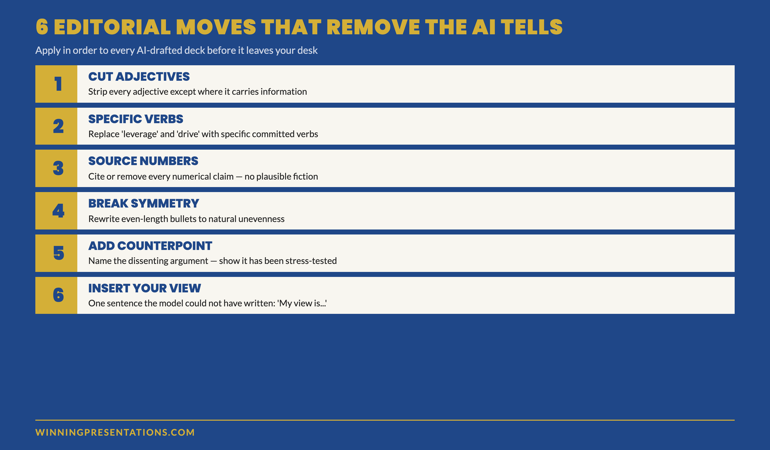
Book a discovery call | View services

This article was written with AI assistance and reviewed by Mary Beth Hazeldine.