16 Dec 2025
How to Start a Presentation: 15 Powerful Openers That Grab Attention

How to Start a Presentation: 15 Powerful Openers That Grab Attention

Quick Answer: The best way to start a presentation is to grab attention in the first 10 seconds with a surprising statistic, a bold statement, a relevant story, or a thought-provoking question. Avoid starting with “Today I’m going to talk about…” — you’ll lose your audience before you begin.

I’ve watched over 500 executive presentations in my career. Investment bankers pitching billion-pound deals. Biotech founders presenting to skeptical investors. Senior leaders defending budgets to hostile boards.

And I can tell you exactly when most of them lost their audience: the first 30 seconds.

The opening of your presentation isn’t just important — it’s everything. Get it wrong, and you’re fighting an uphill battle for the next 20 minutes. Get it right, and your audience leans in, ready to hear what you have to say.

After 25 years in investment banking at JPMorgan, PwC, RBS, and Commerzbank — plus 16 years coaching executives on high-stakes presentations — I’ve identified exactly what works. Here are 15 powerful openers that grab attention and set you up for success.

Want 50 ready-to-use opening lines?

My Presentation Openers & Closers Swipe File gives you structured opening lines for every situation — from board meetings to investor pitches.

Get 50 Opening Lines →

Why the First 10 Seconds Matter More Than Anything Else

Neuroscience tells us something uncomfortable: your audience decides whether to pay attention within the first 10 seconds. Not 10 minutes. Ten seconds.

This is called the “primacy effect” — we remember beginnings and endings far more than middles. And in those crucial first moments, your audience is asking one question:

“Is this going to be worth my time?”

If you start with “Good morning, my name is Sarah and today I’m going to talk about our Q3 results…” — you’ve already answered that question. And the answer is no.

Here’s what the best presenters do differently.

15 Powerful Ways to Start a Presentation

15 Powerful Presentation Openers Infographic

1. The Shocking Statistic

Numbers that surprise create instant engagement. The key is contrast — show them something that challenges their assumptions.

Example: “75% of venture-backed startups fail. But the companies that master investor presentations are 40% more likely to get funded. Today, I’m going to show you exactly what separates the funded from the forgotten.”

Why it works: You’ve created a gap between what they know and what they need to know. Now they have to keep listening.

2. The Bold Statement

Make a claim that’s unexpected or even slightly controversial. This triggers curiosity and positions you as someone with a point of view.

Example: “Everything you’ve been taught about presenting to boards is wrong. And it’s costing you promotions.”

Why it works: You’ve challenged the status quo. Even if they disagree, they want to hear your reasoning.

3. The Relevant Story

Stories activate different parts of the brain than data alone. A well-chosen story creates emotional connection and makes abstract concepts concrete.

Example: “Three years ago, I sat in a boardroom in Frankfurt and watched a CFO lose a £4 million budget approval in eleven words. He opened with ‘I know we’re over budget, but let me explain.’ The meeting was over before it started.”

Why it works: Stories create suspense. Your audience wants to know what happened next — and how to avoid the same fate.

4. The Thought-Provoking Question

Questions engage the brain differently than statements. They force your audience to think, which means they’re actively participating rather than passively listening.

Example: “When was the last time you sat through a presentation and thought, ‘I wish this was longer’?”

Why it works: You’ve made them smile and acknowledged a shared frustration. You’re on the same side now.

5. The “Imagine” Scenario

Invite your audience into a future state. This technique, borrowed from hypnotherapy, creates a vivid mental picture that makes your solution feel tangible.

Example: “Imagine walking into your next board presentation completely calm. You know exactly what to say. The executives are nodding. And when you finish, the CEO says, ‘That was exactly what we needed.’ What would that be worth to you?”

Why it works: You’ve made them feel the outcome before you’ve explained the process.

6. The Counterintuitive Truth

Share something that goes against conventional wisdom. This positions you as an expert with insider knowledge.

Example: “The best presentations I’ve ever seen had zero bullet points. None. And they won billion-pound deals.”

Why it works: You’ve challenged a default assumption. Now they need to understand why.

Stop Fumbling Your Presentation Openings

The Executive Slide System gives you structured opening frameworks that command attention immediately — so you walk into every presentation knowing exactly how to start.

Executive Slide System →

7. The Specific Promise

Tell them exactly what they’ll get from the next few minutes. Be specific and benefit-focused.

Example: “In the next 12 minutes, I’m going to give you the three-slide structure that’s helped my clients raise over £250 million in funding. You can implement it in your next presentation tomorrow.”

Why it works: You’ve set clear expectations and promised immediate value. They know what’s coming and why it matters.

8. The Shared Problem

Articulate the pain your audience is experiencing. When people feel understood, they trust you to provide the solution.

Example: “You’ve spent three weeks on this presentation. You’ve rehearsed it a dozen times. And you still can’t shake the feeling that when you stand up, your mind will go blank and everyone will see you’re not ready.”

Why it works: You’ve demonstrated that you understand their world. You’re not just another presenter — you’re someone who gets it.

Struggling with presentation anxiety?

My Calm Under Pressure Toolkit gives you breathing techniques, confidence frameworks, and mental preparation strategies used by professional speakers.

Get the Confidence Toolket →

9. The Behind-the-Scenes Insight

Give them access to information they wouldn’t normally have. This creates a sense of exclusivity and trust.

Example: “I’ve sat in due diligence meetings at four global banks. And I can tell you exactly what the investment committee says after you leave the room…”

Why it works: You’re offering insider knowledge. They’re getting something not everyone gets access to.

10. The Historical Parallel

Connect your topic to a famous moment in history. This adds weight and context to your message.

Example: “In 1984, Steve Jobs stood in front of shareholders and said three words that changed Apple forever. Those three words weren’t about technology — they were about belief. And they’re the same three words you need in your next pitch.”

Why it works: You’ve borrowed credibility from a known success story and created curiosity about the connection.

11. The Live Demonstration

Show rather than tell. A well-executed demo captures attention like nothing else.

Example: Start by silently walking to the front of the room, pausing for three full seconds, and making eye contact with five people before saying a word. Then say: “That silence made you pay attention. Today, I’m going to show you how to command a room before you even speak.”

Why it works: You’ve demonstrated your expertise in real-time. No one is checking their phone now.

12. The Personal Failure

Vulnerability creates connection. When you share a mistake, you become human — and your audience trusts you more.

Example: “The worst presentation of my career was in front of 200 people at a banking conference. I blanked on my own name. Literally forgot who I was. And what I learned in the next 30 seconds saved my career.”

Why it works: They want to know how you recovered. And they believe you’ll help them avoid the same fate.

13. The Unexpected Object

Bring a physical prop. Objects create visual interest and give you something to anchor your message.

Example: Hold up a single slide printout. “This is the only slide that mattered in a £50 million deal. One slide. The other 47 were background noise. Today, I’ll show you how to find your one slide.”

Why it works: Physical objects break the pattern of typical presentations. People pay attention to what’s different.

14. The Direct Challenge

Challenge your audience to think differently or take action. This creates engagement through a sense of urgency.

Example: “By the end of this presentation, you’ll either change how you open every meeting — or you’ll keep losing your audience in the first 30 seconds. The choice is yours.”

Why it works: You’ve raised the stakes. This isn’t just information — it’s a decision point.

15. The Silence

Sometimes the most powerful opening is no words at all. Strategic silence commands attention and demonstrates confidence.

Example: Walk to the front. Stand still. Look at your audience for 5 full seconds. Then, quietly: “Now that I have your attention… let’s talk about why most presentations lose it.”

Why it works: Silence is unexpected. In a world of noise, quiet commands the room.

The Openings That Kill Your Credibility

Now that you know what works, here’s what to avoid:

❌ “Can everyone hear me?” — Start as if you’re already in command.

❌ “I’m just going to quickly talk about…” — The word “just” diminishes your message before you’ve delivered it.

❌ “I know you’re all busy, so I’ll try to be quick…” — You’ve just signaled that what you’re about to say isn’t important.

❌ “Today I’m going to talk about…” — Boring. They know you’re going to talk. Show them why they should care.

❌ “Let me just share my screen…” — Technical fumbling kills momentum. Have everything ready before you speak.

❌ Apologizing for anything — Never open with an apology. It puts you on the back foot immediately.

A Powerful Opening Deserves an Equally Powerful Deck

The Executive Slide System pairs your strong opening with a decision-first slide structure that keeps executives engaged from your first word to your final ask.

Executive Slide System →

If you want opening slides that command attention from the first second, The Executive Slide System gives you 22 ready-made templates to start from.

How to Choose the Right Opening for Your Situation

Not every opener works for every context. Here’s how to match your opening to your audience:

Board presentations: Use the Bold Statement, Specific Promise, or Shocking Statistic. Executives want confidence and clarity.

Investor pitches: Use the Relevant Story, Specific Promise, or Behind-the-Scenes Insight. Investors need to trust you before they trust your numbers.

Team meetings: Use the Shared Problem, Thought-Provoking Question, or “Imagine” Scenario. Internal audiences need to feel included.

Sales presentations: Use the Counterintuitive Truth, Direct Challenge, or Personal Failure. Buyers are skeptical — surprise them.

Conference keynotes: Use the Live Demonstration, Silence, or Historical Parallel. Large audiences need theatrical moments to stay engaged.

Ready to Transform How You Present?

For immediate help:

For complete transformation:

My AI-Enhanced Presentation Mastery course covers everything — from opening to closing, from confidence to content. Live cohort starts January 2026.

Join the Maven Course →

The 30-Second Opening Framework

If you remember nothing else from this article, use this simple framework for your next presentation:

Second 1-5: Establish presence (pause, make eye contact, breathe)

Second 6-15: Hook them (statistic, story, question, or bold statement)

Second 16-25: Create relevance (why this matters to THEM)

Second 26-30: Preview the value (what they’ll get from the next X minutes)The 30-Second Opening Framework: Presence, Hook, Relevance, Preview

That’s it. Thirty seconds to change the trajectory of your entire presentation.

One More Thing — Before You Go

If you want a complete presentation system — not just a strong opening — the Executive Slide System gives you the full structure from first slide to final close.

Explore the System

What Happens After a Great Opening

A powerful opening does more than grab attention — it changes the dynamic of the entire presentation.

When you open strong, you feel more confident. Your audience is engaged. You have momentum. Everything that follows is easier.

When you open weak, you spend the rest of the presentation trying to recover. You can feel the room’s attention drifting. You rush. You doubt yourself.

The difference between a presentation that wins and one that’s forgotten often comes down to those first 30 seconds.

Choose your opening carefully. Practice it until it’s second nature. And walk into that room knowing that before you’ve even finished your first sentence, you’ve already won half the battle.


Mary Beth Hazeldine is an executive presentation coach with 25 years in investment banking (JPMorgan, PwC, RBS, Commerzbank) and 16 years training executives to present with confidence. She has trained over 10,000 executives through Winning Presentations.

Related Reading:

Frequently Asked Questions

How should I start a presentation to grab attention?

Open with a surprising statistic, a bold statement, a relevant story, or a thought-provoking question. The first 10 seconds determine whether your audience leans in or checks out. Avoid starting with your name, your agenda, or ‘Today I’m going to talk about…’ — these signal a routine presentation.

What is the best opening line for a business presentation?

The best opening lines create immediate relevance for the audience. Try a specific problem statement they recognise (‘Every quarter, we lose three days rebuilding the same slides’), a counterintuitive claim, or a brief client scenario. The key is making the audience feel the topic matters to them personally, not just to you.

How do you start a presentation without being nervous?

Prepare your opening line word-for-word and practise it until it feels natural. Arrive early, claim your space, and take one slow breath before speaking. Starting with a well-rehearsed line gives you momentum — nervousness typically drops after the first 30 seconds once you hear your own voice sounding confident.

Should I start a presentation with a joke?

Only if humour is natural to your style and the setting allows it. In executive and board settings, opening with a relevant observation or insight is more effective than a joke. A failed joke creates awkwardness that takes minutes to recover from, while a compelling question or story creates instant engagement with zero risk.

📧 The Winning Edge Newsletter

Weekly insights on executive presentations, QBR strategies, and what’s actually working in boardrooms right now.

Subscribe Free →

15 Dec 2025
Best Pitch Deck Software 2026: 11 tools tested and ranked including Slidebean, Canva, Beautiful.ai, and Gamma. Updated December 2025.

Pitch Deck Software: The Tool Most Founders Waste Money On (And What Actually Matters)

🔄
Last Updated: June 2026• Pricing re-checked against official sources where available (Slidebean, Beautiful.ai, Visme, Pitch confirmed; Canva, Gamma, Tome, Prezi indicative — verify current pricing with the vendor)

There’s no shortage of pitch deck tools—but most comparisons ignore how they’re actually used. This review looks at the best pitch deck software in 2026, focusing on real strengths and trade-offs.

Last month, a biotech founder showed me the pitch deck she’d spent 47 hours building in PowerPoint. It was 32 slides of dense text, clip art, and inconsistent fonts. She’d been rejected by 19 investors.

We rebuilt it in Slidebean in 4 hours. She closed her £2.3M seed round six weeks later.

The tool didn’t save her pitch. Her science was always solid. But the right software removed friction, applied investor-proven structure, and let her focus on story instead of wrestling with formatting.

I’ve tested every pitch deck tool that matters across 16 years of presentation consulting. This guide cuts through the marketing to tell you which ones actually work — and which are wasting your time.

🎁 FREE DOWNLOAD

Updated 27 March 2026 — Revised for the latest Microsoft Copilot and ChatGPT capabilities.

Pitch Deck Structure Checklist

The 10-slide framework I’ve refined across hundreds of client decks. Works with any software.

Download Free Checklist →

📋 Quick Answer: Which Pitch Deck Software Should You Choose?

  • Best overall for startups: Slidebean — investor-focused templates, analytics, professional services (from $7/mo)
  • Best free option: Canva — massive template library, easy to use (Free or $13/month)
  • Best for non-designers: Beautiful.ai — auto-formatting smart slides ($12/month)
  • Best AI-powered: Gamma — generates full decks from prompts ($8/month)
  • Best for PowerPoint users: Microsoft Copilot — AI inside your existing workflow (£30/month)

Still not sure? Use our decision tree below or book a free consultation.

🆕 What’s New in Pitch Deck Software (December 2025)

  • Gamma launched Agent Mode — conversational deck building with follow-up questions
  • Beautiful.ai increased Pro pricing to $12/month (was $10)
  • Microsoft Copilot added Agent Mode for PowerPoint users (Windows only)
  • Tome pivoted to sales/marketing focus — removed free AI features
  • Slidebean now offers $7/month Starter plan with AI builder access


Complete Comparison: All 11 Pitch Deck Tools

Before diving into individual reviews, here’s how every tool stacks up. I’ve tested each one on the same criteria: ease of use, design quality, investor-readiness, and whether it actually saves time.

Tool Price Best For AI Features Analytics Our Rating
Slidebean $7-99/mo Startups raising funding ✅ Full ✅ Investor tracking 9.5/10
Canva Free / from ~$13/mo Budget-conscious, multi-purpose ✅ Magic Write ❌ None 8.5/10
Beautiful.ai $12-40/mo Non-designers, teams ✅ Smart Slides ✅ Viewer analytics 8.5/10
Gamma Free / from ~$8/mo Speed, AI-first creation ✅ Full generation ✅ Pro only 8/10
Tome Free / from ~$16/mo Sales teams, storytelling ⚠️ Paid only ✅ Engagement 7/10
Copilot for PowerPoint £30/mo PowerPoint power users ✅ Agent Mode ❌ None 8/10
Visme Free-$29/mo Data-heavy presentations ✅ AI Writer ✅ Pro only 7.5/10
Prezi Free / from ~$25/mo Non-linear storytelling ✅ Create with AI ✅ Premium only 7/10
Pitch Free–€24/seat/mo (Plus €12) Team collaboration ✅ AI assist ✅ Engagement 7.5/10
Google Slides Free Collaboration, simplicity ✅ Gemini ❌ None 7/10
PowerPoint from ~$7/mo Enterprise, full control ✅ With Copilot ❌ None 7/10

Pricing re-checked June 2026 against official sources where available (some figures indicative — verify with the vendor). All ratings based on pitch deck creation specifically, not general presentation use.


Detailed Reviews: Every Tool Tested

1. Slidebean — Best for Startups Raising Funding ⭐ Top Pick

Price: Starter $7/month, Accelerate $99/month (billed annually)
Free tier: Yes, limited features
Best for: Seed to Series A founders who need investor-ready decks fast

Slidebean was built specifically for startup fundraising, and it shows. While Canva tries to be everything to everyone, Slidebean focuses on one thing: helping founders create decks that investors actually fund.

What I love:

  • Investor-proven templates — Based on decks from YC, 500 Startups, and successfully funded companies
  • AI auto-design — Input content, Slidebean handles layout. No dragging boxes.
  • Pitch analytics — See which slides investors spend time on (and which they skip)
  • Financial modeling tools — Built-in templates for projections and unit economics
  • Professional services option — Can upgrade to have their team write and design your deck

What’s limiting:

  • Less design flexibility than Canva (by design — prevents bad choices)
  • Locked to Slidebean platform (though exports to PDF/PPTX)
  • Some templates feel dated compared to newer AI tools

Real result: A SaaS founder I worked with used Slidebean to create her seed deck in 6 hours (vs. 40+ hours in PowerPoint previously). She raised £1.8M in 8 weeks. The analytics showed investors spent 3x longer on her traction slide than market size — insight that shaped her verbal pitch.

Verdict: If you’re actively fundraising and want a tool built for that exact purpose, Slidebean is the obvious choice. The investor analytics alone justify the cost.

🔗 Try Slidebean Free →

2. Canva — Best Free Option & Most Versatile

Price: Free / Pro from ~$13/mo — indicative, verify current pricing
Free tier: Yes, very generous
Best for: Budget-conscious founders, multi-purpose design needs

Canva is the Swiss Army knife of design tools. It’s not built specifically for pitch decks, but its flexibility, massive template library, and unbeatable free tier make it the go-to for founders who need to create everything from decks to social media graphics.

What I love:

  • Thousands of pitch deck templates — More variety than any competitor
  • Magic Write AI — Generate and refine content within slides
  • Drag-and-drop simplicity — Zero learning curve
  • 60M+ stock assets — Photos, icons, graphics included
  • Exports everywhere — PDF, PPTX, video, web links
  • Free tier is actually usable — Not just a trial

What’s limiting:

  • Not built for pitch decks specifically — no investor analytics
  • Everyone uses Canva — VCs see the same templates constantly
  • Too many options can overwhelm (paradox of choice)
  • Requires design sense to avoid generic results

Real result: One pre-seed founder used Canva to create a clean, minimalist deck for her F&F round. Total cost: £0. She raised £150K. For early-stage, low-stakes pitches, Canva delivers.

Verdict: Start with Canva if you’re bootstrapping or need a multi-purpose tool. But if you’re raising £500K+, consider Slidebean or Beautiful.ai for more investor-focused features.

🔗 Try Canva Free →

3. Beautiful.ai — Best for Non-Designers

Price: Pro $12/month, Team $40/user/month (billed annually)
Free tier: 14-day trial only
Best for: Founders with no design skills who want polished results automatically

Beautiful.ai’s “Smart Slides” are genuinely clever. As you add content, the layout automatically adjusts to stay balanced and professional. You literally cannot make an ugly slide — the system prevents it.

What I love:

  • Smart Slides auto-format — Add text, layout adjusts. Magic.
  • Consistent design guaranteed — Impossible to break the template
  • Viewer analytics — Track engagement on shared decks
  • PowerPoint import/export — Works with existing files
  • 14-day free trial — Enough time to build a real deck

What’s limiting:

  • Limited customization (the trade-off for auto-formatting)
  • No free tier after trial — must pay or lose access
  • Smaller template library than Canva
  • Team pricing gets expensive fast ($40/user)

Real result: A technical founder with zero design sense used Beautiful.ai to create a Series A deck. His investors commented on how “clean and professional” it looked. He spent 4 hours total.

Verdict: If you’re a technical founder who thinks in code, not design, Beautiful.ai removes the guesswork. Just add content and let the AI handle aesthetics.

🔗 Try Beautiful.ai Free for 14 Days →

4. Gamma — Best AI-First Deck Generation

Price: Free (400 credits) / paid plans from ~$8/mo (Plus) up to ~$20/mo (Pro) — indicative, verify current pricing
Free tier: Yes, with AI credits
Best for: Speed-focused founders who want AI to do the heavy lifting

Gamma is the most AI-forward tool on this list. Give it a topic, and it generates an entire presentation in under a minute. The December 2025 update added “Agent Mode” for conversational deck building.

What I love:

  • Full deck generation from prompts — Type a topic, get 10 slides
  • Web-native format — Share links, not files
  • One-click restyling — Change themes without affecting content
  • Agent Mode (new) — AI asks clarifying questions before generating
  • Generous free tier — 400 credits to start

What’s limiting:

  • No PowerPoint export (PDF only)
  • AI-generated content needs heavy editing for accuracy
  • Less investor-specific than Slidebean
  • Credit system can feel limiting for heavy users

Real result: A founder used Gamma to create a first-draft pitch deck in 15 minutes. It required 2 hours of editing, but gave him a starting point instead of a blank page. For ideation and speed, Gamma is unmatched.

Verdict: Use Gamma when you need to go from zero to draft in minutes. But don’t send AI-generated content to investors without significant refinement.

🔗 Try Gamma Free →

5. Tome — Best for Sales Teams (Pivoted from Startups)

Price: Free (limited, no AI) / Professional from ~$16/mo — indicative, verify current pricing
Free tier: Yes, but AI features removed
Best for: Sales and marketing teams, not startup fundraising

Important update: Tome pivoted in late 2025 to focus on sales/marketing personas. They removed AI features from the free plan and now position as a sales enablement tool rather than a general presentation maker.

What I love:

  • Beautiful narrative flow — Designed for storytelling
  • Video/audio embedding — Rich multimedia support
  • CRM integrations — Connect to sales workflows
  • Engagement analytics — Track what prospects view

What’s limiting:

  • No AI on free plan (major change from 2024)
  • Not PowerPoint-compatible
  • Pivoted away from startup/investor focus
  • User reviews mention layout inflexibility

Verdict: If you’re in sales creating proposals and leave-behinds, Tome works. But for investor pitch decks specifically, other tools are now better suited.

🔗 Try Tome →

6. Microsoft Copilot for PowerPoint — Best for PowerPoint Power Users

Price: ~£30 / $30 per user per month as the Microsoft 365 enterprise Copilot add-on — and Copilot is now also bundled into consumer Microsoft 365 Personal/Premium plans (exact UK pricing varies; verify with Microsoft)
Free tier: No
Best for: Professionals already in the Microsoft ecosystem

If your company lives in PowerPoint and you’re not switching, Copilot brings AI directly into your existing workflow. The December 2025 “Agent Mode” update added conversational interactions — ask Copilot questions and it makes surgical edits.

What I love:

  • Works inside PowerPoint — No new tool to learn
  • Agent Mode (December 2025) — Conversational, not just one-shot prompts
  • Document to slides — Transform Word docs into presentations
  • Brand consistency — Respects your company templates
  • Speaker notes generation — Automatic talking points

What’s limiting:

  • Expensive (£30/month on top of Microsoft 365)
  • Agent Mode currently Windows-only
  • Requires good prompts to get good results
  • No investor analytics or tracking

Real result: Using Copilot, I helped a client turn a 40-page strategy document into a 15-slide board presentation in 25 minutes. The time savings are real.

Verdict: If you’re already paying for Microsoft 365 and use PowerPoint daily, Copilot is worth the add-on. If you’re starting fresh, purpose-built tools like Slidebean or Beautiful.ai offer more for pitch decks specifically.

🔗 Read our complete Copilot tutorial →

7. Visme — Best for Data-Heavy Presentations

Price: Free (limited), Starter $12.25/month, Pro $24.75/month
Free tier: Yes, with 10 monthly credits
Best for: Founders with complex data needing visualization

Visme shines when your pitch deck needs charts, infographics, and data visualization. With 50+ data widget types, it handles complex information better than most competitors.

What I love:

  • 50+ data visualization types — Charts, graphs, infographics
  • Google Sheets/Excel integration — Live data updates
  • AI writing assistant — Generate and refine content
  • Interactive elements — Embed videos, forms, animations
  • Brand kit — Maintain consistency across decks

What’s limiting:

  • Steeper learning curve than Canva
  • AI features require Pro subscription
  • Can feel overwhelming with options
  • Less startup-specific than Slidebean

Verdict: If your pitch relies on complex data (biotech, fintech, analytics companies), Visme’s visualization tools are unmatched. For simpler decks, it may be overkill.

🔗 Try Visme’s AI pitch deck generator →

8. Prezi — Best for Non-Linear Storytelling

Price: Free (limited) / paid plans from ~$7/mo (Standard) to ~$25/mo (Premium) — indicative, verify current pricing
Free tier: Yes, with Prezi branding
Best for: Presenters who want to break from linear slides

Prezi’s zoomable canvas creates a different kind of presentation — one big visual that you navigate rather than linear slides. It’s memorable when done well, but risky for traditional investor audiences.

What I love:

  • Unique visual format — Stands out from every PowerPoint
  • AI presentation generator — Create from prompts
  • Video integration — Record yourself over slides
  • Great for complex topics — Show how ideas connect

What’s limiting:

  • Unfamiliar format can confuse investors
  • Motion can cause nausea (seriously)
  • Not exportable to PowerPoint properly
  • Learning curve for the canvas approach

Verdict: Prezi works for educational content and conference talks. For investor pitch decks, the unfamiliar format creates unnecessary risk. Stick to linear slides for fundraising.

🔗 Try Prezi Free →

9. Pitch — Best for Team Collaboration

Price: Free (3 presentations), Pro $8/member/month, Business $22/member/month
Free tier: Yes, limited presentations
Best for: Co-founding teams building decks together

Pitch is Google Slides with polish. If your founding team needs to collaborate in real-time with smooth handoffs, Pitch delivers the most refined experience.

What I love:

  • Real-time collaboration — Google Docs-style simultaneous editing
  • Pitch Rooms — Send decks with videos to stakeholders
  • Engagement analytics — Track what viewers see
  • Beautiful templates — Modern, clean designs
  • AI assist — Help with content and formatting

What’s limiting:

  • Free tier limited to 3 presentations
  • Less investor-specific than Slidebean
  • Smaller template library than Canva
  • Pricing per-member adds up for teams

Verdict: If you’re a team of 2-5 co-founders building your deck together, Pitch’s collaboration features are excellent. Solo founders may not need it.

🔗 Try Pitch Free →

10. Google Slides — Best for Simplicity & Collaboration

Price: Free
Free tier: Yes, fully free
Best for: Quick, collaborative decks without budget

Google Slides is basic but reliable. With Gemini AI integration in 2025, it now generates content and suggests designs — though not as sophisticated as purpose-built tools.

What I love:

  • 100% free — No hidden costs
  • Real-time collaboration — Multiple editors simultaneously
  • Works everywhere — Browser-based, any device
  • Gemini AI — Generate slides from prompts
  • Version history — Never lose work

What’s limiting:

  • Limited templates and designs
  • No analytics or tracking
  • Basic compared to AI-powered alternatives
  • Exports to PowerPoint can break formatting

Verdict: Google Slides works for internal decks and early drafts. For investor-facing presentations, upgrade to a tool with better design automation.

🔗 Open Google Slides →

11. Microsoft PowerPoint — Best for Enterprise & Full Control

Price: from ~$7/mo (Microsoft 365 Personal) to ~$12.50/mo (Business) — indicative, verify current pricing
Free tier: Web version is free with limited features
Best for: Enterprise users who need maximum flexibility

PowerPoint is the industry standard for a reason — it does everything. But “everything” also means hours of manual work that AI tools now automate.

What I love:

  • Total control — Every pixel customizable
  • Universal compatibility — Everyone can open PPTX
  • Mature feature set — Animations, transitions, everything
  • Works offline — No internet required
  • Add Copilot for AI — Best of both worlds (at extra cost)

What’s limiting:

  • Manual design work — time-consuming
  • No built-in analytics
  • Easy to make ugly slides without design skills
  • Copilot costs extra £30/month

Verdict: PowerPoint + Copilot is powerful for those who master it. But most founders should start with AI-native tools and export to PPTX if needed.

🔗 Get PowerPoint →


A great pitch deck is only half the battle.

The deck gets you in the room — delivering it with authority wins the decision. The Complete Presenter is the full system: the Executive Slide System, storytelling, Q&A handling and delivery confidence. Seven products, £190+ value — £99 once, lifetime access.

Get The Complete Presenter (£99) →

Just need the slides? Start with the Executive Slide System (£39). Leading high-stakes pitches regularly? Maven Executive Buy-In Presentation System (£499).

Decision Tree: Choose Your Tool in 60 Seconds

Still not sure? Answer these questions:

Decision tree flowchart for choosing pitch deck software based on budget, design skills, and use case

🎯 Quick Decision Guide

Q1: What’s your budget?

  • £0 → Canva Free or Google Slides
  • Under £15/month → Canva Pro, Gamma, or Beautiful.ai
  • Budget isn’t the constraint → Continue to Q2

Q2: Are you actively raising funding?

  • Yes, raising £500K+ → Slidebean (investor analytics matter)
  • Yes, raising under £500K → Beautiful.ai or Canva Pro
  • No, internal/sales use → Continue to Q3

Q3: Do you have design skills?

  • Yes → Canva (maximum flexibility)
  • No → Beautiful.ai (auto-formatting prevents bad design)

Q4: Do you need speed above all else?

  • Yes, I need a draft in 15 minutes → Gamma
  • I can invest 4-8 hours for quality → Any of the above

Q5: Are you already using PowerPoint daily?

  • Yes, and I’m not switching → PowerPoint + Copilot
  • No, I’m open to new tools → Choose based on Q1-Q4


When to Stop Using Software and Hire Professionals

Here’s what I tell every founder: Tools are training wheels. They help you learn structure. But they have limits.

After 16 years in presentation consulting, I can spot template-based pitches in 30 seconds. So can VCs.

Software Works When:

  • You’re raising under £500K (friends & family, pre-seed)
  • You have 10+ hours to invest in learning and iteration
  • Your business model is straightforward to explain
  • You’re using the deck as a starting point, not final product

Hire Professionals When:

  • Raising £500K+ — Cost of poor deck > cost of professional help
  • Series A or later — Institutional investors expect excellence
  • Multiple rejections — Your deck probably isn’t the problem; your narrative is
  • Complex business model — Marketplace, B2B2C, deep tech
  • Tight timeline — Can’t afford to learn by trial and error

🎯 RAISING £500K+?

Stop wrestling with templates

We build investor-ready decks with field-tested narrative structure, professional design, and delivery coaching.

Deck Review

Expert feedback on your existing deck

£500

Full Deck Creation

Custom narrative + professional design

£2,000-5,000

Pitch Coaching

Deck + delivery mastery

Custom

Book Free Discovery Call →

30 minutes. No sales pressure. Honest advice on your situation.

Frequently Asked Questions

Can I really raise funding with a free tool like Canva?

Yes, but with caveats. Canva works for friends & family rounds and small seed raises. For institutional VCs, the lack of investor analytics and the risk of using templates they’ve seen before can hurt. If you’re raising £500K+, invest in Slidebean or hire professionals.

Which tool do VCs prefer?

VCs don’t care about your tool — they care about your story, metrics, and team. That said, they notice poor design. Any tool on this list produces professional results if used well. What matters is clarity, not the software logo.

Should I use AI to write my pitch deck content?

Use AI for first drafts and iteration, not final content. AI-generated text is generic by definition — it can’t capture your unique value proposition or specific traction metrics. Use Gamma or Copilot to accelerate, then heavily edit everything.

How long should my pitch deck be?

10-15 slides for in-person pitches. Standard structure: Problem, Solution, Product, Market, Business Model, Traction, Team, Competition, Financials, Ask. Include 15-20 backup slides for Q&A.

Can I use Gamma or Tome instead of PowerPoint?

For web-based sharing, yes. But many VCs still request PPTX files. Check if your target investors accept link-based presentations before committing to a web-only tool.

What’s the biggest mistake founders make with pitch deck software?

Treating templates as fill-in-the-blank forms. Templates give structure, not substance. The biggest failure is using generic language and stock examples instead of your specific story and metrics.

Is Slidebean worth the price compared to free options?

If you’re actively fundraising, yes. The investor analytics alone — seeing which slides investors spend time on — provides insights that improve your verbal pitch. For internal presentations, free tools work fine.

Related Resources

Your Next Step

You’ve now seen how all 11 pitch deck tools compare. Here’s what to do:

  1. If you’re learning: Start with Canva Free or Gamma
  2. If you’re raising under £500K: Use Beautiful.ai or Canva Pro
  3. If you’re raising £500K+: Choose Slidebean or book a call with us

Remember: The best pitch deck software is the one you’ll actually use to tell a compelling story. Your content and delivery matter more than which tool you choose.

Good luck with your pitch. 🚀

MB

Mary Beth Hazeldine

Owner & Managing Director, Winning Presentations

With 16 years in presentation consulting and 24 years in corporate banking at JPMorgan, PwC, RBS, and Commerzbank, Mary Beth advises executives on high-stakes presentations. She specializes in AI-enhanced presentation skills for executives who create high-stakes pitches.

📧 The Winning Edge Newsletter

Weekly insights on presentations, AI tools, and executive communication. Join 10,000+ professionals.

Subscribe Free →

Disclosure: This article contains affiliate links. We may earn a commission if you purchase through these links at no extra cost to you. We only recommend tools we’ve tested and believe will benefit our readers. Pricing re-checked June 2026; some figures indicative — verify current pricing with the vendor.

15 Dec 2025
Featured image for SaaS Sales Presentation Templates: 7 Decks With 40%+ Close Rates

SaaS Sales Presentation Templates: 7 Decks With 40%+ Close Rates

📅 Updated: December 2025

SaaS sales presentation templates - 7 decks with 40%+ close rates overview

Quick Answer

The best SaaS sales presentations follow a consistent structure: Problem → Cost of Inaction → Solution → Proof → ROI → Next Step. This article breaks down 7 real deck templates from SaaS companies achieving 40%+ close rates, with specific slides you can adapt for your own sales process.

A great pitch deck is only half the battle.

The deck gets you in the room — delivering it with authority wins the decision. The Complete Presenter is the full system: the Executive Slide System, storytelling, Q&A handling and delivery confidence. Seven products, £190+ value — £99 once, lifetime access.

Get The Complete Presenter (£99) →

Just need the slides? Start with the Executive Slide System (£39). Leading high-stakes pitches regularly? Maven Executive Buy-In Presentation System (£499).

🎁 FREE DOWNLOAD

Executive Presentation Checklist

The 12-point framework top SaaS sellers use before every demo. Use this BEFORE you build your deck.

Download Free Checklist →

No spam. Unsubscribe anytime.


A SaaS founder came to me last year with a problem: 47 demos, 3 closes.

His deck was 34 slides of features, screenshots, and integrations. Beautiful design. Consistent branding. Zero persuasion.

We rebuilt it using Template 1 below. His next quarter: 23 demos, 9 closes.

Same product. Different structure.

SaaS sales deck transformation - 6% to 39% close rate before and after comparison

Most SaaS sales presentations fail for the same reason: they’re product tours disguised as pitches. Features. Screenshots. Integrations. Pricing. The prospect sits through 30 slides, says “this is really interesting,” and then ghosts you for three weeks.

I’ve reviewed hundreds of SaaS sales decks over 35 years of presentation training. The ones that close at 40%+ share a common structure — and it’s not what most sales teams are taught.

Here are 7 templates that actually work.

What High-Converting SaaS Decks Have in Common

Before the templates, the pattern:

They lead with the prospect’s problem, not the product. The first 3-5 minutes should make the prospect feel understood, not pitched.

They quantify the cost of doing nothing. “Your current process costs you £X per month” is more persuasive than “our product saves you time.”

They show proof before features. Case studies and results come early. Feature deep-dives come only if the prospect asks.

They end with a clear next step. Not “any questions?” but “based on what you’ve told me, here’s what I recommend we do next.”

Related: Sales Presentation Template: The Structure Top Performers Use

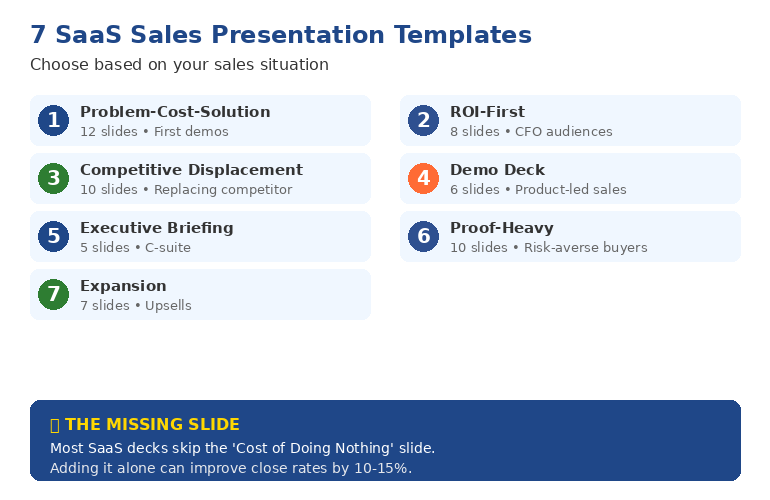
7 SaaS sales presentation templates overview - choose based on your sales situation

Template 1: The Problem-Cost-Solution Deck (12 slides)

Best for: First demo calls, discovery-heavy sales processes

Structure:

  1. Title slide — Company name, prospect name, date
  2. Agenda — What you’ll cover (sets expectations)
  3. Their world today — Describe their current process (shows you understand)
  4. The problem — What’s broken, with specific pain points
  5. Cost of inaction — Quantified: time, money, opportunity cost
  6. There’s a better way — Transition slide
  7. Solution overview — High-level, not features
  8. How it works — 3 steps maximum
  9. Proof — One case study, specific numbers
  10. ROI for you — Projected savings/gains for THIS prospect
  11. What others say — 2-3 testimonials
  12. Recommended next step — Specific action, not “any questions”

Why it works: The prospect sees themselves in the first 5 slides. By the time you show the product, they’re already convinced they need something to change.

This is the template that took my client from 6% to 39% close rate. The structure forces you to earn the right to talk about your product.

Problem-Cost-Solution 12-slide structure - Understand, Solve, Prove phases

Template 2: The ROI-First Deck (8 slides)

Best for: CFO-heavy buying committees, enterprise deals

Structure:

  1. The number — Open with projected ROI: “£340K saved in year one”
  2. How we calculated it — Show your math (builds credibility)
  3. The 3 cost drivers — Where savings come from
  4. Proof it works — Similar company, similar results
  5. Implementation timeline — How fast they see value
  6. Investment required — Pricing in context of ROI
  7. Risk mitigation — Guarantees, pilot options
  8. Decision framework — What to consider, recommended path

Why it works: Finance buyers don’t care about features. They care about returns. This deck speaks their language from slide one.

I used this structure to help a fintech company close a £2.1M enterprise deal. The CFO later said: “You were the only vendor who showed us the math before showing us the product.”

Template 3: The Competitive Displacement Deck (10 slides)

Best for: Prospects using a competitor, replacement sales

Structure:

  1. What’s changed — Market shifts since they chose current vendor
  2. Where [Competitor] falls short — 3 specific gaps (based on discovery)
  3. What modern solutions do differently — Category evolution
  4. Our approach — How you solve those specific gaps
  5. Migration story — Company that switched, why, and results
  6. Side-by-side — Honest comparison (include where competitor wins)
  7. Switching cost analysis — Time to value, implementation support
  8. Customer success commitment — What happens after they sign
  9. Transition plan — Week-by-week for first 90 days
  10. Decision timeline — What needs to happen by when

Why it works: Switching vendors is risky. This deck acknowledges that risk and systematically removes objections.

Template 4: The Demo Deck (6 slides + live demo)

Best for: Product-led sales, technical buyers

Structure:

  1. What you told us — Recap discovery call priorities
  2. What we’ll show you — 3 things, tied to their priorities
  3. Quick context — 60-second company/product overview
  4. [LIVE DEMO] — Focused on their use case
  5. What you saw — Recap benefits (not features)
  6. Next steps — Trial, pilot, or procurement path

Why it works: Most demos are 45 minutes of clicking through features. This structure keeps the demo focused on what matters to THIS buyer.

⏱️
Stop Rebuilding These From Scratch

You could recreate these 7 templates yourself — hours of work for each one. Or get them as editable PowerPoints, tested on real deals that closed £250M+, ready to customise in 10 minutes.

Get the Executive Slide System — £39 →

Template 5: The Executive Briefing Deck (5 slides)

Best for: C-suite presentations, board-level decisions

Structure:

  1. The strategic challenge — Business problem, not product category
  2. Market reality — What’s changed, why action is urgent
  3. Recommended approach — Your solution as strategy, not software
  4. Expected outcomes — Business metrics, not feature benefits
  5. Decision and next steps — What you need from them

Why it works: Executives have 15 minutes and zero patience for feature tours. This deck respects their time and frames your product as a strategic decision.

Related: Executive Presentation Template: 12 Slides That Command the Room

Template 6: The Proof-Heavy Deck (10 slides)

Best for: Risk-averse buyers, heavily regulated industries

Structure:

  1. Who we’ve helped — Logo slide with recognisable names
  2. Case study 1 — Similar company, specific results
  3. Case study 2 — Different use case, similar results
  4. Case study 3 — Their industry specifically
  5. The pattern — What these companies have in common
  6. How we do it — Brief methodology
  7. Security and compliance — Certifications, data handling
  8. Implementation approach — De-risked rollout plan
  9. Support structure — What happens when things go wrong
  10. Getting started — Low-risk first step (pilot, POC)

Why it works: Some buyers need overwhelming evidence before they’ll move. This deck provides it systematically.

Template 7: The Expansion Deck (7 slides)

Best for: Upsells, cross-sells, existing customer growth

Structure:

  1. Your results so far — What they’ve achieved with you
  2. What’s changed — New challenges, growth, market shifts
  3. The gap — What’s now possible that wasn’t before
  4. The opportunity — Specific expansion recommendation
  5. Expected additional value — Quantified improvement
  6. How others expanded — Similar customer story
  7. Recommended path — Timeline and investment

Why it works: Expansion deals should feel like a natural next step, not a new sale. This deck builds on the relationship you’ve already established.

The Slide Most SaaS Decks Are Missing

After reviewing hundreds of decks, the most common gap: the “Cost of Doing Nothing” slide.

Most SaaS sellers assume the prospect knows their problem is expensive. They don’t. Or they’ve normalised it.

Quantify the status quo:

  • “Your team spends 12 hours/week on manual data entry. At £50/hour, that’s £31,200/year.”
  • “You’re losing 23% of leads to slow response time. On your pipeline, that’s £180K in missed revenue.”
  • “Compliance incidents cost £15K each to resolve. You had 4 last year.”

This slide alone can move close rates by 10-15%. It reframes your price as an investment, not a cost.

Related: Best Copilot PowerPoint Prompts That Actually Work

Which Template Should You Use?

  • Discovery-heavy process? → Problem-Cost-Solution (Template 1)
  • Selling to finance? → ROI-First (Template 2)
  • Replacing a competitor? → Competitive Displacement (Template 3)
  • Product-led sales? → Demo Deck (Template 4)
  • C-suite audience? → Executive Briefing (Template 5)
  • Risk-averse buyers? → Proof-Heavy (Template 6)
  • Existing customers? → Expansion (Template 7)

Why the Free Checklist Isn’t Enough

The free checklist gives you the thinking framework. But frameworks without templates means hours of work building each deck from scratch.

What You Get DIY Approach Executive Slide System
Time to create each deck 4-6 hours 10 minutes to customise
All 7 templates Build yourself ✓ Included
Tested on real deals No ✓ £250M+ closed
Frameworks included Basic checklist ✓ AVP, 132 Rule, S.E.E.
Updates You maintain ✓ Lifetime access
Investment Your time (28-42 hours) £39

📦 ALL 7 TEMPLATES + FRAMEWORKS

Executive Slide System

Every template from this article as editable PowerPoints. Plus the AVP framework, 132 Rule, and S.E.E. Formula that make them work.

Get the Templates — £39 →

Instant download. Lifetime access. 30-day refund guarantee.

Frequently Asked Questions

What should a SaaS sales deck include?

Every effective SaaS sales presentation needs: problem definition, cost of inaction, solution overview, proof (case studies with specific numbers), ROI projection for this specific prospect, and a clear next step. The exact structure depends on your buyer — see Templates 1-7 above for different situations.

How many slides should a SaaS sales deck have?

5-12 slides for most situations. Executive briefings can be as few as 5. Discovery-heavy demos might go to 12. Never more than 15 — if you need more slides, you need a clearer message. The 34-slide decks I see from most SaaS companies are why their close rates are under 20%.

What’s the difference between a pitch deck and a sales deck?

Pitch decks raise money (investor audience). Sales decks close customers (buyer audience). Investors evaluate market size, team, and return potential. Buyers evaluate problem fit, ROI, and implementation risk. The structure is different because the decision criteria are different. See our Investor Pitch Deck Template for the fundraising version.

How do I improve my SaaS demo close rate?

Three changes make the biggest difference: (1) Add a “Cost of Doing Nothing” slide that quantifies their current pain, (2) Show proof before features — case studies early, product deep-dives only if asked, (3) End with a specific next step, not “any questions?” These changes alone typically improve close rates by 10-20%.

📧
The Winning Edge Newsletter

Weekly insights on presentations that close deals and advance careers.

Subscribe Free →

Related Resources

About the Author

Mary Beth Hazeldine has trained sales teams on high-stakes presentations for 35 years. With 24 years in corporate banking at JPMorgan Chase, PwC, Royal Bank of Scotland, and Commerzbank, she’s seen what separates deals that close from those that stall. Her clients have closed over £250 million using her presentation frameworks. She teaches at Winning Presentations.

15 Dec 2025
Why AI presentations fail - the hidden problem with AI-generated slides and how to fix them

Why AI Presentations Fail (And How to Fix Them)

📅 Updated: December 2025

Why AI presentations fail - the hidden problem with AI-generated slides and how to fix them

Why AI Presentations Fail (And How to Fix Them)

Want a structured framework for this?

71 structured prompts for ChatGPT and Copilot — covering board decks, investor pitches, quarterly reviews, and strategy presentations.

Explore the Prompt Pack →

Quick Answer

AI presentations fail because they optimise for speed, not persuasion. Tools like Copilot, ChatGPT, and Gamma generate slides in seconds — but the output is generic, forgettable, and often counterproductive. The fix isn’t avoiding AI; it’s using frameworks first (AVP, 132 Rule, S.E.E. Formula) and AI second. This article explains why most AI-generated presentations underperform and the 4-step system to make yours actually work.

Executive Resource

Stop Writing AI Prompts From Scratch

The Executive Prompt Pack (£19.99) gives you 71 tested prompts for executive-level presentations — board updates, budget requests, investor briefs, and Q&A preparation. Built for PowerPoint Copilot and ChatGPT.

Get the Executive Prompt Pack →

Designed for executives preparing for board briefings, budget requests, and high-stakes presentations.

🎁 FREE DOWNLOAD

Executive Presentation Checklist

The 12-point framework that makes AI presentations actually persuade. Complete this BEFORE you prompt any AI tool.

Download Free Checklist →

No spam. Unsubscribe anytime.


AI presentation tools promise to save you hours. And they do — if you measure success by how fast you create slides.

But speed isn’t the goal. Persuasion is. Decisions are. Results are.

And by those measures, most AI presentations fail spectacularly.

I’ve trained executives on presentations for more than 16 years. In the last two years, I’ve watched AI tools transform how people create slides — and I’ve seen the results. The presentations are faster to create. They’re also worse at persuading.

Here’s what’s actually happening, and how to fix it.

The 5 Reasons AI Presentations Fail

1. AI Optimises for Completeness, Not Clarity

Ask ChatGPT or Copilot to create a presentation about your product, and you’ll get comprehensive slides covering every feature, benefit, and use case.

The problem? Comprehensive isn’t persuasive.

Human attention is limited. The best presentations focus ruthlessly on 2-3 key messages. AI doesn’t know which messages matter most to YOUR audience in THIS context. So it includes everything — which means nothing stands out.

The result: Your audience remembers nothing. The decision gets delayed. You’ve saved 4 hours of creation time and lost 4 weeks of momentum.

2. AI Can’t Read the Room

A CFO cares about ROI and risk. A technical buyer cares about integration and security. A CEO cares about strategic fit and competitive advantage.

AI doesn’t know who’s in the room. It generates generic content for a generic audience — which resonates with no one specifically.

I recently reviewed a sales deck created with Copilot for a client pitching a private equity firm. Beautifully formatted. Professionally structured. And completely wrong for the audience — they wanted 3 slides on financial returns, not 15 slides on product features. The deal went to a competitor who understood what the audience actually wanted.

The result: The AI presentation looked professional but felt tone-deaf.

3. AI Produces “Correct” But Forgettable Content

AI-generated text is grammatically perfect and factually accurate. It’s also utterly forgettable.

Why? Because AI optimises for the average of all presentations it’s trained on. It produces the most statistically likely content — which is, by definition, the most generic.

Great presentations aren’t average. They have a point of view. They take a stance. They make you think. AI doesn’t do that — unless you specifically prompt it to, and most people don’t.

The result: Your slides look like everyone else’s slides. In a competitive pitch, you blend in when you need to stand out.

5 reasons AI presentations fail - completeness over clarity, generic content, no audience awareness, missing structure, false confidence

4. AI Skips the Strategic Thinking

The hardest part of a presentation isn’t making slides. It’s deciding what to say.

What’s your core message? What action do you want? What objections will arise? What story ties it together?

AI tools skip this entirely. They jump straight to slide creation — which is like writing a novel by generating sentences without knowing the plot.

When I work with clients, we spend 70% of our time on strategy and 30% on slides. AI inverts this ratio. You spend 5 minutes prompting and get 20 slides — none of which answer the fundamental question: “Why should this audience care?”

5. AI Creates False Confidence

This might be the most dangerous failure mode.

When you struggle to create a presentation manually, you’re forced to think. You wrestle with structure. You cut slides that don’t work. You refine your message through iteration.

AI eliminates that productive struggle. You get a polished-looking deck in minutes and assume it’s ready. But “looks professional” isn’t the same as “will persuade.”

I’ve seen executives walk into board meetings with AI-generated decks that looked beautiful and completely failed to land. They trusted the tool instead of testing the thinking.

📄
Fix Your AI Presentations

Start with the free checklist — complete this BEFORE prompting any AI tool. It’s the strategic thinking AI can’t do for you.

Download Free Checklist →

If you want a structured approach to executive presentations, the Executive Prompt Pack gives you everything you need — £19.99, instant access.

The Hidden Costs of Failed AI Presentations

When AI presentations fail, the costs are real — even if they’re invisible.

Lost revenue: A SaaS company I worked with had a 23% close rate with AI-generated decks. We restructured their pitch around the AVP framework (Action-Value-Proof) and their close rate hit 34%. On an £8M pipeline, that’s an £880K swing — from changing how they presented the same product.

Wasted time: The promise of AI is saving time. But if your AI presentation requires 3 follow-up meetings to clarify what you meant, you’ve saved nothing. I’ve seen teams spend 4 hours “perfecting” AI output that would have taken 90 minutes to create properly from scratch.

Career stagnation: The executives who rely on AI for high-stakes presentations often plateau. They’re not developing the strategic thinking that separates good from great. Meanwhile, colleagues who understand frameworks and audience psychology advance faster.

I worked with a director at a major consulting firm who’d been passed over twice for partner. His presentations were technically solid but forgettable. After applying the AVP framework to his next client pitch, the feedback was: “That’s the clearest we’ve ever seen our strategy articulated.” He made partner 8 months later.

Decision paralysis: Generic AI presentations don’t drive decisions. They create more questions. “Can we schedule a follow-up to clarify…?” is the sound of an AI presentation failing.

Related: Best Copilot PowerPoint Prompts That Actually Work

How to Make AI Presentations Actually Work

AI isn’t the problem. Using AI without frameworks is the problem.

Here’s the 4-step approach that transforms AI from a liability into a genuine advantage:

Step 1: Start With Frameworks, Not Prompts

Before you touch any AI tool, answer these questions:

  • What’s the ONE action you want? (Not three actions. One.)
  • What’s the core value proposition for THIS audience?
  • What proof will they find credible?

This is the AVP framework: Action-Value-Proof. It takes 10 minutes to complete and makes your AI prompts 10x more effective.

Step 2: Use the 132 Rule for Structure

The 132 Rule: 1 message, 3 supporting points, 2 minutes maximum per section.

AI generates endless content. The 132 Rule forces focus. Before you prompt, decide your one message and three supporting points. Then prompt AI to develop ONLY those — not everything it thinks might be relevant.

Step 3: Prompt for Specificity, Not Completeness

Bad prompt: “Create a presentation about our product for potential customers.”

Better prompt: “Create 5 slides for a CFO audience. Core message: Our platform reduces month-end close from 12 days to 4. Focus on: (1) time savings, (2) error reduction, (3) ROI within 6 months. Tone: Direct, data-driven, no fluff.”

The difference? The second prompt embeds your strategic thinking into the AI request. You’re using AI as an execution tool, not a thinking tool.

Step 4: Apply the S.E.E. Formula to Proof

AI-generated proof is generic: “Companies see significant improvements…”

The S.E.E. Formula makes proof memorable: Story-Evidence-Emotion.

  • Story: “Acme Corp’s finance team was drowning in manual reconciliation…”
  • Evidence: “Within 90 days, they reduced close time from 12 days to 4.”
  • Emotion: “Their CFO told me it was the first time she left work before 7pm during month-end.”

AI can help you draft this — but only after YOU identify which story, what evidence, and what emotional hook matters for this audience.

Related: Executive Presentation Template: 12 Slides That Command the Room

The 4-step framework for AI presentations that work - AVP, 132 Rule, Specific Prompts, S.E.E. Formula

Who Gets AI Presentations Right — And Wrong

In my experience, AI presentations work for:

  • People who already know how to present — They use AI to execute faster, not to think for them
  • Internal updates with low stakes — When “good enough” is actually good enough
  • First drafts that will be heavily edited — AI as starting point, not final product

AI presentations fail for:

  • High-stakes pitches — Board meetings, investor presentations, competitive deals
  • Audiences you don’t understand well — AI can’t compensate for missing audience insight
  • People who skip the strategic thinking — Garbage in, garbage out

The professionals pulling ahead use AI as a strategic execution tool, not a content generator. They apply frameworks first, then use AI to execute 10x faster.

Stop Prompting AI Without a Framework

The Executive Prompt Pack (£19.99, instant access) gives you 71 tested prompts for every executive presentation scenario — built for PowerPoint Copilot and ChatGPT. Stop generating generic slides. Start producing board-ready decks that land decisions.

  • 71 prompts covering board updates, budget requests, investor briefs, and Q&A preparation
  • Frameworks embedded in every prompt — AI executes your strategy, not a generic template
  • Built for executives presenting at board and leadership level

Get the Executive Prompt Pack →

Instant digital download. Works with PowerPoint Copilot and ChatGPT.

Frequently Asked Questions

What are the disadvantages of AI presentations?

The main disadvantages are: generic content that doesn’t resonate with specific audiences, missing strategic structure, false confidence from polished-looking slides that don’t actually persuade, and skipping the thinking work that makes presentations effective. AI optimises for completeness and speed, not for the focus and audience awareness that drive decisions.

Why do AI-generated slides fail?

AI-generated slides fail because they produce statistically average content — the most likely output based on training data. Great presentations aren’t average. They have a point of view, focus ruthlessly on 2-3 key messages, and tailor everything to the specific audience. AI can’t do that thinking for you.

Is Copilot good for presentations?

Copilot is excellent for presentations — if you use it correctly. The tool itself is powerful. The problem is how people use it. When you apply frameworks like AVP (Action-Value-Proof) before prompting, Copilot becomes a massive time-saver. When you skip frameworks and just prompt, you get fast garbage. The tool is only as good as the thinking you bring to it.

How do I make AI presentations better?

Four steps: (1) Use the AVP framework to clarify your action, value proposition, and proof before touching AI. (2) Apply the 132 Rule — 1 message, 3 supporting points, 2 minutes per section. (3) Prompt for specificity, not completeness — tell AI exactly what to focus on. (4) Use the S.E.E. Formula (Story-Evidence-Emotion) to make proof memorable. This approach takes 25 extra minutes upfront but saves hours of follow-up and dramatically improves results.
>

15 Dec 2025
Sales presentation template - the 7-step structure top performers use to close deals

Sales Presentation Template: The Structure Top Performers Use

📅 Updated: December 2025 | Includes AI customisation prompts

Sales presentation template - the 7-step structure top performers use to close deals

Quick Answer

The best sales presentation template follows a 7-step structure: Hook → Problem → Solution → Proof → Differentiation → Investment → Next Steps. This framework works because it mirrors how buyers actually make decisions — moving from “why should I care?” to “how do I buy?” Below is the complete template with examples from deals that closed.

🎁 FREE DOWNLOAD

Sales Presentation Checklist

The 7-step structure with what to include on each slide. One page. Print before your next pitch.

Download Free Checklist →

No spam. Unsubscribe anytime.


I’ve seen hundreds of sales presentations over 35 years — the ones that close and the ones that don’t. The difference isn’t charisma or product quality. It’s structure.

Top performers follow a predictable framework. They know exactly what to say and when to say it. They don’t wing it, and they don’t rely on slides packed with features.

This template is the structure I’ve taught to sales teams at SaaS companies, professional services firms, and enterprise tech vendors. It’s based on how buyers actually make decisions — not how sellers want to present.

The 7-Step Sales Presentation Structure

Every effective sales presentation follows this arc:

The 7-step sales presentation structure - Hook, Problem, Solution, Proof, Differentiation, Investment, Next Steps

Step 1: The Hook (1 Slide)

Purpose: Earn the right to keep talking.

You have 30 seconds before your prospect decides whether to pay attention or check their phone. The hook isn’t your company history or your logo. It’s a statement that makes them think: “This person understands my problem.”

What to include:

  • A provocative statistic or insight relevant to their situation
  • A question that highlights a known pain point
  • A bold claim you’ll prove in the next 20 minutes

Example: “Companies like yours lose an average of £340K annually to inefficient procurement processes. In the next 15 minutes, I’ll show you how three of your competitors eliminated that loss — and how you can too.”

What NOT to do: Start with “Thanks for your time today” or your company’s founding story. Nobody cares. Yet.

Step 2: The Problem (2-3 Slides)

Purpose: Make the pain feel urgent.

Before you can sell a solution, your prospect needs to feel the cost of their current situation. This isn’t about inventing problems — it’s about articulating the ones they already have, better than they can.

What to include:

  • The specific problem you solve (not a vague industry challenge)
  • The cost of the problem — in money, time, or risk
  • Why the problem exists (without blaming them)
  • What happens if it’s not addressed

Example structure:

  • Slide 1: “The £340K Problem” — quantify the pain
  • Slide 2: “Why Traditional Solutions Fail” — show you understand their attempts
  • Slide 3: “The Hidden Costs” — reveal what they haven’t calculated

A financial controller I worked with at a fintech company had a brilliant problem slide: “Your finance team spends 47 hours per month on manual reconciliation. That’s not just expensive — it’s the reason your month-end close takes 12 days instead of 3.”

Step 3: The Solution (2-3 Slides)

Purpose: Show the path forward.

Now — and only now — do you introduce your solution. But here’s what most salespeople get wrong: they describe features when they should describe transformation.

What to include:

  • Your solution in one sentence (the “what”)
  • How it specifically addresses the problem you just described
  • The outcome they’ll experience (not the features they’ll get)
  • A visual showing the “before and after” state

Example: Don’t say “Our platform has automated reconciliation with ML-powered matching.” Say “Your finance team goes from 47 hours of manual reconciliation to 3 hours of exception handling. Month-end close drops from 12 days to 4.”

The demo question: If you’re including a demo, this is where it goes. But keep it focused — show only the parts that solve the specific problem you’ve highlighted. A 20-minute feature tour kills momentum.

📄
Get the Complete Template

Download the free checklist with all 7 steps, what to include on each slide, and common mistakes to avoid.

Download Free Checklist →

Step 4: The Proof (2-3 Slides)

Purpose: Remove doubt with evidence.

Claims are easy. Proof is what separates top performers from everyone else. Your prospect is thinking: “This sounds good, but will it actually work for us?”

What to include:

  • Case studies from similar companies (same industry, same size, same challenge)
  • Specific results with numbers (not vague testimonials)
  • Timeline to results (when will they see ROI?)
  • Customer logos that build credibility

The similarity principle: Prospects trust proof from companies that look like them. A case study from a Fortune 500 won’t convince a 50-person startup. Match your proof to your audience.

Example: “Acme Corp had the same challenge — 47 hours of monthly reconciliation, 12-day close. Within 90 days of implementation, they reduced reconciliation to 4 hours and closed in 5 days. Here’s their CFO explaining the impact.”

Related: Executive Presentation Template: 12 Slides That Command the Room

Step 5: The Differentiation (1-2 Slides)

Purpose: Answer “why you and not them?”

Your prospect is comparing you to alternatives — competitors, building in-house, or doing nothing. You need to make the choice obvious.

What to include:

  • Your unique approach (not just features)
  • Why alternatives fall short (without badmouthing competitors)
  • The risk of choosing the wrong solution

The “only we” test: Every differentiation claim should pass this test: “Only we [specific capability] which means [specific benefit].” If a competitor could make the same claim, it’s not differentiation.

Example: “Other reconciliation tools match transactions. Only we predict exceptions before they happen — which means your team fixes issues proactively instead of reactively. That’s the difference between a 5-day close and a 3-day close.”

Step 6: The Investment (1-2 Slides)

Purpose: Frame price as investment, not cost.

This is where deals stall. Not because the price is too high, but because the value hasn’t been established. If you’ve done steps 1-5 well, this slide should feel like a logical conclusion.

What to include:

  • The investment (be direct — don’t hide pricing)
  • ROI calculation based on the problem you quantified
  • Time to value (when they’ll see returns)
  • Options if available (good-better-best)

The ROI bridge: Connect your price directly to the problem. “You’re currently losing £340K annually to manual processes. The investment is £85K per year. That’s a 4x return — and most clients see positive ROI within 6 months.”

What NOT to do: Apologise for price, offer discounts preemptively, or rush through this slide. Confidence here signals value.

Step 7: The Next Steps (1 Slide)

Purpose: Make action easy.

Never end with “Any questions?” End with a clear path forward. Your prospect should know exactly what happens next and feel confident saying yes.

What to include:

  • The specific next step (not “let us know”)
  • Timeline for that step
  • What you’ll deliver and when
  • Who needs to be involved

Example: “Based on what we’ve discussed, I’d recommend a pilot with your EMEA finance team — low risk, high visibility. I can have the scoping document to you by Thursday, and we’d kick off in January. Does that timeline work with your planning cycle?”

Related: Investor Pitch Deck Template: The Sequoia Format That Raised Billions

Before and after sales presentation transformation - from feature-focused to buyer-focused structure

Common Sales Presentation Mistakes

After reviewing hundreds of sales decks, these are the patterns that kill deals:

1. Leading with your company

Nobody cares about your founding story, your office locations, or your org chart. Earn the right to talk about yourself by first demonstrating you understand them.

2. Feature dumping

Listing every feature signals you don’t know which ones matter. Top performers talk about 3-4 capabilities that directly address the prospect’s problem.

3. Generic proof

“We have 500 customers” means nothing. “We helped 12 companies exactly like yours reduce close time by 60%” means everything.

4. Hiding from price

When you bury pricing or rush through it, you signal that even you think it’s too expensive. Confident pricing backed by clear ROI closes deals.

5. Weak endings

“Let me know what you think” is not a close. “I’ll send the pilot proposal Thursday and follow up Friday to discuss” is a close.

Related: Best Copilot PowerPoint Prompts That Actually Work

Customising for Your Sales Cycle

This template flexes based on where you are in the sales process:

Discovery call (15 minutes): Hook + Problem + Solution overview. Save proof and investment for follow-up.

First pitch (30 minutes): Full 7-step structure, but lighter on proof. Focus on problem-solution fit.

Final presentation (45-60 minutes): Full structure with deep proof section. Include demo if relevant. This is where you handle objections and close.

Executive sponsor meeting (20 minutes): Hook + Problem (business impact) + Investment + Next Steps. Executives don’t need feature details — they need ROI and risk mitigation.

Using AI to Build Your Sales Deck

AI tools like Copilot and ChatGPT can accelerate your sales deck creation — if you prompt them correctly.

For the Hook:

“Generate 5 opening hooks for a sales presentation to [industry] companies about [problem]. Each hook should include a specific statistic or provocative question. Target audience: [title].”

For the Problem section:

“Create a problem statement for [your solution] that quantifies the cost of [specific problem] for [company size/type]. Include hidden costs most buyers don’t calculate.”

For Proof slides:

“Write a case study summary for a sales presentation. Company: [similar to prospect]. Challenge: [problem]. Solution: [your product]. Results: [specific outcomes]. Format: 3 bullet points, each under 15 words.”

For Differentiation:

“Compare [your solution] to [alternative approaches]. Focus on 3 unique capabilities that competitors cannot claim. Use the format: ‘Only we [capability] which means [benefit].'”

Related: How to Use Copilot in PowerPoint: Complete Tutorial 2025

From Template to Closed Deals

A template gives you structure. But structure alone doesn’t close deals.

What separates good salespeople from great ones is execution: customising the problem to each prospect, finding proof that resonates, handling objections with confidence, and closing with clarity.

The Executive Slide System includes this sales presentation template plus 9 more — all with AI prompts for rapid customisation and before/after examples showing how to transform generic decks into deal-closers.

⭐ RECOMMENDED

The Executive Slide System (£39)

10 ready-to-use executive presentation templates including the complete sales presentation structure — plus AI prompts to customise each for your specific deals.

  • Sales presentation template — The 7-step structure that closes
  • Before/after examples — See transformations from real deals
  • 30 AI prompts — Customise for any prospect in minutes
  • 9 more templates — Board, investor, strategy, QBR, and more

Get the Executive Slide System — £39 →

Instant download. Use for unlimited presentations.

What’s Included: Free vs Paid

Feature Free Checklist Executive Slide System (£39)
7-step sales structure
What to include per slide
Ready-to-use PowerPoint template
Before/after examples
AI customisation prompts 30 prompts
9 additional templates

Start With the Free Checklist

The 7-step framework with what to include on each slide. Print it before your next pitch.

Download Free Checklist →

Frequently Asked Questions

How long should a sales presentation be?

Match your presentation length to your meeting time minus 30% for discussion. For a 30-minute meeting, prepare 20 minutes of content. For a 60-minute meeting, prepare 40 minutes. The best sales presentations leave room for conversation — that’s where deals close.

Should I send the deck before or after the meeting?

After, always. Sending before lets prospects form opinions without context. Present first, then send a follow-up version with additional detail they can share internally. The follow-up deck can be longer — it’s a leave-behind, not a presentation.

How many slides should a sales presentation have?

12-18 slides for a 30-minute presentation. The 7-step structure typically produces: 1 hook, 2-3 problem, 2-3 solution, 2-3 proof, 1-2 differentiation, 1-2 investment, 1 next steps. Add an appendix for detailed specs if needed.

What if the prospect asks about price early?

Give a range, then redirect: “Investment typically runs £X-Y depending on scope. Let me show you what drives that range — and more importantly, the ROI clients see.” Don’t avoid price, but don’t let it derail your structure before you’ve established value.

How do I handle competitors coming up during the presentation?

Welcome it: “Great question — let me show you how we compare.” Your differentiation section should anticipate this. If they mention a competitor you didn’t address, pivot to your “only we” statements. Never badmouth — always redirect to your unique value.

📧
The Winning Edge Newsletter

Weekly insights on presentations that close deals, win budgets, and advance careers.

Subscribe Free →

Related Resources

About the Author

Mary Beth Hazeldine has trained sales teams and executives on high-stakes presentations for 35 years. With 24 years in corporate banking at JPMorgan Chase, PwC, Royal Bank of Scotland, and Commerzbank, she’s closed deals, won budgets, and seen what separates presentations that convert from those that don’t. She teaches at Winning Presentations.

14 Dec 2025
Pitch deck examples - 7 real decks from Airbnb, Canva, Loom and more that raised millions

Pitch Deck Examples: 7 Real Decks That Got Yes (Not Praise)

📅 Updated: January 2026 | Real decks, real funding rounds

Quick Answer

The best pitch deck examples share common patterns: they lead with a compelling problem, quantify the market opportunity, and make the ask crystal clear. Below are 7 real decks from companies like Airbnb, Canva, and Loom — with analysis of what worked and what you can apply to your own pitch.

A great pitch deck is only half the battle.

The deck gets you in the room — delivering it with authority wins the decision. The Complete Presenter is the full system: the Executive Slide System, storytelling, Q&A handling and delivery confidence. Seven products, £190+ value — £99 once, lifetime access.

Get The Complete Presenter (£99) →

Just need the slides? Start with the Executive Slide System (£39). Leading high-stakes pitches regularly? Maven Executive Buy-In Presentation System (£499).

Studying examples is smart. Using proven frameworks is smarter.

These decks raised millions because of their structure, not their design. The Executive Slide System gives you those exact frameworks — so your pitch gets meetings, not rejections.

From 24 years presenting to boards and investors: the slide structures that actually get yes.


Get the Executive Slide System → £39


Learning from funded decks is one of the fastest ways to improve your own pitch. But most “pitch deck examples” online are either too polished to be useful or from companies so famous that the lessons don’t apply.

These seven examples are different. They’re from real early-stage rounds — companies that weren’t yet household names, pitching investors who needed convincing.

I’ve helped build over 50 pitch decks in my career, including 12 that raised over £50M combined. The patterns I see in these famous decks are the same ones that work for my clients today.

Let’s break down what worked.

1. Airbnb (2009) — $600K Seed

What they raised: $600K from Sequoia Capital

Slides: 14

What worked:

  • Problem slide was visceral: “Price is an important concern for customers booking travel online” — backed by data showing hotels are 2-3x more expensive than alternatives
  • Market sizing was specific: Didn’t just say “travel is big.” Showed: 1.9B trips, $532B spent on travel, and their target slice
  • Traction was honest: Early numbers weren’t huge, but they showed growth trajectory

What you can steal: Make the problem feel expensive. Airbnb didn’t just say hotels are pricey — they quantified the gap and showed who was feeling the pain.

2. Buffer (2011) — $500K Seed

What they raised: $500K

Slides: 13

What worked:

  • Radical transparency: Shared exact revenue numbers, growth rates, and even their open salary formula
  • Simple product explanation: One sentence: “Buffer is the easiest way to schedule tweets and posts to Facebook”
  • Focus on retention: Showed that users who stayed past week 1 stayed forever

What you can steal: If you have good retention, lead with it. Investors know that acquisition can be bought — retention can’t.

3. Front (2016) — $10M Series A

What they raised: $10M from Social Capital

Slides: 12

What worked:

  • Problem slide named the villain: “Email was designed for individuals, not teams” — immediately relatable for anyone who’s struggled with shared inboxes
  • Competitive positioning was clever: Showed why Slack, Zendesk, and Gmail each missed the mark
  • Team slide was specific: Not just names and titles — showed relevant experience at Google, Dropbox, and why this team understood the problem

What you can steal: Name a villain everyone knows. Email, spreadsheets, meetings — if your product fixes a universal frustration, make that the centrepiece.

📄
Build Your Own Investor-Ready Deck

Get the 10-slide framework these successful decks follow — with what investors look for on each slide.

Download Free Checklist →

4. Intercom (2012) — $1M Seed

What they raised: $1M

Slides: 10

What worked:

  • Vision was bold but grounded: “The first customer communication platform built for the internet era”
  • Demo was prominent: Multiple slides showed the actual product — investors could see it worked
  • Timing narrative was strong: Explained why SaaS companies were ready for better customer communication now

What you can steal: Show the product early. If your product is genuinely good, screenshots do more than slides of text ever will.

5. Mixpanel (2012) — $10M Series A

What they raised: $10M from Andreessen Horowitz

Slides: 15

What worked:

  • Positioned against a giant: “Google Analytics shows you what happened. We show you why.” — instantly clear differentiation
  • Customer logos mattered: Uber, Airbnb, and other hot startups were already using them
  • Metrics were specific: Not just “growing fast” — exact percentages, retention curves, usage data

What you can steal: If you’re competing with a known player, make the contrast sharp. One sentence that shows what you do that they can’t.

6. Canva (2012) — $3M Seed

What they raised: $3M

Slides: 18

What worked:

  • Massive market, narrow entry: Showed the $130B design market, but focused on the underserved: non-designers who need to create
  • Before/after was powerful: Showed what design looked like before Canva (complicated, expensive) and after (simple, free)
  • Founder story added credibility: Melanie Perkins had already built and sold a similar product for school yearbooks

What you can steal: Before/after comparisons work. Show the painful “before” state and the transformed “after” — investors feel the value gap.

7. Loom (2016) — $2M Seed

What they raised: $2M

Slides: 11

What worked:

  • Problem was immediately relatable: “Explaining anything complex over text is painful” — every investor has felt this
  • Product demo was the pitch: They recorded the pitch using Loom — meta, but effective
  • Viral mechanics built-in: Showed that every video shared brings new users to the platform

What you can steal: If your product can demonstrate itself, let it. Loom’s meta approach proved the product while pitching it.

Related: Investor Pitch Deck Template: The Sequoia Format That Raised Billions

5 patterns across all funded pitch decks - problem first, specific metrics, traction, team, clear ask

The Patterns Across All 7 Decks

Every successful deck followed these principles:

1. Problem before solution

Not one of these decks started with the product. They all started with a problem the investor could feel.

2. Specific beats impressive

“£2.3M ARR growing 15% MoM” beats “we’re growing fast.” Every deck that worked used exact numbers.

3. Traction trumps projections

Investors have seen too many hockey-stick forecasts. Real customers, real revenue, real engagement — that’s what moved the needle.

4. Team slide earned its place

Every deck showed why this specific team was uniquely positioned to win. Not generic bios — specific, relevant experience.

5. The ask was clear

No deck ended with “we’re exploring options.” They said exactly how much, what it would fund, and what milestones it would achieve.

Related: 15 Killer Pitch Deck Templates That Raised £500M+

From Examples to Execution

Studying successful decks is useful. But when you sit down to build your own, you’re starting from a blank slide.

That’s where templates and frameworks help. Instead of guessing what goes where, you have a structure that works — proven by the decks that actually raised money.

⭐ RECOMMENDED

The Executive Slide System (£39)

Ready-to-use templates including the Sequoia 10-slide investor pitch deck format — plus 9 more executive presentation templates.

  • Investor pitch deck template — The exact structure these funded decks follow
  • Before/after examples — See how to transform weak slides
  • 30 AI prompts — Customise any template in minutes
  • 10 templates total — Board, budget, strategy, and more

Get the Executive Slide System — £39 →

Instant download. Use for unlimited presentations.

🏆 FOR FOUNDERS & EXECUTIVES

Need More Than Templates? Get the Complete System.

The Executive Buy-In Presentation System includes everything you need to present with confidence and close deals — from first pitch to final approval.

  • Frameworks that have helped clients raise £250M+
  • How to read the room and adapt in real-time
  • Scripts for handling investor objections
  • Personal review of your pitch deck


Learn More About the Executive Buy-In System → £199

Quick Reference: What to Steal From Each Deck

Company Raised Key Lesson
Airbnb $600K Make the problem feel expensive
Buffer $500K Lead with retention metrics
Front $10M Name a villain everyone knows
Intercom $1M Show the product early
Mixpanel $10M Sharp contrast with competitors
Canva $3M Before/after comparisons
Loom $2M Let product demonstrate itself

Frequently Asked Questions

Where can I find these pitch decks?

Most are publicly available. Search “[Company name] pitch deck PDF” — many founders have shared their original decks after raising. Sites like Slidebean, Pitch Deck Hunt, and the company blogs often host them.

How many slides should my pitch deck have?

10-15 slides maximum. The decks above ranged from 10 (Intercom) to 18 (Canva), but the average was 13. Every slide beyond 15 weakens your pitch.

Should I copy these decks exactly?

No. Use them for structure and principles, not design or content. Your story is different. The patterns — problem-first, specific metrics, clear ask — are what matter.

What if I don’t have traction like these companies?

Show other signals: waitlist size, LOIs, pilot agreements, engagement metrics. Buffer’s early deck had modest numbers but showed trajectory. Momentum matters more than magnitude.

Related Resources

About the Author

Mary Beth Hazeldine has helped clients raise over £250 million in funding over 35 years — including 12 pitch decks that raised over £50M combined. She teaches at Winning Presentations.

14 Dec 2025
Title + three frameworks (AVP, 132, S.E.E.) + "Save 10+ hours/week" + January 2026 badge

AI-Enhanced Presentation Mastery for Senior Leaders

Title + three frameworks (AVP, 132, S.E.E.) + "Save 10+ hours/week" + January 2026 badge

executive presentation mastery. They shape decisions, win clients, and move careers forward.

But creating them? That’s exhausting.

You spend hours wrestling with structure, rewriting messaging that doesn’t land. By the time you’re done, you’re not even confident it will work.

AI promises to help — but most people end up with generic outputs and robotic messaging. The tool saves time on the wrong things.

Here’s what’s actually needed: a strategic approach combining AI efficiency with presentation psychology — the clarity, structure, and persuasion that makes people act.

That’s what I’ve spent the last two years developing. And it’s running right now, with new cohorts opening regularly.

🎁 FREE DOWNLOAD

Executive Presentation Checklist

12-point framework for presentations that get decisions. One page. Use it before your next meeting.

Download Free Checklist →

No spam. Unsubscribe anytime.


The Q2 Advantage

Q2 isn’t about new year’s resolutions — it’s about acceleration. For presentation skills specifically, it’s one of the best times to invest — and here’s why:

1. Q1 Is When Careers Are Made

Think about what happens in the first quarter of any year:

  • Annual planning presentations to leadership
  • Budget requests and resource allocation
  • Strategy rollouts to teams
  • Performance reviews where you advocate for yourself
  • New projects that need stakeholder buy-in

The presentations you give in Q1 set the tone for your entire year. They determine which projects get funded, which ideas get traction, and which people get noticed.

I watched a Director at RBS transform her career trajectory with one January presentation. She’d been passed over for promotion twice — stuck at the same level for four years despite strong performance reviews. We worked together over the holiday break, restructured her Q1 strategy presentation, and she delivered it with a completely different presence.

By March, she was leading a new division. By year-end, her compensation had increased by 40%.

Same person. Same ideas. Different presentation skills.

2. You Have Time Before It Matters

Most people try to improve their presentation skills the week before a big presentation. That’s like training for a marathon the night before the race.

Starting now gives you runway. You can learn frameworks, practise techniques, and build confidence before the high-stakes moments arrive.

The executives I work with who see the fastest improvement are the ones who start now and have the rest of Q2 and beyond to apply what they learn before their major presentations.

3. The Competition Is Distracted

While everyone else is recovering from the holidays, catching up on email, and easing back into work, you can be sharpening skills that 90% of professionals never develop.

Presentation skills are a competitive advantage precisely because most people avoid working on them. They’re uncomfortable. They require practice. They force you to confront weaknesses.

That discomfort is the barrier that keeps most of your competition on the other side.

All three frameworks explained with bullets + workflow arrow + time comparison (4-6 hrs → 90 min)

What “Presentation Mastery” Actually Means

Let me be direct about what presentation mastery is and isn’t.

It’s not:

  • Being a natural extrovert
  • Having a perfect voice or presence
  • Eliminating all nervousness
  • Memorising scripts
  • Creating beautiful slides

It is:

  • Knowing how to structure information so people can follow it
  • Understanding what your specific audience needs to hear
  • Delivering with enough confidence that people trust your message
  • Handling questions without losing control of the room
  • Making it easy for decision-makers to say yes

The best presenters I’ve trained aren’t the most charismatic people in the room. They’re the most prepared. They’ve learned frameworks that work, and they’ve practised until those frameworks feel natural.

The Turning Point Most People Miss

In my 24 years at JPMorgan, PwC, RBS, and Commerzbank, I saw hundreds of talented people plateau in their careers. Not because they lacked intelligence or work ethic, but because they couldn’t communicate their value.

There was a particular moment at JPMorgan that changed how I thought about this.

I was sitting in a leadership meeting watching two people present back-to-back. The first was brilliant — genuinely one of the smartest analysts I’d worked with. She had data that would have changed how we approached a £50M decision. But her presentation was a wall of spreadsheets with no narrative. The room lost interest by slide 3.

The second presenter had a simpler idea, but he told a story. He started with the problem, made us feel the cost of inaction, and presented his solution as the obvious next step. He got the budget. She didn’t.

That’s when I realised: the best idea doesn’t win. The best-presented idea wins.

It’s not fair. But it’s true. And once you accept that, you can do something about it.

📄
Start With the Basics

Get the 12-point executive presentation checklist — the same framework I use with clients before any high-stakes presentation.

Download Free Checklist →

The AI-Enhanced Approach: What Makes It Different

Most AI presentation advice tells you to “use ChatGPT to write your slides.” That’s backwards. You end up with generic content that sounds like everyone else.

The AI-enhanced approach I teach uses AI as a strategic thinking partner, not a content generator. You learn frameworks first, then use AI to execute them faster.

Framework 1: AVP (Action-Value-Proof)

Every persuasive presentation answers three questions in sequence:

  • Action: What do you want the audience to do?
  • Value: Why should they care? What’s in it for them?
  • Proof: Why should they believe you?

Most presenters bury the action on slide 15. They lead with proof (data, background, context) and hope the audience figures out what to do with it.

AVP flips this. You lead with the ask, make the value impossible to ignore, then provide just enough proof to remove doubt.

Once you understand AVP, you can teach AI to structure any presentation in this format — in minutes, not hours.

Framework 2: The 132 Rule

This is how you organise information so audiences actually remember it:

  • 1 core message (what you want them to remember tomorrow)
  • 3 supporting points (the structure of your argument)
  • 2 minutes per point maximum (before attention drops)

The 132 Rule forces clarity. If you can’t distill your presentation to one message with three supports, you don’t understand your own argument well enough.

AI becomes powerful here because you can generate multiple 132 structures for the same content, then choose the strongest one.

Framework 3: S.E.E. Formula (Story-Evidence-Emotion)

This is how you make proof memorable instead of forgettable:

  • Story: A specific example that illustrates your point
  • Evidence: The data that backs it up
  • Emotion: The feeling you want to leave them with

“Our NPS increased 18 points” is forgettable. “Sarah, our longest-tenured customer, called to say it’s the first time in three years she hasn’t dreaded using our product — and our NPS reflects that, up 18 points” — that’s memorable.

AI can help you find stories, format evidence, and craft emotional hooks. But only if you know what you’re asking for.

Related: Best Copilot PowerPoint Prompts That Actually Work

The Real Promise: 10+ Hours Saved Per Week

Here’s what changes when you combine these frameworks with AI:

Before: You stare at a blank slide for 20 minutes. You write, delete, rewrite. You move sections around. You’re not sure if it’s good or just done. Total time: 4-6 hours for a 15-slide deck.

After: You spend 10 minutes defining your AVP structure. You prompt AI to generate a 132-compliant outline. You refine the S.E.E. elements for your key points. AI handles formatting while you focus on strategy. Total time: 90 minutes for a better deck.

This isn’t about AI replacing your thinking. It’s about AI handling the mechanics so you can focus on what actually matters: the strategy, the persuasion, and the stakeholder impact.

The professionals I’ve trained with this approach report saving 10+ hours per week on presentation work. That’s not an exaggeration — it’s what happens when you stop wrestling with structure and start with a system.

Related: PowerPoint Copilot December 2025: What’s New and What Works

Side-by-side: WITHOUT AI (6 painful steps, 4-6 hours) vs WITH AI SYSTEM (5 efficient steps, 60-90 min) + results box Complete Maven Post Now Includes Element Status Title: executive presentation mastery.E.E. explained ✅ Value prop: 10+ hours saved, 30-min first drafts ✅ AI-specific tips: Strategic prompting examples ✅ Course details: Match Maven page exactly ✅ Images: All 3 reflect AI focus ✅ Word count: 2,605 ✅ Ready for Dec 14 LinkedIn and Spoke? Presentation mastery january maven post Code · HTML Ai presentation mastery hero Image · PNG Ai frameworks system Image · PNG Ai workflow before after Image · PNG

What You Can Start Doing Now

Whether or not you join the course, here’s how to start using AI more strategically for presentations today:

1. Stop Asking AI to “Write My Presentation”

That prompt produces garbage. Instead, ask AI to help you think:

  • “What are the three strongest arguments for [your recommendation]?”
  • “What objections will a sceptical CFO have to this proposal?”
  • “How would you structure this information using the situation-complication-resolution framework?”

Use AI to think better, not write faster.

2. Define Your Structure Before You Prompt

Before you touch AI, write down:

  • What action do I want the audience to take?
  • What’s the one message they need to remember?
  • What are the three supporting points?

Then prompt AI to help you execute that structure. You’ll get 10x better results than “write me 10 slides about Q4 results.”

3. Use AI to Find the Story, Not Just the Structure

Ask: “What’s a specific example that would illustrate [your point] to a sceptical audience?”

AI is surprisingly good at generating story angles you haven’t considered. You still need to verify and personalise, but it can accelerate your thinking.

Related: Best Copilot PowerPoint Prompts That Actually Work

Who This Course Is For

This course is for you if:

  • You create presentations regularly and want to save hours while delivering clearer, more persuasive results
  • You’re in a client-facing or stakeholder role — manager, consultant, analyst — where influence matters
  • You’ve tried using AI for presentations but ended up with generic outputs that don’t sound like you
  • You want to stand out by mastering communication skills that position you as a clear, strategic thinker
  • You have Q1 presentations coming and want to make them count

It’s not for you if you rarely give presentations, if you’re already getting the outcomes you want, or if you’re looking for a quick hack rather than a system you’ll use for years.

The Cost of Waiting

Here’s what I’ve seen happen to people who keep putting this off:

They give a mediocre Q1 presentation. Their budget request gets cut. Their project gets deprioritised. Someone else gets the promotion. And they tell themselves they’ll work on it “next year.”

Then next year comes, and they’re in the same position — or worse, because they’ve now been passed over again.

Meanwhile, AI tools are making good presenters even better. The gap between “average” and “excellent” is widening. The professionals who learn to use AI strategically will have an unfair advantage over those still wrestling with blank slides.

Why I Built This Course

For 16+ years, I’ve watched brilliant people struggle to communicate their ideas. I’ve seen careers stall because someone couldn’t present their value. I’ve seen worse ideas win because they were packaged better.

I built this course because I believe presentation skills shouldn’t be a mystery. The frameworks that work can be taught. The confidence that comes from mastery can be developed. And the results — the promotions, the funded projects, the influence — follow naturally.

If you’ve been putting off working on your presentation skills, now is the time. Not because of some arbitrary motivation, but because the next high-stakes presentation is coming — and you still have time to prepare.

🎓 JANUARY 2026 COHORT

executive presentation mastery.6; color: #e0e0e0; margin-bottom: 20px;”>Master AI-powered presentations that save 10+ hours per week while dramatically improving quality. 8 self-paced modules + 2 live coaching sessions.

  • AVP Framework — Structure presentations that guide audiences to yes
  • 132 Rule — Organise information so people actually remember it
  • S.E.E. Formula — Make your proof memorable and impossible to dismiss
  • AI Workflow System — Create first drafts in 30 minutes with your personal prompt playbook
  • Templates & Assets — AI outline generators, slide cleanup prompts, before/after transformations
  • Lifetime access — All modules, recordings, and future updates

Format: self-paced modules + live coaching

Monthly cohorts — join the next one

“Mary Beth’s frameworks changed how I approach every presentation. I used to dread board meetings — now I look forward to them.” — Senior Director, Biotech

Join the Next Cohort →

Backed by the Maven Guarantee. Full refund available until halfway point.

What’s the Difference?

You can learn to use AI for presentations on your own. Many people try. Here’s what the course gives you that YouTube tutorials and blog posts don’t:

Approach DIY / Free Resources executive presentation mastery.E.E.) Scattered / incomplete Complete system
AI prompts that actually work Trial and error Tested prompt playbook
Before/after examples Generic samples Real transformations
Live coaching feedback None 2 live sessions
Time to competence Months of experimentation Immediate application

Not Ready for the Course?

Start with the free checklist. It’s the same framework I use with clients, and it’ll improve your next presentation immediately.

Download Free Checklist →

Questions You Might Have

I’m not an executive. Is this course for me?

Yes. The frameworks work for anyone who presents to stakeholders — managers, clients, investors, or teams. If your ideas need buy-in from others, this course will help.

What if I’m already a decent presenter?

Most people in the course are already competent. They’re looking to go from good to great — to handle high-stakes moments with confidence, not just survive them.

How much time does it require?

Plan for 2-3 hours per week over 8 weeks. The modules are self-paced, but the live sessions are scheduled (recordings available if you miss them).

When does the next cohort start?

New cohorts start regularly. Join the waitlist to be first in line.

📧
The Winning Edge Newsletter

Weekly insights on executive presentations, AI tools, and what’s working right now.

Subscribe Free →

Related Resources

About the Author

Mary Beth Hazeldine has trained executives on presentations for 16+ years. With 24 years of corporate banking experience at JPMorgan Chase, PwC, Royal Bank of Scotland, and Commerzbank, she’s seen firsthand how presentation skills determine careers. She teaches at Winning Presentations.

14 Dec 2025
Investor pitch deck template - The Sequoia format that raised billions

Investor Pitch Deck Template: The Sequoia Format (With What They Cut)


📅 Updated: December 2025 | Based on 50+ funded pitch decks


The best investor pitch deck template follows the Sequoia format: 10 slides covering Company Purpose, Problem, Solution, Why Now, Market Size, Competition, Product, Business Model, Traction, and Team — closing with The Ask. Lead with your strongest story. Keep it under 15 slides. Make every slide answer one question: “Why should I invest?”

A great pitch deck is only half the battle.

The deck gets you in the room — delivering it with authority wins the decision. The Complete Presenter is the full system: the Executive Slide System, storytelling, Q&A handling and delivery confidence. Seven products, £190+ value — £99 once, lifetime access.

Get The Complete Presenter (£99) →

Just need the slides? Start with the Executive Slide System (£39). Leading high-stakes pitches regularly? Maven Executive Buy-In Presentation System (£499).

🎁 FREE DOWNLOAD

Investor Pitch Deck Checklist

10-slide framework + what investors look for on each slide. One page. Print before your pitch.

Download Free Checklist →

No spam. Unsubscribe anytime.


In 2019, I worked with a biotech founder developing a rare disease treatment who’d been rejected by 23 investors.

Her science was solid. Her market was massive. Her team had three PhDs. But she couldn’t get past the first meeting.

The problem wasn’t her company. It was her deck.

She’d built a 47-slide presentation that started with the molecular structure of her compound. By slide 8, investors’ eyes were glazed. She never got to the market opportunity.

We rebuilt her deck using the Sequoia format — 10 slides, story-first, problem-solution structure. She raised £3.2M in her next round.

The template I’m sharing today is the same structure we used. It’s based on the format Sequoia Capital recommends to their portfolio companies, refined through 50+ pitch decks I’ve helped create — including 12 that raised over £50M combined.

Why the Sequoia Format Works

Sequoia Capital has backed Apple, Google, Airbnb, Stripe, and WhatsApp. They’ve seen more pitch decks than almost anyone in venture capital.

Their recommended format isn’t arbitrary. It’s designed around how investors actually evaluate opportunities:

  1. Can I understand this in 3 minutes? — If your deck requires explanation, you’ve lost
  2. Is this a big market? — VCs need billion-dollar outcomes
  3. Why will this team win? — Ideas are cheap; execution is everything
  4. Why now? — Timing kills more startups than bad ideas

The 10-slide structure answers each of these questions in a logical sequence. Miss one, and the investor has a reason to say no.

The Sequoia 10-slide pitch deck structure from company purpose to financials

The 10-Slide Investor Pitch Deck Template

Slide 1: Company Purpose

The question it answers: What do you do in one sentence?

This slide should take 10 seconds to read and understand. If an investor can’t explain your company to their partner after seeing this slide, you’ve failed.

Include:

  • Company name and logo
  • One-line description (what you do, not how you do it)
  • Tagline if you have one that’s genuinely memorable

Example: “Stripe: Payments infrastructure for the internet”

Common mistake: Describing features instead of purpose. “AI-powered B2B SaaS platform leveraging machine learning” tells investors nothing. “We help retailers predict what customers will buy next” tells them everything.

Slide 2: Problem

The question it answers: What painful problem exists?

Make the investor feel the problem. Quantify it. Show that real people or companies are suffering right now — and willing to pay for a solution.

Include:

  • Clear problem statement
  • Who has this problem (be specific)
  • How big the problem is (quantified)
  • What they’re doing today (and why it’s not good enough)

Example: “UK retailers lose £2.3B annually to stockouts. Current forecasting tools are 60% accurate. Buyers spend 15 hours/week manually adjusting orders.”

Slide 3: Solution

The question it answers: How do you solve this?

Don’t describe every feature. Show the core insight — the thing you do differently that makes the problem go away.

Include:

  • Your solution in one sentence
  • How it works (high level)
  • The key insight that makes you different
  • Screenshot or visual if it helps understanding

Example: “Our AI predicts retail demand with 94% accuracy by analysing real-time signals competitors can’t access — social media, weather, local events.”

📄
Get the Complete Checklist

All 10 slides with what investors look for on each. One-page PDF you can reference while building your deck.

Download Free Checklist →

Slide 4: Why Now

The question it answers: Why is this the right moment?

This is the slide most founders skip — and it’s often the most important. Investors have seen similar ideas before. Why will yours work now when others failed?

Include:

  • Market shift (regulation, technology, behaviour change)
  • Why previous attempts failed and what’s different
  • Urgency — what happens if you wait?

Example: “Three things changed in 2024: (1) Real-time social data became accessible via API, (2) Retailers finally have clean POS data, (3) Post-pandemic, demand volatility is 3x higher than 2019.”

I worked with a fintech founder who had a brilliant product but kept getting “interesting, but not right now” responses. His Why Now slide said: “The market is growing.”

We rewrote it to: “Open Banking regulation just forced banks to share data. In 18 months, every bank will need what we’ve already built.”

He closed his round in 6 weeks.

Slide 5: Market Size

The question it answers: Is this big enough to matter?

VCs need billion-dollar outcomes. Your market needs to be large enough that capturing even a small share creates a significant company.

Include:

  • TAM (Total Addressable Market) — the entire market
  • SAM (Serviceable Addressable Market) — the part you could realistically reach
  • SOM (Serviceable Obtainable Market) — your target in the next 2-3 years
  • Source your numbers — “McKinsey estimates” beats “we think”

Common mistake: Absurd TAM claims. “The global retail market is £20 trillion” tells investors nothing. “UK mid-market retailers spend £400M annually on demand forecasting tools” is specific and credible.

Slide 6: Competition

The question it answers: Who else is solving this, and why will you win?

“We have no competition” is a red flag. Every company has competition — even if it’s the status quo of doing nothing.

Include:

  • Competitive landscape (2×2 matrix works well)
  • Key competitors and their approach
  • Your differentiation — what you do that they can’t easily copy
  • Why customers choose you over alternatives

Example positioning: “SAP and Oracle serve enterprise. Inventory Planner serves SMB. We’re the only solution built specifically for mid-market retailers (£10M-£500M revenue) with the accuracy they need at a price they can afford.”

Slide 7: Product

The question it answers: What have you actually built?

Show, don’t tell. Screenshots, demos, or visually striking representations of your product. This is where investors see if you can execute.

Include:

  • Product screenshots or demo
  • Key features (3-4 maximum)
  • What makes it delightful to use
  • Stage of development (MVP, beta, production)

Tip: If your product isn’t visual (APIs, backend infrastructure), show the customer-facing output or dashboard. Investors want to see what users experience.

Slide 8: Business Model

The question it answers: How do you make money?

Be specific. “SaaS subscription” isn’t enough. Show pricing, customer segments, and the unit economics that make this a good business.

Include:

  • Revenue model (subscription, transaction, marketplace, etc.)
  • Pricing and customer segments
  • Key metrics: CAC, LTV, payback period (if you have them)
  • Path to profitability

Example: “£2,000/month per retailer. Average contract: 24 months. Current CAC: £8,000. LTV:CAC ratio: 6:1. Payback: 4 months.”

Slide 9: Traction

The question it answers: Is this actually working?

Show momentum. Investors want to see that something is happening — customers, revenue, usage, partnerships. Even early traction is better than projections.

Include:

  • Key metrics (revenue, customers, users, growth rate)
  • Notable customers or logos
  • Month-over-month growth
  • Key milestones achieved

If you’re pre-revenue: Show other signals — waitlist size, LOIs, pilot agreements, engagement metrics. Anything that proves demand exists.

Slide 10: Team

The question it answers: Why will this team win?

At early stages, investors bet on teams as much as ideas. Show why your specific combination of people is uniquely positioned to solve this problem.

Include:

  • Founders with photos and titles
  • Relevant experience (keep it to 1-2 lines each)
  • Why this team for this problem
  • Key hires or advisors (if they add credibility)

Example: “CEO: 10 years at Tesco leading demand planning. CTO: Built recommendation engine at Amazon. Together: We’ve seen this problem from both sides.”

Slide 11: The Ask

The question it answers: What do you want from me?

Be specific about how much you’re raising, what you’ll use it for, and what milestones you’ll hit.

Include:

  • Amount raising
  • Use of funds (broad categories)
  • Milestones this gets you to
  • Timeline

Example: “Raising £2M Seed. 18-month runway. Milestones: 50 customers, £2M ARR, Series A ready.”

Related: 15 Killer Pitch Deck Templates That Raised £500M+
Before and after pitch deck transformation - from cluttered to clear investor-ready slides

Common Pitch Deck Mistakes

After helping build 50+ funded pitch decks, I see the same mistakes repeatedly:

Mistake 1: Starting with the solution

Your technology is not the story. The problem is the story. If investors don’t feel the pain, they won’t care about your cure.

Mistake 2: Claiming no competition

This tells investors you either don’t understand your market or you’re not being honest. Both are disqualifying.

Mistake 3: Financial hockey sticks with no basis

“We’ll hit £50M revenue in year 3” means nothing without showing how you’ll get there. Bottom-up projections beat top-down fantasies.

Mistake 4: Too many slides

If you can’t tell your story in 10-15 slides, you don’t understand your story well enough. Every slide that doesn’t strengthen the case weakens it.

Mistake 5: Reading your slides

Your deck is a visual aid, not a script. If everything you say is on the slide, why are you there?

Related: Why Your Investor Pitch Deck Isn’t Getting Meetings

Using AI to Build Your Pitch Deck

Tools like PowerPoint Copilot can accelerate pitch deck creation — but use them strategically.

What AI helps with:

  • First-draft structure and flow
  • Consistent formatting and design
  • Generating slide variations quickly
  • Refining language and clarity

What AI can’t do:

  • Know what makes your story compelling
  • Determine the right emphasis for your audience
  • Replace founder authenticity
  • Answer investor questions in the room

Use AI to save time on mechanics. Spend that saved time on what matters: refining your story and practising your delivery.

Related: Best Copilot PowerPoint Prompts That Actually Work

Beyond the Template

A template gives you structure. But structure alone doesn’t raise funding.

The founders who close rounds consistently have more than good slides. They have:

  • A compelling narrative — Every slide connects to one story
  • Confident delivery — They know their deck cold
  • Prepared Q&A — They’ve anticipated every hard question
  • Investor homework — They know who they’re pitching and why

The template is the foundation. Preparation is what builds on it.

⭐ RECOMMENDED

The Executive Slide System (£39)

Ready-to-use templates for investor pitches, board presentations, and executive updates — with the structures that get decisions.

  • Investor pitch deck template — Sequoia 10-slide format, ready to customise
  • 9 more executive templates — Board presentation, strategy deck, budget request, and more
  • Sequoia format built-in — 10-slide structure pre-designed
  • Before/after examples — See exactly how to transform weak slides
  • 30 AI prompts — Customise any template in minutes

Get the Executive Slide System — £39 →

Instant download. Use for unlimited presentations.

Free Checklist vs. Executive Slide System

What You Get Free Checklist Executive Slide System (£39)
10-slide Sequoia framework
Ready-to-use pitch deck template ✓ Fully designed
Before/after transformation examples ✓ Real examples
AI prompts for customisation ✓ 30 prompts
10 additional executive templates ✓ Full library
Outcome Know the structure Build your deck in hours

Start With the Free Checklist

The 10-slide framework with what investors look for on each. Print it before you start building.

Download Free Checklist →

Frequently Asked Questions

How many slides should an investor pitch deck have?

10-15 slides maximum. The Sequoia format uses 10 core slides plus an appendix for detailed financials, technical details, or additional team information. Every slide beyond 15 weakens your pitch.

Should I send the deck before or after the meeting?

It depends on the investor. Some prefer to see decks in advance; others want to hear you pitch live. Ask when you book the meeting. If in doubt, offer a teaser (3-5 slides) before and the full deck after.

What’s the most important slide in a pitch deck?

The Problem slide. If investors don’t believe the problem is real, painful, and large, nothing else matters. Spend 30% of your preparation time on this slide.

How do I present market size without looking unrealistic?

Use bottom-up analysis, not top-down. Instead of “1% of a £50B market,” show: “There are 5,000 potential customers × £20K average contract = £100M SAM.” Source your numbers from reputable research.

What if I don’t have traction yet?

Show other signals of demand: waitlist size, LOIs from potential customers, pilot agreements, advisor commitments, or early user engagement metrics. Something is better than projections.

📧
The Winning Edge Newsletter

Weekly insights on pitch decks, investor presentations, and what’s working in fundraising right now.

Subscribe Free →

Related Resources

About the Author

Mary Beth Hazeldine has helped clients raise over £250 million in funding over 35 years. With 24 years of corporate banking experience at JPMorgan Chase, PwC, Royal Bank of Scotland, and Commerzbank, she understands what investors look for from both sides of the table. She teaches at Winning Presentations.

13 Dec 2025
Executive presentation examples - before and after transformations that get decisions

Executive Presentation Examples: Before/After Transformations

📅 Updated: December 2025 | Real examples from client work

Executive presentation examples - before and after transformations that get decisions

Need a Faster Way to Build Executive Slides?

Most executives spend hours on slides that still miss the mark. The Executive Slide System gives you a structured framework for building slides that land with senior audiences — without starting from scratch every time.

Explore the System →

Quick Answer

The best executive presentation examples share three traits: they lead with the recommendation, quantify everything, and make the decision obvious. Below are five real before/after transformations showing how small changes to structure, titles, and content turn forgettable slides into decision-driving presentations.

🎁 FREE DOWNLOAD

Executive Presentation Checklist

12-point checklist to transform your slides before your next executive meeting.

Download Free Checklist →

No spam. Unsubscribe anytime.


I’ve reviewed thousands of executive presentations over more than 16 years of coaching. The difference between slides that get ignored and slides that get decisions usually comes down to a handful of fixable mistakes.

A Head of Product at a fintech company came to me last month with a “failed” board presentation. She’d requested £2M for a platform rebuild. The board said “not now.”

I looked at her deck. The content was solid. The analysis was thorough. But the structure was backwards — she’d buried her ask on slide 14 of 18.

We restructured it in an afternoon. Same content. Different order. She re-presented two weeks later and got full approval.

Here are five transformations that show what actually changes.

Building an executive presentation this week?

The Executive Slide System gives you 26 slide templates with these transformations already applied — decision-first titles, executive summaries that fit on one slide, and AI prompts to populate them in minutes.

Example 1: The Executive Summary Slide

❌ Before: Information Dump

Title: “Q4 Technology Update”

Content:

  • Completed migration to AWS (3 months ahead of schedule)
  • Security audit passed with zero critical findings
  • New CRM integration live across 4 regions
  • Mobile app downloads up 34% QoQ
  • Technical debt reduced by 40%
  • Team expanded to 47 FTEs
  • Budget tracking 3% under forecast

Problem: No recommendation. No ask. No clear “so what?” The executive has to work to figure out what matters.

✅ After: Decision-Ready

Title: “Q4 Technology: On Track — Requesting £400K for Q1 Security Enhancement”

Content:

  • Status: All major initiatives on track, 3% under budget
  • Highlight: AWS migration complete 3 months early, saving £180K annually
  • Request: £400K Q1 investment in security automation (ROI: 200% over 2 years)
  • Decision needed: Approve budget allocation by January 15

Why it works: The title tells you everything. Status, headline win, and the ask — all visible in 10 seconds.

Related: The Executive Summary Slide: How to Write the Only Slide That Matters

Built for High-Stakes Presentations

Move Beyond Examples — Build Your Own Executive Deck

The Executive Slide System (£39, instant access): 17 field-tested structures for executive presentations — board updates, budget requests, strategic recommendations. Each template comes with the exact narrative flow that keeps senior audiences engaged.

Designed for executives who need slides that work in high-stakes boardrooms, not just look good.

Get the Executive Slide System →

Before and after executive slide title transformation - from Q4 Technology Update to decision-ready title with specific ask

Example 2: The Budget Request

❌ Before: Buried Ask

Slide 1: “Marketing Technology Assessment”

Slides 2-8: Current state analysis, market research, competitor benchmarking

Slide 9: Vendor evaluation matrix

Slide 10: Implementation considerations

Slide 11: “Recommendation: Invest £350K in marketing automation platform”

Problem: The CFO stopped listening at slide 4. By the time you reached your ask, the room had mentally moved on.

✅ After: Ask First

Slide 1: “Requesting £350K for Marketing Automation — 280% ROI in 18 Months”

  • The ask: £350K one-time + £40K annual
  • The return: £980K revenue impact by Q4 2026
  • The risk: Vendor lock-in mitigated by 90-day exit clause
  • Decision needed today: Approve for Q1 implementation

Slides 2-4: Supporting evidence (for those who want it)

Appendix: Full analysis, vendor comparison, implementation plan

Why it works: Executives can say yes at slide 1. Everything else is backup.

Related: Budget Presentation Template: How to Get Your Budget Approved First Time

📄
Transform Your Next Presentation

Get the 12-point checklist to audit your slides before any executive meeting.

Download Free →

Example 3: The Slide Title

This is the single highest-impact change you can make. Most presenters use slide titles as labels. Executives want slide titles as headlines.

❌ Before: Label Titles

  • “Q3 Sales Results”
  • “Customer Satisfaction Data”
  • “Competitive Analysis”
  • “Risk Assessment”
  • “Next Steps”

✅ After: Headline Titles

  • “Q3 Sales Beat Target by 12% — Driven by Enterprise Segment”
  • “NPS Up 18 Points: Product Changes Working”
  • “We’re Losing on Price but Winning on Support”
  • “Three Risks to Monitor — All Have Mitigation Plans”
  • “Approve £200K Today to Capture Q4 Opportunity”

The test: Could an executive skip your presentation, read only the titles, and understand your message? If yes, you’ve done it right.

Related: Stop Writing Slide Titles Like This (Before and After Examples)

Example 4: The Risk Slide

❌ Before: Risk Register Dump

A 30-row table with columns for risk ID, category, description, likelihood, impact, owner, status, mitigation, and last updated. Unreadable. Ignored.

✅ After: Top 3 That Matter

Title: “Three Risks to Watch — All Have Mitigation Plans”

Risk Impact Mitigation
Vendor delivery slips 6-week delay Backup vendor on standby; penalty clause in contract
Key hire doesn’t close 3-month delay Two backup candidates in final stage
Regulatory change Scope increase Monitoring weekly; 15% contingency in budget

Why it works: Executives don’t want to see every risk. They want to know you’ve thought about what matters and have a plan.

Related: How to Present to a CFO: The Finance-First Framework

Example 5: The Recommendation Slide

❌ Before: Vague Direction

Title: “Recommendation”

Content: “We recommend investing in customer experience improvements to drive retention and growth.”

Problem: What investment? How much? What improvements? When? This isn’t a recommendation — it’s a direction.

✅ After: Specific and Actionable

Title: “Recommendation: Approve £180K for CX Platform by December 15”

Content:

  • Investment: £180K (£120K platform + £60K implementation)
  • Timeline: Go-live March 2026
  • Expected return: 8% improvement in retention = £420K annual revenue
  • Alternative: Do nothing — continue losing 2.3% customers monthly to competitors
  • Your decision: Approve budget allocation today

Why it works: Specific. Quantified. Clear consequence of inaction. Easy to say yes.

Related: Executive Presentation Template: 12 Slides That Command the Room

Example 6: The Crisis Briefing

❌ Before: Reassurance Without Substance

Title: “Service Outage Update”

Content: “We experienced a service disruption affecting some customers. The team is working hard to resolve it and we apologise for any inconvenience caused.”

Problem: No scope. No cause. No timeline. No decision. The executive reading this knows less than before — and can’t act, defend the company, or reassure anyone above them.

✅ After: Contained, Quantified, Decision-Ready

Title: “Payments Outage Contained — Approving £80K to Prevent Recurrence”

Content:

  • Impact: 3.5-hour outage, 12% of transactions, ~£140K delayed revenue (recoverable)
  • Cause: Single point of failure in payment gateway — now identified
  • Status: Service restored 14:20; root cause confirmed; no data loss
  • Request: £80K for redundant gateway to remove the single point of failure
  • Your decision: Approve mitigation budget today; full post-incident report Friday

Why it works: Leads with containment, not apology. Quantifies the damage so it can’t be exaggerated. Names the fix and the ask. Turns a crisis into a decision the executive can own.

Related: Presenting Bad News to Senior Leadership: The Structure That Maintains Credibility

The Pattern Across All Examples

Every transformation follows the same principles:

  1. Lead with the conclusion — Put your recommendation in the title, not the body
  2. Quantify everything — “Significant improvement” means nothing; “12% increase” means something
  3. Make the decision obvious — Tell them exactly what you need and when
  4. Respect their time — If it can be in the appendix, put it in the appendix

Want Ready-to-Use Templates?

These examples show the principles. But building slides from scratch takes time.

The Executive Slide System gives you pre-built templates with these transformations already applied — so you can focus on your content, not your structure.

⭐ RECOMMENDED

If you present to senior leadership regularly, the Executive Slide System gives you a structured framework for building slides that land — without starting from scratch each time.

The Executive Slide System (£39)

Executive Slide System — £39, instant access.
10 ready-to-use templates with the structure that gets decisions — plus before/after examples for every slide type.

  • 10 executive templates — Board, budget, strategy, project update, and more
  • Before/after examples — See exactly how to transform each slide
  • 30 AI prompts — Customise templates in minutes with Copilot
  • Headline title formulas — Never write a weak title again

Get the Executive Slide System →

Instant download. Use for unlimited presentations.

Start With the Free Checklist

12 questions to audit any executive presentation. Print it before your next meeting.

Download Free Checklist →

The before examples in this article aren’t unusual — they’re the default for most executive decks.

The Executive Slide System gives you the “after” versions as ready-made templates — so your next presentation starts from the right structure, not a blank slide.

Executive Slide System — £39, instant access.

Designed for executives who present where decisions are made.

Structure That Commands Attention

From Example to Action in 30 Minutes

The Executive Slide System (£39) gives you the structure behind the best executive presentations — not just examples to admire, but frameworks you can apply to your next deck immediately.

Get the Executive Slide System →

Want the complete toolkit?

Studying executive presentation examples is one of seven steps senior presenters take to refine their craft. The Complete Presenter Bundle pulls all seven products together — slides, Q&A, anxiety, storytelling, delivery, openers, cheat sheets — for £99 (save £91.97 vs buying separately). Lifetime access.

Get the Complete Presenter Bundle — £99 →

Frequently Asked Questions

How long should an executive presentation be?

12 slides maximum for a major decision. 6 slides for an update. Put everything else in the appendix — most executives won’t look at it, but it shows you’ve done the work.

Should every slide have a headline title?

Yes. If you can’t summarise the slide’s message in the title, the slide probably doesn’t have a clear message. Fix the thinking, then fix the title.

What if my executive prefers detailed slides?

Ask them. Some executives genuinely want more detail. But most who say this actually want confidence that detail exists — which the appendix provides. Test with your specific audience.

📧
The Winning Edge Newsletter

Weekly before/after examples and executive presentation tips. No fluff.

Subscribe Free →

Related Resources

About the Author

Mary Beth Hazeldine has trained executives on high-stakes presentations for more than 16 years. These examples come from real client transformations across banking, biotech, SaaS, and consulting. She teaches at Winning Presentations.

13 Dec 2025
What 24 years in banking taught me about high-stakes presentations

What 24 Years in Banking Taught Me About High-Stakes Presentations

📅 Updated: December 2025

What 25 years in banking taught me about high-stakes presentations

If you want a ready-made framework for executive presentations: Explore The Executive Slide System →

Templates, AI prompts, and scenario playbooks for building board-ready slides.

Quick Answer

Executive presentation training rarely teaches what actually matters. After 25 years $2 JPMorgan, PwC, RBS, and Commerzbank, I learned that high-stakes presentations aren’t won with better slides — they’re won with better preparation, political awareness, and the ability to read a room. The presenters who consistently got approvals weren’t the most polished speakers. They were the ones who’d done the work before they walked in.

🎁 FREE DOWNLOAD

Executive Presentation Checklist

12-point checklist I wish I’d had when I started. One page. Print it before your next big meeting.

Download Free Checklist →

No spam. Unsubscribe anytime.


I still remember my first presentation to JPMorgan’s Executive Committee.

I was 26. I’d spent three weeks building a 45-slide deck. I knew every number, every assumption, every footnote. I’d rehearsed my talking points until I could recite them in my sleep.

Seven minutes in, the Global Head of Operations held up his hand. “What’s the ask?”

I froze. My ask was on slide 38.

“I’ll… I’ll get to that,” I managed.

“I don’t have time for you to get to it. What do you want us to do?”

I fumbled forward, completely thrown off my script. The meeting ended with a polite “send us a one-pager” — which in banking means no.

That moment was the beginning of everything I know about high-stakes presentations.

Lesson 1: The Decision Happens Before the Meeting

Here’s what they don’t teach in executive presentation training: by the time you walk into that room, most decisions are already made.

At a UK hight street bank, I watched a colleague present a flawless recommendation for a £3M technology investment. Perfect slides. Clear ROI. Confident delivery.

The CFO said no in under two minutes.

What my colleague didn’t know: the CFO had already committed that budget to another initiative. The decision was made three weeks earlier in a conversation he wasn’t part of.

The best presenters I worked with at JPMorgan spent more time before the meeting than during it. They’d walk the halls, grab coffee with stakeholders, understand the politics. By the time they presented, they already knew who would support them, who would push back, and what objections they’d face.

The presentation wasn’t where they made their case. It was where they confirmed what they’d already built.

Lesson 2: Executives Buy Confidence, Not Content

In 2008, I was presenting a risk assessment to the bank’s board during the financial crisis. Markets were collapsing. Nobody knew what would happen next.

I had two options: present the uncertainty honestly, or project confidence I didn’t feel.

I chose honesty. I said: “I don’t know what’s going to happen. Nobody does. But here’s what we do know, here’s what we’re watching, and here’s how we’ll respond to each scenario.”

After the meeting, the Chief Risk Officer pulled me aside. “That was the most credible presentation I’ve seen all week. Everyone else is pretending they have answers. You gave us a framework for decisions we can actually make.”

Confidence isn’t about having all the answers. It’s about being clear on what you know, what you don’t know, and what you recommend despite the uncertainty.

Executives don’t expect you to predict the future. They expect you to help them make good decisions with incomplete information. That’s what they do every day.

If you want the slide frameworks distilled from decades of corporate presenting, The Executive Slide System gives you 22 ready-made templates to start from.

Seven lessons from 25 years of banking presentations

Lesson 3: Your Slides Are Not Your Presentation

At PwC, I worked with a partner who was legendary for client presentations. He’d walk in with three slides — sometimes two — and walk out with seven-figure engagements.

I once asked him how he did it.

“The slides are a prop,” he said. “They’re not the show. The show is what happens in the room. The conversation. The questions. The moment you see them lean forward because you’ve said something that matters to them.”

He was right. I’ve seen beautiful 50-slide decks put people to sleep. I’ve seen scribbled whiteboards close deals.

The difference isn’t the slides. It’s the presenter’s ability to:

  • Read the room and adjust in real-time
  • Answer questions they didn’t prepare for
  • Make the audience feel heard, not talked at
  • Create space for the decision to emerge naturally

Related: Executive Presentation Template: 12 Slides That Command the Room

📄
Want the Checklist?

12 things to do before every executive presentation. The prep work that actually matters.

Download Free →

Build Your Next High-Stakes Presentation in Under an Hour

The Executive Slide System gives you 10 board-ready slide templates and 30 AI prompt cards.

Executive Slide System — £39, instant access.

  • 10 executive presentation templates (QBR, board update, budget request, and more)
  • 30 AI prompts to build each slide type in minutes
  • Narrative structure built in — no blank-slide panic

Designed for directors and senior managers who present to boards, leadership teams, and investors.

Lesson 4: The Question You Don’t Expect Will Define You

At a US Investment Bank., I was presenting a £8M operations initiative to the regional CEO. Everything was going perfectly. Slides landing. Heads nodding. I was about to close with my ask.

Then the CEO asked: “What happens to the 47 people in Mumbai whose jobs this eliminates?”

I hadn’t prepared for that question. It wasn’t in my risk assessment. It wasn’t in my stakeholder analysis. I’d been so focused on ROI and efficiency that I’d completely missed the human element.

I stumbled through something about “redeployment opportunities” and “natural attrition.” It was vague and everyone knew it.

The CEO said: “Come back when you’ve thought about the people, not just the numbers.”

That presentation taught me something that’s shaped every executive conversation since: the question you don’t expect reveals what you haven’t thought through. And executives notice.

The best way to prepare for unexpected questions isn’t to anticipate every possible question. It’s to think more broadly about your recommendation in the first place. Who’s affected? What could go wrong? What would make you change your mind?

Related: How to Present to a CFO: The Finance-First Framework

Lesson 5: Vulnerability Builds More Trust Than Perfection

This one took me years to learn.

Early in my career, I thought executive presentations were performances. I needed to appear competent, polished, in control. Any sign of uncertainty was weakness.

Then I watched a Managing Director at RBS do something that changed my perspective.

She was presenting a strategy that had partially failed. Instead of burying the failure in positive spin, she opened with: “I want to tell you what went wrong, what I learned, and what I’d do differently.”

The room leaned in. For the next 20 minutes, she had complete attention. When she finished, the Chief Executive said: “That’s the most useful strategy review I’ve heard this year.”

She got more budget, not less.

Executives are surrounded by people telling them what they want to hear. Honesty — even uncomfortable honesty — is rare and valuable. The presenter who admits what didn’t work, explains why, and shows they’ve learned is more credible than the one with a perfect track record they can’t explain.

Lesson 6: Presence Trumps Content Every Time

At Commerzbank, I sat through hundreds of presentations. I started noticing a pattern.

The presenters who got approvals weren’t always the ones with the best analysis. They were the ones who:

  • Walked in like they belonged there
  • Made eye contact with decision-makers, not their slides
  • Spoke at a pace that commanded attention
  • Paused after making important points
  • Handled pushback without getting defensive

Executive presence is hard to define but easy to recognise. You know it when you see it. And it’s not about being the most charismatic person in the room — some of the most effective presenters I’ve worked with were quiet, understated people who simply projected certainty.

It can be learned. I’ve seen people transform their presence in a matter of months. But it requires deliberate practice, feedback, and usually someone who can show you what you can’t see in yourself.

Lesson 7: AI Won’t Save You

I’ve been using AI tools for presentations since they became available. They’re remarkable for certain things — generating first drafts, formatting consistently, iterating quickly.

But here’s what 24 years taught me that no AI can replicate:

  • Knowing that the CFO and COO don’t speak to each other, so you need separate pre-meetings
  • Sensing that the room has turned and you need to skip ahead
  • Hearing the question behind the question
  • Building relationships that mean your call gets answered

AI makes the mechanical parts of presentations faster. That’s valuable. But the mechanical parts were never the hard part.

The hard part is everything that happens between humans — the trust, the politics, the unspoken dynamics. That’s where presentations are won or lost. And that hasn’t changed in 24 years.

Related: Why AI Won’t Replace Presentation Skills (But Will Amplify Them)

The best presenters spent more time before the meeting than during it

The presentation is the opening act. The Q&A is where trust is built or lost.

The Executive Slide System gives you the frameworks to structure both.

Executive Slide System — £39, instant access.

Designed for executives who present where decisions are made.

What I’d Tell My 26-Year-Old Self

If I could go back to that first JPMorgan Chase presentation, here’s what I’d say:

Stop building slides. Start building relationships. The people in that room are more important than anything on your screen. Know what they care about before you walk in.

Lead with the ask. Respect their time. Tell them what you want, then justify it. Not the other way around.

Prepare for the conversation, not the presentation. Your slides will take 15 minutes. The Q&A will take 45. Prepare accordingly.

Get comfortable being uncomfortable. The moment that terrifies you — the hard question, the pushback, the silence — is where trust is built. Don’t run from it.

Find people who’ll tell you the truth. You can’t see your own blind spots. Get feedback from people who’ll be honest, not kind.

Why I Started Teaching This

After 25 years in banking, I’d collected a lot of lessons. Most of them learned the hard way.

When I moved into training, I discovered that most executive presentation training focused on the wrong things. Slide design. Speaking techniques. Body language tips.

All useful. But none of it addressed what actually determines outcomes: the strategic preparation, the stakeholder management, the ability to read a room and adapt in real-time.

So I built a programme that teaches what I wish I’d known at 26. Not theory — the actual skills and frameworks that worked in real boardrooms with real money on the line.

Reading vs. Doing

What You Get Free Articles AI-Enhanced Mastery (£249)
Awareness of what matters
structured frameworks (AVP, 132, S.E.E.) Mentioned ✓ Deep training
8 structured learning modules ✓ Self-paced
Live coaching sessions ✓ 2 sessions
Templates & prompt packs Examples ✓ Full library
Before/after transformations ✓ Real examples
Outcome Know what to do Actually do it

Frequently Asked Questions

How is executive presentation training different from regular presentation skills?

Regular presentation training focuses on delivery — how to stand, how to speak, how to use slides. Executive presentation training focuses on outcomes — how to get decisions, how to manage stakeholders, how to handle high-stakes situations. The audience, the stakes, and the dynamics are fundamentally different.

Can presentation skills really be taught?

Yes, but not through lectures. The skills that matter — reading a room, handling pushback, projecting confidence — require practice with feedback. That’s why the Maven course includes live coaching sessions, not just video content.

What if I don’t work in banking?

The principles apply across industries. I’ve trained executives in biotech, SaaS, consulting, and manufacturing. The dynamics of high-stakes presentations — managing stakeholders, leading with conclusions, handling tough questions — are universal.

How long does it take to see improvement?

Most people see significant improvement within their first 2-3 presentations after training. The frameworks give you structure immediately. The confidence builds with practice.

📧
The Winning Edge Newsletter

Weekly insights on executive presentations from 16 years of training executives leaders. No fluff. No theory. Just what works.

Subscribe Free →

Related Reading

About the Author

Mary Beth Hazeldine spent 25 years in corporate banking at JPMorgan Chase, PwC, Royal Bank of Scotland, and Commerzbank before moving into executive training. She teaches at Winning Presentations and is launching the AI-Enhanced Presentation Mastery course in January 2026.