15 Dec 2025
Sales presentation template - the 7-step structure top performers use to close deals

Sales Presentation Template: The Structure Top Performers Use

📅 Updated: December 2025 | Includes AI customisation prompts

Sales presentation template - the 7-step structure top performers use to close deals

Quick Answer

The best sales presentation template follows a 7-step structure: Hook → Problem → Solution → Proof → Differentiation → Investment → Next Steps. This framework works because it mirrors how buyers actually make decisions — moving from “why should I care?” to “how do I buy?” Below is the complete template with examples from deals that closed.

🎁 FREE DOWNLOAD

Sales Presentation Checklist

The 7-step structure with what to include on each slide. One page. Print before your next pitch.

Download Free Checklist →

No spam. Unsubscribe anytime.


I’ve seen hundreds of sales presentations over 35 years — the ones that close and the ones that don’t. The difference isn’t charisma or product quality. It’s structure.

Top performers follow a predictable framework. They know exactly what to say and when to say it. They don’t wing it, and they don’t rely on slides packed with features.

This template is the structure I’ve taught to sales teams at SaaS companies, professional services firms, and enterprise tech vendors. It’s based on how buyers actually make decisions — not how sellers want to present.

The 7-Step Sales Presentation Structure

Every effective sales presentation follows this arc:

The 7-step sales presentation structure - Hook, Problem, Solution, Proof, Differentiation, Investment, Next Steps

Step 1: The Hook (1 Slide)

Purpose: Earn the right to keep talking.

You have 30 seconds before your prospect decides whether to pay attention or check their phone. The hook isn’t your company history or your logo. It’s a statement that makes them think: “This person understands my problem.”

What to include:

  • A provocative statistic or insight relevant to their situation
  • A question that highlights a known pain point
  • A bold claim you’ll prove in the next 20 minutes

Example: “Companies like yours lose an average of £340K annually to inefficient procurement processes. In the next 15 minutes, I’ll show you how three of your competitors eliminated that loss — and how you can too.”

What NOT to do: Start with “Thanks for your time today” or your company’s founding story. Nobody cares. Yet.

Step 2: The Problem (2-3 Slides)

Purpose: Make the pain feel urgent.

Before you can sell a solution, your prospect needs to feel the cost of their current situation. This isn’t about inventing problems — it’s about articulating the ones they already have, better than they can.

What to include:

  • The specific problem you solve (not a vague industry challenge)
  • The cost of the problem — in money, time, or risk
  • Why the problem exists (without blaming them)
  • What happens if it’s not addressed

Example structure:

  • Slide 1: “The £340K Problem” — quantify the pain
  • Slide 2: “Why Traditional Solutions Fail” — show you understand their attempts
  • Slide 3: “The Hidden Costs” — reveal what they haven’t calculated

A financial controller I worked with at a fintech company had a brilliant problem slide: “Your finance team spends 47 hours per month on manual reconciliation. That’s not just expensive — it’s the reason your month-end close takes 12 days instead of 3.”

Step 3: The Solution (2-3 Slides)

Purpose: Show the path forward.

Now — and only now — do you introduce your solution. But here’s what most salespeople get wrong: they describe features when they should describe transformation.

What to include:

  • Your solution in one sentence (the “what”)
  • How it specifically addresses the problem you just described
  • The outcome they’ll experience (not the features they’ll get)
  • A visual showing the “before and after” state

Example: Don’t say “Our platform has automated reconciliation with ML-powered matching.” Say “Your finance team goes from 47 hours of manual reconciliation to 3 hours of exception handling. Month-end close drops from 12 days to 4.”

The demo question: If you’re including a demo, this is where it goes. But keep it focused — show only the parts that solve the specific problem you’ve highlighted. A 20-minute feature tour kills momentum.

📄
Get the Complete Template

Download the free checklist with all 7 steps, what to include on each slide, and common mistakes to avoid.

Download Free Checklist →

Step 4: The Proof (2-3 Slides)

Purpose: Remove doubt with evidence.

Claims are easy. Proof is what separates top performers from everyone else. Your prospect is thinking: “This sounds good, but will it actually work for us?”

What to include:

  • Case studies from similar companies (same industry, same size, same challenge)
  • Specific results with numbers (not vague testimonials)
  • Timeline to results (when will they see ROI?)
  • Customer logos that build credibility

The similarity principle: Prospects trust proof from companies that look like them. A case study from a Fortune 500 won’t convince a 50-person startup. Match your proof to your audience.

Example: “Acme Corp had the same challenge — 47 hours of monthly reconciliation, 12-day close. Within 90 days of implementation, they reduced reconciliation to 4 hours and closed in 5 days. Here’s their CFO explaining the impact.”

Related: Executive Presentation Template: 12 Slides That Command the Room

Step 5: The Differentiation (1-2 Slides)

Purpose: Answer “why you and not them?”

Your prospect is comparing you to alternatives — competitors, building in-house, or doing nothing. You need to make the choice obvious.

What to include:

  • Your unique approach (not just features)
  • Why alternatives fall short (without badmouthing competitors)
  • The risk of choosing the wrong solution

The “only we” test: Every differentiation claim should pass this test: “Only we [specific capability] which means [specific benefit].” If a competitor could make the same claim, it’s not differentiation.

Example: “Other reconciliation tools match transactions. Only we predict exceptions before they happen — which means your team fixes issues proactively instead of reactively. That’s the difference between a 5-day close and a 3-day close.”

Step 6: The Investment (1-2 Slides)

Purpose: Frame price as investment, not cost.

This is where deals stall. Not because the price is too high, but because the value hasn’t been established. If you’ve done steps 1-5 well, this slide should feel like a logical conclusion.

What to include:

  • The investment (be direct — don’t hide pricing)
  • ROI calculation based on the problem you quantified
  • Time to value (when they’ll see returns)
  • Options if available (good-better-best)

The ROI bridge: Connect your price directly to the problem. “You’re currently losing £340K annually to manual processes. The investment is £85K per year. That’s a 4x return — and most clients see positive ROI within 6 months.”

What NOT to do: Apologise for price, offer discounts preemptively, or rush through this slide. Confidence here signals value.

Step 7: The Next Steps (1 Slide)

Purpose: Make action easy.

Never end with “Any questions?” End with a clear path forward. Your prospect should know exactly what happens next and feel confident saying yes.

What to include:

  • The specific next step (not “let us know”)
  • Timeline for that step
  • What you’ll deliver and when
  • Who needs to be involved

Example: “Based on what we’ve discussed, I’d recommend a pilot with your EMEA finance team — low risk, high visibility. I can have the scoping document to you by Thursday, and we’d kick off in January. Does that timeline work with your planning cycle?”

Related: Investor Pitch Deck Template: The Sequoia Format That Raised Billions

Before and after sales presentation transformation - from feature-focused to buyer-focused structure

Common Sales Presentation Mistakes

After reviewing hundreds of sales decks, these are the patterns that kill deals:

1. Leading with your company

Nobody cares about your founding story, your office locations, or your org chart. Earn the right to talk about yourself by first demonstrating you understand them.

2. Feature dumping

Listing every feature signals you don’t know which ones matter. Top performers talk about 3-4 capabilities that directly address the prospect’s problem.

3. Generic proof

“We have 500 customers” means nothing. “We helped 12 companies exactly like yours reduce close time by 60%” means everything.

4. Hiding from price

When you bury pricing or rush through it, you signal that even you think it’s too expensive. Confident pricing backed by clear ROI closes deals.

5. Weak endings

“Let me know what you think” is not a close. “I’ll send the pilot proposal Thursday and follow up Friday to discuss” is a close.

Related: Best Copilot PowerPoint Prompts That Actually Work

Customising for Your Sales Cycle

This template flexes based on where you are in the sales process:

Discovery call (15 minutes): Hook + Problem + Solution overview. Save proof and investment for follow-up.

First pitch (30 minutes): Full 7-step structure, but lighter on proof. Focus on problem-solution fit.

Final presentation (45-60 minutes): Full structure with deep proof section. Include demo if relevant. This is where you handle objections and close.

Executive sponsor meeting (20 minutes): Hook + Problem (business impact) + Investment + Next Steps. Executives don’t need feature details — they need ROI and risk mitigation.

Using AI to Build Your Sales Deck

AI tools like Copilot and ChatGPT can accelerate your sales deck creation — if you prompt them correctly.

For the Hook:

“Generate 5 opening hooks for a sales presentation to [industry] companies about [problem]. Each hook should include a specific statistic or provocative question. Target audience: [title].”

For the Problem section:

“Create a problem statement for [your solution] that quantifies the cost of [specific problem] for [company size/type]. Include hidden costs most buyers don’t calculate.”

For Proof slides:

“Write a case study summary for a sales presentation. Company: [similar to prospect]. Challenge: [problem]. Solution: [your product]. Results: [specific outcomes]. Format: 3 bullet points, each under 15 words.”

For Differentiation:

“Compare [your solution] to [alternative approaches]. Focus on 3 unique capabilities that competitors cannot claim. Use the format: ‘Only we [capability] which means [benefit].'”

Related: How to Use Copilot in PowerPoint: Complete Tutorial 2025

From Template to Closed Deals

A template gives you structure. But structure alone doesn’t close deals.

What separates good salespeople from great ones is execution: customising the problem to each prospect, finding proof that resonates, handling objections with confidence, and closing with clarity.

The Executive Slide System includes this sales presentation template plus 9 more — all with AI prompts for rapid customisation and before/after examples showing how to transform generic decks into deal-closers.

⭐ RECOMMENDED

The Executive Slide System (£39)

10 ready-to-use executive presentation templates including the complete sales presentation structure — plus AI prompts to customise each for your specific deals.

  • Sales presentation template — The 7-step structure that closes
  • Before/after examples — See transformations from real deals
  • 30 AI prompts — Customise for any prospect in minutes
  • 9 more templates — Board, investor, strategy, QBR, and more

Get the Executive Slide System — £39 →

Instant download. Use for unlimited presentations.

What’s Included: Free vs Paid

Feature Free Checklist Executive Slide System (£39)
7-step sales structure
What to include per slide
Ready-to-use PowerPoint template
Before/after examples
AI customisation prompts 30 prompts
9 additional templates

Start With the Free Checklist

The 7-step framework with what to include on each slide. Print it before your next pitch.

Download Free Checklist →

Frequently Asked Questions

How long should a sales presentation be?

Match your presentation length to your meeting time minus 30% for discussion. For a 30-minute meeting, prepare 20 minutes of content. For a 60-minute meeting, prepare 40 minutes. The best sales presentations leave room for conversation — that’s where deals close.

Should I send the deck before or after the meeting?

After, always. Sending before lets prospects form opinions without context. Present first, then send a follow-up version with additional detail they can share internally. The follow-up deck can be longer — it’s a leave-behind, not a presentation.

How many slides should a sales presentation have?

12-18 slides for a 30-minute presentation. The 7-step structure typically produces: 1 hook, 2-3 problem, 2-3 solution, 2-3 proof, 1-2 differentiation, 1-2 investment, 1 next steps. Add an appendix for detailed specs if needed.

What if the prospect asks about price early?

Give a range, then redirect: “Investment typically runs £X-Y depending on scope. Let me show you what drives that range — and more importantly, the ROI clients see.” Don’t avoid price, but don’t let it derail your structure before you’ve established value.

How do I handle competitors coming up during the presentation?

Welcome it: “Great question — let me show you how we compare.” Your differentiation section should anticipate this. If they mention a competitor you didn’t address, pivot to your “only we” statements. Never badmouth — always redirect to your unique value.

📧
The Winning Edge Newsletter

Weekly insights on presentations that close deals, win budgets, and advance careers.

Subscribe Free →

Related Resources

About the Author

Mary Beth Hazeldine has trained sales teams and executives on high-stakes presentations for 35 years. With 24 years in corporate banking at JPMorgan Chase, PwC, Royal Bank of Scotland, and Commerzbank, she’s closed deals, won budgets, and seen what separates presentations that convert from those that don’t. She teaches at Winning Presentations.
14 Dec 2025
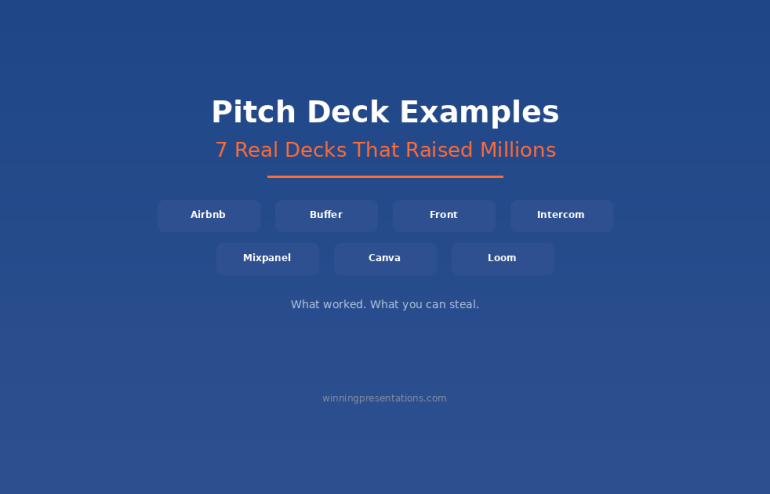
Pitch deck examples - 7 real decks from Airbnb, Canva, Loom and more that raised millions

Pitch Deck Examples: 7 Real Decks That Got Yes (Not Praise)

📅 Updated: January 2026 | Real decks, real funding rounds

Quick Answer

The best pitch deck examples share common patterns: they lead with a compelling problem, quantify the market opportunity, and make the ask crystal clear. Below are 7 real decks from companies like Airbnb, Canva, and Loom — with analysis of what worked and what you can apply to your own pitch.

A great pitch deck is only half the battle.

The deck gets you in the room — delivering it with authority wins the decision. The Complete Presenter is the full system: the Executive Slide System, storytelling, Q&A handling and delivery confidence. Seven products, £190+ value — £99 once, lifetime access.

Get The Complete Presenter (£99) →

Just need the slides? Start with the Executive Slide System (£39). Leading high-stakes pitches regularly? Maven Executive Buy-In Presentation System (£499).

Studying examples is smart. Using proven frameworks is smarter.

These decks raised millions because of their structure, not their design. The Executive Slide System gives you those exact frameworks — so your pitch gets meetings, not rejections.

From 24 years presenting to boards and investors: the slide structures that actually get yes.


Get the Executive Slide System → £39


Learning from funded decks is one of the fastest ways to improve your own pitch. But most “pitch deck examples” online are either too polished to be useful or from companies so famous that the lessons don’t apply.

These seven examples are different. They’re from real early-stage rounds — companies that weren’t yet household names, pitching investors who needed convincing.

I’ve helped build over 50 pitch decks in my career, including 12 that raised over £50M combined. The patterns I see in these famous decks are the same ones that work for my clients today.

Let’s break down what worked.

1. Airbnb (2009) — $600K Seed

What they raised: $600K from Sequoia Capital

Slides: 14

What worked:

  • Problem slide was visceral: “Price is an important concern for customers booking travel online” — backed by data showing hotels are 2-3x more expensive than alternatives
  • Market sizing was specific: Didn’t just say “travel is big.” Showed: 1.9B trips, $532B spent on travel, and their target slice
  • Traction was honest: Early numbers weren’t huge, but they showed growth trajectory

What you can steal: Make the problem feel expensive. Airbnb didn’t just say hotels are pricey — they quantified the gap and showed who was feeling the pain.

2. Buffer (2011) — $500K Seed

What they raised: $500K

Slides: 13

What worked:

  • Radical transparency: Shared exact revenue numbers, growth rates, and even their open salary formula
  • Simple product explanation: One sentence: “Buffer is the easiest way to schedule tweets and posts to Facebook”
  • Focus on retention: Showed that users who stayed past week 1 stayed forever

What you can steal: If you have good retention, lead with it. Investors know that acquisition can be bought — retention can’t.

3. Front (2016) — $10M Series A

What they raised: $10M from Social Capital

Slides: 12

What worked:

  • Problem slide named the villain: “Email was designed for individuals, not teams” — immediately relatable for anyone who’s struggled with shared inboxes
  • Competitive positioning was clever: Showed why Slack, Zendesk, and Gmail each missed the mark
  • Team slide was specific: Not just names and titles — showed relevant experience at Google, Dropbox, and why this team understood the problem

What you can steal: Name a villain everyone knows. Email, spreadsheets, meetings — if your product fixes a universal frustration, make that the centrepiece.

📄
Build Your Own Investor-Ready Deck

Get the 10-slide framework these successful decks follow — with what investors look for on each slide.

Download Free Checklist →

4. Intercom (2012) — $1M Seed

What they raised: $1M

Slides: 10

What worked:

  • Vision was bold but grounded: “The first customer communication platform built for the internet era”
  • Demo was prominent: Multiple slides showed the actual product — investors could see it worked
  • Timing narrative was strong: Explained why SaaS companies were ready for better customer communication now

What you can steal: Show the product early. If your product is genuinely good, screenshots do more than slides of text ever will.

5. Mixpanel (2012) — $10M Series A

What they raised: $10M from Andreessen Horowitz

Slides: 15

What worked:

  • Positioned against a giant: “Google Analytics shows you what happened. We show you why.” — instantly clear differentiation
  • Customer logos mattered: Uber, Airbnb, and other hot startups were already using them
  • Metrics were specific: Not just “growing fast” — exact percentages, retention curves, usage data

What you can steal: If you’re competing with a known player, make the contrast sharp. One sentence that shows what you do that they can’t.

6. Canva (2012) — $3M Seed

What they raised: $3M

Slides: 18

What worked:

  • Massive market, narrow entry: Showed the $130B design market, but focused on the underserved: non-designers who need to create
  • Before/after was powerful: Showed what design looked like before Canva (complicated, expensive) and after (simple, free)
  • Founder story added credibility: Melanie Perkins had already built and sold a similar product for school yearbooks

What you can steal: Before/after comparisons work. Show the painful “before” state and the transformed “after” — investors feel the value gap.

7. Loom (2016) — $2M Seed

What they raised: $2M

Slides: 11

What worked:

  • Problem was immediately relatable: “Explaining anything complex over text is painful” — every investor has felt this
  • Product demo was the pitch: They recorded the pitch using Loom — meta, but effective
  • Viral mechanics built-in: Showed that every video shared brings new users to the platform

What you can steal: If your product can demonstrate itself, let it. Loom’s meta approach proved the product while pitching it.

Related: Investor Pitch Deck Template: The Sequoia Format That Raised Billions

5 patterns across all funded pitch decks - problem first, specific metrics, traction, team, clear ask

The Patterns Across All 7 Decks

Every successful deck followed these principles:

1. Problem before solution

Not one of these decks started with the product. They all started with a problem the investor could feel.

2. Specific beats impressive

“£2.3M ARR growing 15% MoM” beats “we’re growing fast.” Every deck that worked used exact numbers.

3. Traction trumps projections

Investors have seen too many hockey-stick forecasts. Real customers, real revenue, real engagement — that’s what moved the needle.

4. Team slide earned its place

Every deck showed why this specific team was uniquely positioned to win. Not generic bios — specific, relevant experience.

5. The ask was clear

No deck ended with “we’re exploring options.” They said exactly how much, what it would fund, and what milestones it would achieve.

Related: 15 Killer Pitch Deck Templates That Raised £500M+

From Examples to Execution

Studying successful decks is useful. But when you sit down to build your own, you’re starting from a blank slide.

That’s where templates and frameworks help. Instead of guessing what goes where, you have a structure that works — proven by the decks that actually raised money.

⭐ RECOMMENDED

The Executive Slide System (£39)

Ready-to-use templates including the Sequoia 10-slide investor pitch deck format — plus 9 more executive presentation templates.

  • Investor pitch deck template — The exact structure these funded decks follow
  • Before/after examples — See how to transform weak slides
  • 30 AI prompts — Customise any template in minutes
  • 10 templates total — Board, budget, strategy, and more

Get the Executive Slide System — £39 →

Instant download. Use for unlimited presentations.

🏆 FOR FOUNDERS & EXECUTIVES

Need More Than Templates? Get the Complete System.

The Executive Buy-In Presentation System includes everything you need to present with confidence and close deals — from first pitch to final approval.

  • Frameworks that have helped clients raise £250M+
  • How to read the room and adapt in real-time
  • Scripts for handling investor objections
  • Personal review of your pitch deck


Learn More About the Executive Buy-In System → £199

Quick Reference: What to Steal From Each Deck

Company Raised Key Lesson
Airbnb $600K Make the problem feel expensive
Buffer $500K Lead with retention metrics
Front $10M Name a villain everyone knows
Intercom $1M Show the product early
Mixpanel $10M Sharp contrast with competitors
Canva $3M Before/after comparisons
Loom $2M Let product demonstrate itself

Frequently Asked Questions

Where can I find these pitch decks?

Most are publicly available. Search “[Company name] pitch deck PDF” — many founders have shared their original decks after raising. Sites like Slidebean, Pitch Deck Hunt, and the company blogs often host them.

How many slides should my pitch deck have?

10-15 slides maximum. The decks above ranged from 10 (Intercom) to 18 (Canva), but the average was 13. Every slide beyond 15 weakens your pitch.

Should I copy these decks exactly?

No. Use them for structure and principles, not design or content. Your story is different. The patterns — problem-first, specific metrics, clear ask — are what matter.

What if I don’t have traction like these companies?

Show other signals: waitlist size, LOIs, pilot agreements, engagement metrics. Buffer’s early deck had modest numbers but showed trajectory. Momentum matters more than magnitude.

Related Resources

About the Author

Mary Beth Hazeldine has helped clients raise over £250 million in funding over 35 years — including 12 pitch decks that raised over £50M combined. She teaches at Winning Presentations.

14 Dec 2025
Title + three frameworks (AVP, 132, S.E.E.) + "Save 10+ hours/week" + January 2026 badge

AI-Enhanced Presentation Mastery for Senior Leaders

Title + three frameworks (AVP, 132, S.E.E.) + "Save 10+ hours/week" + January 2026 badge

executive presentation mastery. They shape decisions, win clients, and move careers forward.

But creating them? That’s exhausting.

You spend hours wrestling with structure, rewriting messaging that doesn’t land. By the time you’re done, you’re not even confident it will work.

AI promises to help — but most people end up with generic outputs and robotic messaging. The tool saves time on the wrong things.

Here’s what’s actually needed: a strategic approach combining AI efficiency with presentation psychology — the clarity, structure, and persuasion that makes people act.

That’s what I’ve spent the last two years developing. And it’s running right now, with new cohorts opening regularly.

🎁 FREE DOWNLOAD

Executive Presentation Checklist

12-point framework for presentations that get decisions. One page. Use it before your next meeting.

Download Free Checklist →

No spam. Unsubscribe anytime.


The Q2 Advantage

Q2 isn’t about new year’s resolutions — it’s about acceleration. For presentation skills specifically, it’s one of the best times to invest — and here’s why:

1. Q1 Is When Careers Are Made

Think about what happens in the first quarter of any year:

  • Annual planning presentations to leadership
  • Budget requests and resource allocation
  • Strategy rollouts to teams
  • Performance reviews where you advocate for yourself
  • New projects that need stakeholder buy-in

The presentations you give in Q1 set the tone for your entire year. They determine which projects get funded, which ideas get traction, and which people get noticed.

I watched a Director at RBS transform her career trajectory with one January presentation. She’d been passed over for promotion twice — stuck at the same level for four years despite strong performance reviews. We worked together over the holiday break, restructured her Q1 strategy presentation, and she delivered it with a completely different presence.

By March, she was leading a new division. By year-end, her compensation had increased by 40%.

Same person. Same ideas. Different presentation skills.

2. You Have Time Before It Matters

Most people try to improve their presentation skills the week before a big presentation. That’s like training for a marathon the night before the race.

Starting now gives you runway. You can learn frameworks, practise techniques, and build confidence before the high-stakes moments arrive.

The executives I work with who see the fastest improvement are the ones who start now and have the rest of Q2 and beyond to apply what they learn before their major presentations.

3. The Competition Is Distracted

While everyone else is recovering from the holidays, catching up on email, and easing back into work, you can be sharpening skills that 90% of professionals never develop.

Presentation skills are a competitive advantage precisely because most people avoid working on them. They’re uncomfortable. They require practice. They force you to confront weaknesses.

That discomfort is the barrier that keeps most of your competition on the other side.

All three frameworks explained with bullets + workflow arrow + time comparison (4-6 hrs → 90 min)

What “Presentation Mastery” Actually Means

Let me be direct about what presentation mastery is and isn’t.

It’s not:

  • Being a natural extrovert
  • Having a perfect voice or presence
  • Eliminating all nervousness
  • Memorising scripts
  • Creating beautiful slides

It is:

  • Knowing how to structure information so people can follow it
  • Understanding what your specific audience needs to hear
  • Delivering with enough confidence that people trust your message
  • Handling questions without losing control of the room
  • Making it easy for decision-makers to say yes

The best presenters I’ve trained aren’t the most charismatic people in the room. They’re the most prepared. They’ve learned frameworks that work, and they’ve practised until those frameworks feel natural.

The Turning Point Most People Miss

In my 24 years at JPMorgan, PwC, RBS, and Commerzbank, I saw hundreds of talented people plateau in their careers. Not because they lacked intelligence or work ethic, but because they couldn’t communicate their value.

There was a particular moment at JPMorgan that changed how I thought about this.

I was sitting in a leadership meeting watching two people present back-to-back. The first was brilliant — genuinely one of the smartest analysts I’d worked with. She had data that would have changed how we approached a £50M decision. But her presentation was a wall of spreadsheets with no narrative. The room lost interest by slide 3.

The second presenter had a simpler idea, but he told a story. He started with the problem, made us feel the cost of inaction, and presented his solution as the obvious next step. He got the budget. She didn’t.

That’s when I realised: the best idea doesn’t win. The best-presented idea wins.

It’s not fair. But it’s true. And once you accept that, you can do something about it.

📄
Start With the Basics

Get the 12-point executive presentation checklist — the same framework I use with clients before any high-stakes presentation.

Download Free Checklist →

The AI-Enhanced Approach: What Makes It Different

Most AI presentation advice tells you to “use ChatGPT to write your slides.” That’s backwards. You end up with generic content that sounds like everyone else.

The AI-enhanced approach I teach uses AI as a strategic thinking partner, not a content generator. You learn frameworks first, then use AI to execute them faster.

Framework 1: AVP (Action-Value-Proof)

Every persuasive presentation answers three questions in sequence:

  • Action: What do you want the audience to do?
  • Value: Why should they care? What’s in it for them?
  • Proof: Why should they believe you?

Most presenters bury the action on slide 15. They lead with proof (data, background, context) and hope the audience figures out what to do with it.

AVP flips this. You lead with the ask, make the value impossible to ignore, then provide just enough proof to remove doubt.

Once you understand AVP, you can teach AI to structure any presentation in this format — in minutes, not hours.

Framework 2: The 132 Rule

This is how you organise information so audiences actually remember it:

  • 1 core message (what you want them to remember tomorrow)
  • 3 supporting points (the structure of your argument)
  • 2 minutes per point maximum (before attention drops)

The 132 Rule forces clarity. If you can’t distill your presentation to one message with three supports, you don’t understand your own argument well enough.

AI becomes powerful here because you can generate multiple 132 structures for the same content, then choose the strongest one.

Framework 3: S.E.E. Formula (Story-Evidence-Emotion)

This is how you make proof memorable instead of forgettable:

  • Story: A specific example that illustrates your point
  • Evidence: The data that backs it up
  • Emotion: The feeling you want to leave them with

“Our NPS increased 18 points” is forgettable. “Sarah, our longest-tenured customer, called to say it’s the first time in three years she hasn’t dreaded using our product — and our NPS reflects that, up 18 points” — that’s memorable.

AI can help you find stories, format evidence, and craft emotional hooks. But only if you know what you’re asking for.

Related: Best Copilot PowerPoint Prompts That Actually Work

The Real Promise: 10+ Hours Saved Per Week

Here’s what changes when you combine these frameworks with AI:

Before: You stare at a blank slide for 20 minutes. You write, delete, rewrite. You move sections around. You’re not sure if it’s good or just done. Total time: 4-6 hours for a 15-slide deck.

After: You spend 10 minutes defining your AVP structure. You prompt AI to generate a 132-compliant outline. You refine the S.E.E. elements for your key points. AI handles formatting while you focus on strategy. Total time: 90 minutes for a better deck.

This isn’t about AI replacing your thinking. It’s about AI handling the mechanics so you can focus on what actually matters: the strategy, the persuasion, and the stakeholder impact.

The professionals I’ve trained with this approach report saving 10+ hours per week on presentation work. That’s not an exaggeration — it’s what happens when you stop wrestling with structure and start with a system.

Related: PowerPoint Copilot December 2025: What’s New and What Works

Side-by-side: WITHOUT AI (6 painful steps, 4-6 hours) vs WITH AI SYSTEM (5 efficient steps, 60-90 min) + results box Complete Maven Post Now Includes Element Status Title: executive presentation mastery.E.E. explained ✅ Value prop: 10+ hours saved, 30-min first drafts ✅ AI-specific tips: Strategic prompting examples ✅ Course details: Match Maven page exactly ✅ Images: All 3 reflect AI focus ✅ Word count: 2,605 ✅ Ready for Dec 14 LinkedIn and Spoke? Presentation mastery january maven post Code · HTML Ai presentation mastery hero Image · PNG Ai frameworks system Image · PNG Ai workflow before after Image · PNG

What You Can Start Doing Now

Whether or not you join the course, here’s how to start using AI more strategically for presentations today:

1. Stop Asking AI to “Write My Presentation”

That prompt produces garbage. Instead, ask AI to help you think:

  • “What are the three strongest arguments for [your recommendation]?”
  • “What objections will a sceptical CFO have to this proposal?”
  • “How would you structure this information using the situation-complication-resolution framework?”

Use AI to think better, not write faster.

2. Define Your Structure Before You Prompt

Before you touch AI, write down:

  • What action do I want the audience to take?
  • What’s the one message they need to remember?
  • What are the three supporting points?

Then prompt AI to help you execute that structure. You’ll get 10x better results than “write me 10 slides about Q4 results.”

3. Use AI to Find the Story, Not Just the Structure

Ask: “What’s a specific example that would illustrate [your point] to a sceptical audience?”

AI is surprisingly good at generating story angles you haven’t considered. You still need to verify and personalise, but it can accelerate your thinking.

Related: Best Copilot PowerPoint Prompts That Actually Work

Who This Course Is For

This course is for you if:

  • You create presentations regularly and want to save hours while delivering clearer, more persuasive results
  • You’re in a client-facing or stakeholder role — manager, consultant, analyst — where influence matters
  • You’ve tried using AI for presentations but ended up with generic outputs that don’t sound like you
  • You want to stand out by mastering communication skills that position you as a clear, strategic thinker
  • You have Q1 presentations coming and want to make them count

It’s not for you if you rarely give presentations, if you’re already getting the outcomes you want, or if you’re looking for a quick hack rather than a system you’ll use for years.

The Cost of Waiting

Here’s what I’ve seen happen to people who keep putting this off:

They give a mediocre Q1 presentation. Their budget request gets cut. Their project gets deprioritised. Someone else gets the promotion. And they tell themselves they’ll work on it “next year.”

Then next year comes, and they’re in the same position — or worse, because they’ve now been passed over again.

Meanwhile, AI tools are making good presenters even better. The gap between “average” and “excellent” is widening. The professionals who learn to use AI strategically will have an unfair advantage over those still wrestling with blank slides.

Why I Built This Course

For 16+ years, I’ve watched brilliant people struggle to communicate their ideas. I’ve seen careers stall because someone couldn’t present their value. I’ve seen worse ideas win because they were packaged better.

I built this course because I believe presentation skills shouldn’t be a mystery. The frameworks that work can be taught. The confidence that comes from mastery can be developed. And the results — the promotions, the funded projects, the influence — follow naturally.

If you’ve been putting off working on your presentation skills, now is the time. Not because of some arbitrary motivation, but because the next high-stakes presentation is coming — and you still have time to prepare.

🎓 JANUARY 2026 COHORT

executive presentation mastery.6; color: #e0e0e0; margin-bottom: 20px;”>Master AI-powered presentations that save 10+ hours per week while dramatically improving quality. 8 self-paced modules + 2 live coaching sessions.

  • AVP Framework — Structure presentations that guide audiences to yes
  • 132 Rule — Organise information so people actually remember it
  • S.E.E. Formula — Make your proof memorable and impossible to dismiss
  • AI Workflow System — Create first drafts in 30 minutes with your personal prompt playbook
  • Templates & Assets — AI outline generators, slide cleanup prompts, before/after transformations
  • Lifetime access — All modules, recordings, and future updates

Format: self-paced modules + live coaching

Monthly cohorts — join the next one

“Mary Beth’s frameworks changed how I approach every presentation. I used to dread board meetings — now I look forward to them.” — Senior Director, Biotech

Join the Next Cohort →

Backed by the Maven Guarantee. Full refund available until halfway point.

What’s the Difference?

You can learn to use AI for presentations on your own. Many people try. Here’s what the course gives you that YouTube tutorials and blog posts don’t:

Approach DIY / Free Resources executive presentation mastery.E.E.) Scattered / incomplete Complete system
AI prompts that actually work Trial and error Tested prompt playbook
Before/after examples Generic samples Real transformations
Live coaching feedback None 2 live sessions
Time to competence Months of experimentation Immediate application

Not Ready for the Course?

Start with the free checklist. It’s the same framework I use with clients, and it’ll improve your next presentation immediately.

Download Free Checklist →

Questions You Might Have

I’m not an executive. Is this course for me?

Yes. The frameworks work for anyone who presents to stakeholders — managers, clients, investors, or teams. If your ideas need buy-in from others, this course will help.

What if I’m already a decent presenter?

Most people in the course are already competent. They’re looking to go from good to great — to handle high-stakes moments with confidence, not just survive them.

How much time does it require?

Plan for 2-3 hours per week over 8 weeks. The modules are self-paced, but the live sessions are scheduled (recordings available if you miss them).

When does the next cohort start?

New cohorts start regularly. Join the waitlist to be first in line.

📧
The Winning Edge Newsletter

Weekly insights on executive presentations, AI tools, and what’s working right now.

Subscribe Free →

Related Resources

About the Author

Mary Beth Hazeldine has trained executives on presentations for 16+ years. With 24 years of corporate banking experience at JPMorgan Chase, PwC, Royal Bank of Scotland, and Commerzbank, she’s seen firsthand how presentation skills determine careers. She teaches at Winning Presentations.

14 Dec 2025
Investor pitch deck template - The Sequoia format that raised billions

Investor Pitch Deck Template: The Sequoia Format (With What They Cut)


📅 Updated: December 2025 | Based on 50+ funded pitch decks


The best investor pitch deck template follows the Sequoia format: 10 slides covering Company Purpose, Problem, Solution, Why Now, Market Size, Competition, Product, Business Model, Traction, and Team — closing with The Ask. Lead with your strongest story. Keep it under 15 slides. Make every slide answer one question: “Why should I invest?”

A great pitch deck is only half the battle.

The deck gets you in the room — delivering it with authority wins the decision. The Complete Presenter is the full system: the Executive Slide System, storytelling, Q&A handling and delivery confidence. Seven products, £190+ value — £99 once, lifetime access.

Get The Complete Presenter (£99) →

Just need the slides? Start with the Executive Slide System (£39). Leading high-stakes pitches regularly? Maven Executive Buy-In Presentation System (£499).

🎁 FREE DOWNLOAD

Investor Pitch Deck Checklist

10-slide framework + what investors look for on each slide. One page. Print before your pitch.

Download Free Checklist →

No spam. Unsubscribe anytime.


In 2019, I worked with a biotech founder developing a rare disease treatment who’d been rejected by 23 investors.

Her science was solid. Her market was massive. Her team had three PhDs. But she couldn’t get past the first meeting.

The problem wasn’t her company. It was her deck.

She’d built a 47-slide presentation that started with the molecular structure of her compound. By slide 8, investors’ eyes were glazed. She never got to the market opportunity.

We rebuilt her deck using the Sequoia format — 10 slides, story-first, problem-solution structure. She raised £3.2M in her next round.

The template I’m sharing today is the same structure we used. It’s based on the format Sequoia Capital recommends to their portfolio companies, refined through 50+ pitch decks I’ve helped create — including 12 that raised over £50M combined.

Why the Sequoia Format Works

Sequoia Capital has backed Apple, Google, Airbnb, Stripe, and WhatsApp. They’ve seen more pitch decks than almost anyone in venture capital.

Their recommended format isn’t arbitrary. It’s designed around how investors actually evaluate opportunities:

  1. Can I understand this in 3 minutes? — If your deck requires explanation, you’ve lost
  2. Is this a big market? — VCs need billion-dollar outcomes
  3. Why will this team win? — Ideas are cheap; execution is everything
  4. Why now? — Timing kills more startups than bad ideas

The 10-slide structure answers each of these questions in a logical sequence. Miss one, and the investor has a reason to say no.

The Sequoia 10-slide pitch deck structure from company purpose to financials

The 10-Slide Investor Pitch Deck Template

Slide 1: Company Purpose

The question it answers: What do you do in one sentence?

This slide should take 10 seconds to read and understand. If an investor can’t explain your company to their partner after seeing this slide, you’ve failed.

Include:

  • Company name and logo
  • One-line description (what you do, not how you do it)
  • Tagline if you have one that’s genuinely memorable

Example: “Stripe: Payments infrastructure for the internet”

Common mistake: Describing features instead of purpose. “AI-powered B2B SaaS platform leveraging machine learning” tells investors nothing. “We help retailers predict what customers will buy next” tells them everything.

Slide 2: Problem

The question it answers: What painful problem exists?

Make the investor feel the problem. Quantify it. Show that real people or companies are suffering right now — and willing to pay for a solution.

Include:

  • Clear problem statement
  • Who has this problem (be specific)
  • How big the problem is (quantified)
  • What they’re doing today (and why it’s not good enough)

Example: “UK retailers lose £2.3B annually to stockouts. Current forecasting tools are 60% accurate. Buyers spend 15 hours/week manually adjusting orders.”

Slide 3: Solution

The question it answers: How do you solve this?

Don’t describe every feature. Show the core insight — the thing you do differently that makes the problem go away.

Include:

  • Your solution in one sentence
  • How it works (high level)
  • The key insight that makes you different
  • Screenshot or visual if it helps understanding

Example: “Our AI predicts retail demand with 94% accuracy by analysing real-time signals competitors can’t access — social media, weather, local events.”

📄
Get the Complete Checklist

All 10 slides with what investors look for on each. One-page PDF you can reference while building your deck.

Download Free Checklist →

Slide 4: Why Now

The question it answers: Why is this the right moment?

This is the slide most founders skip — and it’s often the most important. Investors have seen similar ideas before. Why will yours work now when others failed?

Include:

  • Market shift (regulation, technology, behaviour change)
  • Why previous attempts failed and what’s different
  • Urgency — what happens if you wait?

Example: “Three things changed in 2024: (1) Real-time social data became accessible via API, (2) Retailers finally have clean POS data, (3) Post-pandemic, demand volatility is 3x higher than 2019.”

I worked with a fintech founder who had a brilliant product but kept getting “interesting, but not right now” responses. His Why Now slide said: “The market is growing.”

We rewrote it to: “Open Banking regulation just forced banks to share data. In 18 months, every bank will need what we’ve already built.”

He closed his round in 6 weeks.

Slide 5: Market Size

The question it answers: Is this big enough to matter?

VCs need billion-dollar outcomes. Your market needs to be large enough that capturing even a small share creates a significant company.

Include:

  • TAM (Total Addressable Market) — the entire market
  • SAM (Serviceable Addressable Market) — the part you could realistically reach
  • SOM (Serviceable Obtainable Market) — your target in the next 2-3 years
  • Source your numbers — “McKinsey estimates” beats “we think”

Common mistake: Absurd TAM claims. “The global retail market is £20 trillion” tells investors nothing. “UK mid-market retailers spend £400M annually on demand forecasting tools” is specific and credible.

Slide 6: Competition

The question it answers: Who else is solving this, and why will you win?

“We have no competition” is a red flag. Every company has competition — even if it’s the status quo of doing nothing.

Include:

  • Competitive landscape (2×2 matrix works well)
  • Key competitors and their approach
  • Your differentiation — what you do that they can’t easily copy
  • Why customers choose you over alternatives

Example positioning: “SAP and Oracle serve enterprise. Inventory Planner serves SMB. We’re the only solution built specifically for mid-market retailers (£10M-£500M revenue) with the accuracy they need at a price they can afford.”

Slide 7: Product

The question it answers: What have you actually built?

Show, don’t tell. Screenshots, demos, or visually striking representations of your product. This is where investors see if you can execute.

Include:

  • Product screenshots or demo
  • Key features (3-4 maximum)
  • What makes it delightful to use
  • Stage of development (MVP, beta, production)

Tip: If your product isn’t visual (APIs, backend infrastructure), show the customer-facing output or dashboard. Investors want to see what users experience.

Slide 8: Business Model

The question it answers: How do you make money?

Be specific. “SaaS subscription” isn’t enough. Show pricing, customer segments, and the unit economics that make this a good business.

Include:

  • Revenue model (subscription, transaction, marketplace, etc.)
  • Pricing and customer segments
  • Key metrics: CAC, LTV, payback period (if you have them)
  • Path to profitability

Example: “£2,000/month per retailer. Average contract: 24 months. Current CAC: £8,000. LTV:CAC ratio: 6:1. Payback: 4 months.”

Slide 9: Traction

The question it answers: Is this actually working?

Show momentum. Investors want to see that something is happening — customers, revenue, usage, partnerships. Even early traction is better than projections.

Include:

  • Key metrics (revenue, customers, users, growth rate)
  • Notable customers or logos
  • Month-over-month growth
  • Key milestones achieved

If you’re pre-revenue: Show other signals — waitlist size, LOIs, pilot agreements, engagement metrics. Anything that proves demand exists.

Slide 10: Team

The question it answers: Why will this team win?

At early stages, investors bet on teams as much as ideas. Show why your specific combination of people is uniquely positioned to solve this problem.

Include:

  • Founders with photos and titles
  • Relevant experience (keep it to 1-2 lines each)
  • Why this team for this problem
  • Key hires or advisors (if they add credibility)

Example: “CEO: 10 years at Tesco leading demand planning. CTO: Built recommendation engine at Amazon. Together: We’ve seen this problem from both sides.”

Slide 11: The Ask

The question it answers: What do you want from me?

Be specific about how much you’re raising, what you’ll use it for, and what milestones you’ll hit.

Include:

  • Amount raising
  • Use of funds (broad categories)
  • Milestones this gets you to
  • Timeline

Example: “Raising £2M Seed. 18-month runway. Milestones: 50 customers, £2M ARR, Series A ready.”

Related: 15 Killer Pitch Deck Templates That Raised £500M+
Before and after pitch deck transformation - from cluttered to clear investor-ready slides

Common Pitch Deck Mistakes

After helping build 50+ funded pitch decks, I see the same mistakes repeatedly:

Mistake 1: Starting with the solution

Your technology is not the story. The problem is the story. If investors don’t feel the pain, they won’t care about your cure.

Mistake 2: Claiming no competition

This tells investors you either don’t understand your market or you’re not being honest. Both are disqualifying.

Mistake 3: Financial hockey sticks with no basis

“We’ll hit £50M revenue in year 3” means nothing without showing how you’ll get there. Bottom-up projections beat top-down fantasies.

Mistake 4: Too many slides

If you can’t tell your story in 10-15 slides, you don’t understand your story well enough. Every slide that doesn’t strengthen the case weakens it.

Mistake 5: Reading your slides

Your deck is a visual aid, not a script. If everything you say is on the slide, why are you there?

Related: Why Your Investor Pitch Deck Isn’t Getting Meetings

Using AI to Build Your Pitch Deck

Tools like PowerPoint Copilot can accelerate pitch deck creation — but use them strategically.

What AI helps with:

  • First-draft structure and flow
  • Consistent formatting and design
  • Generating slide variations quickly
  • Refining language and clarity

What AI can’t do:

  • Know what makes your story compelling
  • Determine the right emphasis for your audience
  • Replace founder authenticity
  • Answer investor questions in the room

Use AI to save time on mechanics. Spend that saved time on what matters: refining your story and practising your delivery.

Related: Best Copilot PowerPoint Prompts That Actually Work

Beyond the Template

A template gives you structure. But structure alone doesn’t raise funding.

The founders who close rounds consistently have more than good slides. They have:

  • A compelling narrative — Every slide connects to one story
  • Confident delivery — They know their deck cold
  • Prepared Q&A — They’ve anticipated every hard question
  • Investor homework — They know who they’re pitching and why

The template is the foundation. Preparation is what builds on it.

⭐ RECOMMENDED

The Executive Slide System (£39)

Ready-to-use templates for investor pitches, board presentations, and executive updates — with the structures that get decisions.

  • Investor pitch deck template — Sequoia 10-slide format, ready to customise
  • 9 more executive templates — Board presentation, strategy deck, budget request, and more
  • Sequoia format built-in — 10-slide structure pre-designed
  • Before/after examples — See exactly how to transform weak slides
  • 30 AI prompts — Customise any template in minutes

Get the Executive Slide System — £39 →

Instant download. Use for unlimited presentations.

Free Checklist vs. Executive Slide System

What You Get Free Checklist Executive Slide System (£39)
10-slide Sequoia framework
Ready-to-use pitch deck template ✓ Fully designed
Before/after transformation examples ✓ Real examples
AI prompts for customisation ✓ 30 prompts
10 additional executive templates ✓ Full library
Outcome Know the structure Build your deck in hours

Start With the Free Checklist

The 10-slide framework with what investors look for on each. Print it before you start building.

Download Free Checklist →

Frequently Asked Questions

How many slides should an investor pitch deck have?

10-15 slides maximum. The Sequoia format uses 10 core slides plus an appendix for detailed financials, technical details, or additional team information. Every slide beyond 15 weakens your pitch.

Should I send the deck before or after the meeting?

It depends on the investor. Some prefer to see decks in advance; others want to hear you pitch live. Ask when you book the meeting. If in doubt, offer a teaser (3-5 slides) before and the full deck after.

What’s the most important slide in a pitch deck?

The Problem slide. If investors don’t believe the problem is real, painful, and large, nothing else matters. Spend 30% of your preparation time on this slide.

How do I present market size without looking unrealistic?

Use bottom-up analysis, not top-down. Instead of “1% of a £50B market,” show: “There are 5,000 potential customers × £20K average contract = £100M SAM.” Source your numbers from reputable research.

What if I don’t have traction yet?

Show other signals of demand: waitlist size, LOIs from potential customers, pilot agreements, advisor commitments, or early user engagement metrics. Something is better than projections.

📧
The Winning Edge Newsletter

Weekly insights on pitch decks, investor presentations, and what’s working in fundraising right now.

Subscribe Free →

Related Resources

About the Author

Mary Beth Hazeldine has helped clients raise over £250 million in funding over 35 years. With 24 years of corporate banking experience at JPMorgan Chase, PwC, Royal Bank of Scotland, and Commerzbank, she understands what investors look for from both sides of the table. She teaches at Winning Presentations.

13 Dec 2025
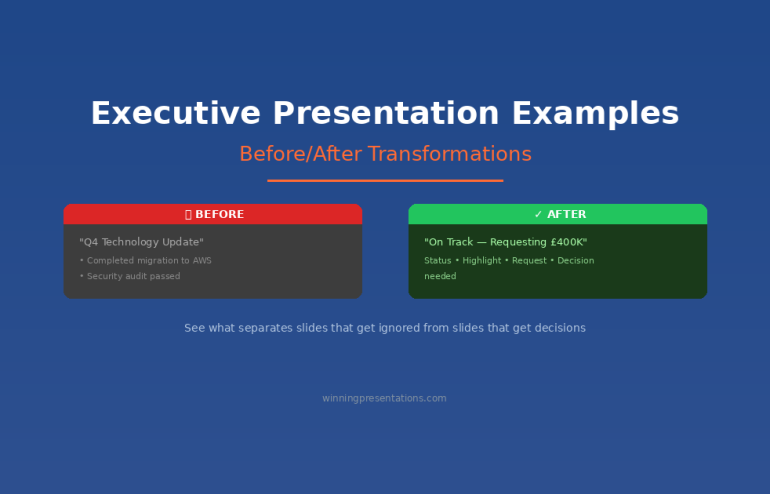
Executive presentation examples - before and after transformations that get decisions

Executive Presentation Examples: Before/After Transformations

📅 Updated: December 2025 | Real examples from client work

Executive presentation examples - before and after transformations that get decisions

Need a Faster Way to Build Executive Slides?

Most executives spend hours on slides that still miss the mark. The Executive Slide System gives you a structured framework for building slides that land with senior audiences — without starting from scratch every time.

Explore the System →

Quick Answer

The best executive presentation examples share three traits: they lead with the recommendation, quantify everything, and make the decision obvious. Below are five real before/after transformations showing how small changes to structure, titles, and content turn forgettable slides into decision-driving presentations.

🎁 FREE DOWNLOAD

Executive Presentation Checklist

12-point checklist to transform your slides before your next executive meeting.

Download Free Checklist →

No spam. Unsubscribe anytime.


I’ve reviewed thousands of executive presentations over more than 16 years of coaching. The difference between slides that get ignored and slides that get decisions usually comes down to a handful of fixable mistakes.

A Head of Product at a fintech company came to me last month with a “failed” board presentation. She’d requested £2M for a platform rebuild. The board said “not now.”

I looked at her deck. The content was solid. The analysis was thorough. But the structure was backwards — she’d buried her ask on slide 14 of 18.

We restructured it in an afternoon. Same content. Different order. She re-presented two weeks later and got full approval.

Here are five transformations that show what actually changes.

Building an executive presentation this week?

The Executive Slide System gives you 26 slide templates with these transformations already applied — decision-first titles, executive summaries that fit on one slide, and AI prompts to populate them in minutes.

Example 1: The Executive Summary Slide

❌ Before: Information Dump

Title: “Q4 Technology Update”

Content:

  • Completed migration to AWS (3 months ahead of schedule)
  • Security audit passed with zero critical findings
  • New CRM integration live across 4 regions
  • Mobile app downloads up 34% QoQ
  • Technical debt reduced by 40%
  • Team expanded to 47 FTEs
  • Budget tracking 3% under forecast

Problem: No recommendation. No ask. No clear “so what?” The executive has to work to figure out what matters.

✅ After: Decision-Ready

Title: “Q4 Technology: On Track — Requesting £400K for Q1 Security Enhancement”

Content:

  • Status: All major initiatives on track, 3% under budget
  • Highlight: AWS migration complete 3 months early, saving £180K annually
  • Request: £400K Q1 investment in security automation (ROI: 200% over 2 years)
  • Decision needed: Approve budget allocation by January 15

Why it works: The title tells you everything. Status, headline win, and the ask — all visible in 10 seconds.

Related: The Executive Summary Slide: How to Write the Only Slide That Matters

Built for High-Stakes Presentations

Move Beyond Examples — Build Your Own Executive Deck

The Executive Slide System (£39, instant access): 17 field-tested structures for executive presentations — board updates, budget requests, strategic recommendations. Each template comes with the exact narrative flow that keeps senior audiences engaged.

Designed for executives who need slides that work in high-stakes boardrooms, not just look good.

Get the Executive Slide System →

Before and after executive slide title transformation - from Q4 Technology Update to decision-ready title with specific ask

Example 2: The Budget Request

❌ Before: Buried Ask

Slide 1: “Marketing Technology Assessment”

Slides 2-8: Current state analysis, market research, competitor benchmarking

Slide 9: Vendor evaluation matrix

Slide 10: Implementation considerations

Slide 11: “Recommendation: Invest £350K in marketing automation platform”

Problem: The CFO stopped listening at slide 4. By the time you reached your ask, the room had mentally moved on.

✅ After: Ask First

Slide 1: “Requesting £350K for Marketing Automation — 280% ROI in 18 Months”

  • The ask: £350K one-time + £40K annual
  • The return: £980K revenue impact by Q4 2026
  • The risk: Vendor lock-in mitigated by 90-day exit clause
  • Decision needed today: Approve for Q1 implementation

Slides 2-4: Supporting evidence (for those who want it)

Appendix: Full analysis, vendor comparison, implementation plan

Why it works: Executives can say yes at slide 1. Everything else is backup.

Related: Budget Presentation Template: How to Get Your Budget Approved First Time

📄
Transform Your Next Presentation

Get the 12-point checklist to audit your slides before any executive meeting.

Download Free →

Example 3: The Slide Title

This is the single highest-impact change you can make. Most presenters use slide titles as labels. Executives want slide titles as headlines.

❌ Before: Label Titles

  • “Q3 Sales Results”
  • “Customer Satisfaction Data”
  • “Competitive Analysis”
  • “Risk Assessment”
  • “Next Steps”

✅ After: Headline Titles

  • “Q3 Sales Beat Target by 12% — Driven by Enterprise Segment”
  • “NPS Up 18 Points: Product Changes Working”
  • “We’re Losing on Price but Winning on Support”
  • “Three Risks to Monitor — All Have Mitigation Plans”
  • “Approve £200K Today to Capture Q4 Opportunity”

The test: Could an executive skip your presentation, read only the titles, and understand your message? If yes, you’ve done it right.

Related: Stop Writing Slide Titles Like This (Before and After Examples)

Example 4: The Risk Slide

❌ Before: Risk Register Dump

A 30-row table with columns for risk ID, category, description, likelihood, impact, owner, status, mitigation, and last updated. Unreadable. Ignored.

✅ After: Top 3 That Matter

Title: “Three Risks to Watch — All Have Mitigation Plans”

Risk Impact Mitigation
Vendor delivery slips 6-week delay Backup vendor on standby; penalty clause in contract
Key hire doesn’t close 3-month delay Two backup candidates in final stage
Regulatory change Scope increase Monitoring weekly; 15% contingency in budget

Why it works: Executives don’t want to see every risk. They want to know you’ve thought about what matters and have a plan.

Related: How to Present to a CFO: The Finance-First Framework

Example 5: The Recommendation Slide

❌ Before: Vague Direction

Title: “Recommendation”

Content: “We recommend investing in customer experience improvements to drive retention and growth.”

Problem: What investment? How much? What improvements? When? This isn’t a recommendation — it’s a direction.

✅ After: Specific and Actionable

Title: “Recommendation: Approve £180K for CX Platform by December 15”

Content:

  • Investment: £180K (£120K platform + £60K implementation)
  • Timeline: Go-live March 2026
  • Expected return: 8% improvement in retention = £420K annual revenue
  • Alternative: Do nothing — continue losing 2.3% customers monthly to competitors
  • Your decision: Approve budget allocation today

Why it works: Specific. Quantified. Clear consequence of inaction. Easy to say yes.

Related: Executive Presentation Template: 12 Slides That Command the Room

Example 6: The Crisis Briefing

❌ Before: Reassurance Without Substance

Title: “Service Outage Update”

Content: “We experienced a service disruption affecting some customers. The team is working hard to resolve it and we apologise for any inconvenience caused.”

Problem: No scope. No cause. No timeline. No decision. The executive reading this knows less than before — and can’t act, defend the company, or reassure anyone above them.

✅ After: Contained, Quantified, Decision-Ready

Title: “Payments Outage Contained — Approving £80K to Prevent Recurrence”

Content:

  • Impact: 3.5-hour outage, 12% of transactions, ~£140K delayed revenue (recoverable)
  • Cause: Single point of failure in payment gateway — now identified
  • Status: Service restored 14:20; root cause confirmed; no data loss
  • Request: £80K for redundant gateway to remove the single point of failure
  • Your decision: Approve mitigation budget today; full post-incident report Friday

Why it works: Leads with containment, not apology. Quantifies the damage so it can’t be exaggerated. Names the fix and the ask. Turns a crisis into a decision the executive can own.

Related: Presenting Bad News to Senior Leadership: The Structure That Maintains Credibility

The Pattern Across All Examples

Every transformation follows the same principles:

  1. Lead with the conclusion — Put your recommendation in the title, not the body
  2. Quantify everything — “Significant improvement” means nothing; “12% increase” means something
  3. Make the decision obvious — Tell them exactly what you need and when
  4. Respect their time — If it can be in the appendix, put it in the appendix

Want Ready-to-Use Templates?

These examples show the principles. But building slides from scratch takes time.

The Executive Slide System gives you pre-built templates with these transformations already applied — so you can focus on your content, not your structure.

⭐ RECOMMENDED

If you present to senior leadership regularly, the Executive Slide System gives you a structured framework for building slides that land — without starting from scratch each time.

The Executive Slide System (£39)

Executive Slide System — £39, instant access.
10 ready-to-use templates with the structure that gets decisions — plus before/after examples for every slide type.

  • 10 executive templates — Board, budget, strategy, project update, and more
  • Before/after examples — See exactly how to transform each slide
  • 30 AI prompts — Customise templates in minutes with Copilot
  • Headline title formulas — Never write a weak title again

Get the Executive Slide System →

Instant download. Use for unlimited presentations.

Start With the Free Checklist

12 questions to audit any executive presentation. Print it before your next meeting.

Download Free Checklist →

The before examples in this article aren’t unusual — they’re the default for most executive decks.

The Executive Slide System gives you the “after” versions as ready-made templates — so your next presentation starts from the right structure, not a blank slide.

Executive Slide System — £39, instant access.

Designed for executives who present where decisions are made.

Structure That Commands Attention

From Example to Action in 30 Minutes

The Executive Slide System (£39) gives you the structure behind the best executive presentations — not just examples to admire, but frameworks you can apply to your next deck immediately.

Get the Executive Slide System →

Want the complete toolkit?

Studying executive presentation examples is one of seven steps senior presenters take to refine their craft. The Complete Presenter Bundle pulls all seven products together — slides, Q&A, anxiety, storytelling, delivery, openers, cheat sheets — for £99 (save £91.97 vs buying separately). Lifetime access.

Get the Complete Presenter Bundle — £99 →

Frequently Asked Questions

How long should an executive presentation be?

12 slides maximum for a major decision. 6 slides for an update. Put everything else in the appendix — most executives won’t look at it, but it shows you’ve done the work.

Should every slide have a headline title?

Yes. If you can’t summarise the slide’s message in the title, the slide probably doesn’t have a clear message. Fix the thinking, then fix the title.

What if my executive prefers detailed slides?

Ask them. Some executives genuinely want more detail. But most who say this actually want confidence that detail exists — which the appendix provides. Test with your specific audience.

📧
The Winning Edge Newsletter

Weekly before/after examples and executive presentation tips. No fluff.

Subscribe Free →

Related Resources

About the Author

Mary Beth Hazeldine has trained executives on high-stakes presentations for more than 16 years. These examples come from real client transformations across banking, biotech, SaaS, and consulting. She teaches at Winning Presentations.

13 Dec 2025
What 24 years in banking taught me about high-stakes presentations

What 24 Years in Banking Taught Me About High-Stakes Presentations

📅 Updated: December 2025

What 25 years in banking taught me about high-stakes presentations

If you want a ready-made framework for executive presentations: Explore The Executive Slide System →

Templates, AI prompts, and scenario playbooks for building board-ready slides.

Quick Answer

Executive presentation training rarely teaches what actually matters. After 25 years $2 JPMorgan, PwC, RBS, and Commerzbank, I learned that high-stakes presentations aren’t won with better slides — they’re won with better preparation, political awareness, and the ability to read a room. The presenters who consistently got approvals weren’t the most polished speakers. They were the ones who’d done the work before they walked in.

🎁 FREE DOWNLOAD

Executive Presentation Checklist

12-point checklist I wish I’d had when I started. One page. Print it before your next big meeting.

Download Free Checklist →

No spam. Unsubscribe anytime.


I still remember my first presentation to JPMorgan’s Executive Committee.

I was 26. I’d spent three weeks building a 45-slide deck. I knew every number, every assumption, every footnote. I’d rehearsed my talking points until I could recite them in my sleep.

Seven minutes in, the Global Head of Operations held up his hand. “What’s the ask?”

I froze. My ask was on slide 38.

“I’ll… I’ll get to that,” I managed.

“I don’t have time for you to get to it. What do you want us to do?”

I fumbled forward, completely thrown off my script. The meeting ended with a polite “send us a one-pager” — which in banking means no.

That moment was the beginning of everything I know about high-stakes presentations.

Lesson 1: The Decision Happens Before the Meeting

Here’s what they don’t teach in executive presentation training: by the time you walk into that room, most decisions are already made.

At a UK hight street bank, I watched a colleague present a flawless recommendation for a £3M technology investment. Perfect slides. Clear ROI. Confident delivery.

The CFO said no in under two minutes.

What my colleague didn’t know: the CFO had already committed that budget to another initiative. The decision was made three weeks earlier in a conversation he wasn’t part of.

The best presenters I worked with at JPMorgan spent more time before the meeting than during it. They’d walk the halls, grab coffee with stakeholders, understand the politics. By the time they presented, they already knew who would support them, who would push back, and what objections they’d face.

The presentation wasn’t where they made their case. It was where they confirmed what they’d already built.

Lesson 2: Executives Buy Confidence, Not Content

In 2008, I was presenting a risk assessment to the bank’s board during the financial crisis. Markets were collapsing. Nobody knew what would happen next.

I had two options: present the uncertainty honestly, or project confidence I didn’t feel.

I chose honesty. I said: “I don’t know what’s going to happen. Nobody does. But here’s what we do know, here’s what we’re watching, and here’s how we’ll respond to each scenario.”

After the meeting, the Chief Risk Officer pulled me aside. “That was the most credible presentation I’ve seen all week. Everyone else is pretending they have answers. You gave us a framework for decisions we can actually make.”

Confidence isn’t about having all the answers. It’s about being clear on what you know, what you don’t know, and what you recommend despite the uncertainty.

Executives don’t expect you to predict the future. They expect you to help them make good decisions with incomplete information. That’s what they do every day.

If you want the slide frameworks distilled from decades of corporate presenting, The Executive Slide System gives you 22 ready-made templates to start from.

Seven lessons from 25 years of banking presentations

Lesson 3: Your Slides Are Not Your Presentation

At PwC, I worked with a partner who was legendary for client presentations. He’d walk in with three slides — sometimes two — and walk out with seven-figure engagements.

I once asked him how he did it.

“The slides are a prop,” he said. “They’re not the show. The show is what happens in the room. The conversation. The questions. The moment you see them lean forward because you’ve said something that matters to them.”

He was right. I’ve seen beautiful 50-slide decks put people to sleep. I’ve seen scribbled whiteboards close deals.

The difference isn’t the slides. It’s the presenter’s ability to:

  • Read the room and adjust in real-time
  • Answer questions they didn’t prepare for
  • Make the audience feel heard, not talked at
  • Create space for the decision to emerge naturally

Related: Executive Presentation Template: 12 Slides That Command the Room

📄
Want the Checklist?

12 things to do before every executive presentation. The prep work that actually matters.

Download Free →

Build Your Next High-Stakes Presentation in Under an Hour

The Executive Slide System gives you 10 board-ready slide templates and 30 AI prompt cards.

Executive Slide System — £39, instant access.

  • 10 executive presentation templates (QBR, board update, budget request, and more)
  • 30 AI prompts to build each slide type in minutes
  • Narrative structure built in — no blank-slide panic

Designed for directors and senior managers who present to boards, leadership teams, and investors.

Lesson 4: The Question You Don’t Expect Will Define You

At a US Investment Bank., I was presenting a £8M operations initiative to the regional CEO. Everything was going perfectly. Slides landing. Heads nodding. I was about to close with my ask.

Then the CEO asked: “What happens to the 47 people in Mumbai whose jobs this eliminates?”

I hadn’t prepared for that question. It wasn’t in my risk assessment. It wasn’t in my stakeholder analysis. I’d been so focused on ROI and efficiency that I’d completely missed the human element.

I stumbled through something about “redeployment opportunities” and “natural attrition.” It was vague and everyone knew it.

The CEO said: “Come back when you’ve thought about the people, not just the numbers.”

That presentation taught me something that’s shaped every executive conversation since: the question you don’t expect reveals what you haven’t thought through. And executives notice.

The best way to prepare for unexpected questions isn’t to anticipate every possible question. It’s to think more broadly about your recommendation in the first place. Who’s affected? What could go wrong? What would make you change your mind?

Related: How to Present to a CFO: The Finance-First Framework

Lesson 5: Vulnerability Builds More Trust Than Perfection

This one took me years to learn.

Early in my career, I thought executive presentations were performances. I needed to appear competent, polished, in control. Any sign of uncertainty was weakness.

Then I watched a Managing Director at RBS do something that changed my perspective.

She was presenting a strategy that had partially failed. Instead of burying the failure in positive spin, she opened with: “I want to tell you what went wrong, what I learned, and what I’d do differently.”

The room leaned in. For the next 20 minutes, she had complete attention. When she finished, the Chief Executive said: “That’s the most useful strategy review I’ve heard this year.”

She got more budget, not less.

Executives are surrounded by people telling them what they want to hear. Honesty — even uncomfortable honesty — is rare and valuable. The presenter who admits what didn’t work, explains why, and shows they’ve learned is more credible than the one with a perfect track record they can’t explain.

Lesson 6: Presence Trumps Content Every Time

At Commerzbank, I sat through hundreds of presentations. I started noticing a pattern.

The presenters who got approvals weren’t always the ones with the best analysis. They were the ones who:

  • Walked in like they belonged there
  • Made eye contact with decision-makers, not their slides
  • Spoke at a pace that commanded attention
  • Paused after making important points
  • Handled pushback without getting defensive

Executive presence is hard to define but easy to recognise. You know it when you see it. And it’s not about being the most charismatic person in the room — some of the most effective presenters I’ve worked with were quiet, understated people who simply projected certainty.

It can be learned. I’ve seen people transform their presence in a matter of months. But it requires deliberate practice, feedback, and usually someone who can show you what you can’t see in yourself.

Lesson 7: AI Won’t Save You

I’ve been using AI tools for presentations since they became available. They’re remarkable for certain things — generating first drafts, formatting consistently, iterating quickly.

But here’s what 24 years taught me that no AI can replicate:

  • Knowing that the CFO and COO don’t speak to each other, so you need separate pre-meetings
  • Sensing that the room has turned and you need to skip ahead
  • Hearing the question behind the question
  • Building relationships that mean your call gets answered

AI makes the mechanical parts of presentations faster. That’s valuable. But the mechanical parts were never the hard part.

The hard part is everything that happens between humans — the trust, the politics, the unspoken dynamics. That’s where presentations are won or lost. And that hasn’t changed in 24 years.

Related: Why AI Won’t Replace Presentation Skills (But Will Amplify Them)

The best presenters spent more time before the meeting than during it

The presentation is the opening act. The Q&A is where trust is built or lost.

The Executive Slide System gives you the frameworks to structure both.

Executive Slide System — £39, instant access.

Designed for executives who present where decisions are made.

What I’d Tell My 26-Year-Old Self

If I could go back to that first JPMorgan Chase presentation, here’s what I’d say:

Stop building slides. Start building relationships. The people in that room are more important than anything on your screen. Know what they care about before you walk in.

Lead with the ask. Respect their time. Tell them what you want, then justify it. Not the other way around.

Prepare for the conversation, not the presentation. Your slides will take 15 minutes. The Q&A will take 45. Prepare accordingly.

Get comfortable being uncomfortable. The moment that terrifies you — the hard question, the pushback, the silence — is where trust is built. Don’t run from it.

Find people who’ll tell you the truth. You can’t see your own blind spots. Get feedback from people who’ll be honest, not kind.

Why I Started Teaching This

After 25 years in banking, I’d collected a lot of lessons. Most of them learned the hard way.

When I moved into training, I discovered that most executive presentation training focused on the wrong things. Slide design. Speaking techniques. Body language tips.

All useful. But none of it addressed what actually determines outcomes: the strategic preparation, the stakeholder management, the ability to read a room and adapt in real-time.

So I built a programme that teaches what I wish I’d known at 26. Not theory — the actual skills and frameworks that worked in real boardrooms with real money on the line.

Reading vs. Doing

What You Get Free Articles AI-Enhanced Mastery (£249)
Awareness of what matters
structured frameworks (AVP, 132, S.E.E.) Mentioned ✓ Deep training
8 structured learning modules ✓ Self-paced
Live coaching sessions ✓ 2 sessions
Templates & prompt packs Examples ✓ Full library
Before/after transformations ✓ Real examples
Outcome Know what to do Actually do it

Frequently Asked Questions

How is executive presentation training different from regular presentation skills?

Regular presentation training focuses on delivery — how to stand, how to speak, how to use slides. Executive presentation training focuses on outcomes — how to get decisions, how to manage stakeholders, how to handle high-stakes situations. The audience, the stakes, and the dynamics are fundamentally different.

Can presentation skills really be taught?

Yes, but not through lectures. The skills that matter — reading a room, handling pushback, projecting confidence — require practice with feedback. That’s why the Maven course includes live coaching sessions, not just video content.

What if I don’t work in banking?

The principles apply across industries. I’ve trained executives in biotech, SaaS, consulting, and manufacturing. The dynamics of high-stakes presentations — managing stakeholders, leading with conclusions, handling tough questions — are universal.

How long does it take to see improvement?

Most people see significant improvement within their first 2-3 presentations after training. The frameworks give you structure immediately. The confidence builds with practice.

📧
The Winning Edge Newsletter

Weekly insights on executive presentations from 16 years of training executives leaders. No fluff. No theory. Just what works.

Subscribe Free →

Related Reading

About the Author

Mary Beth Hazeldine spent 25 years in corporate banking at JPMorgan Chase, PwC, Royal Bank of Scotland, and Commerzbank before moving into executive training. She teaches at Winning Presentations and is launching the AI-Enhanced Presentation Mastery course in January 2026.


13 Dec 2025
Executive presentation template - 12 slides that command the room

Executive Presentation Template: 12 Slides That Command the Room

📅 Updated: January 2026 | Based on 25 years presenting to C-suite leaders

Quick Answer

The best executive presentation template follows a 12-slide structure: Executive Summary, Situation Overview, Problem/Opportunity, Recommendation, Strategic Options, Implementation Plan, Resource Requirements, Risk Assessment, Timeline, Success Metrics, Governance, and Call to Action. Lead with your conclusion. Executives decide in the first 2 minutes — give them what they need upfront.

The first time I presented to JPMorgan’s Executive Committee, I made a classic mistake.

I built a 35-slide deck. Started with background context. Walked through the analysis methodically. Saved my recommendation for slide 28.

The Managing Director interrupted at slide 4: “What do you want us to do?”

I fumbled forward to my recommendation, completely thrown off. The meeting ended with “send us a summary” — the polite executive way of saying no.

That experience taught me something that changed every presentation I’ve given since: executives don’t want information. They want decisions.

After 25 years presenting to C-suite leaders at JPMorgan, PwC, RBS, and Commerzbank — and training executives on their own presentations — I’ve developed a 12-slide structure that works every time.

Why Most Executive Presentations Fail

Before I share the template, you need to understand why the typical approach doesn’t work.

Mistake #1: Building up to the conclusion

Academic training teaches us to present evidence, then reach a conclusion. Executive presentations are the opposite. Lead with your recommendation. Then provide supporting evidence for those who want it.

Mistake #2: Including everything

Your 40-slide deck shows how much work you’ve done. Executives don’t care about your effort. They care about the decision in front of them. The appendix exists for a reason — use it.

Mistake #3: Presenting information instead of decisions

“Here’s an update on Project X” is information. “Project X requires £200K additional funding to hit the Q2 deadline — I recommend we approve it” is a decision. Executives want the second one.

Related: The 3-Slide System That Gets Executive Decisions Fast

12-slide executive presentation structure from executive summary to call to action

Board presentation in two weeks — and slide one is still the title slide?

Executive Slide System has 16 Executive Templates including Executive Summary, Strategic Recommendation, and Board Meeting Opener — the exact slides this article teaches. £39, instant download, 30-day refund.

Get the Slide System →

The 12-Slide Executive Presentation Template

This structure works for board updates, strategic recommendations, budget requests, and major initiative proposals. Adjust the emphasis based on your specific context, but the flow remains consistent.

Slide 1: Executive Summary

Purpose: Give them everything they need in 60 seconds.

This single slide should answer: What’s the situation? What do you recommend? What do you need from them?

If an executive could only see one slide, this is it. Many will make their decision here and use the rest of your presentation to confirm it.

Include:

  • One-sentence situation statement
  • Your recommendation (specific and actionable)
  • Key supporting points (3 maximum)
  • What you need from them (decision, resources, approval)

Related: The Executive Summary Slide: How to Write the Only Slide That Matters

Slide 2: Situation Overview

Purpose: Establish shared understanding of current state.

Keep this factual and brief. You’re not building a case yet — you’re ensuring everyone starts from the same place.

Include:

  • Current state (quantified where possible)
  • Key context executives need
  • What triggered this presentation

Slide 3: Problem or Opportunity

Purpose: Make the case for action.

This is where you create urgency. Quantify the cost of the problem or the value of the opportunity. Make inaction feel expensive.

Include:

  • The problem/opportunity clearly stated
  • Financial impact (cost of inaction or value of action)
  • Why now — what happens if we wait?

Slide 4: Recommendation

Purpose: State exactly what you want them to do.

Be specific. “Approve £1.2M investment in customer platform upgrade with a go-live target of September 2026” is a recommendation. “Consider investing in technology improvements” is not.

Include:

  • Your specific recommendation
  • Why this approach over alternatives
  • Expected outcome if approved

From blank slide to board-ready in under 30 minutes

26 templates, 93 AI prompts, 16 scenario playbooks. £39, instant access, lifetime use.

Get the System →

Slide 5: Strategic Options

Purpose: Show you’ve considered alternatives.

Present 2-3 options including your recommendation. This demonstrates rigorous thinking and gives executives a sense of control. Make your recommended option clearly the best choice.

Include:

  • Option A (your recommendation) — with pros/cons
  • Option B (viable alternative) — with pros/cons
  • Option C (do nothing) — with consequences

Slide 6: Implementation Plan

Purpose: Prove you can execute.

Executives approve ideas they believe will actually happen. Show you’ve thought through how to make this real.

Include:

  • Key phases or workstreams
  • Major milestones
  • Who owns what
  • Dependencies and assumptions

Slide 7: Resource Requirements

Purpose: Be transparent about what you need.

This is where trust is built or broken. Understate requirements and you’ll lose credibility when reality hits. Overstate and you won’t get approval.

Include:

  • Financial investment (broken down by category)
  • People required (FTEs, contractors, skills)
  • Technology or infrastructure needs
  • Timeline for each investment

Related: Budget Presentation Template: How to Get Your Budget Approved First Time

Slide 8: Risk Assessment

Purpose: Show you’ve thought about what could go wrong.

This is where most presenters lose executives — by either ignoring risks or drowning them in a 50-row risk register.

At RBS, I watched a colleague present a £5M initiative with a single line: “Risks are manageable.” The CFO’s response: “Name three.” He couldn’t. Proposal rejected.

The next week, I presented a similar-sized initiative. I led with our top three risks and the mitigation plan for each. Same CFO said: “You’ve clearly thought this through. Let’s discuss the timeline.”

Include:

  • Top 3-5 risks (no more)
  • Likelihood and impact for each
  • Mitigation strategy
  • Kill switch — what would make you stop?

Related: How to Present to a CFO: The Finance-First Framework

Slide 9: Timeline

Purpose: Make progress visible and measurable.

Executives want to know when they’ll see results and how they’ll track progress. Give them clear milestones.

Include:

  • Key milestones with dates
  • Decision points and checkpoints
  • Quick wins (what will we see in 90 days?)
  • Full completion date

Slide 10: Success Metrics

Purpose: Define what winning looks like.

If you can’t measure it, executives can’t evaluate it. Be specific about how you’ll know this worked.

Include:

  • Primary KPIs (3 maximum)
  • Baseline and target for each
  • How and when you’ll measure
  • Leading indicators (early signs of success/failure)

Slide 11: Governance

Purpose: Show how you’ll stay accountable.

Who’s responsible? How will progress be reported? What authority does the team have? Executives want to approve and move on — show them they can trust the process.

Include:

  • Executive sponsor and project lead
  • Steering committee (if applicable)
  • Reporting cadence and format
  • Escalation process

Slide 12: Call to Action

Purpose: Make the decision easy.

Don’t end with “any questions?” End with exactly what you need them to do, right now.

Include:

  • Specific decision requested
  • What happens after approval
  • Next steps with owners and dates
  • Your contact for follow-up

The Presentation That Changed Everything

Six months after my JPMorgan disaster, I used this structure for a £4M technology investment proposal.

Same Executive Committee. Same intimidating room. Different approach.

I opened with my executive summary: “I’m requesting £4M to modernise our client onboarding platform. Return is strong. Main risk is vendor delivery — we’ve built in a kill switch at Phase 1 completion. I need your approval today to hit our Q3 deadline.”

The Managing Director who’d shut me down six months earlier nodded and said: “Walk us through the risks.”

Forty-five minutes later, I had full approval. Not because I was a better speaker. Because I’d given them what they needed in the format they expected.

The structure works. Trust it.

Before and after executive presentation comparison - from information dump to decision-ready structure

Adapting the Template for Different Contexts

The 12-slide structure is a framework, not a straitjacket. Here’s how to adjust for common scenarios:

Board presentations: Emphasise governance, risk, and strategic alignment. Boards think in quarters and years, not weeks. See: Board Presentation Template

Budget requests: Lead with ROI and resource requirements. CFOs want numbers upfront. See: Budget Presentation Template

Project updates: Simplify to 6 slides — summary, progress, risks, decisions needed, next steps, appendix. See: Project Status Updates That Don’t Waste Everyone’s Time

QBR presentations: Focus on metrics, insights, and forward-looking actions. See: QBR Presentation Template

Using AI to Build Your Executive Presentation

Tools like PowerPoint Copilot can accelerate your executive presentations — if you use them strategically.

What AI does well:

  • Generating first-draft structure from your notes
  • Creating consistent formatting across slides
  • Transforming bullet points into visual layouts

What AI can’t do:

  • Know your audience’s politics and priorities
  • Determine the right recommendation for your context
  • Anticipate the questions your specific executives will ask

Use AI for speed. Use your judgment for substance.

Related: Best Copilot PowerPoint Prompts That Actually Work

Why a Template Isn’t Enough

This structure will get you 80% of the way. But structure alone doesn’t command a room.

The executives who consistently get approvals have more than a good template. They have:

  • Pre-meeting relationships — They’ve socialised the recommendation before the meeting
  • Confident delivery — They present without reading slides
  • Q&A mastery — They handle tough questions without getting defensive
  • Executive presence — They project credibility before they say a word

The template is the foundation. The skills are what make it work.

Walk into the boardroom with a deck built on proven structure

Executive Slide System — 26 templates plus the Pyramid Principle, SCQA, and AVP frameworks built in. Designed for senior audiences who want the recommendation first, not the journey. £39.

Explore the System →

Want the complete toolkit?

A repeatable executive presentation template is one of seven assets senior presenters keep ready for any board ask. The Complete Presenter Bundle pulls all seven products together — slides, Q&A, anxiety, storytelling, delivery, openers, cheat sheets — for £99 (save £91.97 vs buying separately). Lifetime access.

Get the Complete Presenter Bundle — £99 →

Frequently Asked Questions

How long should an executive presentation be?

12 slides for a major decision. 6 slides for an update. Rule of thumb: 2 minutes per slide maximum. If your meeting is 30 minutes, prepare 12 slides and expect to only get through 8 — the rest is Q&A.

Should I send the presentation before the meeting?

Yes — 24-48 hours in advance if possible. This gives executives time to form questions and means less time presenting, more time discussing. Pre-read culture is standard at most global organisations.

How do I handle pushback on my recommendation?

Don’t get defensive. Acknowledge the concern, ask a clarifying question, then address it directly. “That’s a fair point. Can you help me understand what specifically concerns you about the timeline? … I see. Here’s how we’ve built in contingency for that.”

What if I have more than 12 slides of content?

Put it in the appendix. The core 12 slides are your presentation. Everything else is backup for questions. Most executive meetings never get to the appendix — and that’s fine.

How do I present virtually vs. in-person?

Virtual requires tighter structure and more visual slides — executives are more likely to multitask. Keep slides less text-heavy, use more visuals, and check in more frequently: “Any questions before I move to risks?”

Ready for the deeper buy-in framework?

The Executive Buy-In Presentation System

A self-paced programme on Maven covering the structure, psychology, and stakeholder analysis behind senior approvals. 7 modules with optional recorded Q&A sessions — no deadlines, no mandatory attendance. £499, lifetime access to materials.

Explore the programme →

📧 The Winning Edge Newsletter

Weekly insights on executive presentations, AI-enhanced workflows, and what’s actually working in boardrooms right now.

Subscribe Free →

Related Resources

🎁 Free: Executive Presentation Checklist

The 12-point checklist I use before every executive presentation. One page. Covers structure, timing, and the mistakes that get decks rejected.

Download Free Checklist →

No email required. Instant download.

About the Author

Mary Beth Hazeldine is Owner & Managing Director of Winning Presentations. With 25 years in corporate banking at JPMorgan Chase, PwC, Royal Bank of Scotland, and Commerzbank, she advises senior professionals across financial services, consulting, and technology on structuring presentations for board approval and high-stakes funding decisions.

12 Dec 2025
CFO Presentation Checklist - 10 questions finance leaders always ask about the ask, the return, the risk, and execution

CFO Presentation Checklist: 10 Questions Finance Leaders Always Ask

📅 Updated: December 2025

Quick Answer

Before any CFO presentation, prepare for these 10 questions: What exactly are you asking for? Why this amount? Why now? What’s the ROI? What assumptions are you making? How does this compare to alternatives? What could go wrong? What’s the exit strategy? Who else has done this? Can you actually deliver? Answer these confidently, and you’ll handle 90% of what comes your way.

CFO Presentation Checklist: 10 Questions Finance Leaders Always Ask

🎁 FREE DOWNLOAD

CFO Questions Cheat Sheet

All 10 questions with word-for-word scripts. One page. Print it before your meeting.

Download Free Checklist →

No spam. Unsubscribe anytime.


I’ve sat in hundreds of CFO presentations — on both sides of the table. The pattern is remarkably consistent: CFOs ask variations of the same 10 questions.

I once watched a marketing director nail every slide. Beautiful deck. Solid data. Clear ROI. Then the CFO asked, “What’s our exit strategy if this fails?”

She froze. Hadn’t prepared for it. The proposal got delayed three months.

Meanwhile, a junior analyst I coached the following week got his £180K request approved in one meeting. The difference? He’d rehearsed answers to all 10 questions the night before. When the CFO pushed back on assumptions, he had sensitivity analysis ready. When she asked about risks, he had mitigation plans.

Miss one question, and you look unprepared. Nail them all, and you’ll often walk out with approval.

Here’s your pre-meeting checklist.

The 10-Question CFO Presentation Checklist

Questions About the Ask

☐ 1. “What exactly are you asking for?”

Be specific: amount, timing, and what it funds. Not “around £400K” — say “£412,000, split between £285,000 software and £127,000 implementation.”

☐ 2. “Why this amount?”

Show your working. Break down the components. Have vendor quotes ready. Round numbers signal you haven’t done the homework.

☐ 3. “Why now?”

Quantify the cost of delay. “Each month we wait costs £38,000 in manual processing” is better than “We need to move quickly.”

Questions About the Return

☐ 4. “What’s the ROI?”

State your return and your confidence level. “200% ROI on conservative assumptions. Even at 50% of projected benefit, we break even in 14 months.”

☐ 5. “What assumptions are you making?”

List them explicitly. Better they challenge an assumption than dismiss the whole proposal as “not thought through.”

☐ 6. “How does this compare to other uses of this money?”

Know what else is competing for budget. Position your proposal against alternatives.

Questions About Risk

☐ 7. “What could go wrong?”

Have 3-4 risks ready with mitigation plans for each. CFOs trust people who’ve thought about failure.

☐ 8. “What’s our exit strategy?”

Define your kill switch. “If we’re not seeing 10% improvement by Month 4, we stop. Maximum downside is £95,000.”

☐ 9. “Who else has done this?”

Benchmarks and case studies. CFOs trust external validation over internal optimism.

Questions About Execution

☐ 10. “Can you actually deliver this?”

Show operational readiness: who owns it, timeline, dependencies, and what you need from other teams.

For the complete framework on structuring your CFO presentation, see: How to Present to a CFO: The Finance-First Framework

📄
Print This Before Your Meeting

Get all 10 questions with word-for-word scripts for how to answer each one. One page PDF.

Download Free Cheat Sheet →

The Question That Saves Stalled Proposals

When a CFO says “Let’s revisit next quarter,” most people accept the delay.

Instead, ask: “What would you need to see to make a decision today?”

Often there’s a specific concern you can address on the spot. Maybe they want sensitivity analysis. Maybe they need sign-off from another stakeholder. Maybe they just want you to acknowledge a risk you glossed over.

Ask the question. You might save yourself three months of waiting.

How to Use This Checklist

Before your presentation: Review each question. Write out your answer. Practice saying it out loud — not reading it, saying it.

During your presentation: You probably won’t get all 10 questions. But being prepared for all 10 means you’ll handle whatever comes with confidence.

After your presentation: Note which questions came up. Update your answers for next time.

Related: Budget Presentation Template: How to Get Your Budget Approved First Time

Beyond the Checklist

This checklist prepares you for the Q&A. But what about the presentation itself?

The structure, the opening, the ROI slide, the risk section — getting these right is what earns you the chance to answer questions in the first place.

That’s where templates help.

⭐ RECOMMENDED

The Executive Slide System (£39)

Ready-to-use templates for CFO presentations, budget requests, and executive updates — with the Finance-First structure built in.

  • CFO presentation template with pre-built ROI calculator
  • Budget request structure matching what finance leaders expect
  • 10 executive templates for board meetings, QBRs, strategy presentations
  • 30 AI prompts to customise each template fast

Get the Executive Slide System — £39 →

Got a CFO Meeting This Week?

Download the checklist now. Print it. Review it before you walk in.

Download Free Cheat Sheet →

Related Resources

About the Author

Mary Beth Hazeldine spent 24 years in corporate banking at JPMorgan Chase, PwC, Royal Bank of Scotland, and Commerzbank — presenting to CFOs and finance leaders on deals worth billions. She now trains executives at Winning Presentations.


12 Dec 2025
Why AI won't replace presentation skills - what AI handles vs what you master

Why AI Won’t Replace Presentation Skills (But Will Amplify Them) [2026]

📅 Updated: March 2026

Why AI won't replace presentation skills - what AI handles vs what you master

Why AI Won’t Replace Presentation Skills (But Will Amplify Them)

Quick Answer

AI presentation tools like Copilot and ChatGPT can generate slides in seconds — but they can’t read the room, handle tough questions, or build the trust that closes deals. The executives winning in 2026 aren’t choosing between AI and presentation skills. They’re using AI to handle the mechanics so they can focus on what matters: persuasion, presence, and human connection.

🎁 FREE DOWNLOAD

The AI + Human Presentation Checklist

What to delegate to AI vs. what only you can do. One page. No fluff.

Download Free Checklist →

No spam. Unsubscribe anytime.


Last month, I watched a biotech executive lose a £3 million funding round.

His slides were flawless. Copilot had generated a beautiful deck — clean layouts, smart charts, professional transitions. He’d spent maybe two hours on a presentation that would have taken me two days five years ago.

But when the lead investor asked, “What happens if your Phase 2 trials are delayed six months?” — he froze.

Not because he didn’t know the answer. Because he’d spent so much time perfecting slides that he’d forgotten to prepare for the conversation.

The AI did exactly what it was supposed to do. He didn’t.

Using Copilot or ChatGPT for presentations?

The executives pulling ahead aren’t using AI less — they’re using it with the right frameworks. The Executive Prompt Pack gives you 71 pre-structured prompts so AI executes your strategy, not a generic template.

Explore the Executive Prompt Pack →

The Dangerous Assumption

Here’s what I’m seeing across boardrooms, pitch meetings, and executive presentations: a dangerous assumption that better slides mean better outcomes.

They don’t.

I’ve trained executives for 16+ years. I’ve watched presentation technology evolve from overhead projectors to PowerPoint to Prezi to AI. And every single time, the same pattern repeats:

New technology makes average presenters slightly faster at being average.

The executives who were already good? They use the new tools to become exceptional. The gap widens, not narrows.

Copilot doesn’t change this equation. It accelerates it.

What AI Actually Does Well

Let me be clear: I’m not anti-AI. I use PowerPoint Copilot every day. I teach my clients to use it. It’s genuinely transformative for certain tasks.

AI excels at:

  • First drafts. Getting from blank page to working structure in minutes instead of hours.
  • Visual consistency. Layouts, formatting, brand alignment — all the mechanical work.
  • Content transformation. Turning documents into slides, data into charts, notes into talking points.
  • Iteration speed. “Make this more concise.” “Add a comparison.” “Simplify this chart.” Instant.
  • Agent Mode autonomy. Copilot’s Agent Mode (launched late 2025) can research, structure, and build complete presentations end-to-end — handling multi-step tasks without you prompting each step manually.

I used to spend 40% of my preparation time on slide mechanics. Now it’s maybe 10%. That’s a genuine productivity gain.

But here’s what I do with the time I save: I prepare for the parts AI can’t help with.

What AI Cannot Do (And Never Will)

No matter how sophisticated the technology gets, AI will never be able to:

1. Read the room in real-time

The CFO just glanced at her phone. The CEO’s arms are crossed. The technical lead is nodding enthusiastically while everyone else looks confused.

These signals tell you whether to speed up, slow down, skip ahead, or stop and ask a question. AI generates slides. You navigate the humans.

2. Handle the question that matters

The most important moment in any executive presentation isn’t on your slides. It’s the question that comes after.

“What’s your contingency if this fails?”

“Why should we fund this instead of the other three proposals?”

“What aren’t you telling us?”

Your answer — delivered with confidence, specificity, and composure — is what gets the yes or no. No AI can prepare you for that.

3. Build trust through presence

When I worked at JPMorgan, we had a saying: “People fund people, not PowerPoints.”

Trust is built through eye contact, conviction, how you handle pressure, whether you admit what you don’t know. It’s built in the pauses between slides, not on them.

A deck generated by AI is a deck that could have been generated by anyone. Your presence in the room is the differentiator.

4. Create genuine emotional connection

The most persuasive moment I ever witnessed wasn’t a clever chart or a well-designed slide.

It was a founder showing a photo of her grandmother — the person whose medical condition inspired her biotech startup — while explaining why she’d spent seven years on this problem.

AI can’t feel. It can’t share your conviction. It can’t make the room feel what’s at stake.

Related: How to Create Executive Presentations That Get Results

📄
The AI + Human Checklist

A one-page guide to what you should delegate to AI vs. what only you can do. Stop wasting time on the wrong things.

Download Free Checklist →

The Executive Who Got It Right

Compare that biotech executive with someone I worked with last quarter — a Head of Strategy at a FTSE 250 company presenting a £12 million transformation programme to the board.

She used Copilot to build her initial deck in 45 minutes. Solid structure, clean visuals, data-driven charts. Same AI tools as everyone else.

Then she spent the next two weeks on what AI couldn’t help with:

  • Anticipating the 15 most likely questions and rehearsing her answers
  • Understanding each board member’s priorities and concerns
  • Preparing three different versions of her “walk them through the numbers” section based on how much detail they wanted
  • Practicing her opening until she could deliver it while making eye contact with every person in the room
  • Building relationships with key stakeholders before the meeting so she had allies in the room

The presentation took 20 minutes. The Q&A went 40 minutes. She got full approval.

“The slides were table stakes,” she told me afterward. “The real work was everything else.”

The Prompts That Make AI Think Like an Executive

The Executive Prompt Pack (£19.99, instant access) gives you 71 tested Copilot and ChatGPT prompts designed for executive-level presentations — board updates, budget requests, investor briefs, and Q&A preparation. Each prompt embeds the strategic thinking AI skips, so the output is presentation-ready, not just formatted text.

  • 71 prompts structured around executive communication frameworks
  • Covers PowerPoint Copilot and ChatGPT for high-stakes decks
  • Instant download — use before your next board presentation

Get the Executive Prompt Pack →

Designed for executives across banking, consulting, and technology who present at board and leadership level.

The New Presentation Skills Stack

The new presentation skills stack - Layer 1 AI Fluency, Layer 2 Strategic Clarity, Layer 3 Human Performance

Here’s what I’m teaching executives in 2026. It’s not “ignore AI” or “embrace AI.” It’s a new stack of skills:

Layer 1: AI Fluency (Delegate This)

Know which tools to use for what. Master the prompts that generate useful output. Understand the limitations so you’re not surprised when AI produces garbage. Build your first draft fast.

This layer is now table stakes. Everyone will have it within two years.

Layer 2: Strategic Clarity (Own This)

What’s the one thing your audience needs to understand? What decision are you asking them to make? What’s the narrative arc that takes them from where they are to where you need them to be?

AI can’t answer these questions because they require understanding context, politics, relationships, and stakes that exist outside the presentation itself.

Layer 3: Human Performance (Master This)

How you show up in the room. Handling pressure. Building trust. Reading signals. Adapting on the fly. Answering the question behind the question.

This is where the gap between good and great has always been. AI just made it more visible.

Related: Why Presentation Templates Aren’t Enough

What 16+ Years of Presentation Training Taught Me About Technology

I started Winning Presentations in 1989. Since then, I’ve watched:

  • Overhead projectors replaced by slides
  • Slides replaced by PowerPoint
  • PowerPoint enhanced by animation, then Prezi, then beautiful templates
  • Templates supplemented by AI

Every single time, the technology got easier. Every single time, my clients asked: “Do we still need presentation training?”

And every single time, the answer was the same: The technology changes what you need to learn. It doesn’t eliminate the need to learn.

In 1995, you needed to learn how to not read from your slides. (Most people still need this.)

In 2005, you needed to learn how to not overwhelm with animation. (Death by bullet point became death by fly-in.)

In 2015, you needed to learn how to not hide behind beautiful design. (Prezi made terrible presenters look temporarily interesting.)

In 2026, you need to learn how to not let AI do the thinking for you.

The pattern is consistent: each wave of technology handles the mechanical work better, which raises the bar on the human work.

Stop Writing AI Prompts From Scratch

The Executive Prompt Pack (£19.99, instant access) — 71 prompts for every executive presentation scenario, structured so AI executes your thinking rather than replacing it.

For executives building a structured AI-powered presentation practice, the Executive Prompt Pack gives you 71 prompts designed for every executive presentation scenario — the practical complement to the skills covered in this article.

Get the Executive Prompt Pack →

Instant digital download. Works with PowerPoint Copilot and ChatGPT.

The Widening Gap

The widening gap between great and average presenters as AI tools are introduced

Here’s what concerns me about AI in presentations:

The executives who were already investing in their presentation skills are using AI to save time on mechanics and double down on mastery. They’re getting better faster.

The executives who thought “good enough” slides would carry them are now producing “good enough” slides in one-tenth the time — and they’re not investing the saved time in getting better. They’re just moving on to the next thing.

The gap is widening.

I see it in client work. The best presenters I train are light-years ahead of where they were five years ago. The mediocre ones are exactly where they were — just faster at being mediocre.

Which side of that gap do you want to be on?

Why Reading About Presentation Skills Doesn’t Work

You’ve made it this far, which tells me you understand the stakes. AI is changing the game, and the winners will be the people who master both the technology and the human skills.

But here’s what I’ve learned in 16+ years: you can’t read your way to presentation mastery.

I’ve written hundreds of articles like this one. They’re useful for awareness — understanding what matters and why. But presentation skills are performance skills. You don’t get better by reading. You get better by doing, getting feedback, and iterating.

That’s why I created a different approach.

🎓 ENROL NOW — MONTHLY COHORTS

AI-Enhanced Presentation Mastery: Persuade Faster, Influence More

A hybrid course combining 8 self-paced modules with 2 live coaching sessions — master AI-powered presentations that save time and win decisions.

What you’ll master:

  • The AVP Framework (Action-Value-Proof) — Create compelling outlines in minutes that guide audiences to yes
  • The 132 Rule — Organize information in the exact sequence your audience’s brain processes it
  • The S.E.E. Formula (Story-Evidence-Emotion) — Make your proof memorable and recommendations impossible to dismiss
  • Your Personal AI Playbook — Customised prompts that reflect your expertise and communication style

What’s included:

  • 8 self-paced modules (released January–April 2026)
  • 2 live 60-minute coaching sessions in April 2026
  • Lifetime access to all recordings and materials
  • Templates, checklists, prompt packs, and before/after examples
  • Access to next cohort at no additional cost if you can’t attend live

Investment: £499

Reserve Your Spot — £499 →

Dec 31, 2025 – May 1, 2026 • Hybrid format • All sessions recorded

Reading vs. Doing

What You Get Free Articles AI-Enhanced Mastery (£499)
Awareness of what matters
structured frameworks (AVP, 132 Rule, S.E.E.) Mentioned ✓ Deep training
8 structured learning modules ✓ Self-paced
Live coaching sessions ✓ 2 sessions in April
Templates & prompt packs Examples only ✓ Full library
Before/after transformations ✓ Real examples
Outcome Know what to do Actually do it

Not Ready for the Course?

Start with the free AI + Human Presentation Checklist — know exactly what to delegate vs. what to master.

Download Free Checklist →

The Bottom Line

AI is the most significant change to presentations since PowerPoint. But it doesn’t change the fundamental truth:

Presentations are human performance. AI is just the instrument.

A great musician with a mediocre instrument will outperform a mediocre musician with a Stradivarius. Every time.

The executives who thrive in 2026 won’t be the ones with the best AI tools. They’ll be the ones who use AI to handle the mechanics — and invest the time saved in becoming genuinely persuasive humans.

That’s the skill set that can’t be automated. That’s what I teach.

The question is: which side of the widening gap will you be on?

FAQ

Will AI eventually be able to deliver presentations for us?

AI can generate video avatars and synthetic voices, but trust is built through human presence. Even if AI could deliver slides, the Q&A, relationship-building, and real-time adaptation will remain human skills. The “delivery” is the smallest part of executive presentations.

How much time should I spend on AI vs. human skills?

For most executives, AI fluency takes 2-4 weeks to develop. Human performance skills take months to years. Invest accordingly — get competent with AI quickly, then focus your ongoing development on the human elements.

What if my company mandates AI use?

Great — use it for what it’s good at (drafts, formatting, iteration) and free up time for what matters (strategy, practice, relationship-building). Mandated AI adoption is an opportunity if you’re strategic about where you invest your saved time.

Is this relevant if I don’t use Copilot?

Yes. The principles apply regardless of which AI tools you use — ChatGPT, Gamma, Beautiful.ai, or any future tools. The human skills remain constant even as the technology evolves.

📧
The Winning Edge Newsletter

Weekly insights on AI-enhanced presentations, executive communication, and what’s actually working in boardrooms right now.

Subscribe Free →

Related Resources

About the Author

Mary Beth Hazeldine has trained executives on presentations for 16+ years. With 25 years of corporate banking experience at JPMorgan Chase, PwC, Royal Bank of Scotland, and Commerzbank, she’s helped clients enhanced presentation mastery at Winning Presentations.


12 Dec 2025
How to present to a CFO - the finance-first framework for getting budget approval

How to Present to a CFO: The Finance-First Framework [2026]

📅 Updated: December 2025 — Includes CFO presentation templates and AI prompts

Quick Answer: How Do You Present to a CFO?

To present to a CFO successfully, lead with the financial ask and expected ROI in your first 30 seconds. CFOs don’t want context first — they want to know: what do you need, how much, and what’s the return? Structure your presentation as: (1) The Ask, (2) The ROI, (3) The Risk, (4) The Timeline, then supporting detail. This “finance-first” approach respects their time and speaks their language.

🎁 FREE DOWNLOAD

Presenting to a CFO is a specialist application of senior executive presentation training — finance audiences read decks differently from operating committees, and the four-part structure above only lands when the underlying method is right.

CFO Presentation Cheat Sheet

The 10 questions every CFO asks — with scripts for how to answer each one.

Download Free Cheat Sheet →

No spam. Unsubscribe anytime.


I’ll never forget the silence in that JPMorgan conference room.

I was three years into my banking career, presenting a £2 million technology investment to our divisional CFO. I’d spent two weeks preparing. Every slide polished. Every data point triple-checked. I walked in confident.

Twelve minutes in, he held up his hand.

“Mary Beth, I’m sure this is all very interesting. But what do you actually want, and what’s the return?”

I’d buried my ask on slide 14. He’d stopped listening by slide 6.

That moment changed how I present forever. Over the next 21 years — through JPMorgan, PwC, Royal Bank of Scotland, and Commerzbank — I watched hundreds of brilliant people make the same mistake I’d made. Smart proposals. Strong business cases. No approval.

The problem was never the idea. It was the presentation.

They were presenting like marketers. CFOs think like investors.

Since then, I’ve helped clients secure over £250 million in funding by fixing this one fundamental shift. This guide shows you exactly how to present to a CFO in a way that gets decisions, not deferrals.

How to present to a CFO - the finance-first framework for getting budget approval

Why Most CFO Presentations Fail

CFOs reject good ideas every day. Not because the ideas are bad — because the presentations don’t answer the questions CFOs actually care about.

Here’s what’s frustrating: the advice you’ve probably heard is making things worse.

The 3 Fatal Mistakes (That “Best Practice” Taught You)

Mistake 1: “Set the context first”

Every presentation course tells you to establish context before making your ask. Build the narrative. Take them on a journey. Create understanding.

CFOs hate this.

They’re thinking about 47 other budget requests, a board meeting on Thursday, and why IT costs are up 12%. They don’t have mental bandwidth for your journey. They want to know: what do you need, and what do I get?

When you bury your ask on slide 18, you’ve lost them by slide 6.

Mistake 2: “Focus on benefits”

Marketing taught us to sell benefits, not features. “This will improve efficiency.” “This will enhance collaboration.” “This will drive innovation.”

CFOs don’t buy benefits. They buy returns.

“Improve efficiency” is meaningless. “Reduce processing costs by £180,000 annually against a £50,000 investment” is a decision. CFOs think in payback periods, IRR, and opportunity costs. If you can’t quantify it, they can’t justify it.

Mistake 3: “Keep it positive”

You’ve been told to project confidence. Don’t dwell on risks — it makes you look uncertain. Sell the upside.

This destroys your credibility.

CFOs have seen projects fail. They’ve inherited budget disasters from optimistic predecessors. They’re paid to be skeptical. When you downplay risks, they assume either you haven’t thought them through — or there are risks you don’t even know about.

The CFO who approved my first major proposal told me why: “You were the first person all week who told me what could go wrong. Everyone else was selling. You were thinking.”

Related: Budget Presentation Template: How to Get Your Budget Approved First Time

The Finance-First Framework

This framework flips the traditional presentation structure. Instead of building to your ask, you lead with it — then provide the supporting evidence CFOs need to say yes.

The Finance-First Framework: Ask, ROI, Risk, Timeline, Detail

Step 1: The Ask (First 30 Seconds)

State your request immediately. In your first sentence if possible.

“I’m requesting £400,000 for marketing automation. Expected return is £1.2 million over 24 months. That’s 3x ROI with a 6-month payback. I need a decision by January 15th to hit our Q1 implementation window.”

That’s 42 words. The CFO now knows exactly what’s at stake before you’ve shown a single slide.

Compare that to: “Thank you for making time today. I wanted to walk you through some exciting developments in our marketing technology landscape and share some research we’ve been doing on automation platforms…”

The first version respects the CFO’s time. The second wastes it.

Step 2: The ROI (Make It Scannable)

After your opening ask, show the financial case in a format CFOs can evaluate in seconds:

Metric Value
Investment Required £400,000
Expected Return (24 months) £1,200,000
ROI 200%
Payback Period 6 months
Break-Even Point Month 8

Critical: Show your assumptions.

CFOs don’t trust black-box numbers. Add a line under your ROI table: “Based on 15% conversion improvement (industry benchmark: 12-18%) and current lead volume of 2,400/month.”

This shows you’ve done the work. It also gives them something to test — if they disagree with an assumption, you can discuss it rather than having the whole proposal dismissed.

Step 3: The Risk (Address It Before They Ask)

Every CFO is thinking: “What happens if this fails?”

Answer that question proactively:

Key risks and mitigation:

Implementation delay: Vendor has guaranteed 90-day deployment with penalty clause

Adoption risk: Phased rollout with 3 pilot teams before full deployment

ROI underperformance: Kill switch at Month 4 if we’re not seeing 10% improvement

That last point — the kill switch — is powerful. It tells the CFO: “I’ve thought about failure, and I have a plan to limit downside.”

Suddenly your £400,000 request feels much less risky. It’s not “give me £400,000 and hope for the best.” It’s “give me £400,000 with built-in checkpoints.”

Step 4: The Timeline (Show You’re Ready)

CFOs want to know you can execute. A clear timeline demonstrates operational readiness:

  • January: Vendor selection finalised, contracts signed
  • February-March: Implementation and integration
  • April: Pilot with 3 teams (50 users)
  • May: Checkpoint — evaluate results, go/no-go decision
  • June: Full rollout (200 users)
  • July: First ROI measurement

Note the checkpoint in May. This reinforces the kill switch and shows you’re not asking for blind faith.

Step 5: Supporting Detail (Only If Asked)

Everything else — market research, competitive analysis, vendor comparisons, implementation details — goes in an appendix or backup slides.

Don’t present it unless the CFO asks. If they want to dive deeper, you’re prepared. If they don’t, you haven’t wasted their time.

📄
Get the CFO Question Scripts

Download the 10 questions every CFO asks — with word-for-word scripts for how to answer each one confidently.

Download Free Cheat Sheet →

The 10 Questions Every CFO Asks

After hundreds of CFO presentations, I’ve found they ask variations of the same 10 questions. Prepare for these, and you’ll handle 90% of what comes your way.

Questions About the Ask

1. “What exactly are you asking for?”

Be specific: amount, timing, and what it funds. “£400,000 in Q1, split between £280,000 for software licensing and £120,000 for implementation services.”

2. “Why this amount? How did you arrive at it?”

Show your work. Break down the components. CFOs respect rigorous cost estimation.

3. “Why now? What happens if we wait?”

Quantify the cost of delay. “Each month we delay costs £45,000 in manual processing. Q1 pricing expires March 31st.”

Questions About the Return

4. “What’s the ROI, and how confident are you in these numbers?”

State your ROI and your confidence level honestly. “200% ROI based on conservative assumptions. Even at 50% of projected benefit, we break even in 14 months.”

5. “What assumptions are you making?”

List them explicitly. Better they challenge an assumption than dismiss the whole proposal.

6. “How does this compare to other uses of this money?”

This is the opportunity cost question. Know what else is competing for budget and why your proposal ranks higher.

Questions About the Risk

7. “What could go wrong?”

Have 3-4 risks ready with mitigation plans for each. Don’t minimize — demonstrate you’ve thought it through.

8. “What’s our exit strategy if this doesn’t work?”

The kill switch. Define checkpoints, success criteria, and what happens if you don’t hit them.

9. “Who else has done this? What were their results?”

Benchmarks and case studies. CFOs trust external validation over internal optimism.

Questions About Execution

10. “Can you actually deliver this?”

Show operational readiness: team, timeline, dependencies, and what you need from other departments.

Related: How to Create Executive Presentations That Get Results

What I Learned Sitting Next to a CFO for Six Months

At RBS, I spent six months on a project that put me in every CFO review meeting for our division. I wasn’t presenting — I was supporting the presenters with financial analysis. But I had a front-row seat to what happened after they left the room.

Three things I never forgot:

First, CFOs talk to each other. After one presenter left, the CFO turned to the Finance Director and said, “That’s the third request this month where nobody could tell me the payback period.” They keep mental scorecards of who wastes their time.

Second, they decide faster than you think. Most CFOs told me they knew within 90 seconds whether they’d approve something. The rest of the meeting was either confirming that instinct or looking for reasons to say no. If you haven’t landed your ask by then, you’re playing defence.

Third, they want to say yes. This surprised me most. CFOs aren’t trying to block good investments. They’re trying to make good capital allocation decisions. When someone brings a clear ask, solid ROI, and honest risk assessment, the CFO relaxes. You’ve done the work. They can trust the numbers.

The presenters who got approved weren’t better speakers. They were better prepared.

Real Example: How One Request Went from “No” to “Yes”

A marketing director I worked with had her £400,000 automation request rejected twice. Same CFO, same request, same underlying business case.

The third time, we restructured everything using the Finance-First Framework.

Original approach (rejected):

  • 22 slides building up to the ask
  • 10 minutes of market context before any numbers
  • ROI buried on slide 18
  • Risks mentioned briefly, no mitigation
  • “We need this” energy instead of “Here’s the return” evidence

Revised approach (approved):

  • 6 slides total
  • Ask and ROI in first 30 seconds
  • Clear assumptions, visible for challenge
  • 3 risks with specific mitigation plans
  • Kill switch at Month 4
  • Backup slides ready but not presented

The result? Not only approved — she got £500,000. The CFO added budget for training because he trusted she’d thought it through.

“The kill switch is what did it,” she told me later. “He said it was the first time someone had shown him they were prepared to fail fast.”

CFO Presentation Slide Structure

If you’re presenting to a CFO, use this 6-slide structure:

6-slide CFO presentation structure: Ask, ROI, Problem, Solution, Timeline, Risk

Slide 1: The Ask
Amount, expected return, payback period, decision deadline. All in the first 30 seconds.

Slide 2: The ROI
Investment table with assumptions visible. Make it scannable in 5 seconds.

Slide 3: The Problem (Cost of Inaction)
What is the current situation costing? Quantify the pain.

Slide 4: The Solution
What you’re proposing and why this option. Keep it tight.

Slide 5: The Timeline
Key milestones with checkpoints. Show operational readiness.

Slide 6: The Risk
Top 3 risks, mitigation for each, kill switch criteria.

Everything else? Appendix. Don’t present unless asked.

Related: Budget Presentation Template: The Complete 6-Slide Structure

How to Use AI to Prepare Your CFO Presentation

Tools like PowerPoint Copilot can help you build CFO presentations faster — but only with the right prompts.

Try this prompt:

"Create a 6-slide CFO presentation requesting [amount] for [project]. 

Slide 1: Executive ask with specific amount, expected ROI, payback period, and decision deadline.
Slide 2: ROI table showing investment, return, and key assumptions.
Slide 3: Cost of current problem (quantified).
Slide 4: Proposed solution (one slide, focused).
Slide 5: Implementation timeline with checkpoints.
Slide 6: Top 3 risks with mitigation and kill switch criteria.

Audience: CFO who values brevity, data, and risk awareness.
Tone: Confident but realistic. Show you've done the work."

This gives Copilot the structure and audience context to generate something useful — not generic corporate slides.

Related: Best Copilot PowerPoint Prompts That Actually Work

Why This Framework Gets Approvals

The Finance-First Framework works because it aligns with how CFOs actually think:

CFOs are portfolio managers. They’re constantly comparing your request against every other demand on capital. You need to make the comparison easy — ROI, payback, risk-adjusted return.

CFOs are skeptics by training. They’ve seen optimistic projections fail. They’ve inherited messes from approved projects that went sideways. When you acknowledge risks upfront, you build credibility.

CFOs are time-poor. They have dozens of decisions to make. Respecting their time by leading with the ask — instead of burying it — signals that you understand their world.

CFOs want to say yes. Contrary to popular belief, CFOs don’t enjoy rejecting good ideas. They reject presentations that don’t give them what they need to justify the spend. Give them the ammunition, and they’ll often become your advocate.

Why a Framework Isn’t Enough

The Finance-First Framework will help you structure better CFO presentations. But if you’re presenting to executives regularly, you’ve probably noticed:

Every presentation type needs a different structure.

A CFO presentation is different from a board update. A budget request is different from a QBR. A strategy presentation is different from a project status update.

You could spend hours adapting frameworks for each situation. Or you could use templates that have already done the work — with the right structure, the right prompts, and the right flow built in.

That’s why I created the Executive Slide System.

⭐ RECOMMENDED FOR CFO PRESENTATIONS

The Executive Slide System (£39)

Ready-to-use templates for every executive presentation type — including CFO-ready budget requests with ROI calculators built in.

What’s inside:

  • Budget request template with pre-built ROI calculator slide
  • CFO presentation structure matching the Finance-First Framework
  • Board update, QBR, and strategy templates — 10 templates total
  • 30 AI prompts mapped to each template for quick customisation
  • Executive slide checklists to verify your deck before presenting

Get the Executive Slide System — £39 →

Used by professionals at investment banks, consultancies, and Fortune 500 companies.

Free Framework vs. Executive Slide System

What You Get This Article Executive Slide System (£39)
Finance-First Framework
Ready-to-use CFO presentation template ✓ Pre-built structure
ROI calculator slide ✓ Plug in your numbers
AI prompts for customisation 1 example 30 mapped prompts
Board, QBR, and strategy templates ✓ 10 template types
Best for Learning the approach Getting CFO approval fast

“Got my £180K budget approved in the first meeting. The ROI calculator slide made the CFO’s decision easy.”

— James T., Head of Operations, Manchester

Before Your Next CFO Meeting

Download the 10 Questions Every CFO Asks — with scripts for how to answer each one.

Download Free Cheat Sheet →

FAQ: How to Present to a CFO

How long should a CFO presentation be?

6 slides maximum for the core presentation. Have backup slides ready, but don’t present them unless asked. CFOs value brevity — 15 minutes is usually plenty.

Should I send materials in advance?

Yes. Send a 1-page executive summary 24-48 hours before. This lets the CFO come prepared with questions, which actually speeds up approval.

What if the CFO challenges my assumptions?

Good — that means they’re engaged. Have sensitivity analysis ready: “If we only achieve 50% of projected benefit, we still break even in 14 months.” Show you’ve stress-tested the numbers.

How do I handle “Let’s revisit next quarter”?

Ask directly: “What would you need to see to make a decision today?” Often there’s a specific concern you can address on the spot. If they genuinely need time, ask for a specific follow-up date.

What’s the biggest mistake people make?

Burying the ask. CFOs spend the first 5 minutes wondering “What do they want?” Instead of listening to your brilliant context. Lead with the number.

📧
Get Weekly Executive Presentation Tips

Join executives getting my best frameworks, templates, and presentation strategies every Thursday.

Subscribe to The Winning Edge →

Related Resources

About the Author

Mary Beth Hazeldine spent 24 years in corporate banking at JPMorgan Chase, PwC, Royal Bank of Scotland, and Commerzbank — presenting to CFOs, boards, and investors on deals worth billions. Her clients have raised over £250 million in funding using her proprietary “3Ps” methodology. She now trains executives at Winning Presentations.