31 Dec 2025
Why presentation confidence keeps slipping even when you present all the time

Why Presentation Confidence Keeps Slipping (Even When You Present All the Time)

Already familiar with the cycle? Jump to what actually works →

These are clinical techniques — not another set of presentation tips

Tips don’t change a physiological response. Conquer Speaking Fear applies the same clinical NLP methods used in professional anxiety treatment — targeting the nervous system patterns that drive the slipping cycle, not just the symptoms you notice in the room.

Explore Conquer Speaking Fear →

Last updated: December 31, 2025 · 7 minute read

You’ve been presenting for years. Sometimes a decade or more. Why doesn’t it get easier?

You’ve done the presentations. You’ve survived the meetings. You’ve even received positive feedback. Yet every time you step up to present, the same anxiety returns — sweaty palms, racing thoughts, that familiar knot in your stomach.

If more experience was the solution, you’d be confident by now. But presentation confidence doesn’t work that way.

As a qualified clinical hypnotherapist who spent years treating anxiety disorders before training executives at Winning Presentations, I’ve seen this pattern time and again. And I can tell you exactly why your presentation confidence keeps slipping — and what actually fixes it.

⚡ Key Takeaways

  • Repetition without the right conditions reinforces anxiety — it doesn’t cure it
  • The anxiety reinforcement cycle keeps you trapped: anticipatory fear → survival mode → relief → repeat
  • Your nervous system doesn’t distinguish between “survived” and “succeeded”
  • Presentation confidence requires rewiring at the physiological level, not just more practice
  • Systems and techniques work where willpower and exposure alone fail

📥 FREE DOWNLOAD: Executive Presentation Checklist

Want the technique itself? Conquer Speaking Fear (£39) walks you through the clinical process in under 2 hours.

The pre-presentation routine that calms nerves and builds genuine confidence.

Presentation Confidence Resource

If you are finding that confidence dips keep coming back no matter what you try, Conquer Speaking Fear is a structured programme designed specifically for this pattern — the cycle that keeps pulling confidence down even when sessions go well.

The Myth of “Just Do It More”

The most common advice for building presentation confidence is some version of: “The more you do it, the easier it gets.”

This sounds logical. It works for most skills. And it’s completely wrong for presentation anxiety.

Here’s why: anxiety doesn’t respond to logic. It’s a physiological response, not a thinking problem. Your nervous system doesn’t care that you’ve “done this before.” It only knows that right now, in this moment, it perceives threat.

When you present while anxious, survive it, and feel relieved afterward, you haven’t built confidence. You’ve reinforced a pattern:

  1. Anticipate presentation → feel fear
  2. Present while afraid → endure it
  3. Finish → feel relief
  4. Next presentation → start at step 1

Your brain learns: “Presentations are scary things we survive.” That’s not presentation confidence — that’s survival mode on repeat.

The Anxiety Reinforcement Cycle That Destroys Presentation Confidence

The anxiety reinforcement cycle that destroys presentation confidence

In my hypnotherapy practice, I saw this cycle with hundreds of clients. The same pattern that creates public speaking anxiety creates fear of flying, social anxiety, and performance anxiety of all kinds.

The cycle works like this:

Stage 1: Anticipatory Anxiety

Days or weeks before the presentation, you start thinking about it. Your imagination runs worst-case scenarios. Your body begins producing stress hormones as if the threat is happening now.

By the time the actual presentation arrives, you’ve been anxious for days. You’re already exhausted before you start.

Stage 2: Fight-or-Flight Activation

When you actually present, your nervous system is in full threat response. Heart racing. Shallow breathing. Tunnel vision. Your prefrontal cortex — the part responsible for clear thinking — partially shuts down because your brain thinks you need to run or fight, not think.

This is why smart, articulate people suddenly can’t find words. It’s not a skill problem. It’s a nervous system hijack.

Stage 3: Survival and Relief

You finish. The relief is enormous. Your body floods with the feeling of “we made it.” This feels like success, but it’s actually reinforcement.

Your nervous system just learned: “That was dangerous. We survived. Be on guard next time.”

Stage 4: Reset to Baseline

You return to normal until the next presentation. Then the cycle begins again — often stronger, because each survival reinforces the threat perception.

This is why your presentation confidence keeps slipping even though you keep presenting. You’re not building confidence. You’re building better anxiety responses.

Break the Anxiety Cycle — Before Your Next Presentation

The reason confidence keeps slipping is that each anxious presentation reinforces the anxiety pattern rather than your confidence. Conquer Speaking Fear is a 2-hour self-paced programme using clinical NLP techniques to interrupt this cycle at the physiological level where it actually starts.

The Anxiety Cycle Is Learnable — and Breakable

If you understand why confidence keeps slipping, you can stop relying on willpower to push through it. The Conquer Speaking Fear programme teaches a structured approach to interrupt the anxiety response at its root:

  • Nervous system regulation techniques to calm the physical anxiety response before you present
  • A framework for building genuine, lasting confidence through structured practice — not repetition alone
  • Practical recovery methods for when anxiety spikes mid-presentation

Designed for experienced professionals who know their material but still feel the anxiety response each time.

Get Conquer Speaking Fear → £39

Why Your Presentation Confidence Keeps Slipping: The Real Reasons

Understanding the cycle is step one. But there are specific reasons why your presentation confidence keeps slipping rather than building.

Reason 1: You’re Practicing Anxiety, Not Confidence

Every presentation where you feel afraid and push through is a repetition — but a repetition of what? You’re practicing the experience of being anxious while presenting. You’re getting better at being nervous.

Presentation confidence requires practicing confidence, not practicing survival. The conditions matter as much as the repetitions.

Reason 2: Relief Feels Like Success

After a stressful presentation, the relief is so powerful it feels like accomplishment. “I did it!” But relief and growth are different emotions.

True presentation confidence feels calm before, during, and after. It doesn’t require recovery. When you need to recover from a presentation, you haven’t built confidence — you’ve depleted your stress reserves.

Reason 3: No System For Managing State

Most professionals have no reliable system for managing their physiological state before presenting. They hope they’ll feel okay. Sometimes they do. Usually they don’t.

Without a system, you’re gambling on chemistry. Some days your nervous system cooperates; other days it doesn’t. That’s not presentation confidence — that’s luck.

Reason 4: You’re Focused on the Wrong Thing

Anxious presenters focus on themselves: “How do I look? What if I forget? Are they judging me?” This self-focus feeds anxiety.

Confident presenters focus on their message and audience: “What do they need to understand? How can I help them?” This outward focus short-circuits the self-conscious spiral.

For a complete guide to confidence techniques, see my article on how to speak confidently in public.

What Actually Builds Lasting Presentation Confidence

The good news: presentation confidence is buildable. Not through willpower or exposure, but through specific techniques that work at the level where anxiety actually operates — your nervous system.

1. Physiological Regulation

Before you can present confidently, you need to be able to shift your nervous system out of threat response. This is trainable.

Techniques like the 3-Breath Reset (breathe in for 4 counts, hold for 4, out for 6) directly activate your parasympathetic nervous system — literally telling your brain the threat is over. This isn’t meditation woo-woo; it’s how your nervous system is wired.

For detailed breathing and regulation techniques, see my public speaking tips guide.

2. Anchoring Confident States

Your brain can access confident states on demand — if you train it. This is an NLP technique I used extensively in hypnotherapy.

By deliberately recalling confident moments while creating a physical trigger (like pressing thumb and forefinger together), you build a shortcut to confidence. Before presenting, you access that state instead of hoping it appears.

3. Reframing the Experience

The physiological response of anxiety (racing heart, heightened alertness, energy surge) is identical to excitement. The only difference is the label your brain applies.

Training yourself to interpret these sensations as “I’m ready” instead of “I’m afraid” actually changes the experience. This isn’t positive thinking — it’s neurological reframing.

4. Systems Instead of Willpower

Confident presenters don’t rely on feeling confident. They have pre-presentation routines that reliably produce the right state.

When you have a system — a specific sequence that works every time — you stop gambling on how you’ll feel. The system produces the state, regardless of your mood that day.

For a step-by-step approach to building this kind of confidence, see my guide on how to build confidence in public speaking.

Breaking the Cycle in 2026

If your presentation confidence keeps slipping despite years of experience, you now understand why. You’ve been practicing the wrong thing.

The path forward isn’t more presentations. It’s changing the conditions under which you present — and building systems that produce confidence instead of hoping it appears.

This requires intention. It requires the right techniques. And for many people, it requires structured support rather than going it alone.

But it’s absolutely achievable. I’ve watched anxious professionals transform into confident presenters — not by doing more presentations, but by doing them differently.

If you’re setting presentation skills goals for 2026, make breaking this cycle one of them. The compound returns on genuine presentation confidence — in your career, your influence, and your wellbeing — are substantial.

Walk Into the Room Composed — Not Bracing Yourself

When you finish this programme, the difference isn’t just internal. Colleagues and stakeholders see someone who handles pressure with authority — because the physiological patterns driving the anxiety cycle have been reset, not suppressed. Conquer Speaking Fear is how executives move from managing nerves to leading without them.

If you want a structured approach that works specifically on confidence that keeps slipping, the Conquer Speaking Fear programme is built around exactly this pattern.

Ready to walk into your next presentation differently?

Conquer Speaking Fear (£39, instant access) gives you the nervous system tools and structured frameworks to approach presenting with more control — even when the stakes are high.

Learn more about Conquer Speaking Fear

If this pattern sounds familiar

You are not alone in this — and it is not a willpower problem. When preparation and practice have not been enough on their own, a structured approach that works at the nervous system level can make the difference. Conquer Speaking Fear was designed for exactly this situation.

FAQs: Presentation Confidence

Why does my presentation confidence keep slipping even though I present regularly?

Repetition without the right conditions reinforces anxiety rather than building presentation confidence. When you present while anxious, survive it, and feel relief afterward, your nervous system learns “presentations are threats we survive” — not “presentations are opportunities where I succeed.” You’re practicing anxiety, not confidence.

How long does it take to build genuine presentation confidence?

With the right techniques targeting your nervous system (not just tips and tricks), most professionals feel significant improvement within 2-4 weeks. Complete rewiring of the anxiety response typically takes 8-12 weeks of deliberate practice. The key is working at the physiological level where anxiety actually lives.

Why doesn’t “just do it more” work for presentation anxiety?

Anxiety is a physiological response, not a thinking problem. Your nervous system doesn’t care that you’ve “done this before” — it only knows it perceives threat right now. Each anxious presentation reinforces the pattern: anticipate → fear → survive → relief → repeat. More repetitions without changing the conditions just strengthen this cycle.

What’s the difference between surviving a presentation and being confident?

Survival requires recovery afterward — the relief feels enormous because you depleted your stress reserves. Genuine presentation confidence feels calm before, during, and after. You don’t need to recover because the experience wasn’t threatening. If you need recovery time after presenting, you’re surviving, not thriving.

Can presentation confidence actually be built, or are some people just naturally confident?

Presentation confidence is absolutely buildable through specific techniques that work at the nervous system level. I’ve trained hundreds of anxious professionals who now present with genuine calm. It’s not about personality — it’s about having systems that produce confident states reliably, regardless of how you naturally feel.


Mary Beth Hazeldine is a qualified clinical hypnotherapist and Owner & Managing Director of Winning Presentations. She spent years treating anxiety disorders in private practice before bringing those clinical techniques to corporate training. After 25 years in banking at JPMorgan Chase, PwC, Royal Bank of Scotland, and Commerzbank, she now helps professionals build genuine presentation confidence through psychology-based methods.

Get Weekly Presentation Insights

Join professionals getting practical presentation tips every Tuesday.
Subscribe to The Winning Edge →

31 Dec 2025
Presentation skills goals for 2026 - what senior professionals need to improve

Presentation Skills Goals for 2026: What Senior Professionals Actually Need to Improve

Last updated: December 31, 2025 · 9 minute read

Most presentation skills goals fail before February.

Not because professionals lack discipline. Not because they’re too busy. But because they’re setting the wrong goals entirely.

“Present more confidently” isn’t a goal — it’s a wish. “Get better at slides” isn’t measurable. “Stop being nervous” isn’t achievable through willpower alone.

After 24 years in corporate banking and training over 5,000 executives at Winning Presentations, I’ve watched hundreds of professionals set presentation skills goals every January. The ones who actually improve share something specific: they treat presentation skills like a system, not an event.

Senior professionals who improve fastest invest in a working executive presentation toolkit rather than hoping a single course or book will fix the structural issues.

Here’s what actually works for setting presentation skills goals in 2026 — and why most advice gets it completely wrong.

⚡ Key Takeaways

  • Most presentation skills goals fail because they lack feedback loops, structure, and measurement
  • The 3 goals that matter: Clarity under pressure, executive structuring, and message discipline
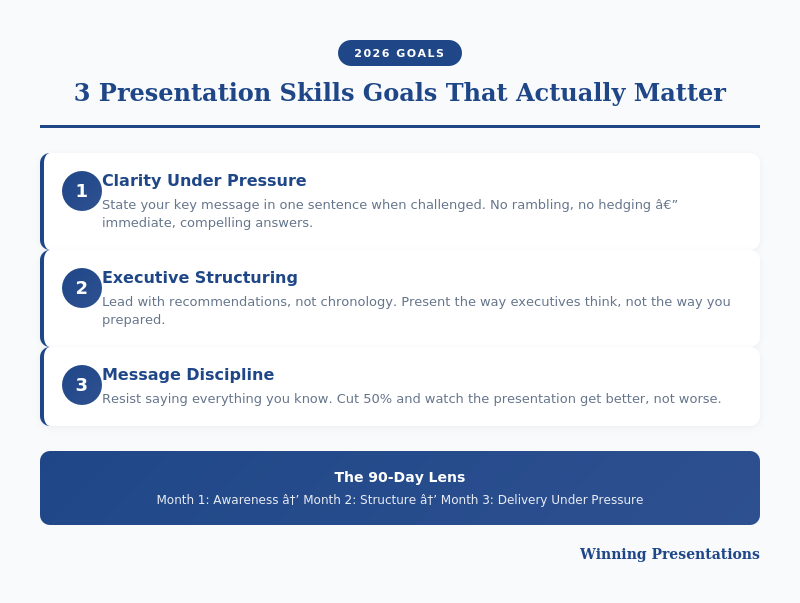
  • 90-day improvement lens — Month 1: Awareness, Month 2: Structure, Month 3: Delivery under pressure
  • Systems beat motivation — deliberate practice compounds; random repetition doesn’t
  • Senior professionals think differently — they focus on skill systems, not presentation events

📥 FREE DOWNLOAD: Executive Presentation Checklist

The pre-presentation routine I use before every high-stakes talk.

Download Free →

Why Most Presentation Skills Goals Fail

Every January, millions of professionals make some version of the same resolution: “This year, I’ll get better at presenting.”

By March, nothing has changed.

The problem isn’t motivation. Research on professional development consistently shows that intention alone doesn’t drive skill improvement. What does? Systems.

Here’s why most presentation skills goals fail:

No Feedback Loop

You present. It goes “okay.” You present again. It goes “okay.” Without specific, structured feedback, you’re just reinforcing existing habits — good and bad.

Most professionals never get real feedback on their presentations. Colleagues say “that was great” because they’re being polite. Your manager focuses on content, not delivery. You have no idea what’s actually working or failing.

No Structure

“Get better at presenting” isn’t a goal — it’s a direction. Better how? Better at what specifically? Better measured by whom?

Vague presentation skills goals produce vague results. Without structure, you’ll drift toward whatever feels comfortable rather than what actually needs improvement.

No Measurement

How do you know if you’ve improved? Most professionals can’t answer this question. They rely on feelings: “I think I’m better.” “That one went well.”

Feelings aren’t measurement. Without clear metrics — even simple ones — you can’t track progress or identify what’s working.

No Pressure Simulation

Practising presentations alone in your office isn’t the same as presenting to a sceptical board. The skills that matter most — composure under pressure, handling tough questions, reading the room — only develop under realistic conditions.

This is why many professionals “know” what to do but can’t execute when it matters. They’ve practised the easy part and avoided the hard part.

For more on building genuine confidence, see my guide on how to speak confidently in public.

The 3 Presentation Skills Goals That Actually Matter

3 presentation skills goals that actually matter for professionals

After training thousands of executives, I’ve identified the three presentation skills goals that actually differentiate senior professionals from everyone else.

These aren’t “soft skills.” They’re specific, measurable capabilities that directly impact whether you get the outcome you want from a presentation.

Goal 1: Clarity Under Pressure

Can you articulate your key message in one sentence when someone interrupts you mid-presentation and asks “what’s the bottom line?”

Most professionals can’t. They’ve prepared 20 slides but haven’t distilled their core message. When pressure hits — an unexpected question, a time cut, a sceptical executive — they ramble, hedge, or lose the thread entirely.

What this looks like in practice:

  • You can state your recommendation in under 15 seconds
  • You can explain your “why” without slides
  • You stay coherent when challenged or interrupted
  • Your answer to “so what?” is immediate and compelling

How to develop it: Practise the “elevator pitch” for every presentation. Before you open PowerPoint, write your one-sentence message. Then test yourself: can you deliver it under pressure?

Goal 2: Executive Structuring

Do you structure presentations the way senior leaders think — or the way you think?

Most professionals present chronologically: “Here’s what I did, here’s what I found, here’s what I recommend.” Executives want the opposite: “Here’s my recommendation, here’s why, here’s what I need from you.”

What this looks like in practice:

  • You lead with the decision or recommendation
  • You provide supporting evidence, not comprehensive data
  • You anticipate the three questions they’ll ask
  • You can present the same content in 5 minutes or 30 minutes

How to develop it: Study how your most effective executives present. Notice the structure. Then apply it to your own content — starting with the “so what” instead of building toward it.

For detailed frameworks, see my guide on executive presentations.

Goal 3: Message Discipline

Can you resist the urge to say everything you know?

The curse of expertise is wanting to share all of it. But senior leaders don’t want comprehensive — they want relevant. They don’t want thorough — they want clear.

What this looks like in practice:

  • You cut 50% of your slides and the presentation gets better
  • You answer questions directly without over-explaining
  • You let silence exist instead of filling it with caveats
  • Your backup slides contain more content than your main deck

How to develop it: After preparing any presentation, force yourself to cut it by half. Not by rushing — by prioritising. What’s essential? What’s “nice to have”? Kill the nice-to-haves.

💡 Ready to Structure Like a Senior Leader?

The Executive Slide System includes 7 frameworks for structuring presentations the way executives think — recommendation-first, evidence-based, action-oriented.

Stop building toward your point. Start with it.

Get the Executive Slide System — £39 →

The 90-Day Improvement Lens for Presentation Skills Goals

Annual presentation skills goals are too distant. They let you procrastinate. “I have all year” becomes “I’ll start next month” becomes “maybe next year.”

Think in 90-day cycles instead. Three months is long enough to create real change, short enough to maintain urgency.

Month 1: Awareness

Before you can improve, you need to know what needs improving. Most professionals have blind spots — habits they don’t notice, weaknesses they’ve never identified.

Actions for Month 1:

  • Record yourself presenting (video, not just audio)
  • Ask 3 colleagues for specific, honest feedback
  • Identify your top 3 weaknesses — the specific things hurting your impact
  • Watch executives you admire — what do they do differently?

This month isn’t about changing anything. It’s about seeing clearly.

Month 2: Structure

Now that you know what to work on, build the systems that will drive improvement.

Actions for Month 2:

  • Create a pre-presentation routine you use every time
  • Develop 2-3 frameworks you apply to every presentation
  • Build a feedback system — how will you get input after each presentation?
  • Schedule deliberate practice, not just presentations

Structure turns intentions into habits. Without it, you’ll default to old patterns under pressure.

Month 3: Delivery Under Pressure

This is where most professionals skip. They practice alone, in comfortable settings, without stakes.

Actions for Month 3:

  • Present to colleagues who will challenge you — not support you
  • Practice with time constraints (you have 5 minutes, not 20)
  • Rehearse handling interruptions and tough questions
  • If possible, get coaching or join a structured programme

Skills that collapse under pressure weren’t really skills — they were comfort-zone performances.

For advanced techniques on handling pressure, see my guide on advanced presentation skills.

🎓 Want Structured Development?

If 2026 is the year you want to master presentation skills properly, structured development matters more than random practice.

Framework-based programmes with psychology techniques and expert feedback create lasting change — not just temporary motivation. If you’d like to discuss what structured development might look like for you, get in touch →

How Senior Professionals Think About Presentation Skills Goals

There’s a mental shift that separates professionals who continuously improve from those who plateau.

Skills vs Events

Plateau thinking: “I have a big presentation next month. I need to prepare for it.”

Growth thinking: “Presenting is a skill I’m developing. Each presentation is a data point.”

When you treat presentations as isolated events, you prepare, perform, and forget. When you treat presenting as an ongoing skill development, each presentation becomes an opportunity to test, learn, and refine.

Systems vs Motivation

Plateau thinking: “I need to feel confident before I can present well.”

Growth thinking: “I need systems that work even when I don’t feel confident.”

Motivation is unreliable. Systems are consistent. The executives who present brilliantly under pressure don’t rely on feeling good — they rely on preparation routines, structural frameworks, and recovery techniques that work regardless of how they feel.

Deliberate Practice vs Repetition

Plateau thinking: “The more I present, the better I’ll get.”

Growth thinking: “Purposeful practice on specific weaknesses improves skill. Random repetition just reinforces habits.”

Twenty years of presenting doesn’t automatically make you good. It makes you experienced. If you’ve been reinforcing bad habits for twenty years, you’re just an experienced bad presenter.

Deliberate practice means identifying specific weaknesses, designing exercises to address them, getting feedback, and adjusting. It’s uncomfortable. That’s why it works.

Making 2026 the Year You Actually Improve Your Presentation Skills Goals

Here’s the honest truth: most people reading this won’t do anything different in 2026.

Not because they lack ability or desire. But because they’ll set vague goals, rely on motivation, and treat presentation skills as an afterthought when they’re not actively presenting.

The professionals who actually improve will:

  • Set specific, measurable presentation skills goals (not wishes)
  • Build systems that don’t depend on motivation
  • Create accountability through feedback loops or structured programmes
  • Practice under realistic pressure, not comfortable conditions
  • Treat presenting as a skill to develop, not an event to survive

If that sounds like work, it is. Skill development always is. But the compound returns are substantial — in promotions, influence, credibility, and career opportunities.

The question isn’t whether presentation skills matter for your career in 2026. They obviously do.

The question is whether you’ll treat them like the strategic asset they are — or continue hoping that “more practice” will somehow produce different results.

Your Next Step

📖 FREE: Executive Presentation Checklist
The pre-presentation routine I use before every high-stakes talk.
Download Free →

💡 QUICK WIN: Executive Slide System — £39
7 frameworks for structuring presentations the way senior leaders think.
Get Instant Access →

🎓 COMPLETE SYSTEM: Structured Development
If you’re ready for comprehensive training with expert guidance, let’s discuss what that looks like for you →

FAQs: Presentation Skills Goals

What are the most important presentation skills goals to set for 2026?

The three presentation skills goals that matter most are: clarity under pressure (being able to state your key message when challenged), executive structuring (leading with recommendations instead of building toward them), and message discipline (resisting the urge to say everything you know). These directly impact whether you achieve your presentation outcomes.

How long does it take to improve presentation skills?

With deliberate practice and structured feedback, most professionals see meaningful improvement within 90 days. The key is focusing on specific weaknesses rather than general “practice.” Random repetition reinforces habits; deliberate practice changes them. Think in 90-day improvement cycles rather than annual goals.

Why do most presentation skills goals fail?

Most presentation skills goals fail because they lack four things: feedback loops (you don’t know what’s working or failing), structure (vague goals produce vague results), measurement (feelings aren’t data), and pressure simulation (practicing alone doesn’t prepare you for real stakes). Systems address all four.

How can I measure improvement in my presentation skills?

Measure presentation skills improvement through specific outcomes: Did you get the decision you wanted? Did stakeholders engage or disengage? How many clarifying questions did you get (fewer often means clearer communication)? Did you stay within your time limit? Recording yourself and comparing over time also provides objective measurement.

What’s the difference between deliberate practice and just presenting more?

Presenting more reinforces existing habits — good and bad. Deliberate practice involves identifying specific weaknesses, designing exercises to address them, getting feedback, and adjusting your approach. Twenty years of presentations doesn’t automatically make you skilled; it makes you experienced. The distinction determines whether you improve or plateau.


Mary Beth Hazeldine is the Owner & Managing Director of Winning Presentations. She spent 24 years in corporate banking at JPMorgan Chase, PwC, Royal Bank of Scotland, and Commerzbank, and has trained over 5,000 executives to present with impact. Her clients have raised over £250 million using her frameworks.

Get Weekly Presentation Insights

Join 2,000+ professionals getting practical presentation tips every Tuesday.
Subscribe to The Winning Edge →

30 Dec 2025
Presentation skills for new leaders - what changes when you get promoted

What Changes When You Get Promoted: Presentation Skills for New Leaders

Last updated: December 30, 2025 · 6 minute read

The presentation skills that got you promoted won’t work in your new role.

This catches most new leaders off guard. You’ve been presenting successfully for years. You got promoted partly because of those presentations. Why would you need to change anything?

Because everything about your context has changed — and presentation skills for new leaders require different approaches than presentation skills for individual contributors. At Winning Presentations, I’ve coached hundreds of professionals through this exact transition. Here’s what nobody tells you about presenting after promotion.

⚡ Key Takeaways

  • You’re no longer proving competence — you’re setting direction and building confidence in your team
  • Your former peers are watching — how you present establishes whether they’ll follow you
  • Less detail, more vision — leaders paint the destination, not the step-by-step journey
  • You now present other people’s work — a completely different skill than presenting your own
  • Silence and listening matter more — your words carry more weight, so use fewer of them

📥 FREE DOWNLOAD: 7 Presentation Frameworks

Leadership presentation structures for team updates, strategy sessions, and executive briefings.

Download Free →

What Actually Changes When You Get Promoted

Before your promotion, presentations were about demonstrating your expertise. You showed your analysis. You proved you’d done the work. You earned credibility through detail.

After promotion, everything inverts.

Harvard Business Review research on new leader credibility shows that newly promoted leaders face a unique challenge: they must establish authority while maintaining relationships with former peers who may feel passed over or resentful.

Presentation skills for new leaders must navigate this tension. Present too confidently, and you seem arrogant. Present too tentatively, and you seem unsure of your new role. The balance is learnable — but it doesn’t come naturally to most people.

At JPMorgan, I watched a brilliant analyst get promoted to VP and immediately lose his team. Same person, same intelligence, same content. But he kept presenting like an analyst when he needed to present like a leader. Within six months, two of his best people had transferred out.

The presentation skills that made him promotable became the obstacle to his success in the new role.

5 Presentation Skills for New Leaders: The Essential Shifts

5 presentation shifts for new leaders after promotion

Shift 1: From Proving to Directing

As an individual contributor, you proved your value through comprehensive analysis. As a leader, you direct attention toward decisions and outcomes.

Before promotion: “Here’s my analysis of the three options, with full methodology…”

After promotion: “We’re going with Option B. Here’s why it’s right for us, and here’s what I need from each of you.”

Presentation skills for new leaders require stating positions clearly and asking for action — not building elaborate cases to prove you’ve thought it through. Your team needs direction, not persuasion.

Shift 2: From Your Work to Their Work

One of the hardest transitions: you’ll increasingly present work you didn’t do yourself.

This requires a completely different skill. You need to understand material well enough to field questions, defend recommendations, and provide context — without having done the underlying analysis.

The key: meet with your team before presentations. Ask “what questions should I expect?” and “what’s the weakest part of this analysis?” Then own the material as if it were yours, while crediting your team publicly.

For frameworks on presenting at this level, see my guide on executive presentations.

Shift 3: From Detail to Vision

Leaders paint destinations. Individual contributors map the route.

Before promotion: Detailed slides explaining methodology, data sources, and analytical approach

After promotion: Clear picture of where we’re going, why it matters, and what success looks like

Presentation skills for new leaders emphasise the “why” over the “how.” Your team will figure out the how — they need you to make the why compelling and clear.

💡 Need Leadership Presentation Frameworks?

The Executive Slide System includes 7 frameworks specifically designed for leaders — team updates, strategic direction, board briefings, and change communication.

Stop presenting like an analyst. Start presenting like a leader.

Get the Executive Slide System — £39 →

Shift 4: From Speaking to Listening

Counterintuitive but critical: as a leader, your presentations should include more listening, not more talking.

Your words now carry more weight. A casual comment from you can send your team in the wrong direction for weeks. Presentation skills for new leaders include knowing when to stop talking and start asking.

Practical techniques:

  • End sections with genuine questions, not rhetorical ones
  • Build in structured discussion time — “I want to hear your concerns before we proceed”
  • Pause after making key points to let people respond
  • Ask your quietest team members directly for their perspective

For more on presence and delivery, see my guide on how to speak confidently in public.

Shift 5: From Peer to Authority (Without Becoming a Stranger)

Yesterday they were your peers. Today you’re their boss. How you present in your first few months establishes the relationship forever.

What works:

  • Acknowledge the transition directly: “I know this is an adjustment for all of us”
  • Credit their expertise publicly: “Sarah knows this area better than I do”
  • Ask for input before announcing decisions when possible
  • Be confident in your role without being dismissive of your history together

What doesn’t work:

  • Pretending nothing has changed
  • Over-asserting authority to establish dominance
  • Apologising for being promoted
  • Trying to remain “one of the gang”

For more advanced techniques, see my guide on advanced presentation skills.

The Mistakes New Leaders Make with Presentation Skills

I’ve watched these patterns play out hundreds of times across my career in banking and consulting:

Mistake 1: Over-proving. New leaders often feel imposter syndrome and compensate by overwhelming people with detail. This backfires — it signals insecurity, not competence.

Mistake 2: Under-deciding. Afraid to seem authoritarian, new leaders present options without clear recommendations. Teams find this frustrating and destabilising.

Mistake 3: Ignoring the elephant. Everyone knows you just got promoted. Pretending it didn’t happen creates awkwardness. Address it briefly and move forward.

Mistake 4: Changing everything immediately. New leaders sometimes use presentations to announce sweeping changes — proving they’re “doing something.” This alienates teams and creates unnecessary resistance.

For board-level presentation structure, see my guide on board presentation structure.

🎓 Preparing for Your Next Level?

AI-Enhanced Presentation Mastery is designed for professionals stepping into leadership roles. You’ll develop the executive presence and presentation skills that make promotion successful — not just achieved.

8 modules. 2 live coaching sessions. Direct feedback on your actual presentations.

Learn More — £249 →

Your First 90 Days: Presentation Skills for New Leaders

The presentations you give in your first 90 days as a new leader set the tone for years. Here’s what to prioritise:

Week 1-2: Listen more than you speak. Your first presentations should be short and include genuine requests for input.

Week 3-4: Share your early observations and emerging priorities. Frame them as “what I’m seeing” not “what we’re doing.”

Month 2: Present a clear vision with specific asks. By now you should have enough context to provide direction.

Month 3: Establish your rhythm. Regular team updates, consistent format, predictable cadence. Teams thrive on knowing what to expect from their leader.

Presentation skills for new leaders develop through deliberate practice in these early months. Get feedback. Adjust. The patterns you establish now become your leadership style.

Resources for New Leaders

📖 FREE: 7 Presentation Frameworks
Leadership structures for team updates, strategy, and executive briefings.
Download Free →

💡 QUICK WIN: Executive Slide System — £39
7 frameworks + templates designed for leaders presenting to teams and boards.
Get Instant Access →

🎓 COMPLETE SYSTEM: AI-Enhanced Presentation Mastery — £249
8-module course with live coaching. Develop leadership presence that sticks.
Learn More →

FAQs: Presentation Skills for New Leaders

What presentation skills do new leaders need most?

New leaders need to shift from proving competence to directing action. This means stating positions clearly, presenting other people’s work effectively, emphasising vision over detail, building in listening time, and navigating the transition from peer to authority. The skills that got you promoted won’t automatically work in your new role.

How do I present to my former peers after getting promoted?

Acknowledge the transition directly but briefly. Credit their expertise publicly. Ask for input before announcing decisions when possible. Be confident in your role without being dismissive of your shared history. Don’t pretend nothing has changed, but don’t over-assert authority either.

Should I change my presentation style after a promotion?

Yes — but strategically. Shift from detailed analysis to clear direction. Speak less and listen more. Focus on the “why” rather than the “how.” Your team needs vision and decision-making, not comprehensive proof of your competence. The transition should feel natural, not abrupt.

How do I establish authority in presentations without seeming arrogant?

State positions clearly while remaining open to input. Credit your team publicly. Ask genuine questions and incorporate feedback visibly. Confidence comes from clarity and decisiveness, not from dominance or dismissiveness. The best new leaders present with conviction while demonstrating respect.

What’s the biggest presentation mistake new leaders make?

Over-proving. New leaders often feel imposter syndrome and compensate by overwhelming their audience with detail to demonstrate they’ve earned the promotion. This backfires — it signals insecurity rather than competence. Confident simplification and clear direction establish authority far more effectively.


Mary Beth Hazeldine is the Owner & Managing Director of Winning Presentations. She spent 24 years in corporate banking at JPMorgan Chase, PwC, Royal Bank of Scotland, and Commerzbank — coaching hundreds of professionals through leadership transitions. She now helps new leaders develop the presentation skills that make promotion successful, not just achieved.

Get Weekly Presentation Insights

Join 2,000+ professionals getting practical presentation tips every Tuesday.

Subscribe to The Winning Edge →

30 Dec 2025
Expert

Why Technical Experts Struggle with Executive Presentations (And How to Fix It)

Last updated: December 30, 2025 · 6 minute read

You spent three weeks on the analysis. You know this material better than anyone. And yet, five minutes into your board presentation, you can see their eyes glazing over.

This is the paradox I watched play out hundreds of times during my 24 years in corporate banking: the people who knew the most often presented the worst.

Technical experts struggle with executive presentations not because they lack intelligence or preparation — but because their expertise works against them. At Winning Presentations, I’ve helped hundreds of analysts, engineers, and specialists break through this barrier. Here’s what’s actually going on — and how to fix it.

⚡ Key Takeaways

  • The curse of knowledge — you can’t un-know what you know, so you assume too much
  • Expertise creates over-explanation — you share the journey when executives only want the destination
  • Technical credibility ≠ executive credibility — different audiences need different proof
  • The fix is mindset, not technique — you must learn to think like a decision-maker, not an analyst

📥 FREE DOWNLOAD: Executive Presentation Checklist

The pre-presentation checklist I give to technical experts before boardroom presentations.

Download Free →

The Curse of Knowledge: Why Technical Experts Struggle with Executive Presentations

Harvard Business Review calls it “the curse of knowledge” — once you know something, you can’t imagine not knowing it. And this is exactly why technical experts struggle with executive presentations.

When you’ve spent weeks deep in analysis, every detail feels essential. Every caveat feels necessary. Every methodology step feels important to explain.

But executives haven’t been on that journey with you. They’re coming in cold, with seven other agenda items competing for their attention. They don’t need to understand your process — they need to understand your conclusion.

At Royal Bank of Scotland, I watched a brilliant credit analyst lose the room in under three minutes. His analysis was impeccable. His recommendation was sound. But he started with methodology, built through data, and buried his conclusion on slide 22. The MD interrupted: “What do you actually want us to do?”

He knew the material too well. And that knowledge became his biggest obstacle.

The 4 Traps That Cause Technical Experts to Struggle with Executive Presentations

4 traps that cause technical experts to struggle with executive presentations

Trap 1: Showing Your Working

In school, you got marks for showing your working. In boardrooms, you lose the room.

Technical experts instinctively present chronologically: “First we gathered data, then we analysed it, then we found these patterns, and therefore we recommend…”

Executives want the reverse: “We recommend X. Here’s why. Any questions on methodology are in the appendix.”

For more on this structure, see my guide on board presentation structure.

Trap 2: Mistaking Thoroughness for Credibility

Technical experts often believe that comprehensiveness proves competence. “If I show them everything I considered, they’ll trust my conclusion.”

The opposite is true. Executives see thoroughness as inability to prioritise. They think: “If this person can’t distinguish what matters from what doesn’t, can I trust their judgment?”

Real credibility at the executive level comes from confident simplification — showing you understand what matters most.

Trap 3: Defending Against Imaginary Objections

Because you know every weakness in your analysis, you preemptively address them all. “Now, you might be wondering about sample size…” “Some might argue that…”

This makes you look uncertain. Executives read it as lack of conviction. They’re thinking: “If you’re not sure, why should I be?”

Address limitations when asked. Don’t volunteer every caveat upfront.

💡 Struggling to Structure Executive Presentations?

The Executive Slide System gives technical experts 7 board-ready frameworks — including the “recommendation first” structure that executives expect.

Stop presenting like an analyst. Start presenting like a decision-maker.

Get the Executive Slide System — £39 →

Trap 4: Answering Questions Like a Witness

When executives ask questions, technical experts often give complete, technically accurate answers. Every fact. Every nuance. Every consideration.

This exhausts executives and makes simple questions feel complicated.

Senior leaders answer differently. They give the headline, then stop. If more detail is needed, the questioner will ask. This is how technical experts struggle with executive presentations even in Q&A — they over-answer.

For more on handling executive questions, see my guide on how to present to a CFO.

4 Mindset Shifts That Fix Why Technical Experts Struggle with Executive Presentations

These aren’t techniques — they’re ways of thinking that change everything.

Shift 1: You’re Not Teaching — You’re Enabling a Decision

Technical experts default to “education mode.” They want the audience to understand their analysis.

Executives don’t need to understand your analysis. They need to make a decision. Your job isn’t to transfer knowledge — it’s to make their decision easy.

Before every presentation, ask yourself: “What decision am I helping them make?” Then cut everything that doesn’t serve that decision.

Shift 2: Your Credibility Comes From Confidence, Not Comprehensiveness

Stop trying to prove you’re smart by showing all your work. Prove it by being clear, decisive, and unflappable.

The executive thought process: “This person has clearly thought it through. They’re giving me what I need. They’re not wasting my time. I trust their judgment.”

That trust comes from confident simplification — not from comprehensive coverage.

Shift 3: Silence Is Better Than Caveats

When you feel the urge to add “however” or “although” or “it should be noted that” — stop. Most caveats can wait until Q&A.

Your recommendation should land cleanly. Qualifications muddy the water. Save nuance for when someone specifically asks for it.

Shift 4: Think About What They Do Next, Not What They Learn

Technical experts think: “What do I need to explain?”

Executive presenters think: “What do I need them to do after this meeting?”

If you want budget approval, everything serves that. If you want a decision on a vendor, everything serves that. Ruthlessly cut anything that doesn’t move them toward the action you need.

For more on advanced techniques senior leaders use, see my complete guide on advanced presentation skills.

🎓 Ready to Present Like a Senior Leader?

AI-Enhanced Presentation Mastery is designed for technical experts who need to present at the executive level. Module 3 specifically addresses “The Expert’s Curse” with exercises to restructure how you think about presentations.

8 modules. 2 live coaching sessions. Feedback on your actual presentations.

Learn More — £249 →

What Changes When Technical Experts Fix This

One finance director I worked with had been passed over for promotion twice. His analysis was always the best in the room. But his presentations were lectures.

We didn’t change his content. We changed his mindset. Recommendation first. Ruthless cuts. Confident delivery without defensive caveats.

Six months later, he was presenting directly to the board. Same intelligence. Same expertise. Different approach.

The reason technical experts struggle with executive presentations isn’t a skills gap — it’s a thinking gap. Close the thinking gap, and everything else follows.

Resources for Technical Experts

📖 FREE: Executive Presentation Checklist
Pre-presentation checklist for technical experts presenting to senior leaders.
Download Free →

💡 QUICK WIN: Executive Slide System — £39
7 board-ready frameworks + templates. Stop presenting like an analyst.
Get Instant Access →

🎓 COMPLETE SYSTEM: AI-Enhanced Presentation Mastery — £249
8-module course with live coaching. Break through the expert’s curse for good.
Learn More →

FAQs: Why Technical Experts Struggle with Executive Presentations

Why do technical experts struggle with executive presentations?

Technical experts struggle with executive presentations because their expertise works against them. The “curse of knowledge” means they can’t imagine not knowing what they know, so they over-explain, show too much working, and bury conclusions in methodology. Executives want recommendations first — not the journey that led there.

How can technical experts improve their executive presentation skills?

The key is mindset, not technique. Shift from “teaching mode” to “decision-enabling mode.” Lead with your recommendation. Cut ruthlessly. Treat comprehensiveness as a weakness, not a strength. Save caveats for Q&A. Think about what you want them to do, not what you want them to learn.

What’s the biggest mistake technical experts make in boardroom presentations?

Showing their working. Technical experts present chronologically — data, analysis, findings, conclusion — when executives want the reverse. Start with your recommendation, provide key supporting evidence, and put methodology in the appendix. Don’t build to your conclusion; start with it.

How do I stop over-explaining in executive presentations?

Before each slide or section, ask: “Does this help them make the decision I’m asking for?” If not, cut it or move it to the appendix. Practice giving answers in one sentence. If they need more detail, they’ll ask. The urge to explain everything is the expert’s curse — resist it deliberately.

Can technical experts really learn to present like executives?

Absolutely. The skills are learnable — but they require unlearning habits that made you successful as an analyst. The technical experts who break through often become the most effective executive presenters because they combine deep knowledge with disciplined communication. It takes deliberate practice and often external feedback to shift ingrained patterns.


Mary Beth Hazeldine is the Owner & Managing Director of Winning Presentations. A qualified clinical hypnotherapist, she spent 24 years in corporate banking at JPMorgan Chase, PwC, Royal Bank of Scotland, and Commerzbank — watching brilliant technical experts struggle with executive presentations. She now helps them break through the expert’s curse and present with the confidence of senior leaders.

Get Weekly Presentation Insights

Join 2,000+ professionals getting practical presentation tips every Tuesday.

Subscribe to The Winning Edge →

30 Dec 2025
Advanced presentation skills - what senior leaders do differently

Advanced Presentation Skills: What Senior Leaders Do Differently

Last updated: December 30, 2025 · 10 minute read

Most presentation advice teaches you how to be competent. This article teaches you how to be exceptional.

After 24 years in corporate environments — at JPMorgan Chase, PwC, Royal Bank of Scotland, and Commerzbank — I’ve watched hundreds of senior leaders present. Managing Directors. C-suite executives. Board members.

What I noticed: the techniques that make someone a “good” presenter are completely different from the advanced presentation skills that make someone commanding, memorable, and persuasive at the senior level.

The basics matter. But if you’ve mastered the basics and want to present like a senior leader, you need to develop these advanced presentation skills. At Winning Presentations, these are the techniques I teach to executives who want to move from competent to compelling.

⚡ Key Takeaways

  • Senior leaders speak in headlines — they lead with conclusions, not build-ups
  • They use strategic silence — pauses signal confidence and create emphasis
  • They make one point, not many — clarity beats comprehensiveness
  • They read the room constantly — and adapt in real-time
  • They own the space physically — presence comes from stillness and intention

📥 FREE DOWNLOAD: 7 Presentation Frameworks

The structures senior leaders use for every presentation type — from team updates to board meetings.

Download Free →

The Gap Between Basic and Advanced Presentation Skills

Basic presentation skills get you through. Advanced presentation skills get you promoted.

Here’s what I mean:

Basic skills: Clear slides. Steady voice. Eye contact. Logical structure. Not reading from notes. Finishing on time.

These are table stakes. They’re necessary but not sufficient. Every competent professional eventually develops these.

Advanced presentation skills: Commanding attention without demanding it. Making complex ideas feel simple. Reading and adapting to room dynamics. Creating moments that people remember days later. Influencing decisions through presence, not just content.

Harvard Business Review research shows that executive presence — the way senior leaders carry themselves — accounts for a significant portion of leadership advancement. Presentation skills are the most visible expression of that presence.

For the foundational techniques, see my guide on professional presentation skills. What follows are the advanced techniques that build on that foundation.

7 Advanced Presentation Skills Senior Leaders Use

These are the patterns I’ve observed in the most effective senior presenters — and the techniques I now teach to executives at Winning Presentations.

Advanced presentation skills framework - 7 techniques senior leaders use

1. They Speak in Headlines First

Average presenters build up to their conclusion. Senior leaders start with it.

Average approach: “We analysed the market, reviewed three options, considered the risks, and concluded that…”

Senior leader approach: “We should acquire Company X. Here’s why.”

This isn’t just more efficient — it’s a completely different communication philosophy. Senior leaders assume their audience is intelligent and time-pressed. They give the conclusion first, then provide supporting evidence for those who need it.

I call this “newspaper structure” — headline first, details second. Practice leading with your recommendation or key message, then backing it up.

For a complete framework on structuring executive-level presentations, see my guide on creating executive presentations.

2. They Use Strategic Silence

Most presenters fill every moment with words. Senior leaders use silence as a tool.

Strategic silence works in three ways:

  • Before key points: A 2-3 second pause signals “what comes next is important” — audiences lean in
  • After questions: Pausing before answering shows you’re thinking, not reacting — it signals confidence
  • After your conclusion: Ending with silence rather than filler (“so, yeah…”) makes your ending land

Watch any effective CEO speak. They’re comfortable with silence in ways that junior presenters aren’t. This is a learnable advanced presentation skill.

At PwC, I noticed that partners who commanded the most respect in client meetings were also the ones who spoke least — but when they spoke, everyone listened. The silence between their statements created weight.

3. They Make One Point, Not Many

Average presenters try to be comprehensive. Senior leaders try to be memorable.

If you make ten points, your audience remembers zero. If you make one point with three supporting arguments, your audience remembers one.

The discipline: Before any presentation, ask yourself: “What is the ONE thing I need this audience to remember?” Then structure everything around that single point.

This is harder than it sounds. It requires killing your darlings — cutting good content that doesn’t serve your core message. But it’s what separates forgettable presentations from influential ones.

💡 Want Executive-Level Frameworks?

The Executive Slide System gives you 7 proven structures used by senior leaders for any business presentation — from team updates to board meetings.

  • The “Headline First” framework
  • Board recommendation structure
  • Strategic update template
  • Video walkthroughs for each

Get the Executive Slide System — £39 →

4. They Read the Room and Adapt

Average presenters deliver their prepared content regardless of audience response. Senior leaders treat presentations as dynamic conversations.

What they’re watching for:

  • Body language shifts (leaning in = interest, arms crossed = resistance, checking phones = lost attention)
  • The senior person’s reaction (often the decision-maker)
  • Confusion or skepticism on faces
  • Moments of strong agreement (to emphasise) or disagreement (to address)

How they adapt:

  • If attention is waning: “Let me cut to what matters most for this decision…”
  • If someone looks skeptical: “I can see some concern — let me address that directly…”
  • If running long and losing the room: “I’ll move to the recommendation and we can discuss details as needed…”

This advanced presentation skill requires preparation — you need to know your content well enough to restructure it on the fly.

5. They Own the Physical Space

Senior leaders don’t just stand in a room — they own it.

What this looks like:

  • Stillness when speaking: No swaying, fidgeting, or pacing. Movement is intentional.
  • Expansive posture: Taking up space rather than shrinking into it
  • Deliberate movement: Walking to a different position to signal a transition, then planting again
  • Eye contact that lingers: Completing a thought while looking at one person, not darting around

At Royal Bank of Scotland, I watched executives command rooms of 50+ people simply through how they positioned themselves. They arrived early, stood where they intended to present, and “claimed” the space before anyone else arrived.

For more on developing this kind of presence, see my guide on how to speak confidently in public.

Executive presence model for advanced presentation skills

6. They Tell Stories With Purpose

Everyone knows stories are powerful. Senior leaders use them strategically, not decoratively.

The difference:

  • Decorative story: A relevant anecdote that entertains
  • Strategic story: A specific narrative that makes your key point unforgettable and emotionally resonant

The senior leader approach:

  1. Identify the ONE point you need to land
  2. Find a story that embodies that point (ideally from your own experience)
  3. Tell it briefly — 60-90 seconds maximum
  4. Connect it explicitly to your business message

I once watched a Managing Director turn a room’s opinion on a £10 million investment with a two-minute story about a similar decision made five years earlier. The data hadn’t changed. The story changed how they felt about the data.

7. They Project Certainty (Even When They’re Not)

Senior leaders rarely sound uncertain, even when discussing uncertain topics.

This isn’t about being arrogant or closed-minded. It’s about how you frame uncertainty.

Average presenter: “I’m not sure, but maybe we should consider…”

Senior leader: “Based on current evidence, my recommendation is X. There are risks, which I’ll address.”

Both might have the same level of internal confidence. The difference is in the framing. Senior leaders:

  • State positions clearly, then acknowledge limitations
  • Use “I recommend” rather than “I think maybe”
  • Address uncertainty as risk to be managed, not as lack of conviction

This advanced presentation skill requires practice — it’s a language pattern, not just a mindset.

🎓 Ready to Develop Advanced Presentation Skills?

AI-Enhanced Presentation Mastery is designed for senior professionals who want to move beyond competent to commanding. It includes modules specifically on executive presence, strategic storytelling, and reading room dynamics.

8 modules. 2 live coaching sessions. Direct feedback on your actual presentations.

Learn More — £249 →

How to Develop Advanced Presentation Skills

These skills don’t develop from reading about them. They develop from deliberate practice with feedback.

Step 1: Record Yourself

Video yourself presenting. Watch it with the sound off first — you’ll see habits you never knew you had. Then watch with sound. Most people do this once, cringe, and never do it again. Senior leaders do it repeatedly.

Step 2: Focus on One Advanced Presentation Skill at a Time

Don’t try to develop all seven skills simultaneously. Pick the one that would make the biggest difference for you:

  • If you’re too detailed → Practice “headline first”
  • If you’re too rushed → Practice strategic silence
  • If people forget your points → Practice the “one point” discipline
  • If you feel rigid → Practice reading the room
  • If you feel nervous → Practice owning the space

Work on one skill for 4-6 weeks before adding another.

Step 3: Get Feedback From Senior People

Peers can tell you if you were clear. Senior leaders can tell you if you were compelling. Seek feedback specifically from people above your level who present well.

For more on the CEO-level techniques, see my guide on how to present like a CEO.

The Real Difference Advanced Presentation Skills Make

Early in my banking career, I was technically competent but forgettable. I delivered information clearly. I finished on time. I answered questions adequately.

But I wasn’t advancing.

What changed wasn’t my content — it was how I delivered it. I learned to lead with conclusions, use silence, make single points land, and command physical space. Within two years, I was presenting to boards.

Advanced presentation skills aren’t about being flashy or charismatic. They’re about being strategic with every element of your communication — words, pauses, movement, and presence.

My clients have collectively raised over £250 million using these techniques. Not because they’re naturally gifted — but because they developed these advanced presentation skills deliberately.

For the executive summary techniques specifically, see my guide on how to write an executive summary slide.

Your Next Step

Pick one advanced presentation skill from this list. Practice it in your next three presentations. Notice what changes.

That’s how senior leaders got to where they are — one deliberate improvement at a time.

Resources for Advanced Presentation Skills

📖 FREE: 7 Presentation Frameworks
The structures senior leaders use for every presentation type.
Download Free →

💡 QUICK WIN: Executive Slide System — £39
7 board-ready frameworks + templates + video walkthroughs.
Get Instant Access →

🎓 COMPLETE SYSTEM: AI-Enhanced Presentation Mastery — £249
8-module course with live coaching. Develop advanced presentation skills with direct expert feedback.
Learn More →

FAQs About Advanced Presentation Skills

What’s the difference between basic and advanced presentation skills?

Basic presentation skills are about competence: clear slides, steady voice, logical structure, finishing on time. Advanced presentation skills are about influence: commanding attention, making ideas memorable, reading and adapting to room dynamics, and creating moments that drive decisions. Basic skills get you through. Advanced skills get you promoted.

How long does it take to develop advanced presentation skills?

Expect 6-12 months of deliberate practice to see significant advancement. The key is focusing on one skill at a time for 4-6 weeks, getting feedback, and presenting regularly. Most people try to improve everything at once and improve nothing. Senior leaders who present well have usually been refining these skills for years.

Can you develop advanced presentation skills without natural charisma?

Absolutely. Most senior leaders I’ve trained weren’t naturally charismatic — they were deliberate. The techniques in this guide are learnable skills, not personality traits. Strategic silence, headline-first structure, and physical presence are all patterns you can practice and develop regardless of your natural style.

What’s the most important advanced presentation skill to develop first?

Start with “headline first” — leading with your conclusion rather than building up to it. This single change shifts how audiences perceive you from “informer” to “leader.” It’s also the fastest to implement. You can start using it in your very next presentation.

How do senior leaders handle nerves differently?

Senior leaders still feel nervous — they’ve just learned to channel it differently. They use pre-presentation rituals, reframe anxiety as excitement, and focus on serving the audience rather than performing for them. The visible difference is that their nervous energy goes into preparation, not into visible fidgeting or rushed delivery.


Mary Beth Hazeldine is the Owner & Managing Director of Winning Presentations and a Microsoft Copilot PowerPoint specialist. A qualified clinical hypnotherapist, she has trained over 300 executives on advanced presentation skills, drawing on 24 years of corporate experience at JPMorgan Chase, PwC, Royal Bank of Scotland, and Commerzbank. Her clients have collectively raised over £250 million using her presentation techniques.

Get Weekly Presentation Insights

Join 2,000+ professionals getting practical presentation tips every Tuesday.

Subscribe to The Winning Edge →

29 Dec 2025
How to present to a board of directors - 7 critical mistakes to avoid

How to Present to a Board of Directors: 7 Mistakes to Avoid

Last updated: December 29, 2025 · 5 minute read

Learning how to present to board of directors is one of the most high-stakes skills in business — and the first time I did it, I made every mistake on this list.

Forty slides. Twenty-five minutes of monologue. A recommendation buried on slide 37. The Chairman interrupted me halfway through: “What exactly are you asking us to decide?”

That was at Royal Bank of Scotland, early in my career. It was humiliating — but it taught me how differently boards operate compared to every other audience.

After 24 years of presenting to boards at JPMorgan Chase, RBS, PwC, and Commerzbank, and training hundreds of senior professionals at Winning Presentations, I’ve seen these same mistakes destroy otherwise strong presenters.

Here are the seven mistakes to avoid when you present to a board of directors.

⚡ Key Takeaways

  • Don’t bury your recommendation — lead with it on slide one
  • Don’t over-explain your process — boards want conclusions, not journeys
  • Don’t hide the risks — experienced directors always notice
  • Don’t read the board paper aloud — assume they’ve read it
  • Don’t use too many slides — 5-8 maximum for 15 minutes

📥 FREE DOWNLOAD: Executive Presentation Checklist

The pre-board-meeting checklist I use before every executive presentation.

Download Free →

7 Mistakes to Avoid When You Present to Board of Directors

7 mistakes to avoid when presenting to a board of directors

Mistake 1: Burying Your Recommendation

Most presenters build up to their conclusion. Background, analysis, options, then finally — the recommendation.

This fails catastrophically with boards. Directors are time-poor and decision-focused. If they don’t know what you’re asking within the first minute, they lose patience.

Fix: First slide, first sentence: your recommendation. “I’m recommending we proceed with Option B at £2.4 million.”

For the complete framework, see my guide on how to brief executives.

Mistake 2: Over-Explaining Your Process

“First we conducted market research, then we interviewed stakeholders, then we built financial models, then we…”

Board members don’t care about your process. They care whether your conclusions are sound. Explaining how you worked signals insecurity.

Fix: Cut process explanations entirely. If someone asks “How did you arrive at that figure?”, answer briefly then. Don’t pre-emptively justify.

Mistake 3: Hiding the Risks

Inexperienced presenters minimise risks, hoping board members won’t probe. This always backfires.

Experienced directors have seen thousands of presentations. They know every proposal has risks. When you don’t mention them, they assume either: (a) you haven’t thought it through, or (b) you’re hiding something.

Fix: Address risks proactively. “Here are the three main risks and how we’d mitigate each.” This builds credibility.

💡 Want Board-Ready Templates?

The Executive Slide System includes 7 frameworks specifically designed for board presentations, including risk presentation templates.

Get the Executive Slide System — £39 →

Mistake 4: Reading the Board Paper Aloud

Board members receive papers in advance — often hundreds of pages for a single meeting. They’ve read yours (or at least skimmed it).

Repeating what’s in the paper wastes time and signals you don’t understand how boards work.

Fix: Assume they’ve read it. Say: “You’ve seen the detailed analysis in the paper. I’ll focus on the three points that most need discussion.”

Mistake 5: Using Too Many Slides

Harvard Business Review recommends senior executives see no more than one slide per two minutes.

For a 15-minute board presentation, that’s 5-8 slides maximum. Most presenters use three times that.

Fix: Move detail to backup slides. Your main deck should contain only what’s essential for the decision. Everything else is “detail on demand.”

Mistake 6: Filling Every Silence

When the Chairman pauses to think, anxious presenters jump in with more information. This interrupts the decision-making process.

Fix: When you finish a point, stop talking. When someone asks a question and you’ve answered, stop talking. Let silence exist. Directors use it to think.

Mistake 7: Getting Defensive Under Questioning

Board members will probe, challenge, and sometimes disagree. This isn’t hostility — it’s their job. Responding defensively makes you look unprepared.

Fix: Pause before answering. Thank them for the question (briefly). Answer directly. If you don’t know, say “I’ll need to confirm that and follow up.” Never bluff.

For more on handling tough questions, see my guide on how to present to the CFO.

What Works When You Present to Board of Directors

Avoiding these mistakes is half the battle. The other half is having the right structure.

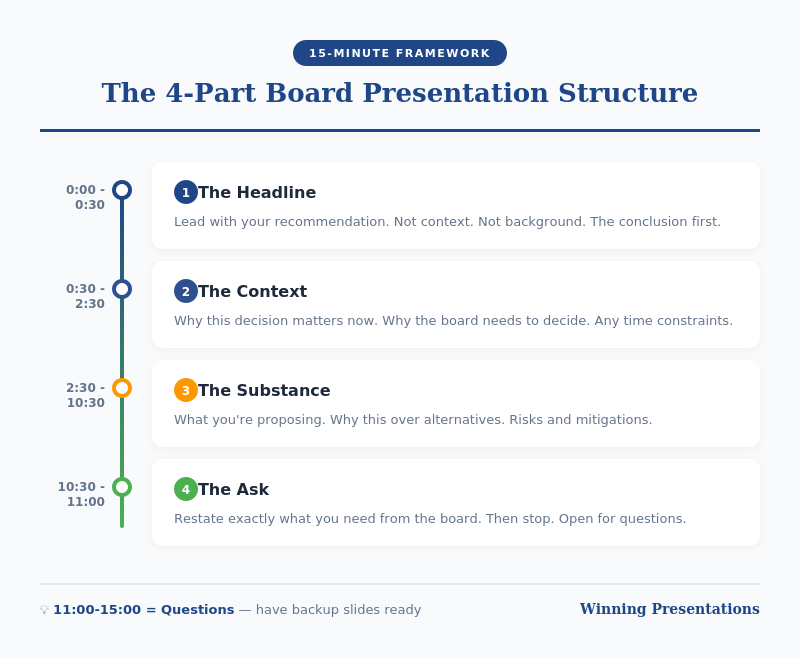
The 4-part framework that works:

  1. Headline (30 seconds) — Your recommendation, first slide
  2. Context (2 minutes) — Why this decision matters now
  3. Substance (8-10 minutes) — Your case, alternatives, risks
  4. The Ask (1 minute) — Exactly what you need from them

This leaves time for questions within a typical 30-minute slot.

For the complete structure with examples, see my hub guide on how to brief executives.

For general presentation confidence, see my guide on how to speak confidently in public.

🎓 Want to Master Board Presentations?

AI-Enhanced Presentation Mastery includes a complete module on executive and board presentations, plus live coaching sessions where I work with you on your actual board decks.

8 modules. 2 live sessions. Frameworks from 24 years of boardroom experience.

Learn More — £249 →

Resources for Board Presentations

📖 FREE: Executive Presentation Checklist
Pre-meeting checklist for any board or C-suite presentation.
Download Free →

💡 QUICK WIN: Executive Slide System — £39
7 board-ready frameworks + templates + video walkthroughs.
Get Instant Access →

🎓 COMPLETE SYSTEM: AI-Enhanced Presentation Mastery — £249
8-module course including executive presentations module + live coaching.
Learn More →

FAQs: How to Present to Board of Directors

How do I prepare to present to a board of directors for the first time?

Structure your presentation using the 4-part framework: Headline, Context, Substance, Ask. Practice until your opening 30 seconds is automatic. Prepare backup slides for likely questions. Arrive early and test the technology. Most importantly, lead with your recommendation — don’t make them wait.

How long should a board presentation be?

Prepare 15 minutes of speaking maximum, even if you’re given 30 minutes. Boards value discussion time. If your prepared remarks take 15 minutes, that leaves 15 for questions — which is often where the real decision-making happens.

What do board members really want to see?

A clear recommendation. Honest assessment of risks. Evidence you’ve considered alternatives. And brevity. Boards see dozens of presentations per meeting. The ones that stand out respect their time and get to the point quickly.

How do I handle tough questions from board members?

Pause before answering — it shows confidence, not uncertainty. Answer directly without being defensive. If you don’t know something, say “I’ll confirm that and follow up” rather than guessing. Board members respect honesty far more than bluffing. They’ve seen too many presentations to miss evasion.


Mary Beth Hazeldine is the Owner & Managing Director of Winning Presentations and a Microsoft Copilot PowerPoint specialist. She has presented to boards at JPMorgan Chase, Royal Bank of Scotland, PwC, and Commerzbank during her 24-year corporate career. Her clients have collectively raised over £250 million using her presentation techniques.

Get Weekly Presentation Insights

Join 2,000+ professionals getting practical presentation tips every Tuesday.

Subscribe to The Winning Edge →

29 Dec 2025
Board presentation structure - how to brief executives in 15 minutes or less

Board Presentation Structure: How to Brief Executives in 15 Minutes or Less

Last updated: December 29, 2025 · 9 minute read

The first time I presented to a board of directors, I made every mistake possible.

I prepared 45 slides. I started with background context. I buried my recommendation on slide 38. And when the CFO interrupted five minutes in to ask “What are you actually recommending?”, I fumbled through my deck trying to find the answer.

That was at Royal Bank of Scotland, early in my career. I learned more about board presentation structure in that painful 20 minutes than in years of regular presenting.

Here’s what I know now after 24 years of presenting to boards at JPMorgan Chase, PwC, Royal Bank of Scotland, and Commerzbank: boards don’t want information. They want decisions.

Your board presentation structure needs to deliver a clear recommendation, supported by evidence, with explicit asks — in 15 minutes or less. Everything else is noise.

At Winning Presentations, I’ve trained hundreds of executives on this exact framework. Here’s how it works.

⚡ Key Takeaways

  • Lead with your recommendation — boards want the answer first, then the evidence
  • Use the 4-part structure: Recommendation → Context → Evidence → Ask
  • 15 minutes maximum — plan for 10, leave 5 for questions
  • One slide per section maximum — 4-6 slides total, not 40
  • End with a clear, specific ask — what decision do you need from them?

📥 FREE DOWNLOAD: Executive Presentation Checklist

The pre-presentation checklist I use before every board meeting. Covers structure, timing, and common pitfalls.

Download Free →

Why Board Presentation Structure Is Different

Regular presentations can meander. You can build to a conclusion. You can use suspense.

Board presentations cannot.

Harvard Business Review research shows that board members have limited attention spans for individual agenda items — often as little as 10-15 minutes. They’re processing multiple complex topics in a single meeting. They need to make decisions, not absorb information.

This means your board presentation structure must be:

  • Conclusion-first: Lead with your recommendation, not your analysis
  • Decision-oriented: Everything supports a specific ask
  • Ruthlessly concise: If it doesn’t support the decision, cut it
  • Interrupt-proof: You should be able to state your recommendation in 30 seconds if asked

The structure I’m about to share has been tested in hundreds of board presentations. It works because it’s designed for how boards actually process information.

The 4-Part Board Presentation Structure

Board presentation structure framework - the 4-part structure for executive briefings

Part 1: Recommendation (2 minutes)

Start with your conclusion. Not background. Not context. Your recommendation.

“I’m recommending we approve a £2.4M investment in the CRM upgrade, to be implemented over Q2-Q3, with expected ROI of 340% over three years.”

This should take 30 seconds to say and one slide to show.

Why lead with this? Because boards are thinking “What do you want from us?” from the moment you start. If you make them wait, they’re mentally searching for your point instead of listening to your argument.

By stating your recommendation first, you frame everything that follows. The board knows what to listen for.

For techniques on delivering this opening with confidence, see my guide on how to speak confidently in public.

Part 2: Context (3 minutes)

Now — and only now — provide the minimum context needed to understand your recommendation.

The key question: What does the board need to know to evaluate my recommendation? Nothing more.

This typically includes:

  • The problem or opportunity you’re addressing
  • Why this is board-level (scale, risk, strategic importance)
  • Timeline constraints, if any

One slide maximum. Often this can be combined with your recommendation slide if you’re ruthless about brevity.

What NOT to include: history of how you got here, alternative approaches you considered, technical details, organisational politics. These belong in the appendix if anywhere.

💡 Want Ready-Made Executive Templates?

The Executive Slide System includes board presentation templates built on this exact structure — plus 6 other frameworks for different executive contexts.

  • Board recommendation template
  • Executive summary one-pager
  • Investment case structure
  • Video walkthroughs of each framework

Get the Executive Slide System — £39 →

Part 3: Evidence (5 minutes)

Now support your recommendation with evidence. This is the “why you should agree” section.

Structure your evidence around the board’s likely concerns:

  • Financial: What’s the cost, return, and payback period?
  • Risk: What could go wrong, and how will you mitigate it?
  • Execution: Who’s accountable, and what’s the timeline?
  • Strategic fit: How does this align with company priorities?

Two to three slides maximum. Use data, not opinions. Be specific: “23% cost reduction” not “significant savings.”

Anticipate questions and address them proactively. If the CFO always asks about cash flow impact, include it before she asks.

Part 4: The Ask (2 minutes)

End with a crystal-clear ask. What specific decision do you need from the board today?

Good asks:

  • “I’m requesting approval to proceed with the £2.4M investment.”
  • “I’m seeking authorisation to negotiate final terms with the vendor.”
  • “I need the board’s input on whether to prioritise Option A or Option B.”

Bad asks:

  • “Thoughts?” (Too vague)
  • “I wanted to update you on our progress.” (Not a decision)
  • “Let me know if you have questions.” (Passive, not action-oriented)

If you don’t have a clear ask, question whether this needs to be a board presentation at all. Informational updates can usually be handled in pre-read documents.

For techniques on delivering powerful closings, see my guide on how to start a presentation — which also covers endings.

Board Presentation Structure: Timing Guide

Board presentation timing guide - how to allocate 15 minutes across four sections

If you have 15 minutes on the agenda, plan for 10 minutes of presenting and 5 minutes of questions.

Section Time Slides
Recommendation 2 min 1
Context 3 min 1
Evidence 5 min 2-3
Ask 1-2 min 1
Questions 5 min Appendix

Notice this gives you 4-6 slides maximum for your main presentation. Everything else goes in the appendix — ready if asked, but not in your core flow.

Board Presentation Structure: Slide Template

Here’s a template you can adapt for any board presentation:

Slide 1: Recommendation + Context

  • Headline: Your recommendation in one sentence
  • 3-4 bullets: Key context points
  • Visual: Timeline or high-level financial summary

Slide 2: Financial Case

  • Investment required
  • Expected return (ROI, NPV, payback)
  • Comparison to alternatives if relevant

Slide 3: Risk and Mitigation

  • Top 3 risks
  • Mitigation plan for each
  • Contingency if needed

Slide 4: Execution Plan

  • Timeline (phases, milestones)
  • Accountability (who owns this)
  • Dependencies

Slide 5: The Ask

  • Specific decision requested
  • What happens next if approved
  • When you’ll report back

Appendix: Technical details, alternative analysis, historical context, org charts — anything that supports questions but doesn’t need to be in the main presentation.

🎓 Master Executive Presentations

AI-Enhanced Presentation Mastery includes a complete module on executive and board presentations — plus live coaching sessions where I review your actual presentations and give direct feedback.

8 modules. 2 live sessions. Learn the techniques that got me through hundreds of board presentations.

Learn More — £249 →

Common Board Presentation Structure Mistakes

After reviewing hundreds of board presentations, these are the mistakes I see most often:

Mistake 1: Burying the Recommendation

Starting with history, context, or analysis before stating what you want. By slide 10, the board has mentally checked out.

Mistake 2: Too Many Slides

40 slides for a 15-minute slot is not thorough — it’s unfocused. Ruthlessly cut anything that doesn’t directly support your recommendation.

Mistake 3: No Clear Ask

Ending with “Any questions?” instead of a specific decision request. Boards need to know what you’re asking them to do.

Mistake 4: Reading the Slides

Your slides are for reference, not scripts. Speak to the board, not the screen. They can read faster than you can talk.

Mistake 5: Not Preparing for Interruptions

Boards interrupt. It’s how they process. If you can’t state your recommendation in 30 seconds when interrupted, you’re not prepared.

Your Next Step

Before your next board presentation, restructure using the 4-part framework: Recommendation → Context → Evidence → Ask.

Time yourself. If you can’t deliver it in 10 minutes, you haven’t cut enough.

Resources for Executive Presentations

📖 FREE: Executive Presentation Checklist
Pre-presentation checklist for board meetings and executive briefings.
Download Free →

💡 QUICK WIN: Executive Slide System — £39
7 frameworks + templates for any executive presentation context.
Get Instant Access →

🎓 COMPLETE SYSTEM: AI-Enhanced Presentation Mastery — £249
8-module course including executive presentations module + live coaching.
Learn More →

FAQs About Board Presentation Structure

How long should a board presentation be?

Plan for 10 minutes of presenting, leaving 5 minutes for questions if you have a 15-minute slot. Most board presentations can — and should — be delivered in under 10 minutes. If you need more time, you probably haven’t focused your message enough.

How many slides should a board presentation have?

4-6 slides maximum for your core presentation. Everything else goes in the appendix, ready for questions but not in your main flow. More slides usually means less clarity, not more thoroughness.

Should I include an executive summary slide in my board presentation?

Your first slide essentially IS your executive summary — your recommendation plus key context. A separate “executive summary” slide before this often wastes time and delays your main point.

What if the board interrupts before I finish my board presentation structure?

Expect interruptions — they’re normal in board settings. Be prepared to state your recommendation in 30 seconds if asked. Answer the question directly, then ask: “Shall I continue with the evidence, or would you like to discuss this point further?”

How do I handle tough questions during a board presentation?

Prepare your appendix with supporting data for likely questions. If you don’t know an answer, say “I’ll get you that information by [specific date]” rather than guessing. Board members respect honesty more than waffling.

What’s the biggest mistake in board presentation structure?

Burying the recommendation. Starting with background, context, or analysis instead of stating what you want. Lead with your conclusion — the board can follow your logic backward, but they can’t extract your point from 40 slides of analysis.


Mary Beth Hazeldine is the Owner & Managing Director of Winning Presentations and a Microsoft Copilot PowerPoint specialist. She has delivered hundreds of board presentations during 24 years at JPMorgan Chase, PwC, Royal Bank of Scotland, and Commerzbank, and now trains executives on high-stakes presentation skills.

Get Weekly Presentation Insights

Join 2,000+ professionals getting practical presentation tips every Tuesday.

Subscribe to The Winning Edge →

29 Dec 2025
How to improve public speaking skills - the 5 things that actually matter

How to Improve Public Speaking Skills: The 5 Things That Actually Matter

Last updated: December 29, 2025 · 5 minute read

Most advice on how to improve public speaking skills focuses on the wrong things.

“Make better slides.” “Use more hand gestures.” “Work on your vocal variety.”

These aren’t wrong — they’re just not where the leverage is. After 24 years of corporate presenting and 19 years of training professionals at Winning Presentations, I’ve identified the five areas that create 80% of the improvement.

Focus on these first. Everything else is polish.

⚡ Key Takeaways

  • Structure is the foundation — a clear framework makes everything else easier
  • Your opening determines engagement — nail the first 30 seconds
  • Pacing separates amateurs from pros — slow down for key points
  • Presence comes from stillness — stop fidgeting, start commanding
  • Recovery skills build real confidence — know how to handle mistakes

📋 In This Guide

⭐ The Missing Piece Most People Skip

You can master all 5 areas below—but if nerves hijack your delivery, none of it matters. Conquer Your Fear of Public Speaking addresses the root cause that derails most presenters.

Includes:

  • The psychology of why fear shows up (even when you’re prepared)
  • The Calm-First Method to reset your nervous system
  • In-the-moment recovery techniques when things go wrong

Get the Complete System → £39

Based on clinical hypnotherapy practice + 24 years of corporate presenting at JPMorgan, PwC, RBS, and Commerzbank.

The 5 Things That Actually Improve Public Speaking Skills

I’ve watched hundreds of presenters improve over the years. The ones who progress fastest focus obsessively on these five areas — often ignoring everything else until they’ve mastered them.

5 high-leverage areas to improve public speaking skills - structure, opening, pacing, presence, recovery

1. Structure: The Foundation Everything Else Builds On

A clear structure makes every other aspect of presenting easier. When you know exactly where you’re going, you don’t get lost. When you don’t get lost, you don’t panic. When you don’t panic, you look confident.

Research from Harvard Business Review confirms that audiences remember structured presentations far better than unstructured ones.

The quick fix: Use a simple framework for every presentation. Problem → Solution → Proof → Action. Or Situation → Complication → Resolution. Pick one and stick with it until it becomes automatic.

Most of my clients at JPMorgan and PwC used the same three structures for 90% of their presentations. Simplicity beats creativity when you’re still improving public speaking skills.

2. Opening: The First 30 Seconds Determine Everything

Your audience decides within 30 seconds whether to pay attention or check their phones. This isn’t opinion — it’s how human attention works.

What doesn’t work: “Good morning, my name is… and today I’ll be talking about…”

What does work: Opening with a question, a surprising fact, a brief story, or a bold statement. Something that creates curiosity.

I coach clients to script their first 30 seconds word-for-word and rehearse until it’s automatic. This eliminates the “blank mind” problem that derails so many presentations. For 15 specific opening techniques, see my guide on how to start a presentation.

3. Pacing: The Difference Between Amateur and Professional

Nervous speakers rush. They talk fast, skip transitions, and barrel through to the end. This signals anxiety and makes content harder to absorb.

The fix: Deliberately vary your pace.

  • Speed up slightly for background information
  • Slow down dramatically for key points
  • Pause completely before important conclusions

The contrast signals importance. When you slow down, people lean in. When you pause, they anticipate. Master this and you’ll seem more polished than 90% of presenters.

For more on delivery techniques, see my complete guide on how to speak confidently in public.

Of course, pacing falls apart when nerves take over. That’s why managing your physiological state matters just as much as technique. Conquer Your Fear of Public Speaking covers exactly how to stay calm enough to control your delivery.

⭐ Why Technique Fails Under Pressure

You know what to do. But when the moment arrives, your nervous system takes over. Structure disappears. Pacing goes out the window. This isn’t a knowledge problem — it’s a physiology problem.

Conquer Your Fear of Public Speaking teaches you:

  • How to interrupt the fear response before it peaks
  • The 60-second pre-presentation reset
  • Recovery techniques when you lose your place

Master Your Nerves → £39

4. Presence: Stillness Commands Attention

Presence isn’t about charisma or natural talent. It’s about what you don’t do.

Stop swaying. Stop fidgeting. Stop touching your face. Stop pacing randomly.

The technique: Plant your feet. Keep your hands in a neutral “home position” (loosely at your sides or resting on the podium). Move deliberately when you choose to, then return to stillness.

Stillness signals confidence. Movement signals nerves. It’s that simple.

Watch any great speaker and you’ll notice: they’re remarkably still when making key points. The movement comes between points, not during them.

5. Recovery: The Skill Nobody Practices (But Everyone Needs)

Here’s a secret: confident speakers aren’t people who never make mistakes. They’re people who recover smoothly when they do.

Losing your place, stumbling over words, having technology fail — these happen to everyone. The difference is having a plan.

Recovery phrases to memorise:

  • “Let me come back to that point.”
  • “Give me a moment to check my notes.”
  • “Actually, let me rephrase that.”

Practice these until they’re automatic. Then, when something goes wrong, you have an immediate response ready — no panic required.

I’ve frozen in front of 200 people at a conference. Took a breath, said “Give me a moment,” checked my notes, continued. Several people told me afterward they hadn’t noticed. Recovery is a skill, and it’s learnable.

For more on building lasting confidence, see my guide on how to build confidence in public speaking.

The complete recovery system—including what to do when your mind goes completely blank—is covered in Conquer Your Fear of Public Speaking.

Quick Wins vs. Long-Term Development to Improve Public Speaking Skills

If you’re presenting next week, focus on areas 1 and 2: get your structure tight and nail your opening.

For long-term improvement, work on one area per month:

  • Month 1: Structure (use the same framework for every presentation)
  • Month 2: Opening (script and drill your first 30 seconds)
  • Month 3: Pacing (record yourself and watch for rushing)
  • Month 4: Presence (eliminate one fidget habit)
  • Month 5: Recovery (memorise three recovery phrases)

This compounds. After five months, you’ll be unrecognisable from where you started.

For a detailed improvement framework, see my guide on how to get better at public speaking.

Your Next Step to Improve Public Speaking Skills

Pick one area from this list. Just one. Focus on it for the next 2-4 weeks.

That’s how real improvement happens — not by trying to fix everything at once, but by systematic focus on high-leverage skills.

⭐ Ready to Address the Root Cause?

Technique matters. But if anxiety undermines your delivery, all the structure and pacing tips in the world won’t help. Conquer Your Fear of Public Speaking gives you the complete system to present with confidence.

What’s Inside:

  • The Psychology of Speaking Fear (why it happens even when you’re prepared)
  • How Fear Gets Conditioned—and how to break the cycle
  • The Calm-First Method with full theory explained
  • Pre-Speaking Reset + In-the-Moment Recovery strategies

Get Complete Access → £39

FAQs About Improving Public Speaking Skills

What’s the fastest way to improve public speaking skills?

Focus on structure and your opening. A clear framework eliminates most anxiety, and a strong opening buys you audience goodwill. These two areas give you the most improvement in the shortest time — you can meaningfully improve both in a single week.

How long does it take to become a good public speaker?

With focused practice on one area at a time, most people see significant improvement in 3-6 months. The key is consistent practice with real presentations — not endless rehearsal in isolation. Aim for at least one real presentation every two weeks while you’re actively improving.

Can you improve public speaking skills without a coach?

Yes, but it takes longer. A coach provides the feedback loop that accelerates improvement. Without one, record yourself and watch it back — this reveals habits you can’t see while presenting. Finding a skilled presenter willing to give honest feedback is the next best option.

What’s the most common mistake when trying to improve public speaking skills?

Trying to fix everything at once. People read a list of 20 tips and try to implement all of them in their next presentation. This overwhelms working memory and usually makes things worse. Focus on one skill at a time, master it, then move to the next.

📬 Get Weekly Presentation Insights

Join 2,000+ professionals getting practical presentation tips every Tuesday. No fluff—just techniques that work.

Subscribe to The Winning Edge →

📥 Free Download: 7 Presentation Frameworks

Structure your presentations so you always know what comes next. The same frameworks I taught executives at JPMorgan and PwC.

Download Free →


Mary Beth Hazeldine is the Owner & Managing Director of Winning Presentations and a qualified clinical hypnotherapist. She draws on 24 years of corporate experience at JPMorgan Chase, PwC, Royal Bank of Scotland, and Commerzbank. Her clients have collectively raised over £250 million using her presentation techniques.

28 Dec 2025
How to get better at public speaking - what works vs what doesn't after 24 years of presenting

How to Get Better at Public Speaking: What Actually Works

Last updated: December 28, 2025 · 5 minute read

I wasted three years trying to get better at public speaking using advice that doesn’t work.

I read every book. Watched every TED talk about TED talks. Practised in front of mirrors until I felt ridiculous. Visualised success until I could picture standing ovations in my sleep.

Still terrified. Still mediocre.

Then I discovered what actually moves the needle — and it’s not what most articles tell you. After 24 years of corporate presenting and 19 years of training others, I’ve learned that most popular advice on how to get better at public speaking is either wrong or incomplete.

Here’s what actually works.

⚡ Key Takeaways

  • “Practice more” is incomplete advice — deliberate practice on specific skills beats repetition
  • Feedback from the right people matters more than hours of solo practice
  • Recording yourself is uncomfortable but essential — you can’t fix what you can’t see
  • Focus on one skill at a time for 2-4 weeks before moving to the next
  • Real presentations beat rehearsals — there’s no substitute for actual stakes

📥 FREE DOWNLOAD: 7 Presentation Frameworks

Stop winging your structure. These frameworks give you a proven path from opening to close.

Download Free →

What Doesn’t Work to Get Better at Public Speaking

Let me save you some time. These popular techniques either don’t work or work far less than people claim:

❌ “Just practice more”

This is the most common advice and the most misleading. Research on deliberate practice shows that repetition without feedback doesn’t improve performance — it just reinforces existing habits, including bad ones.

I practised my presentations obsessively for years. All I did was get really good at being mediocre in a consistent way.

❌ Picturing the audience in their underwear

I genuinely don’t know who invented this advice, but it’s absurd. Trying to visualise something ridiculous while also delivering complex information just splits your attention and makes everything worse.

❌ Memorising your entire presentation

This backfires spectacularly. Memorised presentations sound robotic, and the moment you lose your place, you’re in freefall with no recovery path.

I memorised a 20-minute presentation for a Commerzbank client pitch. Forgot one line. Couldn’t recover because I’d memorised a script, not understood a structure. Disaster.

❌ Generic “be confident” advice

Confidence is a result, not a technique. Telling someone to “be confident” is like telling someone to “be taller.” For actual confidence-building techniques, see my guide on how to build confidence in public speaking.

What Actually Works to Get Better at Public Speaking

How to get better at public speaking - what works vs what doesn't comparison

✅ Record yourself and actually watch it

This is uncomfortable. Do it anyway.

You think you’re pausing for effect — the video shows you’re racing through without breathing. You think you’re making eye contact — the video shows you’re staring at your slides. You think your “ums” aren’t that bad — the video counts 47 in ten minutes.

I resisted recording myself for years. When I finally did, I discovered I had a habit of looking at the ceiling when thinking. No one had ever told me. I’d been doing it for a decade.

Record your next presentation. Watch it once. Pick ONE thing to fix.

✅ Get feedback from someone who presents well

Not your spouse. Not your friend who “thinks you did great.” Someone who actually presents at a high level and will tell you the truth.

At JPMorgan, I finally asked a senior MD who was known for brilliant client presentations to watch me and give honest feedback. His comment: “You start strong but lose energy in the middle. Your voice drops and you speed up like you want it to be over.”

That single piece of feedback improved my presentations more than three years of solo practice.

💡 Want a Shortcut?

Public Speaking Cheat Sheets distil everything I’ve learned about effective presenting into quick-reference guides you can review before any presentation.

Openings that hook. Structures that flow. Techniques for energy, pacing, and presence.

Get the Cheat Sheets — £14.99 →

✅ Focus on one skill for 2-4 weeks

Don’t try to improve everything at once. Your working memory can’t handle it.

A focused improvement plan:

  • Weeks 1-2: Pausing (count to 2 after key points)
  • Weeks 3-4: Opening strong (see my guide on how to start a presentation)
  • Weeks 5-6: Eliminating filler words
  • Weeks 7-8: Eye contact (one thought per person)

This compounds. After two months, you’ve made four significant improvements. After six months, you’re unrecognisable.

✅ Present more often — with real stakes

There’s no substitute for actual presentations to actual audiences where something actually matters.

Rehearsing alone builds familiarity. Presenting to real humans builds skill. The nervous system activation, the need to read the room, the pressure to recover from mistakes — none of this happens in practice.

Volunteer for presentations. Take the meeting slot no one wants. Every real presentation is a rep that counts.

For more on managing the nerves that come with real stakes, see my complete guide on how to speak confidently in public.

🎓 Want Structured Improvement?

AI-Enhanced Presentation Mastery gives you an 8-module system covering every aspect of presenting — with live coaching sessions where I give you the direct feedback that accelerates improvement.

Stop guessing what to work on. Get a proven curriculum.

Learn More — £249 →

The Fastest Path to Get Better at Public Speaking

If I had to start over, here’s exactly what I’d do:

  1. Week 1: Record my next presentation and identify my biggest weakness
  2. Weeks 2-3: Focus exclusively on fixing that one weakness
  3. Week 4: Get feedback from a strong presenter on my progress
  4. Repeat with the next weakness

This cycle — record, focus, feedback, repeat — is how professionals improve at any skill. Public speaking is no different.

For more specific techniques, see my complete public speaking tips guide.

Your Next Step

Record your next presentation. Watch it once. Identify ONE thing to fix. Work on that for two weeks.

That’s it. That’s how you actually get better at public speaking.

Resources to Improve Your Speaking

📖 FREE: 7 Presentation Frameworks
Structure your presentations so you always know what comes next.
Download Free →

💡 QUICK WIN: Public Speaking Cheat Sheets — £14.99
Quick-reference guides for openings, structure, delivery, and presence.
Get Instant Access →

🎓 COMPLETE SYSTEM: AI-Enhanced Presentation Mastery — £249
8-module course with live coaching sessions. Stop guessing — get direct feedback.
Learn More →

Frequently Asked Questions About Getting Better at Public Speaking

How long does it take to get better at public speaking?

With focused practice on one skill at a time plus regular real presentations, most people see noticeable improvement in 4-6 weeks. Significant transformation typically takes 3-6 months. The key is consistency and feedback — not just hours logged.

Can you get better at public speaking without a coach?

Yes, but it takes longer. A coach provides the feedback loop that accelerates improvement. Without one, you can substitute by recording yourself and finding a skilled presenter willing to give honest feedback. The improvement cycle still works — it’s just slower.

What’s the single most effective way to get better at public speaking?

Recording yourself and watching it back. It’s uncomfortable, but nothing else gives you accurate information about what you actually do (versus what you think you do). Most people are shocked by what they discover — and that shock is the starting point for real improvement.

Is public speaking a natural talent or a learned skill?

It’s overwhelmingly a learned skill. Some people start with advantages — comfortable with attention, naturally expressive — but the techniques that make someone genuinely excellent are all learnable. I was terrible for five years before becoming good enough to train others.


Mary Beth Hazeldine is the Owner & Managing Director of Winning Presentations and a Microsoft Copilot PowerPoint specialist. She draws on 24 years of corporate experience at JPMorgan Chase, PwC, Royal Bank of Scotland, and Commerzbank, plus qualifications as a clinical hypnotherapist. Her clients have collectively raised over £250 million using her presentation techniques.

Get Weekly Presentation Insights

Join 2,000+ professionals getting practical presentation tips every Tuesday.

Subscribe to The Winning Edge →

28 Dec 2025
How to build confidence in public speaking - 5 stage progressive framework for lasting confidence

How to Build Confidence in Public Speaking: A Step-by-Step Guide

Quick Answer

Building confidence in public speaking takes longer than most advice suggests — not because you lack ability, but because the standard techniques only address behaviour, not the nervous system fear response beneath it. A staged approach combining real exposure, physiological regulation, and cognitive reframing produces lasting results in 6–12 weeks.

⚡ If You Have a Presentation in the Next 48 Hours

Before anything else: slow your exhale to twice the length of your inhale (4 counts in, 8 counts out) for 60 seconds. This directly activates your parasympathetic system and reduces the cortisol spike that triggers voice shake and mind-blank. Do it in the bathroom, in your car, anywhere. It works in under two minutes — and it is what executive coaches teach before high-stakes presentations.

Last updated: December 28, 2025 · 6 minute read

Here’s what nobody tells you about building confidence in public speaking: it doesn’t happen in a single breakthrough moment.

I spent years looking for that magic technique — the one thing that would suddenly make me confident. I read books, watched TED talks, even tried hypnotherapy recordings. Nothing stuck.

Then I realised why. Confidence isn’t something you find. It’s something you build. Layer by layer, presentation by presentation, until one day you notice you’re not terrified anymore.

After 19 years of training professionals (and overcoming my own five-year battle with presentation anxiety), I’ve developed a step-by-step framework for how to build confidence in public speaking that actually works.

⚡ Key Takeaways

  • Confidence is built progressively, not found in a single breakthrough
  • Start with low-stakes situations and gradually increase difficulty
  • Collect evidence of competence — your brain needs proof
  • Focus on one skill at a time rather than trying to fix everything
  • Recovery from mistakes builds more confidence than flawless performances

📥 FREE DOWNLOAD: 7 Presentation Frameworks

The exact structures I use for every presentation — from team updates to board meetings.

Download Free →

Why Quick Fixes Don’t Build Confidence in Public Speaking

Most advice on public speaking confidence focuses on what to do in the moment. Breathe deeply. Power pose. Visualise success.

These techniques help manage anxiety — I cover 10 of them in my complete guide on how to speak confidently in public — but they don’t build lasting confidence.

Real confidence comes from evidence. Your brain needs proof that you can handle presentations before it stops treating them as threats.

This is based on the same principle as exposure therapy, which psychologists have used for decades to treat anxiety. Gradual, repeated exposure to the feared situation — with successful outcomes — rewires your brain’s threat response.

That’s why the framework below focuses on systematically building that evidence — starting small and progressively increasing the challenge.

When Practice Alone Stops Working, This Does

Conquer Speaking Fear is a four-session hypnotherapy and NLP programme built specifically for executives whose fear of speaking hasn’t responded to the usual routes — practice, preparation, or positive thinking. It works at the level of the nervous system response, not just the behaviour on top of it.

  • Hypnotherapy and NLP techniques for the fear response itself
  • Protocols for voice shake, mind-blank, and pre-presentation dread
  • Strategies for high-stakes situations: board rooms, all-hands, panels

£39, immediate access.

Get Conquer Speaking Fear → £39

Used by executives in financial services, consulting, and senior leadership who needed the fear gone — not just managed.

If the stage-by-stage approach resonates, Conquer Speaking Fear gives you the clinical framework behind it — structured for executives who have already tried the standard routes.

For Executives Who Can’t Afford a Shaky Moment

Whether it’s a board presentation, a funding round, or a company-wide all-hands — when the stakes are high enough that nerves are not an option, Conquer Speaking Fear (£39) gives you a systematic approach that holds under pressure.

Get Conquer Speaking Fear → £39

Immediate access. Work at your own pace.

The timeline above is an honest guide, but the nervous system component is what determines your ceiling. A structured clinical approach shortens that timeline considerably for executives who have hit a plateau with standard practice.

The 5-Stage Framework to Build Confidence in Public Speaking

How to build confidence in public speaking - 5 stage progressive framework

Stage 1: Safe Practice (Week 1-2)

Start where there’s zero risk of judgement.

What to do:

  • Record yourself presenting to your phone (don’t watch it yet — just get comfortable being recorded)
  • Present to your pet, plant, or empty room
  • Practice your opening 30 seconds until it’s automatic

This feels silly. Do it anyway. You’re training your nervous system to associate presenting with safety, not threat.

I did this in my bathroom mirror for three weeks before a major client pitch at JPMorgan. By the time I walked into the meeting, my opening was muscle memory.

Stage 2: Friendly Audiences (Week 3-4)

Now add humans — but only supportive ones.

What to do:

  • Present to a trusted friend or family member
  • Ask a supportive colleague to listen to a 2-minute summary of your project
  • Join a Toastmasters group or practice session

The goal isn’t feedback. It’s experiencing presenting to real humans without disaster. Your brain files this as evidence: “We presented. We survived. Maybe it’s not so dangerous.”

If you struggle with pre-presentation nerves at this stage, my guide on how to calm nerves before a presentation covers the 4-7-8 breathing technique that works in 60 seconds.

Stage 3: Low-Stakes Real Situations (Week 5-8)

Time for real presentations — but choose low-stakes ones first.

What to do:

  • Volunteer to give a brief update in a team meeting
  • Offer to present one section of a group presentation
  • Ask a question in a larger meeting (this counts as public speaking)

Each small success deposits evidence into your confidence bank. Don’t skip to high-stakes presentations yet — you’re still building your foundation.

I remember my first “win” at this stage. I volunteered to present a 3-minute project update at Royal Bank of Scotland. My voice shook, but I got through it. Three people said “good summary” afterward. That tiny validation mattered more than any technique I’d learned.

💡 Struggling with Presentation Anxiety?

Calm Under Pressure gives you the complete system for managing nerves — including the emergency techniques I use with clients before high-stakes presentations.

Audio exercises, breathing protocols, and the exact pre-presentation ritual I developed over 20 years as a clinical hypnotherapist.

Get Calm Under Pressure — £19.99 →

Stage 4: Deliberate Skill Building (Ongoing)

Now that basic presenting feels manageable, focus on one skill at a time.

Pick ONE per month:

  • Month 1: Pausing deliberately (count to 2 after key points)
  • Month 2: Eye contact (hold for a full sentence per person)
  • Month 3: Opening strong (nail your first 30 seconds)
  • Month 4: Handling questions (pause before answering)

Trying to improve everything at once overwhelms your working memory. One skill at a time compounds into massive improvement over six months.

For 25 specific skills to work on, see my complete public speaking tips guide.

Stage 5: Recovery Confidence (The Real Goal)

Here’s the counterintuitive truth: flawless presentations don’t build confidence. Recoveries do.

The moment you lose your place, recover, and keep going — that’s when your brain learns “we can handle anything.”

What to do:

  • After every presentation, note one thing that went wrong and how you recovered
  • Deliberately practice recovery phrases: “Let me come back to that” or “Actually, let me rephrase”
  • Reframe mistakes as confidence-building opportunities, not failures

I’ve frozen in front of 200 people at a PwC conference. I took a breath, smiled, said “Give me a moment,” checked my notes, and continued. Several people said afterward they hadn’t noticed anything wrong. That moment built more confidence than dozens of smooth presentations combined.

For more recovery techniques and the complete anxiety elimination system, see my guide on how to overcome fear of public speaking.

🎓 Want Guided Confidence Training?

AI-Enhanced Presentation Mastery includes a complete module on building unshakeable confidence, a self-paced programme you work through at your own pace.

8 modules. Immediate access. Lifetime updates.

Learn More — £499 →

How Long Does It Take to Build Confidence in Public Speaking?

Most people following this framework notice significant improvement within 8-12 weeks.

But here’s what matters more than timeline: you’re building a permanent skill, not a temporary fix.

The confidence you build through progressive practice doesn’t disappear when you’re tired or stressed. It’s encoded in your nervous system as evidence that you can handle presentations.

For the specific techniques to use within this framework — breathing, anchoring, power positions, and more — read my complete guide on how to speak confidently in public.

Your Next Step to Build Confidence in Public Speaking

Start Stage 1 today. Record yourself presenting for 60 seconds — to no one, about anything. Don’t watch it. Just do it.

Tomorrow, do it again. By next week, it’ll feel normal. That’s confidence being built.

Resources to Build Your Confidence

📖 FREE: 7 Presentation Frameworks
Structure your presentations so you always know what comes next.
Download Free →

💡 QUICK WIN: Calm Under Pressure — £19.99
The complete anxiety elimination system with audio exercises and emergency techniques.
Get Instant Access →

🎓 COMPLETE SYSTEM: AI-Enhanced Presentation Mastery — £499
8-module self-paced course covering confidence, structure, delivery, and AI tools. Immediate access.
Learn More →

If this pattern sounds familiar

You are not alone in this — and it is not a willpower problem. When preparation and practice have not been enough on their own, a structured approach that works at the nervous system level can make the difference. Conquer Speaking Fear was designed for exactly this situation.

FAQs About Building Public Speaking Confidence

Can introverts build confidence in public speaking?

Absolutely. Introversion is about where you get energy, not whether you can present well. Many excellent speakers are introverts — they just need recovery time afterward. The progressive framework above works especially well for introverts because it builds confidence gradually without overwhelming your system.

What if I’ve been presenting for years and still lack confidence?

Years of anxious presenting can actually reinforce the fear. The key is breaking the pattern with deliberate practice focused on evidence collection. Start tracking your recoveries and small wins. Your brain has years of “danger” evidence — you need to consciously build “safety” evidence to counteract it.

How is building confidence different from “fake it till you make it”?

Faking confidence creates a gap between how you feel and how you act — which often increases anxiety. This framework builds real confidence through progressive evidence. You’re not pretending to be confident; you’re systematically proving to your nervous system that presentations are safe.

What’s the fastest way to build public speaking confidence?

There’s no overnight fix, but you can accelerate the process by increasing your presentation frequency during Stage 3. Instead of one presentation per week, aim for three. More repetitions mean faster evidence accumulation. Combine this with the breathing and anchoring techniques from my complete guide for maximum speed.


Mary Beth Hazeldine is the Owner & Managing Director of Winning Presentations and a Microsoft Copilot PowerPoint specialist. A qualified clinical hypnotherapist, she has helped clients across financial services, consulting, and senior leadership overcome presentation anxiety, drawing on 25 years of corporate experience at JPMorgan Chase, PwC, Royal Bank of Scotland, and Commerzbank.

Get Weekly Presentation Insights

The Winning Edge — Weekly Insights for Executives

Every week I share one presentation technique, one mindset shift, and one real-world scenario from 25 years of executive coaching. No fluff. Read in under three minutes.

Join The Winning Edge — Free