

The Hostile Question Playbook: 11 Board Patterns and Pre-Built Answers
Quick answer: A hostile question playbook is a pre-built reference of the question patterns senior peers and board members use most often, paired with structured response shapes that buy thinking time without sounding evasive. The eleven patterns covered here account for the majority of difficult exchanges in board-level Q&A. Knowing them in advance turns the question session from an unpredictable risk into something you can prepare for in the same way you prepare your slides.
Jump to:
Lakshmi had presented to her group’s board four times before. Each time, the questions had been pointed but predictable. The fifth presentation broke the pattern. A non-executive director she had met only once interrupted at slide three: “I am not convinced we have the diagnosis right. Why is this even the right question to be answering?” Lakshmi had a forty-page appendix built to defend the answer. She did not have anything built to defend the question.
Her response was to re-explain the methodology. Faster. With more data. The chair stopped her after ninety seconds and asked the rest of the board for their views. Lakshmi spent the rest of the meeting recovering ground that should never have been lost. The proposal passed, but with three caveats and a request to come back in eight weeks. Two of those caveats were preventable.
A senior board observer told her afterwards that the question pattern she had been hit with was the most common premise challenge in board rooms — and one of the most preventable, if you have prepared for the shape of the question rather than the contents of any specific objection. Lakshmi had not. Most senior presenters have not.
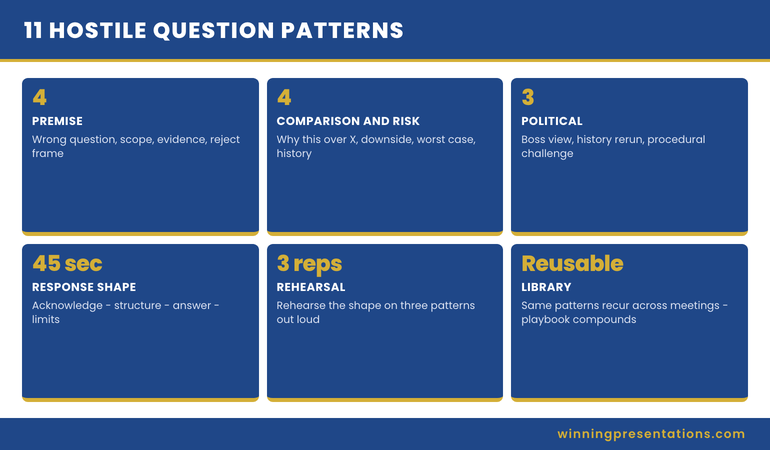
A hostile question playbook fixes the asymmetry. Boards have spent decades developing question patterns. Presenters who treat each one as a fresh surprise lose ground that experienced boards expect them to hold. The eleven patterns below are not exhaustive — boards are creative — but they cover the majority of what shows up in senior peer rooms.
If you present to a board this quarter
The Executive Q&A Handling System is a structured library of board question patterns paired with response shapes for each one. Three files. Instant access. Designed for senior professionals who present to boards, executive committees, and investment panels.
Why a playbook beats improvisation
Most senior presenters prepare their slides exhaustively and improvise the Q&A. The asymmetry is strange. The question session is where the decision actually gets made. The slides give the room a vocabulary. The answers give the room a verdict. Yet preparation tends to flow the wrong way around: ten hours on the deck, twenty minutes on possible questions.
Improvisation works when the questions are within range of what you have already thought about. It fails when the question pattern is one your mind has not rehearsed under pressure. Cortisol narrows the search space. The brain reaches for the most familiar adjacent answer, which is usually the analysis you have just defended. The room sees this as defensiveness. The proposal stalls.
A playbook addresses the cortisol problem. If you have already named a question pattern and rehearsed the response shape, your brain has somewhere to land that is not “re-explain the analysis”. The playbook does not tell you what to say. It tells you what kind of thing to say. The content fills in from your knowledge of the proposal. The shape comes from preparation.
Patterns 1 to 4: the premise challenges
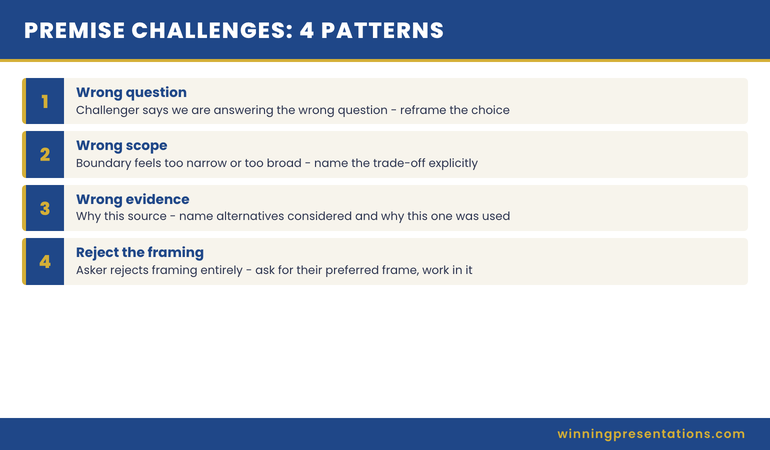
Premise challenges are the questions that attack the framing of the proposal rather than its content. They are the most common pattern at board level and the most damaging when handled badly. The four patterns below cover almost all of them.
Pattern 1 — The “wrong question” challenge. “I am not sure we are answering the right question.” This is what hit Lakshmi. The challenger is not disputing your data. They are disputing whether the data answers the question that matters. The wrong response is to defend the data. The right response is to acknowledge the framing critique and offer a structured choice between framings before defending either.
Pattern 2 — The “wrong scope” challenge. “This feels too narrow / too broad.” The board is signalling that the boundary you have drawn is uncomfortable. Defending the boundary as it stands almost always loses ground. The response shape is to name the trade-off explicitly: what you would gain by widening the scope, what you would lose, and what your recommendation would be in either world.
Pattern 3 — The “wrong evidence” challenge. “Why are we relying on that source?” or “Has anyone looked at the data from a different angle?” This is rarely an attack on the methodology. It is usually a request to demonstrate that you considered alternatives. The response shape is to name two or three alternative sources or angles, what they would have changed, and why the evidence base you used was the most defensible.
Pattern 4 — The “I do not accept that framing” challenge. Sharper than pattern 1. The challenger is not asking whether the framing is right. They are stating that it is wrong. The response shape is to ask, briefly, what alternative framing they would accept, and to commit to working through the implications under their preferred framing in the room. This concedes nothing on the substance but signals that you are not defending the framing for its own sake.
For senior presenters who face board Q&A
A structured library of board question patterns and response shapes
The Executive Q&A Handling System is built around the question patterns boards use most often. Each pattern is paired with a response shape that gives you a structured way to answer without re-explaining the analysis. Designed for senior professionals presenting to boards, investment committees, and executive sponsors.
- Question pattern library covering premise, scope, comparison, and political challenges
- Response shapes that give you a 45-second structured answer under pressure
- Scenario playbooks for board, investor, and executive committee Q&A
- Three files, instant access, designed for repeat use before high-stakes meetings
£39 · Instant access · Designed for executive Q&A scenarios
Patterns 5 to 8: the comparison and risk questions
Comparison and risk questions are less destabilising than premise challenges, but they are more frequent. Boards use them to test whether the presenter has thought beyond the proposal in front of them. Failing them rarely kills a proposal. It does, however, reduce the credit the presenter receives for everything else.
Pattern 5 — The “why this over X” comparison. “Why are we doing this rather than option X?” Option X is usually something the board has been thinking about that is not in your slides. The wrong response is to dismiss option X. The response shape is to acknowledge X as a serious alternative, name two or three reasons your recommendation differs, and explicitly state what would change your view in favour of X. This shows the room you have considered the alternative, not avoided it.
Pattern 6 — The “what is the downside” risk question. “What goes wrong here?” The response shape is to name the two or three failure modes you have actually thought about, what early signal would tell you each was happening, and what the response would be. Saying “we have de-risked it” is a credibility hit at board level. Naming concrete failure modes is the opposite.
Pattern 7 — The “what is the worst case” question. Different from pattern 6. The board is asking for the magnitude, not the failure mode. The response shape is a numeric answer with a confidence band, followed by what you would do at that point. Refusing to give a number reads as evasion. Giving a number without a confidence band reads as overconfidence.
Pattern 8 — The “have we done this before” comparison. “How does this compare to the last time we tried something similar?” The implicit reference is usually a previous initiative that did not work. The response shape is to name the comparison explicitly, identify the structural differences that make this proposal different, and acknowledge the structural similarities that make it the same. Pretending the comparison does not exist is the most common failure mode.
If your role involves frequent board exposure, the broader skill of structured Q&A handling is one of the highest-leverage areas to develop. The patterns here are a starting library, not the full inventory.
Patterns 9 to 11: the political questions
Political questions are the hardest pattern to prepare for because the content varies but the dynamic is consistent. The board member asking is not asking the question on the surface. They are testing where you sit on a relationship the board cares about.
Pattern 9 — The “what does your boss think” question. “Has your CFO signed off on this?” or “What is the CEO’s view?” The board is checking whether you have the political coverage to deliver. The response shape is to name the senior endorsements you actually have, distinguish between formal sign-off and informal support, and never overstate. Overstating here is one of the few things that ends careers in a single meeting.
Pattern 10 — The “we tried this before” history question. Different from pattern 8. The board member asking is usually the one who was in the room the last time it failed. The response shape is to acknowledge their context explicitly, distinguish what is different now, and concede any structural similarities you cannot deny. Dismissing the history reads as not knowing the company.
Pattern 11 — The “I am not sure we should be discussing this” question. The board member is questioning the appropriateness of the conversation, not the content. This is the most political pattern of all and the easiest to mishandle. The response shape is to acknowledge the procedural concern, defer to the chair on whether to continue, and signal that you are comfortable either way. Pushing back on a procedural challenge is almost always a credibility hit.
The response shape that works for all 11
A useful property of the eleven patterns is that they share a common response shape. The shape has four parts and runs in the same order regardless of which pattern you are facing. Once it is in muscle memory, you can adapt the content of any answer in real time without losing the structure.
Step one: acknowledge the question on its own terms. Repeat the substance of the question briefly, in language the asker would recognise as fair. This costs four seconds and signals that you are not going to evade. It also gives your cortisol a chance to drop.
Step two: name the structure of your answer. “There are three things to consider” or “I would distinguish two cases” or “the answer depends on which version of the question you are asking”. This buys composition time and signals that you are about to give a structured answer rather than a defensive one.
Step three: deliver the answer at the level of the question. If the question was about premise, answer at premise level — not at data level. If the question was about magnitude, give a number with a band. If the question was political, address the relationship behind the question. Most failed answers fail because they answer at the wrong altitude.
Step four: name what you do not know. Add one short sentence on the limits of your answer. “What I cannot tell you in this room is X. I will come back with that by Y.” This signals that you understand the boundary of your own answer, which is the strongest credibility move available at board level.
The four-part shape is roughly forty-five seconds total. Most board questions warrant exactly that amount of speaking time. The discipline is to stop at forty-five seconds rather than continue talking out of nervousness.
Companion technique for hostile Q&A
Bridging vs blocking when the room shifts
The four-part response shape works when you have time to use it. When the room moves faster, you need a layer underneath: bridging or blocking, and the rules for choosing between them. Read the companion piece on bridging vs blocking Q&A techniques for the decision rule used in fast-moving boards.
How to build your own playbook
A playbook is not a script. Scripts collapse the moment the question deviates from what you rehearsed. A playbook is a small library of patterns and response shapes that you can compose under pressure. Building it takes a few hours per high-stakes meeting and gets faster with practice.
Start with the eleven patterns above. For your specific proposal, write one example question for each pattern, in the words your board would actually use. Not the words you would use. The exercise is to put yourself in the head of the most sceptical voice in the room. If you cannot generate the question, ask someone who has been in that room before.
For each example, write a response shape, not an answer. Two or three bullet points naming what the answer needs to address. The actual sentences will form in the room. The shape stops you reaching for the wrong altitude when the cortisol hits.
Rehearse the four-part shape on three of the eleven patterns out loud. Not all eleven. Three. The discipline is in the structure, not in covering every pattern. If the four-part shape is in muscle memory, the other eight patterns will be handled adequately even if you have not rehearsed them specifically. If you face board members who frequently pile on with multiple challenges in sequence, the related companion piece is also useful preparation.
Repeat before every high-stakes presentation. The patterns do not change. The proposal does. Your playbook adapts in the few hours before each board, not in the moment.
Frequently asked questions
Are these the only hostile question patterns I will face at board level?
No. They are the most common patterns. Boards are creative, and a particular board’s culture, history, and pet topics will produce variations. The eleven cover roughly seventy to eighty per cent of difficult exchanges in board-level Q&A from the experience of senior presenters across financial services, biotech, and government. The remainder require pattern recognition built up over time.
How long does it take to internalise the four-part response shape?
Most senior presenters can put the structure into muscle memory in a few rehearsed run-throughs spread over two or three days. The harder discipline is stopping at step four rather than continuing to talk. That tends to take a small number of live presentations to build.
Should I rehearse specific answers, or just the shape?
Rehearse the shape. Specific answers tend to come out wooden because the brain knows it is reciting. The shape gives you a place to land while your brain composes the actual sentences in the room. The answers feel more natural to the audience and read as thinking rather than reading.
What if a board member asks a question that does not fit any of the eleven patterns?
Use the four-part shape anyway. Acknowledge, name the structure, answer at the right altitude, name the limits of your answer. The shape is what holds the room. The pattern recognition is a useful guide, but the shape is the real preparation.
If you present to a board, an investment committee, or an executive panel
Stop improvising the part of the meeting where the decision actually gets made
The Executive Q&A Handling System gives you the question pattern library and the response shapes used by senior presenters across financial services, biotech, professional services, and government. The structure is reusable across boards and across topics. The investment is one-time. The application is every meeting.
- Question pattern library covering board, investor, and executive committee Q&A
- Response shapes designed for forty-five-second structured answers
- Scenario playbooks for premise challenges, comparison questions, and political questions
- Three files, instant access, no subscription, no expiry
£39 · Instant access · Designed for executive Q&A scenarios
The Winning Edge — weekly
One short note each Thursday on board-level Q&A patterns, structured response shapes, and the behaviours senior presenters use under pressure. Written for professionals who do not have time for newsletters that read like newsletters.
Want a starting point first? The free Executive Presentation Checklist covers the structural fundamentals for board-level meetings before you commit to a paid system.
For a wider view of how this fits into senior-level Q&A handling, see the companion article on handling tough questions in presentations.
Next step: Pick one upcoming board-level meeting. Write one question for each of the eleven patterns in your stakeholders’ words. Rehearse the four-part response shape on three of them out loud. That is your playbook for the meeting.
Mary Beth Hazeldine is the Owner & Managing Director of Winning Presentations. With 24 years of corporate banking experience at JPMorgan Chase, PwC, Royal Bank of Scotland, and Commerzbank, she advises senior professionals across financial services, healthcare, technology, and government on structuring presentations and Q&A for high-stakes board meetings, investment committees, and executive sessions. She speaks German and works extensively with the German-speaking financial markets.