

Public Speaking for Executives vs Everyone: The Distinction Most Courses Miss
QUICK ANSWER
Public speaking for executives is not a polished version of public speaking for everyone. The audience reads differently, the stakes are decision-shaped rather than applause-shaped, and the structures that earn TED Talk standing ovations actively reduce credibility in front of senior approvers. The distinction is not nerves or charisma. It is a different discipline with different rules, and most public speaking courses teach the wrong one.
JUMP TO
Two disciplines, one name ·
The audience reads differently ·
Decision-shaped vs applause-shaped stakes ·
Why the structure flips ·
What actually works at senior level ·
Fixing the wrong training ·
FAQ
Henrik had been on the public speaking circuit for nine months before his first board presentation. Toastmasters twice a week. A weekend course in storytelling. A six-week online programme on stage presence. By the time he stood in front of the executive committee of a mid-sized Nordic bank, he was, by any reasonable measure, a confident speaker. He had the eye contact. He had the pauses. He had the personal story.
The committee declined his proposal in nineteen minutes. The chair told him afterwards, almost apologetically, that the room had found him “performative.” Henrik thought he had been polished. The board had read him as theatrical. The skills that had earned him a standing ovation at his Toastmasters club had landed in front of a senior decision audience as a reason to doubt the substance of the case.
This is not an unusual story. It is a structural one. The training Henrik had spent nine months absorbing was excellent training for one kind of public speaking, and almost the wrong training for the other.
Public speaking nerves at executive level?
If senior-level public speaking has become a source of anxiety rather than confidence, Conquer Your Fear of Public Speaking is built around the specific patterns senior professionals face — credit committees, board rooms, regulator meetings — not generic stage fright.
Two disciplines, one name
Public speaking is one of those domains where the language has not caught up with reality. The phrase covers a TED Talk, a wedding speech, a sales kick-off, a regulatory hearing, a credit committee paper, an investor pitch, and a town hall. These are not different applications of one skill. They are at least three or four different disciplines that share only the surface property that someone is standing up and talking to an audience.
The training industry has, until quite recently, treated all of them as the same thing. The dominant model has been the keynote speaker model: stage presence, narrative arc, vocal modulation, pause for effect, signature opening, signature close. This model works extremely well for the contexts it was built for — conferences, keynotes, festivals, large audiences who came to be moved or inspired.
It works much less well for the contexts senior professionals actually present in. A credit committee did not come to be moved. A board did not come to be inspired. An investment committee did not come for a story arc. They came to make a decision, and the standard public speaking toolkit pulls in the wrong direction at almost every step.
The audience reads differently
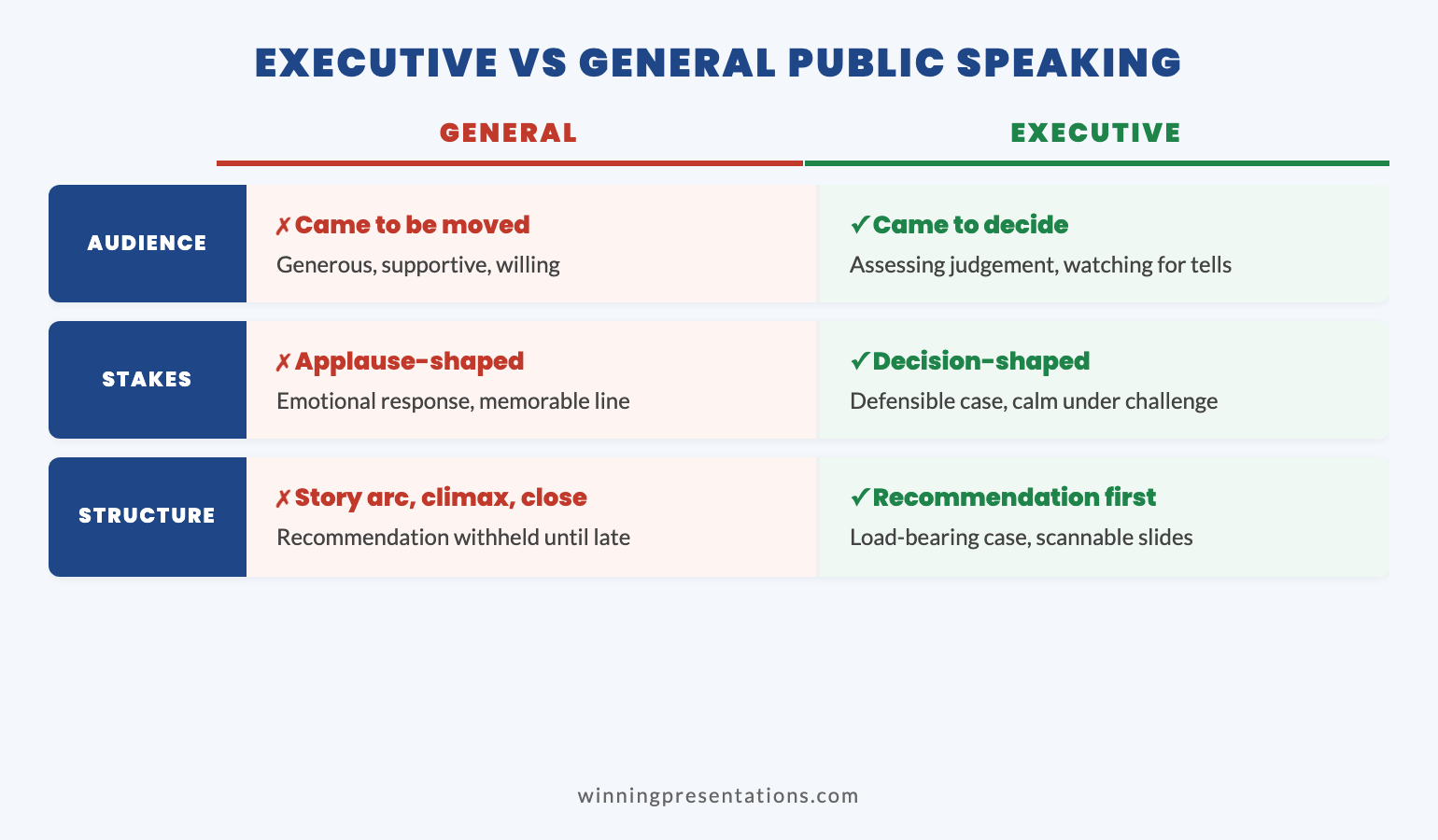
The first divergence is the audience. A general public speaking audience is, by default, a generous one. They came to listen. They want you to do well. They will smile at the moments where you might want them to smile. They are reading you as a speaker, and the question they are answering is “did this person move me?”
A senior decision audience is not generous in the same way. They are not hostile, but they are different. They are reading you as a colleague who has been given thirty minutes of their morning to make a case. The question they are answering is not “did this person move me.” It is closer to “do I trust this person’s judgement enough to act on what they are recommending?”
That second question is far more clinical than the first. It is not solved by warmth, by a strong opening line, or by a rehearsed personal story. It is solved by the room watching how you handle yourself when an assumption is challenged, by the visible structure of your reasoning, and by the calmness with which you answer questions you did not expect. Generic public speaking training does not optimise for any of these things, because the audiences it was built for did not require them.
Decision-shaped stakes vs applause-shaped stakes
The second divergence is the stakes. A keynote earns or fails to earn applause. A senior presentation earns or fails to earn a decision. These two outcomes feel similar from the speaker’s chair — both involve a room responding to you — but they have almost nothing in common in how they are produced.
Applause is largely an emotional response. It rewards the things that feel good in the moment: vulnerability, story, vocal control, a strong line, a moment of connection. Decisions are far less moment-driven. They are made on the basis of whether the case holds up to scrutiny, whether the speaker seems credible enough to bet on, and whether the implications of approving or declining are clearly understood.
The most striking effect of this difference is what counts as a “good moment.” In keynote speaking, a good moment is a memorable line that lands. In executive speaking, a good moment is a difficult question answered without flinching, in two clean sentences, with the speaker showing they had thought about the question before the room asked it. Most public speaking courses do not even have a category for the second type of moment, because their audiences never produced it.
Why the structure of the talk flips
Generic public speaking trains an arc: hook, build, climax, resolution. The recommendation comes at the end, ideally after a story that earns it. This is the right shape for an audience that is willing to follow you for thirty minutes. It is the wrong shape for a senior approver who is reading the deck on their phone in the back of a car between two other meetings.
Executive speaking flips the structure. The recommendation comes first. The case for it is laid out in load-bearing order. The implications, the costs, the risks, and the alternatives considered are laid out in a way that survives a senior reader landing on any single slide and reading just that slide. By slide three, an executive audience should be able to articulate what you are asking them to approve and why. By slide ten, they should have the full case.
The same speaker can deliver both structures. They are not personality-driven. They are discipline-driven. The reason most senior professionals struggle with the second structure is not that they cannot do it. It is that the public speaking training they have absorbed actively contradicts it. They have been taught, often very effectively, to withhold the punchline. In front of a senior audience, that withholding reads as either inexperience or evasion.
For a deeper look at the slide patterns that earn approval at senior level — rather than the patterns that win at speaking competitions — the executive public speaking course online walks through the structural differences in detail.
CONQUER YOUR FEAR OF PUBLIC SPEAKING
For senior-level public speaking, not generic stage fright
Senior-level public speaking nerves are different from stage fright. The audiences are different, the stakes are decision-shaped, and the visible signs of nerves are read as judgement signals. This system is built for executives presenting to credit committees, boards, regulators, and investors — not for keynote speakers.
- Patterns for the specific audiences senior professionals face
- Structured techniques for the moments where nerves show most
- Voice, breath, and recovery work tied to executive scenarios
- Self-paced, instant access on purchase
Conquer Your Fear of Public Speaking — £39, instant access. Designed for senior professionals who present to decision audiences.
Designed for senior-level decision audiences, not general stage performance.
What actually works in front of senior audiences
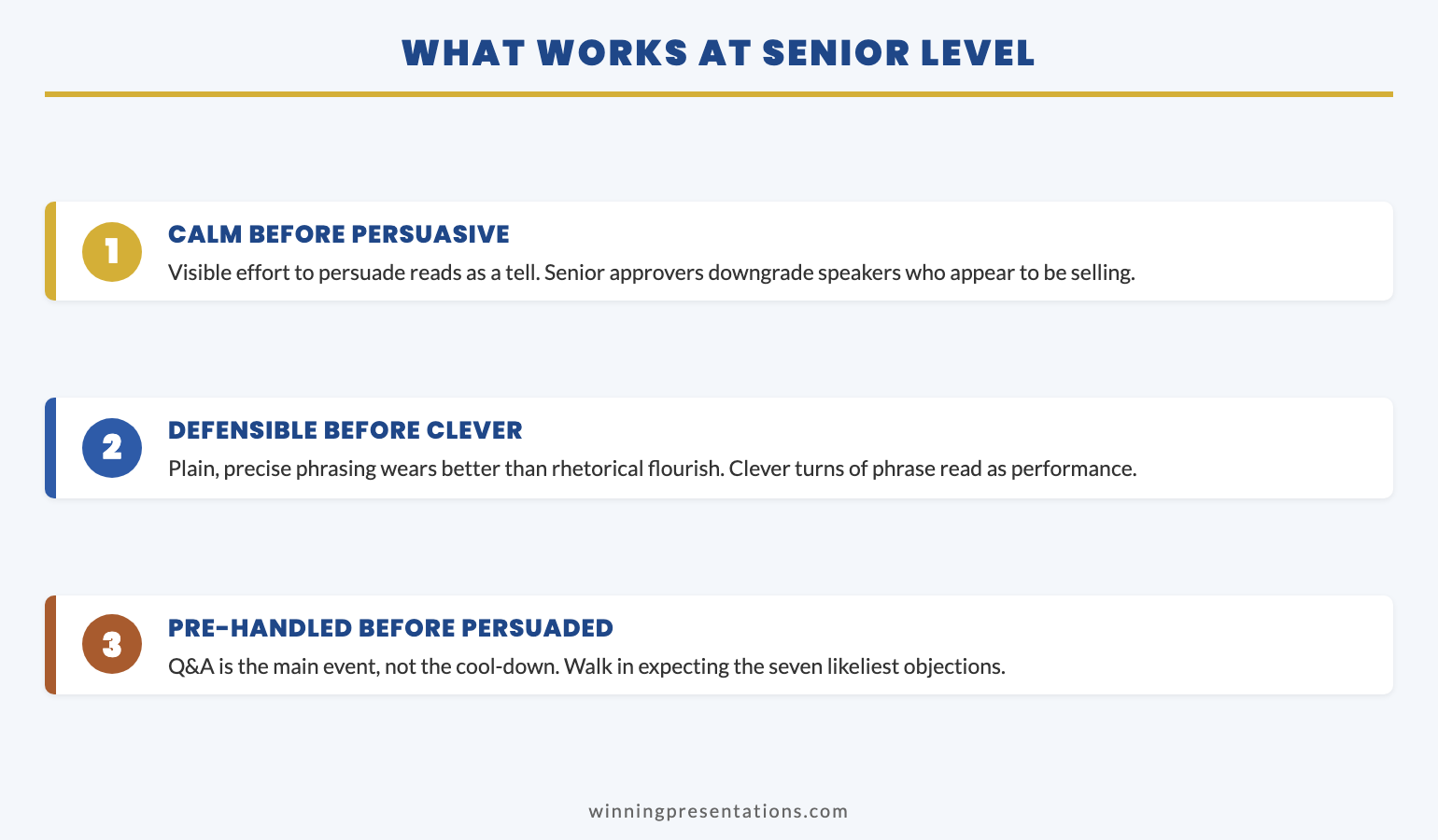
If most generic public speaking advice does not transfer cleanly to senior contexts, what does? Three patterns stand out across the senior professionals who do this consistently well.
Calm before persuasive. A senior approver reads visible effort to persuade as a tell. The harder you appear to be selling, the more they assume the case is weak. The presenters who earn approval consistently are not the most charismatic ones. They are the calmest ones. They speak slightly slower than feels natural. They allow silences. They look at the questioner while a difficult question is being asked, rather than nodding through it. None of this is theatrical. It is the opposite of theatrical — and that is the point.
Defensible before clever. A clever turn of phrase is a liability in front of a senior audience. It signals that the speaker is performing. The phrasing that wears well at executive level is plain, direct, and precise. The presenter who says “the underlying assumption that breaks if we are wrong here is the volume forecast” earns more credibility than the presenter who says, “this all hinges on volume — if that goes, so do we.” Both communicate the same content. Only one feels load-bearing.
Pre-handled before persuaded. Senior professionals who present consistently well treat the question session as the main event, not the cool-down. They prepare the seven to ten most predictable objections in writing, rehearse the responses aloud, and walk in expecting the room to ask all of them. The contrast with generic public speaking training is striking. Most courses spend forty minutes on opening lines and four minutes on Q&A. In senior contexts, the proportions need to flip. Building public speaking confidence at senior level often comes down to this preparation rather than to delivery polish.
Fixing the wrong training
If you have been through standard public speaking training and now present at senior level, the fix is not to undo the training. Many of the underlying skills — vocal control, breath, the use of pause — transfer cleanly. The fix is to layer the senior-context discipline on top, and in some cases to deliberately undo a few habits the generic training installed.
The habits worth undoing first are the ones that read as performative in a senior room. Heavy use of personal story in the opening. Long, dramatic pauses for emphasis. Vocal modulation that makes a moment feel “big.” Eye contact that lingers for effect. None of these are wrong in keynote contexts. All of them, used in a credit committee or a board, signal “I am performing for you” rather than “I am presenting a case to you” — and the latter is what the room came for.
The new habits worth installing are the calm-defensible-prehandled patterns above, plus the structural flip that puts the recommendation at the front and lays out the case in load-bearing order. Professional public speaking training aimed at senior professionals tends to spend most of its weight here, where the keynote-trained presenter has the most to gain.
If the speaking is for stakeholder approval rather than nerves
When the difficulty at senior level is less about nerves and more about turning rooms of stakeholders into approving rooms, the Executive Buy-In Presentation System covers the curriculum — stakeholder analysis, case construction, objection pre-handling, and the structures that hold up to senior scrutiny. £499, lifetime access to materials.
What is going on underneath, in most cases, is that the keynote training trained the right body of skill for the wrong audience. Once you can see the audience clearly — what they came for, what they read as credible, what they read as performative — the corrections are not large. They are just specific.
Why senior speaking is its own discipline
The professionals who become consistently good at senior-level public speaking tend to share a small library of moments. The committee declined a proposal that was, by every objective measure, the right one. A peer with a thinner case got approval because they had presented it differently. A regulator quietly stopped engaging midway through a session and the speaker realised the room had been lost in the first three slides. These moments are not failures of confidence. They are signals that the discipline being applied was the wrong one.
The fix is to treat senior public speaking as its own thing, with its own training, its own vocabulary, and its own audiences. The keynote canon is not wrong. It is just for a different room.
CONQUER YOUR FEAR OF PUBLIC SPEAKING
Built for the rooms senior professionals actually present in
Self-paced system addressing the specific patterns of senior-level public speaking nerves — calmness under scrutiny, voice and breath under pressure, recovery techniques for the visible signs of nerves that read most loudly to senior audiences. £39, instant access.
Designed for credit committees, boards, regulator meetings, and senior client presentations.
Frequently asked questions
Is public speaking for executives really different from public speaking in general?
Yes. The audience reads differently — senior decision audiences are answering “do I trust this person’s judgement?” rather than “did this person move me?” The stakes are decision-shaped, not applause-shaped. The structure flips, with the recommendation at the front. And several specific habits installed by generic training (heavy personal story, dramatic pauses, vocal modulation for effect) actively reduce credibility in front of senior approvers. The underlying skills overlap, but the disciplines are different.
Do public speaking courses help executives at all?
They help with the foundational skills — voice, breath, pause, basic stage composure. They tend not to help with the senior-context discipline, because most courses were built for general audiences (conferences, weddings, sales kick-offs) where the rules are different. Executives often need to layer senior-context training on top of generic public speaking training, and in some cases unlearn a few habits the generic training installed.
What is the most common mistake executives make in public speaking?
Treating senior decision audiences as if they were keynote audiences. The most visible symptoms are: leading with a personal story rather than a recommendation, withholding the punchline until the end of the talk, using vocal modulation to make moments feel “big,” and treating the question session as a cool-down rather than the main event. Each of these reads as either inexperience or evasion at senior level, even though it earns applause in keynote contexts.
If I am nervous in front of senior audiences, is that a public speaking problem or a different problem?
It is usually a senior-context-specific problem rather than a general public speaking one. The nerves often come from sensing that the room is reading you as a colleague being assessed, not as a speaker being supported. The fix is rarely more general public speaking practice. It is calmness training under scrutiny, plus the structural and pre-handling work that removes the “I am about to be caught out” feeling that drives most senior-level speaking nerves.
The Winning Edge
A weekly newsletter for senior professionals who present at board level. One specific structural idea per issue, drawn from real boardroom and committee work. No filler.
Not ready for the full system? Start here instead: download the free Executive Presentation Checklist — the pre-flight checks that catch the structural mistakes most senior professionals make in the last 24 hours before a high-stakes meeting.
If this article landed for you, The voice coaching industry secret is the natural next read. It walks through why senior executives often need different vocal training than public speakers and how the standard voice work transfers (and fails to transfer) to senior rooms.
Next step: open the next presentation you are preparing for a senior audience and run two checks. Where in the deck does the recommendation appear, and could a senior reader articulate it from slide three? Which of the calm-defensible-prehandled patterns is doing the least work? That is the gap most worth closing first.
Mary Beth Hazeldine is the Owner & Managing Director of Winning Presentations. With 24 years of corporate banking experience at JPMorgan Chase, PwC, Royal Bank of Scotland, and Commerzbank, she advises senior professionals across financial services, healthcare, technology, and government on structuring presentations for high-stakes funding rounds and approvals. She speaks German and works extensively with the German-speaking financial markets.