
Tag: public speaking course

22 May 2026
Featured image for Training Fatigue: Five Presentation Courses, Still Not Confident

Training Fatigue: Five Presentation Courses, Still Not Confident

QUICK ANSWER

Training fatigue is the quiet despair of senior professionals who have done four, five, sometimes six presentation courses and still do not feel confident in front of the rooms that matter. The diagnosis is rarely effort. It is that most courses train delivery polish for general audiences, not the senior-context disciplines — structure, preparation, Q&A — that actually produce confidence in front of boards, committees, and senior approvers. The earlier courses were not bad. They were aimed somewhere else.

Astrid had paid for course number six the night before her board presentation. She did it from her hotel room, on her phone, at half past ten, with the deck open on the desk beside her and a glass of water she had not touched. The course was £349 and promised “executive presence in five sessions.” She added it to her cart, and just before she pressed pay, she felt something she had not quite felt before. It was not hope. It was a kind of quiet despair.

She had done a two-day public speaking workshop in 2019. A storytelling intensive in 2021. A six-week online programme on stage presence in 2022. A voice-coaching package in 2023. A weekend on “high-stakes communication” the previous autumn. Each of them had been, by any reasonable standard, well-run. She had liked the trainers. She had done the homework. She had finished each one feeling slightly more capable, and within four to six weeks of going back into her actual work, she had felt the gains quietly drain out again.

What sat under the despair, when she let herself look at it, was not a worry that she was untrainable. It was a worry that she had been training the wrong thing. The board presentation in the morning was not going to be lost on stage presence. It was going to be lost — if it was lost — somewhere underneath all of that, in places her courses had never quite reached.

This is what training fatigue looks like at senior level. It is not laziness, and it is rarely lack of investment. It is the slow realisation, often years in, that the curriculum on offer has been pointing at the wrong layer.

Five courses in and still not feeling confident?

If presentation training has stopped producing durable confidence in front of senior audiences, it may be that the work you need next is not more delivery polish. Conquer Your Fear of Public Speaking is built around the patterns senior professionals face in credit committees, boards, and regulator meetings — not generic stage fright.

Explore the system →

What training fatigue actually feels like

Training fatigue is rarely the dramatic thing it sounds like. It does not arrive as a moment of crisis. It arrives, instead, as a small, familiar feeling that sits down beside you while you are filling in the booking form for the next course. The feeling is something close to: “I am doing this again, and I think I already know how the next eight weeks will go.”

The pattern is recognisable to almost any senior professional who has trained in this space for a while. The first course was illuminating. The second was useful. The third had a few new ideas. The fourth was mostly familiar, with one or two genuinely fresh frames. By the fifth, the marginal value had narrowed to a single technique, a single phrase, a single exercise that might or might not transfer to the next presentation.

And underneath it all, there is the awkward fact that the rooms that matter — the executive committee, the regulator briefing, the funding pitch, the board — still feel difficult. Not impossible. Not panic-inducing. Just difficult, in a way that the courses do not seem to have made dramatically less difficult.

What makes this fatigue particular at senior level is that the fatigue is not a sign that the professional has stopped trying. It is, very often, a sign that the professional has been trying extraordinarily diligently in a direction that does not lead all the way to where they need to go.

Four reasons most presentation courses fail to build durable confidence

When you look closely at the kind of training that dominates the market, four structural reasons emerge for why so much of it fails to produce confidence that lasts. None of these is a comment on the trainers. They are comments on the design.

Reason one: audience mismatch. The dominant model in presentation training is built for general audiences — conferences, sales kick-offs, internal town halls, weddings, Toastmasters rooms. These audiences are forgiving, generous, and reading the speaker as a performer. The senior audiences most professionals actually struggle with — boards, credit committees, regulators, investment panels — are reading the speaker as a colleague being assessed. The toolkit that wins one room signals “performative” in the other. A course that has never named that distinction has, by default, trained the wrong reflexes.

Reason two: delivery-only focus. Most courses spend the bulk of their time on the visible layer — voice, pause, eye contact, posture, opening lines, closing lines. These are real skills, and they do transfer to a point. But in front of senior audiences, confidence is not produced primarily by delivery polish. It is produced by knowing the case is sound, the structure is load-bearing, and the questions have been pre-handled. A course that trains only the visible layer leaves the load-bearing layer untouched, which is why the gains evaporate.

Four reasons most presentation courses fail to build durable senior confidence infographic showing audience mismatch, delivery-only focus, no preparation framework, and no Q and A work

Reason three: no preparation framework. Senior-level confidence is mostly preparation, and most courses do not teach a preparation framework with any real load. They teach a slide template, perhaps, or a story arc, perhaps a “rule of three.” What they rarely teach is how to map the audience in the room, how to identify the load-bearing assumptions in the case, how to sequence material so a senior reader can land on slide three and still know what is being asked of them. The professionals who present consistently well at senior level have an internal preparation routine that does most of the work. Most courses do not install one.

Reason four: little or no Q&A work. The session that reveals confidence at senior level is the question session, not the presentation itself. It is the moment a sceptical director asks the inconvenient question and the room watches how the speaker holds. Most presentation courses spend forty minutes on opening lines and four on Q&A. In senior contexts, the proportions need to flip. Building genuine public speaking confidence at senior level often comes down to this preparation rather than to anything that happens during the talk.

For a closer look at how these structural gaps tend to play out across formats, the article on coaching vs online courses walks through where each format helps and where each one quietly leaves the senior-context layer untouched.

CONQUER YOUR FEAR OF PUBLIC SPEAKING

A self-paced system for the rooms general courses do not reach

If five presentation courses have not produced durable confidence in front of senior audiences, the gap is rarely lack of effort. It is that the courses were aimed at general audiences. Conquer Your Fear of Public Speaking is built specifically for senior-context performance pressure — credit committees, boards, regulators, and senior client meetings.

  • Patterns for the specific audiences senior professionals face
  • Structured techniques for the moments where nerves show most
  • Voice, breath, and recovery work tied to executive scenarios
  • Self-paced, instant access on purchase

Conquer Your Fear of Public Speaking — £39, instant access. Designed for senior professionals who have done several general courses already.

Get the system →

Built for senior-level decision audiences, not general stage performance.

What is actually underneath senior-level confidence

One of the most useful things a senior professional can do, after several courses, is sit down and ask honestly: when I do feel confident in a senior room, what is doing the work? The answers are almost never “I had great vocal modulation today” or “my opening line really landed.” They are answers like these.

“I knew the case held.” The single largest predictor of confidence in front of a senior audience is the speaker’s quiet, internal knowledge that the case is structurally sound. Knowing the assumption that breaks if it is wrong. Knowing the alternative that was considered and rejected, and why. Knowing the cost of the path not chosen. Confidence here is not a feeling. It is a reflection of what is on the page.

“I had pre-handled the question I was most afraid of.” The second largest predictor is having stared down the worst question in advance. Senior professionals who present well have usually written down, in plain language, the seven to ten objections most likely to land — and rehearsed the responses out loud, two clean sentences each. The question session stops being a threat. It becomes the part of the meeting they were most prepared for.

“The room could land on slide three and still know what I was asking.” The third predictor is structural. Confidence rises sharply when the speaker knows the deck is load-bearing — when the recommendation is on the front, the case is sequenced in priority order, and any single slide reads coherently in isolation. This is structural craft, and most courses have not trained it.

What none of those predictors are about is delivery polish. The professionals who do this consistently well are not, by and large, the most charismatic ones. They are the ones who walked into the room knowing the case held, the questions had been pre-handled, and the deck would survive a senior reader skimming it on their phone.

When the gap is stakeholder buy-in, not delivery

For some senior professionals, the deeper issue under training fatigue is not nerves at all. It is that the rooms they need to win — the executive committee that has to greenlight the programme, the board that has to approve the spend, the senior stakeholder who has to back the proposal — require a different curriculum altogether. Stakeholder analysis. Case construction. Pre-handling objections. The structural work of moving a room of senior decision-makers from neutral to approving.

This is where many people quietly realise that the courses they have taken were never going to close the gap, because the gap was never about delivery in the first place. It was about the discipline of building a case that holds up to senior scrutiny — and that is closer to a structural craft than to a public speaking one.

If you recognise that pattern in your own situation, the article on the presentation skills gap at VP level walks through what shifts as the audience moves from internal teams to senior approvers, and what stops working when it does.

If the real gap is stakeholder buy-in, not nerves

When training fatigue is rooted in the realisation that the harder problem is turning rooms of senior stakeholders into approving rooms, The Executive Buy-In Presentation System covers the structural curriculum — stakeholder analysis, case construction, objection pre-handling, and the slide patterns that hold up to senior scrutiny. £499, lifetime access to materials, monthly cohort enrolment, optional recorded Q&A.

Explore the programme →

How to break the training fatigue cycle

The fix for training fatigue is not, ironically, more training in the same direction. It is a deliberate change of layer. There are four moves worth making, in roughly this order, before booking the next course.

Move one: name the audience honestly. Open a notebook and list the three to five rooms that actually matter for your career over the next two years. Not abstract audiences. Specific ones. The credit committee. The regulator briefing. The investment panel. The board. The C-suite quarterly review. Whatever they are, write them down. Once they are on the page, ask of any course you are considering: was it built for these rooms, or for someone else’s rooms? If the honest answer is “someone else’s,” that course will produce, at best, a partial transfer.

Move two: audit the layer your existing training has touched. Take the courses you have already done and ask, of each one: did this work on delivery, or on structure, or on preparation, or on Q&A? In most cases, the answer for four out of five courses will be “delivery.” The training fatigue is not because the delivery work was bad. It is because the other three layers have barely been touched.

Four moves to break the presentation training fatigue cycle infographic showing name the audience, audit the layer, install one structural change, and judge by the room not the course

Move three: install one structural change at a time. The most durable confidence gains tend to come not from another full course, but from a single structural change applied to the next real presentation. Move the recommendation to the front. Write the seven worst questions and rehearse the responses aloud. Rebuild slide three so it can stand alone. Each of these is a small change, and each of them does more for confidence than another six weeks of vocal modulation work. Professional public speaking training aimed at senior professionals tends to spend most of its weight on changes of this kind.

Move four: judge progress by the room, not by the course. The most reliable signal that training is producing durable confidence is not how it feels at the end of the course. It is how the next senior room reads. Did the questions feel less ambushing? Did the recommendation land earlier? Did the speaker get through the inconvenient question without flinching? These are the metrics. The course is just a delivery mechanism for them.

CONQUER YOUR FEAR OF PUBLIC SPEAKING

For the senior nerves general courses leave behind

If general training has not removed the underlying tightness in front of senior audiences, the next move is rarely more general training. The patterns that show most loudly in front of credit committees, regulators, and boards have their own structured techniques — calmness under scrutiny, voice and breath under pressure, recovery work for the visible signs of nerves. £39, self-paced, instant access.

Get the system →

Designed for senior-level decision audiences, not general stage performance.

Why the earlier courses were not wasted

One of the most important things to keep clear, when stepping back from the cycle, is that the earlier courses were not bad. The voice work was real voice work. The storytelling teaching was real storytelling teaching. The stage presence programme was a real programme. These trained skills that are usable, and many of them transfer to the senior context.

What did not transfer was the framing. The courses were aimed at audiences for whom delivery polish is the load-bearing variable. Senior approvers are not those audiences. The earlier work was not undone by recognising this. It was contextualised. Voice control still matters. Pause still matters. Eye contact still matters. They just stopped being where confidence was going to be made or lost. That moved one layer down, into the structural and preparation work most of those courses did not have time to teach.

For senior professionals who want to formalise that next layer in a structured format, the presenting with confidence course is the natural place to start — explicitly built for the rooms that did not respond to earlier training, rather than for general audiences who would have responded to it.

The earlier courses gave you the surface. The senior-context work installs what sits underneath, so the surface has something to rest on.

Frequently asked questions

Why do I feel less confident after five presentation courses than I expected to?

Because most general presentation courses train the visible layer — voice, pause, story, opening lines — which is not where senior-level confidence is primarily produced. In front of boards, committees, and senior approvers, confidence comes from the case being structurally sound, the questions being pre-handled, and the deck being load-bearing. Five rounds of delivery polish do not touch those three things, which is why the gains drain out within weeks of going back into real work.

Were the courses I did a waste of money, then?

No. The skills they trained — voice, breath, pause, story, basic stage composure — are real and they transfer to the senior context. They were just aimed at general audiences for whom delivery polish is the load-bearing variable. Senior approvers are not those audiences. The earlier work is not wasted; it sits on the surface. The work that fixes training fatigue sits one layer underneath, in structure, preparation, and Q&A.

How do I tell if a new course will be different from the five I have already done?

Ask, before booking, four specific questions. What audiences was this curriculum built for? How much time does it spend on structure and preparation versus on delivery? Does it cover Q&A as the main event or as an afterthought? Are the senior-context examples real ones — credit committees, boards, regulators, investment panels — or are they generalised “professional audience” examples? If the curriculum cannot answer those, it is most likely another delivery-polish course in a different wrapper.

If general courses have not built confidence, will more practice on my own help?

Practice helps once it is practising the right things. Practising delivery in the mirror, after five courses, tends to deliver diminishing returns. Practising the senior-context disciplines — restructuring a real deck so the recommendation lands at the front, writing the seven worst questions and rehearsing the responses aloud, rebuilding slide three so it stands alone — tends to produce visible gains within a single presentation cycle. The shift is from practising performance to practising preparation.

The Winning Edge

A weekly newsletter for senior professionals who present at board level. One specific structural idea per issue, drawn from real boardroom and committee work. No filler.

Subscribe to The Winning Edge →

CONQUER YOUR FEAR OF PUBLIC SPEAKING

If five courses have not closed the gap, this is built for what is left

Conquer Your Fear of Public Speaking is a self-paced system focused on the senior-level patterns general courses do not reach. There is no risk of buying a sixth iteration of the same delivery-polish curriculum, because this one is not aimed at general audiences. It is aimed at the rooms where the previous courses ran out of road — credit committees, boards, regulators, and senior client meetings.

  • Patterns for the specific audiences senior professionals face
  • Structured techniques for the moments where nerves show most
  • Voice, breath, and recovery work tied to executive scenarios
  • Self-paced, instant access, lifetime access to materials

£39, instant access. If, having worked through it, you find it does not address what your earlier courses left behind, Gumroad’s standard refund process applies — the financial risk of trying a more senior-context-shaped system is small.

Get the system →

For senior professionals already several courses in, who suspect the next layer is not more delivery work.

Not ready for another paid system? Start here instead: download the free Executive Presentation Checklist — the structural pre-flight checks that catch the load-bearing mistakes most senior professionals make in the last 24 hours before a high-stakes meeting. It is a small first move in the structural direction, and it costs nothing.

If this article resonated, the natural next read is how to build confidence in public speaking. It walks through the underlying components of senior-level speaking confidence in more detail and explains why most of them sit underneath, rather than on top of, the things general courses train. The speaking confidence course for professionals hub also maps the formats that tend to suit professionals who have already cycled through several rounds of general training.

Next step: open the next presentation you are preparing for a senior audience and run two checks. First, of the courses you have done so far, which layer were they primarily aimed at — delivery, structure, preparation, or Q&A? Second, which of those four layers is doing the least work in the deck in front of you right now? That is the gap most worth closing first, and it is almost certainly not the layer five general courses have already drilled.

Mary Beth Hazeldine is the Owner & Managing Director of Winning Presentations. With 24 years of corporate banking experience at JPMorgan Chase, PwC, Royal Bank of Scotland, and Commerzbank, she advises senior professionals across financial services, healthcare, technology, and government on structuring presentations for high-stakes funding rounds and approvals. She speaks German and works extensively with the German-speaking financial markets.

22 May 2026
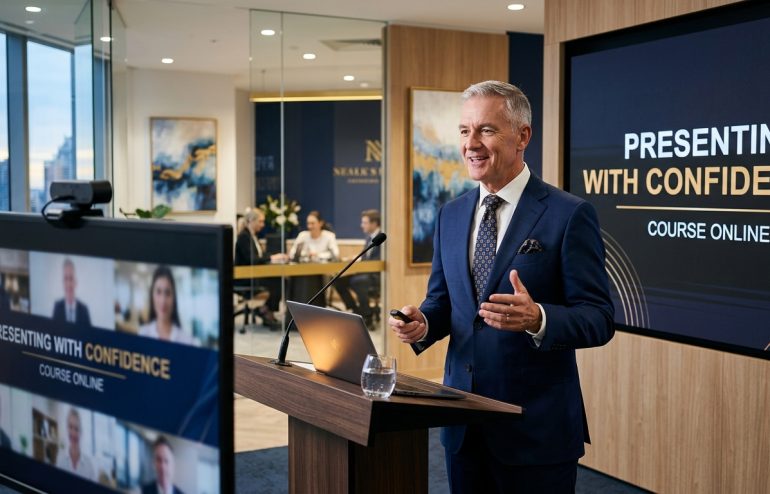
Featured image for Presenting with Confidence Course Online: What Actually Works

Presenting with Confidence Course Online: What Actually Works

QUICK ANSWER

A presenting with confidence course is worth buying when it trains the specific patterns of senior-level rooms — calmness under scrutiny, voice and breath under pressure, and recovery from the visible signs of nerves — rather than generic stage fright. Evaluate any course on four dimensions: who the audience is built for, what is actually trained, the format, and whether the work transfers to the specific rooms you present in. Most courses fail on the first dimension, which is why the rest never lands.

Folake had been searching for a presenting with confidence course online for three weeks before she bought one. She is a divisional director at a UK insurer, presenting to the executive risk committee roughly twice a quarter. The nerves were not a daily feature of her job. They were a feature of those specific mornings — the rooms where one wrong sentence under questioning could cost her credibility for the rest of the year. She bought the highest-rated course she could find, finished it in four evenings, and felt, by her own description, “more polished but no calmer.”

The course had not been a bad one. It had been a course built for someone else. The patterns it trained — opening lines, vocal warmth, story openings, eye contact across a wider audience — were the patterns of a keynote speaker. They were not the patterns of a divisional director answering a regulator’s question with the chair watching. The mismatch was not the course’s fault. It was a buying decision that had been made on rating rather than on fit.

This article is the framework Folake wishes she had used three weeks earlier — what a presenting with confidence course should and should not promise, and how to evaluate one before paying for it.

If senior-level rooms are where the nerves are loudest

Conquer Your Fear of Public Speaking is built around the patterns senior professionals face — committees, boards, regulators, investors — rather than generic stage fright. If that is the audience the course needs to fit, it is the right starting point.

Explore the system →

What you are actually buying

The first piece of clarity worth having before paying for any presenting with confidence course is what the category actually contains. The phrase “confidence course” is doing a lot of work. It can mean a stage-fright recovery programme aimed at people whose nerves stop them speaking at all. It can mean a delivery polish programme aimed at trainers and speakers who already perform regularly. It can mean a senior-context programme aimed at directors, partners, and VPs who present rarely but in rooms where the cost of a wobble is high. These are three different products. The buying mistake most senior professionals make is treating them as interchangeable.

What a confidence course should promise is a specific body of training. Patterns for the audiences you actually face. Voice and breath techniques that hold up under pressure rather than only on a quiet stage. Recovery work for the moments where nerves show — a dry mouth, a quickening pace, a thought that loses its way mid-sentence. A confidence course should not promise that you will never feel nerves again, that the room will love you, or that approval will follow. Any course that promises any of those is selling something other than confidence.

The realistic outcome of a good confidence course is not the absence of nerves. It is the presence of patterns. Patterns the body and the voice can default to under pressure, so that the visible signs of nerves stop being read by the room as judgement signals. That distinction — patterns under pressure rather than freedom from pressure — is what separates a course that earns its price from a course that polishes the surface and leaves the underneath untouched.

Four dimensions to evaluate

A senior buyer should evaluate any presenting with confidence course online on four dimensions, in this order. Skipping the first is what produces the Folake result.

1. Audience fit. Who is the course built for? The marketing copy will rarely say this clearly, so look at the examples in the syllabus. If the case studies feature TEDx speakers, conference keynotes, sales kick-offs, or wedding speeches, the course is built for the keynote audience. If the case studies feature credit committees, board rooms, executive risk committees, regulator meetings, or investor pitches, the course is built for senior decision audiences. The same techniques can produce wildly different results in these two contexts. Audience fit is the dimension that decides whether the rest of the course transfers at all.

2. What is actually trained. Read the module list as a procurement memo. A confidence course built for senior contexts should spend most of its weight on calmness under scrutiny, voice and breath under pressure, and recovery from the visible signs of nerves. It should not spend most of its weight on opening lines, signature stories, or charismatic stage presence. Those are delivery skills. They are useful, but they are not what holds a senior professional together when a committee chair asks the difficult question. If the syllabus is mostly delivery polish, the course is a delivery polish course wearing a confidence label.

3. Format. Self-paced or cohort? Live or recorded? Both formats work — but they suit different buyers. A self-paced course suits a senior professional whose presenting calendar is irregular and who needs to revisit specific patterns before specific meetings. A cohort course suits someone who needs the accountability of a fixed schedule and a peer group. Neither is better in the abstract. The question is which fits the rhythm of your actual work. The wrong format is the second most common reason a confidence course fails to land, after audience mismatch.

4. Transfer to real rooms. The most important dimension and the one most courses cannot answer well. How does the work in the course transfer to the specific rooms you present in? A good confidence course will be specific about this. It will tell you which patterns are designed for short-form Q&A, which are designed for sustained presentations, and which are designed for the moments where nerves spike — the regulator’s first question, the chair’s interruption, the slide where the assumption is challenged. If the course cannot answer the transfer question, the work will stay in the course. It will not arrive in the room with you.

Red flags to watch for

A small set of patterns recurs across confidence courses that under-deliver for senior professionals. None of these are scams. They are simply mismatches that the marketing does not flag.

Clinical language without clinical depth. A confidence course is not a therapy programme. When the marketing leans heavily on words like “anxiety,” “phobia,” or “trauma” without the credentials and structure to back them up, the course is using clinical framing to sell a delivery skills product. Senior professionals rarely need clinical language. They need behavioural patterns that hold under pressure. The right framing for a senior buyer is calm, structured, and practical — not pathologised.

Generic stage-fright framing. If the course treats all nerves as the same nerve, it is built for general audiences. Senior-level nerves have a specific shape. They are situational, scrutiny-driven, and tied to credibility rather than to performance. A course that does not distinguish between general stage fright and senior-room scrutiny is a course built for someone else. The transfer to your real rooms will be partial at best.

Big promises about outcomes. Any course that promises the room will love you, that approval will follow, or that nerves will disappear is selling outcomes the course cannot control. The honest promise of a confidence course is a process promise: better patterns under pressure, a calmer default voice, a clearer recovery from the moments where nerves show. Outcome promises are a marketing choice. Process promises are a professional one. Buy from the second.

This is similar to the due-diligence questions before paying for coaching — the same evaluation discipline applies whether you are paying for a course or for one-to-one work. The buyer who asks the structural questions first ends up with the better fit, almost regardless of the price point.

CONQUER YOUR FEAR OF PUBLIC SPEAKING

Built around the rooms senior professionals actually present in

A self-paced system addressing the specific patterns of senior-level public speaking nerves — calmness under scrutiny, voice and breath under pressure, and recovery techniques for the visible signs of nerves that read most loudly to senior audiences. Built for committees, boards, and regulator meetings rather than for keynote stages.

  • Patterns for the specific audiences senior professionals face
  • Structured techniques for the moments where nerves show most
  • Voice, breath, and recovery work tied to executive scenarios
  • Self-paced, instant access on purchase

Conquer Your Fear of Public Speaking — £39, instant access. Lifetime access to the materials.

Get the system →

Designed for senior-level decision audiences, not general stage performance.

What good looks like

A presenting with confidence course online that earns its place for a senior professional has a recognisable shape. The content is specific to the audience. The format respects the rhythm of senior work — short modules, clearly named, easy to revisit before a particular meeting rather than only consumable in one block. The promises are process promises, not outcome promises. The transfer to real rooms is named explicitly, with examples drawn from rooms that look like the buyer’s rooms.

Good also looks like restraint. A senior buyer should be wary of courses that promise to teach a complete public speaking system in a single product. The body of senior-level skill is wider than that. Confidence work is one strand. Slide structure is another. Stakeholder analysis is another. Case construction is another. A course that bundles everything tends to do none of it well. A course that is honestly scoped — “this is the confidence and delivery layer; the structural work is elsewhere” — tends to do its scope much better.

Good also includes what the course does not promise. It does not promise that nerves will disappear. It does not promise approval. It does not promise that the room will love you. It does not promise that the difficult question will not come. It promises patterns that hold under pressure when those things happen, which is the only honest promise a confidence course can make. The same discipline applies when senior professionals are weighing repeated rounds of training and asking whether they have hit training fatigue — restraint in the promise is what separates the course that earns repeat work from the one that exhausts the buyer.

If you are evaluating where the confidence work fits within a wider professional toolkit, professional public speaking training online is the natural next reference. It walks through how confidence training, delivery training, and structural training fit together — and which to buy first depending on the room you most often present in.

Making the decision

The buying decision for a presenting with confidence course online comes down to one question that contains all four evaluation dimensions: does this course train the specific patterns of the rooms I actually present in? If the answer is yes, the course is likely to transfer. If the answer is “I am not sure, but it is highly rated,” the course is likely to leave you, like Folake, more polished but no calmer.

For senior professionals — directors, VPs, partners, regulators’ counterparts — the rooms in question are decision rooms, not applause rooms. The audiences are reading you as a colleague being assessed rather than as a speaker being supported. The nerves that show up in those rooms are a specific kind of nerve. They are not solved by a stage-presence programme. They are not solved by storytelling. They are solved by patterns built for scrutiny — calm voice, controlled breath, a recovery from the moments where the body wants to speed up. The course that trains those patterns is the course worth buying. The one that does not, is not, regardless of price or rating.

Most senior professionals who go through this evaluation arrive at the same shortlist: a self-paced system that respects an irregular calendar, scoped specifically to confidence and delivery rather than the whole curriculum, and built around senior decision audiences rather than general stage performance. That shortlist is short by design — most courses on the open market do not meet all three criteria. The ones that do are the ones worth paying for. A speaking confidence course built for professionals applies the same evaluation lens, with side-by-side comparisons of the typical course types.

This is the same buying discipline that applies to other senior development decisions — see the presentation skills gap at VP level for a parallel framework on how to evaluate fit before paying for any senior-context training.

CONQUER YOUR FEAR OF PUBLIC SPEAKING

Self-paced, instant access, lifetime to the materials

Buy once, keep the materials, revisit before specific meetings. The structured techniques, voice and breath work, and recovery patterns are organised for the irregular rhythm of senior presenting calendars — not for a fixed-week cohort schedule. £39, instant access.

Get the system →

For senior professionals who present rarely but in rooms where calmness matters most.

Frequently asked questions

What should a presenting with confidence course online actually contain?

For senior professionals, the core content should be calmness under scrutiny, voice and breath under pressure, and recovery techniques for the visible signs of nerves. Delivery polish — opening lines, stage presence, vocal warmth — is useful but secondary. The test is whether the syllabus addresses the specific audiences and rooms the buyer presents in, rather than treating all public speaking nerves as the same nerve. A course built for keynote stages will transfer only partially to a credit committee or a board.

Is a self-paced course better than a live cohort for confidence work?

Neither format is better in the abstract. A self-paced course suits a senior professional whose presenting calendar is irregular — the kind who needs to revisit a specific pattern in the week before a particular meeting. A live cohort suits a buyer who needs the accountability of a fixed schedule and a peer group. The mistake is buying the format that fits someone else’s rhythm. Match the format to the actual rhythm of your presenting work.

What red flags should I watch for when evaluating a course?

Three recur. Clinical language (“anxiety,” “phobia,” “trauma”) without the credentials to back it up — that signals a delivery course wearing a clinical label. Generic stage-fright framing that treats all nerves as the same nerve — that signals a course built for general audiences. And outcome promises that the room will love you or approval will follow — those are promises a course cannot keep. The honest promises a confidence course can make are process promises about patterns under pressure.

How long should a presenting with confidence course take to complete?

For a senior buyer, the question is less about total length and more about modular structure. A course that can only be consumed in one block does not fit how senior professionals actually use this material — they revisit specific patterns before specific meetings rather than working straight through. A well-designed self-paced confidence course will have short, clearly named modules so a particular pattern (recovering from a difficult question, controlling pace under pressure) can be re-watched in fifteen minutes the night before a presentation.

The Winning Edge

A weekly newsletter for senior professionals who present at board level. One specific structural idea per issue, drawn from real boardroom and committee work. No filler.

Subscribe to The Winning Edge →

Not ready for the full system? Start here instead: download the free Executive Presentation Checklist — the pre-flight checks that catch the structural mistakes most senior professionals make in the last 24 hours before a high-stakes meeting.

If this article landed for you, How to build confidence in public speaking is the natural next read. It walks through the practical patterns senior professionals use to build calmness under scrutiny, with examples drawn from the same kinds of rooms.

Next step: open the syllabus of any presenting with confidence course you are considering and run the four-dimension check — audience fit, what is actually trained, format, and transfer to your real rooms. If any of the four is unclear from the marketing copy, that is the question to ask before buying. Most buyers skip the first dimension and pay for the consequences.

Mary Beth Hazeldine is the Owner & Managing Director of Winning Presentations. With 24 years of corporate banking experience at JPMorgan Chase, PwC, Royal Bank of Scotland, and Commerzbank, she advises senior professionals across financial services, healthcare, technology, and government on structuring presentations for high-stakes funding rounds and approvals. She speaks German and works extensively with the German-speaking financial markets.
20 May 2026
Featured image for Public Speaking for Executives vs Everyone: The Distinction Most Courses Miss

Public Speaking for Executives vs Everyone: The Distinction Most Courses Miss

QUICK ANSWER

Public speaking for executives is not a polished version of public speaking for everyone. The audience reads differently, the stakes are decision-shaped rather than applause-shaped, and the structures that earn TED Talk standing ovations actively reduce credibility in front of senior approvers. The distinction is not nerves or charisma. It is a different discipline with different rules, and most public speaking courses teach the wrong one.

Henrik had been on the public speaking circuit for nine months before his first board presentation. Toastmasters twice a week. A weekend course in storytelling. A six-week online programme on stage presence. By the time he stood in front of the executive committee of a mid-sized Nordic bank, he was, by any reasonable measure, a confident speaker. He had the eye contact. He had the pauses. He had the personal story.

The committee declined his proposal in nineteen minutes. The chair told him afterwards, almost apologetically, that the room had found him “performative.” Henrik thought he had been polished. The board had read him as theatrical. The skills that had earned him a standing ovation at his Toastmasters club had landed in front of a senior decision audience as a reason to doubt the substance of the case.

This is not an unusual story. It is a structural one. The training Henrik had spent nine months absorbing was excellent training for one kind of public speaking, and almost the wrong training for the other.

Public speaking nerves at executive level?

If senior-level public speaking has become a source of anxiety rather than confidence, Conquer Your Fear of Public Speaking is built around the specific patterns senior professionals face — credit committees, board rooms, regulator meetings — not generic stage fright.

Explore the system →

Two disciplines, one name

Public speaking is one of those domains where the language has not caught up with reality. The phrase covers a TED Talk, a wedding speech, a sales kick-off, a regulatory hearing, a credit committee paper, an investor pitch, and a town hall. These are not different applications of one skill. They are at least three or four different disciplines that share only the surface property that someone is standing up and talking to an audience.

The training industry has, until quite recently, treated all of them as the same thing. The dominant model has been the keynote speaker model: stage presence, narrative arc, vocal modulation, pause for effect, signature opening, signature close. This model works extremely well for the contexts it was built for — conferences, keynotes, festivals, large audiences who came to be moved or inspired.

It works much less well for the contexts senior professionals actually present in. A credit committee did not come to be moved. A board did not come to be inspired. An investment committee did not come for a story arc. They came to make a decision, and the standard public speaking toolkit pulls in the wrong direction at almost every step.

The audience reads differently

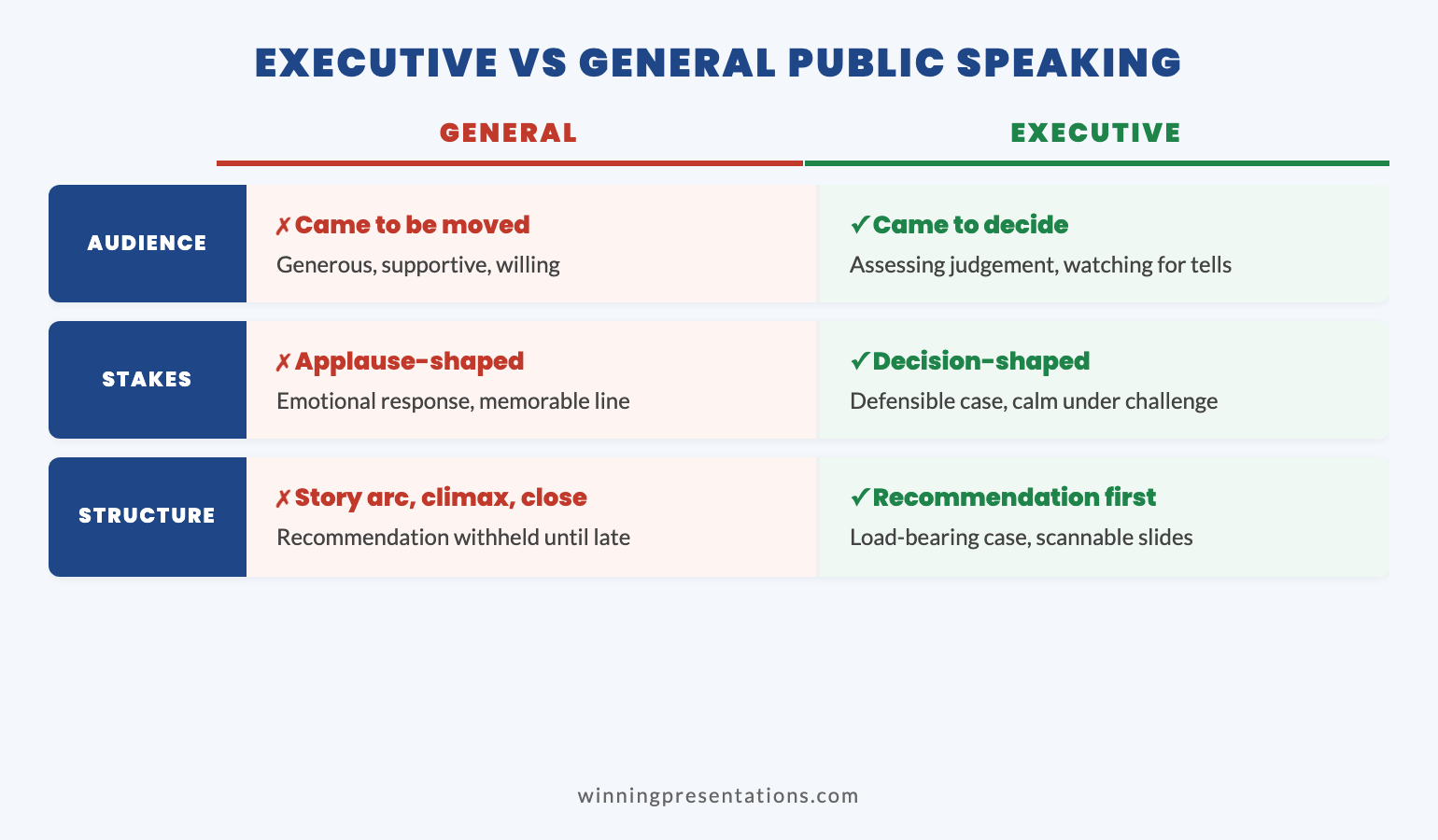
The first divergence is the audience. A general public speaking audience is, by default, a generous one. They came to listen. They want you to do well. They will smile at the moments where you might want them to smile. They are reading you as a speaker, and the question they are answering is “did this person move me?”

A senior decision audience is not generous in the same way. They are not hostile, but they are different. They are reading you as a colleague who has been given thirty minutes of their morning to make a case. The question they are answering is not “did this person move me.” It is closer to “do I trust this person’s judgement enough to act on what they are recommending?”

That second question is far more clinical than the first. It is not solved by warmth, by a strong opening line, or by a rehearsed personal story. It is solved by the room watching how you handle yourself when an assumption is challenged, by the visible structure of your reasoning, and by the calmness with which you answer questions you did not expect. Generic public speaking training does not optimise for any of these things, because the audiences it was built for did not require them.

Comparison infographic showing the differences between general public speaking and executive public speaking across audience expectation, stakes, structure, and credibility signals

Decision-shaped stakes vs applause-shaped stakes

The second divergence is the stakes. A keynote earns or fails to earn applause. A senior presentation earns or fails to earn a decision. These two outcomes feel similar from the speaker’s chair — both involve a room responding to you — but they have almost nothing in common in how they are produced.

Applause is largely an emotional response. It rewards the things that feel good in the moment: vulnerability, story, vocal control, a strong line, a moment of connection. Decisions are far less moment-driven. They are made on the basis of whether the case holds up to scrutiny, whether the speaker seems credible enough to bet on, and whether the implications of approving or declining are clearly understood.

The most striking effect of this difference is what counts as a “good moment.” In keynote speaking, a good moment is a memorable line that lands. In executive speaking, a good moment is a difficult question answered without flinching, in two clean sentences, with the speaker showing they had thought about the question before the room asked it. Most public speaking courses do not even have a category for the second type of moment, because their audiences never produced it.

Why the structure of the talk flips

Generic public speaking trains an arc: hook, build, climax, resolution. The recommendation comes at the end, ideally after a story that earns it. This is the right shape for an audience that is willing to follow you for thirty minutes. It is the wrong shape for a senior approver who is reading the deck on their phone in the back of a car between two other meetings.

Executive speaking flips the structure. The recommendation comes first. The case for it is laid out in load-bearing order. The implications, the costs, the risks, and the alternatives considered are laid out in a way that survives a senior reader landing on any single slide and reading just that slide. By slide three, an executive audience should be able to articulate what you are asking them to approve and why. By slide ten, they should have the full case.

The same speaker can deliver both structures. They are not personality-driven. They are discipline-driven. The reason most senior professionals struggle with the second structure is not that they cannot do it. It is that the public speaking training they have absorbed actively contradicts it. They have been taught, often very effectively, to withhold the punchline. In front of a senior audience, that withholding reads as either inexperience or evasion.

For a deeper look at the slide patterns that earn approval at senior level — rather than the patterns that win at speaking competitions — the executive public speaking course online walks through the structural differences in detail.

CONQUER YOUR FEAR OF PUBLIC SPEAKING

For senior-level public speaking, not generic stage fright

Senior-level public speaking nerves are different from stage fright. The audiences are different, the stakes are decision-shaped, and the visible signs of nerves are read as judgement signals. This system is built for executives presenting to credit committees, boards, regulators, and investors — not for keynote speakers.

  • Patterns for the specific audiences senior professionals face
  • Structured techniques for the moments where nerves show most
  • Voice, breath, and recovery work tied to executive scenarios
  • Self-paced, instant access on purchase

Conquer Your Fear of Public Speaking — £39, instant access. Designed for senior professionals who present to decision audiences.

Get the system →

Designed for senior-level decision audiences, not general stage performance.

What actually works in front of senior audiences

If most generic public speaking advice does not transfer cleanly to senior contexts, what does? Three patterns stand out across the senior professionals who do this consistently well.

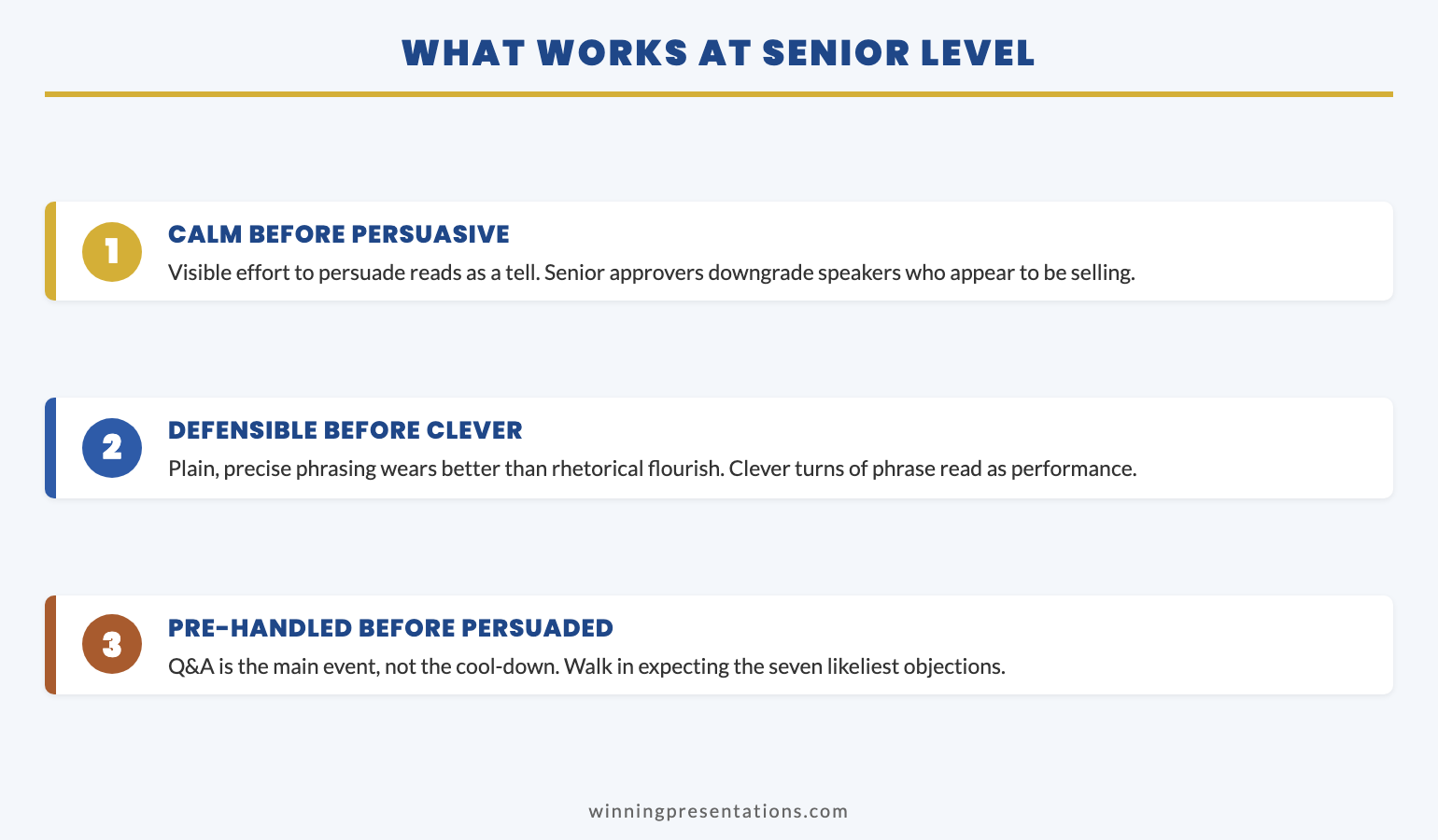
Calm before persuasive. A senior approver reads visible effort to persuade as a tell. The harder you appear to be selling, the more they assume the case is weak. The presenters who earn approval consistently are not the most charismatic ones. They are the calmest ones. They speak slightly slower than feels natural. They allow silences. They look at the questioner while a difficult question is being asked, rather than nodding through it. None of this is theatrical. It is the opposite of theatrical — and that is the point.

Defensible before clever. A clever turn of phrase is a liability in front of a senior audience. It signals that the speaker is performing. The phrasing that wears well at executive level is plain, direct, and precise. The presenter who says “the underlying assumption that breaks if we are wrong here is the volume forecast” earns more credibility than the presenter who says, “this all hinges on volume — if that goes, so do we.” Both communicate the same content. Only one feels load-bearing.

Pre-handled before persuaded. Senior professionals who present consistently well treat the question session as the main event, not the cool-down. They prepare the seven to ten most predictable objections in writing, rehearse the responses aloud, and walk in expecting the room to ask all of them. The contrast with generic public speaking training is striking. Most courses spend forty minutes on opening lines and four minutes on Q&A. In senior contexts, the proportions need to flip. Building public speaking confidence at senior level often comes down to this preparation rather than to delivery polish.

Three patterns that work in senior public speaking infographic showing calm before persuasive, defensible before clever, and pre-handled before persuaded as ordered disciplines

Fixing the wrong training

If you have been through standard public speaking training and now present at senior level, the fix is not to undo the training. Many of the underlying skills — vocal control, breath, the use of pause — transfer cleanly. The fix is to layer the senior-context discipline on top, and in some cases to deliberately undo a few habits the generic training installed.

The habits worth undoing first are the ones that read as performative in a senior room. Heavy use of personal story in the opening. Long, dramatic pauses for emphasis. Vocal modulation that makes a moment feel “big.” Eye contact that lingers for effect. None of these are wrong in keynote contexts. All of them, used in a credit committee or a board, signal “I am performing for you” rather than “I am presenting a case to you” — and the latter is what the room came for.

The new habits worth installing are the calm-defensible-prehandled patterns above, plus the structural flip that puts the recommendation at the front and lays out the case in load-bearing order. Professional public speaking training aimed at senior professionals tends to spend most of its weight here, where the keynote-trained presenter has the most to gain.

If the speaking is for stakeholder approval rather than nerves

When the difficulty at senior level is less about nerves and more about turning rooms of stakeholders into approving rooms, the Executive Buy-In Presentation System covers the curriculum — stakeholder analysis, case construction, objection pre-handling, and the structures that hold up to senior scrutiny. £499, lifetime access to materials.

Explore the programme →

What is going on underneath, in most cases, is that the keynote training trained the right body of skill for the wrong audience. Once you can see the audience clearly — what they came for, what they read as credible, what they read as performative — the corrections are not large. They are just specific.

Why senior speaking is its own discipline

The professionals who become consistently good at senior-level public speaking tend to share a small library of moments. The committee declined a proposal that was, by every objective measure, the right one. A peer with a thinner case got approval because they had presented it differently. A regulator quietly stopped engaging midway through a session and the speaker realised the room had been lost in the first three slides. These moments are not failures of confidence. They are signals that the discipline being applied was the wrong one.

The fix is to treat senior public speaking as its own thing, with its own training, its own vocabulary, and its own audiences. The keynote canon is not wrong. It is just for a different room.

CONQUER YOUR FEAR OF PUBLIC SPEAKING

Built for the rooms senior professionals actually present in

Self-paced system addressing the specific patterns of senior-level public speaking nerves — calmness under scrutiny, voice and breath under pressure, recovery techniques for the visible signs of nerves that read most loudly to senior audiences. £39, instant access.

Get the system →

Designed for credit committees, boards, regulator meetings, and senior client presentations.

Frequently asked questions

Is public speaking for executives really different from public speaking in general?

Yes. The audience reads differently — senior decision audiences are answering “do I trust this person’s judgement?” rather than “did this person move me?” The stakes are decision-shaped, not applause-shaped. The structure flips, with the recommendation at the front. And several specific habits installed by generic training (heavy personal story, dramatic pauses, vocal modulation for effect) actively reduce credibility in front of senior approvers. The underlying skills overlap, but the disciplines are different.

Do public speaking courses help executives at all?

They help with the foundational skills — voice, breath, pause, basic stage composure. They tend not to help with the senior-context discipline, because most courses were built for general audiences (conferences, weddings, sales kick-offs) where the rules are different. Executives often need to layer senior-context training on top of generic public speaking training, and in some cases unlearn a few habits the generic training installed.

What is the most common mistake executives make in public speaking?

Treating senior decision audiences as if they were keynote audiences. The most visible symptoms are: leading with a personal story rather than a recommendation, withholding the punchline until the end of the talk, using vocal modulation to make moments feel “big,” and treating the question session as a cool-down rather than the main event. Each of these reads as either inexperience or evasion at senior level, even though it earns applause in keynote contexts.

If I am nervous in front of senior audiences, is that a public speaking problem or a different problem?

It is usually a senior-context-specific problem rather than a general public speaking one. The nerves often come from sensing that the room is reading you as a colleague being assessed, not as a speaker being supported. The fix is rarely more general public speaking practice. It is calmness training under scrutiny, plus the structural and pre-handling work that removes the “I am about to be caught out” feeling that drives most senior-level speaking nerves.

The Winning Edge

A weekly newsletter for senior professionals who present at board level. One specific structural idea per issue, drawn from real boardroom and committee work. No filler.

Subscribe to The Winning Edge →

Not ready for the full system? Start here instead: download the free Executive Presentation Checklist — the pre-flight checks that catch the structural mistakes most senior professionals make in the last 24 hours before a high-stakes meeting.

If this article landed for you, The voice coaching industry secret is the natural next read. It walks through why senior executives often need different vocal training than public speakers and how the standard voice work transfers (and fails to transfer) to senior rooms.

Next step: open the next presentation you are preparing for a senior audience and run two checks. Where in the deck does the recommendation appear, and could a senior reader articulate it from slide three? Which of the calm-defensible-prehandled patterns is doing the least work? That is the gap most worth closing first.

Mary Beth Hazeldine is the Owner & Managing Director of Winning Presentations. With 24 years of corporate banking experience at JPMorgan Chase, PwC, Royal Bank of Scotland, and Commerzbank, she advises senior professionals across financial services, healthcare, technology, and government on structuring presentations for high-stakes funding rounds and approvals. She speaks German and works extensively with the German-speaking financial markets.
19 Dec 2025
Presentation skills training comparison - traditional vs psychology and AI approach for lasting confidence

Presentation Skills Training: Why Most Programs Fail (And What Actually Works)

A hypnotherapist and ex-banker reveals why traditional presentation training doesn’t stick — and the psychology + AI approach that does

You’ve probably been through presentation skills training before. A one-day workshop. A corporate programme. Maybe even executive coaching.

And yet here you are, still searching for answers.

That’s not your fault. It’s a fundamental problem with how presentation training is designed. After 24 years presenting in corporate banking and treating hundreds of anxiety clients as a clinical hypnotherapist, I’ve seen exactly why most programmes fail — and what actually creates lasting change.

🎁 Free Download: Get my Executive Presentation Checklist — the pre-presentation routine I use before every high-stakes talk. A taste of what proper training includes.

Why Traditional Presentation Skills Training Doesn’t Work

Most presentation training focuses on the wrong things:

Problem #1: They teach techniques without addressing psychology.

“Make eye contact.” “Use gestures.” “Vary your tone.” These are surface-level tips that don’t help when your nervous system is in fight-or-flight mode. In my hypnotherapy practice, I saw this constantly — people who knew exactly what they should do but couldn’t do it when anxiety hit.

You can’t perform techniques when your hands are shaking and your mind is blank.

Problem #2: One-day workshops don’t create lasting change.

Research on skill acquisition is clear: lasting change requires spaced practice over time, not a single intensive session. Yet most corporate presentation training is a one-day event that’s forgotten within weeks.

Problem #3: They ignore the preparation bottleneck.

Most presentation anxiety comes from inadequate preparation — not lack of delivery skills. When you’re rushing to finish slides the night before, of course you’ll be nervous. But traditional training focuses almost entirely on delivery, not on how to prepare effectively.

Problem #4: They don’t adapt to how work has changed.

AI has transformed how we create content. Professionals who learn to use these tools effectively can prepare presentations in a fraction of the time — reducing anxiety and improving quality. Yet most presentation training ignores this entirely.

Related: Why Most Presentation Training Fails (And What Actually Works)

What Effective Presentation Skills Training Actually Looks Like

After training over 5,000 executives and treating hundreds of anxiety clients, I’ve identified what actually works:

1. Address the Psychology First

Before you can improve delivery, you need to manage your nervous system. This means learning techniques that work at the physiological level — breathing patterns that activate the parasympathetic response, anchoring techniques that access confident states on demand, and reframing methods that change how your brain interprets arousal.

This isn’t “mindset” fluff. It’s applied psychology from clinical practice.

Related: Public Speaking Tips: 15 Techniques That Actually Work

2. Fix the Preparation Problem

The executives I train who are most confident aren’t naturally gifted speakers — they’re exceptionally well-prepared. They have systems for structuring their message, creating compelling visuals, and rehearsing effectively.

Modern AI tools have made this dramatically easier. What used to take 6+ hours can now be done in 90 minutes — if you know how to use the tools correctly. That extra preparation time translates directly to confidence.

Related: AI Presentation Workflow: How I Cut Creation Time from 6 Hours to 90 Minutes

3. Space Learning Over Time

Skill development requires practice, feedback, and iteration. A single workshop can’t provide that. Effective training happens over weeks, with opportunities to apply techniques, get feedback, and refine your approach.

4. Combine AI Efficiency with Human Connection

AI can help you create better content faster. But the delivery — the presence, the connection, the ability to read the room and adapt — that’s irreducibly human. The best training teaches you to leverage AI for preparation while developing the human skills that make presentations memorable.

The 3Ps Framework: How My Clients Have Raised £250M+

Over 35 years, I’ve developed a methodology called the 3Ps Framework that addresses all three elements of effective presenting:

Proposition: What you’re actually saying — the structure, the argument, the story. Most presentations fail here before anyone opens their mouth. AI tools can dramatically accelerate this phase when used correctly.

Presentation: How the content is visualised and delivered. This includes slide design, pacing, and the technical aspects of delivery. Again, AI can help — but only if you know how to prompt it effectively.

Personality: The human element — presence, confidence, connection. This is where psychology matters most. No AI can give you executive presence. But the right techniques can unlock it.

Clients using this framework have raised over £250 million in funding. Not because they became different people — but because they learned to prepare effectively, manage their psychology, and deliver with authentic confidence.

Related: The 3Ps Framework: How My Clients Have Raised £250M+ in Funding

Presentation Skills Training That Actually Works

My AI-Enhanced Presentation Mastery course combines everything that makes training effective:

  • Psychology-based confidence techniques from my hypnotherapy practice
  • AI-powered preparation systems that cut creation time by 75%
  • Spaced learning over 8 modules with 2 live coaching sessions
  • Real-world application to your actual presentations

January cohort: £249 (increases to £499 in April)

Only 60 seats. Early bird ends December 31st.

See the full curriculum →

Who This Approach Works Best For

The psychology + AI approach to presentation skills training is particularly effective for:

Executives who present to boards and investors. High stakes require both confidence and preparation. The AI tools accelerate your preparation; the psychology techniques ensure you deliver with presence.

Professionals who’ve tried training before without lasting results. If you’ve done workshops that didn’t stick, you likely need the psychology component that was missing — not more tips on gestures and eye contact.

Anyone who spends too long preparing presentations. If you’re regularly working late on slides, AI-enhanced workflows can reclaim hours of your week while actually improving quality.

People who know their material but freeze under pressure. This is a classic sign that psychology, not knowledge, is the bottleneck. Clinical techniques for managing your nervous system will help more than any delivery tip.

Related: How to Create Executive Presentations That Get Results

What to Look for in Presentation Skills Training

If you’re evaluating options for presentation skills training, here’s what to look for:

Does it address psychology, not just technique? Look for programmes that teach anxiety management, confidence building, and mindset — not just “10 tips for better slides.”

Is it spaced over time or a one-day event? Lasting change requires practice and iteration. A single workshop is entertainment, not training.

Does it include modern tools? AI has changed how presentations are created. Training that ignores this is already outdated.

Is there personalised feedback? Generic advice only gets you so far. Look for programmes with live coaching or feedback on your specific presentations.

What’s the trainer’s actual experience? Theory is easy. Look for trainers who have presented in high-stakes environments themselves — not just taught others to do it.

Frequently Asked Questions

How is this different from corporate presentation training?

Most corporate training focuses on delivery tips (eye contact, gestures, voice) without addressing the psychology that prevents you from using those tips under pressure. It’s also typically a one-day event with no follow-up. The approach I teach addresses psychology first, uses AI to solve the preparation bottleneck, and is spaced over time for lasting change.

I’ve done presentation training before and it didn’t help. Why would this be different?

If previous training didn’t work, it likely focused on surface techniques without addressing your nervous system’s response to presenting. The psychology-based techniques I teach — drawn from clinical hypnotherapy — work at the physiological level where anxiety actually lives. That’s the missing piece for most people.

Do I need to be technical to use the AI components?

Not at all. The AI tools I teach (primarily Microsoft Copilot and ChatGPT) are designed to work with natural language prompts. If you can describe what you want, you can use these tools. The course includes exact prompts you can copy and adapt.

How much time does the training require?

The AI-Enhanced Presentation Mastery course includes 8 self-paced modules (about 30-45 minutes each) plus 2 live coaching sessions (90 minutes each). Most people complete it over 4-6 weeks while applying techniques to real presentations.

What if I’m already a confident presenter?

The AI components alone can save you 4+ hours per presentation. Even confident presenters benefit from more efficient preparation and advanced techniques for reading the room, handling difficult questions, and adapting on the fly.

Is there a guarantee?

Yes. Maven offers a full refund until the halfway point of the course. If it’s not working for you, you get your money back.


Your Next Step

If you’re serious about improving your presentation skills — not just attending another workshop that doesn’t stick — here’s what I recommend:

  1. Start with the fundamentals. Read my guide to 15 Public Speaking Tips That Actually Work and try the techniques in your next presentation.
  2. Download the checklist. Get the Executive Presentation Checklist and use it before your next high-stakes talk.
  3. Consider structured training. If you want the complete system — psychology, AI tools, and live coaching — the AI-Enhanced Presentation Mastery course covers everything.

The January cohort has 60 seats at £249 (early bird pricing ends December 31st). After that, the price increases to £499.

Ready for Presentation Training That Actually Works?

AI-Enhanced Presentation Mastery

Psychology-based confidence + AI-powered preparation + Live coaching

£249 £499

Early bird ends December 31st • 60 seats • Full refund guarantee

Enrol Now →


Mary Beth Hazeldine is a qualified clinical hypnotherapist and Managing Director of Winning Presentations. She spent 24 years in corporate banking at JPMorgan, PwC, Royal Bank of Scotland, and Commerzbank, and has trained over 5,000 executives to present with impact. Her clients have raised over £250M using her frameworks.