
Sweating Through Your Shirt Mid-Presentation: The 20-Second Physical Reset
Quick Answer
When the sweat surges mid-presentation, the most useful 20-second response is not anti-perspirant or a tactical pause — it is a physiological reset that interrupts the sympathetic loop driving the sweat response. The reset has three components done in sequence: a slow, lengthened exhale that activates the vagus nerve, a brief pressure on a single cool point on the inside of the wrist, and a deliberate shift of weight onto one foot to ground the body. Twenty seconds. No one in the room sees you do it. The sweat does not stop instantly, but the surge stops escalating and the nervous system begins to settle.
On this page
Tomas had been twenty minutes into a quarterly board update for a European pharmaceutical group when he felt the first shirt-stripe of warm dampness travel down his back. The meeting was going well. The chair was nodding at the right slides. The numbers were strong. There was no obvious trigger. By minute twenty-two his shirt was visibly wet across the chest, his collar was soaked, and he could feel a single bead of sweat tracking down his temple. The remaining nine slides became an exercise in standing slightly further back from the table, talking slightly faster, and trying not to lift his arms.
The mid-presentation sweat surge is one of the least-talked-about physical symptoms of presentation anxiety in senior professionals. Shaking and racing heart get more attention because they are easier to acknowledge. Sweating sits in a different cultural register — it feels more humiliating, more visible, and more difficult to explain away. It is also surprisingly common in senior executives whose other symptoms are well-controlled. The body has its own logic about when and how it expresses anxiety, and the sweat response often shows up specifically in people who have learned to suppress the visible behavioural ones.
The sweat is not a sign that you are coping badly. It is a sign that the sympathetic nervous system has activated more than the situation requires, and the body has chosen the cooling channel as the expression. The settling work is the same kind of work that addresses the other physical symptoms — interrupting the sympathetic loop, activating the parasympathetic recovery, and giving the body a different signal to settle around. The 20-second reset is the in-the-moment version of that work.
If sweating mid-presentation is your most reliable symptom
It is one of the most common physical symptoms in senior presenters and one of the most responsive to the right techniques. The in-the-moment reset interrupts the surge; the deeper rebuild changes what the body brings into the meeting in the first place.
Why the sweat hits mid-presentation when the meeting is going well
The cognitive expectation is that anxiety symptoms appear in the moments before the meeting, peak at the start, and subside as the presentation goes well. For some senior professionals this is what happens. For many — particularly those whose anxiety has shifted into the physiological-background pattern — the timing is reversed. The opening goes smoothly. The body, having braced for the start, begins to release. And the release itself is what the sympathetic system reads as a return to baseline that needs further regulation, which produces the sweat surge in minutes 15–25.
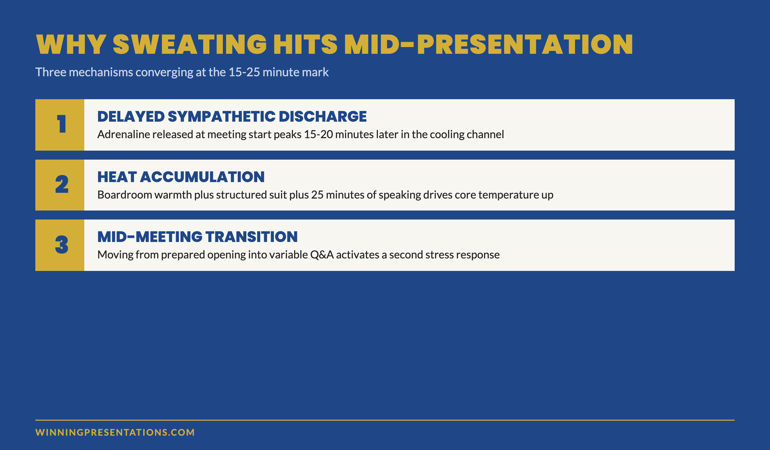
Three specific mechanisms drive this pattern.
The first is delayed sympathetic discharge. The body’s adrenaline release at the start of the meeting circulates for 15–20 minutes before peaking. The sweat response, which is downstream of the adrenaline peak, lags behind the felt sense of activation. By the time the sweat surge hits, you have stopped feeling acutely anxious — but the chemistry that triggers the cooling channel is at its highest point.
The second is heat accumulation under stage clothing. Senior presentation environments — board rooms, executive committee rooms, conference centres — are usually warmer than the body needs for the cognitive load of presenting. Combined with a structured suit jacket, a buttoned shirt, and the heat generated by 25 minutes of standing and speaking, the body’s core temperature drifts upward. The sweat response activates to bring it back down. The trigger is partly thermal, not purely psychological.
The third is the body’s specific mid-meeting transition. Around the 15–20 minute mark in most senior presentations, you move from the prepared opening into the more variable middle section — questions, discussion, the parts where the room interacts with the material. The transition itself is a stress moment for the body, even when consciously it does not feel like one. Some senior professionals’ bodies express this transition through the sweat channel rather than the heart-rate channel.
None of this is a deficit. All of it is the body responding to the actual situation — the chemistry, the heat, and the transition — accurately. The work is not to suppress the response. The work is to give the body the signal it uses to settle the cooling channel without disrupting the meeting.
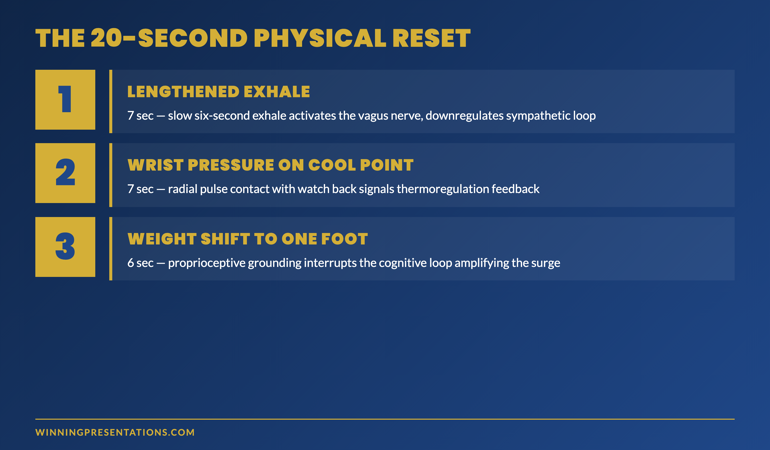
The 20-second physical reset — three components in sequence
The reset is built to be done while you are standing or seated at a meeting table, with no visible behaviour change. It works best when you start it as soon as you feel the first wave of warmth, before the surge has fully escalated. The three components are sequential — they build on each other and each takes about seven seconds.
Component 1 — Lengthened exhale (7 seconds)
Take a slow, deliberate exhale through the mouth, slightly longer than your inhale. The aim is not to take a deep breath in — the inhale stays normal. The aim is to extend the exhale to about six seconds, slightly pursed-lip if needed to slow the release. The lengthened exhale activates the vagus nerve, which sends a parasympathetic signal that begins to interrupt the sympathetic loop driving the sweat. Done while you are standing in front of slides or seated at a meeting table, the exhale is invisible — it looks like a slightly slower breath while you let an answer land.
The mechanism here is well-established physiology. The vagus nerve is the main parasympathetic conduit; lengthening the exhale activates the heart-rate variability response that downregulates sympathetic activation. This is not folk wisdom. It is the same mechanism that breath-focused interventions across medicine work through.
Component 2 — Wrist pressure on a cool point (7 seconds)
While the exhale is happening, press the underside of your right wrist gently against the cool surface of your watch back, the cool side of a glass of water, or the cool metal of a meeting table edge. Hold for about seven seconds. The pressure on the underside of the wrist activates a small thermoregulation feedback — the radial pulse runs close to the surface there, and the nervous system reads the cool input as a signal that core temperature is being addressed. The sweat response begins to ease back.
This component is the one that surprises senior professionals when they first try it. The pressure is small, the duration is short, and the effect is disproportionate. The reason is not the temperature itself — it is the combination of cool input and slow exhale, which the body integrates as a stronger settling signal than either alone.
Component 3 — Weight shift to one foot (6 seconds)
Shift your weight onto your left foot for about six seconds. If you are standing, this is invisible — your stance does not need to change. If you are seated, press your left foot firmly into the floor while letting the right foot stay relaxed. The weight shift produces a small proprioceptive signal that grounds the nervous system in the body. It is the somatic version of “come back to where you are standing right now,” and it interrupts the cognitive loop that is sometimes amplifying the physical surge.
The three components together take 20 seconds. The sweat does not stop instantly — the body needs another 60–90 seconds for the chemistry to settle — but the surge stops escalating, and most senior professionals report that within two minutes the sense of “this is going to keep getting worse” has resolved. That is usually enough to get through the next ten minutes of the meeting without a second wave.
For the in-the-room physical symptoms — without anyone noticing
Calm Under Pressure — rapid-response techniques for senior presenters
- Rapid-response techniques for the physical symptoms of presentation anxiety: shaking hands, racing heart, trembling voice, nausea, sweating
- Methods designed to be used in the room, in the moment, without anyone in the meeting noticing
- Built for senior professionals presenting to boards, executive committees, investment panels — not for first-time speakers
- Practical techniques you can deploy mid-meeting, with the physiology behind why each one works
Calm Under Pressure — £19.99, instant access, lifetime use.
The in-the-moment layer that complements deeper rebuild work.
What to do in the 30 minutes before the meeting
The reset works best when the body’s pre-meeting state is already relatively settled. The 30-minute window before walking into the room is where the prevention layer happens. Three components, each taking about ten minutes, calibrated for the senior leader who wants to reduce the chance the surge happens at all.
The first ten minutes is for the body. A slow walk — not in the meeting venue, ideally outside or in a quiet corridor — at an easy pace. Not pacing. Walking with deliberate slowness gives the body a different rhythm than the rapid one it has been carrying, and the slight cool of moving air begins to settle the thermoregulation baseline before the meeting heat hits it.
The second ten minutes is for the mind. Sit in a quiet space — a meeting room booked for the purpose, a chair in a less-trafficked corridor, the back row of the actual meeting room before others arrive. Do not look at slides. Do not check email. Read three printed pages of something cognitive but unrelated to the meeting — a newspaper article, a chapter of a book. The aim is to give the cognitive load a different focus before it locks onto the meeting material.
The third ten minutes is for the breath. The same lengthened-exhale pattern from the reset, done four times — six seconds in, eight seconds out, twelve cycles. This builds the parasympathetic baseline so the meeting starts with the vagus nerve already partly engaged. Calm Under Pressure walks through the full pre-meeting protocol with the physiology behind each step.
Wardrobe and visible-sweat reduction (the practical layer)
The physiological work is the substantive layer. The wardrobe layer is practical and reduces the visible consequence when a surge does happen. Senior professionals often skip this conversation because it feels too small. It is small — and it changes the experience of the meeting noticeably when a surge does occur.
The single highest-leverage wardrobe choice is fabric. Lightweight wool blends, technical merino, and the new generation of moisture-wicking dress shirts move sweat away from the skin and dry faster than cotton or polyester. A senior executive wardrobe can be re-engineered for sweat performance without losing any visual formality. Three shirts in technical fabric, in the rotation for high-stakes meeting days, removes the visible-stripe problem almost entirely.
The second is layering. A structured navy jacket worn over a technical shirt allows the jacket to absorb visible signs while the shirt manages the moisture. Keep the jacket on through the meeting, even if the room is warm — the absorption layer is doing more work than the slightly elevated temperature would otherwise indicate.
The third is the small detail of the back of the shirt. Most senior professionals worry about the chest. The visible problem is more often the back, particularly when standing in front of a screen with the audience seeing your back when you turn to reference a slide. Position yourself to face the audience as much as possible, reference slides by gesture rather than full body turn, and use a presenter remote so you can stay oriented towards the room.
When the sweat is one symptom of a deeper anxiety pattern
The reset addresses the symptom in the moment. When the sweating is part of a broader returning anxiety — particularly for senior leaders whose presentation confidence used to be settled — the deeper hypnotherapy work in Conquer Your Fear of Public Speaking shifts the baseline that produces the surge in the first place. £39, instant access.
Get Conquer Your Fear of Public Speaking →
Recorded clinical hypnotherapy sessions for senior presenters with returning anxiety.
Frequently asked questions
Will the reset work if the sweat has already been visible for several minutes?
Yes, with one caveat. The reset interrupts the sympathetic loop that is driving further escalation, so even when sweat is already visible, the surge stops getting worse and begins to ease. The visible damp area does not retreat — that takes 30–60 minutes of body-temperature normalisation — but the panic-amplification of “it’s getting worse” resolves, and most senior professionals report that the rest of the meeting becomes manageable. The earlier in the surge you start the reset, the more effective it is, but it works at any stage.
Can I use the reset while answering a question, or does it need a pause in the meeting?
It can be done while answering a question, with practice. The lengthened exhale takes seven seconds, which is the natural length of a deliberate pause between sentences in senior-level Q&A — the kind of pause that reads as considered rather than awkward. The wrist pressure happens silently with the hand resting on the table or holding a glass. The weight shift is invisible. With practice, senior presenters routinely deploy the reset during the discussion phase of a meeting without anyone reading it as anything other than a thoughtful pause.
Are antiperspirants enough on their own?
For mild surges in someone whose anxiety is otherwise well-controlled, yes. For senior professionals whose sweat response has become a reliable symptom of presentation anxiety, antiperspirants reduce the visible symptom but do not address the underlying activation. They are a useful bottom layer of the response, not the substantive intervention. Clinical-strength antiperspirants applied the night before a high-stakes meeting can meaningfully reduce visible sweating, particularly under the arms; for back and chest sweating, they are less effective and the physiological work matters more.
Should I see a doctor about the sweating?
If the sweating is specific to high-stakes presentations and absent in other contexts, it is presentation anxiety expressing through the cooling channel and a doctor is unlikely to add much. If the sweating is happening across many situations — in normal meetings, at rest, at night — it may be hyperhidrosis or another medical pattern, and a GP referral is sensible. The distinction between context-specific anxiety sweating and generalised sweating matters; the treatments are different.
How long does it take to see the reset working reliably?
Most senior professionals report it works on the first attempt — the sympathetic interruption is largely automatic once the components are deployed correctly. What takes practice is doing it without thinking about doing it, so the reset becomes a background tool rather than a conscious effort. By the third or fourth high-stakes meeting where you have used it, the reset becomes part of how you carry yourself in the room — automatic, invisible, and dependable when needed.
The Winning Edge — weekly newsletter for senior presenters
One framework, one micro-story, one slide pattern — every Thursday morning, ten minutes’ read. For senior professionals who want my best material before it appears anywhere else.
Not ready for the full programme? Start here: download the free Executive Presentation Checklist — a one-page reference for the structural questions every executive deck must answer before the meeting.
For more on why presentation anxiety often returns mid-career, see presentation anxiety at 50+ and what rebuilds confidence.
Mary Beth Hazeldine — Owner & Managing Director, Winning Presentations Ltd. After 24 years in corporate banking at JPMorgan Chase, PwC, Royal Bank of Scotland and Commerzbank, and five years recovering from her own presentation anxiety, she works with senior professionals across financial services, healthcare, and technology on the embodied side of high-stakes presenting.